



Abstract
In this study we focused on the spelling of high-functioning students with dyslexia. We made a detailed classification of the errors in a word and sentence dictation task made by 100 students with dyslexia and 100 matched control students. All participants were in the first year of their bachelor’s studies and had Dutch as mother tongue. Three main error categories were distinguished: phonological, orthographic, and grammatical errors (on the basis of morphology and language-specific spelling rules). The results indicated that higher-education students with dyslexia made on average twice as many spelling errors as the controls, with effect sizes of d ≥ 2. When the errors were classified as phonological, orthographic, or grammatical, we found a slight dominance of phonological errors in students with dyslexia. Sentence dictation did not provide more information than word dictation in the correct classification of students with and without dyslexia.
Each year the number of students with learning disabilities increases in colleges and universities. In Flanders, the Dutch-speaking northern half of Belgium, the number of students with dyslexia in higher education is estimated at 4,000, or 2% to 3% of the student population (Vlaamse Onderwijsraad, 2006). This is not necessarily the result of a growing number of individuals with dyslexia, but the development of better guidance protocols in primary and secondary education. Also, the establishment of various support services for students with disabilities in higher education has ensured a better participation of this group in postsecondary education. Research has shown almost unequivocally that people with dyslexia continue to have serious problems with reading, spelling, and phonological skills into adulthood (Callens, Tops, & Brysbaert, 2012; Hatcher, Snowling, & Griffiths, 2002; Swanson & Hsieh, 2009). However, it is our experience that in higher education accommodations are more easily granted for reading than for spelling problems, maybe because the latter have not yet been investigated as thoroughly (MacArthur, 2009). Effective support begins with sound knowledge of the difficulties students with dyslexia are facing (Gerber, 2009; Henneman, 1994).
In contrast to the many studies that have investigated the reading and phonological problems of individuals with dyslexia, relatively few have looked at the nature of the spelling errors in (young) adults with dyslexia (Cassar, Treiman, Moats, Pollo, & Kessler, 2005). Nevertheless, spelling problems are a common characteristic of dyslexia in languages with both regular and irregular orthographies (Angelelli, Notarnicola, Judica, Zoccolotti, & Luzzatti, 2010; Callens et al., 2012; Swanson & Hsieh, 2009) and can remain suboptimal throughout the life span (Farmer, Riddick, & Sterling, 2002; Maughan et al., 2009). Spelling problems are particularly relevant for students because poor writing skills not only have implications for functioning in day-to-day tasks (Gerber, 2009; Maughan et al., 2009) but also may affect the marks they get on written reports, which often form the basis of student assessments and evaluations (Whitehurst & Lonigan, 1998).
When children learn to spell, they learn that spoken words consist of individual sounds (phonemes), which can be represented by letters (Fischer, Shankweiler, & Liberman, 1985). Unfortunately, the mapping between sounds and letters is not always regular or predictable. This creates difficulties for all beginning spellers but is an additional burden for children with dyslexia whose poor phonological skills make the acquisition of inconsistent sound-to-letter mappings extra hard (Cassar et al., 2005).
Alphabetic languages differ in the degree of transparency of the mappings between sounds and letters. These differences can be seen as a continuum from languages with a deep orthography, such as English, to languages with a shallow orthography, such as Italian or Spanish (Ise & Schulte-Körne, 2010; Ziegler & Goswami, 2005). Several cross-linguistic studies have demonstrated that in languages with a transparent orthography, children acquire basic spelling skills faster than in languages with a deep orthography (Ise & Schulte-Körne, 2010; Wimmer & Landerl, 1997). The language difference in sound–letter transparency is likely to affect performance of individuals with dyslexia as well (Patel, Snowling, & de Jong, 2004).
Dutch Orthography
In this study, we investigated the spelling performance of young adults who have Dutch as native language. Despite the fact that Dutch is moderately transparent and, therefore, more transparent than English, it has a comparable mapping system between sounds and letters as English. In particular, both languages try to match letters to sounds as much as possible, but sometimes fail because of morphological considerations or because of the word’s etymology. Keuning and Verhoeven (2007) investigated spelling development in Dutch elementary school children. The authors argued that a child’s ability to spell is influenced by a variety of skills, such as phonological skills, orthographic knowledge, morphological awareness, and knowledge of spelling rules.
Dutch and English orthography can be broken down in a similar way (Fischer et al., 1985; Ise & Schulte-Körne, 2010). The basic principle is the mapping of spoken words to written representations by means of phoneme–grapheme correspondences. Ideally, the spelling of a word has a one-to-one correspondence to the phonemic structure of the word, as in the English word punch or the Dutch word vis (fish in English). Words with unambiguous spellings are more frequent in Dutch than in English because of the higher consistency between the phonemes and the graphemes.
Both in Dutch and in English the letter-to-sound mappings are complicated by a number of inconsistencies, making that the same phoneme can be represented by different graphemes (for inventories in English, see Spencer, 2009; Ziegler, Stone, & Jacobs, 1997). So, the phoneme /O/ in English can be written as o (zero), oa (toast), oe (toe), o-e (zone), ol (folk), ough (though), ow (yellow), au (chauffeur), or eau (bureau). In Dutch, it can be written as o (bomen [trees]), oo (boom [tree]), au (chauffeur), or eau (bureau). Many of these inconsistencies are not arbitrary. They follow a morphological pattern (Fischer et al., 1985) or a language-specific spelling rule that can be used to deal with the inconsistency (Bourassa, Treiman, & Kessler, 2006), or they can be understood on the basis of the language from which the word originated. For instance, with respect to the first principle, knowing in English that health shares a meaning unit (morpheme) with heal can help one remember that it should be spelled with ea. A similar phenomenon occurs in Dutch, where the end letter of the word wind (wind) is pronounced /t/ (i.e., it is devoiced) but written “d” because the voiced /d/ is audible in the plural form winden (winds). An example of a language-specific spelling rule is the fact that in English and Dutch adjectives related to countries must be written with a capital (a French cheese, een Franse kaas), whereas in French they must not (un fromage français). Another example of such a language-specific rule in Dutch is that long vowels must be written in duplicated form when the syllable ends on a consonant but not when the vowel is the end of the syllable. Therefore, one has to write boom (tree) because of the end m and bomen (trees) because the coda of the first syllable is empty (bo-men). Finally, some inconsistencies can be understood by knowing that the words were loaned from another language with its own spelling–sound correspondences. This is the case for words such as chauffeur and bureau (both in English and Dutch), which were taken from the French language.
Not all reasons for the spelling deviations are still known to language users today, however, making that many of them are arbitrary. This is particularly true for foreign borrowings that have become fully integrated in the language because there was no alternative (chauffeur still has a distinct feeling because there is an easier alternative, driver). Examples in English are words such as yacht, eunuch, slaughter, and rhododendron. Examples in Dutch are computer (computer) and papier (paper). The spelling also has an arbitrary feeling when the distinction made sense at some time in the past but is no longer clear in present days. This is the case, for instance, for the English word ghost, which received an extra h (as opposed to goat) because of the analogy with the Dutch word gheest. An example in Dutch is the spelling of the diphthong /ei/ (as in play). This can be written with ei as in geit (goat) or with ij as in wijd (wide) because at the time of the spelling introduction the distinction could be heard in some dialects. For words with unclear spelling deviations, the spellings must be memorized because the phonological principle cannot be followed and the spelling cannot be reconstructed on the basis of a rule.
Classification System for Spelling Errors
For the analysis of spelling errors, a variety of classification systems have been proposed. Some of them focus strongly on phonological aspects such as violations of the phoneme-to-grapheme correspondence rules, whereas others focus more on orthographic, morphological, or grammatical errors (for more information, see Protopapas, Fakou, Drakopoulou, Skaloumbakas, & Mouzaki, 2012). In line with previous spelling research (Moats, 1995; Saywer, Wade, & Kim, 1999; Vanderswalmen, Vrijders, & Desoete, 2010) we distinguished three broad categories, depending on whether the inaccurate spelling violates the pronunciation (i.e., is phonologically inaccurate), violates a morphological or language-specific spelling rule (i.e., is grammatically incorrect), or involves the choice of a wrong (arbitrary) grapheme to represent a phoneme (i.e., is phonologically and grammatically acceptable, but not orthographically correct).
Phonological errors are violations of the phonological principle so that the written word is pronounced differently than the intended target word (e.g., *gangstser for gangster). These errors were classified further into different subcategories in line with the classification of Protopapas et al. (2012), including insertions (e.g., *yorghurt instead of yoghurt), omissions (e.g., *delberate instead of deliberate), substitutions (e.g., *dalkness instead of darkness), and transpositions (*haelth instead of health).
Grammatical spelling errors are errors that do not lead to wrong pronunciations but that violate the language-specific grammatical rules and, critically, are taught explicitly (and extensively) in schools. In Dutch, these mainly involve the morphological consistency of singular and plural nouns (wind-winden), the spelling rules concerning (homophonic) verb forms, conventions about how to write short and long vowels in open and closed syllables (e.g., *boomen [trees] instead of bomen [trees]), conventions about the capitalization of words, and conventions on the formation of compound words (which in general must be written as a single word; so schooljaar [school year] instead of *school jaar). For more explanation of these language-specific errors, see the appendix.
Finally, orthographic errors are errors that preserve the phonology of the word but are orthographically incorrect. Critically, these errors are word specific and do not violate the language-wide grammatical spelling rules. They mainly involve loan words with deviant phoneme–grapheme correspondences and words with phonemes that can be spelled in different ways. The correct spelling of this type of words cannot be derived on the basis of the phonology or the grammar and, therefore, has to be memorized. Although grammatical errors could be considered as a special case of orthographic errors, we have chosen to deal with them separately, as has been done in previous research (Moats, 1995; Protopapas et al., 2012; Vanderswalmen et al., 2010).
In the present study, we investigated whether adults with dyslexia make similar proportions of phonological errors, orthographic errors, and grammatical errors as adults without spelling difficulties. We also wanted to compare spelling performance at the word and the sentence level. Some definitions consider dyslexia as a persistent problem in reading and writing at the word level (e.g., Stichting Dyslexie Nederland, 2008), whereas others do not specify the level at which the reading and/or spelling disorder is present (e.g., American Psychiatric Association, 1994; World Health Organization, 1991). This difference in definition has direct implications for the assessment. Previous research regarding the assessment of dyslexia in adults (Callens et al., 2012; Hatcher et al., 2002; Swanson & Hsieh, 2009) has suggested that tests at the word level are sufficient to correctly classify students with dyslexia. If dyslexia is indeed a problem at the word level, then spelling tests can be limited to the dictation of words. On the other hand, the correct spelling of sentences involves greater attention to the syntactic dependencies of the words, so that it is not impossible that both word and sentence dictation have diagnostic value. A sentence dictation test would then be complementary to a word dictation test, and both would contain valuable information for the assessment of spelling problems.
Spelling Performance in Students With Dyslexia
A review of the literature shows that little is known for sure about the spelling problems of adults with dyslexia. Indeed, most research on spelling difficulties concerns children with dyslexia who are in the early stages of spelling instruction (Bourassa et al., 2006; Cassar et al., 2005), and the little evidence that is available seems to be contradictory.
A first series of studies focused on phonological spelling errors (e.g., Angelelli et al., 2010; Campbell & Butterworth, 1985; Vellutino, Scanlon, & Chen, 1995). These were motivated by the phonological deficit hypothesis, which made authors hypothesize that individuals with dyslexia would make a disproportionally large number of phonological errors (errors in the sound-to-letter mappings, e.g., *appeciate for appreciate) because of their poor phonological skills. This, however, does not seem to be generally the case. Landerl and Wimmer (2000) analyzed the spelling errors of German children with dyslexia. They argued that phonological errors—although present in early stages of German spelling development—are transient and comparable with those of controls by the end of Grade 2. According to Landerl and Wimmer, in languages with a reasonably transparent orthography, such as German, older children with dyslexia in particular make orthographic spelling errors. Several other studies also failed to find a disproportionally large number of phonological errors in writers with dyslexia (Bourassa & Treiman, 2003; Nelson, 1980). Cassar et al. (2005), for instance, compared the spellings of English speaking children with dyslexia (mean age 11.7 years) with those of nondyslexic children in primary education (mean age 6.8 years) using a spelling-level matched design. The authors argued that children with dyslexia had difficulties with the same linguistic structures as typically developing (but younger) spellers. Even experienced teachers were unable to reliably distinguish writers with dyslexia from the typical beginners, based on the children’s spellings alone. According to Cassar et al. (2005), children with dyslexia have problems with phonological processing, leading to segmentation problems and problems with spelling, but older children with dyslexia have similar phonological processing skills as younger typical children and produce the same kinds of spelling errors. The authors concluded that phonology is more delayed than impaired in spelling.
In contrast, Caravolas and Volin (2001) argued in favor of a prevalence of phonological errors. They analyzed the phonological spelling accuracy in Czech (also a transparent orthography) primary school children with dyslexia. In this study, children with dyslexia continued to make more phonologically inaccurate spellings than their nondyslexic peers even in Grade 5. On the basis of this finding, Caravolas and Volin argued that the difficulties with phonological representation in spelling were not resolved after a few years of practice. McLoughlin, Leather, and Stringer (2002) even found some evidence for this argument in adult students with dyslexia. They reported that adult students with dyslexia continued to make more phonological errors such as omitting or adding letters in words or confusing sequences of letters (e.g., *headaigech for headache).
With respect to grammatical spelling errors, very much the same contradictory picture emerges. Most research here has focused on the extent to which adults with dyslexia use morphology to overcome their spelling difficulties. Carlisle (1987) used a spelling-level matched design to compare the spellings of fourth, sixth, and eighth graders without learning disabilities with those of ninth graders with dyslexia. The group of students with dyslexia was more likely than the control group to spell the stem of a word correctly but to spell the derived form incorrectly (e.g., magic for magic but *magichan for magician). Since the students with dyslexia made few phonological errors, Carlisle assumed that their misspellings were not attributed primarily to poor phonological encoding, but to an inefficient use of morphemic structures in spelling.
Along the same lines, Bourassa et al. (2006) found that both normally developing children (mean age 7.8 years) and children with dyslexia (mean age 11.5 years) used morphology in their spellings to some extent, but neither group used it as much as they could have given their knowledge of the stems. The authors concluded that older children with dyslexia have morphological awareness skills similar to those of younger normal children.
Other spelling researchers reported that individuals with dyslexia make a higher number of both phonological and morphological errors than their peers without spelling difficulties. Moats (1996), for instance, analyzed the spelling errors in a free-writing sample of young adults with persistent reading and spelling difficulties. The poorer spellers made proportionally more phonological and morphophonological errors than the controls. On the basis of this finding Moats concluded that although poor spellers might eventually learn to spell, their spellings stay marked by persistent phonological and morphophonological errors.
In contrast to the previous studies, Elbro and Arnbak (1996) found that children with dyslexia took more advantage of and benefitted more from the morphophonemic rules than children with no spelling difficulties. They investigated the use of morphophonemic rules in the spellings of Danish teenagers with dyslexia (mean age 15.3 years), who were compared to younger children without dyslexia (mean age 9.4 years). These contradictory findings may suggest an impact of the language tested and/or the educational practices on the pattern of spelling errors observed.
Finally, it has been claimed that individuals with dyslexia have particular difficulties with orthographic spellings. Meyler and Breznitz (2003) argued that exception words were particularly difficult for university students with dyslexia. Kemp, Parrila, and Kirby (2009) found that high-functioning students with dyslexia used simple phonological strategies relatively well but had difficulties with words that needed to be memorized. As a possible explanation for this weakness, Kemp et al. put forward the hypothesis that students with dyslexia—even if they are high functioning—lack reading experience or are less able to retain idiosyncratic orthographic representations. The difficulty of individuals with dyslexia to retain orthographic representations has been related by some researchers to weaker visual memory, especially for letters in sequence (Bell, McCallum, & Cox, 2003; Fischer et al., 1985; Tenney, 1980). Again, however, evidence is far from convergent. Fischer et al. (1985) investigated educated adults with dyslexia to see whether they differed from controls in their use of visual retention strategies. They observed that the students with dyslexia made more memory-related errors than the controls but that the magnitude of the difference was smaller than for rule-related errors.
Approach and Aims of the Present Study
In the present study we conducted a thorough analysis of the spelling skills of Dutch-speaking students with dyslexia in higher education according to the three spelling principles listed above by comparing the performance of 100 students with dyslexia to those of 100 controls matched on age, gender, field of study, and fluid IQ. In addition, we analyzed the spelling errors both at the word and sentence levels. We tried to find answers to the following questions: (a) How many more spelling errors do students with dyslexia make than students without dyslexia? (b) Do they make relatively more errors of a certain kind? and (c) Is there a difference between the word and the sentence level? If adults with dyslexia show a different pattern in their spellings than typically achieving peers, with notable weaknesses in one area and strengths in another, then this could offer new possible insights into the underlying causes of spelling deficits in dyslexia and the way these problems could be treated (Bourassa et al., 2006).
Obviously, students with dyslexia are expected to make more errors than students without dyslexia, as spelling impairment is part of the definition of dyslexia and this impairment is known to continue in adulthood (Schatschneider & Torgesen, 2004; Vellutino, Fletcher, Snowling, & Scanlon, 2004). What is more interesting, however, is to examine the extent of the problem and whether adults with dyslexia show a different error pattern than controls without specific spelling problems. Such an analysis may provide us with better insight into the spelling problems of students with dyslexia, which may result in better assessment and educational support.
Higher education students are interesting even more so because they provide an estimate of the ceiling level that can be attained by students with dyslexia. Chances are very low that differences between students with dyslexia and controls at this stage can still be explained by a developmental delay, as nearly all of our students with dyslexia had taken years of remedial teaching and put extra effort in their studies.
Method
Participants
This research is part of a longitudinal study about dyslexia in higher education in Flanders (Callens, Tops, & Brysbaert, 2012). A total of 100 first-year students with dyslexia were given a broad range of cognitive tasks, reading and spelling tests, and questionnaires about their study strategies and personality. All students studied at a profession-oriented college or a university in the surroundings of Ghent (one of the main cities of Flanders) and were referred to us by the office for students with disabilities (Cursief vzw).
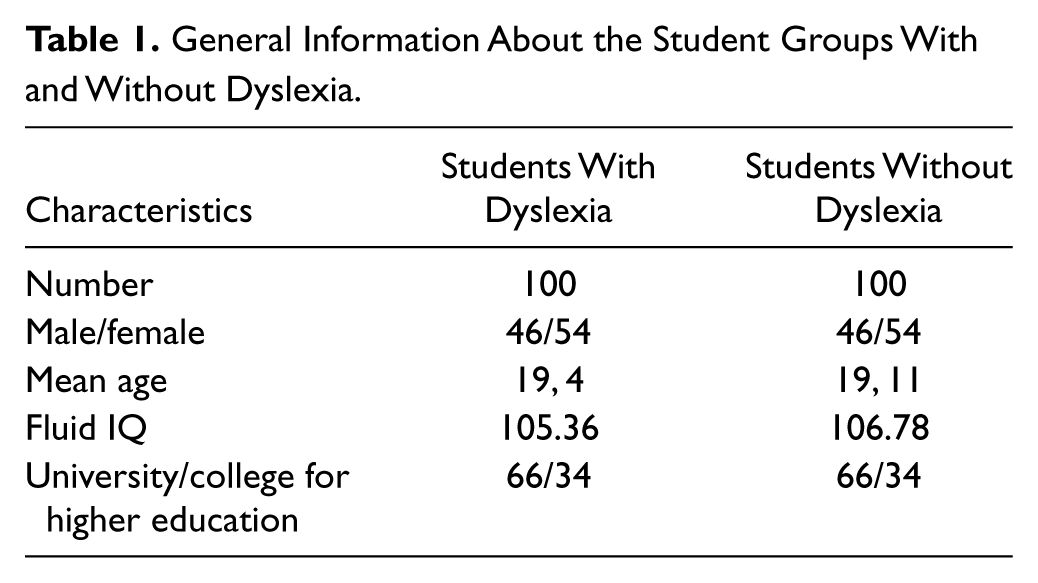
All students were tested by trained diagnosticians and were identified with dyslexia based on three criteria that are used by the Stichting Dyslexie Nederland (2008): (a) reading and/or spelling abilities significantly below age level (< Pc 10), (b) resistance to instruction despite effective teaching, and (c) impairment not explained by extraneous factors, such as sensory deficits. The diagnosis was confirmed in the tests we administered. The average age of this group was 19 years 4 months (18 years to 23 years 5 months). The average fluid IQ on the KAIT (Dekker, Dekker, & Mulder, 2004) was 105.4 (85–127).
In addition, 100 control students without a learning disability were recruited and matched on age, gender, and current field of study. The average age of the matched control group was 19 years 11 months (17 years 9 months to 21 years 6 months). The average fluid IQ was 106.8 (85–131). There were no significant differences between groups in age, t(198) = 0.91, p = .36, or fluid IQ, t(198) = −0.92, p = .36. In Table 1, a summary of the main characteristics of the sample group is presented. The 200 students spoke Dutch as their first language. All had normal or corrected vision. Every student was individually tested according to the official instructions.
General Information About the Student Groups With and Without Dyslexia.
Instruments
The Word Spelling dictation task used in the present study is part of the Test for Advanced Reading and Writing (De Pessemier & Andries, 2009). This is a test battery used to diagnose dyslexia in Dutch-speaking (young) adults. The Word Spelling subtest contains the dictation of 30 words of increasing difficulty. The word dictation was computer paced. Each participant was given a blue pen and instructed to put on headphones. Words were presented with a regular interval of 3 seconds, so that students had to produce an immediate response (as in taking notes during lectures). The results of this variable are beyond the scope of this article and are not further discussed. After the first hearing, the headphones were put aside and the participant was given a green pen. The student was allowed to use this to correct any mistakes. In addition, the words the student had missed were read out loud again by the test administrator, and the participant used the green pen to write them down. For each word the participants were asked how sure they were about their spelling (not sure, almost sure, or very sure). This last question was used as a measurement of metacognitive knowledge but is not taken into account in the present study.
About one third of the words of the Word Spelling subtest followed the regular Dutch phoneme-to-grapheme correspondence rules; one third of the words were irregular words in which a grammatical spelling rule was tested. The rest of the words were exception words involving word-specific inconsistent sound-to-letter mappings that need to be memorized.
The sentence dictation test (Ghesquière, 1998) was developed to provide a spelling test for adolescents, more specifically for Dutch students in the final years of secondary education and the first years of higher education. The dictation consists of 12 paragraphs of three coherent sentences each, containing several phonological, orthographical, and grammatical target words of low, medium, and high frequency. Concerning sentence dictation, it is not limited to the spelling of individual words but also assesses the use of the morphosyntactic rules and prevalent spelling rules at the sentence level (Vanderswalmen et al., 2010).
To guarantee a standardized administration for all participants, we administered the sentence dictation according to the instructions of the manual. Participants were given a standard form to write on. Each sentence was initially read in full by the test administrator. Then, parts of the sentence were read separately by the test administrator in a uniform way. The paragraphs of the text were indicated by a line between them. At the request of the student, sentences or parts of the sentences were repeated by the test administrator. No additional information was given about punctuation or capitals. Information about the validity and the reliability of the various tests can be found in Table 2.
Reliability and Validity Indexes for the Different Tests Used.
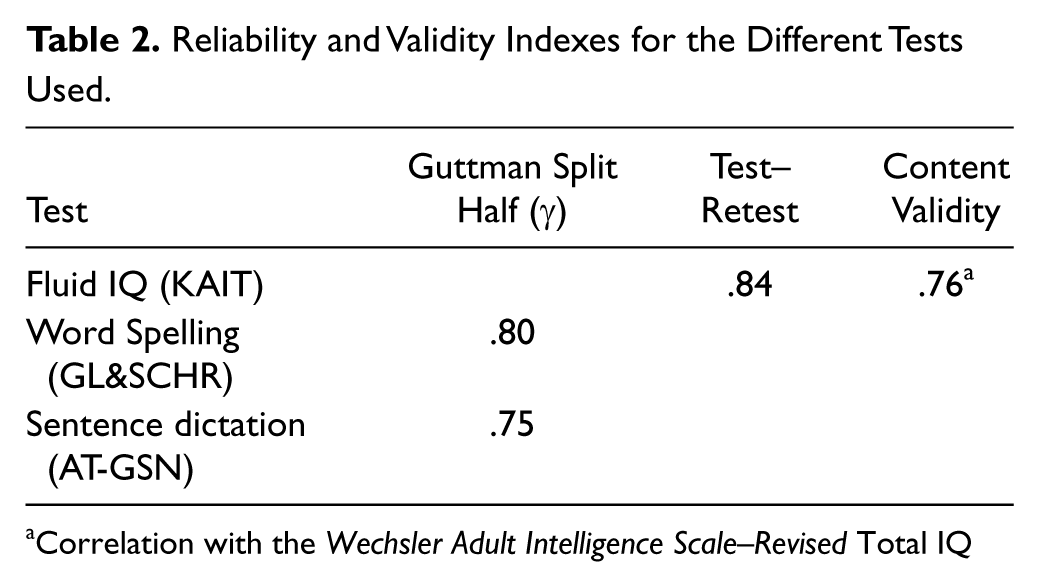
Correlation with the Wechsler Adult Intelligence Scale–Revised Total IQ
Procedure
The complete test protocol (which also contained other tests that are beyond the scope of the present study) was split into two counterbalanced parts that were administered during two different sessions. The test administrator and the participant were seated in front of each other in a silent and well-lit space. The word and sentence dictation tasks always took place in different sessions. The order of the tests in Parts 1 and 2 was determined in such a way that two similar tests were never administered in the same part. There was always a break halfway through each session. Students could ask for an extra pause if necessary. Half of the students started with the word dictation whereas the other half started with the sentence dictation, and each control student followed the same test sequence as the matched student with dyslexia. Order was of no influence on the results, neither for the students with dyslexia, t(98) = −0.19, p = .17, nor for the control students, t(98) = 0.58, p = .56.
The error classification we used was based on the end product (i.e., the type of error made) and not on the (erroneous) strategy used by the writer. Multiple spelling errors on the same word were taken into account. In that case, every error was counted and all errors were added up to a total score.
Results
First we examined to what extent the scores on the word and the sentence tests were comparable by correlating them. The correlation between the total number of errors in word dictation and sentence dictation was high (r = .84, N = 200, p < .0001), which suggests that both tests largely measured the same skills. It also indicates that the tests we used were reliable. Next, we looked at the absolute number of errors per category in the word and sentence dictation. The mean error rates and standard deviations are presented in Table 3. Overall, the students with dyslexia made about twice as many errors as the students without dyslexia, both in the word dictation (d = 2.19) and in the sentence dictation (d = 1.96). All effect sizes were large.
Mean Number of Errors in the Word and Sentence Dictation.
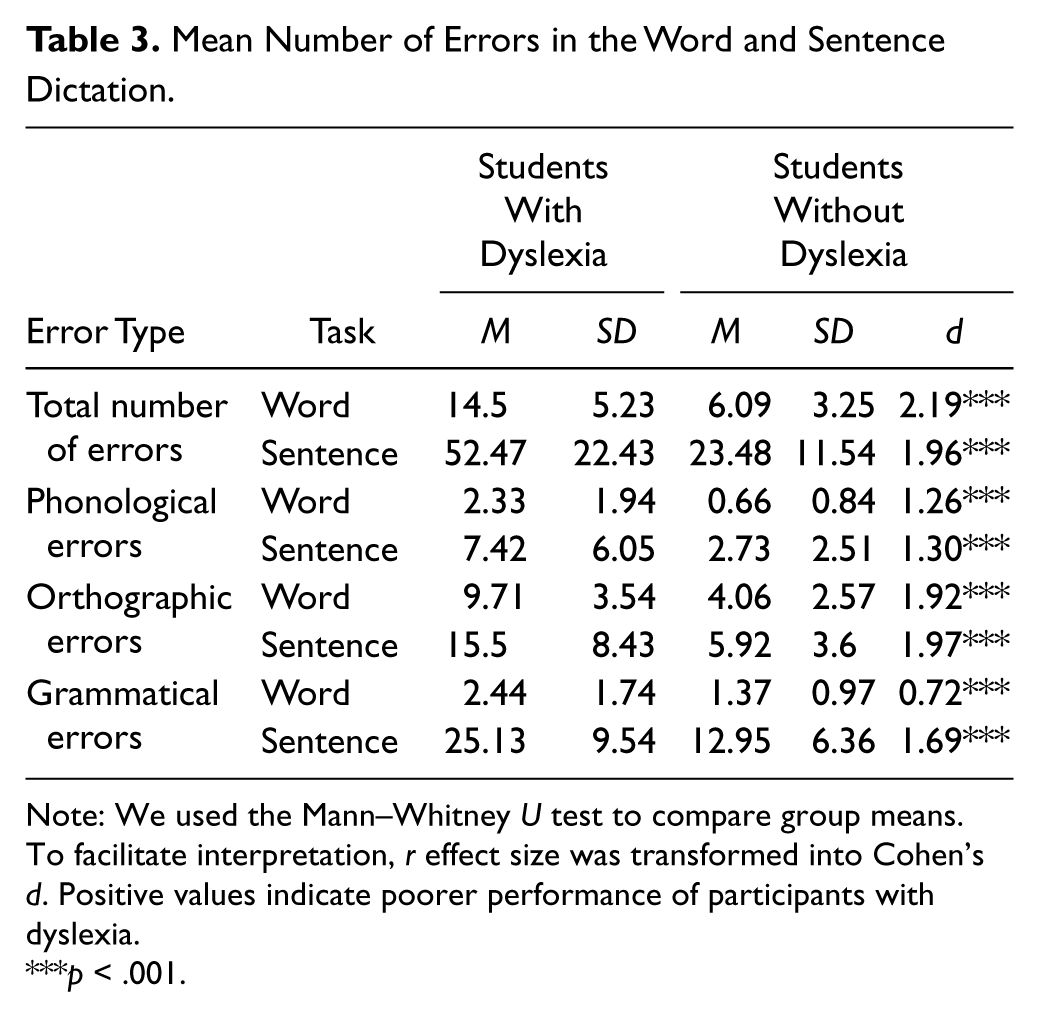
Note: We used the Mann–Whitney U test to compare group means. To facilitate interpretation, r effect size was transformed into Cohen’s d. Positive values indicate poorer performance of participants with dyslexia.
p < .001.
A look at Table 3 indicates that the worse performance of students with dyslexia was present for all three types of errors, with possibly some higher level of orthographic errors. To investigate this further, we looked at the proportions of errors (and their standard deviations) made for each type of word in the word and sentence dictation tasks to find out whether students with dyslexia made disproportionately more errors in one category than in the others. The analysis of these data should be treated with caution because the numbers in the different conditions are not fully independent (given that all proportions per participant add up to 1). Still, they give us a good picture of whether students with dyslexia have a different error profile than do the control students.
As can be seen in Table 4, there are no statistically significant differences between the proportions of errors of the students with dyslexia and those of the students without dyslexia. All effect sizes were small, except for the grammatical errors, where the effect size was medium and in favor of the students with dyslexia. Students with dyslexia made proportionally fewer grammatical errors than their normally achieving peers, in both word and sentence dictation. These were offset by higher proportions of phonological errors and—to a lesser extent—orthographic errors.
Mean Percentages (and standard deviations) of Different Error Types in Word and Sentence Dictation.
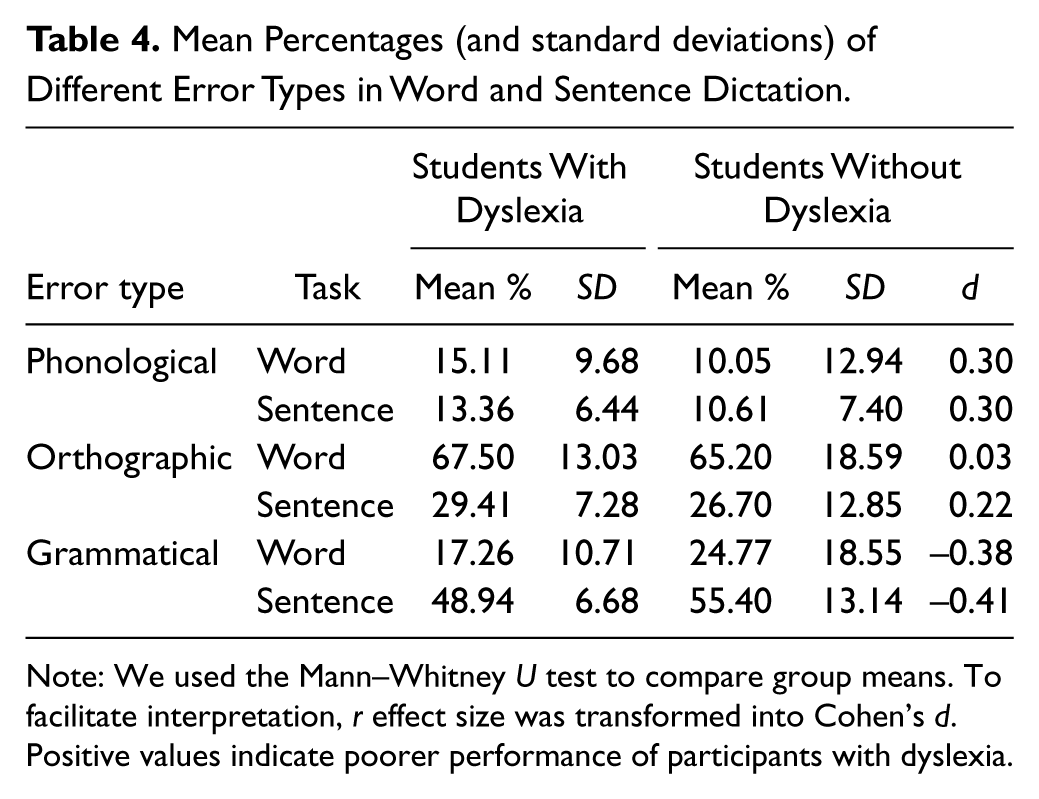
Note: We used the Mann–Whitney U test to compare group means. To facilitate interpretation, r effect size was transformed into Cohen’s d. Positive values indicate poorer performance of participants with dyslexia.
We ran a 2 (dyslexic vs. control) × 2 (word level vs. sentence level) × 3 (phonological vs. orthographic vs. grammatical errors) ANOVA on the error proportions. There was a main effect of error type, F(3, 582) = 930.89, p < .001, and a significant interaction between task and error type, F(3, 582) = 585.78, p < .001. In the word dictation test, orthographic errors were by far the most common type of error made by both groups; in the sentence dictation test, grammatical errors were the most common type. We also observed a significant interaction between error type and group, but this effect was much more modest than two previous effects, F(3, 582) = 13.34, p < .001. As indicated above, the participants with dyslexia made proportionally more phonological errors and orthographic errors than the controls, and fewer grammatical errors. None of the other effects or interactions approached significance (all ps > .17), indicating that the differences between the two groups were very similar for sentence dictation and for word dictation.
In Table 5, we present the different subtypes of the phonological errors, together with the effect sizes of the differences in proportions of errors. Even without statistics, it is clear that the pattern of mistakes was very similar in both groups: Nearly half of the errors were substitutions (representing a phoneme by a wrong grapheme), slightly fewer than one third were omissions, and the remainder were nearly all insertions of an extra grapheme. Grapheme transpositions were rare.
Number and Percentage of Phonological Errors in the Word and Sentence Dictation.
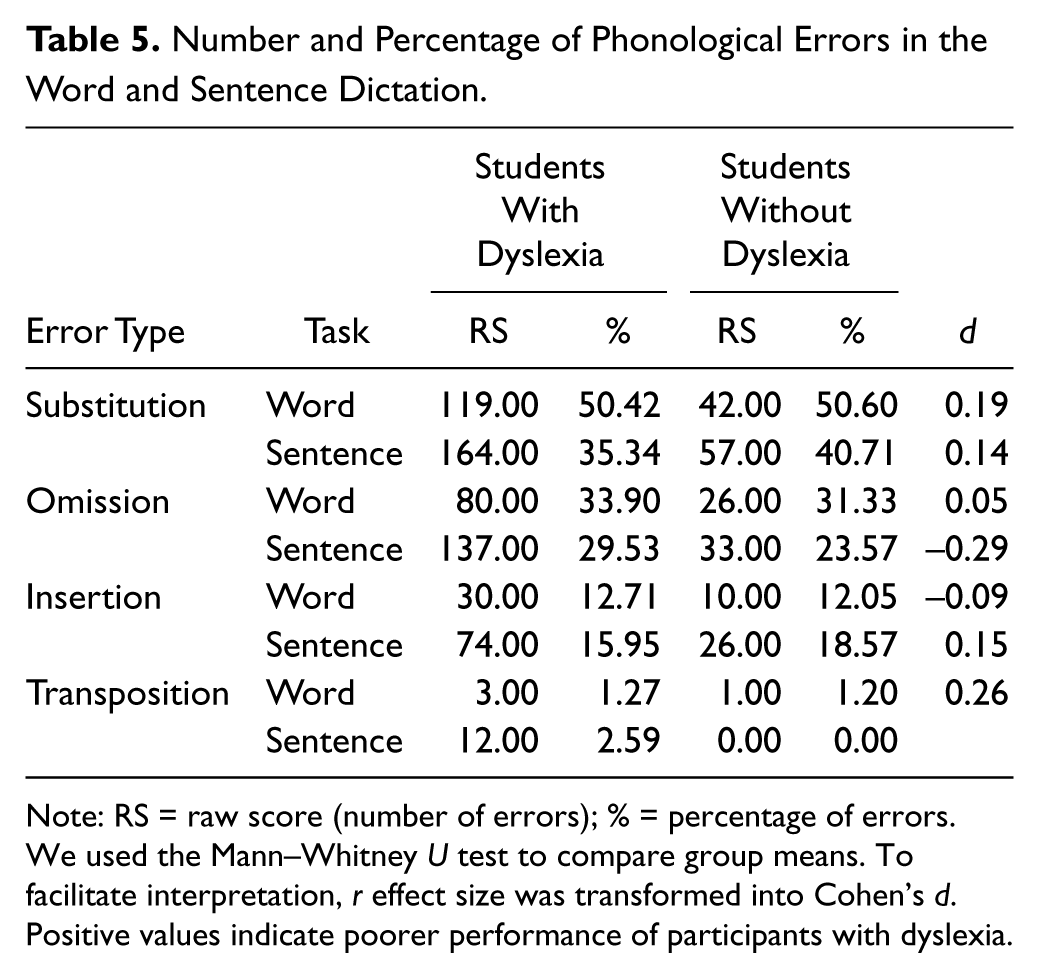
Note: RS = raw score (number of errors); % = percentage of errors. We used the Mann–Whitney U test to compare group means. To facilitate interpretation, r effect size was transformed into Cohen’s d. Positive values indicate poorer performance of participants with dyslexia.
To further examine the quality of the phonological spelling errors, we calculated the orthographic distance between the produced and the required spelling patterns. The orthographic distance was expressed as a ratio of the erroneous spelling (e.g., *hedace) relative to the source word (e.g., headache). The ratio value (e.g., 6/8 or 0.75) was converted into an absolute z score so that longer and shorter spelling errors did not offset each other (the distance between the error and the source word could go in either direction, representing more [e.g., *rowing for ruin] or fewer letters [*fy for fly] than needed). No differences in absolute orthographic distance were found between students with and without dyslexia, as shown in Table 6.
Absolute Orthographic Distance of the Phonological Errors: Target Source Ratio Expressed as z Values.
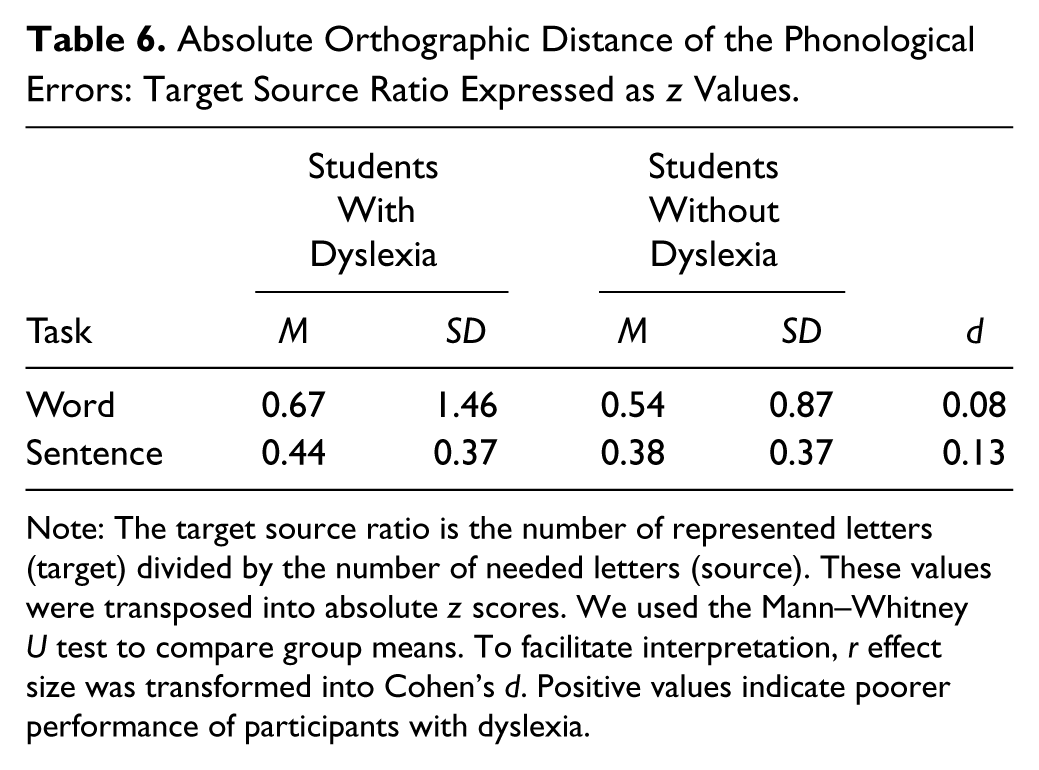
Note: The target source ratio is the number of represented letters (target) divided by the number of needed letters (source). These values were transposed into absolute z scores. We used the Mann–Whitney U test to compare group means. To facilitate interpretation, r effect size was transformed into Cohen’s d. Positive values indicate poorer performance of participants with dyslexia.
Finally, Table 7 shows the results of the various subcategories of grammatical errors (see the appendix for an explanation of the various subcategories). Because the errors per category were rather small in number, we analyzed only the raw data (numbers of errors). There were big effect sizes for pre- and suffix spelling errors (d = 0.86) and errors against punctuation marks and diacritics (e.g., ‘, ¨, - ; d = 0.91). Medium effect sizes were found for the spelling of analogous morphological patterns (d = 0.75), open and closed syllables (d = 0.50 and 0.60), and verb spellings (d = 0.43). A small effect size was found for capitalization errors in the advantage of the students with dyslexia (d = −0.28). Again, these results need to be interpreted with caution. These subcategories imply small numbers of occurrences per category, leading to large confidence intervals. Looking at the differences between word level and sentence level is not meaningful in this table because the subcategories were not equally distributed over both tasks.
Mean Number of Grammatical Errors in Word and Sentence Dictation.
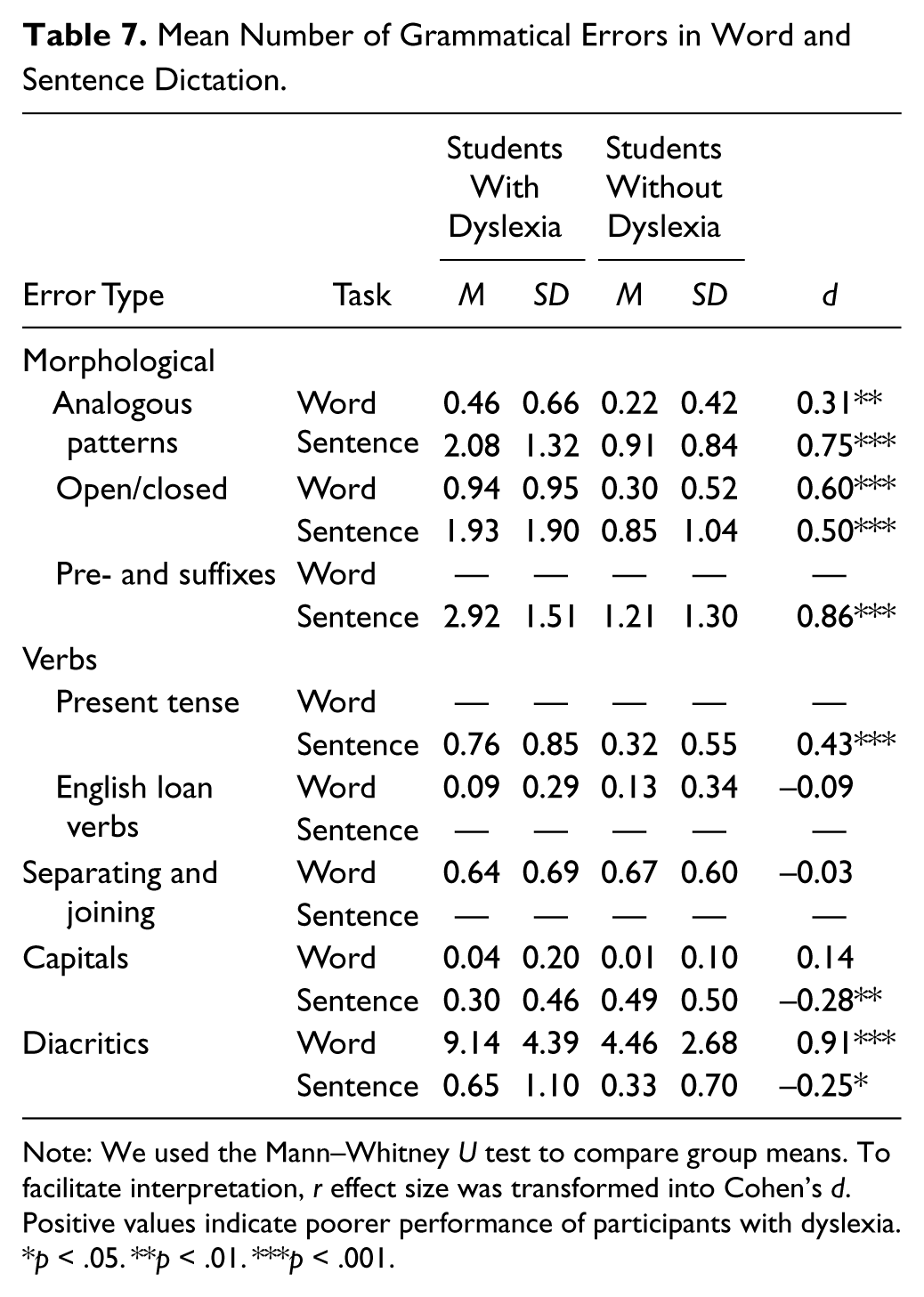
Note: We used the Mann–Whitney U test to compare group means. To facilitate interpretation, r effect size was transformed into Cohen’s d. Positive values indicate poorer performance of participants with dyslexia.
p < .05. **p < .01. ***p < .001.
Discussion
In this study, we compared the spelling performance of higher education students with dyslexia to that of students without learning disabilities in word dictation and sentence dictation tasks. We attempted to find answers to the following questions: (a) How many more spelling errors do students with dyslexia make relative to their nondyslexic peer students? (b) Is the pattern of spelling errors different for both groups? and (c) Is there a difference between the spelling errors made in the sentence dictation task and in the word dictation task? To have sufficient power, two groups of 100 participants were compared.
With respect to the first question, this study confirms that higher education students with dyslexia make substantially more spelling errors than their peers without dyslexia, at both the word and the sentence levels. This is in line with previous research showing that spelling problems persist for individuals with dyslexia, even for high-functioning adults (Callens et al., 2012; Ehri, 1992; Hatcher et al., 2002; Swanson & Hsieh, 2009; Vanderswalmen et al., 2010). More important than the statistical significance is the large effect size (d ≈ 2). Indeed, this effect size is larger than any other observed in the study (Callens et al., 2012). Spelling errors clearly are one of the main problems students with dyslexia in higher education experience. The higher number of errors was observed for all three types of spelling errors (Table 3). Given that students in higher education perform at a peak level, our findings suggest that the spelling errors are not simply the result of delayed development (Cassar et al., 2005). Despite years of efforts (and often remedial teaching), the end level of achievement remains lower for students with dyslexia than for other students.
The second question we addressed is to what extent the error patterns differ for both groups. As summarized in the introduction, little systematic empiric research has been done in this respect, with conflicting results. Our data go some way toward clarifying the situation. First, it is clear that no matter which error type researchers are investigating, they are bound to find a big difference between students with dyslexia and control students (Table 3). This easily leads to the impression that the type of error examined is particularly affected, when a study is limited to one type of error only. However, when the full picture is taken into account, the percentages of errors students with dyslexia and control students make look very much the same (Table 4): For both groups, orthographic errors predominate in word dictation, whereas grammatical errors are most common in sentence dictation, in line with the fact that correct sentence writing requires sufficient grammatical knowledge. Further subdivisions of the error categories failed to reveal substantial differences either (Tables 5–7).
If anything, students with dyslexia tended to make proportionally more phonological errors, as was previously argued by Caravolas and Volin (2001) and McLoughlin et al. (2002), and slightly fewer grammatical errors. The latter is in line with the findings of Elbro and Arnbak (1996), suggesting more similarity between Danish and Dutch than between these languages and English. At the same time, it should be kept in mind that students with dyslexia in absolute terms made almost twice as many grammatical errors as their normally achieving peers. So, the difference is one of a modulation of a pervasive spelling deficit rather than an island of spared performance. Students with dyslexia are able to profit from morphological regulations to slightly offset their worse overall performance. An explanation of this may be that many of the students with dyslexia have taken remedial schooling in reading and spelling. This schooling may have been more effective for the correct application of grammatical spelling rules than for the correct spelling of the memory-related words used in the dictation tasks. A closer look at the different subcategories revealed that students with dyslexia have particular difficulties with the application of spelling rules for punctuation marks and word diacritics and morphological analogy (e.g., health and heal).
In contrast to the findings of Meyler and Breznitz (2003) and Kemp et al. (2009), we found rather small relative differences for orthographic words between both groups (especially at the word level). As was hypothesized by Fischer et al. (1985), we found evidence that students with dyslexia make more orthographic errors than controls in absolute terms. However, in relative terms the percentages of orthographic errors were very similar in both groups. Some authors have associated orthographic spelling errors with an overall deficient visual memory because the spelling of these words needs to be memorized. This is contradicted by the finding that the students with dyslexia in our study slightly outperformed nondyslexic controls in a direct visual memory test (Callens et al., 2012). In their meta-analysis, Swanson and Hsieh (2009) also noticed that visual memory in adults with dyslexia is not impaired. Therefore, it seems unlikely that the difficulties with orthographic spellings can be explained by a general deficit in visual memory. Rather, the deficit seems to be spelling specific.
The fact that the error profiles were very similar for students with dyslexia and controls raises the question of what underlies the substantially higher across-the-board error rate in students with dyslexia. A potentially interesting theory in this respect was published by Szmalec, Loncke, Page, and Duyck (2011). They argued that adults with dyslexia have a particular problem not with the retention of individual items of information but with the retention of serial-order information. According to this view, spelling problems would be a result of the difficulty in keeping apart the various letter combinations that make up words. Against this view is our finding that letter transpositions errors were not relatively more common in students with dyslexia than in controls (Table 5).
The final research question we addressed was whether sentence dictation provides more information than word dictation in adults with dyslexia. Overall, this does not seem to be the case. The main difference between sentence dictation and word dictation is that sentence construction involves more syntactic rules, so that more errors can be made against these. However, this seems to be true to very much the same degree in the dyslexic and nondyslexic spellers. Similarly, word dictation relies more on spelling exceptions, which are prone to elicit memory-related or orthographic errors, but the pattern was again similar for students with and without dyslexia. So both word and sentence dictation have their strengths for a detailed spelling error analysis, but the differences were not exclusive to individuals with dyslexia. The fact that the sentence dictation task does not introduce new information also became clear when we tried to predict a student’s status (dyslexic or control) on the basis of all the tests we administered (Callens et al., 2012). Only three tests were needed, after which the model was saturated. Of these tests, word dictation was one, but not sentence dictation. Tables 3 and 4 demonstrate why. Because students with dyslexia have slightly less of a deficit in grammatical errors and because sentence dictation taps more into this spelling component, the difference between students with dyslexia and controls is less pronounced for sentence dictation (d = 1.96) than word dictation (d = 2.19). So for practical purposes sentence dictation does not add anything to word dictation. A more interesting alternative in this respect may be the précis writing assignment of Hatcher et al. (2002). In this task, the student first reads a text and is then asked to write a one-page summary. Such a free-writing sample may be a more informative assessment of word order, capitalization, and punctuation errors (see also Tops, Callens, Van Cauwenberghe, Adriaens, & Brysbaert, in press).
Our findings have practical implications for the support and assessment of students with dyslexia in higher education. Even high-performing, intelligent adults with dyslexia do not manage to reach a level of spelling proficiency that is unlikely to hurt them in written assessments. Specialized intervention programs focused on grammatical spellings have some effect, but not to such an extent that they offset the weakness students with dyslexia are confronted with. New technologies for literacy could have benefits for struggling writers (McNaughton, Hughes, & Clark, 1997; Stoddard & MacArthur, 1993) but at the same time confront them with potentially new burdens and at present do not seem to lead to major benefits (MacArthur, 2009). One way to improve them may be to work with error data sets such as the one presented here, so that more information will be available about which errors are associated with which words (and more appropriate alternatives can be suggested to the users).
Overall, we conclude that higher-education students with dyslexia make more spelling mistakes than their nondyslexic peers, on average twice as many. When the errors were classified as phonological, orthographic, or grammatical, we found very much the same pattern in both groups (with possibly a slight relative predominance of phonological errors at the expense of grammatical errors). Sentence dictation did not provide more information than word dictation.
Footnotes
Appendix
Acknowledgements
The authors thank Valérie Van Hees and Charlotte De Lange from Cursief vzw for their help in the study and the recruitment of participants. They also thank Joke Lauwers for her assistance in testing the participants, as well as Annemie Desoete and two anonymous reviewers for their helpful suggestions.
Declaration of Conflicting Interests
The author(s) declared no potential conflicts of interest with respect to the research, authorship, and/or publication of this article.
Funding
This study was made possible by an Odysseus Grant awarded by the Government of Flanders to MB.