




Abstract
The present study aimed to examine the nature of the working memory and general cognitive ability deficits experienced by university students with a specific reading comprehension deficit. A total of 32 university students with poor reading comprehension but average word-reading skills and 60 age-matched controls with no comprehension difficulties participated in the study. The participants were assessed on three verbal working memory tasks that varied in terms of their processing demands and on the Das–Naglieri Cognitive Assessment System, which was used to operationalize intelligence. The results indicated first that the differences between poor and skilled comprehenders on working memory were amplified as the processing demands of the tasks increased. In addition, although poor comprehenders as a group had average intelligence, they experienced significant difficulties in simultaneous and successive processing. Considering that working memory and general cognitive ability are highly correlated processes, these findings suggest that the observed differences between poor and skilled comprehenders are likely a result of a deficient information processing system.
Approximately three decades ago Gough and Tunmer (1986) proposed the “simple view of reading,” according to which reading comprehension is equal to the product of two separate components: decoding and linguistic comprehension. A skilled comprehender needs not only to decipher words from print, but also to comprehend the message the words convey. Despite the fact that these two skills correlate strongly with each other (e.g., Shankweiler et al., 1999), they are also separable (e.g., Kendeou, Savage, & van den Broek, 2009), and depend on partly different cognitive and linguistic skills (e.g., Oakhill & Cain, 2012; Oakhill, Cain, & Bryant, 2003). On the basis of the performance on these skills, researchers have classified readers into four groups: those with poor decoding and poor linguistic comprehension (generally poor readers), those with poor decoding and average linguistic comprehension (dyslexics), those with poor linguistic comprehension and average decoding (poor comprehenders), and those with no impairments in either component (normal readers; e.g., Catts, Hogan, & Fey, 2003; Elwér, Keenan, Olson, Byrne, & Samuelsson, 2013). The present study focuses on the group of poor comprehenders and examines how working memory and general cognitive ability may affect their reading comprehension when word reading is intact.
By definition, poor comprehenders read accurately, fluently, and at age-appropriate levels, but fail to understand much of what they read (Nation, 2005). Because of the nature of this reading difficulty, many children fall off the radar of parents and teachers and remain undiagnosed. Examining the cognitive profile of these individuals has important theoretical and practical implications. In terms of theory, researchers should be able to identify a number of cognitive processes that may contribute to reading comprehension, over and above those that have traditionally been linked to efficient word reading. In terms of the practical implications, the existence of a group of individuals with specific reading comprehension deficits (estimated to about 10% of the school-age population; see Hulme & Snowling, 2011) suggests that attention should be paid to the development and implementation of early identification and intervention programs.
Research on specific reading comprehension deficits started in the 1980s by Oakhill and her colleagues (Oakhill, 1984; Oakhill, Yuill, & Parkin, 1986; Yuill & Oakhill, 1988). Oakhill (1984), for example, found that poor comprehenders performed worse than normal readers on answering both literal and inferential questions after reading short stories. Their difficulty on inference generation persisted even when they were allowed to go back to the text and look for the answers. More recent studies have demonstrated that poor comprehenders also experience difficulties in comprehension monitoring (e.g., Ehrlich, Remond, & Tardieu, 1999), anaphoric processing (e.g., Ehrlich & Remond, 1997), narrative production (e.g., Cragg & Nation, 2006), and metacognitive knowledge (e.g., Cain, 1999). These text-level processing skills are related to comprehension because they enable the reader to make the necessary integrative and inferential links to construct a meaning-based representation of the text.
Poor comprehenders have also been found to perform worse than skilled comprehenders on higher-level processing skills such as working memory (e.g., Cain & Oakhill, 2006; Carretti, Borella, Cornoldi, & De Beni, 2009; De Beni, Palladino, Pazzaglia, & Cornoldi, 1998; Nation, Adams, Bowyer-Crane, & Snowling, 1999; Swanson & Berninger, 1995; Swanson, Howard, & Sáez, 2006; Yuill, Oakhill, & Parkin, 1989). Working memory, defined as the capacity to store and process information simultaneously (Baddeley, 2012), is related to reading comprehension because to understand a given text, an individual must be able to hold information in memory while carrying out other concurrent operations. In one of the most popular working memory tasks, the listening span task (Daneman & Carpenter, 1980), the participants are asked to remember several words (storage component) while simultaneously verifying the truthfulness of sentences (processing component). In light of this dual-task nature of the working memory tasks, an examination of the relationship between storage and processing is a promising approach to understand which component (storage, processing, or both) is responsible for the observed difficulties of poor comprehenders in working memory.
One way of testing the nature of the listening span task and its relationship with reading comprehension is to compare it to a similar task that has more processing demands, albeit similar storage requirements. In the context of this study, we employed the sentence questions task (see Georgiou, Das, & Hayward, 2008). In sentence questions, the participants are asked to answer questions about nonsensical but syntactically sound sentences, in which the content words have been replaced by color words (e.g., “The yellow greened the blue. Who greened the blue?”). After answering each question, the participants are instructed to keep the answer in their memory and then, after answering a set of questions, say the answers given to each question in the same order they gave them. Instead of answering “true” or “false” to each sentence (as in the listening span task), in sentence questions the whole sentence has to be remembered and recalled. Thus, although the storage demands in the two working memory tasks are comparable (store the last word/answer), the processing level in sentence questions is deeper. Arguably, if the processing component of working memory is the bottleneck in poor comprehension, then controlling for the effects of listening span should not eliminate completely the differences between poor and skilled comprehenders in sentence questions.
Closely connected to the issue of the component processes involved in listening span is the discussion surrounding the nature of digit span backward (e.g., St. Clair-Thompson, 2010). In digit span backward, participants are asked to recall series of digits in reverse order. Some researchers have argued that it is a measure of short-term memory (e.g., Colom, Abad, Rebello, & Shih, 2005; Engle, Tuholski, Laughlin, & Conway, 1999), some others that it is a measure of working memory (e.g., Gathercole, Pickering, Ambridge, & Wearing, 2004), and some others that it is a measure of working memory when assessed in children and of short-term memory when assessed in adults (e.g., St. Clair-Thompson, 2010). The task differs from other short-term memory tasks (i.e., digit span forward) because of the requirement to reverse the sequence of digits. However, it also differs from working memory tasks because all of the items to be remembered are presented successively, with no processing activity required in between the items. Thus, compared to listening span, digit span backward requires less processing.
Studies that have included both digit span backward and listening span have shown that poor comprehenders (particularly older ones) perform significantly worse than skilled comprehenders only on listening span (e.g., Cain & Oakhill, 2006; De Beni & Palladino, 2000; Stothard & Hulme, 1992). These findings suggest that tasks with reduced processing demands do not pose significant difficulties for poor comprehenders. If Waters and Caplan’s (1996) argument that the listening span task assesses mostly storage is correct, then controlling for the effects of digit span backward (a task that assesses mostly storage) should eliminate any group differences on listening span. In contrast, group differences should persist in the case of sentence questions that requires a deeper level of processing.
Another higher-level processing skill that has not been examined in depth in the studies with poor comprehenders is that of general cognitive ability. The focus of the existing studies has been on possible differences between poor and skilled comprehenders on verbal and nonverbal ability (e.g., Cain & Oakhill, 2006; Nation, Clarke, & Snowling, 2002), with the findings being rather mixed. On one hand, Nation et al. (2002) reported significant differences between the two groups of comprehenders on both verbal and nonverbal ability. On the other hand, Cain and Oakhill (2006) reported a marginally significant difference between the groups on verbal ability and no significant differences on nonverbal ability.
In the present study, we deviated from the traditional way of assessing general cognitive ability by using the Das–Naglieri Cognitive Assessment System (D-N CAS; Naglieri & Das, 1997). We chose this battery for a number of reasons. First, D-N CAS is based on four separable but interdependent cognitive processes, namely planning, attention, simultaneous, and successive (PASS) processing (Das, Naglieri, & Kirby, 1994). A composite of these processes gives us a full-scale IQ score that correlates with academic achievement more strongly than the traditional IQ tests (Naglieri, Goldstein, De Lauder, & Schwebech, 2006). Second, several studies with unselected samples of school children have shown that the PASS processes are related to reading comprehension (e.g., Georgiou & Das, in press; Kirby & Das, 1977; Kendeou, Papadopoulos, & Spanoudis, 2012, in press; Leong, Cheng, & Das, 1985; Naglieri & Rojahn, 2004). Finally, there are interesting theoretical links between each of the PASS processes and reading comprehension (see below) that we would like to examine further.
PASS theory is rooted in Luria’s (1966, 1973) work and proposes that cognition is organized in three systems and four cognitive processes (e.g., Das et al., 1994). The first system is planning, which involves executive functions responsible for controlling and organizing behavior, selecting and constructing strategies, and monitoring performance. The ability to plan and organize information has been found to predict reading comprehension (e.g., Das, Kar, & Parrila, 1996; Sesma, Mahone, Levine, Eason, & Cutting, 2009). Poor comprehenders have also been found to perform worse than skilled comprehenders on measures that require planning (e.g., Locascio, Mahone, Eason, & Cutting, 2010; Reiter, Tucha, & Lange, 2005).
The second system is attention, which is responsible for maintaining arousal levels and ensuring focus on relevant stimuli. Individuals with attention deficits often have difficulties in reading comprehension (e.g., McInnes, Humphries, Hogg-Johnson, & Tannock, 2003; Miller et al., 2012; Samuelsson, Lundberg, & Herkner, 2004). An explanation could be that individuals with attention deficits are more easily distracted by details when reading long texts, and consequently fail to focus on main ideas. However, it is also possible that they fail to inhibit alternative meanings of words, which interferes with their ability to form a coherent representation of a text (Gernsbacher, Varner, & Faust, 1990). This explanation is supported by the finding of several studies that poor comprehenders make more intrusion errors in memory tasks (e.g., Borella, Carretti, & Pelegrina, 2010; De Beni & Palladino, 2000; Pimperton & Nation, 2010). Specifically, information that was initially relevant but then became irrelevant was difficult for poor comprehenders to suppress. Thus, weaknesses in inhibition may lead to difficulties in working memory, which, in turn, may lead to difficulties in reading comprehension.
The third system is an information processing system—it employs simultaneous and successive processing to encode, transform, and retain information. Simultaneous processing is engaged when the relationship between items and their integration into whole units of information is required, as in the analysis and synthesis of logical-grammatical relationships in a story or in inference generation. The essential nature of this sort of processing is that any portion of the result is at once surveyable without dependence on its position in the whole. In turn, successive processing is required for organizing separate items in a sequence as, for example, in remembering a sequence of events in a story exactly in the order in which they were presented.
The Present Study
The objective of the present study was twofold: (a) to examine the nature of working memory deficits experienced by university students with a specific reading comprehension deficit and (b) to examine if poor comprehenders experience deficits in general cognitive ability (operationalized with PASS processes). To our knowledge, with the exception of a single-case study (Perfetti, Marron, & Foltz, 1996), no other studies have examined the cognitive profile of adults with a specific reading comprehension deficit. This is a unique group of students who were able to secure admission to a university despite their poor comprehension. The few studies that included adult poor comprehenders did not assess their reading accuracy or fluency (De Beni et al., 1998; Palladino, Cornoldi, De Beni, & Pazzaglia, 2001), and as a result we do not know if their sample consisted of individuals with a specific reading comprehension deficit or generally poor readers.
Method
Participants
A total of 92 students attending a large university in western Canada participated in the study. To select the poor comprehenders and their age-matched controls, we first administered a measure of reading comprehension (Nelson–Denny Reading Test; see below for details) and two measures of reading fluency (word reading efficiency and phonemic decoding efficiency) to 451 undergraduate students. The students were all participating in the subject pool program in the Department of Educational Psychology and received credit toward one of their courses for their participation. We used reading fluency instead of reading accuracy measures because previous studies with university students have reported ceiling effects on reading accuracy even among poor readers (e.g., Deacon, Parrila, & Kirby, 2006; Parrila, Georgiou, & Corkett, 2007). Thirty-two students (20 females, 12 males; age M = 23.02 years, SD = 3.02) performing at least 1 standard deviation below their grade level on reading comprehension and reading fluency were invited to participate in the second phase of the study. These students composed the poor comprehenders group. Another 60 students (41 females, 19 males; age M = 22.04 years, SD = 2.67) with age-appropriate reading comprehension and reading fluency were randomly selected from the larger group of students to compose the control group. All participants were first-year education students, reported English as their native language, were registered full-time in their program of studies, and did not experience any sensory or behavioral problems. When asked by the researchers, only eight of the poor comprehenders reported experiencing reading comprehension problems and only four of them were receiving support from the Specialized Support and Disabilities Services of the university. None of the participants in the control group reported experiencing any reading comprehension difficulties. For their participation in the second phase of the study, the students received a $20 honorarium. Independent sample t tests confirmed that the two groups differed significantly on reading comprehension, but not on reading fluency (see Table 1).
Descriptive Statistics for the Screening Measures Used in the Study for Each Group Separately.
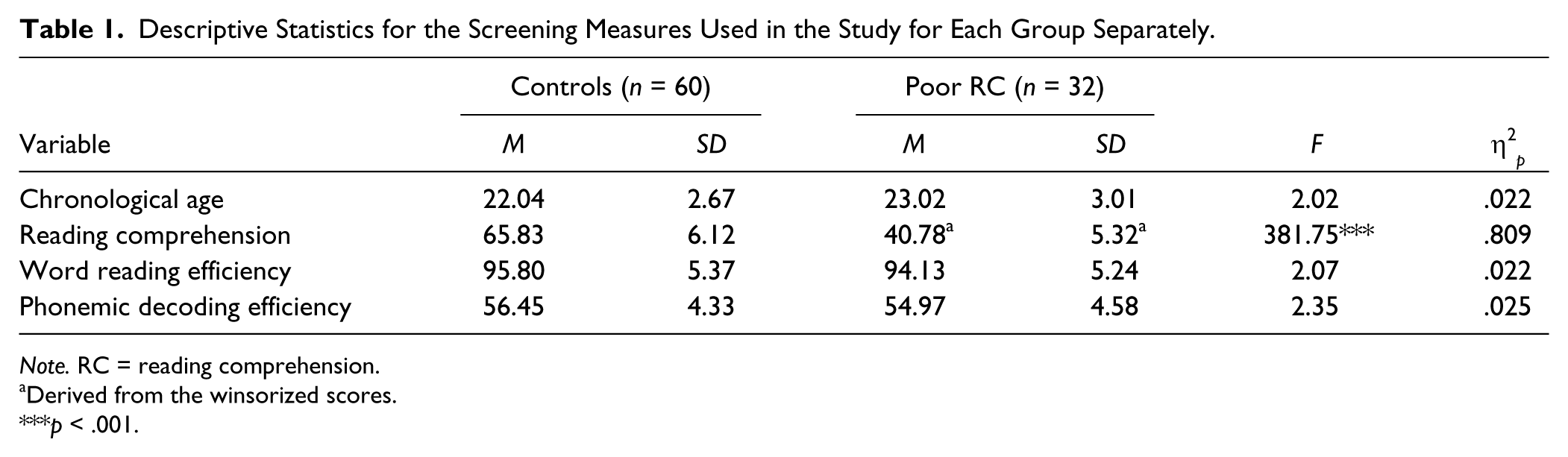
Note. RC = reading comprehension.
Derived from the winsorized scores.
p < .001.
Measures
Working memory
Listening span task
This task was adapted from Daneman and Carpenter (1980). The participants were asked to listen to a group of sentences and then determine if each sentence was true or false (e.g., “Money grows on trees”; see Georgiou et al., 2008, for the list of items). The participants were instructed to keep the last word in each sentence in their memory and then, after completing a group of sentences, say the last word in each sentence in the same order they heard the words. The sentences ranged in length from four to nine words and were presented in groups that ranged in size from two to five sentences. The participant’s score was the total number of correctly recalled words (max = 38). Cronbach’s alpha reliability coefficient in our sample was .82.
Sentence questions
This task was adapted from the D-N CAS (Naglieri & Das, 1997). The participants were asked to answer questions about nonsensical sentences in which the content words were replaced by color words (e.g., “The yellow greened the blue. Who greened the blue?”; see Georgiou et al., 2008, for the list of items). After answering each question, the participants were instructed to keep the answer in their memory, and then after answering a set of questions they were asked to say the answers given to each question in the same order they gave them. The sentences were presented in groups that ranged in size from two to five. The participant’s score was the total number of correctly recalled answers (max = 38). Cronbach’s alpha reliability coefficient in our sample was .85.
Digit span backward
This task was adopted from the third edition of the Wechsler Intelligence Scale for Children (Wechsler, 1992) and required participants to repeat a sequence of digits backward. The strings of digits were presented orally by the experimenter with a time interval of about 1 second between each digit. The strings started with only two digits, and one digit was added at each difficulty level (the maximum length was seven digits). The task was terminated when the participants failed both trials of a given length. The participant’s score was the number of digit strings accurately recalled. Cronbach’s alpha reliability coefficient in our sample was .70.
PASS cognitive processes
The PASS cognitive processes were assessed with the D-N CAS (Naglieri & Das, 1997), and the scoring of the subtests was performed according to the test manual. For the purpose of this study we administered the basic D-N CAS battery, which includes two measures for each subscale.
Planning was assessed with two measures: Matching Numbers and Planned Codes. In Matching Numbers, the participants were presented with four pages containing eight rows of numbers that were increasing in size. For each row, the participants were instructed to underline the two numbers that were the same. The time and number correct for each page was recorded. Cronbach’s alpha reliability coefficient in our sample was .85. The Planned Codes subtest required participants to fill in as quickly as possible, and in any manner they chose, empty boxes with a combination of Os and Xs that corresponded to a letter that was printed on top of each empty box (A = OX; B = XX; C = OO; D = XO). The task contained two pages, each with a distinct set of codes arranged in seven rows and eight columns. The participants were allowed 1 min to fill in as many empty boxes as possible. The time (in case someone finished before the time limit) and number correct for each page were recorded. Cronbach’s alpha reliability coefficient in our sample was .80.
Attention was assessed with two measures: Expressive Attention and Number Detection. In Expressive Attention, all participants were given three pages of stimuli to name. In the first page, the subjects read color words (i.e., blue, yellow, green, and red) that were semirandomly arranged in eight rows of five. In the second page, the subjects were instructed to name the colors of a series of rectangles printed in the aforementioned colors. In the third page, the color words were printed in a different ink color than the color of the word’s name (e.g., the word RED printed in blue ink). The participants were asked to name the color of the ink without saying the color word. The participant’s score was calculated using the time and the number of correct responses on the third page only. Cronbach’s alpha reliability coefficient in our sample was .84. The Number Detection subtest required participants to find and underline target stimuli (e.g., the numbers 1, 2, and 3 printed in Arial font, and numbers 4, 5, and 6 printed in Castellar font) among distracters (e.g., the same numbers printed in the “wrong” font). The participants were allowed 3 min to complete the task. The time (in case someone finished before the time limit) and number correct were recorded. Cronbach’s alpha reliability coefficient in our sample was .84.
Simultaneous processing was assessed with two measures: Nonverbal Matrices and Verbal Spatial Relations. In Nonverbal Matrices, the participants were presented with a pattern of shapes/geometric designs that was missing a piece and were asked to choose among six alternatives the piece that would accurately complete the pattern. A discontinuation rule of four consecutive mistakes was applied. The participant’s score was the total number correct. Cronbach’s alpha reliability coefficient in our sample was .92. In Verbal Spatial Relations, the participants were presented with six drawings, arranged in a specific spatial manner, and a printed question. Then, they were instructed to choose one of the six drawings that best answered the question within a 30-s time limit (e.g., “Which picture shows a triangle to the left of a square?”). A discontinuation rule of four consecutive mistakes was applied. The participant’s score was the total number correct. Cronbach’s alpha reliability coefficient in our sample was .90.
Finally, successive processing was assessed with Word Series and Sentence Repetition. In Word Series, the examiner read a series of words, varying in length from four to nine words, and then asked the participant to repeat the words in the same order. This task uses the following nine single-syllable, high-frequency words: book, car, cow, dog, girl, key, man, shoe, and wall. A discontinuation rule of four consecutive mistakes was applied. The participant’s score was the total number of word series correctly repeated. Cronbach’s alpha reliability coefficient in our sample was .90. In Sentence Repetition, the participants were read 20 sentences aloud and were asked to repeat each sentence exactly as presented. The sentences were made of color words (e.g., “The blue yellows the green”) and increased in length (from 4 to 19 words). A discontinuation rule of four consecutive mistakes was applied. The participant’s score was the total number of sentences repeated correctly. Cronbach’s alpha reliability coefficient in our sample was .89.
Reading fluency
Reading fluency was assessed with two measures: word reading efficiency and phonemic decoding efficiency. Both tasks were adopted from the Test of Word Reading Efficiency (Torgesen, Wagner, & Rashotte, 1999). In the word reading efficiency task, the participants were asked to read as fast as possible a list of 104 words, divided into four columns of 26 words each. In the phonemic decoding efficiency task, the participants were asked to read as fast as possible a list of 63 nonwords. A short, eight-word/nonword practice list was presented before each subtest. In each task, the participant’s score was the number of correct words/nonwords read within a 45-s time limit. Torgesen et al. (1999) reported alternate-form reliability for word reading efficiency to be .89 and for phonemic decoding efficiency to be .94 for ages 18 to 24. The correlation between word reading efficiency and phonemic decoding efficiency in our sample was .72.
Reading comprehension
Form G from the Nelson–Denny Reading Test (Brown, Fishco, & Hanna, 1993) was used to assess reading comprehension. The test contained seven passages and a total of 38 multiple-choice questions, each with five answer choices. The participants were asked to read each passage and then answer the multiple-choice questions. The time limit for the test was 20 min. A participant’s score was the number of correct answers multiplied by 2 (max = 76). Cronbach’s alpha reliability coefficient in our sample was .92.
Procedures
All tests were individually administered by the first author and a graduate student with experience in psychoeducational assessment. Testing took place in a quiet room at the university and lasted approximately 30 min for the screening phase and 1 hr for the follow-up session. In the screening face, the students were first assessed on reading comprehension and then on the two reading fluency tasks. In the follow-up session, the students were first assessed on the working memory tasks and then on CAS.
Scoring of the CAS measures
The scoring of the CAS measures was completed according to the manual (Naglieri & Das, 1997). Because there are no norms for adults, we used the norms for the 18-year-olds to calculate the scaled and standard scores for our sample. More specifically, the raw scores on each one of the eight CAS subtests were first converted to scaled scores (these are the values reported in Table 2 for each subtest). Next, the scaled scores of the two tasks that composed a subscale were added together and the sum was converted to a standard score for that subscale (this is the score reported for each subscale in Table 2).
Descriptive Statistics for All the Variables in the Study for Each Group Separately.

Note. RC = Reading Comprehension; CAS = Cognitive Assessment System.
p < .05 **p < .01 ***p < .001.
Results
Table 2 shows the descriptive statistics for the rest of the measures used in the study for each group separately. Before conducting any group comparisons we examined the distributional properties of the variables in each group. The distribution of the variables in the control group was normal. In contrast, the distribution of reading comprehension in the poor comprehenders’ group was skewed due to the presence of two outliers at the low end of the distribution. To normalize the distribution of this variable, we replaced the outliers’ scores with that of the next nonoutlier’s score plus one (Tabachnick & Fidell, 2001). This resulted in a normal distribution, and the winsorized data were used in further analyses.
Group Comparisons on Working Memory
One-way MANOVA with group (2) as a fixed factor and listening span, sentence questions, and digit span backward as the dependent variables showed a significant main effect of group, Wilks’ λ = .884, F(3, 88) = 3.86, p = .012. Follow-up ANOVAs indicated that the two groups differed on listening span, F(1, 90) = 4.21, p = .040, and sentence questions, F(1, 90) = 11.07, p = .001, but not on digit span backward, F(1, 90) = 3.36, p = .069.
We then performed a MANCOVA using digit span backward as a covariate. This was done to examine the hypothesis that if listening span assesses mostly storage, then controlling for the effects of digit span backward (a task that assesses mostly storage) should eliminate the group differences on listening span. However, group differences should persist in the case of sentence questions because it requires a deeper level of processing. The results revealed a main effect of group, Wilks’ λ = .917, F(2, 88) = 3.98, p = .022. The subsequent ANCOVAs indicated that the two groups differed on sentence questions, F(1, 89) = 7.62, p = .007, but not on listening span, F(1, 89) = 2.45, p = .121. Finally, a one-way ANCOVA with group as a fixed factor, listening span as a covariate, and sentence questions as a dependent variable revealed a significant effect of group, F(1, 89) = 7.02, p = .010, the controls performing better than poor comprehenders.
Group Comparisons on PASS Cognitive Processes
Next, four MANOVAs (one for each of the PASS subscales) were conducted to examine what processing skills differentiated between the two groups. The results showed a significant effect of group in simultaneous processing, Wilks’ λ = .782, F(2, 89) = 12.41, p = .001, and successive processing, Wilks’ λ = .866, F(2, 89) = 6.86, p = .010. Follow-up ANOVAs indicated that the two groups differed on both measures of each subscale, with the controls performing better than the poor comprehenders.
The Cognitive Profile of Poor Comprehenders
Because group comparisons may not tell the whole story if a group is heterogeneous, we further created a performance profile for each poor comprehender. The top half of Table 3 summarizes the number of poor comprehenders exhibiting deficits in working memory and the bottom half of Table 3 summarizes the number of individuals with deficits in PASS processes. We defined a deficit as a score on the cognitive processes of at least 1.5 SDs below the mean score of a participant’s respective age group, in this case the control group’s mean performance.
Number of Poor Comprehenders Exhibiting Deficits in Working Memory and in Planning, Attention, Simultaneous, and Successive (PASS) Processes.
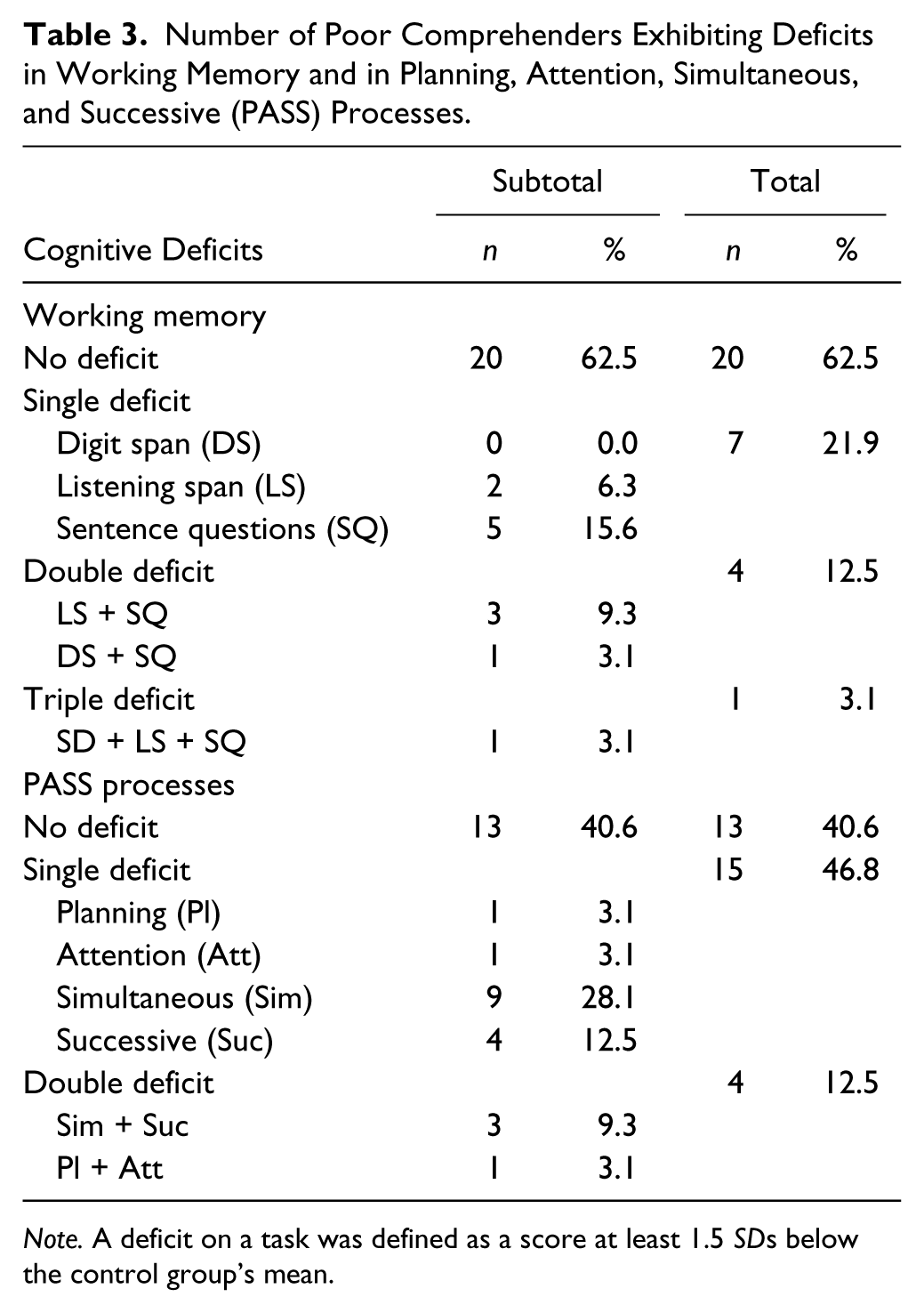
Note. A deficit on a task was defined as a score at least 1.5 SDs below the control group’s mean.
The results of the profile analysis indicated first that 37.5% of poor comprehenders had a deficit in at least one working memory task. Ten individuals had a deficit in sentence questions (alone or in combination with another task). In contrast, only two individuals had a deficit in digit span backward, and it was accompanied by a deficit in the other two working memory tasks. Second, 59.3% of poor comprehenders had a deficit in at least one of the PASS processes. The most dominant single-deficit type was in simultaneous processing (28.1%), and the most dominant double-deficit type was in simultaneous/successive processing (9.3%). Finally, eight of the poor comprehenders with a deficit in working memory also had a deficit in one or more of the PASS processes (mostly with successive processing).
Discussion
The present study aimed to examine in more detail the nature of the difficulties poor comprehenders experience in two higher-level processing skills, namely, working memory and general cognitive ability. To date, most of the research on reading disabilities has focused on dyslexia (e.g., Vellutino, Fletcher, Snowling, & Scanlon, 2004) and much less is known about individuals with poor reading comprehension but age-appropriate word reading. Identifying university students with this profile is interesting given that they had to achieve reasonably well to gain admittance to university.
In regards to working memory, our findings replicate those of previous studies in which poor comprehenders were found to perform less well than skilled comprehenders (e.g., Cain & Oakhill, 2006; De Beni et al., 1998; Elwér et al., 2013; Nation et al., 2002; Perfetti et al., 2006; Swanson & Berninger, 1995; Swanson et al., 2006). They are also partly in line with the findings of a recent meta-analysis (see Carretti et al., 2009) in which the deficits of poor comprehenders were specific to verbal working memory (we did not include visuospatial working memory tasks in our study) and exacerbated when the working memory tasks required more attentional resources (storage and processing). In our study, significant differences between poor and skilled comprehenders were found only in complex verbal working memory tasks (the listening span task and sentence questions). However, we also showed that the listening span task—a measure that is supposed to assess both storage and processing—is rather shallow in its processing requirements. Once we partialled out the effects of digit span backward, the differences between skilled and poor comprehenders on listening span fell to nonsignificant levels.
The poor comprehenders in our study had a pronounced difficulty in sentence questions, a measure that requires deeper processing than the listening span task. The inclusion of these two sentence-processing working memory tasks in our study is important because it shows that the differences between skilled and poor comprehenders are not due to their deficiencies in semantic processing. In contrast to listening span, sentence questions has reduced semantic load while retaining a meaningful syntactic frame for each of its sentences. The differences between the two groups cannot be attributed to a deficient inhibitory mechanism either because the two groups did not differ in any of our attention tasks and only one of our poor comprehenders with a deficit in working memory also had a deficit in attention.
Comments from Luria regarding memory for sentences are appropriate at this point. Luria (1976) reported that whereas 7 to 10 isolated words could not be remembered after their first presentation, the same words could be easily recalled when presented in a sentence. So stable was the memory of these sentences that their recall did not diminish even when another sentence was read in between the presentation of the first sentence and its recall. He attributed the stability to the semantic organization of the content of the sentences. As long as brain lesions did not touch the area responsible for semantic organization (occipital-parietal and frontal regions), recall was not impaired (by lesions of the upper part of the brain stem, and pituitary tumors that produced a mild mnemonic disorder). By restraining the facilitatory effects of semantic organization in sentence questions, we increased the processing demands of this measure.
The second area of interest in our study was that of general cognitive ability. Although some studies excluded subjects with below average intelligence (e.g., Palladino et al., 2001; Swanson & Berninger, 1995), this approach is not routinely followed. In our study, general cognitive ability was operationalized in terms of four cognitive processes, namely PASS processes (Das et al., 1994). It has been argued that when intelligence is perceived as a unidimensional construct and assessed with traditional IQ tests, it does not sufficiently account for individual differences in reading ability (Naglieri & Reardon, 1993). Our results indicated that poor comprehenders experience difficulties in both simultaneous and successive processing. The difficulties in simultaneous processing were anticipated on the basis of the findings of previous studies with unselected samples showing that simultaneous processing was the best predictor of reading comprehension (e.g., Leong et al., 1985; Naglieri & Rojahn, 2004) as well as on the basis of the findings of a recent intervention study that showed an improvement in reading comprehension following intensive instruction on simultaneous processing (Mahapatra, Das, Stack-Cutler, & Parrila, 2010). Mahapatra and colleagues (2010) argued that the specific intervention program was effective because of its emphasis on abstraction, perception of interrelationship among the obtained information, strategic thinking, and the ability to focus on relevant information.
Although both syntactic and semantic understanding are essential for reading comprehension (Nation, 2005), the first related to successive and the second to simultaneous processing, the results of our profile analysis showed a particular weakness in the latter. The majority of poor comprehenders (28.1%) experienced single deficits in simultaneous processing. Indeed, in extreme cases of poor comprehension in our sample (those performing 2 SDs below their grade level; n = 5), we observed an exclusive deficit in simultaneous processing. This complements the frequently found difficulty poor comprehenders have in inference generation (e.g., Cain & Oakhill, 1999; Oakhill, 1982).
Neither planning nor attention differentiated between poor and skilled comprehenders and only one student had a single deficit in each of these processes. The nonsignificant difference on planning was rather surprising given that previous studies with poor comprehenders reported significant deficits in planning (Locascio et al., 2010) and executive functioning (an aspect of which is planning; Cutting, Materek, Cole, Levine, & Mahone, 2009). The nonsignificant contribution of planning may be attributed to the planning measures used in our study. Parrila, Das, and Dash (1996) showed that there are two clusters of planning measures, simple and complex, and that the relationship of planning with the rest of the PASS processes varies as a function of the complexity of the planning tasks. Das, Snart, and Mulcahy (1982) also found a positive relationship between planning and reading comprehension, when planning included complex tasks, such as planned composition and syllogistic reasoning. These tasks are not included in the CAS and were not used in the present study.
Some limitations of the present study are worth mentioning. First, we did not administer any visuospatial working memory tasks. Although our decision was based on the findings of a recent meta-analysis (see Carretti et al., 2009) showing that poor comprehenders did not differ from skilled comprehenders on visuospatial working memory, the exclusion of these measures does not allow us to say much about the modality of the working memory deficits. Future studies should examine the role of both verbal and nonverbal working memory along with a battery of broader cognitive measures in determining reading and comprehension. Second, because there are no norms for adults in D-N CAS, we used the norms for 18-year-old students to calculate the scaled and standard scores for our sample. Although we have no reason to believe that our university students would perform lower than 18-year-old students (at least our previous study with university students showed higher scores in all PASS processes; Georgiou & Das, in press), we still have to interpret our findings with some caution.
To conclude, the results of our investigation reaffirmed the weaknesses of poor comprehenders in working memory that increase as the processing demands of the working memory tasks go up. However, further evaluation of their cognitive weaknesses revealed the critical contribution of two other cognitive processes, especially that of simultaneous processing. Poor performance on simultaneous and successive processing may thus signify the importance of implementing a cognitive intervention program that would target both difficulties. Such a program has been found to be effective with children (e.g., Mahapatra et al., 2010; Papadopoulos & Kendeou, 2010); however, its effectiveness remains to be established for adult participants in future research.
Footnotes
Declaration of Conflicting Interests
The author(s) declared no potential conflicts of interest with respect to the research, authorship, and/or publication of this article.
Funding
The author(s) disclosed receipt of the following financial support for the research, authorship, and/or publication of this article: The project has been funded by a Killam Cornerstone Grant to the first author.