



Abstract
We examined the self-reported use of reading, study, and learning strategies in university students with a history of reading difficulties (HRD; n = 77) and with no history of reading difficulties (NRD; n = 295). We examined both between-groups differences in strategy use and strategy use as a predictive measure of academic success. Participants completed online questionnaires regarding reading history and strategy use. GPA and frequency of use of academic support services were also obtained for all students. University students with HRD reported a different profile of strategy use than their NRD peers, and self-reported strategy use was differentially predictive of GPA for students with HRD and NRD. For students with HRD, the use of metacognitive reading strategies and the use of study aids predicted academic success. Implications for university student services providers are discussed.
Despite residual reading difficulties and demonstrated academic challenges, students with reading and learning disabilities are pursuing postsecondary education in a university setting in increasing numbers (Henderson, 1999; Lewis, Farris, & Greene, 1999; Sanford et al., 2011). Approximately 22% to 25% of individuals with dyslexia are able to compensate for their difficulties to the point that at least some of their reading skills are within the normal range by adulthood (Lefly & Pennington, 1991). Adults who report a history of reading acquisition problems, but who are able to cope with the demands of higher education as adults, have been referred to as compensated (Lefly & Pennington, 1991) or high-functioning dyslexics (Deacon, Cook, & Parrila, 2012; Deacon, Parrila, & Kirby, 2006; Gallagher, Laxon, Armstrong, & Frith, 1996; Kemp, Parrila, & Kirby, 2009). Full compensation in these individuals is rare (Deacon et al., 2012; Parrila, Georgiou, & Corkett, 2007), and little is known about the reading, learning, and study strategies that drive academic success in students with a history of reading difficulties (HRD). Understanding the strategies that students with HRD use to succeed in university is of great practical interest as this can inform support toward the best academic outcomes for students with HRD. The goals of the present study are to compare the use of metacognitive reading, learning, and study strategies in students with HRD and with no history of reading difficulties (NRD) and to understand which strategies are associated with successful academic performance in students with HRD.
Metacognitive Reading Strategies
Metacognitive reading strategies are those that involve the application of metacognition—awareness and monitoring of the relationship between cognitive resources and task demands (Olson, Platt, & Dieker, 2008)—to the process of reading. Thus, metacognitive reading strategies involve activities designed to control, monitor, and evaluate the reading process (Pressley, 2000; Pressley, Brown, El-Dinary, & Allferbach, 1995). These may include planning reading tasks, monitoring that information is understood, and integrating new information with background knowledge (Wade, Trathen, & Schraw, 1990). While reading comprehension in university students is linked to vocabulary abilities and prior knowledge of the topic (Cromley & Azevedo, 2007a; Cromley, Snyder-Hogan, & Luciw-Dubas, 2010), reading strategies that include summarizing information, self-questioning, and connecting new to previous learning and that encourage inference from text have also been found to have a significant direct effect on reading comprehension (Cromley & Azevedo, 2007a; Cromley et al., 2010). Given the challenges and demands of reading at a university level, the use of reading strategies that promote a sophisticated level of reading comprehension may result in higher levels of academic success (Taraban, Kerr, & Rynearson, 2004; Taraban, Rynearson, & Kerr, 2000).
Despite the clearly important role that reading plays in postsecondary education (Taraban et al., 2000; Taraban et al., 2004), few studies have examined the use of metacognitive reading strategies in students with a history of reading or learning difficulties. Previous research has found that academically successful university students with HRD used study and learning strategies that rely on reading to a similar degree as academically successful students with NRD (Corkett, Parrila, & Hein, 2006). However, we are not aware of any studies that have compared directly a general population of students with and without reading disabilities on use of metacognitive reading strategies specifically.
Likewise, we know little about the relationship between the use of metacognitive reading strategies and academic achievement in students with HRD. In a general population of undergraduate students, Taraban and colleagues found that the use of metacognitive reading strategies, as measured by the Metacognitive Reading Strategies Questionnaire (MRSQ), was positively associated with both academic achievement (Taraban et al., 2000) and grade expectations (Taraban et al., 2004). We will examine whether there is such a relationship for students with HRD.
Study and learning strategies
Study and learning strategies involve the deliberate use of any behaviors, thoughts, or actions during learning for the purpose of acquiring, integrating, and storing in memory new knowledge and skills (Proctor, Prevatt, Adams, Hurst, & Petscher, 2006; Weinstein & Hume, 1998). Both study and learning strategies have also been defined as systematic processes used by a learner to develop a deeper and broader understanding of a concept (Weinstein & Hume, 1998). The Learning and Study Strategies Inventory (LASSI) is the most widely used measure of self-reported strategies that students apply to learning and studying (Weinstein, 1987; Weinstein & Palmer, 2002). The LASSI comprises 10 individual scales, 6 of which are designed to measure students’ use and awareness of academic strategies: Information Processing (elaboration and organization of information to promote understanding and recall), Selecting Main Ideas (picking out important information for further study), Self-Testing (awareness and use of review and self-testing), Study Aids (use of aids that support meaningful learning and retention), Test Strategies (use of test-taking and test preparation strategies), and Time Management (use of schedules to manage time effectively). Studies have shown that the full LASSI profile is able to distinguish between academically successful and unsuccessful university students 71% of the time (Marrs, Sigler, & Hayes, 2009) and can explain up to 56% of variance in GPA (Lawson, 2009). That said, not all of the LASSI scales have been linked with academic success (Kern, Fagley, & Miller, 1998; Kirby, Silvestri, Allingham, Parrila, & La Fave, 2008; Marrs et al., 2009; Proctor et al., 2006).
Within the broad rubric of study and learning strategies, many prior studies have reported different relationships between strategy use and academic achievement depending on whether the strategies used are either metacognitive or behavior based (Proctor et al., 2006; Ruban, McCoach, McGuire, & Reis, 2003). Metacognitive study and learning strategies involve purposefully planning, executing, and monitoring learning tasks by attending to and evaluating the degree to which new information is being understood, integrated, and retained (Flavell, 1979; Taraban et al., 2004). A metacognitive approach to learning has been associated with deeper processing of information (Evans, Kirby, & Fabrigar, 2003; Kirby et al., 2008) and may be particularly important to academic success for students with reading or learning disabilities (Borkowski, Estrada, Milstead, & Hale, 1989; Kirby et al., 2008). In line with this, use of metacognitive study and learning strategies has been found to be positively associated with academic achievement for students with learning disabilities (Ruban et al., 2003; Trainin & Swanson, 2005).
Further support for these relationships comes from evidence that metacognitive study and learning strategy use is prevalent in academically successful students with a history of reading or learning difficulties (Reis, McGuire, & Neu, 2000; Trainin & Swanson, 2005). Academically successful students with a history of learning difficulties reported using a variety of strategies to compensate for their difficulties; these included metacognitive study and learning strategies such as analyzing individual difficulties to overcome, planning and monitoring learning, and integrating new course materials with previous learning (Reis et al., 2000). Other research has found that academically successful students with learning disabilities use a number of metacognitive study and learning strategies (rehearsal, critical thinking, organization, and elaboration) similar to the number used by students with no history of learning difficulties (Trainin & Swanson, 2005).
However, students with a history of reading or learning difficulties have also been found to utilize fewer metacognitive study and learning strategies than the general population of students (Corkett et al., 2006; Kirby et al., 2008; Kovach & Wilgosh, 1999; Proctor et al., 2006). Specifically, students with a history of reading or learning difficulties had lower scores on the Selecting Main Ideas (Kirby et al., 2008; Kovach & Wilgosh, 1999; Proctor et al., 2006) and Test Strategies (Kirby et al., 2008; Proctor et al., 2006) scales of the LASSI compared to either a control group or the normative population.
Previous research on the LASSI has found that the scales most consistently linked to academic achievement are those that represent metacognitive study and learning strategies. In a general population of students, positive relationships have been reported between academic achievement and Selecting Main Ideas (Kirby et al., 2008; Proctor et al., 2006), Self-Testing (Kirby et al., 2008; Marrs et al., 2009), Information Processing (Marrs et al., 2009; Proctor et al., 2006), and Test Strategies (Kern et al., 1998; Kirby et al., 2008; Proctor et al., 2006). We will examine whether these relationships hold for both groups of students with conceptually and psychometrically more rigorous LASSI scales (see below for details).
We consider behavioral study and learning strategies to be those that involve concrete behaviors or actions designed to facilitate information acquisition and storage. These may include highlighting or underlining text, reviewing notes, organizing activities (Lawson, 2009; Reis et al., 2000; Weinstein & Palmer, 2002), or actively seeking help from others (Corkett et al., 2006; Corkett, Hein, & Parrila, 2008; Reis et al., 2000; Ruban et al., 2003; Sarver, 2000; Trainin & Swanson, 2005). Behavioral study and learning strategies may also include the utilization of academic support services provided by postsecondary institutions such as academic advising (Vogel & Adelman, 1992) or test-taking accommodations (Alster, 1997).
Prior research on the use of behavioral study and learning strategies in university students with a history of reading or learning difficulties has yielded mixed results. Some studies have reported greater self-reported use of some behavioral study and learning strategies, such as organization of study materials (Corkett et al., 2006; Heiman & Precel, 2003) and help seeking (Trainin & Swanson, 2005) by university students with learning disabilities (Heiman & Precel, 2003; Trainin & Swanson, 2005) or HRD (Corkett et al., 2006). Self-reported use of other behavioral study and learning strategies, as measured by the Study Aids scale of the LASSI, has been inconsistent; for example, whereas students with dyslexia reported greater use of study aids than a control group (Kirby et al., 2008), students with learning disabilities reported using fewer study aids than a control group (Kovach & Wilgosh, 1999). Also, although students with learning disabilities had higher scores than a control group on the use of study aids, they did not score higher than the LASSI normative sample (Proctor et al., 2006). Additionally, although Kirby et al. (2008) found that students with reading disabilities reported higher use of time management than a control group, other studies have reported no differences in the use of time management strategies between students with and without learning disabilities (Proctor et al., 2006; Trainin & Swanson, 2005). Thus, the use of behavioral study and learning strategies in general appears to differ across students with and without a history of reading and learning difficulties, though the specific pattern of differences is not clear.
Qualitative research has found that gifted university students with learning disabilities (Reis et al., 2000) and high-achieving university students with reading disabilities (Corkett et al., 2008) attribute their academic success to the use of behavioral study and learning strategies, such as organization of study materials, time management, and help seeking. Supporting these reports, students with learning disabilities who used academic support services (i.e., academic advising) received fewer failing grades than a matched group of students without learning disabilities who did not use academic support services (Vogel & Adelman, 1992); help seeking has been positively associated with academic achievement in students with learning disabilities (Trainin & Swanson, 2005). Thus, although behavioral study and learning strategies are perceived as useful by students with a history of reading and learning difficulties, with the exception of academic support services and help seeking, behavioral study and learning strategies such as time management and study aids have not been clearly linked to academic success in university students, regardless of disability status.
The present study
Based on the above background, we have two research questions. First, we evaluate whether there are overall differences in metacognitive reading, metacognitive study and learning, behavioral study and learning strategy use, and academic performance between students with HRD and NRD. While the previous studies have not always produced consistent results, they do suggest a potential difference between metacognitive and behavioral strategies: We expect that students with HRD will report using fewer metacognitive reading, learning, and study strategies but more behavioral study and learning strategies than students without HRD.
Second, we investigate the relationships between the use of these reading, study, and learning strategies and academic achievement for students with HRD and those with NRD. Given that previous research has shown that metacognitive reading strategies are positively associated with GPA in a general population of university students (Taraban et al., 2000; Taraban et al., 2004), we suspect that this relationship will also emerge in our study of students with HRD and NRD. We predict that this relationship will be particularly strong in students with HRD, given their demonstrated difficulties with reading comprehension (Deacon et al., 2012). Because our target population of HRD is defined by a history of reading difficulties, the principal strategies of interest to this study include those that involve a specific reading component. Thus, we include metacognitive reading strategies as a first step in our regression equation. We then go on to evaluate the additional prediction of GPA offered by learning and study strategies.
As with metacognitive reading strategies, we predict that the use of metacognitive study and learning strategies will be positively associated with GPA in students with HRD and NRD (see, e.g., Proctor et al., 2006; Reis et al., 2000). It is, however, less clear what these relationships will be for behavioral learning and study strategies. Although high-achieving students with a history of reading or learning difficulties perceive behavioral strategies as important to academic success (Corkett et al., 2008; Reis et al., 2000; Trainin & Swanson, 2005), no study has demonstrated this relationship empirically. Further, Ruban et al. (2003) found a negative relationship between the use of behavioral study and learning strategies and GPA. Given this conflicting picture, we make no prediction regarding the relationship between behavioral study and learning strategies and GPA in students with HRD. Similarly, previous research has failed to demonstrate a clear link between the use of behavioral study and learning strategies and GPA in students with NRD; thus, we make no prediction regarding the relationship between behavioral study and learning strategies and GPA in students with NRD.
Methods
Participants
Participants (n = 474) were 1st-year university students at a public coeducational research university on the east coast of North America. This university offers upwards of 180 graduate and undergraduate degree programs across 12 faculties. Students at this university are a diverse group consisting of approximately 45% local students and 55% national and international students. The average entering grade of 1st-year students is approximately 85%, and 92.5% of students enter with a high school average of 75% or higher. All participants were undergraduate students attending university for the first time, and all completed the Adult Reading History Questionnaire–Revised (ARHQ-R) (Parrila et al., 2007; see Procedure section). Participant characteristics are presented in Table 1. Of the 474 participants who completed the ARHQ-R, 473 agreed to analyses of their data, including GPA, for research purposes. In our analyses, we excluded the data for 7 participants with incomplete GPA data and 29 students who reported speaking a language other than English as a first language.
Descriptive Statistics for the Full Sample (n = 437).

Note. HRD = history of reading difficulties; Art/Soc = Arts, Social Sciences, Interdisciplinary Studies; Eng/Arc = Engineering, Architecture & Planning; Health = Health Professions, CompSci = Computer Science; Mgmt = Management.
The full sample of students with complete data and who reported speaking English as a first language consisted of 437 participants. Within this sample, we identified 79 students with a self-reported HRD; these students scored greater than 0.37 on the ARHQ-R (Parrila et al., 2007; see Measures for scoring). We also identified 298 students with NRD who scored between 0 and 0.25 on the ARHQ-R (cutoff scores based on, e.g., Deacon et al., 2006; Lefly & Pennington, 2000). The remainder of participants scored in the range of 0.26 to 0.36 on the ARHQ-R. Although use of the extreme groups approach is discouraged when the goal of research is to make inferences about linear relationships in the data (Preacher, Rucker, MacCallum, & Nicewander, 2005), the goal of the present study is to identify patterns of strategy use and academic achievement within discreet groups of students based on previously defined criteria for HRD. Thus, only those students who met criteria for HRD or NRD were included in subsequent analyses.
The mean age of students with HRD was significantly higher than that of students with NRD (mean difference of roughly 6 months; see Table 2). There were 41 (53%) women with HRD and 195 (66%) women with NRD, reflecting a significantly greater proportion of women in the NRD group, χ2 (1, N = 372) = 4.35, p = .046.
Basic Descriptive Statistics and ANOVA Results.

Note. HRD = history of reading difficulties; NRD = no history of reading difficulties; MRSQ = Metacognitive Reading Strategies Questionnaire–Analytic Scale; SelfTest = modified Learning and Study Strategies Inventory (LASSI) Self-Testing scale; MainIdeas = modified LASSI Selecting Main Ideas scale; InfoProc = modified LASSI Information Processing scale; Review = modified LASSI Review scale; StudyAids = modified LASSI Study Aids scale; TimeMgmt = modified LASSI Time Management scale; Service = frequency of academic support services use.
p ≤ .05. **p ≤ .01.
Procedure
All incoming 1st-year university students in a single academic year were invited by e-mail to complete the ARHQ-R as an online survey by Student Services at the university. Those students who completed the ARHQ-R online were also invited to complete selected scales of the LASSI and MRSQ questionnaires. Surveys were completed between August 26 and September 28, with the exception of one student who completed the questionnaires on October 11. All surveys were conducted with the survey program FluidSurvey. Prior to completing the ARHQ-R survey, students were asked for consent to access their responses and to follow their academic progress, including GPA and use of academic support services.
Measures
ARHQ-R
The ARHQ-R (Parrila et al., 2007) is based on the Adult Reading History Questionnaire (Lefly & Pennington, 2000), a revised version of the Reading History Questionnaire (Finucci, Whitehouse, Isaacs, & Childs, 1984). This inventory includes a series of 24 questions at the elementary and current levels regarding reading and spelling ability, reading speed, attitudes toward school and reading, assistance received, repeating grades or courses, effort required to succeed, and exposure to print. Participants were asked to rate their difficulty in each area on a Likert-type scale from 0 to 4. Scores were calculated by dividing the total number of points from the 8 elementary school items and dividing this by 32, the maximum number of points possible, resulting in possible scores between 0 and 1; with scores greater than 0.37 indicating a history of reading difficulty (Parrila et al., 2007). Only the eight questions pertaining to elementary school were used in this study as an indication of early reading acquisition problems, to allow for the possibility that participants were able to compensate for their early reading problems at some point in their educational careers. The ARHQ-R has been reported to have a high internal consistency, with alpha values ranging from .90 to .96 (Kirby et al., 2008; Parrila et al., 2007).
MRSQ
The MRSQ (Taraban et al., 2000) is a questionnaire that measures students’ use of metacognitive reading comprehension strategies that have been tested on a broad sample of undergraduate students (Taraban et al., 2000; Taraban et al., 2004). We included the Analytic subscale given its emphasis on evaluating reading comprehension strategies in particular. The Analytic subscale measures cognitive strategies that relate to processes such as inference and evaluation (e.g., As I am reading, I evaluate the text to determine whether it contributes to my knowledge and understanding of the subject). Cronbach’s alpha for the analytic subscale was .85, indicating good reliability (Taraban et al., 2000). Items were presented on a 5-point Likert-type scale, with responses ranging from never to always.
LASSI second edition
The LASSI-2 (Weinstein & Palmer, 2002) is a standardized inventory designed to assess postsecondary students’ awareness and use of learning strategies (e.g., I review notes before the next class; I try to relate what I am studying to my own experiences) as well as attitudes, motivations, and beliefs related to postsecondary education. This inventory contains 10 subscales with 8 items in each scale. The coefficient alpha values for these scales are reported to range from .73 to .89 (Weinstein & Palmer, 2002). Given our focus on metacognitive and behavioral study and learning strategies, we administered the six strategy-focused subscales: Selecting Main Ideas, Information Processing, Self-Testing, Study Aids, Test Strategies, and Time Management. Participants were asked to respond to each strategy using a 5-point Likert-type scale ranging from not at all typical of me to very much typical of me.
Academic support services
Students’ use of formal support services was measured by the raw number of visits by each student to academic support services throughout the year. These visits were tallied across services of academic advising, student accessibility, writing center, and study skills workshops.
Grade point average
The public university at which this study took place measures GPA on a scale ranging from 0 to 4.3. Students included in this study provided consent to access their GPA through the office of the registrar. Average GPA was calculated across the two semesters of each student’s 1st year.
Results
Factor Analysis of LASSI
The individual scales of the LASSI were created using conceptual analysis and grouped using alpha coefficients. Although the authors of the LASSI proposed a three-factor model including the constructs Skill, Will, and Self-Regulation (Weinstein & Palmer, 2002), the three-factor model has not held up to statistical confirmatory factor analysis as there is high correlation among scales and a great deal of overlap among constructs (Cano, 2006; Kern et al., 1998; Olaussen & Bråten, 1998; Olejnik & Nist, 1992; Prevatt, Petscher, Proctor, Hurst, & Adams, 2006). Although support for the construct validity of the LASSI has been reported (Ruban et al., 2003), others have suggested that it is more informative to use the individual scales alone or to break these down even further (Prevatt et al., 2006). Thus, the six LASSI scales included in this study (Selecting Main Ideas, Information Processing, Self-Testing, Study Aids, Test Strategies, and Time Management) were first analyzed for their factor structure using an exploratory rather than a confirmatory technique. Considering that the goal of this analysis was to refine the measurement according to a theoretical solution based on the underlying constructs of strategy use, Tabachnik and Fidell (2007) recommend the use of exploratory factor analysis (EFA). We conducted this analysis using the full sample of participants (n = 437). Due to high correlations among LASSI items, principal axis factoring was used to extract maximum variance from the data set with each successive factor in order to identify the number of factors supported by the LASSI items and to determine whether the resulting factors corroborated the original structure of the LASSI scales.
An EFA with 47 individual items from the six administered LASSI scales yielded 12 factors with eigenvalues greater than 1, confirmed by the scree plot, accounting for 61.12% of the variance in subscale scores. However, a large number of items had low communality values (less than .2) and were found to cross-load on more than one factor (Tabachnik & Fidell, 2007). Thus, we applied an orthogonal (varimax) rotation to maximize the variance of the loadings within each factor and facilitate interpretation of the factors. This method has been recommended when factor scores are to be used as variables in subsequent analyses (Tabachnik & Fidell, 2007). The rotation yielded 8 factors with eigenvalues greater than 1 and accounted for 41.98% of the variance in subscale scores. However, a number of items continued to load poorly across factors. This finding is consistent with previous research showing that the LASSI scales do not conform to statistical factor analysis (Cano, 2006; Kern et al., 1998; Olaussen & Bråten, 1998; Olejnik & Nist, 1992; Prevatt et al., 2006).
In order to facilitate further conceptual and statistical analysis of the LASSI scales, all LASSI items were analyzed independently by two members of the research team to determine which items represented strategies. Strategies were operationally defined as active processes designed to enhance information processing and knowledge acquisition (e.g., Butler, 1995; Harvey, 1995; McKean, 2005; Trainin & Swanson, 2005). Five LASSI items unanimously deemed to not represent specific strategies according to this definition (e.g., ability-based or attention/concentration-based items) were removed. During the EFA, items that had low communality values and that did not load on a factor were analyzed for conceptual fit with the identified factors. Items that fit neither statistically nor conceptually on any scale were removed. A further six items were removed from the analysis due to low communality values and poor loadings on all factor solutions, and the EFA with varimax rotation was repeated following each item deletion. Because the EFA clearly indicated a minimum of 4 and a maximum of 7 factors, forced solutions of 4, 5, 6, and 7 factors were conducted and analyzed for statistical and conceptual fit with the data.
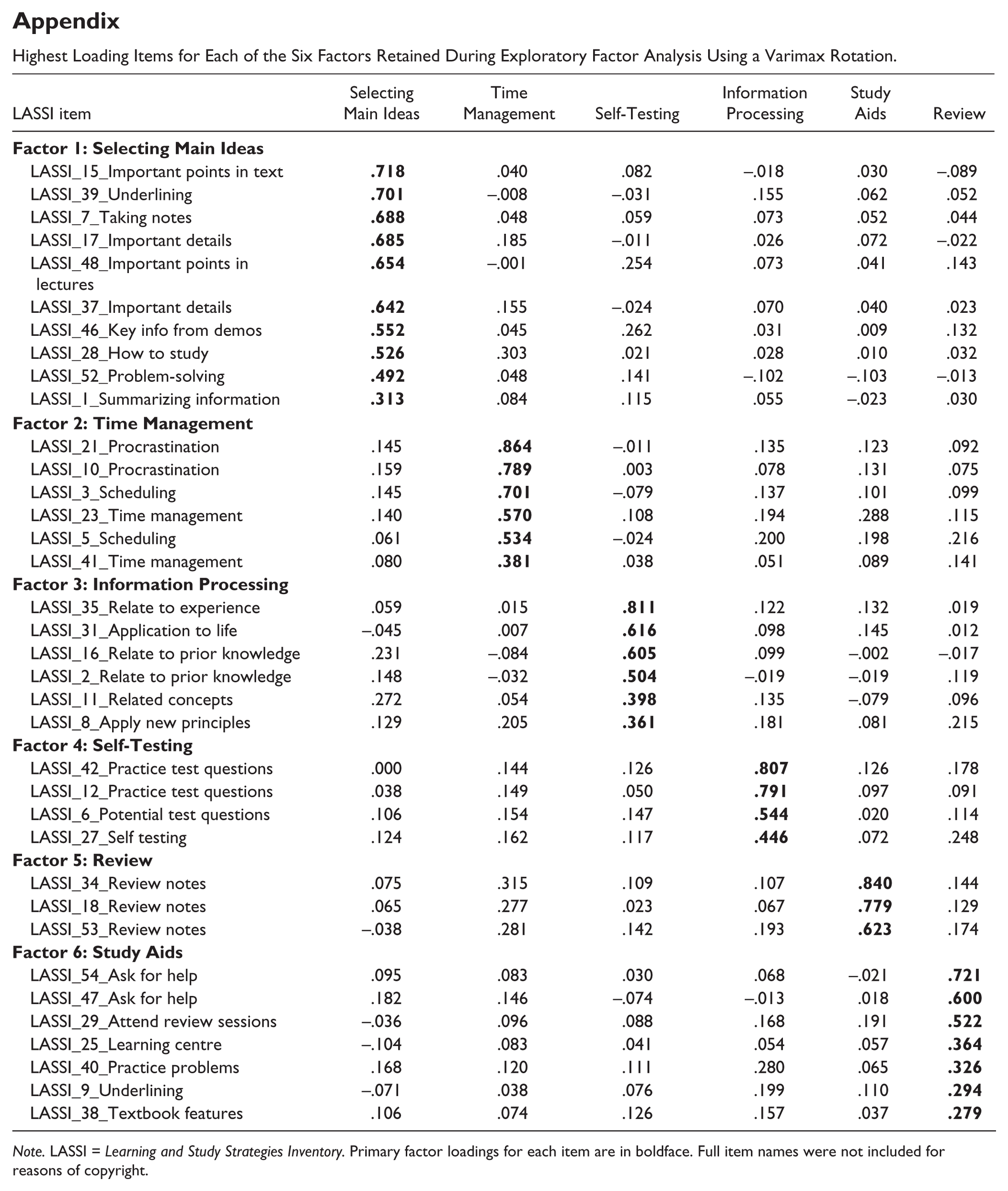
Following the removal of items using both statistical and conceptual analysis, a total of 36 items remained. The final EFA with varimax rotation supported both a six- and a seven-factor solution. However, a 2-item scale is generally undesirable and in this case not meaningful in terms of explained variance (about 2.47%); thus a six-factor solution was retained. Loadings of the six-factor varimax solution are provided in the appendix.
The revised scales included modified versions of Selecting Main Ideas, Information Processing, Self-Testing, Study Aids, and Time Management. Test Strategies from the original LASSI was not retained as a scale, but Review was added. Although the resulting scales contained a number of items that were consistent with the original LASSI scales, removing or redistributing the individual items that fit poorly on the original LASSI scales resulted in generally higher reliability and stronger face validity for our sample than the original LASSI scales (see Table 3).
Cronbach’s Alpha Values Obtained for the Administered LASSI and MRSQ Scales.
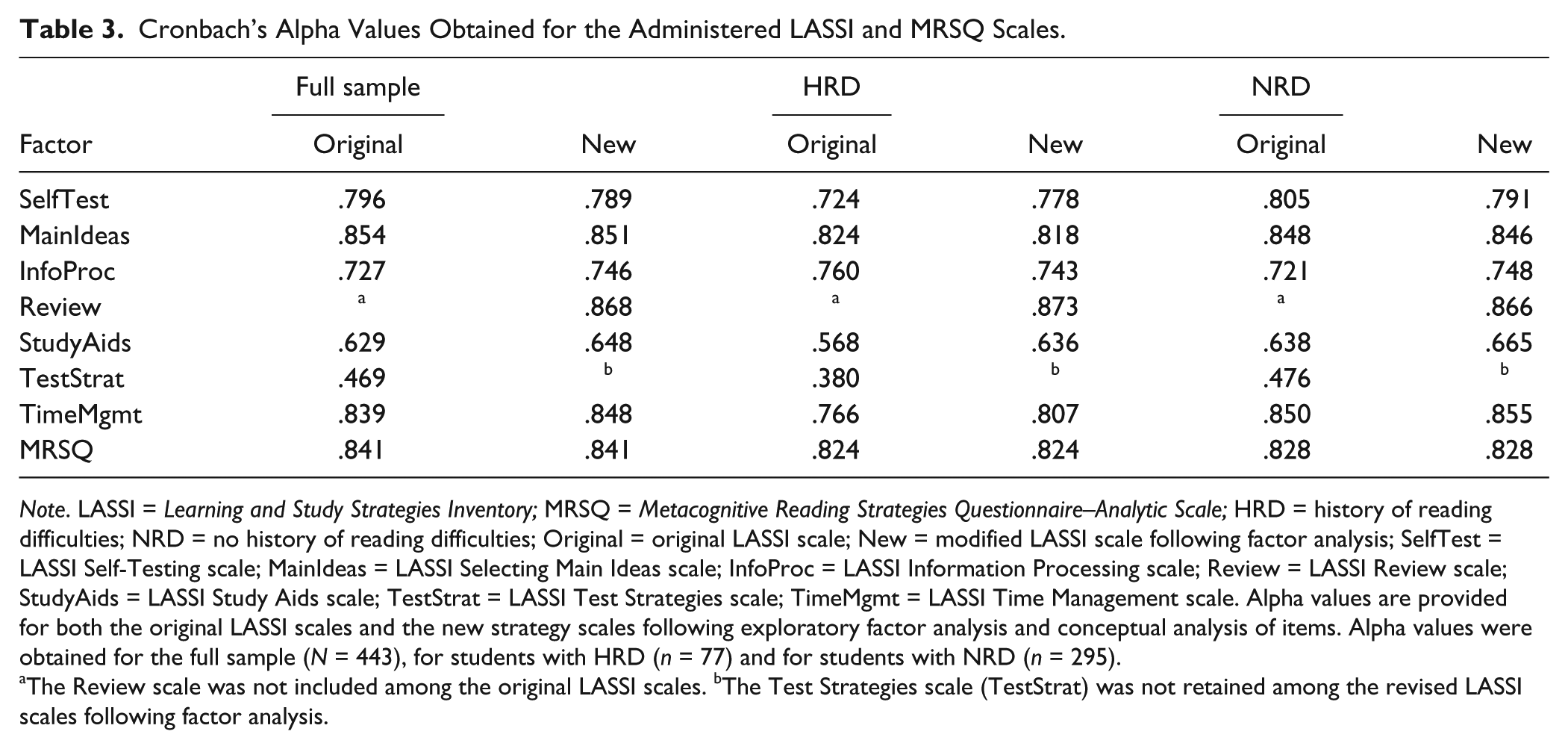
Note. LASSI = Learning and Study Strategies Inventory; MRSQ = Metacognitive Reading Strategies Questionnaire–Analytic Scale; HRD = history of reading difficulties; NRD = no history of reading difficulties; Original = original LASSI scale; New = modified LASSI scale following factor analysis; SelfTest = LASSI Self-Testing scale; MainIdeas = LASSI Selecting Main Ideas scale; InfoProc = LASSI Information Processing scale; Review = LASSI Review scale; StudyAids = LASSI Study Aids scale; TestStrat = LASSI Test Strategies scale; TimeMgmt = LASSI Time Management scale. Alpha values are provided for both the original LASSI scales and the new strategy scales following exploratory factor analysis and conceptual analysis of items. Alpha values were obtained for the full sample (N = 443), for students with HRD (n = 77) and for students with NRD (n = 295).
The Review scale was not included among the original LASSI scales. bThe Test Strategies scale (TestStrat) was not retained among the revised LASSI scales following factor analysis.
Distributional Analyses
Because multiple regression is known to be influenced by issues related to departures from normality, heteroscedasticity, and multicollinearity, all predictor variables were examined to ensure that the assumptions of normality and homogeneity of variances were met using partial regression plots, measures of skew and kurtosis, and variance inflation factor (VIF) values (Tabachnik & Fidell, 2007). Only Academic Support Services was positively skewed, which was corrected with a 90% Winsorization (Allison, Primavera, & Louis, 1993) in which all values above the 95th percentile were set to the value of the 95th percentile (five visits).
There were no problems with multicollinearity; all VIF values were less than 3 for all predictors, and correlations among predictors were low to moderate. A correlation matrix of GPA and predictor variables for the full sample and for each group is included in Table 4.
Correlations Among GPA and Predictor Variables Used in the Multiple Regression Analyses for Both Groups (Full; n = 372), Students With HRD (n = 79), and Students With NRD (n = 295).

Note. HRD = history of reading difficulties; NRD = no history of reading difficulties; MRSQ = Metacognitive Reading Strategies Questionnaire–Analytic Scale; SelfTest = modified Learning and Study Strategies Inventory (LASSI) Self-Testing scale; MainIdeas = modified LASSI Selecting Main Ideas scale; InfoProc = modified LASSI Information Processing scale; Review = modified LASSI Review scale; StudyAids = modified LASSI Study Aids scale; TimeMgmt = modified LASSI Time Management scale; Service = frequency of academic support services use.
p ≤ .05. **p ≤ .01.
We also conducted a set of standard diagnostics to check for multivariate outliers on the criterion variable (standardized residuals), among predictors (Mahalanobis’ distance), and with undue influence on the regression equation (Cook’s distance) (Allison et al., 1993). There were four possible outliers on the criterion and three possible outliers among predictors. All seven possible outliers were within acceptable limits on Cook’s distance (less than .075) and had no undue influence on the regression equation (Allison et al., 1993). Accordingly, we retained all data to ensure representativeness of both samples.
Group Comparisons
Our first research question was about mean group differences in GPA, metacognitive reading (as measured by MRSQ), metacognitive study and learning, and behavioral study and learning strategy use between students with HRD and NRD. Descriptive statistics for these variables for each group are presented in Table 2. According to an analysis of variance, students with HRD had significantly lower GPA than students with NRD. Given likely correlations between our strategy measures, we conducted a MANOVA with group (HRD and NRD) as a between-groups factor to evaluate mean differences on MRSQ, Academic Support Services, and modified LASSI scales of Selecting Main Ideas, Information Processing, Self-Testing, Time Management, Study Aids, and Review. There was a significant difference between students with HRD and NRD, Λ = .832, F(8, 363) = 9.173, p < .001. Subsequent ANOVAs (see Table 2 for details) showed significant differences between the groups on Selecting Main Ideas and MRSQ with lower strategy use reported on both for students with HRD. No other differences emerged as significant.
Relationships Between Strategy Use and Academic Performance
To answer our second research question about the relationship between metacognitive reading strategies, metacognitive study and learning strategies, and behavioral study and learning strategies and GPA for students with HRD and NRD, a hierarchical multiple regression analysis was conducted for each group. As previously discussed, given that our population of students with HRD is defined by a history of reading difficulties, the goal of the present study was to understand, first, the contribution that reading-based strategies may have on academic achievement and, second, the contribution of other study and learning strategies over and above that of metacognitive reading strategies. Thus, in each regression, MRSQ was entered as a first step, and our six measures of metacognitive and behavioral study and learning strategies were entered in the second step. Table 5 summarizes the results of the regression analyses for the students with HRD and NRD.
Predictors of GPA for Students With HRD and NRD.

Note. HRD = history of reading difficulties; NRD = no history of reading difficulties; MRSQ = Metacognitive Reading Strategies Questionnaire–Analytic Scale; SelfTest = modified Learning and Study Strategies Inventory (LASSI) Self-Testing scale; MainIdeas = modified LASSI Selecting Main Ideas scale; InfoProc = modified LASSI Information Processing scale; Review = modified LASSI Review scale; StudyAids = modified LASSI Study Aids scale; TimeMgmt = modified LASSI Time Management scale; Service = frequency of academic support services use.
p ≤ .05. **p ≤ .01.
For students with NRD, the model accounted for 6.7% of the variance in GPA, F(7, 286) = 2.55, p = .011, R2 = .067 (see Table 5). When other predictors in the model were controlled, Time Management (B = .034, p = .014) and Academic Support Services (B = .073, p = .049) had significant positive partial correlations with GPA, and Review (B = –.066, p = .005) had a significant negative partial correlation with GPA.
For students with HRD, the model accounted for 23.5% of the variance in GPA, F(7, 68) = 2.61, p = .015, R2 = .235 (see Table 5). MRSQ had a significant positive correlation with GPA (B = .033, p = .026), and when other predictors in the model were controlled, Review (B = –.144, p = .006) had a significant negative partial correlation with GPA (see Table 5). Study Aids approached significance as a predictor for GPA (B = .058, p = .056).
Given the high degree of variability within the HRD group, as evidenced by large standard error values (see Table 5), and the relatively small sample size of this group (n = 77; Allison et al., 1993), we conducted a backward regression to determine whether shared variance among predictor variables may have obscured significant results. As before, MRSQ was entered as a first step, and the six measures of metacognitive and behavioral study and learning strategies were added in a second step. In this approach, the least significant predictor variables are removed one by one until only significant predictors remain. The order of removed variables was as follows: Selecting Main Ideas (B = –.007, p = .763), Information Processing (B = –.034, p = .372), Self-Testing (B = .032, p = .377), Academic Support Services (B = .093, p = .199), and Time Management (B = .046, p = .093). The remaining variables (MRSQ, Study Aids, and Review) predicted GPA in students with HRD, F(2, 73) = 4.81, p = .004, R2 = .165. MRSQ (B = .033, p = .026) and Study Aids (B = .073, p = .013) were significant positive predictors of GPA, and Review (B = –.099, p = .013) was a significant negative predictor of GPA (see Table 6). The emergence of Study Aids as a significant predictor in the backwards regression supports the possibility that its effects on GPA were obscured in the previous analysis.
Backwards Regression to Explore the Relationship Between Strategy Use and Academic Achievement for Students With a History of Reading Difficulties.
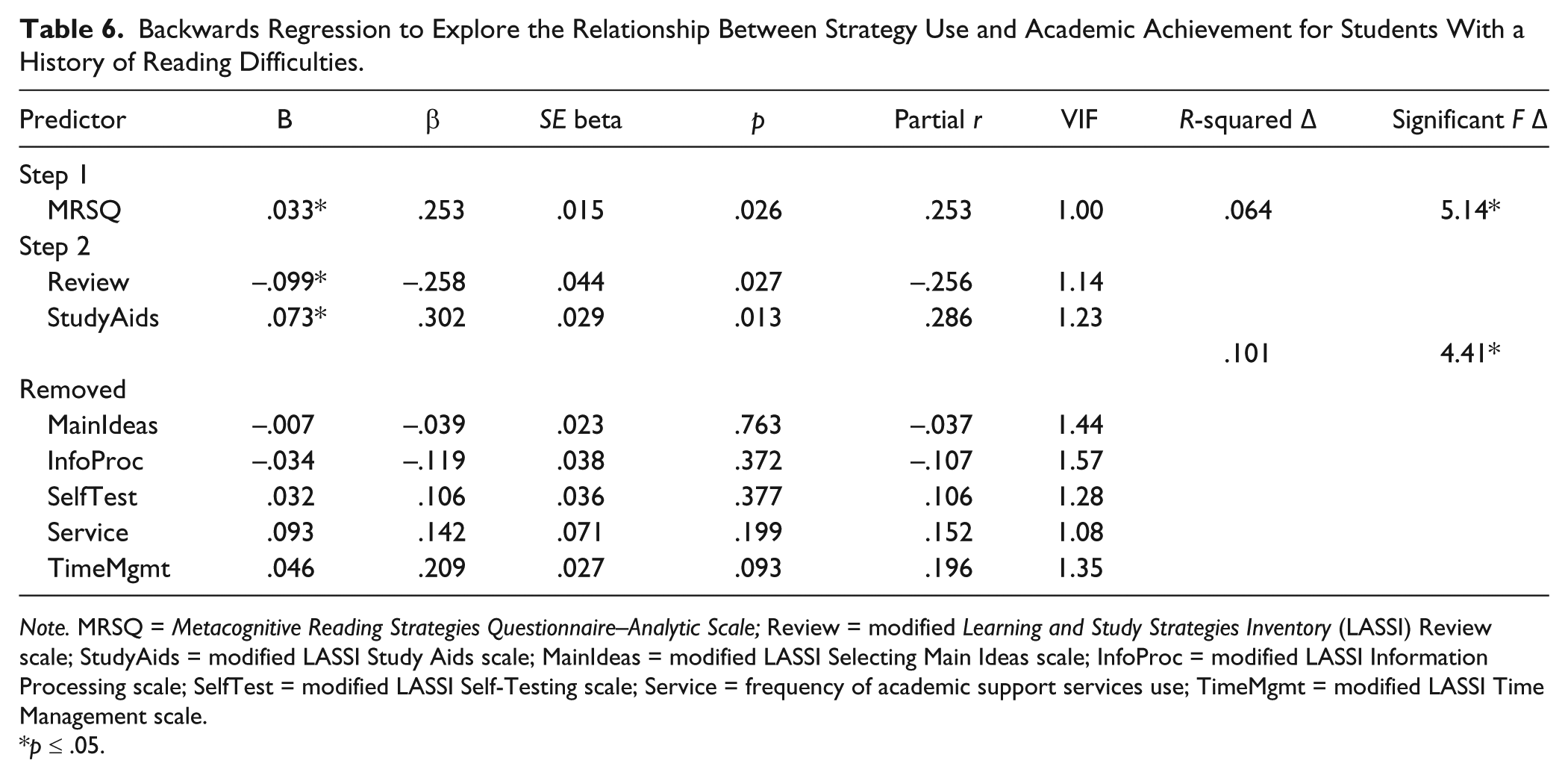
Note. MRSQ = Metacognitive Reading Strategies Questionnaire–Analytic Scale; Review = modified Learning and Study Strategies Inventory (LASSI) Review scale; StudyAids = modified LASSI Study Aids scale; MainIdeas = modified LASSI Selecting Main Ideas scale; InfoProc = modified LASSI Information Processing scale; SelfTest = modified LASSI Self-Testing scale; Service = frequency of academic support services use; TimeMgmt = modified LASSI Time Management scale.
p ≤ .05.
Discussion
We examined whether students with and without a history a reading difficulties differ in their use of metacognitive reading, metacognitive and behavioral study and learning strategies, and GPA and whether the relationship between the strategies and GPA in these two student groups is different.
Consistent with our expectations, students with HRD had lower overall GPAs than students with NRD. To our knowledge, this is the first study showing that self-reported HRD is associated with poorer performance in university. If this result is replicated in future studies, then self-report could be used to identify early a group of students potentially at risk for poor academic performance. Elsewhere we have shown that students with self-reported HRD but no formal diagnosis (and thus no access to accommodations) exhibit nonoptimal reading behaviors that likely would be easily corrected if targeted (Deacon et al., 2012).
Likewise, as predicted, students with HRD endorsed fewer metacognitive reading strategies than students with NRD. We hypothesized further that students with HRD would endorse fewer metacognitive study and learning strategies than students with NRD, but this was only partially supported. Consistent with past research (Kirby et al., 2008; Kovach & Wilgosh, 1999; Proctor et al., 2006), students with HRD endorsed fewer items on the Selecting Main Ideas scale than students with NRD. Although previous research has reported that students with HRD used fewer information-processing strategies (Corkett et al., 2006) than students with NRD, no differences have been reported on the LASSI Information Processing or Self-Testing scales specifically, which is consistent with our findings. Thus, our findings indicate that overall, students with HRD are less likely to apply metacognitive strategies to reading than students with NRD and that these two groups differ on their use of metacognitive study and learning strategies specifically in terms of Selecting Main Ideas. However, Selecting Main Ideas was not associated with GPA in either group.
Our hypothesis that students with HRD would report greater use of behavioral study and learning strategies than students with NRD was not supported. This is in contrast to findings by Kirby et al. (2008) that students with dyslexia reported higher use of time management and study aids than a control group. However, given the inconsistency in the literature surrounding behavioral study and learning strategy use (Corkett et al., 2006; Heiman & Precel, 2003; Kirby et al., 2008; Proctor et al., 2006; Trainin & Swanson, 2005) and differences in samples between these studies, our findings are not wholly unexpected.
Predictors of Academic Performance
All included strategies accounted for 17% of the variance in GPA for students with HRD but only 6% for students with NRD, indicating their differential importance. Our hypothesis that a different pattern of strategy use would predict academic success for students with HRD and NRD was supported; however, our hypotheses regarding specific predictors of GPA for each group were only partially supported. For students with HRD, metacognitive reading strategies alone were a significant positive predictor of GPA, and review of class material was a significant negative predictor of GPA when all eight variables were included as predictors. The relationship between the use of metacognitive reading strategies and academic achievement has been demonstrated in a general population of students (Taraban et al., 2000; Taraban et al., 2004); our findings indicate that the use of these strategies also predicts academic success in students with HRD.
In contrast to both our hypotheses and to prior research that has suggested metacognitive study and learning strategies may be important predictors of academic success in students with HRD (Corkett et al., 2008; Reis et al., 2000; Ruban et al., 2003; Trainin & Swanson, 2005), none of the metacognitive study and learning strategies predicted GPA in the initial model, and only Study Aids emerged as a significant predictor of GPA for students with HRD in the more parsimonious model. While this latter result provides some support for previous research findings that high-achieving students with HRD partially attribute their academic success to the use of behavioral study and learning strategies (Corkett et al., 2008; Reis et al., 2000), more research is needed to pinpoint which strategies are effective for whom and under what conditions as the effect is clearly more limited than assumed.
For students with NRD, the multiple regression analysis revealed that behavioral study and learning strategies, rather than metacognitive reading, study, and learning strategies, predicted academic performance, but only to a limited extent given the total explained variance of 6%. Specifically, the use of Time Management and Academic Support Services positively predicted GPA, whereas the use of Review strategies negatively predicted academic performance for students with NRD. Our findings stand in contrast to prior literature that has found both Time Management and Study Aids to be negatively associated with academic performance in a general population of students (Proctor et al., 2006; Ruban et al., 2003). However, Vogel and Adelman (1992) hypothesized that students without learning disabilities would benefit from the use of academic support services, which appears to be the case in the present study.
Whereas previous studies have found a strong positive relationship between the use of metacognitive reading (Taraban et al., 2000; Taraban et al., 2004), study, and learning strategies (Kirby et al., 2008; Leutner, Leopold, & den Elzen-Rump, 2007; Marrs et al., 2009; Proctor et al., 2006) and academic achievement in a general population of students, we found a null relationship between the use of metacognitive reading, study, and learning strategies and GPA for students with NRD. However, not only do the LASSI scales used in the present study differ from those used in previous studies based on our use of EFA to derive our factors, but previous studies have used different methodology in investigating the relationship between strategy use and academic achievement. For example, Taraban et al. (2000), Marrs et al. (2009), and Proctor et al. (2006) explored differences in strategy use between high- and low-achieving students and found that high-achieving students reported higher use of metacognitive reading strategies (Taraban et al., 2000) and scored higher on LASSI scales associated with metacognitive study and learning strategies (Marrs et al., 2009; Proctor et al., 2006). Kirby et al. (2008) examined zero-order correlations between strategy use and achievement, but achievement was based solely on reading ability rather than overall GPA. Last, Kern et al. (1998) examined zero-order correlations between strategy use and achievement and found that although Self-Testing was moderately correlated with GPA (r = .22), there were near zero correlations for Selecting Main Ideas and Information Processing in a general population of students. Additionally, because the goal of the present study was to characterize strategy use associated with students with HRD we employed a hierarchical multiple regression analysis that prioritized the use of metacognitive reading strategies over and above other study and learning strategies. Therefore, our findings are not unusual given the discrepant methods used in previous studies.
Another point worthy of discussion comes from the relationship between the Review scale and GPA. For both HRD and NRD students, the Review scale was not significantly correlated with GPA. However, for both groups, when other variables in the regression analyses were held constant, Review emerged as a negative predictor of GPA. This unexpected set of findings may be explained in a number of different ways. Although Review in and of itself does not appear to have a negative effect on achievement, it is possible that students with HRD who rely more on metacognitive reading strategies to make deep inferences and connections regarding new learning spend less time reviewing their notes than students who do not make use of such strategies. Likewise, students with NRD who engage in effective time management strategies may have more time to spend using a variety of strategies, whereas those who have difficulty managing their time effectively may be forced to rely more heavily on review strategies at the expense of those that promote deeper processing of material. Regardless of the specific explanation, results should not be interpreted as an indication that Review in and of itself is detrimental to academic achievement.
Limitations
The results reported here need to be interpreted carefully within the context of the predictor variables used to represent strategy use. In order to fully understand the contribution of distinct strategies to academic achievement, we used revised versions of the LASSI scales for our MANOVA and regression analyses. These revised scales allowed us to ensure that only items that represented active strategies, and that conformed to a clear factor structure, were included in the analysis. Despite research demonstrating strong associations between the LASSI as a whole and GPA (Lawson, 2009), the high degree of overlap among LASSI scales, and the lack of agreement on the factorial validity of the LASSI (Cano, 2006; Kern et al., 1998; Olaussen & Bråten, 1998; Olejnik & Nist, 1992; Prevatt et al., 2006) has been problematic for statistical analyses in the past. The revised LASSI scales included in the present study represent a significant step in the development of empirically defined strategy scales by both raising awareness of the limitations of existing inventories and refining the existing LASSI scales through statistical and conceptual analysis. However, continued work is needed to continue to refine existing strategy inventories on both a conceptual and a statistical basis.
Another potential limitation of the present study is the fact that participants completed the strategy questionnaires at the beginning of their university careers. Previous research investigating self-report measures of strategy use has called into question the accuracy of using prospective self-report measures to measure actual strategy use. Cromley and Azevado (2007b), for example, reported that concurrent measurement of strategy use during academic tasks is more accurate than prospective self-report (see also Cromley & Azevedo, 2011). As well, given that the students in our study were in their 1st year of university, it is possible that they reported their usage of various strategies on the basis of their high school experience or on their anticipated approach to learning at a university level. Although limiting our sample to only 1st-year university students ensures a relatively homogeneous sample in terms of education experience, it also means that we cannot draw any conclusions regarding strategy use and academic achievement further into their educational careers. Thus, future research would benefit from both a more heterogeneous sample of university students with more experience in using reading, study, and learning strategies at a university level as well as varied time points of measurement of strategy use as it relates to academic achievement.
We also need to bear in mind that the learning, study, and reading strategies measured here accounted for only a small percentage of the variance in GPA, particularly for students with NRD. It is likely important for future research to include measures of both motivation and self-regulated learning, which have been shown to play an important role in academic achievement in students with learning disabilities (Garcia & Pintrich, 1996; Pintrich & Groot, 1990). Likewise, it might be useful to examine background knowledge and vocabulary, as Cromley and colleagues (Cromley & Azevedo, 2007a; Cromley et al., 2010) have reported that these contribute more to reading comprehension than strategy use alone. Thus, although strategy use makes a meaningful contribution to academic achievement in both HRD and NRD students, there are a number of other factors worthy of investigation. Future studies need to examine a broader set of predictors simultaneously to provide a comprehensive understanding of the factors associated with academic achievement for students with reading and learning disabilities and for the general population of students.
Implications and Future Directions
The finding that students with HRD have both lower GPAs and use fewer metacognitive reading strategies than their peers with NRD suggests that students with a self-reported HRD represent a population that requires academic support (Deacon et al., 2012; Parrila et al., 2007). Furthermore, findings that the use of metacognitive reading strategies are significantly associated with academic success in students with HRD supports the proactive use of early intervention programs that emphasize metacognitive awareness as it applies to reading. For example, for students with learning disabilities, training programs designed to promote self-regulated learning and metacognitive awareness have been successfully implemented (Borkowski, Estrada, Milstead, & Hale, 1989; Butler, 1995; Lawson, 2009). Such programs enhance strategic learning by aiding students in developing, modifying, and personalizing metacognitive strategies that can be generalized across learning tasks (Borkowski et al., 1989; Butler, 1995; Lawson, 2009). Such training programs can be further refined to emphasize the importance of metacognitive reading strategies, specifically, in order to help students who report HRD to become more effective readers.
Likewise, both students with HRD and students with NRD may benefit from specific instruction on the use of appropriate study aids or time management principles as part of an early outreach program or even as part of introductory coursework. Having a better understanding of which strategies are associated with academic success in students with HRD or NRD can help academic support service providers to make effective recommendations and provide effective supports for incoming students.
Footnotes
Appendix
Highest Loading Items for Each of the Six Factors Retained During Exploratory Factor Analysis Using a Varimax Rotation.
| LASSI item | Selecting Main Ideas | Time Management | Self-Testing | Information Processing | Study Aids | Review |
|---|---|---|---|---|---|---|
|
|
||||||
| LASSI_15_Important points in text |
|
.040 | .082 | −.018 | .030 | −.089 |
| LASSI_39_Underlining |
|
−.008 | −.031 | .155 | .062 | .052 |
| LASSI_7_Taking notes |
|
.048 | .059 | .073 | .052 | .044 |
| LASSI_17_Important details |
|
.185 | −.011 | .026 | .072 | −.022 |
| LASSI_48_Important points in lectures |
|
−.001 | .254 | .073 | .041 | .143 |
| LASSI_37_Important details |
|
.155 | −.024 | .070 | .040 | .023 |
| LASSI_46_Key info from demos |
|
.045 | .262 | .031 | .009 | .132 |
| LASSI_28_How to study |
|
.303 | .021 | .028 | .010 | .032 |
| LASSI_52_Problem-solving |
|
.048 | .141 | −.102 | −.103 | −.013 |
| LASSI_1_Summarizing information |
|
.084 | .115 | .055 | −.023 | .030 |
|
|
||||||
| LASSI_21_Procrastination | .145 |
|
−.011 | .135 | .123 | .092 |
| LASSI_10_Procrastination | .159 |
|
.003 | .078 | .131 | .075 |
| LASSI_3_Scheduling | .145 |
|
−.079 | .137 | .101 | .099 |
| LASSI_23_Time management | .140 |
|
.108 | .194 | .288 | .115 |
| LASSI_5_Scheduling | .061 |
|
−.024 | .200 | .198 | .216 |
| LASSI_41_Time management | .080 |
|
.038 | .051 | .089 | .141 |
|
|
||||||
| LASSI_35_Relate to experience | .059 | .015 |
|
.122 | .132 | .019 |
| LASSI_31_Application to life | −.045 | .007 |
|
.098 | .145 | .012 |
| LASSI_16_Relate to prior knowledge | .231 | −.084 |
|
.099 | −.002 | −.017 |
| LASSI_2_Relate to prior knowledge | .148 | −.032 |
|
−.019 | −.019 | .119 |
| LASSI_11_Related concepts | .272 | .054 |
|
.135 | −.079 | .096 |
| LASSI_8_Apply new principles | .129 | .205 |
|
.181 | .081 | .215 |
|
|
||||||
| LASSI_42_Practice test questions | .000 | .144 | .126 |
|
.126 | .178 |
| LASSI_12_Practice test questions | .038 | .149 | .050 |
|
.097 | .091 |
| LASSI_6_Potential test questions | .106 | .154 | .147 |
|
.020 | .114 |
| LASSI_27_Self testing | .124 | .162 | .117 |
|
.072 | .248 |
|
|
||||||
| LASSI_34_Review notes | .075 | .315 | .109 | .107 |
|
.144 |
| LASSI_18_Review notes | .065 | .277 | .023 | .067 |
|
.129 |
| LASSI_53_Review notes | −.038 | .281 | .142 | .193 |
|
.174 |
|
|
||||||
| LASSI_54_Ask for help | .095 | .083 | .030 | .068 | −.021 |
|
| LASSI_47_Ask for help | .182 | .146 | −.074 | −.013 | .018 |
|
| LASSI_29_Attend review sessions | −.036 | .096 | .088 | .168 | .191 |
|
| LASSI_25_Learning centre | −.104 | .083 | .041 | .054 | .057 |
|
| LASSI_40_Practice problems | .168 | .120 | .111 | .280 | .065 |
|
| LASSI_9_Underlining | −.071 | .038 | .076 | .199 | .110 |
|
| LASSI_38_Textbook features | .106 | .074 | .126 | .157 | .037 |
|
Note. LASSI = Learning and Study Strategies Inventory. Primary factor loadings for each item are in boldface. Full item names were not included for reasons of copyright.
Declaration of Conflicting Interests
The author(s) declared no potential conflicts of interest with respect to the research, authorship, and/or publication of this article.
Funding
The author(s) disclosed receipt of the following financial support for the research, authorship, and/or publication of this article: This research was funded by the Social Sciences and Humanities Research Council (SSHRC), Grant/Award Number: ‘890-2011-0072’.