



Abstract
The main objective of this research was to analyze the impact of transcription skills of Spanish writers when writing an independently composed sentence within a writing-level design. The free-writing sentence task from the Early Grade Writing Assessment (Jiménez, in press) was used to examine the production, accuracy, speed, syntactic complexity, quality, and fluency of children with poor transcription skills (PTS). The results showed that there were significant differences between children with PTS and peers who had good transcription skills. The PTS group members were less accurate, slower, and less fluent or even dysfluent. Furthermore, their sentences were less complex and contained lower quality content. These results suggest that transcription skills play a crucial role in early written expression in Spanish, and poor transcription abilities hamper the acquisition and normal development of sentence composition.
Nowadays, writing is considered a complex cognitive process in which different factors are involved. Writing is set up by different processes: generating ideas, translating those ideas into written form, reviewing the product to integrate the many cognitive and social processes involved, and monitoring success (Flower & Hayes, 1980). Transcription skills are involved in all of these processes. If text composition is effortful for adults, it is especially so for children with learning disabilities (LD). However, students with LD are not the only ones who struggle with writing. In fact, the National Assessment of Educational Progress rated only 28% of 4th-grade, 31% of 8th-grade, and 24% of 12th-grade students as proficient (Persky, Daane, & Jin, 2003). Nevertheless, for students with LD, the difficulties are greater. In comparison to their typically achieving peers, children with LD have less knowledge about writing, less skill with language, less effective strategies for writing, and substantial difficulties with spelling and handwriting.
The present study aims to extend the research on Spanish writing disabilities by examining the ability to compose sentences of children with and without poor transcription skills (PTS). While several adult writing models have been proposed and studied (e.g., Flower & Hayes, 1980; Hayes, 1996), the development of writing skills in young children in the early grades has only recently garnered attention. We need to start with a theoretical framework of development of writing skills in order to be able to understand the difficulties that children experience. Berninger et al. (2002) and Berninger and Amtmann (2003) provided a framework that allowed us to analyze the writing challenges encountered by children with transcription difficulties. Berninger and colleagues expanded the Simple View of Writing model (Juel, Griffith, & Gough, 1986) and developed a model of written expression based on the research with an elementary school–age population. Juel et al. (1986) established three major components in their model: (a) transcription, including handwriting and spelling; (b) executive functions, such as conscious attention, planning, reviewing, revising, and developing strategies for self-regulation; and finally, (c) the production of words, sentences, or discourse. During the writing process, information for both short-term and long-term memory is stored in working memory (Berninger, 2000; Swanson & Berninger, 1996). Short-term memory is activated during reviewing and revising, whereas long-term memory is activated during text generation. Translating cognitive processes are divided into transcription and text generation. Transcription refers to the transformation of language representations in working memory into text and requires the retrieval of orthographic symbols and execution of fine-motor movements for producing them (Abbott & Berninger, 1993). Transcription is the coordination of handwriting and spelling. Text generation is a dynamic process in which ideas are produced and represented in memory (Berninger, 2000). Both skills allow the writer to transform language into orthographic symbols (Berninger & Amtmann, 2003).
Berninger and Winn (2006) introduced some modifications to the model, resulting in the Not-So-Simple View of Writing model. The main structure of the model remained the same, but some additions by Berninger and Winn reflect a deeper understanding of the role of working memory and attention in written expression. In the Not-So-Simple model, text generation is supported by the collaboration between low-level skills (handwriting and spelling) and high-level skills for self-regulation. This writing system is only one of many features needed for effective writing. Berninger and Winn proposed that the multiple components of the internal writing system interact with the external environment and brain to support writing.
Transcription is especially important in developing writing in the elementary school years, and writing development depends on automatization of transcription skills (Graham & Harris, 2004). As students develop phonemic awareness and gain understanding of the alphabetic principle, they start to apply all this knowledge to written spelling. Handwriting develops for language expression, and text generation occurs when children learn to produce letters and attempt to spell words to compose sentences (Berninger, 2000). During the first steps of learning how to compose, writers are just beginning to develop the skills necessary to generate words, sentences, and texts, and these skills are developing at different rates. Being able to spell words is an important step in writing where children demonstrate their phonological knowledge of letter-sound correspondences to mimic conventional writing (Puranik & Al Otaiba, 2012). For elementary school–age children, spelling skill is strongly related to quality and length of composition (Aram, 2005; Graham, Berninger, Abbott, Abbott, & Whitaker, 1997). Abbott, Berninger, and Fayol (2010) carried out a longitudinal, cross-sectional study with children from Grades 1 through 5 and found spelling to be the most consistent predictor of writing. Handwriting, specifically handwriting fluency, has been causally related to writing performance (Graham et al., 1997). When transcription demands are removed (i.e., dictate their composition), children show an improvement in their composition ability (Bourdin & Fayol, 2002; Reece & Cummings, 1996). Additional evidence of the relevance of transcription skills comes from Graham et al. (1997), who found that transcription skills explained 41% of the variance in compositional quality and 66% percent of the variance in fluency for students in Grades 1 through 3. Moreover, Berninger (1999) and Berninger and Swanson (1994) found that in Grades 1 through 6, a high percentage of compositional variance was explained by transcription, but this explained variance dropped in Grades 7 through 9. These results suggest that transcription imposes higher resource costs for younger children (see Bourdin & Fayol, 1994; Olive & Kellogg, 2002), but as handwriting and spelling become fluent, text generation and other writing processes become less limited by transcription. Nevertheless, learning how to write involves challenges related not only to transcription but also to high-order skills (Graham & Harris, 2004, 2005). Proficiency in writing requires more than transcription skills; it requires the coordination and integration of several language and cognitive skills as well (Scott, 2005).
The inability to produce legible letters automatically, quickly, and effortlessly (Berninger & Amtmann, 2003) is an indicator for children at risk of developing serious deficits in writing skills. Transcription is considered a powerful predictor for identifying children with writing disabilities (see Berninger, Abbott, Augsburger, & García, 2009). These specific LD are characterized by poor handwriting skills, poor spelling skills, or poor handwriting and spelling skills (Berninger, 2006, 2007a, 2007b, 2008). More recent studies (Berninger, Nielsen, Abbott, Wijsman, & Raskind, 2008a, 2008b; Berninger, Raskind, Richards, Abbott, & Stock, 2008) have supported the conclusion that specific LD in transcription skills interfere with typical writing development but are treatable with specialized instruction. Handwriting and spelling instruction in the early grades not only resulted in improvements in each of these skills for children who were experiencing difficulty mastering them but also enhanced their sentence construction skills and writing output (Graham & Harris, 2005; Graham, Harris, Fink-Chorzempa, & MacArthur, 2002). Struggles in transcription are thought to constrain higher order skills such as planning and revising (e.g., Berninger, 2000; Graham et al., 1997; Graham & Harris, 2004, 2005). However, if children do not have to pay close attention to how to spell a word, or if handwriting is fluent, they may not forget the ideas they are organizing and planning in working memory (Graham et al., 2002). Sumner, Connelly, and Barnett (2014a) carried out a study with children with dyslexia and poor spelling skills. Their results provided strong evidence regarding how the cognitive demands of a transcription skill are manifested during the writing process. Sumner et al. found that spelling ability constrains vocabulary choices when writing and thus affects the text quality.
Fluency has received peripheral attention in writing research; one reason could be that the notion of fluency is most often associated with spoken-language phenomena (Uppstad & Solheim, 2007). Another reason could be that fluency may be the term with the most varied definitions in writing research, reflecting the different ways researchers conceptualize it. Chenoweth and Hayes (2001) measured writing fluency in terms of the number of words written per minute, Berninger and Swanson (1994) in terms of length, Elola (2006) in terms of number of words written, and Rosenthal (2006) in terms of number of correctly spelled words. These different measures are either a writing speed index or a writing production index, and most of them have been proposed to examine generation fluency at the text level.
In the present study, we examined the relevance of considering fluency in a free-writing sentence. We understand that writing fluency has to be characterized by the ability to write accurately as well as quickly and therefore proposed two fluency measures: fluency as a composing rate, which was obtained by dividing the number of correctly spelled words by the time spent writing, and fluency in terms of accuracy, which was obtained by dividing the number of correctly spelled words by the total number of words produced per minute.
For writers with PTS, all these processes may require a lot of effort that will steal important resources from fluent composition. Several studies have suggested that the attention capacity available for different cognitive processes is limited (e.g., Just & Carpenter, 1992; Kellogg, 1996). Fayol (1999) pointed out that writing involves several components that affect and even steal cognitive resources from each other. If transcription processes operate correctly, they draw little from working memory and attention resources, freeing these resources for use in other cognitive processes. Furthermore, it has been suggested that the transcription process, lexical access, and spelling irregularities can have an impact on the cognitive effort of writing (Fayol, 1999) and also on the lexical retrieval speed influence in writing fluency and quality (Snellings, Van Gelderen, & De Glopper, 2004).
The aim of the present study was to analyze the sentence production level in Spanish Grade 3 students with and without PTS through a writing level (WL) match design. In order to determine whether the Spanish students with PTS have a sentence-writing deficit, we compared productivity, accuracy, speed, syntactic complexity, quality, and fluency measures within a WL design. The writing and independently composed sentence tasks from the Early Grade Writing Assessment (EGWA; Jiménez, in press) were administered.
Because a lack of adequate foundational skills in either text generation or transcription is thought to constrain higher order skills such as planning and revising, which are essential components of writing (e.g., Berninger, 2000; Graham et al., 1997; Graham & Harris, 2000), and text generation can evolve from the word to the sentence and discourse levels only after transcription skills become sufficiently established (Alamargot & Fayol, 2009), we expected that children with PTS would be less productive, accurate, and fluent writers. Furthermore, we hypothesized that sentences written by these children would be characterized by lower quality content and less complex syntactic structure.
Method
Participants
A sample of 92 Spanish children (46 boys, 46 girls) was selected from a population of 1,653 students in Grades 1 through 3 from 12 schools in the Canary Islands. The children came from urban zones and from average socioeconomic backgrounds, and they attended state and private schools.
We excluded children who required support and specific educational attention due to sensory impairments, acquired neurological impairments, and other problems traditionally used as exclusionary criteria for LD or severe behavior disorders, either for a period or throughout the whole of their schooling. We also excluded students with high ability and late entry to the education system (i.e., students who arrived from other countries or who entered the education system late for any reason, including due to personal conditions or past school records). This information was provided by the Dirección General de Ordenación, Promoción e Innovación Educativa from the Canary Islands Government (Boletín Oficial de Canarias, 2010, 2011).
Based on their performance on Factors III (Word Production, i.e., spelling) and IV (Letter Production, i.e., handwriting fluency) of EWGA, 1 the 92 study children were assigned to one of three groups: (a) an experimental group of 31 third-grade children (18 boys, 13 girls) with PTS (PTS group), (b) a control group of 30 third-grade typically achieving writers (12 boys, 18 girls) matched in age with the PTS group (chronological age [CA] group), and (c) a control group of 31 first-grade children (16 boys, 15 girls) matched in WL with the PTS group (WL group). Those children whose performance was less than the 25th percentile in both factors were grouped and labeled as having PTS, while children whose performance was greater than the 25th percentile in both factors were assigned to one of the control groups according to each grade. The distribution by sex was similar across different groups: χ2(2) = 3.67, p = .159. There were no significant differences in age between the PTS and CA groups, F(2, 89) = 0.01, p = 1.0; but the WL group members were younger than the PTS group members, F(2, 89) = 496.16, p < .001. The PTS and WL groups were matched in “writing dictated words with inconsistent spelling task,” F(2, 89) = 2.75, p = .30, and “writing dictated words that fit spelling rules from dictation task,” F(2, 89) = 0.09, p = 1.0. Table 1 provides descriptive information regarding sample size, age, and dictation task measures for each group. Finally, there were significant differences in writing pseudowords from dictation between groups, F(2, 89) = 9.57, p < .001. The CA group was better than the PTS group, F(2, 89) = 4.28, p < .001, and the WL group F(2, 89) = 2.96, p < .001.
Group Descriptive Information Regarding Number, Age, and Dictation Tasks.
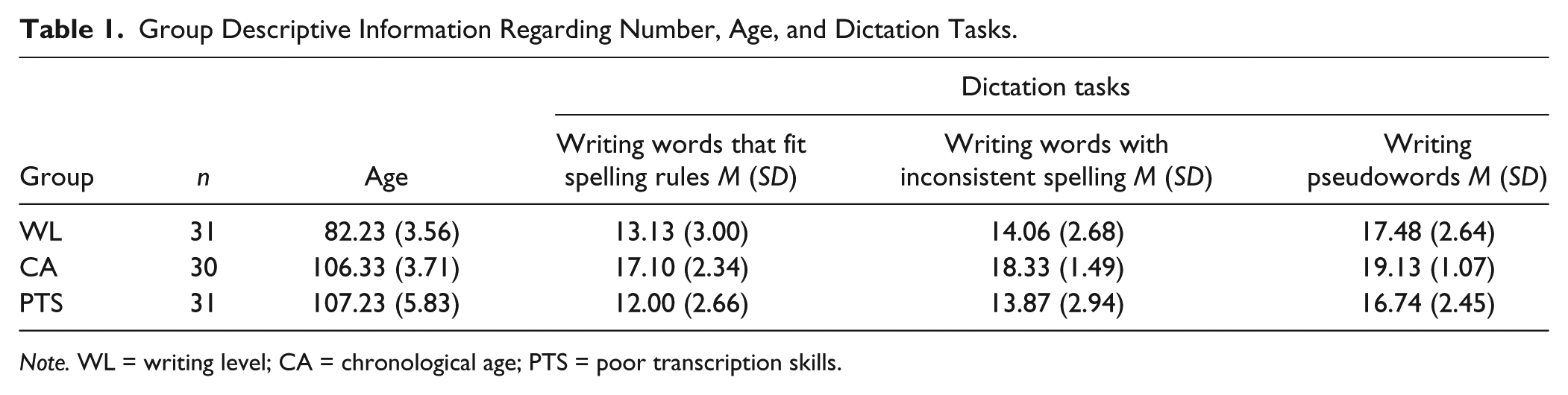
Note. WL = writing level; CA = chronological age; PTS = poor transcription skills.
Materials
All of the tasks assessed writing performance in the Spanish language. The study participants were assessed using the following writing tasks from EGWA. 2
Writing words that fit spelling rules from dictation
The objective is to assess whether the student is able to write words that fit the spelling rules; this indicates that he or she has memorized these rules and recalled the orthographic representation (e.g., “m” before “p” and “b”: sombrero [hat], ombligo [navel]; the letter “r” is written at the beginning of a word: radio [radio] and after “l,” “n,” and “s”: sonreír [smile]). The examiner should indicate on the data collection form the number of words for which the student has used the correct spelling rule.
Writing dictated words with inconsistent spelling
The objective is to assess whether the student is able to write words that are spelled differently than they are pronounced, that is, words that do not conform to any spelling rules. If the student is able to write words that do not conform to any spelling rules, it indicates that he or she has memorized the orthographic representation. The examiner should indicate on the data collection form (a) the number of words spelled correctly and (b) for each word, any substitutions, deletions, added letters, translations, and pronunciation (i.e., if the student pronounces the word or part of a word while writing).
Writing pseudowords from dictation
The objective is to assess whether the student is able to write the graphemes that correspond to the phonemes of the word. The spelling of pseudowords indicates knowledge of the rules of phoneme-grapheme correspondence. All the words that sound the same, whether they do or do not conform to spelling rules, are valid (e.g., if the student should write hiefe but writes iefe or yefe, either will be considered correct since the reading sounds like the pseudoword issued). The examiner should indicate on the data collection form the number of pseudowords written correctly.
Writing an independently composed sentence
This task assesses the student’s ability to write an independently composed sentence. The examiner should encourage a conversation with the student about his or her interests, asking the student about favorite games, hobbies, and so forth. After the student describes one or two situations, the examiner asks the student to write two sentences about what he or she has described during the conversation. The total test time is 5 min.
Scoring
The scores used in this study are described below.
Productivity
Three measures were calculated: (a) total number of words (incomplete sentences are taken into account), (b) total number of correct words, and (c) total number of word errors produced. A word was considered spelled correctly (a) when it did not contain misspellings; (b) when, if it was a foreign word, it was written correctly in the native language; (c) when, if it was the first letter in a sentence, it was capitalized; (d) when the stress mark was omitted; and (e) when numerical quantities were expressed graphically with numbers.
A word was considered incorrect (a) when, as the first letter at the beginning of the sentence, it was written in lowercase; (b) when it was written in uppercase when it was not a real name or written with a capital letter in the middle of the word; and (c) when there was a mismatch of gender, number, or verb or when one of the words involved in the syntactic construction was incorrect.
Accuracy
This was the ratio between the total number of words produced and the total number of correct words written.
Speed
This was the number of words produced per second.
Fluency
Two fluency measures were used: (a) fluency as a composing rate measuring the number of correctly spelled words written per second, which was calculated by dividing the number of correctly spelled words by the total time spent writing the sentences, and (b) fluency as a rate between number of words produced and total number of correct words per minute (1st and 2nd min).
Syntactic complexity
A syntactic complexity measure was calculated based on the sentence structure, complements, objects, or modifiers present in the sentence. One point was awarded for a simple sentence (only one independent clause). Two points were assigned to a compound sentence (contained at least two independent clauses and could be formed using a coordinating conjunction, semicolon, or colon). Three points were assigned to a complex sentence (contained an independent clause and at least one dependent clause). Four points were given for a compound-complex sentence (had two independent clauses and at least one subordinate clause; the subordinate clause could be part of an independent clause). Finally, an extra point was assigned for each direct object, indirect object, adverbial complement, prepositional complement, or any other modifier or complement.
Quality written content
Because it was observed that poor spelling and penmanship have a negative impact on assessment of quality (Berninger & Swanson, 1994), all sentences were rewritten to a computer without errors and printed on paper. The sentences of the same participant were filed together and separated from those of the other children. Eight expert schoolteachers with at least 5 years’ experience teaching classes at the primary school level were selected. The teachers were asked to score the set of written sentences on a scale of 1 to 10 for quality content appropriateness. The correlations between the teachers were significant (> .80). The quality written content measure was calculated as a mean of the four teachers’ scores.
Classification task
Groups were formed based on two factors of EGWA. Factor III (Word Production) is composed of five tasks: total number of correctly spelled words that fit spelling rules from word dictation, total number of correctly spelled words with inconsistent spelling from word dictation, total number of correctly spelled words in sentence dictation, total number of pseudowords correctly spelled using phoneme-grapheme rules, and letters written correctly in order from memory per minute. Factor IV (Letter Production) contains two tasks: letters written correctly per minute in an allograph selection task and letters written correctly per minute in alphabet copying. Two composite scores for the tasks in each factor were obtained based on the sum of the task punctuations. These composite scores were used to classify the different groups (see Participants section).
Procedure
The writing an independently composed sentence task was administered to each student individually by a trained researcher. First, the examiner engaged the student in a conversation that was of interest to the student, asking the student about his or her favorite games, hobbies, and so forth. After the student described two events, the answer sheet and instructions were provided. The examiner did not offer a visual model of the sentences, and he or she started timing when the child began to write the first letter of the first word. The examiner used two marks to indicate on the data collection form at which point in the writing the student was at the 1st min and at the 2nd min.
Results
To analyze whether significant differences existed between the groups in production, speed, and fluency as compositional rate, we conducted a multivariate general linear model analysis with a between-subjects factor, group (WL, CA, and PTS), and as dependent variables total number of spelled words; total number of correctly spelled words; total number of errors; accuracy (proportion of words correctly spelled); speed (total number words spelled per second); fluency as compositional rate (total number of words correctly spelled per second); syntactic complexity; and quality of written content. Means and standard deviations for these variables in each group are shown in Table 2 and are represented in Figure 1.
Correlations Among Teachers’ Scores.
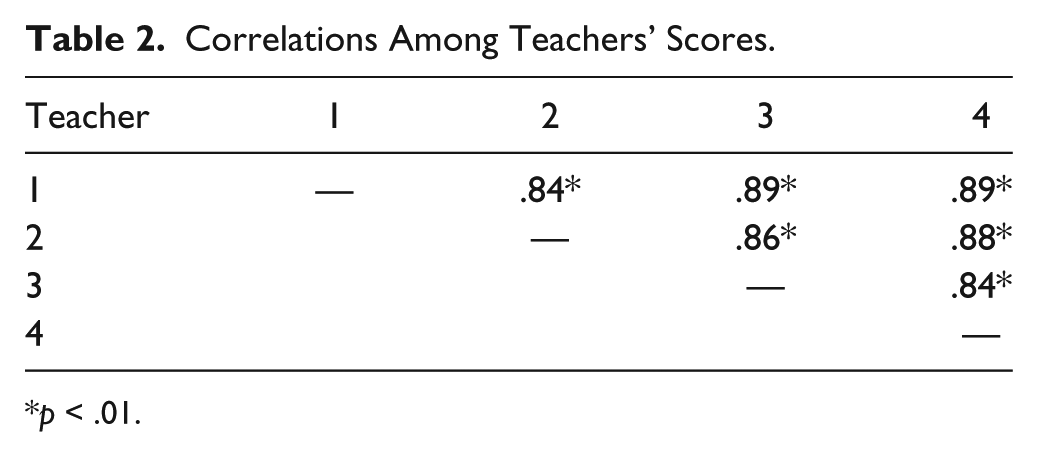
p < .01.
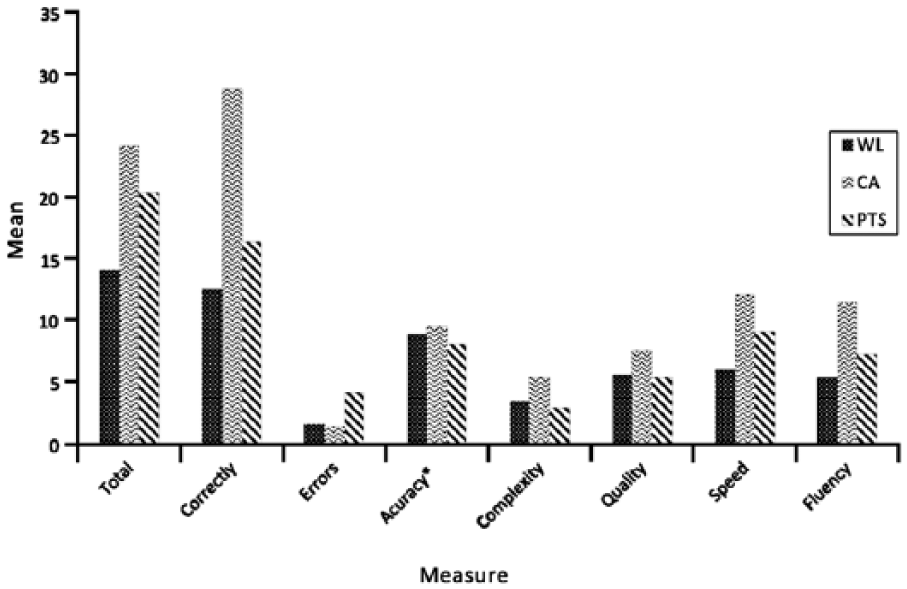
Means of experimental measures in each group.
Multivariate Analysis
The multivariate analysis yielded a main effect of group, F(8, 168) = 9.387, p < .001, ŋ2 = .448. Between-participants effects revealed there were significant group differences on total number of words F(2, 88) = 10.251, p < .001, ŋ2 = .191; total number of correctly spelled words, F(2, 88) = 12.450, p < .001, ŋ2 = .223; total number of errors, F(2, 88) = 11.875, p < .001, ŋ2 = .214; accuracy, F(2, 87) = 13.169, p < .001, ŋ2 =.232; speed, F(2, 88) = 28.654, p < .001, ŋ2 =.397; fluency as compositional rate, F(2, 88) = 35.334, p < .001, ŋ2 = .448; syntactic complexity, F(2, 88) = 30.897, p < .001, ŋ2 = .415; and quality written content, F(2, 88) = 21.468, p < .001, ŋ2 = .330. Multiple comparisons for each dependent variable are listed below.
Total number of words
There were significant differences between the WL group and the PTS and CA group, with WL, F(1, 88) = 20.064, p < .001, and with PTS, F(1, 88) = 7.91, p < .01. There were no significant differences between the CA and PTS groups, F(1, 88) = 2.773, p = .297.
Total number of correctly spelled words
There were significant differences between the CA and WL groups, F(1, 88) = 24.319, p < .001, and between the CA and PTS groups, F(1, 88) = 9.784, p < .001, but the differences between the PTS and WL groups were not significant, F(1, 88) = 3.252, p = .224. The CA children produced significantly more correctly spelled words than the PTS and WL children.
Total number of errors
This analysis revealed that the PTS group made more errors than the WL group, F(2, 87) = 18.893, p < .001, and the CA group, F(2, 87) = 16.660, p < .001. There were no significant differences between the WL and CA groups (F < 1).
Accuracy
This analysis revealed that the PTS group was less accurate during writing a sentence than the WL group, F(2, 87) = 8.366, p < .001, and the CA group, F(2, 87) = 26.181, p < .001. In the same way, the CA group was more accurate than the WL group, F(1, 88) = 5.577, p < .05.
Speed
There were significant differences between the CA and WL groups, F(1, 88) = 57.278, p < .001; between the CA and PTS groups, F(1, 88) = 14.056, p < .001; and between the PTS and WL groups, F(1, 88) = 14.585, p < .001. The CA group was significantly faster than the PTS and WL groups. In the same way, the PTS group was significantly faster than the younger writers (WL group).
Syntactic complexity
There were significant differences between the CA and WL groups, F(1, 88) = 35.043, p < .001, and between the CA and PTS groups, F(1, 88) = 55.344, p < .001. The differences between the WL and PTS groups were not significant, F(1, 88) = 2.308, p = .397. The CA group’s sentences were significantly more complex than the PTS and WL groups’ sentences.
Quality of written content
There were significant differences between the CA and WL groups on this measure, F(1, 88) = 23,997, p < .001, and between the CA and PTS groups, F(1, 88) = 38.686, p < .001, but the differences between the PTS and WL groups were not significant, F(1, 88) = 1.745, p = .571. Quality content scores for the CA group were significantly higher than for the PTS and WL groups.
Fluency as compositional rate
There were significant differences between the CA and WL groups, F(1, 88) = 67.713, p < .001, between the CA and PTS groups, F(1, 88) = 31.595, p < .001, and between the PTS and WL groups, F(1, 88) = 6.801, p < .001. The CA group was significantly more fluent than the PTS and WL groups. In the same way, the PTS group children were significantly more fluent than the younger writers (WL group).
To analyze whether there were (a) significant differences in fluency as a rate of accuracy per minute and (b) differences at the beginning and after a minute of writing an independently composed sentence, we carried out a repeated-measures general linear model with a between-participants factor: group (WL, CA, and PTS), moment as a within-participants factor (1st min vs. 2nd min), and fluency as accuracy per minute as a dependent variable. Means and standard deviations for fluency for each group per moment are shown in Table 3 and represented in Figure 2.
Means and Standard Deviations for the Experimental Measures in Each Group.
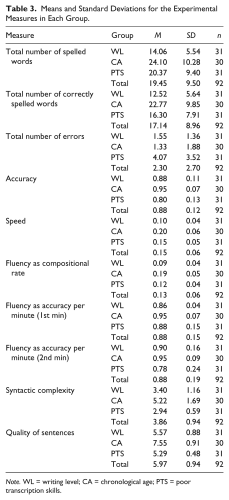
Note. WL = writing level; CA = chronological age; PTS = poor transcription skills.

Means of fluency measure (as accuracy per minute) for each group and moment factor.
The analysis yielded a significant effect of group, F(1, 79) = 10.58, p < .01, ŋ2 = .21. The PTS group had lower scores than the WL group, F(2, 79) = 8.63, p < .05, and the CA group, F(2, 79) = 20.38, p < .001. Both main effect of moment and the interaction of group by moment were not significant (F < 1).
Discussion
The main aim of this research was to analyze the impact of transcription skills of Spanish writers when writing an independently composed sentence within a WL design. As we previously argued, transcription skill takes a relevant place in writing acquisition, being of special importance in the beginning of a child’s education (Berninger et al., 1992; Borzone & Diuk, 2003), and deficits in this ability are likely to hamper the acquisition and development of high-level writing processes. Transcription includes handwriting and spelling as necessary tools that enable the writer to translate internal language into external written symbols to express ideas in written language (Richards, Berninger, & Fayol, 2009). Children with PTS are characterized by spelling and/or handwriting difficulties that interfere with the normal development of writing. In the present study, the Spanish group with PTS was composed of third graders who had difficulties in both spelling and handwriting. As compositional scores, total number of words, number of correctly spelled words, errors, proportion of correctly spelled words, speed, quality, syntactic complexity, and fluency were collected, calculated, and used as dependent variables in two analyses.
As we expected, there were significant differences between typically achieving writers across the grades (WL, CA) on total of words, total of correctly spelled words, speed, and both fluency measures. Typically achieving first-grade writers produced fewer words, were slower, and were less fluent compared with typically achieving third-grade writers. These results, according to McCutchen (1996), suggest that children are progressively mastering lower order skills, leading to improvement in composition.
The absence of significant differences on accuracy and total number of errors between the CA and WL groups suggested that both groups of children tended to write well-known words with a strong orthographic representation to complete the writing and independent composition tasks.
When we compared the performance of the PTS and CA groups, we found significant differences in productivity measures (except on total number of words), accuracy, speed, and fluency. The PTS group produced significantly more errors and were less accurate, slower, and less fluent than their classmates. Moreover, the first analysis revealed the PTS group members produced significantly more errors and were less accurate than typically achieving first graders. The second analysis revealed that they were also less fluent than typically achieving first graders. The PTS group displayed difficulties in handwriting skills, orthographic representation of letter forms in memory, accessing of retrieval in memory, and planning for producing the letter.
Barrientos (2016) carried out research involving students with PTS to analyze the dynamics of handwriting movements in real time for Spanish-speaking children. They examined the time invested in pauses and automaticity using writing the alphabet, copying the alphabet, and allograph selection tasks. The authors reported that children with transcription difficulties invested a greater amount of time in pauses and were lacking in automaticity. Likewise, our PTS group lacked adequate spelling skills, an important step in writing where children demonstrate their knowledge of phonological awareness skills and of letters and letter-sound correspondences. If the PTS group children did not have a precise representation of a word’s spelling in memory, they spent more time, their probability of producing more errors increased, and they could not free up cognitive resources that they might need during writing, making them less accurate, slower, and less fluent writers. Sumner, Connelly, and Barnett (2013, 2014a, 2014b) demonstrated that differences in fluency in children with poor spelling abilities (dyslexia) seemed to reflect long pauses within words. Thus, handwriting execution is not impaired in children with dyslexia. The slow writing that is typical of children with dyslexia is due to pausing more often when composing and is related to spelling ability. This may reflect processing problems in response to high cognitive load through having to contend with spelling and composing concurrently.
Taking account of all the evidence, the lack of fluency in children with PTS could be explained by poor handwriting and poor spelling skills, reflected in long pauses within letters, a lack of handwriting, and long pauses within misspelled words.
Another point relates to explanations of lack of transcription skills’ being a constraint on development in writing sentences. Younger writers produced lower compositional quality sentences and less complex sentences when compared to a third-grade control group, which aligns with the conclusion that first-grade children’s transcription abilities are just starting to develop and thus might constrain generation of text to an even larger extent (Ehri, 2000). In addition, we found the same differences between Spanish PTS children and their pairs. Both handwriting and spelling are highly cognitively demanding processes for Spanish PTS children and typical first graders. According to the capacity theory of writing (McCutchen, 1996), the demands of writing are dealt with through working memory, and when the cognitive demands exceed the limits, breakdown occurs. Production can evolve from word to sentence (and then discourse) levels only after transcription skills become sufficiently established (Alamargot & Fayol, 2009). Teaching and practicing transcription skills in school allows students to reduce these working memory demands over the years. Indeed, in the early elementary years, transcription skills use up most of working memory’s resources, and their cognitive demands might compromise the use of other writing processes (Bourdin & Fayol, 2002).
Another conclusion we could draw from the present study is that it is necessary to establish a definition of fluency. In the present study, we proposed two measures of fluency. Fluency as a composing rate was obtained by dividing the text quantity by the time spent writing. However, given the characteristics of the free sentence task, children may differ in length (total number of words written) and time that they spent on writing. For these reasons, we calculated fluency in terms of accuracy (obtained by dividing the correctly spelled words by the total number of words produced) and time (per minute). Depending on how the fluency was conceptualized, the conclusions were different. In our first analysis, PTS group members were significantly less fluent when compared to the CA group, but they were significantly more fluent than younger writers. In our second analysis we found that independent of the product-moment factor, the PTS group children were significantly worse than the children matched for age and children matched in WL.
These results suggest that Spanish children with PTS have a deficit in the textual production at the sentence level. Thus, there is good reason to believe that transcription skills play a crucial role in early written expression in the Spanish language. Poor transcription abilities hamper the acquisition and development of sentence composition. Because transcription proved to be a restrictive factor in writing Spanish for the PTS group and younger children, one overall recommendation is that designing intervention programs tapping transcription skills is warranted. Evidence has already shown the positive effect of handwriting (e.g., Christiensen, 2004) and spelling interventions (e.g., Graham et al., 2002). Specific spelling instruction for children with dyslexia targeting phonology and morphology has been conducted and has shown a great improvement postintervention in the children’s ability to spell derivational words (Tsemeli & Seymour, 2006). Scott (2002) suggested that interventions for poor spellers should have explicit word analysis training (in phonology and morphology) and should provide opportunities to apply this knowledge in reading and writing activities. By integrating explicit spelling instruction with literacy activities, the gaps are bridged in terms of applying this knowledge when writing. After demonstrating the link between phonology and spelling, and even phonology and handwriting/written production, it is feasible to propose that interventions targeted at explicit spelling instruction would have a positive outcome on the writing produced by these children. It is reasonable to suggest that improving spelling first would release working memory resources to be devoted to higher level planning or to increase fluency in writing.
Learning how to write adult-like text involves challenges related not only to transcription but also to text generation (Graham & Harris, 2000). Both are essential components of writing (Berninger, 2000; Graham & Harris, 2000). The results from several meta-analyses (Datchuk & Kubina, 2013; Graham & Perin, 2007; Rogers & Graham, 2008) suggest that a struggling writer may benefit from intervention in sentence construction and transference of acquired skills to more complex tasks such as sentence and extended composition.
Beginning writers rarely spontaneously plan or revise their compositions, and their higher level skills are not sufficiently developed to influence production. The executive functions in younger children are regulated by assistance from teachers or parents and require a great deal of scaffolding from adults (Berninger, 2000). However, in the course of the school years, transcription becomes more efficient, reducing the cognitive effort (Kellogg, 1998, 2001). Limpo and Alves (2013) suggested that if transcription stops being a major constraint, this may contribute to the development of self-regulatory skills that in turn will positively influence the quality of sentence and text generation. Both authors recommended that explicit instruction and practice in transcription skills, planning, and revising, along with self-efficacy, may facilitate writing development beyond the traditional education years.
Footnotes
Declaration of Conflicting Interests
The author(s) declared no potential conflicts of interest with respect to the research, authorship, and/or publication of this article.
Funding
The author(s) disclosed receipt of the following financial support for the research, authorship, and/or publication of this article: This research was supported by Agencia Canaria de Investigación, Innovación y Sociedad de la Información, ref. ProID20100030 from the Government of the Canary Islands.