



Abstract
Numbers may be manipulated and represented mentally over a compressible number line oriented from left to right. According to numerous studies, one of the primary reasons for dyscalculia is related to improper understanding of the mental number line. Children with dyscalculia usually show difficulty when they have to place Arabic numbers on a physical number line. However, it remains unclear whether they have a deficit with the mental number line per se or a deficit with accessing it from nonsymbolic and/or symbolic numbers. Quebec French-speaking 8- to 9-year-old children with (24) and without (37) dyscalculia were assessed with transcoding tasks (number-to-position and position-to-number) designed to assess the acuity of the mental number line with Arabic and spoken numbers as well as with analogic numerosities. Results showed that children with dyscalculia produced a larger percentage absolute error than children without mathematics difficulties in every task except the number-to-position transcoding task with analogic numerosities. Hence, these results suggested that children with dyscalculia do not have a general deficit of the mental number line but rather a deficit with accessing it from symbolic numbers.
Introduction
Every day, children are exposed to numbers. They count sets of objects; say, read, and write numbers; manage common activities using time and date; measure distances or even money; and so forth. People easily—and even automatically—perceive, use, and manipulate numbers in their daily lives. Thus, children need to acquire efficient and precise mental numerical representations when they have to deal with Arabic and spoken numbers.
The model of number acquisition (Von Aster & Shalev, 2007) was proposed to account for the development of numerical abilities in children. According to this model, the development of cognitive number representations is achieved from infancy to schooling through four main steps: (a) an inherited basic number sense based on a core-system representation of magnitude (i.e., the quantity to which a number corresponds), (b) the acquisition of number words during preschool, (c) the learning of Arabic symbols in primary school, and (d) the development of a mature mental number line (MNL). This final MNL step is constructed from the linguistic and Arabic number system and comes into play when identifying ordinal positions of numbers with reference to their numerical neighbors. The concept of MNL was prior developed by Dehaene (1992, 2010) in the theoretical triple-code model (Dehaene, 1992, 2010) representing numerical skills in adults. According to this model, numbers may be manipulated and represented mentally in three different codes—Arabic, verbal, and analogic. The Arabic and verbal codes are both symbolic and nonsemantic (i.e., they do not bear information about numerosity themselves). In the Arabic number form, numbers are manipulated in Arabic format (e.g., 3), allowing one to process exact calculation or parity judgment, for example. In the verbal code, numbers are manipulated in words (e.g., /three/), allowing counting or process addition and multiplication arithmetic facts, for example. Finally, the analogic code is the abstract and amodal representation of the magnitude of nonsymbolic numerosities that could be represented internally over a compressible number line oriented from left to right: this code is the MNL, an important component of “number sense.” Mental number representations obey the Weber-Fechner Law, according to which the mentally represented magnitude is a logarithmic function of the objective number stimulus and that influences people’s performances in numerical processes, especially in discrimination tasks (i.e., the discriminability of two numbers decreases as the magnitude of the numbers increases). The larger the numbers are, the more their mental representation becomes indistinct. Even if the triple-code model was implemented for adult processes, it also could give a relevant framework for the understanding of the development and the deficits of numerical skills in children. This model and the one of number acquisition of Von Aster and Shalev (2007) were used as theoretical frameworks in the present study.
Most researchers have investigated children’s MNL using the typical number-to-position task. In this kind of task, children were shown a physical number line, with start and end points identified with numbers (e.g., 0 and 100), on which they were asked to mark with a pencil the corresponding position of an Arabic number (Berteletti, Lucangeli, Piazza, Dehaene, & Zorzi, 2010; Booth & Siegler, 2006, 2008; Friso-van den Bos et al., 2015; Laski & Siegler, 2007; Opfer & Siegler, 2007; Siegler & Booth, 2004; Siegler & Opfer, 2003) or a spoken number (Berteletti et al., 2010; Geary, Hoard, Nugent, & Byrd-craven, 2008; Siegler & Opfer, 2003). In fewer studies, researchers used variants of this task such as the reverse position-to-number task (Ashcraft & Moore, 2012; Iuculano & Butterworth, 2011; Siegler & Opfer, 2003) in which a child is shown a number line with a mark and is asked to tell the corresponding number. Researchers hypothesized that children’s estimation on or from a physical number line reflects their internal representation of numbers (Siegler & Opfer, 2003). The classical analyses performed on the results obtained in these two tasks examined the fit of linear, logarithmic, and exponential models to the median estimates of children for each of the presented numbers. The linear model corresponds to the linear function and implies that mean estimates should perfectly correspond to numerical magnitudes. The logarithmic model corresponds to the logarithmic function and implies that mean estimates should increase logarithmically with numerical magnitude. The exponential model corresponds to the exponential function and implies that mean estimates should increase exponentially with numerical magnitude. Authors consider that the more linear the number curve fit was, the more precise was the MNL acuity.
In studies conducted with children of different ages, researchers showed that MNL acuity develops with age. For example, children in Grade 3 were more successful placing Arabic numbers on a 0 to 100 number line than those in Grade 2, who were better than children in Grade 1, who were better than children in kindergarten (Booth & Siegler, 2006, 2008). Number line placements of children in kindergarten conformed to the logarithmic model (Booth & Siegler, 2006, 2008; Laski & Siegler, 2007), whereas children in Grade 1 showed more linear number representations (Booth & Siegler, 2006; Geary et al., 2008; see Siegler & Booth, 2004, for a review).
Many researchers have already highlighted a strong link between MNL acuity and mathematics performance. For example, Friso-van den Bos et al. (2015) showed that in children from kindergarten to Grade 2, those with MNL (assessed with Arabic numbers) fitting the linear model performed better in a standardized mathematics test of word problem solving than children with MNL fitting the logarithmic model. Interestingly, Friso-van den Bos et al. also showed that this number line task allowed them to distinguish between children who were and who were not at risk for mathematics difficulties (MD). These authors reported various growth trajectories of MNL acuity: typical or high performers, who started with high scores and showed a slight increase over time; catch-up children, who started with lower scores on MNL acuity but quickly caught up to levels much closer to typical performers; and at-risk children, who started with lower scores but did not show the quick increase in scores expected after the onset of formal education. Also, it has been shown that the acuity of the MNL of young kindergarten children, assessed with Arabic numbers and analogic numerosities (i.e., sets of dots), was predictive of their exact and approximate calculation abilities (Xenidou-Dervou, van der Schoot, & van Lieshout, 2014). Furthermore, a correlation was reported between MNL acuity (measured with Arabic numbers) and performances in addition solving in children in Grade 1 (Booth & Siegler, 2008) as well as between MNL acuity (measured with spoken numbers) and mathematics performance in children in Grades 1 through 5 and in adults (Ashcraft & Moore, 2012). For children in Grades 2 and 3, Cowan and Powell (2014) also highlighted a strong relation between MNL acuity (measured with Arabic numbers) and many arithmetic skills such as basic calculation fluency, written multidigit computation, and arithmetic word problems. Finally, poor ability to resolve arithmetic word problems orally in Grade 2 was predicted by poor estimations of Arabic numbers on number lines in children in Grade 1 (Reeve, Paul, & Butterworth, 2015). To resume, MNL acuity, measured with Arabic numbers, appeared to be strongly related to various mathematics performances (basic and written calculations as well as arithmetic word problem solving). Furthermore, some results suggested a relationship between MNL acuity measured with spoken numbers or with analogic numerosities and mathematics performance.
The integrity of the MNL was also explored in children with dyscalculia. Developmental dyscalculia (DD) is defined in the Manuel diagnostique et statistique des troubles mentaux (DSM-V) (American Psychiatric Association, 2013) as a mathematics disorder that interferes with learning and daily life activities. DD is manifested by difficulties affecting various abilities such as counting, enumeration, calculation, and problem solving. Studies on children with DD found a prevalence from 1% to 10% (Badian, 1999; Barbaresi, Katusic, Colligan, Weaver, & Jacobsen, 2005; Devine, Soltész, Nobes, Goswami, & Szűcs, 2013; Dirks, Spyer, van Lieshout, & de Sonneville, 2008; Gross-Tsur, Manor, & Shalev, 1996; Lewis, Hitch, & Walker, 1994; Share, Moffitt, & Silva, 1988). People with DD can be marginalized and their social and professional integration affected (Badian, 1999). DD is then frequently attributed to a “number sense” deficit, although this functional origin remains controversial. According to the triple-code model (Dehaene, 1992, 2010), a number sense deficit results from an impaired analogic code or, in other words, from an impaired MNL. According to the four-step developmental model of number acquisition (Von Aster & Shalev, 2007), the impairment of number processing, called pure developmental dyscalculia, results from either an impairment of the inherited core-system representation of magnitude (Step 1), which corresponds to the MNL in the triple-code model (Dehaene, 1992, 2010), or an impairment in the acquisition of symbolic numbers (numbers words, Step 2; Arabic numbers, Step 3). Considering the sequential nature of these steps in mathematical learning, both impairments lead to an impairment of the MNL (Step 4) whose development is based on the inherited basic number sense and on the intermediate development of domain-specific abilities (i.e., symbolic numbers).
In various studies, authors showed that children with dyscalculia actually had difficulties placing symbolic Arabic numbers on a number line. For example, in a number-to-position task with spoken numbers from 1 to 100, 6- to 8-year-old children with dyscalculia showed an MNL with a logarithmic curve, whereas children without MD had already gotten linear representations (Geary et al., 2008). Also, Cirino, Fuchs, Elias, Powell, and Schumacher (2015) recently highlighted an impairment of the MNL in 7- to 8-year-old children with dyscalculia who showed a larger absolute difference between the number placement and the correct position in a number-to-position task with Arabic numbers from 0 to 100. Landerl, Fussenegger, Moll, and Willburger (2009) showed that 9- to 10-year-old children with dyscalculia had a linear-curve fit of the MNL in a number-to-position task measured with Arabic numbers from 1 to 100, as children without MD. However, compared to these typically developing (TD) children who showed linear number representations, they showed difficulties with numbers from 1 to 1,000 for which they still had a logarithmic-curve fit of the MNL. Moreover, older children with dyscalculia, aged 10 to 12, had a lesser linear-curve fit of the MNL measured with Arabic numbers than children without MD (Andersson & Östergren, 2012). In one single-case study, the researchers (van Viersen, Slot, Kroesbergen, van’t Noordende, & Leseman, 2013) used symbolic numbers in Arabic code and nonsymbolic numerosities (sets of dots) in number-to-position tasks to assess MNL acuity in a 9-year-old girl with dyscalculia. Compared to children without MD, this little girl was impaired in every task. Her MNL fitted the logarithmic curve in the symbolic and nonsymbolic tasks, whereas it fitted the linear curve of children without MD.
To summarize, studies showed that MNL acuity, measured with Arabic numbers, is strongly related with mathematics performance in children. Reported studies also showed that children with dyscalculia were impaired in placing spoken and Arabic numbers on a number line. Such a deficit can be interpreted as an impairment of the MNL or as an access impairment to the MNL. An impairment affecting the ability to place symbolic numbers as well as nonsymbolic numerosities on a physical number line would rather suggest that the MNL per se is affected. Such an impairment was reported in only one single-case study (van Viersen et al., 2013). To date, data issued from the literature are not altogether convincing and do not allow one to fully understand the functional origin of the MNL acuity deficit in dyscalculia. Dyscalculia is commonly explained by a “number sense” deficit, manifested by difficulties in processing nonsymbolic numerosities (Dehaene, 1992, 2010). However, according to another explanatory hypothesis, dyscalculia would rather be a specific deficit in the access to number sense from Arabic numbers (Noël & Rousselle, 2011; see also Lafay, St-Pierre, & Macoir, 2014, and Noël, Rousselle, & De Visscher, 2013, for reviews). The present study aimed to identify the functional origin of dyscalculia with tasks tapping the activation of mental representations of numbers and numerosities. More specifically, this study addressed the following contrasted questions: (a) Does dyscalculia originate from a deficit of the MNL per se, supporting the number sense deficit hypothesis? or (b) Does dyscalculia come from a deficit in the MNL access from symbolic numbers, rather supporting the number access deficit hypothesis.
The Current Study: Objectives and Hypotheses
The present study addressed the two following main issues: (a) Is dyscalculia a general MNL deficit, affecting the capacity to process nonsymbolic numerosities and symbolic numbers? (b) If not, is dyscalculia a specific deficit in the MNL access from symbolic (Arabic/spoken) numbers? To answer these questions, we investigated the integrity of the MNL in children with dyscalculia through the assessment of their abilities to place symbolic numbers and nonsymbolic numerosities on a physical number line (number-to-position transcoding task) and to produce symbolic numbers and nonsymbolic numerosities from a physical number line (position-to-number transcoding task).
It was hypothesized that, if dyscalculia is a general deficit of the MNL, children with dyscalculia should be impaired in placing nonsymbolic numerosities as well Arabic and spoken symbolic numbers on a physical number line. On the other hand, if dyscalculia pertains to an MNL access deficit from symbolic (Arabic and spoken) numbers, children with dyscalculia should be impaired in placing Arabic and spoken symbolic numbers on a number line but not in placing nonsymbolic numerosities.
Method
Participants
Seventy-six 8- or 9-year-old, third-grade, French-speaking children were recruited for this study. They had no history of sensory, physical, neurological, language, and/or psychiatric illness. All these children were recruited from 11 French schools in Quebec City, Canada. Of these schools, 1 was classified as being in a poor socioeconomic environment, 9 as average, and 1 as being in an advantageous environment, according to the socioeconomic index published by Québec’s Ministère de l’Éducation, du Loisir et du Sport (2014).
The initial research sample included 37 children with typical development and 39 children with MD, as identified by each child’s teacher, special education teacher, or speech-language pathologist. These 39 children with MD met the DSM-V (American Psychiatric Association, 2013) criterion according to which the affected academic skills cause significant interference with academic or occupational performance for more than 6 months. According to the DSM-V (American Psychiatric Association, 2013), the affected academic skills in dyscalculia are substantially and quantifiably below those expected for the individual’s chronological age, as confirmed by individually administered standardized achievement measures and comprehensive clinical assessment. Compliance with this criterion was examined with the Zareki-R (Dellatolas & Von Aster, 2006), a paper-and-pencil French battery designed to assess number processing and calculation in children aged 6 to 11 years old. This test battery comprises the following 11 subtests: (a) counting dots, (b) backward oral counting, (c) dictation of numbers, (d) mental calculation (additions, subtractions, multiplications), (e) number reading, (f) number positioning on an analog scale, (g) magnitude comparison on spoken numbers, (h) estimation of sets of dots, (i) contextual estimation of quantities, (j) spoken problem solving, and (k) magnitude comparison of Arabic numbers. The selection of participants in the current study was based on recent Quebec-French normative data for third grade (Lafay, St-Pierre, & Macoir, in press). Thirty-seven TD children (21 girls and 16 boys) scored above −1.5 standard deviations (SD) on the Zareki-R test and formed the group of TD children. Of the children presenting mathematic difficulties, 11 scored above −1.5 SD of the average on the total score of the Zareki-R test and were excluded from the present study. Four children were excluded because they had to reattempt a grade. Finally, 24 children (20 girls and 4 boys) who scored−1.5 SD below the average on the total score of the Zareki-R test formed the group of children with DD.
In summary, there were 37 TD children (mean age in months = 107.3, SD = 3.8) and 24 children with MD (mean age = 108.2, SD = 4.3). An ANOVA was performed on the mean age with the variable Mathematic Group (Group: TD vs. MD). The result showed no Mathematic Group effects, F(1, 55) = .058, p = .810, ηp2 = .001, indicating that the groups did not differ significantly in mean age. There were 21 girls (57%) and 16 boys (43%) in the TD group and 20 girls (83%) and 4 boys (17%) in the MD group, and the difference in gender distribution between the two groups was significant, χ2(1) = 4.666, p = .031. The two groups (TD: 31 right-handers, 84%, and 6 left-handers, 16%; MD: 19 right-handers, 79%, and 5 left-handers, 21%) were equivalent in terms of handedness distribution, χ2(1) = 0.210, p = .647. Finally, the repartition of children according to the socioeconomic environment was significantly different, χ2(2) = 10.364, p = .006, in the two groups (TD: 23 children from an advantaged socioeconomic environment, 62%; 8 children from an average socioeconomic environment, 22%; and 6 children from a poor socioeconomic environment, 16%; MD: 7 children from an advantaged socioeconomic environment, 29%; 15 children from an average socioeconomic environment, 63%; and 2 children from a poor socioeconomic environment, 8%).
An ANOVA (Group: TD vs. DD) on the total score of the Zareki-R showed a Group effect, indicating that the performance of children with DD was significantly poorer than that of TD children with regard to general mathematical abilities (see Table 1). Furthermore, a MANOVA (Group: TD vs. DD) on each subtest score (11) of the Zareki-R showed a Group effect (DD lower than TD) on the following eight subtests: Backward Oral Counting, Number Dictation, Mental Calculation, Number Reading, Number Positioning on an Analog Scale, Oral Magnitude Comparison on Spoken Numbers, Contextual Estimation of Quantities, and Problem Solving. A marginal Group effect (DD lower than TD) was observed for three subtests: Dot Counting, Estimating Sets of Dots, and Magnitude Comparison of Arabic Numbers.
Participants’ general cognitive abilities: Typically developing (TD) and developmental dyscalculia (DD), mean (standard deviation) and statistics.
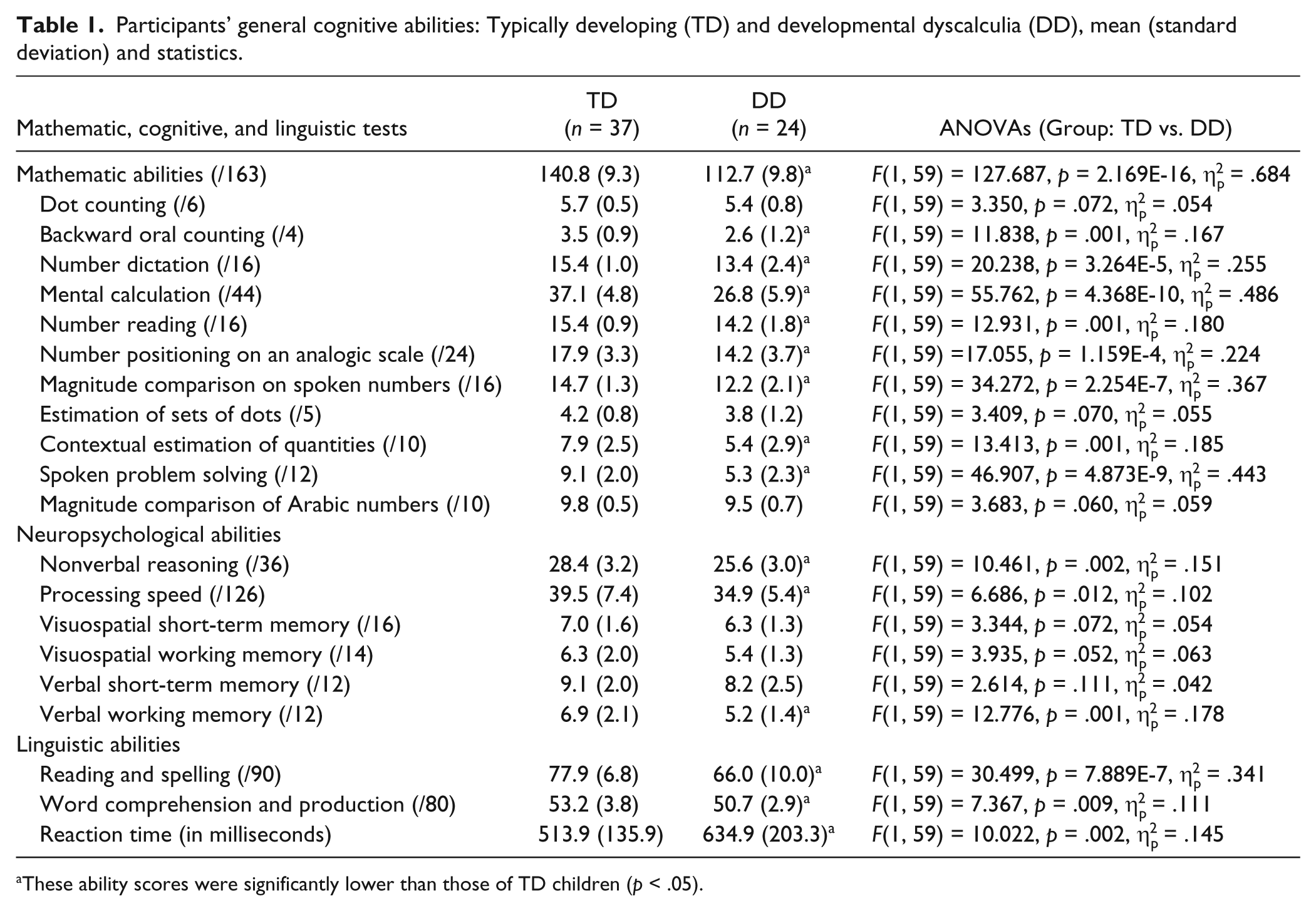
These ability scores were significantly lower than those of TD children (p < .05).
Tasks and Materials
Neuropsychological and linguistic abilities
A high comorbidity of dyscalculia and other developmental deficits such as dyslexia has been demonstrated (Gross-Tsur et al., 1996), leading some researchers (e.g., Geary,1993) to propose that dyscalculia could result from a general deficit affecting cognitive functions such as working memory. Thus, all children first underwent a general neuropsychological assessment tapping the cognitive domains sensitive to number processing. Neuropsychological abilities assessed were nonverbal reasoning (Raven’s Coloured Progressive Matrices; Raven, 1977), visuospatial and verbal short-term and working memory (Corsi Block Test; Corsi, 1972; Isaacs & Vargha Khadem, 1989), and forward and backward digit repetition (subtests of the Zareki-R; Dellatolas & Von Aster, 2006). Linguistic abilities were assessed with the Reception (spoken word-to-picture matching) and Production subtests (picture naming) of the Évaluation du Langage Oral battery (Khomsi, 2001) and with the Reading and Spelling subtests of the Batterie Analytique du Langage Écrit battery (Cogni-science, 2010).
Experimental tasks
Access to the MNL and its integrity per se were assessed with two experimental tasks consisting of (a) locating on a physical number line the magnitude of a symbolic number or an analogic numerosity (i.e., number-to-position transcoding) and (b) producing a symbolic or an analogic numerosity corresponding to the magnitude specified on a physical number line (i.e., position-to-number transcoding).
Each child was tested individually in a quiet room in his or her school. Testing took place from February to June of the school year. Each child was tested during one session that lasted between 45 min and 1 hour. The presentation order of the experimental tasks was randomized between children. All the stimuli were presented on a computer screen with DMDX (Forster & Forster, 2003), a method that allows for controlling the presentation time of stimuli. Children were asked to answer by writing on a sheet of paper with a pencil or by producing a spoken response.
Nonsymbolic tasks
In the number-to-position transcoding task, an analogic number was presented to the child, who was asked to estimate and locate the corresponding magnitude on a physical number line. The analogic number consisted of a set of dots (blue circles of various sizes, randomly distributed in a 10-centimeter square). The dot size was controlled (various dots of various sizes distributed over an identical surface area) with a program developed by Price, Palmer, Battista, and Ansari (2012). The child was given a pencil and a sheet of paper on which was drawn a 20-centimeter horizontal number line from 0 to 100. The start (an empty square) and the end (a square with 100 circles) points of the line were marked with analogic numerosities. Children were asked to quickly and approximately estimate the magnitude of each numerosity by putting a mark across the line.
In the position-to-number transcoding task, a 20-centimeter horizontal number line from 0 to 100 with a mark corresponding to a specific magnitude was presented on the computer screen. The child was given a response sheet comprising 100 dots randomly displayed in a 10-centimeter square and was asked to quickly surround with a pencil (without counting) the approximate number of dots corresponding to the magnitude of the mark (see Figure 1).
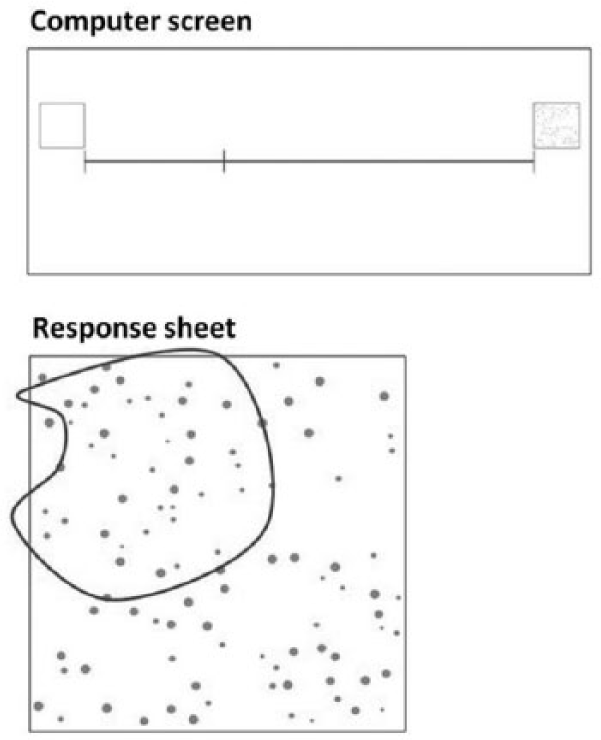
Illustration of the position-to-analogic number transcoding task.
The following 20 numerosities were randomly presented in each task: 1, 4, 5, 8, 11, 19, 24, 27, 33, 36, 47, 53, 58, 62, 65, 76, 84, 89, 93, and 96 in the number-to-position task; and 1, 3, 6, 8, 13, 18, 22, 29, 31, 34, 45, 52, 57, 63, 67, 74, 86, 88, 91, and 95 in the position-to-number task.
Five practice trials were proposed to allow children to familiarize themselves with the tasks. Each trial started with the presentation of the target numerosity, which remained on the screen until response or until 7,000 milliseconds, and was followed by a 1,000-millisecond delay.
Symbolic tasks
The same transcoding tasks were used to assess MNL access from symbolic numbers presented in Arabic and spoken forms.
In the number-to-position transcoding tasks, a symbolic number was presented to the child, who was asked to estimate and locate that number on a number line. In the Arabic modality, an Arabic number (Calibri, 22 millimeters) was presented in the center of the computer screen. In the spoken modality, an earphone picture was presented on the computer screen and the child was presented with a spoken number through earphones at an intensity of 70 decibals. Children were given a pencil and a sheet of paper on which was drawn a 20-centimeter horizontal number line from 0 to 100. The start and end points were marked with Arabic numbers in the Arabic modality (0 and 100) and with verbal written numbers in the spoken modality (zero “zero” and cent “hundred”). Each child was asked to quickly and approximately estimate the magnitude of the symbolic number by putting a mark across the line.
In the position-to-number transcoding tasks, a 20-centimeter horizontal number line from 0 to 100 with a mark corresponding to a specific magnitude was presented on the computer screen. The child was asked to estimate this magnitude by writing the corresponding Arabic number on a sheet of paper (Arabic modality) or by producing the corresponding spoken number (spoken modality).
The following 20 numerosities were randomly presented in each task and in each modality: 2, 4, 7, 9, 12, 17, 21, 28, 32, 35, 46, 56, 59, 61, 64, 73, 85, 88, 92, and 97 in number-to-position with Arabic numbers and in position-to-number with spoken numbers transcoding; 1, 3, 6, 8, 13, 18, 22, 29, 31, 34, 45, 52, 57, 63, 67, 74, 86, 88, 91, and 95 in spoken number-to-position transcoding; 1, 4, 5, 8, 11, 19, 24, 27, 33, 36, 47, 53, 58, 62, 65, 76, 84, 89, 93, and 96 in position-to- (Arabic)-number transcoding.
Five practice trials were proposed to allow children to familiarize themselves with each task. Each trial started with the presentation of the target number, which remained on the screen until response or until 7,000 milliseconds, and was followed by a 1,000-millisecond delay.
Data analysis
The two experimental tasks consisted of magnitude estimation, and exact responses were not expected (i.e., there was no right or wrong response). Therefore, similar to studies in which such estimation tasks were used (e.g., Siegler & Opfer, 2003), initial analyses involved comparisons of the fit of linear, logarithmic, and exponential models to the median estimates for numerical values of each group for each task, each modality, and each of the 20 numbers. Medians rather than means were used to minimize the effect of outliers. More particularly, we compared the fit of linear and logarithmic models to the median estimates in the number-to-position transcoding task and the fit of linear and exponential models to the median estimates in the position-to-number transcoding task in accordance with Siegler and Opfer (2003). t tests were then computed in each modality on the percentages of variance (r²), which accounted for linear function in TD and DD children. Regarding the response analyses, we calculated the percent absolute error (PAE) to score the children’s performances for each estimated number (Siegler & Booth, 2004): PAE = ([child’s estimate− number to be estimated] / number line scale), as it was also conducted in Hornung, Schiltz, Brunner, and Martin (2014). For example, in the number-to-position task with nonsymbolic numerosities, if the magnitude of the stimuli was 20, and the child marked a position corresponding to 40 on the physical mental line, the PAE would be 0.20 (i.e., [40-20] / 100 = 0.20; corresponding to 20% of absolute error). From these calculations, mean PAE scores were computed.
Results
Neuropsychological and Linguistic Abilities
A MANOVA was first performed and revealed a main group effect on overall neuropsychological and linguistic abilities, F(8, 52) = 5.600, p = 3.977E-05; Pillai’s trace = .463, ηp2 = .463. Given this group effect, univariate main effects were then examined, and impairment in the following tests were identified: Raven’s Coloured Progressive Matrices; Coding subtest of the Wechsler Intelligence Scales for Children, fourth edition; and the backward digit repetition subtest of the Zareki-R (see Table 1), indicating that the performance of the DD group was significantly poorer than that of the TD group for nonverbal reasoning, processing speed, and verbal working memory. Furthermore, the results showed a marginal Group effect (TD > DD) in tasks measuring visuospatial memory (forward and backward Corsi Block Test). Finally, the analysis did not show a Group effect in the forward digit repetition subtest of the Zareki-R that the two groups did not differ significantly for verbal short-term memory. With regard to linguistic abilities, an ANOVA (Group: TD vs. DD) showed a Group effect in the total number of correct responses for both Reception and Production subtests of the Évaluation du Langage Oral and for both Reading and Spelling subtests of the Batterie Analytique du Langage Écrit, indicating that the performance of the DD group was significantly poorer than that of the TD group with respect to word comprehension and word production abilities as well as reading and spelling abilities. In summary, compared to TD children, children with DD were significantly less successful for nonverbal reasoning, processing speed, verbal working memory, word comprehension and production, and reading and spelling. These data were entered as covariates in the results analyses of the experimental tasks.
Experimental Tasks
Nonsymbolic tasks
As shown in Table 2, the best fit was the linear equation for the TD and DD groups in the two nonsymbolic tasks.
Fit of linear and logarithmic or exponential models to the median estimates of children on experimental tasks for typically developing (TD) and developmental dyscalculia (DD).

In accordance with Siegler and Opfer (2003), we compared the fit of linear and logarithmic models to the median estimates for numerical values for the number-to-position transcoding task. The exponential model did not show a good fit in this task. We compared the fit of linear and exponential models to the median estimates for numerical values for the position-to-number transcoding task. The logarithmic model did not show a good fit in this task.
Further analysis was performed in order to examine the linear curve fit in DD and TD children. Therefore, t tests (Group: TD vs. DD) were performed for each task on the percentage of variance (r²) accounting for linear function. The results showed that children with DD had a marginally lower r² than TD children for the number-to-position transcoding task, t(59) = 2.025, p = .052, and for the for position-to-number transcoding task, t(59) = 1.983, p = .054, suggesting similar linear curve fits in DD and TD children. An ANCOVA was then performed on the percentage of variance (r²) accounting for linear function with all general cognitive measures as covariates. The results showed that the marginal Group effect disappeared for the number-to-position transcoding task, F(1, 51) = 1.956, p = .168, ηp2 = .037, as well as for the position-to-number transcoding task, F(1, 51) = 1.836, p = .181, ηp2 = .035.
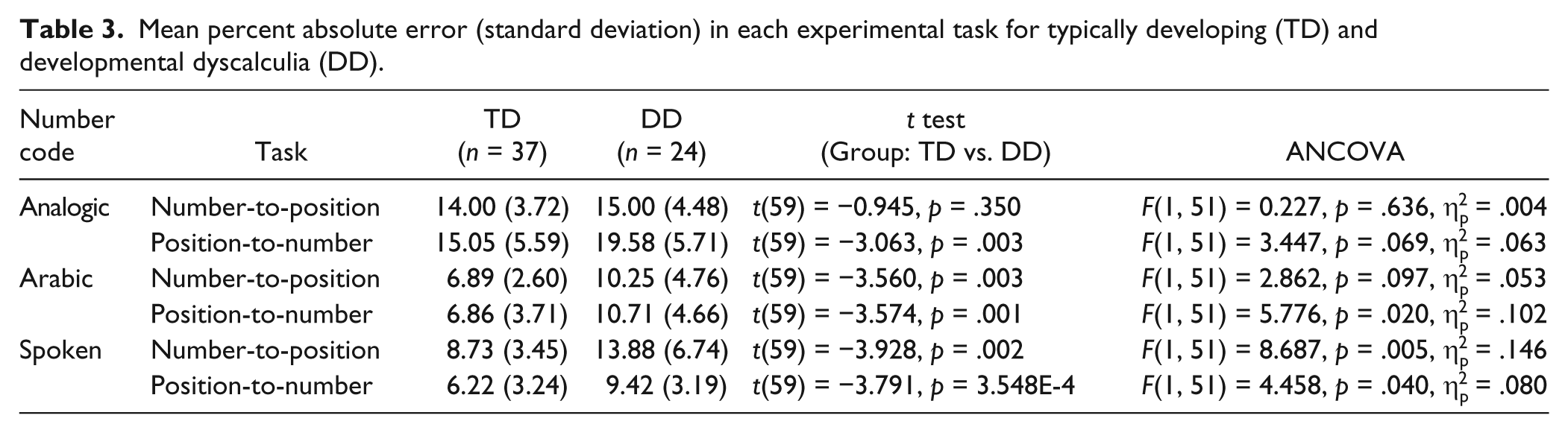
t tests (Group: TD vs. DD) were also performed on the PAE in each task. As presented in Table 3, the results showed that the PAE of children with DD was as large as that of TD children in the number-to-position transcoding task but larger than that of TD children in the position-to-number transcoding task. An ANCOVA, including scores on cognitive measures as covariates, was then performed for each task. The analyses showed that the Group effect remained significant when each cognitive variable was entered as a covariate one at a time but disappeared when they were processed together.
Mean percent absolute error (standard deviation) in each experimental task for typically developing (TD) and developmental dyscalculia (DD).
Symbolic tasks
The same analyses were performed on symbolic tasks. First, the best fit for the TD and DD groups in each modality and each task was the linear equation (see Table 2).
Second, children with DD had a lower r² than TD children for the number-to-position, t(59) = 3.015, p = .006, and position-to-number transcoding tasks, t(59) = 2.056, p = .042, in the Arabic modality as well as for the number-to-position, t(59) = 2.411, p = .022, and position-to-number transcoding tasks, t(59) = 2.546, p = .014, in the spoken modality. Overall, children with DD showed less linear curve fit than TD children for symbolic numbers. An ANCOVA was then performed for each task and each modality on the percentage of variance (r²) accounting for the linear function with each general cognitive measure as a covariate. The results showed that the Group effect remained significant for the number-to-position task in the Arabic modality, F(1, 51) = 6.566, p = .013, ηp2 = .114. However, the Group effect disappeared for the position-to-number transcoding task in the Arabic modality, F(1, 51) = 2.833, p = .098, ηp2 = .053, as well as for the number-to-position, F(1, 51) = 1.721, p = .195, ηp2 = .033, and position-to-number transcoding tasks, F(1, 51) = 2.401, p = .127, ηp2 = .045, in the spoken modality.
Finally, the PAE of children with DD was larger than that of TD children for number-to-position and position-to-number transcoding tasks in the Arabic modality as well as for number-to-position and position-to-number transcoding tasks in the spoken modality (see Table 3). An ANCOVA was performed for each task and each modality on the PAE with each general cognitive measure as a covariate. The Group effects remained significant in the two modalities when each cognitive variable was entered as a covariate one at a time. When all the cognitive variables were processed together, the Group effect became marginal for the number-to-position task in the Arabic modality but remained significant for the other tasks.
Discussion
In the present study, we investigated the integrity of the MNL in children with dyscalculia through the assessment of their abilities to place symbolic numbers and nonsymbolic numerosities on a physical number line (number-to-position transcoding task) and to produce symbolic numbers and nonsymbolic numerosities from a physical number line (position-to-number transcoding task). These tasks were designed to answer the following research questions: (a) Does dyscalculia originate from a deficit of the MNL per se, supporting the number sense deficit hypothesis? or (b) Does dyscalculia come from a deficit in the MNL access from symbolic numbers, supporting the number access deficit hypothesis?
In summary, results showed that with respect to MNL acuity, the best fit was the linear equation for both TD and DD groups in each nonsymbolic and symbolic task. Children with DD showed a less linear curve fit than TD children in the two transcoding tasks involving Arabic and spoken symbolic numbers, while no difference in the linear curve was observed in the two groups for nonsymbolic numbers. Moreover, the PAE was larger in children with DD compared to TD children for both Arabic and spoken numbers. With regard to analogic numbers, the PAE was not different in children of the two groups in the number-to-position transcoding task, while the PAE of children with DD was larger than that of TD children in the position-to-number transcoding task.
Until now, researchers showed that with respect to MNL acuity, children with DD had a logarithmic curve fit for 1 to 100 spoken numbers at 6 to 8 years old, whereas children without MD had already gotten a linear curve fit (Geary et al., 2008). Children aged 9 to 10 with DD showed a linear curve fit for Arabic numbers from 1 to 100 as children without MD (Landerl et al., 2009). However, they showed a logarithmic curve fit for Arabic numbers from 1 to 1,000, whereas children without MD had already gotten a linear curve fit (Landerl et al., 2009). Finally, children aged 11 to 12 showed less linear curve fit than children without MD for Arabic numbers from 1 to 1,000 (Andersson & Östergren, 2012). To our knowledge, the study that we have performed is the first to show that MNL acuity in children with DD of 8 to 9 years old fits the linear curve, no matter the symbolic or nonsymbolic nature of numbers from 0 to 100. Based on these data solely, one could conclude that the MNL is preserved in children with DD. However, the analyses conducted to measure the acuity of the MNL showed that the portrait is not so clear-cut.
In our study, children with DD did not present any difficulties (i.e., their curve fitted the linear model, and their PAE was similar to that of TD children) placing nonsymbolic numerosities on a physical mental line, a result suggesting that the MNL per se was not impaired. These results suggested the preservation of the number sense in children with DD. They ran counter the results of van Viersen et al. (2013), who were the only researchers reporting an impairment to place analogic numbers on a number line in a single-case study of a 9-year-old girl with DD. However, in the opposite direction (i.e., position-to-number transcoding task with analogic numerosities), the performance of children with DD was similar to that of TD children regarding the linear curve fit, but not for the PAE, which was larger. In our opinion, the dissociation observed in children with DD between success in the number-to-position task and impairment in the position-to-number transcoding task could be explained by the inherent characteristics of the two tasks and by the fact that the two transcoding tasks did not seem to reflect the same processes. In the number-to-position transcoding task performed with Arabic numbers, children 7 to 8 years old showed a logarithmic model of the objective number stimulus before showing a more mature and precise linear model at 11 to 12 years old. However, they initially showed an exponential model in the reverse position-to-number transcoding task (Ashcraft & Moore, 2012; Siegler & Opfer, 2003). A possible explanation is that the number-to-position task simply requires one to spatially and globally match the perceived nonsymbolic numerosities to the physical number line. As explained by Iuculano and Butterworth (2011), using such a task encouraged a direct mapping onto a defined physical space so that children could access and represent (i.e., linearly) the real value of numerosities and process them in a holistic way. Inversely, the position-to-number transcoding task required one to transcode a position on a physical number line to nonsymbolic numerosities or, in other words, to transcode a continuous input to a discontinuous output, a process that could require greater effort. This interpretation is compatible with the idea that when allowed or encouraged by the task, the use of analytic strategies, such as a symbolic mediation, might be preferred to the access to numerosities because of the input difficulty consisting of a continuous, nondirectly perceived number (Iuculano & Butterworth, 2011). Given the fact that in our study, children with DD presenting impairment in the MNL access from Arabic and spoken numbers, such a symbolic mediation would explain the difficulty they presented with analogic numerosities in the position-to-number transcoding task. Further studies are needed to confirm this hypothetical interpretation.
Pertaining to the second research question, our results showed a deficit in MNL access from symbolic numbers in children with DD. Compared to TD children, they were impaired in the two tasks with the physical mental line involving the transcoding of Arabic and spoken numbers. In these tasks, they showed a less linear curve fit (i.e., a lower percentage of variance, r²) and produced a larger PAE than TD children. Our results were consistent with those reported by Andersson and Östergren (2012), who also showed that in 10- to 12-year-old children with DD, the Arabic representations of numbers from 1 to 1,000 were less linear in the TD children. They were also in line with the case study of a 9-year-old girl with DD (van Viersen et al., 2013) who was impaired (i.e., her MNL corresponded to logarithmic representations, and her PAE was larger than those of her pairs) to place Arabic numbers on a physical number line. To our knowledge, only one study (Geary et al., 2008) explored the transcoding of spoken numbers on a physical number line and showed an impairment in children with DD of 6 to 8 years old.
Given our results, we suggested that children with DD did not present a general deficit of the MNL but rather a specific deficit in accessing it from symbolic numbers, therefore affecting the capacity to place symbolic numbers on a physical number line and to produce symbolic numbers from a physical number line. Furthermore, our results highlighted the importance of symbolic numbers in mathematical development, as already demonstrated in many studies. For example, it has been shown that the ability to place spoken numbers on a physical number line was critical for mathematical development in children aged 7 to 8 (Praet & Desoete, 2014). Also, the capacity to place Arabic numbers on a physical number line was predictive of the exact calculation abilities of young, 5- to 6-year-old children in kindergarten (Xenidou-Dervou et al., 2014). Moreover, Purpura, Baroody, and Lonigan (2013) showed that the relation between informal (e.g., nonsymbolic comparison) and formal (e.g., calculation) mathematical knowledge was fully mediated by the ability to process Arabic numbers and to connect them to their corresponding quantities. This study has thus demonstrated that success in calculation abilities was directly linked to the comprehension of the relations between number sense and Arabic numbers. Our results did not support the number sense deficit proposed by Dehaene (1992, 2010) or the MNL deficit proposed by Von Aster and Shalev (2007) to account for DD in children. However, they strongly supported the interpretation made by Noël and Rousselle (2011), who suggested that dyscalculia is a specific deficit in accessing number sense from Arabic numbers. In our study, we also showed the presence of such an access deficit from spoken numbers.
The triple-code model (Dehaene, 1992, 2010) and the developmental model of number acquisition (Von Aster & Shalev, 2007) join a more general debate about the MNL being an innate or an acquired ability (see Everett, 2013, for a review). Some authors claimed that innate numerical abilities are found in infants (Antell & Keating, 1980; Starkey & Cooper, 1980; Wynn, 1992), in adults without mathematic language and education (Butterworth, Reeve, Reynolds, & Lloyd, 2008; Frank, Everett, Fedorenko, & Gibson, 2008; Gordon, 2004), and even in animals (e.g., Brannon, 2005). In this respect, the triple-code model (Dehaene, 1992, 2010) also postulates that the MNL is innate, while according to the developmental model of number acquisition by Von Aster and Shalev (2007), the development of a mature MNL depends on the prior development of three numerical abilities: (a) an inherited basic number sense based on a core-system representation of magnitude, (b) the acquisition of number words during preschool, and (c) the primary school learning of Arabic symbols. Therefore, the impairment observed in children with DD of the present study to place Arabic and spoken numbers on a physical number line could simply reflect their problems processing symbolic numbers. This result combined with the preservation of their ability to process analogic numbers thus seemed to confirm the triple-code model (Dehaene, 1992, 2010) and to challenge the developmental model of number acquisition (Von Aster & Shalev, 2007).
Some limitations of the present study warrant consideration. First, the neuropsychological evaluation showed that children with DD also presented nonnumerical deficits (e.g., verbal working memory), suggesting a general cognitive deficit. According to Geary (1993, 2010), mathematical difficulties could be explained by a cognitive deficit affecting general and basic functions such as working memory. Further studies should assess children with mathematic difficulties only to disentangle what is related to numerical processing and what resorts to cognitive deficits. Second, the present study used a bounded physical number line to assess the integrity of the MNL. Nonetheless, Reinert, Huber, Nuerk, and Moeller (2015) suggested that using such a number line assesses more strategies such as proportion-based estimation (Barth & Paladino,2011) and not specific numerical estimations. According to these authors, an unbounded physical number line might measure numerical estimation more “purely.” Hence, further studies should use unbounded number lines to more specifically assess the integrity of the MNL in children with MD.
The present study had implications for clinicians working with children living with DD. The results of our study showed that children with DD did not have a general deficit of the MNL but rather a specific access deficit to the MNL from symbolic numbers. Therefore, our study suggests that the assessment of mathematical capacities cannot be limited to calculation skills or solving problems but should include an extensive investigation of numerical abilities, involving the ability to place Arabic and spoken numbers on a physical number line.
This study also opens up new research perspectives. Further studies are needed to confirm our results. Other studies should also address the specific development of the MNL in children with and without dyscalculia. Their abilities to access the MNL with nonsymbolic and symbolic numbers at various ages of development could inform the exact learning sequence of numerical abilities as well as the relationship between symbolic numbers, analogic numbers, and the MNL. Furthermore, an investigation of the involvement of symbolic number deficits in MD in children is essential. More precisely, it is important to analyze the role of Arabic number processing and that of spoken number processing in symbolic number processing. For example, studies with younger children in a longitudinal paradigm could be useful to examine these questions.
Footnotes
Authors’ Note
We would like to thank the following participating schools for their collaboration: La Mosaïque, St Fidèle, La Farandole, St Pierre et St Laurent de l’île d’Orléans, Sous bois, St Jean Baptiste, Cap Soleil et St-Pierre, L’Orée des bois, Trivent, et Institut Saint-Joseph. The present study was approved by the Ethics Committee of the Research for the Centre de Recherche de l’Institut Universitaire en Santé Mentale de Québec.
Declaration of Conflicting Interests
The author(s) declared no potential conflicts of interest with respect to the research, authorship, and/or publication of this article.
Funding
The author(s) received no financial support for the research, authorship, and/or publication of this article.