



Abstract
Training in phonological awareness has brought about well-documented positive effects on learning to read in lower-primary grades. Less is known about long-term gains extending to upper-primary and junior high school. The few longitudinal studies covering at least 5 years suggest that gains in decoding are sustained, whereas effects on reading comprehension have either not been studied or produced equivocal results. The present study followed up the reading development of 209 Finland Swedish students from kindergarten until Grade 9, half of whom participated in an 8-month phonological intervention in kindergarten. The intervention group outperformed the control group in both word reading and reading comprehension in Grades 1 through 9. However, albeit statistically significant, the differences at the group level were small. The main result was a clear-cut difference in both skills among readers at risk belonging to the lowest 25% in foundational skills at the beginning of kindergarten. In Grade 6, altogether 60% of the nontrained readers at risk still belonged to the lowest quartile in reading comprehension as opposed to 24% of their peers in the intervention group. The pattern was repeated in Grade 9, with trained readers at risk performing at the level of nontrained mainstream readers.
A well-grounded expectation is that when training in phonological awareness is given before children have learned to read, virtually all children will benefit from it, with gains seen particularly in initial word-reading ability (e.g., Bus & van IJzendoorn, 1999; Ehri et al., 2001). Drawing on a bold statement of a causal connection between phonological skills and beginning to read (Bradley & Bryant, 1983), Lundberg, Frost, and Petersen (1988), using a large unselected sample of kindergartners, demonstrated that the entire training group showed a gain in a word-to-picture recognition task in Grades 1 and 2. A later meta-analysis by Suggate (2010) arrived at the same conclusion. However, besides the general gains, a strong interest lies in the reading development of those children who, because of poor reading readiness skills, are at risk of reading failure. Even concerning this subgroup, the evidence speaks in favor of early intervention (for reviews and meta-analyses, see Al Otaiba, Puranik, Ziolkowski, & Montgomery, 2009; Bus & van IJzendoorn, 1999; Ehri et al., 2001; Schneider & Stengård, 2000; Suggate, 2016), with sizeable gains in word-reading skills being found in elementary grades. Moreover, studies on reading development in general suggest that the position of a young reader as compared to the peer group is established early. If no remedial teaching is provided, students with the poorest reading ability at the end of Grade 1 tend to remain so in later grades (de Jong & van der Leij, 2003; Elwér, Keenan, Olson, Byrne, & Samuelsson, 2013; Juel, 1988; Landerl & Wimmer, 2008; Lundberg, 1994; Svensson & Jacobson, 2006).
Questions thus arise as to whether training in phonological awareness given prior to the teaching of reading results in a permanent change in the position of children at risk of reading failure. Obviously, a sufficiently accurate word-reading ability is the sine qua non for reading ability to develop. Interventions targeting phonological awareness promote specifically word-decoding ability, which is likely to lead to a growth in vocabulary knowledge (e.g., Perfetti & Stafura, 2014). Although beneficial in general, word-reading ability as such is not adequate for an efficient comprehension of continuous texts. Hence it is possible that successful training in phonological awareness results in clear-cut accuracy gains when beginning to read but not in the progress of reading fluency because the latter is not targeted by interventions but rather depends on the amount of reading children perform; this is mostly done on a voluntary basis. Somewhat unexpectedly and despite the training success, there is a striking lack of studies relevant to the maintenance and further development of training-related gains. The crucial problem is whether the positive change due to training in phonological skills will be sustained throughout the school career. In other words, do the former readers at risk continue to perform above an agreed cutoff level for reading difficulty? This means that both reading accuracy and fluency as well as reading comprehension are at stake. To our knowledge, there are only seven studies that have a bearing on this question. Each study features a follow-up of at least 5 years (Blachman et al., 2014; Byrne, Fielding-Barnsley, & Ashley, 2000; Elbro & Klint Petersen, 2004; Kjeldsen, Kärnä, Niemi, Olofsson, & Witting, 2014; Partanen & Siegel, 2014; Snowling & Hulme, 2011; Wolff, 2016). However, the results are equivocal. Thus, our purpose is, after analyzing existing evidence, to provide a study of kindergarten training in phonological awareness with a 9-year follow-up of decoding fluency and reading comprehension in Grades 1, 3, 4, 6, and 9, that is, covering the compulsory education.
Are Training Effects Limited to Word-Reading Ability?
Blachman et al. (2004, 2014) studied the same sample over 11 years. In the initial intervention study, 69 second- and third-grade struggling readers were chosen on the basis of a performance below the 25th percentile on word reading. The training group received 8 months of one-to-one tutoring in decoding and word recognition, while the comparison group participated in the standard tutoring provided by the schools. After 1 year, the children with training still showed significant gains relative to the comparison group in word recognition, reading rate, spelling, and passage reading, with the effect sizes (d) ranging from moderate to strong. After 11 years, two out of the 12 reading and spelling measures showed a training-related effect. These were the Woodcock Basic Skills Cluster (d = 0.53) and Woodcock Word Identification (d = 0.62). In other words, far-reaching gains were found at the most basic level of word reading. It is also of note that 1 to 2 years of teaching to read preceded the intervention. In her randomized study on 9-year-old readers at risk with a word-reading ability under the 16th percentile, Wolff (2016) replicated the results of Blachman et al. (2014). Her intervention also included training in reading fluency and comprehension and resulted in immediate gains in every skill trained. Five years later, only the gains associated with word decoding could be observed. It is noteworthy that those with the poorest initial decoding skills in Grade 3 showed the best training-related progress in Grade 9.
It can be argued that the absence of long-term comprehension gains in the studies of Blachman et al. (2014) and Wolff (2016) may have been caused by the late start in training, which took place after the reading level had already been stabilized (e.g., Landerl & Wimmer, 2008), and thus the optimal time window was lost. Partanen and Siegel (2014) identified 140 kindergarteners as readers at risk on the basis of a performance below the 25th percentile in the Wide Range Achievement Test 3 Reading test. Classroom training in phonological awareness was provided for all the children, and in addition, the readers at risk also participated in an intensive program featuring similar content. The authors do not report the Grade 7 results for spelling and reading comprehension, but the training-related gains were clearly apparent for word-reading skills. More specifically, of the original readers at risk composing the lowest quartile, only 6% remained in that range in Grade 7. The early findings of Byrne et al. (2000) concerning a phonemic awareness training given to unselected kindergarteners engendered a sense of disappointment, because even students showing reading failure 6 years later had performed satisfactorily in the posttest of phonemic awareness training. Intriguingly however, reading problems in Grade 5 were associated with a slow rate of response to training; this means that the session of last erroneous performance occurred significantly later among struggling readers than among students with typical reading development. The authors concluded that while the average performance may not differentiate trained and untrained groups, the learning rate does. It is also possible that while average reading scores are largely similar for training and control groups, the distributions may differ, with fewer trained children having very low scores. On the whole, the results of Blachman et al. (2014) and Wolff (2016) allude to the possibility that the long-term effects of early training in phonological awareness may be restricted to the very basic reading level, because those effects on comprehension are conspicuous by their absence. Two other relevant studies, Byrne et al. (2000) and Partanen and Siegel (2014), leave the question open because they did not include reading comprehension in the final follow-up tests.
Unlike English, learning to decode and learning to spell proceed hand-in-hand in more regular orthographies such as Swedish and Finnish. Therefore, transfer effects of phonological awareness training on spelling are predictable. Of considerable interest is whether such effects can also be obtained for readers at risk. In a kindergarten training study, Poskiparta, Niemi, and Vauras (1999) found a strong effect (Cohen’s d = 1.7) at the end of Grade 1 for Finnish-speaking students who scored among the lowest 11% in a pretest of phonological awareness. Using a more lenient criterion of 25th percentile or less, a previous study of the present sample found an effect size of 0.67 at the end of Grade 1 (Kjeldsen, Niemi, & Olofsson, 2003). A further relevant question is whether progress in initial spelling ability is reflected in literacy development in subsequent grades.
Phonological Training and Reading Comprehension
To date, three studies have found evidence of long-term gains in reading comprehension that can be traced back to training in phonological awareness. Elbro and Klint Petersen (2004) trained kindergarteners with a familial risk of dyslexia. Follow-up tests in Grades 2, 3, and 7 showed that these children outperformed the at-risk control group in word- and nonword-reading efficiency including a fluency component. Reading comprehension in Grade 7 showed a statistically nonsignificant trend in favor of the training group, while the not-at-risk control group outperformed both at-risk groups. However, an additional post hoc analysis revealed an intriguing finding: The very poorest Grade 7 readers showed a training-related advantage in comparison with the students at risk who were not trained such that significantly fewer of them performed under the 5th percentile in reading comprehension. This finding is in line with the suggestion of Byrne et al. (2000) that training effects may be related to the distribution of the data rather than indicating a difference in the group averages.
In a similar vein, Snowling and Hulme (2011) asked the question of how well an intervention could raise children with a high risk of reading problems to a more typical range of language and reading skills. Children representing 8% of the lower end of reading-readiness skills were sampled from a school beginner pool when they were 5 to 6 years old. An intervention, combining phonological awareness with basic elements of reading, was conducted during the 1st year of compulsory education. As predicted, an immediate posttest showed sizeable gains in single word reading, and these were sustained after 11 months. Interestingly, a reading comprehension test in Grade 6 showed that the average performance of the training group was close to the population mean. This positive finding was corroborated and extended to higher grades in a Finnish study of Swedish-speaking students (Kjeldsen et al., 2014). In the study, training in phonological awareness was given to unselected training and control groups comprising two thirds of the age class in the district. The intervention had a strong positive effect on the level of decoding in Grades 3, 4, and 6 but not on the slope depicting development. The level of decoding also significantly predicted reading comprehension in Grade 9. The effects of the intervention on reading comprehension were, for the most part, indirect and mediated by the level of decoding. However, the effect size (d) was 0.31, indicating a small effect. Finally, indirect evidence of comprehension effects can be found in a study by Etmanskie, Partanen, and Siegel (2016; Figure 1) on the same children who participated in the Partanen and Siegel study (2014). In Grade 2, the students with early poor comprehension were grouped at the 7th percentile. However, there appeared to be an improvement in reading comprehension until Grade 7, when the same students were then grouped around the 25th percentile.

Multiple-group path model for the development of reading ability following the kindergarten phonological training intervention.
It can be concluded that studies on early training in phonological awareness have produced scant evidence of any long-term effects that would extend over at least 5 years. Moreover, such effects appear more predictable for decoding than comprehension (Blachman et al., 2014; Byrne et al., 2000; Wolff, 2016). Obviously, long-term effects on reading comprehension are the ones most desired. However, despite the absence of such findings (Blachman et al., 2014; Partanen & Siegel, 2014; Wolff, 2016), there are indications that when the analysis is focused on readers with the poorest initial prognosis, a positive outcome may be observable (Elbro & Klint Petersen, 2004; Etmanskie et al., 2014; Snowling & Hulme, 2011). This is supported by a close inspection of the sampling criteria, which have varied from the 25th percentile in reading readiness (Blachman et al., 2014; Partanen & Siegel, 2014) and the 16th percentile in word decoding (Wolff, 2016) to a more stringent 8th percentile in reading readiness (Snowling & Hulme, 2011) and familial risk for dyslexia (Elbro & Klint Petersen, 2004). Moreover, such restricted effects may be more clearly seen in the ranking distribution of students rather than as differences between group averages (Byrne et al., 2000; Elbro & Klint Petersen, 2004; Partanen & Siegel, 2014; Snowling & Hulme, 2011).
Current Study
The point of departure for the present study was the positive albeit small gains in reading fluency and comprehension found by Kjeldsen et al. (2014) for unselected students. In the present study, reading development was delineated throughout the 9-year compulsory education following training in phonological awareness given during the kindergarten year. We propose a theoretical model in which immediate training-related gains in phonological awareness are transferred to better word decoding and spelling ability in Grade 1. This positive development is expected to continue and, through improved decoding ability, extend to improved reading comprehension in later grades. Second, we examine whether the immediate intervention effect and the ensuing chain-link process of reading development differ between kindergarteners defined as at risk for reading failure and those not at risk. Third, we follow up the at-risk kindergarteners to elaborate on how their reading development is associated with participation in the intervention. The hypothesis for the current study is that the original findings will be seen as consisting of two differing trends and, subsequently, that the training-induced effects on both decoding and comprehension will be smaller for mainstream readers than those at risk. It is also hypothesized that during the following school years, fewer at-risk kindergarteners will remain in the risk group from among the trained as opposed to the nontrained students.
Method
The study was conducted in the autonomous district of Åland, which is situated in the southwestern part of Finland. Eighty-eight percent of the population of approximately 29,000 have Swedish as their mother tongue. Swedish is also the language of teaching throughout the school curriculum. Swedish is a Germanic language and, together with Dutch, it can be placed around the middle in the range of shallow to deep orthographies (Seymour, Aro, & Erskine, 2003). Sound-to-letter correspondence is generally predictable, but unlike very shallow orthographies, such as Finnish, pseudowords can be created that sound like real words when read. Swedish-speaking first graders read pronounceable nonwords with a facility that approaches the performance of Finnish and Greek peers, that is, beginning readers of languages with nearly perfect grapheme-to-sound as well as sound-to-grapheme mapping (e.g., Goswami, 2010). The syllable structure of Swedish is more complex, and long compound words pose problems particularly for struggling readers (e.g., filkonverteringsprogrammet, “file conversion program”; see Olofsson, 2003). However, the general picture is that of a sufficient regularity that favors beginning readers and is excellently suited to early training of phonological awareness. Thus, it could be expected that training in Swedish offers faster results than in opaque orthographies, such as Danish, English, and Portuguese.
Children and adolescents in Åland show a similar high level of literacy as the rest of Finland. At the time of the intervention in 1997–1998, knowledge of phonological awareness had penetrated the educational training of kindergarten and preschool staff, and exercises in classrooms were common. From the point of view of the intervention, this makes it harder to produce training-related gains in literacy because even the control children had experience in pertinent language games.
Participants
The 209 original participants in the study by Kjeldsen et al. (2003) comprised two thirds of all the students entering kindergarten in Åland in 1997. Formal a priori power analysis was unfortunately not conducted at the beginning of the study. However, a meaningful post hoc power analysis (Cohen, 1988) was considered feasible because the present study was designed after that of Lundberg et al. (1988). The crucial intervention outcome was the training-induced gain in phonological awareness. We used the effect size (Cohen’s d) reported by Lundberg et al. as a proxy of the population parameter. A G*Power 3 statistical program (Faul et al., 2007) suggested a statistical power of 0.95 with sample sizes of 28 and 28 for the intervention and control groups, respectively. Thus, in retrospect, our study was sufficiently powered for detecting the targeted outcome.
The intervention took place in nine kindergarten classes, which belonged to five different elementary school districts in the southern part of the main island of Åland. All the children and all the kindergarten classes in this area participated. At the beginning of the study, in September 1997, the children had an average age of 6 years and 2 months. At the time of data collection in Grade 9, the average age of the available 191 students was 15 years 2 months. Attrition was mostly due to the nine children who remained for an extra year in kindergarten on the basis of prognostic data suggesting that an additional year would be beneficial for their academic debut. Additionally, seven children subsequently moved away from Åland and two children moved within Åland, resulting in a group change. (For additional information, see Kjeldsen et al., 2014.)
Selecting Readers at Risk
We defined the reader-at-risk status as low performance (<25th percentile) in the kindergarten pretest in both phonological skills and letter knowledge. There were 30 such children in the intervention group and 22 in the control group. The criteria are comparable to those used by Blachman et al. (2004, 2014) as well as by Partanen and Siegel (2014). Although the criterion leniency increases the probability of not finding differences between mainstream readers and those at risk for initial reading failure, the decision was necessary because of the small sample size.
Procedure
At the beginning of the kindergarten year (August and September 1997), both the training and control groups were pretested individually as regards phonological skills, letter knowledge, vocabulary, and signs of early reading. Identical posttests were given at the end of the training period. (For more details, see Kjeldsen et al., 2003.) Subsequent tests of literacy development were always given in April or May at the end of Grades 1, 3, 4, 6, and 9.
The intervention was given by the local kindergarten teachers. As noted, even the control children had participated in phonological language games to some extent. This was unavoidable because dissemination of the findings of Lundberg et al. (1988) had made them popular throughout Finland. The main difference between the intervention and control groups was the degree of systematicity and also quantity of phonological exercises in favor of the intervention group (see below). Control children followed the ordinary kindergarten curriculum featuring language and interaction, counting, local history and society, art and culture, and music and drama. More specifically, questionnaires given to their teachers indicated that language activities were organized in 10 out of 13 control kindergartens on average one or two times a week, including rhymes and jingles, some learning of the alphabet, and syllable and phoneme segmentation. The median group size across the intervention and control classes was eight children, varying from three to 18.
Training Program
The training program was adopted from Lundberg et al. (1988). It has been translated and adapted for U.S. classrooms (Adams, Foorman, Lundberg, & Beeler, 1998) as well as field-tested with U.S. kindergarten students and teachers (Foorman, Francis, Beeler, Winikates, & Fletcher, 1997; Foorman, Francis, Shaywitz, Shaywitz, & Fletcher, 1997). A detailed description of the present program can be found in Kjeldsen et al. (2003). The program started in September 1997 and continued for 8 months; during this period, 15- to 20-min sessions were arranged 5 days a week. The program was structured in a sequence beginning from an easy listening task to the most advanced levels of phoneme identification and manipulation. The program consisted of six groups of tasks with increasing difficulty. Each group consisted of seven to 12 tasks. A typical session consisted of five to nine short games or tasks, many of which were repetitions from previous sessions. A smaller number of the children received an amount of training corresponding to 60% of the complete program. As it transpired later, this smaller amount of training exerted a similar effect on reading and spelling in Grades 1 and 2 as the complete program (Kjeldsen et al., 2003). To ensure treatment fidelity, kindergarten staff in the training group were carefully instructed both in groups and individually about how to administer the tasks. During the year before the study, in-service courses open to all teachers in Åland presented the theoretical background. A pilot program with different students was implemented for the teachers of the training group in order to familiarize the involved teachers with the exercises and tests. Treatment fidelity was assessed through questionnaires to individual teachers, who also wrote diaries about their work. Teacher feedback was examined by the first author upon its arrival to monitor staff adherence to the program guidelines. The main response was that kindergarten staff experienced the intervention as a further step in their professional development. Organizing phonological exercises stimulated discussions about phonological awareness and language development in general. The enthusiasm of the children was reported as rewarding for the teachers.
Throughout Grades 1 to 9, special education instruction was provided for the students. In Finland, the special needs of students are determined by the classroom teacher, who then takes the initiative; no additional diagnosis is mandatory. Despite diminishing resources, special education services are amply provided for, with 10% to 15% of students participating annually (Statistics Finland, 2017).
Measures: Predictors
The kindergarten predictors consisted of the same tests used by Lundberg et al. (1988) at the beginning and end of the kindergarten year.
Letter Knowledge
Each child was presented, in a random order, with all the upper- and lowercase Swedish letters and was asked to say their respective names. The Scandinavian letters å, ä, and ö were included but not w. The maximum score was 56 and the reliability α = .98.
Phonological Awareness
The sum score (maximum = 58) of eight tests of phonological awareness (α = .96) was used. The tests were rhyming, word segmentation, syllable blending, syllable segmentation, initial phoneme identification, initial phoneme deletion, phoneme blending, and phoneme segmentation. Reliabilities of the subtests are not available.
Rhyming
The rhyme test had 18 items, each consisting of four simple pictures to which the examiner gave the corresponding names. The task was to select the two rhyming pictures. The maximum score was 18.
Word segmentation
Segmentation of sentences into words consisted of one sentence with five monosyllabic words and one with seven multisyllabic words. The examiner presented a sentence orally and asked the child to mark each word in the sentence with a plastic marker. The maximum score was 2.
Syllable blending
In this test, the examiner presented a word, syllable by syllable, with a pause of 2 s between each syllable. Each syllable had a marker placed on the table in front of the child, from left to right. The child repeated the syllables and was then asked to say the resulting word, which was then checked against a picture turned face-down. Three multisyllabic items were used. The maximum score was 3.
Syllable segmentation
Syllable segmentation was similar to the syllable-blending test, but in this exercise the child and the experimenter changed roles. Now the child had the picture and was asked to present the word syllable by syllable to the experimenter. The test items were three multisyllabic words. The maximum score was 3.
Initial phoneme identification
In the initial phoneme identification test, the child deciphered the initial sound of a word illustrated by a small drawing. Eight common nouns of increasing length from two to five phonemes were used. The structure of the words was consonant vowel (CV), CVC, CCVC, CVCC, CVCVC, and CVCCV. The last two structures consist of two syllables. This test was done as part of the following subtest of initial phoneme deletion. The maximum score was 8.
Initial phoneme deletion
Initial phoneme deletion was attempted after the identification of the initial sound of the word, either successfully or with help from the experimenter. This was done by saying aloud the remaining part of the word after the first sound had been deleted. The same words were used as in the former subtest. The maximum score was 8.
Phoneme blending
In this test, a word was presented phoneme by phoneme, and the child then selected from two pictures the one that corresponded to the resulting word. Eight common nouns were used: three with two phonemes, CV or VC; three CVC words; and two with four phonemes. There was one word with a consonant cluster (CCV). The maximum score was 8.
Phoneme segmentation
In this test, the child had to divide simple words into parts of a phoneme size and to place a marker on each part. Eight words were used, of the same type as the words in the phoneme-blending test. The maximum score was 8.
School Measures
In school, the tests simultaneously had the role of a yearly screening of literacy progress. They were administered in group sessions involving the whole class. The number of students in each class varied from four to 24.
Grade 1: Word Decoding
For this task, the participant had to silently read “chains” of words that were concatenated by deletion of the interword blank space. Each chain consisted of two to four words, randomly ordered, and the reader had to mark each word boundary with a pencil. The chains were constructed so as to have no ambiguity regarding the boundary location, and they were composed of high-frequency words. The number of correctly marked chains in 3 min minus the number of errors gave the score. The maximum score was 120. The test manual reports a Grades 1 and 2 test-retest reliability of .95 (Jacobson, 1993).
Spelling
Thirty words were dictated by the researcher, with each word first presented in a sentence context and thereafter in isolation. One of the words was a trisyllabic, irregularly spelled word. The spelling test is widely used in the Swedish-speaking part of Finland, and the reported Cronbach’s α is .90 (Andersson et al., 1970).
Word Decoding in Grades 3, 4, and 6
This was tested with context-free letter and word chains (Jacobson, 2001). Group of readers were instructed to draw a slash between two identical letters or two real words that occurred in chains of three (Grade 3) or four (Grades 4 and 6). The words were nouns, verbs, adjectives, or numerals, and their length varied from two to six graphemes. The task was discontinued after 2 min. The test manual gives a test-retest reliability of .89 for Grade 3 and .84 for Grade 5 (Jacobson, 2001). No estimates are available for Grades 4 and 6. Because the Grade 3 version differed from those used in later grades, it had to be equated with these later grades. This was done by collecting data from a new sample of third graders randomized into two groups (n = 30; n = 32). The two decoding tests were given to the groups in different orders. The data from these tests were used to transform Grade 3 data to Grade 4–equivalent data. (For additional details, see Kjeldsen et al., 2014.)
Reading Comprehension in Grades 4 and 6
This was measured with the subtest Swedish DLS group test (Järpsten & Taube, 1997). It consists of four narratives, each of which was followed by a set of multiple-choice questions tapping detailed knowledge and ability to make inferences. The total number of questions was 35. Reliability (α) is reported as .91 for Grade 4 and .87 for Grade 6 (Järpsten & Taube, 1997).
Reading Comprehension in Grade 9
This was measured by a group test consisting of 10 short texts with increasing length and difficulty (Johansson, 1992). For each text, the reader chose the most suitable heading out of five alternatives and decided which ones (from two to four) out of six statements were correct. Zero points were given if the participant chose more than one heading for a text. Each correctly chosen statement gave 1 point, and each incorrectly chosen deducted 1 point. The maximum score was 36. The few negative total scores were interpreted as being based on guessing and were recorded as zero. According to the test manual, the Cronbach’s α is .72 (Johansson, 1992).
Data Analysis
Our first objective was to evaluate the plausibility of the theoretical model for the development of reading ability following the phonological training intervention. Second, we examined whether the prespecified intervention effects on phonological awareness or the proposed chain-link process of reading development differed between the kindergarteners defined as at risk for reading difficulties and those not at risk. The analyses were performed within a structural equation modeling framework, which, compared to more traditional approaches, allows the specification of more complex models and provides more information on model fit. Multiple-group path models were estimated in Mplus 7.4 (Muthén & Muthén, 1998–2015) using maximum-likelihood estimation with robust standard errors (MLR). MLR yields the maximum-likelihood parameter estimates with standard errors and χ2 test statistics that are robust to non-normality of observations. Full-information maximum-likelihood estimation with raw data is considered a state-of-the-art technique for handling missing data (see Enders, 2010). The percentages of missing data on the study variables were rather low, ranging from 0% to 9%.
The hypothesized multiple-group path model comprised a series of regressions, including the measures of reading ability regressed on themselves (i.e., autoregressive paths) or on an analogous measure at a previous time point. The change in phonological awareness was regressed on the treatment variable (i.e., intervention or control). The effects of gender and baseline phonological awareness on all the study variables were also controlled for. The model was evaluated according to χ2 goodness-of-fit statistics and several fit indices following conventional criteria for acceptable model fit: comparative fit index (CFI) > .95; root mean square error of approximation (RMSEA) < .06, and standardized root mean square residual (SRMR) < .08 (Hu & Bentler, 1999). Nested models were compared using χ2 difference tests to determine whether equality constraints across the groups were warranted on the model parameters. Throughout the analyses, we used the 90% level of confidence to determine the statistical significance of the parameter estimates. The decision to use a less restrictive confidence level was guided by an intention to decrease the probability of a Type II error (i.e., failure to reject the null hypothesis in the presence of a true effect) given the moderate sample size. For a review of the criticisms of null-hypothesis significance testing, see Nickerson (2000).
Third, we followed up the composition of the lowest quartile/at-risk group to elaborate on whether this group’s later reading development was associated with participation in the intervention. These analyses were based on the whole sample, including students who had already learned to read by the beginning of the intervention. Comparisons between at-risk intervention and control students were done by means of simple nonparametric analyses given the small number of students included in these subsamples. More specifically, cross-tabulations were produced to illustrate the relative standing of at-risk children in terms of the selected measures for later reading ability.
Results
Descriptive Statistics
Table 1 displays the means, standard deviations, and bivariate correlations for the variables included in the multiple-group path models. According to these data, the proportion of boys and the mean scores of baseline phonological awareness were approximately the same for the at-risk and not-at-risk kindergarteners between the intervention and control conditions. However, boys were conspicuously overrepresented in both at-risk groups. In contrast, the condition was statistically significantly associated with most of the posttest measurements of reading ability, the means of which were consistently highest for the not-at-risk kindergarteners in the intervention condition and lowest for the at-risk kindergarteners in the control condition. Particularly interesting are the mean scores for the at-risk kindergarteners in the intervention condition and those for the not-at-risk kindergarteners in the control condition: Most of the posttest mean scores were approximately the same, or even slightly higher, for the former group as compared to the latter.
Descriptive Statistics and Bivariate Correlations for the Variables Included in the Multiple-Group Path Model.

Note. PA = phonological awareness; S = spelling; WD = word decoding; RC = reading comprehension; K = kindergarten; a = pretest; b = post-test; G1 to G9 = Grade 1 to Grade 9.
p < .05. **p < .01.
Multiple-Group Path Model for the Development of Reading Ability Following Intervention
We started by estimating a baseline model in which all correlations and regression coefficients were freely estimated for both groups (i.e., not at risk, at risk). According to the principle of model parsimony, only those gender and baseline phonological awareness effects that were found to be statistically significant in one or both of the groups were included in the following stages of model estimation. In addition to the temporally proximal associations specified in the theoretical model, a number of paths were included, as suggested by the model modification indices, to improve model fit. The path diagram for the complete model is presented in Figure 1.
In the next stage of modeling, individual parameters were tested for equality across the two groups. For each parameter, a χ2 difference test was used to determine whether an equality constraint was supported or whether the model fit was statistically significantly better, according to the 90% level of confidence, when allowing the parameter to be freely estimated in both groups (see Note 1). The parameters that were found to be statistically equal across the groups were constrained equal, and a final multigroup model was estimated. The model demonstrated excellent model fit, χ2(60) = 48.960, p = .845; RMSEA = 0.000 (90% confidence interval [CI] = [0.000, 0.037]); CFI = 1.000; Tucker-Lewis index = 1.035; SRMR = 0.065. Unstandardized parameter estimates for the final model are reported in the following section and in Figure 1, where the estimates in parentheses are not statistically significantly different from zero.
In terms of gender effects, the results for the not-at-risk group indicated that boys had lower initial levels of phonological awareness, b = −4.371, p = .012, and lower word-decoding skills in Grade 1, b = 3 –.403, p = .006, as compared to girls. The effects in the at-risk group were not statistically significant. In both groups, however, boys scored lower than girls in spelling in Grade 1, b = 2 –.189, p = .001. In addition to predicting higher phonological awareness at the end of kindergarten, b = 0.472, p < .001, initial levels of phonological awareness were positively associated with the spelling skills of at-risk kindergarteners in Grade 1, b = 0.307, p = .017, and with both the at-risk and not-at-risk groups’ reading comprehension in Grade 4, b = 0.128, p = .005.
The results support the proposed theoretical model for the development of reading ability following the intervention. First of all, the direct effect of the intervention on the increase in phonological awareness during kindergarten is of particular interest. In line with the descriptive statistics presented previously, the model-estimated scores for posttest phonological awareness were significantly higher in the intervention condition as compared to the control condition for both at-risk and not-at-risk kindergarteners. Importantly, the estimated intervention effect was 1.50 times higher for the at-risk group, b = 18.233, p < .001, than for the not-at-risk group, b = 12.124, p < .001.
Furthermore, the increase in phonological awareness, partly accounted for by participation in the intervention, predicted higher scores in word decoding, b = 0.089, p = .002, and spelling, b = 0.137, p = .009, in Grade 1 for both at-risk and not-at-risk kindergarteners. Moreover, both Grade 1 word decoding, b = 0.514, p < .001, and spelling skills, b = 0.404, p = .010, positively predicted word decoding in Grade 3, which in turn positively predicted reading comprehension in Grade 4, b = 0.143, p = .004, for not-at-risk kindergarteners and b = 0.490, p < .001, for at-risk kindergarteners. Grade 4 reading comprehension skills positively predicted reading comprehension in Grade 6, b = 0.265, p = .002, for not-at-risk kindergarteners and b = 0.491, p < .001, for at-risk kindergarteners, which further predicted reading comprehension in Grade 9, b = 0.371, p < .001.
As suggested by the modification indices, the model also shows a statistically significant direct intervention effect on reading comprehension in Grade 6, b = 3.741, p < .001. Moreover, Grade 9 reading comprehension was predicted not only by Grade 6 reading comprehension but also by reading comprehension in Grade 4, b = 0.341, p < .001; word decoding in Grade 1, b = 0.253, p < .001; and for the at-risk kindergarteners, even the increase in phonological awareness at the end of kindergarten, b = 0.221,p = .001. Finally, Grade 1 spelling was found to directly predict not only decoding in Grade 3 but also reading comprehension in Grade 4, b = 0.247, p = .031, and Grade 6, b = 0.274, p < .001.
As indicated by the group-specific estimates reported in this section, participation in the intervention and prior ability were, in many cases, more predictive of later reading ability for the at-risk kindergarteners as compared to the not-at-risk kindergarteners. A similar pattern of intervention effects could be inferred from the descriptive statistics presented previously.
Follow-Up of At-Risk Children
Figure 2 demonstrates kindergarten–to–Grade 9 changes in the composition of the group of children whose reading ability scores belonged to the lowest quartile, that is, the at-risk group. The figure summarizes cross-tabulations of the at-risk and not-at-risk kindergarteners in the intervention and control conditions and the at-risk and not-at-risk students based on selected reading ability measurements in Grades 1, 6, and 9. The results indicate that 32% of the at-risk kindergarteners in the intervention condition still belonged to the at-risk group in word decoding in Grade 1 as opposed to 60% of those in the control condition. With regard to the not-at-risk kindergarteners in the intervention condition, 13% appeared in the at-risk group in Grade 1 as opposed to 31% of the not-at-risk kindergarteners in the control condition. The results, thus, indicate gains from the intervention for both at-risk and not-at-risk kindergarteners in terms of Grade 1 risk status. Overall, approximately twice the percentage of students in the control condition, as compared to those in the intervention condition, was defined as at risk in Grade 1.

Maintenance of intervention effects: Distribution of kindergarten at-risk and not-at-risk children below the 25th percentile in decoding (Grade 1) and reading comprehension (Grades 6 and 9).
In Grades 6 and 9, differences between the intervention and control conditions were still apparent in terms of the students’ risk status based on measures of reading comprehension, in that both the at-risk and not-at-risk kindergarteners still showed gains from the intervention. Namely, 24% of the at-risk kindergarteners in the intervention condition still belonged to the at-risk group in Grade 6 as opposed to 60% of those in the control condition. Only 9% of the not-at-risk kindergarteners in the intervention condition appeared in the at-risk group in Grade 6, in comparison to nearly 4 times the percentage, 35%, for the not-at-risk kindergarteners in the control condition. Furthermore, whereas 25% of the at-risk kindergarteners in the intervention condition still belonged to the at-risk group in Grade 9, approximately twice the proportion, 53%, of those in the control condition had remained in the at-risk group. Moreover, 17% of the not-at-risk kindergarteners in the intervention condition were defined as at risk in Grade 9; the corresponding percentage for kindergarteners not at risk in the control condition, 27%, was 1.6 times higher. Clear differences in reading comprehension are also suggested by the comparison of trained and nontrained children (see Table 1). While not reaching statistical significance in Grade 4 (t = 1.69; df = 40), group differences were highly significant in Grade 6 (t = 3.69; df = 39) and Grade 9 (t = 5.87; df = 37).
When a cutoff score is used to produce categorical information, many individual cases may actually be located close to the cutoff but on opposite sides. Figure 3 gives scatterplots to further illustrate the associations between the z scores for the baseline language abilities of at-risk kindergarteners and their later reading ability test scores in reference to the lowest quartile. Whereas more of the at-risk children in the control condition remained in the lowest quartile, more of those in the intervention condition scored well above the cutoff for the lowest quartile in word decoding in Grade 1 and reading comprehension in Grades 6 and 9 (see Note 2).
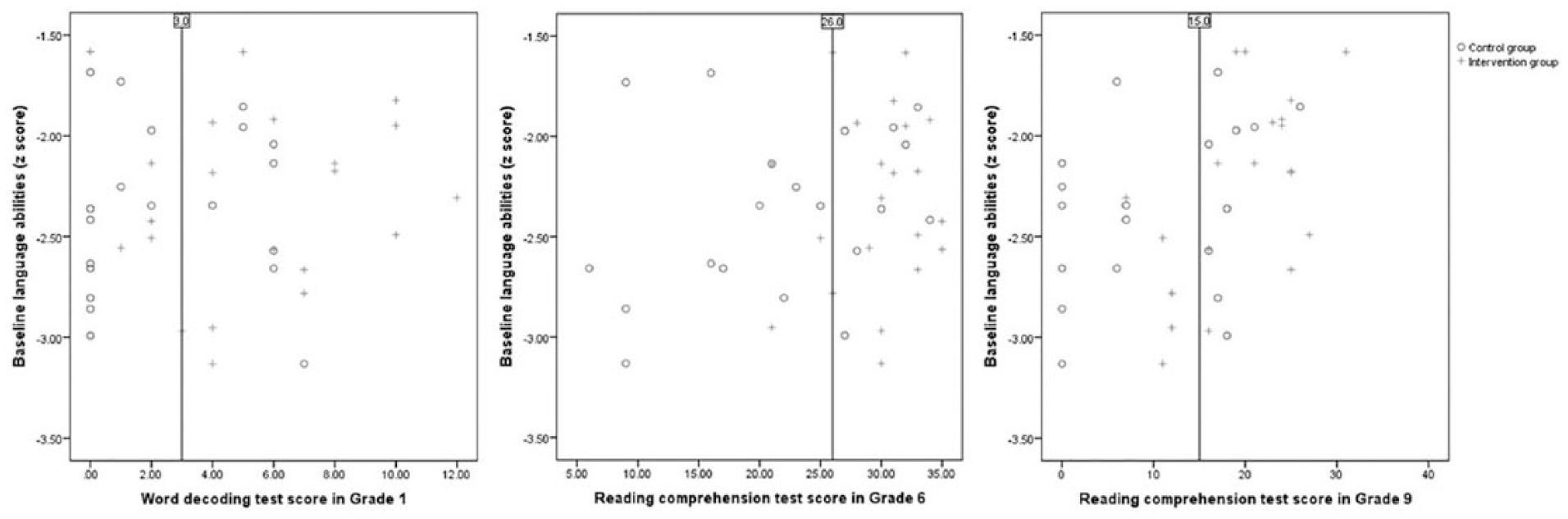
Scatterplots depicting the association between baseline language abilities and later test scores among children determined as at risk in kindergarten.
Discussion
During the 9-year follow-up after the kindergarten training in phonological awareness, we found both expected and novel transfer effects on literacy development. The results supported the proposed theoretical model for the development of reading ability following the intervention in that immediate training effects on phonological awareness were associated with better word decoding and spelling ability in Grade 1 and that, through improved decoding ability, this positive development extended to better reading comprehension in later grades. Although improved word-reading ability, spelling, and reading comprehension in Grades 1 and 2 is not news in the light of previous literature, they can now be regarded as a necessary prerequisite for justifying a long-term follow-up throughout compulsory education. Our longitudinal data showed that the initial advantage of the trained students in word reading was stable and sustained until the end of Grade 6. The finding complements the previous literature, which has reported contradictory results although mostly with shorter follow-ups. However, even this result must be treated with a caveat because the gains at the group level, albeit reliable over the years, were small in absolute terms, with mainstream intervention and control students performing fairly similarly. The key outcome was that for students at risk for reading failure, the intervention gave an advantage over their peers in the control group, and the ensuing permanent advantage was sustained until the end of Grade 9. Importantly, the effect was substantial for both word-reading ability and reading comprehension. This is a novel result that extends the finding of Snowling and Hulme (2011; Table 2), who compared reading performance with norm data.
In spite of the training, there were consistent gender differences in the whole sample in favor of girls as regards virtually all measurements throughout the school years (Kjeldsen et al., 2014); this is an outcome that is a great concern for the Finnish educational system (e.g., Torppa, Eklund, Sulkunen, Niemi, & Ahonen, 2018). However, an after-the-fact analysis of students at risk suggested that both boys and girls performed similarly in Grades 6 and 9, with the boys’ average fluency and comprehension scores being at the level of boys in general. This is an encouraging finding, although it remains merely descriptive because it lacks statistical power.
When practiced, phonological games and exercises set the stage for the instigation of learning the interplay between sounds in words and letters. In the present study, this occurred naturally, as a result of curiosity and without a need to formally teach letter names. It may be speculated that such a development is more easily triggered in orthographies featuring regularity of sound-to-letter mappings. In the comparative study of 13 European orthographies (Seymour et al., 2003), learning to decode accurately was hampered only by orthographic irregularity, that is, for students speaking Danish, French, Portuguese, or Scottish English. As Swedish is placed in the middle of the regularity continuum, the acquired phonological awareness of Åland kindergarteners was easily transferable to learning to decode. This important difference is also behind the well-known phonological linkage hypothesis emphasizing the simultaneous learning of phonemes, letters, and their mutual association. This hypothesis has been developed for English-speaking learners (Hatcher, Hulme, & Ellis, 1994) and has also been successfully applied to Danish kindergarteners (Elbro & Klint Petersen, 2004) as well as Portuguese-speaking Brazilian preschoolers (Cardoso-Martins, Mesquita, & Ehri, 2011).
The question remains, however, as to why some longitudinal studies have found that the initial gains are later restricted to word-reading ability or have even dissipated over the years. It is of note that both Blachman et al. (2004, 2014) and Wolff (2016) trained children who had already attended school for 1 or 2 years. Consequently, it is possible that momentum was thereby lost because the training was burdened by the need to unlearn unsuccessful strategies brought by about an initial reading failure. Under such circumstances, balancing the intervention in terms of word reading and text comprehension skills is a formidable task (see, e.g., Suggate, 2010; Wolff, 2016). Indeed, studies reporting on long-term transfer effects on reading comprehension differ from those not reporting on such findings. The reason being that the training in phonological awareness, or combining it with learning of the alphabet, was given to either kindergarteners (Elbro & Klint Petersen, 2004; Etmanskie et al., 2016; Kjeldsen et al., 2014) or first graders ages 5 to 6 years (Snowling & Hulme, 2011). Thus, as suggested by several reviews and meta-analyses, a sufficiently early training appears to hold the key to success that students at risk show during compulsory education (Al Otaiba et al., 2009; Bus & van IJzendoorn, 1999; Ehri et al., 2001; Schneider & Stengård, 2000). Our review of the available long-term intervention studies also reached the same conclusion. On the other hand, to state that phonological awareness is a transfer-appropriate skill hardly amounts to more than rewording the issue, thus leaving intact the question of processes possibly underlying the transfer to decoding and subsequent reading comprehension. We suggest that two interlinked processes are the contributing factors: the mutual assistance (scaffolding) among the students and the boost in their metacognitive skills. The former is brought about by the playlike ambiance of phonological exercises, while the latter is a product of the substantial problem-solving component inherent in them. As argued by Whitebread et al. (2009) as well as by Whitebread and O’Sullivan (2012), games and exercises launch a fruitful development from play to self-regulation, which helps to improve metacognition and eventually leads to independent learning. Such a development is an example of a virtuous circle outlined by Snowling and Hulme (2011).
Mutual Scaffolding
Following the guidelines of Adams et al. (1998) and Lundberg et al. (1988), training was conducted in natural kindergarten groups consisting of both mainstream and at-risk students. This means that some participants in the group had already mastered the phonological exercises, while for many others, they were a novel experience. It could be argued that such an arrangement is inefficient in comparison to one-to-one tutoring of students who have poorly developed prereading skills. To our knowledge, there is no direct test of this notion (but see Elbaum, Vaughn, Tejero Hugher, & Watson Moody, 2000). Somewhat unexpectedly, our group-play situations brought about pedagogically relevant side effects. Kindergarten teacher diaries and monthly in-service meetings brought to the fore that language games proved attractive to all children regardless of their initial skill level; this seemed to favor spontaneous collaboration where more advanced students assisted their less skilled peers in problem solving. This unintended outcome resembles the well-known principle of instructional scaffolding within the zone of proximal development (e.g., Johnston, 2010; Tharp & Gallimore, 1988; Wood, Bruner, & Ross, 1976), with the nuance that some of the children assume the role of a tutor together with the adults. A reasonable assumption is that they are suitable for this role by virtue of having themselves recently acquired the targeted skills. The crucial aspect is whether children experience the situation as play as opposed to formal practice. For example, McInnes, Howard, Miles, and Crowley (2009) drew on children’s own definition of play to create both formal and playful practice conditions. It was shown that playful conditions had a positive impact on learning. Moreover, the children in playful conditions showed more on-task behavior and were more involved, thus had a greater learning experience. Playful activities within educational contexts are likely to lead to effortful, deliberate, and intentional learning (e.g., Whitebread, Coltman, Jameson, & Lander, 2009). Although the language games of the present training program feature structure and systematicity, they obviously gave space to the children’s own spontaneous discoveries when manipulating rhymes, syllables, and phonemes.
Metacognition
Phonological games and exercises encourage children to play with words and word parts, gradually helping them to understand how spoken words predictably consist of syllables and sounds that can be deliberately manipulated. As Gombert (1993) has underscored, such an insight is an example of metacognition, also known as metaphonological understanding. The link is logical because phonological awareness means an ability to go beyond what is immediately given and obvious. The ability to manipulate even small phonemic units (e.g., segmenting and blending; Ziegler & Goswami, 2005) is typical of phonological exercises. It is justifiable to assume that such a skill also includes a metacognitive component because the child must maintain a distance from what the words under study signify. Several other findings support the link with metacognition. Enhanced phonological awareness is transfer appropriate, fostering other skills relevant to reading. For example, Lundberg et al. (1988) found a general improvement in spelling, while Poskiparta et al. (1999) reported improved spelling and listening comprehension skills among students at risk. Moreover, the playlike nature of games is conducive to independent learning (e.g., Whitebread et al., 2005), leading to self-initiated practicing (Share, 1995; Share & Stanovich, 1995). In this process, cracking the letter-to-sound code is just a further minor step in the ability to manipulate speech sounds in words, which is the primary aim of phonological training. Moreover, there is a documented correlation between reading comprehension and metacognition (Lundberg, 1991; Pressley & Gaskins, 2006), although the causal link appears difficult to prove (e.g., Annevirta, Laakkonen, Kinnunen, & Vauras, 2007).
Of considerable interest is what happens at home and in school after such training has been given in kindergarten. Unfortunately, a pervasive problem with intervention studies extending over several years is that it is difficult to keep a record of pedagogical events and voluntary activities taking place between the measurement points. Two longitudinal studies without a training component suggest that such information would be valuable. More specifically, a good reading ability acquired during Grade 1 is shown to be a unique predictor of print exposure data collected in 10th (Sparks, Patton, & Murdoch, 2014) or 11th grade (Cunningham & Stanovich, 1997). A tempting speculation is that early training in phonological awareness may promote such a head start by boosting reading comprehension through improved metacognition, thus giving an impetus to reading for fun. There is a rich literature on how leisure reading is linked to fluency and reading comprehension (for meta-analysis and reviews, see, e.g., Mol & Bus, 2011; Schiefele, Schaffner, Möller, & Wigfield, 2012; Stanovich, 1986).
In addition to voluntary activities, pedagogic measures also play a role. For example, in Finland, remedial teaching is amply provided in elementary grades. In a recent First Steps longitudinal study, 2,000 Finnish-speaking students were followed from kindergarten until Grade 9. In the study, those with a learning problem of any kind who received special teaching at some point during Grades 1 to 4 were estimated to constitute 60% to 90% of the students, depending on the severity of difficulty (Niemi, 2017). Special teaching is arranged either in small groups or individually, thus corresponding to Tier 2 and Tier 3 instruction. Because Åland shares this feature with Finnish-speaking Finland (Statistics Finland, 2017), it may be concluded that effective special education has helped to maintain the initial benefits from the intervention. However, such assistance is not likely to benefit only those who have participated in an intervention. To be more precise, it is rather the opposite that would be expected to occur, with members of the control group receiving more support during the postintervention years, thus making it more difficult to detect a difference between the intervention and control groups.
Limitations
To a certain degree, the present findings are simply a demonstration that long-term effects from a kindergarten phonological intervention on reading comprehension are indeed possible. The cohort available for the study was small by present standards, and partly because of this, our inclusion criterion was rather lenient albeit often adopted by researchers. As a consequence, the study was not sufficiently powered to delineate the literacy development of so-called treatment resisters, that is, students who show little progress in spite of additional training (e.g., Torgesen, 2000). Moreover, treatment fidelity was assured by methods deemed appropriate in the late 1990s, which do not fulfill current standards. No quantitative data were collected, which, for example, precludes a comparison of intervention and control kindergarten teachers. In addition, we have no data on intervening activities and processes, because only target skills could be measured at each time point. In an ideal study, continuous monitoring of reading habits and self-concepts as well as remedial measures would provide more information about possible important milestones.
Implications for Practice
Our findings are relevant to educational practice in four important ways. First, the Lundberg et al. (1988) training program can be administered in preschools and kindergartens to the whole cohort instead of targeting a preselected group at risk for reading failure. The burden of a large number of participants is effectively reduced by the fact that the games are designed for children’s enjoyment, making them eager to perform the exercises according to the rules given, in due time even without adult guidance (Lundberg et al., 1988, p. 269). Language games are attractive to children at this age, and active participation is typical regardless of the skill level (e.g., Lifter, Foster-Sanda, Arzamarski, Briesch, & McClure, 2011; Piaget, 1962; Synodi, 2010). The uniform intervention is easily adapted to the kindergarten curriculum, and it is also cost-effective because no additional resources are needed. Ensuing mutual assistance has a considerable socialization potential (e.g., Tharp & Gallimore, 1988). It should also be noted that the Åland curriculum does not set literacy standards that must be reached by the children. This feature has important consequences for teachers’ work. Quantified literacy standards, for example, mastering phoneme blending or a predefined number of letters, will affect the pedagogical choices that the teachers make (for a discussion within the Head Start framework, see Powell, Diamond, Bojczyk, & Gerde, 2008). It can also be argued that those who have already mastered the skills practiced in the games should be given more advanced tasks. The Åland curriculum effectively avoids such choices because the kindergartners who progress more rapidly start coaching their peers in a joint language game, which they conceive as play instead of intentional learning. In addition, repeated opportunities to use the skills in play is valuable for all children, which is an asset when, for example, students have a diverse language background (e.g., Lonigan, Farver, Nakamoto, & Eppe, 2013) or come from deprived socioeconomic environments (Lonigan, Purpura, Wilson, Walker, & Clancy-Menchetti, 2013).
Second, the systematic and easy-to-implement nature of the intervention helps to avoid such gaps in phonological exercises that may result from less planned and spontaneously arranged practice, as in our control group. For example, teachers may continuously give simpler tasks to keep all students engaged (for a further discussion within the Head Start framework, see Skibbe, Gerde, Wright, & Samples-Steele, 2016).
Third, the results suggest that training-related gains are not limited to word reading but seem to extend to text comprehension, as well. We have speculated above about the possible reasons for this. If confirmed in future studies, the transfer helps to prevent so-called late-emerging reading problems, which are unnoticed during the first elementary grades (Catts, Compton, Tomblin, & Bridges, 2012; Etmanskie et al., 2016; Torppa, Eklund, van Bergen, & Lyytinen, 2015). Moreover, ethical reasons argue for the inclusion of those children who have already mastered the idea of phonological awareness or can even read. Obviously, the risk for early stigmatization is lower in such a setting.
Fourth, at the level of the whole intervention group, the training-related gains in reading development were significant albeit not impressive. However, the opposite was true for the students at an initial risk of reading difficulties. Predictably, progress in phonological awareness led to at least average decoding skills in the intervention group. Less predictably, even the reading comprehension scores of these students steadily followed the skill distribution among the mainstream readers, which is crucial evidence for the educational value of the intervention. The most obvious explanation has been suggested by Lervåg, Hulme, and Melby-Lervåg (2018). Once decoding skills reach a threshold level, their further improvement does not promote comprehension. However, for struggling readers, even small improvements in decoding and fluency may lead to better text comprehension. In this way, decoding would have a bottleneck function for struggling readers who try to comprehend written text. In addition, we have speculated that the motivational playful elements with ensuing social exchange promote a positive attitude to language, thus facilitating the later leap to literacy. While such curiosity is common among normally progressing peers, prospective struggling readers need concrete assistance to gain the same insight. When that occurs, learning to decode and interest in literacy develop with less strain.
Conclusions
The present study has shown that early phonological training provides a good head start to literacy development, especially as regards children at risk for future reading difficulties. When offered to kindergarten groups before formal reading instruction, the training generates more positive reading-related effects than remediation following reading failure. For a successful intervention, the instruction has to be administered by trained professionals in a systematic and structured way. The training preferably includes all the children in kindergartens and is given by the ordinary teachers within the kindergarten schedule. It is thus cost-effective for the municipality. It is also plausible that gains may extend beyond adolescence and help to counteract a negative self-image and dropping out from society later in life, which may result from persistent reading failures at school. In the face of the increasing tendency toward functional illiteracy in modern societies (e.g., Eme, 2011; Vágvölgyi, Coldea, Dresler, Schrader, & Nuerk, 2016), this perspective is crucial, not least because at an adult age efforts to help are hampered by extracurricular factors, such as low persistence in literacy interventions (Greenberg et al., 2013).
Footnotes
Declaration of Conflicting Interests
The author(s) declared no potential conflicts of interest with respect to the research, authorship, and/or publication of this article.
Funding
The author(s) disclosed receipt of the following financial support for the research, authorship, and/or publication of this article: The first author has received financial support from the Government of the Åland Islands.
