



Abstract
The present study explores the longitudinal development between Grade 3 word level reading skills and higher level semantic skills to Grade 10 reading comprehension for 3,157 students. In particular, this work focused on how the developmental relations varied for subsamples of students who are English learners (EL; N = 308), students identified as specific learning disability (SLD; N = 133), and general education (Gen Ed; N = 2,716) students who have no formal classification or diagnoses. Multiple group structural equation modeling showed that the relation between Grade 3 vocabulary and Grade 10 reading comprehension did not vary across three student subgroups when accounting for Grade 3 fluency and that when controlling for students’ vocabulary, the unique effect of oral reading fluency ranged from a standardized effect of γ = .22 to γ = .39 across the three subgroups. Quantile regression using estimated factor scores revealed heterogeneous relations of component skills to reading comprehension across each subgroup.
Skilled reading comprehension is multifaceted, with underpinnings that begin to develop at a very early age and ultimately requires the simultaneous coordination of many cognitive processes. Although models of reading development vary widely, it is generally agreed that skilled readers are able to derive meaning from text both accurately and efficiently. To do this, there are many component skills operating in tandem; each one of these component skills develops at its own pace and can be refined by both instruction and exposure to print. It is reasonable to assume and it has been empirically demonstrated that skilled reading comprehension integrates both bottom-up and top-down models, making skills related to word level skills such as decoding and reading fluency important as well as language-based skills such as vocabulary; this approach to reading development is often referred to as an interactive model of reading (Rumelhart, 1977). Existing literature points to the importance of both word level, or basic reading skills such as decoding and reading fluency (Blachman, 2000; Bradley-Klug, Shapiro, Lutz, & DuPaul, 1998; Fuchs, Fuchs, Hosp, & Jenkins, 2001; National Reading Panel, 2000), and text level skills, or more advanced language based skills such as vocabulary (RAND Reading Study Group, 2002; Roth, Speece, & Cooper, 2002), oral language (Kendeou, van den Broek, White, & Lynch, 2009), and listening comprehension (Kendeou et al., 2009), for the development of adequate reading comprehension. One theoretical framework that encompasses both word level and meaning level skill development is the Simple View of Reading (SVR; Hoover & Gough, 1990). Within this framework, skilled reading comprehension is the product of efficient word decoding and listening comprehension such that both skill sets are necessary for successful reading comprehension. The framework has been empirically validated in several subgroups of readers, including monolingual English speakers (Catts, Hogan, & Adlof, 2005; Catts, Adlof, & Weismer, 2006; Chen & Vellutino, 1997; Cutting & Scarborough, 2006; Joshi & Aaron, 2000; Tunmer & Chapman, 2012) and Spanish-speaking bilingual students (Kieffer & Vukovic, 2012).
Empirical evidence exits to support the notion that the relation between decoding and oral language skills and reading comprehension changes over time. In monolingual-English, typically developing students in the early grades, word recognition skills are paramount in their contribution to reading comprehension, while in later grades, the importance of oral language increases (Catts, Adlof, Hogan, & Weismer, 2005; Francis, Fletcher, Catts, & Tomblin, 2005; Gough, Hoover, Peterson, Cornoldi & Oakhill, 1996; Kendeou et al., 2009; Kershaw & Schatschneider, 2012). In bilingual populations, empirical findings have been mixed. Some studies suggest that decoding related skills are more predictive of reading comprehension compared to language abilities in the early grades, transitioning to favoring language skills in the later grades (Hoover & Gough, 1990); however, other studies have found that English word reading does not predict comprehension in sample of bilingual students (Kieffer & Vukovic, 2012; Lesaux, Crosson, Kieffer, & Pierce, 2010). The available studies have demonstrated mixed findings related to the role of word reading in the prediction of reading comprehension for bilingual learners, suggesting that more research is needed in this area.
The present study explores the longitudinal development of reading comprehension across multiple subgroups of children and investigates relations between word level reading skills (measured by reading fluency) and higher level semantic skills (measured by receptive vocabulary) to later reading comprehension outcomes. In particular, we focus on the roles of reading fluency and vocabulary levels in third grade and how these skills are related to reading comprehension in Grade 10 in subsamples of students who are English learners (EL), students identified as specific learning disability (SLD), and students who we have no formal classification or diagnosis, whom we refer to as general education students (Gen Ed) for the purposes of this study. Previous cross-sectional research in this area has shown that EL and SLD students perform lower than their Gen Ed peers on literacy tasks from Grade 3 to Grade 10 (Solari, Petscher, & Folsom, 2014). Of particular interest in the previous study was the lack of convergence of literacy scores between the EL and SLD students and their Gen Ed peers even though these students should have, hypothetically, received specialized instructional supports. The present study takes a longitudinal approach to investigate the relations between early comprehension predictors and later reading comprehension, which has potential to inform early instructional practices so that EL and SLD students have more opportunities to perform more similarly to their Gen Ed peers. The current study allows for a test of the hypothesis that both fluency and vocabulary have both direct and indirect longitudinal effects on reading comprehension. In addition, the sample allows us to test this hypothesis in different subgroups of students to determine if between-group variation exists. Lastly, this allows us to investigate variability within each subgroup to determine if the predictive relation of fluency and vocabulary to Grade 10 reading comprehension was conditional on levels of reading comprehension.
Relation Between Fluency and Comprehension
Oral reading fluency has been operationally defined as the oral translation of text with speed and accuracy (Fuchs et al., 2001). The role of reading fluency, or the rate and accuracy of reading, is not specifically delineated in the SVR, although empirical data suggest a significant relation between reading fluency and reading comprehension (Chard, Vaughn, & Tyler, 2002; Fuchs et al., 2001). Reading fluency is considered critical for reading development given its relation with reading comprehension (Fuchs et al., 2001) and ability to differentiate typically developing readers with at-risk readers (Deno, Fuchs, Marston, & Shin, 2001). It has been suggested that the relation between reading fluency and reading comprehension becomes salient when considering the allocation of attentional stores (Fuchs et al., 2001; LaBerge & Samuels, 1974). Some data have suggested that individuals who are skilled at oral reading fluency free up cognitive capacity for higher level comprehension of text, perhaps more specifically, in formulating inferences while reading (Thurlow & van den Broek, 1997). More recent studies have begun to investigate reading fluency as an independent predictor of reading comprehension when word reading and oral language skills are considered concurrently; the results of these studies have been mixed. Adlof, Catts, and Little (2006) investigated the role of reading fluency to determine if it explained unique variance in the prediction of reading comprehension above and beyond decoding and oral language skills in second-, fourth-, and eighth-grade students; their models did not show additional variance for reading fluency in the prediction of comprehension. Kim and Wagner (2015) investigated reading fluency’s role in the prediction of reading comprehension in first grade through fourth grade; results demonstrated that in Grades 2 through 4, reading fluency mediated the relation between word reading and comprehension and partially mediated the relation between oral language skills and reading comprehension. Similarly, Silverman, Speece, Harring, and Ritchey (2013) found that in a sample of fourth graders, reading fluency, measured by both word and passage level fluency, fully mediated the relation between decoding and reading comprehension. Finally, in a study with younger students, Solari, Grimm, McIntyre, and Denton (2018) found that when investigating the role of fluency in first-grade students, separating students into those at risk for reading difficulties and those not at risk, fluency was predictive of reading comprehension with word decoding and oral language skills for the not-at-risk students. For the at-risk students, reading fluency became the most important predictor of reading comprehension. Further evidence of the importance of reading fluency in concurrent and later reading comprehension comes from studies that train reading fluency and detect gains in reading comprehension scores (National Reading Panel, 2000). In a meta-analysis of studies that included both typically developing students and those with learning disabilities, Therrien (2004) found that targeted fluency instruction improved both reading fluency and reading comprehension performance in both subgroups.
Investigations into the development of oral reading fluency suggest that it develops over time during the elementary school years. Early reading skills such as phonological awareness and letter-sound fluency have been shown to be predictors of oral reading fluency (Speece, Mills, Ritchey, & Hillman, 2003). Other studies have indicated a significant relation between both phonological awareness and rapid automatized naming and oral reading fluency (Allor, 2002). It is generally agreed that oral reading fluency is related to earlier emerging reading skills and that reading fluency is a predictor of reading comprehension both concurrently and longitudinally. It is feasible to see reading fluency as the culmination of early reading skill development, including alphabet knowledge, phonological awareness, and single word decoding, which may explain the strong and predictive relation it has with reading comprehension. Previous researchers have recognized reading fluency as the bridge between single word decoding and reading comprehension (Pikulski & Chard, 2005).
Relation Between Vocabulary and Comprehension
Many correlational studies have established the relation between breadth of vocabulary and reading comprehension; simple correlations have been reported between .33 and .82 (Roth et al., 2002); this wide range in correlational values could be attributed to variation in vocabulary assessments, different subsamples of individuals, and age of participants. Two cross-sectional studies covering grades K–10 by Foorman and colleagues found that latent language skills, inclusive of vocabulary, strongly predicted reading comprehension in Grades 1 (.67) and 2 (.58) controlling for word reading skills (Foorman, Herrera, Petscher, Mitchell, & Truckenmiller, 2015) as it did in Grades 3 through 10 (partial standardized coefficient ranged .75 to .96; Foorman, Koon, Petscher, Mitchell, & Truckenmiller, 2015). A meta-analysis conducted by Scarborough (2001) found 20 studies that investigated the relation between receptive vocabulary and reading comprehension; this analysis found that the mean correlation was .33. Snow (2002) demonstrated that as children get older, the relation between receptive vocabulary and comprehension strengthens, from .45 in first-grade to .69 in seventh-grade samples. Receptive vocabulary has been shown to hold a predictive relation with later reading comprehension in samples as young as 3 and 4 years old predicting out to kindergarten, fourth, and seventh grade (Dickinson & Tabors, 2001). In school-aged samples, similarly, studies have demonstrated that receptive vocabulary knowledge is predictive of reading comprehension (Roth et al., 2002; Sénéchal, Ouellette, & Rodney, 2006). One study investigated the long-term predictive power of receptive vocabulary on later reading comprehension. In this study, Cunningham and Stanovich (1997) demonstrate, in a sample of monolingual English speakers, through multiple regression, that first-grade receptive vocabulary was significantly related to 11th-grade reading comprehension. The impact of vocabulary teaching on comprehension is mixed; some studies have demonstrated that vocabulary intervention improves comprehension performance (Beck, Perfetti, McKewon, 1982; Stahl, 1983), while others have not shown an impact (Pany & Jenkins, 1978). In a meta-analysis of vocabulary intervention studies, Stahl and Fairbanks (1986) found significant effects on global reading comprehension measures after students received instruction to develop vocabulary. In a more recent meta-analysis (Elleman, Lindo, Morphy, & Compton, 2009), it was reported that vocabulary interventions were nearly three times more effective in increasing reading comprehension in students with reading difficulties than students who did not have reading problems, suggesting that vocabulary development may be even more important for students who are struggling with reading.
There has been much debate in the literature to whether breadth of vocabulary, or the size of an individual’s word knowledge, or depth of vocabulary, or the richness of knowledge or words, is more important in the development of skilled reading comprehension. Previous studies using multiple regression have reported that depth of vocabulary, or the ability to provide definitions of words, to be more predictive of reading comprehension (Ouelette, 2006; Roth et al., 2002) when comprehension is measured by the Woodcock Johnson Passage Comprehension subtest, which follows a cloze format. In contrast, Tannenbaum, Torgesen, and Wagner (2006) found that when using structural equation modeling, vocabulary breadth, measured with a receptive vocabulary assessment, accounted for 62% of the variance on the state standardized reading comprehension assessment; depth of vocabulary knowledge did not have significant relation with the reading comprehension measure. It can be argued that receptive vocabulary is a proximal measure for oral language; in fact, correlational data report significant correlations between .31 and .57 for receptive vocabulary and other oral language measures in monolingual English populations (Roth et al., 2002).
To date, the majority of research on the relation between vocabulary and comprehension has been conducted in monolingual English populations. There are very few studies that specifically investigate the role of English vocabulary development and English reading comprehension in EL populations. The research that exists suggests that vocabulary acquisition is significantly related to reading comprehension for EL children (Carlisle, Beeman, Davis, & Spharim, 1999). Lindsey, Manis, and Bailey (2003) examined a sample of EL and demonstrated that receptive vocabulary, measured in early kindergarten, accounted for a significant amount of unique variance in reading comprehension in first grade. Carlisle et al. (1999), found that for early developing readers EL readers, English vocabulary was a significant predictor of reading comprehension. Proctor, Carlo, August, and Snow (2005), in a sample of fourth-grade Spanish-speaking EL, through structural equation modeling, found that English vocabulary predicted reading comprehension directly and indirectly through the listening comprehension. A handful of instructional studies that involve EL children have demonstrated that direct instruction in vocabulary in English enhances English comprehension performance (Carlo et al., 2004). To our knowledge, there are no studies that investigate the long-term impact of English vocabulary levels in the early grades on later reading comprehension outcomes in samples of EL students.
Present Study
In the current study, we explore the relation between reading fluency, receptive vocabulary, and reading comprehension. With the current data set, we are able to look at these relations longitudinally, investigating the relations of earlier reading fluency and receptive vocabulary (Grade 3) with later reading comprehension performance (Grade 10). The majority of studies investigating these relations have been either cross-sectional or examined longitudinal growth across 2 to 5 years. Very few studies have investigated early development in vocabulary and fluency on much later reading comprehension (high school). In addition to providing data that investigate these relations across multiple years, the data allow us to investigate specific subgroups who have been previously shown to be at risk for successful comprehension development (EL and SLD) compared to their Gen Ed peers. To our knowledge, there have not been any studies that investigate these longitudinal relations across the multiple subgroups of students that are included in the present study. Additionally, because of our analytical approach, the current study investigates variability within each subgroup (EL, SLD, Gen Ed) to examine if Grade 10 reading comprehension level impacts the predictive relation between reading fluency and receptive vocabulary.
Research Questions
In this longitudinal study, we utilize a large database to investigate the relations between Grade 3 reading fluency and receptive comprehension and Grade 10 reading comprehension to answer the following questions:
Research Question 1: What is the relation between Grade 3 fluency and receptive vocabulary Grade 10 reading comprehension?
Research Question 2: Are the relations between reading fluency, receptive vocabulary, and comprehension different between the three subgroups of interest: Gen Ed, SLD, and EL students?
Research Question 3: To what extent do the relations among reading and language skills vary for Gen Ed, SLD, and EL students based on their conditional levels of reading comprehension skills in Grade 10?
Method
Participants
Data were drawn from a large archival database of reading scores maintained at a large university in the Southeast. The full archival database included over 1.5 million records of students across grades K–10 in any given year from 2003 through 2014. Because the questions of interest were reliant on a longitudinal participant pool, an initial sample of 14,773 records was identified of students who maintained at least one record in each of grades K–10 from 2003–2004 school year to 2013–2014 school year. Further distillation of this initial sample was required as most of the records (~79%) were observed to only maintain demographic information and did not include reading scores. The final subsample from the 14,773 records was drawn such that students in Grade 3 who had scores on at least one of the selected measures within that grade (i.e., oral reading fluency or vocabulary) also had at least one reading comprehension score in Grade 10 (i.e., fall, winter, or spring reading comprehension data). A final subsample of 3,157 students who met these criteria were drawn. Starting in Grade 3, students were distributed across 1,169 classrooms, 430 schools, and 54 districts. Among the participants, 52% were female, and 63% were eligible for free or reduced-price lunch. Forty-nine percent of students were White, 27% Black, 19% Hispanic, 4% multiracial, 1% Asian, and <1% American Indian. By language background, approximately 10% of students were classified as English learners (n = 308); 4% of students were served on an individualized education plan for learning disabilities (n = 133); 86% of students (n = 2,716) were classified as general education students. Table 1 reports estimated effect size differences between the initial and full subsamples with small differences observed between the groups on the Grade 3 and Grade 10 measures (i.e., Cohen’s d range, 0.10–0.20).
Pre-Imputation and Post-Imputation Descriptive Statistics for the Full Sample and by Subgroup.
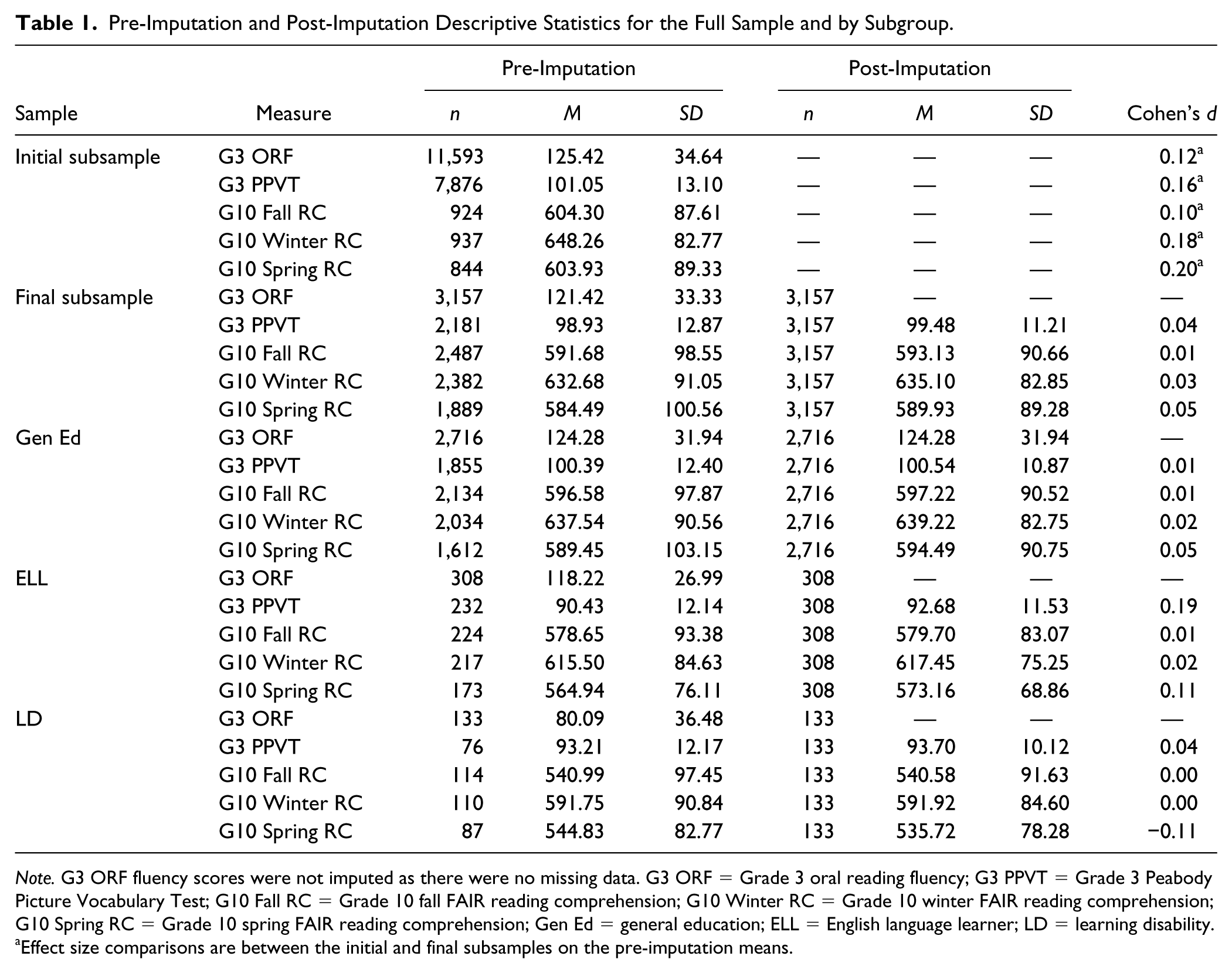
Note. G3 ORF fluency scores were not imputed as there were no missing data. G3 ORF = Grade 3 oral reading fluency; G3 PPVT = Grade 3 Peabody Picture Vocabulary Test; G10 Fall RC = Grade 10 fall FAIR reading comprehension; G10 Winter RC = Grade 10 winter FAIR reading comprehension; G10 Spring RC = Grade 10 spring FAIR reading comprehension; Gen Ed = general education; ELL = English language learner; LD = learning disability.
Effect size comparisons are between the initial and final subsamples on the pre-imputation means.
Measures
Peabody Picture Vocabulary Test
The Peabody Picture Vocabulary Test (PPVT; Dunn & Dunn, 1997) measure tests the breadth of receptive vocabulary knowledge and requires pointing to one of four pictures that represents the target word and was individually administered to all students at the spring of the school year. Raw scores were converted to age-appropriate standardized scores based on the published norms. Cronbach’s alpha for scores on the assessment across the 25 standardized age groups has been reported as between .92 and .98 with median reliability of .95. Alternative form reliability exceeds 0.88; criterion-related validity coefficients with reading ability range from 0.69 to 0.91 (Williams & Wang, 1997).
DIBELS Oral Reading Fluency
DIBELS Oral Reading Fluency (ORF; Good, Kaminski, Smith, Laimon, & Dill, 2001) is a measure that assesses oral reading rate and accuracy in grade-level connected text. This standardized, individually administered test was designed to identify students who may need additional instructional support in reading and monitor progress toward instructional goals. Research has demonstrated adequate to strong predictive validity of DIBELS ORF for reading comprehension outcomes (r = .65–80; Roehrig, Petscher, Nettles, Hudson, & Torgesen, 2008). The median score was used for the purpose of analyses.
Florida Assessments for Instruction in Reading Comprehension
The Florida Assessments for Instruction in Reading Comprehension (FAIR; Foorman, Petscher, & Schatschneider, 2015) assessment is a computer-adaptive test consisting of literary and informational passages followed by seven to nine multiple-choice questions. Students are exposed to up to four passages until they approach a reliable estimate of their ability (i.e., α = .90). A percentile rank, standard score, and developmental ability score are provided for each student upon completion of the task. Developmental ability scores for the reading comprehension task (M = 500, SD = 100, range, 200–800) were used in this study as they represent vertically scaled estimates that are appropriate for measuring growth. Marginal reliability from item response theory (IRT) was .92 in Grades 3 through 10. Correlations between the FAIR fall reading comprehension score and the state achievement test range from .62 in ninth grade to .74 in fifth grade (Petscher & Foorman, 2011).
Data Analysis
The sample size described in the previous section notes that the structure of the data is nested with students clustered together in classes, schools, and districts. A more fine-grained review of the clustering structure revealed that data reflect a nesting structure and that most upper-level units only contained one to two lower level units. For example, 1,169 classrooms were represented in the data; however, 65% of the classrooms only contained one to two students. Similarly, approximately 50% of the 430 schools contained one to two classrooms. Due to the sparseness of the clustering, only single-level analyses at the student level were tested.
A combination of multiple-group confirmatory factor analysis (CFA), structural equation modeling (SEM), and quantile regression was used in the study. The availability of multiple assessments of reading comprehension scores in Grade 10 allowed a testing of how well they conformed to a latent variable structure, with further examination of the invariance of that structure among the general education, EL, and SLD subgroups of students. With only three measures of reading comprehension, a single factor was specified to evaluation fit across all groups. The Comparative Fit Index (CFI), Tucker-Lewis Index (TLI), and root mean square error of approximation (RMSEA) were evaluated for the appropriateness of model fit. CFI and TLI values of at least .95 are viewed as acceptable levels of fit, as are RMSEA values less than .10.
Invariance testing occurred by first specifying a factor model with equality constraints for the factor loadings, factor mean and variance, and observed measure residual variances across the three subgroups. Fit and modification indices were then evaluated to identify places where a released constraint would result in a well-fitting partially invariant model.
A key question in the study was not just the average developmental relations among fluency, vocabulary, and later reading comprehension but the extent to which the strength of relations was dependent on various conditional levels of reading comprehension. Models such as SEM are not well equipped to test for such relations as they are rooted in a conditional mean framework. Rather, a quantile regression can be used to evaluate the extent to which fluency and vocabulary have differential explanatory power of reading comprehension skills on the level of conditional reading comprehension (Petscher, 2016; Petscher & Logan, 2014). Quantile regression is considered to be a special case of conditional median regression (Koenker & Bassett, 1978) such that it may be used to test for relations between variables at points other than mean. Although quantile regression cannot be used in a latent variable framework, we opted to use estimated factor scores from the best fitting CFA model. An important analytic consideration that was first tested was the level of factor score determinacy. That is, factors from a latent variable model and estimated factor scores are not identical. The latter is designed to approximate the former when the two are highly correlated. Estimated factor scores are known to be influenced by reliability of the observed measures and the missing data (Eastabrook & Neale, 2013) to the point that means and variances may be different from the factor model itself (Lawley & Maxwell, 1971) and subsequently the correlations among multiple factors. The appropriateness of using estimated factors in the present study was evaluated in a two-fold manner. First, the factor score determinacy index (i.e., correlation between the estimated factor score and the factor) was estimated. Values of at least .90 were considered sufficient to suggest that the estimated factor score could be used in the quantile regression because a correlation of .90 is very strong. Second, the correlations among the three key measures (i.e., fluency, vocabulary, and latent reading comprehension) were evaluated from the SEM and when using the estimated factor score. If the correlation matrices approximated each other well, this provided converging evidence that the correlational structure was well preserved in the estimated factor scores from the original model. Following this sequence of testing, quantile regressions were run for each subgroup of students examining the relations of fluency and vocabulary scores with reading comprehension.
Results
Preliminary Analyses and Missing Data
Descriptive statistics are reported for the sample in Table 1. A preliminary review of the data for missingness across the measures showed missing data rates as follows: Grade 3 ORF (0% missing), Grade 3 PPVT (30% missing), Grade 10 fall reading comprehension (22% missing), Grade 10 winter reading comprehension (25% missing), and Grade 10 spring reading comprehension (41% missing). Little’s (1988) test of data missing completely at random was not supported, χ2(9) = 39.38, p < .001; thus, we evaluated the missing patterns to discern if they were related to values of unobserved data. A review suggested that the patterns were ignorable, and a missing at random designation was used. Multiple imputation via SAS software was done on the full sample with 100 total imputations.
The descriptive statistics in Table 1 reflect pre- and post-imputation values as well as a standardized effect size to gauge the similarity of the pre- and post-imputation distributions. Results suggested that almost no discrepancy existed across the five measures when comparing the two distributions (Cohen’s d range, 0.01–0.04). When disaggregating the means across subgroups, a potentially small difference was found for the PPVT pertaining to EL students (d = 0.19); however, this was still quite small. Means showed that the general education students outperformed the EL and SLD subgroups on all measures and were at the normative mean of vocabulary (M = 100.54, SD = 10.87) compared to the other groups who were lower than the normative mean (M = 92.68 and M = 93.70 for EL and SLD, respectively). Correlations (Table 2, upper matrix) reflected mostly moderate associations among fluency and vocabulary with reading comprehension (i.e., approximately r = .45), while the three reading comprehension scores were strongly associated with each other (i.e., r = .66).
Pre-Imputation (Lower Diagonal) and Post-Imputation (Upper Diagonal) Correlation Matrix (Upper Matrix) and Variable Correlation Comparison Between Factor Model (Lower-Diagonal) and Estimated Factor Scores (Upper-Diagonal; Lower Matrix).

Note. G3 ORF = Grade 3 oral reading fluency; G3 PPVT = Grade 3 Peabody Picture Vocabulary Test; G10 RC = Grade 10 latent reading comprehension; Gen Ed = general education; ELL = English language learner; LD = learning disability.
Factor Analysis
The first CFA model tested a unidimensional structure of the three reading comprehension variables without respect to subgroup considerations. Because this was a just identified model, no fit statistics were available. Consequently, the fully constrained model across subgroups was fit to the data and resulted in acceptable fit, χ2(11) = 107.02, CFI = .98, TLI = .98, RMSEA = .091 (90% CI = .076, .107); however, the model fit indices suggested the model fit could be greatly improved by relaxing the group equality constraint on the factor mean. This revision led to a χ2(10) = 46.99, CFI = .99, TLI = .99, RMSEA = .059 (90% CI = .043, .077) that fit statistically better than a fully constrained model (Δχ2 = 60.03, Δdf = 1, p < .001). Figure 1 (top) displays the resulting model whereby the standardized loadings were strong and the residual variances were low for the observed measures. Note that the latent means vary across groups; the EL group was set as the referent group, meaning that the values for general education students and students with learning disabilities are interpreted as standardized deflections from the EL group. Substantively, the interpretation is that general education students’ latent reading comprehension was 0.26 standard deviations greater than EL students, whereas students with learning disabilities’ latent reading comprehension was −0.39 standard deviations below EL students. The difference in latent reading comprehension between general education students and students with learning disabilities was 0.65 standard deviations (i.e., -0.39 – 0.26 = -0.65).
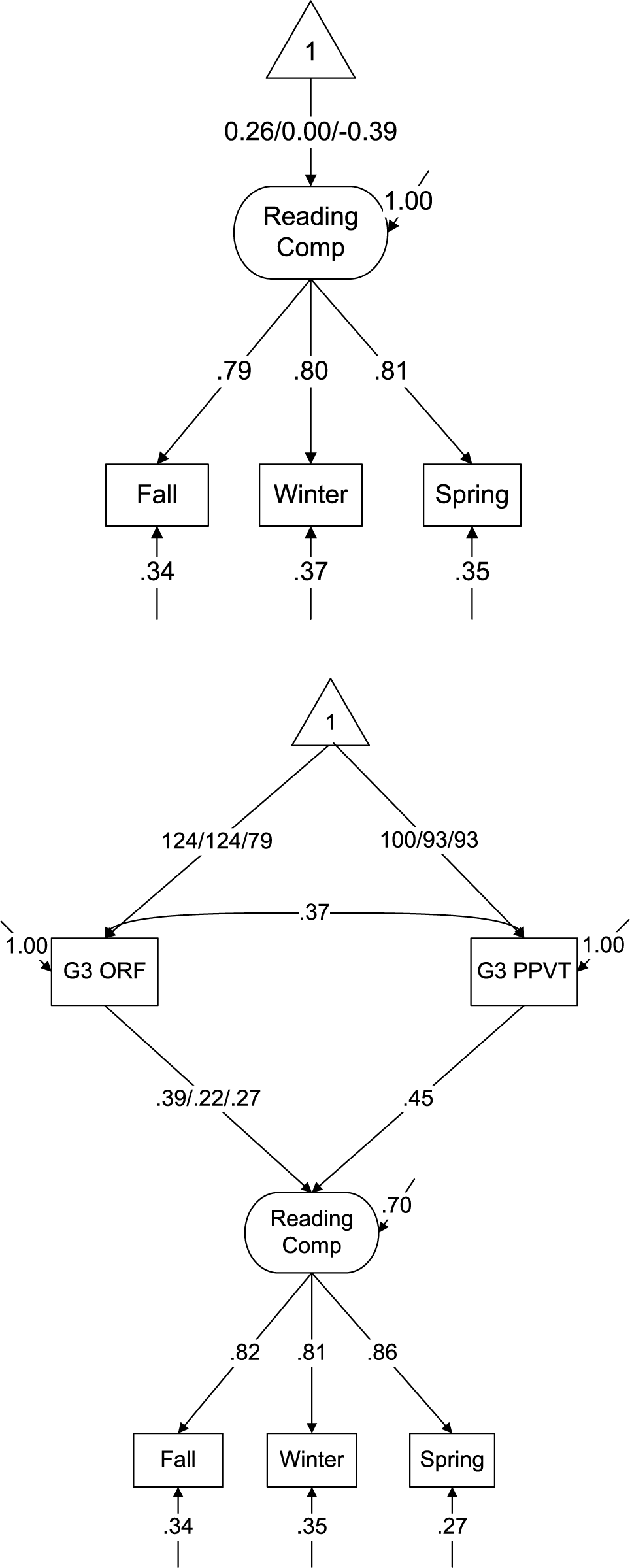
Models of partial invariance for (top) confirmatory factor analysis of latent reading comprehension performance and (bottom) structural equation model of oral reading fluency and Peabody Picture Vocabulary Test predicting latent reading comprehension across general education/English language learners/learning disability subgroups. All estimated coefficients significant at p < .01.
Structural Equation Modeling
The process of testing invariance for the SEM to address Research Questions 1 and 2 was identical to the CFA. An initial model was fully constrained across all groups (i.e., loading, residual variances, factor intercept and variance, path coefficients, observed variable means, covariance). Model fit and modification indices were then evaluated to determine places where fit could be improved in light of important theoretical considerations. Initial model testing indicated that a fully invariant model did not fit well, χ2(40) = 439.85, CFI = .88, TLI = .92, RMSEA = .097 (90% CI = .089, .106), with modification indices suggesting that equal constraints should be relaxed across the groups for the fluency and vocabulary means as well as for the path from fluency to reading comprehension. With the inclusion of these edits, a partially invariant SEM fit well to the data, χ2(38) = 142.45, CFI = .99, TLI = .99, RMSEA = .051 (90% CI = .042, .060), and was a significant improvement over the previous model (Δχ2 = 294.40, Δdf = 2, p < .001). Figure 1 (bottom) displays the results from this model. Note that relaxing of constraints in the model only pertained to some of the groups. For example, the fluency means were constrained to be the same for the Gen Ed and EL groups (i.e., 124) but were different from the SLD group mean (79). Similarly, the EL and SLD mean on vocabulary was constrained to be equal (i.e., 93), but the Gen Ed mean was different (100). Results suggested that the path from vocabulary to reading comprehension was statistically the same across three groups, with a standardized coefficient of γ = .45. Conversely, fluency had statistically different predictions of reading comprehension across all three groups and was more strongly related for Gen Ed students (γ = .39) compared to either EL (γ = .22) or SLD (γ = .27) groups. By including fluency and vocabulary, 49% of the variance in reading comprehension scores was explained for Gen Ed students compared to 41% for EL students and 38% for SLD students.
Quantile Regression
Although the findings suggested that Grade 3 fluency and vocabulary skills matter in predicting Grade 10 reading comprehension, it was of interest to test the extent to which the magnitude of these relations within each group varied according to levels of conditional reading comprehension ability (i.e., Research Question 3) using quantile regression. As previously noted, prior to the quantile regression, it was important to test the factor score determinacy as well as compare the correlation matrices. Factor score determinacy from the original factor analysis [i.e., Figure 1 (top)] was found to be quite strong, with correlations of .94 (Gen Ed), .95 (EL), and .93 (SLD) observed across the groups. Moreover, a review of the correlation matrices for the confirmatory factor analysis (Table 2, lower matrix, lower diagonal) largely mimicked that of the matrix for using an estimated factor score for reading comprehension (Table 2, lower matrix, upper diagonal). The largest observed discrepancy was for EL students in the fluency-comprehension relation (.56 for the CFA vs. .41 for the estimated factor score). Given the relative consistency among correlations and the strong determinacy values, it was deemed reasonable to use the factor scores in the quantile regression. To facilitate interpretation, the fluency, vocabulary, and reading comprehension factor scores were standardized. Figure 2 (upper left) displays the predictions for the Gen Ed group. The x-axis for the group of plots represents the conditional quantile, which is conceptually similar to a percentile, for the estimated factor score of reading comprehension (e.g., .20 quantile is ≈20th percentile). The y-axis is the range of coefficients for the relation between the predictor label and the estimated reading comprehension score. The dark line is the coefficient for the relation between the predictor and reading comprehension at each quantile, with the shading as the confidence interval around each point. For example, when looking at the lower left figure (i.e., Grade 3 ORF on the y-axis), this plot demonstrates the unique predictive relation between Grade 3 fluency and reading comprehension controlling for grade vocabulary. Notice that at the .50 quantile on the x-axis, the coefficient is .37, which is nearly identical to the coefficient that is shown in Figure 1 (bottom) for the relation between fluency and reading comprehension (i.e., .39). This comparison demonstrates an inherent property of quantile regression, namely, that when data are multivariate normal, it would be expected that the relations at the .50 quantile (≈50th percentile) should be identical to findings from a means-based mean like SEM. The close proximity of the quantile regression coefficient for fluency and the SEM coefficient highlights this property. When evaluating fluency, in the Gen Ed sample, the data line suggests that the relation between fluency and reading comprehension is stronger at lower quantiles of conditional reading comprehension distribution (i.e., approximately .40) compared to higher quantiles (i.e., approximately .30). For vocabulary, the inverse appears true such that vocabulary matters more for Gen Ed students as reading comprehension scores increased.

Multiple quantile regression of reading comprehension on oral reading fluency and Peabody Picture Vocabulary Test scores for (upper left) general education students, (upper right) English language learners, and (lower center) students with learning disabilities.
Considering EL students (Figure 2, upper right), fluency was more strongly associated with reading comprehension for students with higher fluency scores, while vocabulary was a relatively stable predictor of reading comprehension across all levels. Note that when comparing the individual strength of predictions between Gen Ed and EL students, fluency maintains a consistently stronger relation to comprehension for Gen Ed students (ranging from .30 to .40 across quantiles) compared to EL students (ranging from .10 to .35). Conversely, vocabulary has a relatively similar magnitude across quantiles for both groups. Quantile plots for SLD students (Figure 2, bottom) demonstrated an increasing importance of fluency across levels of comprehension, whereas vocabulary mattered more for students with lower reading comprehension skills (i.e., < .40 quantile) and higher reading comprehension (i.e., > .70 quantile) compared to those in the middle of the distribution. Compared to the Gen Ed students, vocabulary was a seemingly more important predictor for SLD students at lower levels of reading comprehension, whereas fluency was a relatively more important predictor for Gen Ed students at lower levels of reading comprehension.
Discussion
Using a large, longitudinal data set, we sought to understand the relations between elementary oral reading fluency and vocabulary scores and their relations to high school reading comprehension. Because of the nature of the data used, we were further able to test the extent to which the relations varied among general education students, students identified as English language learners, and students with learning disabilities. Finally, we tested whether such relations not only varied across subgroups but whether there was within-group variability in the relative strengths of fluency and vocabulary that is dependent on one’s later reading comprehension skills.
Five important findings were observed in this work. First, it was seen that the relation between Grade 3 vocabulary and Grade 10 reading comprehension did not vary across three student subgroups when accounting for Grade 3 fluency. Second, when controlling for students’ vocabulary, the unique effect of oral reading fluency ranged from a standardized effect of γ = .22 to γ = .39 across the three subgroups. Third, quantile regression for Gen Ed students revealed that oral reading fluency maintained a fairly stable relation to reading comprehension across the conditional distribution of reading comprehension scores, whereas vocabulary had a stronger relation to reading comprehension for those students with stronger reading comprehension skills. Fourth, quantile regression results for EL students demonstrated that vocabulary maintained a stable relation to reading comprehension, whereas oral reading fluency more strongly predicted reading comprehension for students with stronger reading comprehension skills. Fifth, pertaining to students with an SLD, the results showed that fluency was more strongly related to comprehension for students with stronger reading comprehension skills, whereas vocabulary was more strongly related to reading comprehension when reading comprehension was poor. The totality of the findings not only suggest that early oral reading fluency skills differentially related across student groups in predictive strength to high school reading comprehension but that the relative importance of reading fluency and vocabulary in explaining comprehension differences varies according to one’s reading comprehension ability, and these relations differ across the three subgroups.
Relations Between Elementary Literacy and High School Reading Comprehension
Results of whole group comparisons suggest that early vocabulary knowledge is related to high school reading comprehension across all groups investigated. While longitudinal investigations of early vocabulary knowledge and later reading comprehension are rare, it is not surprising that there is a significant relation between these two constructs for all three groups of students. Extant data suggest a strong relation between vocabulary and reading comprehension (RAND Reading Study Group, 2002; Roth et al., 2002). Of interest in this analysis is the differential finding of the impact of oral reading fluency to later reading comprehension, which suggests a stronger relation for the Gen Ed subgroup compared to the EL and SLD samples. For Gen Ed students, reading fluency is typically well established by third grade; therefore, it would make sense that for this subgroup, it would provide a stable, strong predictor of reading comprehension in Grade 10. While studies that investigate longitudinal relations between early oral reading fluency and later (high school) reading comprehension are not common, several studies have suggested that the relation between the fluency and comprehension is strong and significant in Gen Ed populations (Blachman, 2000; Bradley-Klug et al., 1998; Fuchs et al., 2001; National Reading Panel, 2000). Previous research with students identified as reading disabled has shown that oral reading fluency is a particular deficit (Chard et al., 2002) that may act as a bottleneck for successful reading comprehension; this may explain the weaker relation between fluency and comprehension for the SLD group. That is, difficulties with fluent reading may disrupt reading comprehension. This can be further supported when examining the quantile regression for the SLD group, which highlights the importance of vocabulary for students whose reading comprehension was on the lower end of the distribution. This group of students, the lowest comprehenders, in the SLD subsample may rely on their knowledge of vocabulary to interpret text when fluency is taxed, essentially using their oral language skills as a compensatory strategy to comprehend written text.
Limitations
The present study is limited by several factors. Students who are identified as having a specific learning disability include individuals with disabilities other than reading (e.g., math and/or writing). The study relied on school records and reports for the identification of all high-risk subgroups. It is common to use school records of disability (e.g., Hosp & Reschly, 2002); however, because of the nature of our data set, we were unable to independently identify high-risk status. Further, identification of students as an English language learner does not mean that all students spoke a particular second language, for example, Spanish. Thus, generalizations to specific subgroups of ELs are limited, and it was not known what specific language was spoken by the student and family. Although a strength of the study is that the relations are examined from elementary to high school, only observed scores were used for the predictors. A replication of project might leverage multiple variables to create latent factors of fluency and vocabulary in a similar manner as to how reading comprehension was defined in this study. Future research may extend this work by using multiple and different measures of reading comprehension in formulating a latent construct, especially in light of work by Keenan, Betjemann, and Olson (2008), who observed low rates in percentage of individuals overlapping captured by pairs of reading comprehension assessments. Finally, as future work seeks to replicate and extend this work, additional covariates and theoretical issues could be thought through to enhance our understanding of secondary differences as a function of early reading and language knowledge (e.g., including auto-regressors, family background variables, demographics, behavioral genetics, and IQ).
Implications for Practice and Conclusions
The findings of this study suggest several important implications for these subgroups of students. From an assessment standpoint, the study results point to vocabulary serving as a potentially important diagnostic tool for later reading comprehension. As previously suggested when investigating typically developing English monolingual students, the development of vocabulary at an early age is important for later comprehension (Cunningham & Stanovich, 1997); this study adds that those with less developed vocabularies in the early school grades may be most at risk for problems in reading comprehension in high school. Our study is also consistent with many others in highlighting the importance of assessing oral reading fluency as an early indicator of problems in reading comprehension. From an instructional perspective, the results support the use of vocabulary instruction to improve reading comprehension; this may be particularly important for EL students. Instructional attention can be directed at activities that facilitate vocabulary by explicit instruction of words, especially those used frequently in academic language (Lesaux, Kieffer, Faller, & Kelley, 2010). Also, language activities should be used that indirectly teach vocabulary through reading and discussion of text-level materials, especially topic-connected texts that provide repeated support for vocabulary (Ukrainetz, 2015). Specific to SLD students, this study concurs with previous literatures suggesting the importance of word level skill development and links early reading fluency performance to high school reading comprehension, showing that deficits in this area are potentially consistent across time and impact overall reading achievement in adolescence.
Footnotes
Declaration of Conflicting Interests
The author(s) declared no potential conflicts of interest with respect to the research, authorship, and/or publication of this article.
Funding
The author(s) received no financial support for the research, authorship, and/or publication of this article.