



Abstract
The present study examined whether temporal processing (TP) is associated with reading of a non-alphabetic script, that is, Chinese. A total of 126 primary school–aged Chinese children from Taiwan (63 children with dyslexia) completed cross-modal, visual, and auditory temporal order judgment tasks and measures of Chinese reading and literacy-related skills. The results showed that typically developing children and children with dyslexia differed in all TP skills. Structural equation modeling indicated that cross-modal TP contributed independently to character recognition in the entire sample if the significant effects of phonological awareness, orthographic knowledge, and rapid automatized naming were considered. The multi-sample analysis showed that TP did not predict reading in the typical group after controlling for literacy-related skills, but visual and cross-modal TP skills independently contributed to reading in the group with dyslexia in addition to literacy-related skills. Finally, the path analysis indicated that in the typical group, separate TP skills affected reading through literacy-related skills, but visual and cross-modal TP skills had direct effects on character reading in the group with dyslexia. These findings suggest that TP is more important for reading in children with dyslexia than in typically developing children, and the roles of TP in dyslexia require further examination.
Research suggests that readers with developmental dyslexia tend to show impairment in temporal processing (TP), a broad term used to define the low-level processing of the temporal characteristics, such as stimulus duration, rapidity of change of stimuli, and sequence order, of sensory stimuli in different modalities (Grondin, 2010). Previous research has demonstrated that children with dyslexia have problems in processing temporally proximate, brief stimuli (Tallal, 1980), expressed as, for example, deficits in detecting temporal intervals between the stimuli and judging their temporal order. Recently, many studies have considered dynamic changes within a stimulus as the key temporal parameters and have found that readers with dyslexia have difficulty performing tasks involving rhythm and stress perception (e.g., Goswami et al., 2011), coherent motion detection (e.g., Witton et al., 1998), and the detection of frequency and amplitude modulation (e.g., Boets, Wouters, van Wieringen, de Smedt, & Ghesquière, 2008).
A central issue in this research area is whether TP deficits represent a general impairment that characterizes dyslexia (e.g., Farmer & Klein, 1995). The present study aims to address this issue by examining whether temporal deficits exist in cross-modal processing, in addition to unimodal TP deficits, in Chinese children with dyslexia. The mechanisms by which cross-modal TP affects Chinese reading are also explored by delineating its associations with literacy-related skills.
TP Deficits and Reading Difficulties
A large number of studies have indicated that TP deficits in different modalities are associated with reading impairment (for reviews, see Farmer & Klein, 1995; McArthur & Bishop, 2001; Wright, Bowen, & Zecker, 2000). Difficulties in processing the temporal features of sounds have been found in children with dyslexia (e.g., Heiervang, Stevenson, & Hugdahl, 2002) and adults with dyslexia (e.g., Ben-Yehudah, Banai, & Ahissar, 2004; Groth, Lachmann, Riecker, Muthmann, & Steinbrink, 2011; Hari & Kiesilä, 1996), and auditory TP is correlated with reading achievement in typically developing readers (e.g., Malenfant et al., 2012; Marshall, Snowling, & Bailey, 2001).
Researchers have postulated that the dysfunction of auditory TP disrupts the development of phonological skills, which are central to reading acquisition (e.g., Schulte-Körne, Deimel, Bartling, & Remschmidt, 1999; Talcott et al., 2002; Talcott et al., 2000; Tallal, 2004). Specifically, auditory TP enables the accurate perception of acoustic changes in speech, which is the basis for the identification of phonetic contrasts and the segmentation of words into their constituent phonemes. Deficient auditory TP might therefore interfere with the establishment of stable phonemic representations and the ability to consciously access and manipulate these representations—namely, phonological awareness (PA). Finally, these impaired phonological skills disrupt reading development. Indeed, there is evidence that PA mediates the relationship between auditory TP and reading ability (e.g., Malenfant et al., 2012; Marshall et al., 2001).
In addition to TP in auditory modality, some studies have supported the importance of visual TP in reading acquisition (e.g., Olson & Datta, 2002) and have suggested that visual and auditory TP have dissociable relationships with reading in both readers with dyslexia (e.g., Edwards et al., 2004; Laasonen, Service, & Virsu, 2001; Witton et al., 1998) and typical readers (e.g., Au & Lovegrove, 2001; Walker, Hall, Klein, & Phillips, 2006). Existing accounts of an effect of visual TP on reading difficulty mostly assume that the dysfunction of visual TP may impair orthographic processing and in turn lead to reading problems (e.g., Boets et al., 2008; Meyler & Breznitz, 2005; Walker et al., 2006). Specifically, visual TP deficits mark problems in the visual magnocellular system, which sends information to the posterior parietal cortex to direct spatial attention and guide saccadic eye movements. Therefore, deficient visual TP may be linked to difficulties in the rapid shifting of visual-spatial attention and encoding of letter positions, which are crucial for orthographic processing (e.g., Stein, 2001; Talcott et al., 2000).
A few studies have found a positive association between visual TP and orthographic skills (e.g., Au & Lovegrove, 2001; Talcott et al., 2002; Talcott et al., 2000). In a longitudinal study on an unselected sample of preschool children (Boets et al., 2008), path analysis indicated that visual TP showed an indirect effect as well as a direct effect on reading and spelling through orthographic skill in Grade 1. Notably, these effects exist after considering auditory TP, which predicted speech perception and PA and predicted later reading and spelling.
Although some studies have failed to support the hypothesized auditory TP-phonological path and visual TP-orthographic path to reading (Booth, Perfetti, MacWhinney, & Hunt, 2000; Walker et al., 2006), a common finding in most studies is that in alphabetic reading, separate TP deficits are related to reading difficulties and deficient literacy-related skills. Research is needed to further clarify the relationship among the separate TP deficits, literacy-related skills, and reading ability.
Cross-Modal TP and Reading Difficulties
While most research has focused on the roles of unimodal TP skills in reading, a few studies have investigated temporal deficits in cross-modal processing (e.g., Laasonen, Service, & Virsu, 2002; Meyler & Breznitz, 2005; Rose, Feldman, Jankowski, & Futterweit, 1999). This line of research is important, because it can inform whether cross-modal processing plays a unique role in reading development beyond unimodal processing. Reading involves processing across modalities and requires the accurate and rapid integration of successive perceptual information that fluctuates over milliseconds. Given the cross-modal and time-constrained nature of language and reading, cross-modal TP may affect reading (e.g., Laasonen et al., 2002).
Current evidence appears to support the suggestion that unimodal and cross-modal TP deficits are associated and co-occur in dyslexia. In a study of English-speaking children (Rose et al., 1999), for example, TP skills were measured by the task of judging whether pairs of temporal patterns were the same or different in terms of the temporal gaps between their elements (i.e., the rhythm). In the visual TP task, the elements in the pattern pairs were light flashes, the auditory TP task presented pure tones as elements, and in the cross-modal tasks, each pair of patterns presented both a flash and a tone. Poor readers were less accurate in all the temporal pattern perception tasks than were typical readers, suggesting impaired cross-modal TP as well as deficits in auditory and visual TP. Moreover, cross-modal TP contributed a unique prediction of reading greater than the unimodal TP, indicating that its effect on reading is differentiable from those of unimodal TP skills. Similar results have been observed in adults with dyslexia (Meyler & Breznitz, 2005).
TP and Chinese Reading
TP involves low-level cognitive skills that process the temporal features of sensory stimuli (Grondin, 2010). Thus, impairment in TP may have wide consequences on the higher-order cognitive abilities that are based on TP. If TP skills underlie reading ability, their effects on reading should be universal across readers of both alphabetic and non-alphabetic orthographies. Although most previous studies have involved readers of alphabetic languages, some research on Chinese reading and TP supported this reasoning (e.g., Chung et al., 2008; Goswami et al., 2011). As a logographic writing system, Chinese characters have complex visual forms. A character typically maps onto a syllable and a morpheme without the grapheme-phoneme correspondence typical of alphabetic writing systems. Therefore, character reading requires processing of the elements and spatial configurations of a character rather than sequential phonological decoding. Despite the characteristics of Chinese reading, research shows that it is still linked to auditory and visual TP skills. Chinese children with dyslexia have impaired auditory TP skills, such as temporal order judgment (TOJ), temporal interval discrimination, and rise time sensitivity (i.e., the perception of acoustic cues for the rhythmic timing of speech), and auditory TP predicts PA and reading acquisition (Goswami et al., 2011; Meng et al., 2005).
Two studies have indicated that Chinese children with dyslexia have poorer performance in both auditory and visual TP skills than do typically developing children, but visual TP appears to be a more powerful predictor of Chinese reading than auditory TP (Chung et al., 2008; Wang & Yang, 2018). Chung et al. (2008) found that children with dyslexia performed similarly in visual and auditory TOJ tasks to reading-level controls but less accurately than age-matched controls. Visual TP explained a unique variance in Chinese character recognition after auditory TP when literacy-related skills were considered, including PA, orthographic knowledge (OK), and rapid automatized naming (RAN); however, auditory TP did not result in a similar explanation when visual TP and literacy skills were controlled. Wang and Yang (2018) reported a similar pattern and additionally studied the associations between TP and literacy-related skills. Specifically, auditory TP uniquely predicted PA, visual TP predicted OK, and both TP skills explained the unique variance in RAN.
The Present Study
The first question of this study was whether children with dyslexia had a general deficit in TP or they selectively differed from typically developing children on auditory, visual, or cross-modal TP. We were particularly interested in cross-modal TP, because it has been less studied than unimodal TP skills despite the fact that reading and learning to read involve cross-modal cognitive processes. To the best of our knowledge, the present study is among the first to examine cross-modal TP in Chinese children with dyslexia. We adopted the TOJ task, a common measure of cross-modal and unimodal TP skills. Based on the existing findings, we expected the children with dyslexia to show poorer performance than typically developing children in the TP tasks, which would be suggestive of an association between deficient TP and reading difficulty.
The second purpose of this study was to examine the independent contribution of the TP skills to Chinese character reading after the literacy-related skills were considered (i.e., PA, OK, and RAN) and whether it was the same for children with and without dyslexia. Finally, our third question was whether the effect of TP on reading was direct or mediated by literacy-related skills. As indicated in the earlier review, a general account of the link between TP and reading assumes that TP affects literacy processing. Therefore, we anticipated that the TP skills would be connected to PA, OK, and RAN, although we did not formulate a specific hypothesis regarding the relative strengths of the associations due to the lack of relevant research.
Method
Participants
In total, 136 Chinese children were recruited from primary schools in Central and Southern Taiwan. Ten children did not complete all major tasks and were removed from the analysis. The final sample included 63 children with dyslexia (41 boys and 22 girls) and 63 typically developing children (41 boys and 22 girls). On average, the children were 9.7 years old (SD = 1.5, age range = 6.4–12.8), and most children were in Grades 3 and 4 (percentages of the children in Grades 1–6: 7.9%, 11.1%, 30.2%, 19%, 15.9%, and 15.9%). The children with dyslexia were referred by resource classrooms in the primary schools and were screened by the Chinese character recognition test (Huang, 2001) and nonverbal IQ test once consent was obtained. The teachers and parents were asked to report any cases of developmental disabilities and psychiatric abnormalities, such as attention deficit hyperactivity disorder (ADHD). Those students who were reported to have the medical history of aforementioned diseases/difficulties were excluded from this study. In sum, the criteria used for inclusion in the group with dyslexia were (a) a standard score below a −1.5 standard deviation on the Chinese character recognition test, (b) scores in the lowest 25th percentile on regular Chinese examinations in their classes, (c) an IQ greater than 85, (d) normal or corrected-to-normal vision and hearing, and (e) an absence of ADHD. We recruited the typically developing children from the same classes as the children with dyslexia and paired the students by gender and age. Finally, only the children who had average IQ scores were included, resulting in comparable IQ scores between the two groups.
Measures
TP skills
The auditory, visual, and cross-modal TP skills were measured by three TOJ tasks that were adopted from previous studies (Chung et al., 2008; Wang & Yang, 2018; adapted from Bretherton & Holmes, 2003).
Auditory TOJ
The auditory stimuli were two sine wave tones, one with a frequency of 250 Hz (low tone) and the other with a frequency of 500 Hz (high tone). Each trial presented a pair of stimuli, and the participants were required to press an assigned key when they heard the low tone and another key when they heard the high tone in the order of the tones. Stimuli were presented in one of four sequence orders (i.e., high-high, high-low, low-high, and low-low). Both tones were 75 ms in duration, presented sequentially, and separated by one of six inter-stimulus intervals (ISIs) to prevent the participants from anticipating the occurrence of the second stimulus (i.e., 8, 15, 30, 60, 150, and 205 ms). After the participants responded, the next trial began immediately. The participants completed eight practice trials that provided feedback. Then, they completed 72 experimental trials. For each of the four stimulus sequence orders, there were 18 experimental trials (three trials for each of the six ISIs). Throughout the task, the participants placed the index finger of each hand on the two assigned keys. The number of correct trials was recorded to indicate the auditory TP skill. The test–retest reliability of the task was .81 over a 4-week interval (Wang & Yang, 2018).
Visual TOJ
The stimuli were 25 mm × 25 mm white crosses (×) and circles (○) presented against a black background at the center of a 13-inch laptop screen. The participants sat approximately 50 cm from the computer screen. The task procedure was the same as that in the auditory task, and the participants viewed a pair of stimuli and responded by pressing two keys in the exact order of the stimuli. There were four possible stimulus sequence orders: ×-×, ×-○, ○-×, and ○-○. A previous study reported a test–retest reliability of .88 for this task (Wang & Yang, 2018).
Cross-modal TOJ
The stimuli of both the auditory (i.e., high and low tones) and the visual tasks (i.e., × and ○) were used in the cross-modal task. To reduce the participants’ cognitive loading during this task, they received this task after the visual and auditory TOJ tasks. The 72 auditory-visual trials presented stimuli in the following four possible orders: high tone-o, high tone-x, low tone-o, and low tone-x. The 72 visual-auditory trials were presented in the following four stimuli orders: o-high tone, o-low tone, x-high tone, and x-low tone. There were equal numbers of trials for each of the eight sequence orders and each of the six ISIs. Eight stimulus pairs were presented randomly in the eight practice trials. The numbers of correct trials in the auditory-visual and visual-auditory trials were averaged to indicate cross-modal TP skill.
Chinese character reading
The Chinese character recognition test (Huang, 2001) is a standardized group test used to measure reading ability in students from Grades 1 to 9. The test consists of 200 characters ordered in increasing levels of difficulty. The participants were required to read each character aloud as quickly as possible. To maintain the students’ motivation, especially half of them are with dyslexia, this test was terminated if the participant successively failed to recognize five characters. Huang (2001) reported a test–retest reliability of .94 with a 4-week interval.
PA
The PA test battery (screening), a standardized test to measure the PA of students in primary and secondary schools, was used (Tzeng, Chen, & Hsieh, 2006). It comprises five subtests, each containing 15 items. The subtests measure vowel and consonant phoneme isolation, tone awareness, onset deletion, and phoneme blending. The sum of the five subtest scores represents the PA score. Tzeng et al. (2006) reported that the test–retest reliability of the subtests with a 2-week interval were between .63 and .78.
OK
OK was measured by three standardized tests. The Chinese radical recognition test (Hung, 2006) consists of 20 multiple-choice items. Each item visually presents four characters (e.g., 箹, 紆,  , and
, and  ), and the participants are required to choose the character that does not contain the radical shared by the others (). The semantic radical test (Hung & Fang, 2006b) comprises 17 multiple-choice items, each presenting four low-frequency characters. The participants are asked to choose the character (e.g., 溪 (river, /xi1/) that is irrelevant to the other characters (e.g., 雞 (chicken, /ji1/), 貓 (cat, /mao1/), and 狗 (dog, /gou3/)). Because the characters occur at a low frequency, the participants must infer meanings by identifying their semantic radicals. Finally, the phonetic radical test (Hung & Fang, 2006a) contains 17 multiple-choice items; each presents a target character (e.g., /chao3/) and four alternative characters (e.g., /chao3/, /lu2/, /chien1/ and /tsai4/). The participants choose the character with the same pronunciation as the target character. The final score for the OK of each participant was the average of the standardized scores of the three tests, calculated according to the norms. According to the test manuals, the test–retest reliabilities were all .88 over a 2-week period.
RAN
The RAN test (Tzeng, Chang, Chien, & Ling, 2011) comprised four types of items, each of which presented the following five stimuli: figures, digit numbers, colors, and Zhuyin Fuhao (e.g., ㄅ/b/, ㄇ/m/). Twenty-five items of each type were presented in a five (row) by five (column) array for a total of 100 items. The participants were asked to name the stimulus names from left to right sequentially as quickly and accurately as possible in 1 min. The number of correctly named items was recorded as a test score. The test–retest reliabilities ranged from .77 to .91 over a 2-week interval.
Nonverbal intelligence
Raven’s Standard Progressive Matrices–Parallel Form was adopted, and the responses were scored based on the local norms (Chen & Chen, 2006).
Data Analysis
To compare the TP skills of the children with and without dyslexia, we conducted a mixed-design analysis of variance (ANOVA) with the subject group as the between-subjects variable and the TP modality as the within-subject variable. The power analysis using G*Power showed that assuming a medium effect size of .25 and power of .80, a sample size of 86 was required to test the effect of the between-subjects variable. Although we adopted Structural Equation Modeling (SEM) to test the independent effects of the predictors on character recognition, the model was the same as a regression model with seven predictors. Assuming a medium effect size of .15 and power of .80, a sample size of 43 was required to test the regression coefficient. Therefore, using our sample size, the major tests in this study had adequate power. The model testing was based on the covariance matrix and used maximum likelihood estimation as implemented in Mplus 7.2 (Muthén & Muthén, 1998–2017). The model fit was evaluated by the chi-square statistic, comparative fit index (CFI), Tucker–Lewis index (TLI), root mean square error of approximation (RMSEA), and standardized root mean square residual (SRMR). There is a good fit to the data when the CFI and TLI values exceed 0.95 and RMSEA is less than 0.06 (Kline, 2011).
Results
Group Comparisons of TP Skills Between Children With and Without Dyslexia
Table 1 displays the mean scores of the measurements in the groups with and without dyslexia. The group assignment of the participants was validated by the significant group differences on character reading, PA, OK, and RAN (ps < .001) despite the comparable ages and IQ scores.
Means, Standard Deviations, and Comparisons Between Children With and Without Dyslexia.
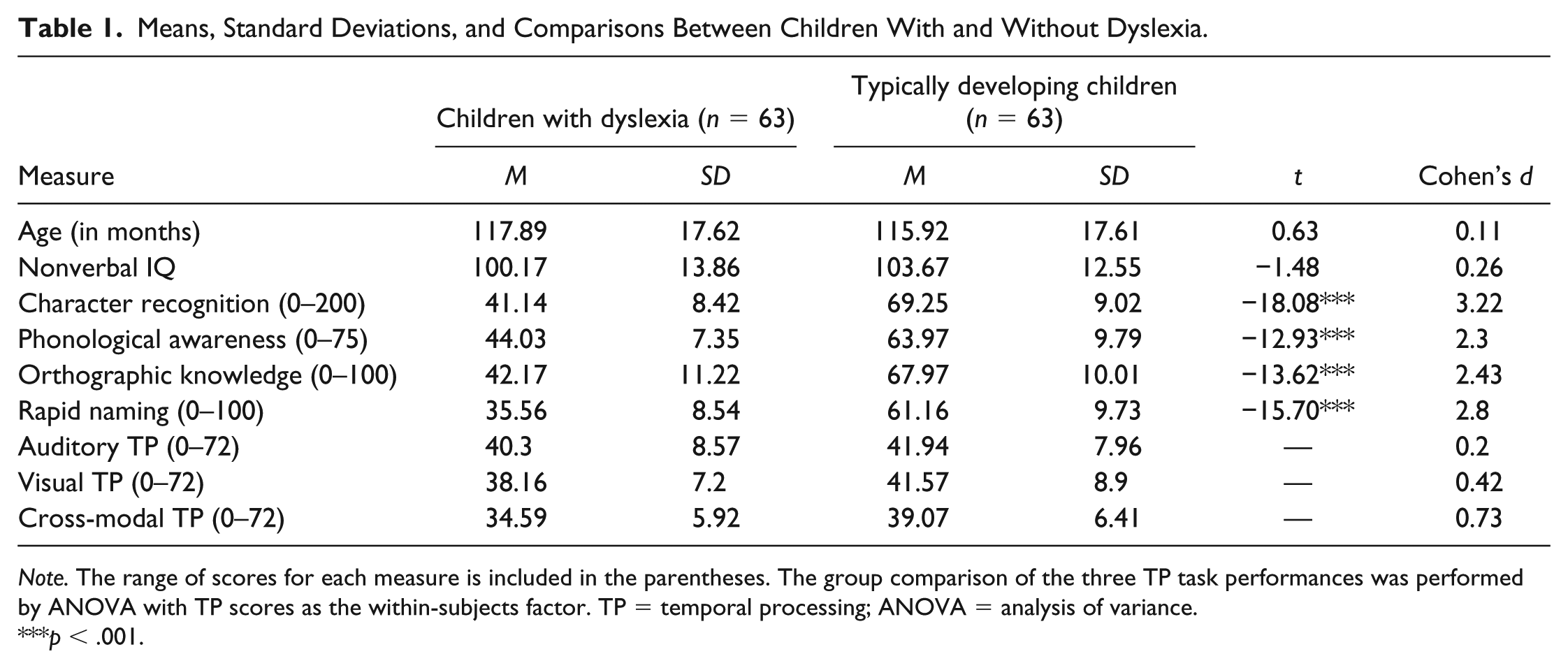
Note. The range of scores for each measure is included in the parentheses. The group comparison of the three TP task performances was performed by ANOVA with TP scores as the within-subjects factor. TP = temporal processing; ANOVA = analysis of variance.
p < .001.
Table 1 also displays the mean number of correct responses in each of the three task conditions per group. A 2 (group: typically developing children and children with dyslexia) × 3 (condition: auditory, visual, and cross-modal TP) ANOVA was performed with the task condition as the within-subjects factor. A main effect of group was found, F(1, 124) = 13.06, p < .001,
An analysis of covariance (ANCOVA) controlling for age and nonverbal IQ revealed that the main effect of group remained significant, F(1, 122) = 12.42, p = .001,
Correlations Among TP, Literacy-Related Skills, and Chinese Character Reading
Table 2 presents the bivariate correlations between accuracy in TP and other measured variables in the two groups. A significant correlation between visual and cross-modal TP skills was found in the group with dyslexia. However, in both groups, auditory and visual TP skills were not significantly correlated. Chinese character reading had a moderate to strong association with the literacy-related skills in the typical group, but had an association only with OK and RAN in the group with dyslexia. Whereas the typically developing children’s character reading was associated only with the cross-modal TP skill, character reading in the children with dyslexia showed a moderate to strong association with both visual and cross-modal TP skills. The correlations were further analyzed by SEM.
Bivariate Correlations Between Variables in Children With and Without Dyslexia.
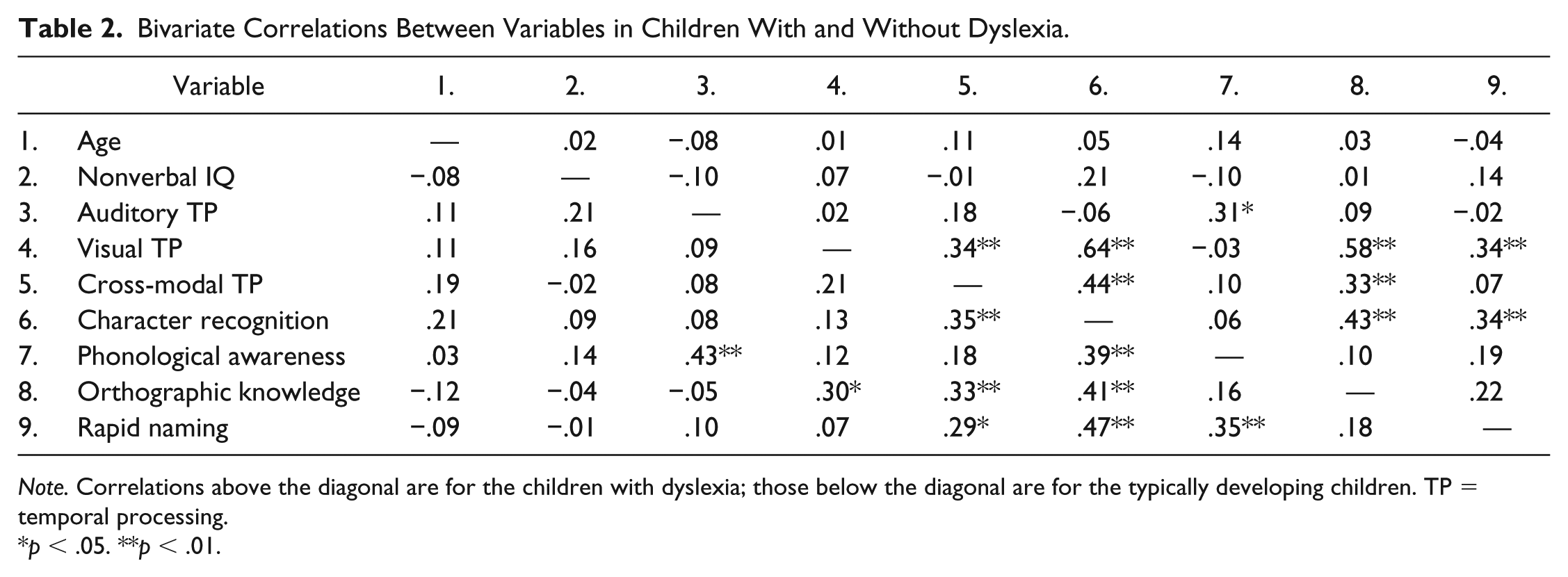
Note. Correlations above the diagonal are for the children with dyslexia; those below the diagonal are for the typically developing children. TP = temporal processing.
p < .05. **p < .01.
Unique Contributions of Separate TP Skills in Predicting Chinese Character Reading
To reveal the unique contributions of auditory, visual, and especially cross-modal TP abilities in predicting Chinese character reading beyond the effects of literacy-related skills, we estimated several structural equation models. The first model (M0) estimated the paths from the three TP skills to character reading in the entire sample. This model specified the paths from nonverbal IQ, PA, RAN, and OK to character reading to control for these variables. Because age was not correlated with any measured variables, the model did not include age. This model was saturated and did not provide model fit estimates. The TP skills and control variables explained 80.4% of the variance of character reading, p < .001. As shown in Table 4, the results indicated that cross-modal TP (B = 0.29, SE = 0.12, β = .11, p = .01), PA, RAN, and OK (ps < .001) were significant predictors of character reading. This finding suggests that after considering the effects of literacy-related skills, cross-modal TP skill still independently predicts Chinese reading.
To further examine whether the effects of the TP skills and control variables on reading differed between the children with and without dyslexia, we conducted multi-sample analysis to test for the equality of the model parameters across the two sub-samples. The grouping variable (i.e., group with dyslexia vs. typical group) was introduced to all of the following models (see Table 3). In M1, we allowed all parameters to be equivalent across the children groups. The model fit estimates indicated a poor data fit. As indicated by the contribution to the χ2 value from each group, the model provided a slightly better fit (χ2 = 6.71) in the typical group than in the group with dyslexia (χ2 = 9.43). This finding suggests that at least some parameters are inequivalent between the typical children and children with dyslexia. Therefore, M2 deleted the equality constraints on the paths from the three TP skills to character reading, assuming that they had different effects on typically developing and impaired reading. The model fit was improved but still unsatisfactory, implying that certain parameters were unequal. Finally, we allowed the parameters of PA, RAN, and OK to be unequal one at a time to identify the best model. Only the model that specified unequal parameters of OK (M3) provided a reasonable data fit. M3 appeared to provide a better data fit than M2 according to the improved model fit indices and the marginally significant chi-square difference test result, Δχ2 = 3.81, Δdf = 1, p = .051. This finding indicated that the parameters of OK and the three TP skills differed between the groups.
Fit Indices of the Three Models Testing the Equality of the Parameters Between the Group With Dyslexia and Typical Group.
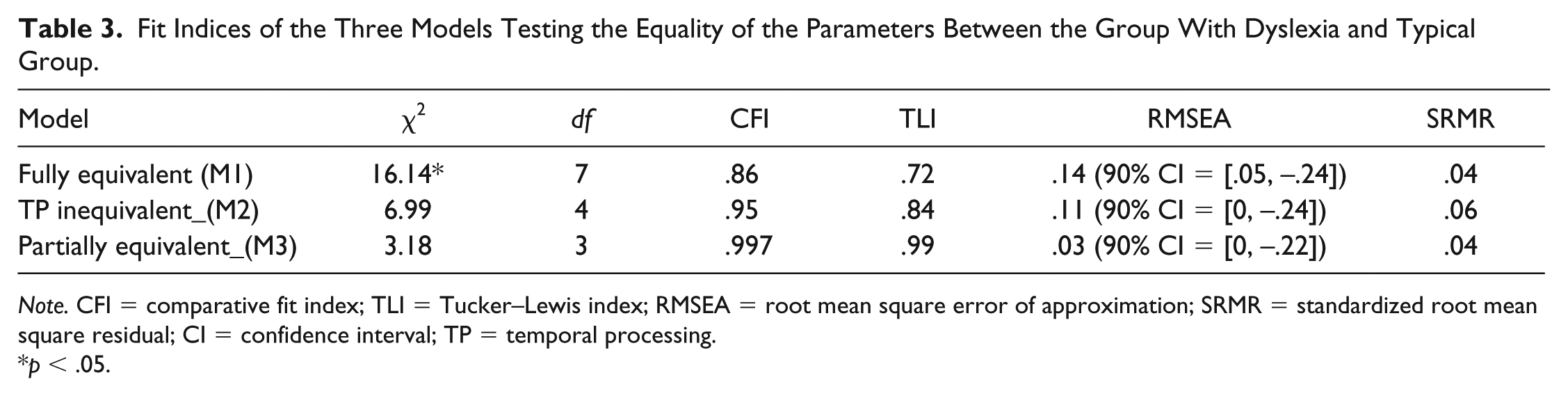
Note. CFI = comparative fit index; TLI = Tucker–Lewis index; RMSEA = root mean square error of approximation; SRMR = standardized root mean square residual; CI = confidence interval; TP = temporal processing.
p < .05.
The standardized estimates of M3 are reported separately for each group in Table 4. The effects of TP skills on reading differed between the groups. The cross-modal TP skill was a significant predictor only in the group with dyslexia (B = 0.4, SE = 0.14, β = .27, p = .004). There was also an effect of the visual TP skill in the children with dyslexia (B = 0.52, SE = 0.13, β = .43, p < .0001). Notably, the effects of the cross-modal and visual TP skills were found after considering the significant effects of PA and RAN. However, after considering that PA, RAN, and OK significantly predicted character reading in the typically developing children, none of the TP skills showed unique effects.
Complete Standardized Path Estimates of the Final Model of the Entire Sample (M0) and Two Sub-Samples (M3).
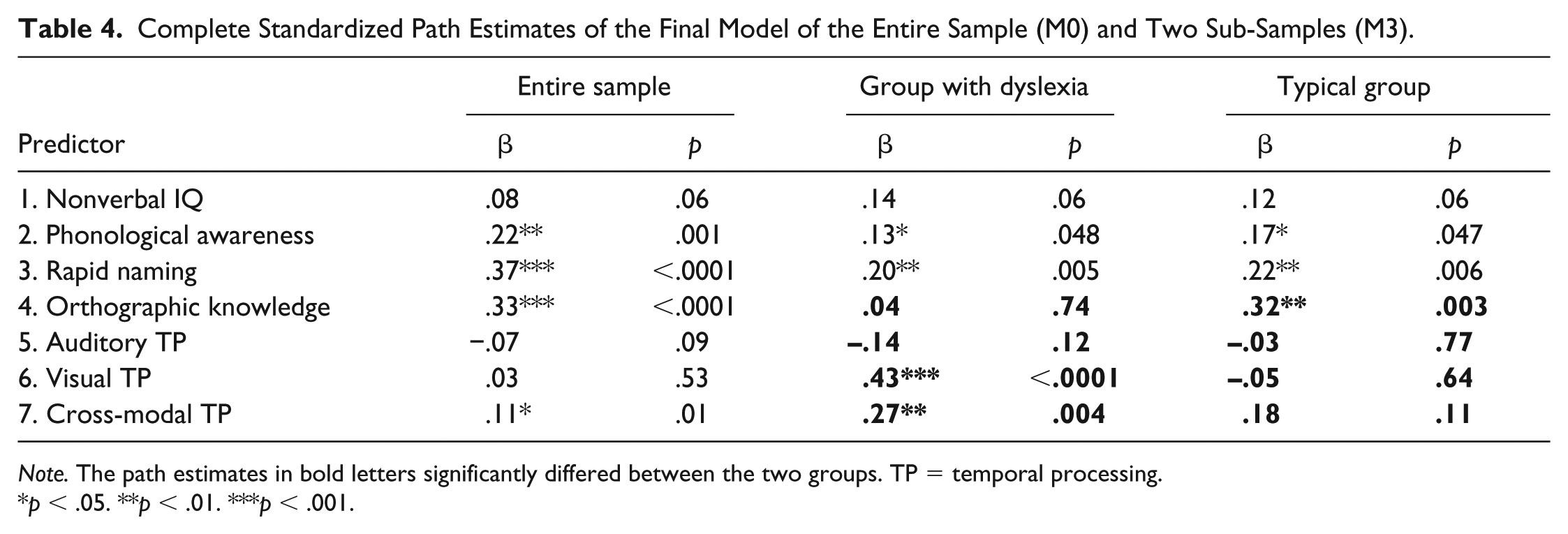
Note. The path estimates in bold letters significantly differed between the two groups. TP = temporal processing.
p < .05. **p < .01. ***p < .001.
Whether TP Affected Character Reading Through Literacy-Related Skills
There is scant evidence examining how TP in separate modalities affects reading through literacy processing. Therefore, we conducted a path analysis to explore whether PA, RAN, and OK mediated the associations between TP skills and character reading. The analyses were exploratory and mainly data-driven because existing research has not specified any relationships between cross-modal TP and literacy-related skills or the associations between auditory and visual TP and RAN. Existing evidence supports the presence of a path from auditory TP to PA, a path from visual TP to OK, and all the paths from PA, OK, and RAN to character reading. Thus, we estimated the paths from cross-modal TP to all the literacy-related skills and those from the three TP skills to RAN. The model modifications did not reveal any model that fit the data of the entire sample or simultaneously fit the two sub-samples. Considering that the aforementioned results showed significantly different inter-factor associations between the two groups, we analyzed the groups separately.
Figure 1 depicts the final models of the two groups. The estimation of Model A resulted in a reasonable fit of the data in the typical group, χ2(11, N = 63) = 12.62, p = .32, CFI = .97, TLI = .95, RMSEA = .05 (90% confidence interval [CI] = [0, .15]), SRMR = .1. This model indicates that in typically developing children, the cross-modal TP skill had a significant effect on OK and RAN, which, in turn, affected reading. As expected, the auditory and visual TP skills affected character reading through PA and OK. The tests using a bootstrapping method showed that the indirect effects of auditory and cross-modal TP were marginally significant, ps = .05, but those of visual TP were not (p = .12). However, regarding the data of the children with dyslexia, we found that Model B provided a good fit, χ2(10, N = 63) = 9.11, p = .52, CFI = 1, TLI = 1, RMSEA < .001 (90% CI = [0, .13]), SRMR = .05. This finding indicates that cross-modal and visual TP directly affected character reading, whereas the effects of PA, OK, and RAN disappeared.
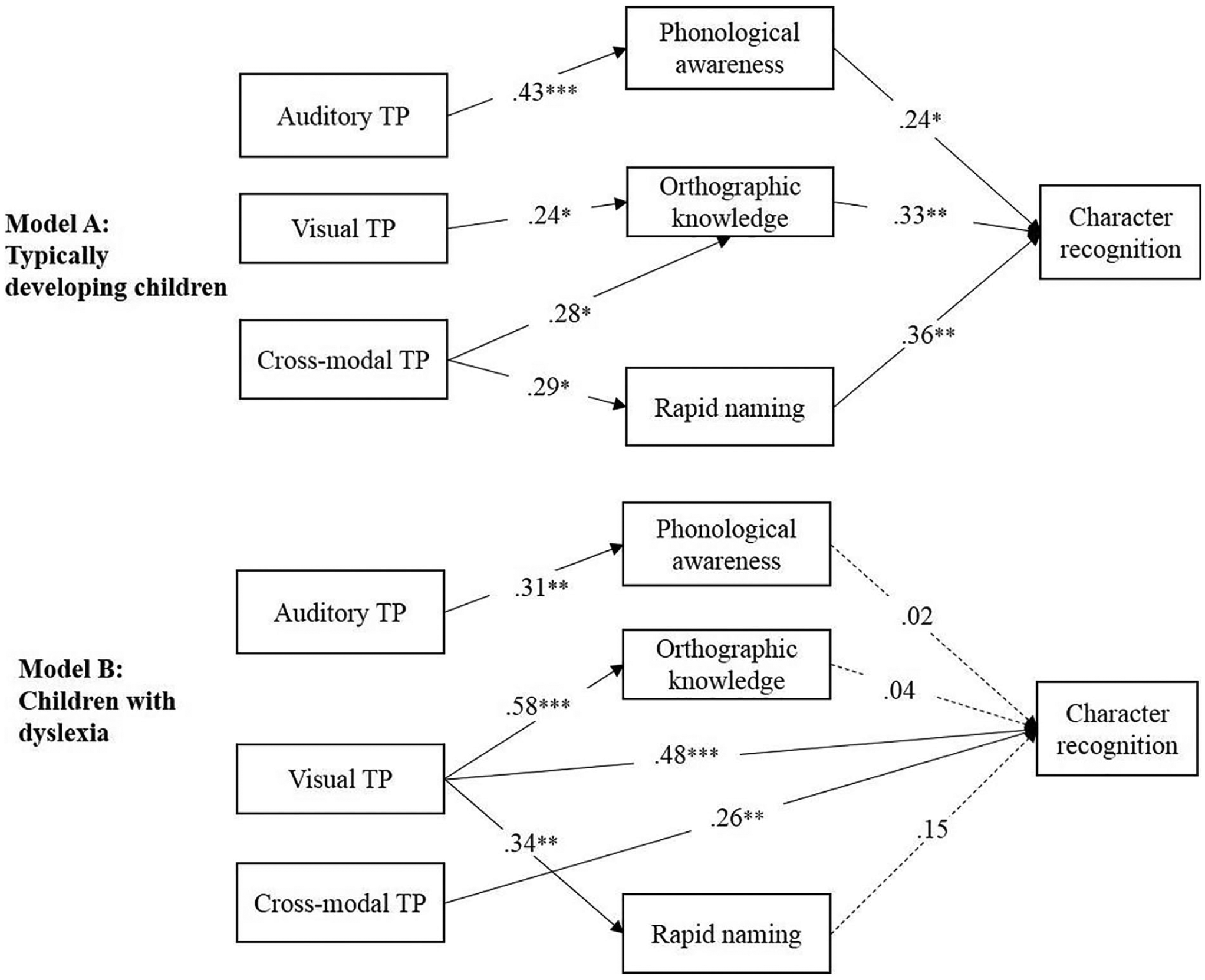
The mediation models for the typical and dyslexic groups to address the mediation of literacy-related skills in the relationship between the TP skills and Chinese character recognition.
Discussion
The present study found that TP skills differed between the Chinese children with and without dyslexia. Chinese children with dyslexia were impaired in auditory, visual, and cross-modal TP skills. On average, they were less accurate than typically developing children in judging the temporal order of a pair of auditory and visual stimuli rapidly presented in succession within one modality and across modalities. In addition to group difference on TP, the associations between TP skills and character reading score were examined. The SEM showed that in the entire sample, cross-modal TP was a unique predictor of character reading after considering nonverbal IQ and the literacy-related skills. The multi-sample analysis indicated that in the typically developing children, none of the TP skills independently predicted reading after considering the significant effects of PA, OK, and RAN; however, the cross-modal and visual TP skills contributed independently of PA and RAN in predicting reading in the children with dyslexia. Regarding the effects of TP on reading, the path analysis showed that while TP skills may affect reading in typically developing children through literacy-related skills, in the group with dyslexia, visual and cross-modal TP appear to exert direct effects on reading.
This study is among the first to investigate the potential association between cross-modal TP impairment and reading in Chinese children. It aimed to determine whether TP skills, especially cross-modal TP, are important for Chinese reading. The finding that the children with dyslexia showed inferior cross-modal, auditory, and visual TP skills compared with the typically developing children supports the presence of a general association between impaired TP and poor reading. This finding also corroborates previous work investigating cross-modal and unimodal TP in readers of alphabetic languages (e.g., Laasonen et al., 2002; Meyler & Breznitz, 2005; Rose et al., 1999). Moreover, we evaluated the importance of TP skills in reading relative to literacy-related skills. The analysis of the entire sample indicated that cross-modal TP has a small but significant contribution to character reading after considering the effects of PA, OK, and RAN. The findings appear to suggest that regardless of dyslexia status and literacy-related skills, cross-modal TP is relevant for explaining character reading. Nevertheless, the multi-sample analysis in one model showed that TP skills were more important for reading in the group with dyslexia than in the typical group. While in the typical group, TP skills did not contribute to reading independently of PA, OK, and RAN, the cross-modal and visual TP skills demonstrated a contribution beyond that of the known predictors of reading in the group with dyslexia. This finding suggests that TP skills could mark severe reading problems but do not contribute to reading ability within the typically developing range.
As previously mentioned, our test of the mediation of literacy-related skills in the relationship between TP skills and reading was exploratory, given the limited research on some associations between the skills and the small size of our sub-samples. The finding of the path analysis of the typical group appeared to be consistent with the dual-pathway model, which assumes that auditory TP affects reading via PA and visual TP through OK (e.g., Farmer & Klein, 1995; Stein, 2001). Moreover, cross-modal TP affected OK and RAN, which then affected reading. Nevertheless, the indirect effects of auditory and cross-modal TP were marginally significant, partly due to the small sample size in the typical group. In the group with dyslexia, this model did not fit the data. Although auditory and visual TP affected PA, OK, and RAN, these literacy-related skills did not predict reading; in contrast, cross-modal and visual TP showed direct effects on reading without mediation by any literacy-related skills. It appears that the typical pattern of relationships among TP, literacy processing, and reading is disrupted in dyslexia.
The present findings suggest that TP was more important for character reading in the group with dyslexia than the typical group. One possible reason is that TP is a low-level domain-general ability that underlies many higher-order cognitive processes, including literacy processing. In typically developing children, TP skills develop and function effectively, supporting the healthy development of literacy-related skills. Because these skills are domain-specific and more closely related to reading acquisition than domain-general skills, when their effects are considered, the relative importance of TP skills are reduced. However, in children with dyslexia, deficient TP skills are likely to have a broader impact on different cognitive processes, which might show a cumulative and strong effect on reading. Thus, they might have independent effects on reading in addition to literacy-related skills. Another possible explanation is that reading in typically developing children is more automatic, and these children can directly access the sounds of words from the lexicon (Castles & Coltheart, 1993). Thus, their processing of written words might rely less on low-level cognitive processing skills like TP, resulting in their little effects when literacy-related skills are considered. In contrast, children who have dyslexia may depend more on low-level skills to perceive and analyze the written words; therefore, TP skills may still play a role in reading.
This study demonstrated that cross-modal TP plays a unique role in reading. This finding is expected because of the cross-modal and time-constrained nature of language and reading. Research on audio-visual speech integration documents that audio-visual interactions improve speech perception and comprehension (e.g., Schwartz, Berthommier, & Savariaux, 2004). Six-month-old infants are already influenced by visual cues when perceiving auditory speech (e.g., Teinonen, Aslin, Alku, & Csibra, 2008). In addition, when children learn to read, according to Laasonen et al. (2002), the visual system sequentially decodes the printed letters and converts them to their phonological equivalents; meanwhile, children must program and execute motor sequences for speech output as well as monitor speech through feedback from auditory and kinesthetic/tactile perception. Cross-modal TP should be engaged in this rapid transfer and integration of information across modalities.
Interestingly, we found that visual TP contributed much more than cross-modal and auditory TP to character reading in the group with dyslexia. Similarly, some studies have indicated that visual TP is more strongly related to Chinese reading than auditory TP (Chung et al., 2008; Wang & Yang, 2018). Visual TP likely reflects not only TP ability but also visual processing ability. Many studies have demonstrated the particular importance of visual-orthographic processing in Chinese reading, given the complex visual forms of Chinese and weak correspondence between orthography and phonology (e.g., Liu, Chen, & Chung, 2015; Liu, Chen, & Wang, 2016; Luo, Chen, Deacon, Zhang, & Yin, 2013; McBride-Chang, Chow, Zhong, Burgess, & Hayward, 2005; Siok, Spinks, Jin, & Tan, 2009). Therefore, deficient visual TP might affect reading impairments by impeding the processing of the temporal features of written units. Furthermore, deficient visual TP might lead to deteriorated processing of visual information itself.
Some limitations of the present study must be mentioned. First, only TOJ tasks were adopted to assess TP skills. Future studies could use other tasks to examine whether Chinese reading displays similar associations with different aspects of TP, such as temporal pattern recognition and gap detection. Second, this study did not control for working memory. We controlled for nonverbal IQ; thus, the TP deficits in the children with dyslexia should not be secondary to a deficiency in general intelligence. However, it is still likely that the association between TP skills and reading might change after considering working memory. Third, we expected TP skills to affect reading development rather than the other way around. However, our research design cannot eliminate the possibility that reading ability had an impact on TP skills because we did not have a group of younger children matched to the group with dyslexia by reading level. To establish the causal role of TP skills in reading, future studies could include a reading-level-matched control group or adopt a longitudinal design. Finally, the children were tested during breaks between lessons at their schools. It is possible that they were distracted by occasional noise outside the testing room, resulting in their relatively low accuracy in the TOJ tasks. Future studies may test students during class time to reduce distraction and enhance the test validity.
Overall, the present study is congruent with the majority of the existing findings (see Ramus, 2003; Rosen, 2003, for controversies and critiques), substantiating the importance of effective TP for reading acquisition. It also shows that TP impairment in dyslexia is not specific to modality. In addition to auditory and visual TP, cross-modal TP differed between children with and without dyslexia. Overall, cross-modal TP independently contributed to Chinese character reading beyond literacy-related skills. Nevertheless, TP was more important for reading in children with dyslexia than in typically developing children. Regarding the underlying mechanisms of the TP-reading link, TP in separate modalities was differentially related to reading through separate literacy-related skills. However, in the children with dyslexia, TP appeared to independently affect reading. The skills to process timing and temporal changes of perceptual stimuli are very basic and they develop early in human life (e.g., Benasich & Tallal, 1996; Háden, Honing, Török, & Winkler, 2015). If the relationship between TP and dyslexia is unique or even causal, it may inform the early identification of children with dyslexia. Therefore, further research investigating the relationships between TP and literacy-related skills in this population is valuable.
Footnotes
Declaration of Conflicting Interests
The author(s) declared no potential conflicts of interest with respect to the research, authorship, and/or publication of this article.
Funding
The author(s) disclosed receipt of the following financial support for the research, authorship, and/or publication of this article: This work was partially supported by the Research Support Scheme of Department of Special Education and Counseling at The Education University of Hong Kong (RSS2017-18-003).
