




Abstract
Developmental dyslexia is defined as a specific reading disorder but is also thought to be underpinned by a deficit in motor skills that may well affect handwriting performance. However, the results of studies addressing this issue are not consistent. The present study was, therefore, designed to better understand the functioning of handwriting in children with dyslexia, by conducting an analysis of the legibility and fluency of handwritten letters, supplemented by an assessment of motor skills. The performances of 15 children with dyslexia (Mage = 11.4 years) were compared with those of two groups of typically developing children, one matched for chronological age, the other for orthographic level (Mage = 8.7 years) on two handwriting measures (production of the letters of the alphabet and the child’s first name and surname). Results revealed a delay in motor skills, as well as in letter legibility, letter production duration, and the number of short pauses (i.e., lasting between 20 and 199 ms) made during letter production, in the children with dyslexia, with strong negative correlations between motor skills and the number of short pauses. Results are discussed in the context of handwriting control development in children, and perspectives are set out for practitioners.
Although many studies have demonstrated that developmental dyslexia is underpinned by a phonological core deficit (Snowling, 2000), it should nonetheless be regarded as a heterogeneous syndrome, characterized by frequent associations with other developmental problems, including motor deficits (Brookes et al., 2010; Denckla et al., 1985; Fawcett & Nicolson, 1995; Ramus et al., 2003). Depending on the theoretical approach, these motor impairments could reflect either a comorbid entity (Chaix et al., 2007) or a more general cerebellar deficit affecting automation, planning, and motor coordination that could be responsible for reading disabilities (Nicolson et al., 2001; Nicolson & Fawcett, 1990; see Nicolson & Fawcett, 2011, for an overview).
It is when we consider the orthographic difficulties of children with dyslexia in the context of written production that the question of a possible motor deficit impairing handwriting arises. Learning to write by hand requires learners to meet a twofold challenge: gradually increasing the fluency of handwriting, while improving the legibility of the letters through increasingly automatized motor programs that control gestures more and more efficiently (Chartrel & Vinter, 2006; Hamstra-Bletz & Blöte, 1990; Van Galen, 1991; Ziviani & Wallen, 2006).
Although the primary function of handwriting is to produce a written trace, it can also interact with orthographic processing. Many studies have demonstrated a relationship between the mastery of handwriting skills and spelling success in typically developing children, with inefficient handwriting consuming cognitive resources at the expense of orthographic processing (see Pontart et al., 2013, for an overview). In this respect, assessing the functioning of handwriting in children with dyslexia and the extent to which these children may have a specific handwriting impairment related to a motor deficit would appear to be an important research objective, in view of the broader orthographic difficulties they encounter when writing.
Handwriting Difficulties in Children with Dyslexia
Several studies have examined the handwriting skills of children with dyslexia, aged 8 to 12 years, in a variety of situations (dictation, copy, and composition) and a variety of languages, including English, Norwegian, and Chinese (Berninger et al., 2008; Cheng-Lai et al., 2013; Lam et al., 2011; Martlew, 1992; Sovik & Arntzen, 1986; Sumner et al., 2013, 2014). In all these studies, investigations consisted in analyzing the legibility and/or fluency of the written units (letters, ideograms, and words) produced by the children.
Regarding legibility (e.g., positioning, size, accuracy of formation, and arrangement of strokes composing the units), results systematically show that the productions of children with dyslexia are less legible than those of typical, chronological age-matched children, whatever the orthographic system, whether the children have to write letters (Martlew, 1992, for English; Sovik & Arntzen, 1986, for Norwegian) or ideograms (Cheng-Lai et al., 2013; Lam et al., 2011, for Chinese). By contrast, Martlew (1992) failed to find any difference in legibility between the productions of children with dyslexia (here, age 10 years) and those of younger children of the same spelling level (age 8 years).
Results are less consistent regarding fluency (e.g., production rates, pauses, and/or speed of pen in movement), whereas Sovik and Arntzen (1986) and Martlew (1992) failed to find any differences in the duration of word production and/or interword pauses between children with dyslexia, aged 9 or 10 years, and those of their typical age-matched peers, Cheng-Lai et al. (2013) and Lam et al. (2011) observed lengthier ideogram production durations in Chinese children with dyslexia, aged 9 years and 7 to 11 years. For her part, Martlew (1992) found that children with dyslexia wrote faster than younger children of the same spelling level. According to Berninger et al. (2008), although poorer handwriting performances can be observed in children with dyslexia, it is above all their more severe spelling deficits that explain the difficulties encountered in written production.
This interpretation is corroborated by the results of two studies conducted by Sumner et al. (2013, 2014) to conjointly analyze the spelling performances and handwriting fluency of 9.4-year-old children with dyslexia, compared with those of two groups of typical children matched on chronological age or spelling ability (6.6 years). In the first study, Sumner et al. (2013) showed that the pen movement speed (calculated by excluding pauses above a 30-ms threshold) of the children with dyslexia was greater than that of children of the same spelling level when writing the letters of the alphabet or composing texts, but did not differ from that of same-age peers. However, the children with dyslexia were found to pause (above a 30-ms threshold) for longer than the age-matched group. In the second study, Sumner et al. (2014) replicated and specified these findings in a copying task where children had to write out a single sentence twice, once as carefully as possible and once as fast as possible. Results showed that the children with dyslexia were once again able to produce pen movements at the same speed as their age-matched peers (and more rapidly than children with same spelling level for the copying as fast as possible condition), but spent more time pausing (above a 30-ms threshold) and made more intraword pauses (above a 250-ms threshold) while writing (but fewer than children with the same spelling level, whatever the copy condition).
According to Sumner et al. (2014), the consistent results yielded by their two studies confirmed that the main problem of children with dyslexia is not so much handwriting execution (as assessed in their study by pen movement speed) as spelling. It is these spelling difficulties (e.g., word-level problems) that generate pauses in general and, more specifically, within words. Comparison of these sparse studies investigating handwriting in children with dyslexia reveals two main findings.
First, the fact that the legibility of productions is systematically lower for children with dyslexia compared with children of the same age, but no different from that of younger children with the same orthographic level, suggests that children with dyslexia exhibit a delay in handwriting development rather than a specific difficulty. This delay does not seem to depend on orthographic and allographic systems, as differences between children with dyslexia and children of the same age have been observed in more or less consistent alphabetic languages (here, Norwegian and English) as well as for pictographic languages (here, Chinese).
Second, the fact that a decrease in production fluency in children with dyslexia, compared with children of the same age, has not been systematically found raises the question of the reasons for this heterogeneity in the results. One possible explanation relates to the variety of tasks used from one study to another to assess the temporal course of written production (e.g., copying and/or recall of letters, ideograms, alphabet, words, or sentences; text production). Differences in writing rates and pauses may be due to the engagement of spelling or text composition processes, in addition to handwriting. Moreover, the greater or lesser orthographic transparency of the languages considered in these studies introduces variations in spelling complexity that can also lead to variations in fluency. Nevertheless, although this factor can be put forward to explain why Sumner et al. (2013, 2014) found an effect of dyslexia on production fluency in English, in contrast to Sovik and Arntzen (1986)’s findings in Norwegian, it is not consistent with Martlew (1992)’s failure to find any differences in the duration of word production and/or pauses in English.
Another possible explanation lies in the different criteria used to gauge fluency, in terms of both the variety of temporal variables considered (word production duration, overall pause duration, interword pause duration, intraword pause duration, speed of pen in movement, etc.) and the temporal thresholds chosen to define the periods of pausing and movement. On this last aspect, Sumner et al. (2013, 2014) used pause duration as the criterion to distinguish between handwriting and spelling levels of processing. Deeming that the duration of a writing pause can be viewed as an indicator of the complexity and/or cost of the processes taking place (Alamargot et al., 2006), these authors argued that spelling processing can take place during pauses lasting more than 30 ms (Sumner et al., 2013) or 250 ms (Sumner et al., 2014), while handwriting processing efficiency manifests itself in the speed of the pen in movement (therefore excluding pauses lasting more than 30 ms from the calculations).
It was on the basis of this criterion that Sumner et al. (2013, 2014) concluded that handwriting seems not to be affected by dyslexia, as there was no significant effect on the speed of pen in movement. Nevertheless, assessing handwriting solely through the pen in movement at the surface of the paper is highly questionable. Handwriting consists not only in executing pen movements, but also in making handwriting pauses (in-air movement time and/or movement stops on the paper) to control (i.e., calculate and adjust) the execution of these movements, that is to say, determining the location, order, number, and relative size of the strokes, as well as the duration and range of required motor strength (e.g., Bara & Gentaz, 2010; Morin et al., 2017; Palmis et al., 2017; Van Galen, 1991).
It has been shown that these handwriting pauses are more likely to be short (e.g., mean duration less than 100, 130, or 250 ms, depending on the study) compared with pauses dedicated to high-level processing (see Alamargot et al., 2007, 2010; Olive et al., 2009; Olive & Kellogg, 2002), and are more likely to be characterized by a high number of occurrences within and between the letters (see Alamargot et al., 2006, 2010; Chuy et al., 2012; Maggio et al., 2012; Olive et al., 2009). The duration and/or number of these handwriting pauses is greater for writers who are young (Alamargot et al., 2010; Chartrel & Vinter, 2006; Palmis et al., 2017; Pontart et al., 2013), are weak (Rosenblum et al., 2003), have a developmental coordination disorder (Ellis, 1988; Paz-Villagrán et al., 2014; Rosenblum & Livneh-Zirinski, 2008), or have to write under unusual conditions, such as on the low-friction surface of a digitizing tablet with a stylet (Alamargot & Morin, 2015; Guilbert et al., 2019).
Indeed, short pauses that frequently interrupt the pen in movement are characteristic of the retroactive control of handwriting execution (Chartrel & Vinter, 2006). Typical of beginning writers, this mode of control consists in calculating the pen’s trajectory stroke by stroke, step by step, adjusting it according to visual feedback and feedback from the current trace. With practice and increasing expertise, the retroactive mode of control is gradually replaced by feedforward control. This relies on automatized motor programs that set the parameters (shape, height, and speed) and ensure the execution of the handwriting movement (Bara & Gentaz, 2010). Stored in long-term memory, these programs contain the action plans needed to produce each letter. As the trajectory is planned in advance in procedural memory, uniformly shaped letters can be produced quickly and smoothly, and the movement is no longer interrupted by short pauses (van Galen, 1991).
Given the importance of short pauses to the understanding of handwriting control and its development, it is amazing that this indicator has received so little attention in previous studies of written production in dyslexia. In the latter, either pauses were considered together, independently of their duration or number (Martlew, 1992; Sovik & Arntzen, 1986; Sumner et al., 2013, 2014), or else only pauses lasting more than 250 ms were taken into account (Sumner et al., 2014). Accordingly, to complement the few previous studies to have evaluated the effect of dyslexia on handwriting dynamics, it is essential to specify which temporal variables are used to analyze the temporal domain of handwriting processing. In addition to studying general fluency (i.e., no distinction made between pauses and movements) or measuring a specific indicator (e.g., speed of the pen in movement, excluding pauses), it is important to consider the short pauses that interrupt the handwriting movement, especially those lasting less than 250 ms, which have been inexplicably neglected up to now. We believe that using a three-temporal indicators that break fluency down into movement and measure the short pauses that interrupt this movement (i.e., production duration per letter, speed of pen movement, and number of short pauses per letter) is a relevant means of tackling the effect of dyslexia on the control of handwriting.
The Present Study
In view of the heterogeneity of previous results, particularly those relying on temporal parameters like fluency, it seemed necessary to conduct a more in-depth assessment of handwriting in children with dyslexia, especially the temporal aspects, to better understand the extent to which these children may have handwriting difficulties related to a motor deficit, in addition to spelling problems. To achieve these goals, we had to decide on the writing tasks to administer, the measures and variables to consider (notably at the temporal level), the evaluation of motor skills, and the experimental plan.
First, to examine the children’s handwriting skills, we had to administer written production tasks that limited the need for orthographic processing and made it possible to measure different aspects of handwriting. As with previous studies, we chose to supplement the written production of the letters of the alphabet, which is often used to assess the efficiency of the handwriting process (see Abbott & Berninger, 1993; Graham et al., 2006), with the written production of the participants’ first name and surname (Alamargot et al., 2018; Chuy et al., 2012; Pontart et al., 2013). This last task provides a more specific measure of handwriting execution, for unlike the alphabet task, it does not involve the retrieval from memory of the alphabetical order, and involves the sequence of letters that was probably learned first and is frequently written (for a discussion, see Pontart et al., 2013).
Second, because the presence of short pauses during execution may reflect less mature control of handwriting, it seemed important to complement the assessment of the handwriting gesture by undertaking a fine-grained analysis of pauses. Categorizing the numbers of pauses (per letter) according to their duration could be a methodological solution for circumscribing the range of short handwriting pauses that interrupt the movement of the pen.
Third, as in most other studies (Cheng-Lai et al., 2013; Sumner et al., 2013, 2014), it seemed necessary to measure the motor skills of children with dyslexia independently of their handwriting, to analyze potential relationships between the two sets of abilities.
Fourth and last, to evaluate whether the handwriting and/or motor difficulties of children with dyslexia stem from a developmental delay or from a specific impairment, we compared their performances with those of two groups of typically developing children, one matched on chronological age, the other on orthographic level.
Method
Participants
A total of 45 children whose mother tongue was French took part in this study, with the informed consent of their parents or guardians. Of these, 15 children (six girls and nine boys) with a mean age of 11.44 years (SD = 0.97) had been diagnosed with dyslexia (DYS) and were recruited through 11 speech therapy clinics in the Nouvelle Aquitaine area of France. All the children were enrolled in local primary schools and attended general education classes, with no additional support other than the interventions provided by speech-language therapists outside the school. None of them had undertaken a specific program of instruction in the school setting and two of them were repeaters.
Each of the 15 children with dyslexia was paired with two typically developing children: one child of the same sex and chronological age, and one child of the same sex and orthographic skills. Accordingly, two groups of typically developing children (TYP_A: paired on age: n = 15; Mage = 11.50 years, SD = 1.01; TYP_O: paired on orthographic skills: n = 15; Mage = 8.71 years, SD = 0.60) were formed and compared with the group of children with dyslexia (DYS). The children in the two groups of typically developing students were recruited from state-run schools in the Nouvelle Aquitaine area (France). They were all native French speakers and none were repeaters.
The diagnoses of dyslexia had previously been established either at a referral center for language disorders or in a consultant’s office, based on the usual official speech and language assessments. Nevertheless, to (a) undertake a detailed assessment of the DYS group (in addition to the official speech and language assessments), (b) build homogeneous groups of typical children (with no outliers at the cognitive, reading, orthographic, or motor levels), and (c) pair the DYS group with the Typ_O group on the basis of orthographic skills, we conducted complementary measurements using standardized tests. These background measures were intended to evaluate nonverbal intelligence, orthographic skills (spelling and grammar), reading skills, working memory capacities (verbal and visuospatial), and motor skills.
Measures
Background measures
The complementary background measures assessing nonverbal intelligence, orthographic skills, reading skills, working memory capacities, and motor skills were conducted with a series of nine tests. Nonverbal intelligence was assessed using Raven’s Progressive Matrices (PM38; Raven, 1998), where participants have to find the missing piece to complete a logical matrix. The raw score is the number of correct answers for the total number of items (N = 18). Reading skills were assessed with the test La pipe et le Rat (Lefavrais, 1987), in which children have to read a list of words as quickly as possible in the space of 3 min, underlining the names of any animals. The raw score is the number of words read minus the words that are incorrectly underlined (speed score). Orthographic skills were assessed with a short version of the Test de Niveau Orthographique (Doutriaux & Lepez, 1980). This test is composed of a series of 40 sentences, each containing a missing word: participants have to select the correct orthographic form among three options. Half the items elicit spelling skills, for example, Il passe des heures entières devant sa __ de jeux: (a) console, (b) quonsole, (c) consolle [He spends hours in front of his game console]. The other half elicits grammatical skills, for example, Pendant l’orage, il __ dans les bois: (a) marchez, (b) marchait, (c) marché [During the storm, he walked in the woods]. The raw score corresponds to the number of correct answers out of 40. Verbal and visuospatial working memory capacities were, respectively, assessed using two tests: the Wechsler Intelligence Scales for Children (WISC) Digit Span (Wechsler, 2005), in which participants have to repeat increasingly long series of numbers (first in the right order, then in the reverse order); and the Visual Patterns Test (Della Sala et al., 1997), in which participants complete from memory a set of spatial configurations inside a matrix of increasing size. The raw scores for these two tests correspond to the number of correctly replicated sequences (32 for WISC Digit Span and 28 for Visual Patterns Test). Finally, motor skills were evaluated through four tests selected to probe the different facets of fine and gross motor skills. Two tests were taken from the sensorimotor functions domain of the Neuropsychological Assessment (NEPSY) scale (Korkman et al., 2003): Fingertip Tapping—designed to assess finger dexterity, motor speed, and rapid motor programming; and Manual Motor Sequences—designed to assess the ability to learn and automate (by imitation) rhythmic movements using one or both hands. These two tests were supplemented with two others evaluating broader cerebellar function (Fawcett & Nicolson, 1999; Stoodley et al., 2005): the Finger-to-Nose test (bringing the hand up from the side to the nose, describing a large circle) and the Static Balance tests with eyes open and closed, with and without countdown. The z scores for these four tests were averaged to obtain a composite score. The reliability of this series of nine tests, as assessed by Cronbach’s alpha, was high (α = .77).
Handwriting measures
To assess their handwriting skills, the children were asked to write by hand, using their usual handwriting, their first name and surname twice in a row, starting with a capital letter and the 26 alphabet letters once from A to Z, in cursive, lowercase letters. For each task, they were asked to write as quickly as possible but also as carefully as possible. To assess the fluency of letter production, the written tasks were performed on a pen-display tablet (Wacom Cintiq 21UX) connected to a laptop piloted by Eye and Pen© software (Alamargot et al., 2006; Chesnet & Alamargot, 2005). The children wrote directly on the surface of the tablet using a stylus (Wacom Intuos 3 Grip Pen). The software recorded the timing, position, and state of the pen tip on the tablet screen in real time, and managed the display of the written traces, instructions, and writing areas on the screen, composed of four boxes for the first name–surname writing, and 26 boxes for the letters of the alphabet. These boxes served to impose the location of the handwriting on the tablet screen, to track pen movements in the air between letters or words as closely as possible (monitoring of participants’ topokinesthetic processing). The boxes were large enough not to constrain the length of the written trace.
Procedure
Participants performed the tasks in individual sessions conducted by the same experimenter (a final-year speech therapy student specializing in clinical interventions who was specially trained by the researchers to administer the protocol). These tasks were administered in a fixed sequence, in two sessions 1 week apart. The standardized tests (intended to further describe the children and form the comparison groups) were administered during the first session, and the handwriting tasks during the second one.
Data Analysis
Accuracy of letter recall
The accuracy of first name–surname and alphabet letter recall was assessed according to the percentage of letters that were correctly recalled in the right order, out of the total number of letters expected (i.e., number of letters composing each child’s first name and surname, written twice; 26 letters in the alphabet string).
Quality of the letters
For both the first name–surname and alphabet tasks, the quality of the letters was assessed according to (a) the percentage of children who made at least one allographic error (e.g., writing an uppercase letter instead of a lowercase one) and (b) the percentage of legible letters (out of the total number of letters produced), based on the Evaluation Tool of Children’s Handwriting (ETCH; Amundson, 1995) criteria. A letter was deemed to be nonlegible if it (a) was not quickly recognizable out of context and at first glance, (b) was poorly formed, distorted, reversed, or greatly rotated, (c) could be confused with another letter or numeral, (d) had additional or missing parts, (e) was sloppy or intentionally hatched, (f) overlapped with another letter, or (g) was not proportional. After each of these criteria had been applied, the coding consisted in awarding one point for each correctly formed letter, be it uppercase or lowercase. To test the reliability of the legibility assessment, a second rater judged 18 productions for each of the two tasks (i.e., six randomly selected productions per task, for each of the three groups). There was no significant difference between the two raters’ scores regarding the percentage of legible letters in the first name–surname task: Rater 1: M = 64.40%, SD = 9.47; Rater 2: M = 65.19%, SD = 10.05; t(1, 17) = −1.00, ns, and Pearson’s correlation coefficient for the two scored series was high and significant (r = .83, p < .01). Similarly, there was no significant difference between the two raters’ scores regarding the percentage of legible letters in the alphabet task: Rater 1: M = 76.27%, SD = 11.30; Rater 2: M = 76.54%, SD = 8.49; t(1, 17) = −0.18, ns, and Pearson’s correlation coefficient for the two scored series was high and significant (r = .94, p < .01).
Fluency of letter production
The fluency of letter production was assessed by a set of three complementary variables, calculated separately for the alphabet and first name–surname tasks. These allowed us to circumscribe the temporal domain of handwriting and highlight the effect of dyslexia. Production duration per letter was calculated by dividing the total amount of time that elapsed between the beginning (first pixel) of the first letter and the end (final pixel) of the last letter by the number of letters produced (ms/letter). This production time, which included both the pauses and the duration of the pen movements, was treated as a general indicator of handwriting skills. Speed of pen movement was calculated by dividing the distance covered by the pen by the actual writing time (i.e., when the pen was moving across the tablet; cm/s). This calculation excluded all pauses (raised or pressed, lasting more than 20 ms; see Note 1), giving an indication of handwriting trajectory speed and motor execution efficiency (Alamargot et al., 2010; Sumner et al., 2013). To calculate the number of short pauses per letter, we began by establishing five categories of pauses lasting up to 1,000 ms, in 200-ms increments: pauses lasting between 20 and 199 ms (P1); pauses lasting between 200 and 399 ms (P2); pauses lasting between 400 and 599 ms (P3); pauses lasting between 600 and 799 ms (P4); and pauses lasting between 800 and 1,000 ms (P5). We then divided the total number of pauses produced in each category by the number of letters produced (n/letter).
Results
Statistical analyses were carried out using SPSS software. We ran one-way analyses of variance (ANOVAs) to assess the effect of the interindividual factor (group: DYS, TYP_A, and TYP_O), and two-way ANOVAs to assess the effects of the interindividual factor (group: DYS, TYP_A, and TYP_O) and the intraindividual factor (five pause categories: P1, P2, P3, P4, and P5), and the interaction between the two. The effect size
We begin by setting out the results on the standardized tests, including motor skills assessment, we used to assess in detail the children with dyslexia and match them with groups of typical children. We then report the comparison between the handwriting performances of the children with dyslexia and those of the two groups of typical children matched on chronological age or spelling level, when producing alphabet and first name–surname letters. During this comparison, particular attention was paid, among other measures, to the analysis of short writing pauses (lasting less than 250 ms), for although these had not yet been studied, they could nevertheless attest to the presence of handwriting difficulties in children with dyslexia, linked to poorer motor skills.
Background Measures
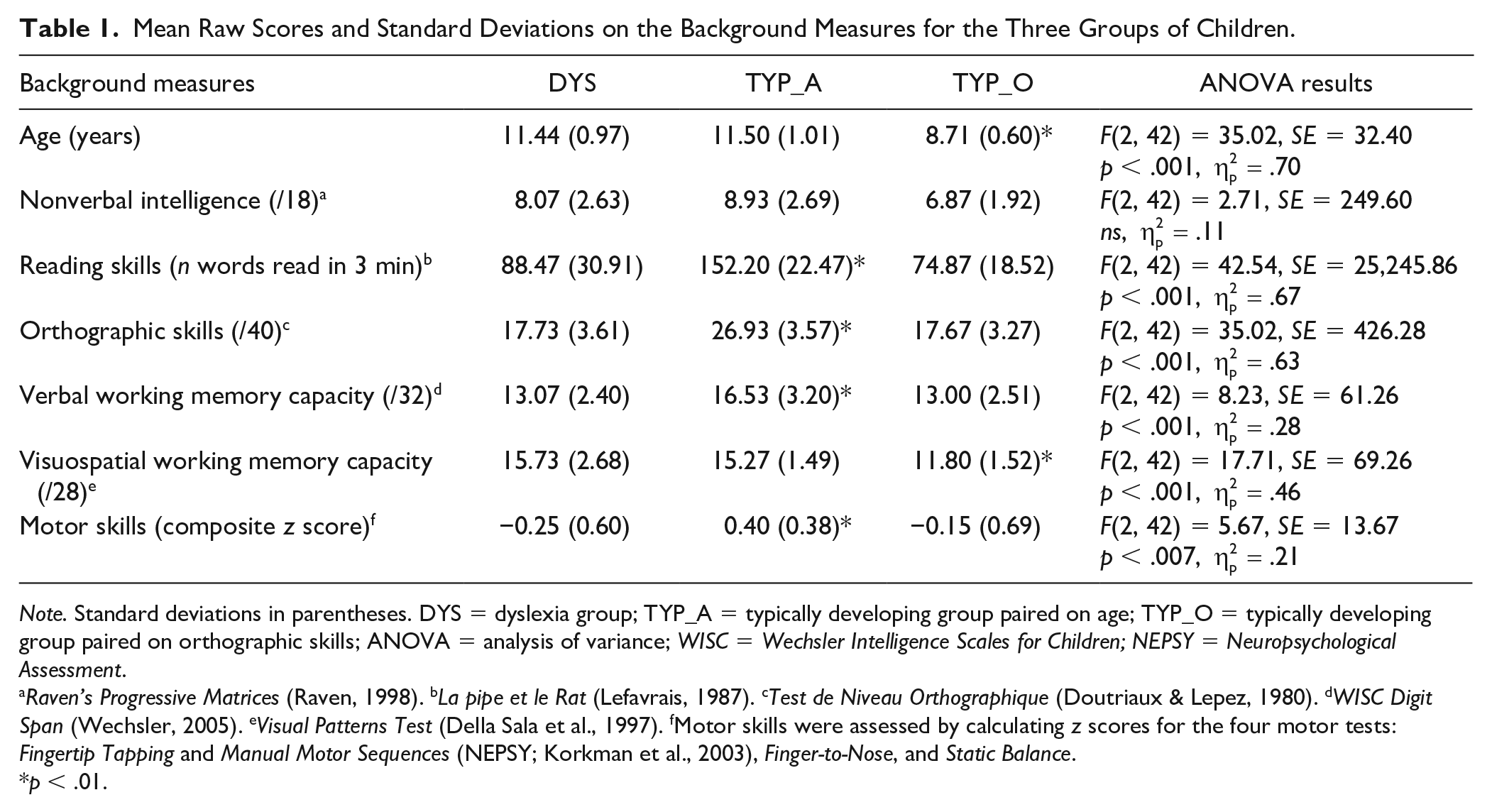
The raw scores on the complementary background measures used to assess the DYS children in greater depth, select the typical children, and pair them with the DYS children are set out in Table 1.
Mean Raw Scores and Standard Deviations on the Background Measures for the Three Groups of Children.
Note. Standard deviations in parentheses. DYS = dyslexia group; TYP_A = typically developing group paired on age; TYP_O = typically developing group paired on orthographic skills; ANOVA = analysis of variance; WISC = Wechsler Intelligence Scales for Children; NEPSY = Neuropsychological Assessment.
Raven’s Progressive Matrices (Raven, 1998). bLa pipe et le Rat (Lefavrais, 1987). cTest de Niveau Orthographique (Doutriaux & Lepez, 1980). dWISC Digit Span (Wechsler, 2005). eVisual Patterns Test (Della Sala et al., 1997). fMotor skills were assessed by calculating z scores for the four motor tests: Fingertip Tapping and Manual Motor Sequences (NEPSY; Korkman et al., 2003), Finger-to-Nose, and Static Balance.
p < .01.
Results showed significant effects of group (DYS, TYP_A, and TYP_O) on reading speed, orthographic score, verbal working memory capacity, and motor skills composite score. For each of these variables, partial comparisons showed that the performance of DYS children was significantly poorer than that of TYP_A children (p < .01), but not than that of TYP_O children (p > .13). A significant effect of group was observed on visuopatial working memory capacity, as the TYP_O children’s mean score was lower than that of the DYS children (p < .0002). Furthermore, the level of general intelligence (PM38) did not differ significantly between the three groups.
Handwriting Measures
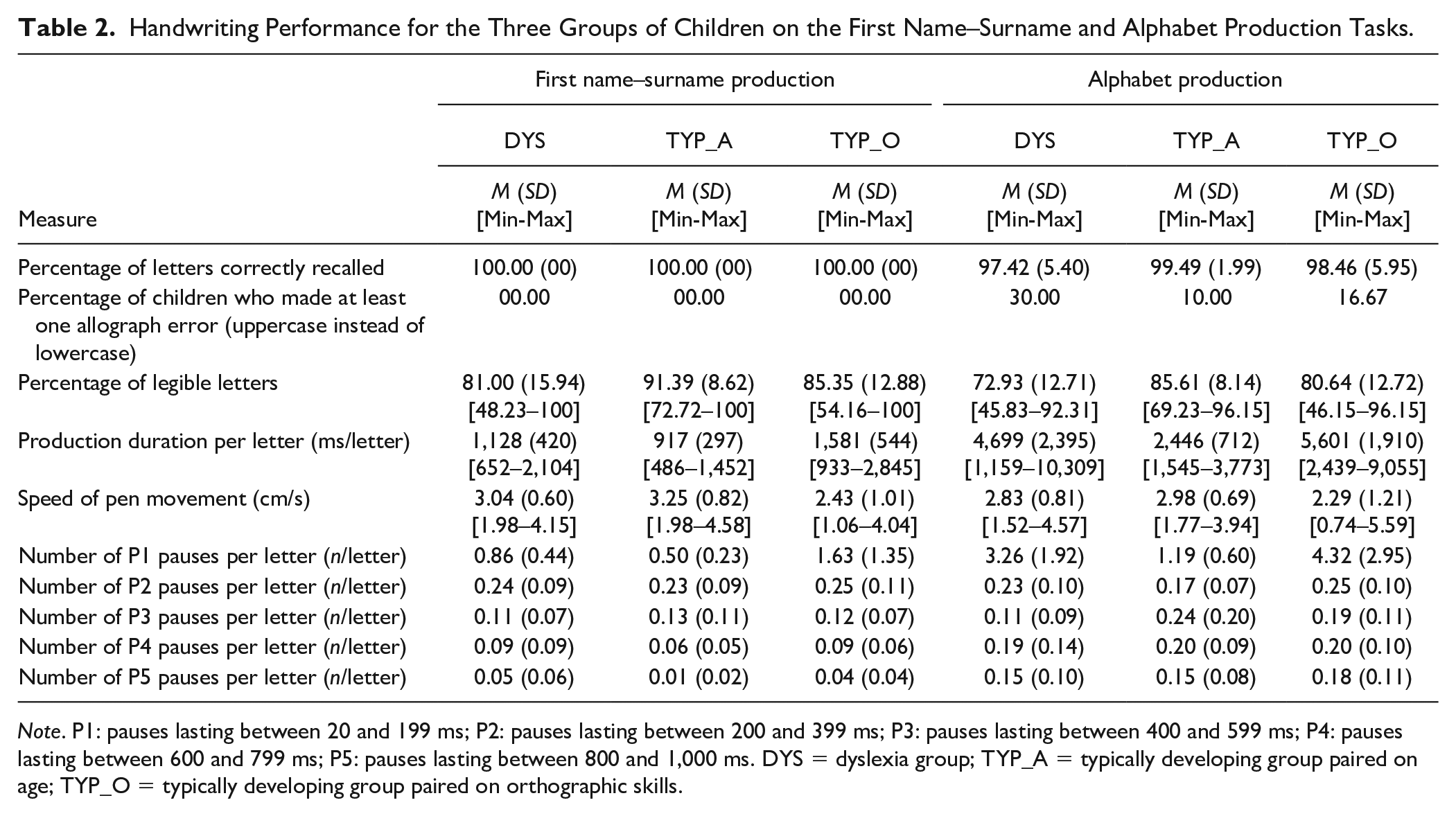
The performance for each of the three groups of children on the first name–surname and alphabet tasks is provided in Table 2.
Handwriting Performance for the Three Groups of Children on the First Name–Surname and Alphabet Production Tasks.
Note. P1: pauses lasting between 20 and 199 ms; P2: pauses lasting between 200 and 399 ms; P3: pauses lasting between 400 and 599 ms; P4: pauses lasting between 600 and 799 ms; P5: pauses lasting between 800 and 1,000 ms. DYS = dyslexia group; TYP_A = typically developing group paired on age; TYP_O = typically developing group paired on orthographic skills.
First name–surname production
In terms of the accuracy of letter recall, all the letters (100%) were correctly recalled by all three groups of children in the first name–surname production task. Regarding the quality of the letters, no child made a single allographic error in the first name–surname production task. In addition, the effect of group on the percentage of legible letters was not significant, F(2, 42) = 2.46, mean squared error (MSE) = 0.016, p < .10,

First name–surname production.
The number of P1 pauses per letter was higher for the DYS group than for the TYP_A group, but lower than for the TYP_O group (p < .001). No significant difference was found between the DYS group and either the TYP_A group or the TYP_O group for the four other (P2, P3, P4, and P5) pause categories.
Alphabet letter production
Concerning the accuracy of letter recall, there was no significant effect of group on the percentage of correctly recalled letters in the alphabet production task. Regarding the quality of letters, the percentage of participants who made at least one allographic error during the alphabet recall was significantly higher for the DYS group than for the TYP_A group, χ2(1, 30) = 5.00, p < .025. There was no significant difference between the DYS and TYP_O groups. Regarding letter legibility, the percentage of legible letters varied significantly according to group, F(2, 42) = 4.71, MSE = .012, p < .02,
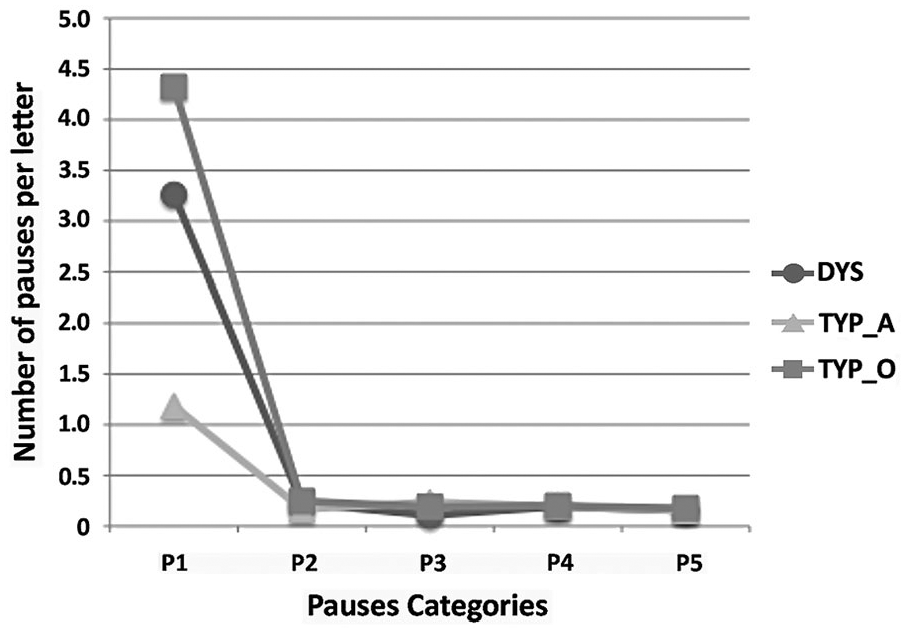
Alphabet letter production.
The number of P1 pauses was higher for the DYS group (M = 3.26; SD = 1.92) than for the TYP_A group (M = 1.18; SD = 0.61, p < .0001), but lower than for the TYP_O group (M = 4.33 n/letter; SD = 2.96, p < .002). No significant difference was found between the groups for the other (P2, P3, P4, and P5) pause categories.
Relationships between motor skills and handwriting performances
Analyses of correlations between performances on the motor skills tests (composite z score) and letter legibility, letter production duration, speed of pen movements, and number of P1 pauses per letter showed that the DYS group stood out from the two others, with high significant negative correlations between the motor skills composite score and the number of P1 pauses per letter, for both the first name–surname task (r = −.63, p < .02) and the alphabet task (r = −.64, p < .01). We did not find any other significant correlations between motor skills and alphabet or first name–surname performances for any of the three groups.
Discussion
The purpose of the present study was to describe, in more detail than previous studies had done, the functioning and specifically the temporal course of the handwriting component in children with dyslexia, comparing them with two groups of typically developing children: one matched on chronological age (TYP_A), the other on spelling level (TYP_O; 2.5 years younger on average). A strength of the study was that we used an important set of standardized background measures to describe these groups. There were no differences among groups on nonverbal intelligence. The children with dyslexia performed similarly to TYP_O peers, but significantly poorer than their TYP_A peers, on reading speed, orthographic skills, verbal working memory capacity, and on a motor skills composite score. The TYP_O group demonstrated significantly lower performance than the children with dyslexia on visuopatial working memory capacity.
The children in these three groups were asked to write by hand the letters of the alphabet and their first name and surname on a digitizing screen tablet that recorded their pen activity on its surface. These tasks were intended to assess handwriting skills by minimizing the contribution of orthographic processing. For each of the two tasks, we carried out an analysis of letter legibility, supplemented by a temporal analysis of letter production, based on three variables: production duration per letter, pen movement speed (excluding pauses), and number of pauses (according to their duration: five categories of pauses lasting between 22 and 1,000 ms) per letter. This last variable allowed us to categorize short handwriting pauses, especially those lasting between 20 and 199 ms, that had not been taken into account in previous studies and which might serve to highlight handwriting difficulties in children with dyslexia.
From a general point of view, results showed that while some of the handwriting performances of children with dyslexia were poorer than those of the TYP_A children, none of them were poorer than those of the TYP_O children. Thus, compared with TYP_A children, the children with dyslexia produced fewer legible letters when producing the alphabet from memory, and were also more likely to make at least one allographic error during production. At the temporal level, in terms of letter production duration, it took the children with dyslexia almost twice as long to produce a letter of the alphabet as it did for TYP_A children (4,699 ms/letter vs. 2,446 ms/letter), but there was no difference for the letters in their first name and surname (produced almost 8 times faster than the letters of the alphabet). Pause number analysis showed that the children with dyslexia made more P1 pauses (lasting between 20 and 199 ms) for both the alphabet task and the first name–surname task, but the numbers of pauses of longer durations (four categories between 200 and 1,000 ms, in increments of 200 ms) did not vary across the groups. There were no differences between the children with dyslexia and either the TYP_A or TYP_O children with regard to pen movement speed. Finally, an examination of the correlations between motor skills (significantly lower in the children with dyslexia than in their TYP_A peers) and temporal variables on the written production tasks revealed a specific, pronounced, and systematic relationship among children with dyslexia between motor performances and their number of P1 pauses (lasting between 20 and 199 ms) made during the two letter production tasks (alphabet and first name–surname). Thus, only in DYS group weaker motor skills were associated with a higher number of very short handwriting pauses (here, lasting less than 200 ms). These results raise three points of discussion.
First, the fact that the handwriting performances of children with dyslexia were never poorer than those of the TYP_O group is consistent with previous studies and indicates that the difficulties identified here stemmed from a delay in the handwriting and motor domains, rather than from a specific disorder. This delay manifested itself in differences in legibility, as well as in letter production duration (in the case of the letters of the alphabet) and number of P1 pauses (lasting between 20 and 199 ms) per letter (in the case of letters of the alphabet as well as the letters in the first name–surname).
Second, concerning more specifically fluency of letter production, the fact that it took for the children with dyslexia longer to produce the letters than it did for the TYP_A children, but only for written production of the alphabet (no difference on the first name–surname task) probably suggests particular difficulties associated with the task. To the extent that the percentage of alphabet letters that were correctly recalled did not differ from one group to another, we can assume that the longer letter production times of the DYS group for the alphabet task were not due in absolute terms to a lack of knowledge of the alphabet string (e.g., letters and order of letters), but rather to difficulty retrieving isolated letters from memory. No such difficulty was observed when they produced their first name and surname, as the letter sequence, which had been memorized at an early age and frequently reproduced, was probably retrieved as a single chunk without any calculation (Pontart et al., 2013). The difficulty that the children with dyslexia had dealing with alphabet letter retrieval does not mean, however, that they did not also have handwriting difficulties when they actually came to produce the letters they had retrieved. It is this other difficulty (e.g., controlling the execution of the pen movements) that was reflected in the higher number of very short pauses (i.e., lasting less than 200 ms) per letter recorded during the alphabet and first name–surname tasks. Thus, compared with the TYP_A children, the children with dyslexia needed to halt their pen movement more frequently in the course of writing a letter, whatever the handwriting task and thence the accessibility of this letter in memory (the letters making up a child’s first name and surname are presumably highly familiar and accessible). Moreover, they had to halt their pen movements more, for as the analysis of the correlations confirmed, they had less efficient motor skills, whatever the handwriting task and the familiarity of the letters.
Third, the presence of differences in short pauses, but the absence of any difference in pen movement speed, whatever the handwriting task, suggests that the handwriting delay encountered by children with dyslexia relates not so much to the motor execution of the movement as to the control of this movement. The fact that they frequently needed to interrupt the movement of the pen during letter production could indicate that these children with dyslexia continued to rely on feedback control of handwriting, which consists in calculating and adjusting the forthcoming strokes step by step, on the basis of visual feedback. The fact that the children with dyslexia in our study produced fewer legible alphabet letters than their TYP_A peers is consistent with this explanation and the results of previous studies (Cheng-Lai et al., 2013; Lam et al., 2011; Martlew, 1992; Sovik & Arntzen, 1986). Frequent interruptions in pen movement presumably hamper the production of well-formed letters and continuous strokes (Beery & Beery, 2004; Tseng & Murray, 1994; Volman et al., 2006). This difficulty correctly producing the letters would explain both the poorer quality of the written trace and the insertion, in the case of the alphabet, of uppercase letters, which are easier to process than cursive lowercase ones. Moreover, the fact that legibility was only reduced for alphabet letters suggests that children with dyslexia can enhance the quality of execution, despite making more short pauses, for letters that they frequently produce, like those in their first name and surname.
Indeed, although we replicated some of Sumner et al. (2013)’s results showing a lack of a difference between children with dyslexia and chronological age-matched typically developing children as regards speed of pen movement (excluding pauses), our conclusions, based on tasks limiting orthographic processing and a deeper analysis of pauses, are somewhat different. It turns out that, regardless of their spelling difficulties (not studied here), children with dyslexia also have handwriting delay, linked to less efficient motor skills, that alter the legibility and fluency of their productions, actually increasing the production duration of a letter (when producing alphabet string) and the number of short handwriting pauses per letter (when producing either alphabet or first name–surname letters). One possible explanation of these results is that children with dyslexia are less efficient at accessing orthographic information (Berninger et al., 2008; Sumner et al., 2013, 2014). This would presumably impact on the resources available for handwriting control, according to cascade models such as Van Galen (1991). Accordingly, children with better motor skills would likely be less affected by an extra orthographic pressure on handwriting control, and any variability in short pausing in children with dyslexia would then become strongly related to variability in motor skills. Although this interpretation, where orthographic difficulties are treated as an intermediate variable, can account for the link between motor skills and the number of short pauses made when producing the letters of the alphabet, it cannot explain the presence of the same kind of correlation during the production of the children’s first name and surname, which does not mobilize orthographic information.
Conclusion
As shown in the present study, the persistence of a high number of short pauses linked to less efficient motor skills in children with dyslexia is a unique and important outcome that we believe confirms the presence of handwriting difficulties in these children, leading to less fluent and less legible letter production. These results indicate the need to test the hypothesis of a more general cerebellar disorder (Nicolson & Fawcett, 2011; Tseng & Murray, 1994) at the handwriting level (see Palmis et al., 2017, for an overview) in children with dyslexia. They also point to the need to further explore the effects of these handwriting and motor delays on spelling management, as well as on text composition. On this point, several studies have a highlighted a relationship between the level of handwriting skills and the level of text composition in both typical students (Alves & Limpo, 2015; Graham et al., 1997; Medwell et al., 2009) and deaf students (Alamargot et al., 2018), but to our knowledge, very little research has been conducted among students with dyslexia (Connelly et al., 2012). Future studies will enable us to better understand how children with dyslexia simultaneously manage and coordinate low-level processes and the more complex cognitive processes involved in spelling and text composition. A methodology similar to ours here, involving the use of a digitizing tablet and well-designed measures and variables, would allow knowledge about dyslexia and written production to be enhanced.
Implications for Practice
Our results, which did not reveal any specific differences for children with dyslexia, but instead highlighted a delay in both motor skills and letter fluency and legibility, are highly relevant for practitioners. The finding that even at the end of primary school, children with dyslexia still make numerous short pauses when producing letters suggests that they should be given handwriting training to support their control of handwriting gestures in writing situations. This would be in addition to interventions centered on spelling.
The results of the present study could also help to improve the assessment of children’s handwriting skills. In line with Pontart et al. (2013), they show that very simple tasks, such as the written production of alphabet and first name–surname letters, complemented by an adequate analysis of legibility and temporal variables, can be effectively used to highlight handwriting difficulties. Although they do not evaluate exactly the same aspects of handwriting processing, the complementarity of these two tasks helps to clarify the respective contributions of poor motor skills and letter knowledge to handwriting difficulty.
Moreover, our results show that although a digitizing tablet that can track the temporal course of handwriting could prove useful to practitioners, it is above all important to consider the appropriate temporal variables, to conduct a relevant evaluation of the writing activity. For example, it is not only pen movement speed that needs to be considered when exploring handwriting skills in children with dyslexia, but also the presence of the short pauses made during letter production that interrupt the pen movement.
Limitations and Directions for Future Research
Interesting though they may be, these results must obviously be interpreted with caution, and need to be replicated, as they are based on a small sample size, even if great care was taken in selecting the children and matching the groups, on the basis of standardized tests of nonverbal intelligence, reading, spelling, working memory, and motor skills. Future studies with larger samples are therefore necessary to further explore handwriting mastery in children with dyslexia and confirm the developmental delay we found here for letter handwriting. It would also be interesting to collect different types of handwriting samples that might include longer texts. Similarly, the present results concern children at the end of primary school, that is to say, 11- to 12-year-old children who are supposed to have begun automatizing the motor programs that subtend handwriting. It is therefore necessary to carry out comparative studies to look for a similar delay before and after primary school, to unravel the developmental origins of this delay and assess the extent to which it persists in secondary school.
Footnotes
Acknowledgements
The authors thank the speech therapists (Violaine Baille, Cindie Bourillon, Lucie Bonnet, Claire Ernst, Muriel Grassin, Marie Guérineau, Laurie Maffre, Agnès Maurice, Anicée Prévost, Odile Saulnier, Corinne Souchaud) who helped to select the children, and the Vienne education service, which smoothed the way for the research team’s work in local schools. The authors also thank Elizabeth Portier for translating and revising the English style of this article.
Declaration of Conflicting Interests
The author(s) declared no potential conflicts of interest with respect to the research, authorship, and/or publication of this article.
Funding
The author(s) disclosed receipt of the following financial support for the research, authorship, and/or publication of this article: This research received financial support from the French National Research Agency (ANR)’s Dynamics of Orthographic Processing (DyTO) project, and the state/region planning contract (CPER) for Nouvelle Aquitaine (France) and for Ile-de-France (France).