



Abstract
This article presents the application of the interactive dynamic literacy (IDL) model (Kim, 2020b) toward understanding difficulties in learning to read and write. According to the IDL model, reading and writing are part of communicative acts that draw on largely shared processes and skills as well as unique processes and skills. As such, reading and writing are dissociable but interdependent systems that have hierarchical, interactive, and dynamic relations. These key tenets of the IDL model are applied to the disruption of reading and writing development to explain co-occurrence of reading–writing difficulties using a single framework. The following hypotheses are presented: (a) co-occurrence between word reading and spelling and handwriting difficulties; (b) co-occurrence of dyslexia with written composition difficulties; (c) co-occurrence between reading comprehension and written composition difficulties; (d) co-occurrence of language difficulties with reading difficulties and writing difficulties; (e) co-occurrence of reading, writing, and language difficulties with weak domain-general skills or executive functions such as working memory and attentional control (including attention-deficit/ hyperactivity disorder [ADHD]); and (f) multiple pathways for reading and writing difficulties. Implications are discussed.
Keywords
Reading and writing skills are necessary foundations for learning and living in the contemporary information-driven society. Unfortunately difficulties with reading and/or writing are prevalent: Approximately 10% to 20% of the population have reading difficulties (International Dyslexia Association, 2020), and many children with reading difficulties also experience writing difficulties (e.g., Graham et al., 2021; Katusic et al., 2009). Although reading and/or writing difficulties may not be readily visible like many physical disabilities, challenges with reading and writing development are “educationally handicapping conditions” (Berninger & May, 2011, p. 170). Students with learning disabilities, the majority of whom experience reading and writing difficulties, have lower reading achievement at the start of schooling, and this lower achievement persists (e.g., Morgan et al., 2011). According to one estimate, the gap in reading skills between students with and without disabilities is more than 3 years (Gilmour et al., 2019).
Reading difficulties have been widely recognized in research and educational settings. However, continuities and interfaces in co-occurrence of reading and writing difficulties are limited in theoretical accounts and educational practice despite reading–writing connections (e.g., J. A. Langer, 1986; Loban, 1963; Shanahan, 2016) and high rates of co-occurrence of reading and writing difficulties (Berninger, 2008; Mayes & Calhoun, 2006). In this article, I aim to address the connections between reading–writing difficulties using the interactive dynamic literacy (IDL) model (Kim, 2020b). The IDL model posits that reading and writing are dissociable but interdependent systems that draw on shared and unique processes and skills, and have hierarchical, interactive, and dynamic relations. I apply the IDL model as a conceptual framework for disruption in reading and writing development, and specify key hypotheses related to co-occurrence of reading and writing difficulties. To this end, I briefly review extant theoretical frameworks for reading–writing relations and the IDL model, followed by the application of the IDL model for reading and writing difficulties. Note that in this article, the term difficulties is used to include disabilities and impairment that arise from biological factors and environmental factors (Berninger & May, 2011; Snow, 2002).
IDL Model
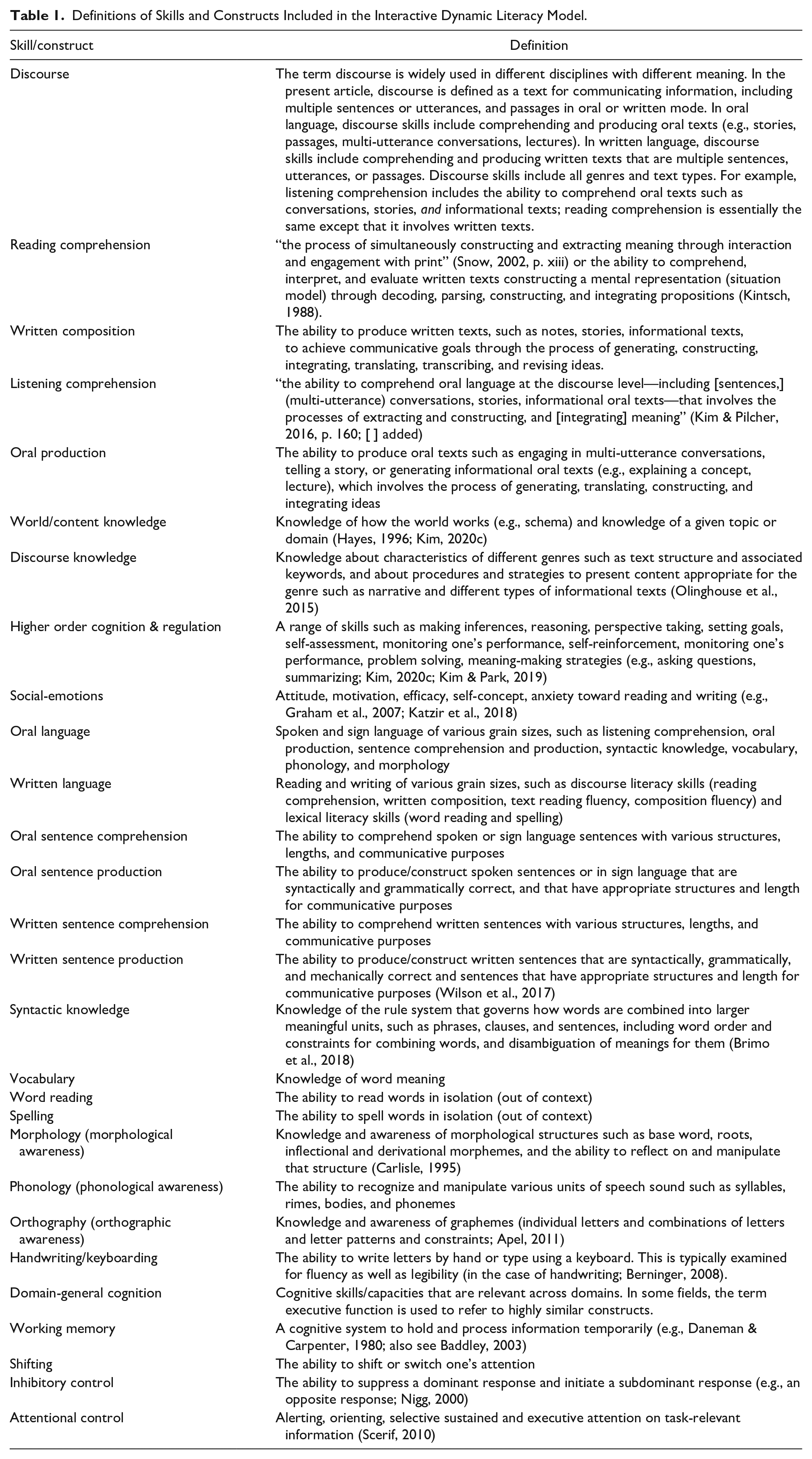
A few points are worth noting before a brief review of the key tenets of the IDL model. First, the basic premise of the IDL model is that reading and writing are part of language systems used for communicative purposes. This does not, however, entail that written language, reading and writing, and oral language are identical constructs. Instead, oral language undergirds written language, and oral language and written language are interdependent systems. Second, the IDL model is a component skills model where the focus is an articulation of skills that contribute to reading and writing processes, and the structural relations among component skills. The processes of reading have been discussed in detail in models such as the Landscape model (van den Broek et al., 2005) and RI-Val model (O’Brien & Cook, 2016), and writing processes have been detailed in the Hayes and Flower model (Hayes & Flower, 1980) and by Bereiter and Scardamalia (1987). More broadly, processes involved in discourse comprehension, which include comprehension of oral and written texts, have been discussed extensively in the construction-integration model (Kintsch, 1988) and others (see McNamara & Magliano, 2009, for an excellent review). Process-driven theoretical models largely focus on processes of encoding, accessing, activating, retrieving, storing, constructing, and integrating information, whereas skills-driven theoretical models largely focus on skills and knowledge that are involved in or contribute to these processes. Both types of models are necessary and complement each other as information processing involves skills, and skills development requires information processing. Third, in this article, the term skill is used as an overarching or collective term, for lack of a better term, that refers to all the constructs included in the IDL model, such as the language, cognitive, and print-related skills, knowledge, and social-emotional constructs (see Table 1 for the definition of the skills and constructs in the IDL model). Fourth, the IDL model is a working model based on the evidence available to date. As such, it is amenable to modifications per future work and evidence. Finally, the IDL model recognizes that the skills develop via interactions between biology (genetics) and individual characteristics, and multiple layers of environment (Snow, 2002; van Bergen et al., 2014), but detailed accounts about the interactions are beyond the scope of the model.
Definitions of Skills and Constructs Included in the Interactive Dynamic Literacy Model.
Highly Similar Systems Undergird Reading and Writing
The central premise of the IDL model is that highly similar oral language, knowledge, cognition (domain-general and higher order cognitions), and social-emotional systems undergird both reading and writing. As depicted in Figure 1, these include content/topic knowledge and discourse knowledge; social-emotional constructs; higher order cognitions and regulation; oral language skills, which include listening comprehension and oral language production, vocabulary, and syntactic knowledge; word reading and spelling; phonological, morphological, and orthographic knowledge and awareness; and domain-general cognitions or executive functions. Table 1 shows definitions of the skills or constructs in the IDL model. These skills are employed during the various recursive processes of reading comprehension (decoding, parsing, and inferencing for constructing and integrating propositions) and written composition (generating, translating, transcribing, revising, and editing ideas). Because these processes occur with the constraint of limited cognitive resources, in addition to accuracy, developing automaticity at sublexical (e.g., retrieval of phoneme-grapheme correspondence; handwriting/keyboarding fluency), lexical (e.g., word reading fluency, spelling fluency), sentence (sentence reading comprehension and sentence writing fluency), and discourse levels (text/oral reading fluency, text writing or composition fluency) is critical to allow cognitive resources for higher order semantic processes (e.g., Berninger, 2008; LaBerge & Samuels, 1974).
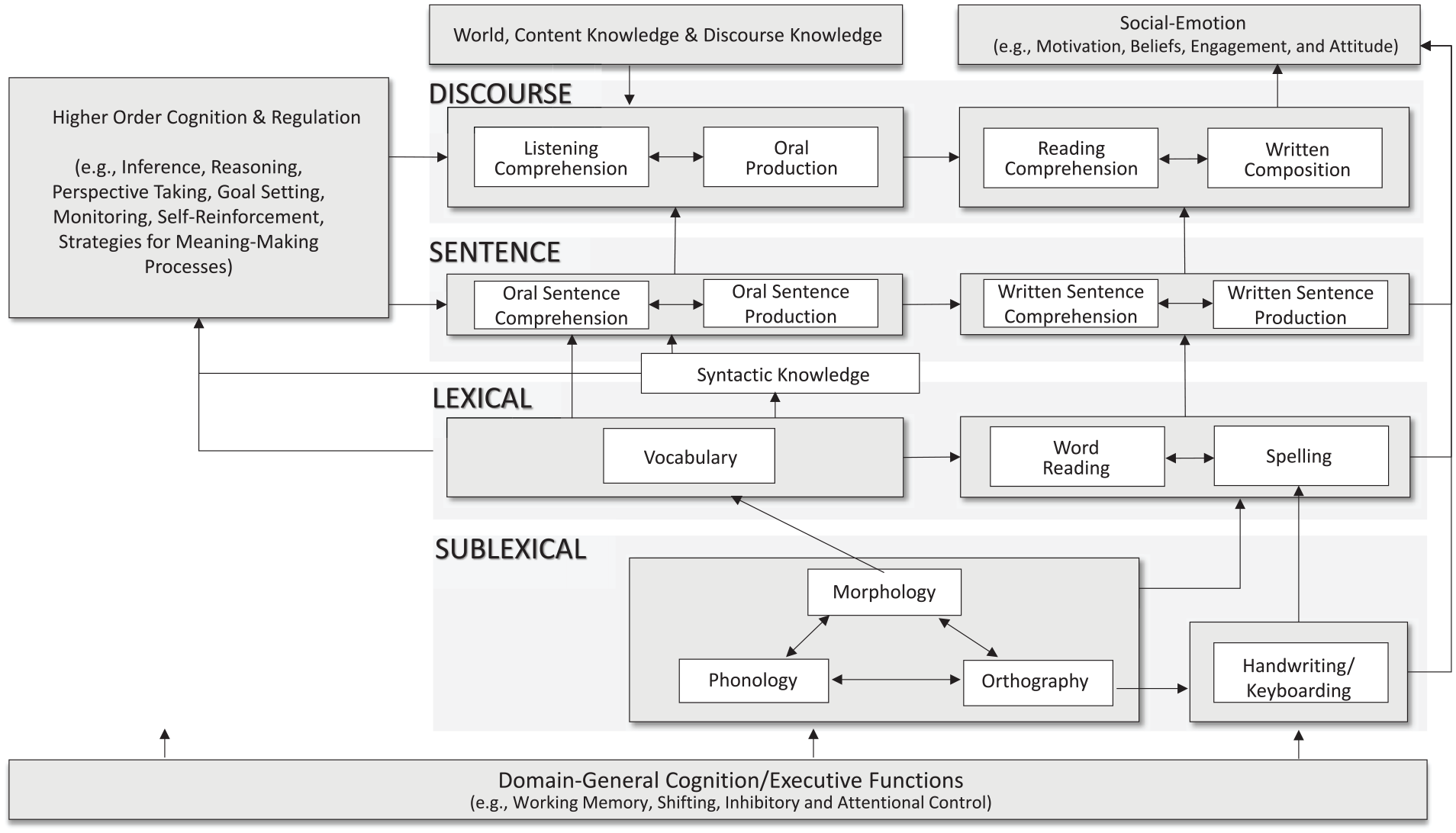
Interactive dynamic literacy model.
One consequence of reading and writing skills drawing on highly similar systems is that reading and writing are related. However, this does not entail that reading and writing are identical constructs (see J. A. Langer, 1986; Shanahan, 2016). The IDL model posits that reading–writing relations differ as a function of grain size: The relation is stronger at the lexical level—word reading and spelling—than at the discourse level—reading comprehension and written composition. This is because lexical-level literacy skills draw on or are constrained by a small set of the same skills, such as phonology, orthography, and morphology. However, word reading and spelling also have differences as spelling words requires more precise knowledge and representation in memory than reading words (Ehri, 1997; Shanahan, 2016). For example, reading the word bird requires retrieving phonological information associated with each grapheme. Spelling the word requires identification of the phonemes and correct sequencing of the letters b-i-r-d by retrieving a word-specific memory for the /ər/ sound, ir, not er or ur.
The reading–writing relations at the discourse level (reading comprehension and written composition) are not expected to be as strong as word reading-spelling relations because reading comprehension and written composition have greater differences in processes and the component skills are differentially tapped for comprehension and composition processes. In comprehension, meaning-making and meaning generation are delimited by the given texts, and therefore, meaning-making processes tend to focus on adapting the development of the reader’s situation model to the author’s message. In composition, the meaning-making process focuses on generating, developing, organizing, and expressing ideas and production (transcription and mechanical aspects). Therefore, although comprehension and composition processes draw on a highly similar set of skills, successful composition relies on skillful and strategic self-directed processes to a greater extent than does comprehension to coordinate, manage, regulate, and monitor automatic processes and to employ nonautomatic strategies and corrective actions. In other words, the demands and employment of language, cognitive, and knowledge systems differ for comprehension and composition processes (J. A. Langer, 1986). The hypothesis on different magnitudes of the relations by linguistic grain size is supported by a recent meta-analysis, which showed that word reading and spelling are more strongly related (r = .82) than reading comprehension and written composition (r = .46; Kim et al., 2021).
Hierarchical Relations
In the IDL model, component skills are hypothesized to have hierarchical relations—skills are arranged in a multilevel structure, roughly aligned with linguistic grain sizes of discourse, sentence, lexical, and sublexical units (see Figure 1). At the highest level in the hierarchy are discourse skills, including oral language (listening comprehension, oral language production) and literacy skills (reading comprehension and written composition—see Note 1). These are supported by higher order cognitions and regulations, sentence-level skills, and syntactic knowledge, vocabulary, and lexical literacy skills, which, in turn, are supported by sublexical skills and domain-general cognitions. Hierarchical relations imply that causal mechanisms are operating at multiple levels such that higher order processes and skills rely on output from lower levels of processes and skills, and problems in lower-level processes and skills cause downstream problems in and constrain higher order processes and skills. In other words, component skills are connected in a chain of relations (see Figure 1). For example, working memory influences reading comprehension and written composition via component skills in multiple pathways in a cascading manner (e.g., working memory → vocabulary and syntactic knowledge → higher order cognitions → discourse oral language → reading comprehension and written composition). Note that the hierarchical relations hypothesis does not imply a one-way bottom-up process in reading and writing. Instead, top-down and bottom-up processes work interactively during reading and writing (e.g., Kintsch, 1988; Stanovich, 1980) such that meaning-making processes constrain the “alternatives of lower levels but are themselves constrained by lower-level analyses” (Stanovich, 1980, p. 35).
Interactive Relations
Another key tenet of the IDL model is the interactive nature of developmental relations among skills via learning experiences. Interactive relations mean that a change in one skill influences changes in other skills, and thus, skills develop interdependently in time. Interactive relations are posited for skills at the same hierarchy and across hierarchies. Specifically, reading and writing—for example, word reading and spelling; reading comprehension and written composition—are expected to have interactive relations. This is based on two rationales. First, if reading and writing draw on a similar set of skills (see Figure 1), development of one is likely to facilitate or bootstrap development of the other. The second rationale is a functional and experiential aspect—many reading and writing tasks occur together to achieve goals (e.g., making notes after reading, writing after reading written source materials). Reading also occurs in seemingly purely writing tasks as writers produce and read their own written texts during text production, revision, and editing processes of writing (see text interpretation and reflection processes in Hayes’s (1996) framework). The co-occurring experiences facilitate and reinforce representation and acquisition of key knowledge and meta-awareness about print (e.g., conventions of orthographic symbols and graphophonics), text attributes, and meaning-making processes as well as procedural knowledge about how to access and generate meaning in written texts (Fitzgerald & Shanahan, 2000; Shanahan, 2016). Therefore, reading comprehension is expected to influence writing texts, and writing experiences can help students to reflect on how information is presented in written texts, which may promote awareness of text structure and text meaning and, consequently, reading comprehension (Graham et al., 2017; J. A. Langer & Flihan, 2000).
Evidence for the interactive relation between reading and writing, however, is somewhat mixed. Meta-analyses showed that reading instruction improves writing outcomes (Graham et al., 2018), and writing instruction improves reading outcomes (Graham & Hebert, 2010). Using cross-sectional data from students in Grades 1, 3, 5, and 7, Berninger and Abbott (2010) found that reading skills predicted writing skills and vice versa. Shanahan and Lomax (1986) used cross-sectional data from second graders and fifth graders, and they found support for the following interactive relations: word reading (composed of word reading and phonetic analysis) → spelling → reading vocabulary → reading comprehension → story structure in written composition. Furthermore, a longitudinal study from Grade 1 to Grade 7 using the cross-lagged structural equation model showed that word reading and spelling, and reading comprehension and written composition had bidirectional relations (Abbott et al., 2010). However, a longitudinal study with students in Grade 3 to Grade 6 found a unidirectional relation of reading to writing for word reading–spelling and reading comprehension–written composition relations (Kim et al., 2018). Another longitudinal study worked with students from Grade 1 to Grade 4 and found a unidirectional relation of reading to writing for lexical and discourse reading and writing skills, but a bidirectional relation for sentence-level reading and writing skills (e.g., Ahmed et al., 2014).
That the interactive relation between reading and writing does not entail symmetry in the relation (Shanahan, 2016). For instance, as the longitudinal studies (Abbott et al., 2010; Ahmed et al., 2014; Kim et al., 2018) suggest, reading skills might be a leading factor and might trigger the interactive relations between reading and writing at a later phase. However, the nature of interactive relations between reading and writing might be also influenced by instruction. For instance, if spelling is used as a primary context for the teaching of phoneme-grapheme correspondences, then spelling might act as a leading factor into the interactive relations between word reading and spelling.
In addition to the interactive relations between reading and writing, component skills are posited to have interactive relations with reading and writing skills via experiences. For example, reading comprehension and written composition are expected to develop bidirectionally with vocabulary such that individuals with greater vocabulary knowledge are better in reading comprehension and written composition, which promote greater reading and writing experiences, which, in turn, promote vocabulary development (e.g., Quinn et al., 2020). Similar interactive relations are expected between background knowledge and reading comprehension and written composition. In addition, literacy skills and associated experiences of success or struggle with reading and writing influence social-emotional aspects such as motivation, self-efficacy, and beliefs and attitude toward literacy, which, in turn, influence literacy development. Thus, social-emotional processes are expected to bidirectionally relate to reading and writing (Katzir et al., 2018). Finally, interactive relations are also hypothesized between component skills (e.g., vocabulary and syntactic knowledge and inference; Lepola et al., 2012; vocabulary and morphology; Kieffer & Lesaux, 2012).
Dynamic Relations
The fourth key tenet of the IDL model is dynamic or changing relations: The relations of component skills to literacy outcomes vary as a function of developmental phase and measurement of the construct. The dynamic relations hypothesis as a function of development posits that the relative contributions of component skills vary as a function of the individual’s developmental phase of reading and writing skills, largely due to the constraining roles of lexical literacy skills, word reading, and transcription. Evidence supports this hypothesis in reading such that in the beginning developmental phase, word reading dominates reading comprehension, whereas in a later developmental phase, oral language skills largely explain reading comprehension (e.g., Adlof et al., 2006; Hoover & Gough, 1990; Kim & Wagner, 2015; Lonigan et al., 2018).
The second aspect of the dynamic relations hypothesis states that the contributions of component skills to reading and writing vary depending on how constructs are measured. Reading comprehension and written composition in theoretical models, including the IDL model, are theoretical constructs of general reading comprehension and written composition skills that encompass various genres and transcend particularities of assessment features. Theoretical models generally concern relations among constructs assuming perfect measurement of the constructs, and therefore are not typically expected to include hypothesis about operationalization or measurement. However, accumulated evidence clearly indicates that reading comprehension measures vary in the extent to which they draw on component skills such as decoding or language comprehension (Francis et al., 2006; Keenan et al., 2008), and assessment formats such as multiple choice, open-ended, or free recall influence one’s comprehension performance (Cao & Kim, 2021; Collins et al., 2020; Reardon et al., 2018). The same applies to measurement of composition skills. Composition is evaluated on multiple dimensions, including overall quality, productivity/text length, fluency, vocabulary, grammatical accuracy, syntactic complexity, or spelling and conventions (e.g., Abbott & Berninger, 1993; Mackie & Dockrell, 2004; McMaster & Espin, 2007; Wagner et al., 2011), and these different dimensions differentially tap language and cognitive component skills (e.g., Kim et al., 2014, 2015). In fact, the reading comprehension–written composition relation is hypothesized to differ depending on dimensions of written composition (see Kim & Graham, 2021, for details), and a recent meta-analysis showed that reading comprehension is more strongly related to writing quality (r = .46) than to writing productivity (r = .19; Kim et al., 2021).
Measurement has consequences and implications for research and practice. In research, findings such as unique predictors are influenced by how reading comprehension or written composition is operationalized (e.g., Francis et al., 2006; Keenan et al., 2008; Kim et al., 2014, 2015); without recognition of the role of measurement, differential findings arising from measurement features create disarray and confusion. In practice, measurement factors can lead to inaccuracies in identifying students’ needs. As such, in the IDL model, measurement or operationalization of constructs is acknowledged as an important aspect to fully understand the relations between reading and writing, and between predictors (component skills) and outcomes (reading comprehension and written composition). This is in line with theoretical models and frameworks of writing (Hayes, 1996; Kim & Graham, 2021) and reading (Francis et al., 2018; Kim, 2020c).
The IDL Model and Previous Frameworks
The IDL model builds on theoretical models of reading and writing, respectively (see Kim, 2020b, for a review), and a long line of work that recognizes reading–writing relations such as the shared knowledge hypothesis (Fitzgerald & Shanahan, 2000; Shanahan, 2016), cognitive models of writing (Hayes, 1996; Kim, 2020a), and the sociocognitive model (Nystrand, 1989; Rubin, 1984; see Shanahan, 2016, for a review). As such, the IDL model shares commonalities with these frameworks, but it also extends them in important ways. According to the shared knowledge theory (Fitzgerald & Shanahan, 2000; Shanahan, 2016), reading and writing are related because they draw on the following four sources of shared knowledge: (a) metaknowledge about written language, which refers to knowledge about purposes and functions of reading and writing, monitoring one’s own meaning-making and knowledge, and reader–writer interactions; (b) domain knowledge about substance and content such as world knowledge as well as knowledge of word meanings and the knowledge gained from reading or writing; (c) knowledge about universal text attributes, including graphophonics, syntax, and text structure; and (d) procedural knowledge, which includes knowledge about accessing, using, and generating knowledge, and the ability to instantiate integration of automatic processes and employment of intentional strategies (e.g., asking questions). The IDL model recognizes these shared skills between reading and writing, but lays out specific shared component skills organized in a nonrandom way by linguistic grain size. Importantly, the IDL model specifies structural relations among skills—hierarchical, interactive, and dynamic relations—which previous frameworks lacked.
The cognitive models of writing (Hayes, 1996; also see Deane et al., 2008) recognized reading as a critical part of the writing process. However, the focus in these models was writing process, and no detailed account of shared processes and skills between reading and writing were provided. The IDL model extends these models by viewing reading and writing as interdependent and interactive systems influencing each other, and by articulating the nature of shared systems and skills. Finally, the IDL model also recognizes reading and writing as communicative acts that involve negotiation between readers and writers, aligned with the sociocognitive perspectives of writing (Nystrand, 1989; Rubin, 1984). According to the sociocognitive perspectives of writing, reading and writing are discourse practices in social contexts and the relations among readers and writers shape the discourse, and each act of writing is considered an episode of reader–writer interactions as the writer considers audience and makes adaptations for audience (Rubin, 1984). In the IDL model, the act of reading and writing are part of larger communicative acts where readers and writers intersect in meaning-making processes.
Application of the IDL Model to Reading and Writing Difficulties/Disabilities
A consequence of shared resources and skills for reading and writing is co-occurrence of reading and writing difficulties (Berninger, Nielsen, et al., 2008; Hebert et al., 2018; Kim, 2020b). If highly similar language and cognitive component skills underpin both reading and writing, individuals with reading difficulties are likely to have writing difficulties and vice versa. I unpack this overarching hypothesis in the following sections. Note, though, that causality, including co-occurrence, is probabilistic, and individuals with reading difficulties (e.g., dyslexia, comprehension difficulties) or writing difficulties (e.g., dysgraphia, composition difficulties) might exhibit difficulties in all phenotypes or a subset of them (Berninger & May, 2011).
Co-Occurrence Between Word Reading and Spelling and Handwriting Disabilities
As noted above, strong relations are posited and found for the lexical-level literacy skills (i.e., word reading and spelling) as they involve essentially the same processes of phonological, orthographic, and morphological information. An important consequence of the strong relation between word reading and spelling is that students who struggle with word reading, including those with dyslexia, will highly likely experience difficulties with spelling. This is well supported by literature (e.g., Berninger, Nielsen, et al., 2008; Lefly & Pennington, 1991; Scarborough, 1998) and recognized the widely adopted definition of dyslexia (e.g., the International Dyslexia Association).
Co-occurrence also applies to dyslexia and dysgraphia. Dysgraphia is “disability in legible and automatic handwriting from memory associated with orthographic coding and/or finger sequencing impairments” (Beers et al., 2017, p. 2; also see Berninger et al., 2015). As a production task, writing requires transcription skills, and therefore dysgraphia causes problems in spelling and written composition. Dysgraphia is caused by impaired graphomotor skills, which are built on orthographic coding, motor planning and execution, and visual-motor integration (Berninger et al., 1992; for visual-motor integration, also see Daly et al., 2003). Dyslexia and dysgraphia share commonality because both rely on orthographic coding; therefore, some individuals with dysgraphia experience dyslexia, and the converse is true (e.g., Beers et al., 2017; Berninger, Nielsen, et al., 2008).
Dyslexia Influences Written Composition as Well as Reading Comprehension
Given the co-occurrence of word reading and spelling difficulties, and the necessary role of spelling in written composition, a logical corollary is that dyslexia influences written composition as well as reading comprehension (Berninger, Nielsen, et al., 2008; Hebert et al., 2018). Although it is well recognized that word reading difficulties result in reading comprehension difficulties (Catts et al., 2006; Hoover & Gough, 1990), it is underrecognized that individuals with dyslexia also likely have written composition difficulties. Studies reported that individuals with dyslexia had impaired handwriting, spelling, and written composition (Berninger, Nielsen, et al., 2008; Gregg et al., 2007; Hebert et al., 2018), and their impaired spelling explained their performance in written composition (Berninger, Nielsen, et al., 2008). Individuals with dyslexia made a greater number of spelling errors and paused more during written composition (Connelly et al., 2006; Sumner et al., 2013), and their compositions had fewer main ideas and poorer organization (Cragg & Nation, 2006), and fewer words and lower writing quality (Costa et al., 2016; Gregg et al., 2007; Wengelin et al., 2014) than their age-matched peers without dyslexia. A recent meta-analysis showed that students with reading difficulties perform more poorly on writing than their same age peers (Graham et al., 2021). These results indicate that dyslexia is not just a reading disability but also a writing disability.
Co-Occurrence Between Reading Comprehension and Written Composition Disabilities
The shared systems hypothesis and interactive relations hypothesis also imply co-occurrence between reading comprehension and written composition. Both reading comprehension and written composition involve working with printed words, meaning-making processes, and constructing and integrating mental representations, drawing on largely shared skills (see Figure 1). Therefore, difficulties associated with decoding/encoding words and meaning-making processes will not be specific to reading comprehension or written composition, and as a consequence, individuals with reading comprehension difficulties would experience difficulties with written composition, and vice versa. Although evidence about co-occurrence of reading and writing difficulties at the discourse level is more limited than that for lexical literacy skills, extant studies support this hypothesis. Poor comprehenders’ compositions are of lower quality (Anderson, 1988; Cragg & Nation, 2006; Graham et al., 2021; Guan et al., 2013; Wong et al., 1989), and their compositions exhibit lower levels of the component skills that contribute to reading comprehension and written composition, such as language use, coherence, and organization. Specifically, poor comprehenders’ compositions were less cohesive, and included lower order connectives (i.e., additive connectives than subordinate connectives; Carretti et al., 2016; Re & Carretti, 2016), more grammatical errors (Anderson, 1988; Guan et al., 2013), and poor syntactic construction, coherence, consistency, and structure (Carretti et al., 2013; Cragg & Nation, 2006; Re & Carretti, 2016).
Co-Occurrence of Language Difficulties With Reading Difficulties and Writing Difficulties
One of the important shared skills between reading and writing is oral language (see Figure 1). Therefore, children with difficulties with language development, including those with developmental language disorder (or specific language impairment), would manifest difficulties with reading and writing development—that is, reading difficulties and writing difficulties would co-occur with language difficulties. Robust evidence supports co-occurrence of developmental language disorder and reading difficulties such that a large number of children with developmental language disorder experience difficulties with phonological processing and consequent difficulties with word reading and spelling (e.g., Bishop & Snowling, 2004; Catts et al., 2005; McCarthy et al., 2012; Puranik & Lonigan, 2012). Moreover, children with insufficient skills in vocabulary, morphosyntax, syntax, listening comprehension, and production have difficulties in reading comprehension (e.g., Botting, 2007; Cain et al., 2000; Cain & Oakhill, 2007; Conti-Ramsden et al., 2001). In a similar vein, children with reading difficulties show weaknesses in oral language skills. Children with dyslexia have weaknesses in vocabulary and grammatical knowledge (e.g., Bishop & Snowling, 2004; Catts et al., 1999; Snowling, 2008), and children with reading comprehension difficulties also experience difficulties with producing oral texts as their oral texts are less cohesive and less coherent (e.g., Cain, 2003; Cain & Oakhill, 1996).
Research also indicates co-occurrence between developmental language disorder and writing difficulties. Written compositions by individuals with developmental language disorder have less complex sentence structures, more grammatical errors, fewer and less complete cohesive ties, fewer number of words, fewer number of verbs and different verbs, and lower writing quality (Dockrell & Connelly, 2015; Fey et al., 2004; Gillam & Johnston, 1992; Mackie & Dockrell, 2004; Scott & Windsor, 2000). This is confirmed in a recent meta-analysis, which showed that students with developmental language disorder had poorer performances on overall writing quality (g = −0.92) and specific dimensions of written composition such as grammar (g = −0.68), vocabulary (g = −0.68), and spelling (g = −1.17) than their age-matched peers (Graham et al., 2020). Moreover, vocabulary and grammatical knowledge predict the quality of written products for children with developmental language disorder (Dockrell & Connelly, 2015). Taken together, evidence from multiple lines of work indicates that reading and writing difficulties co-occur with language difficulties.
Co-Occurrence of Reading, Writing, and Language Difficulties With Impaired Domain-General Skills Including ADHD
A critical corollary of the hierarchical relations hypothesis (see Figure 1) is that reading and writing difficulties co-occur with impaired domain-general cognitions such as working memory, inhibitory control, and attentional control (e.g., attention-deficit/hyperactivity disorder [ADHD]) because domain-general cognitions cause chains of downstream vulnerabilities with impaired language and literacy learning due to the hierarchical relations (see Figure 1; also see Berninger, 2008, for working-memory-based explanations for dyslexia, dysgraphia, and developmental language disorder). For example, weak phonological loop in working memory impairs phonological processing necessary for word reading and spelling (Pugh et al., 2013; Ramus, 2004), and vocabulary and grammatical knowledge (e.g., Botting & Conti-Ramsden, 2001; Gathercole et al., 1994). Visuospatial sketchpad and orthographic loop influence orthographic processing, and thus influence handwriting fluency, word reading, and spelling (Berninger & May, 2011; Richards et al., 2006). Similarly, weak inhibitory and attentional control also compromise phonological, orthographic, and semantic processes and associated mental representations, which, in turn, result in problems in word reading and spelling, and vocabulary and grammatical knowledge (Berninger & O’Donnell, 2004).
Therefore, developmental language disorder, and reading and writing difficulties, would co-occur with impaired working memory and inhibitory and attentional control. A robust body of evidence supports this hypothesis. Individuals with developmental language disorder have weak phonological memory (Ellis-Weismer et al., 1999; Gathercole & Baddeley, 1990). Individuals with dyslexia have weaknesses in phonological memory (Elbro et al., 1998), phonological awareness (Melby-Lervåg et al., 2012), and phonological retrieval (Compton et al., 2001; Wolf & Bowers, 1999). Those with reading comprehension difficulties have impaired working memory (both general system and phonological memory; see Swanson et al., 2007, for a review). Moreover, a large body of behavioral and brain imaging literature has shown co-occurrence of ADHD with reading disability such as dyslexia (e.g., N. Langer et al., 2019; Willcutt et al., 2005; Willcutt & Pennington, 2000) and writing disability (Yoshimaus et al., 2011). Individuals with ADHD also have difficulties in listening comprehension in terms of making inferences, monitoring understanding of the story, identifying causal relations among story events, and recognizing important information (Lorch et al., 2007). According to one estimate, more than 70% of children with ADHD have disabilities in reading, writing, or math (Mayes & Calhoun, 2006). Another estimate based on a birth cohort of all children in a state indicates that children with ADHD are approximately four times more likely to have writing disability than those without ADHD (Yoshimaus et al., 2011).
Multiple Constraints and Pathways for Reading and Writing Difficulties
The hierarchical relations and interactive relations hypotheses of the IDL model entail interdependence among component skills, which implies that multiple interconnected chains of problems are likely to be observed. In other words, there are multiple constraints and multiple pathways by which reading and writing development can be disrupted. Word reading and spelling disabilities stem from inefficient processing in phonology, orthography, and/or morphology, which, in turn, are due to weak domain-general cognitive skills (see Figure 1). Thus, disruption or inefficient processing in one or a combination of these skills would result in word reading and spelling difficulties, and ultimately in reading comprehension and written composition difficulties.
Multiple causes of word reading difficulties are in line with multiple deficit or multifactorial causal models of developmental dyslexia (Catts et al., 2017; McGrath et al., 2020; Pennington, 2006; van Bergen et al., 2014). The IDL model expands the multiple deficit or multifactorial causal models of dyslexia at least in two ways. First, the IDL model specifies multiple pathways by which difficulties with reading comprehension and written composition can occur. Aligned with the hierarchical relations hypothesis, these multiple sources are hierarchically related and, therefore, there are multiple chains of pathways (see Figure 1 and section “Hierarchical Relations”). This implies that without adequate development or acquisition of each of these skills in the chain, discourse literacy skills will not securely and successfully develop. Second, the IDL model expands the multiple deficit model, which primarily focuses on difficulties with lexical literacy skill, dyslexia, to discourse literacy skills—reading comprehension difficulties and to writing difficulties. In fact, sources of difficulties for discourse literacy skills are even more complex and multifaceted than difficulties for lexical literacy skills (see Figure 1).
Implications for Practice
As noted above, the skills included in the IDL model develop through interactions between child characteristics (genetic endowment and associated neural systems, cognitive processes, and behavioral manifestations) and multiple layers of environmental factors (e.g., van Bergen et al., 2014). One of the crucial environmental factors relating to reading and writing development, and difficulties with reading and writing is formal instruction. Decades of work on effective teaching of reading and writing, including for students with reading and writing difficulties, indicate addressing reading and writing difficulties requires intensive, multicomponent, and sustained instruction (e.g., Graham, McKeown, et al., 2012; Graham & Perin, 2007; Vaughn et al., 2015, 2016; Wanzek et al., 2013, 2016, 2018). Students with reading and writing difficulties require more than typical instruction or Tier 1 instruction (core instruction for all students), and they need systematic, supplemental, and intensive instruction (e.g., see Multitier System of Supports [MTSS] literature). As reviewed above, reading and writing involve complex processes and numerous language and cognitive skills, and as such, remediating reading and writing skills requires multicomponent approaches that systematically address the multiple skills shown in Figure 1. Furthermore, reading and writing difficulties are typically persistent and lifelong challenges, particularly for individuals whose difficulties are biologically based; for these individuals, difficulties may appear to be overcome at the level of behavioral manifestations, but they likely continue to have underlying genetic vulnerabilities (Berninger & May, 2011). Thus, sustained efforts, not one-off or short-term efforts, are needed. Bearing these general principles in mind, below are practical implications of the IDL model.
The shared systems and interactive relations hypotheses imply that explicit and systematic teaching of shared component skills would improve both reading outcomes and writing outcomes. Teaching component skills in the context of reading would improve writing outcomes and teaching component skills in the context of writing would improve reading outcomes. Meta-analyses indeed reported that reading instruction improves writing outcomes (Graham et al., 2018), and writing instruction improves reading comprehension outcomes (Graham & Hebert, 2010).
The shared systems and interactive relations hypotheses also imply that systematically teaching reading and writing in an integrated manner facilitates acquisition of both reading and writing. Integrated instruction, when taught well, will have a synergy effect, deepening students’ knowledge, skills, insights about reading and writing, and using reading and writing skills together for learning goals. For example, quality teaching of phonological, orthographic, and morphological skills would result in improved word reading and spelling. Phonology, orthography, and morphology can be taught in the context of either reading or spelling, but learning is strengthened and reinforced when they are taught synergistically together in the context of reading and spelling words (Graham et al., 2017).
The effect of integrated reading and writing instruction also applies to discourse literacy skills, reading comprehension, and written composition. This includes effective teaching of shared meaning-making processes and skills, such as making sense of, synthesizing, analyzing, integrating, and evaluating meaning as well as strategies to aid these processes such as think aloud, rereading, asking questions, highlighting, using graphic organizers, and summarizing (Foorman et al., 2016; Graham, Bollinger, et al., 2012; Graham et al., 2016; Graham, McKeown, et al., 2012; Shanahan et al., 2010). In addition, high quality integrated instruction should attend to language skills such as vocabulary and syntactic knowledge (e.g., parsing and constructing sentences), background knowledge such as content/domain and world knowledge and discourse knowledge (e.g., text structure and associated linguistic features), and higher order cognitive skills and regulation such as setting goals, monitoring, making inferences, and understanding others’ perspectives. A recent meta-analysis showed that integrating instruction of comprehension and composition improves both comprehension and composition (Graham et al., 2017).
It should be noted that integrated instruction of reading and writing does not mean that skills automatically transfer to reading or writing processes. To support transfer of skills between reading and writing, instruction should make the connections and similarities between reading and writing explicit and visible (Shanahan, 1988). This includes instructional efforts to create opportunities for students to understand overlapping features between reading and writing in their own learning materials. As an example, in comprehension instruction, discussion about an author’s approach to convey meaning can include thinking about how such an approach can help students’ own writing. In writing instruction, a lesson on text structure can include discussion on noticing how such text structures are used in the texts students read.
The need for integrated instruction should not be taken to mean that integrated instruction is sufficient for ensuring successful development of reading and writing skills. As stated above, reading–writing relations do not entail that reading and writing are identical skills. There are children who are good readers but poor writers, and good writers but poor readers (Costa et al., 2016; Holmes & Castles, 2001; Mayes & Calhoun, 2006; Schiller et al., 2001). The dissociability of reading and writing skills implies that in addition to integrated instruction of reading and writing, reading and writing also need to be taught, respectively, for reading- and writing-specific processes and skills (e.g., handwriting and keyboarding for writing; Berninger, 2008; J. A. Langer, 1986; Santangelo & Graham, 2016; Shanahan, 1988, 2016).
The need for teaching reading- and writing-specific processes and skills is likely greater for reading comprehension and written composition than for word reading and spelling. As discussed above, stronger relations are expected and found for word reading and spelling than for reading comprehension and written composition (Kim et al., 2021). When children are classified according to their strengths and weaknesses in reading and writing, the prevalence of discrepant profiles of students will differ by grain size. In the lexical literacy skills, many students will have the profile of strong word reading and strong spelling (or weak in both skills), whereas fewer students will have mixed profiles—strong word reading and weak spelling or strong spelling and weak word reading. This implies a high likelihood that what is taught in word reading transfers to spelling or vice versa.
In contrast, the relation between reading comprehension and written composition is hypothesized and found to be moderate (Kim et al., 2021). This suggests that the prevalence of mixed profiles will be greater in the discourse literacy skills—that is, a greater number of students will have a divergent performance levels in reading comprehension versus written comprehension. The moderate relation also suggests that the likelihood of what is learned in reading comprehension transferring to written composition or vice versa is lower than transfer between word reading and spelling acquisition. In fact, Graham and colleagues (2017) found that integrated instruction of reading and writing resulted in a larger effect on lexical literacy skills than on discourse literacy skills. This indicates that the need for respective instruction of reading and writing, in addition to integrated instruction, is especially greater for reading comprehension and written composition. Extant literature clearly suggests that in writing, students need to be taught writing processes—generating, planning (e.g., organizing), translating, and transcribing ideas—and effective strategies to aid these processes, including setting goals, drafting, evaluating, revising, and editing (Graham, Bollinger, et al., 2012; Graham et al., 2016) as well as self-regulation strategies (Graham, McKeown, et al., 2012; Harris et al., 2013). Similarly, reading instruction should include attention to reading fluency (National Institute of Child Health and Human Development, 2000), and analyzing and working with texts, using reading comprehension strategies such as monitoring, clarifying, and analyzing and marking texts (Foorman et al., 2016; Shanahan et al., 2010).
The shared systems and corollary co-occurrence between reading and writing difficulties also indicate the importance of including writing, in addition to reading, as part of an assessment system and identification of students’ needs and phenotypes. Typical assessment and identification practices tend to focus on reading skills, but this needs to be expanded to include writing as part and parcel of systematic assessments. Students with reading difficulties need systematic assessment of writing skills; students with writing difficulties (e.g., dysgraphia, spelling difficulties, or composition difficulties) should be also assessed in reading skills. Co-occurrence between reading and writing difficulties also implies that students with reading difficulties also need intensive instruction on writing in addition to reading, which is underrecognized in practice (Berninger & May, 2011; Berninger, Nielsen, et al., 2008).
The hierarchical relations and interactive relations hypotheses imply a need for a systematic approach to assessments and instruction. Assessments should consider students’ developmental needs, considering linguistic grain sizes (lexical skills and/or discourse skills) and their language and cognitive component skills (e.g., see Wilson et al., 2017, for an example of writing assessment considering linguistic grain sizes). Instruction should attend to foundational skills while promoting development of higher order skills at the same time. Chains of downstream effects of low-order skills on higher order skills indicate a need for building solid foundations. Building foundational reading and writing skills—word reading and transcription skills—is necessary as they place constraints on the extent to which meaning-making processes can occur. Until foundational reading and writing skills are adequately developed, sense-making processes are severely restricted. For example, explicit and systematic instruction on phonological awareness, morphological awareness, and orthographic awareness would not only improve word reading and spelling but also have cascading effects on reading comprehension and written composition. This does not, however, indicate delaying teaching of higher order skills until or only after lower order skills are mastered. Instead, the skills in the IDL model interactively develop and therefore need to be taught in tandem. Although building foundations for handwriting fluency, word reading, and spelling skills is critical during initial literacy instruction in early childhood education and primary grades, oral language, higher order cognitive skills, and meaning-making processes and strategies should also be taught explicitly and systematically starting as early as possible (Dickinson et al., 2010; Shanahan, 1988; Snow et al., 1998).
The dynamic relations hypothesis as a function of measurement implies a need for paying attention to measurement and assessment. Precise measurement is a prerequisite for accurate identification of individuals with reading and/or writing difficulties, and associated instruction that meets the identified needs. Readers’ and writers’ needs are not identical, and their hallmark phenotype, such as dysgraphia, dyslexia, or developmental language disorder, and the causes and sources of their impairment/difficulties are different. The first step for effective instruction is accurate identification of students’ needs or sources of difficulties. The identified needs, of course, should directly inform instructional planning and decision-making for intensive, explicit, and systematic instruction on the identified sources. For example, it does not make sense to spend a lot of instructional time on reading comprehension strategies for an individual who is struggling with basic decoding skills.
Measurement is particularly challenging and important for complex and multidimensional constructs, such as reading comprehension and written composition. The influence of task format and text features on one’s performance in reading comprehension and written composition behooves capturing reading comprehension and written composition skills using multiple tasks to the extent possible (e.g., including multiple genres). Although reading comprehension assessments typically include multiple passages and genres, in writing measurement, normed tasks typically include a single genre and/or a single task per genre and yet studies have consistently shown that multiple tasks are necessary for reliable measurement of writing skills (e.g., Kim et al., 2017; Swartz et al., 1999). Use of multiple tasks is especially critical when assessment results are used for critical decisions such as students’ eligibility to services such as special education. If it is not feasible to assess skills using multiple tasks due to practical constraints such as limited assessment time and resources and lack of multiple assessments, educators should be mindful of limitations of using a single measure and pay attention to cumulative data and patterns, and student and family history of difficulties with reading and writing skills. Given the severe lack of quality assessment in written composition, future efforts are warranted for the development and validation of quality writing assessments that can be used in research and practice.
Conclusion
Decades of research has revealed a wealth of information about reading and writing development and reading–writing connections. Based on these rich and productive lines of work, in the present article, I advance the literature and our understanding by applying the IDL model toward understanding and addressing difficulties in learning to read and write and by explaining co-occurrence of reading–writing difficulties using a single framework. Like any theoretical model and hypothesis, the ideas presented here should undergo rigorous testing with various populations and be modified for precision as necessary.
Footnotes
Declaration of Conflicting Interests
The author(s) declared no potential conflicts of interest with respect to the research, authorship, and/or publication of this article.
Funding
This research was supported by the grant from the Institute of Education Sciences (IES), U.S. Department of Education (R305A130131, R305A170113, R305A180055, R305A200312, and R305C190007) and Eunice Kennedy Shriver National Institute of Child Health and Human Development (NICHD) (P50HD052120). The content is solely the responsibility of the author and does not necessarily represent the official views of the funding agency.
