



Abstract
The present study investigated the phonological and semantic aspects of written word learning among children with dyslexia, taking into account their use of phonetic and semantic cues embedded in words. Fifty-three Mandarin-speaking fifth graders were taught the pronunciations and meanings of 24 Chinese single-character pseudowords (children with dyslexia: n = 27; age-matched peers: n = 26). The regularity of phonetic cues and the transparency of semantic cues embedded in the characters were experimentally manipulated. Children’s learning outcomes in orthography-to-pronunciation associations (learning the pronunciations of novel characters) and orthography-to-meaning associations (learning the meanings of novel characters) were examined separately. Results indicated that children with dyslexia performed more poorly than did their peers only in the learning stage of orthography-to-pronunciation learning. Otherwise, children with dyslexia demonstrated comparable performance in orthography-to-meaning learning, in the use of embedded pronunciation and meaning cues, and in retention of learning in comparison with their peers. Children applied phonetic and semantic cues jointly in the learning stage. For the 1-week retention, phonetic cues supported children’s performance on the task of orthography-to-pronunciation associations, whereas semantic cues aided in that of orthography-to-meaning associations. These findings expand our knowledge of children with dyslexia and provide insights for future reading interventions.
Learning to read is a gradual and effortful process (the stages of reading development; Chall, 1983). Learners not only need to develop oral language comprehension but also acquire written word knowledge and thus read words via decoding (the simple view of reading; Hoover & Gough, 1990). High-quality written word knowledge supports automatic word reading and furthers high-level reading comprehension. A high-quality lexical representation requires precise, strong associations among the orthography, pronunciation, and meaning information of a word (the lexical quality hypothesis; Perfetti & Hart, 2002). Therefore, it is of great importance to study and support young readers’ written word learning, including building the associations of orthography-to-meaning and orthography-to-pronunciation. However, building these associations can pose great challenges to certain populations, such as children with developmental dyslexia, who demonstrate particular difficulties in word recognition and spelling despite their average intelligence and sufficient educational opportunities (e.g., Lyon et al., 2003). Building upon previous research on paired-associate learning (PAL) in dyslexia (e.g., Litt & Nation, 2014), this study further examined children with dyslexia’s learning of orthography-to-pronunciation and orthography-to-meaning associations, taking into account their use of phonetic and semantic cues embedded in words. The findings will contribute to a better understanding of how children with dyslexia learn written words, enrich existing reading theories, and guide the development of novel reading interventions.
Visual-Verbal Paired Associate Learning Deficits in Dyslexia
For novice readers, a novel written word in isolation is nothing more than an abstract symbol, or a sequence of abstract symbols, until they attach a pronunciation and/or a meaning to the novel written word and thus build a lexical representation of it. Written word learning clearly involves paired associate learning (PAL)—explicitly learning the association between two stimuli—and reading ability is likewise linked to PAL ability (e.g., Clayton et al., 2018; Hulme et al., 2007). A substantial body of research has consistently shown that children with dyslexia demonstrate specific deficits in visual-verbal PAL but not in visual-visual PAL (e.g., Chinese: H. Li et al., 2009; Dutch: Messbauer & de Jong, 2003, 2006; English: Litt & Nation, 2014). In most previous PAL research, the verbal stimulus is the pronunciation of a nonword that is pronounceable in the participants’ native language, such as /dof/ in English (in Hulme et al., 2007) and /Samont/ in Dutch (Messbauer & de Jong, 2003). The visual stimulus is normally (a) an abstract visual shape that does not lead to any meaning (e.g., a black, irregular shape in Hulme et al., 2007, and a novel, square shape without the bottom line in Messbauer & de Jong, 2003) or (b) an abstract symbol from extinct written languages such as Akkadian (Litt & Nation, 2014). Given that learning to read is a specific type of visual-verbal PAL task that requires learners to map the written form of a word (i.e., the visual stimulus) to the pronunciation of that word (i.e., the verbal stimulus), it is thought that the difficulties of children with dyslexia in learning written words may stem from their deficits in visual-verbal PAL more broadly (e.g., Windfuhr & Snowling, 2001).
More recently, Litt and Nation (2014) aimed to characterize the source of visual-verbal PAL deficits in dyslexia in greater detail. They separated the verbal learning (i.e., learning the pronunciation of nonwords in English, such as /hib/, without any demand for mappings) and associative learning components (e.g., /hib/—Akkadian) of a visual-verbal PAL task. The findings suggest that the visual-verbal PAL deficits of English-speaking children with dyslexia can be fully explained by their deficits in learning novel phonological forms instead of in associative learning. If this conclusion is universal, as it appears to be, children with dyslexia do not necessarily demonstrate deficits in a visual-verbal PAL task when they map a learned/familiar pronunciation to a visual stimulus but rather only when the pronunciation is entirely new at the time that they are trying to map it to a visual cue. This is heartening, as the typical process by which children learn to read involves mapping existing vocabulary to the written forms of the respective words.
However, there is more evidence that contradicts this prediction. In H. Li et al. (2009), children with dyslexia still demonstrated visual-verbal PAL deficits although they were not asked to establish any new phonological representations in the visual-verbal PAL task. In this task, the verbal stimuli were the pronunciations of real Chinese characters that were familiar to the participants (e.g., /mei2/). Similarly, Ho et al. (2006) and Y. Li et al. (2021) demonstrated poor orthography-to-pronunciation learning performance among Chinese children with dyslexia, although all the pronunciations used were familiar to the children. Due to the lack of existing evidence, it remains unclear what accounts for the poor performance in mapping established phonological forms to visual stimuli in children with dyslexia. However, when considering the involvement of pronunciation and meaning information in visual-verbal PAL simultaneously, there are at least two possibilities that can lead to competing predictions about orthography-to-meaning learning in dyslexia.
One possible reason why children with dyslexia struggled to create visual-verbal associations with familiar/acquired verbal stimuli in more recent work (Ho et al., 2006; H. Li et al., 2009; Y. Li et al., 2021) might be due to the lack of meaning information of the words used in the given PAL tasks. In most extant research on visual-verbal PAL, children were typically required to make arbitrary mappings between visual and verbal stimuli without any meaning information involved. Consequently, children with dyslexia must learn the visual-verbal associations by rote, which might have maximized their difficulties in the task. In contrast, children with dyslexia performed just as well as their peers when learning visual-visual associations with at least one visual stimulus depicting a concrete picture from which the children could infer meaning (e.g., an image of a cat in Messbauer & de Jong, 2006). In this regard, children with dyslexia may struggle when the task is too abstract (i.e., when they cannot derive meaning information from the stimuli) but may not necessarily have issues with learning orthography-to-meaning associations (i.e., when meaning information is available).
Another possibility might be attributed to the involvement of oral production in the visual-verbal PAL tasks but not in the visual-visual PAL tasks used in existing research (Ho et al., 2006; H. Li et al., 2009; Y. Li et al., 2021). Children with dyslexia may have difficulty retrieving specific and accurate pronunciation representations quickly because of their well-documented phonological deficits (e.g., Shu et al., 2005; Snowling, 1998). In visual-verbal PAL tasks, children must remember (in the presentation phase) and then orally produce (in the testing trials) the verbal stimulus that was attached to a given visual stimulus. In contrast, the visual-visual PAL task was implemented without a demand for oral production, and the participants were asked to identify the paired visual stimulus from a set of distractors in multiple-choice questions (e.g., a matching/pairing task between visual stimuli) or produce a nonverbal stimulus (e.g., drawing a visual symbol). If it was about the problem that arose from the task demand for oral production, even when meaningful information was available, children with dyslexia might still demonstrate poor orthography-to-meaning learning.
Building upon research on PAL that identifies and describes deficits in dyslexia, the first goal of the present work was to identify the specific difficulties that children with dyslexia have in orthography-to-pronunciation and orthography-to-meaning learning. Novel single-character words that are fictitious but plausible in children’s native language were used to avoid potential confounders from children’s existing word knowledge. They were taught both the pronunciation and the meaning of each written word (using established pronunciations, thus without the demand for learning novel phonological forms) in a process that mimicked students’ written word learning in the classroom. The children were then tested on their learning outcomes of orthography-to-pronunciation associations (i.e., naming task) and orthography-to-meaning associations (i.e., definition task), both with a demand for oral production. In doing so, the present study serves to clarify the inconsistent findings of previous research and to identify which of the aforementioned two possibilities may better suit the collective understanding of the sources of the visual-verbal PAL deficits in dyslexia.
Furthermore, based on prior PAL research, the current focus was on a more specific orthographic learning process. Examining plausible, novel words that follow the orthographic rules in children’s own writing system allows an investigation of the roles of word properties—such as the cues that are embedded in the single-character words—in children’s written word learning. As detailed in the next section, this study examined children with dyslexia’s use of phonological and semantic strategies simultaneously in orthography-to-pronunciation and orthography-to-meaning learning, in contrast to previous studies that only considered phonological strategy and orthography-to-pronunciation learning (Ho et al., 2006; Y. Li et al., 2021).
Phonological and Semantic Strategies in Word Learning in Dyslexia
In contrast to rote learning, as learners progress, it becomes possible to extract rule-based regularities in their respective writing systems by what many researchers see as a special type of statistical learning (e.g., see Arciuli, 2018, for a review). The mapping between the orthography and the pronunciation or meaning of a written word is no longer entirely arbitrary when learners can rely on cues that are embedded in words. Therefore, they can apply these regularities (e.g., letter-sound correspondences in English; orthography-pronunciation-meaning regularities in Chinese characters) in learning novel written words (e.g., Ho & Bryant, 1997a; Rastle & Coltheart, 1999; Shu et al., 2000). Researchers trained Chinese children on an artificial orthography, a nonalphabetic writing system that mimics the orthographic regularities of the Chinese writing system, and the results indicated the successful acquisition of novel orthographic regularities (e.g., phonetic and semantic regularity) among typically developing children (He & Tong, 2017b) but not children with dyslexia (Tong et al., 2020).
Based on the evidence of the difficulties that children with dyslexia have in grasping novel orthographic regularities in the writing system, a critical but understudied question is whether children with dyslexia could effectively apply acquired orthographic regularities in written word learning. Based on the connectionist theory of word learning (e.g., Ehri, 1992), learners can utilize orthography-pronunciation-meaning connections (i.e., acquired orthographic regularities) as a powerful mnemonic system to encode new words. Therefore, the second goal of the present study was to fill this gap by examining whether and to what extent Chinese children with dyslexia utilize phonetic and semantic cues embedded in single-character words (plausible, novel single-character words that follow orthographic regularities in children’s orthography) to support their orthography-to-pronunciation and orthography-to-meaning learning.
In the Chinese writing system, the basic unit is called a character (e.g., 清), which maps onto a syllable (e.g., /qing1/) and a morpheme (e.g., related to clear or pure). Most characters (72%) taught in primary school are semantic-phonetic compound characters, each of which consists of both a phonetic radical (e.g., the radical on the right: 青, pronounced as /qing1/) and a semantic radical (e.g., the radical on the left: 氵, meaning water, semantically related to pure), carrying the phonetic and semantic cues of the character (Shu et al., 2003). Approximately 200 semantic and 800 phonetic radicals in written Chinese (Hoosain, 1991) are crucial processing units for young children in learning to read (e.g., Ho & Bryant, 1997b; Ho et al., 2003; Shu et al., 2000). However, the extent to which those cues are available can vary and are therefore considered in terms of their phonetic regularity (i.e., the availability of phonetic cues) and semantic transparency (i.e., the consistency of meaning cues).
Phonetic Regularity
Based on Shu et al.’s (2003) definition, a phonetic radical may provide full, partial, or no pronunciation information of the compound character—respectively termed regular, semiregular, or irregular. Due to the lack of grapheme–phoneme correspondence rules (GPC rules) in the Chinese writing system, phonetic regularity depends on the congruency between the pronunciation of a character and the pronunciation of its phonetic radical. A regular compound character has the same pronunciation (e.g., 清 /qing1/) or the same segment but a different tone (e.g., 请 /qing3/) as its phonetic radical (e.g., 青 /qing1/). A semiregular compound character has the same onset (e.g., 打 /da3/—丁 /ding1/) or rime (e.g., same tone, 精 /jing1/—青 /qing1/, or different tone, 洪 /hong2/—共 /gong4/) as the phonetic radical. An irregular compound character has a different syllable segment from its phonetic radical, regardless of whether the tone is the same or different (e.g., same tone, 猜 /cai1/—青 /qing1/; different tone, 研 /yan2/—开 /kai1/). The percentages of regular, semiregular, and irregular compounds that children encounter in primary school are 43%, 30%, and 12%, respectively (with 15% consisting of other compounds that are exceptions and cannot be categorized). Using the PAL paradigm, previous work has demonstrated the effective use of regular and semi-regular phonetic cues in orthography-to-pronunciation learning among typically developing children (e.g., Chow, 2018, 2019; Hsuan et al., 2018) as well as among children with dyslexia (e.g., Ho et al., 2006; Y. Li et al., 2021). However, whether these findings apply to orthography-to-meaning learning remained an open question prior to the present study.
Semantic Transparency
In Chinese, a transparent character may have the same meaning (e.g., 嘴 mouth - 口 mouth), belong to the same category (e.g., 妈 mother -女 female), or carry a directly related meaning (e.g., 橱 cabinet - 木 wood) as its semantic radical (Shu et al., 2003). In contrast, an opaque character has an entirely unrelated meaning to its semantic radical, such as 猜 guess - 犭 animal. The percentages of transparent and opaque compounds that children encounter in the primary school years are 65% and 5%, respectively (with 27% semitransparent and 3% consisting of other compounds). It is evident that typically developing children can utilize transparent semantic radicals to support their orthography-to-pronunciation learning using the PAL paradigm (e.g., Chow, 2018, 2019) and to derive the meaning of new characters (e.g., Shu & Anderson, 1997). However, it is unclear whether and to what extent these benefits apply to children with dyslexia.
The current study aimed to extend Ho et al.’s (2006) and Y. Li et al.’s (2021) work. Both Ho et al. (2006) and Y. Li et al. (2021) applied a classic visual-verbal PAL paradigm and found that children with dyslexia performed more poorly in orthography-to-pronunciation learning than their age-matched peers, whereas their ability to use phonetic cues was intact. Y. Li et al. (2021) extended Ho et al.’s (2006) work by including a semiregular condition of phonetic regularity. The present work further extends Ho et al.’s (2006) and Y. Li et al.’s (2021) work by the inclusion of semantic cues (transparent versus opaque) and an examination of orthography-to-meaning learning with a demand for oral production, in addition to the previously studied phonetic cues (regular vs. semi-regular vs. irregular) and orthography-to-pronunciation learning. Given the prevalence of compound characters, which contain both phonetic and semantic radicals, investigating the intersection of phonetic regularity and semantic transparency simultaneously, as in this study, can provide a fuller picture of how children utilize embedded cues in learning written words.
The Present Study
Children with dyslexia demonstrate particular deficits in visual-verbal paired associate learning (PAL) but not in visual-visual PAL (e.g., Messbauer & de Jong, 2003, 2006). Previous work has suggested that Chinese children with dyslexia have poor orthography-to-pronunciation learning (a specific type of visual-verbal PAL; Ho et al., 2006; Y. Li et al., 2021). However, prior to the current study, it was unclear whether children with dyslexia have difficulties in orthography-to-meaning learning, which could be another form of visual-verbal PAL if the PAL task involves a demand for oral production. Based on earlier research on PAL in dyslexia, our first goal was to identify the specific difficulties that Chinese children with dyslexia have in orthography-to-pronunciation and orthography-to-meaning learning (both with a demand for oral production), compared with their age-matched peers.
Moreover, while Chinese children with dyslexia demonstrate difficulties in grasping novel orthographic regularities in the writing system (Tong et al., 2020), they appear to be able to effectively apply acquired orthographic regularities (e.g., phonetic cues embedded in Chinese characters) in orthography-to-pronunciation learning (Ho et al., 2006; Y. Li et al., 2021). Our second goal was to, for the first time, extend existing work by the inclusion of another source of acquired orthographic regularities (i.e., semantic cues embedded in characters) and another outcome measure of orthography-to-meaning learning.
To answer the two research questions, we explicitly taught children with and without dyslexia 24 pseudo-characters using a classic visual-verbal PAL paradigm, with a 1-week delayed task for retention of learning. These pseudo-characters, which are fictitious but plausible in the Chinese writing system, were developed and used to avoid potential confounders from children’s prior word knowledge. Each of the 24 target pseudo-characters was made up of a real phonetic and a real semantic radical that was familiar to all participants (thus following the orthographic regularities in Chinese), to ensure that we indeed examined children’s use of acquired orthographic regularities as intended. Children’s performance under specific experimental conditions (i.e., the combination of phonetic regularity [regular vs. semi-regular vs. irregular] and semantic transparency (transparent vs. opaque)) were compared to identify the influences of phonetic regularity and semantic transparency.
We hypothesized that children with dyslexia would demonstrate weaker overall learning outcomes, given the well-documented learning deficits in dyslexia (e.g., Ho et al., 2006; H. Li et al., 2009; Y. Li et al., 2021; Litt & Nation, 2014; Messbauer & de Jong, 2003). More specifically, Chinese children with dyslexia would show poorer orthography-to-pronunciation learning than their age-matched peers, as indicated in previous studies (Ho et al., 2006; Y. Li et al., 2021). It remains an open question, however, whether or not their orthography-to-meaning learning differs from that of their peers: They might not necessarily have difficulties in building orthography-to-meaning associations, as detailed in the introduction section; it is also plausible that they might demonstrate poorer performance than their peers due to the involvement of oral production in the orthography-to-meaning PAL task used in the current study.
As for the roles of phonetic regularity and semantic transparency, we expected to observe a phonetic regularity effect on all children’s orthography-to-pronunciation learning outcomes, as in previous work, in that all children may perform the best on regular pseudo-characters (Ho et al., 2006; Y. Li et al., 2021), followed by semi-regular pseudo-characters (Y. Li et al., 2021), and finally irregular pseudo-characters. We were not able to make specific predictions for the role of semantic transparency or each of the different experimental conditions regarding the combination of phonetic regularity and semantic transparency. This is largely due to the lack of research on semantic cue use and limited evidence for phonetic cue use.
Regarding the retention of their word learning, Chinese children with dyslexia have documented difficulties in the PAL process but not in their retention of orthography-to-pronunciation learning (e.g., 1-hr retention, Ho et al., 2006; 1-week retention, Y. Li et al., 2021). We expected to replicate (a) the intact retention of learning in both orthography-to-pronunciation and orthography-to-meaning learning and (b) the phonetic regularity effect on orthography-to-pronunciation learning (Y. Li et al., 2021). We also anticipated observing an interaction between phonetic regularity and semantic transparency in typically developing children, as revealed in previous work (e.g., Y. Li et al., 2020). It is possible that this interaction could be different among children with dyslexia due to phonological deficits (e.g., Shu et al., 2005; Snowling, 1998).
Method
Participants
The participants were 53 fifth-grade native Mandarin-speaking children from 19 classrooms in a participating primary school in Beijing, China. Information from the school teachers was used to exclude children with hearing or articulatory problems, neurological deficits, and/or a diagnosis of attention-deficit/hyperactivity disorder.
Due to the lack of standardized measurements for identifying dyslexia in mainland China, the same screening procedure for dyslexia in mainland China used in previous studies was conducted (e.g., Ding et al., 2016; Y. Li et al., 2021; Xia et al., 2016). Specifically, a child was identified as having dyslexia when all the following three criteria were met: First, the child was nominated and confirmed by their Chinese language teacher as facing challenges in reading but without difficulties in spoken language. Second, the child scored one grade below the mean score of Grade 5 (M = 119.04, SD = 12.10, based on Liu et al., 2017) on the screening task—a character recognition task (H. Li et al., 2012) widely used for screening children with dyslexia in mainland China (e.g., Shu et al., 2003, 2006). In the task, children were asked to read aloud a total of 150 Chinese characters in order of increasing difficulty and were stopped if 15 successive errors were made; one point was awarded for each correct response. Third, they demonstrated normal intelligence on a nonverbal reasoning measure (i.e., general cognitive ability) adapted from Raven et al.’s (1996) Progressive Matrices. Typically achieving children from the same classrooms as children with dyslexia served as age-matched peers; they were also nominated by their Chinese language teachers before testing on character recognition and nonverbal reasoning measures.
Our final sample included 27 children with dyslexia (dyslexia group, 16 boys, mean age = 10 years and 7.74 months, SD = 5.41 months) and 26 age-matched peers (comparison group, 14 boys, mean age = 10 years and 8.81 months, SD = 3.21 months). The children with dyslexia scored 102.74 (SD = 5.81) out of 150 items on the character recognition task, significantly lower than the comparison group (M = 120.96, SD = 6.23), t = −11.02, p < .001. The two groups were comparable on the nonverbal reasoning measure: dyslexia group, M = 42.24, SD = 4.95; comparison group, M = 44.04, SD = 5.11, t = −1.15, p > .05.
Design
A 2 (Group: Dyslexia vs. Comparison) × 3 (Phonetic Regularity: Regular vs. Semi-Regular vs. Irregular) × 2 (Semantic Transparency: Transparent vs. Opaque) × 6 (Testing Trials 1–6) mixed factorial design was applied. Group was a between-participants factor, and the other three were within-participants factors. The two dependent variables were participants’ learning outcomes for the pronunciations and meanings of the target pseudo-characters (i.e., single-character words), reflecting their orthography-to-pronunciation and orthography-to-meaning learning, respectively.
Materials
Target pseudo-characters
Twenty-four 2-radical pseudo-characters (i.e., single-character words) were developed, each of which was a novel combination of a real semantic and a real phonetic radical in the legitimate position, and thus was novel and plausible to the participants. The pronunciation of each pseudo-character was assigned to a real syllable in spoken Chinese, while the meaning of the pseudo-character was represented via a meaningful picture. Only the radicals that were familiar to the participants were included because the current interest was to examine whether and to what extent the children could utilize phonetic and semantic cues based on their existing knowledge of radicals.
The current participants were considered to be familiar with the meaning of all 24 semantic radicals given that we only chose the semantic radicals on which the participants had a mean accuracy rate of .96 in identifying the meaning of the semantic radical in the pilot study. Regarding the structure, 18 of the pseudo-characters are left-right-structured, for example,  ; 3 are top-bottom-structured, for example,
  ; and the other 3 are semi-enclosed-structured, for example,
  . This distribution was designed to reflect the full range of structural configurations in Chinese characters. The number of strokes of all pseudo-characters ranged from 7 to 12, in line with the visual complexity of characters taught in Chinese elementary schools (63% of the characters have 7–12 stokes based on Shu et al.’s [2003] analysis). All phonetic radicals are stand-alone characters, and thus each has a legitimate pronunciation. The participants were familiar with the pronunciations of all phonetic radicals supported by our pilot study, in which the current participants showed a mean accuracy rate of .99 in pronouncing all 24 phonetic radicals.
A within-item design was applied to manipulate the phonetic regularity and semantic transparency of pseudo-characters. The regularity of phonetic cues embedded in a pseudo-character was manipulated by assigning a pseudo-character with different pronunciations. The three conditions were regular, semi-regular, and irregular, in which the pseudo-character carries full, partial, or no pronunciation information. For example, a target pseudo-character  had a phonetic radical:
  (pronounced /ben3/).
  was under the regular condition when assigned /ben3/, the semi-regular condition when assigned /hen3/ (different onset but the same rime and tone as /ben3/), and the irregular condition when assigned with /jiu4/ (different onset, rime, and tone from /ben3/). The three conditions were counterbalanced across participants. For each pseudo-character, one-third of the participants learned it in each of the regular, semiregular, or irregular conditions.
Moreover, the transparency of semantic cues carried by a pseudo-character was manipulated into transparent versus opaque, providing highly relevant or no meaning information to the pseudo-character. This was implemented by pairing a pseudo-character with different pictures to assign different meanings. For instance, the target pseudo-character  had a semantic radical: 山 (meaning mountain).
  was under the transparent condition when paired with a picture illustrating a golden mountain, and it was under the opaque condition when paired with a picture showing a female wearing novel glasses. For each pseudo-character, half of the participants learned it under the transparent condition whereas the other half learned it in the opaque condition; the two conditions were counterbalanced across participants.
Taken together, six types of pseudo-characters were generated: (a) a regular phonetic and a transparent semantic radical; (b) a semi-regular phonetic and a transparent semantic radical; (c) an irregular phonetic and a transparent semantic radical; (d) a regular phonetic and an opaque semantic radical; (e) a semiregular phonetic and an opaque semantic radical; and (f) an irregular phonetic and an opaque semantic radical. All participants learned all 24 pseudo-characters, four under each of the six experimental conditions. For each pseudo-character, the particular experimental conditions that were assigned were counterbalanced across participants (see Table 1 for illustration). For each participant, it was ensured that the pronunciation differed across the 24 pseudo-characters. In addition, care was taken to balance the distribution of character structure and visual complexity for each condition. For each participant, among the four pseudo-characters under each condition (e.g., regular and transparent), three were left-right-structured, and the other was either top-bottom-structured or semi-enclosed-structured. Furthermore, the mean number of strokes was matched across the six conditions (range = 8.5–8.75; see Table 2 for details).
Six Types of Pseudo-Characters and Examples of Each.

Note. In each cell, notations such as S1-P1 specify the experimental condition, in which S refers to the semantic radical, P refers to the phonetic radical, and 1 refers to full information (0.5 refers to partial information, and 0 refers to no information). For instance, S1-P1 refers to a character consisting of a transparent semantic radical and a regular phonetic radical, whereas S0-P0.5 refers to a character consisting of an opaque semantic radical and a semi-regular phonetic radical. This table also illustrates the allocation of stimuli across the participants. Using a within-item design, each novel character was assigned to each of the six conditions across participants, resulting in six versions of the materials (as shown in Table 1). Within each group, the participants were divided into six groups, and each group learned one version in the study. In this study, colored pictures of novel objects were used to illustrate the meaning of each character. Take the first character (i.e.,  , whose semantic radical is semantically related to bamboo) in this table as an example. Under conditions involving transparent semantic radicals, this character was paired with Picture 1, a novel image of bamboo, so that the semantic radical can provide reliable meaning cues to the character. In contrast, under conditions involving opaque semantic radicals, this character was paired with Picture 2, a novel image of cash, as in new currency bills, so that the semantic radical does not carry any meaning cues of the character.
Four Pseudo-Characters Used in Each of the Six Conditions for Each Participant.

Note. The pseudo-characters each participant learned under the six conditions were matched in terms of character structure and the mean number of strokes.
Procedure
The experiment was conducted in a separate quiet room located in the participating school. Well-trained research assistants majoring in psychology worked with the children in a one-to-one setting. Children learned the target pseudo-characters in a PAL task (e.g., Hulme et al., 2007; H. Li et al., 2009). Throughout the PAL task, children received no information about the availability of phonetic or semantic cues. To ease the cognitive burden of learning 24 pseudo-characters simultaneously, the 24 pseudo-characters were divided into two sets. Children learned each set of 12 pseudo-characters in two separate sessions with a 1-week interval through the same PAL task as described subsequently. The order of the two sets was counterbalanced across participants. There were no differences in the learning procedures between the two sets or the six experimental conditions of pseudo-characters.
At the beginning of the PAL task, all target pseudo-characters were paired with a picture illustrating their meaning and were printed on a separate paper card. The cards were shown to the children one at a time in random order. For each pseudo-character, the experimenter verbally provided the child with the pronunciation and asked the child to remember the pronunciation. The child then needed to repeat the pronunciation once, to demonstrate that they had heard and were able to produce the pronunciation of the pseudo-character correctly. If the child made an error, the experimenter repeated the correct pronunciation as many times as needed until the child could accurately repeat the pronunciation of that pseudo-character.
The same procedure was repeated to train the participants regarding the meaning of the pseudo-character. The meaning was provided verbally via a phrase (i.e., an adjective and a noun, such as “golden mountain”) and illustrated by the paired picture. After the children had successfully recalled and reproduced both the pronunciation and the meaning of a given pseudo-character, they then moved on to learn the next pseudo-character. After the children had learned the pronunciations and then the meanings of all 12 pseudo-characters, they moved on to the testing trials.
In subsequent testing trials, the children were asked to pronounce the printed target pseudo-characters and then orally produce their corresponding meanings. In each test trial, children were presented with the written pseudo-characters on paper cards (this time, without showing them paired pictures) one at a time and asked to pronounce the pseudo-characters. If the children pronounced a pseudo-character correctly, the experimenter confirmed the correct response and then verbally provided the correct pronunciation again. One point was awarded for each correct response. When the children mispronounced a pseudo-character, the experimenter pronounced the pseudo-character correctly and asked the children to repeat the correct pronunciation once. Zero points were awarded an initial incorrect response. Regardless of the accuracy, children always heard the correct pronunciation of each pseudo-character once immediately after they pronounced that pseudo-character. The same procedure was then applied to test the children on the meaning of that pseudo-character before they moved on to the next one. After the 12 pseudo-characters were tested in an initial testing trial, the children moved on to the next testing trial. There was a maximum of six testing trials, each involving all 12 target pseudo-characters in random order. The random order was different for each trial across all children, with the constraint that the same pseudo-character never occurred twice in succession. The testing of pronunciation/meaning stopped if children pronounced/defined all 12 target pseudo-characters correctly in two successive testing trials, in which case the children earned full credit for the remaining trial(s). The scoring system reflects the number of correct responses, with a maximum of 72 possible points (12 pseudo-characters × 6 trials). Note that this was for each of the two sets of 12 pseudo-characters; therefore, the maximum possible score was 144 for all 24 pseudo-characters.
In the 1-week retention testing trial, each child’s long-term retention of the newly learned pronunciation and meaning of the target pseudo-characters was assessed by a recall task. The recall task was exactly the same as a testing trial in the learning phase, except that no corrective feedback was provided. The maximum possible score was 24 (one trial for each of the 24 total pseudo-characters). The retention percentage was calculated as the ratio of the score on the recall task to that on the sixth testing trial of the PAL task, according to the formula from H. Li et al. (2009): Retention percentage (%) = (retention trial/last testing trial) × 100%.
Results
To examine the use by children with dyslexia of phonetic and semantic cues in their orthography-to-pronunciation and orthography-to-meaning learning separately, two separate sets of model analyses were conducted, with children’s performance on orthography-to-pronunciation or orthography-to-meaning as the dependent variable.
Orthography-to-Pronunciation Learning
Table 3 shows the descriptive analysis of the accuracy of orthography-to-pronunciation learning (see Note 1) on the PAL task across testing trials, phonetic regularity, semantic transparency, and the two groups. A mixed-design analysis of variance (ANOVA) was conducted on participants’ total scores on the PAL task, with group (dyslexia vs. comparison) as a between-participants factor and phonetic regularity (regular vs. semi-regular vs. irregular), semantic transparency (transparent vs. opaque), and trial (Trials 1–6) as within-participants factors.
Descriptive Analyses of Accuracy on Paired Associate Learning (PAL) Task Across Testing Trials, Experimental Conditions, and Groups on Orthography-to-Pronunciation Learning.

Note. Numbers are the mean raw scores (out of 4); standard deviations are in parentheses.
All the four main effects were significant: group, F(1, 51) = 4.91, p < .05, η2 = .09; phonetic regularity, F(2, 102) = 140.06, p < .001, η2 = .73; semantic transparency, F(1, 51) = 21.55, p < .001, η2 = .30; and trial, F(5, 255) = 206.57, p < .001, η2 = .80. The overall performance of children with dyslexia was significantly poorer than that of their peers. The children learned regular pseudo-characters significantly better than semiregular pseudo-characters (p < .001) and learned semiregular pseudo-characters significantly better than irregular pseudo-characters (p < .01). The children also learned transparent pseudo-characters significantly better than opaque pseudo-characters. Moreover, the children’s performance improved significantly over the course of six trials (ps < .001).
The Phonetic Regularity × Trial Interaction effect was significant: F(10, 510) = 21.62, p < .001, η2 = .30. Children’s accuracy on semiregular and irregular pseudo-characters significantly improved across the six trials (ps < .05), suggesting a continued growth that might be extended with more learning trials. However, their accuracy on regular pseudo-characters improved over the first five trials (ps < .05), seemingly to yield to a ceiling effect, and thus their performance on Trial 6 did not significantly differ from that on Trial 5 (p >.05).
In addition, there was a significant three-way interaction among phonetic regularity, trial, and semantic transparency: F(10, 510) = 2.49, p < .01, η2 = .05. To unpack this relationship, three 2-way simple effect analyses between trial and semantic transparency were conducted on regular, semiregular, and irregular pseudo-characters (see Figure 1 for illustration).
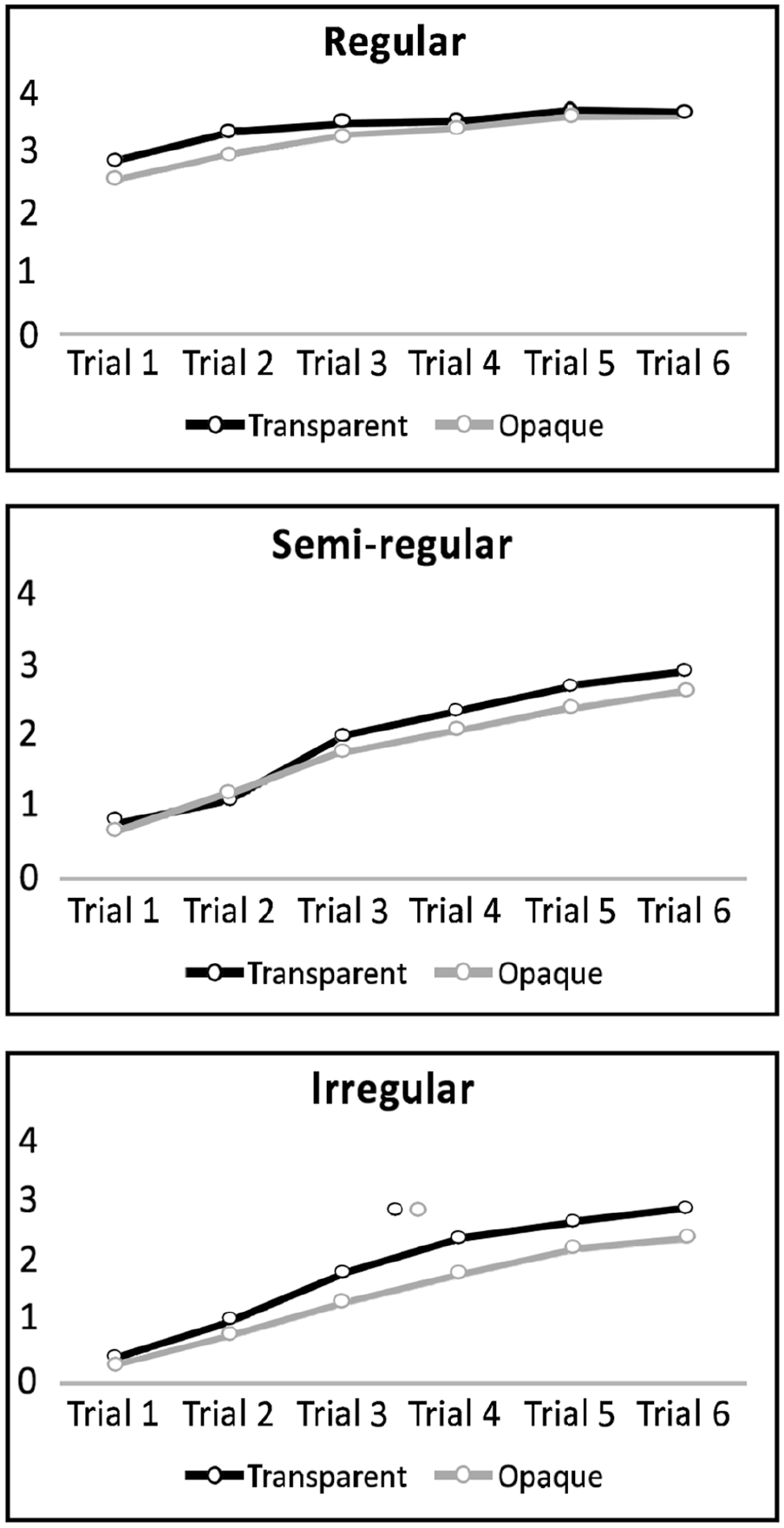
Significant interactions among phonetic regularity, semantic transparency, and trial on orthography-to-pronunciation learning.
For regular pseudo-characters, the children’s performance on transparent pseudo-characters was significantly better than on opaque pseudo-characters in the first three trials (ps < .05) but not in Trials 4 to 6 (ps > .06). As for semiregular pseudo-characters, children’s performance on transparent pseudo-characters did not significantly differ from that on opaque pseudo-characters in the first four trials (ps > .14), and their performance only became significantly better in the last two trials (ps < .05). Similarly, regarding irregular pseudo-characters, the effect of transparency was not significant in the first two trials (ps > .19) but became significant in the last four trials (ps < .01). Compared with regular pseudo-characters, for the semi-regular and irregular pseudo-characters, the benefit of transparent semantic cues was observed at a later stage, starting from Trials 4 and 2, respectively, and the absence of semantic cues seemed not to be compensated for by undergoing six learning trials. All other two-way, three-way, and four-way interactions were not significant (ps > .05).
One-week retention
Table 4 shows the descriptive analyses of the accuracy of children with dyslexia on orthography-to-pronunciation learning in the 1-week retention task and of the retention percentages. A 2 (Group: Dyslexia vs. Comparison) × 3 (Phonetic Regularity: Regular vs. Semi-Regular vs. Irregular) × 2 (Semantic Transparency: Transparent vs. Opaque) mixed-design ANOVA was carried out on children’s retention percentages. The only significant main effect was that of phonetic regularity: F(2, 102) = 25.87, p < .001, η2 = .34. Children’s retention of regular pseudo-characters was significantly better than that of semi-regular and irregular pseudo-characters (ps < .001), whereas there was no significant difference between their retention of semi-regular and irregular pseudo-characters (p = .36). The main effects of semantic transparency and group were non-significant: F(1, 51) = 3.86, p = .06, η2 = .07; F(1, 51) = .06, p = .81, η2 = .001, respectively. All two-way and three-way interactions were not significant (ps > .38).
Descriptive Analyses of Accuracy on 1-Week Retention Testing Trial and Retentive Percentage for Both Groups on Orthography-to-Pronunciation Learning.

Note. Numbers are the mean raw scores (out of 4); standard deviations are in parentheses.
Orthography-to-Meaning Learning
Table 5 presents the descriptive analysis of the accuracy of orthography-to-meaning learning (see Note 2) on the PAL task across testing trials, experimental conditions, and the two groups. The same mixed-design ANOVA was conducted on participants’ total scores on the PAL task as in the previous section on orthography-to-pronunciation learning. The main effect of group was not significant, F(1, 51) = 1.05, p = .31, η2 = .02. The other three effects were significant: phonetic regularity, F(2, 102) = 8.12, p < .001, η2 = .14; semantic transparency, F(1, 51) = 146.02, p < .001, η2 = .74; and trial, F(5, 255) = 180.10, p < .001, η2 = .78. Children with dyslexia did not differ from their peers in terms of learning the meaning of pseudo-characters. The children learned regular pseudo-characters significantly better than semiregular pseudo-characters (p < .01), but their learning of semiregular pseudo-characters did not significantly differ from that of irregular pseudo-characters (p = .85). The children thus learned transparent pseudo-characters significantly better than opaque pseudo-characters. Moreover, the children’s performance improved significantly throughout the first five trials (ps < .001), yet no difference was observed between Trials 5 and 6 (p = .159), suggesting that five learning trials were sufficient.
Descriptive Analyses of Accuracy on Paired Associate Learning (PAL) Task Across Testing Trials, Experimental Conditions, and Groups on Orthography-to-Meaning Learning.

Note. Numbers are the mean raw scores (out of 4); standard deviations are in parentheses.
Furthermore, the Semantic Transparency × Trial Interaction was significant, F(5, 255) = 20.87, p < .001, η2 = .29. Children’s accuracy on transparent pseudo-characters significantly improved from Trials 1 through 3 (ps < .05) but showed no further improvement after Trial 3 (ps > .29), suggesting that three learning trials were sufficient for children’s orthography-to-meaning learning of transparent pseudo-characters. In contrast, children’s accuracy on opaque pseudo-characters improved over the first five trials (ps < .05), with no further improvement from Trial 5 (ps > .05), suggesting that five learning trials were sufficient for children’s orthography-to-meaning learning of opaque pseudo-characters.
The three-way interaction among group, phonetic regularity, and trial was significant: F(10, 510) = 2.28, p < .05, η2 = .04. In addition, the Group × Trial and Phonetic Regularity × Trial Interactions were significant: F(5, 255) = 3.19, p < .01, η2 = .06; F(10, 510) = 2.04, p < .05, η2 = .04, respectively. Given that the particular interest of the current study lies in the group differences, the three-way interaction was further unpacked by analyzing the simple effects of Phonetic Regularity × Trial Interaction for each group (see Figure 2).

Significant interactions among the group, phonetic regularity, and trial on orthography-to-meaning learning.
The only group difference was observed in children’s performance in the first trial. For the comparison group, their performance on regular pseudo-characters was significantly better than on semi-regular and irregular pseudo-characters (p < .001), whereas for children with dyslexia there were no significant differences among regular, semiregular, and irregular pseudo-characters (p = .35). This suggests that from the very beginning (in the first trial), typically developing children were able to use phonetic cues to remember the meanings of characters, whereas children with dyslexia did not. No other significant two-way, three-way, or four-way interactions were found (ps > .05).
One-week retention
Table 6 displays the descriptive analysis of children’s accuracy on orthography-to-meaning learning in the 1-week retention task as well as that of the retention percentages across experimental conditions for both groups. The same mixed-design ANOVA was carried out on children’s retention percentages as described in the previous section. The only significant main effect was observed for semantic transparency: F(1, 51) = 21.72, p < .001, η2 = .299. The main effects of phonetic regularity and group were not significant: F(2, 102) = 1.18, p = .310, η2 = .023; F(1, 51) =1.68, p = .200, η2 = .032. All two-way and three-way interactions were not significant (ps >.05).
Descriptive Analyses of Accuracy on 1-Week Retention Testing Trial and Retention Percentage for Both Groups on Orthography-to-Meaning Learning.

Note. Numbers are the mean raw scores (out of 4); standard deviations are in parentheses.
Discussion
The present study investigated how children with and without dyslexia utilize phonetic and semantic cues embedded in words to support their orthography-to-pronunciation and orthography-to-meaning learning, which were both considered visual-verbal PAL in this study because of the consistent task demand for oral production. Consistent with previous work on PAL and written word learning, we found that children with dyslexia showed poorer performance in orthography-to-pronunciation learning than their age-matched peers (e.g., Ho et al., 2006; H. Li et al., 2009; Y. Li et al., 2021). However, despite the well-documented visual-verbal PAL deficits in dyslexia (e.g., Ho et al., 2006; H. Li et al., 2009; Y. Li et al., 2021; Litt & Nation, 2014; Messbauer & de Jong, 2003), we did not observe any particular difficulties in orthography-to-meaning learning for the children with dyslexia.
This study is the first to consider the effect of semantic cues in addition to previously studied phonetic cues. We replicated previous findings that all children effectively applied both regular (Ho et al., 2006; Y. Li et al., 2021) and semiregular (Y. Li et al., 2021) phonetic cues in orthography-to-pronunciation learning. We further extended the conclusion regarding regular phonetic cues to orthography-to-meaning learning. Moreover, all children appeared to utilize semantic and phonetic cues jointly in both orthography-to-pronunciation and orthography-to-meaning learning. We also found that retention of newly learned characters by children with dyslexia was as good as that of their peers without dyslexia. Taken together, the current findings contribute to clarifying the particular difficulties in written word learning in dyslexia, and they thus enrich the literature on PAL and written word learning. In the following sections, we discuss our findings in detail and in comparison with previous studies.
Poor Orthography-to-Pronunciation but Intact Orthography-to-Meaning Learning in Dyslexia
As hypothesized, children with dyslexia showed poorer orthography-to-pronunciation learning of novel written words than their age-matched peers, although the pronunciations were all familiar to them (i.e., without the demand for building novel phonological forms), consistent with previous work in Chinese (e.g., Ho et al., 2006; Y. Li et al., 2021). In contrast, they demonstrated orthography-to-meaning learning (when meaning information was available) as good as that of their peers despite the involvement of oral production. Together, these findings raise questions regarding Litt and Nation’s (2014) conclusion from PAL research that visual-verbal PAL deficits in dyslexia could be fully explained by the novel phonological form learning instead of the associative learning component.
We fully acknowledge that the current work was not a PAL study (H. Li et al., 2009; Litt & Nation, 2014), in which an abstract visual stimulus was arbitrarily associated with pronunciation. Instead, we focused on a very specific type of visual-verbal PAL, the orthographic learning process in Chinese. Our use of plausible novel words that follow the orthographic rules in the children’s own writing system allows for an investigation in which children’s visual-verbal mapping is not entirely arbitrary. In fact, this is closer to what happens in learning to read, as an increasing number of researchers have suggested that learners extract rule-based regularities in their respective writing systems through statistical learning (e.g., Arciuli, 2018). In this regard, our present findings enrich the PAL literature by providing evidence from less arbitrary PAL tasks.
It was beyond the scope of our study to clarify the underlying sources of visual-verbal PAL deficits in dyslexia. However, the current findings, together with those of Ho et al. (2006) and Y. Li et al. (2021), indicate that children with dyslexia indeed face challenges in mapping acquired/familiar pronunciations onto the written forms of words (termed orthography-to-pronunciation learning here), at least in cases where the visual-verbal PAL task includes a demand for oral production and does not involve meaning information. Future PAL research may consider and evaluate this evidence to strengthen the theoretical framing and methodology and clarify the sources of visual-verbal PAL deficits in dyslexia.
It would be far-fetched to claim our findings to be universal as our work was among the first to consider orthography-to-pronunciation and orthography-to-meaning learning simultaneously in dyslexia. Future studies on this topic are warranted. To facilitate future research, we offer two potential explanations for the intact orthography-to-meaning learning in dyslexia observed in our study.
First, in the current study, the learning of orthography-to-pronunciation and orthography-to-meaning associations can be considered precise versus imprecise visual-verbal mappings, respectively. In the testing trials of the current orthography-to-pronunciation task, children must produce the accurate pronunciation/syllable of a pseudo-character (i.e., precise visual-verbal PAL) to perform well. In contrast, they only needed to give a verbal description of the meaning of the target pseudo-character (i.e., imprecise visual-verbal PAL) in the orthography-to-meaning task. We speculate that children with dyslexia might have difficulties in making precise mappings between visual and verbal stimuli, but they do not necessarily face challenges with building imprecise, meaning-based visual-verbal associations. Thus, we provide supporting evidence on the idea that visual-verbal PAL deficits in dyslexia might be tied to the demand for precise mapping, even without the requirement of learning new phonological forms. To test this idea within the PAL framework more broadly, future researchers are encouraged to design careful experiments specifically to compare precise versus imprecise visual-verbal PAL in dyslexia when visual stimuli other than novel written words are used.
Second, it is also possible that the current findings are unique to Chinese-speaking children, instead of being universal across children in alphabetic writing systems. Chinese-speaking children likely rely more on orthographic information than phonological information in learning to read in general. For example, Y. Li et al. (2020) pointed out that Chinese-speaking children demonstrated learning of orthography-to-meaning associations even in the most challenging condition, in which they had to guess the pronunciation of novel characters in the learning phase in the absence of any pronunciation cues. Therefore, we need to be cautious about interpreting the intact orthography-to-meaning learning in dyslexia revealed in the current study. Whether and to what extent this finding can be generalized to other populations, such as English-speaking and Spanish-speaking children, needs to be examined empirically in the future.
Use of Phonological and Semantic Strategies in Poor Orthography-to-Pronunciation Learning in Dyslexia
As in previous studies (Ho et al., 2006; Y. Li et al., 2021), we also found that Chinese children with dyslexia demonstrated poorer performance than their age-matched peers in orthography-to-pronunciation learning. In addition, children with dyslexia had an intact ability to utilize phonological strategies just like their peers; we replicated that they can compensate for such poor learning by effectively applying regular phonetic cues (Ho et al., 2006; Y. Li et al., 2021) and semi-regular phonetic cues (Y. Li et al., 2021). More specifically, while children with dyslexia performed more poorly than their age-matched peers as indicated by raw scores, all children’s orthography-to-pronunciation learning performance on regular pseudo-characters reached the ceiling after five trials (on average 3.62 vs. 3.81 of 4).
In contrast, although all children learned semiregular pseudo-characters significantly better than irregular pseudo-characters (with a consistent performance discrepancy across groups), their performance improved throughout all six trials without reaching a ceiling. These findings are in line with those of Y. Li et al. (2021) and indicate that children need more than six trials (as we only included a total of six trials here) to acquire the pronunciations of semi-regular and irregular pseudo-characters. Children with dyslexia likely need even more learning trials than their typically developing peers (e.g., He & Tong, 2017a). Future work should focus on semiregular and irregular characters and include a more extended period (e.g., more exposures/trials) to further understand how to better support the learning of such challenging words by children with and without dyslexia.
In addition to evidence from earlier studies, we first found that children with dyslexia also have an intact ability to utilize transparent semantic cues in addition to previously studied phonetic cues. Moreover, these two sources of cues are similarly intertwined across groups. It is not intuitively obvious that we would observe the facilitation of transparent semantic cues in children’s orthography-to-pronunciation learning because of the lack of demand for accessing meaning information in this learning task. This finding can be discussed within the connectionist theory of word learning (e.g., Ehri, 1992): Transparent semantic radicals carry orthography-meaning connections that can offer readers the glue that bonds sub-lexical components in characters to their meanings and to pronunciations in memory. According to the lexical quality hypothesis (Perfetti & Hart, 2002), the quality of a lexical representation depends on the extent to which the orthographic, phonological, and semantic aspects of a word are integrated. Thus, transparent semantic cues likely supported the development of relatively high-quality lexical representations of these pseudo-characters. This in turn helped them perform well in the PAL tasks of orthography-to-pronunciation learning. These findings point to the importance of including meaning information in children’s written word learning.
Furthermore, in orthography-to-pronunciation learning, all children’s use of semantic cues appears to be dependent upon the extent to which phonetic cues are available, at least in the present visual-verbal PAL paradigm. With regular phonetic cues, the benefit from transparent semantic cues was observed in the early stage of our PAL task (from the first to the third trials). This might be because children processed the straightforward phonetic cues quickly and thus were able to make use of semantic cues from the very beginning. In contrast, children started to rely on available semantic cues at the late stage, relatively earlier in the case of no phonetic cues (i.e., irregular condition, from third to sixth trials) than when partial phonetic information was available (i.e., semiregular condition, from the fifth to sixth trials). This might be related to the analytic process involved in identifying phonetic and semantic radicals in a compound character. A radical can serve as either a phonetic or a semantic radical across characters. Therefore, in reading Chinese, readers must first decompose the sub-lexical units within a character and then judge whether a radical carries phonetic or semantic cues (Shu, 2003). In the semi-regular condition, our participants needed more time to analyze and identify the supportive semantic radicals in pseudo-characters than in the irregular condition.
Intact Phonological and Semantic Strategies in Orthography-to-Meaning Learning in Dyslexia
Our findings on children’s use of regular phonetic and transparent semantic cues in orthography-to-meaning learning were similar to those for orthography-to-pronunciation learning. Children with dyslexia had an intact ability to utilize both phonological and semantic strategies, similar to their peers. All children reached ceiling performance on transparent pseudo-characters in three trials (dyslexia group: 3.58 vs. comparison, 3.75, out of 4), and that on opaque pseudo-characters with five trials (dyslexia group: 3.26 vs. comparison, 3.35, out of 4), suggesting an overall much stronger learning outcome than for orthography-to-pronunciation learning. We were not able to directly compare these findings to those of earlier research (Ho et al., 2006; Y. Li et al., 2021) because those studies did not consider orthography-to-meaning learning. In addition, the only group difference we observed was that typically developing children started to use regular phonetic cues from the very beginning (first trial), earlier than the children with dyslexia (starting from second trial). Note that the effect of semiregular phonetic cues seems to be limited to orthography-to-pronunciation learning, in line with the findings of Y. Li et al. (2021).
Similar to our explanation of the facilitative effect of transparent semantic cues on orthography-to-pronunciation learning in the previous subsection, our findings on children’s use of phonetic and semantic cues in orthography-to-meaning learning can also be discussed in the framework of the connectionist theory of word learning (e.g., Ehri, 1992) and the lexical quality hypothesis (Perfetti & Hart, 2002). Fully reliable, regular phonetic cues aided children in’s learning of the pronunciations of pseudo-characters, which, in addition to transparent semantic cues, supported children in building a tight connection between the phonological/semantic and orthographic aspects of a word. Our findings together support the notion that it is essential to teach children both the pronunciation and the meaning of novel written words to create a high-quality lexicon.
Intact Retention of Learning in Dyslexia
The goal of written word learning is for children to build high-quality, long-standing lexical representations. Thus, it is critical to consider children’s learning retention. Our findings extend previous conclusions on the intact retention of orthography-to-pronunciation learning of children with dyslexia compared with their age-matched peers (Ho et al., 2006; Y. Li et al., 2021) to their intact 1-week retention of newly learned orthography-to-meaning associations. Moreover, we replicated previous findings on the facilitation of regular phonetic cues in the 1-week-delayed orthography-to-pronunciation PAL tasks for all children (Y. Li et al., 2021), and we extended it to the facilitative effect of transparent semantic cues in the retention of orthography-to-meaning learning across groups. Moreover, we found that phonetic and semantic cues do not seem to play a role in the retention of learning.
Beyond the group comparison, we also carefully evaluated children’s retentive percentage of newly acquired words (the ratio of children’s performance in the 1-week-delayed trial to that in the last trial on PAL tasks). All children were able to reach a retention percentage higher than 80% while maintaining the orthography-to-pronunciation associations of regular pseudo-characters (dyslexia group: 84.72% vs. comparison group: 81.25%). In contrast, they only reached a low retention percentage of approximately 50% for semi-regular and irregular pseudo-characters (semi-regular: dyslexia group, 50.31% vs. comparison group, 54.49%; irregular: dyslexia group, 46.61% vs. comparison group, 49.68%). A similar pattern was observed for the retention of orthography-to-meaning learning. Children had very high retention percentages for transparent pseudo-characters (dyslexia group: 90.66% vs. comparison group: 93.21%), whereas the retention percentage was much lower (although still decent) for opaque pseudo-characters (dyslexia group: 69.55% vs. comparison group: 78.20%).
These findings together suggest that (a) all children can sustain their acquired associations of orthography-to-meaning at a higher level than that of orthography-to-pronunciation and (b) they have particular difficulties in maintaining pseudo-characters that do not carry regular phonetic cues (in the orthography-to-pronunciation task) or transparent semantic cues (in the orthography-to-meaning task). It was beyond the scope of the current study to clarify the underlying mechanisms of these findings, which might be interesting for future researchers. Our findings at least indicate that in follow-up review sessions, it might be beneficial to put more emphasis on these challenging words to support the consolidations of children’s newly developed lexical representations.
Limitations and Future Directions
While the current study has yielded critical findings, our conclusions must be considered and interpreted under the specific conditions under which this study was conducted. First, this was a cross-sectional study that only included fifth graders (senior elementary schoolers). Caution is needed in generalizing our findings to other grades. Future work should aim for the inclusion of children in other grades and even for a longitudinal design to examine the potential developmental changes. Second, we focused on Chinese character learning, and as we noted in an earlier subsection in the discussion, Chinese children may apply a different approach to learning new written words from children in alphabetic writing systems. On the same note, in many studies of this topic in Chinese, real, familiar Chinese syllables are used, paired with pseudo-characters, instead of fake, novel pronunciations as in work in alphabetic writing systems such as was done by Litt and Nation (2014). This relates to the prevalence of homophones in the Chinese writing system (with around 1,200 syllables for about 7,000 characters; Shu, 2003). Naturally, Chinese children do not necessarily need to establish new phonological forms in written word learning, even without an existing oral vocabulary. In this regard, our findings are informative but should not be directly applied to word learning in other writing systems.
Moreover, while all possible efforts have been made to ensure a rigorous experiment here, it was entirely beyond our control that, even at the time this study was written up, standardized assessments for identifying dyslexia were not yet available in mainland China. We have done our best to follow the methods of earlier studies to identify Chinese children with dyslexia. Future studies should apply standardized assessments when they become available. Consequently, the current findings should be interpreted with caution. Our screening for dyslexia did not consider children’s cognitive skills related to dyslexia. Standardized assessments would also help further differentiate the subtypes of dyslexia based on their cognitive deficits (e.g., Ho et al., 2006), which may affect their performance in using phonological or semantic strategies to read. Furthermore, our current focus was on whether and to what extent children with dyslexia demonstrated poorer performance on phonological and semantic learning than their age-matched peers, and whether they apply phonological and semantic strategies differently. It was beyond our scope to distinguish whether such poor performance was due to a developmental delay or deficit. Future work can clarify this by adding a reading-ability-matched group, as was done in Ho et al. (2006).
Note that the semitransparent condition is not included here. Future research should include a semitransparent condition of semantic transparency for a more comprehensive investigation. Furthermore, Ho et al. (2006) taught their Chinese participants both the pronunciation and meaning of all novel words, and, unfortunately, children with dyslexia still demonstrated poor orthography-to-pronunciation learning. It would be too soon to draw any conclusions based on this single study, which did not include direct experimental manipulation (e.g., with vs. without the demand for learning word meanings). Based on the limited extent of current research, future investigations should examine whether the demand for learning word meanings itself can compensate for children with dyslexia’s poor orthography-pronunciation learning in Chinese and other writing systems.
Finally, although the target language here is Chinese, embedded phonetic and semantic cues in words are not unique to the Chinese writing system. In English, for instance, phonetic and semantic cues are available as well. In alphabetic writing systems, pronunciation cues come from GPC rules. For example, cat is a regularly spelled word following the GPC rules, whereas again is an irregularly spelled word violating the GPC rules. In addition, semantic cues originate from meaning units within words. For instance, the meaning of tightrope is predictable based on the two constituent words (tight and rope), whereas hogwash has a meaning that cannot be predicted by the two constituent words (hog and wash; Schäfer, 2018). Therefore, the current findings regarding the use of cues embedded in words have broad implications for future research on written word learning among children with dyslexia across writing systems.
Conclusion
The current investigation for the first time provides empirical evidence that children with dyslexia demonstrate intact orthography-to-meaning learning, despite their poorer orthography-to-pronunciation learning than their age-matched peers. In addition, their use of embedded phonetic and semantic cues, as well as retention of learning, are intact. Like their peers, they apply phonetic and semantic cues jointly in the word learning stage; they also appear to rely on these cues according to their related topic area (i.e., phonetic cues for orthography-to-pronunciation learning, and semantic cues for orthography-to-meaning learning) after 1-week retention. These findings enrich existing reading theories and provide insights for future reading interventions.
Footnotes
Acknowledgements
We thank Hailey Gibbs at the University of Maryland, College Park, for her constructive comments and feedback on an early draft of this article. We thank the participating school, students, and parents.
Declaration of Conflicting Interests
The author(s) declared no potential conflicts of interest with respect to the research, authorship, and/or publication of this article.
Funding
This paper was supported by grants from the National Social Science Fund of China [Grant Number 14ZDB157] to X.L. and the Ministry of Education of the People’s Republic of China [Grant Number 17YJA190009] to H.L. The writing of this paper was partially supported by a Start-Up Research Grant at The Education University of Hong Kong [#RG 35/2021-2022R] to Y.L.
