



Abstract
Teacher preparation for problem-solving instruction is essential to meeting the math needs of English learners (ELs) with math learning disabilities (MLD) in U.S. public schools. In investigating this instruction with Hispanic ELs with MLD, this study focused on how professional development supported one special educator’s implementation of effective practices for both academic language and problem-solving instruction. The professional development prepared the teacher for instructional and cooperative learning phases that faded prompting as students achieved independence in applying the problem-solving strategy. A multiple-baseline design was used to assess nine third-grade Hispanic ELs with MLD. As compared with the baseline phase, instructional scaffolding increased word problem solving for all the participants. All students’ level of probe performance was maintained during follow-up sessions. The results suggest the intervention facilitated improved math problem-solving performance.
Keywords
English learners (ELs) are the fastest-growing demographic segment in public schools throughout the United States, with an estimated 4.9 million students enrolled in kindergarten through Grade 12 (McFarland et al., 2019). English learners are students in the process of acquiring English as a second language but who have not achieved academic English proficiency. The majority of ELs in the United States are Hispanic Spanish-speaking students. These students bring a vast amount of social capital to the classroom and native language skills that, if properly developed, would benefit their learning. Unfortunately, due to the political nature of language policy in the United States, many ELs only receive instruction in their second language, English (e.g., Cummins, 2007). Thus, many Hispanic ELs face challenges both in overcoming a language barrier and achieving academically in English. Math is one area in which ELs do not perform well, as evidenced by national reports that indicate ELs’ math skills are not as stable compared with White students. Specifically, the average scaled score of ELs on the 2019 National Assessment of Educational Progress fourth-grade mathematics assessment was 24 points lower than that for non-ELs, and EL performance was 42 points lower on the eighth-grade mathematics assessment (NCES, 2019).
Starting in elementary school, word problems are a key part of the mathematics curriculum. Moreover, teaching word-problem-solving skills is part of preparing students for algebra, which is considered a critical gateway to later academic success and life outcomes (National Mathematics Advisory Panel [NMAP], 2008). Teaching problem solving is a multifaceted, strategic instructional process that requires making math lessons comprehensible to students and ensuring that students have well-developed oral and written linguistic skills necessary for understanding mathematical concepts, vocabulary, syntax, and grammar (Driver & Powell, 2017). Consider the following word problem which requires multiple cognitive skills to solve: “Lee had 15 pieces of candy. He ate 5 pieces in the morning and three more pieces in the afternoon. How many pieces of candy does he have left?” This is just a math problem expressed in words but answering a word problem is dependent upon reading and academic language skills such as knowing the variety of terms that can signal subtraction and understanding the syntax governing how information and values are presented in sentences. Addressing the range of instructional needs for ELs with math learning disabilities (MLD) can be challenging for elementary school teachers, so there is a great need for professional development in both math strategies and academic language instruction (NMAP, 2008). Therefore, the present study explored a professional development model for helping a special educator learn to support her ELs with MLD problem-solving abilities.
Math Problem Solving
Accumulating research supports the value of teaching evidence-based math strategies for native English-speaking populations, but much less is understood about how to adapt this instruction for students who struggle with word problems (Powell et al., 2020). Teachers tend to provide instruction in advanced skills only after students master basic skills, so students who struggle with basic skills may receive less instruction on more complex skills such as problem solving (Rittle-Johnson & Jordan, 2016). Moreover, teachers rarely consider explicitly teaching students the academic language of math in conjunction with problem-solving strategies (de Araujo et al., 2018). This may be because teachers overlook the linguistic and reading complexity of solving word problems in instruction or because teachers have limited working knowledge of how to teach academic language (i.e., topics and the related terminology, phrases, and concepts that are unique to math content) or how to promote and apply students’ language experiences to the concepts and terminology of word problems (e.g., Fuchs et al., 2015). As a result of this, further research needs to be conducted integrating reading and comprehension strategies with evidence-based math practices for students who struggle with problem solving.
Math problem solving is arduous for ELs with MLD to learn in their second language due to limited (a) academic vocabulary and syntax development, (b) math content knowledge, and (c) exposure to strategies for efficiently solving word problems (e.g., Kong et al., 2021; Orosco & Abdulrahim, 2018). Research indicates that although basic math skills, such as computation, are taught well enough for ELs with MLD to perform comparably to their native English-speaking peers, teachers do not as often help ELs with MLD acquire the specific vocabulary to comprehend word problems at a level equivalent to native English speakers (e.g., Orosco & Abdulrahim, 2017, 2018). As a result, a well-developed academic language in English may be a critical first step to improving word-problem-solving skills for ELs. Although classroom research in problem-solving development with ELs in special education is sparse, one theme that has emerged from the literature is the importance of providing interactive strategic approaches that focus on direct, explicit, and scaffolded instruction of core math principles (e.g., basic math and reading skills, vocabulary, and comprehension) with oral language development and collaborative learning (e.g., Orosco et al., 2013, 2014). As an example, Orosco et al. (2013) used a single-subject experimental design to develop and test an instructional scaffolding (IS) evidence-based practices approach to improving Hispanic ELs’ problem-solving skills. The strategic approach was built on the principle that IS can improve a student’s problem-solving behavior by providing instructional feedback (i.e., performance-contingent feedback) appropriate for a student’s reading and language comprehension levels. The IS included pre-teaching and modeling of math ideas, concepts, and relationships before introducing the math vocabulary in a word problem lesson. As students become familiar with specific math concepts and terminology for that lesson, the teacher then began to integrate comprehension strategy instruction which included helping students understand the question, key vocabulary, and numbers as well as how to set up the equation for problem solving, solve the problem, and check for accuracy via collaboration. The IS strategy improved all students’ performance on increasingly challenging word problems, and the improvements were maintained during the follow-up phase. The students practiced the formal language of mathematics word problems and used their English skills to solve the problems successfully. The results suggest that ELs need to learn a strategic approach for improving their solution accuracy. This should include learning evidence-based strategies for solving multistep word problems as well as learning and communicating in the academic language that is common to problem solving (Dennis et al., 2016; Zheng et al., 2013). In the present study, we combined professional development in math strategies with academic language instruction to mediate word-problem-solving accuracy in ELs.
Professional Development Theoretical Model
We built the professional development intervention on the theoretical frameworks of reciprocal teaching (Palinscar & Brown, 1984), effective instruction for students with learning disabilities (e.g., cooperative learning groups, interactive dialogue, explicit teaching strategies; Gersten et al., 2009; NMAP, 2008), and cognitive psychology (e.g., Orosco et al., 2013, 2014). A common emphasis across these frameworks is on supporting students’ comprehension of the material. For example, different instructional practices are used to build students’ vocabulary knowledge so that they can contextualize and bring meaning to math language. To cognitively process the word problem, students learn to visualize or create mental images of elements (e.g., Roberts & Truxaw, 2013; Swanson, 2014). Teachers ask students questions about the word problem and provide specific feedback on their answers, but students also have opportunities to ask and answer their questions about the problem.
Teachers model a strategic process for solving the word problem and provide students with guided practice in applying the strategy themselves (e.g., Fuchs et al., 2008; Jitendra et al., 2013). In addition, students learn to monitor their understanding while working on the word problem and apply procedures for adjusting their problem-solving approach when difficulties arise. To facilitate achieving independence in solving math word problems strategically, students participate in cooperative learning during which they practice their English language skills. Finally, students learn to write down important ideas about the problem-solving process which helps them to organize, clarify, and reflect on what they are learning (e.g., Baxter et al., 2005; Hebert & Powell, 2016).
Purpose and Research Questions
Students with learning disabilities may struggle with solving word problems, even if they are native English speakers (NCES, 2019; Powell et al., 2020). However, ELs with MLD face added challenges because they are not yet proficient in the academic language of math word problems (Orosco et al., 2013). Thus, they may have a difficult time translating the printed or verbal inputs into the required arithmetic operation for a solution (e.g., Orosco et al., 2013). Yet, math teachers often are unprepared for addressing the dual content and language needs of their ELs with MLD, and few professional development models exist to support them in acquiring these pedagogical skills (Battey et al., 2013).
The purpose of this intervention study was to begin addressing this gap in the literature base by helping one special education teacher implement evidence-based practices for solving math word problems. Our primary research question was:
Secondarily, we were interested in students’ ability to transfer their problem-solving skills to a standardized test that was not aligned with the instructional procedures. Therefore, we asked: Research Question 2: To what extent does professional development in word-problem-solving and academic language instruction improve the standardized problem-solving performance of ELs with MLD?
Method
This multiple-baseline, single-case design study provided professional development for a special educator to implement a word-problem-solving and academic language intervention. She delivered the instructional practices (average of 25 min per session) for 14 sessions (Group 1), 13 sessions (Group 2), and 12 sessions (Group 3) over 7 weeks in a pull-out math class for third-grade ELs with an MLD diagnosis. The intervention was supplementary to the 50 min of general education the math students received per day. The sections that follow detail the study methods.
Setting and Participants
The participating school was a U.S. urban, public elementary school with 559 enrolled students (78% Hispanic [see Note 1], 38.2% of whom were ELs; 8.1% Black/African American; 8.5% White, non-Hispanic; 2% Asian; and 3% Other), 69.6% of whom qualified for free or reduced-price lunch—a proxy for economic disadvantage. We use the term Hispanic EL about the participants because the student population had been identified as coming from Spanish-speaking descendants (e.g., Mexican, Mexican American), and they were acquiring English as a second or another language.
Students
The study included nine third-grade Hispanic ELs identified with MLD who were taught in three different groups by the teacher receiving our professional development. The English level of all participants was categorized by their state’s English Language Development Test (ELDT) as EL intermediate. The ELDT is a standardized measure of English listening, speaking, reading, and writing with reported reliability between 0.73 and 0.94 across elementary grade levels (Marr et al., 2009). According to the ELDT descriptors, students at the intermediate level can respond with increasing accuracy (i.e., reduced number of errors) to communication and learning demands and can identify and understand more concrete details, some major abstract concepts, and some details of extended academic discourse in English. That is, students were able to understand and engage in constructing the meaning of mathematical concepts by making connections, communicating, and representing ideas during classroom instruction and discussion of topics (Hiebert & Wearne, 1993).
Because the focus of the intervention was on the teacher and not the students, the school did not disclose native language proficiency scores nor provide access to the student’s Individualized Education Programs (IEPs) due to privacy concerns protected by federal law (Family Educational Rights and Privacy Act [FERPA]; 20 U.S.C. § 1232g; 34 CFR Part 99, 2004). Therefore, each student’s level of bilingualism could not be determined. Eligibility was based on teacher recommendation for intervention, students’ continued demonstration of word-problem-solving difficulties after 3 years of math instruction in the general education classroom, and students’ performance below the grade-level benchmark on district standardized reading and math assessments. Table 1 provides descriptive and school-related information for the nine students. Note that all names in this article are pseudonyms.
Demographic and School-Related Data for EL Participants in Study.

Note. ELDT = English Language Development Test administered by school district; Int Eng. = Intermediate English; WJ NU IV-Ach Test 10 = Woodcock–Johnson NU Tests of Achievement 3rd Edition, Achievement Test 10: Applied Problems; DRA = Development Reading Assessment; F = female; M = male.
Intervention teacher
Ms. Skotek was selected for this study by school administrators because her teaching evaluations indicated she consistently demonstrated strong instructional skills, “including the use of EL instructional methods” (e.g., concrete objects or images, native language supports) while teaching mathematics to Hispanic ELs with MLD. She was state-certified, held a master’s degree in special education, and had 5 years of experience teaching Hispanic ELs with MLD. Ms. Skotek was the Tier 3 special education instructor on a three-tier team implementing a multi-tiered system of support (MTSS) for mathematics and had her own special education resource room. She taught a total of 17 students with MLD per day who were taught in small groups (e.g., three to five students with similar mathematics goals on their IEPs) for an average of 30 min each, depending on the grade level of the students and the time specified in their IEPs. Three of her small groups, each composed of three students, were included in this study.
Measures
Primary dependent variable
A probing procedure was adapted from previous studies (Kong & Orosco, 2016; Orosco, 2014; Orosco et al., 2013) to evaluate students’ word-problem-solving level of performance with and without prompting (see online supplemental material 1). In each baseline, intervention, and maintenance session, students were administered four grade-level word problems with the algorithm for solution constant across all levels achieved with the strategy intervention. The probe was designed to assess different levels of word-problem-solving skills through the application of five prompts (scaffolds) in determining students’ word problem achievement with and without scaffolding. Scoring the five prompts was dichotomous (0 = incorrect response, 1 = correct response). After a 3-min duration, if the student was having difficulty solving the problem, the student was given the prompts with 1 min to answer each. Another prompt (up to the maximum of five) was initiated if the student failed to respond correctly to the previous one. The administration of prompts averaged 4 to 5 min in duration. The number of prompts administered to solve the problem was used to establish the student’s level of intervention needed to solve word problems accurately.
As part of the probing procedure, each student was asked to solve four unpracticed word problems at the IS level appropriate for their English skills. In this study, word problems applied were like those used in daily instruction which guided students in vocabulary development based on their English problem-solving levels. Word-problem-solving levels were determined based on a linguistic scaffolding ladder that categorized the vocabulary difficulty of word problems into four levels (see Table 2 for an example), each providing support for achieving the next higher level of word-problem-solving development. Level 1 word problems incorporated basic math terminology used in everyday discourse (high-frequency words). Level 2 word problems incorporated word problems with math terms not directly associated with a specific math content (general math words). Level 3 word problems included math words directly associated with a specific math content area (specialized math vocabulary). Finally, Level 4 incorporated math vocabulary associated with a specific math content area topic (technical vocabulary). As an example of this scaffolding, a Level 2 word problem may have asked the following: “Thomas has 4 coins worth a sum of 52 cents. What coins does he have?” In this example, the word problem was made less linguistically complex by taking a Level 2 math term (sum) and teaching a level one meaning (total) without altering the math concept.
Vocabulary Modification Level.

Source. Adapted from “The Effects of Dynamic Strategic Math on English Language Learners’ Word Problem-Solving,” by M. J. Orosco, H. L. Swanson, R. E. O’Connor, & C. Lussier, 2013, The Journal of Special Education, 47(2), 96–107, p. 97. (https://doi.org/10.1177/0022466911416248). Copyright 2011 by the Hammill Institute on Disabilities.
Standardized measure
Students’ relevant mathematical skills were measured with the Woodcock–Johnson NU Tests of Achievement 3rd Edition, Achievement Test 10: Applied Problems (WJ NU III-ACH Test 10; Woodcock et al., 2007). This subtest is an aggregate measure of problem solving, analysis, reasoning, and vocabulary. The WJ NU III has a mean standard score of 100 and a standard deviation of 15. The WJ NU III was nationally normed with a sample of 8,782 participants (ages 2–90), 12% of whom were Hispanic, and the ACH Test 10 had a reported internal reliability coefficient of 0.85 for the ages 8 to 10 sample (Woodcock et al., 2007). We administered the test to students before and after the teacher implemented the instructional practices from our professional development, and the data were used to evaluate whether students were able to transfer their word-problem-solving skills (i.e., math comprehension) to a test not aligned to the instructional practices students experienced. Table 1 provides descriptive and WJ NU III-ACH Test 10 data.
Procedures
Descriptive phase
Initially, we sought to learn about Ms. Skotek’s knowledge of her ELs’ mathematical skills and her current practices in teaching mathematics. During an interview, Ms. Skotek commented that she needed to improve her ability to teach her students to apply deeper thinking skills and solve word problems. In particular, she commented, “I need help addressing more challenging problem-solving standards.” Classroom observations indicated Ms. Skotek delivered direct instruction in basic number skills, number relations, and memorization of facts and content. During word-problem instruction, she modeled setting up a sample problem and then performed the calculations while students observed passively. After her instruction, she had students solve additional word problems independently, following her process. Ms. Skotek or a paraprofessional monitored student work and provided feedback after their work was completed. Students were observed working passively and compliantly, but they often faced unknown vocabulary or comprehension challenges that resulted in the word problems not being solved correctly. Ms. Skotek was aware of this and commented during the interview, I want to be a good problem-solving teacher to my students but just need more work on how to communicate this process effectively. I just do not get enough professional development in math to make me better. I feel like I am on an island as my students who have MLD have different needs than those who are in general education.
Informed by the observations and interview and based on our theoretical frameworks, we designed the professional development (a teacher-focused intervention) to support word problem solving via mathematical communication, math vocabulary, discourse, and writing.
Professional development phase
Ms. Skotek was aware that she needed help identifying and explicating different instructional practices with math strategies that allowed sufficient opportunities for repeated practice with specific feedback and support. In Ms. Skotek’s words, Given the complex knowledge and skills needed to solve word problems and the continued reading and vocabulary difficulties my students experience, there is a great need for me to receive PD with proven evidence-based strategies with academic language development that can be utilized to support ELs.
While teaching word problems, teachers must show students how to use specialized vocabulary and mathematical concepts so that students can use this language to contextualize, communicate, reflect upon their learning, and bolster their understanding. Teaching difficult vocabulary during word problem lessons can clear up misconceptions that may cause linguistic barriers to developing strong problem-solving skills and can help teachers recognize what students do and do not understand.
Professional development was provided in two 2-hr workshops based on an IS framework that taught Ms. Skotek how to model mathematics strategies with extensive hands-on practice and by braiding mathematics, language, and basic writing skills. There were three foci for the professional development content (Powell & Fuchs, 2015): teaching mathematics concepts and vocabulary, teaching evidence-based math strategies, and facilitating collaborative learning group activities or student pairings. The first author, an expert in English as a second language and bilingual special education development with ELs with MLD, led the professional development sessions. The participant teacher learned not only how to implement the mathematical practices, but also why they were important so that she would understand their underlying conceptual rationale. In addition, Ms. Skotek was provided professional development in how to do problem solving in small groups such as developing the social skills of how to listen to one another, how to question each other with agreement and disagreement, and how to share ideas (Gillies, 2007). Ms. Skotek was provided with all the necessary materials for implementation in her classroom. After training, the first author provided the participant monthly booster workshops in which he reviewed mathematics strategy components; shared observational data collected; allowed Ms. Skotek to share her successes, frustrations, and student experiences; demonstrated any practices that Ms. Skotek needed to strengthen; and discussed the next steps to improve her instruction.
The professional development showed the participant how to deliver direct instruction that included modeling and student interaction. For example, Ms. Skotek was taught an evidence-based questioning strategy to determine how well students understood a word problem and to help them connect new information in the word problem with their personal experiences. Next, Ms. Skotek was taught how to model specific math concepts, vocabulary, and terminology used in daily word problems. This modeling activity included providing a contextualized definition of vocabulary, posting the vocabulary (e.g., on chart paper, index cards, or dry erase board), and then applying the word to a sample math problem. Because her students had problem-solving challenges related to reading, it was important for Ms. Skotek to learn these kinds of IS techniques to support her students’ English language development.
In addition, the professional development included modeling for Ms. Skotek on how to teach a common problem-solving strategy ([Know it, Find it, Set it up, Solve it, and Check it]; e.g., Bransford & Stein, 1984). Finally, she was shown how to have students collaborate in applying the phases of the strategy. While the teacher monitored, one of three students in the small group was assigned the leadership role and imitated the teacher’s role by taking the other two students through the strategy and generating questions to check for understanding. The students then solved the problem together and checked to see if it was answered correctly. If answered incorrectly, the problem-solving process was repeated to see where mistakes were made. As students reviewed their steps, the teacher provided prompts or scaffolds as needed (e.g., reading words, clarifying math concepts, or reminding students of a strategy skipped). If their problem-solving challenges persisted, the teacher then retaught specific strategies until students comprehended (Palinscar & Brown, 1984).
Instructional phase
In this stage (see Supplemental 2 as an example), the teacher participant implemented the new mathematical practices during every class session with three small groups of three students each. The typical interactive teaching sequence started with students reading a word problem aloud to practice their oral language. Next, the teacher restated the question, writing in a complete sentence on her board: “The question is. . .” To activate background knowledge about the word problem, the teacher thought out loud, “What do I know about the question?” Then, Ms. Skotek introduced students to new vocabulary, directly and explicitly taught the word meanings, and emphasized the words in the semantic and syntactical context of the problem. She modeled how to relate what was in the word problem to other vocabulary and concepts the students have learned. She also demonstrated how to identify the relevant information and numbers for solving the problem (e.g., underlining the question, circling numbers, and vocabulary) before creating a visual representation of the word problem. After summarizing key ideas, Ms. Skotek showed students how to set up and solve the problem by teaching students to express the problem in an equation. Next, she taught students to check their understanding by inferring aloud how she was going to use what she knew about the problem. That is, she helped them to create an evidence-based problem-solving model (e.g., Bouck et al., 2018). In summary, she modeled problem solving by (a) rereading the problem and creating a mental image of the problem, (b) paying close attention to important vocabulary, (c) creating a representation of the problem through drawing, and (d) developing an equation to solve the problem.
Students were provided multiple opportunities to practice the steps of problem solving provided by this study’s probing instrument that the teacher modeled (scaffolded), and Ms. Skotek prompted students as necessary while they were applying the strategies (see online supplemental material 2 for student examples). The teacher and first author monitored and reassessed students’ effectiveness of strategy usage in their problem solving. Finally, as Ms. Skotek observed students working on problems independently, if she noticed that students were struggling with problem-solving steps in the assigned word problems, she asked them to stop, pay attention to her as she provided further IS. As a general example, when students did not understand a word problem passage, she went back and retaught her problem-solving interactive process such as asking questions, making connections (e.g., activating relevant prior knowledge) to their own experiences, visualizing, and determining important information (see Supplemental 2 as an example).
Cooperative learning phase
Students were considered adept with the strategies at their instructional level when they no longer required prompting to use them appropriately and could then assume responsibility for applying the strategies in collaboration with peers. While they worked, students checked their understanding with each other by generating questions and answers about the word problem, as they learned to do in the previous phase. Students also checked to see whether the word problem was answered correctly by collaborating and discussing how they utilized the strategies to reach the answer. If they experienced any difficulties in this stage, the teacher repeated the problem-solving process to improve students’ application of the specific component with which they were making mistakes. No student required more than three repetitions of instruction in each probing component before demonstrating the correct application.
As students solved problems without prompts, the language of the word problems students used for their practice became increasingly difficult over the course of the study. Students first were taught the strategies with basic word problems (Level 1) and, as they demonstrated proficiency in solving those correctly (i.e., 100% accuracy), they were given more challenging word problems that required further instructional support. If students did not demonstrate proficiency, they were given additional practice at the current level of word-problem difficulty until they achieved 100% mastery.
Experimental Design
The effect of the professional-development-supported instruction on students’ problem-solving performance was assessed using a changing criterion (e.g., word problem complexity increased as participants improved mastery with easier problems), multiple-baseline across groups design (Kazdin, 2010). We adopted several approaches to preventing selection bias (Kratochwill & Levin, 2010). First, students were selected if they qualified for Tier 3 intervention in the school’s MTSS model, which was considered special education, and those students did not receive any other special education services related to math instruction. Second, we randomly generated a list of nine students (from the teacher’s 17 total students) so as not to place those with the most serious problem-solving difficulties in the same group. Finally, we staggered the implementation of the professional-development-supported instruction across subjects.
Baseline phase
During the baseline phase (a minimum of three sessions), each student was given four grade-level math word problems that contained four progressive levels of word-problem difficulty. Participants were allowed as much time as needed to solve the problem and were told to do their best with no assistance. None of the participants required more than 15 min in attempting to solve all four problems. Individual scores were recorded for each participant. The baseline (i.e., the lowest word-problem level the student could not solve accurately) established the starting point in treatment. All nine participants started at a baseline Level 1.
Instructional phase
The first group moved into the instructional phase after baseline stability was established (three baseline sessions). The second group moved into the instructional phase after four baseline sessions, and the third group moved after five baseline sessions. Each group began with teacher modeling and transitioned to cooperative learning when the students were able to apply the problem-solving strategy (see the section on procedures). At the end of each instructional session, students were administered four unpracticed word problems which became gradually more complex as students demonstrated mastery by correctly solving the word problems without teacher prompting. All groups ended the instructional phase simultaneously, so Group 1 had 13 total sessions, Group 2 had 12 sessions, and Group 3 had 11 sessions.
Maintenance
One week after completing the instructional phase, the groups participated in four maintenance sessions to determine whether they retained their level of problem-solving performance. During this phase, the teacher did not deliver any instruction on the problem-solving strategy; rather, students only completed the probe with four unpracticed word problems.
Fidelity
To monitor the teacher’s fidelity to the instructional practices she learned in her professional development, we developed a checklist based on the steps of the problem-solving strategy and instructional prompts (online supplemental material 3). Deviations from the intended procedures might have involved the teacher’s pacing, presentation, and scaffolding. A trained graduate student and the first author independently observed 25% of the lessons implemented, which included two randomly selected sessions at the beginning, middle, and end of the instructional phase.
Using a point-by-point method for determining inter-rater reliability, the two observers were in perfect agreement that the teacher consistently demonstrated 100% of the instructional practices. This confirmed that, after receiving professional development, Ms. Skotek transitioned from instruction focused on skills-based recitation to an interactive teaching approach that built students’ problem-solving development seamlessly with academic language instruction. She applied the practices she learned with various word problem types (joining problems, separating problems, part-part-whole problems, and comparing problems).
Results
Figure 1 displays the word-problem-solving level achieved and Table 3 displays the word-problem-solving mean percentage accuracy score for the level each participant achieved in the baseline, intervention, and maintenance sessions. During the baseline phase, all students demonstrated a stable trend of low performance on more language-complex and computationally difficult word problems, thus indicating a need for the problem-solving strategy instruction that Ms. Skotek learned in her professional development. Through the instructional phase, student data showed an increasing trend of word-problem-solving accuracy (see Figure 1), and this was true while the language complexity and problem difficulty were gradually increased. Following completion of the intervention, students maintained their word-problem-solving accuracy with more language-complex and difficult word problems. Moreover, posttest scores on the WJ NU III-ACH Test 10 (see Table 1) indicated that students significantly improved their general problem-solving ability after experiencing the instructional practices from the professional development, t(8) = 14.55, p < .0001.
Average Problem-Solving (APS) Accuracy Scores Across Phases.

As students solved problems accurately, the word problems presented (levels) became increasingly difficult over the course of the intervention phase.
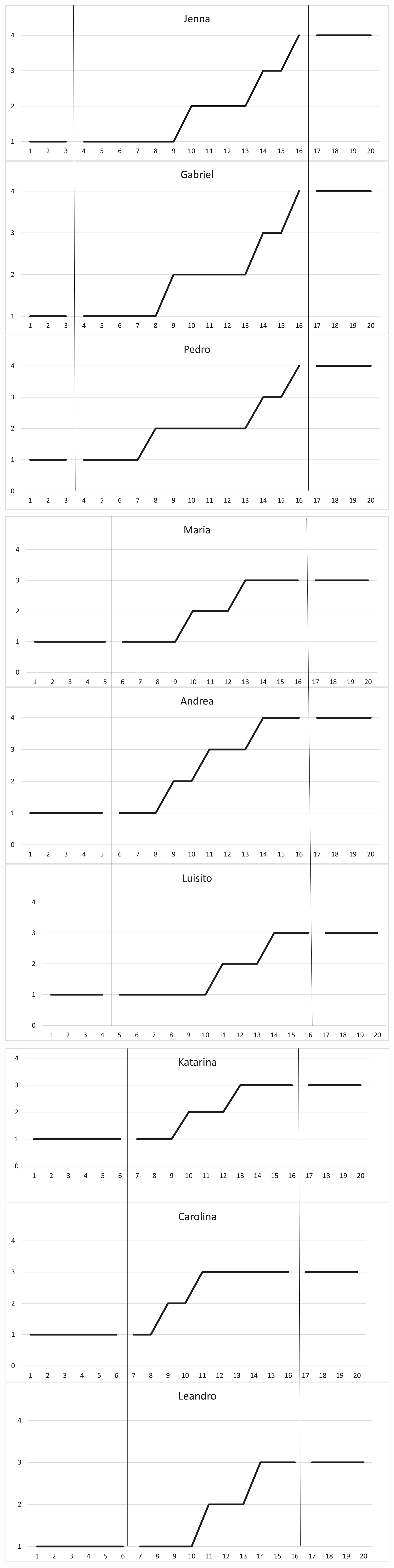
Students’ performance across the baseline, intervention, and maintenance phases.
Effect Sizes
The patterns apparent in the visual inspection also were supported when computing the weighted average Tau-U of all nine students, 0.38, SE = 0.12, 95% confidence interval (CI) = [0.15, 0.60]. The significant effect size favored students’ word-problem-solving accuracy in the instructional phase when compared with baseline. Tau-U effect sizes also were calculated for individual students and are presented with the results for each of Ms. Skotek’s math intervention groups in the sections that follow.
Performance by Math Intervention Group
Group 1
The average problem-solving (APS) scores of Jenna, Gabriel, and Pedro in their three baseline sessions were 50%, 33%, and 58%, respectively. This group participated in 13 sessions with the instructional practices the teacher learned in the professional development, and their APS scores on the word-problem sets during the instructional phase were 75%, 63%, and 66%, respectively. In responding to the changing criterion, students demonstrated a gradual increase in the word-problem level with which they were able to work from Level 1 in baseline to Level 4 by the end of the instructional phase. Moreover, they maintained their performance at Level 4 after the end of the instructional phase. Tau-U effect sizes were calculated for the baseline versus the instructional phase contrast (Jenna = 0.88, 90% CI [0.16, 1.00]; Gabriel = 0.83, 90% CI [0.12, 1.00]; Pedro = 0.25, 90% CI [−0.41, 0.84]). Overall, the Tau-U effect of the 13 instructional sessions on the word-problem-solving performance of Group 1 was 0.66, 95% CI [0.22, 0.94].
Group 2
The APS scores of Maria, Andrea, and Luisito on their four baseline sessions were 63%, 56%, and 69%, respectively. This group participated in 12 sessions with the instructional practices the teacher learned to implement, and their APS scores during the instructional phase were 69%, 79%, and 71%, respectively. In responding to the changing criterion, students demonstrated a gradual increase in their word-problem levels from Level 1 in baseline to Level 3 (Maria and Luisito) or Level 4 (Andrea) in the instructional phase. In the maintenance phase, Maria maintained performance at Level 4, the highest level possible. Andrea and Luisito maintained their performance at Level 3, which was two levels higher than their baseline performance. Tau-U effect sizes were calculated for baseline versus the instructional phase contrast (Maria = 0.24, 90% CI [−0.37, 0.75]; Andrea = 0.77, 90% CI [0.11, 1.00]; Luisito = 0.08, 90% CI [−0.50, 0.62]). Overall, the Tau-U effect of the 13 instructional sessions on the word-problem-solving performance of Group 2 was 0.38, 95% CI [−0.02, 0.63].
Group 3
The APS scores of Katarina, Carolina, and Leandro on their five baseline sessions were 65%, 60%, and 70%, respectively. This group participated in 11 sessions with the instructional practices the teacher learned to implement, and their APS scores during the instructional phase were 71%, 79%, and 73%, respectively. In responding to the changing criterion, students demonstrated a gradual increase in their word-problem levels from Level 1 in baseline to Level 3 in the instructional phase. Moreover, they maintained their performance at Level 3 after the end of the instructional phase. Tau-U effect sizes were calculated for baseline versus the instructional phase contrast (Katarina = 0.21, 90% CI [−0.35, 0.69]; Carolina = 0.67, 90% CI [0.05, 1.00]; Leandro = 0.11, 90% CI [−0.44, 0.60]). Overall, the Tau-U effect of the 13 instructional sessions on the word-problem-solving performance of Group 3 was 0.34, 95% CI [−0.03, 0.57].
Social Validity
Interview data indicated that Ms. Skotek and all students agreed (100%) the instructional practices from the professional development were reasonable to carry out in the classroom and helped students understand and answer word problems. Students made comments such as, “I like how the teacher taught us in steps with writing, and we got to talk about math with writing.” The teacher commented, “I really liked the basic writing steps to solving word problems, and how easily it integrated math language and content with reading comprehension strategies.” The students recommended the instruction include “more time to talk and to write because the writing was difficult.” In addition, Ms. Skotek would have liked professional development and planning time with other teachers to think about how to improve her word-problem-solving and academic language instruction.
Discussion
The purpose of this study was to help one special education teacher develop her pedagogical skills in teaching math strategies and academic language before, during, and after having ELs with MLD solve a word problem. After participating in the professional development, visual analysis of graphed student data indicated a functional relationship between Ms. Skotek’s implementation of the instructional practices and students’ word-problem-solving ability. Specifically, their skills at solving word problems with increasingly complex vocabulary and content improved during the instructional phase in comparison with their performance during the baseline phase. Posttest scores on the WJ NU III-ACH Test 10, t(8) = 14.55, p < .0001, 1 week after the intervention was delivered indicated that students had shown improvement from the intervention. Also, classroom observations indicated that students’ problem-solving skills improved, due to the teacher’s use of intervention afterward and students practicing intervention with more complex word problems as previously defined and solving these problems correctly.
Although the Tau-U effect sizes mostly were moderate to strong (0.65–0.88), some students demonstrated smaller effects (0.08–0.25) or had 90% CI that crossed zero. The latter can indicate that the effects were not significant (Lee, 2016), but there are two important considerations. First, the overall Tau-U effect sizes for the three groups were all positive (0.27–0.70), and none had 95% CIs that crossed zero. Recall that the unit of instruction was the group because students were taught in small groups of three, and all members had to demonstrate mastery at a given level during probing before they were moved to the next level of word-problem complexity. Therefore, the group effect serves as an important indicator.
Second, the changing criterion meant that we expected students would have some variability in their performance during the instructional phase because they would work to mastery and then receive word problems with more complex language and content. The increase in difficulty initially would lower their performance in comparison to the previous criterion until they mastered the new criterion. Students in the math intervention class who experienced more difficulty might be expected to have more dramatic decrements in performance at each successive level, thus influencing the range of their scores across the instructional phase. The fact that all nine students progressed from Level 1 to Level 3 or 4 and maintained their improved level of performance 1 week later after only 25 min of treatment in each of 20 sessions over 10 weeks suggests that the professional development supported implementing the instructional practices both feasible and impactful.
The evidence from this study is consistent with other findings that suggest professional development tailored to the subject area and contextual needs of the teacher can support student outcomes (Clewell et al., 2004; Harris & Sass, 2006). Whereas other professional development studies have focused on the general education population, our study extends this line of work to improving the word-problem-solving abilities of ELs with MLD, a high-priority group (National Academies of Sciences, Engineering, and Medicine, 2018).
Limitations
Although the findings were mostly positive, this was a small-scale study with nine students in three small groups. In addition, all students were native Spanish speakers being taught in a supplemental intervention class, but we were not provided their language proficiency scores. Therefore, it is not possible to determine whether the instructional practices we prepared the teacher to deliver would be more or less effective with ELs with MLD of different language backgrounds, different levels of English proficiency, or different settings. Given the promising results of our preliminary study investigating the impact of professional development on a teacher’s ability to meet the needs of her students, further research with larger samples is warranted and should be designed to include student characteristics in the analysis.
We also acknowledge that the kind of one-on-one professional development that we delivered to Ms. Skotek is resource-intensive. A more scalable model of professional development and ongoing support would be necessary for schools or districts serving large populations of ELs with MLD or districts attempting to advance the skills of multiple teachers who may work in different buildings. Ms. Skotek indicated that she would like to be learning along with colleagues and have the ability to capitalize on peer support, which is a logical approach in her school where teachers are on three-tier teams for MTSS. Thus, professional development targeting groups of teachers might be beneficial not only for achieving scale but also for maximizing the adult learning opportunities and the structure of the MTSS framework. Future research should investigate ways to incorporate MTSS teams or other groups (e.g., professional learning communities) when building teachers’ skills at word-problem-solving instruction for ELs with MLD.
Implications
Our findings suggest that professional development can prepare special educators to support their ELs with MLD in three ways. First, it should prepare educators for building their students’ linguistic math registers or, specifically, the academic language necessary for word problem solving (e.g., Kong & Swanson, 2019). Second, the professional development should focus on explicitly teaching students how to apply what they already know to understand the word problem, visually represent it, identify the quantities involved in the problem, and build their procedural fluency for solving the problem (e.g., Powell et al., 2020). Finally, teachers should learn how to offer students carefully directed practice opportunities for applying their math and language skills as they communicate with peers about the word problem and how they are solving it (Orosco & Abdulrahim, 2018).
With respect to designing the student practice opportunities, our results suggest the instruction can start students with word problems of lower language and math complexity and gradually increase those levels over time. We did this by monitoring students’ instructional levels, which we defined as the highest level of problem-solving performance they could achieve with teacher assistance—either in the form of prompting or corrective feedback (Vygotsky, 1978). The changing criterion mediated students’ word-problem-solving performance and led to durable improvements in the maintenance sessions. Therefore, IS paired with the language and problem-solving practices may be an effective approach to improving outcomes for ELs being taught in an MTSS framework.
Conclusion
Although preliminary, the results of this study suggest professional development on a combination of academic language and problem-solving strategy instruction can help meet the math needs of ELs with MLD. Moreover, teachers can implement this instruction with high fidelity, and both teachers and students can perceive value in the practices. Importantly, educator preparation holds promise for significantly improving students’ problem-solving performance.
Supplemental Material
sj-docx-1-ldx-10.1177_00222194221099671 – Supplemental material for The Effects of Professional Development on English Learners’ Problem Solving
Supplemental material, sj-docx-1-ldx-10.1177_00222194221099671 for The Effects of Professional Development on English Learners’ Problem Solving by Michael J. Orosco and Deborah K. Reed in Journal of Learning Disabilities
Supplemental Material
sj-docx-2-ldx-10.1177_00222194221099671 – Supplemental material for The Effects of Professional Development on English Learners’ Problem Solving
Supplemental material, sj-docx-2-ldx-10.1177_00222194221099671 for The Effects of Professional Development on English Learners’ Problem Solving by Michael J. Orosco and Deborah K. Reed in Journal of Learning Disabilities
Supplemental Material
sj-docx-3-ldx-10.1177_00222194221099671 – Supplemental material for The Effects of Professional Development on English Learners’ Problem Solving
Supplemental material, sj-docx-3-ldx-10.1177_00222194221099671 for The Effects of Professional Development on English Learners’ Problem Solving by Michael J. Orosco and Deborah K. Reed in Journal of Learning Disabilities
Footnotes
Declaration of Conflicting Interests
The author(s) declared no potential conflicts of interest with respect to the research, authorship, and/or publication of this article.
Funding
The author(s) received no financial support for the research, authorship, and/or publication of this article.

Supplemental Material
Supplemental material for this article is available on the Journal of Learning Disabilities website with the online version of this article.
Notes
References
Supplementary Material
Please find the following supplemental material available below.
For Open Access articles published under a Creative Commons License, all supplemental material carries the same license as the article it is associated with.
For non-Open Access articles published, all supplemental material carries a non-exclusive license, and permission requests for re-use of supplemental material or any part of supplemental material shall be sent directly to the copyright owner as specified in the copyright notice associated with the article.
