



Abstract
This article extends the Uppsala Conflict Data Program (UCDP) by presenting new global data on non-state conflict, or armed conflict between two groups, neither of which is the state. The dataset includes conflicts between rebel groups and other organized militias, and thus serves as a complement to existing datasets on armed conflict which have either ignored this kind of violence or aggregated it into civil war. The dataset also includes cases of fighting between supporters of different political parties as well as cases of communal conflict, that is, conflict between two social groups, usually identified along ethnic or religious lines. This thus extends UCDP’s conflict data collection to facilitate the study of topics like rebel fractionalization, paramilitary involvement in conflict violence, and communal or ethnic conflict. In the article, we present a background to the data collection and provide descriptive statistics for the period 1989–2008 and then illustrate how the data can be used with the case of Somalia. These data move beyond state-centric conceptions of collective violence to facilitate research into the causes and consequences of group violence which occurs without state participation.
Introduction
Why do groups engage in violence against other groups? Be it rebel groups that fight one another, supporters of political parties that take to the streets to intimidate and kill opposing party supporters, or identity groups that attack one another (like Hindus and Muslims in Gujarat), we have very few answers to this question. The reason for this is that most of the research on collective violence has been state-centric, focusing on civil war and interstate violence. But for societies experiencing non-state violence, the end result is the same regardless of whether the conflicting parties are fighting the state or another group; civilians are still subjected to displacement, economic devastation, injury, or even death. Indeed, in many regions of the world where thousands are killed annually in this type of non-state violence, it far exceeds other forms of conflict in terms of lethality. While researchers have begun to address non-state conflict, they are hindered by a lack of data. The most prominent civil war dataset, the UCDP/PRIO dataset (Gleditsch et al., 2002; Harbom & Wallensteen, 2011), includes only those cases of political violence in which a state is involved; fighting between non-state actors is thus deliberately excluded.
We seek to rectify this empirical gap by presenting a new global dataset on non-state conflict for the period 1989–2008. 1 By non-state conflict, we mean conflict between two organized groups which results in at least 25 annual battle-related deaths. This dataset includes all conflicts between rebel groups, and thereby serves as a crucial complement to existing datasets, in particular the UCDP/PRIO dataset with which it is directly compatible. In addition, the dataset goes beyond a narrow civil war focus to include all violent conflicts in which the state is not involved, including those that take place between broader social groups, such as clans or ethnic groups. As such, the dataset can be used to study what is commonly labeled ‘communal conflict’. In creating these data, we hope to facilitate research on violence which occurs without state participation, in terms of both the causes of such violence and its consequences.
In this article, we discuss the motivation behind this dataset and compare it to other data projects. We then provide more detail on our criteria and definitions, as well as our data collection procedures. Thereafter, we provide descriptive data which highlight trends in non-state conflict over time and space. The dataset can be used to study both global patterns and case studies. We highlight the latter with an in-depth look at the case of Somalia.
Why a new dataset?
The Uppsala Conflict Data Program (UCDP) Non-State Conflict Dataset contains data of interest to two burgeoning literatures. The first addresses fighting between belligerent groups and paramilitaries which is exclusive to the state. Scholars interested in Iraq, Burma, and elsewhere note that rebel groups sometimes divert scarce military resources towards conflict with each other. While some scholars have begun to investigate why this occurs (Cunningham, Bakke & Seymour, 2010; Fjelde & Nilsson, forthcoming), study on this subject has been hindered by a lack of systematic data.
The second burgeoning literature concerns conflict which occurs between identity groups, that is, communal conflict. This topic has received increasing attention and has been the subject of prominent case studies of India and Indonesia (Rajeshwari, 2004; Varshney, 2002; Varshney, Panggabean & Tadjoeddin, 2004). It has also gained traction in media and policy circles, with some observers suggesting that such fighting is an inherent and increasingly prominent facet of warfare (Kaplan, 1994). Without systematic cross-national data over time, however, this claim remains supposition. In addition to questions regarding the origins and dynamics of communal conflicts, the phenomenon is also interesting vis-à-vis other forms of violence: do communal conflicts spill over into armed rebellion against the government? Or are they a consequence of armed conflict, a result of social polarization and enmity? This relationship has received little attention, again due to the lack of data needed to answer these questions.
There are three sources of global data on non-state conflict. The Correlates of War (COW) project includes the type of violence we refer to as non-state conflict in four different categories (regional war, intercommunal war, wars which take place in territories that do not meet the criteria for system membership, and wars where the warring non-state sides are based across state borders) (Sarkees & Wayman, 2010). COW requires 1,000 annual fatalities for inclusion, which results in only 21 cases in the entire post-WWII period. The Heidelberg Institute of International Conflict Research (HIIK) includes conflicts between non-state actors providing they concern ‘national values of some duration or magnitude’ (HIIK, 2006). HIIK often aggregates multiple conflicts into one megaconflict and often categorizes non-state conflicts as being governmental. 2 HIIK also lacks systematic and replicable criteria for inclusion, instead relying on a subjective, discrete measure for determining cases. Horowitz (2001) also provides narratives from over 150 riots in 50 countries. These data were not, however, collected using clear definitions, and lack documentation (Laitin, 2001). We conclude that the UCDP Non-State Conflict Dataset improves on these previous efforts by being the only dataset to rigorously apply transparent definitions on systematically collected data, including cases of lower-intensity violence.
Criteria and definitions
The UCDP defines non-state conflict as the use of armed force between two organized armed groups, neither of which is the government of a state, which results in at least 25 battle-related deaths in a year. 3 In creating this definition, UCDP faced a number of challenges, the greatest of which was the question of whether a criterion of political motives should be required. In state-based conflicts, UCDP requires an incompatibility over government and/or territory. 4 Following a long process which examined how ‘incompatibilities’ or ‘political objectives’ could be identified, UCDP found that any attempt to specify such a criterion in the context of non-state conflict would be unsystematic and subjective. In the little literature which addresses this topic, there is a tendency to adopt an ‘I know it when I see it’ attitude towards political goals, an attitude often biased by the geographic location of violence. Gangs fighting over control of territory in East Los Angeles are treated as inherently criminal, while clans fighting over territory in Ethiopia are deemed political. 5 We found it impossible to determine adequate and systematic criteria which could distinguish between fighting over scarce resources like water and fighting over resources like drugs; between rebel groups de facto controlling territory and gangs de facto controlling territory; between violent riots in India and fighting in soccer stadiums in Buenos Aires. Thus, there is no requirement for an incompatibility in the non-state conflict data. One benefit of having such an inclusive approach is that researchers wishing to apply their own criterion of ‘political’ goals can do so since we have not pre-emptively excluded any conflicts. Conflict descriptions provided at the UCDP’s Conflict Encyclopedia should assist researchers wishing to undertake such a task (UCDP, 2011).
Types of non-state conflict
UCDP divides non-state conflict into three categories with regard to the level of organization of the parties. The first, Organization level 1, occurs when both actors have a high level of organization, such as between paramilitary United Self-Defense Forces of Colombia (AUC) and the guerrilla Revolutionary Armed Forces of Colombia (FARC) in Colombia, or between the competing rebel groups National Patriotic Front of Liberia (NPFL) and United Liberation Movement of Liberia for Democracy (ULIMO) in Liberia. 6 The second, Organization level 2, captures fighting between political parties/candidates, for example clashes between supporters of the All Nigeria People’s Party and supporters of the People’s Democratic Party in Nigeria. These groups are usually not permanently organized for combat, but occasionally use their organizational structures for such purposes. Finally, Organization level 3 includes groups that define themselves along identity lines, be it ethnic, clan, religious, national, or tribal identities. Fighting between these types of groups captures what is commonly referred to as communal conflict. While wide-scale communal violence is relatively rare, such cases usually gain prominence in the media, for example, between Christians and Muslims in Nigeria in 2004. The dataset includes a variable which designates the level of organization for each case, allowing researchers to easily identify cases of interest.
Data collection
In collecting data on non-state conflicts, we employed the same methodology used in other UCDP data collection efforts as described in Eck & Hultman (2007). Briefly, the data are collected in the following manner: we first run a Factiva database search for all countries applying a string of search terms designed to produce all news articles reporting the use of violence; for the year 2008 alone, we manually read and coded over 55,000 articles. Reports from the International Crisis Group, Human Rights Watch, and Amnesty International are also examined, as well as a number of other area-specific sources. 7 If there are indications of an active non-state conflict, further investigation follows. At this stage, media sources are again consulted using tailored searches that increase the number of sources and broaden the set of search terms. A new effort is also made to find reports from local NGOs, the UN and other international organizations, and other data projects. In the last stage of the data-gathering process, we also collect information from other researchers, including epidemiological studies, reports from truth and reconciliation bodies, and in-depth case studies. These sources rarely provide event-specific information, but can help triangulate conflict activity or provide comparison estimates to verify or discard the reliability of information collected elsewhere. In addition, the UCDP maintains an informal network of experts – mainly researchers, NGO workers, and diplomats – that can be contacted for clarification.
The data are recorded in event-data format, and each event is coded with a low, best, and high estimate for battle-deaths. If the reporting is clear, then there is no difference between the three, but if sources diverge, then low and high estimates are created. The best estimate is often the same as the low estimate, except when the best estimate comes from a more reliable source (hospital, etc.). When in doubt, we always opt for the more conservative option because we believe that it is better to provide a consistent baseline. If there is uncertainty about the identity of the actors involved in an incident, it may be included only in the high estimate. Through the use of a wide array of sources, it is often possible to triangulate the information and link an event to the location of a specific group. At this point, summary figures and claims from the warring parties are also considered. After generating a comprehensive event dataset, the fatalities are aggregated to produce a yearly estimate for each non-state conflict. 8 These data are updated annually to include the most recent year, and previous estimates are continuously revised as new information becomes available. Descriptions of all of the conflicts are available online via the UCDP Conflict Encyclopedia (UCDP, 2011).
Trends and patterns
There were 359 non-state conflicts in the period 1989–2008, with a total of 522 conflict years. This period saw 80,174 deaths (low: 71,160; high: 121,256). 9 Figure 1 shows the pattern of conflicts over time. The period 1989–1991 had few non-state conflicts; after 1994, the number of annual conflicts fluctuates, with a mean of 28. Compared to state-based conflicts, the figure suggests that the differences between the two types of conflict were greatest around the end of the Cold War, which saw a high number of state-based conflicts, but relatively few non-state conflicts. The numbers of state-based and non-state conflicts have converged since 2000, although there is greater variance in the number of non-state conflicts compared to the number of state-based conflicts. While it requires more study, our intuition is that the greater fluctuation in the number of non-state conflicts can be explained at least in part by organizational characteristics: communal conflicts in particular tend to mobilize people on contingent bases, while rebel groups generally strive for more stable organizational structures.
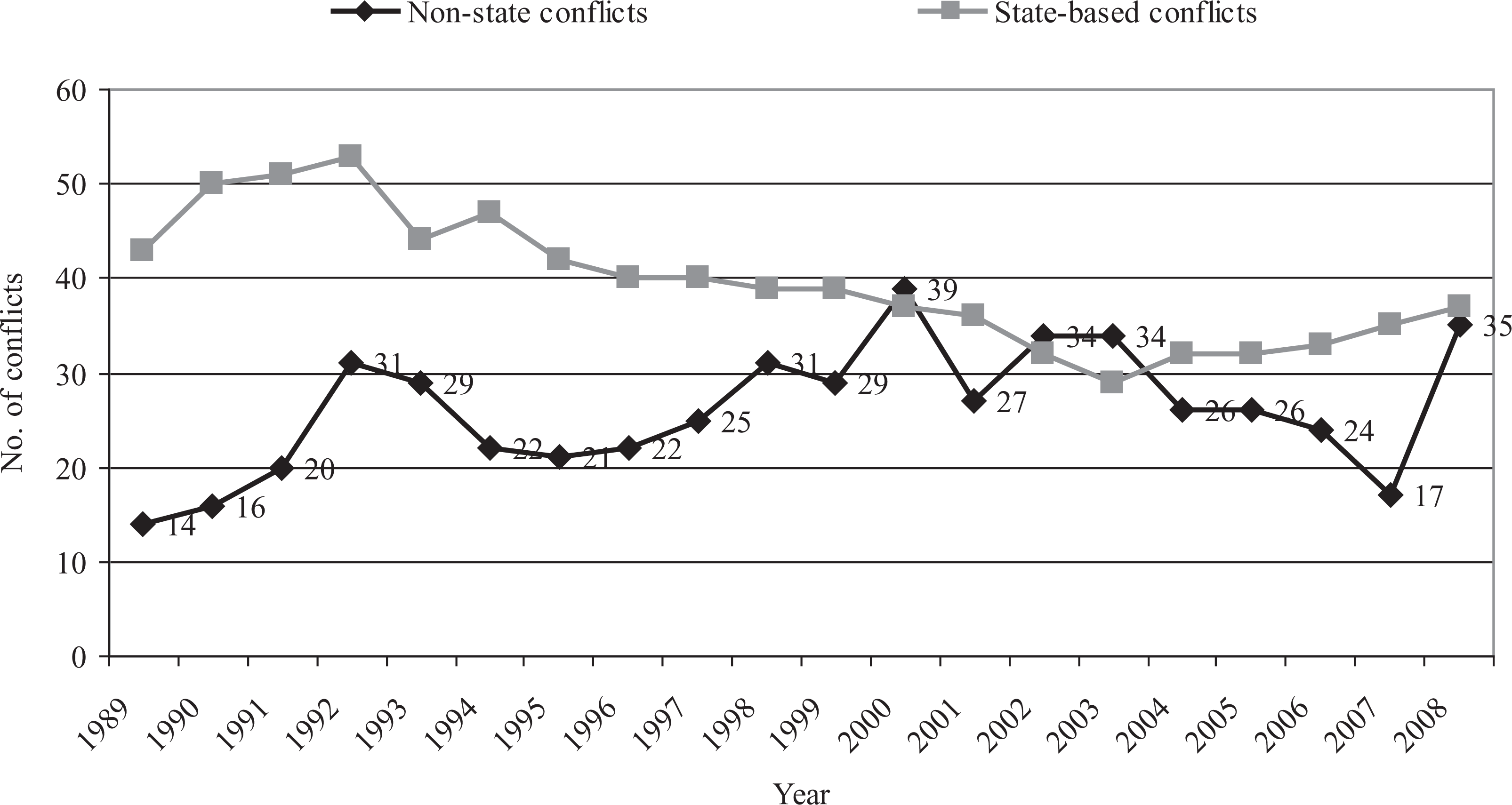
Non-state conflict and state-based conflict, 1989–2008
Figure 2 shows the number of fatalities from non-state conflict, which peak in 1993. This peak is mainly driven by two cases: fighting between the Hutu and the Hunde in the DRC, and the Sudan People’s Liberation Movement/Army’s (SPLM/A) conflict with the Southern Sudan Defense Force (SSDF) in Sudan. The large difference between best and high estimates relates to difficulties in finding reliable fatality estimates for eastern DRC and southern Sudan due to chaotic conditions on the ground. The peaks in 1999 and 2003 were both driven by Hema-Lendu fighting in the DRC. The only discernible trend in Figure 2 is that the number of fatalities from non-state conflict has dropped considerably since 2002, with only a slight increase in 2008.
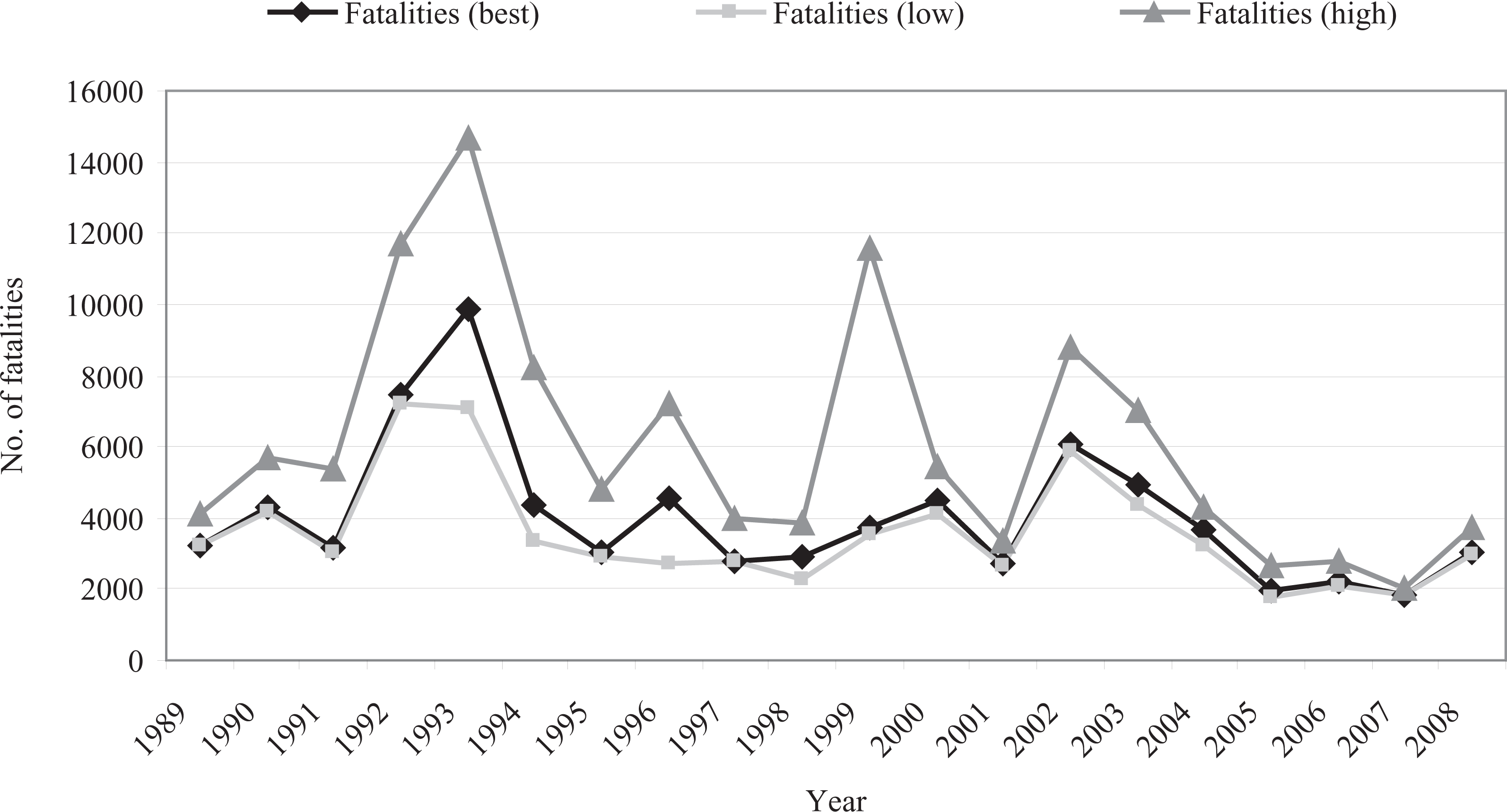
Non-state fatalities, 1989–2008
Simply looking at the number of conflicts can be deceiving, as Figure 2 shows. For instance, in 2008 only 3,009 deaths were recorded although the number of non-state conflicts was the second-highest recorded during the period. Clearly, non-state conflicts have a tendency to differ considerably in their intensity, and the majority are in fact low-intensity: while non-state conflict averages 4,009 deaths annually (low: 3,558; high: 6,063), less than 4% of conflict years see more than 1,000 fatalities (14 out of 359 conflicts). 10
The breakdown of fatalities by organization level is shown in Figure 3. Organization level 2 conflicts produce few fatalities; Organizational level 1 and Organization level 3 conflicts compose the bulk of the fatalities, though the lethality varies quite dramatically from year to year.
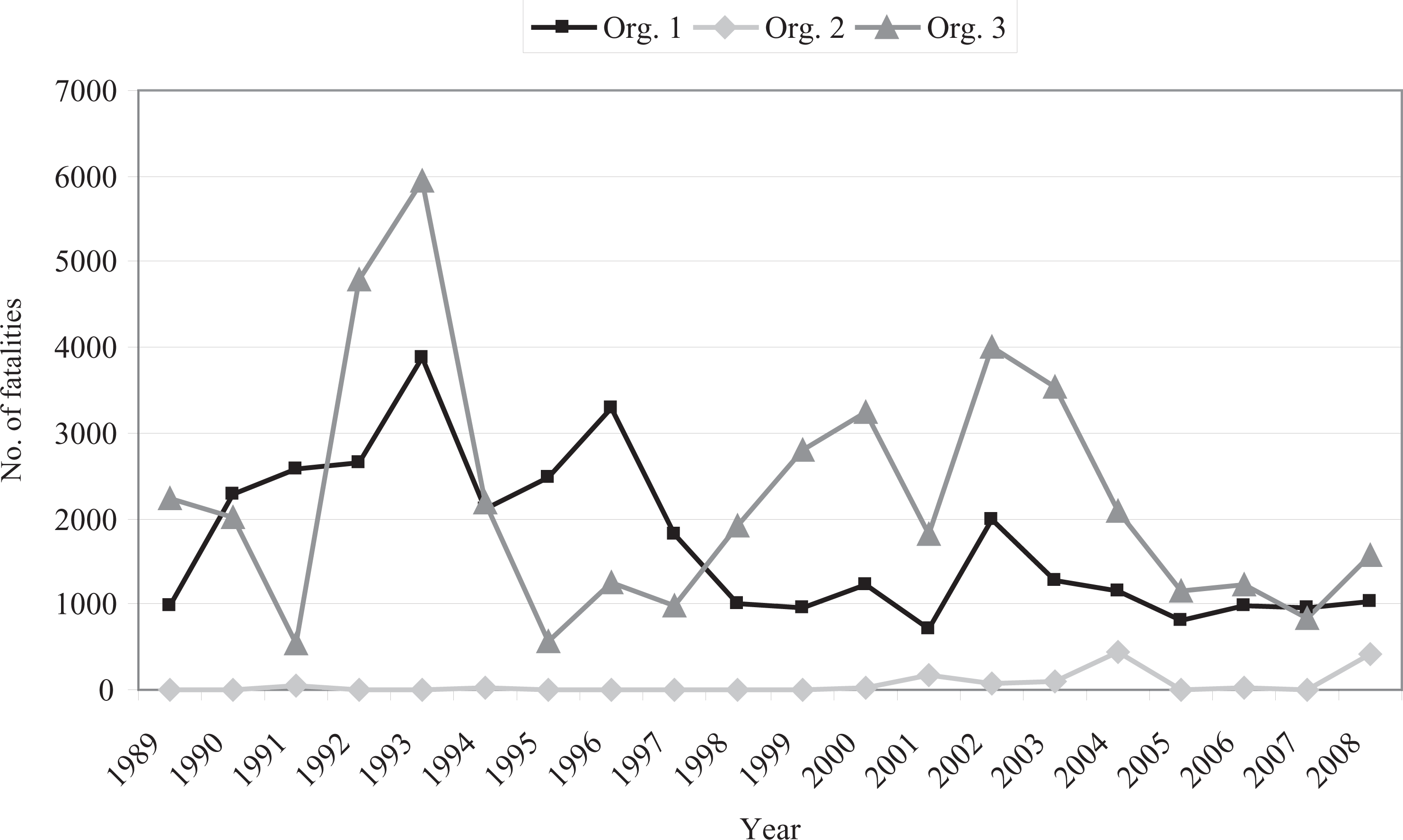
Non-state fatalities by organization level, 1989–2008
Figure 4 shows the regional breakdown of fatalities. Throughout the period, Europe has been the most peaceful region, experiencing non-state conflicts mainly during times of state formation. Registered conflicts include those between Armenians and Azeris (a prelude to Nagorno-Karabakh), and conflicts between self-proclaimed states that attempted to attain statehood (e.g. Republic of Croatia versus various Serb nationalists).
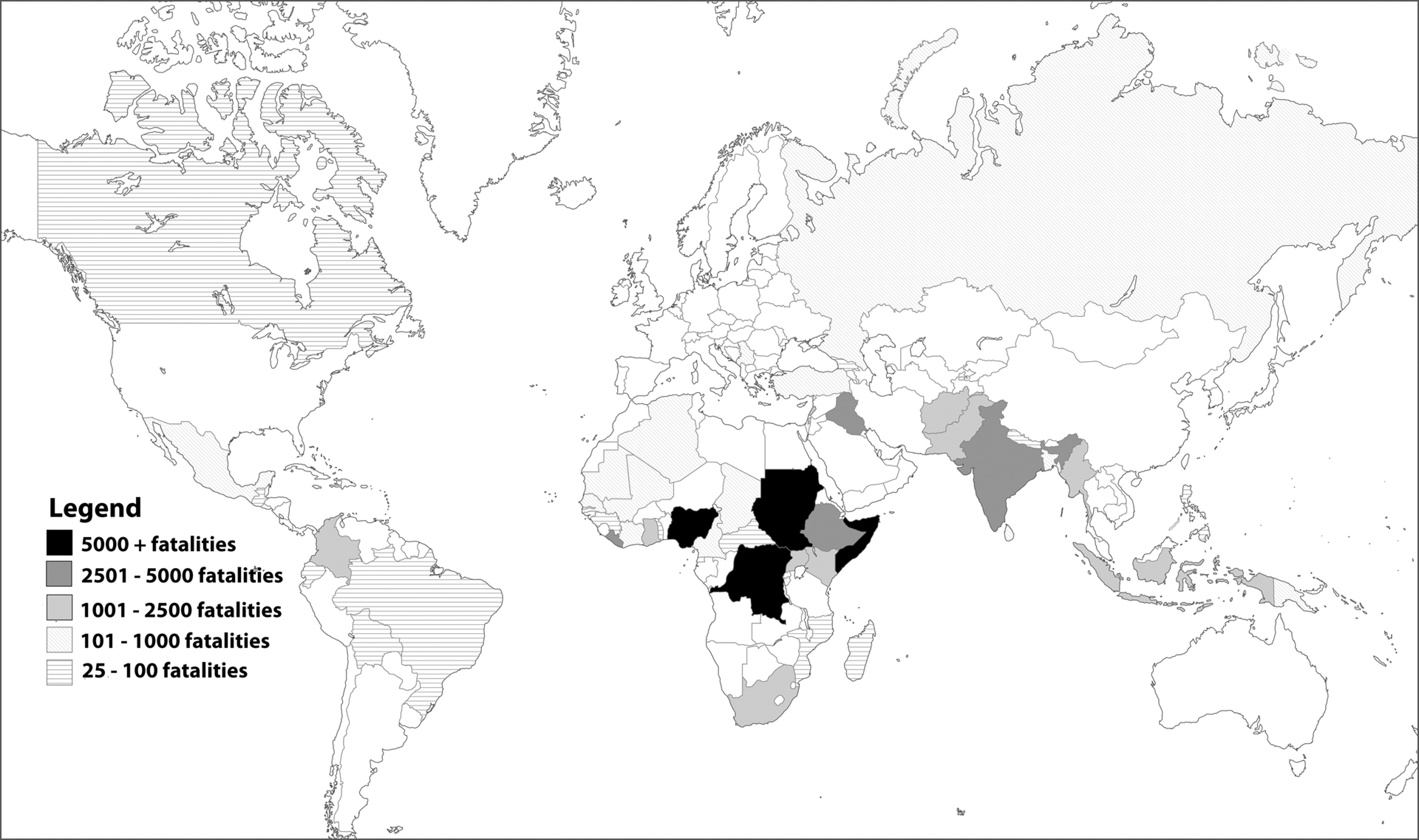
Map of non-state fatalities, 1989–2008
In Asia, Central and South Asia constitute the bulk of the fatalities, and this region has seen an increase in non-state fatalities in recent years, mainly brought on by the situation in Pakistan’s tribal areas. The data also pick up several non-state conflicts in India, including both communal violence (e.g. between Hindus and Muslims, as well as Kuki and Naga tribes) and more organized fighting (e.g. between the Isaac-Muivah and Khaplang factions of the National Socialist Council of Nagaland). Also included in the data are the final years of the Liberation Tigers of Tamil Eelam’s (LTTE) conflict with its Tamil rivals in Sri Lanka and inter-Mujahedeen fighting in Afghanistan throughout 1989–1996. East and Southeast Asia have not seen many non-state conflicts; most have taken place in Myanmar between different separatist groups and pro-government militias.
In the Middle East and North Africa, non-state conflicts in Iraq and Lebanon dominate the data. The conflicts in Lebanon are mainly related to the end of the Lebanese civil war, but also include Hezbollah’s fight with the pro-Israeli South Lebanon Army (SLA) and inter-Palestinian fighting. In Iraq the most violent non-state conflicts occur between different Kurdish organizations in the 1990s.
In the Americas, most non-state conflicts occur in Colombia and Mexico. In Colombia, conflict has arisen mainly between the rebel group FARC and right-wing self-defense groups throughout the 1990s and the early 2000s. In Mexico, non-state conflicts are primarily related to rival drug cartels.
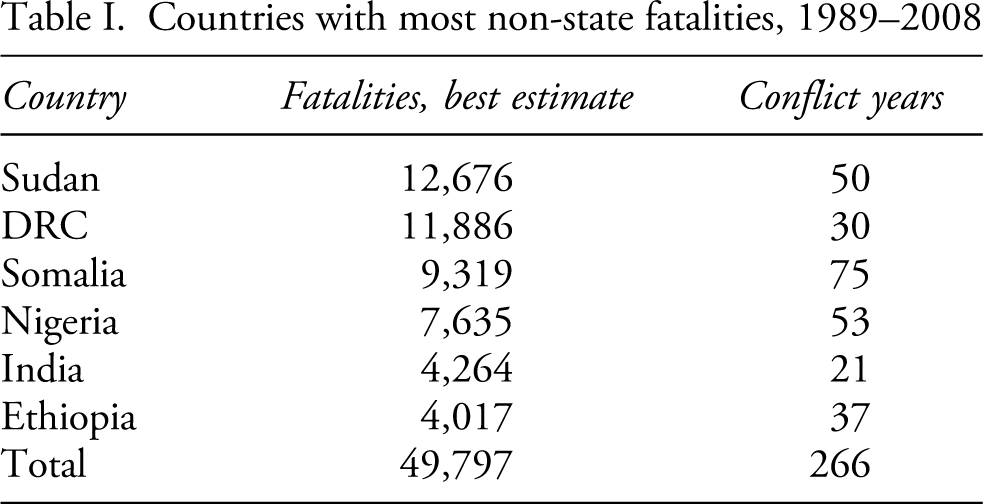
Sub-Saharan Africa clearly stands for the bulk of non-state fatalities, dominating the data with 58,940 fatalities, or 74% of the total fatalities; 69% of the total conflict-years are also found in Africa. Table I lists the countries with the most fatalities from non-state conflict, all but one of which can be found in sub-Saharan Africa. In Sudan, non-state conflict has taken place both in the south and west (Darfur) of the country. In Darfur, non-state conflict pits ethnic groups against each other, while the bulk of conflicts in the south occur between rebel groups and factions engaged in internecine fighting. 11 The DRC has also experienced considerable non-state violence. The most intense conflicts are between opposing ethnic groups, such as the Hutu and Hunde in 1993 and the Hema-Lendu conflict in 1999–2003. The DRC has also suffered from conflicts between rebel groups based in the eastern parts of the country during the civil war of the late 1990s and early 2000s. Somalia has been struck primarily by clan-based fighting; this is discussed in greater detail shortly. In Nigeria, there are two primary faultlines: conflicts over land between various identity groups, and ethnic groups clashing over elections and political positions. In Ethiopia, tribal and clan quarrels are common; cattle-rustling, competition for lands, water, grazing rights, and local political influence purportedly fuel these conflicts.
Countries with most non-state fatalities, 1989–2008
In-depth look at Somalia
In the following section, we illustrate several ways in which the UCDP Non-State Conflict Dataset can be used to understand patterns of violence by examining the case of Somalia. Somalia is particularly relevant to explore since the UCDP/PRIO Armed Conflict Dataset does not record an intrastate armed conflict ongoing in Somalia during 1997–2000 and 2003–2005 due to the lack of an identifiable government; it also records only a low-intensity intrastate conflict for 1993–1996 and 2001–2002. Taken at face value, these observations suggest that Somalia was largely peaceful during this period, a conclusion that is very much at odds with reality on the ground.
The collapse of Somali statehood
The civil war in Somalia began in 1978 with armed opposition to the military regime of Siad Barre. Barre’s regime was overthrown in January 1991 as the United Somali Congress (USC) captured the capital Mogadishu. The interim government founded by the USC soon crumbled when the group splintered into different factions. Attempts at negotiating peace failed to stop the subsequent fighting that wracked Mogadishu. Since no group could claim de facto control over the capital during 1997–2000, UCDP does not identify a government during those years. A Transitional National Government (TNG) was established in 2001, but it was also violently challenged. After its mandate ended in 2003, Somalia remained without a government until 2005, when the Transitional Federal Government (TFG) was established. Since then, the regime, supported by Ethiopian troops and African Union peacekeepers, has been fighting various Islamic movements as the armed conflict continues.
Non-state fighting in 1989–2008
There are 56 different non-state conflicts with a total of 76 conflict years in Somalia 1989–2008; these conflicts have caused 9,059–11,732 deaths. 12 Figure 5 shows the temporal distribution of non-state conflicts and the number of fatalities from both non-state and state-based conflict.
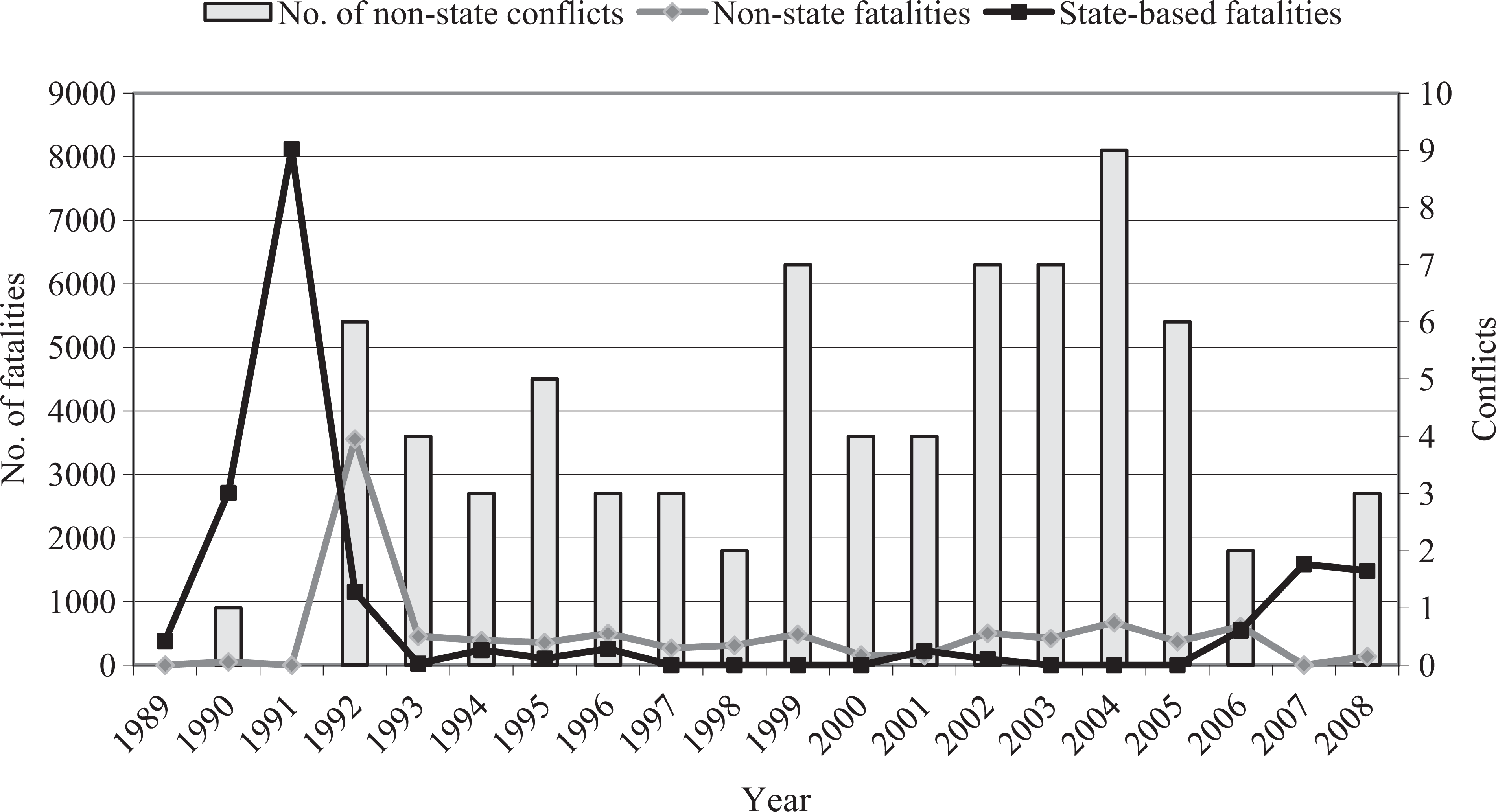
Non-state conflicts and fatalities in Somalia, 1989–2008
Somewhat surprisingly, Figure 5 shows that there is no increase in the number of non-state conflicts or fatalities during those years in which no viable government existed in Somalia compared to the years when a government existed. A likely explanation for this is that the Somali government has rarely been strong enough to suppress clan fighting even when nominally in power.
The timeline shows that non-state conflict is at a relatively low level in 1989–1991 during the final offensives against the Siad Barre military regime. In the aftermath of the rebel victory, there is an increase in non-state conflicts in 1992 as different factions scramble for dominance. Since then, the trend in the number of conflicts fluctuates, while the number of fatalities remains relatively stable around 500 per year. It is possible to identify three different phases of fighting. In the 1992–1999 period, non-state conflicts between organized groups dominate, exemplified by the United Somali Congress/Somali National Alliance (USC/SNA) engaging in conflict with several smaller outfits, experiencing clashes with a breakaway faction, and engaging in an extended non-state conflict with the Rahanweyn Resistance Army (RRA) in southern Somalia. During 1999–2005, overt clan-oriented fighting fills the void, as the leadership of many rebel movements participated in peace negotiations or joined up with or allied against the transitional government. In part as a response to this clan violence, 2006 sees the rise to prominence of Islamist militias, originating from the Islamic Courts Movement based near Mogadishu. From this period onward, the dataset contains non-state conflicts between Islamists and warlords, interclan fighting, and fighting between different Islamist militias (e.g. al-Shaabab and Ahlu Sunna Waljama), all at a relatively low level of intensity.
Geographic dispersion of fighting
Figure 6 displays the number of non-state fatalities and the number of state-based fatalities for the entire 1989–2008 period, per district. 13 Both non-state fighting and state-based fighting share centers of gravity in south-central and north-western Somalia, around Mogadishu and Baidoa, and around Hargeysa and Berbera, respectively. Some notable differences exist though. For state-based conflict, Mogadishu is the epicenter of intense fighting while for non-state conflicts, fighting in the southern and northwestern corners of Somalia rivals that of Mogadishu. Furthermore, state-based fighting has been almost absent from the central regions of Galguduud and Mudug, regions that both experience significant numbers of non-state battles.
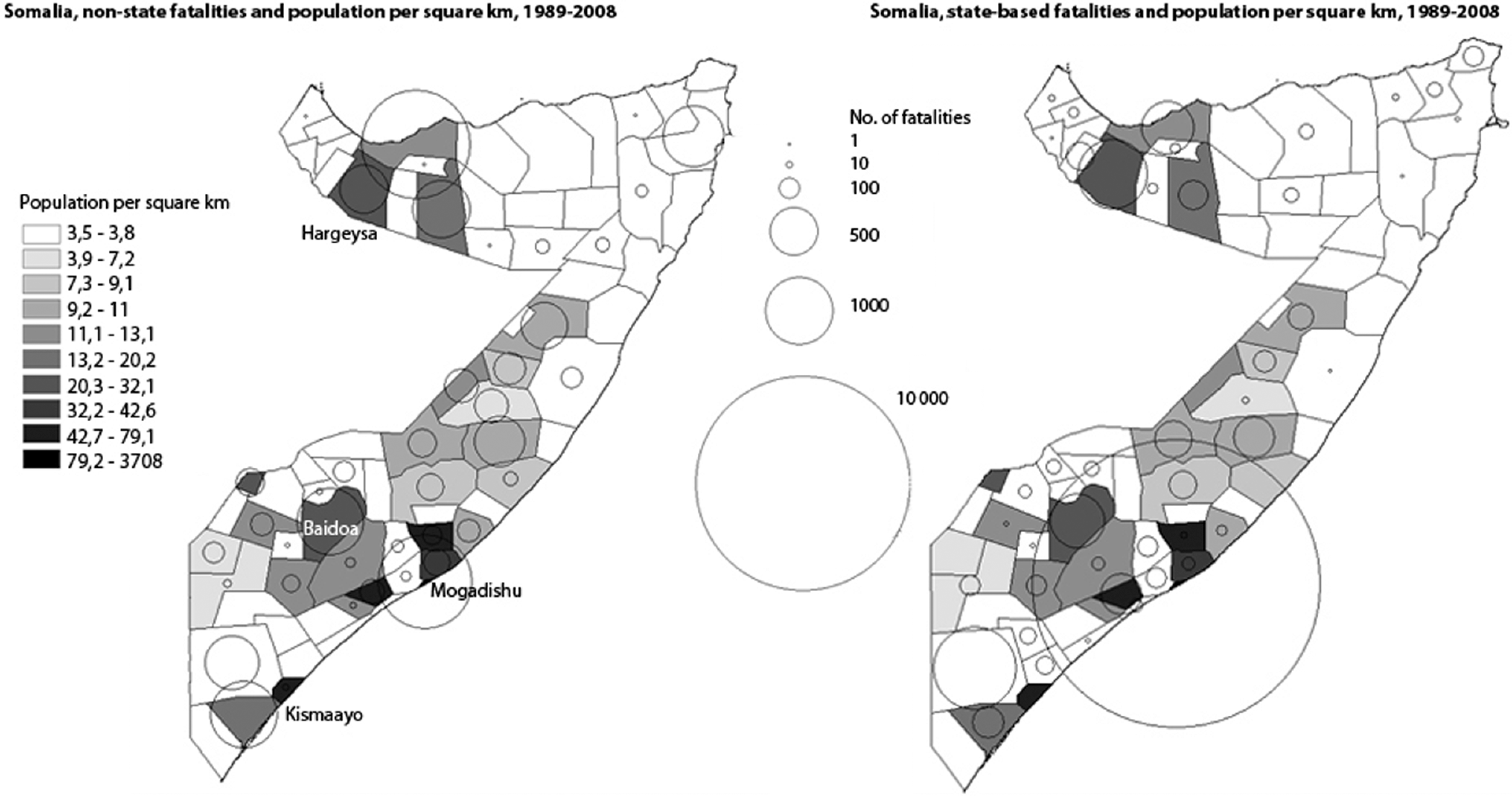
Fatalities by population in Somalia, 1989–2008
The large number of non-state fatalities in northern Somalia is the result of fierce clashes over the self-declared republic of Somaliland, taking place primarily around the valuable port city of Berbera and Burao (south of Berbera) in the early 1990s. Fighting occurred mainly among the Isaaq subclans that constituted the main nucleus of the Somali National Movement (SNM). Since 1995, however, this region of Somalia has been almost free of fighting.
Further east is an area with little state-based violence but where relatively high intensity non-state fighting is visible. Events here can be placed in three clusters: fighting between the self-proclaimed Somaliland and Puntland administrations over border areas in Sool and Sanaag regions, internecine fighting over the Puntland presidency, and clashes in 1992 between the Somali Salvation Democratic Front (SSDF) and the al-Ittihad al-Islami (Islamic Unity). In central Somalia, relatively intense non-state clashes take place in large areas of the Mudug and Galguduud regions, where the bulk of the violence occurs between clans, as opposed to the organized groups that abound in northern and southern Somalia.
The majority of fatalities for both non-state conflicts and state-based conflicts can be found in the important economic and urban centers of Baidoa and Mogadishu in southern Somalia. The area around Baidoa witnessed fighting between the USC/SNA and the RRA in the middle and late 1990s, while the 2000s saw conflicts between different factions of the RRA. To the west of Baidoa, along the border with north-eastern Kenya, clashes between factions of the Somali National Front (SNF) and between different clans (mainly the Garre and Murule clans) are relatively constant throughout the time period. Having always been the prize in the struggle for dominance over Somalia, it is no surprise that the Mogadishu area has experienced by far the highest number of non-state conflicts, and it is even less surprising that state-based fighting in this area surpasses that of non-state clashes. Mogadishu saw little fighting until 1995, when the USC/SNA factionalized over leadership issues and began battling for supremacy. Clan fighting, as well as factional battles within the United Somali Congress/Somali Salvation Alliance (USC/SSA) continued until 2006, when large-scale conflict erupted between the Alliance for the Restoration of Peace and Counter-Terrorism (ARPCT) and the Alliance for the Restoration of Somalia/United Islamic Courts (ARS/UIC).
In the far south, the bulk of non-state fatalities are located in and around the southern city of Kismayo, where most clashes occur between factions of the SPM.
Urban and rural fighting in Somalia
Figure 6 also shows the population density of Somalia. 14 General views of non-state conflicts in other areas of the Horn of Africa hold that it is mainly a rural phenomenon, with fighting occurring over access to water, pasture, and basic livelihoods (but see Meier, Bond & Bond, 2007 and Theisen, 2012 for contrary empirical findings). Figure 6, however, reveals that for Somalia, the bulk of non-state fighting appears to take place in more densely populated areas. Urban areas are particularly important to control in Somalia from an economic perspective since the country lacks easily lootable resources. The concept of warlordism (Duffield, 1998) may be applicable: where central authority has given way, warlords create parallel structures to exert power and generate economic wealth. Alternatively, one could simply argue that the probability of 25 persons being killed is by default higher the more persons there are in an area.
Visually comparing the non-state data with the state-based data suggests that both state-based and non-state conflicts are concentrated in populated areas. Examining correlation coefficients reveals that this relationship is somewhat stronger for state-based conflict. 15 State-based fighting thus seems to be more closely related to controlling urban centers, which is not surprising since controlling government includes controlling the capital.
Figure 6, however, does not distinguish between the different levels of organization that non-state conflict may take. Fighting along clan lines is often theorized to follow a different logic than rebel groups or militias; for instance, the resource scarcity approach argues that clans or tribes tend to fight over issues of scarce resources in environments like those found in the Mudug and Galguduud regions and the sparsely populated far west and southwest corners. 16
Figure 7 shows non-state fatalities and population scores, this time separating between Organization level 1 (rebel groups and organized militias) and Organization level 3 (tribes, clans, and ethnic communities). Visually, it is difficult to draw any clearcut conclusions regarding the relationship between population density and these two types of non-state violence. Correlation coefficients, however, show that Organization level 1 fighting is correlated with population density (r = .69, p < 0.01) while Organization level 3 is not (r = .12, p > 0.1), suggesting that non-state conflicts between rebel groups (Organization level 1) and conflicts along clan lines (Organization level 3) are driven by different dynamics. 17
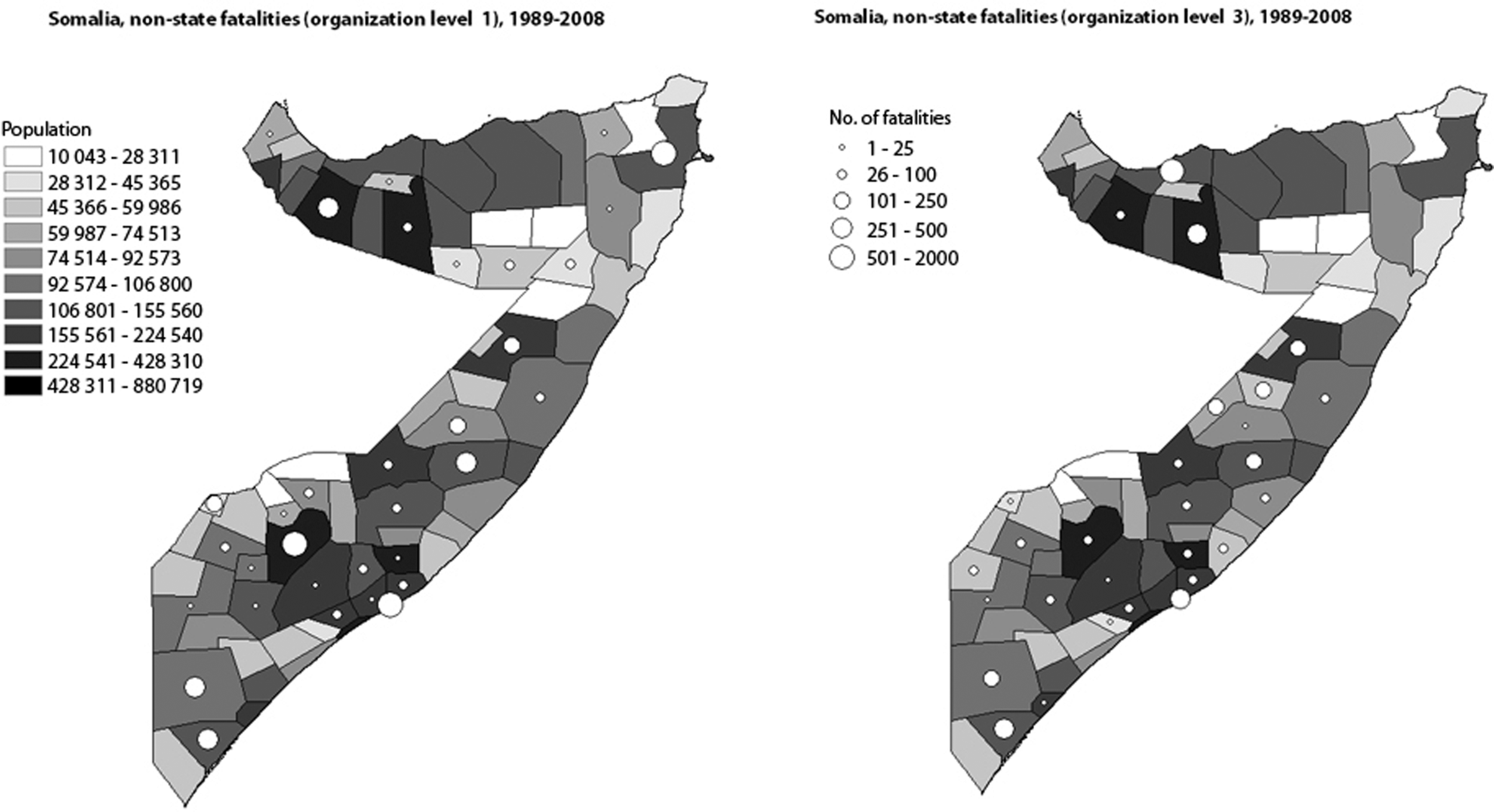
Non-state fatalities by organization level in Somalia, 1989–2008
Conclusion
The new UCDP Non-State Conflict Dataset seeks to fill a number of gaps regarding the data available for analyzing collective violence. By providing disaggregated data on all conflicts which occur between rebel groups, and between rebel groups and other organized groups (such as pro-government paramilitary groups), it complements existing civil war datasets and will hopefully encourage researchers to examine rebel-on-rebel violence as a phenomenon in its own right (cf. Fjelde & Nilsson, forthcoming). The dataset also provides data on other forms of armed violence which take place without state involvement, particularly communal conflict. Previous research has suggested that arguments about resource scarcity are particularly applicable to communal conflict (Theisen, 2008) and research based on the UCDP Non-State Conflict Dataset is underway to examine the effects of natural resources on communal conflict (Eck & Sundberg, 2011; Fjelde & von Uexküll, 2011; Melander & Sundberg, 2010; Theisen & Brandsegg, 2007). Ongoing research also uses the UCDP Non-State Conflict Dataset to examine institutional explanations for communal conflict (Eck, 2011; Kreutz & Eck, 2011). This is the first dataset to provide systematic global data on non-state conflict, and we hope that it will invigorate the study of this subject. Our hope is that this dataset will inspire researchers to study group-on-group violence, both as a phenomenon in its own right and in relation to other forms of organized violence, such as civil war.
Footnotes

Acknowledgements
We thank Peter Wallensteen for his assistance throughout the project, as well as Henrik Urdal and two anonymous reviewers for useful comments.
Funding for this project was provided by the Swedish Research Council (Grant No. 2007-2441), and the Human Security Report Project/Department for International Development, UK (DFID).
Notes
References
Supplementary Material
Please find the following supplemental material available below.
For Open Access articles published under a Creative Commons License, all supplemental material carries the same license as the article it is associated with.
For non-Open Access articles published, all supplemental material carries a non-exclusive license, and permission requests for re-use of supplemental material or any part of supplemental material shall be sent directly to the copyright owner as specified in the copyright notice associated with the article.
