




Abstract
While a number of publications show that natural resources are associated with internal armed conflict, surprisingly little research looks at how natural resources affect post-conflict peace. This article therefore investigates the relationship between natural resources and post-conflict peace by analyzing new data on natural resource conflicts. We argue that the effect of natural resources on peace depends on how a country’s natural resources can constitute a motive or opportunity for armed conflict. In particular, three mechanisms may link natural resources to conflict recurrence: disagreements over natural resource distribution may motivate rebellion; using natural resources as a funding source creates an opportunity for conflict; and natural resources may aggravate existing conflict, acting either as motivation or opportunity for rebellion, but through other mechanisms than distributional claims or funding. Our data code all internal armed conflicts between 1946 and 2006 according to the presence of these resource–conflict links. We claim such mechanisms increase the risk of conflict recurrence because access to natural resources is an especially valuable prize worth fighting for. We test our hypotheses using a piecewise exponential survival model and find that, bivariately, armed conflicts with any of these resource–conflict mechanisms are more likely to resume than non-resource conflicts. A multivariate analysis distinguishing between the three mechanisms reveals that this relationship is significant only for conflicts motivated by natural resource distribution issues. These findings are important for researchers and policymakers interested in overcoming the ‘curse’ associated with natural resources and suggest that the way forward lies in natural resource management policies carefully designed to address the specific resource–conflict links.
Keywords
Introduction
Recent peace and conflict research focuses on the role of natural resources in armed conflict. This research has shown, for example, that oil and surface diamonds increase the risk of conflict outbreak and prolong civil war (Fearon & Laitin, 2003; Lujala, Gleditsch & Gilmore, 2005; Lujala, 2010; Ross, 2004a,b). It is also argued that environmental pressure and resource scarcity escalate violence and affect both national and international security (Homer-Dixon, 1999). Le Billon & Nicholls (2007) point out that these findings suggest that attention needs to be paid to natural resources in post-conflict settlements. However, surprisingly little research examines how these linkages affect peace processes and the sustainability of peace. Only a few studies on peace failure include primary commodity dependence as a control variable (Doyle & Sambanis, 2006; Fortna, 2004; Mukherjee, 2006), but the results are inconclusive.
The policy community, on the other hand, is increasingly concerned with the role of natural resources in post-conflict societies – particularly focusing on how to manage natural resources to hinder conflict relapse and instead utilize the opportunity that natural resources represent (UNEP, 2009). This concern, however, is based on case studies and an assumption about a link between natural resources and recurrence of conflict. The question of whether there is a systematic relationship between natural resources and conflict recurrence, and if so, how natural resources affect post-conflict peace, remains unanswered. In this article we fill this gap by analyzing the relationship between natural resource conflicts and post-conflict peace duration. We hypothesize that natural resource conflicts are more difficult to end (i.e. more likely to recur) than conflicts unaffected by natural resources and test this by looking at the duration of post-conflict peace periods.
To test our hypotheses we create a new dataset on natural resource conflicts based on all internal armed conflicts occurring between 1946 and 2006 (Gleditsch et al., 2002; Harbom & Wallensteen, 2007). 1 In this dataset we code whether conflicts are clearly linked to natural resources, rather than just coding natural resource dependence or presence in the country. We acknowledge that different types of resources can serve the same purpose in a conflict, or the same type of resource can play different purposes. Thus, the conflicts in our dataset are coded according to the specific roles (if any) played by natural resources in the given conflict. We identify three different mechanisms linking natural resources to conflict: (1) disagreements over natural resource (revenue) distribution may motivate rebellion, (2) revenues from natural resources may create funding opportunities for rebels, and (3) natural resources may aggravate ongoing conflict acting either as motivation or opportunity for rebels, but through other roles than as distributional claims or as funding sources. When these mechanisms link natural resources to armed conflict we anticipate that the risk of conflict recurrence is higher than without such natural resource–conflict mechanisms. In all three situations access to natural resources constitutes a highly valuable prize worth fighting for. 2 We test our hypotheses using a piecewise exponential survival model and find that, bivariately, peace periods after armed conflicts with any of these three natural resource–conflict mechanisms tend to be shorter than peace periods after non-resource conflicts. A multivariate analysis distinguishing between the three mechanisms finds to our surprise that this relationship is only statistically significant for conflicts motivated by natural resource distribution issues. This challenges the claim made by Collier & Hoeffler (2004) and Collier, Hoeffler & Rohner (2009), that conflict is better explained by opportunity factors than by grievances, or it indicates that recurring conflicts have different dynamics.
This article is structured as follows: we first elaborate on the relationship between natural resources and post-conflict peace and derive hypotheses; second, we present the coding procedure and descriptive analyses of the natural resource conflict dataset; third, we describe the piecewise exponential survival model we use; fourth, we present our results and discuss possible reasons for the significant peace-shortening effect of the distribution mechanism; and finally, we sum up the article and conclude with the need for more analysis on natural resource management policies which can mitigate this relationship.
How natural resources can influence post-conflict peace
Why do some wars reoccur? Why do parties to internal armed conflicts decide to rearm and restart violence after a period of relative stability and peace? Previous research provides numerous explanations to why civil wars may resume: conflicts between different ethnic groups strengthen divisions and hatred and make durable peace less likely (Kaufmann, 1996); poor and underdeveloped countries are more likely to see conflict resumption because groups opposing the state have little to lose from rebellion (Collier at al., 2003; Walter, 2004); lack of democracy prevents peaceful bargaining (Mukherjee, 2006); settlements without a clear victory create incentives to continue fighting to improve one’s position (Toft, 2010); and lack of a security guarantee provokes resumption as a means to avoid marginalization by antagonistic groups (Walter, 2002).
Within this plethora of factors explaining conflict resumption one factor is missing: natural resources. This is surprising, especially given the vast literature on natural resources and outbreak of armed conflict (Collier & Hoeffler 2004; Fearon & Laitin, 2003; Lujala, 2010). There are some who examine the relationship between natural resources and conflict duration (Fearon, 2004; Lujala, 2010), but only a handful study the effect of natural resources on post-conflict peace. The few who do, investigate only how economic dependence on natural resources influences the likelihood of sustainable peace (Doyle & Sambanis, 2006; Fortna, 2004; Mukherjee, 2006). We believe natural resource wealth may have an effect on the risk of conflict resumption, but we are concerned that variables measuring only the presence of, or dependence on, natural resources do not fully capture this effect. In our dataset we therefore code conflicts where natural resources are known to have played a role. The term resource conflict (or war) has been used by several scholars (e.g. Fearon, 2004; Klare, 2001), suggesting that there is something special about the general relationship between natural resources and conflict, and stirring a suspicion that this relationship has an impact on conflict recurrence too. To properly test this assumption, we merge the three natural resource–conflict mechanisms into one natural resource conflict variable. This also gives us the opportunity to make some comparisons with the studies using primary commodity exports as a measure for natural resource wealth. We thus start by analyzing the general relationship between natural resource conflicts and peace duration using the following hypothesis:
H1: Peace is more likely to fail after natural resource conflicts compared with non-natural resource conflicts.
However, we argue that it is important to also look at the different roles that natural resources can play in conflict. In concert with Humphreys (2005) and Ross (2004b), we emphasize the need to understand the mechanisms at play in the relationship between resources and armed conflict, especially for domestic policymakers and international actors aiming at putting an end to conflict and facilitating stable peace (Humphreys, 2005: 534). Humphreys (2005: 511) distinguishes between six different mechanisms linking natural resources to armed conflict: the greedy rebels mechanism, the greedy outsiders mechanism, the grievance mechanism, the feasibility mechanism, the weak states mechanism and the sparse networks mechanism. Some of Humphreys’s mechanisms are indirect, where natural resources influence other factors known to increase the risk of conflict. The weak states mechanism, for example, explains the natural resource–conflict link through the tendency of natural resource dependent states to be poorly governed, which is known to breed conflict (Fearon & Laitin, 2003).
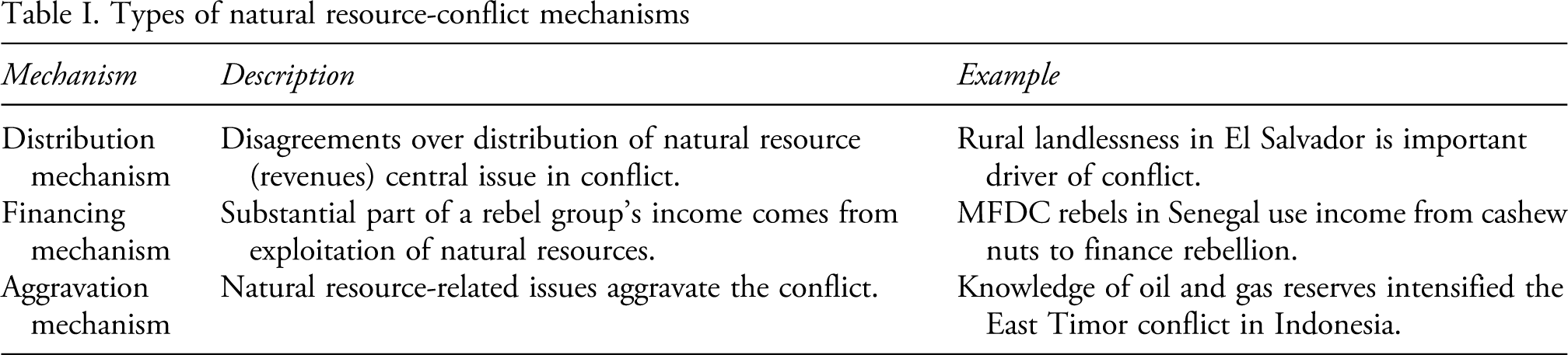
We apply a less fine-tuned – but easier to measure – classification of mechanisms linking natural resources to conflict. In particular, we distinguish between mechanisms mainly influencing the motivation to wage war and mechanisms mainly influencing the opportunity for warfare. Conflicts where a central stake is disagreement over who has ownership over and right to extract natural resources are examples of cases where natural resources constitute a conflict motive. When natural resource extraction is an important funding source for violent conflict, it is a typical example of a case where natural resources provide an opportunity for conflict. Additionally, natural resources may affect conflict in other ways than through distributional claims or as funding source by aggravating already ongoing conflicts, acting as either motivation or opportunity for rebels, such as oil pipelines in a conflict area causing pollution as well as illegal tapping and oil sales. The three natural resource–conflict mechanisms in our dataset are thus: (i) disagreements arise over distribution of natural resources or revenues (distribution mechanism); (ii) rebel groups use natural resources to finance rebellion (finance mechanism); and (iii) natural resource issues aggravate an ongoing conflict (aggravation mechanism). The same type of natural resource can play many different roles in relation to conflict, or many different types of resources can play the same role. For example, in the Niger Delta, oil resources are subject to violent disagreements over the distribution of natural resource revenues. In addition, Niger Delta rebels illegally tap oil from pipelines to finance violence, and in the Delta oil extraction leads to environmental degradation which creates grievances and fuels violence (Oyefusi, 2008). Therefore, the three types of natural resource–conflict links should not be viewed as mutually exclusive. Rather, all mechanisms can be at play in the same conflict at the same time.
Contrary to Walter (2004), who argues that underlying issues related to previous conflicts are not sufficient explanations for conflict relapse, we suggest that such factors influence the risk that ex-combatants restart war. We assume that the role natural resources have played in previous conflicts does not disappear when conflict ends, 3 and further argue that the invaluable prize of access to natural resources can create both motive and opportunity for actors to resume conflict. Below we elaborate more on the three mechanisms linking natural resources to conflict and how these relationships may influence post-conflict peace failure.
Conflicts over distribution of natural resources
The distribution of natural resources and natural resource revenues may spur conflict. The relationship between natural resources and conflict in these cases can best be explained within a motivation framework. Rebel groups fight the government because of (perceived) unfair access to natural resources, unsatisfactory distribution of benefits from natural resources, and lack of control over such resources. Their aim is to improve the distribution of natural resources, in terms of revenues, control, and access. From a government perspective, the motivation to use violence is to avoid losing control over valuable natural resources. Armed conflicts characterized by natural resource distribution mechanisms include both high-value natural resource conflicts (such as oil in the Niger Delta in Nigeria) and conflicts over land ownership (such as the civil war motivated by rural landlessness in El Salvador). Many rebel groups, such as the insurgents in Nepal, justify their fighting and attract supporters by highlighting unfair distribution of natural resource revenues and ownership as a cause of violence and promise, for example, land reform if they get into power (Murshed & Gates, 2006).
Conflicts with distribution mechanisms often include an element of horizontal inequality, that is, where some groups (ethnic, religious, geographical, etc.) think that others are receiving more than they are, or groups in natural resource-rich areas expect to get a bigger share of the resource revenues than they realistically can get (Østby, Nordås & Rød, 2009). Although Walter (2004) claims that the motive behind a civil war is of little importance when it comes to explaining recurring conflict, she has earlier (Walter, 1999: 129) argued that conflicts over land disputes are particularly difficult to solve and should possibly not be included in peace agreements. Webersik & Levy (forthcoming), on the other hand, argue that by not dealing with natural resource-related issues in the aftermath of conflict, the risk of renewed conflict increases. If these types of issues are not included in peace processes, Webersik & Levy (forthcoming) fear groups might actually be worse off than they were before the original war, hence more grievances and possibly more conflict. In the north-eastern parts of India, for example, we see several conflicts linked to landlessness and land distribution. By not dealing with problems of migration and property rights these issues remain unresolved (Homer-Dixon, 1999), which is the case in both Assam and Tripura in north-eastern India where conflicts consequently have been on and off for many years.
Recurrence of conflict depends, among other things, on the ability of rebel groups to recruit new members (Walter, 2004). In line with Webersik & Levy’s (forthcoming) fears, Walter (2004) argues that rebel recruitment is easier if hardships have not improved since the war. By not addressing the motivation of conflict, such as land disputes and disagreements over natural resource revenue distribution, grievances and hardships will not improve and conflict may relapse. Unfortunately, conflicts with resource distribution mechanisms are challenging to solve. When two groups fight over the same natural resource, the conflict is often perceived as a zero-sum game. Yielding is thus seldom an option, as giving in would imply that either the rebel group does not get access to claimed natural resources or that the government loses control over precious natural resources. Fearon (2004) finds something similar, as ‘sons of the soil’ conflicts last longer than other types of conflict. In other words, distribution of natural resource (revenues) constitutes a particularly sticky motivation for internal armed conflict, and when conflicts surround such issues durable peace is less likely. From this we derive the following hypothesis:
H2: Peace is more likely to fail after conflicts with natural resource distribution mechanisms compared with conflicts without such mechanisms.
Conflicts financed by natural resources
Our second category of natural resource–conflict mechanisms includes conflicts where natural resources financed the conflicts. This can typically be diamonds or other high-value natural resources; however, our data also cover examples where agricultural products or resources financed the rebellion. For example, the MFDC rebels in Casamance in Senegal used cashew nuts to finance their uprising (IRIN News, 2003). Timber export in Burma (Ross, 2003: 49) and illegally levying logging taxes in the Philippines (Jarvie et al., 2003: 153) have also been used by rebels to generate income. ‘Blood diamonds’ are, however, a more known source of financing, especially with respect to the civil wars in Angola, Liberia, and Sierra Leone (Le Billon, 2001, 2005). Natural resources provide financial power to wage violent conflict, both for rebels and governments (Ross, 2003: 58). In this article we only analyze conflicts where the opposition group used resources to finance rebellion. We assume that natural resource revenues are part of the national economy, for example through taxes and state ownership, therefore by default, these governments use natural resource revenues to finance the army and their counter-insurgency strategies.
Most armed conflicts take place in poor countries; access to natural resource revenue thus constitutes a significant economic asset for rebels. Letting go of such benefits does not come easy; therefore conflicts financed by natural resources may be more likely to resume than others. Stedman (1997) argues that natural resources are an incentive for spoilers to derail the peace process if the payoff is better in wartime than in peace. When Savimbi lost the 1992 election in Angola, UNITA’s control of diamond mines enabled Savimbi and UNITA to continue the civil war. It is less likely that Savimbi would have ruined the peace process the way he did without such a lucrative war-funding source (Stedman, 1997: 40).
Collier, Hoeffler & Rohner (2009) claim that opportunity to fight is central when understanding the outbreak of intrastate war. Where conflict is feasible, for example through rebel opportunity for natural resource predation, conflict will occur. Applying this logic to risk of conflict recurrence, it is plausible to assume that rebels with previous natural resource-funding opportunities are more likely to restart conflict. This opportunity can be curtailed through strategies such as the Kimberley process certification scheme, guaranteeing ‘conflict-free’ diamonds (Grant, 2012). However, as long as the infrastructure, know-how, and ability to use resources to finance conflict are still present in post-conflict societies – that is, as long as it is still feasible to fight – it is likely that rebels resume conflict. Based on this we suggest the third hypothesis:
H3: Peace is more likely to fail after conflicts with natural resource financing mechanisms compared with conflicts without such mechanisms.
Conflicts aggravated by natural resources
The last category of natural resource–conflict mechanisms includes conflicts where natural resources were less directly involved, but still aggravated the course of the conflicts by adding fuel to an already troublesome situation. The aggravation mechanism contains various roles played by natural resources in conflict, but these roles clearly differ from those defined as distribution or financing mechanisms. Proximity to (potential and real) pipelines, knowledge of natural resource reserves and environmental degradation are examples of situations which can induce or aggravate armed conflict. Several conflicts in the Caucasus have such indirect links to natural resources. For example, the potential of future oil revenues and locations of oil pipelines influenced both the South Ossetia and Abkhazia conflicts in Georgia. Klare (2001: 102) argues that ‘Russia’s determination to control Chechnya and suppress rebel groups in the region is motivated, at least partly, by desire to protect these vital pipeline routes’. Additionally, the Tuareg rebellion in Mali can partly be explained by deterioration in living conditions because of desertification and droughts (Benjaminsen, 2008), while in Nicaragua, the Contras rebels recruited many thousands of peasants disaffected by the government’s agrarian reform (UCDP database, 2010a). Oil and gas reserves are also viewed to have impacted the armed conflict between Fretilin and the Indonesian government (UCDP database, 2010b), the various insurgencies in Chad (Le Billon, 2001; Gould & Winters, 2012) and the Ogaden uprising in Ethiopia (Library of Congress, 1991).
Types of natural resource-conflict mechanisms
H4: Peace is more likely to fail after conflicts with natural resource aggravation mechanisms compared with conflicts without such mechanisms.
Table I summarizes the three types of mechanisms linking natural resources to conflict.
The natural resource conflict dataset
To test the relationships between natural resource–conflict mechanisms and post-conflict peace duration we create a new dataset on natural resource conflicts based on the UCDP/PRIO Armed Conflict Dataset version 4-2007 (Gleditsch et al., 2002; Harbom & Wallensteen, 2007). The UCDP/PRIO dataset defines an armed conflict as ‘a contested incompatibility that concerns government or territory or both, where the use of armed force between two parties results in at least 25 battle-related deaths in a year’ (Harbom & Wallensteen, 2007: 632). 4 We use the episode start and episode end date variables in the UCDP/PRIO dataset to define the conflict episodes that constitute the observations in the natural resource conflict dataset. Unfortunately, in low-intensity conflicts the number of battle-related deaths may fall below the 25 battle death threshold for some years, even though the conflict has not really ended. To account for this we apply Gates & Strand’s (2004) coding rule, merging two accompanying conflict episodes together into one single episode if the peace period between them is less than two years. 5 For example, the conflict between the Angolan government and the FLEC rebels in Cabinda originally has five separate conflict episodes, but with the above coding rule the conflict is represented in the dataset with three conflict episodes. 6
With these modifications, the natural resource conflicts dataset totals 285 conflict episodes (167 conflicts) in 101 countries between 1946 and 2006. In the following sections we describe the coding criteria and data collection and provide some descriptive analyses of the data.
Natural resource conflicts: Coding criteria and descriptions
For all internal armed conflicts between 1946 and 2006 in the natural resource conflict dataset, we code which (if any) natural resource–conflict mechanisms are at play. For a conflict episode to be coded as a natural resource conflict in our dataset, three general criteria must be met. First, we only report a natural resource conflict when the sources specifically mention the name of the rebel group or some other information that ensures us that the natural resource information relates to the specific conflict episode in question. In this way we are able to distinguish a resource conflict from a non-resource conflict going on in the same country at the same time. Second, we include all types of natural resources: land, water, agricultural products, oil, gas, diamonds and other gems, minerals, narcotics, and timber. Third, the sources must specifically describe the natural resource–conflict mechanisms. Moreover, we code all subsequent conflict episodes the same way as the previous episode. For example, we know that the 1989–95 civil war in Liberia was financed by illegal timber trading and diamond smuggling (Altman, Nichols & Woods, 2012), and we assume this had spillover effects on the 2000–03 war as well. However, we do not know if natural resources played a similar role in the 1980 coup d’état in Monrovia. 7
When coding conflicts with natural resource distribution mechanisms we consider two types of distributional issues: distribution of the natural resource itself such as land, water or agricultural products, and conflicts over the distribution of natural resource revenues. However, internal armed conflicts which are mainly ideological or religious, with natural resource distribution claims as side issues, are not included among the cases with distribution mechanisms. 8
When we code conflicts with financing mechanisms we include only cases where natural resources provided income for the opposition side. We assume that natural resources by default finance governments through taxes and state ownership in the same way as other types of income from, for example, tourism and industry; hence we do not expect that natural resource revenues would have a different effect on state-sponsored violence than other types of income. 9 Further, as mentioned above, all types of natural resources may finance rebel groups, including illegal commodities such as drugs; hence we also code conflicts as having financing mechanisms if the rebel groups raise funds from trading illegal commodities.
The third category of natural resource–conflict mechanisms, the aggravation mechanism, represents natural resource–conflict links where resources clearly are important, but neither as a distribution claim nor as a funding source. We coded conflicts to have aggravation mechanisms when our sources described natural resource-related links such as existing or planned oil pipelines increasing the stake of conflict, grievances caused by extraction of natural resources, or political turmoil over natural resource control.
One conflict episode can be characterized by several natural resource–conflict mechanisms; hence the three categories are not mutually exclusive. There are 18 conflict episodes with more than one mechanism. All natural resource–conflict mechanism variables are dichotomous variables, with the value 1 if the mechanism is present and 0 if not. Based on the above coding criteria the dataset includes 117 episodes of natural resource conflicts, while 168 episodes were not affected by natural resources in any substantial way. Of the 117 resource conflict episodes there were 43 with a distribution mechanism, 38 with a financing mechanism, and 55 with an aggravation mechanism.
Below we explore the distribution of natural resource conflicts across time and space. Figures 1a–d show the total number (left-hand side of the graphs) of all ongoing internal conflicts in the world for each year between 1946 and 2006. The lines indicate the percentage (right-hand side of the graphs) of these conflicts that were resource-related.
Figure 1a shows the trend for the general natural resource conflict variable (i.e. including all natural resource–conflict mechanisms). The highest share of natural resource conflicts is 71.5% (1955), while the lowest is 37.5% (1964). After 1970 the share varies between 43% and 66%. The number of natural resource conflicts follows the same trend as internal conflicts in general with an increase in the mid-1970s, reaching a peak in the mid-1990s and then decreasing again. There seems to be a downward trend starting in the mid-1990s, and the relative number of natural resource conflicts drops below 50% in the 2000s. It is, however, too early to tell whether this represents a stable trend of fewer resource conflicts.
Figures 1b–d disclose quite different time trends for the three mechanisms linking natural resources to internal armed conflict. Whereas there is a steady increase in the relative number of conflicts with natural resource-distribution mechanisms, there is a downward trend in the fraction of conflicts with financing mechanisms. This may indicate that natural resources did not become as important as a funding source after the end of the Cold War, as some observers claim (Ross, 2004a). The percentage of conflicts where natural resources have a more indirect impact, via an aggravation mechanism, has been fairly stable since the 1970s, after a steady increase the first 30 years after World War II.
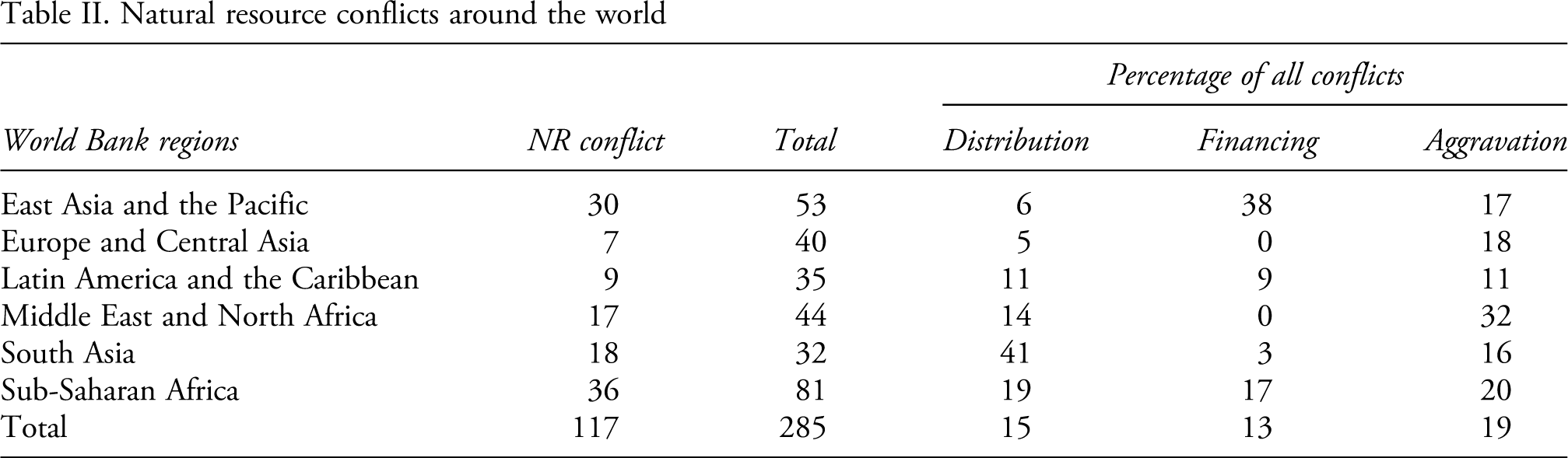
The number of natural resource-related internal armed conflicts also differs across world regions (see Table II). Close to 30% of all conflict episodes are in sub-Saharan Africa (81 of 285) and 44% of those are Number of ongoing internal armed conflicts and share of resource conflicts, 1946–2006
Resource distribution claims are most common in South Asia, influencing 13 of 32 conflict episodes. Using natural resources as a funding source is most common in East Asia and the Pacific, as 38% of the conflict episodes have this resource–conflict link. However, this is driven by the many timber and gem- financed armed conflicts in Burma. Excluding Burma, the financing mechanism linking natural resources to conflict occurs most often in sub-Saharan Africa, where 17% of the conflict episodes are based on resource-related income. Surprisingly, neither Europe and Central Asia nor the Middle East and North Africa have any conflicts with financing mechanisms. In the Middle East and North Africa, on the other hand, a large share of the conflict episodes experience natural resources aggravating conflict in some way other than through a distribution or financing mechanism.
In the next sections we investigate the relationship between natural resources and risk of post-conflict peace failure using these data.
Analyses of natural resource conflicts and post-conflict peace
Natural resource conflicts around the world
To investigate post-conflict peace duration, two conflict-related variables were added to the dataset: a duration variable measuring the length of the post-conflict peace period and a censoring variable recording whether the conflict resumed (peace failure) or not. Peace duration is measured in days starting from the first day of peace to the first day when the conflict again crosses the 25 battle-related death threshold. Peace periods that did not fail (no resumed conflict) before the last day of observation in the dataset are right-censored.
We also include control variables that reflect conditions expected to influence the sustainability of peace in post-conflict societies and that could also affect the role of natural resources. We include conflict-specific, country-specific, and international context control variables. 10 The conflict-specific variables include conflict duration and type of conflict termination. Conflict duration is calculated based on start and end dates in the UCDP/PRIO dataset. 11 We use the outcome variable from the UCDP Conflict Termination Dataset version 2.0 (Kreutz, 2010) to construct a dummy variable with the value 1 if the conflict ended in military victory and 0 if not, and a similar variable for conflicts terminated by peace agreements. For country-specific variables we include GDP per capita from Penn World Tables (Heston, Summers & Aten, 2006), supplemented by Gleditsch (2002), population data from the same source, and ethnic fractionalization (Wimmer, Cederman & Min, 2009). 12 We also include a dummy variable recording whether there are other conflicts in the country in a given year. Among the international context control variables we include a variable taking the value 1 if there were any United Nations peacekeeping operations related to the conflict, 13 and a dummy variable recording whether the conflict was an internationalized internal armed conflict (Gleditsch et al., 2002). All country-specific control variables are time-varying and the three variables conflict duration, GDP per capita, and population are transformed using the natural logarithms. Owing to the temporal domain of some of the control variables, the time period analyzed is 1950–2004. 14
Findings and discussion
Piecewise exponential analyses of natural resource conflicts and peace duration, 1950–2004
Time ratios reported; standard errors in parentheses. ***p < 0.01, **p < 0.05, *p < 0.1. A time ratio larger than 1 indicates longer peace duration, while a time ratio smaller than 1 indicates shorter peace duration.
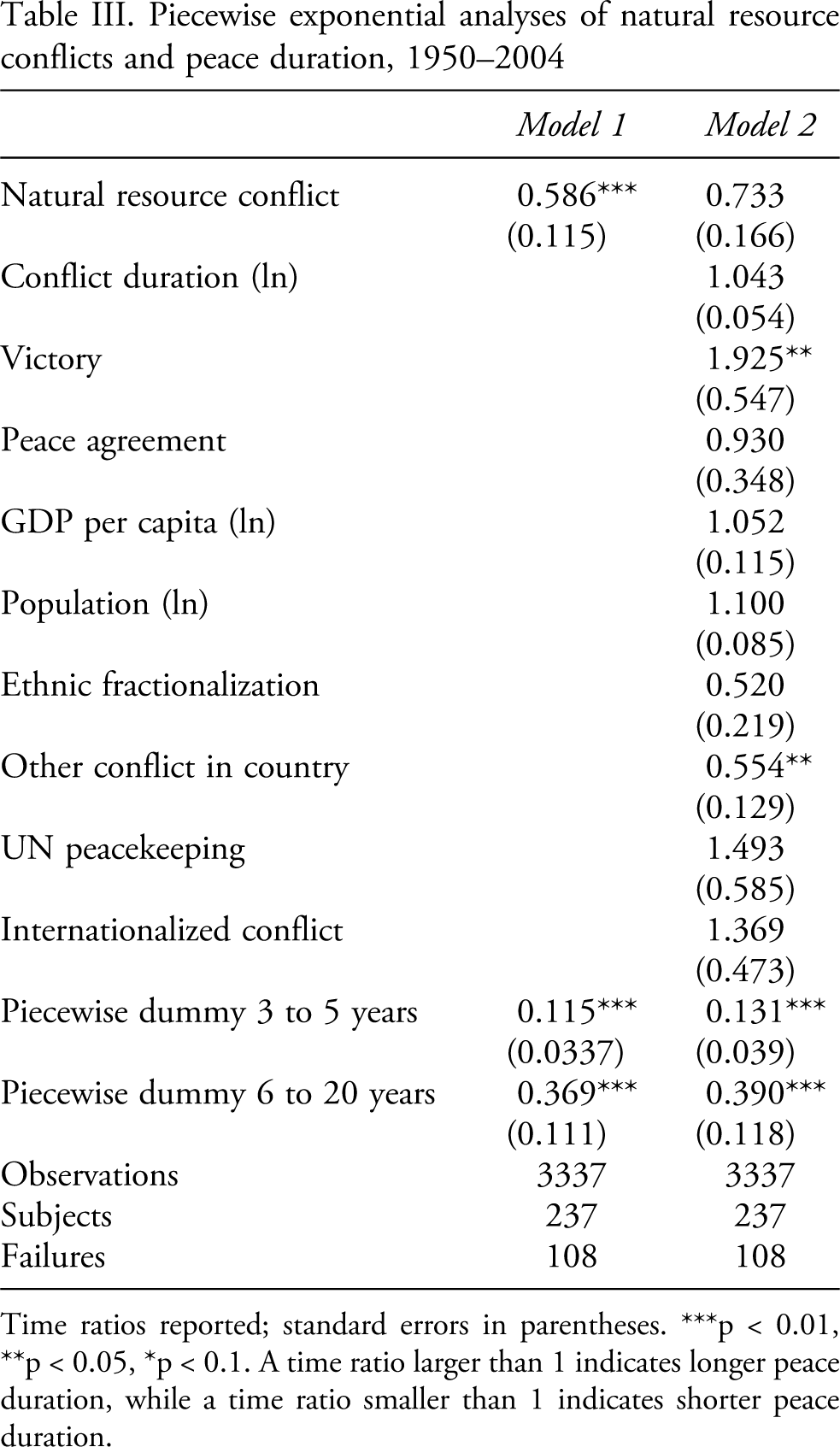
In this article the tables report the expected time ratio of a peace period; time ratios larger than 1 mean longer peace periods, while time ratios smaller than 1 mean shorter peace periods. Model 1, analyzing the bivariate relationship between all natural resource conflicts and peace duration, shows that peace periods after natural resource conflicts are 41.4% shorter than peace periods after non-natural resource conflicts. 15 This means that if a peace period after a non-natural resource conflict is expected to be 4 years, then the peace period after a natural resource conflict is expected to be less than 2.5 years. In other words, it seems that conflicts related to natural resources almost halve the duration of post-conflict peace. In Model 2 we run the analysis with a set of control variables that should be relevant for keeping post-conflict peace. Here, natural resource conflict has no significant effect, but the time ratio still indicates shorter peace periods after natural resource conflicts. The results in Table III hence lend weak support to Hypothesis 1 but are in line with the assumption in previous literature (Doyle & Sambanis, 2006; Fortna, 2004). From Model 2 we also see that two of the strongest factors influencing post-conflict peace are conflict termination by military victory which decreases the likelihood of peace failure and other conflicts in the country which increases the likelihood of peace failure. The other control variables are not significant.
The results in Table III might not be surprising, as we have already discussed how the different roles that natural resources can play in a conflict might affect post-conflict peace differently (see Hypotheses 2–4). To further explore these hypotheses, we investigate the three mechanisms linking natural resources to conflict: the distribution mechanism, the financing mechanism, and the aggravation mechanism. The Kaplan-Meier survival estimate plots in Figure 2a–c show the percentage of post-conflict peace periods that have survived (no peace failure) at least until the time shown on the X axis, with one figure for each mechanism. The dotted line in each plot represents the specific natural resource–conflict mechanism, while the solid lines include all non-natural resource conflicts and the two other natural resource–conflict mechanisms.
Owing to our coding criteria, no conflicts can recur before at least two post-conflict years have passed. After two years the survival rate is lower for societies emerging from conflicts with distribution mechanisms compared to societies recovering from conflicts without such mechanisms, that is, conflicts over natural resource distribution resume faster. For conflicts with financing mechanisms, the survival rate is initially not different from conflicts not financed by natural resources, but after three years the survival rate for conflicts with financing mechanisms is lower than for other types of conflicts and remains lower until the lines cross each other 18 years after the end of conflict. Eight years after conflict termination, approximately 50% of all conflicts with natural resource financing mechanisms have resumed, but it takes 18 more years Kaplan-Meier survival rates for types of natural resource conflicts, 1946–2006.
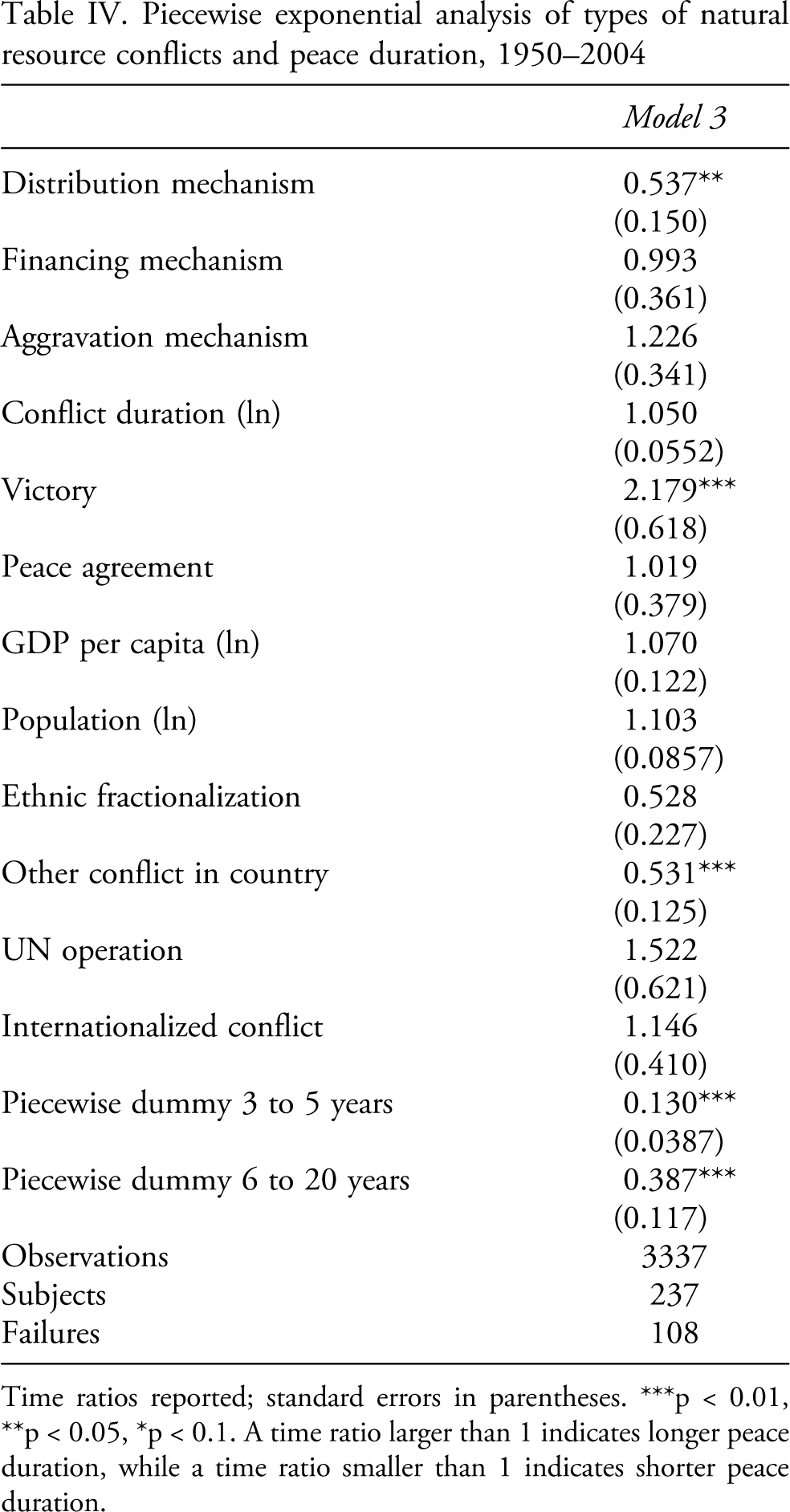
The Kaplan-Meier plots only show bivariate relations between the three types of natural resource–conflict mechanisms and peace duration; thus in Table IV we present findings from a piecewise exponential survival analysis which includes control variables. 17
Piecewise exponential analysis of types of natural resource conflicts and peace duration, 1950–2004
Time ratios reported; standard errors in parentheses. ***p < 0.01, **p < 0.05, *p < 0.1. A time ratio larger than 1 indicates longer peace duration, while a time ratio smaller than 1 indicates shorter peace duration.
The results in Table IV support Hypothesis 2 that conflicts with natural resource (revenues) distribution mechanisms are more likely to resume than conflicts without distribution mechanisms. However, Hypotheses 3 and 4 are refuted. This finding weakens the claim that conflicts occur where feasible (Collier, Hoeffler & Rohner, 2009). Having an opportunity to fight using resources available for financing conflict does not increase the risk that post-conflict peace breaks down. However, if a conflict is driven by a natural resource motive such as claims about unfair distribution of natural resource revenues, it is more likely to resume than if not. What could explain this? Above we argue that disagreement over natural resource distribution is a particularly sticky motivation for violent conflict. Such issues are similar to ‘sons of the soil’ issues (Fearon, 2004), where one (ethnic) group claims ownership of a certain territory (soil). Such claims are justified as legitimate and are thus difficult to withdraw from. Additionally, in poor countries – as countries with conflict often are – access to natural resources may be considered crucial for survival. For these reasons it is not too surprising that conflicts with natural resource distribution mechanisms are more likely to resume than armed conflicts without such motives.
It is more puzzling that armed conflicts financed by natural resources are not significantly more likely to resume. However, from Figure 2b it seems that such conflicts have lower survival rates than armed conflicts without financing mechanisms, at least between three and 18 years after conflict termination. 19 One explanation of these insignificant results could be that motivation is more important than opportunity for sustaining violent conflict. Perhaps war-weariness is more likely when rebel groups lack a strong motive to use violence and therefore are less likely to restart armed conflict. Another potential reason is the use of economic sanctions to diminish rebels’ access to natural resources. At this stage we are not able to test this statistically, but Le Billon & Nicholls (2007), who examine 26 armed conflicts between 1989 and 2006, find that economic sanctions correlate with durable peace.
Hypothesis 4 concerns conflicts with aggravation mechanisms and is not supported in any analyses. This category of natural resource–conflict mechanisms includes a variety of case-specific relationships; it may therefore be less astonishing that these cases do not share the same risk of conflict resumption. It may also be that even if natural resources played a role in these internal armed conflicts, the role was less profound and other factors are better at explaining eventual peace failure for these conflicts. 20
Robustness checks
When conducting statistical analyses there is always a risk of model misspecification. We therefore ran a variety of alternative models and sensitivity analyses to ensure the robustness of our results. In particular, we closely examined the relationship between natural resource–conflict mechanisms, type of conflict termination, and conflict recurrence. Humphreys (2005) suggests that natural resource conflicts are often associated with military victory, since natural resources might make the relationship between the belligerents asymmetric, making victory for one side more viable. However, contrary to Humphreys’s (2005) expectations, all three natural resource–conflict mechanisms significantly reduce the likelihood that a conflict ends in military victory. None of the three resource–conflict mechanisms has a significant effect on peace agreement as the outcome of conflict. In other words, natural resource conflicts are more likely to end unresolved.
It could be more fruitful to look at the interaction effects of the natural resource–conflict mechanisms and type of termination; however, no models including such interaction terms yield any significant results.
Other variables may have an impact, too. We ran the analyses controlling for states’ resource endowment using natural resource dependence as a control variable. 21 This slightly weakened the results, and the distribution mechanism variable in Model 3 is no longer significant. The effect of natural resource dependence is also insignificant, but indicates shorter peace duration. Unfortunately, this variable has less extensive coverage and reduced the number of observations by almost a quarter. Given that we consider our natural resource–conflict mechanism variables as more relevant, we did not include natural resource dependence in the final analyses. Another common control variable is political regime. Democracy is expected to be peace-strengthening, while less democratic regimes are not as able to prevent violence (Mukherjee, 2006). However, including political regime in our analyses did not change the results substantially and did not significantly improve the model, so political regime is not included in the final analyses. 22
Additionally, we checked whether any cases were particularly influential. While there were a few outliers, these did not affect the results significantly. We also tested the proportional hazard assumption by using Schoenfeld residuals, but none of the models violated the assumption. Finally, we ran all analyses with Cox proportional hazard models, but the results did not differ. Overall, we are confident that our finding about the peace-weakening effect of natural resource distribution mechanisms in internal armed conflict is robust.
Conclusion
A number of studies have shown that natural resources affect onset, duration, and intensity of conflict; however, the relationship between natural resources and peace is comparatively less scrutinized. In this article we fill this research gap by arguing that peace is more likely to fail after conflicts related to natural resources because access to such resources is an especially valuable prize worth fighting for. When testing this relationship systematically we find that natural resource conflicts in general have a significant bivariate effect on peace duration, indicating that peace after natural resource conflicts fails faster than after other conflicts. This finding strengthens the overall assumption that natural resources can be negative for post-conflict peace, an assumption already supported by analyses using less specific data (Doyle & Sambanis, 2006; Fortna, 2004). However, this effect is no longer significant when adding control variables.
In analyses that investigate the effect of three natural resource–conflict mechanisms separately, we find that the distribution mechanism significantly shortens post-conflict peace duration. Peace periods after conflicts over natural resource distribution are about half the length of peace periods after other conflicts. To our surprise, the financing and aggravation mechanisms do not influence the risk of peace failure significantly. This finding contradicts Collier, Hoeffler & Rohner (2009), who argue that conflict will recur if it is feasible, such as when natural resources can be used as a funding source. On the other hand it does support theories which suggest that grievances provide a strong motivation to take up arms (Østby, Nordås & Rød, 2009).
It seems plausible to assume that the success of natural resource management in creating sustainable post-conflict peace depends on knowledge about the mechanisms linking resources to conflict. In particular, conflicts over resource distribution represent grave challenges for war-ridden societies seeking sustainable peace. Thus our findings are important for researchers and policymakers interested in overcoming the ‘curse’ associated with natural resources and support the emerging policy and academic work on post-conflict resource management and wealth sharing (e.g. Le Billon & Nicholls, 2007; Lujala & Rustad, 2012). Even if our findings suggest that conflicts financed by natural resources are less of a threat for peace than commonly anticipated, we do not propose that all post-conflict natural resource management efforts should focus more on redistribution policies and less on curtailing rebel access to natural resources. Rather, we call on more research to investigate if the lack of significance for the financing mechanism is explained exactly by the effectiveness of post-conflict policies aiming at limiting rebel finances.
To disclose potential solutions to natural resource conflicts, there is a pressing need to evaluate post-conflict natural resource management policies that have been used and to explore new options for successful peace-building approaches. Future research must take into consideration that various mechanisms link natural resources to armed conflicts and examine how different management policies are able to address these mechanisms.
Footnotes
Replication data

Acknowledgments
We thank the Editor and three anonymous reviewers for comments. In addition we are grateful for advice from Scott Gates, Nils Petter Gleditsch, Håvard Strand, Ingrid Samset, Hanne Fjelde, and others.
Funding
The research was supported by the Norwegian Research Council, grant no 185968.
Notes
References
Supplementary Material
Please find the following supplemental material available below.
For Open Access articles published under a Creative Commons License, all supplemental material carries the same license as the article it is associated with.
For non-Open Access articles published, all supplemental material carries a non-exclusive license, and permission requests for re-use of supplemental material or any part of supplemental material shall be sent directly to the copyright owner as specified in the copyright notice associated with the article.
