



Abstract
In 2011, the Uppsala Conflict Data Program (UCDP) recorded 37 armed conflicts with a minimum of 25 battle-related deaths. This significant increase from the 31 conflicts recorded in 2010 was primarily driven by an increase in conflicts on the African continent, and is only in part due to events tied to the Arab Spring which mostly led to other forms of violence than conventional armed conflict. The number of active conflicts still remains at a relatively low level compared to the peak years in the early 1990s, when more than 50 conflicts were active. The number of wars – conflicts leading to 1,000 or more battle-related deaths – increased to six; however, it is a considerably lower number than during the peak years of the early 1990s. For the second consecutive year, Afghanistan claimed the highest number of fatalities. Five armed conflicts listed for 2010 were not active in 2011, but during the year three new conflicts erupted – Libya, South Sudan and Sudan (Abyei) – and six conflicts already registered were restarted. Only one peace agreement was concluded during the year. Thus, the trend with low numbers of peace accords which started in 2009 continues.
Keywords
In 2011, 37 armed conflicts were active in 30 locations. 1 This constitutes a significant increase from the 31 conflicts 2 recorded for 2010 (Themnér & Wallensteen, 2011). The number of conflicts has now returned to the 2008 level. This is substantially lower than the figures from the peak years in the early 1990s, when over 50 conflicts were active. The rise in the number of conflicts in 2011 was only partly due to events connected to the Arab Spring. While two new conflicts grew out of this context (Libya and Syria) much of the violence related to the Arab Spring was of a different character than what is reported in this article. In some of the countries affected by the protests – Bahrain, Libya, Yemen and Syria – one-sided violence was recorded on the side of the government, but there was also much unorganized violence that could not be recorded. 3
Going back to the end of the Second World War, 248 conflicts have been active in 153 locations worldwide. The annual incidence of conflict and conflict dyads 4 since 1989 is recorded in Tables I and II. Figure 1 shows the trend in the number of armed conflicts since 1946. While the increase in conflicts from 2010 to 2011 is significant – in fact it is the largest increase in the number of active armed conflicts between any two years since 1990 – the pattern is one of relative stability when we consider the trend for the past five years. Hence, we do not yet know whether this year’s increase may eventually challenge the notion of a continuous general decline in minor armed conflict and war (Goldstein, 2011; Pinker, 2011).
Also the dyadic dimension of armed conflict shows a clear increase in 2011, with the number of active dyads going from 39 in 2010 to 50. In nine of the conflicts there were two active dyads and in one conflict (Sudan) there were as many as five conflict dyads, with the average number of dyads per conflict being 1.35. This figure is at the higher end for the 1946–2011 period; in only 13 previous years has a higher number been recorded. The previously observed trend of increasing fragmentation of conflicts thus seems to have returned (Harbom, Melander & Wallensteen, 2008).
In 2011, 36 of the 37 active armed conflicts were fought within states. Of these, nine were internationalized, meaning that they saw international involvement with troop support to one or both sides of the warring parties. These conflicts included Afghanistan, Algeria, Iraq, Mauretania, Rwanda, Somalia, Uganda, USA and Yemen. 5 At nine, the number of internationalized conflicts remains at the same high level as in 2010.
After two years with no conflicts between states, 2011 saw one interstate conflict: Cambodia–Thailand (common border). The two countries have a long history of disagreements over their common border, and the conflict dates back to 1954 when both countries claimed sovereignty over the temple of Preah Vihear. The fighting escalated in 1977–78 with clashes at several different locations along the border. While the armed action decreased and eventually ceased, the dispute remained unsolved and caused new tensions in 2008 and 2009. During the first half of 2011 fighting erupted once more, notably in the vicinity of the Preah Vihear temple, and the conflict became active for the first time in 32 years. Even though talks were held involving the ASEAN (Association of Southeast Asian Nations), the conflict spread to the Surin province in late April and as of late 2011 the conflict remained unsolved.
Six conflicts reached the intensity of war, up by two from 2010. Despite this increase, at six, the number of wars remains relatively low seen over the entire post-1946 period (Gleditsch et al., 2002). Compared to the peak year 1988, it is down by as much as 60%. The conflict with by far the highest number of fatalities was in Afghanistan, followed by Pakistan, Libya, Somalia, Sudan and Yemen. The conflict in Afghanistan escalated for the third consecutive year, causing over 7,000 deaths in 2011. 6 With the NATO-led forces starting to hand over control of domestic security to Afghan government forces, the insurgents stepped up suicide attacks and other bombings in an obvious attempt to undermine the confidence in the government’s ability to provide security. Rumors of secret talks between the parties flourished during the year, but no formal negotiations were held. However, in late December the government agreed to setting up a political office for the Taliban in Qatar.
Two conflicts that were recorded as minor armed conflicts in 2010 escalated to the intensity of war in 2011 (Sudan and Yemen), whereas one of the conflicts (Iraq) recorded as a war in 2010 de-escalated in 2011, and was coded as a minor armed conflict. These three protracted conflicts require closer attention.
Armed conflicts and conflict locations, 1989—2011

a Conflicts recorded as war sometime in the 1989-2011 period are included in the totals as wars.
Armed conflicts by region, 1989–2011 a

a For data back to 1946, see http://www.pcr.uu.se/research/ucdp/datasets/ucdp_prio_armed_conflict_dataset/> or http://www.prio.no/cscw/ArmedConflict.
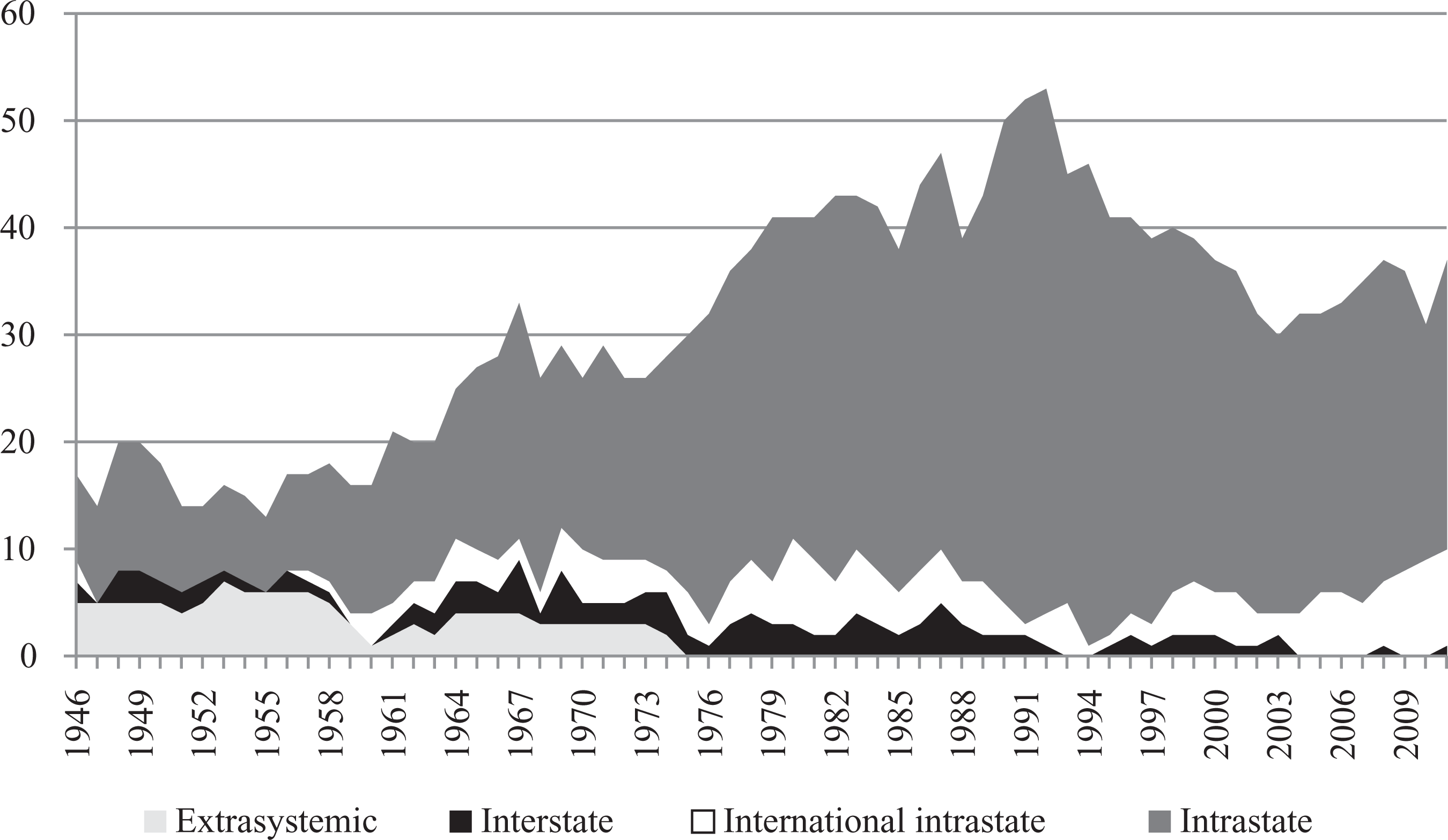
Number of armed conflict by type, 1946-2011
In Yemen, in parallel with the events of the Arab Spring which eventually brought an end to President Saleh’s rule, the conflict between the government and AQAP (Al-Qaeda in the Arabian Peninsula) escalated dramatically. In late March, AQAP seized control of the town of Jaar in the southern Abyan governorate, imposing sharia law. Two months later, the group also seized control of the important port city of Zinjibar. The Yemeni army was supported by both local tribes and the USA, which carried out a number of drone attacks against AQAP members. Eventually the government gained the upper hand. However, the fighting continued throughout the year and violent clashes, particularly in and around Zinjibar, caused the displacement of tens of thousands of people.
In 2011, the level of violence in Iraq, while still high, decreased and the conflict fell below the 1,000 battle-related deaths threshold for the first time since the 2003 US invasion. Despite some major setbacks for the largest armed opposition group, ISI (Islamic State of Iraq), it continued to carry out both suicide attacks and car bombings, and as in 2010 the group targeted Sahwa members (Awakening councils), Sunni tribal militias that have sided with the US forces since late 2006. Furthermore, the number of targeted assassinations of politicians and high-ranking military officers increased drastically. In December 2011 the USA withdrew its last troops from Iraq.
Three new armed conflicts erupted in 2011: Libya, South Sudan and Sudan (Abyei). One of these – the conflict over governmental power in Libya - reached the intensity level of war in 2011. Tied closely to the events of the Arab Spring, the conflict in Libya grew out of demonstrations calling for a better quality of life and a higher level of political participation. The regime of Muammar Gaddafi responded to these protests with brute force. As the situation deteriorated a rebel organization materialized. Operating from Benghazi, the group in late February began referring to itself as the National Transitional Council (NTC) with the explicit intention of removing Gaddafi from power. Facing a possible assault from loyalists, the rebels were aided by the enforcement of a no-fly zone by a coalition of states under the leadership of NATO. This was carried out under a UN mandate, stipulated in resolution 1973. 9 By August the NTC gained the upper hand and by the end of the month Tripoli was under rebel control. However, the fighting persisted as Gadaffi loyalists continued to resist and Gadaffi himself remained at large. On 20 October the last town held by the Gadaffi forces was seized, and Gaddafi was killed, bringing a definite end to a regime that had been in place for over 40 years.
Already at its creation, South Sudan was involved in an intrastate conflict, when the new regime in Juba was challenged by the two rebel groups SSDM/A (South Sudan Democratic Movement/Army) and SSLM/A (South Sudan Liberation Movement/Army). These groups had also fought the authorities in South Sudan prior to the country’s independence, but since Southern Sudan at that time was part of the larger Sudan, and the regional government part of the government of national unity, this was until 9 July recorded as being part of the intrastate conflict in Sudan. 10 After independence the two rebel organizations continued to demand the resignation of the government, citing widespread corruption and rigging of elections. A new round of fighting erupted roughly a month after independence and continued through the rest of the year, mainly in Unity (with SSLM/A) and Jonglei (with SSDM/A) states.
Aside from the breaking away of South Sudan and an escalating intrastate conflict over government, 2011 also saw the eruption of a new, territorial conflict in Sudan, fought over the territory Abyei. Abyei is a heavily contested area located in the borderland between Sudan and South Sudan. The Comprehensive Peace Agreement from 2005 stipulated referenda in South Sudan and in Abyei. The referendum in South Sudan was on whether or not to opt for independence, while the one in Abyei – which has been delayed indefinitely – was supposed to decide if the area should be part of Sudan or South Sudan. The Abyei question was not resolved through negotiations, and in the run-up to independence, both Sudan and South Sudan claimed the territory. In May 2011 Sudan invaded the area and President Omar el-Bashir stated that Abyei belonged to the North. The ensuing fighting reportedly killed more than 100 people. In June an agreement was signed, under which Abyei was to be turned into a non-militarized zone with the deployment of a United Nations Interim Security Force for Abyei (UNISFA). However, the accord was not fully implemented and by the end of 2011 the Sudanese Armed Forces were still in control of Abyei.
Two previously registered conflicts were re-started by new actors in 2011: Ivory Coast and Syria. The eruption of the conflict in Ivory Coast in the early 2000s followed an economic downturn and subsequent discrimination against the country’s Muslim and immigrant population. The three rebel groups emerging in late 2002 sought to improve the situation of these population groups and to topple the government of President Laurent Gbagbo. In late 2004, fighting ceased, but a halting peace process dragged on for several years after the end of the armed conflict. In 2010 presidential elections were finally held, after having been postponed several times. Northerner Alassane Ouattara received 54% of the vote and was declared the winner by the Independent Electoral Commission. The Constitutional Council (consisting of Gbagbo supporters) subsequently overruled the result by invalidating votes originating from the northern regions, instead proclaiming Gbagbo the winner, an action that was quickly condemned by the international community. Several months of electoral difficulties, interferences and alleged tampering unleashed a wave of violence and the rebel group active in the earlier phase of the conflict – which retained control over northern Ivory Coast – began marching south. 11 Furthermore, a new group, FDSI-CI (Forces de Défense et de Sécurité Impartiales de Côte d’Ivoire: also known as the ‘invisible commandos’) appeared and started to fight the government forces. Finally, in April, Gbagbo was captured and in May Outtara was installed as president, ending large-scale violence.
In Syria, as in Libya, protests related to the Arab Spring eventually also grew into an armed struggle when they were met by harsh repression by the Bashar al-Assad regime. Being forced to kill peaceful protesters, an increasing number of soldiers defected, either leaving the country or forming smaller militias, resulting in the formation of a rebel group, Free Syrian Army (FSA), in July. The first armed fighting involving this group was reported in September and during the autumn FSA posed a considerable challenge to the government. The group applied a two-pronged strategy, both holding on to a series of strongholds and using guerilla style hit-and-run tactics. The government forces at least temporarily lost control in the northwest of the country along the Turkish border, as well as over the Homs and Hama provinces. By the end of December 2011, FSA even managed to temporarily capture some suburbs of Damascus, but was quickly forced to retreat.
Five conflicts were re-started by previously registered actors: Cambodia–Thailand (common border), 12 Myanmar (Kachin), Nigeria, Pakistan (Baluchistan) and Senegal (Casamance). Myanmar has been the scene of a number of different conflicts over the past 60 years. However, the Kachin region has (largely) been spared from organized violence following the signing of a ceasefire agreement between the government and separatist rebel group KIO (Kachin Independence Organization) in 1994. Under the accord KIO was granted formal authority over the territory they controlled and over the following near two decades KIO functioned as the local police force. KIO’s leadership participated in the National Convention to write a new constitution for the country, but just like several representatives from other ethnic groups, they aired their disappointment with the outcome of the process. After the constitution came into force, KIO refused to change its armed force into an army-controlled Border Guard Force, causing tensions to grow. Eventually the government sent forces into the KIO controlled area, causing the breakdown of the ceasefire and a return to armed conflict.
In Nigeria, the conflict between the government and Jama’atu Ahlis Sunna Lidda’awati wal-Jihad (Group Committed to Propagating the Prophet’s Teachings and Jihad; commonly called Boko Haram) erupted in 2009, but dropped below the 25 battle-related deaths threshold in 2010 after a government offensive killed the group’s leader and dispersed the fighters. However, in 2011 the conflict escalated again, as the insurgents intensified their attacks on state targets. The first half of the year saw small-scale attacks on police and other security targets, mainly in Maiduguri in northern Nigeria. Over time the group’s attacks became more sophisticated, also spreading geographically. In June, the police headquarters in Abuja was attacked in an apparent suicide bombing using a vehicle-borne improvised explosive device that represented a major leap in the group’s technological development. Similar attacks subsequently followed and these changes in tactics prompted widespread concern that the group was receiving training and support from groups such as AQIM (Al-Qaeda Organization in the Islamic Maghreb) or Somalia’s Al-Shabaab.
In 2011, the conflict between the Pakistani government and BLA resumed after one year of inactivity. Most of the attacks during the year consisted of ambushes and bomb attacks against members of the security forces. Infrastructure was also destroyed.
After seven years of low-level conflict activity, not crossing the 25 battle-related deaths threshold, the conflict over the status of the Casamance region in southern-most Senegal intensified somewhat in 2011 and was recorded as active. The conflict had begun to escalate in mid-2010 and the fighting continued into the first months of 2011, causing relatively high fatality figures. A new upsurge in December caused the 25 battle-related deaths threshold to be crossed.
Four conflicts registered for 2010 were no longer active in 2011: Chad, Peru, India (Assam) and India (Bodoland). Activity in the conflict in Chad, which has been recorded intermittently since the mid-1960s and uninterrupted since 2004, declined, dropping below the 25 battle-related deaths threshold. This was chiefly due to improved relations between the Chadian government and neighboring Sudan. Both states agreed to stop their support for rebel groups fighting in the other country. Subsequently, the rebellion against the N’Djamena regime largely petered out in 2011, while activity in Darfur declined.
After a long period of relative inactivity the Peruvian rebel group Sendero Luminoso stepped up attacks in 2007. The following three years saw continued fighting between this group and government forces. However, in 2011 armed activity declined and in December Comrade Artemio, the group’s leader, announced the end of military struggle and a willingness to negotiate a lasting peace with the government. According to him, the continued struggle for the political goals would be fought without arms.
De-escalating for the fourth consecutive year, the conflict in the northeastern Indian Assam region, fought over the status of the territory, fell below the 25 battle-related deaths threshold in 2011. The main reason for the decline in conflict activity was a succession of temporary truces, eventually resulting in the signing of a formal agreement on a suspension of operations in September. A stumbling block for negotiations had long been ULFA’s (United Liberation Front of Assam) demand that the talks should center on the core issue of sovereignty, a condition that has been rejected by the Indian government. In 2010 ULFA Chairman Arabinda Rajkhowa indicated that this demand may be dropped and, subsequently, in October 2011 the first round of official negotiations were held.
In the conflict fought over the north-eastern Indian territory referred to as Bodoland, armed action decreased in 2011. The already agreed ceasefire with NDFB (National Democratic Front of Bodoland) was extended and in August NDFB-RD (Ranjan Daimary faction) declared a unilateral truce.
In parallel to the increase in both the number of conflicts and wars, another negative development in 2011 was the fact that only one peace agreement was signed. Making this even bleaker, this accord – the Addis Ababa Agreement concluded by the Sudanese government and SPLM/A-North in June – was never implemented and fighting resumed just three days after the signing. After a high annual incidence of signed peace agreements during the 1990s and early 2000s (Harbom, Högbladh & Wallensteen, 2006), the number dropped dramatically from 10 to one between 2008 and 2009. 2010 saw a modest increase to two. At one in 2011, such a low figure has not been recorded since 1987, that is, before the end of the Cold War. 13 The post-Cold War period has been perceived as being marked by internationally driven peace processes and peace agreements (Wallensteen, 2011) – something that might now be challenged.
Footnotes
Replication data
The complete datasets (UCDP/PRIO Armed Conflict Dataset and UCDP Dyadic Dataset) updated to 2011 are found at http://www.pcr.uu.se/research/ucdp/datasets/. Older versions of the UCDP/PRIO Armed Conflict Dataset can also be found at http://www.pcr.uu.se/research/ucdp/datasets/replication_datasets/ and www.prio.no/cscw/armedconflict. The tables and figures in this article were created directly from the Excel sheet at http://www.pcr.uu.se/research/ucdp/datasets/ucdp_prio_armed_conflict_dataset/. Detailed descriptions of the individual conflictsare found at www.ucdp.uu.se/database. Replication data for this article can be found both at http://www.pcr.uu.se/research/ucdp/datasets/replication_datasets/ and  .
.
Acknowledgements
Numerous colleagues in Uppsala have contributed to the data collection, notably Marie Allansson, Christian Altpeter, Jonas Baumann, Johan Brosché, Mihai Croicu, Emma Edström, Helena Grusell, Stina Högbladh, Emma Elfversson, Kornelia Kotsinas, Joakim Kreutz, Marcus Nilsson, Johanna Ohlsson, Therése Pettersson, Daniel Simmons, Samuel Taub, Niklas Törnqvist and Nina von Uexküll.
Notes
Appendix 1. Armed conflicts active in 2011
This list includes all conflicts that exceeded the minimum threshold of 25 battle-related deaths in 2011 and fulfilled the other criteria for inclusion. The column Year shows the latest range of years in which the conflict has been active without interruption. The start year is found in parentheses in the Incompatibility column, which indicates when the armed conflict reached 25 battle-related deaths for the first time. If a conflict has been inactive for more than ten years or if there has been a complete change in the opposition side, the start year refers to the onset of the latest phase of the conflict. For more complete information on the conflict history, see (a) the list of armed conflicts 1946–2011, at http://www.pcr.uu.se/research/ucdp/datasets/ and http://www.prio.no/cscw/ArmedConflict and (b) the Uppsala Conflict Data Program’s online database at http://www.ucdp.uu.se/database. For a list of all conflicts and dyads 1946–2011, see http://www.pcr.uu.se/research/ucdp/datasets/. The column Intensity in 2011 displays the aggregated conflict intensity. Thus, if more than one dyad is active in the conflict, the intensity column records their aggregated intensity.
Appendix 2. Unclear cases in 2011
Cases that have been completely rejected on the grounds that they definitely do not meet the criteria of armed conflict are not included in the list below. For the conflicts listed here, the available information suggests the possibility of the cases meeting the criteria of armed conflicts, but there is insufficient information concerning at least one of the three components of the definition: (a) the number of deaths, (b) the identity or level of organization of a party, or (c) the type of incompatibility. For unclear cases for the entire 1946–2011 period, see http://www.pcr.uu.se/research/ucdp/datasets/ or www.prio.no/cwp/armedconflict The unclear aspect may concern an entire conflict (e.g. Azerbaijan) or a dyad in a conflict that is included in Appendix 1 (e.g. in the Ivorian conflict).
References
Supplementary Material
Please find the following supplemental material available below.
For Open Access articles published under a Creative Commons License, all supplemental material carries the same license as the article it is associated with.
For non-Open Access articles published, all supplemental material carries a non-exclusive license, and permission requests for re-use of supplemental material or any part of supplemental material shall be sent directly to the copyright owner as specified in the copyright notice associated with the article.
