



Abstract
While hostage-taking has been a common form of terrorism for decades, which types of governments are more prone to it remains unclear. Does democracy motivate terrorists to engage in hostage-taking acts because of how easy negotiating with a democratic government is? Or does democracy impose ‘audience costs’ on the government leaders, driving them never to negotiate with hostage-taking terrorists following the long-held principle of no negotiation? This article argues that hostage-taking terrorists are more inclined to target democratic governments because of the greater value given to human life and personal freedom in democracies. Additionally the helplessness of held hostages is more freely exposed by the media in democracies, which leads to the audience focusing on the hostages themselves rather than on the interests of the nation. This in turns compels decisionmakers to concede, especially near election time. It is only when institutional constraints on the executives are high that democratic leaders refuse to make concessions. Using data on hostage events from 1978 to 2005, this article finds strong evidence that supports this theory, showing that democracy has competing effects on hostage-taking terrorism – civil liberties and press freedom are positively associated with hostage-taking incidents, whereas executive constraints have a negative association.
Introduction
Hostage-taking is a unique form of terrorism because it involves direct negotiation between the state and hostage-takers under time pressure. It also attracts enormous attention from the public and the media because the act itself typically lasts longer than other forms of terrorism and there is a buildup leading to the outcome. However, which types of governments are more likely to be the targets of hostage-taking terrorists remains an unanswered question. Does democracy represent an incentive for hostage-taking terrorists because of the ease of negotiating with a democratic government? Or does democracy generate ‘audience costs’ (Fearon, 1994) on the government by the promise of never negotiating with hostage-taking terrorists?
In the terrorism literature, a predominant and important finding is that democracies suffer terrorist attacks the most (Eubank & Weinberg, 1994, 2001; Weinberg & Eubank, 1998; Piazza, 2008). Hostage-taking is a subset of transnational terrorism, but the reasons why democracies are plagued by transnational terrorism may not be able to explain the case of hostage-taking. Further, terrorists seize hostages for specific aims, such as ransom, safe conduct, or the release of their imprisoned compatriots, so hostage-taking terrorism usually involves bargaining between the hostage-takers and their targets, which, compared to other forms of terrorism, may attract greater public attention, may mobilize more government resources for the purpose of the bargaining process, and may lead to more such future incidents occurring if the hostage-takers should succeed in their endeavor. Therefore, distinguishing hostage-taking from other types of terrorism may uncover distinct theoretical mechanisms that condition democracy’s correlation to terrorist activities.
In this article, I argue that democracies are more likely to be targeted by hostage-taking terrorists, just as they are more likely to suffer all types of transnational terrorism, though the mechanisms differ. Democracies are more likely to be attacked by transnational terrorists because their active foreign involvement often triggers hatred and discontent abroad (Savun & Phillips, 2009), because democratic accountability may weaken the government’s ability to combat terrorism (Li, 2005), and because a high level of political competition may motivate terrorist groups to pursue political influence through violence (Chenoweth, 2010). Hostage-taking is different in that the key to the outcome hinges on the decisionmaker’s cost/benefit calculations regarding whether to compromise with hostage-takers, which are largely shaped by the domestic political environment. One feature of democracy, the respect for personal freedom and human life, leads the public to focus on the security of hostages. The media coverage of a hostage situation in democracies also magnifies and conveys the public sentiment. The decisionmaker, who cares about being re-elected, is driven to associate personal political interests with the hostages’ interests while casting aside national interests. Only when the leader’s decisionmaking power is heavily constrained can national interests be stressed. As a result, terrorists tend to undertake hostage-taking to make demands on democratic governments since their goals are more likely to be achieved, particularly when election time is near, but governments that are highly constrained are less susceptible to public pressure and thus less likely to suffer from hostage-taking terrorism.
I examine my hypotheses using a unique dataset on hostage-taking incidents from 1978 to 2005. The results show that democratic governments are more likely to be the targets of hostage-taking terrorists, although the relationship is statistically weak. By decomposing democracy, I find that hostage-taking terrorism is positively correlated to civil liberties and freedom of the press but negatively correlated to executive constraints. The timing of the next election also matters; as elections approach, hostage-taking events are more likely to occur since government executives are more sensitive to public opinion. These results are robust to the exclusion of an outlier country, an alternative measure of civil liberties, and alternative estimators.
While the findings indicate a similar correlation between democracy and hostage-taking terrorism to that between democracy and transnational terrorism, this study is significant in two respects. First, it provides a novel theoretical explanation of why hostage-taking terrorists prefer to target democratic governments, which is distinct from the existing explanations of all forms of terrorism. In particular, this study emphasizes the key role played in a hostage-taking situation by a decisionmaker who is constrained by the domestic pressure from the public and the media as well as by government bureaucracy. The theory and empirical results contrast with existing work on other forms of terrorism (Li, 2005). Second, this study then suggests policy implications that are specific to reducing hostage-taking terrorism. The results imply that, facing hostage-takers, governments may be better advised to take a firm stand to try to not only counter the belief that they tend to give in to terrorists, but also prevent the occurrence of such future events.
In the next section, I will review the literature that discusses the relationship between democracy and terrorism, and argue for the need to disaggregate hostage-taking from other types of terrorism. I will then introduce the ‘dilemma of democracy’ (Enders & Sandler, 2006; Netanyahu, 1997) which occurs not only in the general prevention of terrorism but also more ostensibly in the negotiation with hostage-taking terrorists. My arguments are also advanced in the same section. The section that follows will present the research design and data followed by the results and model checking. The final section will conclude and provide policy suggestions.
Democracy, terrorism, and hostage-taking
Whether democracy promotes or reduces terrorism is theoretically debatable. One argument posits that some inherent characteristics of democratic political systems, including political participation, rule of law, civil society, and free and fast transmission of information, can mitigate the resentment toward governments and reduce the possibility of the recruitment of extremists (Windsor, 2003; Li, 2005). In contrast, some scholars argue that democracy is not useful in reducing terrorism since terrorists’ interests are not represented through democratic politics (Gause, 2005). Still others contend that terrorism flourishes primarily in prosperous democracies because several factors exist in democratic regimes directly or indirectly resulting in grievances or the ease with which terrorists undertake their activities, such as the accessibility of victims by terrorists, civil liberties that permit the freedom of movement, freedom of and access to the media, and the free expression of dissatisfaction and disagreements (Ross, 1993).
Empirically, a majority of studies discover a positive relationship between democracy and transnational terrorism (Eubank & Weinberg, 1994, 2001; Weinberg & Eubank, 1998; Piazza, 2008), and this relationship persists even when the sample is limited to Middle Eastern countries (Piazza, 2007). 1 Given this predominant finding, 2 a new scholarly trend is to examine the disaggregated features of democracy or to explore the mechanisms through which terrorism thrives in democracies. Li (2005) shows that democracy has two competing effects; democratic participation reduces the number of transnational terrorist incidents because of the lowered grievances, but government constraints increase the number, because checks and balances often lead to political deadlock. Chenoweth (2010) argues that democratic competition induces terrorist groups to resort to violence, and the evidence indicates a positive association between political competition and terrorism. Savun & Phillips (2009) show that terrorist activities are more related to active foreign connections than to democracy.
In short, there is near consensus that democratic regimes face more terrorist threats because of a higher level of institutional constraints, because of a greater degree of political contestation, or because of their active foreign policies. These factors, however, do not necessarily lead to more incidents within a subtype of terrorism. For example, a higher level of executive constraints may weaken the state's ability to fight terrorism in general, leading to more terrorist attacks (Li, 2005), but, as I argue in the next section, it may lower the possibility that the executive arbitrarily concedes to hostage-takers, thus reducing hostage-taking terrorism. So, singling out hostage-taking incidents is vital to understanding how the effects of political institutions may differ depending on terrorism type.
Existing studies that isolate hostage-taking from other types of terrorist attacks can be classified by the research approach they utilize. Scholars in one group examine the logic of hostage-takers through psychological approaches (Wilson, 2000; Houghton, 2006). Those in a second group conduct case studies to probe into specific and famous incidents, such as the 1979 Iran hostage crisis and the 2002 Moscow theater hostage crisis (Piadyshev, 2003). Others draw upon quantitative analyses to delve into the factors affecting bargaining success in hostage seizures (Atkinson, Sandler & Tschirhart, 1987; Sandler & Scott, 1987; Gaibulloev & Sandler, 2009) or rely on game theory or time-series analyses to explore the attributes or dynamics of hostage events (Lapan & Sandler, 1988; Brandt & Sandler, 2009).
Indeed, these studies contribute greatly to the research on hostage-taking terrorism, but they focus mainly on the bargaining process or the features of hostage-takers rather than on the targets. In reality, terrorists may randomly choose the victims, but they do not target a government unintentionally (Mani, 2004). In this article, therefore, I focus on the targets of hostage-takers, asking what types of governments are more likely to be the targets of hostage-taking terrorists. I intend to discover the political factors of hostage-taking from the government’s perspective. In so doing, I hope to contribute to the development of a better understanding of hostage-taking terrorism and the provision of more effective counter-terrorism policy advice.
The dilemma of democracy in hostage-taking crises
Liberal democracies face a dilemma between the pursuit of democratic values and counter-terrorism. On the one hand, democratic governments are expected to secure the lives and property of their citizens without severely encroaching on civil liberties and personal freedom. On the other hand, political and civil freedoms and the protection of human life in liberal democracies provide a vulnerable environment for terrorists to engage in terror activities (Enders & Sandler, 2006; Netanyahu, 1997).
In a hostage-taking situation, this dilemma gets more complicated since the government directly faces a trade-off between fighting with terrorists and rescuing hostages. The decisionmakers may face pressure from various sources, including the hostages’ families, the domestic constituency, the media, the bureaucracy, and even foreign governments. They need to consider and evaluate three sets of competing interests – national interests, personal political interests, and hostages’ interests (Nacos, 1994: 136). Therefore, the dilemma of democracy is most evidently exhibited in hostage-taking terrorism.
Positive effect of democracy
Based on the above idea, I argue that democracy is more likely to induce hostage-taking terrorism for two reasons. The first and most important point hinges on the values people widely hold in liberal democracies. Human rights and personal freedom are highly respected in the democratic world (Beetham, 1999; Sen, 1999; Dahl, 2000). 3 The limit to the hostages’ personal freedom and the threat to the hostages’ lives are therefore difficult for the audience in democracies to bear. And since terrorists employ terrorism in order to influence a larger population than solely the victims (Crenshaw, 1981; Hoffman, 2006), how the mass public responds to terrorist attacks shapes the conditions on which they act. Terrorists understand that seizing hostages has greater impact on the public feeling in democracies than in authoritarian regimes and hence tend to target democratic governments.
This ‘respect for human life’ characteristic combined with another important feature of democracy – regular and effective elections – drives democratic leaders to have different considerations from authoritarian leaders. It is widely agreed that public opinion can substantially constrain or influence democratic decisionmakers in foreign policymaking or international negotiations (Putnam, 1988; Holsti, 2004), especially when the intensity of issues under negotiation is high (Trumbore, 1998). When a hostage crisis happens in democracies, the public is unlikely to accept sacrificing hostages, and therefore a rational decisionmaker who faces pressure from constituents usually sees rescuing hostages as a higher priority. In other words, democratic leaders who are concerned about their political prospects have to link their personal interests to the hostages’ interests because the latter receive more public attention.
In contrast, authoritarian leaders do not place their political survival in voters’ hands. They need a relatively smaller winning coalition to secure their leadership and hence lack a motivation to provide public goods (Bueno de Mesquita et al., 2005). Once a hostage incident occurs, an authoritarian leader will tend to consider concessions costly since capitulation may encourage more terrorist activities, which may be more problematic than the loss of hostages’ lives. Only when hostages are crucial to political survival – for example, if patrons are taken hostage – are authoritarian leaders willing to provide private goods to trade for the hostages’ lives.
Second, in democracies, the media play an important role in affecting public attitudes during hostage-taking incidents. Terrorists, to a large extent, depend on media exposure to gain access to the public agenda (Nacos, 1994; Hoffman, 2006), and they may thus strategically select a form of attack that can help attract the highest media attention. While literature on public opinion shows that public support for wars, counter-terrorism, or wartime presidents tends to be high (Holsti, 2004; Willer, 2004; Huddy et al., 2005; McFarland, 2005), particularly due to the media coverage of threatening images (Gadarian, 2010; Nacos, Bloch-Elkon & Shapiro, 2011), this effect can be counteracted by casualties (Mueller, 1973; Gartner & Segura, 1998, 2000; Karol & Miguel, 2007), which suggests that public opinion is sensitive to human costs. Building upon this literature, I argue that, although people are apt to support hawkish anti-terrorism policies, their attitudes may depend on the media focus. In a hostage situation, hostages’ lives are at risk, which not only provides news values to media but also creates a negative atmosphere among the public and within the government. The media emphasis on the victims further increases people’s sympathy for these innocents and reduces attention to government officials. The government leader recognizes that the public attitude is in favor of the hostages and of their loved ones, and thus is eager to wind up the event peacefully. In his/her calculations, resistance is more costly than capitulation, so the final decision is highly likely a concession, and national interests may be cast aside.
In fact, one of the longstanding tenets of US counter-terrorism policy is no concessions and no deals with terrorists, such as ransom payments. Making concessions or striking a deal not only creates incentives for terrorists to keep engaging in such activities but also generates moral hazards; that is, citizens may take more risks since they know the government will cover them (Pillar, 2004: 214). However, this principle is often broken by presidents because of their personal political considerations, which are influenced by the domestic pressure from the public and the media (Nacos, 1994: 123–124). In the 1985 TWA hostage crisis, for example, 153 hostages were taken captive, including 85 Americans. The first priority for the Reagan administration was to get the US hostages home, partly because the media incessantly spotlighted the predicament of the victims (Nacos, 1994; Hoffman, 2006). Compelled by the US government, Israel finally released 756 Shia prisoners, as the hijackers demanded, to free the hostages. This case highlights the importance of media and how they may affect the decisionmaking process.
A critical issue that arises concerns the ‘audience costs’ generated in democracies. 4 Based on this theory, constituents may blame government leaders who surrender to terrorists since the publicly announced policy is not to concede. A hostage-taking situation, however, differs in that citizens typically prefer to see hostages set free. They may not want a public concession to terrorists, but a peaceful outcome can mitigate their disapproval. The formal model developed by Browne & Dickson (2010) shows that leaders can more likely induce terrorists to enter secret negotiations by making a public commitment to never negotiating with terrorists because the audience costs of reneging on this promise is high. Similarly, in a hostage-taking crisis, without a certainty that terrorists can be wiped out without hurting any hostage, the government leader may choose to accept the demand, although probably fulfilling it in secret or with other cover. Terrorists are aware of the costs imposed on democratic leaders when the non-concession policy is broken and thereby prefer to target democratic governments since the leaders cannot withstand the consequence of failed bargaining.
In short, the above discussion can be summarized into three testable hypotheses:
H1: Hostage-takers are more likely to target a democratic government.
H2: A country in which people have higher respect for personal freedom and human life is more likely to become the target of hostage-takers.
H3: A country with a higher level of press freedom is more likely to become the target of hostage-takers.
Negative effect of institutional constraints
Democracy provides a favorable environment for terrorists to engage in hostage-taking activities, but some attributes of democracy may bring about a counteractive effect. A significant attribute is the constraints on the government. Li (2005) argues that institutional constraints may lead to an increase in terrorist events because of the political stalemate and the weakened counter-terrorism ability. In this article, conversely, I argue for a negative effect of executive constraints on hostage-taking, and the key is the structure of decisionmaking.
Returning to the discussion of the competing interests political leaders face during hostage-taking events, I argue that in democracies the leaders’ political interests are greatly influenced by the hostages’ interests since the public and the media pay more attention to the latter. When decisionmakers put their personal interests ahead, national interests can only be represented by the government bureaucracy. The bureaucracy is composed of government officials or technicians who are independent of political pressure, and national interests involving the interests of their branches or their expertise would be their focus. In other words, some relevant administrations such as the army or the security department may be the main voice insisting on the adherence to the non-concession policy during a hostage-taking crisis. And only in a government in which checks and balances are functioning well and the decisionmaker is horizontally accountable can the bureaucratic concerns surpass the leader’s political concerns. 5
A second reason why institutional constraints serve to prevent hostage-taking terrorism is that leaders are less able to take unilateral action given the constraints. When the chief executive’s power is less limited, the negotiation with terrorists can be informal and flexible. When the decisionmaking power is highly constrained or institutionalized, most of the governmental decisions should be made via standard operating procedures (Allison & Zelikow, 1999), which means the head of the government has to stick to formal rules and has less leeway to make an independent decision. In a hostage-taking situation, as a result, greater constraints on the executive lead to a firmer stance against terrorists, which is the long-held principle. 6
The argument that a higher level of executive constraints helps reduce hostage-taking incidents corresponds to the findings in the existing terrorism literature. Sandler, Tschirhart & Cauley (1983) show that the no-negotiation policy tends to be more effective when terrorists engage in riskier activities such as hostage-taking. Lapan & Sandler (1988) demonstrate that the no-negotiation policy is more credible when the behavior of the government is time-consistent, and this can be achieved by a formal rule that removes the discretion of government negotiators (Sandler & Enders, 2004). In other words, the more institutional constraints that are placed on the decisionmaker, the more likely that the no-negotiation or non-concession policy would be obeyed, and the less likely terrorists would resort to hostage-taking:
H4: A country in which the executive is more constrained is less likely to become the target of hostage-takers.
While the executives are simultaneously constrained by government bureaucracy, media, and public opinion, how they react to different sources of pressure may depend on the timing. As the public opinion literature suggests, wars or casualties impose high electoral costs on the executives by reducing their votes in the upcoming election (Abramson et al., 2007; Karol & Miguel, 2007). This effect may be similar or even stronger in the hostage-taking case because hostages are typically innocent citizens and a failed rescue may engender greater public discontent. This means that, as election time approaches, the leader should be prone to negotiate since the event will be more salient in the public’s mind. Terrorists, as a result, are more likely to undertake hostage-taking when election time nears, even if the institutional constraints on the executive are binding: 7
H5: A country is more likely to become the target of hostage-takers as time to the next election approaches.
In sum, democracies are more likely to be harassed by transnational terrorism because of their inherent characteristics, including their foreign involvement, checks and balances, and political competition (Li, 2005; Savun & Phillips, 2009; Chenoweth, 2010). The climate in democracies favors hostage-taking terrorists as well, but the key lies in public attitudes and how they affect decisionmakers. In democracies, the public views human life as being of great importance. Free media further display the helplessness of hostages to the public, which in turn presses government leaders not to take harsh measures, particularly when an election is close. When leaders’ decisionmaking powers are largely constrained, they are more likely to not compromise with terrorists.
Research design and data
To examine my hypotheses, I conduct a quantitative analysis of time-series cross-sectional (TSCS) data. The unit of analysis is the country-year. The data I use are from the ITERATE (International Terrorism: Attributes of Terrorist Events) database, which contains a comprehensive list of transnational terrorist incidents and is continuously updated (Mickolus et al., 2006). ITERATE includes a HOSTAGE file, which covers hostage-taking events from 1978 to 2005 and has information about the targets of demands. Because the research objective is the state, I exclude events in which the targets are unknown or are not nation states. In many cases, terrorists made demands on more than one country; those countries are all counted. In other words, the outcome variable is the number of countries that are targets in a hostage-taking incident in one year. Between 1978 and 2005, there were a total of 358 hostage-taking events in which governments were the targets. Among these cases, there existed a second target in 201 cases and a third target in 61 cases, so the sum is 620. Since I do not model event-specific but only country-specific factors, the existence of multiple targets does not bias my analysis.
Table I shows a list of the top nine countries that suffered from most hostage-taking events, all of which have received demands from hostage-takers at least 15 times. The number of events occurring in these countries accounts for more than two-thirds of the total events (241 out of 358). More than half of the hostage-taking events (205) occurred during the Cold War.
Covariates
Top nine victim countries of hostage-taking, 1978–2005

Political regime: democracy if Polity score is ≥ 6 in both years; authoritarian if Polity score is < 0 in both years; transitioned if Polity score transitioned from negative to ≥ 6.
Moreover, I argue that in democracies members of the public place high value on personal liberty and human life, forcing political leaders to put the rescue of hostages as the first priority. Thus, I employ a variable, civil liberty, to measure the importance of personal freedom and human life. The data are from the Freedom House indices, which are composed of two scores – political rights and civil liberties – and I use the latter because the point here lies in the democratic values people embrace rather than the real political rights they enjoy. Indeed, the civil liberties variable may not fully capture the concept of ‘respect for human life’ I discuss, but this index can be a good proxy for how people view and enjoy personal freedom in a society. And since deeply embedded democratic values are actually immeasurable, the Freedom House index as a widely utilized measurement is a reasonable choice here. This index ranges from 1 to 7 with 1 as the highest level of civil liberties, and I reverse the order so that a higher score represents a higher level of liberties.
I also stress the importance of mass media, which can largely affect and transmit the public sentiment. Another variable, press freedom, is therefore used. The data are gathered from the Freedom House, in which the level of press freedom in each country is categorized into free, partly free, and not free, and I numerate them to 3, 2, and 1.
To test the hypothesis that institutional constraints lead to an adherence to the non-concession policy and thus less hostage-taking incidents, the other variable I utilize is executive constraints, which is retrieved from the Polity IV dataset. In the Polity data, the executive constraints variable refers to ‘the extent of institutionalized constraints on the decisionmaking powers of chief executives’. These limitations may be imposed by any ‘accountability group’, such as political parties, independent judiciary, or powerful advisers (Marshall & Jaggers, 2007: 23), but the point is that decisionmakers are less likely to act unilaterally given these institutional constraints. This index is from 1 to 7 with 7 being the most limitations on the executive leaders.
Furthermore, the theory suggests that the executive is more likely to negotiate as election time approaches since the executive is sensitive to public opinion due to the re-election concern. I thus include a variable time to election denoting the number of years left in the executive’s current term, which is equivalent to the time to the next election. The data are taken from the Database of Political Institutions (DPI) (Beck et al., 2001).
In addition to democracy and its related components, I include a battery of control variables. The logarithm of GDP is used to test if wealthier countries are more likely to become the targets since in many hostage-taking events terrorists ask for ransom. Economic growth can measure the short-term economic performance. Data on both variables are gathered from the World Bank’s World Development Indicators (WDI) database.
Crisis is the number of involvements in foreign policy crises; US ally is whether this country has alliance ties with the USA. These two variables, particularly US ally, are too important to exclude because hostage-takers may target a government due to the resentment caused by this government’s active foreign activities. Without these variables, we cannot tell whether it is democracy per se or the foreign policy behavior democratic countries usually exhibit that actually results in a higher hostage-taking frequency. Following Savun & Phillips (2009), data on foreign crises are from the International Crisis Behavior Project Version 9.0 (Brecher & Wilkenfeld, 1997), and data on US allies are collected from the Alliance Treaty Obligations and Provisions dataset with offensive, defensive, and neutral alliances counted (Leeds et al., 2002).
Another control variable is national capabilities. A strong country may have a greater ability to fight terrorists, and hostage-taking terrorists are no exception. The data are from the National Material Capabilities Data Version 4.0 in the Correlates of War project (Singer & Small, 2010). Regime durability is the number of years since the most recent regime change, coded from the Polity data. It is an important variable in the terrorism literature because of the finding that a stable regime is less susceptible to terrorist attacks (Eyerman, 1998; Li, 2005).
The next two variables are the logarithm of land area (in millions of square kms) and the logarithm of population (in thousands of people), both of which are from the WDI. I also add a regional dummy Middle East, which controls for the possibility that Middle Eastern countries are more frequently harassed by terrorism due to specific historical and cultural factors. All the explanatory variables except time to election are lagged one year behind the outcome variable to avoid the simultaneity bias or inverse relations.
Statistical model
The outcome variable is a discrete and non-negative count of the occurrence of hostage-taking events; the data are TSCS, which is a structure of multilevel data. I thus employ a multilevel Poisson model and allow for varying intercepts across countries to control for country heterogeneity. This model provides the advantage that both within- and between-country differences are appropriately considered depending on the sample size and the variation in each country (Gelman & Hill, 2007).
Since the data are TSCS, dynamics is an issue that should be taken into account (see Wilson & Butler, 2007). Theoretically, all hostage-taking incidents are independent of one another, but it does not rule out the possibility that a country that has experienced incidents in the past has a certain propensity to become a target again. Thus, following Li (2005), I create a variable history, which is the average annual number of hostage-taking events that have occurred in one country since 1978 until the year of observation. Using history rather than the lagged outcome variable provides a longer-run view on time dependence.
Moreover, the end of the Cold War and the 11 September 2001 attack are two striking events that have changed or shocked the international system. Terrorist or hostage-taking events may have declined after the Cold War due to the fewer chances governments have to employ terrorism as a tool to destabilize enemy countries (Enders & Sandler, 1999); they may have also decreased after the 11 September 2001 attacks because of increasingly strict counter-terrorism policies and measures (Enders & Sandler, 2005). Thus, I add two time-period indicators: post-Cold War denotes the time period from 1992 to 2001 and post-9/11 from 2002 to 2005. These two variables as well as the history variable help control the temporal effects.
In summary, the multilevel Poisson model can be stated as follows:


where i denotes the country and t denotes the year. Xi,t-1 are the covariates lagged one year. The first level in the model is the country-year and the second level is the country. The varying intercepts α i help control for unobserved country heterogeneity but compromise the between- and within-country variations.
Results
Table II presents the results. 8 In Model 1, the coefficient for democracy is positive, as expected, but it does not achieve statistical significance at the 95% level, 9 which suggests that democracy may carry competing effects working against one another.
In Model 2, I disaggregate democracy into civil liberty, press freedom, and executive constraints. All the coefficients for these three variables reach statistical significance, but executive constraints has a negative sign whereas the other two have positive signs, lending support for Hypotheses 2, 3, and 4. Hostage-taking terrorists are more likely to target a country where people value personal freedom highly. Countries with a higher level of press freedom are also more vulnerable to hostage-taking terrorism. 10 The institutional constraints on the executive, contrarily, lead to a reduction in hostage-taking incidents.
Other things being equal, a one-unit increase in the civil liberties index is associated with a 16.5% increase in hostage-taking events; a change from not free to partly free or a change from partly free to free in the press freedom variable is associated with a 31% increase in hostage-taking events. In contrast, a one-unit increase in the executive constraints variable leads to a reduction of 12.5% in hostage-taking events. Comparing the magnitudes of these coefficients, we can see that the positive effects resulting from civil liberties and press freedom outweigh the negative effect of executive constraints, which contributes to the positive sign of democracy in Model 1.
From Model 3 to Model 5, I allow civil liberty, press freedom, and executive constraints to enter the models individually. As can be seen in Model 3, civil liberty is positively associated with hostage-taking terrorism, supporting the second hypothesis. In Model 4, press freedom has a positive effect as well, indicating its importance in determining hostage-taking terrorism.
In Model 5, the variable executive constraints has a negative sign, as expected, but it does not reach statistical significance. This actually makes sense because a high level of institutional constraints on the executive is an essential ingredient of democracy and it may thus carry other effects working against its primary negative effect. For instance, representation in democracies helps transmit the interests of hostages and their families to decisionmakers, which may instead make hostage-taking incidents more likely. That is, the negative effect of horizontal constraints could be partially offset by the positive effect of vertical accountability, resulting in this insignificance. When other ingredients of democracy that are positively connected to hostage-taking are considered in the model, as shown in Model 2, the variable executive constraints turns statistically significant because only the variance that is able to account for hostage-taking terrorism is left.
In Model 6, I include the variable time to election to test how the executive is constrained by the re-election consideration. The coefficient for time to election is negative and statistically significant, indicating that hostage-taking terrorism is more likely to occur when election time nears. Other things being equal, a reduction of one year in the time to the next chief executive election leads to a 6% increase in hostage-incidents. This result, along with the above findings, suggests that the chief executive is the key actor in a hostage situation and his/her political survival concern substantially determines the final decision. 11
Effects of democracy and its components on hostage-taking events
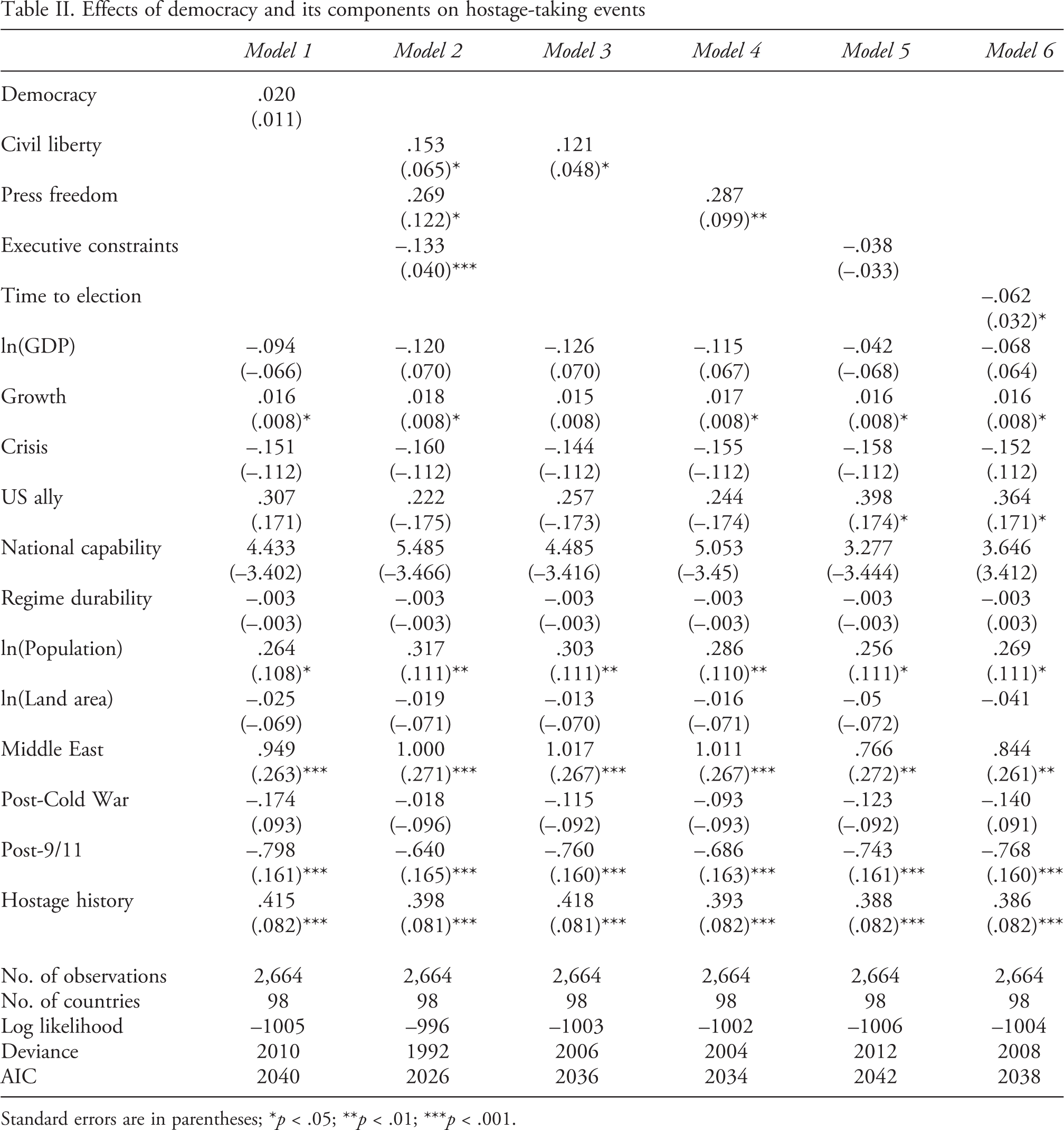
Standard errors are in parentheses; *p < .05; **p < .01; ***p < .001.
Finally, Middle Eastern countries have a higher probability than countries in other regions of facing hostage-taking events, as well as other forms of terrorist events. In terms of the temporal pattern, the number of hostage-taking events has substantially declined after 11 September 2011, possibly indicating the success of counter-terrorism The parameter estimations of hostage-taking events.
To illustrate the effects of democracy and its disaggregated attributes, Figure 1 presents the parameter estimations of hostage-taking incidents estimated from Model 2. 12 In both panels, the horizontal axes denote the level of civil liberties and the vertical axes denote the estimated number of hostage-taking incidents. As can be seen, as the level of civil liberties increases, the likelihood that a country suffers from hostage-taking terrorism increases. The number of hostage-taking incidents, moreover, is affected by the level of press freedom and the degree to which the executive is constrained. The left panel shows that, given the level of civil liberties, countries having partly free media are more likely to suffer from hostage-taking events than countries that restrict media freedom; countries that allow free media are even more vulnerable than the other two types. The right panel tells the story that, given the level of civil liberties, countries in which the executive is highly constrained are less likely to be the targets of hostage-takers than countries in which the executive is only weakly constrained. Note that the estimated numbers in two panels are less than 1, indicating the rareness of hostage-taking incidents.
Model checking and robustness
The statistical results are well supportive of my arguments, but how do the models fit the data? A useful way to assess the model fit is to perform posterior predictive simulations, which is to simulate parameters from the fitted model, to replicate datasets from these simulated parameters, and to compare the replicated data with the actual data. In so doing, the uncertainty of parameter estimation can be considered (Gelman & Hill, 2007). I simulate 1,000 sets of parameters from the result of Model 1 in Table II. Then I obtain 1,000 sets of fitted values. Using these fitted values as the means of the Poisson distribution, I generate 1,000 datasets. On average, these 1,000 datasets successfully replicate 74% of the actual values. In the actual data, the zeros account for 84.3% of the total; in the replicated datasets, the average percentage of zeros is 84.4%, suggesting a great model fit. Moreover, the average percentages of ones and twos in the replicated data are 13.7% and 1.7% respectively; the percentages of ones and twos in the actual data are 11.4% and 2.6% respectively. This indicates that the model fits the data reasonably well (see online appendix for details).
In addition, I conduct a number of diagnostics and alternative robustness analyses. First, I test for autocorrelation that may appear in TSCS data and the overdispersion problem that may plague a Poisson model. The diagnostics results indicate no serial correlations or overdispersion. Second, since the USA is the biggest target of hostage-taking terrorists as well as a stable democracy, the result may be driven by this extreme case. I exclude the USA from the data and perform the same analysis, and the result is robust in the absence of this potential outlier country. Third, I employ an alternative measure of civil liberties – the government’s respect for civil and political rights, which is taken from the CIRI Human Rights Data Project (Cingranelli & Richards, 2010). The result shows that the CIRI measure of civil rights produces a similar effect to the Freedom House measure of civil liberties. Lastly, I perform multilevel negative binomial models and zero inflated negative binomial models, both of which generate similar results to the Poisson model. In short, this article’s findings are robust to the exclusion of an outlier country, an alternative measure of civil liberties, and alternative estimators. All the diagnostics and additional robustness analyses can be seen in the online appendix.
Conclusion
In the empirical literature on terrorism, there is little examination of the relationship between country characteristics and hostage-taking terrorism. This study fills this void by providing a quantitative analysis of hostage-taking terrorism at the country level, discussing what types of governments are more likely to be the targets of hostage-takers. Specifically, it argues that democracy generates different effects dependent on the type of terrorism. While democracy leads to more terrorist attacks because of a higher level of executive constraints, a higher degree of democratic competition, and more active foreign policies, its correlation to hostage-taking terrorism is driven by different attributes.
The results show that democracy produces competing effects on hostage-taking terrorism. A high level of civil liberties and a high degree of press freedom make democratic countries more at risk of experiencing hostage-taking incidents. Institutional constraints, by contrast, have a negative influence on hostage-taking terrorism, implying that horizontal accountability not only limits government leaders’ leeway to choose a flexible means of resolving crises but also consolidates the commitment to a non-concession principle. The re-election concern also compels the leader to concede to hostage-takers when election time gets close, which is demonstrated by the negative relationship between the time to the next election and hostage-taking.
While this article considers free media as one component of democracy, it is very likely that countries having more competitive media systems are more likely to be targeted by hostage-takers because competing media tend to increase sensationalistic coverage to attract a mass audience (Zaller, 1999). Future research may want to explore this relationship between media competition and hostage-taking terrorism. 13
This study highlights the important implications of institutional arrangements on governments seeking to reduce the risk of hostage-taking terrorism. A democratic government is more likely to become the target of hostage-takers, but the risk can be reduced by imposing larger constraints on the executive. A formal rule that regulates the executive’s power in the negotiation with hostage-takers can be useful. While dealing with a hostage-taking crisis, the government may be better suited to take a strong stand and not to reveal or signal the intent to compromise. Once terrorists think of a government as a target that is difficult to negotiate with, hostage-taking incidents may become less attractive.
Footnotes
Replication data

Acknowledgements
I would like to thank the JPR editors, three anonymous reviewers, Jeff Gill, Andrew Martin, Guillermo Rosas, Jamie Monogan, Santiago Olivella, Noel Johnston, and Tsung-han Tsai for their valuable comments and suggestions on this article. Special thanks to Nate Jensen for his helpful advice and comments during the writing process.
Notes
References
Supplementary Material
Please find the following supplemental material available below.
For Open Access articles published under a Creative Commons License, all supplemental material carries the same license as the article it is associated with.
For non-Open Access articles published, all supplemental material carries a non-exclusive license, and permission requests for re-use of supplemental material or any part of supplemental material shall be sent directly to the copyright owner as specified in the copyright notice associated with the article.
