



Abstract
The International Court of Justice (ICJ), as the principal judicial organ of the UN, plays an important role in peaceful resolution of international disputes. Traditionally, relations between Islamic law states, international law, and courts have been relatively tense due to the inherent link between Islamic law and the Islamic faith. Yet, several Islamic law states recognize the ICJ’s compulsory and compromissory jurisdiction. This article asks: Why do some Islamic law states extend support to the International Court of Justice, while others turn away from the Court? I argue and empirically demonstrate that specific characteristic of Islamic law can explain variation of Islamic law states’ preferences towards the ICJ. After providing original data on the characteristics of Islamic legal structures, I systematically compare pertinent rules of international law and Islamic law, focusing on similarities and differences between the two. Islamic law features such as respect for legal scholarship and peaceful resolution of disputes are compatible with principles embraced by the ICJ. Islamic law states that incorporate these norms are supportive of the Court. In contrast, Islamic law states that directly adopt sharia as the law of the land and incorporate sharia in their education systems are less open to the ICJ’s adjudication.
Keywords
Introduction
The International Court of Justice (ICJ), the principal judicial organ of the United Nations, hears legal disputes between states and gives advisory opinions on legal questions referred to it by authorized UN organs and specialized agencies. 1 The bulk of ICJ cases deal with questions of sovereignty, maritime delimitation, diplomatic relations, and border disputes. For a state, the most obvious way to express its support for the ICJ is via signing the optional clause, which signifies that a state has recognized the ICJ’s compulsory jurisdiction. 2 Since its inception, the ICJ has adjudicated many interstate disputes, contributing effectively to peaceful resolution of conflicts. There are also important ‘out of court effects’ associated with the presence of the Court and its ability to provide the last resort outlet for dispute resolution (Bilder, 1998). Research demonstrates that recognizing the ICJ’s jurisdiction has pacifying effects on states’ behavior. States who bargain in the shadow of the Court do so more effectively, are better able to avoid militarized conflict, and are more likely to end overall contention over an issue (Mitchell & Powell, 2011). Effectiveness of ICJ judgments is substantial. Mitchell & Hensel (2007) find that 28 out of the 29 ICJ judgments dealing with territorial, maritime, or river disputes have experienced full compliance. Similarly, Paulson (2004) demonstrates that most ICJ final judgments end ongoing disputes.
Are all states equally attracted to the ICJ as an international adjudicator? Interestingly, the legal design of the ICJ has, since its origins, leaned heavily on Western conceptions of law, embraced by civil and common legal traditions. Islamic law states did not participate in the creation of the Court. 3 As a result, the ICJ structure and procedures differ considerably from faith-based Islamic law. In general, relations between Islamic law states and international courts have been on shaky ground due to the inherent link between Islamic law and the Islamic religion (Brower & Sharpe, 2003).
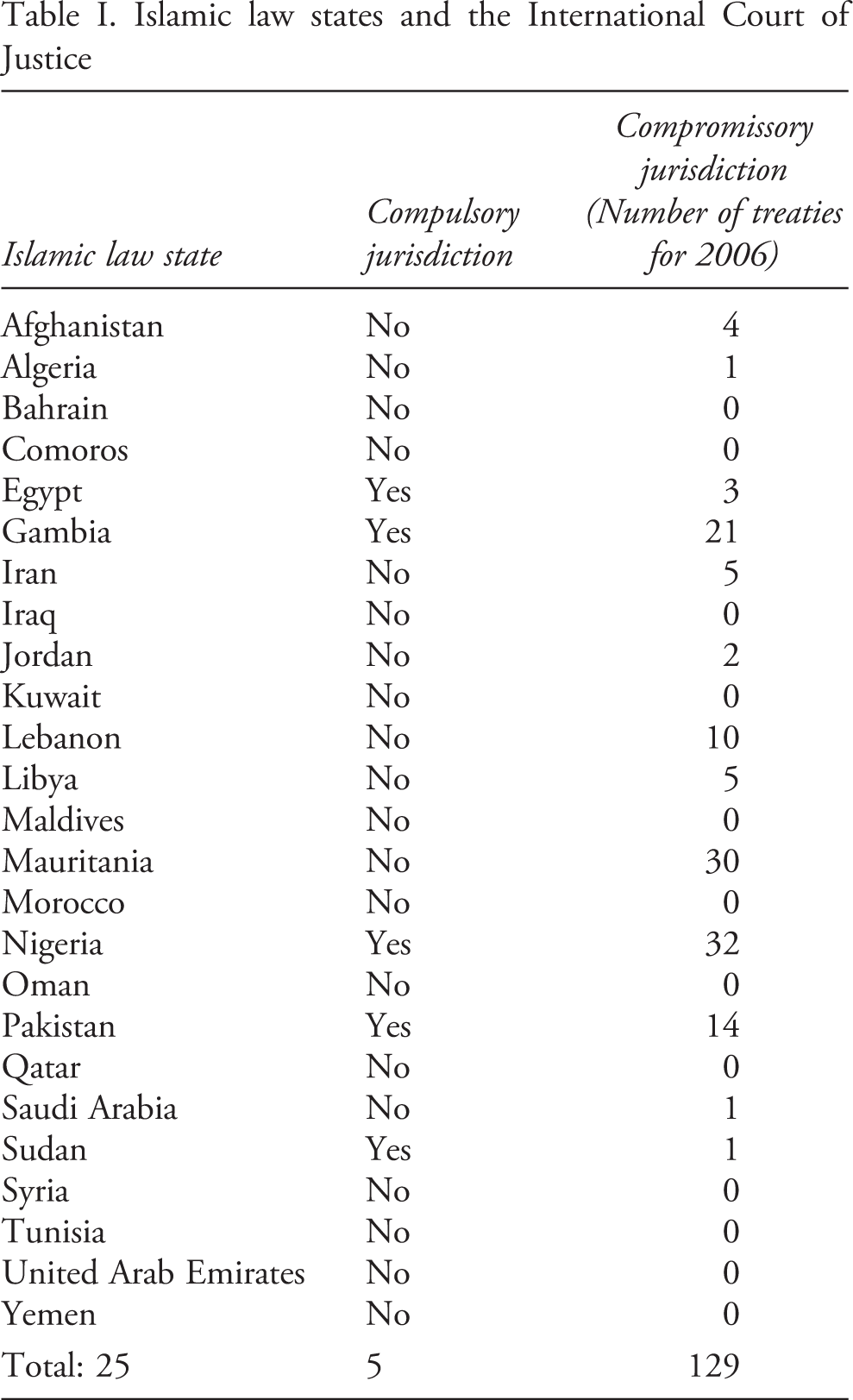
Although there is some evidence that differences between international and Islamic law push Islamic law states away from international courts, the descriptive evidence raises some questions. In fact, despite these differences, several Islamic law states recognize the ICJ’s compulsory jurisdiction, and more than 50% are part of over 100 treaties with compromissory clauses (Table I). Moreover, several of these states embrace traditional Islamic precepts, which at first glance may seem contradictory to international law. Given the features of international and Islamic legal systems, why are some Islamic law states attracted to international adjudication? More specifically, are there any similarities between the two legal systems that may explicate why some Islamic law states support the ICJ? Are there irreconcilable differences between faith-based Islamic law and international law that preclude some states from supporting the Court? This study provides a compelling analysis to address these puzzles. After providing original data on the characteristics of Islamic legal structures, I compare pertinent rules of international and Islamic legal systems, focusing on similarities and differences between the two. I argue that several features of Islamic law, such as presence of customary norms, respect for legal scholarship, and peaceful resolution of disputes are compatible with principles embraced by the ICJ. There are also several characteristics of Islamic law that sharply differ from international law, such as the inherent link between Islamic faith and law, and religious affiliation of the judiciary. I argue that these features push Islamic law states away from the ICJ – a court that embraces the Western-based idea of separation between law and religion.
Islamic law states and the International Court of Justice
The purpose of this study is to introduce variation within the Islamic law tradition and demonstrate that under some conditions, Islamic law states are open to international adjudication. I begin this study with my theoretical argument, which elaborates on the role that domestic legal institutions play in shaping states’ attitudes towards international courts. Next, I discuss similarities and differences between Islamic and international legal systems, with a particular focus on adjudication. I also present hypotheses. The theory is tested by examining Islamic law states’ propensity to accept the ICJ’s compulsory and compromissory jurisdiction (1945–2008).
Theory: Islamic law and the International Court of Justice
One of the core reasons states join specific international courts is that they agree with principles and values these institutions represent. As previous studies show, states’ actions on the international arena reflect their domestic ideological and legal biases (Simmons, 2009; Slaughter, 1995). I assert that states are more comfortable with an international court if it employs rules and principles similar to their own domestic legal systems. As Zartner-Falstrom (2006: 344) argues, ‘Contemporary attitudes towards the authority of existing international law can best be seen as a function of a state’s historical legal tradition and how this legal tradition shapes the legal culture and institutional structures within each state’.
The process of delegation of a dispute to an agent, which is inherent to international adjudication, sparks a priori uncertainty regarding the outcome of a dispute. It is the same process of delegation that causes states – potential litigants – to weigh domestic as well as international costs and benefits of supporting an international court (Powell, 2013a). Similarity between a domestic legal system and an international court allows a state to understand each phase of the adjudication process. The state is also better able to foresee the outcome of the settlement, because familiarity with in-court proceedings increases predictability. States can more accurately form their expectations regarding the outcome of adjudication if the two sets of rules, international and domestic, are comparable (Powell & Wiegand, 2010). Decisions to support an international court are also directly linked to the issue of compliance. No state wishes to abide by a judgment that profoundly contradicts its own domestic laws, especially because after a binding decision is rendered, the international community expects states to comply with it (Simmons, 1999).
Islamic law states did not participate in the creation of the ICJ or its predecessor, the Permanent Court of International Justice (PCIJ). Islamic legal precepts are, therefore, absent from the Court, which has been constructed according to Western legal thought (Mitchell & Powell, 2011). Since its inception, the ICJ has issued 95 judgments in contentious cases; the judgment included a meaningful discussion of Islamic law in only two cases (Lombardi, 2007). 4 Upon joining the Court, Islamic law states must accept its existing rules/procedures, which are non-negotiable. 5 Additionally, there are many other peaceful resolution methods and adjudicative bodies available to states (Shany, 2003). Thus, states can be selective and strategic concerning their choice of these methods, including the courts.
It is especially true for Islamic law states, which have been particularly likely to use methods that allow them to include sharia in the process of dispute resolution. Because mediation and conciliation allow the disputants to choose the third party, Islamic law states have been attracted to these methods. As such, these states have been ‘customizing’ international third-party resolution to reflect their domestic legal preferences. In fact, 78% of attempts at peaceful resolution in territorial disputes of Islamic law states involved an Islamic third party, such as the Arab League, or representatives from other Islamic states (Powell & Wiegand, 2010). Because there are many options available to Islamic law states, they can be very strategic about which courts or other methods they select, seeking out venues with familiar legal rules. Greater similarity between a state’s domestic legal system and the laws of an adjudicator creates stronger incentives for supporting an interstate court. Islamic domestic legal systems vary in how similar they are to international law, and how deep their legal commitment to sharia is.
Islamic law and international law
International and Islamic law: Operationalization of similarities and differences
Similarities
Similarity 1: Law of scholars
The category ‘law of scholars’ constitutes a systemic, all-encompassing similarity between international and Islamic law. It pertains equally to all Islamic law states. Historically, in both legal systems scholars have played an enormous role. Scholarship has largely contributed to the development of international law. As Article 38(1) of the ICJ Statute stipulates, ‘teachings of most highly qualified publicists of the various nations’ are a subsidiary source of international law. Indeed, writers such as Vattel or Gentili constituted supreme authorities in the 16th to 18th centuries, and their works have shaped international law by elucidating ‘the nature, history, and practice of the rules of law’ and pointing out ‘the defects that exist within the system’ (Shaw, 2003: 106). Islamic law is described as a law of scholars (Otto, 2010: 23). Figh, Islamic jurisprudence, has contributed immensely to the comprehension of Islamic legal injunctions (Hamidullah, 1993). Schools of law and jurisprudence, the madhhab, constitute a defining characteristic of Islamic law (Hallaq, 2009).
The importance of scholarship constitutes a bridge between international law and Islamic law by introducing a high degree of compatibility in the legal creation and decision-making process. In other words, how rules are created, where they come from, and how they are applied corresponds in both legal systems. Importantly, the ICJ directly refers to scholarly writings as a source of law. Research demonstrates that authority of an institution to produce binding decisions is developed not only by the substance of decisions, but also by the procedure employed to produce the outcome (Hibbing & Alford, 2004; Tyler, 1990). Because deliberations of scholars shape the substance of both legal systems, Islamic law states see this feature of international law as attractive.
Similarity 2: Custom
As evidence of a general practice accepted as law, ‘custom’ constitutes a source of international law (Article 38.1(b), ICJ Statute) and is composed of two elements: general practice and a conviction that such practice reflects a legal rule. In addition to customary rules that are applicable to all subjects of international law, ‘there may exist customary rules that are only binding upon States of a certain geographical area or region’ (Cassese, 2005: 163). The existence of local customary rules has been recognized by the ICJ in some of its judgments. For example, in the Asylum case the Court discussed regional customs peculiar to Latin America. 7 Customary law constitutes an important source in several Islamic law states. It is sometimes used in place of or as a supplement to written law. Often, traditional Islamic precepts and tribal laws coexist with written codifications. For example, customary law plays a crucial role in rural areas of Sudan, where about 80% of cases are adjudicated according to custom (Köndgen, 2010). Similar to international law, different regions within an Islamic law state may have different customary norms. Consider Nigeria, where ‘customary law is as multifarious as are Nigeria’s many ethnic groups’ (Ostien & Dekker, 2010: 585).
Similarity 3: Partial codification
‘Partial codification’ constitutes a defining feature of international law. There exists no single international body that creates international law, nor a single, hierarchical court system. In addition, several sources of international law are inherently vague. For example, there exists no rule that irrefutably establishes when an observed repeated practice becomes an international custom. In the same way, the exact meaning of ‘general principles of law recognized by civilized nations’ has been the subject of widespread legal debate (Friedmann, 1963; Shaw, 2003; von Glahn & Taulbee, 2010). Since its origins, Islamic law depended on the cooperation between royal and customary law (Hallaq, 2009), which contributed to the fact that several Islamic domestic legal systems are only partially codified. In fact, some states, like Saudi Arabia, lack systematic codification of sharia. In other states, codes/statutes coexist with uncodified custom. For example, Nigerian personal status and family laws are ‘extremely complex’ as written codifications, and a host of customary norms regulate these areas of law (Ostien & Dekker, 2010: 585).
Similarity 4: Peaceful resolution of disputes
The proper management and resolution of disputes is critical to international security. UN Charter Article 2(3) stipulates that states are to ‘settle their international disputes by peaceful means in such a manner that international peace and security, and justice, are not endangered’. This principle, established to prohibit self-help, constitutes a pinnacle of international relations (Merrills, 2005). All means of peaceful settlement, such as negotiations, mediation, adjudication, etc. are embraced by international law. Islamic law promotes peaceful resolution of disputes via highlighting acknowledgment and forgiveness (Irani & Funk, 1998). Sulh, a peaceful settlement between the disputants, was the Prophet Muhammad’s preferred method of dispute resolution. In general, Islam ‘emphasizes that moral relations between nations ought to be the rule’ (Salmi, Majul & Tanham, 1998: 77). The major role of a qadi, an Islamic judge, is to guide the disputants in the process of finding common ground and to restore the fellowship between them.
Similarity 5: Rule of law
Respect for ‘rule of law’ constitutes an underlying premise of international law. The ICJ’s proper role was described as ‘the interpretation and application of international law … and contributing thereby to the rule of law and greater integration of the international society’ (Gross, 1971: 259). Inherent to Islamic law is the application of justice even in relation to people of other religions. One of the most important faces of the Islamic concept of justice is adherence to the divine law, its interpretation and implementation. It is a duty of the believer ‘to seek justice and apply it’ (Abu-Nimer, 2003: 234). Importantly, according to the Koran, no person is above the law, including the Prophet and rulers of Muslim states. Several Islamic constitutions explicitly mention rule of law. For example, the 1980 Constitution of Egypt (Article 64) states: ‘The sovereignty of the law is the basis of state rule.’
I argue that Islamic states with legal systems that are comparable to principles of international law are more likely to recognize the Court’s jurisdiction. Simply put, legal principles that are simultaneously embedded in both the ICJ’s structure and select Islamic legal systems can explain why some Islamic law states gravitate towards the Court. Based on my theory, I propose the following hypothesis:
Hypothesis 1: Islamic law states whose domestic laws incorporate principles similar to those embedded in international law are more likely to recognize the jurisdiction of the International Court of Justice.
Differences
Difference 1: Approach to adjudication clauses
‘Approach to adjudication clauses’ constitutes a systemic, all-encompassing difference between Islamic and international law. It affects all Islamic law states’ view of international adjudication in general, including the ICJ. States may recognize the ICJ’s compulsory jurisdiction through acceptance of the Optional Clause, Article 36(2) of the ICJ Statute. This act signifies a state’s acknowledgment of the ICJ’s adjudicative powers in all legal disputes regarding interpretation of a treaty, of other international obligations, or any question of international law. Alternatively, a state may recognize the ICJ’s jurisdiction through compromissory clauses in bilateral or multilateral treaties (Shaw, 2003). Via a compromissory clause, parties to a treaty agree that if a dispute of a given type arises, it will be submitted to the ICJ, either immediately or after another method of settlement fails. States insert these clauses into agreements pertaining to a variety of issue areas, such as the environment, organized crime, corruption, or air services. 8 The wording of compromissory clauses varies from one treaty to another, but generally such clauses stipulate that disputes concerning the application/interpretation of the agreement may be referred to the Court. 9 Both types of the Court’s jurisdiction, compulsory and compromissory, delegate authority a priori, before a dispute occurs. According to strict interpretation of Islamic law, any clauses that are aleatory in nature are questionable. Sharia speaks against an agreement that incorporates ‘a clause on which the parties would be agreeing on the intervention of a future and unknown event’ (Hassan, 2006: 197).
Difference 2: Relation between law and religion
International law embraces the view that a distinction between law and religion must be observed. Thus, in all international courts religion does not constitute an acceptable basis for a judgment. Although Western legal systems, as well as international law, have extracted many legal principles from religious sources, such as the Bible, these legal systems themselves are separate from religion. Sources of international law, enumerated in Article 38(1) of the ICJ Statute, are strictly secular in nature. They include international conventions, treaties, international custom, general principles of law recognized by civilized nations, judicial decisions, and teachings of the most highly qualified publicists (von Glahn & Taulbee, 2010). In contrast, Islamic faith is intrinsic to Islamic law. This relationship also applies to Islamic international law, siyar, as its origins lie in infallible religious sources. Allah, the creator of men and nations ‘is the lawgiver and the lawmaker’ (Oba, 2002: 822). Just as Muslims are obliged by God to abide by sharia, so are Islamic states. All sources of Islamic law, including the Koran and the Sunna, are closely connected to Islamic faith (Glenn, 2007). 10
The fact that international law does not officially endorse any non-Islamic religion does not, by itself, automatically attract Islamic law states to the ICJ. It is the non-reliance on Islamic principles that constitutes the crux of the problem, since ‘Islamic legal authority rests on divine sovereignty’, the sovereignty of Allah (Westbrook, 1992–93: 826). As some scholars argue, international laws that may constitute common ground with Islamic law ultimately fail to attract Islamic states because they are ‘not substantively and legitimately Islamic’ (Cravens, 1998: 532). Because Islamic law is interpreted as divine, ‘Islam recognizes no other legitimate legal order’ (Ford, 1995: 501).
Additionally, application of religious precepts in Islamic law may directly contradict substantive norms of international law. For example, according to traditional Islamic law, the concept of sovereignty may be based on religious allegiance to a ruler, such as a king or prince (Cravens, 1998: 531). The clash of Islamic law-based and international law-based interpretations of sovereignty became apparent when the ICJ issued an advisory opinion regarding legal ties existing between Western Sahara and Morocco, and Western Sahara and the Mauritanian entity. 11 In its argumentation, Morocco argued that the Western Sahara peoples’ religious allegiance to the Moroccan Sultan amounted to territorial sovereignty (Ricciardi, 1992). The ICJ in its opinion adhered to the traditional, territorial ties-based, Western understanding of sovereignty by declaring that an allegiance to a ruler if it is to be equated to sovereignty ‘must clearly be real and manifested in acts evidencing acceptance of his political authority’. 12
The level of direct incorporation of sharia in the legal system varies across Islamic law states. Some states, like Morocco, limit the influence of sharia to personal status laws. In other states, including Saudi Arabia, sharia is applied directly to state law, criminal or commercial law, making the influence of Islamic laws deeper. A glance at constitutions of Islamic law states reveals how diverse their legalized commitment to Islamic principles can be. For example, the 1979 Iranian Constitution mentions shari/God 44 times, while the 2001 Constitution of Comoros mentions God only in one place – its Preamble.
Difference 2A: Religious affiliation of the judges
As a subset of Difference 2, ‘religious affiliation of the judges’ constitutes a palpable embodiment of the relationship between law and religion in international and Islamic legal systems. The ICJ Statute, as well as other rules regulating international adjudication, contains no provisions that regulate religious affiliation of the judiciary. The fact that Muslim jurists are unlikely to sit on the ICJ complicates matters for Islamic law states, who fear that non-Islamic judges ‘may not be familiar with or sensitive to the shari’a principles and that, consequently, justice may not be carried out as it should be’ (Abtahi, 2005: 646). Under strict Islamic principles, a Muslim may not be judged by a non-Muslim judge. A Qadi, an Islamic judge, must be a devout adherent to Muslim faith. Often times, judges and other officials are required to take religious oaths before assuming office. Several Islamic constitutions mention religious oaths. For example, the 2001 Constitution of Comoros requires the president and the vice-presidents of the union to take religious oaths before the Constitutional Court by the following formula: ‘I swear to Allah, the Compassionate and Merciful to faithfully and honestly fulfill the duties of my office, to act only in the public interest and in accordance with the Constitution’ (Article 13).
I argue that Islamic law states whose domestic laws differ considerably from international law – and that usually implies strict reliance on sharia – should be hesitant to support the Western law-based ICJ. Based on my theory, I propose the following hypothesis:
Hypothesis 2: Islamic law states whose domestic laws embrace traditional sharia principles are less likely to recognize the jurisdiction of the International Court of Justice.
Research design
To evaluate my hypotheses empirically, I analyze data from the 1945–2008 period on Islamic law states’ acceptance of the ICJ jurisdiction. Since Islamic law states constitute the focus of this article, the basic unit of analysis is the Islamic state-year, which allows me to capture these states’ behavior over time. I define an Islamic law state as a state in which a substantial part of the official legal system is directly based on the Koran. In other words, states that officially and directly apply sharia to a substantial part of personal, civil, commercial or criminal law are considered Islamic law states. It is important to note that in a few countries, such as Turkey, the official legal system is not considered Islamic despite the fact that Muslims make up a substantial portion of the population. Therefore, my categorization of Islamic law states is based on the structure and substantive content of the official legal system, and not on the composition of the population. 13 I base my coding on Powell & Mitchell’s (2007; Mitchell & Powell, 2011) categorization of Islamic law states, as well as other subsidiary sources. 14 As a result, 25 states are included in the data. States like Saudi Arabia, where sharia constitutes the national law, Nigeria, which is divided into an Islamic North and a Christian South, and Egypt, the center of Islamic legal modernism, are incorporated in the data. Table I lists all Islamic law states included in the dataset.
States can recognize the ICJ’s jurisdiction in more than one way, including signing the optional clause (compulsory jurisdiction), and via compromissory clauses embedded in treaties (compromissory jurisdiction). My first dependent variable, acceptance of compulsory jurisdiction, has two categories: (1) a state accepts the compulsory jurisdiction with or without reservations or (0) a state does not recognize the Court’s jurisdiction. From 1945 to 2008, Islamic law states accepted compulsory jurisdiction in 19.34% of state-years, with all of them placing reservations on their declarations. Thus, introducing a categorical dependent variable (ICJ acceptance without reservations, ICJ acceptance with reservations, no ICJ acceptance) is not empirically justified. The data are collected from the Annual Volumes of the ICJ Yearbook (Powell & Mitchell, 2007). Accepting compromissory jurisdiction of the ICJ, the second dependent variable, is a yearly count measure of the total number of treaty memberships for each Islamic law state. Table I provides detailed information regarding Islamic law states’ relationship with the ICJ.
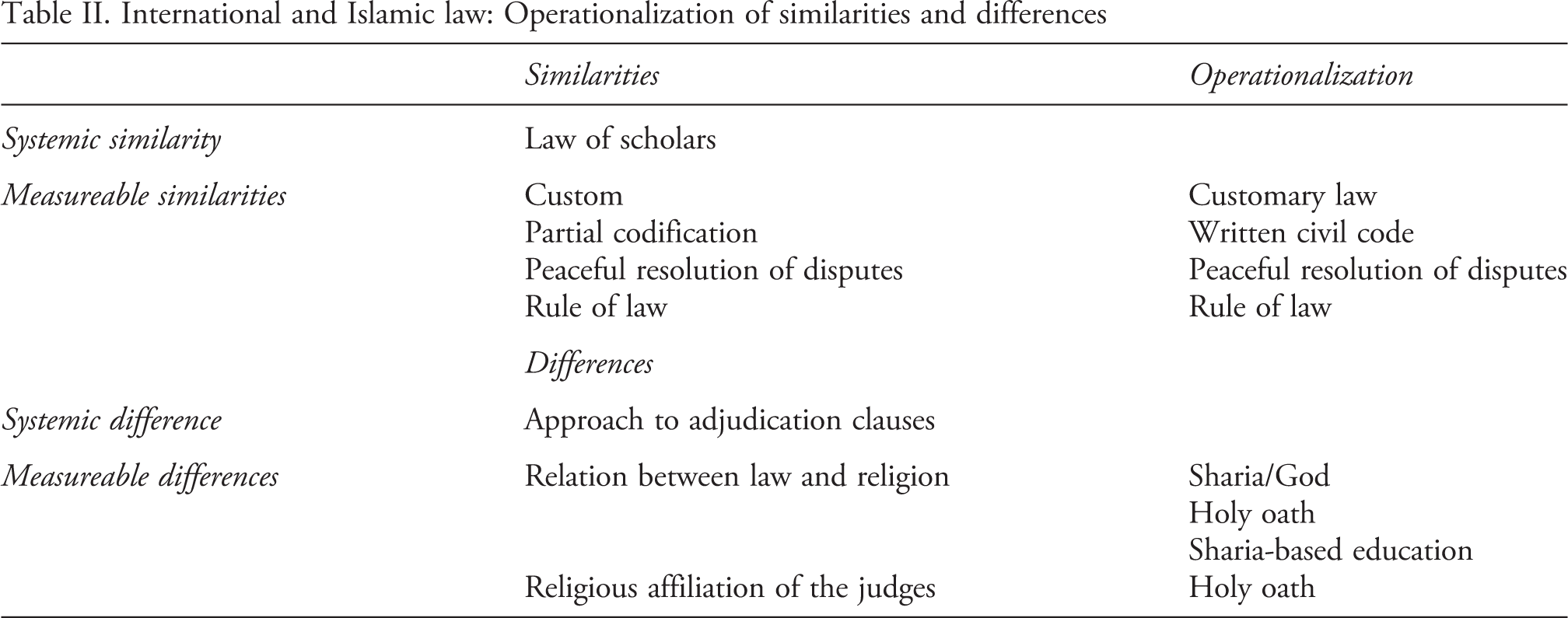
To code past and contemporaneous characteristics of Islamic states’ domestic laws, I gathered my own data using the following sources: Otto (2010), the Central Intelligence Agency (CIA) World Factbook (CIA, 2010), official Islamic states’ constitutions, statutes, other legal documents, and news articles from Lexis-Nexis, JSTOR, the Telegraph, and other periodicals. 15 To test my hypotheses, which focus on similarities and differences between international and Islamic legal systems, I coded two sets of independent variables – the first one deals with similarities, and the second one with differences. Table II lists similarities and differences between Islamic and international law, as well as their operationalization.
The first set of variables includes the following: customary law, written civil code, peaceful resolution of disputes, and rule of law. The customary law variable equals 1 if a state’s legal system during a particular year is based at least in part on customary law, and 0 otherwise. Historically, most Islamic legal systems relied on some form of custom. With time, codification of laws became popular and the number of unwritten laws decreased. Since presence of custom constitutes a similarity between international and Islamic law, I expect that states whose legal system incorporates custom are more likely to support the ICJ. The written civil code variable captures whether a written civil codification was in existence during a particular state-year. Examples of civil codes include the 1948 Egyptian Civil Code and Bahrain’s 2001 Civil Code. Partial codification characterizes both Islamic and international law. I expect that states that have a written civil code will be more likely to support the ICJ.
Peaceful resolution of disputes and rule of law capture the presence of certain constitutional provisions. In constructing these variables, I coded information from the total of 49 constitutions. Entries for these variables in state-years when there was no constitution are coded 0. 16 The first variable codes whether a constitution includes any stipulation referring to peaceful settlement of international disputes. Only a minority of Islamic constitutions contain such provision (11% of state-years), such as Article 24 of the 1956 Constitution of Afghanistan: ‘The State shall endeavour to strengthen the bonds of unity among Muslim countries, to promote international peace and security, to foster goodwill and friendly relations among all nations, and to encourage the settlement of international disputes by peaceful means.’ Data reveal similar patterns with regards to the rule of law variable. Only 21% of constitutions mention rule of law in the context of the judiciary/governance. For example, Article 4 of the 1992 Moroccan Constitution states: ‘Law is the supreme expression of the Nation’s will. All must submit to it. Law can have no retroactive effect.’ I expect that states with constitutions that incorporate these provisions should be more open to the ICJ.
The second set of independent variables, including sharia/God, holy oath, and sharia-based education, is designed to capture differences between Islamic and international law (Table II). These variables measure the depth of commitment to sharia principles. Sharia/God is a count variable that codes the number of times sharia/God are mentioned in a constitution, and ranges from 1 (2001 Comorian Constitution), to 44 (1979 Iranian Constitution). The dichotomous variable holy oath captures whether a constitution mentions a religious oath that is to be taken by public officials. Most constitutions incorporate such requirement (59% of state-years). Religious oaths are required from the executive (the Algerian president), the judiciary (Afghan Supreme Court judges), or the legislature (Yemeni members of the House of Representatives). The sharia-based education dichotomous variable describes whether a state incorporates the Koran/sharia into its education system. Historically, it was commonplace for Islamic law states to officially base their education on sharia. For example, Article 22 of Afghanistan’s 1931 Constitution stipulated: ‘In order to make sure that all educational institutions conduct their programs in accordance with Islamic principles, all educational institutions shall be monitored and inspected by the Afghanistan Islamic government.’ In Iran, schools of figh still enjoy official status in matters pertaining to religious education. Incorporation of sharia-based principles into the educational system constitutes a good measure of a state’s overall commitment to traditional Islamic percepts. I expect that states with constitutions that incorporate holy oaths and repeatedly mention sharia/God, as well as states with sharia-based education systems, are less likely to support the ICJ.
In addition to these variables of interest, I considered several control variables. Regime type captures the democratic legalist perspective, which asserts that democracies’ respect for judicial processes and rule of law carries over into international relations. I employ the Polity IV dataset (Marshall & Jaggers, 2011), which combines information from four institutional characteristics into a single democracy score ranging from 0 (least democratic) to 10 (most democratic). 17 The variable capabilities is based on the national capabilities index (CINC score) as developed by Singer, Bremer & Stuckey (1972). Research demonstrates that powerful states are less likely to support international courts, and weak states see impartial adjudication as a means of protection against stronger states (Scott & Carr, 1987). Global treaty commitments and regional treaty commitments variables measure the number of pacific settlement commitments (global and regional treaties respectively) that a state is a member of during each year. I obtained these variables from the Multilateral Treaties of Pacific Settlement Data Set – Issue Correlates of War (ICOW) Project (Hensel, 2005). Scholarship suggests that membership in global organizations/treaties promoting pacific settlement should increase a state’s support for international courts (Shannon, 2009). However, if a regional organization offers means for peaceful settlement, Islamic law states, which generally prefer a solution offered by an Islamic third party, should prefer such organization over a Westernized ICJ (Powell & Wiegand, 2010).
Empirical analyses
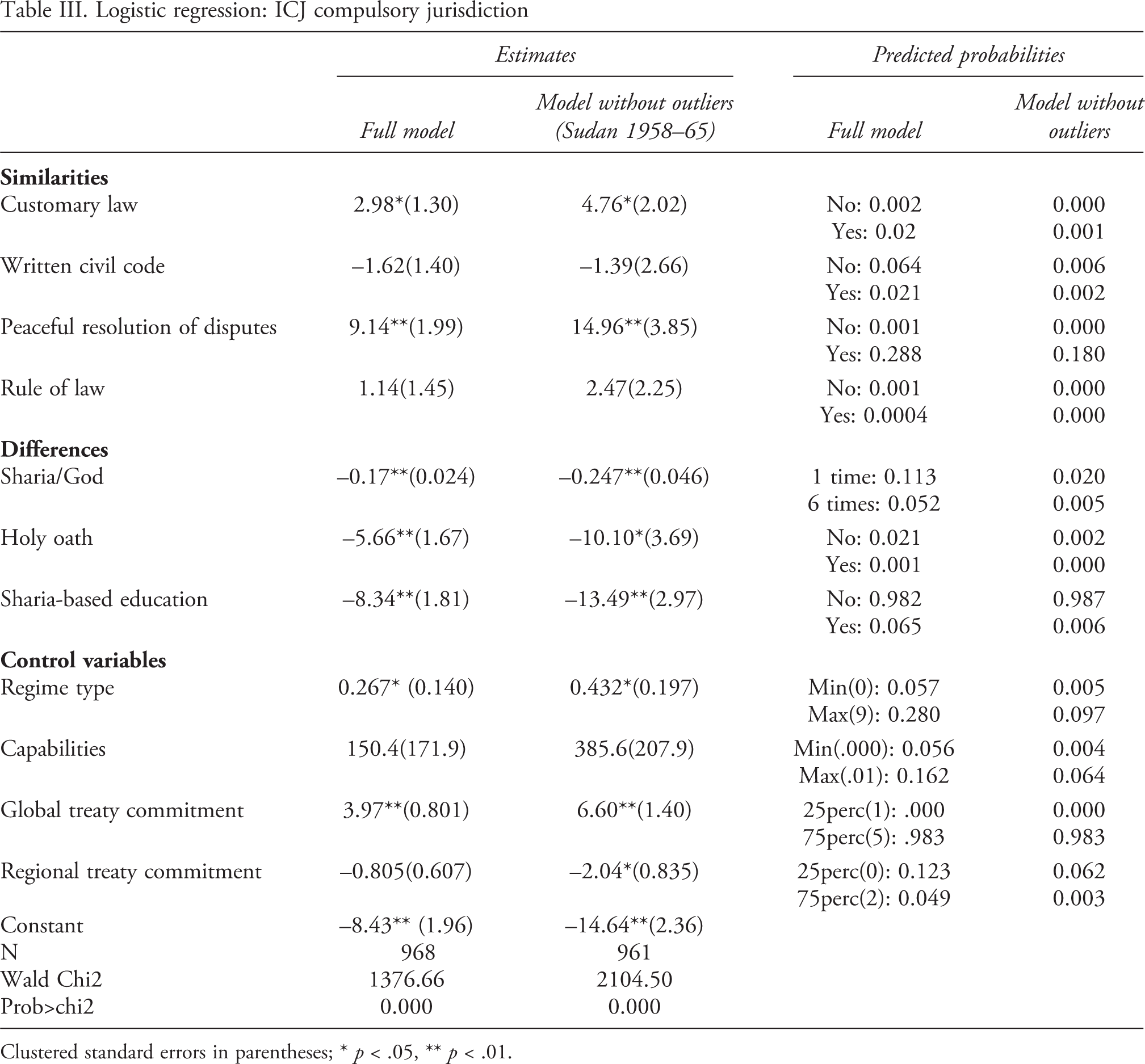
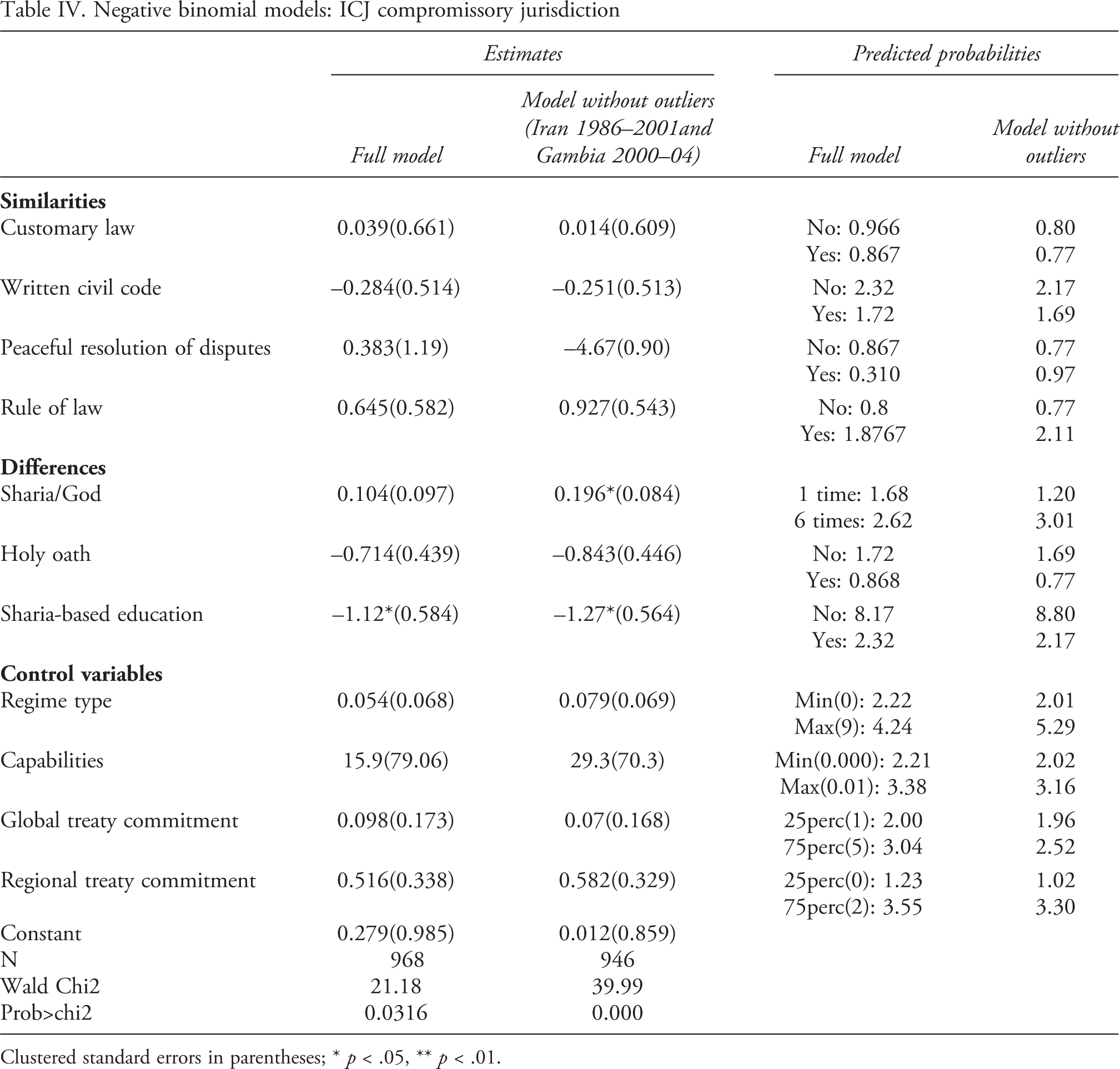
To test my hypotheses, I estimate the following two sets of models: logit models (ICJ’s compulsory jurisdiction, Table III) and negative binomial models (ICJ’s compromissory jurisdiction, Table IV). Models’ estimates are followed by substantive effects: predicted probabilities in Table III and expected counts in Table IV. I cluster all analyses on countries. 18 Both tables present two models: a full model, estimated on all observations, and a model without outliers. Sudan 1958–65 constitutes the biggest outlier in the logit model. The country gained independence in 1956, but because of ongoing political disputes, in 1958 the military seized power and ruled till 1964 when a civilian government came into existence (Kritzer, 2002: 1544). Sudan accepted the ICJ compulsory jurisdiction in January 1958, ten months before the military coup. It has continued to recognize the Court’s jurisdiction despite undergoing many major political/legal changes, providing a good example of stickiness of international commitments.
The negative binomial model overestimates the number of compromissory clauses for post-revolution Iran (1980s–2001) and Gambia during 2000–04. During the 1960s and 1970s, the Iranian Shah Mohammad Reza Pahlavi implemented the so called ‘White Revolution’. Islamic laws were replaced with secular laws in an attempt to Westernize the country (Kritzer, 2002: 738). However, in 1979 the Iranian legal framework returned to a firmly Islamic focus. Under the leadership of the Ayatollah Khomeini, sharia, strictly enforced by clerics, became the basis for the law. Data reflect these dramatic changes. In 1979 Iran’s constitution went from having six constitutional mentions of sharia/God to 44. Also, while it is not included in the model, the total count of the terms ‘sharia’ and ‘Islam’ grew from 19 to 143. This sudden over 7-fold jump in the number of constitutional mentions of sharia/God is the main reason for Iran being an outlier. However, dropping post-revolutionary Iran from the model does not change the results. The behavior of Iran provides a good example of stickiness of international treaties. In 1949, Iran was part of one compromissory treaty; in the late 1950, it was part of five treaties. This number remained unchanged till the ending period of my data, despite fundamental changes that took place in this country.
Logistic regression: ICJ compulsory jurisdiction
Clustered standard errors in parentheses; * p < .05, ** p < .01.
Hypothesis 1 expressed my expectation that states whose domestic laws incorporate principles similar to those embedded in international law should be more accepting of the ICJ. As expected, the presence of customary laws increases the likelihood of accepting compulsory jurisdiction. Coefficients in both logit models are positive and statistically significant. Predicted probabilities demonstrate that states whose domestic laws rely partly on custom are ten times more likely to accept the ICJ’s compulsory jurisdiction (Full Model). The coefficients in the compromissory jurisdiction models, although positive, are statistically insignificant. Both sharia and international law have a deep appreciation for custom through which individuals and states verbalize their preferences for certain substantive laws. Despite the fact that substantively traditional Islamic precepts, often times embodied in these customary norms, differ from international law, their form of expression – orality – draws these states to the ICJ. In all models, coefficients for the written civil code variable are statistically insignificant. Their negative direction may indicate that codifying traditional Islamic precepts expresses a state’s deep commitment to sharia. Historically, several Islamic law states have codified their sharia laws in order to give them a stronger legal status.
Negative binomial models: ICJ compromissory jurisdiction
Clustered standard errors in parentheses; * p < .05, ** p < .01.
Results regarding the peaceful resolution of disputes variable provide strong support for Hypothesis 1 in the context of compulsory jurisdiction. Islamic law states that refer to peaceful resolution of disputes in their constitutions are considerably more likely to accept the ICJ’s adjudicative powers. This principle, inherent in international law, if embedded in an Islamic constitution, forms a natural bridge with the international legal order. The presence of constitutional articles devoted to peaceful resolution increases the likelihood of recognizing compulsory jurisdiction from .001 to .288 (Full Model). This variable in the negative binominal models is statistically insignificant. The last ‘similarity’ variable, rule of law, is positive but statistically insignificant in all four models.
Hypothesis 2 deals with differences between Islamic and international law. It expresses my expectation that Islamic law states whose domestic laws embrace traditional sharia principles are less likely to support the ICJ. Results concerning sharia-based education and presence of holy oath in a constitution provide strong support for my expectations across all four models. Islamic law states that incorporate Islamic principles into their educational systems are significantly less likely to support the ICJ, either through the optional clause or international treaties. Coefficients for the sharia-based education variable are negative and statistically significant in all four models. Substantive effects are very large. As Table III demonstrates, such states are 15 times less likely to recognize the compulsory jurisdiction (Full Model), and belong, on average, to only two treaties with compromissory clauses, compared with eight for states that have secular education systems. Including sharia-based principles directly into the educational system constitutes an expression of a state’s profound commitment to traditional Islamic percepts.
Similarly, I find that presence of a holy oath in a constitution substantially dampens a state’s enthusiasm towards the Court’s compulsory jurisdiction. Specifically, Islamic law states whose constitutions explicitly require a religious oath from public officials are 21 times less likely to commit to the ICJ via optional clause (Full Model). The ICJ constitutes a secular institution: its judges are not required to have any specific religious affiliation and no religious oaths are taken. Constitutional provisions regarding holy oaths demonstrate a state’s deep commitment to embedding sharia into its institutional system. Consider that in several Islamic states, the qadi are ‘primarily religious clerics interpreting “God’s will”’ (Karadsheh, 1996: 243). Such approach to the judiciary directly contradicts the Western belief in separation between law and religion.
States whose constitutions mention sharia/God more frequently, are less likely to accept the ICJ’s compulsory jurisdiction. Substantive effects are large: if a constitution mentions sharia/God once, such a state is twice as likely to sign up to the optional clause compared with a state whose constitution mentions sharia/God six times (the increase is four-fold in the Model Without Outliers). The sharia/God variable captures the depth of a state’s commitment to Islamic precepts and relates directly to the traditional views of international law as ‘derived ultimately from revelation’ (Bsoul, 2008: 12). Somewhat unexpected are the results pertaining to the relationship between the variable sharia/God and states’ recognition of ICJ’s compromissory jurisdiction. States whose constitutions frequently refer to sharia/God belong to more treaties with compromissory clauses – a pattern opposite to what we observe in the context of the compulsory jurisdiction. Note, however, that the sharia/God coefficient, although positive, is statistically significant only in the Model Without Outliers (change in expected count from 1.2 to 3.01). This finding can be explained in light of the fundamental differences between compulsory and compromissory jurisdiction. When signing on to the optional clause, an Islamic law state opens itself up for potential adjudication in all matters pertaining to international law, subject, of course, to reservations. Thus, all other states that also accept the ICJ’s compulsory jurisdiction can potentially sue an Islamic law state. Choosing to become a party to a treaty with a compromissory clause substantially limits the Court’s jurisdiction to the subject matter of the treaty. It also limits the list of potential disputants to the signatories of the treaty.
Since this finding runs counter to my theoretical expectations, I have taken an initial cut at identifying the members of all bilateral and multilateral treaties with compromissory clauses to discern whether Islamic law states are more likely to sign these treaties with other Islamic states. I gathered bilateral treaty membership data from the ICJ website, 19 and obtained the multilateral treaty data from Mitchell & Powell (2011). On average, Islamic law states are almost seven times less likely to sign onto multilateral treaties with compromissory clauses than non-Islamic states. In 2006, there were only three Islamic law states that were signatories to such treaties: Gambia, Mauritania, and Nigeria. Additionally, an overwhelming majority of treaty membership for these states is in treaties with at least one other Islamic law state. For example, out of 21 Gambian treaty memberships, 19 are shared with Nigeria, and all 26 Mauritanian treaty memberships are shared with Nigeria.
Bilateral treaty patterns are different. On average, Islamic law states are slightly more likely than non-Islamic states to sign bilateral compromissory treaties, indicating their preference to utilize treaties with very small membership, which not only limit the subject matter of the ICJ jurisdiction, but also limit the number of potential disputants to only two. Moreover, in the context of bilateral compromissory treaties, Islamic law states fall into three groups: some sign none/very few compromissory bilateral treaties (for example Algeria (1) or Jordan (2)); some belong to a large number of these treaties (Lebanon (10) and Pakistan (14)); and very few fall in the middle (Afghanistan (4), Libya (5)). Patterns are somewhat distinct. States that have only one bilateral treaty sign it either with another Islamic law state or their former colonizer. Lebanon and Pakistan, the only two Islamic law states with a large number of bilateral compromissory treaties, are open to treaties with all states, both Islamic and non-Islamic. These two states, however, constitute a distinct minority among the 25 Islamic law states. States that fall in between these two extremities tend to also be open to treaties with all states. These data suggest the following conclusions. In general, Islamic law states see compromissory jurisdiction as posing a smaller threat of ICJ jurisdiction in comparison with compulsory jurisdiction. Second, these states largely prefer bilateral to multilateral treaties, in order to limit the number of potential disputants to only two states.
Control variables provide additional insights into the relationship between Islamic law states and the ICJ. More democratic Islamic states are more accepting of compulsory jurisdiction, but there is no statistically significant relationship between the regime type variable and compromissory jurisdiction. The coefficient for capabilities is positive but statistically insignificant in all models. I find that membership in peace-promoting international organizations shapes Islamic law states’ views of the ICJ. The likelihood that an Islamic law state will accept the compulsory jurisdiction significantly increases as the state becomes part of a larger number of global international organizations (IOs). Substantive effects are large: if a state is part of five peace-promoting global IOs, its likelihood of signing the optional clause increases to .983 compared with .000 when the state does not belong to such IOs. These patterns support existing literature (Shannon, 2009). Membership in regional treaty commitments, on the other hand, decreases the likelihood of compulsory jurisdiction. These results are not surprising. Existing scholarship demonstrates that Islamic law states prefer non-binding peaceful resolution methods. Thus, if a regional organization offers means for settlement, such method will usually be more attractive than an international court (Powell, 2013b). Consider that membership in regional treaties of pacific settlement offers an opportunity to call on other Islamic states or Islamic third parties for help in settlement.
Conclusion
Scholars and practitioners of international law have repeatedly expressed their concern regarding the relationship between Islamic law states and international courts such as the International Court of Justice. Some have even argued that Islamic law and international law constitute two separate entities, with not much in common (Salmi, Majul & Tanham, 1998). In this article, I attempted to determine if these pessimistic assertions are right, or, in contrast, if there are similarities between the two legal systems that could explain why several Islamic law states recognize the compulsory and compromissory jurisdiction of the ICJ. The proliferation of international dispute resolution methods, including inter-Islamic third-party forums, has created the possibility for Islamic leaders to strategically choose among available venues for peaceful settlement. As my theory suggests, the ICJ may or may not appear equally attractive to all Islamic law states.
This article constitutes, to my knowledge, the first attempt to demonstrate empirically that differences as well as similarities between Islamic and international law matter in shaping Islamic states’ attitudes towards the ICJ. The theoretical framework and empirical tests presented here also advance the scholarship on international relations of Islamic law states. So far, in the context of international law, most of the literature has treated Islamic law states as one category, disregarding important differences that exist within Islamic legal tradition (Mitchell & Powell, 2011; Powell, 2010). My data capture not only the cross-sectional variation within the Islamic legal family, but also over-time patterns of change by providing a more detailed coding of the degree of interconnectivity between Islamic law, Islamic faith, and international law. While previous scholarship has lumped all Islamic states into an ‘isolationist’ camp, this article finds that under some conditions, Islamic states are friendly to international law.
Footnotes
Replication data

Acknowledgements
The author would like to thank Christian Davenport, Tom Ginsburg, Paul Huth, Charlotte Ku, Sara McLaughlin Mitchell, Will Moore, David Nickerson, John Vasquez, Greg Vonnahme, and Dana Zartner for their insightful comments on this project. Maureen Wilson, Patrick Gill, and Mary Longenbaker provided superb research assistance.
Funding
This research has benefited from an Initiation Grant allocated by the Faculty Research Scholarship Program, University of Notre Dame's Office of the Vice President for Research. I also wish to acknowledge a Research and Creative Work Grant from the University of Notre Dame's Institute for Scholarship in the Liberal Arts and a grant from the University of Alabama Research Grants Committee.
Notes
References
Supplementary Material
Please find the following supplemental material available below.
For Open Access articles published under a Creative Commons License, all supplemental material carries the same license as the article it is associated with.
For non-Open Access articles published, all supplemental material carries a non-exclusive license, and permission requests for re-use of supplemental material or any part of supplemental material shall be sent directly to the copyright owner as specified in the copyright notice associated with the article.
