



Abstract
A majority of UN peacekeeping operations deployed to civil wars face violent attacks by rebel groups. To date, the academic study of this type of violence has been very limited. This article is a first attempt to fill this gap. In particular, I aim to examine why rebel groups fight against peacekeepers in some cases, while not in others. I argue that since peacekeepers are mostly impartial but not neutral, they become an actor in a conflict and tend to protect the weaker side from total defeat. This implies that on the one hand, relatively weaker rebels will seek protection from the government by peacekeepers. On the other hand, relatively stronger rebels will challenge the peacekeepers in order to restrict their behavior and/or make them withdraw. If stronger rebels are successful in targeting the peacekeepers and the peacekeepers withdraw or alter their behavior, a victory for these rebel groups should become easier. Using novel data on violence against UN peacekeepers, I find that indeed, stronger rebel groups are more likely to fight against peacekeepers.
As the data collected for this project suggest, more than half of all UN peacekeeping operations are at some point in time attacked by rebel groups. Acts of violence differ greatly: from banditry, deliberate gun or mortar fire and hijacking of transportation material to ambushes on convoys and kidnapping of personnel. Peacekeepers are often targeted directly, but sometimes also happen to be at the wrong place at the wrong time, and get caught in the middle of two fighting groups. These types of violence frequently impede the work of a peacekeeping mission, limit the peacekeepers (blue helmets) to staying in their bases, and sometimes result in their withdrawal if the situation is perceived as being too dangerous. Examples of this are the withdrawal of Belgian soldiers from Rwanda after ten peacekeepers were killed, and the withdrawal of the USA from Somalia after the battle of Mogadishu. For both conflicts, the withdrawal of the peacekeeping mission had disastrous consequences.
While over half of the peacekeeping operations experience violence directed against them, this empirical phenomenon has not been analyzed academically. Scholars so far have mainly studied two questions: ‘Where are peacekeepers sent?’ (Andersson, 2000; Fortna, 2004a, b, 2008b; Gilligan & Stedman, 2003); and ‘Are they effective in establishing a durable peace?’ (Fortna, 2004c; Gilligan & Sergenti, 2008; Hartzell, Hoddie & Rothchild, 2001; Walter, 2002). Most of this research focuses on the senders of peacekeeping missions and not on the receiving side.
Even though rebel violence against peacekeepers occurs often and has great implications, studies of rebel behavior towards peacekeeping missions deployed in civil wars have hitherto been limited. The purpose of this article is to fill this gap. I aim to do so by studying why rebel groups fight against peacekeepers in some cases, while not in others. I base my argument on the assumption that UN peacekeepers strive to be impartial, but not necessarily neutral. This implies that they will always aim to prevent the total defeat of one party during the conflict. I argue that relatively stronger rebels are more likely to attack peacekeepers, because the peacekeepers interfere more with their goals, and prevent them from reaching their goals. Since peacekeepers often adapt to more risk-avoiding strategies or withdraw completely after being attacked, this appears to be a worthwhile strategy for relatively stronger rebels. Those rebel groups weaker than the government should have no incentives to fight against blue helmets; on the contrary, they should expect to be protected by them. Naturally, this argument is conditional on the strength of the peacekeeping operation; the stronger the peacekeeping operation, the better they are at protecting the government and the more need there is for stronger rebels to fight against the peacekeepers.
I examine these hypotheses using a new, global dataset on violence against peacekeepers covering all UN peacekeeping operations from 1989 to 2003. Using data on the relative strength and the relative fighting capacity of all rebel groups in all conflicts where there was a UN peacekeeping operation in this time period, I study under which conditions rebel groups decide to attack peacekeepers. Consistent with my theoretical expectations, I find that relatively strong rebel groups are indeed more likely to attack a peacekeeping operation. However, my results are inconclusive about the effect of the strength of the mission on the likelihood that a rebel group will engage in violence against it. Nonetheless, this article makes a contribution to the growing literature on the dynamics of peacekeeping. It also contributes to our understanding of the risks peacekeepers face. If peacekeepers alter their behavior after being attacked, this could potentially also have important implications for the success of the operation.
The article proceeds as follows. In the next section, I introduce a brief review of the most recent literature on peacekeeping. Following this, I present my theoretical argument. Next, I introduce the dataset coded for this project, and I further outline the research design. Subsequently, I provide empirical tests of my arguments and discuss the results. Finally, I will end by drawing some conclusions and outlining paths for further research into this new field of study.
Peacekeeping literature
Since the early 1990s we can observe an increase in peacekeeping missions deployed around the world. This increase went hand in hand with advances in the academic study of peacekeeping, both with regard to missions deployed in civil wars and in intrastate wars (Fortna & Howard, 2008). The most important question studied is whether or not peacekeeping actually keeps peace. In order to answer this question a large part of the literature has focused on the question of where peacekeepers are sent. Are they deployed to the easy or the difficult conflicts, and how does this affect our study of the effectiveness of peacekeeping? 1
The debate about where peacekeepers are deployed has many sides. De Jonge Oudraat (1996), for instance, argues that UN peacekeepers are only deployed to countries where the permanent members of the Security Council have strategic interests. Others claim that the permanent members of the Security Council rather act out of a desire to spread democracy around the world (Andersson, 2000; Mullenbach, 2005). Gilligan & Stedman argue that the literature in this field suffers from ‘[a] lack of theoretical development’ (2003: 40) and set the standard for more theoretical and methodological rigorous work. They show that the UN sends peacekeepers to those conflicts that have higher death tolls and which can be considered the ‘hard’ cases. Fortna (2004b) expands a dataset produced by Doyle & Sambanis (2000) and looks at all spells of peace in all civil wars between 1944 and 1997. She finds that peacekeeping missions are not likely to be deployed to conflicts that have ended in a victory for either side but rather to conflicts that are experiencing a stalemate, which she subsequently considers to be the difficult cases. Surprisingly, Fortna concludes that peacekeepers are less likely to be deployed to conflicts where the parties signal their willingness for peace in a formal treaty, but more likely to go to conflicts in which a truce is established. The debate on where peacekeepers go is especially interesting, because if peacekeepers are indeed deployed to the hard or difficult cases as Fortna and also Gilligan & Stedman argue, then the cases in which peacekeepers are successful are even more noteworthy (Fortna, 2008b; Howard, 2008).
Touching upon peacekeeping’s core goal, the question of whether peacekeepers actually succeed in keeping or establishing a peace is widely debated. Based on both quantitative and qualitative studies, the academic community has reached the consensus that peacekeepers in general seem likely to prevent the recurrence of civil war after it has ended (Diehl, 2008; Doyle & Sambanis, 2000, 2006; Fortna, 2004b, 2008b; Gilligan & Sergenti, 2008; Hartzell, Hoddie & Rothchild, 2001; Hegre, Hultman & Nygård, 2011). However, these studies have also found that peacekeepers are not effective when they are deployed in an ongoing civil war (Gilligan & Sergenti, 2008; Greig & Diehl, 2005). The issues that are still debated are related to the design of the peacekeeping mission: Doyle & Sambanis (2000) find that traditional peacekeeping missions, that is, those that are lightly armed and have a limited mandate, do not have any effect on peace duration after a civil war. Fortna, on the other hand, finds that ‘[t]raditional peacekeeping missions and observer missions have been the most successful, reducing the risk of war by about 86% and 81%, respectively’ (2004b: 283). Strong mandates are also argued to have a strong positive correlation with the duration of peace after a conflict. Doyle & Sambanis (2000: 791) show that multidimensional peacekeeping operations have a strong and significant positive effect on participatory peace. Hegre, Hultman & Nygard (2011) find that transformational peacekeeping operations 2 reduce the risk of major conflict relative to no conflict by 65%. The type of the peacekeeping mission thus appears to be relevant to its success. While Doyle & Sambanis (2000) argue that this should be viewed in relation to the missions mandate, the argument that the size or type of a peacekeeping mission matters seems to be supported by several researchers (Collier, Hoeffler & Söderbom, 2008; Fortna, 2004b; Hegre, Hultman & Nygård, 2011; Ruggeri, Gizelis & Dorussen, 2012).
Most of this literature on peacekeeping employs a top-down approach and focuses primarily on the characteristics of the peacekeeping mission and the objectives or goals of the sending organization or state. While we can learn a lot from this literature, I argue here that it is of at least similar importance to look at the perspective of the receiving side, the ‘peacekept’ (Clapham, 1998). In the literature, there are only very few studies that take on this view. Fortna (2008b) studies when belligerents will give consent to a peacekeeping mission. Considering that the international community rarely declines a request for a peacekeeping mission by belligerents, she argues that peacekeeping missions are most likely to occur if a rebel group is relatively stronger than the government. This is due to the fact that the government might want the protection of a peacekeeping mission. If a government is relatively stronger than a rebel group, it will not want outside interference from peacekeepers. In a later work, Fortna & Martin (2009) study why belligerents request a peacekeeping mission. They develop a two-player signaling model and demonstrate that peacekeepers function as a signal of credible commitment for reliable and unreliable governments. They conclude that ‘there is a substantial signaling element to the demand for peacekeepers’ (2009: 160).
While violence against peacekeepers is a regularly observed empirical phenomenon and greatly influences the effectiveness of a peacekeeping operation, there are only a handful of studies aiming to explain this type of behavior. The first study looking into this phenomenon sought to explain the increase in peacekeeper fatalities recorded after the Cold War. Seet & Burnham (2000) conclude, using UN data on fatalities, that this increase can be explained by the increase in UN missions in general in the post-Cold War period, as well as by the changing nature of peacekeeping missions. More recently, in a working paper, Fjelde, Hultman & Bromley (2012) look at the timing of attacks against third parties active in a conflict and argue that conflicting parties attack third parties as a way to enhance their bargaining range. They find that rebel groups are most likely to fight against peacekeepers in times when they are losing on the battlefield. Dorussen & Gizelis (2013) focus on local responses to multidimensional UN peacekeeping operations. Distinguishing between cooperative and conflictual behavior, their strongest finding is that rebels are much less likely to cooperate with peacekeepers than governments, and that indeed, rebels are more likely to show conflictual behavior towards the blue helmets. Studying cooperation with peacekeepers, Ruggeri, Gizelis & Dorussen (2012) find that weaker rebels are more likely to cooperate with stronger peacekeeping operations.
Why do rebels fight against peacekeepers?
In this article, I study rebel behavior towards peacekeepers. Asking why rebels fight against peacekeepers in some cases but not in others, I study the role rebel groups ascribe to UN peacekeepers, depending on their own relative strength. The theoretical argument is based on the assumption that in a civil war violence is not used indiscriminately, but as a rational way by actors to improve their bargaining space or signal intentions and resolve (Hultman, 2007, 2009). It follows that rebels will attack peacekeepers for strategic reasons. 3 Below I will argue that relatively stronger rebel groups fight against peacekeepers because they believe that the presence of peacekeepers hampers their chance of winning the conflict, especially when they are of the opinion that the blue helmets protect the government. Challenging the peacekeepers then serves the strategic goal of destabilizing the mission and restricting the peacekeepers’ ability to protect the government.
In order to explain why rebels fight against peacekeepers in some cases while not in others, I rely on one of the fundamental characteristics of the institute of peacekeeping, namely impartiality. Peacekeeping missions are often argued to be based upon the principles of neutrality and impartiality (Donald, 2002; Gibbs, 2000; Goulding, 1993; Heldt & Wallensteen, 2006). While these terms are often thought to be synonymous, their actual definitions differ substantially: the Oxford English Dictionary (2000) defines impartial as ‘not partial; not favoring one party or side more than another; unprejudiced, unbiased, fair, just, equitable’. Neutral on the other hand is defined as ‘not taking sides in a controversy, dispute, disagreement, etc.; not inclining toward any party, view, etc.’ or, when applying it in relation to war or armed conflict ‘not assisting, or actively taking the side of, any belligerent party, state, etc.; remaining inactive in relation to belligerent powers’. As can be seen from these definitions, there is an important difference between the concepts of neutrality and impartiality. Whereas neutrality is passive and implies indifference to the conflict, the conflict issue or the outcome, impartiality is much more active and implies a ‘fair’ and ‘just’ actor. Discussing peacekeeping operations, Donald (2002: 418) concludes that ‘the difference between the two terms is in reality fundamental’.
While true neutrality is only a goal to be accomplished by interpositional missions like the United Nations Peacekeeping Force in Cyprus, impartiality remains an important goal for all consent-based peacekeeping operations, and implies a more active stance towards the behavior of conflict parties. Peacekeepers will always try to prevent a total defeat of one side of the conflict (Gilligan & Sergenti, 2008: 113). The UN’s Handbook on … Multidimensional Peacekeeping Operations defines impartiality as being understood as ‘an objective and consistent execution of the mandate, regardless of provocation or challenge. Impartiality does not mean inaction or overlooking violations’ (UN, 2003: 56). The UN Department of Peacekeeping Operations states that ‘[t]he need for even-handedness towards the parties should not become an excuse for inaction in the face of behavior that clearly works against the peace process’ (UN, 2008: 33). A peacekeeping mission is consequently not merely forced to take sides, but will ‘almost inevitably find itself lining up against the strongest of the domestic factions’ (Clapham, 1998: 314). Peacekeepers, following this notion of impartiality, thus become parties to the conflict and lose their neutrality by trying to maintain their position in the local distribution of power (Pouligny, 2006). In the presence of a peacekeeping mission, local actors act strategically and ‘peacekeepers effectively become a third party in an occasionally violent bargaining process’ (Ruggeri, Gizelis & Dorussen, 2012: 5). A total defeat of one of the parties would not link with the conception of impartiality as being ‘fair, just’. In short, a peacekeeping mission will always try to prevent total defeat of the weaker party in the conflict.
These fundamental characteristics of peacekeeping operations imply that a rebel group will perceive the role of the peacekeepers in a conflict differently depending on whether the rebel group wants protection from the peacekeepers or not. When the rebels are relatively weak, the peacekeepers are seen as a source of protection and as a way to help overcome the commitment problem. Rebel groups that are relatively weaker than the government will fear surprise attacks, even when a peace agreement is signed. Thus, if the rebel group is weaker than the government while the government invites or accepts a peacekeeping mission, the peacekeepers serve to overcome the commitment problem or serve as a source of protection by total defeat. In this case, rebels do not have a strategic motivation to fight against peacekeepers.
Why, then, do rebels decide to attack peacekeepers in some cases? I argue that violence against peacekeepers is more prevalent when the rebel group is the stronger party on the battlefield. Owing to the fact that peacekeepers are by definition impartial, but not neutral, they will aim to protect the weaker party in the conflict, in this case the government. This is especially so when the government has given its consent for the peacekeeping mission, or even explicitly asked for a mission to be deployed to its territory. Assuming that rebel groups either fight for control over the government or over a certain territory, peacekeepers hinder stronger rebels in achieving their goals. In such a situation, rebels would prefer either that peacekeepers are not deployed or that the blue helmets choose a risk-avoiding strategy and stick mostly to their bases. Violence against peacekeepers is then used as a means to ‘destabilize the mission and undermine the ability of the PKO mission to enforce the peace’ (Ruggeri, Gizelis & Dorussen, 2012: 5).
History has shown that this can be a successful strategy: the two clearest examples of this are the withdrawal of Belgium troops from Rwanda in 1994 and the departure of the US forces from Somalia in 1994. Both countries decided to pull out their soldiers after extensive losses: Belgium did so after ten soldiers of a Special Forces unit were killed by Hutu extremists and the USA retreated after the battle of Mogadishu, which killed 18 and wounded 70 of its soldiers. Less clear examples are the fear of massive violence against UNOMSIL peacekeepers when rebels took over Freetown, and the subsequent temporary evacuation of the blue helmets out of Sierra Leone in 1998. Also in Sierra Leone, RUF forces attacked UN blue helmets and demobilization camps multiple times in early 2000 in an attempt to challenge UNAMSIL (Olonisakin, 2008). In Chad, rebels successfully stormed N'Djamena in order to prevent the deployment of EU peacekeepers in early 2008 (Fletcher, 2008). Threats of violence against peacekeepers do not always lead to the complete withdrawal of the mission, but at times lead to risk-avoiding strategies: peacekeepers stay in the relative safety of their compound or avoid the location of clashes until they have calmed down again. In the Democratic Republic of the Congo, the UN peacekeeping operation MONUC has been accused of the latter strategy. UN peacekeepers in Sudan have also been accused of hiding in their compound during heavy fighting, instead of protecting civilians as their mandate subscribed (Charbonneau, 2008). In either way, whether the peacekeepers withdraw or stay in their compound and avoid confrontation with warring parties, this enables the rebels to continue their fight against the government, without the interference of peacekeepers.
Thus, attacking peacekeepers could lead to the withdrawal or adaption of risk-avoiding strategies by peacekeepers, which in turn could lead to a more open playing field for relatively stronger rebel groups, enhancing their chances of victory. Whereas relatively weaker rebel groups will gain more from the protection by peacekeepers, relatively stronger rebels will aim to challenge and undermine the peacekeepers. This leads to the following hypothesis:
H1: When a rebel group is relatively stronger than the government, rebels are more likely to fight against a peacekeeping operation.
It is not only the question of whether the peacekeepers end up protecting the government or the rebels that influences the likelihood of their being attacked by rebels; the resolve the peacekeepers show for incurring costs in order to protect the weaker side also plays a role. The more resolved the peacekeepers appear, the better they will be able to protect the weaker party. 4 Since fighting against peacekeepers comes with high costs, I argue that rebels will only fight against peacekeepers when it is absolutely necessary. When facing a weaker peacekeeping operation, stronger rebels will be able to avoid the costs of fighting against it, since most likely they can achieve their goals and avoid costly, open clashes against the peacekeepers. For instance, observer missions are mostly unarmed and come in relatively small sizes. Rebels aiming to defeat the government will be able to do so without fighting against these missions, since the observers in general will not be able to protect the government. By avoiding fighting against the observer mission, the rebels will also avoid bearing the costs associated with fighting against peacekeepers (for instance, material costs but also naming and shaming, and costs in relation to their future as possible leaders of the country). The same counts for a traditional mission with a small number of troops: these missions will be less likely to be able to protect the government than a larger mission.
The above leads to the following hypothesis:
H2: Rebels that are relatively stronger than the government are more likely to fight against a larger peacekeeping operation.
Data and empirical strategy
The dependent variable (whether violence against peacekeepers occurs or not) is based on a new dataset on violence against peacekeepers, which I have coded for this project. In this dataset, all systematic rebel group violence against UN peacekeeping operations active in civil wars from 1989 till 2003 is coded. Only missions that started as traditional, ‘Chapter VI’ missions are included in the dataset. So, while missions that have evolved to a ‘Chapter VII’ mission over time are included, missions that started with an enforcement mandate are not present. The main reason for this is that the interactions between government, rebels, and peacekeepers are most likely very different when peacekeepers are initially deployed under a Chapter VII mandate.
The dataset is arranged on a dyad-year basis (in this case the dyad is the rebel group–peacekeeping operation). In order for violence against peacekeepers to be considered as being systematic, it needs to be occurring at least twice in a year. Violence is coded broadly; it ranges from kidnappings to wounding of soldiers and hostile deaths. The downside of coding violence against peacekeepers in this way is that I cannot distinguish between different kinds of violence. However, it does allow for a first test of the theoretical argument. Keeping in mind that this article is among the first to date to study violence against peacekeepers, it can be seen as a significant contribution.
The coding is performed on the basis of the United Nations Yearbooks, which combine all reports of the Secretary General to the Security Council, as well as all Security Council reports. The coding process can be illustrated by two empirical examples: the behavior of the RUF against UNAMSIL in Sierra Leone in 2000 is coded as systematic violence against peacekeepers: ‘The situation in Sierra Leone erupted in a new crisis on 1 May and the peace process suffered a very serious setback as the result of unprovoked armed attacks on UN peacekeepers by RUF fighters, the detention of several hundred UN personnel … and the destruction of disarmament and demobilization camps by RUF fighters’ (UN, 2000). This quote clearly shows which rebel group was behind the attacks on the UN and that attacks occurred multiple times. In the following situation this was not so clear: ‘In addition, the conflict between two brigades of the Tajik army in the Kurgan-Tyube area had culminated in a military confrontation, in the course of which a UN military observer was shot and killed on 18 September’ (UN, 2000). While a UN soldier died in the incident, it is not clear whether his death was incidental or malicious, and which of the groups was responsible for his death.
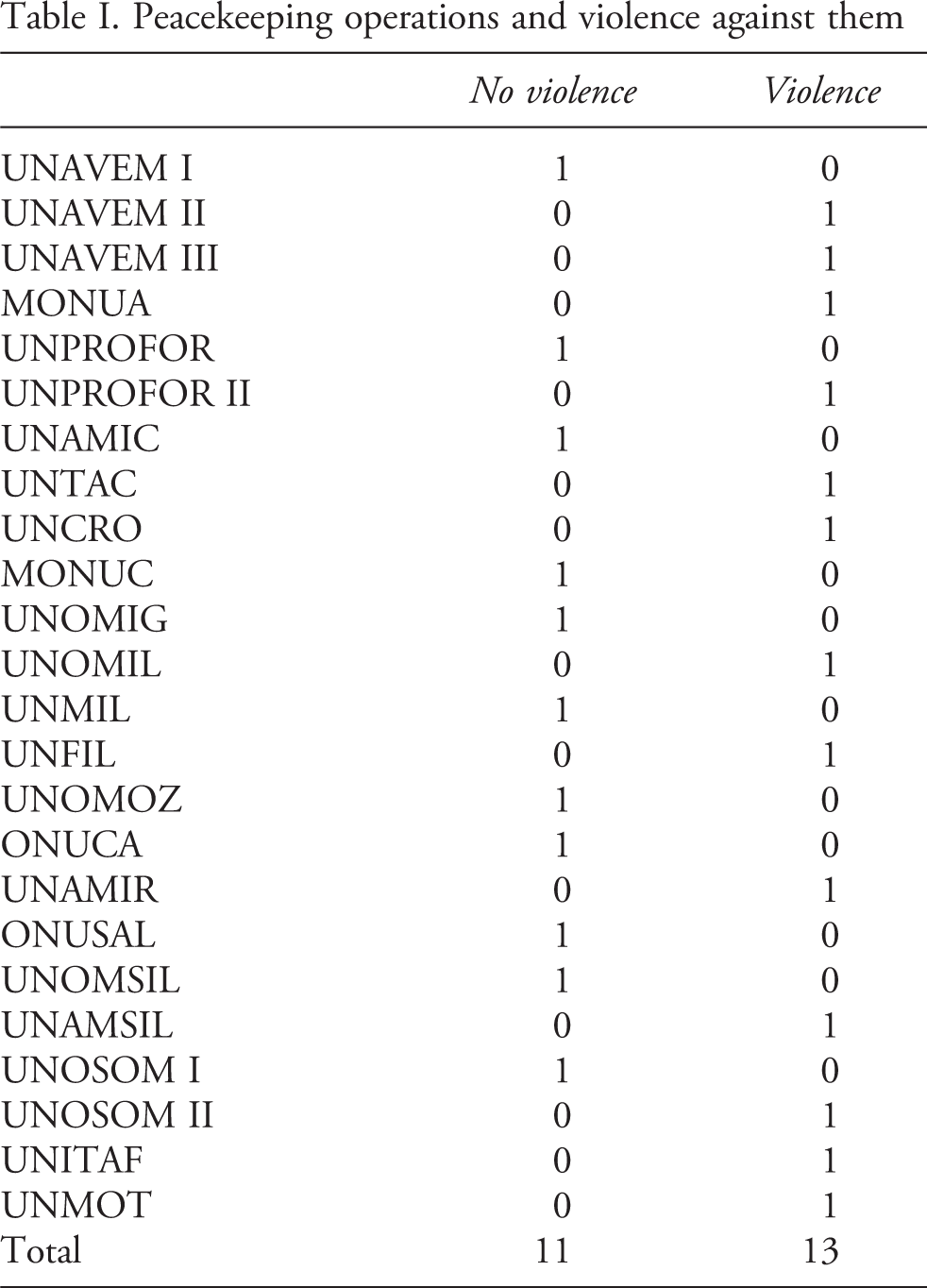
For the 14 years it covers, the dataset includes a total of 24 peacekeeping operations. A majority of these operations (13) experienced rebel group violence directed against peacekeepers at some point during their deployment. Table I shows which peacekeeping operations are included in the dataset and whether or not they were systematically targeted by rebel groups. In total, the dataset contains 99 observations. 5
Peacekeeping operations and violence against them
A power asymmetry in the government’s favor does not necessarily enable government forces to fully defeat a rebel group, for instance due to non-conventional guerilla techniques that might be employed by a rebel group (Hultman, 2007). The Chechen insurgents in Chechnya were outnumbered by Russian soldiers 50 to 1 (Kramer, 2005), but have been successful in fighting the Russians for many years. While Russia argues that the counterinsurgency against Chechen insurgents ended in 2009 and claims its troops are now fighting terrorists (Schwirtz, 2009), there are still hundreds of deaths due to the conflict every year (UCDP, 2012b). Even if a rebel group loses a series of battles, it can easily withdraw into hiding, regroup, and continue the struggle at a later point (Cunningham, Gleditsch & Salehyan, 2009). In order to capture these different dynamics, I also use a measure of relative fighting capacity, as provided in the NSA. Figure 1 shows that while most rebel groups in my dataset are relatively weak in terms of relative strength, many have a high fighting capacity.
I aggregate the NSA dataset to transform it into a dyad-year level of analysis and extrapolate it for the first year after the conflict ends (or fails to reach 25 battle-related deaths) when peacekeepers were still present. I do this in order to capture a sense of the risk peacekeepers face when present right after conflict or in a temporary lull in fighting. 6 I run all models twice with the two different independent variables.
In order to capture the strength of the peacekeeping operation, the size of a peacekeeping mission is coded using information from the United Nations Department of Peacekeeping Operations (UNDPKO), individual mission websites, and Security Council resolutions. Since there might be a discrepancy between mandated troop size and actual troops deployed, if possible the actual troop size is included. Whenever this proved to be impossible, mandated troops are used as an indicator for the size of the peacekeeping mission. Even though peacekeeping operations often do not consist solely of military troops but might also include police forces and civilian personnel, here only the military troops are taken into account. 7
Empirical strategy
Since the dependent variable is dichotomous, I employ a logit model. Following Carter & Signorino (2010), I Distribution of measures of relative strength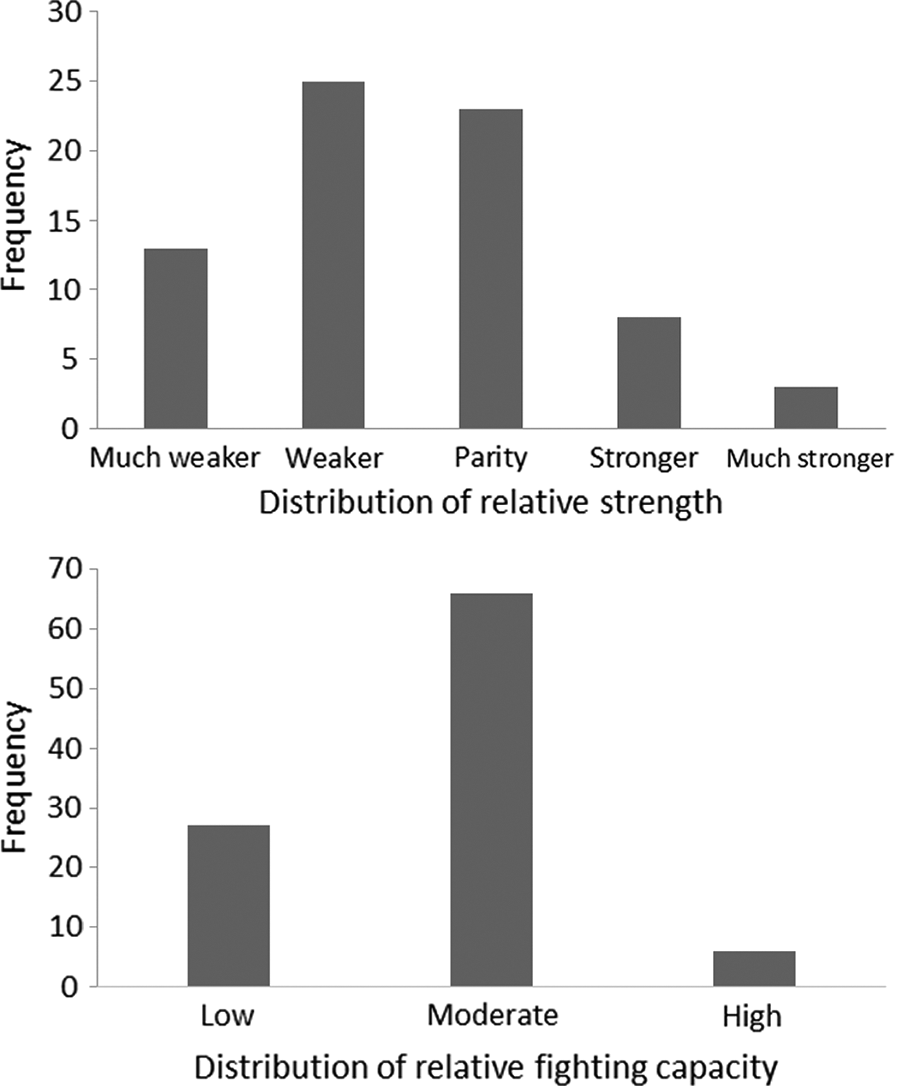
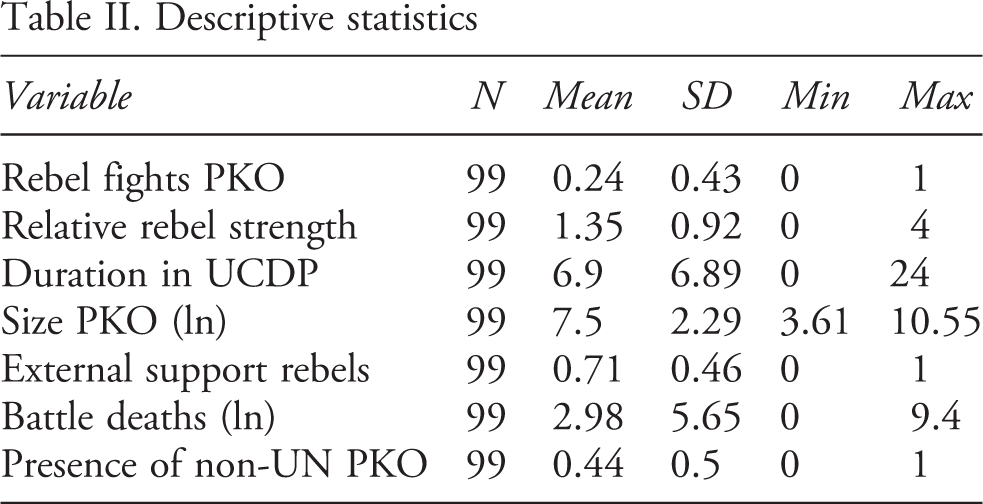
Descriptive statistics
Results and discussion
Cross-tabulation relative rebel strength
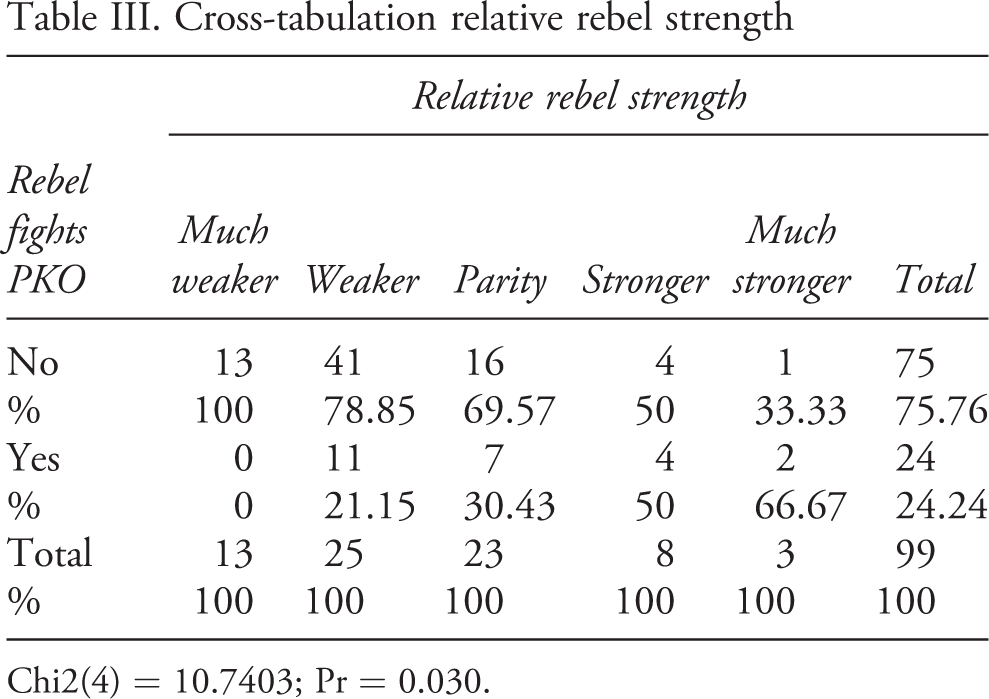
Chi2(4) = 10.7403; Pr = 0.030.
Cross-tabulation relative fighting capacity

Chi2(2)= 12.8242; Pr = 0.002.
Determinants of violence against peacekeepers
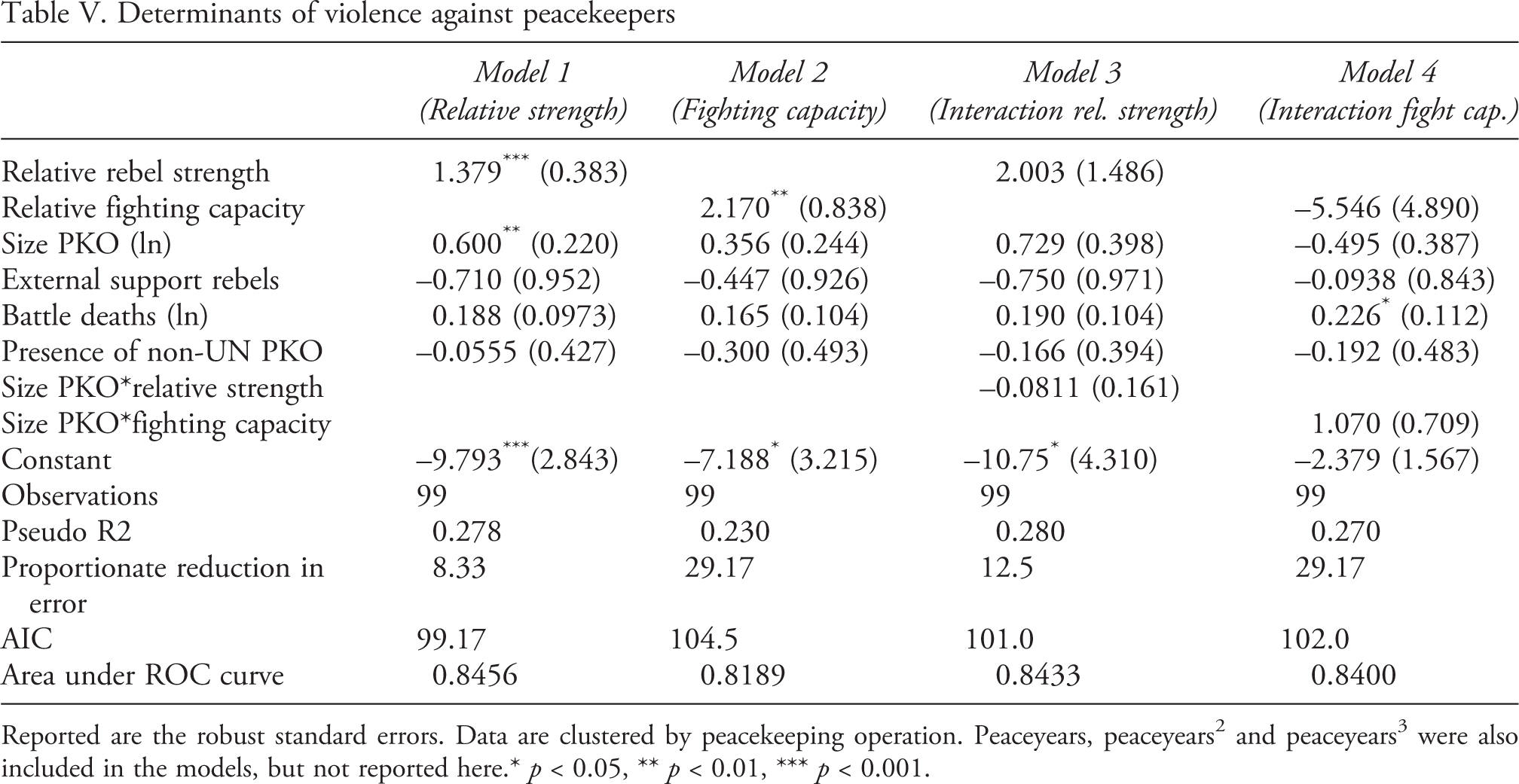
Reported are the robust standard errors. Data are clustered by peacekeeping operation. Peaceyears, peaceyears2 and peaceyears3 were also included in the models, but not reported here.* p < 0.05, ** p < 0.01, *** p < 0.001.
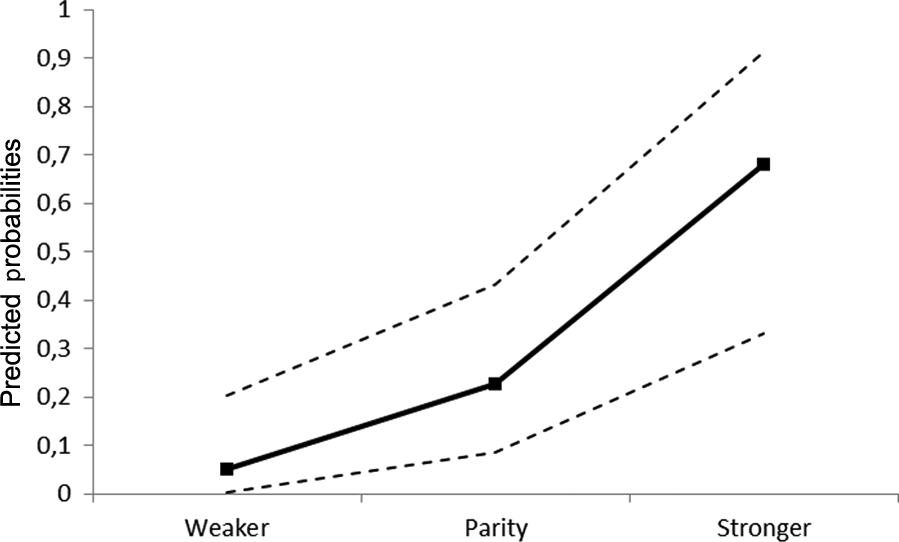
Table V shows the results from the main regressions. In order to examine Hypothesis 1, concerning the relation between a rebel group’s relative strength and the probability that it fights against a peacekeeping operation, I turn to Models 1 and 2. Both these models show results in line with Hypothesis 1. The directions of the effects are positive, appear to be substantial, and are statistically significant. This indicates that as rebels are getting stronger, the likelihood that they fight against peacekeepers is also getting higher. Post-estimation results also show that the effect is substantial. In order to see how large the effect is, Figures 2 and 3 present the predicted probabilities for both measures of rebel group strength. 10
The results are significant and the effect appears to be large: when a rebel group increases its relative strength from parity to stronger, the results show that there is a 31.61% increase in the likelihood that this rebel group will attack a peacekeeping operation. The same is true when looking at fighting capacity: an increase in the relative fighting capacity of a rebel group from moderate to high corresponds to a 45.34% increase in the likelihood that the rebel group is fighting against the peacekeepers. Predicted probabilities of attack against peacekeeping operation based on relative rebel strength, with 95% confidence interval Predicted probabilities of attack against peacekeeping operation based on relative fighting capacity, with 95% confidence interval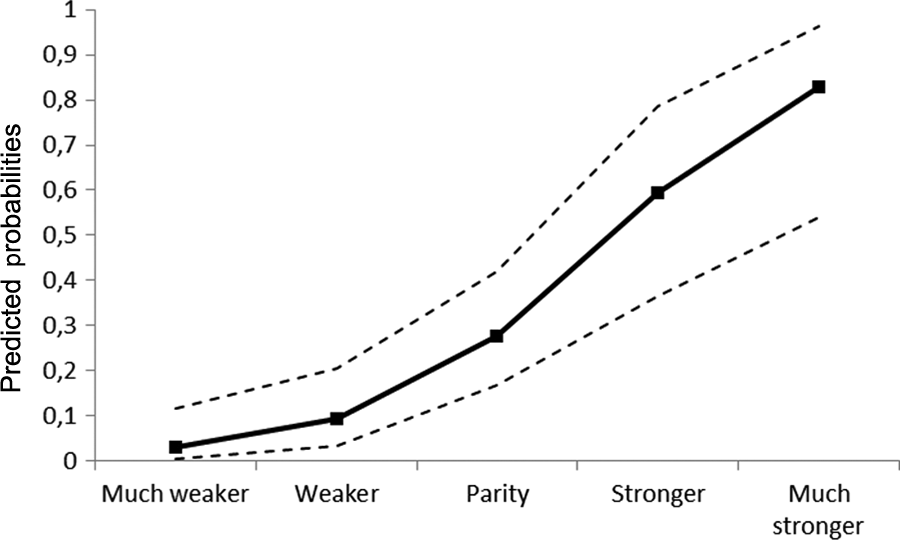
Hypothesis 2 argues that the effect of the relative strength of a rebel group is conditional on the size of the peacekeeping operation. How is the fact that stronger rebels are more likely to fight against peacekeepers influenced by the strength of the peacekeeping operation that the rebels face? Above, I argued that rebels are more likely to attack a stronger peacekeeping operation, because these peacekeepers are more capable of preventing a rebel group victory. Models 1 and 2 in Table V include a variable measuring the size of the peacekeeping operation. The standalone variable measuring the size of the peacekeeping operation is highly significant when looking at the model where a rebel group’s relative strength is the main independent variable, but not in the model with a rebel group’s relative fighting capacity as main independent variable. The models show, however, that while the effect of the size of the peacekeeping mission on the probability that rebels fight against peacekeepers is not significant in all models, the effect of the relative strength and the relative fighting capacity of rebels remains statistically significant when controlling for the size of the peacekeeping operation.
In Models 3 and 4 in Table V, I added the relevant interaction terms between the measures of rebel group strength and the natural log of the number of peacekeepers in a conflict. Neither the interaction terms nor the measures of strength are statistically significant. In Model 5, only the coefficient for the size of the peacekeeping operation is statistically significant. Additionally, in Model 6, the coefficient for relative fighting capacity is in the opposite direction to that expected. This would imply the effect for an increase in relative fighting capacity of a rebel group when there are no peacekeepers present, which is of course not possible in this dataset. These results thus give reason for rejecting Hypothesis 2: on the basis of the current dataset, there is no conditional effect of the size of a peacekeeping operation which influences the probability that rebels attack a peacekeeping operation. 11 In the online appendix (Table B) I report results from models using the type of peacekeeping operation 12 as an independent variable instead of the size of the peacekeeping operation. Results do not differ substantively from models using the size of the peacekeeping operation.
Robustness
In order to see if the main findings are robust to different model specifications, I altered the model in different ways: first, in order to make sure that the results are not dependent on the fact that I cluster them by peacekeeping operation, I also cluster on a country level, by rebel group, and for each peacekeeping operation by itself. 13 The results presented above do not change substantively. Second, since I use the variable for peace years and its squared and cubed terms in my main models to control for temporal dependence, I also run my models with a lagged dependent variable. This changes the assumptions underlying the models: now I assume that previous events have an impact on current events – when controlling for the duration of a conflict, a certain pattern of behavior is taken into account. This does not change the main results.
Since this article is among the first to date to study this type of violence, I had little guidance from previous literature on which control variables to include in my model. In order to see if my results also hold up to different model specifications, I included a different set of control variables: first, I included a variable indicating whether the incompatibility revolved around control over the government or territory. Second, I added a variable estimating whether the rebel group was involved in any kind of negotiations during the year. Finally, I included a measure indicating whether or not the rebels signed a peace agreement during the dyad-year. All data were taken from the UCDP dataset (2012a). Table VI shows the results for these model alterations.
Robustness tests, inclusion of different control variables

Reported are the robust standard errors, clustered by peacekeeping operation. Peaceyears, peaceyears2 and peaceyears3 were also included in the models, but not reported here. * p < 0.05, ** p < 0.01, *** p < 0.001.
In Models 1 and 2 in Table VI, I add the additional control variables to the main models presented above, whereas in Models 3 and 4 the variables used in the previous models are left out. None of the newly added control variables is statistically significant, and model fit statistics show that the variables used in the main models lead to a significantly better model fit. Most importantly, the main results are robust to the addition of these variables: the results do not change in substantive ways. My main finding thus appears to be substantive, significant, and robust to different model specifications.
The main contribution of this article is the finding that, on the basis of the current dataset, there is a positive and statistically significant correlation between a rebel group’s relative strength and the probability that the group fights against peacekeepers. Relatively stronger rebel groups are substantively more likely to attack blue helmets.
Conclusion
Over half of all UN peacekeeping operations between 1989 and 2003 were victims of violence by rebel groups. This article is among the first to date to use violence against peacekeepers as a dependent variable. The aim of this article has been to explain why some rebels fight against peacekeepers, while others do not. Using novel data on violence against peacekeeping operations, I found that rebel groups who are either relatively stronger than the government or have a larger fighting capacity are more likely to attack peacekeepers. This result is in line with my theoretical expectations and is a substantively interesting result: when a rebel group increases in its relative strength compared to the government from parity to stronger, the predicted probability that rebels attack peacekeepers increases by 31%. An increase in the relative fighting capacity from low to moderate increases the probability of attacks against peacekeepers by 18%.
I also hypothesized that stronger rebels would be more likely to fight against a strong peacekeeping operation, since they could avoid fighting against weaker operations. For this argument I found only ambiguous results. First, the effect of the relative strength of a rebel group remains statistically significant when including the size of a peacekeeping operation in the models. However, when including an interaction term, the results are not statistically significant. Thus, it appears that there is no conditional effect of the size of a peacekeeping operation on the likelihood that rebels attack peacekeepers. This also implies that more work is needed to assess if and how the size of a peacekeeping operation influences the likelihood that rebels attack peacekeepers.
While some of the results in this article remain inconclusive, the main theoretical argument holds up against statistical testing. The main finding not only gives us insight into the risks peacekeepers face but is also a novel contribution to the peacekeeping literature. It shows that it is not only the design of the peacekeeping operation which matters (or perhaps not at all), but that local conflict dynamics are also important for understanding the interactions between conflict actors and peacekeepers.
This article needs to be seen as a first probe into rebel violence against peacekeepers. There is especially a need for more elaborate data moving beyond the dyad-year level of analysis in order to also study the more nuanced empirical patterns. I was able to test whether or not there is a statistically significant correlation between the relative strength of a rebel group and the probability that these rebels fight against peacekeepers. Further studies should examine the causal mechanism underlying my theoretical argument in ways that are not possible with the data and analysis drawn on here. In particular, qualitative work studying the role of ‘teasing away peacekeepers’ is necessary. Additionally, the use of geo-coded data will help to link the attacks against peacekeepers to civil war dynamics. Interesting other avenues that open up are the intensity and the timing of violence against peacekeepers.
This article attempted to provide a first insight into the puzzling phenomenon of violence against peacekeepers. This is an important and new field of research that needs further study. Attacks on peacekeepers could have serious policy implications when such violence possibly leads to the withdrawal of the mission, or significantly alters the behavior of the peacekeepers. Questions that are important to answer can be related to the war aims of rebel groups who fight against peacekeepers or governmental violence against peacekeepers. It can be fruitful to link this research with the literature on biased mediators and general literature on third-party interventions. But above all, it will be fruitful to further investigate the causal mechanism behind rebel group violence against peacekeepers, through refining the analysis in this article with more fine-grained data and through qualitative work. Since more than half of all UN peacekeeping operations are targeted by rebel groups at some point, it is important to understand in more detail the mechanisms through which this works.
Footnotes
Replication data

Acknowledgments
I would like to thank Han Dorussen and two anonymous reviewers for excellent suggestions on how to improve this manuscript. Furthermore, I would like to express my thanks to Magnus Öberg, Mats Hammarström, Sara Lindberg Bromley, Nina von Uexkull, Hanne Fjelde, Niklas Karlén, Johannes Kruse, and participants at the research seminar at the Department of Peace and Conflict Research, Uppsala University.
Notes
References
Supplementary Material
Please find the following supplemental material available below.
For Open Access articles published under a Creative Commons License, all supplemental material carries the same license as the article it is associated with.
For non-Open Access articles published, all supplemental material carries a non-exclusive license, and permission requests for re-use of supplemental material or any part of supplemental material shall be sent directly to the copyright owner as specified in the copyright notice associated with the article.
