



Abstract
If a civil war begins, it is more likely to be initiated by an ethnic group than any other type of group. We argue that ethnic groups, on average, are likely to have more grievances against the state, are likely to have an easier time organizing support and mobilizing a movement, and are more likely to face difficult-to-resolve bargaining problems. We further argue that each of these factors was likely due to three pre-existing patterns associated with ethnicity. First, when political power is divided along ethnic lines, ruling elites can disproportionately favor their own ethnic group at the expense of others. This creates grievances that fall along ethnic lines. Second, ethnic groups tend to live together in concentrated spaces, sharing the same language and customs, and enjoying deep ties with ethnic kin. This means that ethnic groups, if they are aggrieved, will have an easier time mobilizing support to demand change. Third, the fact that ethnic identity tends to be less elastic than other types of identity means that credible commitments to any bargain – before and during a conflict— will be more difficult to make. The result is that ethnic groups will have a greater number of reasons, opportunities, and incentives to mobilize and fight than non-ethnic groups.
Since 1946, 64% of all civil wars 1 have divided along ethnic lines. Ethnic identity played an influential role in civil wars in Iraq, Lebanon, Congo, Burundi, Syria, Sudan, Uganda, Pakistan, Rwanda, Georgia, and Nigeria (to name a few). This large ratio of ethnic to non-ethnic civil wars is intriguing for two reasons. First, societies organize themselves along many different lines – class, geography, political ideology, religion, and ethnicity, for example – yet when societies go to war it is usually between groups defined by ethnicity (Blattman & Miguel, 2010). Second, ethnic civil wars do not appear to be driven by ethnic tensions per se. Although these disputes break down along ethnic lines, fighting appears to be driven by the same grievances that drive non-ethnic groups to rebel. 2 Given that most civil wars are motivated by similar complaints and an overall desire for change, why do most divide along ethnic lines?
The most obvious answer is that civil wars include many self-determination movements that, by definition, are ethnic in nature. 3 Self-determination often emerges as a result of ethnic nationalism – the desire of an ethnic group to gain political independence from the state – making ethnicity an inevitable feature of a conflict (Smith, 2000). Moreover, ethnic minorities living far from the capital, along remote international borders, and in geographically concentrated areas are also in a ready-made position to create their own state (Wucherpfennig et al., 2011; Cederman, Girardin & Gleditsch, 2009). It is no surprise, therefore, that combatants fighting civil wars often break down along ethnic lines if self-determination conflicts are included in the universe of cases.
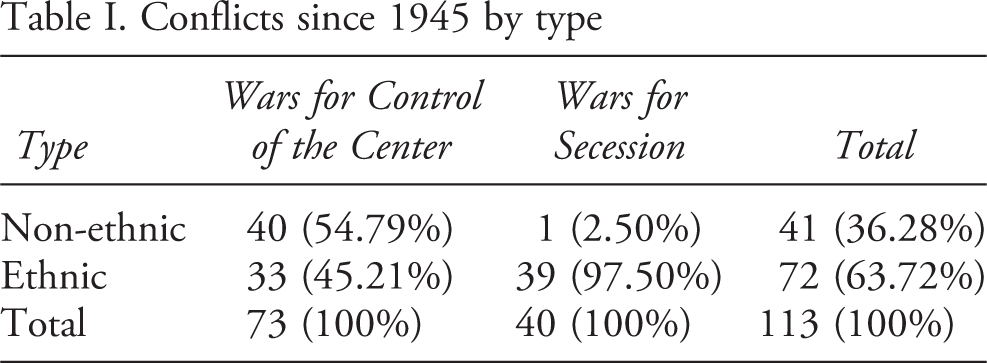
However, even if one removes secessionist movements from the list of civil wars, the puzzle remains. Almost half of the remaining civil wars (all of which are fought for control of government) are started by rebel groups with a different ethnicity from the government (33 of 73 cases, or 45%). Given that many types of societal groups experience discrimination (lower classes and castes, women, homosexuals, etc.), ethnicity is still the most prominent feature around which rebellions are organized.
Any discussion of ethnic conflict requires serious attention to how an ‘ethnic group’ is defined. Scholars have defined ‘ethnicity’ in various ways such as utilizing the characteristics of a group, its cultural context, or the lenses used by external analysts to define a group (Brubaker & Laitin, 1998). Nevertheless, the literature generally agrees that ethnicity is tied to culture (Nagel, 1994) and involves individuals identifying with each other based on shared characteristics such as appearance, language, religion, or traditions (Horowitz, 1985). Barth’s (1969) seminal work outlines four criteria for an ethnic group: it must (1) be predominantly self-perpetuating, (2) share core cultural values, (3) serve as a sphere for communicating and interacting, and (4) have a membership that can be self-identified and identified by others based on the group’s commonalities.
We argue that an individual’s membership in an ethnic group tends to be more stable – particularly across generations – and more clearly identifiable than other types of non-ethnic political memberships such as political ideology or class. This does not mean that the bounds of ethnic groups are static or impervious to change. A rich literature addresses when and how ethnicity can be constructed (May, 2011), suggesting that ‘ethnic groups’ are defined by the context in which they find themselves (Barth, 1969). Ethnic identity can be crafted from within a group as a response to a changing political environment or the frustrations of the modern industrial state (Gellner, 1994, 1997). Alternatively, ethnic identity may be manipulated by a leader as a way to mobilize a segment of the population and gain political support (Brubaker, 2004). This raises the question of ethnicity’s causality in conflict: if ethnicity is at least partially subjective, is it used internally to build solidarity in response to latent catalysts of conflict (disenfranchisement, power imbalances), or does the exogenous definition of ethnic lines create tensions that themselves increase the likelihood of conflict? Further research would be valuable in understanding the actors and causal pathways that promote ethnic group identification.
Regardless of the extent to which ethnicity can be constructed – and by whom – the question remains: Why do so many conflicts divide along ethnic lines even when excluding nationalist secession movements? The existing civil war literature that addresses ethnicity can roughly be broken down into two categories, neither of which addresses this question. One looks at the universe of all ethnic groups and attempts to explain why some of these groups are motivated to launch rebel movements while others are not (Horowitz, 1985; Posen, 1993; Gurr & Harff, 1994; Fearon, 2006; Laitin, 2007; Cederman, Wimmer & Min, 2010). A second category looks at the universe of all countries and attempts to explain whether a state’s ethnic characteristics make a country more or less likely to experience civil war (Fearon & Laitin, 2003; Collier & Hoeffler, 2004; Posner, 2004; Blimes, 2006; Montalvo & Reynal-Querol, 2010). These literatures tell us why one ethnic group might rise against the state while another ethnic group does not, and what ethnic and demographic traits of a country may contribute to its risk of civil war. Yet, neither body of research explains why individuals tend to organize rebellions around ethnicity rather than some other identifying feature.
Conflicts since 1945 by type
Conceptualizing ethnic civil war: The phenomenon
Ethnic civil wars are common
To define our universe of civil war cases, we apply the ethnic conflict classifications from the Ethnic Armed Conflict dataset (Cederman, Wimmer & Min, 2010) to civil war data from the PRIO Battle Deaths Dataset Version 3.0 (Lacina & Gleditsch, 2005). 4 The Ethnic Armed Conflict dataset classifies ethnic wars as involving ‘conflicts over ethnonational self-determination, the ethnic balance of power in government, ethnoregional autonomy, ethnic and racial discrimination (whether alleged or real), and language and other cultural rights’; all other aims are defined as non-ethnic. We specifically consider conflict cases that exceed the 1,000 battle death threshold, a criterion for a case to be classified as a civil war (Fearon & Laitin, 2003).
Table I reveals that the majority of civil wars since 1946 have broken down along ethnic lines. 5 Even removing secessionist wars from the data (98% are defined as ethnic conflicts), 45% of the remaining conflicts for central government are considered ethnic civil wars. These frequencies, and additional patterns discussed below, hold for smaller conflicts below the 1,000 battle death threshold.
Figure 1 shows the frequency of all civil wars initiated since 1946 in five-year increments, distinguishing between ethnic and non-ethnic conflicts. It illustrates how ethnic civil wars have dominated almost all periods since the end of World War II. 6
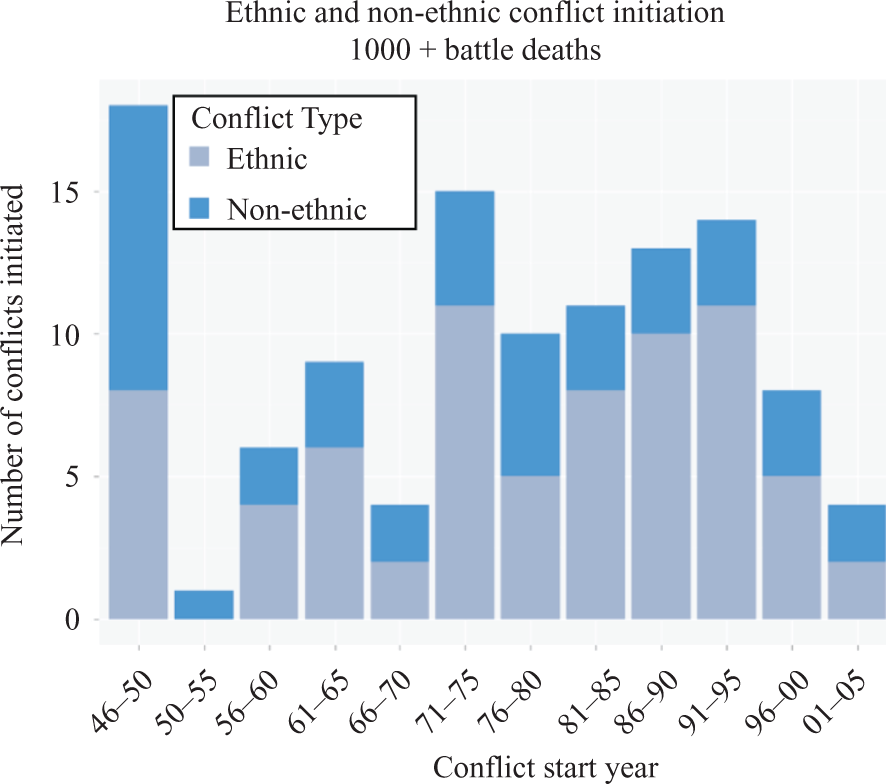
Distribution of civil conflict initiation since 1945
Ethnic civil wars take longer to resolve than non-ethnic civil wars
The mean duration for ethnic civil war between 1946 and 2005 was 13.7 years while the average non-ethnic civil war lasted 8.3 years. This average difference of 5.5 years is indicative of a larger trend which can be seen in Figure 2, which compares the frequency of the two types of civil conflict (ethnic or non-ethnic), graphing the underlying distribution of civil war duration for cases in each conflict category. A higher proportion of non-ethnic conflicts lasted the shortest duration (under eight years), while proportionally more ethnic conflicts lasted longer than eight years. 7 Of the 13 conflicts lasting over 25 years, only two (clustered at the 40-year mark) are non-ethnic. Both analyses of mean duration and distribution of duration frequency show ethnic conflicts last longer on average.
The data reveal three important patterns. First, if a civil war emerges, there is nearly a two-thirds likelihood that the conflict has an ethnic dimension. For the last 60 years, ethnicity has remained a defining feature of the majority of civil wars. Second, once an ethnic faction initiates a civil war, it is likely to continue fighting longer than if a non-ethnic group had initiated the war.
8
Third,
Duration of ethnic and non-ethnic conflict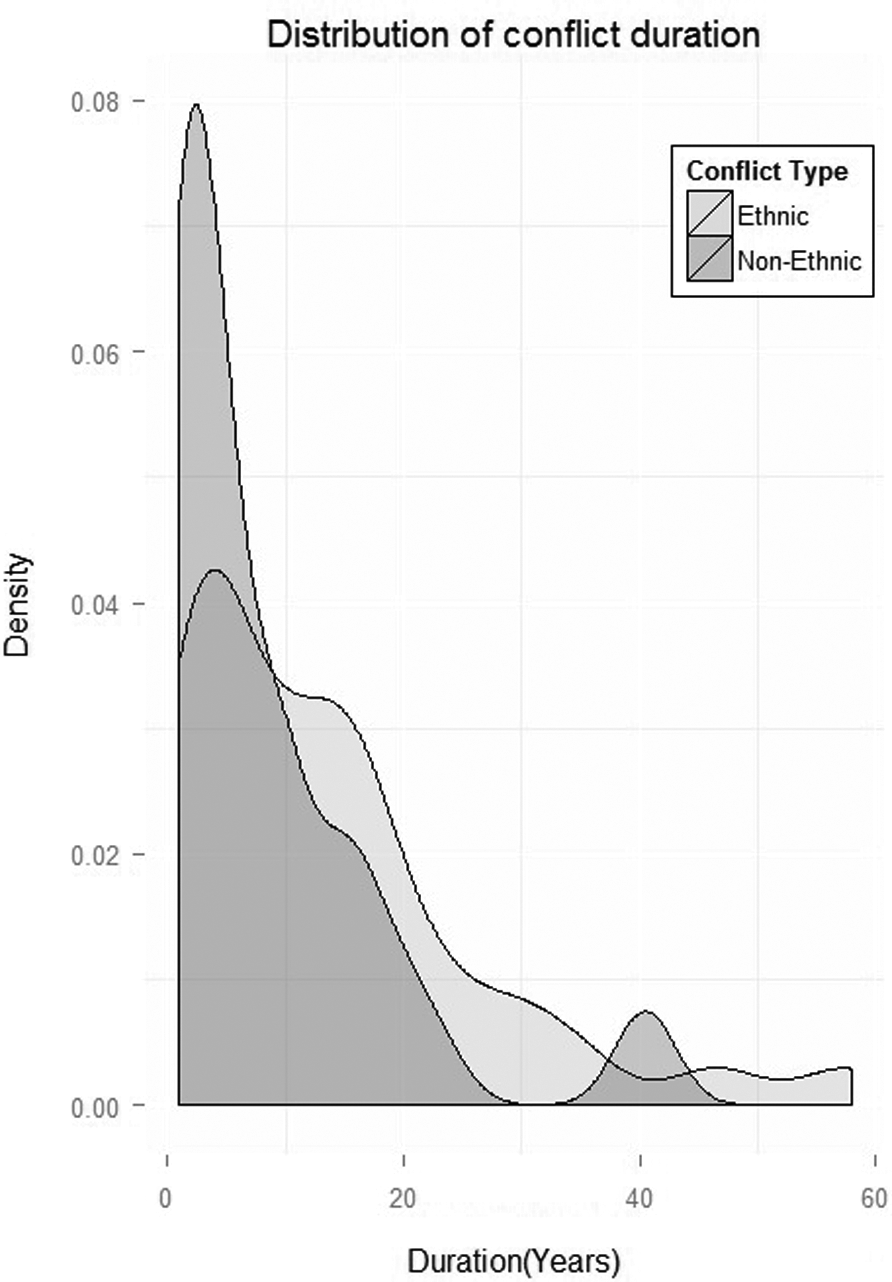
Theoretical framework
The main goal of this article is to offer a theoretical framework for explaining why so many rebel movements are organized (intentionally or not) along ethnic lines. To do this, we draw from the existing literature on grievances, opportunity, and bargaining failures. Catalysts of conflict begin at the most basic level. In order to have a motive to rebel, individuals first must feel aggrieved by the state and be deeply dissatisfied with the status quo (Gurr, 2000). 9 Most aggrieved individuals, however, never rebel (Laitin, 2007). For an organized rebellion to take place, individuals must also be able to coordinate their activity, evade government repression and mobilize sufficient soldiers to threaten war (Collier & Hoeffler, 2004; Fearon & Laitin, 2003). Having deep grievances and building an effective rebel organization, however, are still not sufficient to explain the outbreak of war. For war to occur, a third factor must be present: leaders on both sides of the dispute must be unable to reach and implement a settlement short of war. Groups of individuals that experience all of these conditions should be significantly more likely to rebel than those that do not.
We believe that civil wars so often separate along ethnic lines because grievances, opportunity, and bargaining problems tend to fall disproportionately along ethnic lines, making mobilization easier and more probable. Ethnic groups are more likely to have grievances against the state in part because political power has historically been divided along ethnic lines and because groups tend to migrate along ethnic lines. Ethnic groups are also more likely to have the opportunity to rebel because they are more apt to live in concentrated or geographically peripheral areas. Finally, ethnic groups are also more likely to face difficult bargaining problems partially because ethnic allegiances tend to be more fixed than other types of allegiances, making promises to cooperate across ethnic lines less credible.
Ethnic groups and grievances
The first wave of civil war theory focused heavily on group grievances as the main driver of civil war, and dissatisfaction was seen as arising from at least two sources. Horowitz (1985) argued that groups are more likely to rebel if they had been actively discriminated against by the state. Discrimination could be the result of past colonial policies that have become entrenched, or because a dominant ethnic group consolidated its power and instituted ethnically biased policies to maintain its grip on control. 10 Similarly Gurr (1993) argued that civil wars are most likely in countries where a particular group is economically, politically, or culturally disadvantaged relative to other groups in society (see also Gurr & Moore, 1997).
Still others have argued that dissatisfaction is likely to emerge in countries with high levels of poverty (Boix, 2003), low levels of economic growth, and poor living conditions (Russett, 1964; Gurr, 1970/2010; Scott, 1977; Paige, 1978). The greater the poverty and hardship individuals are forced to endure, the more likely they are to rebel (Fearon & Laitin, 2003; Hegre & Sambanis, 2006; Murdoch & Sandler, 2002). This was also thought to be true relative to other groups in society. Disparities in power between different groups in society, or in their access to government positions, were also considered a structural source of discontent (Wimmer, Cederman & Min, 2009; Cederman & Girardin, 2007).
Each of these arguments applies particularly well to ethnic groups since political and economic power is frequently distributed along ethnic lines (Horowitz, 1993). 11 An ethnic division of power may be the result of colonial practices that favored one ethnic group over another, as was the case in Rwanda, Uganda, and Nigeria (Horowitz, 1985; Laitin, 1986; Young, 1994; Keefer, 2008). It may also result from imperial practices, as occurred in the Soviet Union when ‘titular’ ethnic groups were favored at the expense of larger, more dominant ethnic groups (Gorenburg, 2006). It may arise from simple demographics where the largest ethnic group in a country was able to consolidate power as the state was being constructed (the Castilian people of Spain, for example). Or it may result from redrawing international boundaries as a consequence of victory and defeat in war (the break-up of the Austro-Hungarian empire resulted in a number of multi-ethnic states, such as Czechoslovakia, with one dominant ethnic group and a host of minority groups) (Smith, 1986, 1989).
Dividing political power along ethnic lines, however, is significantly more likely to create grievances if the ruling ethnic group uses its position to discriminate against other ethnic groups (Cederman, Weidmann & Gleditsch, 2011). This can take the form of political exclusion, where those in control make it impossible for other ethnic groups to compete for political power (Rabushka & Shepsle, 1972; Rosenblum, 2007). It can involve linking strong nationalist rhetoric to a ruling ethnicity as a strategy to maintain power (Padró i Miquel, 2007; Kaufman, 1996). It can also take the form of economic discrimination, where the ruling ethnic group disproportionately directs resources to its own members at the exclusion of others (Chandra, 2007). Another factor could be cultural or social discrimination, where the governing ethnic group outlaws the language and cultural practices of other ethnic groups (Sisk, 1996). Ethnic groups who are discriminated against not only become resentful of the privileges enjoyed by those in power but are also more likely to experience poverty and hardship. These practices create cumulative inducements for those individuals to demand change.
Members of ethnic groups are also likely to have greater grievances due to migration patterns and the conflicts these movements can produce with other ethnic groups. Large-scale migration as well as human settlement has commonly occurred along ethnic lines, whether within a country’s borders, between developing countries, or from developing to developed countries (Hoerder, 2002; Castles & Miller, 2009). 12 Such migration patterns can be driven by decisions at the household level, where a family voluntarily migrates in search of higher income, sometimes encouraged by government policy (such as Han Chinese migration to minority regions) or due to scarce resources (as in Darfur, Sudan). Ethnicity-based immigration policies of the receiving country have also influenced which groups of migrants are able to enter (Joppke, 2005).
At the group level, large sets of individuals may be forced to migrate due to war (Salehyan, 2008), ethnic cleansing, or new international boundaries (consider Congo’s conflict in the late 1990s). In both cases, individuals tend to settle with members of the same ethnic group creating competition for limited resources that falls along ethnic lines (Salehyan & Gleditsch, 2006). Violence can then break out if disputes over natural resources and/or strong inequalities in treatment across groups go unresolved (Østby, Nordås & Rød, 2009).
Ethnic groups and the opportunity to rebel
While many members of ethnic groups have grievances against their governments, few actually organize a rebellion (Fearon & Laitin, 2003; Laitin, 2007). Indigenous tribes in South America are some of the most discriminated-against groups in the world and yet have remained surprisingly quiescent. The second wave of civil war theory, therefore, emerged to try to explain why underlying grievances were insufficient to convince individuals to rebel.
According to this literature, aggrieved individuals also require the opportunity to mobilize an armed movement (Fearon & Laitin, 2003; Hegre et al., 2001; Collier & Hoeffler, 2004). Three conditions have been proposed as necessary to make rebellion feasible: (1) a base of support, (2) money and supplies, and (3) a weak central government.
Base of support
Individuals wishing to challenge the state and sustain a rebellion must have a base of support. This enables individual leaders to recruit soldiers willing to fight for the movement (Gates, 2002; Walter, 2004) and provides a safe haven from which the rebels can operate and leaders can evade capture (Collier, 2003). Movements that do not have such a support base or are unable to retain their popularity – like the Red Brigades in Italy since 1988 – are unlikely to remain viable (Weinstein, 2005, 2007).
Concentrated ethnic groups are likely to have an advantage in both of these areas. First, rebel leaders may have an easier time incentivizing co-ethnics to join a movement (Gates, 2002; Humphreys & Weinstein, 2006). Common language and culture facilitate the spread of ideas and information needed for leaders to gauge internal support for the cause (Bates, 1983). Leaders can then draw from a set of individuals whose spatial proximity and dense social networks make it easier for elites to identify relevant members and coordinate recruits (Weidmann, 2009; Fearon, 2006; Esteban & Ray, 2008).
Individuals who speak the same language can also better maintain group trust and accountability (Laitin, 2007) and reduce free-riding (Fearon & Laitin, 1996). According to Bueno de Mesquita et al. (2004) rebel leaders face a time inconsistency problem when seeking supporters. Once conflict ends, leaders of the winning side have little incentive to redistribute spoils to their supporters; knowing this, potential recruits have no reason to believe leaders’ promises of war spoils as a reward for joining the cause. Ethnic groups, however, are uniquely poised to overcome this challenge: shared ties provide incentives for leaders not to defect, both to benefit one’s extended group and because informal network ties help ensure a leader is punished if the promised benefits of a victory are not shared with co-ethnics. Because of this accountability structure, ethnic group members are more willing to join a nascent movement and remain with it.
Finally, ethnic leaders are also likely to have an easier time evading government capture because of the advantages of geography and social sanctioning. Leaders operating from ethnic enclaves, especially in peripheral and hard-to-reach areas, will be more difficult to apprehend than leaders operating in more accessible regions. They are also less likely to be renounced and turned in by neighbors and fellow citizens, since ethnic groups are better able to punish traitors (Moore, 1993; Ostrom, 1990; Petersen, 2001; Weinstein, 2007).
Financing
Recruiting soldiers, building popular support, and evading capture will not be sufficient to conduct a war in the absence of financing. Financing can come from outside patrons (such as diaspora groups, NGOs, or sympathetic third parties), from access to and trade in natural resources (such as diamonds or drugs), or from the production of agricultural products (such as cashew nuts and bananas) (Ballentine, 2003; de Soysa & Neumayer, 2007; Gilmore et al., 2005; Humphreys, 2005; Le Billon, 2001; Ross, 2004). Ethnic cohesion means that groups are more likely to be geographically concentrated, giving them greater access to and control over resources on those lands. If an ethnic group is concentrated along an international border, then engaging and trading in criminal activity will also be easier.
Ethnic groups are more likely to benefit from the support of ethnic kin outside their territory (Collier & Hoeffler, 2004). Because migrants tend to settle with other co-ethnics (Edin, Fredriksson & Åslund, 2003), large diaspora communities have emerged in wealthy immigrant countries such as the United States, Australia, and Canada (Sheffer, 2003). 13 These communities tend to be better organized than other types of groups, have strong ties to the home community, and are willing to channel resources back home. The Irish Republican Army of Northern Ireland, for example, was sustained for many years by donations from the Irish diaspora in the United States (Hanagan, 1998). The same is true of the Tamils living in North America, Europe, and the Middle East (Biersteker & Eckert, 2007; McDowell, 1996; Wayland, 2004; Al-Ali & Koser, 2004; Cheran, 2003). Groups organized by ethnicity are also more likely to have ethnic kin living in neighboring countries, making the cross-border movement of arms and soldiers easier (Salehyan, 2008). These facts suggest that rebel leaders who are able to organize along ethnic lines will be better positioned to gain and maintain the material support needed to sustain a rebellion (Lidow, 2011).
State capacity
Even leaders of wealthy ethnic groups, however, will have difficulty launching a rebellion if the state can thwart their attempts to build a movement. The better able leaders are to evade government repression, the better able they will be to organize. Again, leaders of ethnic groups are likely to have an advantage in evading government repression when the group is located in geographically isolated areas, as was the case with the Tuareg in Mali or Kachin State in Myanmar. Groups located in remote areas show higher correlations with likelihood of rebellion (Buhaug & Lujala, 2005; Buhaug, Gates & Lujala, 2009; Cunningham & Weidmann, 2010; Cederman & Girardin, 2007).
In sum, common language, customs, and cultural ties make coordinating a movement and maintaining its cohesion easier. The geographic concentration of ethnic groups makes it easier for rebel movements to extract resources and evade repression. Ethnic diasporas and cross-border kin can then offer these movements financing and support. Together these factors suggest the ways in which strong ethnic ties can be used to enhance the opportunity to rebel in ways not available to other types of groups.
Ethnic groups and bargaining problems
Understanding the connections between grievance, opportunity, and ethnic identification still does not thoroughly explain the strong connection between ethnicity and civil war. If ethnic groups are more likely to have grievances against the state and are also better able to organize a rebellion, then governments should be aware of this connection and offer solutions that allow both parties to avoid war. Violence occurs in part because leaders on both sides are choosing not to settle.
The third and most recent wave of civil war theory – bargaining theory – has sought to explain why parties engaged in a dispute choose to resolve their dispute through violence rather than bargaining (Fearon, 1995; Garfinkel & Skaperdas, 2000; Walter, 2002, 2009; Powell, 1999). This literature’s central insight is that war is costly and inefficient so disputants should be better off negotiating a compromise and dividing the stakes without first suffering the pain of war (Fearon, 1995). 14 Successful negotiation, however, requires at least three conditions. First, governments and leaders of disaffected groups must be fighting over stakes mutually perceived to be divisible. Second, agreement must exist about the groups’ relative strength and the likely outcome of war. This enables a fair and acceptable division of stakes. Third, both parties must be able to enforce the terms of a settlement to maintain peace over time. If war occurs, it is because at least one of these three conditions is not met.
We believe so many civil wars divide along ethnic lines because leaders of ethnically based opposition groups face particularly severe divisibility and commitment problems. We also believe this is the reason ethnic civil wars tend to last longer than non-ethnic civil wars. The more severe the bargaining problems, the less likely a conflict is to end in a negotiated settlement, and the longer it is likely to last.
Divisibility problems and ethnic civil war
In theory, divisibility issues should be relatively easy to resolve (Fearon, 1995; Powell, 1999). 15 Disputants should be able to divide the stakes – whether political or territorial – in a variety of creative ways. The Conservative and Liberal parties in Colombia, for example, agreed in 1958 to alternate control over the presidency. Political autonomy can also be transferred down to the regional level, as occurred in Aceh in 2005 where rebels were guaranteed a share of political and territorial control. Disputants can also offer side-payments to the party who relinquished claims to a stake.
In reality, some disputants may be less willing to divide certain stakes such as territory because it holds great symbolic value to group members (Goddard, 2006; Hassner, 2003; Toft, 2006). 16 ‘How else,’ Toft asks, ‘can we explain why, in places like Jerusalem and Kosovo, men and women not only are willing to die but also allow their sons and daughters to die just to remain in their homeland?’ (Toft, 2003: 1). Ethnic groups are likely to have deeper ties to territory for historical or cultural reasons or simply because they have inhabited a piece of land for a long time (Hensel, 2000). This creates a situation where members of an ethnic group may place greater value on retaining a piece of territory, making the group more likely to fight for it and less amenable to side-payments (Holsti, 1991).
Information problems and ethnic civil war
Other scholars have focused on private information disputants have regarding their capabilities and resolve, as well as the incentives they have to withhold or misrepresent this information. According to Fearon (1995), parties involved in a dispute may have incentives to conceal aspects of their military strength if this information contains crucial secrets necessary to prosecute a successful war. In other cases, they may have incentives to exaggerate how strong they are if this could convince their opponent to offer them better terms for peace. If governments and potential rebels feel the need to withhold or misrepresent information, and if reliable information is otherwise difficult to obtain, then agreement on the terms of a settlement will be difficult to reach.
We do not believe that information problems are the main driver of ethnic civil war in part because we believe governments are likely to have relatively high-quality information about the strength of ethnic groups and their commitment to change. Macro-level dispersion of ethnic groups within a country tends to be relatively predictable (Weidmann, 2009; Lake & Rothchild, 1996). This is less the case with other types of groups – such as those based on class or ideology – where identification with a group is more fluid, and individuals’ activity within these groups more difficult to follow.
The fact that ethnic civil wars generally last longer than non-ethnic civil wars supports this claim. 17 If private information and incentives to misrepresent are causing civil wars to break out between ethnic groups and the government, then settlements should be reached soon after fighting has commenced (Fearon, 2004; Powell, 2006). Governments should update their beliefs that they are facing a committed opponent and offer whatever deal is necessary to buy peace. We know, however, that civil wars involving ethnic divisions actually last longer (Fearon, 2004) and are not easily resolved in a negotiated settlement (Kaufmann, 1996; Roeder & Rothchild, 2005; Hartzell & Hoddie, 2007). The duration and outcome of ethnic civil wars therefore suggests that information problems are not the main factor causing these wars to break out and last as long as they do. 18
There is, however, one information problem that may account for the higher rate of ethnic civil war. Governments have private information about their willingness to fight nascent uprisings and may have incentives to misrepresent this willingness if they face multiple potential challengers. In a situation where the state includes a large number of ethnic groups, the government may have strong incentives to invest in a reputation for fighting in order to deter additional challenges over time (Walter, 2006a,b).
Commitment problems and ethnic civil war
Any negotiated solution to disputes between a dissatisfied ethnic group and the government likely requires political reform and power-sharing. To credibly commit to such a deal, however, the government and rebel leaders must convince each other that they will honor the terms of the agreement. Because power-sharing is likely to be determined in part by demographics (i.e. each side receives a share of political power commensurate to its share of the population at the signing of the settlement), any change in demographics will make it difficult for the side expected to grow in size to credibly commit to the deal (Fearon, 1995, 2004; Powell, 2004). This creates incentives for members of the weaker side to fight to a decisive solution while their strength is relatively high, rejecting a settlement that is likely to leave them weaker over time.
Ethnic groups are particularly vulnerable to this commitment problem due to the relatively fixed nature of ethnic identity and the play of ethnic politics. Ethnic demographics tend to evolve in predictable ways. Muslims in Lebanon, for example, have had a significantly higher birth rate than Lebanese Christians for much of the 20th century, which has fundamentally changed the demographic balance in that country. Groups attempting to negotiate a settlement, therefore, can look ‘down the road’, anticipate who is likely to be stronger in the future, and anticipate that the agreement cannot be enforced over time.
The fixed nature of ethnic identities can also affect the credibility of commitments in a second way. Negotiated settlements rarely emerge when a plurality of citizens reject the terms being demanded by the rebels as their price for peace (Fearon, 2004). In these cases, governments may wish to grant concessions to an ethnic minority group, but unless politicians can insulate themselves from the play of majoritarian politics, they cannot credibly promise to implement these reforms. Successive presidents in the Philippines, for example, have struggled to reassure Muslims in Mindanao that they will faithfully transfer political autonomy given how unpopular the transfer is with the majority Christian population.
In short, commitment problems ultimately stem from the relative predictability of ethnic demographics and voting patterns. Not only are people’s ethnic identities less open to change than their class affiliation, geographic location, or party identification, but ethnic identity is also one of the best predictors of how individuals are likely to vote, now and in the future (Hutchings & Valentino, 2004; Hajnal & Trounstine, 2013). One implication is that the relatively unchanging nature of ethnic identities allows both sides to predict current and future voting power (Lake & Rothchild, 1996). The side known to be stronger, or that is known to be gaining strength, will struggle to credibly commit to honoring the original agreement making war more likely. Commitment problems, therefore, not only help explain our first puzzle – why so many civil wars are initiated by ethnic groups – but also our second puzzle – why ethnic civil wars last so much longer than non-ethnic wars.
Next steps
The main goal of the article was to offer a basic framework for why so many civil wars have an ethnic dimension. We argued that ethnic groups, on average, are likely to have more grievances against the state, have an easier time organizing support and mobilizing a movement, and face more difficult-to-resolve bargaining problems than groups organized along other lines. This was likely due to three factors: the ways in which political power has historically been divided, leaders’ ease of mobilizing support to demand change, and the relatively non-fluid nature of ethnic identity. The result is that members of ethnic groups will have greater incentives and opportunities to fight the government than members of other types of groups.
We do not suggest that all members of all ethnic groups have the desire and the ability to rebel, or that members of different types of identity groups will always remain passive. In fact, a relatively small percentage of ethnic groups meet all the criteria discussed above. This may explain, in part, why only a small percent of ethnic groups ultimately are willing and able to rebel (Laitin, 2007).
Recent studies on ethnic civil war deepen our understanding of the conditions under which ethnic conflict becomes more probable. Cederman, Wimmer & Min (2010), for example, find that ethnic groups are more likely to rebel when they are heavily excluded from government, when they have greater mobilization capacity, and when they have experienced a loss of political power. How the government treats different ethnic groups and groups’ ease of organizing matter in their willingness and ability to rebel. Other analyses find that higher ethnic group density is correlated with higher likelihood of conflict (Weidmann, 2009), as is a group’s location in mountainous terrain (Buhaug, Cederman & Rød, 2008). Conflict is also likely to last longer when a group has access to mineral wealth (Buhaug, Gates & Lujala, 2009).
This article has offered a theoretical structure for understanding the connection between ethnicity and civil war. Clearly, there is more work to be done to determine how ethnic identity is mobilized for political purposes, the many reasons individuals choose to organize along ethnic (or other) lines, and the mechanisms linking these conditions to a decision to fight. A large area of future research lies in the study of ethnic conflict’s microfoundations (Blattman & Miguel, 2010). As studies look more closely at subnational group dynamics, it becomes increasingly important to understand why individuals choose to identify and join one group rather than another, and why certain groups are more successful than others. Creative research designs such as that of Habyarimana, Humphreys & Posner (2011) have yielded valuable initial insights into in- and out-group dynamics. Further study in this vein is needed, particularly research that links scholarship on group dynamics with the causal mechanisms of conflict.
The biggest challenge, however, will be empirical. Over the last ten years, progress in our understanding of civil war has slowed in part due to insufficient subnational and group-level data. Country-level data existed on the ethnic makeup, ethnic and religious fractionalization, and broad characteristics of a country. Yet cross-national data did not exist on the characteristics of societal groups or on the individuals who ultimately made the decision to fight or stay at peace. 19 There were no data on specific groups, their location and concentration, their movement, their level of support, and their relationship with or level of access to the central government. Data continue to be sparse on individuals’ reasons for identifying with or supporting one group over another. This complicates inquiries into why leaders can better mobilize along ethnic lines and why ethnic groups are more likely to rebel.
These data limitations are beginning to disappear. The data collection efforts of ETH Zürich and UCLA have developed the Ethnic Power Relations (EPR) dataset, a measure of access each ethnic group in a country has to central power (Cederman, Wimmer & Min, 2010). An updated version of the data is now available as the ETH Ethnic Power Relations dataset, or EPR-ETH. These disaggregated data allow researchers to study civil wars at the group rather than country level, thereby testing theories for why groups choose to rebel or not. This greatly improves upon previous data that were either entirely at the country level (such as the ELF index) or were gathered at the group level, but included only discriminated minority groups (MAR data). 20 We expect that these data will lead to a wave of empirically grounded studies on ethnic civil wars, enabling further research on why some ethnic groups rebel but not others.
In addition, UCDP/PRIO conflict data are now geo-coded (Tollefsen, Strand & Buhaug, 2012). The GeoEPR dataset provides polygon data in GIS format showing changes in ethnic power configurations over time. The data represent the settlement of all politically relevant ethnic groups based on country expert assessments (Wimmer, Cederman & Min, 2009). GeoEPR data are also provided in gridded format through PRIO-GRID. These new data will foster deeper analysis of how and when geospatial factors contribute to the likelihood of conflict – particularly between ethnic groups – for state control or secession.
What still needs to be done is to collect data on non-ethnic political groups that is also subnational and comparable across countries. This requires some difficult decisions about the relevant non-ethnic categories and their definitions, which in turn requires researchers to better understand the ways individuals define and organize themselves. This will allow scholars to theorize in greater depth about the factors that strengthen and radicalize some groups, whether government and society treat ethnic groups differently than non-ethnic groups, and whether this affects their propensity to go to war.
This 50th-anniversary issue is an opportune time for the study of ethnic civil war. Scholars will almost certainly take advantage of new GIS data to analyze the conditions that cause some ethnic groups to rebel. This will hopefully be followed by data collection efforts that expand beyond ethnic groups and ethnic conflict to include GIS data on all groups that could potentially organize for war. We hope this article helps ground the new empirical papers in a broader theory. Only by asking why so many civil wars are initiated by ethnic groups can we begin to understand what drives some individuals to turn to violence, and why ethnicity tends to be the identifying feature around which they organize.
Footnotes

References
Supplementary Material
Please find the following supplemental material available below.
For Open Access articles published under a Creative Commons License, all supplemental material carries the same license as the article it is associated with.
For non-Open Access articles published, all supplemental material carries a non-exclusive license, and permission requests for re-use of supplemental material or any part of supplemental material shall be sent directly to the copyright owner as specified in the copyright notice associated with the article.
