



Abstract
A dictator’s motivation for using repression is fairly clear, but why some repress more than others or favor particular types of repressive strategies is less obvious. Using statistical analysis, this article demonstrates that a dictator’s reliance on co-optation fundamentally alters how repression is used. Specifically, it finds that co-optation through the use of political parties and a legislature creates incentives that lead dictators to decrease empowerment rights restrictions, like censorship, while increasing physical integrity rights violations, like torture and political imprisonment. This occurs because, by creating parties and a legislature, a dictator draws his potential opposition out of the general public and into state institutions, making it easier to identify who these opponents are, to monitor their activities, and to gauge the extent of their popular support. This reduces the need to impose broad types of repressive measures, like empowerment rights restrictions, that breed discontent within the overall population. At the same time, co-optation creates the risk that rivals, once co-opted, will use their positions within the system to build their own bases of support from which to seek the dictator’s overthrow, generating incentives for dictators to increase physical integrity violations to limit the threat posed by these individuals.
Introduction
Every political leader faces the challenge of how to hold on to his or her job. This can be particularly true for dictators who typically cannot rely on electoral legitimacy to defend their rule and face a constant threat of overthrow, both at the hands of the masses and the elites (Gandhi & Przeworski, 2006: 2; Frantz & Ezrow, 2011). To mitigate these threats, dictators have two broad tools at their disposal: repression and co-optation. This study examines how autocrats use these two tools, focusing on how co-optation affects a dictator’s reliance on repression.
Repression is a hallmark of autocratic governance. It is a form of sociopolitical control used by authorities against those within their territorial jurisdiction to deter specific activities and beliefs perceived as threatening to political order (Goldstein, 1978). Unlike in democracies where leaders who rely heavily on repression can be voted out of office, in autocracies electoral accountability is largely absent, such that repressive leaders often go unpunished. 1 Dictators are therefore far more likely to rely on repression to maintain political order than are their democratic counterparts (Poe & Tate, 1994; Poe, Tate & Keith, 1999; Hathaway, 2002; Davenport & Armstrong, 2004; Vreeland, 2008). And the evidence indicates that they are wise to do so: the more repressive the dictatorship, the lower the risk of leader overthrow (Escribà-Folch, 2013). 2
Repression comes in many forms, each of which serves a distinct purpose for the regime (Fein, 1995; Hathaway, 2002; Davenport, 2007a). The two major categories of repression are civil liberty or empowerment rights repression (i.e. censorship, restrictions on assembly), which typically affects the population at large, and physical integrity rights repression (i.e. torture, disappearances, political imprisonment), which typically affects specific individuals. Most dictators use a mixture of both. Among post-WWII dictatorships, for example, all dictators repressed empowerment rights to varying degrees, and all but three violated physical integrity rights in some form. 3
Yet repression is not the only survival tool at an autocrat’s disposal. Alternatively, or in conjunction with repression, dictators may use co-optation (Moore, 2000), which refers to the intentional extension of benefits to potential challengers to the regime in exchange for their loyalty (Corntassel, 2007). In addition to patronage, one of the more common ways dictators co-opt is by establishing institutions, such as political parties and legislatures. These institutions incorporate rivals into the regime apparatus and make the exchange of benefits for loyalty more credible, thereby reducing opponents’ incentives to seek the leader’s overthrow and ultimately extending autocratic survival (Geddes, 2006; Gandhi & Przeworski, 2007; Gandhi, 2008; Magaloni, 2008). Institutional co-optation is quite common in autocracies: of the 460 dictators in power from 1946 to 2004, only 11% (50) chose not to create a party or legislature at some point while in office.
In determining their plan for survival, dictators weigh the costs and benefits of both tools. Yet, little is known about the interaction between them and whether the use of one affects a leader’s reliance on the other. Some studies have investigated the impact of co-optation on isolated forms of repression, including torture (Vreeland, 2008; Conrad, 2014) and civil liberties restrictions (Gandhi, 2008), but none have examined how co-optation affects a dictator’s overall repressive strategy. This study looks at this critical topic to inform our understanding of the dynamics of autocratic survival.
We argue that co-optation – specifically in the form of parties and legislatures – fundamentally alters dictators’ repressive strategies, making them less likely to repress empowerment rights yet more likely to repress physical integrity rights. 4 The use of parties and a legislature enables a dictator to more easily identify his most threatening opponents, both by monitoring the popularity of regime officials and by drawing potential opposition out of the general public and into state institutions. However, not all individuals who participate in the system will be loyal to the regime, and the use of these institutions creates space for political contestation that can be politically destabilizing. Institutional co-optation, therefore, enables dictators to target the specific individuals who pose the greatest threat to their rule, and reduce their use of more indiscriminate repression through societal restrictions on speech and assembly rights, which have the potential to fuel popular discontent.
Using empirical tests, we find positive support for our argument. Greater institutional co-optation corresponds with lower empowerment rights restrictions, but higher physical integrity rights restrictions. This finding is notable because it runs counter to the way that political institutions affect repression in full democracies. 5 In democracies, political institutions reduce repression by increasing a leader’s cost of employing repressive tactics because he or she can be voted out of office. Moreover, political institutions enable democratic leaders to offer citizens a legitimate means to participate and contest power, reducing his or her need to repress (Davenport, 2007b). This study, therefore, underscores the argument that has emerged in the repression and co-optation literatures that political institutions such as parties and legislatures operate differently in autocracies than in democracies, and therefore will have different effects on the use of repression in these contexts.
Theoretical background
We begin this study by looking at the theoretical literatures dedicated to repression and co-optation. We discuss each tool individually, before turning to studies that have examined their interaction.
Repression
Repression is perhaps the most obvious strategy for political survival; it is referred to as the ‘Law of Coercive Responsiveness’. Leaders use repression to prevent, counter, and eliminate threats to their power. Indeed, a large body of literature has shown that repression levels increase in response to dissident threats (see, for example, Davenport, 2007c; Francisco, 1995; Hibbs, 1973; Moore, 1998). 6
Repression works as a survival tool in dictatorships because it increases the costs associated with opposing the dictator, making disloyalty a less attractive option and collective action more difficult. It also reduces the potential for civil unrest by limiting the extent to which citizens are willing to make their true opinions about the regime public. This acts as a deterrent against dissident activities because most individuals will only move to protest if they believe others will do the same (Tucker, 2007). Citizens in repressive regimes are less inclined to make their true preferences known and, as a consequence, these regimes tend to have fewer incidents of civil disobedience than other more permissive regimes (Kricheli, Livne & Magaloni, 2011). 7
A dictator’s use of repression, however, does not come without costs (Gartner & Regan, 1996). Repressive measures can foment popular discontent and decrease political legitimacy, increasing the chances that scattered acts of resistance will more easily escalate into destabilizing civil unrest (Lichbach, 1987; Moore, 1998). Similarly, indiscriminate repression can elicit a backlash against the state and strengthen opposition (Kalyvas, 2006; Francisco, 1995). Moreover, individuals may become less inclined to convey information about the level of societal anger to the dictator out of fear of reprisal, reducing the amount of information available to the dictator, complicating his ability to rule (Wintrobe, 1998). Lastly, in order to increase levels of repression, dictators must allocate sufficient power to the security services, which, in the end, may constitute the greatest threat of all to their rule (Wintrobe, 1998). Armed with greater resources, the same individuals hired to protect dictators may at any moment turn against them. Dictators must carefully balance the costs and benefits of the repressive tactics they use to ensure political survival.
Co-optation
In addition to repression, the accumulation of loyalty through co-optation is instrumental to the maintenance of political order and dictatorial survival (O’Donnell, 1979; Wintrobe, 1998; Gandhi & Przeworski, 2006, 2007; Geddes, 2006; Gandhi, 2008; Magaloni, 2008). 8 Co-optation entails ‘encapsulating’ sectors of the populace into the regime apparatus through the distribution of perks (O’Donnell, 1979: 51). Such ‘gifts’ enable dictators to establish control over recipients, inducing them to behave in ways that they might not otherwise and over time inculcating their loyalty (Wintrobe, 1998).
Co-optation is an effective way to maintain power for a number of reasons. First, under dictatorship, it is a very real possibility that a generous leader will be replaced with a more repressive one. This possibility offers individuals, especially those who do particularly well under the current leadership, a powerful motive to support it (Wintrobe, 1998). The distribution of benefits, whether in the form of lump sum payments, positions of power, or policy concessions, gives individuals a vested interest in the continuation of the dictator’s tenure. Second, the use of co-optation decreases the likelihood that isolated episodes of discontent will escalate into the type of large-scale civil unrest that can trigger the dictator’s collapse (Kuran, 1991). Small-scale protests over particularistic issues, such as students protesting over poor facilities or civil servants complaining about salary arrears, are relatively frequent in autocracies, but rarely destabilizing. This type of unrest, however, is more likely to gain momentum when overall societal discontent is high, creating the risk that a diverse coalition of interests will come to view these episodes as an outlet for their dissatisfaction. Third, the decision over whether to ‘accept’ the offer of co-optation often divides the opposition, increasing the coordination costs associated with challenging the regime (Magaloni & Kricheli, 2010). Lastly, co-optation can be an effective deterrent against efforts by the elite to unseat the dictator. By ‘purchasing’ the support of key sectors of the population, dictators can convey to rivals that they are legitimately popular and that unseating them will be viewed unfavorably by the citizenry (Geddes, 2006).
Though co-optation can occur through the distribution of monetary rewards, once an individual has received the gift from the dictator, there is nothing to guarantee that the recipient will not use the transfer to strengthen his own coalition and seek the dictator’s overthrow (Magaloni, 2008). To mitigate this commitment problem, dictators often use political institutions to co-opt opponents, specifically political parties and legislatures, the focus of this study. Opponents agree to take part in these institutions because of the lure of greater (albeit limited) policy influence and a means of advancing their political careers (Magaloni & Kricheli, 2010). These institutions make the exchange of concessions for loyalty between the dictator and potential rivals credible, thereby enabling power-sharing between the dictator and his ruling coalition.
Political parties are effective forms of co-optation because they mobilize popular support, and, perhaps more importantly, create vested interests in the dictator’s survival (Geddes, 2006; Gandhi & Przeworski, 2007; Magaloni, 2008; Gandhi, 2008). Parties allow the dictator to credibly commit to sharing power and the spoils of office with those who participate in them rather than in subversive coalitions (Magaloni, 2008). While a single party is an effective instrument for co-optation, multiple parties are even more so. Allowing more than one party to participate in politics gives potential rivals options, enabling a wider range of the opposition to choose the degree to which they wish to associate with the regime (Gandhi & Przeworski, 2006).
Legislatures are also valuable tools of co-optation. Like parties, legislatures incorporate opponents into the regime, giving them a stake in its continuance (Gandhi & Przeworski, 2007). They provide an arena through which dictators can offer potential rivals policy concessions and negotiate the terms of such deals. Through legislatures, dictators can promise the country’s elite a share of the spoils of office in return for their loyalty, while these elite can use the legislature as a means of monitoring the dictator, ensuring that he is upholding his end of the bargain and enforcing the power-sharing arrangement (Boix & Svolik, 2007).
There are risks, however, for the dictator who is overly reliant on co-optative institutions. The creation of these institutions generates a space for political contestation that can be politically destabilizing. It also opens the door for rivals to cultivate their own bases of support (Geddes, 2006). Moreover, not all individuals who participate in the system will be loyal to it. Some of these allies may use their positions to build their own cadre of supporters, potentially giving them the capacity to establish an organizational network sufficient to spur the leader’s overthrow (Magaloni & Kricheli, 2010). Dictators who co-opt must therefore take care to ensure that those who work harder on their behalf are rewarded with more power and privileges than those who do not, creating a system that is ‘incentive-compatible’ (Magaloni & Kricheli, 2010: 129).
Repression and co-optation
Though most scholars agree that repression and co-optation are critical survival tools for dictators, few have theorized about the relationship between them (Davenport, 2007c). There are a handful of exceptions to this. Wintrobe (1998), for one, develops an economic model of dictatorship based on the supply and demand of loyalty and repression to explain the emergence of four categories of dictatorship (totalitarians, tinpots, tyranny, and timocracy). This model is useful for understanding the abstract relationship between co-optation and repression, as well as for producing expectations about how the different dictatorial types identified are likely to respond to exogenous factors. Because it is based on the personal preferences of the dictator, however, it does not produce any a priori expectations about the relationship between repression and co-optation. In other words, it does not lend itself to the generation of testable expectations regarding how co-optation might affect the use of repression.
Recent work by Vreeland (2008) and Conrad (2014) helps to fill the void. These studies examine the impact of co-optative institutions in dictatorships, specifically political parties, on torture rates. They find that dictatorships with multiple political parties are more prone to torture than those without them. These studies argue that the presence of multiple parties creates greater opportunities for opposition to express alternative political positions. As Vreeland writes, ‘By legalizing political parties, dictatorships explicitly endorse at least some alternative political points of view’ (2008: 70). In such a context, individuals are inclined to toe the line, aware that not all acts of protest within the regime are punished. Some individuals go too far, however, leading to greater reliance on torture in dictatorships with greater perceived political openness.
Similar work by Gandhi (2008) also sheds some insight into how co-optation affects repression. Gandhi finds that dictators that use legislatures and political parties allow greater freedom of speech. She argues that non-democratic leaders often make policy compromises with the opposition and that the presence of these institutions enables the opposition to extract concessions from the dictator, in return for their support for the regime.
These previous arguments contrast with the way in which co-optative institutions affect the use of repression in democracies, where political institutions such as competitive party systems (Bueno de Mesquita et al., 2005) and elections (Davenport, 1997) have been shown to lower repression by providing leaders with alternative mechanisms for control through participation and contestation, reducing the need to repress (Davenport, 2007c). In dictatorships, institutions like parties and legislatures ‘do not provide the same constraints on the incumbent regime that they would provide in a democracy’ (Conrad, 2014: 37). As a result, they are likely to affect the use of repression in different ways in autocratic as opposed to democratic settings.
We build on the ideas presented in this section in our theoretical argument, which we offer in the section that follows. In contrast to previous studies, which have primarily focused on the impact of various forms of co-optation on a single type of repression, we develop a theoretical and empirical framework to show how the use of co-optation affects a dictator’s overall repressive strategy. While the literature shows that co-optation reduces repression in some domains, such as freedom of speech (Gandhi, 2008), our study indicates that dictators strategically offset reductions in empowerment rights repression with greater physical integrity rights repression.
How co-optation affects repression
Certain types of repression are better suited to address certain types of opposition, an insight that most dictators are likely attuned to. There are a variety of ways in which dictators repress, but we follow suit with previous repression studies and emphasize two: repression of empowerment rights and physical integrity rights.
Empowerment rights restrictions involve state or state-affiliated limitations on rights ranging from expression and belief to association and assembly to social freedoms. These types of restrictions are broad and indiscriminate, generally affecting the majority of a country’s population. Personal integrity violations, by contrast, seek to modify behavior and attitudes by threatening human life through imprisonment, disappearances, torture, or mass killings. This type of repression tends to be more narrow and targeted in scope, typically affecting specific individuals identified by the regime as posing the greatest threat to its rule. Most directly, personal integrity violations enable rulers to mitigate particular threats to their power by imprisoning or eliminating political challengers.
Nearly all dictators use both types of repression to maintain power; what differs across regimes is the extent to which they rely on one type more than the other. This trade-off between types of repression occurs because repressive measures generate costs for a leader, including the financial expenses entailed in engaging in repression, and the repercussions of its use, ranging from societal discontent to the narrowing of information channels (Frantz & Ezrow, 2011). Dictators therefore have incentives to choose the strategy that affects the smallest number of individuals while effectively disrupting the most threatening opposition.
Empowerment rights restrictions are a relatively blunt tool and are best suited to address an opposition that is diffuse or more difficult to identify. A dictator is more likely to rely on such a broad approach to repression when he perceives that the greatest threat to his rule originates from within the population, and when he is less certain about the identity of his primary opposition. Physical integrity rights violations, by contrast, are an attractive and more effective option for a dictator when the identity of his opposition is known, enabling him to take a more targeted approach to reducing the threat of his rivals. Such an approach is desirable when the nature of the opposition is observable because the indiscriminate use of repression can breed popular unrest and elicit a backlash against the state (Lichbach, 1987; Moore, 1998; Kalyvas, 2006).
We argue that the extent to which dictators have information about the identity of their key rivals influences the type of repression they will favor. Because institutional co-optation increases dictators’ awareness of their opponents, it leads them to shift their repressive approach in favor of physical integrity rights violations over empowerment rights restrictions. Such a repressive strategy is optimal because it allows the dictator to thwart his rivals while minimizing the costs.
For one, institutional co-optation offers dictators information about the identity of their most serious elite challengers. This is important because regime insiders typically pose the greatest threat to the dictator’s rule (Frantz & Ezrow, 2011). Although these individuals participate within the state-sanctioned system, many still desire to challenge the policies and position of the incumbent. The perks of being a party member or of holding legislative office may be sufficient to maintain the loyalty of many political elite, but some will seek to use their positions to gain independent support bases that they can utilize to mount a challenge to the leader’s position. Parties and legislatures enable dictators to monitor the popularity of these elite rivals and better assess the threat that they pose. Once a dictator identifies an elite challenger as amassing an unacceptable amount of popularity, either within the party or in a legislative district, he can eliminate the potential threat through harassment, imprisonment, or even assassination.
Perhaps more importantly, parties and legislatures are an important tool enabling a dictator to better identify members of the political opposition and the journalists and civil society members who support them. These institutions draw these individuals out of the public by increasing their incentive to participate within the existing framework rather than in subversive coalitions that are more difficult for the state to monitor (Magaloni, 2008). Parties and legislatures increase the opportunity – real or perceived – for the opposition to make meaningful political contributions. Without such institutions, key members of the opposition (and their supporters) have little ability to affect the political process and therefore little reason to make their identity known to the state. By creating a political arena to participate in, a dictator can rely more heavily on physical integrity rights restrictions than on empowerment rights restrictions because he is more certain of the identity of his most threatening opponents. And indeed, in dictatorships that utilize these co-optative institutions, leaders rely heavily on harassment, imprisonment, and disappearances to target and minimize the threat of high profile opposition members and their supporters. This dynamic was articulated by Vladimir Milov, a leader in the Russian opposition: ‘they [dictators] stay away from too much pressure on the general public. They prefer a very focused repression against a few people who are active in proclaiming opposition feeling’ (Dobson, 2012: 121).
In sum, we argue that institutional co-optation enables a dictator to better identify his opposition, allowing him to adopt a more targeted approach to repression and reducing the need for more indiscriminate tactics that run the risk of spurring a popular backlash against the regime. Our argument produces the following testable hypotheses, which we evaluate in the following section:
Hypothesis 1: Institutional co-optation should decrease the repression of empowerment rights.
Hypothesis 2: Institutional co-optation should increase the repression of physical integrity rights.
Empirics
In this section, we test the relationship between co-optation and repression in dictatorships by empirically examining our two hypotheses. To capture empowerment rights repression (ER repression), we use Freedom House’s civil liberties score (Freedom House, 2010a), which measures ‘freedoms of expression and belief, associational and organizational rights, rule of law, and personal autonomy from the state’ (Freedom House, 2010b). We use this measure instead of the Cingranelli & Richards (2010) empowerment rights index because the latter includes in its measurement the right to participate in political parties, making it endogenous to our definition of co-optation. The Freedom House civil liberty score does not suffer from this issue, given that the presence of political parties and legislatures are not taken into consideration in its coding. To ensure that the results presented here are robust to alternative measurements of empowerment rights, however, we ran all of the tests discussed in this section using Cingranelli & Richards’s measure of freedom of speech and our central results remain.
To capture physical integrity rights repression (PIR repression), we use Cingranelli & Richards’s (2010) physical integrity rights index (or CIRI score), which identifies instances of torture, extrajudicial killing, political imprisonment, and disappearances. We acknowledge that this measure may include violations that are not politically motivated. To our knowledge, however, it is the only existing measure of physical integrity rights repression that does not overlap with empowerment rights repression. The Political Terror Scale (PTS) (Gibney, Cornett & Wood, 2008), for example, differentiates between politically and non-politically motivated physical integrity rights repression, but level 4 of the PTS explicitly captures both civil and political violent acts. Because the differentiation of empowerment rights repression and physical integrity rights repression is a critical component of our argument, we use CIRI scores. We transform them so that higher levels correspond to higher levels of repression.
To measure co-optation, our key independent variable, we use Cheibub, Gandhi & Vreeland’s (2010) coding of political parties and legislatures. For political parties, we use their measure of de facto political parties; for legislatures, we do not distinguish between whether a legislature is appointed or elected. For more on the coding of these variables, see Cheibub, Gandhi &Vreeland (2010). We create a variable, cooptation, which takes values of 0 (no legislature and no political parties); 1 (no legislature and one or more political parties; legislature and no political parties); 2 (legislature and one political party); and 3 (legislature and multiple political parties). Increases in this variable correspond with increases in the number of alternative mechanisms of control at a dictator’s disposal. We combine legislatures and political parties, rather than looking at them separately, to examine their interactive effect, following Gandhi & Przeworski (2006, 2007). 9
Because we are interested in how co-optation affects repression in dictatorships, we restrict our sample to countries that are autocratic, as identified by Geddes, Wright & Frantz (2013). The authors classify countries as autocratic based on whether access to leadership positions is determined by free and fair elections. We note that whether countries have political parties or legislatures does not factor into this classification. For detailed information regarding the coding rules used to identify autocracies, see Geddes, Wright & Frantz (2013).
We expect cooptation to decrease ER repression and increase PIR repression. To evaluate this expectation, we conduct time-series cross-sectional (TSCS) regression analysis, enabling us to control for a number of potentially confounding variables identified in the repression literature. This enables us to mitigate omitted variable bias, while also providing readers with information regarding the impact of such factors on ER repression and PIR repression specifically. First, because research has shown that population size increases repression (Henderson, 1993; Poe & Tate, 1994), while level of development decreases it (Henderson, 1991; Poe & Tate, 1994; Poe, Tate & Keith, 1999), we control for each of these variables. We also control for trade (Hafner-Burton, 2005; Abouharb & Cingranelli, 2006; Vreeland, 2008) and economic growth (Henderson, 1991; Vreeland, 2008) given evidence indicating that each decreases repression. We control for the Cold War (using a dummy variable) following Vreeland (2008) and Cingranelli & Richards (1999), who find that repression levels are lower in the post-Cold War era. In addition, in light of Davenport’s (2007a) finding that the type of dictatorship impacts levels of repression, we control for whether regimes are dominant-party, 10 monarchic, personalist, or military (the excluded category).
Previous studies have also demonstrated that political instability and unrest factor into the decision to repress, potentially altering the effect of co-optation on repression. To address this, we first control for both civil and interstate war, given evidence that each increases levels of repression (Abouharb & Cingranelli, 2006; Vreeland, 2008; Escribà-Folch, 2013). Second, we control for several indicators of domestic dissent, including the number of strikes, riots, and antigovernment demonstrations in a given year (Davenport, 2007a). Third, we control for the number of past leadership turnovers during the autocratic period, accounting for the possibility that a history of leadership instability could make leaders more likely to repress. Fourth, we include the number of past coups (both attempted and successful) in the country, given that leaders may be quicker to resort to repression as a survival tactic in countries more prone to coups.
Finally, we control for a few additional domestic factors that could potentially alter the relationship between co-optation and repression. The first is oil wealth, which we measure as oil rents per capita. Oil rich leaders could have less need to rely on repression or use institutions to co-opt, given their access to resource rents, which enables them to buy political support and loyalty. In addition, though dictatorships that use political parties nearly always hold elections (and vice versa) (Geddes, 2006), election years may elicit greater repression, given that even non-competitive elections create positive levels of risk (Cox, 2010). We therefore control for whether an executive, constituent assembly, or legislative election was held in the given year. To explore whether reliance on one type of repression influences how cooptation affects reliance on the other, we also include the other type of repression in our specifications. Lastly, because we find evidence that the effect of cooptation on the two measures of repression varies depending on how long the leader has been in office, we include three polynomials of leader duration in our specification, as Carter & Signorino (2010) suggest. 11
Our sample includes the years 1981 through 2004, the years for which data are available for the variables described above. This sample includes 154 distinct autocratic regimes (listed in the Online Appendix). The median level of ER repression in the sample is 5, with 50% of dictatorships falling between the categories of 5 and 6 (the 25th and 75th percentiles), or ‘partly free’ and ‘not free’ according to Freedom House’s categorizations. The median level of PIR repression in the sample is 4, with 50% of dictatorships falling between the categories of 3 and 6 (the 25th and 75th percentiles), putting most of them in the middle of the CIRI continuum. The data therefore indicate that most of the dictatorships in the sample engage in moderate levels of both types of repression. Most also rely on some form of institutional co-optation: 45% of country-years feature a legislature and multiple political parties, 32% feature a legislature and a single political party, 13% feature either a legislature but no political parties or at least one political party but no legislature, and only 10% feature neither.
There are 1,857 observations in the sample. As is often the case with comparative data, however, values for many of the variables are missing. Using listwise deletion, 21% (384) of the observations would be excluded from the analysis. It is likely that these observations disproportionately comprise those countries with the worst human rights records, given the difficulty of obtaining information about repression (among other things) in those places where it is most severe. Because the presence of missing data can bias estimates and inferences (King et al., 2001), we follow a few recent studies in the repression literature and use multiple imputation to fill in the missing data (Sorens & Ruger, 2012; Nielsen, 2013). Relying on the techniques described in Honaker & King (2010), we carry out five imputations (resulting in five imputed datasets) using the multiple imputation algorithm in the Amelia II program. In the statistical analyses that follow, each model was estimated on each of the five imputed datasets. The results were combined, accounting for variation within and across the imputed datasets, using the suggestions offered by King et al. (2001). Though we do not present them here to conserve space, the central results offered below also hold when using the original, non-imputed data.
In the tests that follow, we evaluate the effect of cooptation on future (as opposed to contemporaneous) levels of repression because research has indicated that changes in institutions of governance often take a few years to impact policy outcomes (Bueno de Mesquita et al., 2003). Repression, in particular, is known to be a very ‘sticky’ policy domain (Hafner-Burton, 2005; Hafner-Burton & Ron, 2009). Bueno de Mesquita et al. (2005) find, for example, that it takes five years for a state’s human rights record to adjust in a stable and lasting way to democratic institutions. We therefore measure our dependent variables (ER repression and PIR repression) in the years that follow the year in which we observe cooptation and the other independent variables in our model. Because we are unsure of how long it takes for repression levels to alter in response to changes in institutional configurations, we explore how cooptation affects repression in five different scenarios: one year, two years, three years, four years, and five years down the road. 12
Effect of co-optation on empowerment rights repression

*p < .05.
Results
Effect of co-optation on physical integrity rights repression
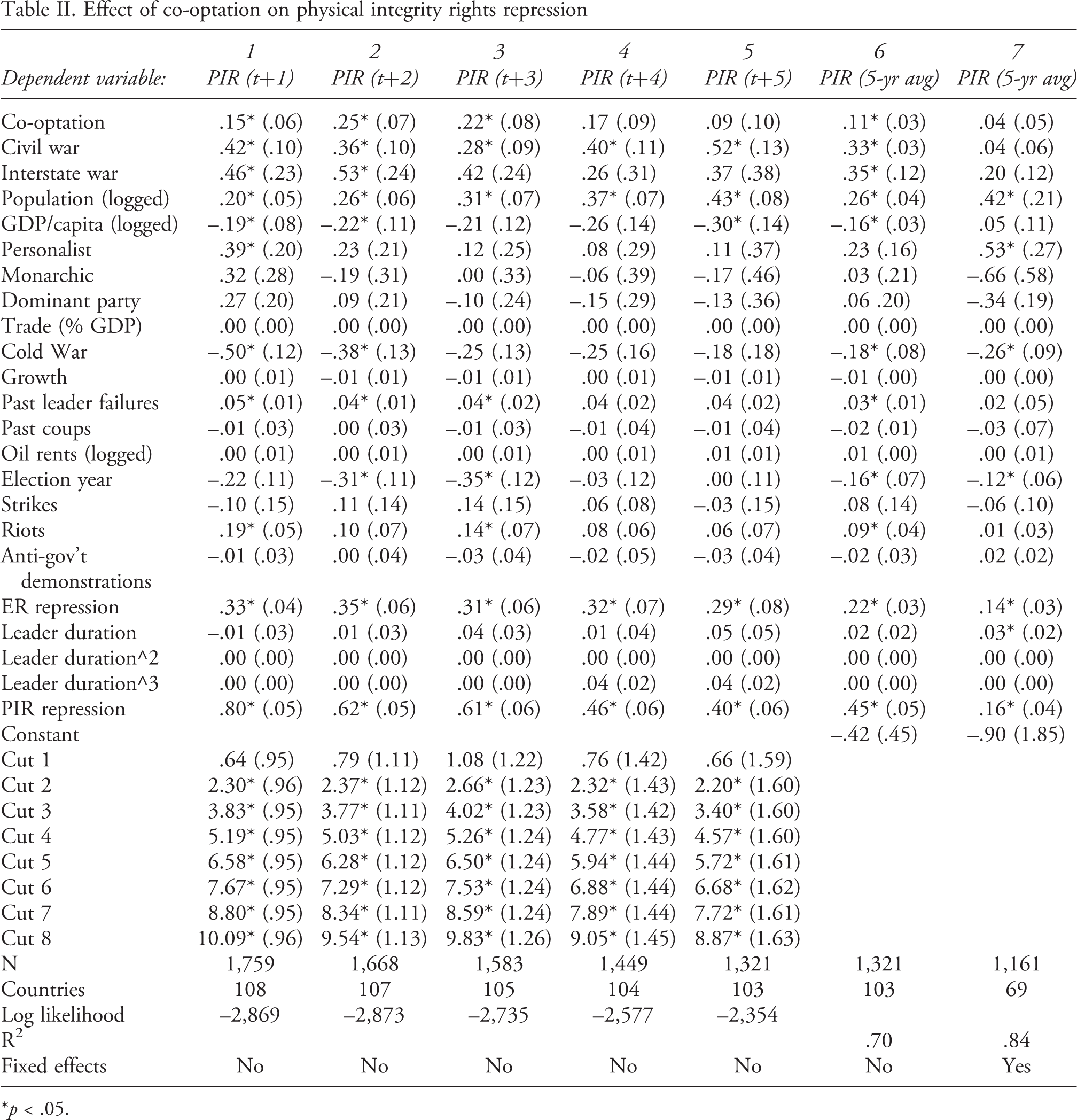
*p < .05.
To smooth out aberrant changes in countries’ repression levels, in Model 6 we evaluate the relationship using a five-year rolling average of repression as the dependent variable (the average of repression measured in t+1, t+2, t+3, t+4, and t+5). We use ordinary least squares (OLS) regression as our estimation Effect of co-optation on future repression levels Predicted five-year average of repression, by level of co-optation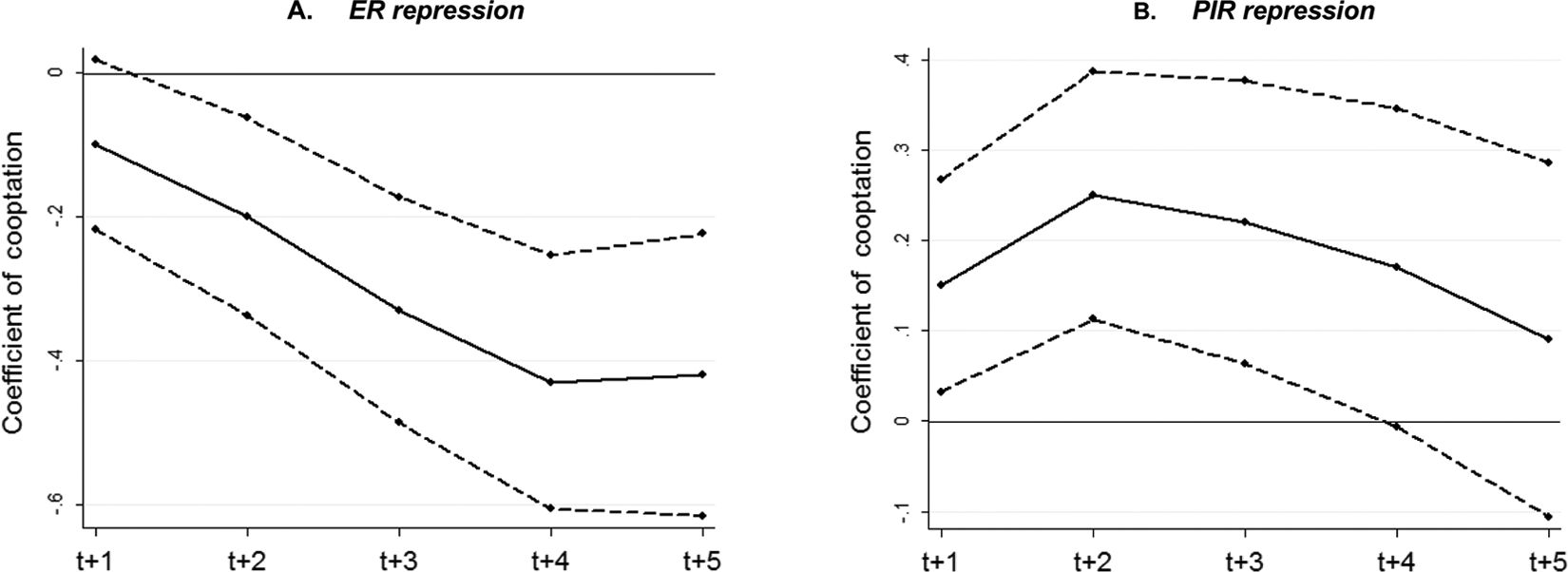

Again, cooptation elicits a negative and statistically significant effect on ER repression, but a positive and statistically significant effect on PIR repression. Figure 2 illustrates the substantive impact of institutional co-optation on each type of repression. Holding all of the control variables in Model 6 at their median values, moving from the lowest to the highest levels of cooptation decreases average ER repression scores from roughly 5.6 to 5.1, while increasing average PIR repression scores from roughly 3.8 to 4.1. These are substantively notable differences once we consider the size of the effects of other key variables. Involvement in civil war, for example, increases ER repression scores about one-tenth of a unit and PIR repression scores about one-third of a unit. Lastly, to give a sense of the relative magnitude of these effects, the y-axes in Figure 2 correspond to the 25th and 75th percentiles of each repression variable, revealing that the negative effect of cooptation on ER repression is somewhat larger than the positive effect it has on PIR repression.
In Model 7, we evaluate these relationships including country dummies in the specification (i.e. a fixed effects model). 14 This enables us to evaluate whether within-country changes in cooptation affect levels of repression. With this model, the coefficient of cooptation is negative when estimating ER repression and positive when estimating PIR repression, in line with our expectations. Both coefficients are smaller in size, however, and the latter is no longer statistically significant. This is rather unsurprising given that variables that change slowly over time, like political institutions, are less likely to show statistical significance in fixed effects models, which inefficiently estimate predictors with low variance (Plümper & Troeger, 2007).
The tests presented here reveal a strong connection between co-optative institutions and increases in physical integrity rights repression and decreases in empowerment rights repression. These tests cannot, however, establish the direction of causality, a serious problem that plagues most cross-national, large-N studies of autocratic institutions (Pepinsky, 2013). It is possible that decreases in empowerment rights repression cause dictators to adopt co-optative institutions, rather than vice versa, because greater freedoms of expression enable opposition groups to exert greater pressure on the regime to legalize political parties and establish a legislature. Though such an argument is persuasive, it does not account for the corresponding changes that we see in physical integrity rights repression. If the relaxation of empowerment rights repression enables opposition groups to effectively coerce dictators into adopting participatory political institutions, then these groups should also be able to pressure the regime to keep physical integrity rights violations low. This is particularly true given that many members of the opposition would themselves be likely targets. Instead we see the opposite: dictators with co-optative institutions are associated with higher physical integrity repression. We are aware that the tests we present here cannot rule out the possibility that it is the repressive strategy that influences the decision to co-opt and not the other way around, but a theoretical story that would explain such a relationship is not obvious. The mechanism that we propose, by contrast, anticipates the divergent changes in the two types of repression that we see associated with the adoption of co-optative institutions in a coherent theoretical framework.
Concluding remarks
This study examined how decisions to co-opt affect dictators’ overall repressive strategies. We argue that when autocrats employ co-optative institutions, such as parties and legislatures, they become more certain of the identities of their most threatening opponents, allowing them to adopt a more targeted approach to harassing and imprisoning their rivals, thereby reducing the need to rely on the widespread repression of their citizens. We find support for this argument: in dictatorships that use parties and legislatures physical integrity rights repression is higher, while empowerment rights repression is lower.
Consistent with previous research showing that repression takes time to adjust to the implementation of institutions (Bueno de Mesquita et al., 2005), both forms of repression exhibit a delayed effect, particularly the reduction in empowerment rights repression. In many ways this makes intuitive sense. The creation of parties and legislatures should lead an autocrat to reduce empowerment rights repression slowly, given that a sudden opening in this arena would likely be risky and difficult to manage. At the same time, when armed with greater insight into potential threats to his rule, an autocrat should respond relatively quickly, leading to a shorter lag time in the increase of physical integrity rights repression. Moreover such repression should then decline slightly once the most threatening opposition members have been targeted, as our results indicate. We leave it to future research, however, to explore in greater depth how time factors into these relationships.
The insights offered here suggest that those individuals interested in reducing human rights abuses should not necessarily interpret the presence of parties and legislatures in a given autocracy as a sign of positive democratic development. While these institutions reduce civil liberties restrictions, we show that they concurrently increase physical integrity rights violations. Reducing repression in autocracies appears to entail far more than simply adopting institutions that are democratic in name only. Future research, therefore, should explore the combination of institutions, such as media or international treaties, or other developments such as the rise of social media, that could work alongside parties and legislatures to increase a leader’s perceived cost of engaging in physical integrity rights violations and potentially lesson their reliance on such tactics.
Footnotes

References
Supplementary Material
Please find the following supplemental material available below.
For Open Access articles published under a Creative Commons License, all supplemental material carries the same license as the article it is associated with.
For non-Open Access articles published, all supplemental material carries a non-exclusive license, and permission requests for re-use of supplemental material or any part of supplemental material shall be sent directly to the copyright owner as specified in the copyright notice associated with the article.
