




Abstract
The impact of armed conflict may persist long after the end of war, and may include a lasting institutional legacy. We use a novel dataset from rural Burundi to examine the impact of local exposure to conflict on institutional quality, and try to ‘unbundle’ institutions by distinguishing between three dimensions of the institutional framework: property rights security, local political institutions, and social capital. We find that conflict exposure affects institutional quality, and document that the impact of conflict on institutional quality may be positive or negative, depending on the institutional measure. Specifically, exposure to violence strengthens in-group social capital and promotes tenure security. However, the appreciation for state institutions is negatively affected by exposure to violence. We find no evidence consistent with design-based theories of institutional quality, or the idea that institutional quality is enhanced by interventions of (non)state external actors. Instead our findings provide some support for the theory of parochial altruism. Our results emphasize the importance for policymakers to consider autonomous responses to conflict when designing development programs. They further imply some caution for actors seeking to reform local institutions through top-down interventions.
Introduction
While many studies emphasize the ‘persistence’ of institutions over extended periods of time (e.g. Acemoglu, Johnson & Robinson, 2001), institutions also evolve in response to various pressures (Austin, 2008). In light of evidence that institutions are among the main determinants of economic development, institutional reform has taken center stage in current development paradigms. Unfortunately, our understanding of the dynamics of institutions, and the determinants of institutional change, is fragmented and limited.
One of the potential, but under-researched, drivers of institutional quality is civil war. ‘Both theory and evidence are weakest in assessing the impact of civil war on the fundamental drivers of long-run economic performance – institutions, technology, and culture – even though these may govern whether a society recovers, stagnates, or plunges back into war’ (Blattman & Miguel, 2010: 8). More than two-thirds of African nations have experienced civil war during the past decades (e.g. Gleditsch et al., 2002). While neoclassical growth models predict that postwar economies should rapidly accumulate capital and experience growth, evidence regarding the speed of post-conflict recovery is mixed (e.g. Chen, Loayza & Reynal-Querol, 2008; Cerra & Saxena, 2008; Miguel & Roland, 2010).
This article aims to connect and contribute to two literatures: we explore the determinants of (local) institutional quality, and seek to understand the consequences of civil war. From the latter literature we know that conflict has persistent effects via various channels, including the impacts on health and disability (e.g. Ghobarah, Huth & Russett, 2003; Iqbal, 2006; Iqbal & Zorn, 2010), education (Lai & Thyne, 2007; Chamarbagwala & Morán, 2011), and food security or poverty (e.g. Gates et al., 2012). Our main objective is to analyze another potential channel, namely the impact of war on the quality of institutions. We try to move beyond coarse aggregates and ‘unbundle’ local institutions. 1 Specifically, we distinguish between three dimensions of the institutional framework: (1) tenure rights security, (2) a measure of appreciation of local political institutions and rule of law, and (3) the strength of social capital (trust and cooperation). Our micro focus implies exploring the role of conflict as a determinant of within-country differences in institutional quality. For our empirical analysis we use a novel dataset from Burundi.
Our data suggest that conflict shocks affect local institutional quality. In terms of scope our article is close to Bellows & Miguel (2009), who document that exposure to violence promotes collective action, political awareness, and participation in Sierra Leone, and to Cassar, Grosjean & Whitt (2013), who add the important qualification that the transformative impact of conflict varies with the nature of that conflict – especially whether it involved within-community fighting. Our results for Burundi support the overall conclusion that conflict affects local institutions – we document positive associations between conflict, on the one hand, and our measures of social capital and tenure security, on the other. However, the effects of conflict vary across institutional proxies and are not unambiguously positive. Specifically, our evidence suggests conflict eroded the appreciation of local political leadership and the rule of law.
Obviously, it is challenging to identify the exact mechanisms via which conflict affects institutions, and we can only come to tentative conjectures regarding this matter. Below, we find that ‘institutional impacts’ are unlikely to be invited by income effects or ‘outside interventions’ by the state or non-governmental organizations (NGOs) intended to improve institutional quality. 2 There is no correlation between local institutional quality and the implementation of NGO projects or the preferential allocation of resources by the postwar government. We argue that transformed preferences and beliefs are a more likely candidate explanation. Our results are most consistent with a bottom-up, ‘evolutionary’ perspective on institutional quality, rather than a design-based view. We expand on this perspective, and more specifically on the recent theory of parochial altruism, in the next section.
This article is organized as follows. In the next section we discuss key theories of institutional change, including parochial altruism (pioneered by Bowles, 2008, 2009). We also develop several testable hypotheses. We then briefly discuss the background of the civil war in Burundi and its institutional aftermath, and describe our data and empirical strategy. We base our analysis on fixed effects models (comparing neighbors with different levels of exposure to violence within the same village, or comparing villages with different levels of violence in the same province), and in addition estimate a series of two-stage least-squares (2SLS) models (using geographical coordinates as instrumental variables for local conflict intensity to account for potential endogeneity and omitted variable issues). We then present our main results and offer conclusions in the final section.
Institutional quality and civil war
The institutional framework is broad and encompasses formal as well as informal institutions. Some institutions are centrally designed and enforced, and others are in the private realm and subject to self-governance (Dixit, 2003; Williamson, 2000). Reflecting this dichotomy, Kingston & Caballero Miguez (2009) identify two broad categories of processes of institutional change: change by design and change by evolution.
The design perspective tends to emphasize centralized authority and starts from the premise of purpose. While this perspective is readily associated with the reform of formal institutions, it might also capture the dynamics of local informal institutions. For example, local institutions may be shaped and reshaped by intervening outsiders, or by strategic decisions of an elite.
The evolutionary perspective, in contrast, captures phenomena where the uncoordinated choices of many agents more or less spontaneously produce a system of norms and rules that allows agents to coordinate their behavior and expectations. For example, Greif (2006: 30) defines institutions as a ‘system of rules, beliefs, norms and organizations that together generate a regularity of (social) behavior’. Central to this so-called ‘equilibrium view’ is that institutions respond to changes in people’s expectations – they are not exogenous rules, but must be self-enforcing to be effective. Institutional change then comes from a change in expectations brought about by either external forces (e.g. (non)government interventions or changes in technology) or internal forces (changes in preferences or beliefs). If a shock or intervention alters (private) behavioral norms, or expectations about how others behave, and if these new features become ‘generalized and routinized’ within the community, then they may lead to a gradual alteration of informal rules and constraints (Blattman, Hartman & Blair, 2014). 3
There is scant rigorous evidence to support either evolutionary or design-based theories of institutional quality, and little is known about what interventions should be implemented if the objective is to strengthen institutions. 4 The role of conflict as a determinant of institutional quality is also ill-understood.
Conflict-induced changes in institutional quality may have evolved originating from a bottom up processes. For example, exposure to conflict may promote pro-social preferences (Bellows & Miguel, 2009; Blattman, 2009; Voors et al., 2012; Bauer et al., 2014; Gilligan, Pasquale & Samii, 2014). Insofar as pro-social preferences facilitate coordination and cooperation and enable community members to form optimistic expectations about the intentions and behaviors of their peers, one would expect conflict exposure to lead to improvements in local institutional quality. However, evidence for such relationship is mixed. For example, Rohner, Thoenig & Zilibotti (2013) and Cassar, Grosjean & Whitt (2013) study the relation between conflict exposure and trust within local communities and point to a negative relation between these variables – a result opposite to the one mentioned above.
Bauer et al. (2014) and Cassar, Grosjean & Whitt (2013) align this apparently contradictory evidence referring to the theory of parochial altruism (Bowles, 2008, 2009). This theory postulates that selective pressures operate at the level of the group (rather than the individual), such that survival of the fittest groups may favor groups consisting of altruists willing to make sacrifices for the group. 5 If so, traits such as within-group generosity, altruism, and trust may co-evolve with hostility towards outsiders in a conflict setting.
Cassar, Grosjean & Whitt (2013) argue the parochial altruism theory goes a long way towards reconciling the opposite results discussed above, if we consider the degree of infighting, or intracommunity violence. The Nepalese and Burundi communities studied by Gilligan, Pasquale & Samii (2014) and Voors et al. (2012), respectively, suffered from attacks by outsiders (army groups and rebels) – fostering in-village trust and altruism. The Tajikistan case analyzed by Cassar, Grosjean & Whitt (2013), on the other hand, involved considerable intracommunity violence, combined with imperfect post-conflict reconciliation. This was not conducive to building social cohesion and in-village trust. Cassar, Grosjean & Whitt (2013: 290) conclude that ‘a crucial feature – the boundary of the in-group relative to the out-group – affects the formation of preferences’. According to Voors et al. (2012), exposure to conflict in the Burundi context, where the great majority of the violence was due to attacks by outsiders, translates into stronger in-group pro-social preferences – more altruism and trust towards community members. By changing preferences and beliefs, conflict also shapes the evolution of local institutions, according to Greif’s equilibrium view of institutions. We hypothesize:
Hypothesis 1a: Violence committed by outsiders facilitates the improvement of local economic institutions (formalization of tenure security).
Hypothesis 1b: Violence committed by outsiders enhances in-group trust and cooperation (i.e. contributes to the accumulation of social capital).
Hypothesis 1c: Violence committed by outsiders promotes hostility towards outsiders and reduces the appreciation of formal institutions associated with the state.
At the same time, conflict could invite institutional reform by design if it changes the preferences or constraints of decisionmakers. For example, conflict may affect priorities for policymakers (by attenuating or accentuating the perceived need for rural development and empowerment of village communities). Or it may introduce new external agents of change, including the international community or NGOs seeking to promote postwar reconstruction. Their interventions typically aim to target key institutional impediments for development. We test whether this is likely to be a major factor steering institutional quality in the context of post-conflict Burundi. This results in the following hypothesis:
Hypothesis 2: Reform efforts by the state or NGOs shape local variation in institutional quality.
Moreover, and more subtly, assuming that ethnic identity matters for in-group membership, differences in the local ethnic composition of communities may impact on the evolution of institutional quality. Conflict in Burundi had a clear ethnic dimension (see next section). We expect that in addition to in-group boundaries separating the village from the rest of the world, there are also in-group boundaries associated with ethnic identities (see also Rohner, Thoenig & Zilibotti, 2013). Ethnically heterogeneous communities may be less able to build trust and social cohesion and improve local institutions. Hence:
Hypothesis 3: Greater ethnic heterogeneity undermines the quality of institutions.
To sum up, in what follows we document whether evolutionary (parochial altruism) and design-based theories of institutional quality are consistent with variation in the quality of local institutions in Burundi.
Civil war and institution building in Burundi
Burundi has known several periods of civil war, involving the nation’s two main groups: Hutu (85% of the population) and Tutsi (14%). Under Belgian colonial rule, Tutsi dominated the public administration and most Hutu were barred from (active) political participation. The process of Hutu exclusion intensified following independence. Ngaruko & Nkurunziza (2000) describe how Tutsi from one region – Bururi province – dominated the state and tried to manage the nation for private gains. This process prompted Hutu insurrections (major insurrections in 1965, 1972, 1988, and 1993), which typically triggered drastic responses from the Tutsi-dominated army. In 1993, following the assassination of Burundi’s first Hutu president Ndadaye, Hutu rebel groups massacred thousands of Tutsi. The army responded with large-scale attacks ‘making no distinction between communities which had been involved in violence against Tutsi and those that were not’ (HRW, 1998: 15). In a period of weeks some 30,000–50,000 people were slain. In the years that followed, violence by rebels and the army raged across the country, killing over 300,000, predominantly Hutu (Bundervoet, Verwimp & Akresh, 2009). Many more have been injured or displaced. About 1.3 million Burundians were internally displaced or refugees in neighboring countries, so some 20% of the country’s population was uprooted (Krueger & Krueger, 2007).
Burundi violence can be divided into two types – selective and indiscriminate violence. The former type targets individuals or communities selectively. The army, for example, singled out individuals who could threaten the Tutsi government. This included Hutu with higher levels of education (Krueger & Krueger, 2007). Selective violence probably also occurred within communities, where the breakdown of the rule of law provided an opportunity to ‘settle scores’, take measures to erase outstanding debts, or reshuffle valued property (see Andre & Platteau, 1998 for such evidence in Rwanda). 6
Other forms of violence appear indiscriminate. In the absence of information to distinguish rebels from the general population, armies often resorted to unselective violence. Other motivations include a desire for extermination, revenge, and plundering. Sometimes there is a perceived need to demonstrate power as part of the ‘tactics of fear’ to control a population (Lyall, 2009; see Uvin, 1999 for evidence on Burundi). However, local intensities of conflict vary with respect to geography. Regions closer to neighboring Democratic Republic of Congo and Rwanda saw more violence as these areas were comparatively more frequented by rebels, while regions in the south saw less violence.
Even though violence and intimidation have not fully disappeared from Burundi, the country has now known several years of relative peace. Efforts to quell the violence caught root at the turn of the century, and in 2003 an internationally brokered peace agreement was signed between the government and all but one of the rebel groups. This paved the way for a transition process that led to an integrated defense force, establishment of a new constitution, and elections resulting in a majority Hutu government (consisting mainly of the National Council for the Defence of Democracy-Front for the Defence of Democracy, CNDD-FDD party). However, Burundi is still among the poorest in the world, and ranks 185 out of 187 on the 2011 Human Development Index (UNDP, 2011). Most of the population is employed in agriculture, of which the majority is at least partly dependent on subsistence farming. Arguably, the success of future transformations from subsistence farming to commercial agriculture or manufacturing will depend on the quality of extant institutions.
A range of interventions has shaped the postwar institutional development in Burundi, aiming to address land ownership and conflicts and the decentralization of government. However, the effectiveness of these interventions has been questioned. The UN operation in Burundi (ONUB) and later the United Nations Integrated Office (BINUB) have been characterized by mismanagement. By 2008 they had spent only 3% of the budget allocated to resolving land issues (Huggins, 2009). Interventions by other organizations have largely been ad hoc and limited in scope. For example, the main program on land tenure reform by the Swiss Agency for Development and Cooperation has been limited to two communes in Ngozi (Uvin, 2008; van Leeuwen, 2009; van der Haar, van der Berg & Langen, 2009).
A major institutional reform was the attempt by the CNDD-FDD government to decentralize authority. Following the 2005 local elections, Communal Law No. 1/16 was enacted, which (in theory) handed down decisionmaking authority from the state to the ‘commune’ (a district within a province). The decentralization process was intended to improve local governance, but has been slow and patchy. Uvin (2008) concludes that, in terms of political transition, not much has changed – the system of vertical governance with power concentrated in the hands of a minority elite has survived. He mentions ‘[c]losed party lists for local elections and no direct election of the communal administrator. It even seems that the administrators, by name, have been centrally designated in negotiations between the parties. As a result, communal administrators are likely to continue to depend on central politics rather than on local politics to ensure their stay in power’ (Uvin, 2008: 112). Writing about the Communal Council, Uvin (2008: 112) argues ‘it is usually the same small clique of urban, educated intermediaries who are empowered’. In light of these arguments, local politicians are often viewed as members of the out-group, representing the state and far-away interests. The parochial altruism thesis, therefore, predicts that the appreciation of local politicians should be lower in conflict exposed communities.
Data and empirical strategy
First we introduce our data. We draw from an original and extensive Burundi Priority Household Survey (BPHS) and Community Survey (BCS). Local enumerators, in collaboration with researchers at ISTEEBU and MICROCON (Institute of Statistics and Economic Studies of Burundi and Micro Level Analysis of Violent Conflict), collected most of the data in August and September 2007. The BPHS contains data from 872 households in 100 collines (communities). Following a first wave of data collection by the World Bank in 1998, we recorded information on socio-economic and farm characteristics. We also collected information on institutional quality. Unfortunately, since institutional data were not recorded in 1998 we cannot construct a panel to study changes in institutional quality over time. Instead, we use a cross-section identification strategy (see below). The BCS collected community-level data, for which we interviewed several (most often three) community leaders (local administrators) in all communities. We collected data in 13 of 16 Burundi provinces (see online appendix for more details on our sample).
Table I.A in the online appendix summarizes our main variables. Panel A shows summary statistics for local institutional data. In some specifications we aggregate household responses to arrive at community-level variables. 7 Our first institutional variable is household ownership of informal ‘land titles’, which is a proxy for tenure security at the household level. It is measured as the fraction of plots to which a household possesses ‘titles’. Most land in Burundi is not formally titled (below 1% is formally titled, see Toulmin, 2009) and, instead, land titles are informal, comprising so-called ‘petit papiers’. Land registration and mediation is handled locally through the Bashingatahe (a council of elders) so that the process of titling requires cooperation. On average, 42% of the plots in our sample are titled.
We have two proxies for social capital. The exact definition of social capital is subject to debate, but it is often treated as a characteristic of communities and described in terms of trust and norms or networks (e.g. Bowles & Gintis, 2002). Social capital may affect economic outcomes by lowering transaction costs or by enabling collective action (say, providing local public goods). For our first indicator of social capital we asked respondents whether they agreed with the statement ‘Do most of the people in your colline help each other out when help is needed?’ On average 86% of households answered affirmatively. We also asked a World Value Survey type of trust question to gauge whether villages trusted their fellow villagers on a six-point scale. We asked respondents to rate their level of trust of fellow colline members. The average score of 4 is rather high.
Our final institutional dimension is the quality of rule of law. The BPHS asked respondents to rate the quality of three institutions on a six-point scale: (1) local justice authority (e.g. mediating in land conflicts), (2) the army, and (3) police. To a large extent these indices captures the (local) appreciation of formal institutions governed by the state – a key outsider in terms of the parochial altruism thesis. We have added the subindices to construct one rule of law index. In addition, we asked respondents to express their appreciation of the quality of local political leadership (so-called Chef de Colline, or community chief). As discussed above, local political leadership in rural Burundi is associated with state intervention and urban involvement. Often, therefore, local political leaders also represent outsiders in the view of rural villagers, and are mainly accountable to political elites in Bujumbura. 8
Panel B summarizes our data on local conflict intensity. To measure individual exposure to violence, the BPHS asked respondents about a range of war experiences, including death of family members, theft, ambush, forced labor, intimidation, property theft, and destruction of household assets. We use this information to construct a victimization dummy indicating if a household experienced any of these experiences. About 50% of the households in our sample experienced such events. We also aggregate these individual indices to arrive at community-level violence measures. 9
Panels C and D summarize additional household-level (X i ) and community-level (C i ) variables, respectively. Household controls include age (years and squared); gender (dummy for male-headed households); education (number of years of education of household head); and wealth (total per capita expenditures). For a follow-up analysis below, where we probe the appropriateness of our identification strategy, we also use lagged control variables (XLi ) and a pre-war (1993) variable, capturing whether the household owned livestock or farmed cash crops. Community variables are distance to an agricultural market (measured in time intervals walking distance) and a Gini variable measuring land inequality. These include the share of community members that owned livestock, population density, a measure of prewar income, and measures of ethnic and social heterogeneity. See the online appendix for variable definitions.
Next we turn to our empirical strategy. We first assess the impacts of violence at the individual level and compare households who experienced conflict to those who did not:

where Iij
refers to our institutional variables, that is, property rights security, social capital, and rule of law of individual i (where i = 1,…,872) in community j (where j = 1,…,100), Vij
is the household victimization index, Xij
and XLjk
refer to a vector of 2007 and 1998 household control variables,
To explore whether the consequences of violence may be felt throughout the community even if only a subset of individuals directly experienced acts of violence, we also look at the effect of village-level violence (Vjk
) on individual institutional quality:
10

In interpreting Models 1 and 2 we are especially interested in coefficient δ 1, associated with the conflict variable, which directly speaks to Hypothesis 1 discussed above. Recall, the parochial altruism thesis predicts that exposure to violence – via stronger in-group pro-social preferences – explains variation in social capital and tenure security. Moreover, hostility towards outsiders should translate into a lower appreciation of political leadership. In addition, to probe Hypothesis 2 on design-based interventions, we include two intervention proxies in vector C. First, we include a variable indicating whether a community had received assistance from NGOs during or after the conflict. 11 Second, we include a dummy for regions likely to have received preferential treatment by the government. Specifically, the president was born and raised in Ngozi province and investments in institution-building may have been transferred to the region for political reasons. If either variable is positively correlated with our institutions variables, this would be consistent with design-based theories of institutional quality.
To test Hypothesis 3, we include a variable measuring ethnic heterogeneity and interact it with our conflict variables. This approach allows us to test whether the effect of conflict varies with the salience of in-group identities. Specifically, we hypothesize that in-group feelings at the village level are stronger when the community is ethnically homogenous. If so, the institutional responses that we seek to capture should be more pronounced in ethnically homogenous villages than in heterogeneous ones. Unfortunately we only have (post-conflict) data on ethnic identity for respondents in 35 villages (rather than the full sample of 100 villages), so our efforts to further probe the relevance of in-group versus out-group sentiments as a determinant of institutional quality may suffer from low statistical power.
In addition, we investigate whether any impacts of violence on institutional quality are driven by other factors such as income effects or migration flows. We replace our dependent variable in Equation 2 by measures of migration, income (total per capita expenditure and perceived poverty), and human capital (education and health).
A key issue for inference is the potential non-random nature of violence during the civil war. An identifying assumption in our analyses until now is that exposure to conflict across villages is (almost) random, conditional on observable characteristics (vectors X and C). One may argue this is a naïve assumption. Perhaps the quality of local institutions has affected patterns of conflict and violence (where communities with better, or worse, institutions are preferred candidates for abuse by army or rebels). If high quality communities attract more violence (and if institutional quality is persistent), then correlations between institutional quality and conflict exposure will overestimate the causal effect (if any) of the latter on the former. The reverse is true when low institutional quality communities are preferred targets. In addition to such ‘reverse causality’ concerns, omitted variables may drive both conflict and institutional quality, inviting a spurious correlation between these variables.
To address these challenges, we use community longitude and latitude as instrumental variables for conflict exposure in a 2SLS framework – allowing us to identify exogenous variation in local conflict intensity. The use of these instruments is motivated by historical accounts of the war (also see Verpoorten, 2012). The war started in the northern provinces where several rebel groups formed, using the Congolese border and Kibira forest for shelter. 12 Fighting moved down to the nation’s capital, Bujumbura, as both rebels and the army fought over its control, but soon spread to northeastern provinces, and eventually ravaged communities throughout the country (for accounts, see United Nations, 1996; Chrétien & Mukuri, 2000; Bundervoet, Verwimp & Akresh, 2009). A gradient in the intensity of violence is evident – fighting was more common in the northern and eastern regions of the country, suggesting latitude and longitude are potentially suitable instruments. This is confirmed by test statistics reported below (instrument relevance and overidentification restrictions).
Results
Conflict and economic institutions

† p < 0.10, *p < 0.05, **p < 0.01. Robust standard errors in parentheses, clustered at village level for columns 2 and 3. Regressions include lagged (1998) individual characteristics. Column 4 reports beta coefficients for column 3.
In Table I, we present our results for tenure security. We record a statistically significant and positive correlation between land titling and conflict intensity at the community and household level. A change of one standard deviation in violence increases tenure security by close to one-half (0.48) of a standard deviation. The results suggest greater security – in terms of informal titling – for individuals or communities that suffered from attacks. Various factors may contribute to this result. In prewar Burundi, land title ownership was limited to cities, and land in the countryside was mostly inherited. After the war, informal land markets started to develop (MEATTP, 2006), responding to local factor imbalances (Lin, 1995) brought about by mass migration or large-scale killings in early stages of the war (over 200,000 deaths in 1993 alone). In addition, people sought to secure land ownership where ownership could be contested by those who fled but could return (ICG, 2003). In many cases returning refugees were unable to exercise their claim on previously ‘owned’ land. Subsequently, local conflict resolution mechanisms where used to mediate (van Leeuwen, 2009). In other cases, using the so-called ‘return package’ provided by the Norwegian Refugee Council (NRC), some households resorted to buying land with accompanying title deeds (NRC, 2007). 14 The formalization of titles represents a complex social process, requiring coordination and cooperation (if only to agree on boundaries). Consistent with the parochial altruism thesis we expect trust and pro-social preferences to improve the ability of communities to govern such processes (ρ = 0.07*).
Conflict and social capital

† p < 0.10, *p < 0.05, **p < 0.01. Robust standard errors in parentheses clustered at village level for columns 2–4. Regressions include 1998 controls. Column 5 reports beta coefficients for column 3.
However, the impact of conflict on the (perceived) quality of institutions is not always positive. In Table III we focus on institutions associated with the state (i.e. one of the out-groups during the war), and consider how conflict affects the subjective assessment of the police, justice system, and army. We find that exposure to violence is associated with a worse view of political institutions. A change of one standard deviation in violence decreases the appreciation of the rule of law by about one-third of a standard deviation (0.33). Similarly, in light of the close connection between local political leaders and (urban and political) out-groups elsewhere, the parochial altruism thesis correctly predicts that conflict negatively affects the appreciation of local politics.
Interestingly, we also find a negative and significant correlation between the quality of political leadership and informal land titles (ρ = –0.16**). Perhaps people respond to poor leadership by demanding greater land security (ICG, 2003).
Conflict and political institutions
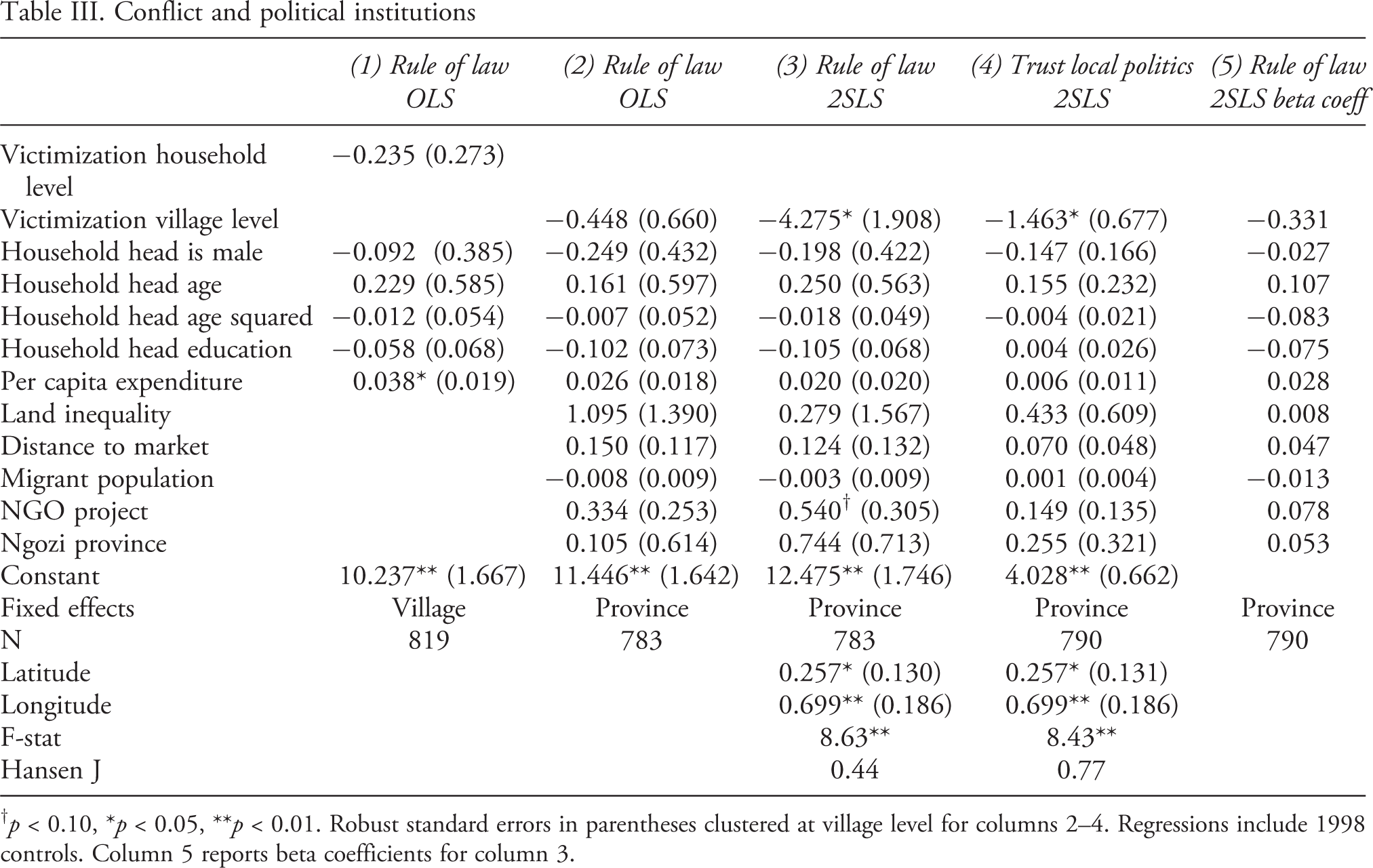
† p < 0.10, *p < 0.05, **p < 0.01. Robust standard errors in parentheses clustered at village level for columns 2–4. Regressions include 1998 controls. Column 5 reports beta coefficients for column 3.
To investigate to what extent local heterogeneity in ethnic composition of villages undermines the quality of institutions, we use our subsample of 35 villages for which we have postwar ethnicity data in Table IV. If ethnic homogeneity facilitates in-group dynamics (fostering a processes associated with parochial altruism), we would expect conflict exposure in ethnically heterogeneity communities to significantly affect institutional quality. Instead we find that the interaction term is not significantly correlated with our measures of institutional quality.
In sum, while conflict exposure drives institutional quality, we find no evidence to support the view that design-based interventions have contributed to this process in Burundi. Instead, our results are more consistent with the parochial altruism thesis, involving changed local preferences or beliefs. At the same time we do not find a clear ethical dimension. It is an open question whether ethnic identity represents a significant boundary to distinguish between in- and out-groups in postwar Burundi (our reduced sample may also lack power to avoid a so-called type II error). We leave this issue for future research.
Postwar outcomes
We now investigate whether alternative mechanisms may explain the patterns in our data. Table V reports coefficients from OLS regressions where we consider variation in a series of postwar outcome variables by victimization. To economize on space we only report coefficients of interest, but all models included a full set of controls (see online appendix Table V.A). We first assess whether civil war affected migration patterns, changing the composition of a community. If so, our results may not be explained by a change in people’s behavior or preferences, but rather by a selection process. However, this concern does not appear justified. When explaining the percentage of community migrants, we find it is not correlated with our conflict variable.
Conflict, institutions, and ethnicity

† p < 0.10, *p < 0.05, **p < 0.01. Robust standard errors in parentheses, clustered at village level. Regressions include household, community, and 1998 controls.
Exogeneity and selection bias
While our instrumental variable strategy should purge most endogeneity concerns, latitude and longitude may be correlated with certain omitted variables – or even with the quality of local institutions – if ethnic or economic variables vary across a geographical gradient. Our instruments would then be correlated with the error terms of the second-stage equations. Note that the Hansen J test has low power, and verifying whether the exclusion restriction holds is difficult. To further explore whether households and communities were indeed targeted randomly (conditional on geographic location), we investigate which household and community characteristics are related to attacks. For example, if rebel sympathies systematically vary across regions, or if economic outcomes vary along a geographical gradient, driving both institutional development and patterns of conflict, then our IV strategy may be biased.
Post-war outcome variables

† p < 0.10, *p < 0.05, **p < 0.01. Robust standard errors in parentheses clustered at village level (except for row 1). Table reports coefficients from separate regressions, regressing the row variable on community level violence and household, community, and 1998 controls and province fixed effects.
Identification

† p < 0.10, *p < 0.05, **p < 0.01. Robust standard errors in parentheses, clustered at village level, for columns 6. Column 6 uses the ESD-SR 2002 data to assess attrition between 1993 and 1998, where the dependent variable is a dummy: 1 if the respondent was present in village in 1993 and 1998, 0 if not. Literacy, age (in decades), and gender are measured in 2002; the dummy for livestock farmer in 1993 is based on recall in 2002; the number of attacks between 1993 and 1998 were drawn from the ACLED database and matched at the commune level (divided by ten).
Across the columns, we find only weak evidence of selective targeting and attrition for gender, education, and age. We conclude that attrition and selection bias are not likely to affect our results.
Conclusions
Institutions are key determinants of growth and development, but our understanding of how institutions evolve over time and in response to shocks is limited. Using micro data we analyze how exposure to conflict affects local institutional quality in Burundi. We ‘unbundle’ local institutions and distinguish between a measure of tenure security, proxies for social capital, and measures of (local) political institutions and leadership. We treat exposure to violence as a ‘natural experiment’. While we do our best to tackle concerns about attribution through a careful instrumentation strategy, we acknowledge that fully addressing all endogeneity issues may be impossible using our observational data.
We report two main results. First, exposure to violence can have a local institutional legacy. In the context of rural Burundi violence was predominantly committed by the army or rebel organizations – not by fellow villagers. Consistent with the parochial altruism thesis, out-group violence fosters in-group social capital and enables communities to coordinate institutional reforms that increase tenure security. In addition, we find some weak evidence that conflict exposure decreases the appreciation of state-level institutions and local political leaders (who to a large extent may be unaccountable outsiders). The overall effect on appreciation of local institutional quality is therefore mixed and seems to be conditional on whether the institution in question is associated with the in-group or the out-group.
Secondly, we find no evidence for design-based theories of institutional quality. In addition, interventions by the state or NGOs are not associated with institutional quality. This suggests that evolutionary perspectives on local institutional quality may be more relevant than top-down theories. This conclusion is consistent with recent rigorous assessments of the impact of large scale development interventions aimed at reforming local institutions in Sierra Leone and the Democratic Republic of Congo, which failed to demonstrate significant outcomes (see Casey, Glennerster & Miguel, 2012 and Humphreys, Sanchez de la Serra & van der Windt, 2013, respectively). 19 This implies some caution for actors seeking to reform local institutions through top-down interventions.
More evidence is needed to test the mechanisms explaining postwar development, including institutional evolution. This work should also probe to what extent our results are specific to the case of Burundi or extend to other post-conflict contexts (as suggested by the ‘generic’ theory of parochial altruism). In addition, it seems interesting to study whether the type of war termination (negotiated settlement versus military victory) affects postwar institutional dynamics (see Toft, 2010).
Footnotes
Replication data

Acknowledgment
We would like to thank the editor and three anonymous referees for their helpful comments. We thank Tom Bundervoet, Philip Verwimp, Eleonora Nillesen, Gonne Beekman, and the staff of ISTEEBU for their collaboration in this project. Remaining errors and omissions are our own.
Funding
Notes
References
Supplementary Material
Please find the following supplemental material available below.
For Open Access articles published under a Creative Commons License, all supplemental material carries the same license as the article it is associated with.
For non-Open Access articles published, all supplemental material carries a non-exclusive license, and permission requests for re-use of supplemental material or any part of supplemental material shall be sent directly to the copyright owner as specified in the copyright notice associated with the article.
