



Abstract
According to a widespread conventional wisdom, there is a link between US nuclear weapons and nuclear proliferation and, therefore, in order to prevent the spread of nuclear weapons to other states, the US government must first make changes to its own nuclear arsenal. This article challenges the notion that US nuclear posture has a significant bearing on the proliferation and non-proliferation behavior of other states. Contrary to the received wisdom in policy circles, this article maintains that state decisions on nuclear non-proliferation issues are driven by a range of other security, economic, and political factors and, once these considerations are taken into account, there is little if any remaining variance to be explained by US nuclear posture. Using a dataset on US nuclear arsenal size from 1945 to 2011, this article examines the relationship between the size of the US nuclear arsenal and a variety of nuclear non-proliferation outcomes. It finds that there is no evidence of a relationship between the size of the US arsenal and: the exploration, pursuit, or acquisition of nuclear weapons by other states; the provision of sensitive nuclear assistance to non-nuclear weapon states; and voting on non-proliferation issues in the United Nations Security Council. The results are robust to alternate conceptualizations and measurements of US nuclear weapons and in various subsamples of data. This article breaks new ground on an empirical research agenda on how the nuclear policies and postures of the major nuclear powers affect the spread of nuclear weapons and has important implications for nuclear security policy.
In the 2010 National Security Strategy of the United States of America, US President Barack Obama placed nuclear non-proliferation first in a list of ‘top national security priorities’. To counter the spread of nuclear weapons, he promised a ‘comprehensive non-proliferation and nuclear security agenda’ that begins with ‘reducing our nuclear arsenal’ (White House, 2010: 4). In an updated 2015 strategy, Obama repeated and re-emphasized this message (White House, 2015: 2–11). Proponents of this policy, including many senior US national security officials and policy analysts, believe that the US nuclear arsenal is an important determinant of proliferation decisions in other states and that the United States can dissuade nuclear proliferation elsewhere by reducing the size of its own nuclear arsenal. As Choubey (2008: 3) explains, ‘A renewed debate on the desirability and feasibility of nuclear disarmament has emerged among US policy makers and influential people on both sides of the political aisle. The notion that preventing the spread of nuclear weapons is much harder without also reducing their number seems to be motivating much of this interest.’ Indeed, encouraged in part by a belief in this relationship, the United States has taken steps in recent years, including agreeing to reduce the size of its strategic deployed nuclear arsenal to levels not seen since the early 1950s in the New START Treaty signed with Russia in 2010.
According to this conventional wisdom, there is a link between the US nuclear arsenal and the spread of nuclear weapons to other countries and, in order to prevent nuclear proliferation, therefore, the US government must first make changes to its own nuclear arsenal.
But is this view correct? The idea has the backing of high-profile and powerful adherents, but it has not been subjected to systematic empirical scrutiny. Moreover, there is a well-developed academic literature on the causes of nuclear proliferation, and, with one prominent exception (Knopf, 2012/13), this research has not directly identified the US nuclear arsenal as a possible cause of nuclear proliferation (e.g. Kroenig & Gartzke, 2014).
This article challenges the notion that US nuclear posture has a significant bearing on the proliferation and non-proliferation behavior of other states. Contrary to the received wisdom in policy circles, this article maintains that state decisions on nuclear non-proliferation issues are driven by a range of other security, economic, and political factors and, once these considerations are taken into account, there is little if any remaining variance to be explained by US nuclear posture or the US government’s commitment to nuclear disarmament.
To test these claims, this article employs a multimethod approach, drawing on both qualitative and quantitative analysis. First, in a brief case study of the world’s most prominent contemporary nuclear non-proliferation challenge, the Iranian nuclear program, the article shows that US nuclear posture did not appear to be a driver of the major developments in Iran’s nuclear program or the international community’s response to it. Next, using a dataset on US nuclear arsenal size from 1945 to 2011, the article examines the relationship between one possible measure of US nuclear weapons policy, the size of the US nuclear arsenal, and a variety of nuclear non-proliferation outcomes. Consistent with the central argument of the article, it finds that there are a wide range of security, economic, and political factors that correlate with the spread of nuclear weapons and with other states’ nuclear non-proliferation policy. It finds no evidence, however, of a relationship between the size of the US arsenal and: the exploration, pursuit, or acquisition of nuclear weapons by other countries; the provision of sensitive nuclear assistance to non-nuclear weapon states; and voting on non-proliferation issues in the United Nations Security Council (UNSC). These findings are robust to alternate conceptualizations and measurements of US nuclear weapons and in various historical time periods including the Cold War and the post-Non-proliferation Treaty eras.
While the principal contribution of this article is to call into question a widely held and influential conventional wisdom about a disarmament–non-proliferation link, it also provides the first systematic, empirical examination of the relationship between US nuclear posture and proliferation outcomes. More broadly, this article promises to open a new line of empirical research into how the nuclear policies and postures of the major nuclear powers affect the spread of nuclear weapons elsewhere. It is appropriate that this agenda begin with a study on US nuclear arsenal size because many defenders of the conventional wisdom (such as in the Choubey quote above) identify the size of the US arsenal as the primary problem and recommend US nuclear reductions as the appropriate solution. Others argue, however, that there may be other aspects of nuclear powers’ commitment to disarmament that affect nuclear non-proliferation and, given the importance of this question to international security policy, these ideas also deserve to become the subject of future empirical evaluation.
Why US nuclear weapons might affect nuclear proliferation
The Treaty on the Non-proliferation of Nuclear Weapons (NPT) is an international institution that enshrines into international law a formal link between arms control and non-proliferation. 1 One of the grand bargains of the NPT is the promise by non-nuclear weapon states not to acquire nuclear weapons in exchange for the nuclear weapon states’ pledge in Article VI ‘to pursue negotiations in good faith on effective measures relating to cessation of the nuclear arms race and nuclear disarmament’. 2 According to a widely held conventional wisdom in policy circles, therefore, if the United States is not seen to be making progress toward Article VI, then the NPT will be weakened and other countries will be more likely to defect on their end of the bargain and build nuclear weapons. Contrarily, if the US government is seen as pursuing disarmament, which can be done most visibly by cutting the large US stockpile of nuclear weapons, then the NPT will be strengthened and other countries will be less likely to build nuclear weapons. In the words of President Obama, ‘The basic bargain is sound: countries with nuclear weapons will move toward disarmament, countries without nuclear weapons will not acquire them.’ 3
Proponents of this conventional view also believe that US nuclear weapons policy can affect not only state decisions to proliferate, but also state decisions on nuclear non-proliferation policy toward other proliferators. As Choubey (2008: 22) laments, too many analysts focus: narrowly on what influence the United States [nuclear posture] directly has on the decision making of a government considering proliferation. It fails to include a key to successful nonproliferation strategy, which is the behavior of other nations to shape the context in which states embarking on proliferation deal with pressures to desist and, moreover, on the willingness of other states to join in enforcement.
The established view, therefore, rests on a clear logic, but there are at least two reasons to doubt its posited relationship between US policy and other states’ decisions. First, the linkage hypothesis is supported by conjecture and anecdote, but not by systematic empirical analysis. In a recent study, Knopf (2012/13) theorizes a set of plausible arguments for and against the link between disarmament and non-proliferation, but he did not subject the question to empirical tests. Rather, he writes that in conducting his research he aims ‘to facilitate future empirical testing of the linkage premise’ (Knopf, 2012/13: 94). His study concludes that ‘To say anything more definitive requires additional empirical research […] more fine-grained analyses are needed’ (2012/13: 132).
Other scholars agree that there is a need for systematic empirical study of the relationship between US nuclear weapons and nuclear proliferation. As Chyba (2008: 27) writes, ‘there has been too little empirical work dedicated to understanding what role US nuclear weapons policy actually plays in […] states’ non-proliferation decisions’. In sum, scholars have identified a need for empirical studies on the link between US nuclear weapons and nuclear proliferation, but the academy has not filled this lacuna.
Second, there is a large body of academic research on the causes of nuclear proliferation and non-proliferation policy (e.g. Gartzke & Kroenig, 2014) and this scholarship has not identified US nuclear policy specifically as an important factor. Indeed, when taking into account what is already known about nuclear proliferation and non-proliferation policy, there is reason to doubt the existence of a US nuclear weapons–nuclear proliferation link. It is to this issue that we will turn in the next section.
Questioning the link between US nuclear weapons and nuclear proliferation
This section develops an argument about the determinants of nuclear proliferation and nuclear non-proliferation policy. It argues that when deciding whether to initiate a nuclear weapons program and when formulating policy toward potential nuclear proliferation in another state, statespeople must consider a variety of security, economic, and political factors and that these variables will ultimately shape the state’s response. After this panoply of factors is taken into account, there is little reason to believe that US nuclear posture, if considered at all, will have a significant impact on the ultimate outcome.
We will begin with an examination of why states build nuclear weapons. Existing studies on why countries explore, pursue, and acquire nuclear weapons have examined the role played by: security threats, domestic politics, and international norms (Sagan, 1996/97; Rublee, 2009); levels of economic development (Singh & Way, 2004; Jo & Gartzke, 2007); the receipt of sensitive nuclear assistance (Kroenig, 2009b; Bluth et al., 2010); civilian nuclear cooperation agreements (Fuhrmann, 2009b); economic development strategies (Solingen, 1994, 2007); proliferation rings (Bruan & Chyba, 2004; Montgomery, 2005); national ‘myth makers’ (Lavoy, 1993); state institutions (Hymans, 2012); and the psychology of individual leaders (Hymans, 2006). Despite decades of research and numerous identified causes, however, academic studies have not specifically proposed the size of the US nuclear arsenal as an important determinant of nuclear proliferation.
To examine why this might be the case, let us imagine a leader of a potential proliferant state, State A, deciding whether to begin a nuclear weapons program. What are the factors that this leader might consider? Given scholarly knowledge about nuclear proliferation, we might expect that the leader would ask whether the possession of nuclear weapons would bring major benefits in the form of enhanced security, domestic political standing, or international prestige. The leader might also consider whether his or her state has the technical capability to produce nuclear weapons. If not, the leader might explore whether other more advanced nuclear states might be willing to assist with sensitive nuclear technology transfers. Next, the leader might ask whether and what kind of international resistance the state might face on its path to the bomb. If his or her nuclear pursuit is uncovered, will other countries apply diplomatic pressure in an attempt to force an abandonment of the program? Will they levy international sanctions? If so, could the national economy withstand the sanctions? Will other states use covert means or take overt military action to stop the program? And, finally, would the benefit of acquiring nuclear weapons outweigh these other costs?
When considering this wide range of pressing matters, it is hard to imagine that leaders would stop to assess US nuclear policy or the size of the US nuclear arsenal. Further, even if they did, it seems unlikely that these factors be among the most important considerations. Would a leader be more likely to build nuclear weapons if the United States possessed 1,550 strategic, deployed nuclear warheads as agreed to in the 2010 New START Treaty signed with Russia than if the US government possessed only 1,000 nuclear warheads as President Obama proposed in the summer of 2013? One would be hard pressed to answer this question in the affirmative.
To be sure, states might consider the size of the US nuclear arsenal to the degree that they expect nuclear war with the United States, but for the vast majority of states in the international system, threat perceptions are much more likely to be determined by the capabilities of regional rivals (Sagan, 1996/97). Moreover, even states directly threatened by the United States are more likely to confront, and therefore fear, the USA’s conventional, as opposed to its nuclear, capabilities (Chyba, 2008). In addition, for non-nuclear weapon states, the fact that the USA possesses nuclear weapons at all might be threatening regardless of the precise size of the US arsenal.
Furthermore, there are other states for which a large US nuclear arsenal might conceivably be a source of reassurance. In a series of multi- and bilateral treaties, including the North Atlantic Treaty Organization (NATO) charter, the US government commits itself to come to the defense of its allies in the event of armed attack. If allied states question the credibility of the US security guarantee, they could be tempted to pursue independent nuclear capabilities. The maintenance of a large US nuclear arsenal might reassure the USA’s security partners and, therefore, prevent proliferation. Yet, there is also reason to doubt that nuclear arsenal size significantly shapes extended deterrence, as existing studies point to the importance of conventional military capabilities and the strength of the patron’s commitment to protégé security (Danilovic, 2001), not patron arsenal size. In sum, according to this theoretical perspective, we might expect US nuclear posture to be peripheral, if not irrelevant, to states’ proliferation decisions.
Let us next move on to consider the determinants of states’ non-proliferation policies. There is a smaller, but growing literature on this subject, explaining why states vary in the degree to which they are willing to help or hinder nuclear programs in other states, such as whether they provide sensitive nuclear assistance to a proliferator (Kroenig, 2010) or whether they consider military action to stop the spread of nuclear weapons (Fuhrmann & Kreps, 2010). 4 A state’s non-proliferation stance toward proliferators has been attributed to: the political relationship between the state and the proliferator (Feaver & Niou, 1996; Fuhrmann, 2009a); a state’s ability to project conventional military power over the proliferator (Kroenig, 2010, 2014a); the existence of common enemies with the proliferator (Kroenig, 2010; Fuhrmann, 2009a); and history of past conflict with the proliferator (Fuhrmann & Kreps, 2010). As with the causes of nuclear proliferation, however, scholars have not proposed the size of the US nuclear arsenal as a determinant of nuclear non-proliferation policy.
Let us again return to a hypothetical leader, this time of State B, determining how to respond to State A’s advancing nuclear program. The leader must first decide whether she supports or opposes State A’s bid to join the nuclear club and, then, subsequently ask what steps she should take to achieve her objectives. To arrive at a decision, the leader may ask how nuclear proliferation in this case affects her state’s security. She might then consider how nuclear proliferation might affect the security of other states. If State A’s proliferation constrains State B’s enemies, for example, State B might even find nuclear weapons in State A at least somewhat desirable (Kroenig, 2010). If, as is more likely, State B decides to try to stop State A’s program, she must then decide what, if any, measures to take. Could State B’s policies have a significant effect on State A’s nuclear development? If not, can State B simply free ride on the efforts of others? Should State B implement sanctions? How much could curtailing trade and investment with the proliferator hurt State B’s own economy? Could State B take covert or military action against State A’s program or provide diplomatic support to other more powerful states to do so? Does the potential security benefit of reducing the probability that State A acquires nuclear weapons outweigh the costs of doing so? Would getting tough with State A hurt State B’s diplomatic relations with State A? Would not getting tough with State A hurt State B’s relationship with other states, including great powers attempting to curtail the global spread of nuclear weapons?
As in the above discussion, once these factors are taken into account, it is hard to imagine that State B’s leaders would stop to consider the size of the US nuclear arsenal. Again, it strains credulity to argue that State B would be more likely to adopt a tougher non-proliferation policy towards State A if the United States possessed fewer nuclear weapons than it does today.
In sum, according to this alternate theoretical perspective, when one considers the panoply of factors that shape states’ proliferation and non-proliferation policies, it is unlikely that the details of US nuclear arsenal size would be the decisive, or even a relevant, determinant of the ultimate outcome. If this perspective is correct, we should expect to see no relationship between US nuclear weapons and proliferation outcomes.
This is a debate that cannot be entirely settled in the theoretical realm, however, and the remainder of the article will subject these competing claims to empirical tests.
Empirical analysis
Several types of empirical analysis prove useful to examine the relationship between US nuclear weapons and nuclear proliferation. First, I conduct a brief qualitative analysis on the most prominent case of nuclear proliferation and non-proliferation over the past decade: the Iranian nuclear crisis. While a single case cannot provide a definitive test, it can provide a plausibility probe into the questions under investigation. If the US nuclear arsenal size did not play a clear role in this case, there is at least some reason to doubt its impact in other less salient cases. Next, to provide a more comprehensive examination, I employ systematic quantitative analysis. Although nuclear proliferation is a rare event, there are sufficient data for statistical analysis and, indeed, in recent years, there has been an explosion of quantitative research on nuclear issues published in the field’s best journals (e.g. Gartzke & Kroenig, 2014). While some question the value of studying nuclear weapons with numbers, there is a growing consensus that quantitative analysis, in combination with other methods, greatly contributes to our understanding of nuclear proliferation (see e.g. Sagan et al., 2014). Thus, a statistical analysis on the determinants of nuclear proliferation and nuclear non-proliferation policy will form the core of the empirical analysis.
The Iranian nuclear crisis
This section will present a brief qualitative analysis of the international crisis surrounding Iran’s nuclear program. Space constraints do not permit a detailed study. Rather, this section will more modestly seek to identify the key analytic questions, briefly sketch the major events in the development of the Iranian nuclear crisis, and weigh evidence for the various theoretical approaches highlighted above by drawing on existing scholarship (e.g. Kroenig, 2014b), major news outlets, analyses in policy journals and think tank reports, and author interviews. 5 It will show that existing accounts of the crisis point to a variety of pressing security, economic, and political factors that drove the major developments in the crisis and that the USA’s nuclear weapons are not featured among these foremost factors.
The Iranian nuclear crisis presents several clear questions, including: why has Iran pursued an advanced nuclear capability? Why has Tehran, at times, agreed to place limits on this program? And, why was the international community, at first reluctant to confront Iran, willing to ratchet up pressure over time?
If the conventional wisdom is correct, we should expect to see US nuclear weapons policy exerting a noticeable effect on these outcomes. This hypothesis will be supported to the degree that Iranian nuclear advances and the international community’s reluctance to get involved were a reaction to the USA’s robust nuclear arsenal. Similarly, this idea will also be supported by evidence indicating that increasing international pressure and Tehran’s willingness to accept limits on the program came in response to US nuclear reductions. If, on the other hand, the central argument of this article is correct, we will find that Iran’s nuclear program and the international response to it are driven largely by other factors.
Iran’s nuclear program was initially an effort to build nuclear weapons in response to Saddam Hussein’s use of chemical weapons in the Iran–Iraq War in the 1980s. 6 The program continued as a means to develop at least a latent nuclear weapons capability in order to deter outside aggression from other external threats, including Israel and the United States, and possibly to help Iran to achieve its stated goal of becoming a predominant power in the region. Over the years, however, Iran has been willing to place limits on this program in response to outside pressure. In October 2003, Iran agreed to suspend its enrichment program as it pursued a diplomatic agreement with the so-called EU-3 group of European powers and, in part, because it feared that, after the US invasion of Iraq, it might become the next target of US military action. Throughout this period, the United States worked to bring Iran’s case to the UN Security Council, but other powers were reluctant to support this effort, mostly due to their economic interests in the country. As Iran increased its provocations, however, including by tearing off the IAEA seals on its centrifuges and resuming enrichment activities in July 2004 and electing firebrand president Mahmoud Ahmadinejad in August 2005, the international community prepared to take action. The first of six UNSCRs against Iran was passed on 23 December 2006. As Iran’s program advanced and the Iranians stonewalled in international negotiations, the international pressure mounted. Fearing that the only alternative to tough diplomacy to stop Iran’s program may be military conflict, many countries were willing to support ever tougher economic penalties. Most notably, in the spring of 2012, the EU passed an oil embargo and Iran was expelled from the SWIFT international banking system. Other major importers of Iranian oil, including China, India, and South Korea, also agreed to reduce purchases from Iran. The sanctions had a significant effect, sending Iran’s economy into recession, and leading, in August 2013, to the election of President Hasan Rouhani, a relative moderate, with a mandate to seek relief from international pressure. Under Rouhani’s leadership, Tehran once again agreed to limits in the November 2013 interim nuclear deal, known as the Joint Plan of Action (JPOA), in exchange for modest lifting of sanctions. These negotiations eventually led to a more comprehensive accord, the Joint Comprehensive Plan of Action (JCPOA).
In sum, the evidence suggests that Iran’s nuclear program has been motivated by several factors, including a desire to deter direct security threats and to advance Iran’s standing in the Middle East. Still, Tehran has been willing to place limits on the program in response to international pressure. Several drivers have shaped the international community’s response. It was at first reluctant to put pressure on Iran due to economic interests, but it was willing to ratchet up sanctions in response to the growing threat posed by Iran’s advancing nuclear program and in order to stave off more destabilizing options.
The Iran case provides less support for the alternative explanation that non-proliferation is affected by US nuclear posture. At a superficial level, there is some correspondence between US arms control measures, including President Obama’s Prague Speech promising a ‘world without nuclear weapons’ in 2009 and the signing of the New START Arms Control Treaty with Russia in 2010, and the subsequent increase in EU sanctions. However, the strength of this apparent relationship is called into question by the fact that international sanctions against Iran began much earlier, in 2006, under a US administration widely viewed as skeptical to disarmament. Moreover, the pressure on Iran continued to mount even as the Obama administration arms control agenda visibly lost momentum after New START. Finally, despite voluminous reporting on this issue, existing mainstream accounts rarely, if ever, mention US nuclear weapons as a salient driver of developments in the Iranian nuclear crisis.
As Nitin Chadda, former Director for Iran Affairs at the National Security Council in the Executive Office of the US President from 2011 to 2015, explains, ‘our success in building an international coalition against Iran was primarily the result of our sustained commitment to a meaningful diplomatic process, which included a realistic and clearly articulated end state vis-a-vis Iran’s nuclear program. We had also been greatly aided by the provocative nuclear behavior of the Iranians.’ 7 When asked about the role of US nuclear weapons policy, he said that ‘the President’s clear commitment to disarmament has been a helpful framing principle in multilateral settings, but, as it relates to Iran policy, while serving as an intellectual basis for the policy approach to Iran, it was secondary to these other more specific features that helped to sustain the international coalition’. Nevertheless, a single case cannot be determinative and may be open to multiple interpretations. For this reason, we next turn to the quantitative analysis.
Quantitative analysis
This section first examines the determinants of state decisions to explore, pursue, and acquire nuclear weapons. Next, to study the effect of US nuclear weapons on other states’ non-proliferation policies, it analyzes the correlates of state decisions to provide sensitive nuclear assistance to non-nuclear weapon states and voting patterns on nuclear proliferation issues in the UNSC.
Nuclear proliferation
This section analyzes the relationship between US nuclear weapons and the exploration, pursuit, and acquisition of nuclear weapons. The universe of analysis is the country-year and includes all non-nuclear weapon states in the international system from 1945 to 2000, the final year for which data on many of the control variables are available. 8 The dependent variables measure whether countries Explore, Pursue, or Acquire nuclear weapons, respectively. These variables are drawn from a study by Singh & Way (2004), which analyzes the correlates of nuclear proliferation. A list of states engaged in these various levels of proliferation behavior is available in the online data appendix.
The key independent variable is US arsenal. It measures the size of the US nuclear arsenal in number of warheads in every year from 1945 to 2010, using data made available by the US Department of Defense. 9 I count all nuclear warheads in the US arsenal, including tactical and strategic nuclear weapons. 10 The variable ranges from a low of six in 1945 to a high of 31,255 in 1967. Information on the size of the US nuclear arsenal from 1945 to 2010 is displayed in Figure 1.
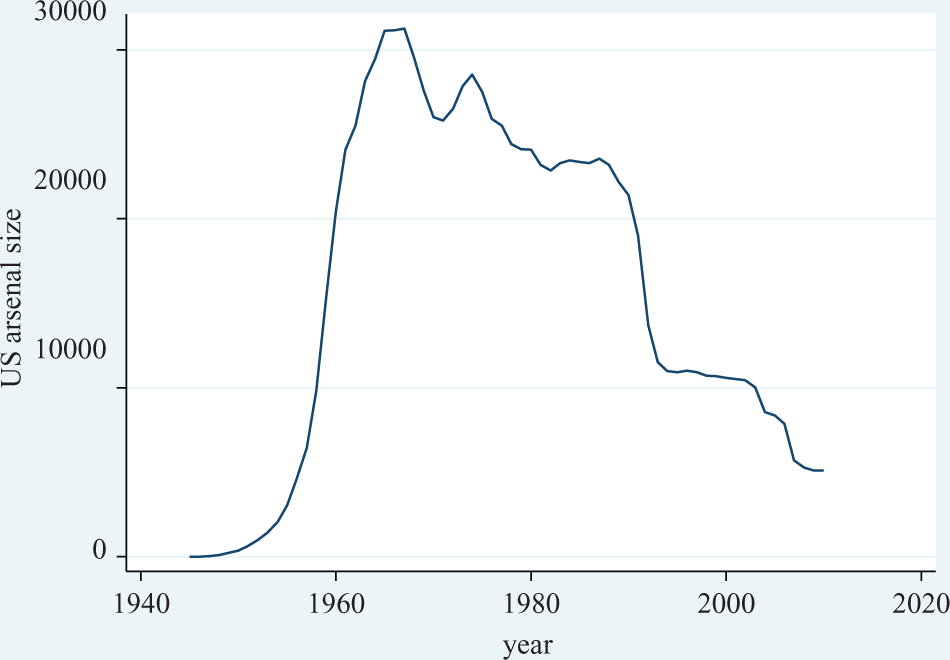
Size of the US nuclear arsenal, 1945–2010
The US nuclear arsenal is the best possible starting point for this empirical research agenda for at least two reasons. First, many claims about US nuclear weapons posing an obstacle to non-proliferation focus on the size of the US arsenal and recommend nuclear reductions as the appropriate solution (e.g. Choubey, 2008). Second, arsenal size is a concept that is easily amenable to measurement and, thus, large-N quantitative analysis. Some may argue that the size of the US nuclear arsenal is not an ideal gauge of the theoretical concept, but, in practice, there is not a better one. For that reason, a full assessment of the linkage hypothesis should start with the US nuclear arsenal, but it also requires studying possible alternative measures of the independent variable. Some alternatives are examined in the robustness test section of this article and additional ideas for future research are proposed in this article’s concluding section.
I control for other factors thought to influence the probability that a country engages in proliferation-related behavior including: levels of economic development, gauged by both GDP per capita and Industrial capacity; the intensity of a state’s security environment, measured by whether a country is engaged in a Rivalry and whether it has a Security guarantee from a nuclear-armed state; domestic political Regime type; Openness to the international economy; and Liberalization, or movements toward greater levels of economic openness. I also include a measure to assess the Year of the observation to account for the possibility that states may have been more likely to consider the nuclear option at the beginning of the nuclear era. 11 More detailed information on the definition and measurement of these variables can be found in Singh & Way (2004). In the models assessing nuclear acquisition, I also control for whether the country has ever received Sensitive nuclear assistance from a more advanced nuclear state as recommended by Kroenig (2009b).
I employ Cox proportional hazard models and cluster robust standard errors by country. The results are presented in Table I. As we can see, there is no relationship between the size of the US arsenal and the probability that countries explore (Model 1), pursue (Model 2), or acquire (Model 3) nuclear weapons. 12 US arsenal is not statistically significant in any of the models. There is no support for the idea that the size of the US arsenal is correlated with the probability that other countries proliferate.
Hazard models of nuclear proliferation, all states, 1945–2000

Statistically significant parameter estimators are denoted by *p < 0.05, **p < 0.01, ***p < 0.001. Coefficients are estimates for Cox proportional hazard models; robust standard errors, adjusted for clustering by country, are in parentheses. GDP denotes gross domestic product. Model 3 is trimmed to take into account available degrees of freedom. Full models also reveal a statistically insignificant relationship between US arsenal and Acquire.
Consistent with the argument of this article and previous research, however, we can see that there are several security, economic, and political variables that are correlated with nuclear proliferation behavior. Countries with a security rival are more likely to engage in all three levels of proliferation. Similarly, countries above a certain level of industrial capacity are more likely to explore and pursue the bomb. The receipt of sensitive nuclear assistance increases the probability that a country acquires nuclear weapons. Year is negative and statistically significant in Models 1 and 2, demonstrating that, consistent with expectation, states were more likely to begin nuclear activity early in the nuclear era. There is some evidence to support the idea that liberalization affects proliferation. The sign on the coefficient for Liberalization is positive and statistically significant in Model 2.
The analysis of the effect of US nuclear weapons on the proliferation behavior of all states, however, is only the first step. It is possible that US nuclear weapons affect proliferation behavior differently in different categories of states, negating each other’s effects in the aggregate data. Next, therefore, I explore the possibility that the relationship between US arsenal size and nuclear proliferation depends on whether the potential proliferant is a US ally. To begin, I include US arsenal x US guarantee, a term that interacts US arsenal with a dichotomous variable that gauges whether the country has a security guarantee from the United States, US guarantee. I also include both lower order terms. 13 Next, I split the sample and analyze the relationship between the size of the US nuclear arsenal and proliferation behavior in samples of US allies and US non-allies separately. The results of the statistical analysis are presented in the online data appendix. In both sets of tests, I find that there is no relationship between the size of the US arsenal and the proliferation behavior of either allies or non-allies. There is no support for the idea that US allies are less likely, or US non-allies more likely, to explore, pursue, or acquire nuclear weapons, the larger the size of the US nuclear arsenal. Once again, I find support for the idea that other security, economic, and political variables are correlated with the spread of nuclear weapons.
Nuclear non-proliferation policy
Next, I turn to nuclear non-proliferation policy. To begin, I explore the determinants of sensitive nuclear technology transfers. Providing sensitive nuclear assistance is the most direct way in which a country can aid another country’s pursuit of a nuclear weapons capability (Kroenig, 2009a). If the size of the US nuclear arsenal complicates US efforts to get cooperation on nuclear non-proliferation, we may expect to find a positive relationship between the size of the US nuclear arsenal and the probability that other countries provide sensitive nuclear assistance. If, on the other hand, state decisions to provide sensitive nuclear assistance are driven by other factors, we should expect to find no relationship between these variables.
Granted, the provision of sensitive nuclear assistance is not an ideal measure of state support for the nuclear non-proliferation regime, but, unfortunately, an ideal measure does not exist. For this reason, this article performs a number of tests on a range of dependent variables in an attempt to test the above hypotheses. At a minimum, sensitive nuclear assistance is certainly among the useful indicators as the transfer of sensitive nuclear materials and technology to non-nuclear states is clearly in tension with the spirit of the non-proliferation regime. While even strongly held norms are sometimes violated, if the conventional wisdom is correct, it would still be reasonable to expect to find variation in levels of violations over time to correspond with variation in US nuclear posture.
To conduct these tests, I repeat the analysis of Kroenig (2009a) on the correlates of sensitive nuclear assistance after including US arsenal. The dataset contains yearly information for all capable nuclear suppliers and potential nuclear recipient dyads in the international system from 1951 to 2000. Capable nuclear suppliers include nuclear weapon states, like the United States, and states that possess sensitive nuclear technology, but that have not produced nuclear weapons, such as Japan. The unit of analysis is the directed-dyad year. 14
The dichotomous dependent variable is Sensitive nuclear assistance. It measures whether a capable supplier state provided sensitive nuclear assistance to a potential nuclear recipient in a given year. Detailed information on the definition and measurement of this variable can be found in Kroenig (2009a).
The key independent variable is US arsenal. I also control for the other factors demonstrated to affect patterns of sensitive nuclear assistance including: the Relative power between supplier and recipient; the presence of a common Enemy between the supplier and recipient; whether the supplier is in a defense pact with a superpower (Superpower pact); the economic circumstances of the supplier, measured by GDP per capita, levels of Economic growth, Openness to the international economy, and Trade dependence with the potential recipient; domestic political Regime type; whether the supplier is a member of the NPT or Nuclear Suppliers Group (NSG); Distance and Distance squared between supplier and recipient; the security environment of the recipient (Disputes); the GDP per capita and economic Openness of the recipient; and whether the recipient is a member of the NPT. For more information on each of these variables, see Kroenig (2009a).
I employ logistic regression to test claims about the correlates of sensitive nuclear assistance. Robust standard errors are adjusted for clustering by dyad. The results are presented in Table II, which reveals that there is no relationship between the size of the US nuclear arsenal and the probability that other countries provide sensitive nuclear assistance. US arsenal is not statistically significant in a full (Model 1) or trimmed (Model 2) model. There is no support for the idea that the smaller the size of the US arsenal, the less likely other countries are to engage in sensitive nuclear transfers.
Correlates of sensitive nuclear assistance, 1951–2000
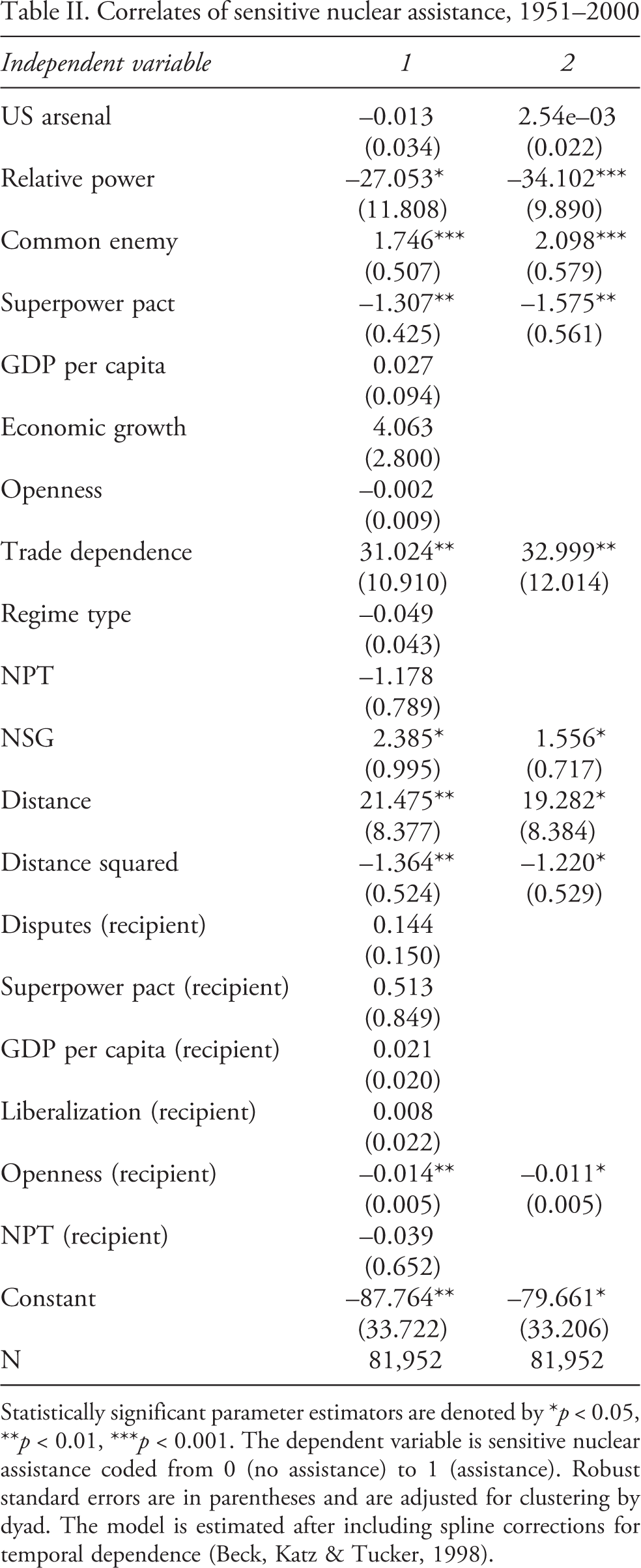
Statistically significant parameter estimators are denoted by *p < 0.05, **p < 0.01, ***p < 0.001. The dependent variable is sensitive nuclear assistance coded from 0 (no assistance) to 1 (assistance). Robust standard errors are in parentheses and are adjusted for clustering by dyad. The model is estimated after including spline corrections for temporal dependence (Beck, Katz & Tucker, 1998).
Consistent with the argument of this article and previous studies (e.g. Kroenig, 2009a), I find that strategic factors, namely the relative power between supplier and recipient, the presence of a common enemy, and the dependence of the supplier on a superpower patron are correlated with sensitive nuclear assistance. I also find that Trade dependence, NSG, Distance, Distance squared, and Openness (recipient) are statistically significant correlates of Sensitive nuclear assistance.
As the final test of the link between US nuclear weapons and other states’ non-proliferation policies, I analyze the relationship between the size of the US nuclear arsenal and state voting behavior on non-proliferation issues in the United Nations Security Council (UNSC). When states are found to be in non-compliance with their NPT obligations by the International Atomic Energy Agency (IAEA) Board of Governors (BOG), their case is referred to the UNSC for consideration. UNSC members can enforce violations of the NPT by, for example, passing UNSC resolutions to impose sanctions on NPT violators. Other nuclear proliferation issues can also be taken up by the UNSC independent of a BOG recommendation. If the maintenance of a large nuclear arsenal complicates US efforts to get international cooperation on international nuclear non-proliferation efforts, then we should expect to find a negative relationship between the size of the US arsenal and whether countries vote ‘yes’ on UNSC resolutions related to nuclear non-proliferation.
To conduct the analysis, I construct a new dataset on votes in the UNSC on nuclear proliferation issues from 1945 to 2011. The dataset contains information on 375 votes by 75 countries in 25 separate UNSC resolutions. Data on UNSC votes are drawn from the official website of the United Nations and a list of the resolutions is available in the online data appendix. 15 The unit of analysis is the country-vote.
The dichotomous dependent variable is UNSC vote. It is coded 1 if a country votes yes on the non-proliferation resolution and 0 if the country votes no or abstains. 16 The key independent variable is US arsenal. I control for other factors that might affect state voting on non-proliferation issues in the UNSC. We might expect militarily powerful countries to be more threatened by the spread of nuclear weapons and thus be more likely to support non-proliferation measures in the UNSC (Kroenig, 2014a). To account for military power, I include Capabilities, a composite index containing information on total population, urban population, energy consumption, iron and steel production, military manpower, and military expenditures. Data for this variable are drawn from the Correlates of War composite capabilities index, version 3.02, and extracted using EUGene (Singer, Bremer & Stuckey, 1972; Bennett & Stam, 2000). 17 I include Regime type to account for the possibility that democratic countries may be more likely to cooperate within international institutions, including the IAEA and the UNSC. 18 To gauge the effect of economic development on UNSC voting patterns, I include GDP per capita. In addition, one might expect NPT member states to be more likely to enforce violations of the NPT than non-members. Therefore I include NPT, which measures whether a state was a member of the NPT at the time that the vote was taken. 19 Finally, I include Explore, as defined above, to account for the possibility that states that are actively exploring a nuclear option themselves might be less likely to support tough non-proliferation measures in the UNSC.
To test the correlates of UNSC voting behavior, I employ logistic regression. Robust standard errors are clustered by country. 20 The results are presented in Table III, in which we can see that there is no relationship between US arsenal size and state voting in the UNSC on proliferation issues. US arsenal does not reach statistical significance in a fully-specified (Model 1) or a trimmed (Model 2) model. This test provides no empirical support for the idea that the maintenance of a large arsenal complicates US efforts to garner international cooperation on nuclear proliferation issues.
Correlates of UNSC voting on nuclear proliferation issues, 1945–2010
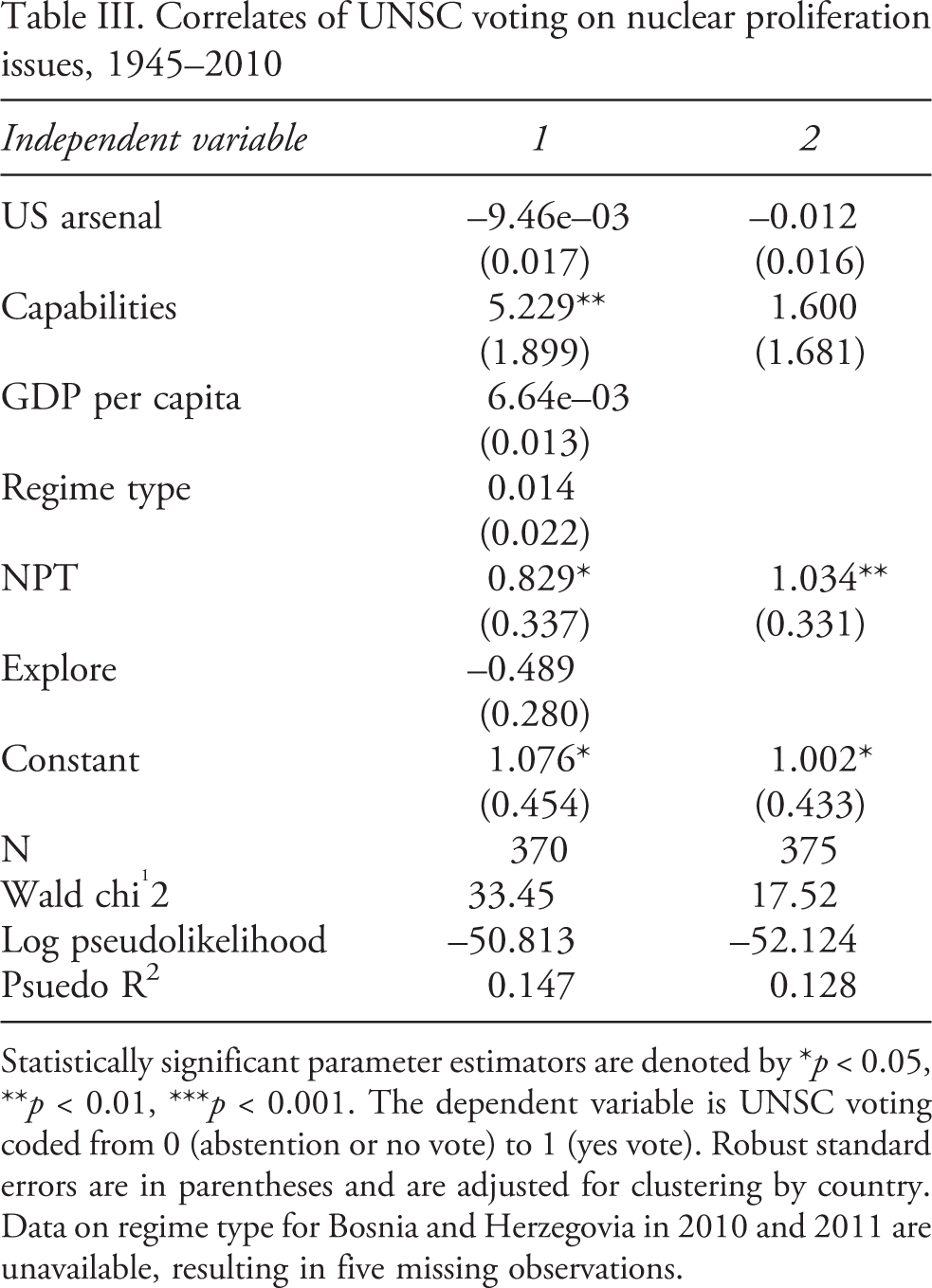
Statistically significant parameter estimators are denoted by *p < 0.05, **p < 0.01, ***p < 0.001. The dependent variable is UNSC voting coded from 0 (abstention or no vote) to 1 (yes vote). Robust standard errors are in parentheses and are adjusted for clustering by country. Data on regime type for Bosnia and Herzegovia in 2010 and 2011 are unavailable, resulting in five missing observations.
Turning to the other variables, we can see that, consistent with the argument of this article, other variables are correlated with UNSC voting. Capabilities is positive and statistically significant in Model 1. As expected, militarily powerful states are more likely to support non-proliferation measures in the UNSC. NPT is also positive and statistically significant, meaning that NPT member states are more likely to vote to enforce non-proliferation measures in the UNSC. This finding supports the intuition that non-member states, such as Israel, India, and Pakistan, might be less willing to support non-proliferation enforcement for fear that they themselves might become the targets of such measures. The other variables do not reach statistical significance. Domestic political regime type, levels of economic development, and the exploration of nuclear weapons do not appear to influence UNSC voting.
In sum, the quantitative results show that there are many statistically significant correlates of nuclear proliferation and non-proliferation, but the size of the US nuclear arsenal is not among them.
Robustness checks
This section presents the results of a number of robustness tests. (More detail on each of these tests is available in the online data appendix.) First, I look for a relationship between the size of the US nuclear arsenal and other non-proliferation-related dependent variables, including the percentage of countries outside the NPT that signed the treaty each year (Carcelli et al., 2014), whether a UNSC Resolution vote on nuclear issues takes place, and whether states adopt the International Atomic Energy Agency (IAEA) Additional Protocol (AP). Next, to assess whether the findings are sensitive to conceptualizations of the key independent variable, I create a number of alternate measures of US arsenal size. I create variables that gauge: the natural logarithm of the US arsenal, an ordinal categorization of the US arsenal size (<100, 100–1,000, 1,000–10,000, > 10,000), annual changes in US arsenal size, whether the United States cuts the size of its arsenal in any given year, and the size of the arsenals of the P-5 nuclear powers combined. 21 To test for the possibility that US arsenal size is related to sensitive nuclear assistance (although this relationship is obscured by counting instances of continued nuclear transfer over time), I drop dyad-years from the dataset after the first instance of sensitive nuclear cooperation. I then assess whether the findings depend on historical time. It is possible that any relationship between US nuclear weapons and proliferation only came into existence after the establishment of the NPT in 1968. Similarly, it is possible that the relationship varied from the Cold War to the post-Cold War periods. To test for these possibilities, I divided my sample by historical time period and conducted regression analysis on the resulting subsamples of data. In addition, in my coding of US nuclear security guarantees, I tried excluding the 1947 Rio Pact, which never contained an explicit nuclear dimension. Finally, I reran the above tests, using a different dataset of nuclear weapons proliferation from Jo & Gartzke (2007).
All of these tests produced similar results. The overall pattern revealed in this study through dozens of tests is that there are many significant correlates of proliferation and non-proliferation behavior, but scant evidence of any significant relationships between US nuclear weapons and the proliferation behavior of other states. 22
Discussion and conclusion
This article examined the relationship between US nuclear weapons and nuclear proliferation. It found that there is no evidence of a relationship between the size of the US nuclear arsenal and a variety of nuclear proliferation outcomes, including whether other states engage in nuclear proliferation themselves and whether they adopt policies designed to prevent the spread of nuclear weapons to additional countries. This finding was robust in a large battery of statistical tests that included alternate conceptualizations and measures of key independent and dependent variables and in several subsamples of data. Claims that the size of the US nuclear arsenal is an important determinant of the proliferation behavior of other states, therefore, do not find empirical support. This study does not allow us to conclude definitively that there is not an association between these sets of variables, but it does demonstrate, at a minimum, that there is not a strong and readily observable empirical correlation between US nuclear arsenal size and non-proliferation. In contrast, the findings of this research lend greater support to the idea that state behavior on nuclear issues is determined by calculations about how nuclear proliferation outcomes affect their interests more narrowly defined.
This research, however, should only be a first step in a broader agenda to evaluate empirically the relationship between arms control and non-proliferation. While nuclear reductions and nuclear arsenal size may be the most visible symbols of a commitment to disarmament, they are not the only ones. Some nongovernmental organizations and non-nuclear weapon states charge that simple quantitative nuclear reductions do not go far enough and that the major nuclear powers need to do much more to show their dedication to Article VI NPT commitments. Future empirical research could examine the non-proliferation effects of other steps toward disarmament taken by the nuclear powers, such as: doctrines of use, nuclear postures, progress on the 13 Steps agreed to at the 2000 NPT Review Conference, stronger negative security assurances, a reduced role for nuclear weapons in military strategy, Comprehensive Nuclear-Test-Ban Treaty (CTBT) ratification, the start of a P-5 process to broaden arms control to include the other three nuclear-weapon states besides the United States and Russia, and an explicit US commitment to work toward nuclear disarmament under the global non-proliferation regime.
To be sure, accurately measuring these variables and conducting meaningful quantitative analysis will be challenging. Moreover, the central argument and findings of this article gives us some reason to be skeptical that these other measures will return evidence of a strong correlation with nuclear proliferation-related outcomes. Nevertheless, this is the type of research that must be conducted if we hope to have a fuller understanding of this question, an understanding that is critical not only to the scholarly study of nuclear proliferation, but also for international security policy.
In his 2015 annual report to Congress on the projected threats to the national security of the United States of America, Director of National Intelligence James R Clapper assessed that the prospect of nuclear proliferation in various countries constitutes a major threat to US national security. 23 As was discussed in the introduction, the United States plans to combat nuclear proliferation, in part, by reducing the number of nuclear weapons in the US nuclear arsenal. The research presented in this article demonstrates, however, that alterations in US nuclear force size may not have a meaningful impact on the proliferation behavior of other states. The United States is correct to recognize nuclear proliferation as a threat to international peace and security, but, given the findings of this research, there is reason to believe that the US government’s efforts to use disarmament as a means of advancing non-proliferation goals might not be met with success. 24
The findings of this article, therefore, leave us with a genuine policy dilemma. Lacking evidence of a tight correspondence between US arsenal size and proliferation behavior in the past, there is reason to doubt that additional cuts will produce cooperation on non-proliferation issues in the future. On the other hand, it is possible that the US government has not yet gone far enough and, at some point in the future – perhaps complete nuclear disarmament – nuclear reductions will eventually result in non-proliferation breakthroughs. If the United States refuses to make further nuclear cuts, other countries might lose faith in the bargains contained in the nuclear non-proliferation regime and defect. On the other hand, the United States may continue reductions that will ultimately fail to produce non-proliferation benefits while possibly weakening the nuclear deterrent that provides security to itself and its allies. There are real risks either way. At a minimum, however, the findings of this research should cause us to doubt the surety of the conventional wisdom and to motivate additional research on this vital subject. In the meantime, the United States should continue to utilize proven methods for preventing nuclear proliferation, such as denying states the technology required to produce nuclear weapons and addressing the threat environments that motivate states to desire nuclear weapons in the first place.
Footnotes

References
Supplementary Material
Please find the following supplemental material available below.
For Open Access articles published under a Creative Commons License, all supplemental material carries the same license as the article it is associated with.
For non-Open Access articles published, all supplemental material carries a non-exclusive license, and permission requests for re-use of supplemental material or any part of supplemental material shall be sent directly to the copyright owner as specified in the copyright notice associated with the article.
