



Abstract
This article presents new data on provisions for police reform in peace agreements (PRPA) between 1975 and 2011. The PRPA dataset complements past research on the determinants and effects of specific terms in agreements with detailed data on police reform provisions. The PRPA dataset also adds a quantitative dimension to the thus far largely qualitative literature on post-conflict security sector reform (SSR). It includes information on six subtypes of police reform: capacity, training, human rights standards, accountability, force composition and international training and monitoring. We show that there is currently a high global demand for the regulation of police reform through peace agreements: police reform provisions are now more regularly included in agreements than settlement terms that call for power-sharing or elections. We observe interesting variations in the inclusion of police reform provisions in relation to past human rights violations, regime type, or the scope of international peacekeeping prior to negotiations, and illustrate the implications of police reform provisions for the duration of post-conflict peace. Finally, we stimulate ideas on how scholars and policymakers can use the PRPA dataset in future to study new questions on post-conflict police reform.
Introduction
Establishing a well-functioning and legitimate police force as part of a wider security sector reform (SSR) process is one of the most vital components of post-conflict peacebuilding (Call, 2002; Brzoska, 2006; Schroeder & Chappuis, 2014). There are a number of reasons for this. The police force represents the most important provider of internal security in post-conflict states, particularly after international peacekeepers have left and national military forces have relinquished responsibility for handling internal policing tasks (Downie, 2013). Further, if dysfunctional or illegitimate institutional structures underpinning the police contributed to the onset of war in the first place, reform is crucial to ensure that these deficiencies do not fuel a relapse to violence in the post-conflict period. Lastly, if officers were themselves perpetrators of violence during the conflict, reform is an important part of restoring trust in the police and, ultimately, creating a legitimate post-conflict state (cf. Goldsmith, 2005).
At the same time, police forces in post-conflict states are frequently ill-equipped, lack basic training in human rights, and are asymmetrically constituted in terms of ethnic groups or warring parties. Consequently, large volumes of development finance are now being targeted at training police officers after war, as well as at embedding them in legitimate political structures (OECD, 2007). But despite a vibrant qualitative debate in the post-conflict SSR and peacebuilding literature on the determinants and effects of police reform, systematic and comparative evidence on the demand for, as well as the impact of, such reform in the areas of equipment, accountability structures, and force composition is still lacking. This is also due to the paucity of available quantitative data.
In this article, we introduce the Police Reform in Peace Agreements (PRPA) dataset to help narrow this gap, contributing to existing research on peace accords and SSR. Quantitative studies of peace agreements have predominantly focused the causes and effects of political dimensions of peace settlements, such as power-sharing between warring parties. While data collections also include information on aspects of the broader security sector context, such as provisions for military power-sharing (Ottmann & Vüllers, 2015), transitional justice (Binningsbø et al., 2012), or demobilization, disarmament and reintegration (DDR) (Harbom, Högbladh & Wallensteen, 2006), the police is neglected in this line of research. This is surprising, as agreements represent important blueprints for post-conflict police reform.
In contrast, the study of police reform has been much more prominent in a growing qualitative literature on the role of SSR in peace processes (Hänggi, 2004; Brzoska, 2006). Researchers have identified several vital ‘ingredients’ to the reform of the police: it is widely accepted that police reform is not only a technical exercise of training officers and building police posts, but also a deeply political process (Cawthra & Luckham, 2003; Bernabéu, 2007). Political dimensions to police reform include, among other things, issues of control and composition. Research has here stressed the need to build political accountability structures, such as parliamentary oversight committees (O’Neill, 2005). Brzoska & Heinemann-Grüder (2004) also identify an ‘ethnic balance’ within the post-conflict police force as fundamental. Others highlight that human rights training is central to improving the job performance of officers and reducing police brutality (Bajraktari et al., 2006). Finally, existing case study research has highlighted the significant international involvement in post-conflict police reform and pointed to the need for local participation and leadership for these international projects to be successful (Donais, 2009).
The PRPA dataset complements these studies’ small-N focus. It represents a first quantitative assessment of how peace agreements address the various technical, political and international facets of post-conflict police reform described in the qualitative literature. Our dataset enables scholars and practitioners to systematically examine whether case study findings can be generalized to a wider set of cases or whether they remain context-specific. It allows future research to explore relationships between aspects of police reform in agreements, their determinants, and their impact on post-conflict human rights practices, peace and political developments.
Defining and measuring police reform as part of peace agreements
We understand the police as the government agency that is tasked with maintaining internal public security and order, as well as with preventing and investigating criminal activities. Embedded in past research, we refer to reform as a change in the institutional structure of the police with respect to three dimensions: their technical capability (changes in the training and equipping of officers), political aspects (addressing human rights standards, composition and accountability structures) and international elements (modifications made under international monitoring and training).
Variables coded in the PRPA dataset

All variables were coded 1 if the respective regulation was present in a peace agreement and 0 otherwise.
Our main sources of information for the coding process were the agreement texts, as provided in the UCDP Peace Agreement Dataset. We extracted those passages that explicitly addressed the police and its reform and categorized them according to several dimensions of reform. We decided for positive coding only in cases where the police were specifically mentioned. For ambiguous references, for example if the accord called for reforming ‘security institutions’ without explicitly stating whether this would also concern the police or not, we examined previous agreements signed as part of the peace process. In those instances where these previous agreements clearly stated that the police force is part of those security institutions, we opted for positive coding. 2
We trained research assistants to conduct an initial round of coding. Every coding was then independently recoded by one of the principal investigators. We then repeated this procedure and all codings were again revised by a different principal investigator than in the first round. When codings for a case were changed in both rounds of revision, we flagged this as an uncertain case in the dataset, a total of eight peace agreements (4% of all agreements). 3
Types of police reform provisions in peace agreements
The PRPA dataset includes information on three dimensions of police reform provisions – a technical, a political and an international dimension – by coding several subtypes.
Technical dimensions of police reform
Technical aspects of police reform, such as training officers in investigative procedures, were prioritized particularly in the early 1990s (DCAF, 2009). Loh argues it is essential to improve police capacity ‘as quickly as possible’ in a peace process to bridge the gap between citizens’ needs and the force’s ability to meet these needs (2010: 6). The PRPA dataset assesses technical dimensions of police reform in two variables. First, we collect data on how accords include provisions to strengthen police capacity, defined as the state of their technical and professional equipment, including the availability of arms, clothing, the size of the force and its place of deployment. For instance, the Protocol on Redeployment in Hebron, concluded between Israel and Palestine, states that ‘Palestinian police stations or posts will be […] manned by a total of up to 400 policemen, equipped with 20 vehicles and armed with 200 pistols’. Second, we code whether an accord called for the training of the police in technical skills – understood as tactical or professional education of officers. One example of an accord addressing this aspect is the Erdut Agreement for Croatia, which states that the transitional authority ‘shall help to establish and train temporary police forces, to build professionalism among the police, and confidence among all ethnic communities’.
Political dimensions of police reform
While technical aspects of police reform were strongly endorsed in peace efforts immediately after 1989, the emergence of liberal peacebuilding in the 1990s gave rise to a new emphasis on the political aspects of such reform (DCAF, 2009). The PRPA dataset collects information on three distinct types of political police reform in peace accords. First, one of the central components of police reform today is to ensure that officers operate with a respect for human rights. If provisions on the latter are not included in accords, police reform risks being counterproductive by ‘reinforcing perceptions that human rights are of little relevance to actual police work’ (Cordone, 2000: 206). The PRPA dataset includes a variable capturing how accords address human rights standards for the police, meaning provisions that regulate the conduct of officers on the basis of internationally accepted human rights. For instance, El Salvador’s Chapultepec Peace Agreement states that the police ‘shall preserve and defend the human rights of all persons’ and prohibits ‘any act of torture’ by the police.
Second, we collect information on how accords help regulate police accountability, which we refer to as provisions that determine the supervisory authority to which the police force must report. O’Neill (2005: 9), for example, stresses that police reform will not succeed without a ‘heavy emphasis on police accountability’ and oversight bodies that prosecute officers for professional misconduct. For instance, Sudan’s Darfur Peace Agreement of 2010 includes provisions for the civil oversight and legal accountability of local police forces.
Third, we collect information on how peace agreements address a police force’s composition, which we understand as terms that adjust the representation of socially or politically relevant groups within the police force. The significance of representation is recognized in the broader SSR literature, which highlights the need for implementing context-driven reforms in order to constitute the police force as a ‘mirror of society at large’ (Bastick, 2007: 13). We code an overall composition variable which captures if any quotas were called for in the accord. We additionally distinguish between accords that provide for reform of the representation of warring parties, ethnic or religious identity groups and women. Examples include the accords signed by Angola’s government and the União Nacional para a Independência Total de Angola (UNITA) in 1991, 1994 and 2002, which regulate the representation of UNITA combatants in the police force and specify the ranks that are to be filled by ex-combatants.
International dimensions of police reform
Qualitative studies have often critically examined the role of international actors in police reform processes (Call, 2002). At the same time, studies also recognize that circumstances of political instability often require strong international leadership in police reform (Bajraktari et al., 2006). The PRPA dataset assesses whether international roles in such reform procedures are already negotiated in peace accords, and we collect information on whether agreements called for the international monitoring and training of the police, such as by peacekeeping troops. For instance, the 2003 Linas-Marcoussis Peace Accords in Ivory Coast called for the monitoring of the police force by United Nations (UN) peacekeepers.
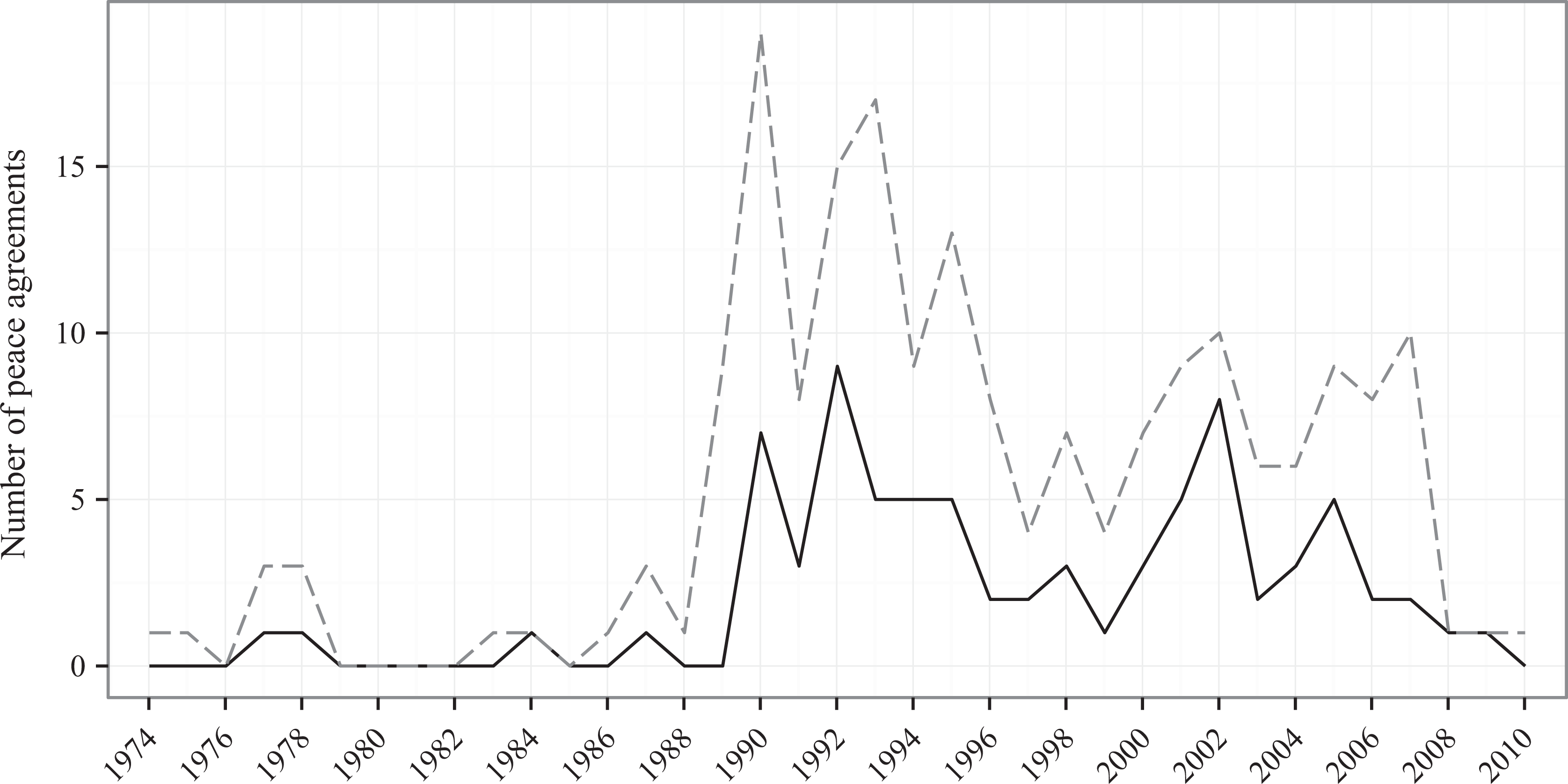
Trends in police reform provisions, 1975–2011
Trends and patterns of police reform in peace agreements
Police reform provisions in peace agreements are not equally distributed across time, while the distinct dimensions and subtypes of such provisions vary in frequency of occurrence. Of the 196 accords included in our sample, 78 (almost 40%) include provisions for police reform. To put this number into perspective, the widely studied issues of power-sharing and elections occur much less frequently: only 24 of the 217 accords in the UCDP Peace Agreement Dataset include terms for political power-sharing and only 69 accords call for elections or electoral reform.
Another insight from the PRPA dataset is that police reform provisions have become an increasingly frequent phenomenon since 1989 (see Figure 1). Of the 14 accords signed before 1989, only four (or 28.6%) call for police reform in some way; meanwhile, 40.9% (74 out of 181) of accords signed after 1989 call for such reform. This growing trend becomes even more visible when we illustrate the percentage of accords per year that include police reform provisions, that has steadily increased over time (see Figure 2).
Our data also show a large variation in terms of how extensively and in what manner police reform is dealt with in peace accords (see Table I). Provisions related to reforming capacity appear most often, with 60 of 78 accords addressing reform. The aspect of training is included in 36 accords. This reflects that police reform is mostly approximated as a technical exercise, as provisions for capacity typically regulate the recruitment of officers or the types of arms they are permitted to carry.
While technical aspects dominate, many agreements do address political aspects of police reform. Reforming accountability structures and a force’s composition are addressed frequently in our sample. Nearly half of those accords that address police reform in some fashion (38 accords) deal with (re-)modelling accountability structures for the police. A further 34 accords include provisions designed to regulate the composition of the police. Most often (23 of 34 accords), the aim is to address the representation of warring parties. In contrast, quotas for female police officers are hardly recognized despite being high on the international agenda (Mobekk, 2010). Only four accords in Burundi, El Salvador, Rwanda and Sudan address gender-sensitive policing.
Context and implications of police reforms in peace agreements
In this section we present potential applications of our dataset, concentrating on preliminary, descriptive insights rather than exhaustive empirical analyses, which we leave to future research. We focus on two approaches: factors that explain why parties address police reform in peace accords – reform provisions being the dependent variable – and the effects of police reform provisions on post-conflict outcomes – reform being the independent variable.
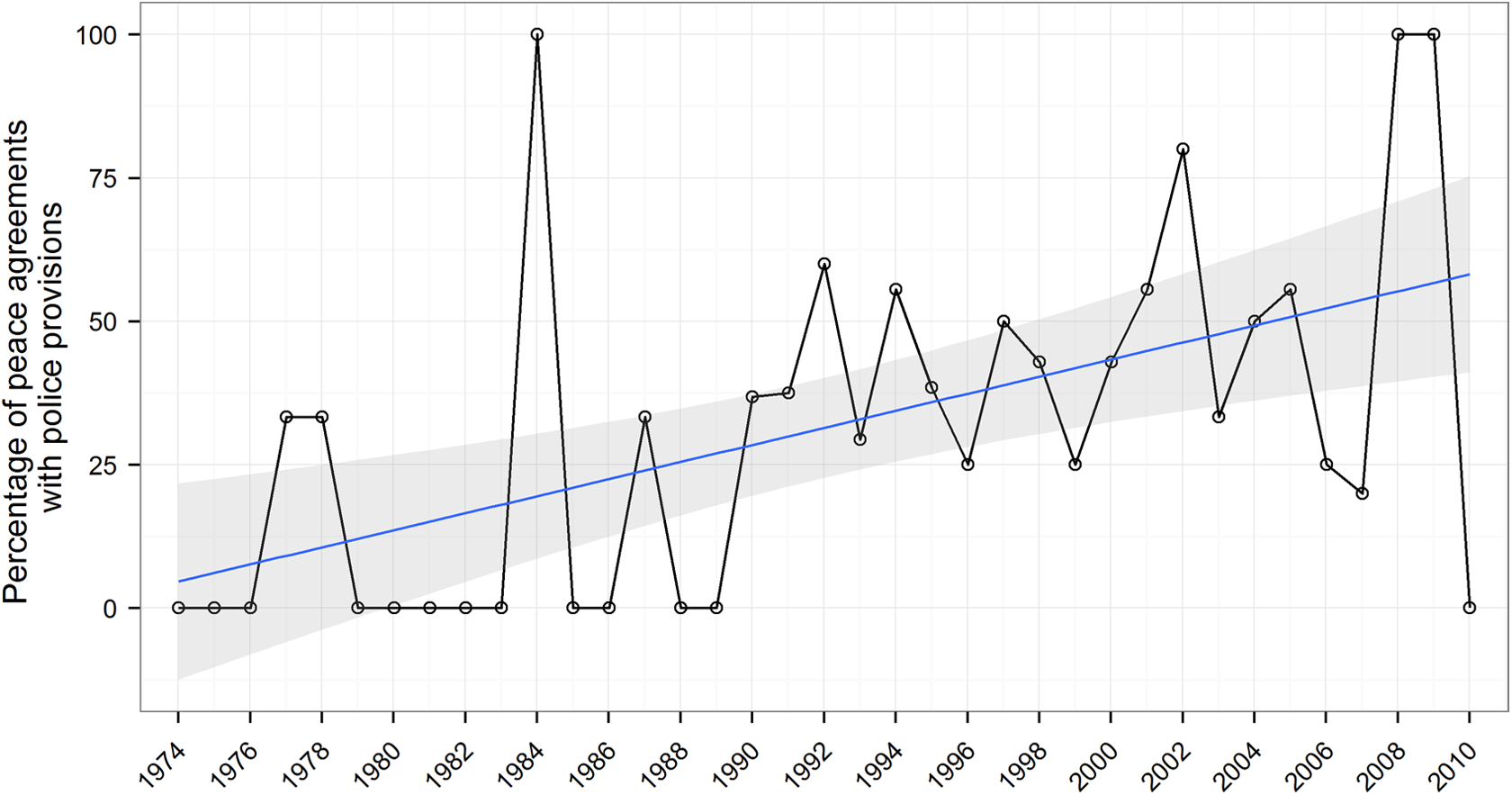
Share of peace agreements with police provisions, 1975–2011
Explaining police reform in peace agreements
To explore potential context conditions of police reform in peace agreements, we use data on a range of covariates. We then model the relationship between these covariates and the occurrence of police reform provisions using a simple logit analysis. This is an exploratory exercise only; our logit model merely serves as a concise way to summarize the probabilistic relationship between context covariates and police reform. Summarizing the data this way has the additional benefit of separating out the individual influence of each variable while controlling for the confounding of other variables. We explicitly refrain from making causal claims regarding these covariates.
Role of police during conflict
If, during armed conflict, the police played a role as perpetrator of human rights violations, rebels should be more likely to urge a government to include police reform provisions in peace agreements. We combine data from the PRPA dataset and the Political Terror Scale (PTS) to explore variations in political terror across post-conflict cases (Gibney et al., 2015). We calculate a five-year average PTS score prior to an agreement. 4
Security apparatus
We assume that police reform should be more likely to be addressed when the reform of the overall security apparatus is an issue in negotiations. We use DDR provisions as an approximation for how security topics arise during peace negotiations and include a dummy variable for DDR provisions in peace accords, taken from the original UCDP Peace Agreement Dataset.
Political environment
As authoritarian regimes often rely on the police as an instrument of repression, police reform in post-authoritarian contexts faces a number of obstacles – such as the potential unwillingness of a government to shed light on its police force’s involvement in past crimes (Goldsmith, 2005). Negotiations involving authoritarian regimes should thus be less likely to address police reform. We use Freedom House (FH) scores in the year the agreement was signed to proxy regime type, ranging from 1 (very democratic) to 7 (very autocratic).
Conflict issue
Does it make a difference whether the conflict was fought over government or over territory for the subsequent inclusion of police reform provisions in accords? We rely on data from the UCDP to distinguish government and territorial conflicts (Högbladh, 2011).
International context
The occurrence of large-scale police training programs funded by Western donors in places such as Afghanistan or Liberia suggests that post-conflict police reform is heavily shaped by international involvement. We include data on the mandate of the UN peacekeeping mission deployed to the country one year prior to the signature of the agreement to measure the level of UN involvement in the peacemaking process. 5
Figure 3 summarizes the results of our exploratory analysis. 6 The positive coefficient for the PTS score indicates that agreements include police reform provisions when there were higher average levels of prior human rights violations. This pattern seems indeed to be driven by concrete human rights violations rather than merely reflecting conflict intensity: no clear relationship between conflict intensity and police reform is apparent. 7 We also find that police reform provisions become more likely when DDR is addressed within a peace agreement. This suggests that conflict parties tend to regulate police reform together with the broader security apparatus.
While we observe more conflicts over government to occur in general, police reform provisions are more likely after territorial conflicts. One explanation for this pattern could be that arrangements made following territorial conflicts often include devolution of authority that might then be reflected in provisions that call for a restructuring of the police force. We further find that more autocratic countries with higher FH scores are less likely to include police reform provisions in peace agreements. Finally, while the majority of agreements did not see the deployment of a peacekeeping mission prior to the signature of the accord (many operations are only deployed as a result of an agreement), those cases that do see a strongly mandated mission are more likely to include police reform provisions in the peace agreement. We do not interpret these patterns as a causal relationship, but believe that this correlational evidence prompts new and interesting research questions: what, for example, is the precise relationship between the role of police forces during war and their reform after war if we go beyond using PTS scores?
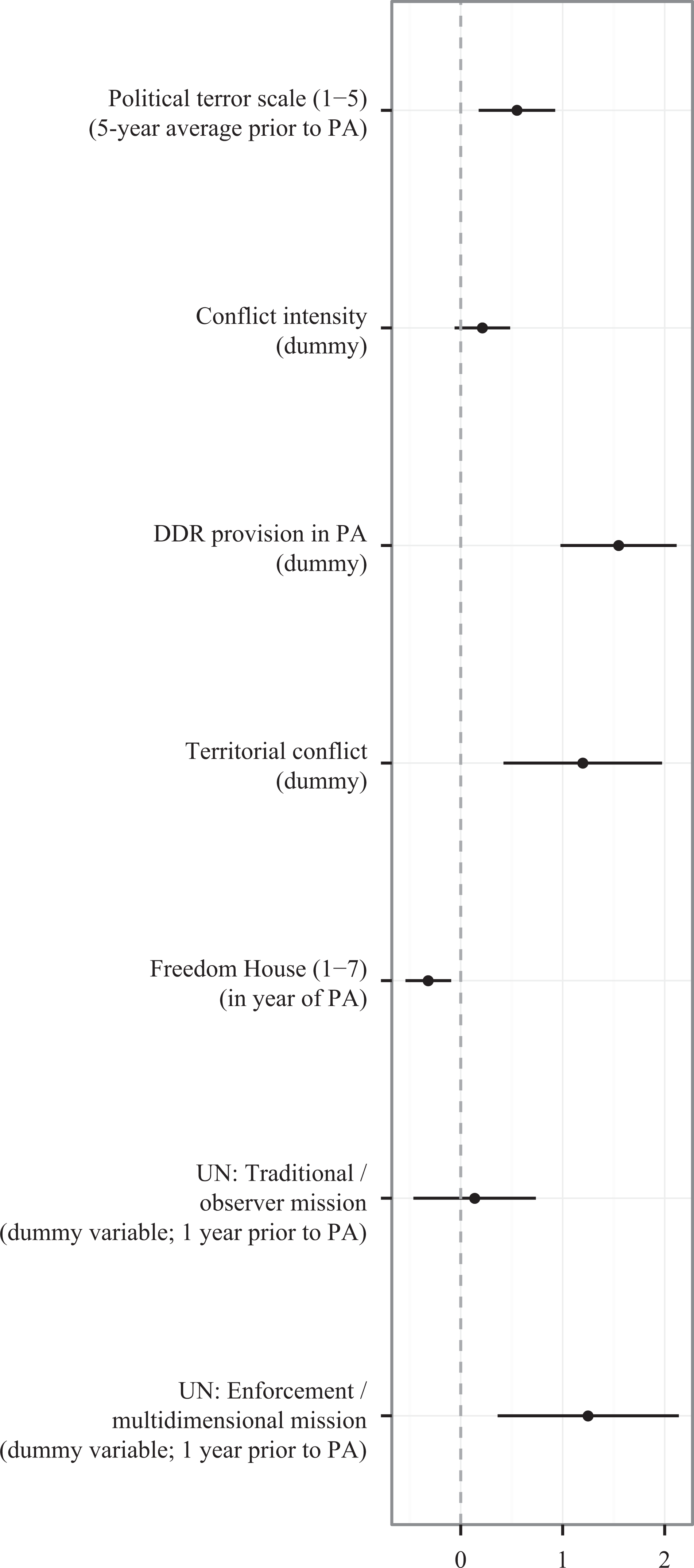
Context conditions of police provisions in peace agreements
Police reform provisions and the survival of peace
The PRPA dataset could also help address further research questions that treat police reform provisions as the independent variable. Several scholars have studied how terms of peace accords affect commitment problems Technical police reform provisions and the survival of peace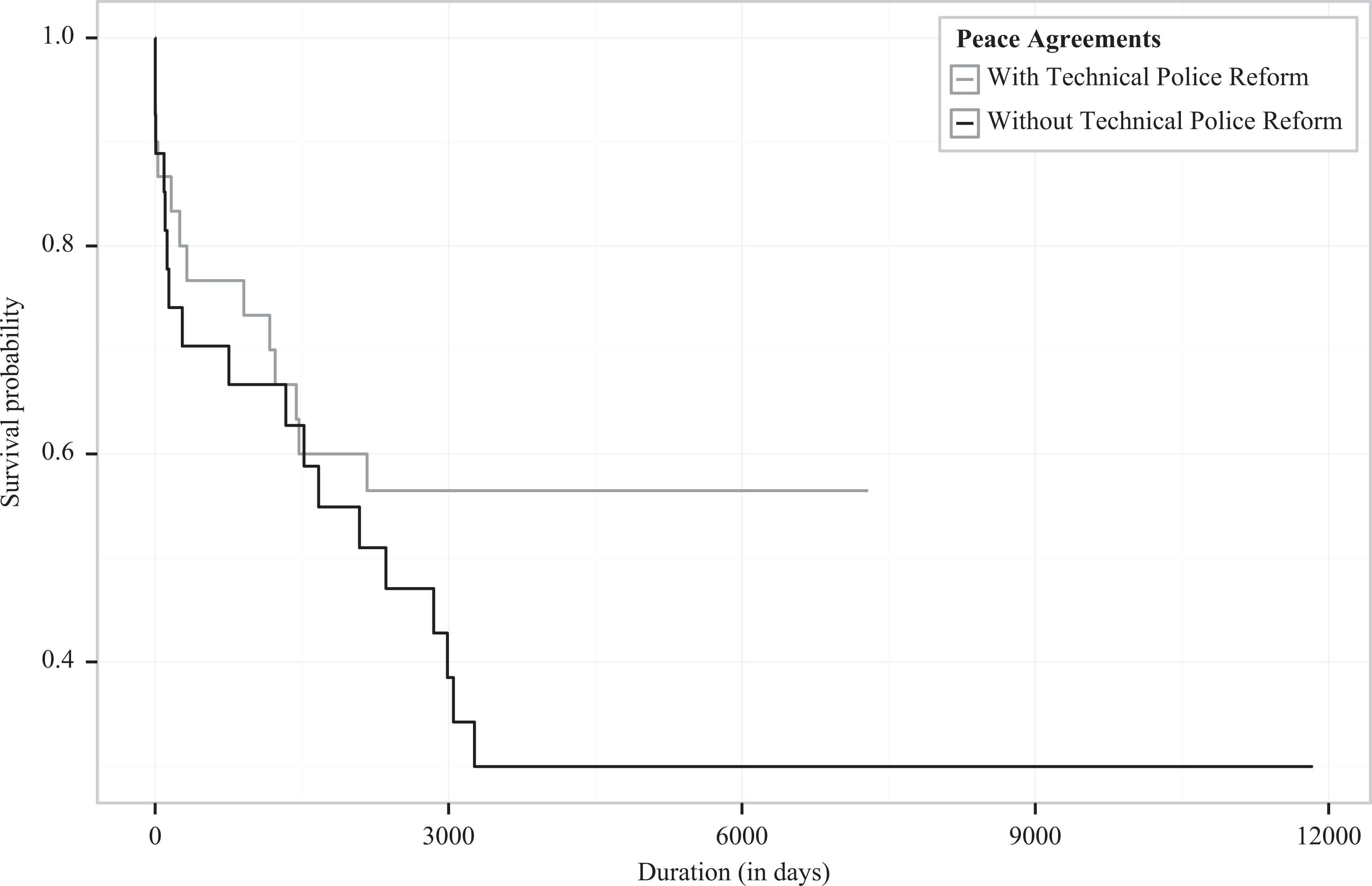
The PRPA dataset enables scholars to statistically test the assumptions about the effects of police reform made in qualitative research. We may theorize that political provisions for reform represent a more credible signal for peace, as opposed to technical reforms. We selected the 57 full peace accords in our sample and aggregated the subtypes of reform provisions to a political provisions and a technical provisions dummy. 8 We then estimated the survival of peace as the number of days peace lasted between the signing date of the accord (taken from the UCDP Peace Agreement Dataset) and the recurrence of armed conflict, using data from the PSED Dataset (Ottmann & Vüllers, 2015) and the UCDP/PRIO Armed Conflict Dataset. If a case had no recurrence of conflict, we right-censored it at 31 December 2011.
We illustrate the relationship between political and technical reform provisions and post-conflict peace by plotting Kaplan-Meier estimates of the survival probabilities of peace in Figures 4 and 5. 9 These curves show that while the inclusion of technical provisions does not seem to be related to the survival of peace, agreements that stipulate political provisions for police reform show a higher survival probability than those that did not inscribe political provisions. Log rank tests show that the difference between the curves of accords with political provisions and those without such provisions is statistically significant at p < 0.05, while no such relationship exists for accords including technical reforms. More theoretical reasoning is required to study why this relationship may come about, especially controlling for any confounding variables that affect both the inclusion of police reforms in agreements and the carrying out of police reform. The PRPA dataset provides an apt empirical basis from which to address this and similar questions.
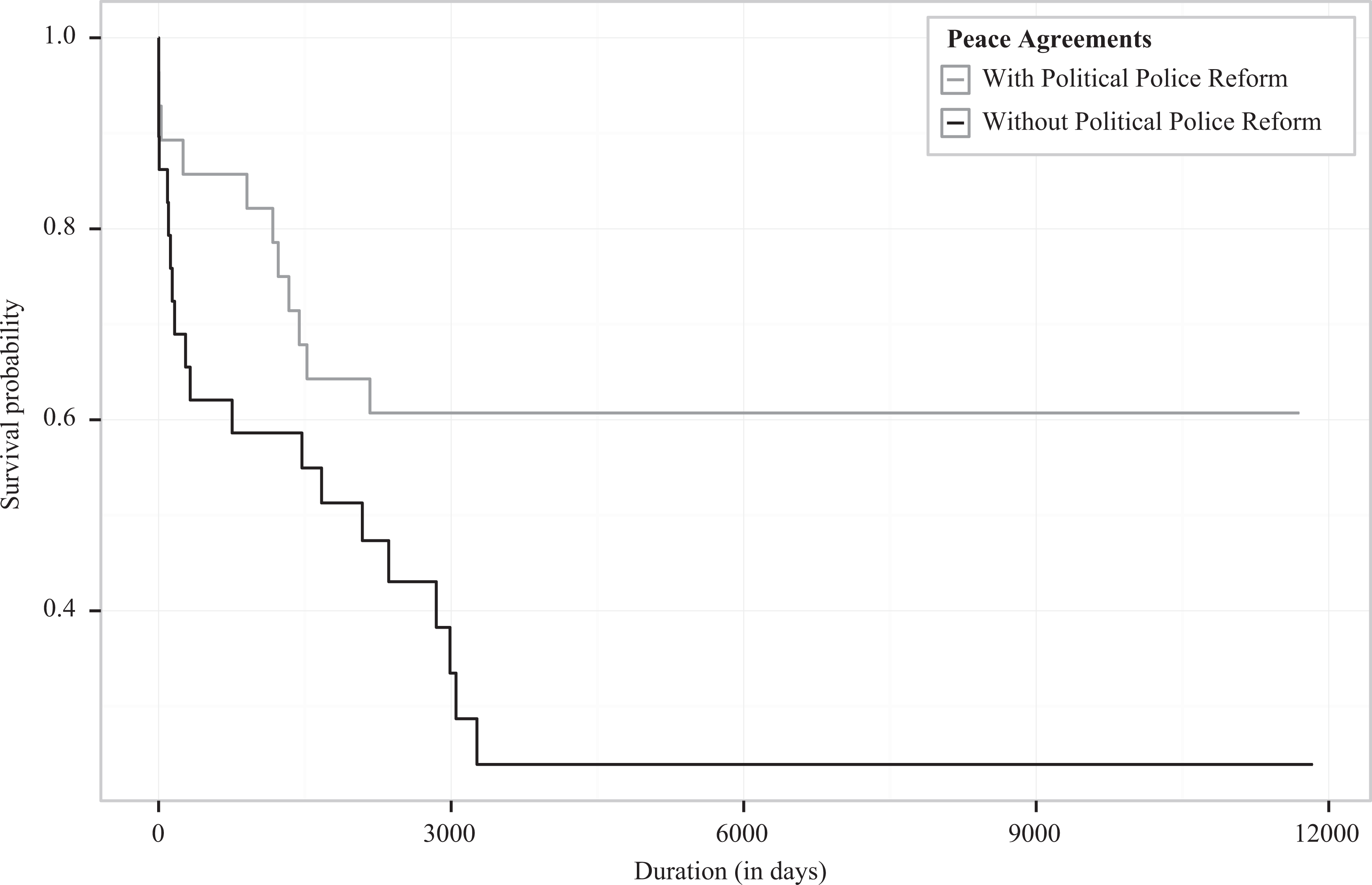
Political police reform provisions and the survival of peace
Discussion and outlook
The PRPA dataset represents the first attempt to quantify the occurrence and dimensions of police reform provisions in peace agreements, complementing the large qualitative literature on post-conflict security sector reform. It offers a starting point to analyze both the conditions under which parties agree to include police reform in peace accords and the impact of police reform on different post-conflict outcomes. The possible applications sketched in the previous sections cannot infer any causal relationships. Rather, they should be regarded as preliminary insights that point to a large variety of potential future research opportunities for scholars from different disciplinary backgrounds which the PRPA dataset can help answer.
For instance, scholars interested in questions of international peacebuilding could use the PRPA dataset to more systematically explore links between the footprint of the international deployment and various aspects of domestic police reform processes, a topic that has only been addressed in qualitative research so far (e.g. Bernabéu, 2007). Scholars working in the fields of criminology or sociology might want to use the PRPA dataset to study whether different aspects of police reform shape post-conflict outcomes beyond the stability of peace, such as societal trust in police forces. Academics with an area studies perspective could use the PRPA dataset to explore regional patterns of police reform, and investigate whether African contexts call for different types of police reform than Latin American or Asian contexts, especially if we consider colonial legacies. Methodologically, scholars could also use the PRPA dataset to select qualitative case studies: as mixed-methods research becomes an increasingly used analytic instrument in the social sciences, the PRPA dataset will allow scholars to consciously select cases based on reliable and standardized criteria.
In addition to possible empirical and methodological applications, we also make a conceptual contribution: the typology of different police reform dimensions presented in this article could be adapted to study police reforms in non-post-conflict situations. This would allow scholars to compare the respective importance of police reform across different processes of transition, for example autocracy-to-democracy and war-to-peace transitions. We also inform the policy debate about external SSR support as funding agencies can use the data to infer where and under what conditions which types of post-conflict police reform are likely and where which type of funding might become necessary in the future.
Footnotes
Replication data

Acknowledgements
We wish to thank our student assistants Miriam Bach and John Preuss for their excellent help with coding, and Sabine Kurtenbach, three anonymous reviewers and the editor Michael Brzoska for helpful comments. All errors remain our own.
Notes
References
Supplementary Material
Please find the following supplemental material available below.
For Open Access articles published under a Creative Commons License, all supplemental material carries the same license as the article it is associated with.
For non-Open Access articles published, all supplemental material carries a non-exclusive license, and permission requests for re-use of supplemental material or any part of supplemental material shall be sent directly to the copyright owner as specified in the copyright notice associated with the article.
