



Abstract
While much previous research has examined the relationship between interstate military alliances and the structure of domestic regimes, existing findings point in contradictory directions. Some have argued that democracies attract each other as alliance partners, and thereby generate international peace as a consequence of their domestic regime type, while others have argued that the causal relationship is reversed, and that international pacification creates the necessary space for international alliances and domestic democratization. To disentangle this difficult empirical relationship, this article presents an empirically grounded simulation model of the dynamic coevolution of interstate military alliances, international conflict, and domestic democratization, demonstrating a statistical approach which accounts both for the complex interdependencies generated by coevolving multiplex networks of interstate ties and for their reciprocal influence on the coevolution of domestic political regimes, over the period 1920–2000. The results show that international institutions and domestic institutions are mutually constituted, with both ‘selection’ effects and ‘influence’ effects operating simultaneously. In particular, the evidence indicates that states with similar regimes are more prone to ally with each other, mutually democratic dyads are less inclined to engage in militarized disputes, and states that form international alliances with democratic partners are more likely to develop domestic democratic institutions. Tests of out-of-sample predictive accuracy, across multidecade prediction windows, further demonstrate that the coevolutionary model consistently outperforms specifications that ignore coevolutionary effects, in predicting subsequent patterns of military alliances, military conflict, and domestic democratization.
Introduction
Scholars of international politics, whether examining patterns of conflict or of cooperation, are increasingly coming to the conclusion that the central driving forces of the international system cannot be accurately represented by independent dyadic interactions (Franzese & Hays, 2007; Hays, Kachi & Franzese, 2010; Hoff & Ward, 2004; Poast, 2010; Ward, Siverson & Cao, 2007), because our behaviors of interest are nearly always the result of interdependent decisions by states (Signorino, 1999; Maoz, 2010; Warren, 2010). We thus find substantial evidence in the existing literature that international militarized disputes evolve in response to an existing network of disputes (Siverson & King, 1980; Siverson & Tennefoss, 1984; Oren, 1990; Ward, Siverson & Cao, 2007), that international alliances evolve in response to an existing network of alliances (Bearce & Bondanella, 2007; Cranmer, Desmarais & Kirkland, 2012; Kinne, 2013a), and that networks of conflict and cooperation also both evolve in response to each other (Kimball, 2006; Maoz et al., 2007; Warren, 2010). We also find evidence that the development of democratic institutions at the domestic level is conditioned by patterns of conflict and cooperation at the international level (Gibler & Wolford, 2006; Manger & Pickup, 2014), while at the same time international conflict and cooperation are conditioned by domestic regime type (Dixon, 1994; Schultz, 1998; Russett & Oneal, 2001). In other words, scholars of international politics generally face a problem, not simply of network evolution, but of multilevel, network-behavior coevolution.
Such interdependencies can generate severe difficulties for statistical inference because they characterize a data generating process which violates the assumption of conditional independence, which lies at the root of most of the statistical estimators commonly used in our discipline. This was the basis of the seminal critique launched by Signorino (1999), arguing that the use of standard logistic regression to analyze conflict onset events can be expected to produce biased parameter estimates because such events are the result of strategic interactions between states. He proposes a game-theoretic random utility model to capture the dynamics of strategic anticipation, thereby producing a maximum likelihood estimator which more closely matches the functional form of the data generating process. However, the need for alignment between the functional form of a data generating process and a corresponding statistical estimator is not restricted to the special case of interdependencies generated by strategic anticipation, but rather represents a basic fact about our ability to generate unbiased causal inferences from observational data (Smith, 1996; Achen, 2002; de Marchi, 2005). Biased parameter estimates will result any time the functional form of the statistical model is not consistent with the data generating process (see Signorino & Yilmaz, 2003).
While a number of approaches have been proposed to deal with interdependencies generated by evolving networks of international ties (Wasserman & Pattison, 1996; Hoff & Ward, 2004; Franzese & Hays, 2007; Poast, 2010; Warren, 2010; Cranmer & Desmarais, 2011), these approaches have generally forced researchers into one of two sets of problematic assumptions. Either they (1) assume the exogeneity of domestic, state-level attributes, in seeking to explain the dynamic evolution of international ties, or (2) assume the exogeneity of international ties in seeking to explain the development of domestic attributes. 1 In contrast, here I utilize a simulation-based approach to statistical estimation, based on an ‘actor-driven’ model of international politics (Snijders, 1996, 2001), which seeks to capture the dynamic coevolution of international cooperation, international conflict, and domestic institutions. This approach combines a random utility model with Markov simulations of network evolution at the international level and behavioral evolution at the domestic level, making possible the explicit incorporation of complex coevolutionary dynamics, across multiple levels of analysis, into a single multivariate statistical model. In this way, it provides a unified framework for both the formalized representation of theories characterized by multilevel, network-behavior coevolution, and the specification of a statistical estimator directly tied to the complex functional form of this data generating process. This analysis thus represents a novel application of actor-oriented simulations to inference regarding the coevolutionary dynamics of state attributes and multiplex international networks – that is, networks in which nodes are connected through multiple forms of relational ties (see Vijayaraghavan et al., forthcoming). In particular, this approach will be used to examine coevolutionary influences between the network of international military alliances, the network of international military conflicts, and domestic democratization, over the period 1920–2000.
In the following section, I review the existing research on the relationship between international alliances, international conflicts, and domestic regime type, highlighting a debate between scholars who view democratization as a primary driver of international peace and those who view the apparent association between democracy and peace as a spurious relationship stemming from the stabilizing effects of institutions of international military cooperation. In the sections that follow, I then present the details of the estimation approach and the operationalization of the statistical model, before turning to a discussion of the empirical findings. These findings are then further confirmed through extensive sensitivity checks, which indicate that the central results are robust to a wide variety of specification choices. Finally, the empirical validity of the model is assessed through out-of-sample predictions of network configurations (i.e. alliances and conflicts) and nodal attributes (i.e. democracy) across varying temporal windows. The results derived from this analysis demonstrate that international and domestic institutions are intimately linked through reciprocal causal processes, with both ‘selection’ effects and ‘influence’ effects operating simultaneously. In particular, the evidence indicates that states with similar regimes are more prone to ally with each other, that mutually democratic dyads are less likely to engage in militarized disputes, and that states embedded in dense networks of international alliances with democratic partners are more likely to develop domestic democratic institutions.
Alliances, conflict, and democracy
Military alliances have long been recognized as one of the central means through which states in the international system structure their relationships and actions (Benson & Clinton, forthcoming; Grant, 2013; Morrow, 1991; Snyder, 1997; Walt, 1987, 1997). Moreover, in recent years the field of international relations has witnessed a proliferation of studies investigating the effects of alliances on state behavior (see Sprecher & Krause (2006) for a review). Scholars have examined the role played by alliances in the outbreak of conflict (Smith, 1995; Gibler, 2009; Kimball, 2006), the aggregation of military capabilities (Schweller, 1994; Sweeney & Fritz, 2004), the deterrence of aggression (Leeds, 2003), the decision by third parties to intervene in pre-existing conflicts (Smith, 1996; Gartzke & Gleditsch, 2004), and the promotion of trade (Long, 2003; Long & Leeds, 2006). Indeed, it has become common practice to use measures of alliance portfolio similarity as indicators of shared interests between states (Signorino & Ritter, 1999).
A number of examinations of the shared interests that drive the selection of particular alliance partners have focused on the role played by domestic democratic institutions. Siverson & Emmons (1991) find that there is a general tendency for democracies to ally with each other at significantly higher rates than other states. This finding is mirrored by Leeds (1999), while Lai & Reiter (2000) find that after 1945 similar regimes of all types are more likely to ally with each other, as are states with culturally similar populations and states separated by smaller geographic distances. Moreover, because alliances are designed to solve conflicts between states (Long, Nordstrom & Baek, 2007), and because democracies tend to cluster in regions of territorial peace (Gleditsch & Ward, 2006), this selection mechanism – whereby democratic states choose to select into alliances with each other – has been proposed as an explanation for the observed tendency of democracies to maintain peaceful relations towards other democracies, known as the ‘democratic peace’ (Russett & Oneal, 2001).
However, in an important critique of this explanation for the democratic peace, Gibler & Wolford (2006) argue that the key causal force is provided not by regime type, but by militarized threats. Backed by evidence from Simon & Gartzke (1996) that the pattern of mutually democratic alliances was only an artifact of Cold War geopolitics, Gibler & Wolford (2006) shift the definition of the dependent variable from alliance presence to alliance formation, in an attempt to demonstrate that the causal path described by theorists of the ‘democratic peace’ is actually reversed. They argue that the fundamental driver is not regime type but territorial conflicts, with democratization following after such conflicts are resolved through alliance treaties.
Thus, whereas one account argues that the casual path runs from democracy to alliances, and finally to peace, the other account argues that the causal path runs from alliances to peace, and finally to democracy. The differences in policy implications between these two accounts could not be more stark. If the first account is correct, then it may make sense to promote the formation of democratic regimes, in the hopes that they will be more likely to form pacifying alliance agreements, and hence more likely to resolve their disputes peacefully. On the other hand, if the second account is correct, it would make more sense to focus first on resolving military threats through the careful negotiation of international agreements, in the hope that this will create the necessary space for domestic democratization.
However, subjecting this debate to empirical scrutiny poses serious difficulties, as the statistical techniques used in nearly all quantitative studies of international conflict and cooperation – logit, probit, survival models, etc. – require the modeler to assume that all observations are independent, conditional on the explanatory variables (Greene, 2003: 68; see also Wasserman & Faust, 1994: 634, 658–662). If some or all of the dynamic interdependencies described above are present in our data generating process, then this assumption of independence represents a kind of functional form misspecification analogous to that identified by Signorino (1999) for the case of strategic interdependencies. When faced with such a situation, standard regression techniques will not only result in severely biased parameter estimates, but will also fail to capture many of the most critical aspects of states’ decisionmaking processes (see Signorino & Yilmaz, 2003).
The coevolution of domestic and international politics
Several methods have been proposed to deal with interdependence structures in dyadic data, including exponential random graph models (ERGMs) (Wasserman & Pattison, 1996; Anderson, Wasserman & Crouch, 1999; Robins et al., 2007), multilevel random effects models (Hoff & Ward, 2004), and spatial-lag models The coevolution of international and domestic institutions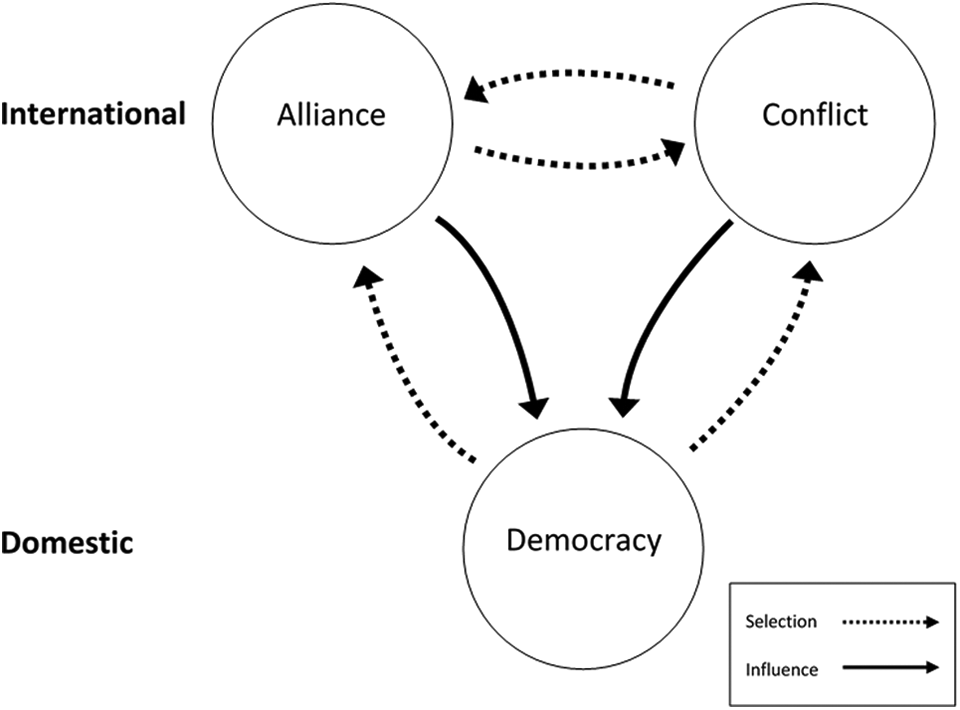
In contrast, here I utilize a simulation-based approach to statistical estimation, based on an ‘actor-driven’ model of international politics (Snijders, 1996, 2001), which seeks to capture the dynamic coevolution of international alliances, international conflict, and domestic democratization. This approach estimates a combined model, which seeks to account both for the forces of selection that lead states to choose (i.e. ‘select into’) particular patterns of international network ties on the basis of their existing ties and domestic attributes, and the forces of influence that lead states to adopt particular domestic attributes on the basis of their pattern of international ties to other actors. In particular, I seek to test the following hypotheses, which together form the coevolutionary system depicted in Figure 1.
First, I hypothesize that forces of ‘selection’ will operate between the international alliance network and the international conflict network. That is, we have strong reasons to suppose that international alliances will channel lines of militarized conflict, such that conflicts become less likely between alliance partners. At the same time, there may be a form of ‘path dependence’ (Arthur, 1994) by which the historical structure of the conflict network creates pressures for conflict management (Weitsman, 1997; Morrow, 2000), which could generate greater incentives for alliance treaties between prior combatants. Hence, we have our first two hypotheses:
H1 (Conflict → Alliance): International alliances are more likely to arise between states with a recent history of international conflict.
H2 (Alliance → Conflict): International conflicts are less likely to arise between states who are joint members of an international alliance.
We also have strong reasons to believe that forces of ‘selection’ will operate between the domestic and international levels. That is, it seems plausible that the process of partner selection between states, whether for cooperative or conflictual interactions, will be conditioned by their domestic political institutions. In particular, much prior research finds that states with similar domestic regimes are more prone to form alliances ties (Lai & Reiter, 2000; Siverson & Emmons, 1991), while also finding that militarized disputes are substantially less likely within jointly democratic dyads (see Dixon, 1994; Gatzke, 1998; Gaubatz, 1996; Harrison, 2010; Maoz & Russett, 1993; Russett & Oneal, 2001). Thus, we would predict that:
H3 (Democracy → Alliance): International alliances are more likely to arise between states with shared democratic institutions.
H4 (Democracy → Conflict): International conflicts are less likely to arise between states with shared democratic institutions.
Finally, existing evidence points to the strong possibility of reciprocal mechanisms of ‘influence’, through which international networks may alter the structure of domestic institutions. A number of studies have found that that the prospects for democratic transitions are influenced by neighborhood diffusion effects (Gleditsch, 2002; Cederman & Gleditsch, 2004; Torfason & Ingram, 2010; Ulfelder, 2008), and in particular that violent, autocratic neighborhoods tend to inhibit the development of democratic regimes (Gibler, 2007; Kadera, Crescenzi & Shannon, 2003; Kim & Rousseau, 2013; Rasler & Thompson, 2004, 2011; Reiter, 2001; Thompson, 1996). Existing work has also investigated a variety of mechanisms through which linkages forged within international institutions might reduce proclivities toward interstate conflict (Boehmer, Gartzke & Nordstrom, 2004; Dorussen & Ward, 2008; Hafner-Burton & Montgomery, 2006; Oneal, Russett & Berbaum, 2003; Pevehouse & Russett, 2006; Russett, Oneal & Davis, 1998), including the provision of information (Kinne, 2013b), elite socialization (Atkinson, 2006), and through the mediating effect of domestic democratization (Mansfield & Pevehouse, 2006; Pevehouse 2002, 2005). This implies that in addition to the direct effects between alliances and conflict posited above, we should also expect that both networks might generate indirect effects through the facilitation or inhibition of processes of democratic diffusion. Hence, we have our final hypotheses:
H5 (Alliance → Democracy): Democratic domestic institutions are more likely to arise in states with alliance ties to other democracies.
H6 (Conflict → Democracy): Democratic domestic institutions are less likely to arise in states with conflict ties to other democracies.
Simulating multilevel coevolution
To model this system formally and empirically, I begin by representing both international militarized disputes and international alliance commitments as dynamic networks of interdependent ties between states. To model shifts in the patterns of such ties, I propose an application of what Snijders (1996, 2001) refers to as an actor-driven approach to the longitudinal modeling of network-behavior coevolution. By characterizing the international system as a collection of networks which evolve from the interdependent decisions of individual states, this approach allows the researcher to derive the functional form of the statistical estimator directly from theoretically driven assumptions about the utility functions of states engaged in international political decisions.
Within this framework, the international alliance network, the international conflict network, and the democratization of individual states, are each conceptualized as continuously coevolving random variables, observed in a series of discrete snapshots over time. Changes in state behavior, whether at the level of international networks or domestic regimes, are assumed to be driven by the decisions of individual states, who seek to maximize a utility function based on their preferred configuration of international linkages and domestic qualities. The agents are myopically rational, both in the sense that they maximize utility with stochastic error, and in the sense that they condition their choices on the current structure of the networks rather than attempting to make predictions about the future structure of the networks. 2 The goal of the model is to use real-world data on the pattern of international alliances, international conflict, and domestic democratization, observed at discreet intervals over several decades, to determine the form of the underlying utility function that is most likely to have produced the observed array of state decisions.
Snijders (1996, 2001) shows that this can be accomplished by (1) specifying a candidate utility function composed of weights on different aspects of network structure and individual behavior, (2) simulating the pattern of tie formation and behavioral evolution that would result if states relied on that utility function, (3) comparing that simulated pattern to the decisions observed in the real-world data, then repeating (1–3) with new candidate utility functions until a specification is found that minimizes the discrepancies between the simulated and observed data. The advantage of this framework lies in providing a formalized representation of the interdependent processes of alliance formation, conflict suppression, and democratization, which can also be fully grounded in empirical data, thereby providing a mode of statistical estimation which allows us to incorporate theoretically derived assumptions concerning multilevel coevolutionary dynamics directly into the functional form of our statistical estimator. 3
Let
Consider a time series

The process of network-behavior coevolution can then be fully described by the combination of:
(a) a family of network rate functions,

which represent the rate at which actor i is able to change her network relations Xh ;
(b) a family of behavior rate functions,

which represent the rate at which actor i is able to make changes to her behavioral state Z;
(c) a family of network evaluation functions,

which describe the stochastic decision rules she uses to judge the desirability of different network configurations; and
(d) a family of behavioral evaluation functions,

which describe the stochastic decision rules she uses to judge the desirability of different behavioral states.
In these expressions,
We will denote as x
h
(i→j) the network that results when the single element
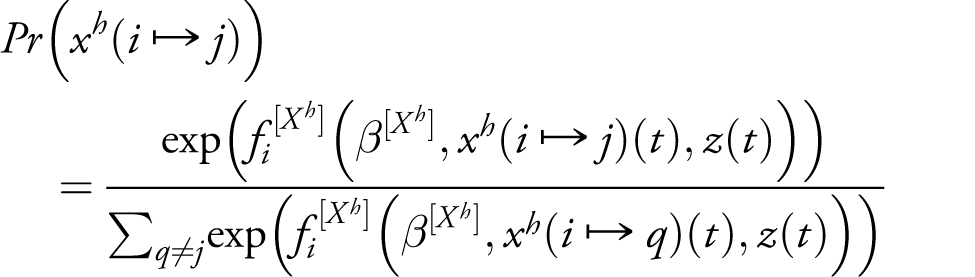
Similarly, the probability that actor i chooses to change her behavior
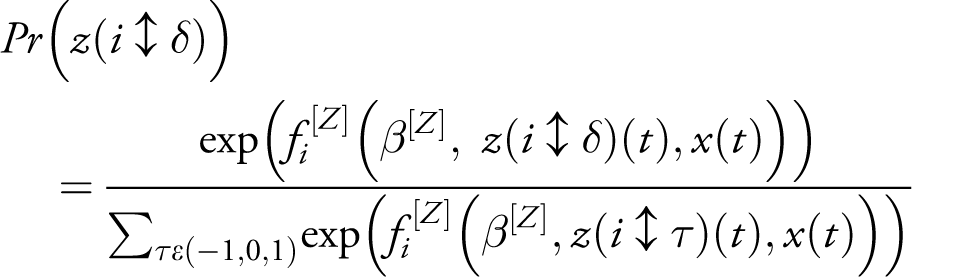
Hence, if we have M longitudinal observations of the coevolving system, the estimation problem consists of estimating the values of
Having used these network simulations to find the
Operationalizing the model
Given this framework, the heart of the modeling enterprise comes to revolve around the selection of the relevant aspects of the system’s configuration which the modeler believes agents may be using to evaluate the desirability of their current position. This requires theoretically driven assumptions about the patterns of interdependence that are likely to result from the decisions of individual states. In other words, it is a question of which functions
Our first network, Alliance, measures the presence of international military alliances. Data on alliance commitments was taken from the Correlates of War Formal Alliance (v4.1) dataset (Gibler, 2009; Singer & Small, 1966). An alliance is defined as a formal, written agreement between two or more states in which they agree to coordinated military action in the event of a future conflict. Alliance ties of the form
Network evolution effects
The most basic network effect, which we can label the Density effect, controls for the general propensity of states to form ties. Analogous to a constant term in standard regression analyses, it is necessary for accurate estimation of the other effects, but on its own contains little substantive content. The relevant parameters for the alliance and conflict network are given by:


Because it is likely that these networks evolve in response to pre-existing tie structures, I also include two basic components of extradyadic interdependence for each network. The Preferential attachment effect controls for the tendency of ties to form towards states that already have a large number of ties, by incorporating into the utility function a term which interacts tie presence with the sum of the current ties of a prospective partner. Similarly, the Transitivity effect controls for the tendency of states to form triadic closures between ties, by allowing the utility associated with a new tie to depend on the number of transitive triangles created through its addition. These effects are given for each network as follows:




Selection effects
To test Hypothesis 1, that conflict conditions the formation of alliances, I also include an interactive effect between the two networks as a component of the alliance network evaluation function:

This builds a parameter into the model which allows the value of a potential alliance partner to vary as a function of the dyad’s conflict history. Following the same logic, to test Hypothesis 2 – that alliances condition the emergence of conflicts – I include an interactive effect between the two networks as a component of the conflict network evaluation function:

To test Hypothesis 3, that alliances are more likely to form between democracies, I include two effects. The first term captures the tendency of ties to form between states with the same regime types,

where

Similarly, to test Hypothesis 4, that conflicts are less likely to arise between democracies, we include analogous effects for the conflict network:


Influence effects
Turning our attention to the domestic level, the most basic effect is again a simple linear constant, analogous to a regression intercept, which captures the general tendency of states to adopt democratic political institutions:

To test Hypothesis 5, that alliance ties facilitate the diffusion of democratic institutions between states, I also include terms in the behavioral evaluation function which interact i’s regime type with i’s total number of alliance partners, and the average regime type of the states to which i has alliance ties:


This allows the model to capture the intuition that democratic diffusion is facilitated through networks of cooperative ties between states, and that domestic democratic transitions become more likely when states are embedded in dense networks of democratic neighbors. Similarly, to test Hypothesis 6, that interstate conflicts inhibit the diffusion of democratic institutions between states, we include analogous behavioral effects arising from the influence of the international conflict network:


Control variables
Finally, in order to guard against spurious results, it will also be necessary to control for basic physical and social factors, which might exogenously condition the likelihood of alliances or conflicts between states. Distance is measured as the network of capital-to-capital distances between states, while Contiguity is dichotomous and equals 1 for any pair of states sharing a land border or separated by less than 400 miles of water (Small & Singer, 1982). To capture the impacts of cultural similarities, I use the COW project’s Cultural Composition of Interstate System Members dataset (Henderson, 1997) to code a dichotomous variable Language, which equals 1 if the most commonly spoken language is the same in both states. Finally, each state’s level of material Power is measured using the Composite Index of National Capability (CINC) as recorded in the National Material Capabilities (v4.0) dataset (Singer, Bremer & Stuckey, 1972). These data are also used to construct a dyadic Power ratio measure, equal to the CINC score of the weaker state divided by the CINC score of the stronger state. 9 All of these factors are included as control variables, by multiplying their values with an indicator of the presence of corresponding dyadic tie or nodal attribute:











Empirical results
When our data are examined visually, the interdependence of international and domestic institutions is quite apparent. In Figure 2, we can see snapshots of the international alliance and conflict networks by decade, for the period 1920–2000, with democratic states represented by green nodes, non-democratic states represented by orange nodes, and the size of the nodes scaled by the power (CINC score) of a given state. The nodes are arrayed using a force-directed layout algorithm (Fruchterman & Reingold, 1991), which reveals several clusters of densely interconnected states. Alliance ties are shown in blue, while conflict ties are shown in red. It is clear from the figures that a general tendency towards regime-type clustering exists across these periods. Moreover, because the layout algorithm is blind to the attributes of individual nodes, we can be confident that the visually apparent clustering of democratic and non-democratic states into separate alliance-conflict cliques is a true property of the underlying data, rather than an artifact of the layout algorithm. However, this basic empirical pattern could be consistent with either of the central theoretical accounts presented above: it could be the case that democracies select themselves into shared alliance agreements, or it might be the case that alliance ties help to spread democracy between states.
Baseline model results
To assess the plausibility of these competing accounts more rigorously, I estimate the stochastic actor-driven model of network-behavior coevolution described above for the period 1920–2000. Observations of the system are made at ten-year intervals, resulting in a dataset of The alliance–conflict network, 1920–2000
Stochastic actor-driven model of the coevolution of alliances, conflict, and democracy

Standard errors in parentheses. **p < 0.01, *p < 0.05, † p < 0.10.
When the evidence is examined for ‘selection’ effects, Hypothesis 3 receives strong support. The positive and statistically significant coefficient for
Turning next to the terms seeking to capture the ‘influence’ effects that exert reciprocal pressure from the international level to the domestic level, Hypothesis 5 receives strong support. The positive and statistically significant coefficient for
The control variables also generally behave as expected. Both alliances and conflicts are more likely between geographically proximate partners, and more likely between states with shared language, matching the findings of Lai & Reiter (2000). It is also interesting to note the very different role played by military power in the two networks, as the model implies that conflicts are more strongly preferred by powerful states, whereas alliances are more strongly preferred by weaker states and are more likely to arise between states with asymmetric power levels, a pattern which Morrow (1991) predicts as a consequence of the trade-off between security and autonomy inherent in alliance treaties. Both networks also show strong tendencies towards preferential attachment, with the alliance network demonstrating an additional preference for transitive closure not observed in the conflict network, perhaps reflecting the need for common interests in multilateral alliance structures.
Robustness checks
While these estimates point to the importance of the coevolutionary effects of ‘selection’ and ‘influence’ between the alliance network, the conflict network, and domestic democratization, it is important to note that the model specification reported in Table I relied on several arbitrary threshold choices; in particular, the Polity score threshold used to code the distinction between democratic and non-democratic states, the temporal lag used to code the persistence of conflict events, and the MID severity threshold used to code the onset of a militarized dispute. In each case, the thresholds chosen represent common choices in the existing literature; however, one might reasonably be concerned that if different values had been chosen for these thresholds, different inferences might have been drawn from the model.
To investigate this possibility, I repeatedly re-estimate the baseline model specification reported above, each time varying the value of one of the parameters governing these specification choices. In particular, I shift the democracy threshold from 5, down to 4 and up to 6, shift the conflict lag from 15 years to 10 and 20 years, and strengthen the conflict threshold to require ‘uses’ of military force rather than ‘displays’ of force. The key coefficients resulting from each of these model variants are displayed graphically with 95% confidence intervals in Figure 3.
These robustness checks demonstrate that the central inferences reported above were not driven by the particular values chosen for these thresholds. In fact, the parameter estimates show a great deal of stability under a wide variety of model specifications. Across all specifications, the models confirm that states with similar regimes are more prone to ally with each other, that mutually democratic dyads are less likely to engage in militarized disputes, and that states embedded in dense networks of international alliances with democratic partners are more likely to develop domestic democratic institutions. Indeed, most of the coefficients show nearly identical effect sizes and standard errors across specifications. One interesting exception concerns the estimates for

Robustness checks
Out-of-sample predictions
While the in-sample fit of these models appears to be robust to a number of specification choices, it is well known that the p-values of the individual coefficients in a multivariate model can be a very fragile means for assessing the relative importance of causal factors, and that models may show strong p-values for particular coefficients despite achieving low overall predictive success (Ward, Greenhill & Bakke, 2010). To examine more concretely the empirical reliability of the model reported in Table I, I use the model to predict out-of-sample features of the international system, observed in 2010, ten years after the close of the temporal window (1920–2000) used to estimate the original model. That is, I take the configuration of the system in 2000 as a starting point, simulate the forward progression of the system over ten years using coefficients reported in Table I, and then compare the simulated outcomes to the empirical configuration actually observed in 2010. In order to examine differences across temporal window lengths, I then repeat the experiment by estimating the model for the period 1920–90 and simulating forward 20 years to predict the 2010 configuration, and finally estimating the model for the period 1920–80 and simulating forward 30 years to predict the 2010 configuration. Because each model seeks to predict the same outcome, their levels of predictive success can be compared directly. For each specification, the simulations are repeated 5,000 times, generating a prediction score for each endogenous dependent variable given by the average of the outcomes observed across the simulations. These scores are assessed for predictive accuracy by generating Receiver Operating Characteristic (ROC) curves and calculating AUC statistics for each of the three dependent outcomes.
To assess whether the coevolutionary effects of ‘selection’ and ‘influence’ are truly influential in the data generating process, I use this approach to compare the predictive success of the full model, reported in Table I, to a constrained model which is identical in all respects except for the absence of selection and influence effects operating between the Alliance, Conflict, and Democracy variables. This generates a relatively difficult comparative test, as the ‘null’ model includes substantial covariate information and generates substantial predictive leverage. Nevertheless, the results show that the full model outperforms the constrained model across all three dependent variables and all three prediction window lengths.
The results are depicted graphically in Figure 4 with each marker showing the relative levels of predictive success achieved for a given outcome, with the success (AUC score) of the full coevolutionary model given on the y-axis, and its relative improvement over the corresponding constrained model given on the x-axis. The three marker shapes represent each of the three dependent outcomes: alliances (squares), conflicts (circles), and democracy (triangles), while the three marker sizes represent each of the three increasing prediction window lengths: 10 years (2000–10), 20 years (1990–2010), and 30 years (1980–2010). The full model outperforms the constrained model regardless of which metric of predictive success is considered. In general, the prediction tasks become more difficult as the temporal window sizes increase, and thus show greater levels of error. However, even in the most error-prone task, seeking to predict global patterns of democratization at a 30-year remove, the full model achieves a 76.9% success rate in predicting Out-of-sample predictions
Conclusion
Taken as a whole, the evidence presented here demonstrates that the dynamics of network-behavior coevolution represent central driving forces in the development of both domestic and international institutions. As a result, international alliances, international conflict, and domestic regimes are constantly coevolving in response to each other, as states find their decisions influenced by a complex multilevel structure that their own actions are simultaneously constructing.
Given the inferential difficulties generated by such dynamics, the solution proposed here is to model these relationships not as independent events, but as elements of a system whose coevolution is governed by the actions of individual states whose incentives are driven, at least in part, by the prior actions of other states. The results of this analysis show that states with similar regimes are more prone to ally with each other, that mutually democratic dyads are less inclined to engage in militarized disputes, and that states embedded in dense networks of international alliances with democratic partners are more likely to develop domestic democratic institutions.
By deriving the functional form of the statistical estimator directly from theoretically driven assumptions about the utility functions of states engaged in these geopolitical decisions, this stochastic actor-driven approach thus reveals that both sides of the democracy–conflict debate have correctly identified elements of this coevolving system. Those focusing on democracy as the fundamental causal variable appear to be correct that domestic regime types influence selection into alliance agreements, while those focusing on alliances as the fundamental causal variable appear to be correct that alliance agreements are crucial to facilitating the diffusion of democratic institutions between states. It seems then, that the positions articulated in this debate are not actually mutually exclusive, but only seemed so because prior analyses were forced by extant statistical technologies to focus on a single causal direction, in a system which is actually characterized by complex reciprocal influences between international and domestic institutions.
Footnotes
Replication data
A replication archive containing data and code for all results is available at https://www.prio.org/JPR/Datasets/ and  .
.
Acknowledgements
I would like to thank Skyler Cranmer, Erik Gartzke, Brandon J Kinne, Zeev Maoz, and Michael D Ward for helpful comments on previous versions of this article. All opinions expressed are those of the author alone.
Notes
References
Supplementary Material
Please find the following supplemental material available below.
For Open Access articles published under a Creative Commons License, all supplemental material carries the same license as the article it is associated with.
For non-Open Access articles published, all supplemental material carries a non-exclusive license, and permission requests for re-use of supplemental material or any part of supplemental material shall be sent directly to the copyright owner as specified in the copyright notice associated with the article.
