



Abstract
Our knowledge of the set of concepts that influence the number of terror attacks experienced by different countries is rudimentary. Existing work on the incidence of terror focuses upon the structural characteristics of polities, economies, and societies, and fails to place competition between dissidents and states center stage. It also tends to treat terror as isolated from other tactics that dissident groups might use to pressure the state. This study addresses these shortcomings by placing government and dissident group behavior at the center of the analysis. Drawing on arguments from the larger literature on dissent and repression, we argue that government behavior and dissident behavior are likely to be more important determinants of terror attacks than structural factors. We scour the literature for existing arguments to round out our model specification, and evaluate hypotheses using Bayesian statistical techniques and a broad scope of relevant data. For many of our independent variables we construct indices using measurement models that are able to account for measurement error and missing data, resulting in a more comprehensive set of data than previous studies. The results demonstrate that measures of government and dissident behavior have more explanatory power than measures of the concepts that populate existing research.
Introduction
This study tests, using cross-national time-series (CNTS) data, hypotheses about the number of terror events that occur in a given country in a given year. Large-N statistical research on the use of terror focuses almost exclusively upon structural characteristics of economies, polities, and societies rather than the tactical choices of states and dissidents (e.g. Lai, 2003, 2007; Abadie, 2004; Li, 2005; Piazza, 2006, 2008b; Chenoweth, 2010; Krieger & Meierrieks, 2011; Gassebner & Luechinger, 2011). However, a considerable body of theoretical and empirical research has established that states and dissidents respond to one another’s conflictual behavior (e.g. Lichbach, 1987; Davenport, 1995, 2007; Tilly, 1995; Francisco, 1996; Moore, 2000; Thyne, 2006; Shellman, 2009; Pierskalla, 2010; Bueno de Mesquita, 2013; Young, 2013; Ritter, 2014). 1 The study is motivated by the literature’s lack of attention to dissident groups’ adoption of terror tactics as a function of the coercive behavior of the state and the tactical choices made by other dissident groups. To move beyond our current understanding we contend that researchers will do well to engage the widely recognized fact that terror is but one tactic that dissident groups use to press claims against states. This means that scholars analyzing terror tactics should examine factors that influence dissidents’ expectations about the government’s response to these tactics, that is, the relative cost/effectiveness of these tactics. For any dissident group these expectations will be influenced by (1) the behavior of the government towards all dissident groups, itself included, and (2) the behavior of other dissident groups towards the government. Existing large-N analyses largely fail to leverage this point to construct, and test, hypotheses about the behavioral covariates of terror attacks. This study does so. Its theoretical contribution is thus diffuse rather than specific: we argue that behavior matters.
Why is ignoring the behavior of governments and other dissident groups a problem? First, terror attacks are a tactical choice: dissidents might use nonviolent protest, non-terror violence (e.g. guerrilla attacks), or some combination of these. Studying the incidence of terror attacks in isolation from other tactics may bias findings. Second, it is difficult to imagine that researchers believe state coercion has no impact upon terror attacks, yet nearly all studies fail to include government repression in their models. 2 Lastly, the policy implications of existing studies are muted: structural characteristics are, by definition, difficult to change. Behavior, however, can be revised by choice. Each of these reasons suggests that the large-N, cross-national study of terror attacks will be enriched by the development of hypotheses about the impact of government and dissident behavior.
Rather than develop novel theory we draw upon existing theories to produce our hypotheses, devoting more space to the hypotheses about the impact of behavior than those about the impact of the structural characteristics of economies, polities, and societies. Krieger & Meierrieks (2011) and Gassebner & Luechinger (2011) provide reviews of the large-N literature, the first conducting a review of published findings and the second performing an Extreme Bounds Analysis (Leamer, 1985, 2008) of essentially the same variables described in the former (see also Chenoweth, 2013). That literature primarily examines transnational terror events (e.g. Li, 2005; Piazza, 2006, 2008a; Gassebner & Luechinger, 2011; Krieger & Meierrieks, 2011), though transnational terror attacks comprise only an estimated 15% of all attacks (LaFree & Dugan, 2007b). In their review of the literature Krieger & Meierrieks (2011: 19) could find only two studies that examine only domestic terror attacks, and three studies that pool both domestic and transnational attacks. Our analysis employs the Global Terrorism Database (GTD; LaFree & Dugan, 2007a), which includes both domestic and transnational events. We leverage statistical techniques that account for missing data and measurement error and so are able to utilize a more comprehensive set of data than previous studies. Our results suggest that government behavior, as well as non-terror dissident behavior, influences the use of terror tactics. Further, we show that including behavior in a model of terror attacks improves the fit of the model more appreciably than including structural characteristics. Our intention is to provide a useful baseline model of the cross-national covariates of terror attacks against which future work, hopefully at lower levels of spatial and temporal aggregation, can be compared.
Country level terror and dissident/state behavior
We are interested in the total number of acts of terror committed by all of the dissident groups that exist in a given country. Dissident groups are any collection of people who make public demands upon the government using means that are not sanctioned by the state as legitimate or routine. We rely upon Schelling’s classic definition of terror as: ‘violence intended to coerce the enemy rather than to weaken him militarily’ (Schelling, 1960: 17). To conceptually distinguish terror tactics from other forms of violence we focus upon whether the tactic would degrade the state’s coercive capacity (non-terror violence), or whether it would not (terror). Terror tactics are acts of violence that target a victim for the purpose of influencing a broader audience. That is, the purpose of the attack is less the direct damage it will do to the target’s coercive capacity than its effect on the audience that witnesses the attack. Nonviolent dissident activity seeks to pressure the state to change policies via economic, political or social coercion, but does not use violence to produce that pressure (Chenoweth & Stephan, 2011; Chenoweth & Cunningham, 2013).
The total number of domestic terror attacks in a country-year is the sum of the numbers of terror attacks all groups in that country commit in a given year. The literature on the use of terror focuses on macro-level structure rather than the behavior of governments and dissidents. Our emphasis on dissident–state interaction leads us to contend that dissident groups’ use of terror tactics is influenced by the following: (1) the state’s use of violent repression and its nonviolent coercive activity, (2) the amount of nonviolent activity by dissident groups, and (3) the amount of violent (non-terror) activity by dissident groups. These propositions are rather straightforward, and in advancing them we rely on previous theoretical work on violent state–dissident interaction, which we discuss in the next two sections. We also survey the existing literature to build arguments about how the institutional context in which governments and dissidents interact affects the dissidents’ choice to use terror tactics. We consider democratic institutions and also turn to a relatively neglected feature of domestic politics: the size of the coercive bureaucracy.
Government coercion
It is widely agreed that states’ coercive behavior influences the behavior of dissidents (e.g. Lichbach, 1987; Enders & Sandler, 1993). Many scholars contend that violent repression raises the costs of dissent (e.g. Gurr, 1970; Tilly, 1978), and some have argued that when the cost of one tactic rises relative to others, dissidents will switch to the less costly tactic (e.g. Lichbach, 1987; Moore, 1998; Enders & Sandler, 2006). We noted above that dissident groups are influenced by their beliefs about the relative costs of alternative tactics. We contend that group’s beliefs about the costs of using violence will be conditioned on the government’s use of violent coercion. We thus hypothesize that state coercion will reduce the level of terror we observe. 3
As often happens in conflict literature, counter-arguments exist to support the conjecture that coercion stimulates, rather than reduces, dissent. These are grievance-based arguments, and the authors who advance them do not dispute that coercion is costly to dissidents. Instead, they argue that coercion alienates people who would have been indifferent or supported the government (e.g. Gurr, 1970; Rasler, 1996; Walsh & Piazza, 2010). Several scholars maintain that arbitrary targeting exacerbates this tendency (e.g. Mason & Krane, 1989; Mason, 2004; Kalyvas, 2006; Findley & Young, 2007), and Wilkinson (2001) in particular advocates that counterinsurgency is a political, rather than military, struggle and that coercion is less effective than investigative police work and prosecution. Each of these arguments suggest that coercion will increase the aggregate level of terror we observe. 4
Dissident competition
A prominent argument in the literature on the use of terror by dissidents suggests that groups that compete for the allegiance of the same supporters can get into an outbidding process where each pursues more violent tactics in an effort to show that they are the strongest group (Tillion, 1960: 50–52; Hutchinson, 1972: 391; Rabushka & Shepsle, 1972; Brubaker & Laitin, 1998: 434; Bloom, 2004; Kydd & Walter, 2006). The implication is that terror attacks stimulate more terror attacks. Because we are aggregating the data at a coarse temporal level the hypothesis is not well captured by inclusion of a lagged term in a regression. Instead, we focus attention on the implication that there will be evidence of overdispersion in an event count model of terror attacks. One reason overdispersion occurs is contagion, meaning the occurrence of one event increases the probability of another event occurring in the future (see King, 1989: 768). If outbidding occurs, then one group’s decision to plan and execute terror attacks is a positive function of other groups’ attacks. As such, outbidding implies overdispersion when data are aggregated across large units of time.
Turning to the relationship between violent (non-terror) dissent and terror attacks, outbidding suggests that there will be a positive relationship between the two. That is, as a dissident group observes violent attacks against the state being committed by other dissident groups, competition for supporters should press it toward devoting more resources to violence, including terror attacks.
What impact will nonviolent protest activity have upon dissidents’ use of terror? Nonviolent protest relies on mass mobilization, needing many people to participate (e.g. DeNardo, 1985; Chong, 1991; Schock, 2005; Chenoweth & Stephan, 2011; Cunningham, 2013). It is conceivable that the more nonviolent protest occurs in society, the more successful that tactic will appear to be, which will lead groups to re-evaluate the merits of nonviolent means relative to violent means. Thus we conjecture that nonviolent protest may reduce the number of terror attacks.
Once again, counter-arguments are available. Mullins & Young (2012) argue that the more common is anti-state protest and violence, the more legitimated all forms of anti-state protest and violence become. They show that crime and even capital punishment are positively associated with terror events. In addition, expected utility arguments suggest that dissidents’ beliefs about the probability of success will influence the likelihood that they challenge the state. The more anti-state activity there is, the weaker the state appears to be, and that will increase groups’ beliefs about the likelihood of successfully challenging the state. If observing greater levels of nonviolent dissent leads groups to conclude that the state is weak, then that group might infer that terror attacks will produce concessions. Thus, as with government coercion, we cannot rule out the possibility that nonviolent protest may increase the aggregate number of terror attacks.
Institutions as context
Contestation and participation
Contestation and participation are the two dimensions of Dahl’s (1971) polyarchy. Contestation refers to the current government’s tolerance for conflicting preferences over policy and leadership, while participation is defined as the proportion of the public that is allowed to take part in politics. Widespread participation and access to public office are likely to reduce violent dissent, including acts of terror. First, high levels of each provide a low-cost means by which groups can pursue political demands (Gurr, 1970: 304–305). Second, the availability of legal pathways for pursuit of policy and leadership change delegitimizes the use of violence as a tactic to pursue political ends (Gurr, 1970: 183–187). Further, dissident groups in societies where nonviolent dissent is banned might infer that nonviolent dissent is likely to be met with repression and prove ineffective. If dissidents substitute violence for nonviolence when the latter is met with repression (Lichbach, 1987; Moore, 1998), then where nonviolent dissent is illegal violent tactics will become attractive. This suggests that the aggregate number of terror attacks is decreasing in contestation and participation.
Again, counter-arguments exist. In particular, Chenoweth (2010: 19) contends that ‘political competition increases terrorist activity’. The idea motivating this hypothesis is that ‘mobilization is high in the most competitive regimes, thereby encouraging conventional and unconventional forms of political activity’ (2010: 19). Chenoweth tests her hypothesis with the ITERATE transnational terror attacks data using measures of political competition and participation. Her results support the hypothesis: competition and participation have a positive impact upon transnational attacks.
Li (2005) argues that participation creates incentives to employ terror because it makes concessions likely and reduces the cost of using terror tactics. It makes concessions likely because governments are more concerned with public welfare when the public has control over their tenure in office. 5 It makes terror less costly because both the number of potential targets and the difficulty of protecting them increase with the size of the winning coalition.
Veto players
Veto players refers to the number of governmental actors whose consent is needed to change policy (Tsebelis, 2002). There are two ways the number of veto points might influence terror attacks. First, a large number of veto points can lead to ‘deadlock’ (i.e. zero policy change), which would diminish the ability of the government to address grievances in the population and increase violent dissent, including terror attacks (Young & Dugan, 2011). Second, some argue that executives facing many veto players will be constrained in their ability to combat dissidents through curtailment of civil liberties and other repressive means. Thus, the state’s response is expected to be relatively mild and, consequently, the use of terror becomes more likely (Crenshaw, 1981; Wilkinson, 2001; Li, 2005). Both of these arguments imply that terror attacks increase with the number of veto players. 6
Association, press, religion, and speech
Liberal democratic ideals include freedom to associate, publish ideas, worship deities of choice, and speak publicly about politics. Arguments can be constructed for either a positive or a negative impact of these institutions on terror. On the negative side, scholars argue that civil liberties produce responsive political systems that forestall the need to turn to terror tactics, and this hypothesis has found support in studies of transnational terror (e.g. Krueger & Maleckova, 2003; Kurrild-Klitgaard, Justesen & Klemmensen, 2006; Krueger & Laitin, 2008). 7 Alternatively, others have argued, and found empirical support, for the argument that liberal institutions facilitate all types of dissent, including terror attacks (Eubank & Weinberg, 1994; Lai, 2007; Chenoweth, 2010; Bell et al., 2014). Given these arguments, we expect that the extent to which government institutions protect freedoms of association, press, religion, and speech will either increase, or decrease, dissidents’ use of terror tactics.
Coercive capacity of the state
One institution that has received little attention is the coercive bureaucracy. Scholars studying dissident and government behavior have largely neglected this aspect of the state and focused instead on the autocratic/democratic distinction which is orthogonal to coercive capacity. Coercive bureaucracy deserves attention as it will affect expectations about the state’s response to dissident violence. One notable exception to the tendency to ignore coercive bureaucracies is Gurr (1988). His argument is that states which have used coercion successfully will be more likely to employ it in the future. Also, states that successfully use coercion will continue to invest in bureaucratic structures created to prosecute coercion. We argue that where coercive bureaucracies are large, dissidents will be hesitant to resort to violent tactics, because a large coercive bureaucracy indicates successful use of repression in the past and a high propensity to use it in the present. 8 This suggests that the size of the coercive bureaucracy should be negatively correlated with dissident violence, including terror tactics.
On the other hand, Coggins (2015) has disaggregated state failure across three categories: human security, state capacity, and political collapse. In a large-N CNTS analysis she finds that neither low human security scores nor low state capacity are associated with more terror attacks, but that countries with political collapse do exhibit higher levels of both domestic and international terror attacks.
The socio-economic context and other important factors
Macroeconomic performance is associated with grievances: the lower the level of performance, the greater the average level of grievances among the population. While grievances are not sufficient to produce dissident activity, the intensity and scope of grievances should covary positively with the amount of dissident activity, including acts of terror (e.g. Gurr, 1970; Crenshaw, 1981; Blomberg, Hess & Weerapana, 2004a,b). 9 That said, Krieger & Meierrieks (2011: 10) report that studies have found little support in favor of a relationship between macroeconomic performance and transnational terror attacks. Given that these results might be a function of analyzing transnational terror attacks, however, we include macroeconomic performance in our model.
Ethno-linguistic composition refers to how heterogeneous the population of a state is. There is a large literature on the effect of ethnic heterogeneity on large-scale conflict (Horowitz, 1985; Posen, 1993; Ellingsen, 2000; Sambanis, 2001; Reynal-Querol, 2002; Fearon & Laitin, 2003; Habyarimana et al., 2007). While the theoretical links between ethnic heterogeneity and conflict remain somewhat obscure (Saideman, 2010) and the empirical findings concerning this relationship are mixed, we conjecture that if ethnic diversity is thought to be a cause of violence between governments and dissidents then we should not rule out the possibility that it will exhibit some relationship with terror attacks (Krieger & Meierrieks, 2011: 12). 10
The relationship between physical quality of life and terror attacks remains unclear. This variable has been shown to be negatively correlated with state failure (Goldstone et al., 2010), and Piazza (2008b) finds state failure has a positive impact on international terror attacks. As mentioned above, Coggins (2015) also finds that political collapse is positively related to both domestic and international attacks. As such, the higher the level of quality of life, the lower we might expect terror incidence to be. However, Coggins (2015) also finds that measures of human security are not strongly associated with terror attacks, and in one case there is a positive relationship between the two.
The size of the population has been shown to have a positive impact upon terror attacks (Krieger & Meierrieks, 2011; Gassebner & Luechinger, 2011). Finally, a state’s involvement in external conflict may affect terror attacks (Drakos & Gofas, 2006).
Statistical analyses
Terror events
To measure the number of terror events at the country-year level we use the Global Terrorism Database (GTD 1.1), available through the Interuniversity Consortium for Political and Social Research (ICPSR). 11 Specifically, we used the GTD 1.1 events data to produce an event count of all types of terror events. The GTD 1.1 dataset codes all terror events regardless of the nationality of the perpetrators and targets and it thus allows us to include domestic as well as international terror events. The temporal domain of our study is 1971–2007. The countries and years included in the analysis can be found in the Online appendix.
Noisy and missing data
As is common in CNTS datasets, ours is full of potentially noisy indicators with many missing values. For this reason we employ Bayesian factor analysis to create measures for several of our concepts. These models have two advantages over classic factor analytic techniques – they directly estimate the values of the latent trait and provide measures of uncertainty for these estimates. When using the resulting variable in subsequent predictive models, this uncertainty propagates directly into estimation.
Another advantage of the Bayesian factor model is the ability to avoid listwise deletion. The model permits one to use differing numbers of indicators for each country. Listwise deletion can lead to biased results, and we are able to retain every observation for which we have values for most, but not all, of our variables. This is particularly helpful in a cross-national setting where it is likely that data will be missing. The estimates will have larger standard errors for country-years with more missing data, which is a desirable result since we should be more uncertain when we have less information. 12 The analysis below would not be possible outside of a Bayesian framework: the classic model would retain, at best, roughly 3.5% of the observations, and that for only a handful of countries.
Observed indicators for measurement models
Here we briefly discuss the data used to create our latent variables. More detailed information can be found in the Online appendix.
Government coercion
To construct a measure of government coercion we draw from three sources: the CIRI project’s Physical Integrity Rights Index (Cingranelli, Richards & Clay, 2014), the Political Terror Scale (PTS) (Gibney, Cornett & Wood, 2009), and the World Handbook of Political Indicators IV (Jenkins & Taylor, 2002). Both the CIRI index and the PTS measure political imprisonment, torture, summary execution, and disappearance. The indicators taken from the World Handbook include government direct actions, government forceful actions, and government violent actions.
Political institutional context
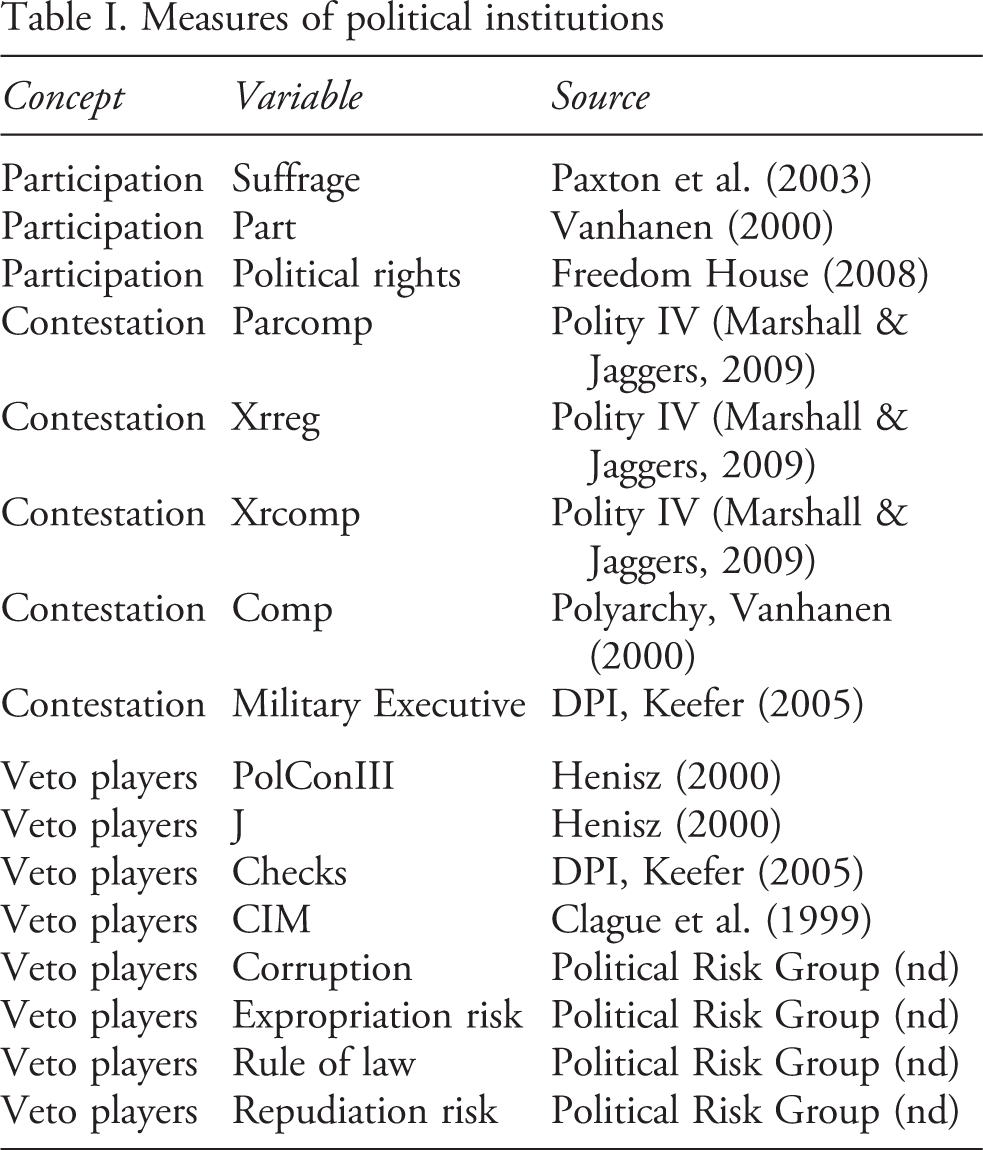
The indicators used to construct measures of participation, contestation, and veto players are listed in Table I. The Suffrage indicator from Paxton et al. (2003) measures the percentage of the adult population that is eligible to vote. Vanhanen’s (2000) participation measure, Part, indicates the proportion of the adult population that actually votes. Finally, a political liberties measure, Political rights, is taken from Freedom House’s 2008 data. Political liberties include electoral processes and participation.
The first three contestation indicators (Parcomp, Xrreg, and Xrcomp) come from the Polity IV dataset (Marshall & Jaggers, 2009). Parcomp measures ‘the extent to which alternative preferences for policy and leadership can be pursued in the political arena’ (Marshall & Jaggers, 2009: 29). Xrreg indicates ‘the extent to which a polity has institutionalized procedures for transferring executive power’ (Marshall & Jaggers, 2009: 18). Xrcomp measures the competitiveness of executive recruitment, meaning the extent to which current political institutions provide equitable access to leadership positions. Vanhanen’s (2000) contestation measure, Comp, is constructed by subtracting the vote share of the largest party from 100. Military executive is a dichotomous variable drawn from the Database of Political Institutions and is coded as 1 if the executive is a military officer.
Measures of political institutions
Coercive capacity of the state
To measure coercive capacity we use the Correlates of War project’s National Material Capabilities (version 3.02) data on military personnel (in thousands) and expenditures (in thousands of US dollars) (Singer, Bremer & Stuckey, 1972; Singer, 1988) from the COW data. From the World Bank’s World Development Indicators 2009 we take a variable that measures a country’s total arms exports during a given year (in 1990 US dollars).
Physical quality of life
To create a measure of the physical quality of life enjoyed by citizens of a country we use indicators of infant mortality, primary school completion rates, and life expectancy. For infant mortality we use the data described in Abouharb & Kimball (2007). Data on primary completion rates and life expectancy are drawn from the World Development Indicators (World Bank, 2009).
Macroeconomic output
We employ three indicators to construct a measure of macroeconomic performance. From the World Bank’s World Development indicators we take a measure of gross capital formation (as a percentage of GDP). We also use a measure of FDI taken from the World Bank’s Global Development Finance indicators. Finally, we include GDP per capita from the Penn World Tables (Heston, Summers & Aten, 2006).
Liberal democratic institutions
For this model we include measures of freedom of the press, association, speech, and religion, and a measure of the rights of workers to form trade associations and engage in collective bargaining. For press freedom we use a categorical measure created by Van Belle (2000) which indicates whether a country’s media outlets are free from government influence, official or unofficial. We follow Van Belle’s advice and collapse this measure into a dichotomous indicator where unrestricted press is coded as 1 and all other types are coded as 0. The freedoms of association, speech, religion, and workers’ rights are measured using variables drawn from the CIRI human rights data (Cingranelli, Richards & Clay, 2014).
Measurement models for latent variables
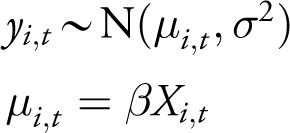
For each measurement model the observed values y of the latent concept X are modeled with a distribution appropriate to the observed indicator. Continuous indicators, and ordinal indicators with six or more categories, were assumed to follow normal distributions, and were all standardized prior to estimation. Formally, for continuous indicators we assume:
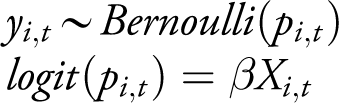
For binary indicators we assume:
Ordinal variables with fewer than six categories were assumed to follow categorical distributions with J categories:
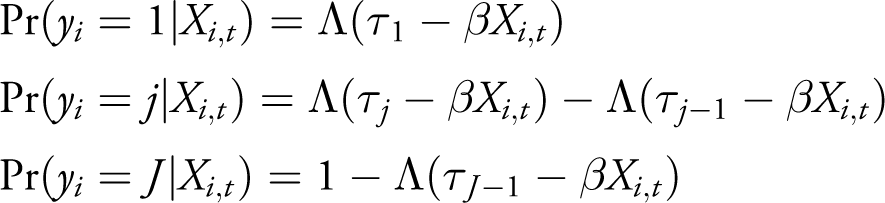
where Λ is the c.d.f. of the standard logistic distribution and the τ s are ‘cut-point’ parameters that indicate the value of the latent variable at which the observed variable changes categories. After the models converged we sampled at least 1K values of the posterior distributions for Xi. We use the means and variances of the draws from the posteriors of the Xis to sample values of the latent variables in the predictive model. 13
Cross-sectional covariation
As discussed above, we expect contagion among attacks: at the yearly level outbidding will produce highly variable numbers of attacks from country to country. Researchers commonly employ the negative binomial model for count data with such characteristics. This model allows the variance of the dependent variable to be larger than the mean by including an additional parameter relative to the Poisson model. In our data we have the additional complication of panel-specific overdispersion. That is, not only are the data overdispersed relative to a Poisson distribution, but the extent to which the variance in the counts exceeds the mean varies by country. To address this issue we estimated a Poisson-lognormal mixture model with random effects for overdispersion (Cameron & Trivedi, 1998; Winkelmann, 2008). The Poisson-lognormal model allows us to estimate the expected number of counts per country-year as a multiplicative function of the covariates described above and a country-specific, normally distributed random effect.
The predictive model is:
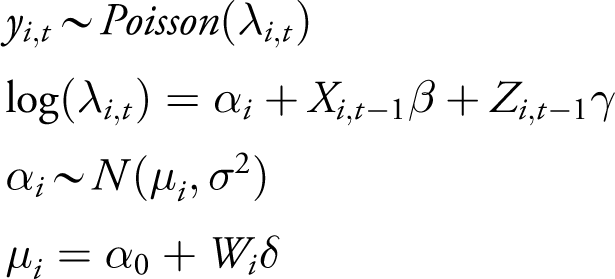
where the α i s are the country-specific overdisperson parameters, X is a matrix of latent variables, and Z is a matrix of observed variables. 14 In the second-level equation, the α i s are modeled as a function of time-invariant country-level characteristics, Wi. 15 During estimation values of X, the set of latent variables, are drawn from their respective posterior distributions from the measurement models. This allows us to account for the uncertainty in the latent variable estimates. 16
Results from the statistical models
Parameter estimates
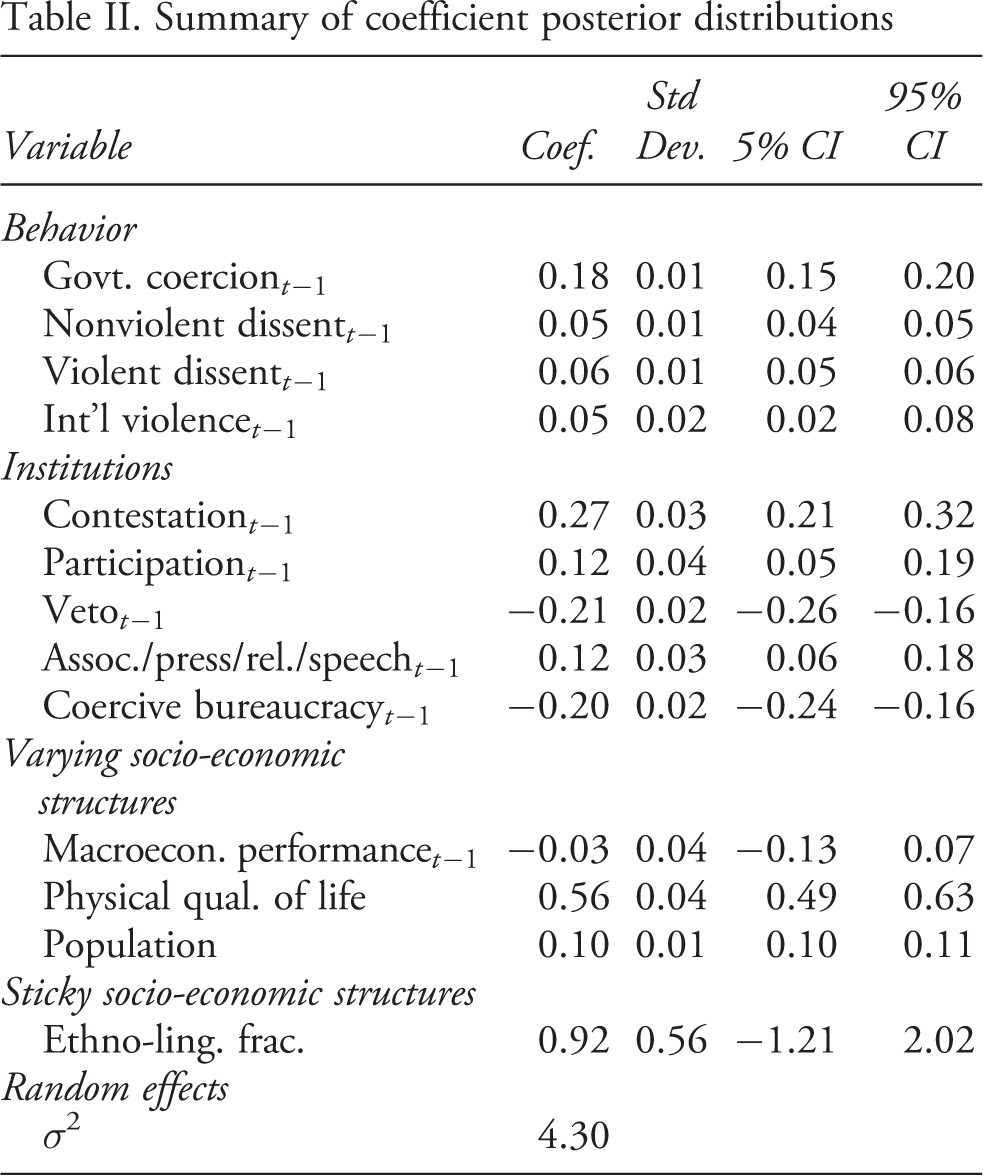
Table II displays the means, standard deviations, and 95% credible intervals for the regression coefficients. All four of the Behavior variables, all five of the Institutions variables, and two of the four Socio-economic structure variables have posterior densities for which at least 95% lies above or below zero: Macroeconomic performance and Ethno-linguistic fractionalization appear not to influence terror attacks. All but two of the variables that do have an impact increase the incidence of terror: both Veto players and the size of the Coercive bureaucracy are associated with lower numbers of terror attacks. Government coercion, Nonviolent dissent, Violent dissent, International conflict, Contestation, Participation, liberal democratic institutions (Assoc./press/rel./speech), Physical quality of life, and the size of the Population are all positively associated with the number of terror attacks that occur in a country.
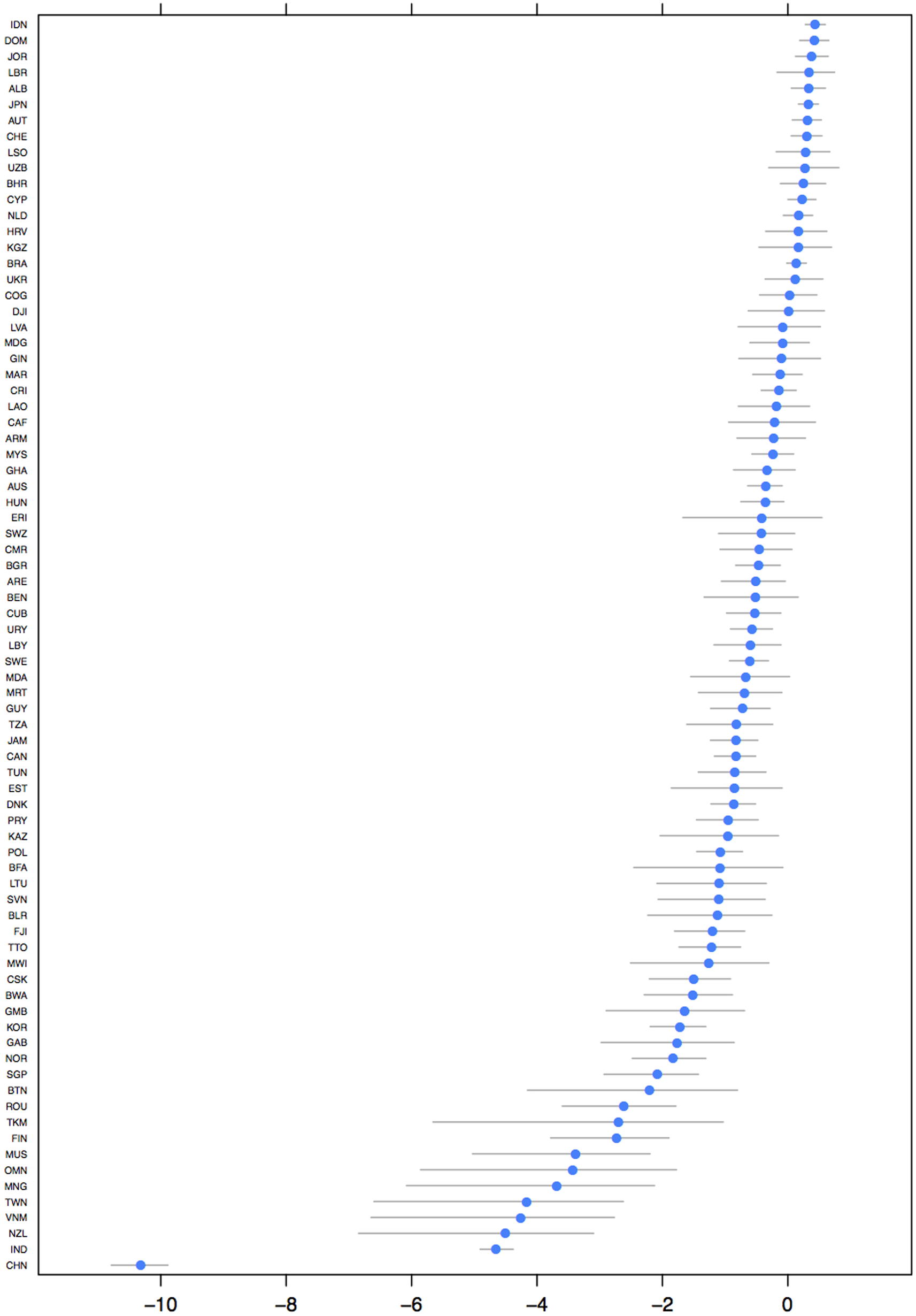
Table II also reports, σ 2, the variance of the country-specific random effects, which serve as country-specific overdispersion parameters. The variance is 4.30, which suggests that the amount overdispersion varies quite a bit across countries. 17 The posterior distributions of the overdispersion parameters (αi) are displayed in Figures 1 and 2. These figures allow us to see where overdispersion is most prominent, and thus where contagion effects are most likely. The largest estimate is that for Peru, which has a random effect statistically distinguishable from the rest of the countries in the analysis. This suggests strong contagion, and is consistent with accounts of competition and outbidding between the Shining Path and other leftist groups during the 1980s (Ron, 2001; Kydd & Walter, 2006). The second and third largest random effects are for El Salvador and Colombia, which is also consistent with a contagion hypothesis. Like Peru, El Salvador and Colombia both experienced large numbers of attacks during periods of violence between the state and several groups with similar ideologies that were competing for the population’s support, circumstances which Kydd & Walter (2006) identify as conducive to outbidding. 18
Summary of coefficient posterior distributions
Model fit
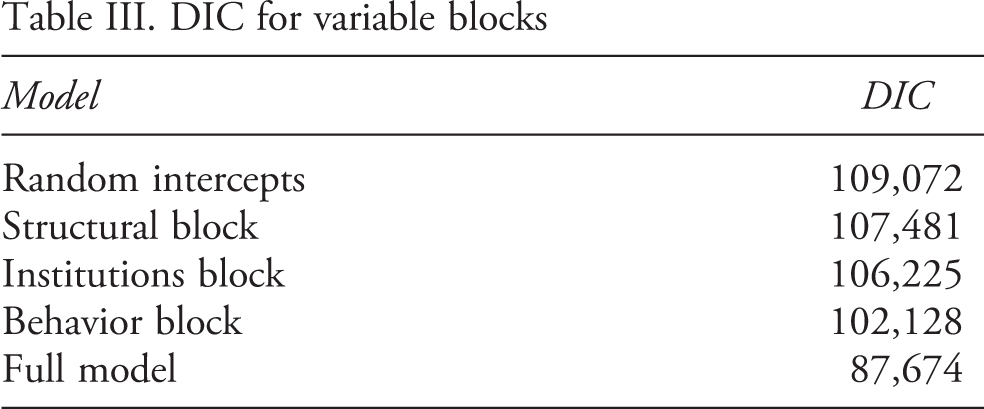
In order to assess model fit we present the Deviance Information Criterion (DIC) (Spiegelhalter et al., 2002) for different model specifications. Similar to the AIC, models with smaller DICs are more able to accurately reproduce the observed data. We present the DIC for each of five model specifications: the full model (including all variables), a model with only behavioral variables, a model with only institutional variables, a model with only structural variables, and a model with only random intercepts. Table III shows that the full model offers a large improvement in fit over the intercept-only model, and also permits us to evaluate the relative impact that each block of variables has upon model fit. In comparison to the null model, the block of dissident and state Behavior variables make the largest contribution to model fit, the political Institutions block has the second largest influence, and the block of Socio-economic structures has the smallest. This is powerful evidence in favor of the focus upon dissident and state behavior that we advocate.
Substantive effects
To evaluate the impact of individual variables we take 1,000 random draws from each of the coefficient distributions, producing 1,000 predicted values (for each observation) for which all of the Xs are set to their observed value. We do this a second time, setting the X of interest to its observed value plus one standard deviation. 19 We then take the difference between these counts. 20 Table IV reports the median and 95% credible intervals of these differences for all country-years in the sample. Summarizing these changes hides considerable variation across countries. In the Online appendix we report the expected change, with a measure of uncertainty, for each country in the sample.
Behavior variables
Table IV indicates that a one standard deviation increase in government coercion produces a median change (across all country-years) of 0.23 additional terror attacks. Keep in mind that our measure reflects the overall level of government coercion toward society. This finding is consistent with that of Walsh & Piazza (2010), and with the arguments made by Rasler (1996) and Mason (2004), that government repression has a stimulative, rather than deterrent, impact upon violent dissent generally, and Wilkinson’s (2001) argument about terror specifically as well as the case study work of Brym & Araj (2006) and Araj (2008).
Nonviolent dissent also has a positive impact on the use of terror tactics. Across the full sample an increase of one standard deviation produced a median increase of 0.18 terror attacks (see Table IV). This suggests that nonviolent dissent is a complement to, not a substitute for, terror attacks, and supports the argument that groups that adopt terror tactics will perceive states as vulnerable as the number of nonviolent protests rise, and commit more attacks. Violent dissident activity also has a positive impact upon terror attacks, while international conflict is associated with fewer attacks.
Political institutions
All five institutional variables exhibit a substantial impact on the use of terror, though Participation and Freedom of association/press/religion/speech have smaller impacts than the other three.
Country-specific overdispersion parameters, top half Country-specific overdispersion parameters, bottom half DIC for variable blocks Summary of distribution of change in predicted count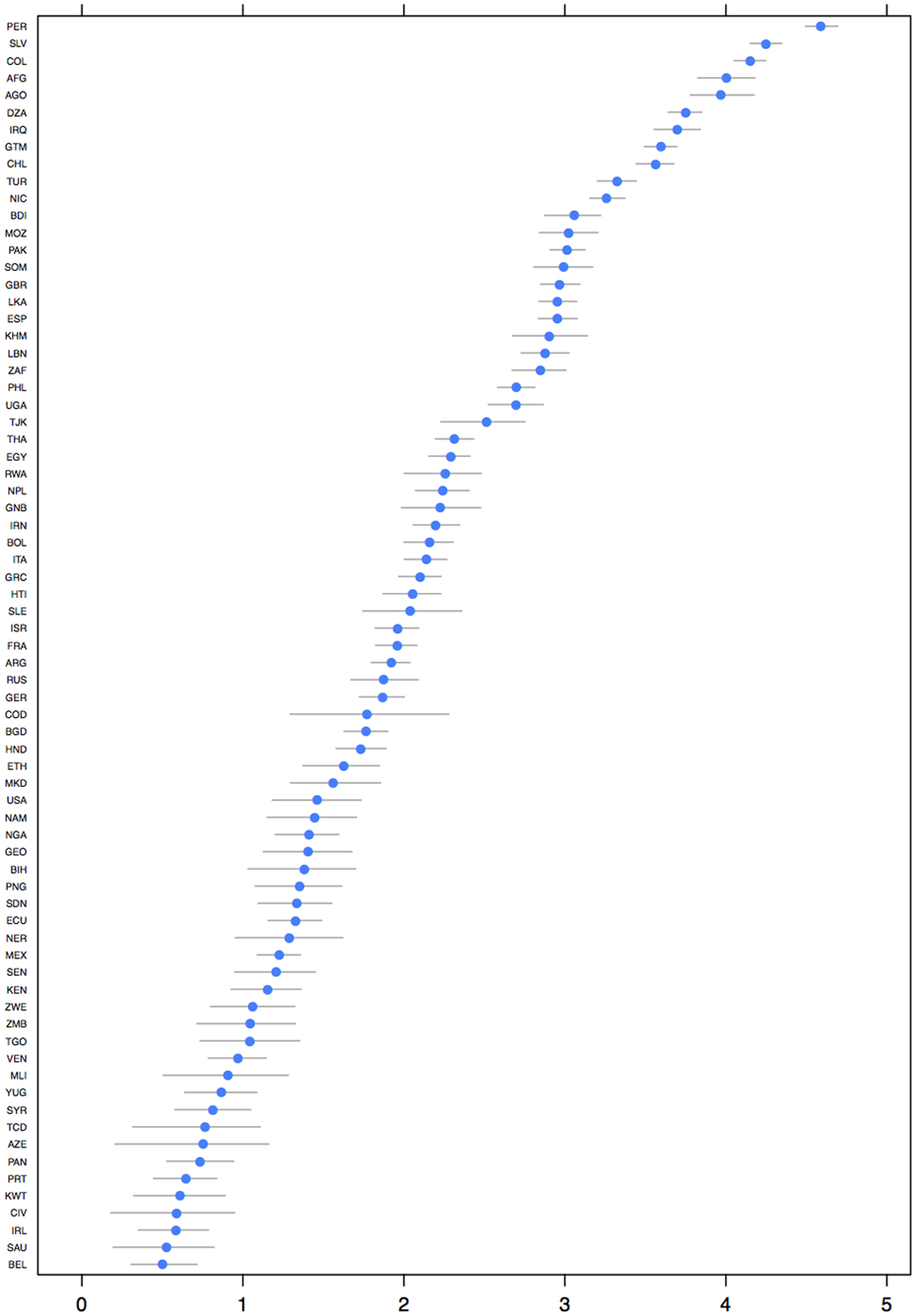
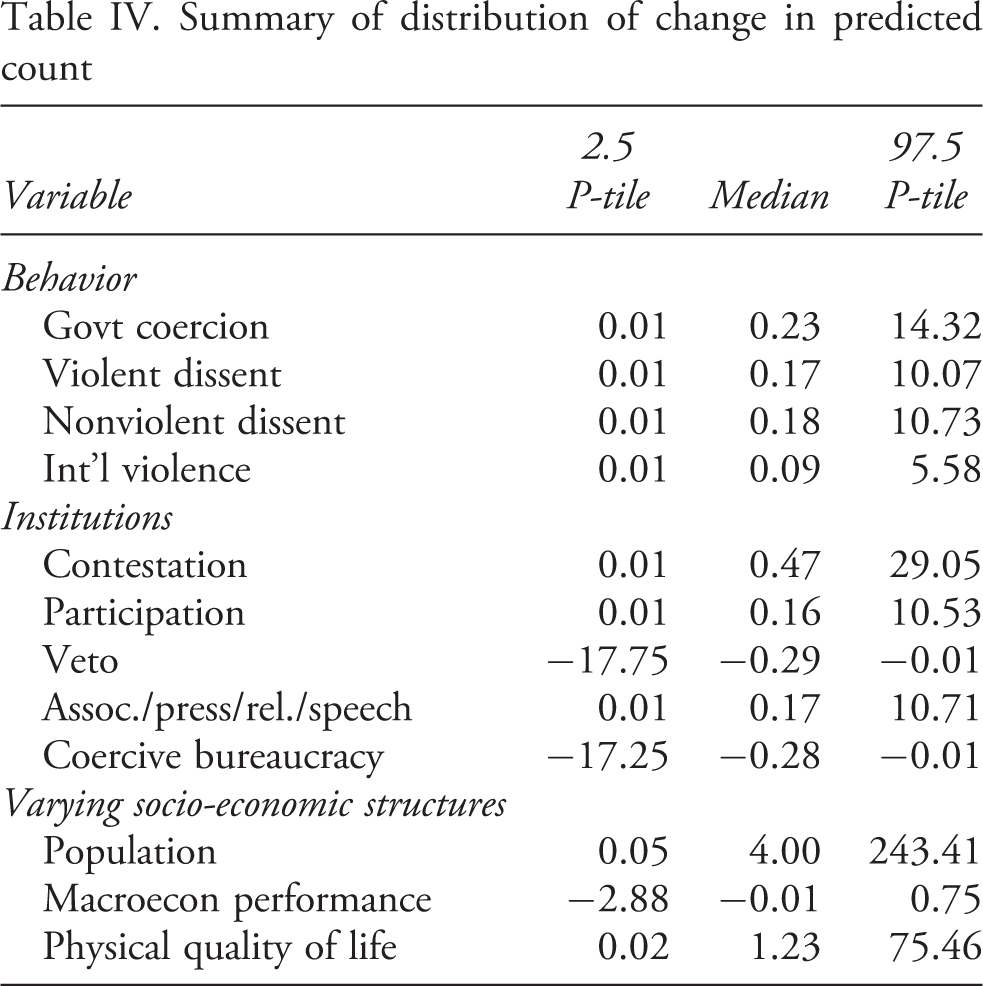
Turning to Veto, Table IV indicates that increasing the value of the veto points variable by one standard deviation decreases the number of terror attacks by 0.29, contrary to results reported in Li (2005) and Young & Dugan (2011).
Our measure of Freedom of association, press, religion, and speech has a positive impact on the number of terror attacks a country experiences, which is consistent with results reported in previous studies by Eubank & Weinberg (1994), Lai (2007), Chenoweth (2010), and Bell et al. (2014).
Our final institutional variable, capacity of the Coercive bureaucracy, exhibits a negative relationship with terror tactics: the median effect across all country-years is a reduction of 0.28 terror attacks. This provides support for our conjecture, based on Gurr’s (1988) argument about garrison states, that a large coercive bureaucracy indicates that past state repression was successful in quelling dissent, and that the state is likely to respond to dissent with repression in the present, and should thus discourage the use of terror by dissidents.
Structural characteristics of economy and society
As noted above, two of the four socio-economic structure variables were found to exhibit no relationship with terror attacks: Ethno-linguistic fractionalization and Macroeconomic performance. Physical quality of life and population size exhibit a positive association with the number of expected terror attacks. Table IV shows that a one standard deviation increase in population produces roughly four additional terror attacks, while a one standard deviation increase in physical quality of life generates 1.23 additional attacks. This is consistent with a result reported in Coggins (2015: 470). 21
Summary and conclusion
Our analysis of the covariates of terror attacks demonstrates the value of framing the choice to adopt terror tactics as a process influenced by the states’ coercive behavior and the other violent and nonviolent dissident behavior within that country. We have done so taking into account both political institutions and socio-economic structures. An evaluation of the impact of each set of variables demonstrates that behavior explains more of the cross-national variation in terror attacks than do either institutions or structural characteristics.
Turning to specifics, we find that government coercion tends to stimulate terror attacks as do other acts of dissent (both violent and nonviolent), international conflict is positively associated with terror, and there is overdispersion consistent with outbidding. Turning to political institutions, our findings indicate that contestation and participation are positively associated with terror attacks, as are civil liberties. Veto points exhibits a negative association with terror attacks. Coercive bureaucracy has a negative, deterrent, impact. Lastly, with respect to the most studied covariates – structural characteristics of the economy and society – we found that both the physical quality of life and population size are positively associated with the incidence of terror.
In concluding we reflect upon this study within the context of the broader disaggregation movement in studies of violent instrastate conflict. During the past five years there has been a considerable increase in studies that either spatially or temporally disaggregate the country-year unit of observation and conduct statistical hypothesis tests in their study of violent conflict (see e.g. Holmes, Piñeres & Curtin, 2006; Cederman & Gleditsch, 2009; Raleigh & Hegre, 2009; Sánchez-Cuenca, 2009). This is important work: while there is value in cross-national studies such as we have reported here, it is equally important that we study the processes that produce terror attacks (and other forms of political violence) as they unfold over time and across space. The ‘year’ is not a special unit of time, nor is the ‘country’ a special unit of space. Data are frequently collected in such a way that countries and years are convenient as units of observation, but more and more scholars are becoming familiar with the collection and analysis of events data that can be assembled using a variety of spatial and temporal units of observation. Further, prominent arguments in the theoretical literature imply that analyzing information about individual dissident groups, rather than information aggregated across all groups in the country, is crucial for understanding and explaining terror attacks. We believe that the findings from studies such as this are most valuable as a baseline against which findings from spatially and/or temporally disaggregated studies can be compared. This is especially important if we are to develop a meaningful capacity to inform policy debates. We believe that this study can provide a valuable baseline for such research, and we hope others will find our case compelling.
Footnotes
Replication data

Acknowledgements
Previous versions of this research have been presented to the Centre for the Study of Civil War Working Group at the Peace Research Institute Oslo (PRIO); the Departments of Political Science at Essex University, Florida State University, and University of North Texas; and the annual meetings of the International Studies Association (2010, New Orleans, LA) and Peace Science Society (2008, Claremont, CA). We appreciate comments and feedback on this project from John Ahlquist, Dave Armstrong, Jason Barabas, Bethany Barrett, Bill Berry, Halvard Buhaug, David Cunningham, Kathleen Cunningham, Scott Edwards, Mike Findley, James Forest, Scott Gates, Jeff Gill, Håvard Hegre, Brian Lai, Jim Piazza, Chris Reenock, Dave Siegel, Håvard Strand, and Joe Young.