



Abstract
This article describes the first complete release of the Issue Correlates of War (ICOW) Territorial Claims dataset, which covers all interstate territorial claims between 1816 and 2001. Territory can have substantial tangible and intangible value for states, and competing claims for control of territory represent one of the leading sources of interstate conflict. The dataset identifies 843 territorial claims and includes measures of the salience of the claimed territory, as well as details of the militarization and ending of each claim. Beyond a discussion of the structure and contents of the dataset and the coding procedures that were used to generate it, this article also presents descriptive analyses of the dataset. These analyses highlight important patterns across time and space, including changes in the prevalence, frequency of initiation, salience, militarization, and resolution of territorial claims. Notable patterns include recent declines in the frequency with which claims tend to become militarized and a lower prevalence of tangible salience measures such as natural resources. The regional distribution of claims has also shifted markedly over time, from a historical concentration in Europe towards Asia, where by 2001 claims were far more prevalent than in any other region. The article concludes with suggestions for future research.
Territory has historically been a leading source of conflict between states (Holsti, 1991; Vasquez, 1993; Hensel, 2012). Conflicting claims over territorial sovereignty have been involved in a large proportion of armed conflicts, and conflicts over territory are more escalatory than conflicts over other issues, particularly when the territory at stake is more valuable.
This article describes the first complete release of the Issue Correlates of War (ICOW) territorial claims dataset. After briefly reviewing past research on territorial conflict, we analyze the temporal and regional patterns of territorial claims over the previous two centuries, providing considerable insights into historical trends in territorial conflict. The article concludes with a discussion of avenues for future research.
Previous work on territory
Research into the causes of conflict between states historically focused on the characteristics of states and dyads. These characteristics, ranging from states’ capabilities (Singer, Bremer & Stuckey, 1972) to their regime types (Oneal, Maoz & Russett, 1996) and their economic activities (Gartzke, 2015), have been comprehensively investigated to identify patterns. Significant progress has been made, improving our understanding of how attributes of states or dyads make armed conflict more or less likely.
An alternative approach has been to study the issues over which states interact, and to determine which issues are most likely to lead to armed conflict (Mansbach & Vasquez, 1981; Diehl, 1992; Hensel et al., 2008). Foremost among the issues investigated by scholars has been territory. Territory can be valued for its tangible contents, such as natural resources or militarily or economically strategic features (Goertz & Diehl, 1992; Hensel, 1996; Humphreys, 2005). It can also be valued for more intangible reasons, such as perceived cultural or historical connections with the state or its citizens (Murphy, 1990; Toft, 2003; Goddard, 2006).
Numerous studies have confirmed that territorial issues are more conflictual than other types of issues (e.g. Holsti, 1991; Senese & Vasquez, 2008; Hensel, 2012). Conflicts over territory are more likely to escalate to higher levels of violence than conflicts over other issues, above and beyond any effect of contiguity (Hensel, 1996; Hensel & Mitchell, 2005; Vasquez & Henehan, 2011). Given the conflictual nature of territory, it is important to study territorial claims to determine not only their connection to armed conflict proneness, but also how they can be managed and ended.
Many prior studies have been limited to cases of armed conflict, investigating whether militarized disputes or wars that had a territorial dimension were systematically different from those that did not. However, such data contain no record of territorial issues that were never militarized, as well as no indication of the relative salience of different territorial issues for the parties. Huth (1996) collected data on territorial issues that addressed some of these concerns for the post-WWII period, and Huth & Allee (2002) extended this back to 1919, but this dataset did not cover territorial claims in the 19th century, did not include detailed measures of both tangible and intangible salience, and did not include other types of contentious issues besides territory.
For this reason, Hensel (2001) introduced the Issue Correlates of War project. Begun in the late 1990s, the ICOW project aims to collect comprehensive, global data on contentious issues that may lead to conflict between states. This article describes the first complete release of the territorial claims data; Hensel et al. (2008) describe preliminary versions of the river and maritime claims datasets.
The ICOW territorial claims dataset
The initial release of the ICOW territorial claims data (Hensel, 2001) covered the Americas from 1816 to 1992. Later updates added Western Europe and extended the data through 2001 (Hensel & Mitchell, 2005; Hensel et al., 2008). This article summarizes the full dataset, which now covers the entire world from 1816 to 2001.
ICOW defines a territorial claim as being present when three conditions are met. There must be explicit competing claims to territorial sovereignty; statements that are vague or do not specifically demand sovereignty do not qualify (such as demands for the independence of a secessionist territory rather than its transfer to the demanding state), nor do demands over the usage of territory (such as demands over the treatment of minorities or sharing of cross-border resource deposits). These statements must concern specific territory; vague statements seeking Lebensraum, energy sources, or a route to the sea without specifying a specific territory do not qualify. Finally, these statements must be made by official government representatives who are authorized to make foreign policy; statements by private citizens, legislators, or soldiers do not qualify unless they are supported by foreign policymakers such as the president, prime minister, or foreign minister and thus represent official policy. 2
All data collection strategies and coding procedures are described in the ICOW General Coding Manual and ICOW Territorial Claims Data Coding Manual, which are available on the project’s web site at http://www.icow.org. The dataset is provided in separate data files for claim-level data and claim-year-level data. The claim-level data include summary information about each claim, and are most useful for studying broad patterns such as the frequency of claims over time. The claim-year-level data contain more details that may vary from year to year, such as the factors that make the claim salient to the claimant states, or the militarization of the claim. 3
Claim-level data
Each territorial claim is assigned a name that summarizes the claimed territory, and the various states that were involved in explicit claims to this territory are divided into challenger–target dyads. A given territory may be subjected to multiple dyadic claims, either because multiple states seek control over part or all of the same territory (as with the Spratly Islands) or because the same two states end one claim but later begin another (either as the territory changes hands or as leaders or other circumstances change). Claim-level data are presented in a file with information about each dyadic claim, as well as an aggregated file that provides summary information across all dyadic claims over a specific piece of territory.
The target state in any dyadic claim is the state that owns or administers the claimed territory, while the challenger state is the one that seeks to acquire this territory. A claim is considered to begin when the three conditions noted earlier are met – when official representatives of the challenger state make explicit claims to sovereignty over a specific piece of territory. It is considered to end when one or more of these conditions ceases to be met, such as when the challenger’s government no longer makes these claims – even if private citizens, such as residents in the claimed area, continue making demands. The dataset also records the way the claim ended, which can range from being dropped or renounced by the challenger to conquered militarily or settled through a bilateral agreement or third-party activity.
Claim-year-level data
The claim-year-level data includes information on factors that may vary over the course of the claim, beginning with the salience, or value, of the claimed territory to the participants. Six different indicators are used to measure the salience of each territorial claim using factors that are believed to make a claimed territory more valuable to the states. More discussion and justification of each indicator is available in articles that introduced earlier versions of the data (Hensel, 2001; Hensel & Mitchell, 2005).
The first three indicators are intended to measure the tangible or physical salience of the territory: Is the claimed territory known or believed to contain valuable natural resources? Does the territory have a (militarily and/or economically) strategic location? Is the area populated, rather than uninhabited?
The remaining three indicators measure the intangible or psychological salience of the territory: Does the claim involve territory that one or both states claim as homeland territory, rather than a colony or dependency? Do one or both states have a (religious, ethnic, linguistic, or similar) identity-related connection with the claimed territory or its inhabitants? Have one or both states administered the territory within the past two centuries, meaning that they have a relatively recent experience of historical sovereignty?
These six indicators can be used in several different ways. Researchers can use any or all of them separately, in order to assess the impact of each one; for example, is strategic value more or less likely to lead to armed conflict over a territory than the presence of economic resources? Alternatively, ICOW has created an aggregated salience index that draws from all six indicators to allow comparison of the overall value of claimed territories. This index assigns one point for each of the six indicators that is present for each of the two claimants, potentially ranging from 0 to 12. Separate six-point indices are also included for the tangible and intangible dimensions of salience, to allow scholars to distinguish between claims based on these dimensions.
This dataset also includes information about the militarization of each claim. The Correlates of War project’s Militarized Interstate Dispute (MID) dataset, version 4.01 (Palmer et al., 2015), was consulted to identify all militarized disputes occurring between two states that were involved in an ongoing territorial claim. Each such dispute was investigated to determine whether or not it was directly related to the claim, as an effort to alter the territorial status quo. The history of claim militarization is also measured in several ways, first by counting the number of overall MIDs, fatal MIDs, and full-scale wars over the claim in the previous five- and ten-year periods before a given year of observation. A weighted measure of recent conflict of each type is also provided, measuring the number of conflicts over the past ten years but weighting more recent conflicts more heavily (Hensel et al., 2008). 4
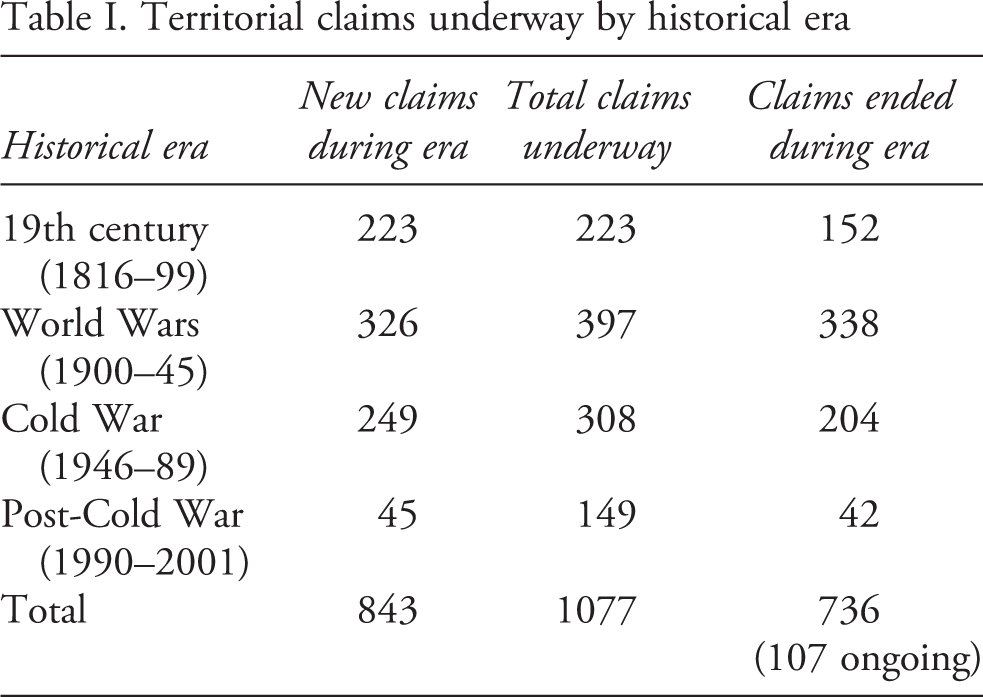
Territorial claims underway by historical era
Patterns in territorial claims, 1816–2001
We now analyze major patterns in territorial claims over the past two centuries, including the onset, persistence, termination, salience, regional distribution, and militarization of territorial claims.
As Table I shows, there have been a total of 843 claims between 1816 and 2001. About one-quarter of these claims began in the 19th century, when after 1815 there were an average of 2.4 new territorial claims per year. The first half of the 20th century saw a noticeable surge in territorial claims, as nearly 40% of all territorial claims began in the years 1900–45. This is by far the densest historical period for claim onset, as each year saw an average of 7.1 new territorial claims, including a significant clustering around the two World Wars. The Cold War period from 1946 to 1989 experienced nearly 30% of all new territorial claims, with an average of 5.7 claims lodged per year, well above the 19th century but still behind the contentious world war period. Since the Cold War, 45 new claims have been lodged, representing about 5% of the total. However, this period only covers the years 1990 to 2001, and the rate of new claims remains at 3.8 new claims per year.
Figure 1 extends Table I by showing the number of claims underway in each year. The number of territorial claims ongoing around the world has increased gradually over the past two centuries, with several notable exceptions. There were sharp increases in territorial claims around the time of World War I and during decolonization in the 1950s and 1960s, and a sharp decrease in the 1920s as the post-WWI claims were resolved. This post-WWI decrease is reflected in the general patterns in Table I, as the period of the two world wars (1900–45) is the only one of these four eras that saw more claims ended than begun.
While the number of claims underway has generally seen a gradual increase over time, we must also
Territorial claims since 1816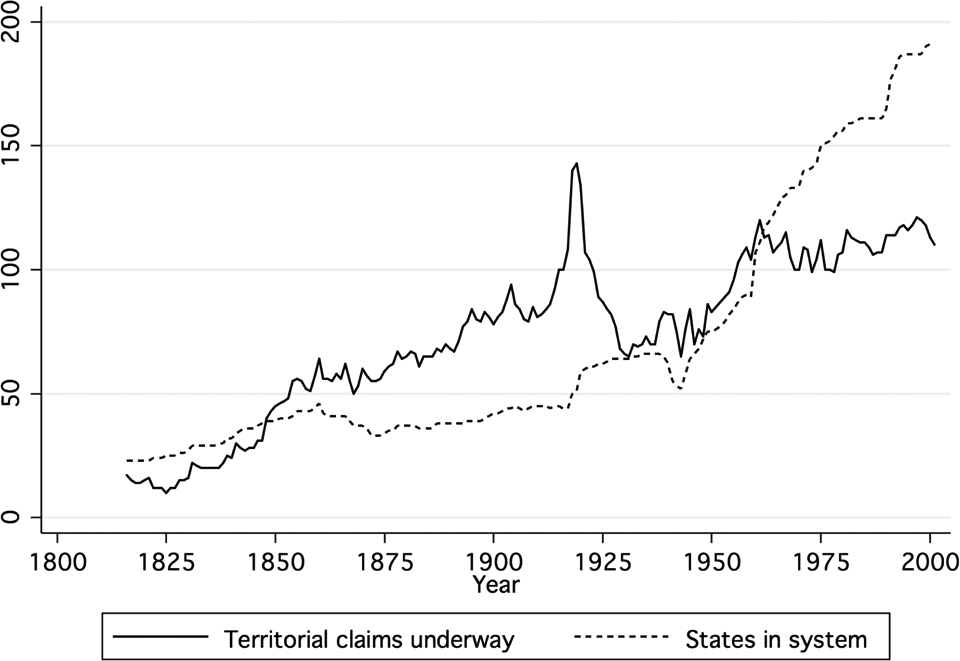
Figure 2 shows the number of territorial claims underway, controlling for the number of states in the system at any given point in time. Displayed is the number of territorial claims per state, on average, across the previous two centuries. This shows that as the gradual increase in territorial claims over the past two centuries has been accompanied by a massive increase in the number of states in the system, the likelihood of any given state being involved in a territorial claim at a given point in time has declined markedly since 1945, falling to levels unseen since the early 19th century. This seems to conform with the suggestion that states are increasingly wary of seeking to alter the territorial status quo (Zacher, 2001; Hensel, Allison & Khanani, 2009), although the phenomenon is of course hardly absent.
Regional patterns
We now move from the global level to regional patterns of territorial claims. Territorial claims have been most common in Europe and Asia, as shown in Table II. As of 2001,
Average territorial claims per state Territorial claims by region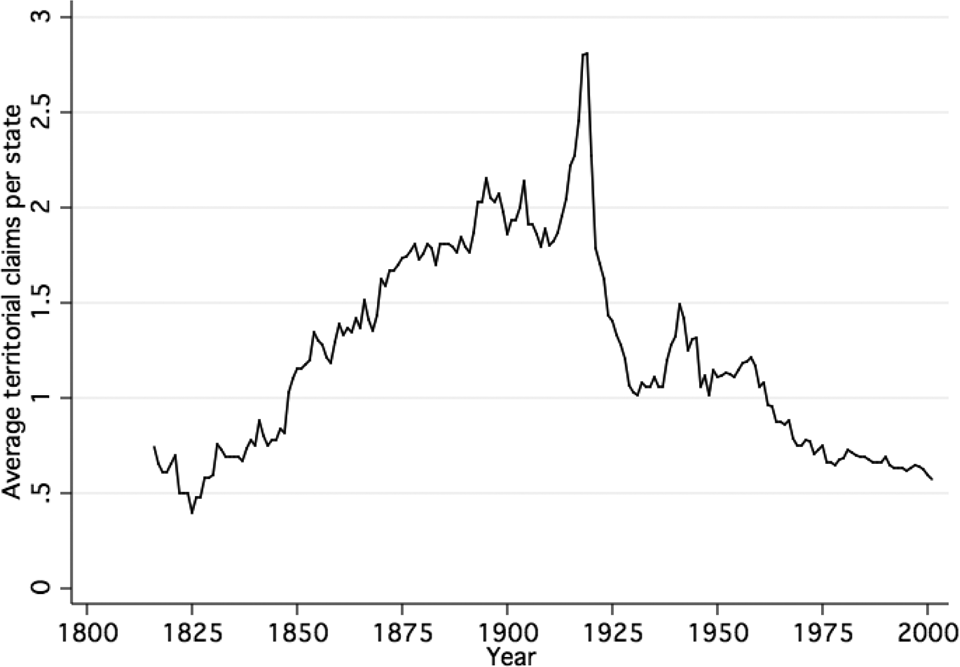
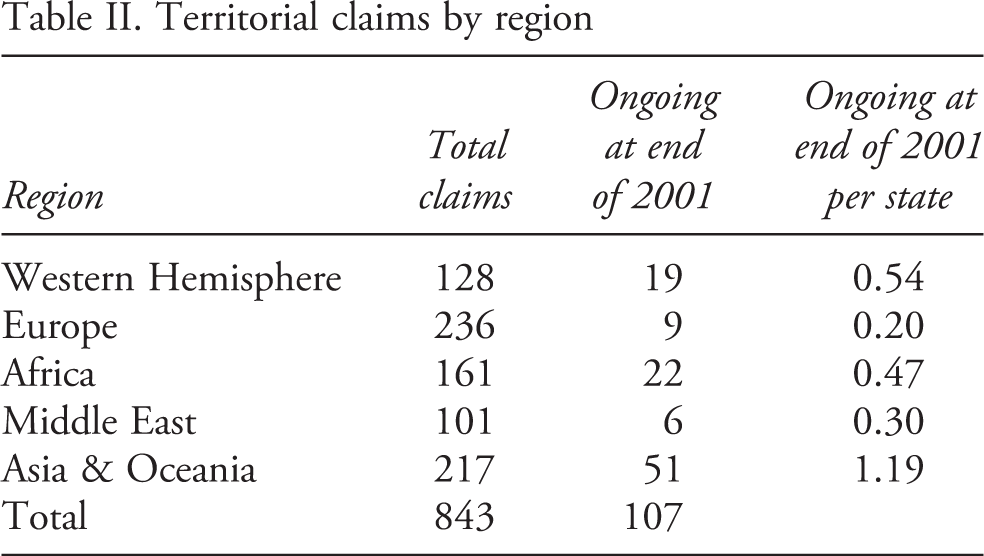
Figure 3 shows the temporal distribution of new territorial claims in each region. These data show the gradual movement of territorial claims across regions, and again highlight the influence of decolonization. During the 19th century, the Western hemisphere experienced the most territorial claims, as colonizers withdrew and the newly independent states struggled to expand themselves. The World Wars period from 1900 to 1945 is,
New territorial claims by region Salience of claimed territories
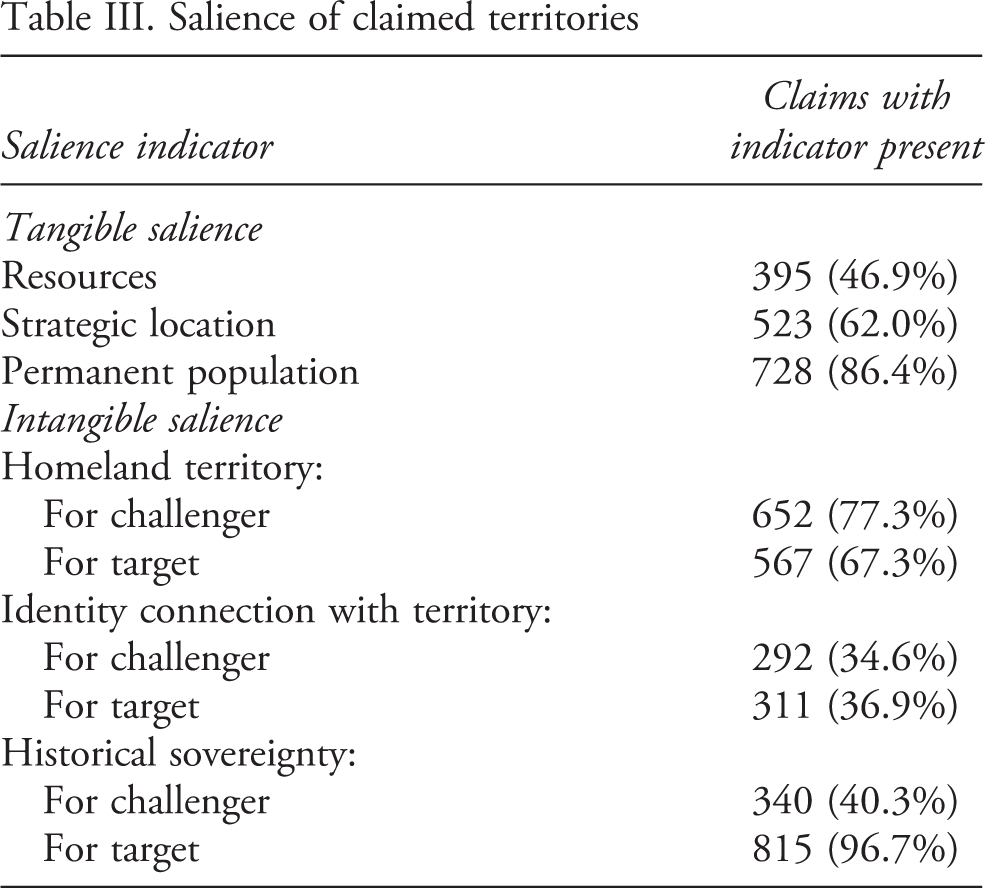
Claim salience
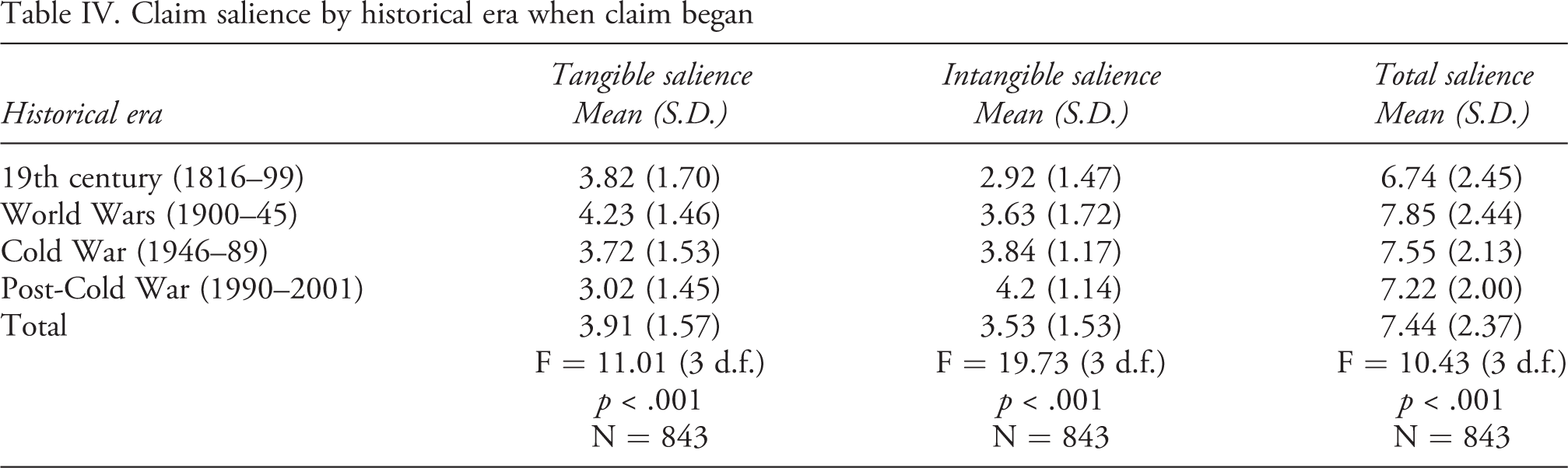
Claim salience by historical era when claim began
The presence of intangible factors, by comparison, varies considerably between the challenger and target states. The majority of claimants consider the territory they claim to be an integral part of their homeland, including 77% of challengers and 67% of target states. The discrepancy between these two numbers reflects the prevalence of claims by states seeking to expand their home territories at the expense of colonial powers. Roughly 40% of challenging states once controlled the territory they claim, suggesting that recovering lost territory has been a significant motivating factor in claim initiation. Lastly, approximately 35% of all territorial claims contain an identity element for either the challenger or the target. While some of the most prominent territorial claims may have involved difficult identity issues, this characteristic has historically been the rarest of the salience indicators.
As with claim frequency, claim salience has changed over time. As Table IV reveals, the salience of new territorial claims has declined modestly over the past century. While there was a substantial rise in claim salience between the 19th and 20th centuries, new claims begun in each era since 1900 have decreased slightly in salience. These changes reflect both a persistent increase in intangible salience over time, and an even greater decrease in tangible salience since World War II.
The decline in tangible salience is largely due to a decline in the frequency with which claimed territories either had strategic value or contained important natural resources. This decline in territorial claims over natural resources in particular is noteworthy, given the technological improvements in recent decades that have allowed the identification of natural resource deposits in areas previously thought to be of little interest, such as offshore islands or uninhabited desert regions.
The increase in intangible salience has been driven in part by decolonization, increasing the frequency with which claimed territories were considered homeland territory by both claimants, as well as an increase in the likelihood that both parties had a prior history of sovereignty over the territory in question. The rise of intangible salience and the decline of tangible salience may also indicate shifting international norms, which have delegitimized territorial change for material gain, but still give weight to the popular will of a territory’s inhabitants.
Claim militarization
Territorial claims have also shown different patterns of militarization over time. As shown in Table V, territorial claims were most likely to become militarized during the Cold War, and most likely to produce fatal violence around the two World Wars. While there have been differences in militarization across different eras, ranging from 33% to 46%, the likelihood of fatal conflict has seen even greater variation. The 19th century saw escalation in just 23% of claims, well below the 33% of the World Wars era. In the post-Cold War era, meanwhile, there are signs that fatal violence over territory has declined significantly, with only six territorial claims (just 13%) producing fatalities.
Militarization of territorial claims


Militarization of territorial claims since 1816
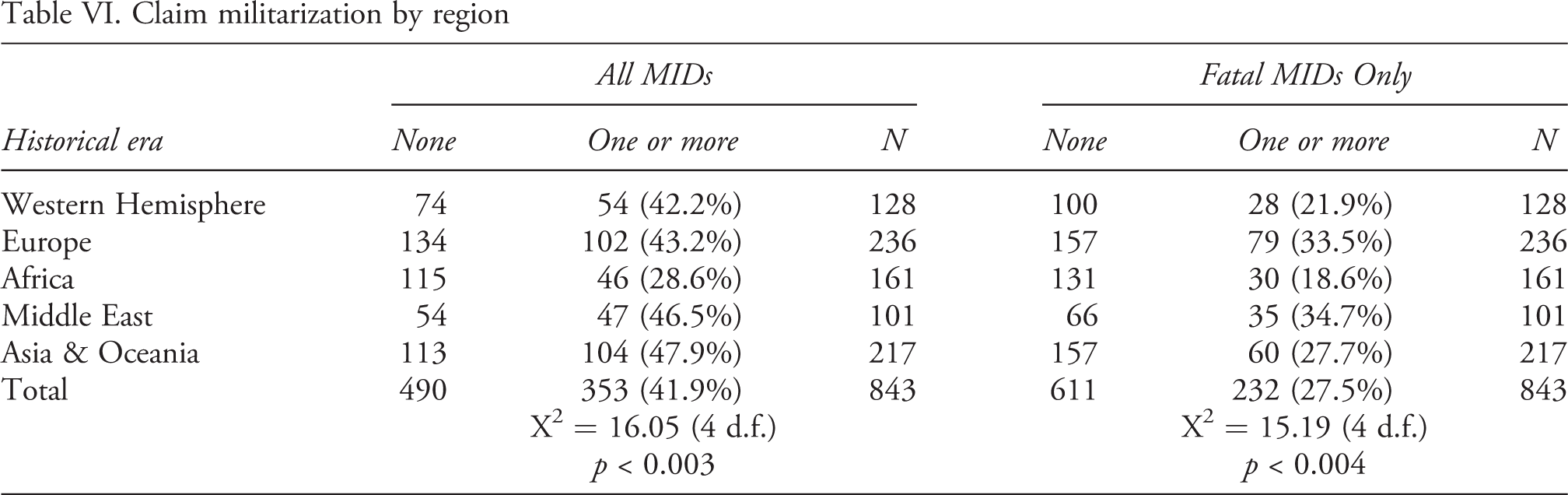
There are also notable regional differences in militarization. As shown in Table VI, territorial claims have been most likely to become militarized in the Middle East and Asia, and most likely to involve fatal violence in Europe and the Middle East. In Africa, meanwhile, territorial claims have been least likely to experience any militarization. In part this reflects the relatively cooperative process by which the colonial powers divided the continent in the 19th century, but post-colonial claims in Africa have also tended to be relatively limited in nature and only rarely become militarized. The Western hemisphere has experienced a roughly average propensity for territorial claims to become militarized, while fatal violence has been significantly less frequent. A similar phenomenon is found in Asia, where territorial claims were most likely to become militarized, but not particularly likely to escalate to fatalities.
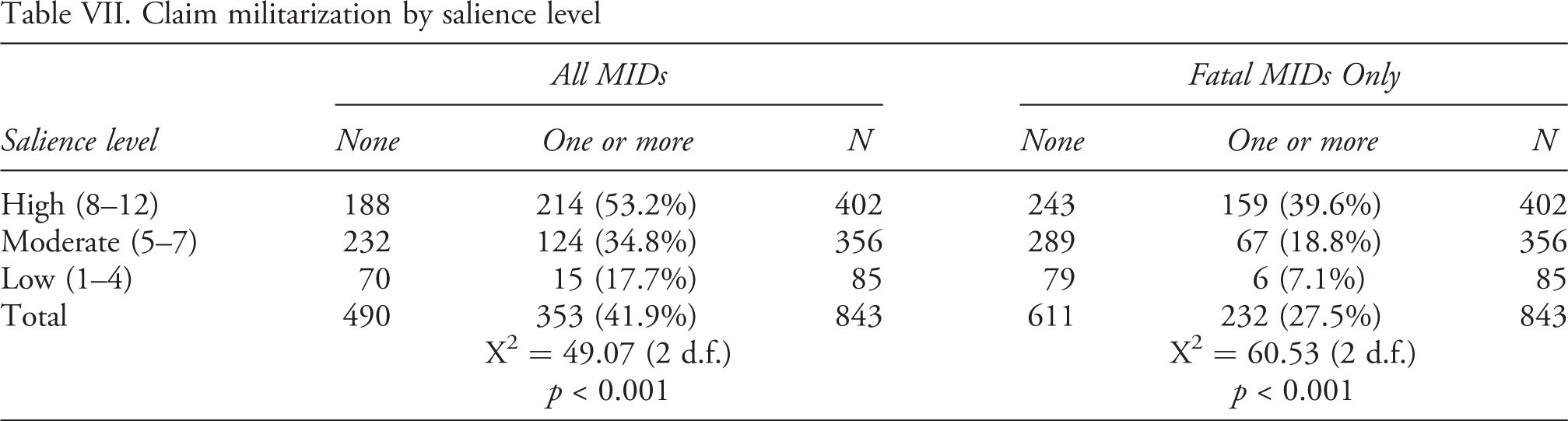
One additional pattern related to militarization is important to highlight: territorial claims with higher salience levels are more likely to become militarized. As shown in Table VII, the highest salience territorial claims have been most likely to become militarized and to produce fatal violence, with over half being militarized and over one-third producing fatalities. Low-salience claims are only about one-third as likely to become militarized, and only rarely has their militarization resulted in fatalities.
Claim termination
Lastly, territorial claims have ended in many different ways. As shown in the first column of Table VIII, bilateral negotiations between the claimants have been most common, ending roughly one-third of all territorial claims. The next most frequent outcome is states simply dropping their claim, typically when failed attempts at conquest or the passage of time make the realization of the challenger’s goal unlikely or when leadership transitions prompt states to reassess the value of continuing the claim. Claims may be dropped explicitly or they may be coded as dropped following a prolonged failure to pursue them despite clear opportunities to do so. Binding and non-binding third-party activities (e.g. arbitration or mediation) and peace conferences have also settled substantial numbers of claims.
At first glance, relatively few territorial claims were settled directly through military conquest. However, this statistic is somewhat misleading, as many territorial claims settled through other methods – including particularly bilateral negotiations and peace conferences such as Versailles in 1919 – reflected battlefield results. If we recode settlements that arise from military outcomes as being settled by military conquest, the patterns change considerably. The important role of military conquest in settling territorial claims becomes clear, ending roughly one in four claims, and trailing only bilateral negotiations in frequency.
Potential research applications of the data
Claim militarization by region
Claim militarization by salience level
Termination of territorial claims

This table only includes claims that have ended as of the current end of the dataset in 2001. ‘Other’ includes cases where one of the claimants leaves the COW interstate system, the territory no longer exists (such as an island falling below sea level), and other events not covered by the categories included.
In addition, the full version of the dataset allows for the investigation of many new topics, including changes in the patterns of territorial claims over time. Perhaps the most notable of these patterns is the overall decline in territorial claims. While territorial claims are still being generated in the post-Cold War period at a rate above the 19th century, there is a marked decrease from the World War and Cold War eras, particularly when adjusting for the greatly increased number of states. Whether this decline results from territorial integrity norms and the spread of economic interdependence (Frederick, 2012) or the slowdown in the creation of new states, the strengthening of international institutions, or some other phenomenon remains to be answered. Additional investigations into how recent claims differ from claims in earlier eras would enhance our understanding of this decline, and would allow scholars to assess whether this trend is likely to represent a persistent decline or just a temporary lull.
A related application is an analysis of the changing frequency with which specific salience measures have been present in territorial claims. Throughout history, resources have been used to justify conquest, yet individual resources have risen and fallen in importance. Similarly, states have lodged many territorial claims over strategic concerns, and the development of nationalism has led to many territorial claims to land populated by the challenger’s ethnic kin. A more detailed analysis of the particular characteristics of claimed territories may help explain the variation in militarization over time, and provide some insight as to which features of contested territories researchers and policymakers should monitor to prevent future conflict.
Another promising topic involves the clear trend away from militarization, especially fatal conflict, in territorial claims. While territorial claims themselves have endured, and states continue to militarize these claims, fatal conflict over territory has declined markedly. As with the declining frequency of territorial claims, the exact causes of this phenomenon are uncertain, and may range from international norms to liberal democratic or economic factors. Understanding this phenomenon can help policymakers work to preserve this beneficial trend.
Finally, regional variation in the frequency and militarization of claims deserves research. Territorial claims remain much more prevalent in Asia than in other regions. Historically, however, Europe and the Middle East have seen the lion’s share of the world’s fatal conflict over territory. While fatal territorial violence in Europe has declined markedly since 1945, it has persisted in the Middle East, and even in Europe more recent conflicts in the Balkans and elsewhere highlight that it has not disappeared. There is no shortage of violence over territorial issues outside of these two regions, but explaining why their claims have been so conflictual could assist efforts to predict and avoid future conflicts.
Footnotes
Replication data
Replication data for the analyses conducted in this article, including codebooks, can be found at https://www.prio.org/JPR/Datasets/ The latest version of the ICOW Territorial Claims dataset is available at  . All analyses were conducted using STATA.
Funding
This project was supported by National Science Foundation awards SES-0960567, SES-0214417, and SES-0079421. All responsibility for this article lies with the authors.
Notes
References
Supplementary Material
Please find the following supplemental material available below.
For Open Access articles published under a Creative Commons License, all supplemental material carries the same license as the article it is associated with.
For non-Open Access articles published, all supplemental material carries a non-exclusive license, and permission requests for re-use of supplemental material or any part of supplemental material shall be sent directly to the copyright owner as specified in the copyright notice associated with the article.
