



Abstract
What are the limits of democracy’s positive influence on human rights? In this article, we argue that contested elections and powerful courts provide leaders with different incentives with regard to hiding torture. Because government torture is generally targeted at individuals that voters find threatening, institutions that reflect public opinion – like electoral contestation – are associated with higher levels of government abuse that leave scars on the victim’s body. Other institutions – like powerful courts – protect the rights of political minorities. Leaders in countries with powerful courts prefer plausible deniability of rights violations and consequently employ higher levels of clean torture, which leaves no scars. We test our hypotheses using data from the Ill-Treatment and Torture (ITT) Data Collection Project that distinguish between Amnesty International (AI) allegations of scarring and clean torture. We employ an undercount negative binomial that accounts for AI’s (in)ability to obtain information about torture. The model assumes that some incidents of torture go unreported and allows the extent of underreporting to vary across countries/years. Estimates from the model yield considerable statistical and substantive support for our hypotheses.
Introduction
Although democratic institutions limit government coercion (e.g. Poe & Tate, 1994; Landman, 2005; Davenport, 2007b,a), one form of abuse – government torture – remains common across autocracies and democracies (Amnesty International, 2014b: 6). The word torture invokes images of medieval horrors, but the reality of government violations of the United Nations Convention Against Torture (CAT) is more banal; beating is the most common form of abuse. 1 Our study focuses on two distinguishable forms of torture: scarring techniques, which leave marks on the victim’s body, and clean tactics that do not leave marks on the victim. This distinction has theoretical value for illuminating the Madisonian tension between majority rule and securing the rights of minority political factions from tyranny of the majority (Dahl, 1963). 2 Why? Because scarring techniques limit the government’s ability to plausibly deny abuse while clean techniques provide repressive government agents with a measure of plausible deniability.
We follow Davenport’s (2007b) call to investigate the differential impact of democratic institutions on government repression and argue that domestic political institutions are not equal in the extent to which they facilitate the ability of people to monitor and punish executive agents who permit or encourage torture. When one ignores the Madisonian tension and conceptualizes democracy as an aggregation of majority rule and separation of powers, it is difficult to fully illuminate the mechanisms that incentivize government agents to prefer clean torture. Our theoretical account shows the differential impact of two institutions commonly associated with democracy – electoral contestation and powerful constitutional courts – on the government’s use of torture. Unlike Rejali (2007), we are not interested in the effect of democracy relative to autocracy on torture. 3 Rather, by considering the effects of two domestic political institutions – electoral contestation and constitutional courts – on government torture, we probe the tension Madison highlights between majority rule and the rights of members of political minorities.
Because torture overwhelmingly targets particular subsets of the population – members of marginalized groups, criminals, and dissidents (Rejali, 2007) – institutions that convert majority preferences to policy – like electoral contestation – do not sufficiently encourage leaders to prioritize plausible deniability about torture. This is because citizens task the leader with their protection, entering a bargain in which that leader will ‘dirty his hands’ when necessary for state security (Walzer, 1973). We argue that states with electoral contestation engage in more scarring torture than their counterparts without contestation: when members of groups that are perceived as threats to ‘order’ transgress legal or social boundaries, the majority’s demand for protection incentivizes elected leaders to abuse those weakly enfranchised individuals in a publicly visible fashion. As the rise of (white) nationalist populism in Western democracies highlights (Mudde, 2007, 2017), blocks of voters who explicitly support aggressive coercive behavior against unwanted others are able to elect executives who promise to take off the gloves on the grounds that they are implementing the will of the people. Put plainly, leaders subject to removal via the ballot box can have positive incentives to (permit their coercive agents to) pursue visible ‘security’ measures vis-á-vis members of marginalized groups deemed to be threatening outsiders.
Other domestic institutions – like powerful constitutional courts – are created to protect the rights of political minorities, even at the expense of the majority. Leaders in countries with powerful judiciaries have a greater preference for hiding violations of human rights, preferring plausible deniability if they should be accused of torture in a court of law. Consequently, we expect countries with powerful courts to demonstrate higher levels of clean torture than states where courts are less effective. In short, while powerful courts provide an incentive for governments to make their abuse difficult to detect, majoritarian institutions are positively associated with abuse that is more readily detectable after the fact.
For example, in two of the world’s largest democracies, the United States and India, voters rarely remove from office politicians who oversee police and militaries that engage in torture. During the Bush administration in the USA, public approval of torture was consistently in the mid to high 40% range (Gronke et al., 2010; Miller, 2011; Richards, Morrill & Anderson, 2012). As Governor of Texas, Bush was responsible for a state prison system criticized for systemic abuse of prisoners (Butterfield, 2004). Despite that background and the 2004 Abu Ghraib scandal, he secured a second term in office. The courts, however, took notice of violations of these abuses. In 1999, a US District Court decided that the Texas prison system required court oversight due to problems including ‘excessive use of force by correctional officers’ (Lyman, 1999). In Rasul v Bush (2004), Hamdan v Rumsfeld (2006), and Boumediene v Bush (2008), the US Supreme Court placed restrictions on the President’s authority to imprison suspects. Although the court did not directly address the issue of torture, these cases played a key role in the administration’s decision to curtail its Enhanced Interrogation Program.
In India, reports of torture by police are common. Between 2008 and 2011 India’s National Human Rights Commission documented more than 4,000 deaths of detainees in police custody (Organization for Minorities of India, 2011: 20–22). The agents perpetrating these abuses do not hesitate to defend them, justifying the use of torture against suspected criminals and terrorists (Wahl, 2013). A high ranking officer interviewed by Wahl (2013) appealed to popular support for torture, arguing ‘A criminal is a person without a soul and the standard techniques for people with souls cannot be applicable.’ Police officers are not alone in their support of torture. A recent AI survey found that 74% of Indians believe torture can be justified to protect the public (Amnesty International, 2014a). In 2010, the lower house of parliament passed a law intended to address abuse by police, but the bill stalled in the upper chamber (Balakrishnan & Srivastava, 2010). The Supreme Court, however, sometimes steps in to check the police, as in a recent ruling that ordered the release of six individuals tried and convicted under India’s Prevention of Terrorism Act (Anand, 2014).
We test our hypotheses using data from the Ill-Treatment and Torture (ITT) Data Collection Project that distinguish between AI allegations of scarring and clean tactics (Conrad, Haglund & Moore, 2014). In order to draw inferences about torture violations using data on AI allegations, we estimate an undercount negative binomial model (Cameron & Trivedi, 1998: Section 10.5) that controls for covariates influencing AI’s ability to obtain enough information about torture to issue an allegation. Using this model, which represents an important advance over work that ignores the undercount problem endemic to human rights data, we find considerable statistical and substantive support for our hypotheses.
Plausible deniability and government torture
Government torture occurs considerably more frequently than people realize. Data from the ITT Data Collection Project indicate that between 1995 and 2005 Amnesty International alleged the use of torture in 71% of all country-years (Conrad, Haglund & Moore, 2013: 207). In addition to its frequency, there are two additional reasons to set torture apart as a noteworthy form of repression. First, state torture requires detention; as long as the detainee is not ‘disappeared’, there is at least one witness to the abuse and potentially evidence including scars or other marks on the body. Second, torture is targeted: unlike restrictions on liberties or indiscriminate shelling, torture tactics can be applied very precisely, particularly at individuals outside the leader’s winning coalition (Rejali, 2007; Conrad, Haglund & Moore, 2013, 2014).
Rejali (2007: 4, 557–559) distinguishes between two types of torture: scarring torture and clean torture. Scarring torture leaves marks on the bodies of its victims; clean techniques include ‘painful physical techniques of interrogation or control that leave few marks’ (Rejali, 2007: 4). 4 Developed in the police departments of the United States, France, and the United Kingdom during the 20th century (Rejali, 2007: 69–78), clean torture is employed for two reasons. First, it is difficult to detect with high levels of certainty. Victims and advocates are ‘less likely to complain about violence committed by (clean torture) […] that may or may not leave traces, violence that we can hardly be sure took place at all’ (Rejali, 2007: 2). Second, when victims do come forward with allegations of torture, it is easier for the state to deny clean torture than to deny abuse that uses scarring techniques. When a victim bears the physical legacy of torture, advocates, judges, etc. are better able to confirm that a violation of human rights has occurred. Clean torture, on the other hand, allows the state to violate rights with less obvious recourse, creating a ‘he said, she said’ game in which the victim’s story is more difficult to corroborate.
Governments do not always wish to deny human rights violations, both because it is costly to be covert and because they have reasons to repress out in the open. Under what conditions do governments want to hide human rights violations like the use of torture? When do leaders (and their subordinates) prefer plausible deniability about such acts? Rejali (2007) argues that governments prefer plausible deniability when they are being monitored. Clean techniques give offending state agent(s) plausible deniability in the face of allegations from victims and/or domestic and international audiences. But monitoring alone does not cause states to prefer clean torture techniques. Executives and their agents only care about being watched to the extent that it is coupled with the potential for costs. Repressive agents who ‘go rogue’ to elicit confessions or control detainees (e.g. Wantchekon & Healy, 1999) worry about the consequences of torture if they are caught, which range from censure to imprisonment. Without the potential for consequences, simply being monitored will fail to influence the government’s choice of repression. In the next section, we discuss the extent to which democratic institutions – electoral contestation and powerful courts – allow non-executive actors opportunities to monitor and sanction the executive for rights violations. We argue that institutions that protect the majority are unlikely to be associated with clean torture, while institutions intended to protect the minority encourage states to torture in ways that make them less likely to be held accountable.
The Madisonian tension and plausible deniability
To develop our theory about the different impact of these institutions, we first make explicit the preferences of three actors: (1) a government leader, (2) the citizens of the polity, and (3) the leader’s coercive agents. First, we assume that the leader wants to stay in power; in order to do so, he need only be concerned with the protection and safety of the members of his winning coalition and not run afoul of an effective court with the ability to remove him from power. 5 One way that the leader can invest in the safety and protection of the members of his winning coalition is to violate the human rights of individuals not in the winning coalition. The leader is responsible for sustaining the body politic, and he has at his disposal a coercive apparatus – police, prison guards, and soldiers – to enforce the state’s monopoly on the legitimate exercise of coercion (Weber, 1946). The executive delegates to managers daily oversight of the agents of coercion, who make decisions about whether to commit violations, either in compliance with, or contrary to, directives from above. We do not theoretically address whether the decision to violate originates with the executive or individual agents, but instead focus on how democratic institutions impact the incentives of the executive and agents in common.
Second, we assume that each citizen delegates national security, writ large, and their own individual protection and safety to the executive (Weber, 1946; Walzer, 1973; North, Wallis & Weingast, 2009). The average member of the winning coalition is willing to withdraw his/her support from the leader if the leader violates his/her individual rights. But it is well established that people are more acceptant of human rights violations undertaken in response to a threat (Davis & Silver, 2004; Davis, 2007; Armstrong, 2013), justified in terms of national security (Davis, 2007; Armstrong, 2013), or directed at minority groups (Fiske, Harris & Cuddy, 2004; Harris & Fiske, 2011; Piazza, 2015). We consequently assume that voters are willing to turn a blind eye to rights violations that are directed at ‘the other’, such as criminals, dissidents, 6 and members of marginalized populations (Walzer, 1973). Bueno de Mesquita (2007) strengthens Walzer’s analysis by showing that the office retention motive leads elected executives to prefer publicly visible security measures to ‘behind the scenes’ policies even when the former are less efficient than the latter. This incentive explains the public declarations of politicians such as Dick Cheney, Donald Trump, and Rodrigo Duterte (among many others) to ‘dirty their hands’ in defense of the nation when confronting members of marginalized groups who are culturally and politically perceived by their supporters as threats to the nation.
Finally, we assume that when government agents do not fear being caught or wish to demonstrate power over subordinates (Foucault, 1979), agents that are willing to torture are likely to use the most straightforward technique – scarring torture. Popular depictions of torture as specialized labor aside, by the time we are adolescents all human beings have the capacity and knowledge to commit the most common form of scarring torture: beating. When they expect to be monitored and punished, but nonetheless expect abuse to help gain a detainee’s compliance, coercive agents are more likely to engage in clean techniques. Thus, non-scarring techniques become more pervasive as agents of the state are increasingly monitored and face costs associated with torture.
Plurality institutions: Electoral contestation
One of the most fundamental tenets of democracy is the notion that leaders attain office via a ballot of the adult population, who choose from among a pool of candidates with often conflicting viewpoints (Cheibub, Gandhi & Vreeland, 2010). Electoral contestation is important because it creates the possibility that the voting public might collectively sanction leaders for human rights violations. Elections can improve human rights outcomes if voters remove authorities who are known to violate rights (Davenport, 2007b) or use the electoral process to select leaders who will not do so in the first place. Faced with the threat of electoral accountability, elected officials face incentives to either end human rights violations altogether or continue to abuse human rights, but in a manner that generates plausible deniability.
Although elections are associated with better human rights performance writ large, several issues limit the extent to which electorates punish politicians whose coercive agents engage in torture. First, countries that elect their leaders invite greater challenges to state authority in the form of crime, protest, and terror (e.g. Powell, 1982; LaFree & Tseloni, 2006; Chenoweth, 2010), producing greater demand among the voting public for executives to ‘dirty their hands’ against criminals and dissidents to protect the body politic (Walzer, 1973). In countries with autocratic institutions, citizens know to falsify their preferences and lie low (Kuran, 1997). Although people do so because they recognize that the state will abuse them (e.g. Hollyer & Rosendorff, 2011), the equilibrium outcome is lower amounts of crime, protest, and violent challenges in autocratic states. This produces fewer opportunities for ‘disciplining’ criminals, dissidents, and members of marginalized groups in countries without elections than in countries with elected leaders.
Second, despite normative support for the general prohibition of torture, the protection of human rights is rarely a key electoral issue in democracies. In order for electoral contestation to motivate the leader to change his behavior with regard to repression, the voting public must prefer the leader to respect the rights of criminals, dissidents, and the marginalized and be willing to vote according to this preference. We do not assume that the electorate inherently values rights protection for the population at large. Instead, we make the relatively innocuous assumption that each voter prefer that the state not violate his/her own rights. Leaders are unlikely to change repressive behavior in the face of electoral contestation unless a sufficient number of voters are willing to cast their ballot on that issue. Some violations, such as curfews or restrictions on speech, apply broadly, but others can be more selectively targeted against particular individuals. In states with electoral contestation, leaders are more likely to avoid human rights violations writ large, but still tolerate violations against people who the public perceives as threatening.
Each of these issues ties directly to the third: who are the most likely victims of torture? Rejali (2007: Ch. 2) identifies criminals, dissidents, and marginalized individuals as most at risk of abuse. The criminal justice system’s need for convictions puts criminals at risk; indeed, the demand for convictions produced the innovation of clean torture as police departments in liberal democracies sought plausible deniability with regard to the techniques they used to elicit confessions. Dissidents are seen as subversive, both by the state and the general population, and they often have extremist viewpoints that prevent them from forming voting coalitions or finding sympathy among the general electorate. The third group are people who are members of marginalized groups. Although torture to meet a democratic states’ perceived juridical (i.e. criminal justice) or national security needs typically takes place in an official building, abuse motivated by civic discipline often occurs on the street. The primary purpose of such abuse is to remind a person that she has overstepped the boundaries implied by her social status. Police abuse of immigrants, the homeless, and other marginalized populations falls under this category of civic discipline torture. Criminals, dissidents, and members of marginalized groups are unlikely to form a voting coalition to threaten to throw out of office executives who order or tolerate torture; other members of the voting public are also unlikely to be sympathetic to the members of these groups, making forming a voting coalition with other voters difficult.
Based on the discussion above, we do not think that the median voter will prefer to protect the rights of individuals most likely to be tortured by the state. In 2014, Amnesty International (2014a) reported that the public in many democratic countries exhibits high levels of approval of torture: 74% of those surveyed in India support such torture, as do 45% of those surveyed in the United States. Miller (2011) similarly reports wide variation in public support for torture, but high values in many countries that elect their politicians. Davenport, Moore & Armstrong (2007) and Conrad & Moore (2010b) find that the threat to governments produced by violent dissent effectively ensures that a state will be accused of torture. Richards, Morrill & Anderson (2012) provide support for this view in the United States: over 50% of the people they surveyed support several clean torture techniques, and more than 25% support a handful of scarring techniques. If leaders know that the electorate holds them responsible for national security and that the electorate is unlikely to punish them for torture, executives have an incentive to permit, and even order, torture that leaves marks on criminals, dissidents, and members of marginalized groups. As a result, we expect states with electoral contestation to permit agents of coercion to employ scarring torture rather than pressure them to adopt the more costly clean techniques.
In states with electoral contestation, leaders permit/order torture against people outside the winning coalition without specifying the techniques. Because they are not concerned about losing office due to torture, leaders generally do not specify that agents use clean techniques in states with electoral contestation. Instead, leaders fail to specify technique or specify more easily implemented scarring techniques against minority groups (i.e. criminals, dissidents, and the marginalized). Similarly, because repressive agents are not themselves worried about the electoral costs of torture, they have no incentive to engage in clean torture absent the leader’s directive.
This discussion leads to our first hypothesis about the relationship between electoral contestation and scarring torture:
Hypothesis 1: Electoral contestation is positively associated with scarring torture.
Protecting the minority: Powerful courts
Although electoral contestation was created as an institution to protect the majority, courts were created to protect individuals, and as a result, often minorities (e.g. Donnelly, 2003: 33–37; Keith, 2011). As such, a wealth of literature highlights the link between domestic judicial effectiveness and government respect for human rights (e.g. Keith, Tate & Poe, 2009; Powell & Staton, 2009; Staton & Moore, 2011). As courts become more powerful, they are better able to sanction executives and their agents for violating rights. Domestic courts gain power endogenously as they interact with other institutional actors and the public (e.g. Weingast, 1997; Ginsburg, 2003; Vanberg, 2005; Staton, 2006; Carrubba, 2009), and they are more powerful when citizens believe the judiciary constrains the behavior of government actors (e.g. Powell & Staton, 2009). When courts are powerful, political figures at all levels of government know that they may be held accountable for actions in opposition to domestic and international law.
Unlike electoral contestation, which relies on voters to monitor and collectively punish violators of human rights, courts can unilaterally make torture more costly for government agents. The threat of costs in a court of law causes leaders who face powerful judiciaries to prefer clean torture. Relative to scarring, clean torture increases evidence production costs by making violations more difficult to prove and by making victims more difficult to find. 7 At high levels of government, leaders are more likely to order clean torture when they face powerful domestic courts because they know that they may be held individually accountable for violations of human rights. When allegations of rights violations come before a court of law, the risk of the court ruling against the executive and his agents declines as the judiciary becomes less powerful. Even allegations of human rights abuse that make it to the court are less likely to be seen as threatening to the state’s ability to repress when courts are ineffective. Executives who order torture and face a powerful judiciary, on the other hand, recognize that victims are more likely to file cases of human rights violations, and that the court can, and may, impose costs on them. In countries with very powerful courts, judicial actors can even remove leaders from power altogether. As such, executives in states with weak courts know that fewer cases will be brought against the state, making the likelihood of sanctions for human rights violations less salient. In expectation, executives face incentives to reduce their use of torture, 8 and to the extent that they use it at all, to shift toward torture techniques that afford them plausible deniability.
Coercive agents are also more likely to consider judicial costs in countries with powerful courts and adjust their behavior accordingly. The weaker courts are, the less likely coercive agents are to expect the domestic judiciary to sanction them for violations of human rights, and the more likely they are to continue with the status quo of scarring torture. Coercive agents do not want to be held individually accountable for violations of human rights. This reasoning leads to our second hypothesis, which follows from our argument that courts provide incentives for both the leader and his agents to prefer clean techniques:
Hypothesis 2: Judicial power is positively associated with clean torture.
Empirical analysis
Although a growing body of scholarship focuses on the effect of institutions on torture (e.g. Hathaway, 2002; Rejali, 2007; Vreeland, 2008; Powell & Staton, 2009; Conrad & Moore, 2010b; Hollyer & Rosendorff, 2011; Lupu, 2013b), researchers have yet to quantitatively examine the effect of political institutions on government choices across types of abuse. This is in large part because most cross-national datasets on torture do not distinguish among torture types (e.g. Cingranelli & Richards, 2010b; Hathaway, 2002). Using new event data on torture allegations from the ITT Data Collection Project (Conrad, Haglund & Moore, 2014), we test our hypotheses about the effect of domestic institutions on the government decision to engage in scarring or clean torture.
Measuring torture by state agents
We turn to the ITT Data Collection Project and produce two dependent variables: counts of the number of allegations of clean and scarring torture, respectively, published by Amnesty International (AI) from 1995 to 2005. Unlike previous data on human rights violations, the ITT Project treats the content of reports generated by advocacy organizations like AI as allegations rather than direct information about violations. Based on content analysis of AI publications, ITT codes data on allegations of government torture and ill-treatment for 154 countries from 1995 to 2005. 9 Operationally, the ITT project defines an allegation as a set of English sentences that make the claim that a state has detained and tortured a person (or people; Conrad & Moore, 2011). The ITT specific allegation (SA) data are events data: they are available at the country-date-event unit of observation. Yet, because the majority of our independent variables are coded at the country-year unit of observation, we aggregate ITT allegations of scarring and clean torture to that unit of analysis by calculating the sum of allegations of each scarring and clean torture within each country-year in our data.
The ITT SA data distinguish among four types of allegations: scarring torture, clean torture, unknown torture, and ill-treatment. In this study, we focus exclusively on the distinction between scarring torture – which leaves visible marks on the victim – and clean torture – which does not. The ITT data coding rules for distinguishing between scarring torture and clean torture are quite detailed. Scarring torture includes (but is not limited to) burning, beating, cutting, whipping, boiling, sexual abuse (to include rape), abuse using animals (e.g. allowing dog bites), maiming, and disfiguring. Clean torture includes (but is not limited to) electrotorture, beating with instruments, beating on body parts so as not to leave marks, water torture, dry choking, climatized air, exhaustion exercises, positional torture and devices, restraints, irritants, sleep deprivation, noise, sensory deprivation, purposefully withholding food/water/medication, isolation from human beings, and forced feeding. 10
Using torture allegations to estimate violations
ITT does not measure the human rights performance of states, but instead creates data about the allegations made by AI. We use ITT to draw inferences about actual human rights abuses, which is to say that we draw inferences about the impact of our independent variables upon a dependent variable that we do not measure directly. We use the ITT allegations data to estimate the unobserved number of violations that occur in each country. More specifically, we use a design that explicitly recognizes ITT as a measure of allegations and directly model the most likely source of bias in these data. The actual level of state torture in a given year is unobservable; in the content analysis of AI documents, ITT explicitly codes information about torture allegations rather than information about violations. Because of its extensive quality control procedure, which includes research teams of subject and area experts as well as approval by veto players, AI is agreed to produce credible allegations (e.g. Clark, 2001). This reputation for credible reporting has not only made AI an effective advocate, but also made its reports a source for content analysis by researchers generating data (e.g. Gibney & Dalton, 1996; Cingranelli & Richards, 2010b; Ron, Ramos & Rodgers, 2005).
That allegations in AI documents are credible, however, does not address whether they are representative of the actual level of state torture in a given country-year. We do not believe that AI allegations of torture constitute an unbiased record of state human rights violations, nor does AI. Indeed, the organization recently took pains to point this out in reference to their statement about the amount of torture they have documented in their reports: ‘This figure provides a sense of the scale of the problem but we can only report on those cases known to us. By no means do they reflect the full extent of torture in the world’ (Amnesty International, 2014b: 6). Allegations of torture are necessarily an undercount of uses of torture by state agents. By their very nature, human rights violations are typically hidden from public view. Indeed, many instances of rights violations are hidden from superiors: the ‘state’ does not have a complete catalog of all of its employees’ violations of human rights. Further, information about abuses of human rights, including torture, is not equally available across countries and over time. AI staffers form relationships with activists, government officials, NGO personnel, and reporters and rely on these networks to provide information about allegations. The information available to AI staffers varies across countries and over time, and this fact influences the number of allegations AI produces.
Before describing our modeling strategy, we present some descriptive statistics for the ITT measures of clean and scarring torture that help to illuminate some of the measurement issues discussed above. Figure 1 shows the median count and interquartile range for each torture measure for each year in the ITT data. A best fit line that treats the median count as a linear function of time is shown in grey. The figure suggests that there is a slight
Median counts and interquartile ranges for each year in the ITT data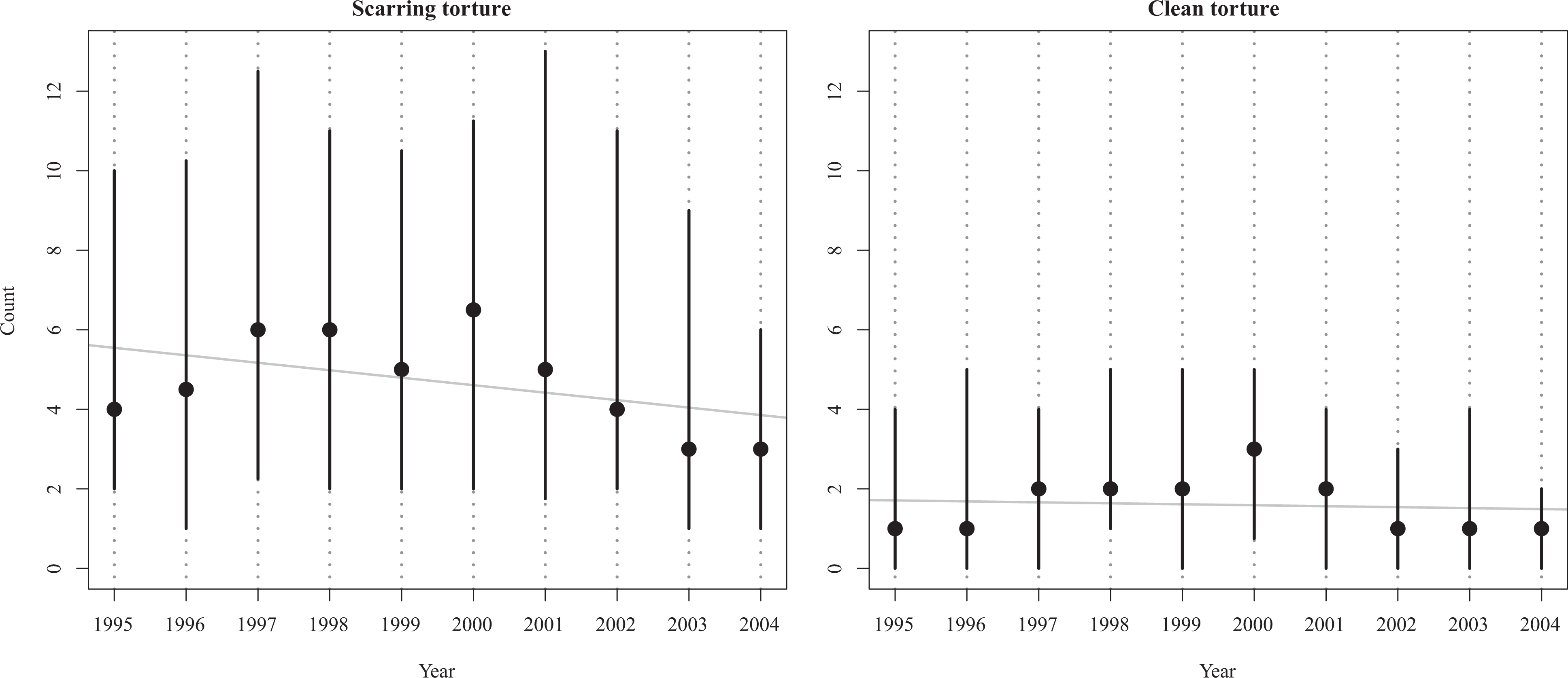
Figure 1 also indicates that, globally, scarring is a more common practice than clean torture. That scarring torture seems to be more common than clean is consistent with our argument that state agents will use scarring torture by default. However, this also likely reflects the fact that clean torture is more difficult to detect than scarring torture; indicators of clean torture likely suffer more from an undercount bias. Importantly, the information problem that AI faces means that some cases of torture will go unreported and that indicators of both practices are biased downwards.
Modeling allegations: An undercount negative binomial
To address the undercount problem that affects allegations of scarring and clean torture, we employ a version of the detection controlled mixture model developed by Feinstein (1989, 1990): an undercount negative binomial regression (Cameron & Trivedi, 1998: Ch. 10). Detection controlled models allow scholars to model the kind of measurement error that impacts human rights data (e.g. Bollen, 1986; Spirer, 1990; Goodman & Jinks, 2003), including the ITT data: measurement error associated with the (in)ability of groups like AI to detect torture perfectly. Sometimes torture occurs and does not lead to allegations, resulting in an undercount of cases of torture (Conrad, Haglund & Moore, 2014). Failure to account for this systematic undercounting process will produce biased estimates of the effects of covariates upon the number of cases of torture, and will also lead to an underestimate of the number of cases of torture (Feinstein, 1990: 247–248).
A detection controlled model allows one to model this type of measurement error by allowing the probability of observing and recording a torture event to vary, as a function of covariates, across observations. This is accomplished by specifying a count model for the total number of events, and a binary response detection model which models the probability of observing an event if one occurs.
11
The observed outcome (number of observed events) is then a proportion of the true number of events. If the total number of instances of torture follows a negative binomial process, the expected count can be expressed as
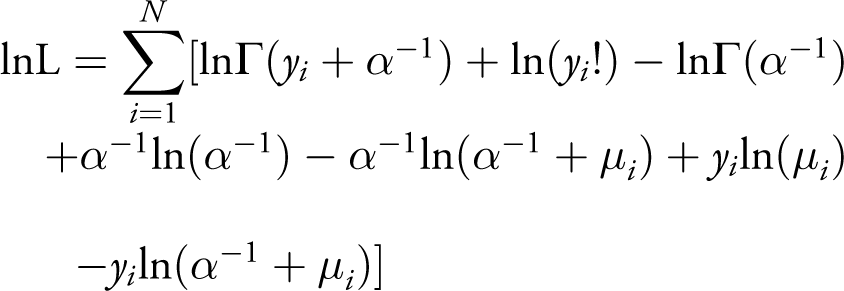
Parameters for this model are identified if the covariates in X are not identical to those in Z. We estimate parameters via maximum-likelihood estimation in R (R Development Core Team, 2015) and include more detail about the model in our Online supplemental appendix.
Operationalization of independent variables
To test our hypotheses about the impact of political institutions upon states’ use of scarring and clean torture using the aforementioned framework, we require measures of both contested elections and judicial power. To measure elections, we use a dichotomous measure from Cheibub, Gandhi & Vreeland (2010). In order for a country to be coded as having contested elections, (1) the executive and the legislature must be selected through popular election, (2) there must be ex ante uncertainty about who will win, (3) the winner must take office following the election, and (4) elections must occur at regular intervals. All countries that do not meet these criteria are coded as not having competitive elections in our data.
We understand judicial power to have three components: (1) whether judges are permitted to rule without interference (Staton & Moore, 2011), (2) whether judges rulings are translated into policy, and (3) whether the domestic population believes the court is powerful and is thus inclined to use it (Powell & Staton, 2009). A number of indicators for one or more of these dimensions have been proposed, but none of them capture all three dimensions. Linzer & Staton (2012) use a dynamic Bayesian ordinal item response theory (IRT) model to develop a measure of judicial power from eight existing indicators. The IRT model produces a continuous measure that ranges from 0 to 1, for which higher values represent greater levels of domestic judicial power. This measure is accompanied by an estimate of uncertainty that we account for in the analysis below by drawing ten values from the posterior density for each observation, estimating our models ten times, and pooling the estimates using the same formula one would use for multiply imputed datasets.
To guard against spurious inferences we include several additional measures in our main models. First, torture techniques are often used in conjunction with one another. In the ITT SA data, an individual event can include allegations of up to three types of torture: scarring, clean, and unstated. We include count measures of unstated torture in our models of scarring and clean torture; we also include a covariate for clean torture in our empirical model of scarring torture, and vice versa. Second, torture is more common when states face dissent (Davenport, Moore & Armstrong, 2007), and torture spells rarely end when dissidents engage in at least one act of violence per year (Conrad & Moore, 2010b). There is also much work that argues for a systematic relationship between competitive elections and dissent (e.g. Gurr, 1970). We control for violent dissident–state interactions in our outcome equations using the Correlates of War (COW) binary measure of civil war, coded positive when at least 1,000 deaths occur (Sarkees, 2000). 12 Finally, we account for (logged) country wealth and population using data from the World Development Indicators (WDI).
To draw inferences about the conditions under which states turn to clean torture using ITT data on allegations, we must also specify a ‘detection equation’ that permits us to model the measurement error (undercount) in each observation in our dataset. Hill, Moore & Mukherjee (2013) examine the extent to which AI allegations of torture, measured using the CIRI data, are biased. To motivate our specification of the detection equation we adopt their argument on organizational incentives and quality of information. We focus on the quality of information available to AI, as we are making an argument and trying to draw inferences, about what affects AI’s ability to learn about torture and issue an allegation.
First, the extent to which AI is able to generate allegations of human rights violations is dependent on its ability to work within a given country. Although AI maintains local offices in many countries, some governments prevent NGOs from operating within their borders. In these cases, it is more difficult for AI to have access to victims, as well as local advocates, and thus more difficult for them to make allegations – even when violations occur. To account for the fact that INGO access is positively associated with the production of allegations, we include a count of the number of human rights-focused INGOs with an office in that country from Murdie & Bhasin (2011). We use the natural log of this count.
Second, governments that censor citizens and media outlets greatly inhibit AI’s ability to produce allegations of human rights abuses, including torture. As a proxy for the amount of public information available to AI we include the CIRI measure of freedom of speech and press, which represents ‘the extent to which freedoms of speech and press are affected by government censorship, including ownership of media outlets’ (Cingranelli & Richards, 2010a: 27). It is an ordinal, trichotomous indicator that ranges from 0 to 2 with higher values representing greater government respect for this right.
Third, Hill, Moore & Mukherjee (2013) also argue that INGOs like AI develop beliefs about a state’s respect for human rights; those beliefs influence the likelihood that AI issues an allegation. The lagged value of the Latent Human Rights Protection Score (version 1; Schnakenberg & Fariss, 2014), which is partly based upon AI’s Annual Reports, is not only a useful measure of AI’s beliefs about the state’s respect for rights; it also helps us model any bureaucratic inertia in the reporting and serves as a proxy measure for the size and strength of the grass roots network in each country that AI taps to obtain information. This index is created using an IRT model like that of Linzer & Staton’s (2012). It is continuous, with a range from roughtly –4 to 4; higher values represent greater respect for rights. The greater the country’s respect in the past, the less vigilant and less likely AI will be to detect violations that occur. We account for the uncertainty in this measure in the same way we do for the Linzer & Staton (2012) measure.
Finally, we include in the detection equation (logged) GDP per capita as an indicator of a country’s average level of wealth. Higher average income is correlated with the existence of infrastructure that eases transportation as well as communication. Both of these make it easier for organizations like AI to collect and disseminate information about abuse. The sample used for estimation consists of 906 observations for 112 countries.
Results and discussion
We begin with the results for the equation that models AI’s ability to detect violations in each country-year. Predicted detection probabilities for clean and scarring torture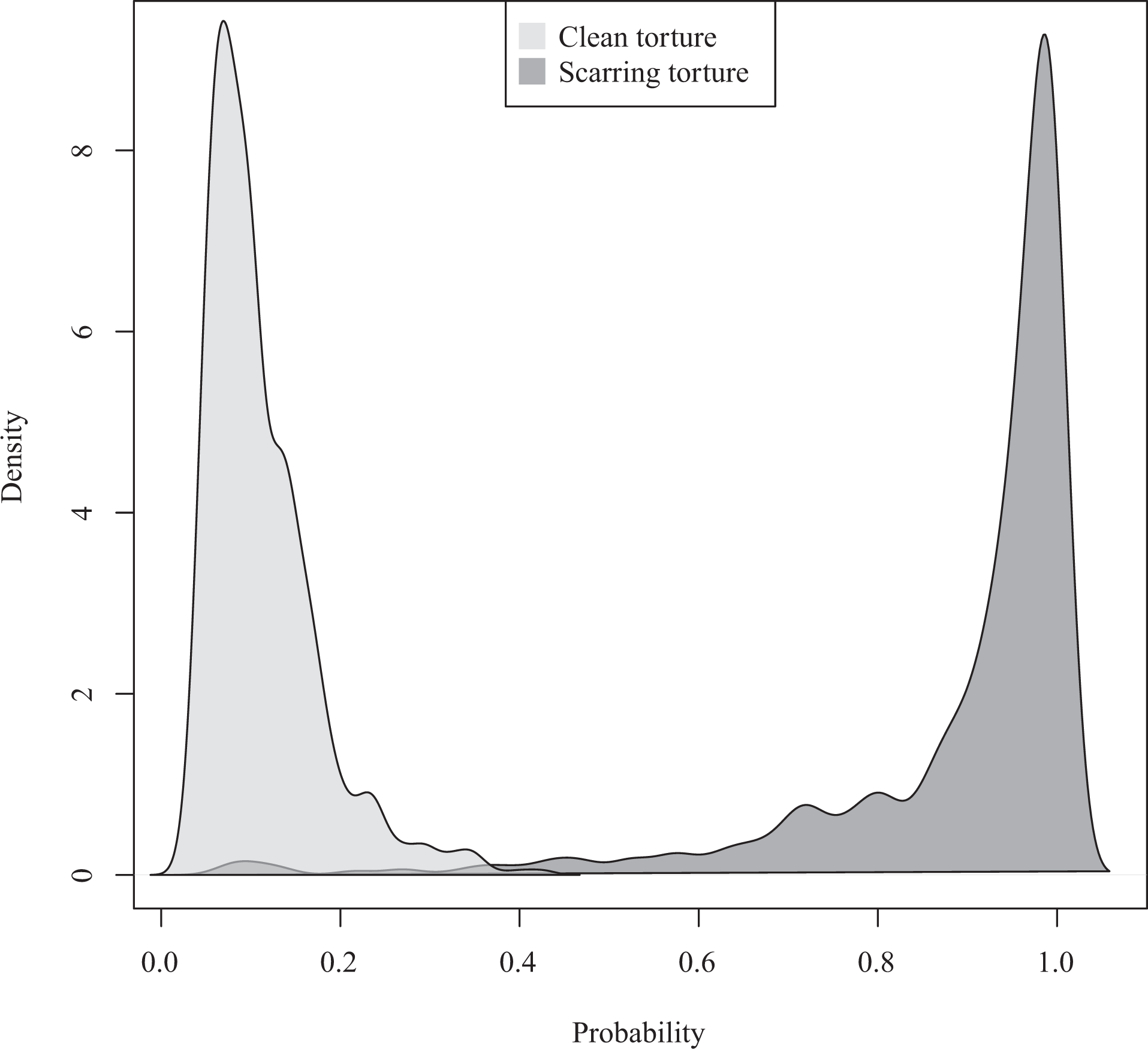
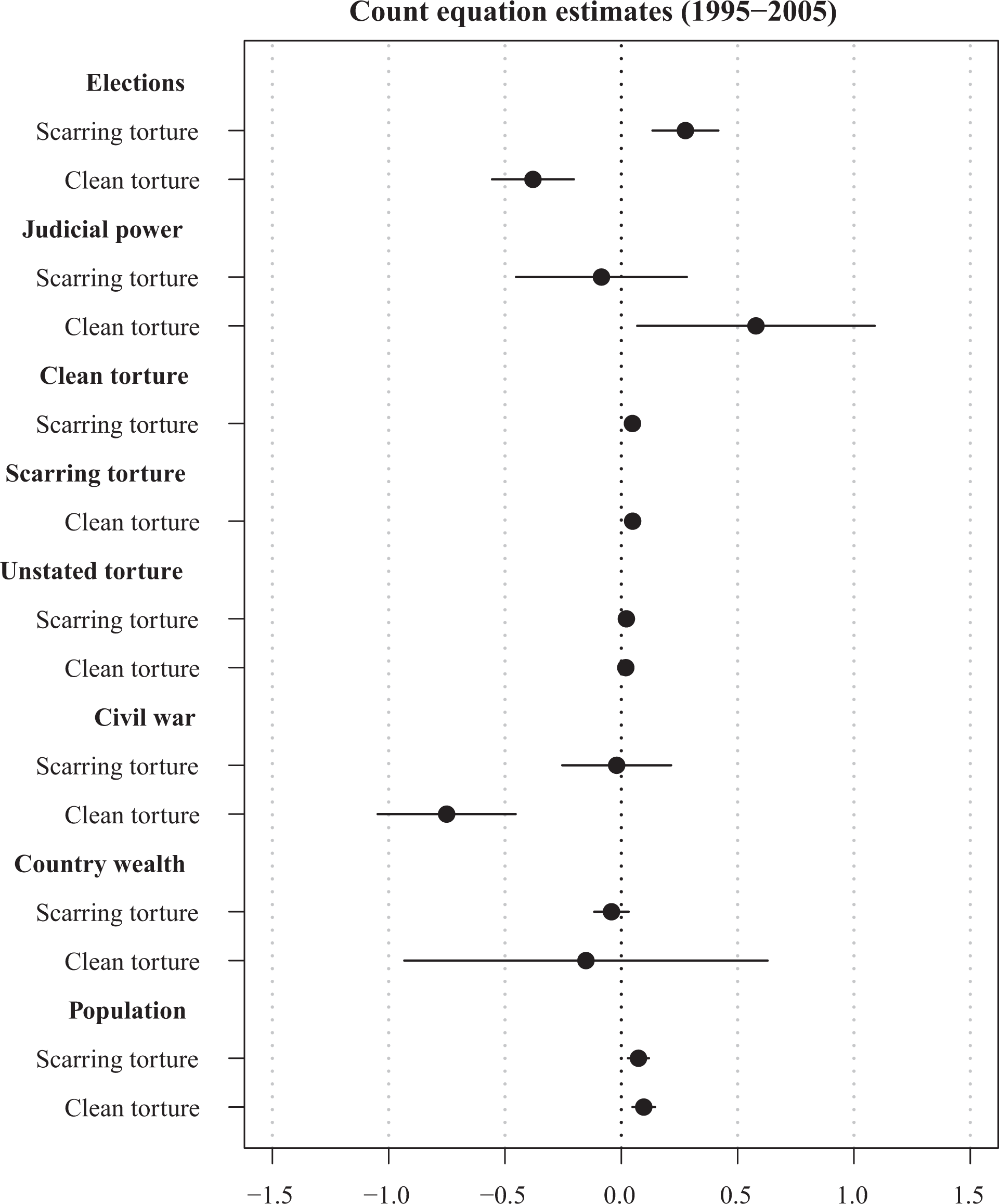
Coefficient estimates from negative binomial equation
We argue that the effect of domestic institutions on torture techniques depends on the extent to which they protect the individual. We hypothesized that electoral contestation does not pressure leaders to substitute clean torture for scarring torture, and ceteris paribus, is associated with higher levels of scarring torture. Because powerful domestic courts are intended to protect the minority, we hypothesized that the presence of such institutions would be positively associated with clean techniques. Figure 3 reports coefficient estimates from undercount negative binomial models where the dependent variable in the count equations is scarring torture and clean torture. 14 Table I reports incidence rate ratios (IRRs).
Incident rate ratios
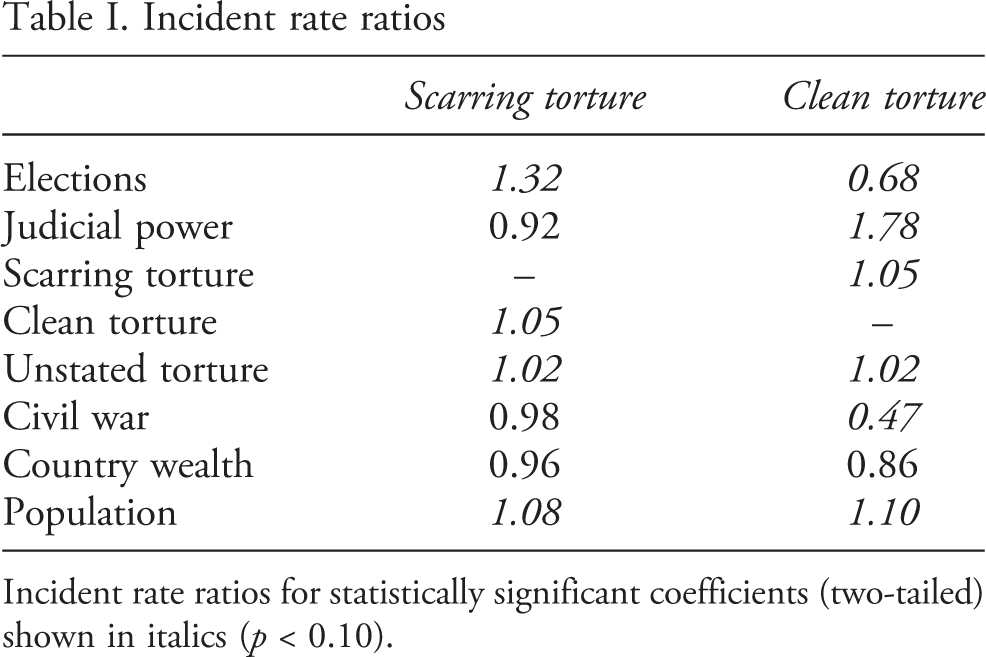
Incident rate ratios for statistically significant coefficients (two-tailed) shown in italics (p < 0.10).
We also find support for our second hypothesis : greater judicial power encourages states to use less visible techniques. Judicial power is unrelated to levels of scarring torture, but positively impacts its level of clean torture (Hypothesis 2), increasing the expected count of clean violations by 78% (i.e. an IRR of 1.78). These results are consistent with a broad set of findings that domestic courts constrain human rights violations more generally (e.g. Powell & Staton, 2009; Keith, Tate & Poe, 2009). We hasten to add, however, that these results do not necessarily paint a positive picture for the effect of courts on human rights practices. Courts may decrease state repression writ large, but they also appear to encourage executives and their agents to be more clever in hiding human rights violations that can be narrowly targeted by turning to clean torture when they do occur.
Regarding the control variables, unstated torture is positively associated with both scarring and clean, and scarring and clean techniques are positively associated with one another. This is likely because (1) unstated torture may include scarring, clean, or some combination of the two techniques, and (2) states often torture using multiple tactics. That scarring and clean are positively related with one another suggests that these techniques may be complements rather than substitutes. Civil war does not impact scarring torture, although it is associated with less clean torture. Country wealth is not associated with either clean or scarring torture; population is positively associated with both techniques.
Conclusion
Democratic institutions reduce the costs of monitoring government agents and can incentivize actors to make allegations of rights violations (Donnelly, 2003; Davenport, 2007b; Davenport, Moore & Armstrong, 2007; Conrad & Moore, 2010b). Yet previous work has failed to note that greater political participation creates more crime and dissent (Powell, 1982; LaFree & Tseloni, 2006; Chenoweth, 2010), which produces more interactions between agents of coercion and people who are unlikely to be members of a winning coalition under electoral contestation. We distinguish between plurality and non-majoritarian institutions, noting that elections only constrain state abuse of people who are members of the selectorate. Because individuals who are tortured are generally drawn from the weakly enfranchised, their rights are unlikely to be protected by the electoral process. Donnelly (2003: 191–192) writes: Only if a sovereign people wills respect for human rights, and thus constrains its own interests and actions, will democracy contribute to realizing human rights. In practice, however, the will of the people, no matter how it is ascertained, often diverges from the rights of individual citizens. Electoral democracies often serve the particular interests of key constituents.
Our results suggest that politicians care more about their constituents than they do about their international reputations; this finding is consistent with previous research that has found the effects of international constraints on human rights violations to be very small and often contingent on domestic institutional structures. We expect that most political scientists, who appear to reflexively think of democratic institutions as producing positive outputs, would not anticipate the argument and findings that electoral contestation is positively associated with scarring torture. Our study brings that argument and finding to light and explains why powerful courts are the liberal democratic institution responsible for the shift to clean torture documented by Ron (1997) and Rejali (2007). As such, this article provides initial evidence that powerful courts may be the key mechanism behind the empirical finding known as the ‘domestic democratic peace’ (Davenport, 2007b). Although contested elections are associated with improved respect for human rights, elections are unlikely to protect the rights of individuals outside the leader’s winning coalition. In order to protect the rights of such minorities in democracies, domestic judicial systems may help – both by providing leaders with incentives to avoid public violations of human rights and by encouraging repressive agents to ‘shirk’ when they are given orders to torture.
Footnotes
Replication data

Acknowledgements
Previous versions of this article were presented at the 2013 Columbia University Human Rights Seminar, the 2013 Annual Meeting of the International Studies Association, the 2012 International Politics of Autocracies Workshop at Rice University, the 2012 Visions in Methodology Workshop at Pennsylvania State University, Arizona State University, the University of Denver, Georgia State University, Texas A&M University, Washington University, and a brown-bag session at the Peace Research Institute, Oslo (PRIO). We are grateful to Ryan Bakker, Helga Malmin Binningsbø, Ryan Carlin, Erica Chenoweth, Eric Coleman, Claude d’Estree, Larissa Fast, Hanne Fjelde, Helge Holtermann, Jesse Johnson, Oliver Kaplan, Ashley Leeds, Michaela Mattes, Sara McLaughlin Mitchell, Nate Monroe, Cliff Morgan, Douglas Morris, Ragnhild Nordås, Jonas Nordkvelle, Håvard Mokleiv Nygard, Gudrun Østby, Erlend Paasche, Darius Rejali, Mark Souva, Julia Strasheim, Rachel Wahl, Jessica Weeks, and Gerdis Wischnath for helpful comments and suggestions. Will Moore passed away shortly after this article was accepted for publication. He was an incredible mentor and friend; we will miss him immensely.
Notes
References
Supplementary Material
Please find the following supplemental material available below.
For Open Access articles published under a Creative Commons License, all supplemental material carries the same license as the article it is associated with.
For non-Open Access articles published, all supplemental material carries a non-exclusive license, and permission requests for re-use of supplemental material or any part of supplemental material shall be sent directly to the copyright owner as specified in the copyright notice associated with the article.
