




Abstract
How does aid in the form of training influence foreign militaries’ relationship to domestic politics? The United States has trained tens of thousands of officers in foreign militaries with the goals of increasing its security and instilling respect for human rights, democracy, and civilian control. We argue that training increases the military’s power relative to the regime in a way that other forms of military assistance do not. While other forms of military assistance are somewhat fungible, allowing the regime to shift resources towards coup-proofing, human capital is a resource vested solely in the military. Training thus alters the balance of power between the military and the regime resulting in greater coup propensity. Using data from 189 countries from 1970 to 2009 we show that greater numbers of military officers trained by the US International Military Education and Training (IMET) and Countering Terrorism Fellowship (CTFP) programs increases the probability of a military coup.
Introduction
Some unpleasant alumni stand out among the many recipients of United States foreign military training. During the Cold War, its School of the Americas gained a reputation for graduating a number of prominent human rights abusers and strongmen in Latin America (Grimmett & Sullivan, 2001). Although it is now renamed the Western Hemisphere Institute for Security Cooperation, the leaders of the 2009 Honduran coup received training there through the International Military Education and Training (IMET) program. More recently, the IMET-trained officer Amadou Sanogo led a March 2012 coup in Mali. The United States is not the only state to produce such students; Moussau Dadis Camara, the leader of a 2008 coup in Guinea, trained in Germany. The little existing research credits US foreign military training (FMT) with sending more professional and liberal soldiers back to their home countries. Are the above examples outliers?
The stakes for determining the effect of aid in the form of FMT have risen as the United States and other countries shift resources into what is variously called ‘security assistance’, ‘partner capacity-building’, and ‘phase zero operations’ as a means of increased donor influence and increased recipient political stability and development. Given the increasing attention to the provision of security and armed services reform as essential components of development and democratization (Collier, 2008), FMT merits consideration in the larger debate over the political consequences of foreign aid. 1
We argue that FMT’s effects differ from other forms of military (and civilian) assistance. While aid in the form of hardware transfers or financing can strengthen the military, it also frees up resources for leaders to coup-proof. Aid as training does not provide regimes such flexibility because it augments the military’s human capital, which civilian leaders have difficulty offsetting by devoting additional assets to stymie coups. Empirically, we find that any US FMT corresponds to a doubling of the probability of a military-backed coup attempt in the recipient country.
Internal and external influences on coups
We examine military-backed coups, an illegal attempt to replace a state’s governmental leadership through its military’s use or threat of violence (Huntington, 2006: 218). While the odds of a coup in any particular state in any particular year are quite low, coups have historically been the most common form of irregular regime change (Singh, 2014: 3).
In general, military coups usually involve very few participants and low levels of violence (Luttwak, 1969). States with weak institutions and conflictual civil-military relations experience more coups (Talmadge, 2015: 2), but vary widely in other characteristics. Some are initiated by quite junior officers (Kandeh, 2004), while others are conducted by the most senior generals. Some coups may result from building too strong a military, while others emerge from not giving it enough resources (Svolik, 2012). Coups may result from the military as a corporate body overthrowing the government (Huntington, 2006), but can also emerge from competition by factions within the military (Singh, 2014).
Coups are difficult to plan and have a high failure rate. Even successful coups often resemble chaotic improvisations rather than well-oiled conspiracies, victory going to the side that ‘simply made the fewest blunders’ (Farcau, 1994: 145). In the types of states where coups predominate, the level of professionalism of the military and other institutions is likely to be low, while the prestige and kleptocratic gains from success are likely to be quite high. A little bit of relative improvement in competence by potential coup plotters in such states may go a long way towards making the potential rewards high enough to risk a coup.
To say something systematic across these diverse cases, we start with a simple argument: coup probability increases with the military’s willingness to overthrow the government (‘motives’), as well as its ability (‘opportunities’) to do so (Belkin & Schofer, 2003: 597).
In terms of opportunities, factors that make a coup’s success more likely, and thus an attempt more attractive, include tactical proficiency at small unit operations, the ability to communicate securely, trust that one’s fellow plotters will not betray you, and the ability to convince those on the sidelines to acquiesce (Luttwak, 1969; Nordlinger, 1977; Farcau, 1994; Singh, 2014). Geddes (1999: 125–129) and Singh (2014: 21–38) in particular describe the importance of plotters’ success at a coordination game (sometimes called the ‘battle of the sexes’) where a small core of first movers quickly wins acceptance by the much larger group of uniformed fence-sitters in the name of corporate unity and bloodshed avoidance.
In terms of motives, Nordlinger (1977: 78) finds that ‘the great majority of coups are partly, primarily, or entirely motivated by the defense or enactment of the military’s corporate interests’ (see also Pion-Berlin, 1992). Incumbent leaders hoping to maintain power grant ‘autonomy to the military in matters of lesser import in exchange for military acceptance of the ethic of subordination’ (Feaver, 1999: 228), what Huntington (2006: 218) famously called ‘objective control’. Unmet corporate interests that can drive a coup include ‘concern with the maintenance of hierarchy, discipline, and cohesiveness within the military; autonomy from civilian intervention; and budgets sufficient to attract high-quality recruits and buy state-of-the-art weapons’ (Geddes, 1999: 126). Coups from the lower ranks are often responses to corruption among both the civilian and military leadership (Kandeh, 2004; Dwyer, 2015).
Buying military support through providing resources and autonomy entails risk (Brooks, 1998; Powell, 2012; Svolik, 2012) since it strengthens the institution that poses the threat. Alternatively, government leaders have a range of ‘coup-proofing’ options to protect themselves from their military, such as exploiting family, ethnic, and religious loyalties for key positions in the military; creating an armed force parallel to the regular military; and developing multiple, overlapping internal security agencies to monitor one another (Quinliven, 1999: 133; see also Belkin & Schofer, 2003; Pilster & Böhmelt, 2011, 2012). Doing so is costly for the regime, and thus it faces a balancing act of expense and coup risk.
Finally, military coup motives and relative ability are likely to be higher in less developed states. States with widespread corruption offer a tempting source of rents as well as of grievances for those further from power. Civilian government legitimacy is likely to be weaker (Holsti, 1996: 102). Pion-Berlin (1992: 83) describes the ‘professionally underdeveloped military whose borders are permeable’ as ‘prey to destructive social or political influences’.
External influences
A smaller body of literature explores international influences on coups. Foreign threats influence coup likelihood, often in counterintuitive ways (Piplani & Talmadge, 2016; MacMahon & Slantchev, 2015). Marinov & Goemans (2014) have shown that the willingness of powerful states to tie foreign aid to democracy in the post-Cold War era has reduced the number of coups and increased the probability that coup leaders will reinstate elections soon afterwards. Thyne (2010) suggests that a signal of US hostility toward a government can encourage the military to intervene to preserve its relationship with the United States.
Direct engagement with foreign militaries through arms transfers may be positively associated with coup probability (Maniruzzaman, 1992). On the other hand, undifferentiated (i.e. non-military) foreign aid can also free up resources to allow regime preservation by expanding government, consolidating powerful groups, or repressing the population (Remmer, 2004; Wright, 2008; Licht, 2010).
(US) Foreign military training and civil-military relations
Research to date has focused on US FMT due to its massive extent and relative transparency. In Fiscal Year 2015, approximately 76,400 students from 154 countries participated, costing $876.5 million. The United States provided about $300 million of this training as aid. 2
Liberal norm transmission is weak and can work both ways
This research has focused on motives rather than ability, emphasizing FMT’s benign influence on militaries’ coup willingness. Ruby & Gibler (2010) argue that foreign trainees learn norms of civilian control in class and absorb them more generally by living in the United States, leading to fewer coups at home. Atkinson (2006, 2010) finds that US FMT, broadly construed, increases the probability that a military will refuse to suppress a liberalizing popular movement. Congressional testimony in 1999 lauds how FMT programs ‘impart American values to the recipients in foreign militaries, both directly and indirectly. […] [the] recent radical decrease in defense budgets would have resulted in coups which today never materialized, in part because of the learned respect for civilian control of the military’ (Pomper, 2000).
We argue that the effect of norms is likely to be weak relative to other influences. Moreover, these norms are as likely to increase as decrease the motivation for coups. We make this case by first noting the tension built within the stated goals of promoting both human rights and civilian supremacy. Successful ‘liberal’ norm transmission may actually exacerbate the disconnect between returning students and an authoritarian government. One internal study by the National Defense University cited a significant decrease in students’ perception of human rights in their home country (Jungdahl & Lambert, 2012).
Even where these norms do not conflict, previous research requires a very strong model of normative transformation whereby relatively brief exposure to US instruction overcomes existing and subsequent norms, institutions, and incentives in officers’ home countries. Many officers, from Pakistan’s Mohammad Zia-ul-Haq to Egypt’s Abdel-Fattah el-Sissi, have appreciated their time in the United States without internalizing its values. More broadly, a small but novel survey of individual US FMT recipients finds little evidence of norms transmission (Taylor, 2014: 13, 173–194).
The norm most likely to be transmitted is the one to which military officers are already receptive: a professional identity independent from their officers’ own government. The US military’s distinct professional culture is largely based on Huntington’s notion of ‘objective civilian control’ (Huntington, 1957). This ideal precludes interference by the military in politics, while generating a strong, separate corporate identity. But Huntington himself recognized that, in anything other than a consolidated democracy, the more professional the military considers itself, the higher the temptation to intervene (Huntington, 2006; Stepan, 1986; Barany, 2012). Casework finds that exporting the US model can lead to civil-military instability (Schiff, 2008; Bachmann, 2014). A National Defense University professor, discussing a coup attempt by one of his students, lays out the problem clearly, ‘We teach them our approach to a “profession of arms” and professional ethics, and we teach them our approach to how they can create a successful, secure, and prosperous society back home. But what happens when there are profound contradictions between the ideal they are taught in their PME education and the reality they see back home?’ (Meiser, 2015).
One final reason for skepticism about norms transmission exists: the United States does not assign it a high priority. According to the US State Department, the many different forms of FMT share the same primary goal: ‘regional stability through effective, mutually beneficial military-to-military relations which culminate in increased understanding and defense cooperation between the US and foreign countries’. 3 Again, evidence exists that FMT recipients get exposure to liberal norms (Jungdahl & Lambert, 2012); we simply argue that other, more powerful assets are transferred alongside.
Aid in the form of human capital
US FMT is foreign aid – resources provided to a state by an outside actor – in a very specific form: an increase in the military’s human capital. We use ‘human capital’ to describe a range of social, instructional, and economic assets. The benefits consist in part of professional knowledge, ranging from small unit tactics to grand strategy, enabling recipients to conduct military operations more effectively. FMT can also impart a more ineffable form of ‘social capital’ (Bourdieu, 1986; Coleman, 1988), establishing a powerful network of prestige, trust, and reciprocal relations that allow privileged actors to achieve higher status positions.
Relative to other foreign assistance, externally provided military human capital is less fungible. It does not free up indigenous resources to shift towards counterbalancing a more empowered military. We therefore expect that FMT will result in more military coups.
(US) military training as human capital
While not using the term ‘human capital’, Singh (2014: 9) emphasizes ‘soft power’ in coups, finding that they succeed not because of ‘the differences in hard military power among the parties but the resources available for setting and coordinating expectations and making facts’. FMT can shift the balance of human capital, increasing the ability to conduct a coup for small groups of soldiers relative to the rest of the military, as well as for the larger military relative to the government.
Increasing human capital has three effects. US FMT, if it does what it claims, improves the relative competence of trainees within the military and consequently the larger military within the government. This competence may also reduce the likelihood of punishment for bad behavior by both the regime and (perhaps more importantly) the United States. Finally, FMT imparts the type of ‘soft power’ aspiring leaders can use to solve the difficult coup coordination game.
The US training infrastructure is vast, experienced, and combat-focused. Its $2.7 billion ‘Basic Skill and Advanced Training’ budget in 2015 ($222 million for ‘Professional Development Education’) is larger than the entire military budgets of 117 countries (Department of Defense, 2014; SIPRI). The US military has acquired a great deal of experience and interest in counterinsurgency and stabilization operations over the past decade. Finally, the United States has been training foreign militaries in earnest for well over half a century.
The IMET training received by Mali’s Sanogo was basic, tactical, but thorough: English in Texas, intelligence in Arizona, work with the marines in Virginia, and finally army infantry officer basic training in Georgia (Cavendish, 2012; Nossiter, 2012). While increased combat proficiency will help if a pitched battle results during a coup, many of these skills (often lacking in developing states’ militaries) – efficient communications, discipline in weapons handling, the ability to operate in a decentralized command structure, and even esprit-de-corps – are equally helpful in bloodless operations (Singh, 2014).
More senior officers at the war colleges are supposed to be prepared ‘for positions of strategic leadership and advisement’, with a focus on ‘national security strategy, theater strategy and campaigning, civil-military relations, joint planning processes and systems, and joint interagency, intergovernmental, and multinational capabilities and integration’ (Chairman, Joint Chiefs of Staff, 2015: A-A-5). If these institutions are at all effective, trainees return home possessing higher levels of professional ability and an increased degree of prestige. Lieutenant Colonel Lamin Sanneh received an MA in Strategic Security Studies, and was then ‘unexpectedly’ chosen to lead the personal security force of Gambia dictator Yahya Jammeh. Later purged from the army, Sanneh fled to the United States, where he helped assemble a small group from the Gambian diaspora for an unsuccessful coup attempt. His six-page ‘Military Strategy for Operation Gambian Freedom’ is replete with the unique language of Pentagon operational doctrine: ‘ends, ways, means’; ‘critical vulnerabilities’; and ‘centers of gravity’. 4
Talmadge (2015) finds training that improves military skills can be used against regimes. Militaries with more US-trained personnel are therefore likely to be more competent (and ambitious). More importantly, FMT can improve the capabilities of groups of soldiers relative to the rest of an unprofessional military. Alumni at all levels of training, in turn, are expected to train others upon returning home, increasing the competence of the military more broadly (as well as creating a social network of like-minded trainees). Mali’s Sanogo apparently leveraged his position as English instructor – ‘he became well known to, and liked by, rank-and-file troops’ – to assume leadership of a band of mutinying soldiers and seize power (Whitehouse, 2012: 94).
FMT makes soldiers harder to punish. Regimes do not want to alienate a valuable and, in the short to medium term, irreplaceable resource. After five weeks’ incarceration and an apology ceremony following their failed 1981 coup attempt in Thailand, the 52 members of the ‘Young Turks’ (led by US-trained officers) gained clemency and rejoined the army (Samutwanit, 1982: 64).
FMT ties trainees into an international network with US officers, making them valuable for executing US interests. Now well-versed in US doctrine and operations, trainees facilitate interoperability for joint missions with US forces. The increased value of the soldiers to the United States in terms of capability, willingness to cooperate, and personal connections and trust, which is after all FMT’s primary goal, may limit US willingness to punish militaries that intervene in politics (Thyne, 2010). For example, the strong US ties of the Egyptian military apparently factored into US support for Hosni Mubarrak’s overthrow (Nepstad, 2013: 343). More broadly, foreign-trained soldiers can leverage their familiarity with external institutions. Saine (2008: 469) blames the 1994 coup in Gambia on ‘the emergence of a junior officer class’, which ‘disingenuously appropriated the language of the IMF and World Bank to promise Gambians “real democracy,” “human rights,” “probity,” “accountability,” and “transparency” in government’.
Relatedly, FMT creates a sense of professional identity and new social ties (Brooks, 2013). The increased prestige associated with training facilitates organization of coups by providing soldiers with greater influence over their peers. When two officers jockeyed for power in a 2014 military coup in Burkina Faso, Isaac Zida – the less senior, US-trained officer – received the backing of the rest of the military and other elites (Bonkougou & Coulibaly, 2014). Mali’s Sanogo proudly wore the insignia of the US Marine Corps. In his analysis of the coup, Whitehouse (2012: 103) argues that ‘This pin, a symbol of his training in the United States, sets him apart from other soldiers. As a rare object in the Malian context and as a signifier of secret knowledge, it conveys not only that the wearer has undergone special preparation, but also […] that he has access to distinctive outside sources of power […] As such, it distinguishes him from other army officers.’ Whitehouse continues, ‘The time he spent in the United States, and the knowledge he acquired there, including the ability to speak English, confer upon him the status of a worldly, educated man who is prepared to face the challenges of his destiny and to master the dangerous forces unleashed by a coup d’état.’
Coups are generally carried out by small groups (Singh, 2014), and FMT can help create a small network of reliable plotters that can work together without fear of a defector (Nordlinger, 1977: 99). The 1994 coup in Gambia was instigated by a mere four junior officers, three of whom had attended officer training in the United States from 1990 to 1991 (Hughes & Perfect, 2008). The 2008 seizure in Guinea was known as the ‘the German coup’ because the small number of low-level, Bundeswehr-trained officers communicated in this common language (Heidelberger, 2010).
Comparison to other forms of aid
We expect to see a stronger relationship between FMT and coups compared to other forms of aid, military and otherwise. Given the importance of quickly seizing high profile points such as the presidential palace and radio station (Singh, 2014), aircraft and armor are rarely employed in large numbers for these operations, and even small arms seldom are the limiting factor. Saddam Hussein, for example, was willing to accept a great number of high-end weapons in the war against Iran, but refused to send soldiers abroad to get the necessary training for fear of their becoming a threat back home (Cordesman & Wagner, 1990: 44).
Other types of foreign aid allow leaders to divert state resources towards coup-proofing: buying off elites, creating additional paramilitary groups, or providing additional public goods. Because of the US training advantages mentioned above, the human capital provided is large relative to its dollar value, and thus any resources freed up for coup-proofing are likely to be minuscule. Before Mali’s coup, FMT amounted to less than 0.5% of total US aid (Boswell, 2012). One might argue that the improved labor component of a US-trained military would allow a government to shift money by reducing its military capital investment without sacrificing security against external threats. However, the newly trained leaders of the military are likely to resist a budget reduction. Indeed, if US FMT increases the ability to conduct a coup, governments will have to spend more of their own budget buying loyalty or coup-proofing.
Why risk training one’s military?
If governments approve the training of their soldiers by outside actors, and such training endangers regime security, why allow it? Given our mechanism, especially coup-prone states should refuse FMT, biasing recipients to countries where coups are less likely. We suggest possible information asymmetries to explain regimes selecting into higher coup risks. MacMahon & Slantchev (2015) show how governments overly concerned with external threats (due to the military’s private information), increase their militaries’ capabilities in response. Alternatively, it is quite possible that the regime knows that FMT increases coup feasibility, but is uncertain by how much (i.e. the revised utility calculation of trainees is private). A regime may consent to the training and increase its bribery of the military accordingly, but also accept some risk that the FMT has made the military coup-prone.
Finally, almost all IMET-eligible countries participate, suggesting that some benefits exist for most regimes. A trained military can be an asset to the incumbent regime for defense against external threats, a tool for repression, closer ties to the United States, etc. Coupled with the rarity of coups in any given year, accepting the benefits of aid appears to outweigh any (increased) risk of losing power.
Hypotheses
We test the following hypotheses:
H1: More training will increase a country’s military-backed coup probability.
While we focus on coup attempts, we do test the role of training on coup success:
H2: More training will increase a country’s successful military-backed coup probability.
We test a third hypothesis comparing FMT, as a less fungible resource, to other sources of aid:
H3: Other forms of aid will not increase a country’s military-backed coup probability.
Non-military advocates for regime change may recognize that a normatively transformed military is unlikely to side with the autocrat if wide-scale violence is required to maintain power. Thus, civilians’ gamble to overthrow a regime may become less costly. Whereas our military human capital makes no predictions about non-military coup attempts, norms-based arguments would suggest otherwise:
H4: More training will increase a country’s non-military-backed coup probability.
Potential endogeneity
We assess reverse causation as implausible. It is unlikely that a high value for our dependent variable, the probability of a military backed coup, results in increased IMET student intake. The US military has historically used FMT ties to advocate military non-intervention in politics. Especially since the Cold War, the United States has rarely found coups to be in its interest. Receiving intelligence of an impending coup in Gambia, the United States took steps in 2014 to allow Senegal to intercept the transiting plotters, despite Gambia’s leader being one of the most erratic and repressive despots on the continent (Reid, 2016). The United States is legally required to cut off IMET when militaries overthrow democratically elected governments, and often suspends programs, as for Guinea in 2008, where coups replace autocrats. Importantly, years since last coup is negatively correlated with coups and positively correlated with FMT meaning that countries that have not recently experienced a coup receive more training (see Figure 1).
Perhaps FMT selects coup-prone individuals. Students are chosen based on ‘leadership potential and likelihood of being assigned, subsequent to IMET participation, to a job relevant to their training for a period of time to warrant the training expense’ (DISAM, 2013). The cross-national nature of IMET and our analysis mitigates this problem. IMET does not train the best soldiers in the world, but trains a few of the (ostensibly) best soldiers from each country. A military with more talented (and conceivably more coup-prone) officers does not get more IMET spots. The number of
Correlation matrix of main explanatory, confounding, and dependent variables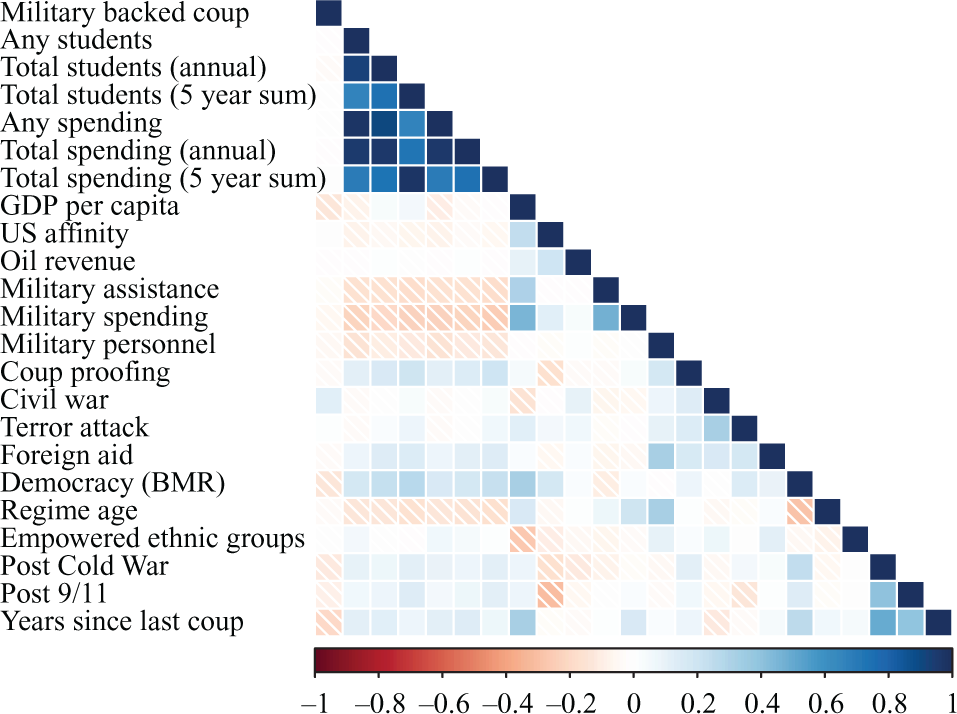
Confounding variables simultaneously affect levels of US FMT and coup propensity. The most obvious factor is wealth. States with poor economies are more likely to have coups and receive foreign aid, including IMET. A related confounding variable is US policy of encouraging new democracies with increased aid. However, democratizing regimes are also quite prone to military coups (Svolik, 2015). We argue that, at least for IMET, the factors the United States uses to determine the level of assistance are relatively finite, knowable, transparent, and measurable. This makes possible steps to avoid spurious correlations, which we discuss below.
Description of the data
Our cautious approach begins with our explanatory variable. While many different US training programs exist, we focus primarily on IMET. First, it is the most transparent, and receives the largest amount of scrutiny. Human rights and civil-military relations are explicitly part of the curriculum, unlike other forms of US training. IMET trainees are therefore the population where we are most likely to see the effect of norms (i.e. the easy case). If we discover more coups in countries with a large number of IMET trainees, this relationship will likely be stronger in less-scrutinized programs with less focus on liberal values.
Second, while other programs reach down into the rank-and-file, the junior and senior officers that make up most IMET trainees are the actors likely to have the wherewithal to launch a coup. On the other hand, IMET data cover a broader range of trainees compared to Ruby & Gibler (2010), who focus only on those in the two most senior grades of war college training. Given that many coup leaders come from relatively low levels in the officer corps, this represents both a quantitative and qualitative improvement on existing work.
Third, IMET is aid. The United States pays for a large, exogenous influx of assets; recipients could not provide these for themselves at home, and they could not afford to reimburse the United States. Most of the officers in the Ruby & Gibler (2010) dataset are funded by their home government. This type of training is not an external addition of human capital but the exchange by a wealthy country of one resource (money) for another (US training).
Our IMET data range from 1970 to 2009 (DSCA, 2012). 5 We create three transformations of IMET personnel data to test our argument. We used the logged number of students trained in a year. A binary variable measures a country receiving any IMET training. Finally, like Ruby & Gibler (2010), we used the logged number of students trained over the previous five years.
IMET course lengths range from a few weeks in recipients’ home countries to a year of intensive training in the United States. These students are unlikely to receive the same amount of training. Therefore, we also tested IMET spending, similarly transformed, as an alternative measurement of the ‘lump sum’ of human capital transferred.
In additional models we incorporate Combatting Terrorism Fellowship Program (CTFP, launched in 2002) data. In 2013, CTFP trained 3,098 student from 131 countries at a cost of $32 million (Department of Defense, 2014) with the goal of enhancing ‘partners’ capacity to combat terrorism’. The program concentrates on relatively senior officers at ‘the strategic and operational levels’. While the State Department allots IMET positions, CTFP is largely run by the Defense Department. Development is not directly taken into account, and thus many countries ineligible for IMET – Japan, Australia, and states in western Europe – receive CTFP slots. Training in human rights and civilian control are not central to the program. Countries ineligible for IMET, such as Indonesia, received significant CTFP assistance; even China has received slots. While IMET poses the toughest test for our theory, analyzing the combined programs not only provides a robustness check (given that CTFP is not explicitly need-based), but avoids a potential bias to our findings.
Dependent variable: Military-backed coup attempts and success
Our primary dependent variable, Military-backed coups, is derived from two comprehensive datasets: the Global Instances of Coups (GIC) (Powell & Thyne, 2011) and the Center for Systemic Peace’s Coup d’Etat events (CSP) (Marshall & Marshall, 2011). For transparency and accuracy of measurement we confined our attention to either successful or attempted coups, excluding alleged or plotted coup events. If the coup’s leader was described as a military officer in the CSP dataset, coups were coded as a Military-backed coup. However, given the complicated coalition politics of authoritarian regimes, the military need not be the leader or instigator to have played a vital role. For this reason we sought out evidence of less direct military involvement. Since 1970, military-backed coups have occured in 286 country-years, 89% of the coups in the dataset.
We focus on coup attempts rather than their success for the same reason bargaining models of war do better at explaining the outbreak of war rather than its outcome. The decision to initiate a coup is based in part on whether the plotters believe they are going to succeed. While IMET increases human capital and capabilities, some of our causal mechanisms predict that militaries receiving FMT might be inclined to launch riskier coups. Nonetheless, we also test military-backed coup Success.
Alternate explanations and confounding variables
H2 predicts differences between the effects of FMT and other forms of assistance. We include US Military aid (USAID), deflated to 2005 dollars and divided by total GDP (WDI), to determine if the effect of training differs systematically from other security assistance. We also include non-military aid, as this can be used to keep regimes in power (by freeing up coup-proofing resources) and is likely to correlate to military assistance. Assuming that any state’s FMT effort correlates to the amount of all aid it provides a certain country, this term can also assuage concerns of bias given that we have no measures of other countries’ military assistance. Total aid measures foreign aid from any source as a percentage of GDP (Tierney et al., 2011).
We aggressively control for potential confounding variables, many of which we discussed above. Years since last coup has often been used as a proxy for a state’s underlying coup risk. Belkin & Schofer (2003) point out the inadequacies of this measurement, but also find it a useful predictor of coups when other structural factors are taken into account. We include the term because it is explicit US policy to cut off IMET following a coup. Years since last coup is therefore a confounding variable.
The United States may in some cases seek to instigate coups against regimes it disagrees with politically. We include Gartzke’s (2006) Affinity of nations index, which measures the shared interests of states using the similarity of votes in the UN general assembly. The United States is likely to support countries it feels are under threat and which do not have a sufficiently strong military for the job. Higher defense spending can increase military loyalty thereby decreasing coup willingness, but can increase coup ability by adding resources and organizational power (Powell, 2012; Besley & Robinson, 2010). While it is unclear in which direction defense spending would shift FMT and coup likelihood, it is clearly a potential confounder. We therefore include Spending per soldier, dividing total military spending by the total number of armed personnel (Singer, 1987). We included Military personnel numbers; military size may dilute the effect of training and affect coup propensity (Powell, 2012).
We also include Democracy (Boix, Miller & Rosato, 2012). Regime type has also been shown to have important effects on the strategies that regime leaders adopt to limit coups (Pilster & Böhmelt, 2012). Democracies represent the easiest cases for norm transmission, and many of the mechanisms we lay out may work differently in such regimes. We therefore analyze democracies and non-democracies separately in some models.
Political and social development plausibly play roles (Johnson, Slater & McGowan, 1984; McGowan & Johnson, 1984) in both coup propensity and US interest, and correlate to the amount of human capital in the state. We include the log of GDP per capita and Economic growth (World Bank, 2013). Oil revenue (Haber & Menaldo, 2011) may lead to increased regime stability (Wright, Frantz & Geddes, 2013), and influences military spending, civil-military relations (Ross, 2004), and US interests.
We include a measure of Coup-proofing, the degree of fractionalization of the ground compatible armed forces (Pilster & Böhmelt, 2011, 2012). The more fractionalized the armed forces, the higher the potential for counterbalancing, and consequently the more coup-proofed a regime.
Civil war creates incentives for the military to intervene politically and potentially increased demand for training. A dummy variable was included if the country was involved in a Civil war during that year (Melander et al., 2016). Countries that suffer from Terrorist attacks might gain more training (START, 2013). Regime age can also affect political stability; we therefore include data from Boix, Miller & Rosato (2012). Elites from Empowered ethnic groups (Wimmer, Cederman & Min, 2009) often have an incentive to launch coups (Roessler, 2011).
We included Cold War and Post-2001 dummies. The United States might be more inclined to punish coup leaders in the post-Cold War era as they are less concerned about alienating allies. It dramatically shifted IMET’s emphasis after the terrorist attacks of 2001. Coups in the same country are unlikely to be independent events (Londregan & Poole, 1990). Along with Years since last coup (discussed above), we include the square and cubed terms (Carter & Signorino, 2010) to account for time dependence (Roessler, 2011; Powell, 2012). All independent variables were lagged one time period. Figure 1 depicts the correlations between our variables. In particular, note the negative relationship between years since a coup and IMET aid.
Methods of analysis
We analyzed our binary dependent variable with logistic regressions, using multiple imputation (Honaker & King, 2010) to deal with missing data. For a second round of analysis, we also employed ‘nearest neighbor’ matching techniques (Dehejia & Wahba, 2002; Smith & Todd, 2005: 153) in case our early results are dependent on our modeling choices: decisions on confounding variables, functional form, or link function (King & Zeng, 2006: 135). We do not suggest that matching eliminates the problems of omitted variable bias.
Results
Before turning to more complicated models we first look at bivariate correlations of our hypothesized relationship. From 1970 to 2009, 60% of military-backed coups occurred in countries that received training in the previous year (Figure 2, Pearson’s χ2 p <.01). Of the countries receiving no IMET that year, 2.7% experienced a coup. Among those country-years with some training, the percentage is 5.3%, nearly double. This is a
Mosaic plot of military-backed coup attempts and students Mosaic plot of military-backed coup success and students

Effects of military training on coup attempts
Every version of our independent variable is significantly associated with Military-backed coup attempts. Figure 4 depicts the differences in predicted probabilities of a coup for 12 models when holding our explanatory
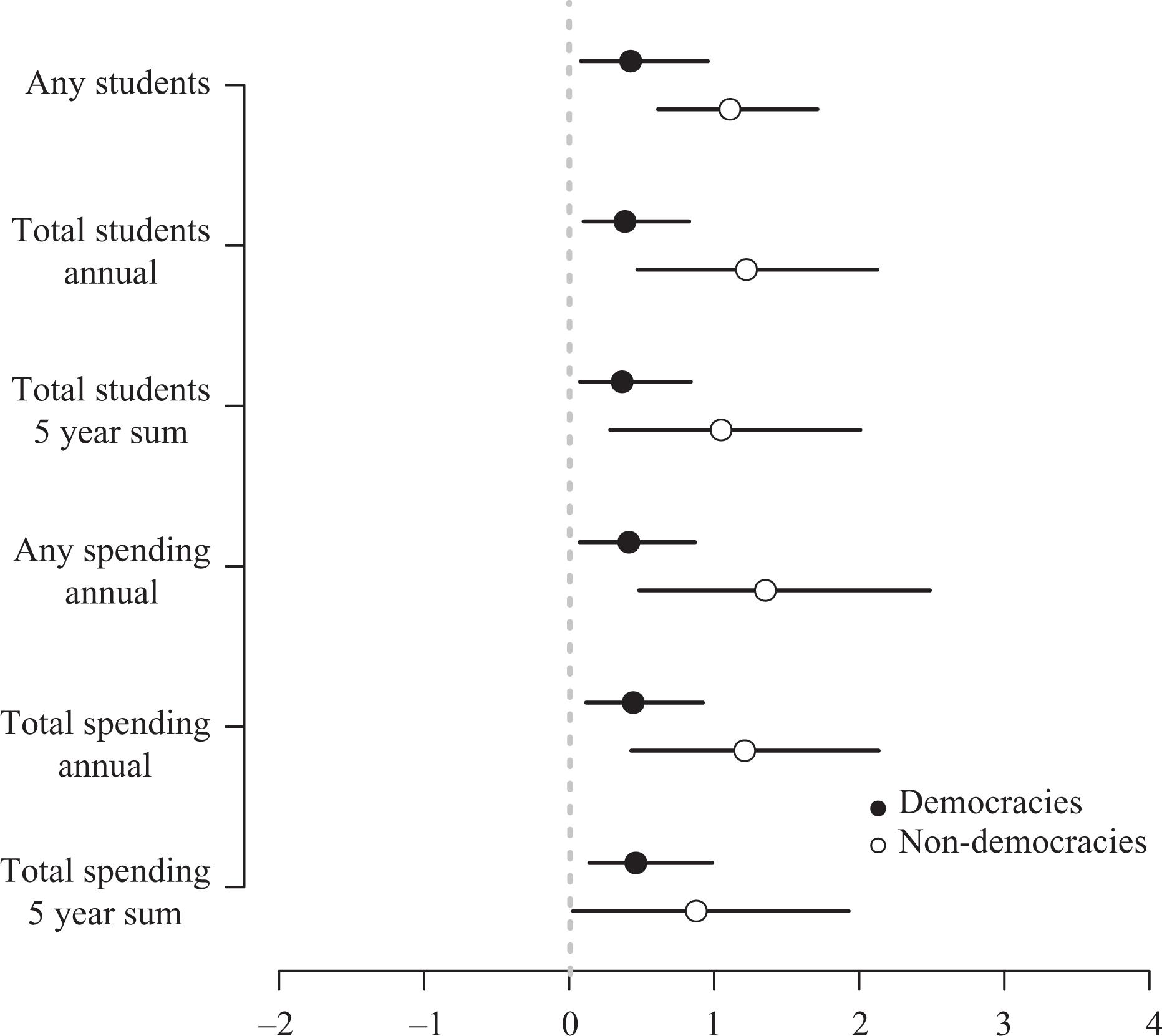
Simulated Effects of IMET and IMET-CTFP students on military-backed coups Simulated effects of any IMET and combined IMET-CTFP students and spending on military-backed coups (matched data), 1970–2009 Simulated effects of IMET on military-backed coups (democracies and non-democracies) Simulated effects of IMET spending on successful coups
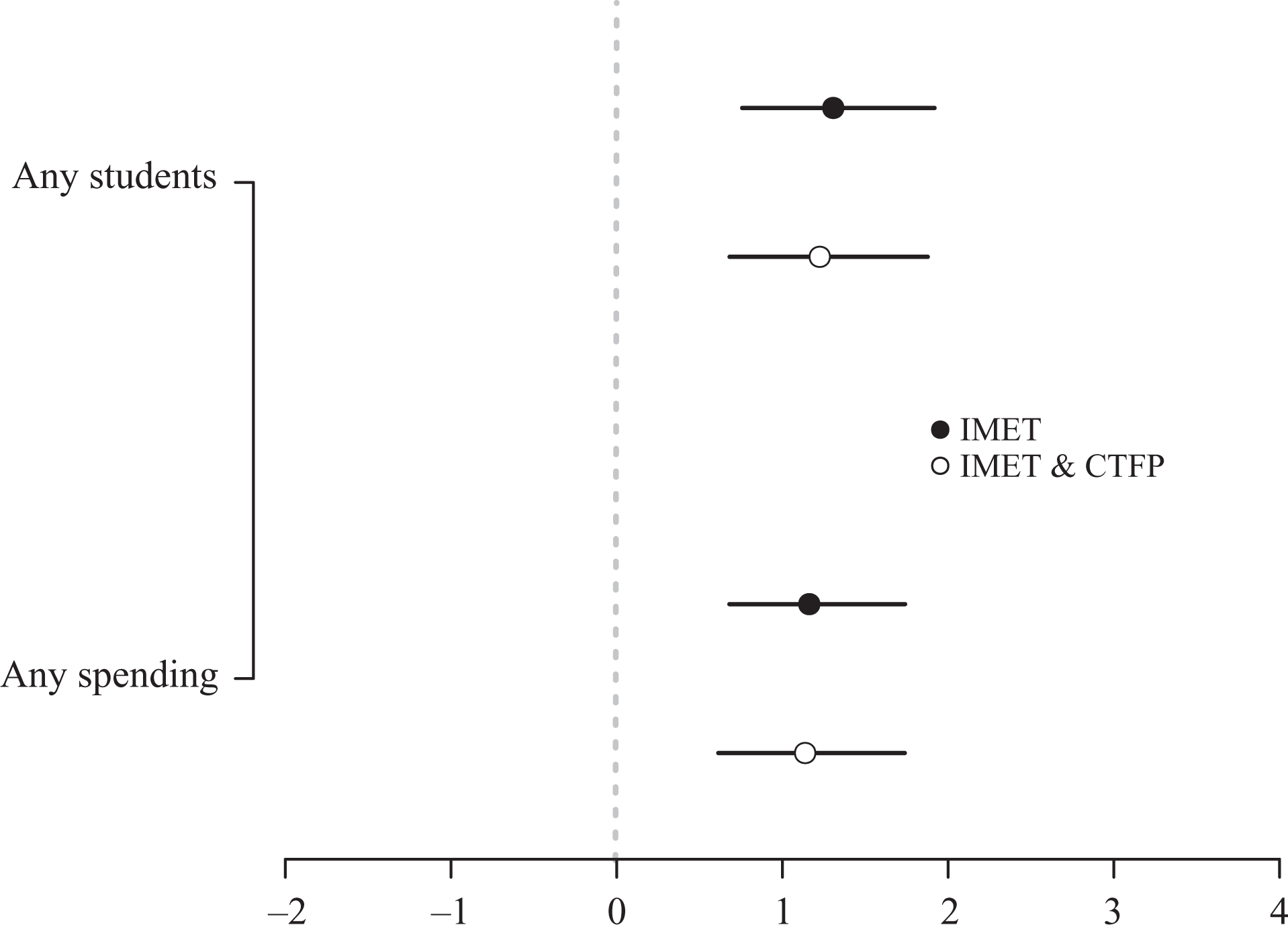
IMET training’s effect on probability of a military-backed coup (standardized coefficients)

Standard errors in parentheses, † p < 0.10, *p < 0.05, **p < 0.01. Models models employ lagged independent variables, a cubic time trend, and multiply imputed data.

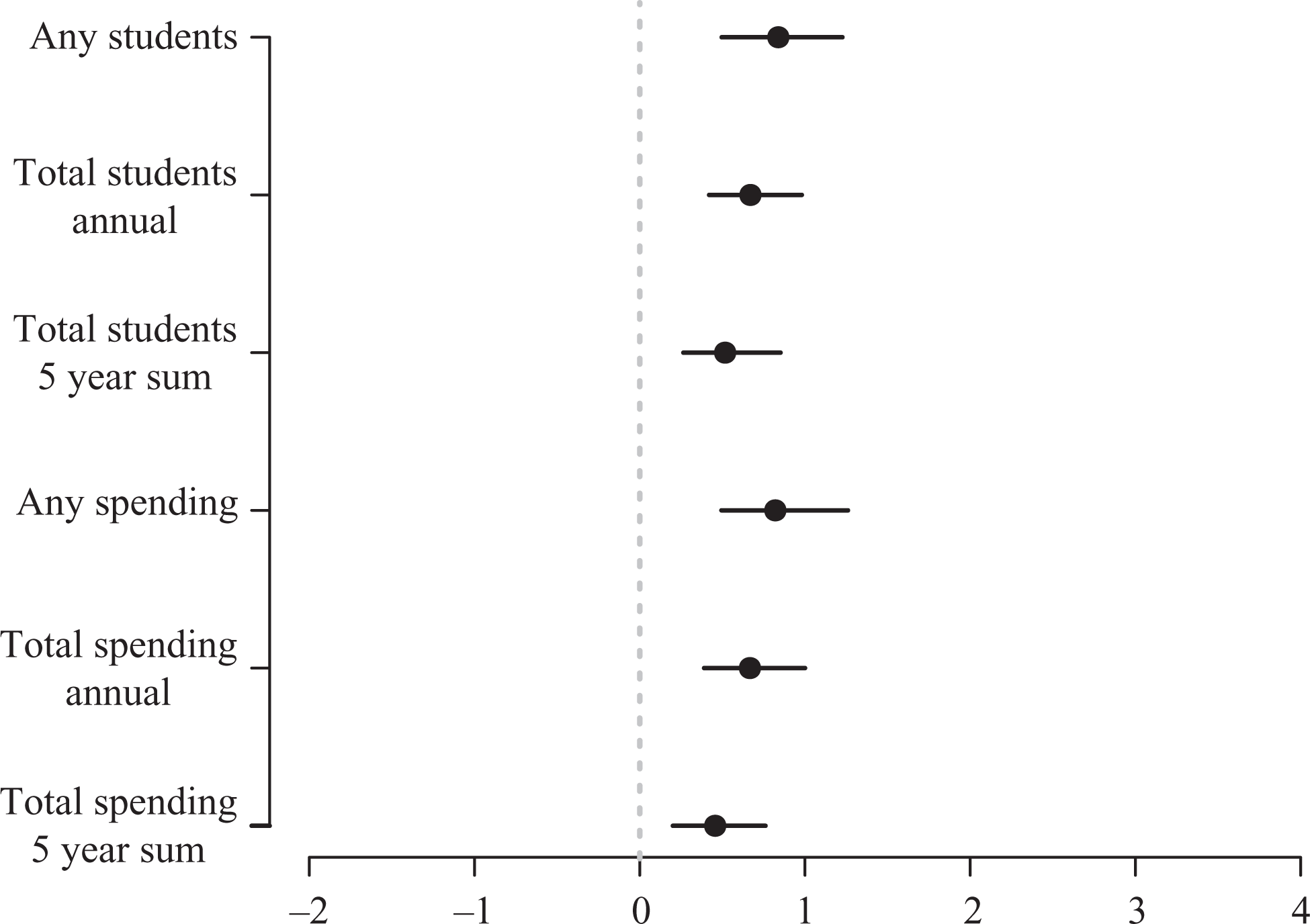
Simulated effects of IMET spending on non-military-backed coups
Figure 6 presents the first differences divided by regime type as coded by Boix, Miller & Rosato (2012). When limited to democracies, the coefficients remain positive and significant (one should not over-interpret the differences in effect size between subcategories). Clearly, training has the opposite effect on coups in democracies than norm-based theories predict.
Effects of military training on coup success
Calculating the first difference of predicted probabilities from the logit regression shows an increase in the probability of a successful coup of about 0.8% (Figure 7). The absolute change is smaller than that for attempts (but successful coups are rarer than attempts). The percentage change in the predicted probability is around 150%. Successful coups are strongly associated with IMET training and spending.
Other forms of aid and non-military backed coups
Table I presents results from regressions where the input variables are standardized by subtracting the mean and dividing by two standard errors (Gelman, 2008). This allows us to better compare coefficients. 7 H3 posited that training works differently compared to other forms of aid. US military aid has an insignificant negative effect on coup probability. This supports our theory that non-training military aid is fungible and can be shifted towards coup-proofing. Foreign aid also has little effect. Only training has a statistically significant effect on coup propensity.
To test H4, we analyzed Non-military-backed coups from the combined CSP and GIC datasets. If IMET was having a positive effect on these sorts of coups, then our theoretical argument that these results are driven by the increased human capital invested in the military would have been incorrect. We do not find any relationship (Figure 8).
Conclusion
The effect on domestic politics of assistance in the form of foreign military training (FMT) is unlikely to be limited to respect for human rights and civilian control. Training imparts valuable resources to and increases the professional distance of a potentially dangerous section of a developing state’s polity. Increasing trainees’ human capital is likely to increase resource demands on the regime, and improve the military’s ability to remove the regime should its demands not be met.
We find a robust relationship between US training of foreign militaries and military-backed coup attempts, despite limiting our analysis to the International Military Education and Training program (IMET), which explicitly focuses on promoting norms of civilian control. If the number of soldiers trained (or dollars spent) moves from the 25th percentile to the 75th, the predicted probability of a coup roughly doubles. We also find that FMT correlates to the likelihood of a successful military-backed coup. That training is positively associated with coups even when analysis is limited to democracies represents an especially profound challenge to the idea that the only political effect of training is to fundamentally alter militaries’ norms. Lack of evidence linking training and non-military-backed coups further undermines this mechanism. Finally, training’s effect on coup propensity differs significantly from other forms of military aid in both direction and magnitude, lending support to our theoretical argument about the non-fungibility of military human capital.
Coups are extreme examples of military involvement in domestic politics. Our theory suggests more generally that trained military officers will grow more autonomous from the regime. This can increase inclination for coups but more broadly means that the military will be less invested in regime survival (Atkinson, 2006, 2010; Brooks, 2013). Providing the military with resources that are not vulnerable to redistribution may mean they are less inclined to repress to prevent regime change in general. In this case, normative and capital-based mechanisms make similar claims, and may reinforce each other.
What are the implications for our findings? Healthy civil-military relations is only one low-priority goal served by US training. From a US government perspective an increase in coups may be a small price to pay given its overall aims. Moreover, developing professional militaries in under-institutionalized states may remain a worthy goal, even if it does risk military participation in politics (Harkness, 2014). More detailed research on the other coup incentives that officers face in their home country is required.
Given recent trends in development, considering military assistance in the wider context of foreign assistance also seems essential. Recent work has found evidence that targeted aid building up a number of robust groups within civil society can lead to increased democratization. This is not so much due to liberal norms adoption but to countervailing institutions achieving some independence from regimes. Our research suggests that the military should be considered in this context. Aid processes that do not consider this may be missing an opportunity. On the other hand, a security-oriented ‘development’ strategy that does not also target civilian groups may lead to increased military dominance. Understanding the risks seems essential to both good security and good development policy.
Footnotes
Replication data

Acknowledgements
Authors are listed in reverse alphabetical order. They would like to thank Ariel Ahram, Steve Biddle, Alexander Debs, Charles Butcher, Kevin Petit, Charlie Glaser, Saeid Golkar, Daniel Kebede, Rose Kelanic, Jikon Lai, Timothy Lynch, David Malet, Terry MacDonald, Alex Montgomery, Fritz Nganje, Will Reno, Drew Stommes, Jordan Tama, participants in seminars at Yale and George Washington Universities as well as the Woodrow Wilson Center, and finally three anonymous referees for helpful comments. We thank David Peyton and Drew Stommes for able research assistance.