



Abstract
Why do some civil wars feature the mass killing of civilians while others do not? Recent research answers this question by adopting a ‘varieties of civil war’ approach that distinguishes between guerrilla and conventional civil wars. One particularly influential claim is that guerrilla wars feature more civilian victimization because mass killing is an attractive strategy for states attempting to eliminate the civilian support base of an insurgency. In this article, I suggest that there are two reasons to question this ‘draining the sea’ argument. First, the logic of ‘hearts and minds’ during guerrilla wars implies that protecting civilians – not killing them – is the key to success during counterinsurgency. Second, unpacking the nature of fighting in conventional wars gives compelling reasons to think that they could be particularly deadly for civilians caught in the war’s path. After deriving competing predictions on the relationship between civil war type and mass killing, I offer an empirical test by pairing a recently released dataset on the ‘technology of rebellion’ featured in civil wars with a more nuanced dataset of mass killing than those used in several previous studies. Contrary to the conventional wisdom, I find that mass killing onset is more likely to occur during conventional wars than during guerrilla wars.
Introduction
Civil wars show remarkable variation in terms of civilian victimization. The recent Syrian civil war, for example, has been devastating for the local population. Pro-regime forces have violated nearly every law of war in a campaign that has featured the shelling of residential neighborhoods, the use of chemical weapons against civilians, and other atrocities. Some observers estimate that the civilian death toll in Syria is around 500,000 (Taub, 2016: 36). 1 Yet not all civil wars are so devastating for civilians. For instance, during Britain’s counterinsurgency campaign in Malaya, the British attempted to limit civilian causalties and even took on ‘the role of protectors of the population’ (Nagl, 2002: 71). 2 What explains this kind of variation? More specifically, why do some civil wars feature the state-sponsored mass killing of civilians while others do not?
One prominent answer to this question takes a ‘varieties of civil war’ approach by disaggregating civil conflicts according to the nature of fighting. In this literature, scholars generally start with the assumption that guerrilla (or irregular) wars are different from conventional civil wars because guerrilla insurgents rely intimately on the local civilian population for survival. This has led many to emphasize a ‘draining the sea’ logic that implies irregular wars should feature more civilian victimization because mass killing is a brutal yet attractive strategy for states attempting to eliminate the civilian support base of a guerrilla insurgency. 3 However, I point out that there are two reasons to question this logic. First, the fact that guerrilla insurgents need the support of the civilian population to survive can also yield the opposite prediction regarding the relationship between civil war type and mass killing. Indeed, the ‘hearts and minds’ logic implies that irregular wars should feature relatively little state-sponsored civilian victimization because protecting the population is the key to success in counterinsurgency. Second, conventional wars – which feature heavy weaponry and clear front lines – can generate incentives to target civilians in the other side’s zone of territorial control.
Empirically, this article advances the debate on varieties of civil war and mass killing by pairing a recently released dataset on the ‘technology of rebellion’ used in civil wars with a more nuanced dataset of mass killing than those used in several previous studies. 4 Contrary to the influential draining the sea argument, the results show that state-led mass killing onset is less likely during guerrilla wars than during conventional wars. 5
It is important, however, not to overstate the conclusions that can be drawn from these results. My findings do not permit one to reach conclusions on the efficacy of civilian targeting. Instead, the article explains why states are more likely to engage in mass killing in particular contexts. This issue, of course, is closely related to debates on the effectiveness of mass killing since expectations about whether civilian targeting will work should shape the likelihood that states engage in it. Yet determining whether mass killing ‘works’ requires a different set of theoretical arguments and a different research design. In recent years, scholars have begun to explore the effects of civilian victimization in creative ways (e.g. Lyall, 2009), and more work in this vein would be valuable. This article’s contribution, however, is to help explain why some civil wars feature mass killing whereas others do not.
The rest of the article proceeds as follows. In the next section, I outline the different causal logics of targeting (or not) the civilian population during civil war and derive competing predictions on civil war variety and mass killing onset. I then describe the data used in the empirical tests, present the results, and contrast my findings with prior research.
Guerrilla warfare and mass killing
Guerrilla conflicts, also called irregular wars, are a specific type of civil war. According to Downes (2007: 423), guerrilla wars are conflicts in which a rebel force, rather than fighting pitched battles in the open, avoids its more powerful opponent’s main forces and engages in hit-and-run operations, attacking when an advantage presents itself and melting away into the wilderness or the surrounding civilian population when reinforcements or superior firepower are brought to bear.
Below I contrast different perspectives on the relationship between civil war type and the mass killing of civilians. I start by outlining the conventional wisdom that civilian victimization is more likely during irregular wars. I then suggest two reasons to question the conventional wisdom and offer competing hypotheses on the relationship between irregular warfare and the likelihood of mass killing.
Conventional wisdom: The logic of ‘draining the sea’
One noteworthy feature of guerrilla warfare is that the population plays a key role in determining the victor. To a greater degree than rebels in conventional civil wars, guerrilla insurgents rely on the goodwill of the local civilian population for supplies, recruits, shelter, camouflage, and information. 6 An insurgency with widespread civilian support can resist the superior firepower of even a very strong state, but an insurgency without the support of the populace cannot last long. This intimate connection between the population and guerrilla insurgents led Mao Zedong, one of the most influential theorists and practitioners of guerrilla warfare, to liken the population to water and the insurgents to fish that swim in it (Mao, 1961: 93).
If the civilian population is the water and the insurgents are the fish, one way to catch the fish is to ‘drain the sea’ by separating the insurgents from the civilian population. Although there are several conceivable ways for a government to erode support for a guerrilla insurgency, one option is to pursue a ‘draining the sea by filling the graves’ strategy. 7 In other words, mass killing may be an attractive (though brutal) strategy for governments trying to eliminate the civilian support base of a guerrilla insurgency.
This idea has a long history. For instance, Imperial Rome fought a seemingly endless series of counterinsurgencies against recalcitrant groups in the empire’s borderlands. The tactics employed were so brutal that the use of unrestrained violence against civilians is sometimes called the ‘Roman method’ of counterinsurgency (Nagl & Burton, 2009: 93). Napoleon Bonaparte favored a similar strategy when targeting the civilian supporters of the monarchist insurrection. Writing to his field commander, Napoleon argued that ‘it is only by making war terrible […] that the inhabitants themselves will rally against the brigands and will finally feel that their apathy is extremely costly to them’. 8 Even today, after the development of international humanitarian law, irregular conflicts are frequently described as ‘dirty’ wars (e.g. Walsh, 2011).
In academic literature, the most explicit connection between guerrilla warfare and mass killing is Valentino, Huth & Balch-Lindsay’s (2004) influential ‘Draining the Sea’ article. According to the authors: While the support of the local population may be one of the great strengths of guerrilla forces, it can also be a weakness. Rather than fighting the guerrillas on their own terms, regimes determined to defeat a guerrilla opponent may adopt a strategy designed to sever the guerrillas from their base of support in the people. Unlike guerrilla forces themselves, this civilian support infrastructure is largely immobile and nearly impossible to conceal. As such, civilian populations offer an obvious target for counterinsurgent operations. (Valentino, Huth & Balch-Lindsay, 2004: 384–385)
To test their argument, Valentino, Huth & Balch-Lindsay (2004) first identify the universe of civil wars over the 1945–2000 period. For each war, they then code a dummy variable indicating whether the primary tactic used by the opposition group was guerrilla warfare and a dummy variable indicating whether the conflict featured state-led mass killing. They define mass killing as the intentional killing of at least 50,000 civilians over the course of five years or less. After estimating logit models of mass killing using these data, the authors report evidence in favor of their hypothesis: mass killing is significantly more likely to occur during guerrilla wars. Thus, a focus on the nature of warfare may provide a compelling explanation for why some civil wars feature widespread civilian victimization and others do not.
Though few other studies explicitly examine the connection between civil war type and mass killing, 9 several related studies explore whether mass killing is an effective tool in counterinsurgency campaigns. This literature on the effectiveness of violence against civilians is relevant here because expectations about the efficacy of a given tactic should influence the likelihood of belligerents adopting it. Therefore, if civilian targeting is an effective tactic for states facing guerrilla insurgencies, states will have an incentive to engage in mass killing during irregular wars.
Several scholars find that targeting civilians is effective under at least some conditions. Lyall (2009), for instance, uses quasi-random Russian artillery fire in Chechnya to show that indiscriminate violence reduces insurgent attacks in shelled areas. In his study of asymmetric conflicts ranging from the Caucasus to Afghanistan to Ethiopia, Arreguin-Toft (2001: 109) concludes that ‘barbarism works’ as a military strategy, although he also acknowledges that it can backfire as a political strategy in the long term. After examining the counterinsurgency tactics used in the Second Anglo-Boer War that killed over 45,000 non-combatants, Downes (2007) notes that civilian victimization is especially effective when the population is small and geographically concentrated. In his study of guerrilla wars in Algeria, Lebanon, and Vietnam, Merom (2003) argues that using overwhelming force against civilians can be an effective cost-management strategy for states, but he also notes that democracies cannot sustain such a strategy indefinitely. Although these studies examine the consequences of civilian targeting rather than the relationship between guerrilla warfare and mass killing per se, they suggest the same general conclusion as Valentino, Huth & Balch-Lindsay (2004): states often have incentives to employ mass killing during irregular wars.
To summarize, the draining the sea hypothesis can be stated as follows: mass killing is more likely to occur during guerrilla wars than during conventional wars.
Challenge 1: The logic of ‘hearts and minds’
Despite its very plausible causal logic and notable degree of empirical support, there are two reasons to question the draining the sea argument. The first is the ‘hearts and minds’ perspective on irregular warfare. The hearts and minds logic starts with exactly the same premise as the draining the sea logic: the civilian population forms the essential support base of any successful guerrilla insurgency. 10 Yet the hearts and minds perspective generates the opposite prediction on the relationship between guerrilla warfare and mass killing. The central idea is twofold. First, from the state’s perspective, defeating a guerrilla insurgency requires attaining the support of the civilian population. Second, earning the support of the population requires, at a minimum, protecting the population so that civilians can cooperate with the government without fearing punishment from the insurgents. If this perspective is correct that the key to victory in counterinsurgency is population protection, it suggests that irregular wars should feature relatively little state-sponsored civilian victimization.
Many associate the hearts and minds approach with David Galula, a former French military officer who died in 1967.
11
Drawing on his experiences in Greece, Indochina, and Algeria, Galula (1964) posits several laws of counterinsurgency in his classic Counterinsurgency Warfare. For Galula, acquiring the allegiance of the population is essential for any counterinsurgent: In conventional warfare, strength is assessed according to military or other tangible criteria, such as the number of divisions, the position they hold, the industrial resources, etc. In [guerrilla] warfare, strength must be assessed by the extent of support from the population as measured in terms of political organization at the grass roots. The counterinsurgent reaches a position of strength when his power is embodied in a political organization issuing from, and firmly supported by, the population. (Galula, 1964: 79)
The need to protect civilians also plays an important role in policy debates on counterinsurgency. With the guerrilla insurgency in Iraq ramping up in 2006, the US military published a landmark field manual on counterinsurgency (FM 3-24). Written under the direction of General David Petraeus, FM 3-24 advocated a distinctly hearts and minds strategy. It states: ‘At its core, COIN [counterinsurgency] is a struggle for the population’s support. The protection, welfare, and support of the people are vital to success’ (Department of the Army, 2006: 28). While FM 3-24 discusses a variety of techniques for winning the support of the population, such as providing economic benefits, reducing corruption, and respecting local customs, protecting the population is paramount. If the counterinsurgent force cannot convince civilians that they will be protected in exchange for their support, other benefits are for naught.
A good deal of academic work is consistent with the view of these counterinsurgency theorists and practitioners. Though the research speaks to the ineffectiveness of indiscriminate violence during irregular wars rather than the relationship between civil war type and mass killing, it has implications for the latter. Reasoning backward, if indiscriminate violence is counterproductive during guerrilla conflicts, then counterinsurgents should have a good reason to exercise restraint toward the civilian population.
Several studies imply this is the case. Indeed, scholars of political violence often argue that the state’s use of indiscriminate violence is counterproductive because it helps solve the collective action problems associated with insurgent recruitment. This process can occur through two mechanisms. First, widespread killing gives rational, survival-maximizing civilians a powerful incentive to support the insurgency due to the simple desire for self-preservation (e.g. Kalyvas, 2006; Leites & Wolf, 1970; Mason & Krane, 1989). 12 Second, mass killing alienates the local population and produces grievances, which then induce individuals to strike back against the hated government (e.g. Wood, 2003; Petersen, 2001). Thus, widespread civilian victimization is expected to fail since it gives civilians, who otherwise might have sat on the sidelines or even cooperated with the state, a reason to defect to the side of the guerrilla insurgents.
Subsequent empirical analyses are consistent with the proposition that indiscriminate violence backfires because it drives civilians to collaborate with the opposition. In the context of the Iraq war, Condra & Shapiro (2012) find that coalition violence against civilians provoked higher levels of violence against coalition forces operating in the same area. Using detailed subnational data from the US aerial bombardment of populated areas during the Vietnam War, Kocher, Pepinsky & Kalyvas (2011) show that bombing civilians increased support for the Vietcong insurgents. Taking a different approach, Findley & Young (2007) use a computational model to compare what they call ‘attrition’ and ‘hearts and minds’ strategies of counterinsurgency and find that the hearts and minds strategy is more effective under most circumstances.
To summarize, counterinsurgency theory, modern military doctrine, and academic work on the futility of indiscriminate violence all suggest that counterinsurgents generally have incentives to protect the civilian population during irregular conflicts. Thus, the hearts and minds logic suggests the following hypothesis: mass killing is less likely to occur during guerrilla wars than during conventional wars.
Challenge 2: The logic of conventional warfare
A second challenge to the draining the sea argument draws on the logic of conventional warfare. Perhaps surprisingly, the draining the sea perspective says little about conventional warfare even though its main prediction is that mass killing is likely in guerrilla wars relative to conventional wars. Indeed, the comparison to conventional wars is largely implicit. 13 However, if we delve into the nature of fighting in conventional wars, there are good reasons to think they could be particularly deadly for civilians caught in the path of war.
Recall that conventional civil wars are conflicts that feature well-defined front lines, heavy weaponry, major battles, and established zones of territorial control for each side. In conventional wars, not only is the nature of fighting quite different from irregular wars, but the role of civilians differs as well. As mentioned before, irregular wars are often understood as a competition between states and insurgents for the loyalty of the civilian population in areas of disputed control. 14 By contrast, in conventional warfare, most civilians do not live in areas of contested control. Rather, they generally live behind clear front lines where one side is dominant. As Balcells (2010: 292) puts it, ‘the control of the armed groups over the population under their dominion is overwhelming’ in conventional wars.
For these reasons, conventional civil wars resemble interstate wars in many important aspects. Interstate wars, of course, often have disastrous consequences for civilians, especially when governments pursue a coercive ‘punishment’ strategy. As Pape (1996: 18) writes, ‘the common feature of all punishment campaigns is that they inflict suffering on civilians’ in order to make continued resistance to the coercer’s demands extremely costly. Additionally, civilians may be targeted as part of a ‘denial’ strategy – a campaign designed to undermine the enemy’s ability to carry out its preferred military strategy – such as when civilians are killed to weaken the other side’s economic production. 15 While there is no consensus on the effectiveness of these civilian victimization strategies in interstate wars, governments are often tempted to use them, particularly when they are desperate to win (Downes, 2008).
Returning to the context of conventional civil wars, it is reasonable to expect that governments may pursue similar punishment and denial strategies by targeting civilians in the rebel group’s zone of control. Such action could be consistent with a punishment strategy designed to convince the rebels and their civilian supporters that continued fighting is too costly. Similarly, targeting civilians in the rebel zone of control might be part of a denial strategy. In a conventional civil war, civilians living ‘behind the front lines’ typically represent the potential pool of recruits and the economic support base of the rebel army (this is true regardless of whether the civilians voluntarily support the rebels or are coerced into doing so). By targeting civilians, the government may hope to weaken the rebel group’s military capabilities over the long haul.
One might point out that the front lines of conventional conflicts sometimes are located far from where most civilians live. In such cases, mass killing should be less likely than when front lines are near major population centers. Yet, even in these circumstances, a conventional war’s toll on the civilian population can be devastating. Given the heavy weaponry and extraordinary level of firepower involved in conventional fighting, civilians are rarely far from striking distance, especially when the government can employ air power and heavy artillery against towns. On top of that, front lines can shift rapidly and massacres of civilians ‘guilty’ of supporting the other side may occur during territorial conquest.
The ongoing Syrian conflict – a clear case of conventional warfare featuring front lines, advanced weaponry, and sieges of major towns – tragically illustrates these dynamics. Since 2012, the city of Aleppo was split into a rebel-controlled east side and a government-controlled west side. In late 2016, the government initiated a campaign to recapture the entire city. The deadly attack started with airstrikes and artillery bombardment against rebel-held neighborhoods and was then followed by a massive ground assault. As they took eastern Aleppo, Assad’s forces began ‘killing people, including women and children, on the spot in their homes and on the street’ (BBC News, 2016). The government’s violence against civilians in the rebel-held zone was so overwhelming that France’s UN ambassador, Francois Delattre, concluded that the Assad regime’s conquest of Aleppo ‘could be one of the biggest massacres of [a] civilian population since World War Two’ (McKernan, 2016).
Moreover, mass killing may be likely during conventional wars because one of the main constraints on government brutality – the possibility of civilians defecting to the opposition – is largely missing. Recall that during irregular wars, widespread violence is thought to backfire (at least according to one school of thought) because it incentivizes civilians to switch their allegiance to the other side. 16 Defection is typically easy because civilians intermingle extensively with combatants from both sides in zones of contested control. In conventional wars, however, this restraint on government violence is typically absent. Conventional wars are not a competition for the loyalty of the population since each side normally possesses overwhelming control over the population behind its part of the front line, making defection difficult. Consequently, governments have little reason to fear that targeting civilians will generate a surge of new recruits for the rebels. Furthermore, governments in conventional wars have less need to work with the civilian population to acquire information because the ‘identification problem’ is crucial only during irregular conflicts (Kalyvas, 2006). While the flow of information can influence the outcome of guerrilla wars, success in conventional wars is primarily determined by the results of major battles. Therefore, since civilian defection is difficult and governments have less need for the information civilians can provide, some of the most compelling motives for government restraint toward civilians are missing during conventional civil wars.
To summarize, the discussion of violence against civilians in the context of conventional warfare suggests the following hypothesis: mass killing is more likely to occur during conventional wars than during guerrilla wars. 17
Empirical evidence
The rest of this article evaluates the empirical record: How does the likelihood of mass killing vary across the distinct varieties of civil war? In what follows, I describe how new and improved data allow us to investigate the relationship between civil war type and mass killing, summarize alternative explanations and data on the covariates, and report the results of the statistical analysis.
Sample of cases and key independent variable
Investigating whether irregular wars are more or less likely to feature mass killing than other forms of civil war begins with two steps. First, it is necessary to identify an appropriate sample of cases for analysis. Second, it is necessary to code whether each case features guerrilla warfare tactics.
Fortunately, the ‘PRIO 100’ dataset (Balcells & Kalyvas, 2014) does both.
18
This dataset starts with the standard list of civil wars from the UCDP/PRIO armed conflict database (Gleditsch et al., 2002).
19
For every conflict year producing at least 100 battle-deaths, it then codes the variety of civil war, which Balcells and Kalyvas call the ‘technology of rebellion’.
20
They conceive of the technology of rebellion as the ‘joint military technologies used by the state and the rebels engaged in the armed conflict’ (Kalyvas & Balcells, 2010: 418). The technology of rebellion framework generates a three-category typology of civil war variety: irregular wars, conventional wars, and symmetric non-conventional (hereafter SNC) wars. These types of warfare are described below:
Irregular war: ‘Irregular or guerrilla warfare is a technology of rebellion whereby the rebels privilege small, lightly armed bands operating in rural areas; it is an expression of relative asymmetry between states and rebels. Rebels have the military capacity to challenge and harass the state, but lack the capacity to confront it in a direct and frontal way. Put otherwise, states can mount a devastating response to a direct armed challenge such that the rebels’ only option is to fight asymmetrically’ (Kalyvas & Balcells, 2010: 418).
Conventional war: ‘Conventional warfare emerges when rebels are able to militarily confront states using heavy weaponry such as field artillery and armor. In conventional wars, military confrontation is direct, either across well-defined front lines or between armed columns; clashes often take the form of set battles, trench warfare, and town sieges’ (Kalyvas & Balcells, 2010: 419).
SNC war: SNC civil wars are those that ‘do not fit well into the irregular war/conventional war dichotomy. They diverge from irregular wars because there is no asymmetry between state and rebels; they also diverge from conventional wars because the two sides are militarily ‘low tech.’ This is the case when states are unable (or, in a few cases, unwilling) to deploy an organized military against poorly equipped insurgents […] SNC wars tend to arise in contexts characterized by extremely weak or collapsed states’ (Kalyvas & Balcells, 2010: 419).
The classification of civil wars according their technology of rebellion presents several advantages. First, Balcells & Kalyvas (2014) offer arguably the most theoretically informed treatment of the nature of fighting in civil wars. Second, the PRIO 100 dataset is advantageous because it allows the technology of rebellion variable to change over the course of a conflict. For instance, the conflict between Russia and Chechen rebels was fought as a conventional war in its early phases before transforming into an irregular war. Therefore, the PRIO 100 dataset offers a more dynamic coding of warfare during civil wars than potential alternative measures. 21
Despite the advantages of the technologies of rebellion data, it is worth noting one potential challenge. While most scholars employ an irregular versus conventional war dichotomy, Kalyvas and Balcells add a third category (SNC wars). Since the existing theoretical arguments are based on differences between irregular and conventional wars, expectations on the likelihood of mass killing during SNC wars are unclear. Nonetheless, I include SNC wars in the analysis because, as Kalyvas & Balcells (2010) point out, the nature of fighting in such wars is conceptually distinct from irregular or conventional wars. Therefore, in addition to providing a first-cut at establishing the record of mass killing during SNC wars, coding SNC wars as a distinct variety of conflict should also give more precise estimates for irregular and conventional wars. However, to assuage concerns that the shift from two to three categories of civil war might somehow distort the results, I reestimate the reported models in two ways (see Online appendix). First, I simply exclude the conflicts coded as SNC wars to compare the risk of mass killing during irregular and conventional wars exclusively. 22 Second, I recode the SNC wars as irregular wars since they are often ‘mistakenly’ considered guerrilla wars (Kalyvas & Balcells, 2010: 419). In both cases, the results are consistent with the main findings reported in the text. 23
Dependent variable
Mass killing, in the most general sense, is the intentional killing of a large number of civilians. For the purposes of this article, however, two additional criteria are added. First, although mass killing can occur in times of war and times of peace, I focus exclusively on wartime mass killing to address the puzzle of why some civil wars feature massive civilian victimization and others do not. Second, while rebel groups can also instigate large-scale violence against civilians, 24 I focus on state-sponsored mass killing to engage with the draining the sea argument that ‘mass killing is often a calculated military strategy used by regimes attempting to defeat major guerrilla insurgencies’ (Valentino, Huth & Balch-Lindsay, 2004: 375). 25
The dependent variable, therefore, is the onset of a state-sponsored mass killing event. I measure state-sponsored mass killing using Ulfelder & Valentino’s (2008) mass killing dataset. They define mass killing as ‘any event in which the actions of state agents result in the intentional death of at least 1,000 noncombatants from a discrete group in a period of sustained violence’ (Ulfelder & Valentino, 2008: 2). The onset of a mass killing episode is coded as the first year in which at least 100 intentional noncombatant fatalities occur.
Given my research design, the mass killing events are paired with the civil wars included in the PRIO 100 dataset. In most cases, pairing the mass killing onsets with the PRIO 100 wars is straightforward because the government is fighting only one conflict at a time. In such cases, the mass killing event is automatically matched to the sole conflict. In the sample, however, there are four mass killing onsets that occur while a government is simultaneously fighting multiple wars against different rebel groups (Ethiopia 1977, Sri Lanka 1989, India 1990, and Georgia 1992). For these cases, I consulted the Ulfelder and Valentino appendix and secondary sources to determine whether the mass killing was associated with all or only some of the conflicts. For example, Ulfelder and Valentino code a mass killing onset in Georgia in 1992, a year in which the PRIO 100 data indicate the Georgian government was fighting two distinct wars: one against ethnic separatists in Abkhazia and another against loyalists to former President Zviad Gamsakhurdia. After examining these conflicts in detail, I deemed it appropriate to code a mass killing event associated with the Abkhazia conflict but not the Zviadist conflict. 26
Using the Ulfelder and Valentino mass killing data is preferable to two alternative measures of mass killing. The first plausible alternative is the mass killing data used in Valentino, Huth & Balch-Lindsay’s (2004) ‘Draining the Sea’ article. Recall that they defined mass killing as the intentional killing of at least 50,000 civilians over the course of five years or less. The shortcoming of this definition is that the death threshold is so high that it excludes several important cases of mass killing. For example, the widespread killing of civilians during the Liberian and Sri Lankan civil wars – archetypical cases of civilian victimization – are excluded because they fall short of the extremely high death threshold. A second potential alternative is an indicator of genocide. The Genocide Convention defines genocide as acts committed with the ‘intent to destroy, in whole or in part, a national, ethnical, racial or religious group, as such.’ 27 This definition creates practical problems for researchers. Notably, political groups are excluded, which means that some of the most brutal campaigns of civilian victimization do not qualify as genocide. 28 Moreover, genocide requires the ‘intent to destroy’ the targeted group. Coding genocide therefore necessitates making a sometimes difficult judgment call on the ultimate intentions of the perpetrators. Consequently, the Ulfelder and Valentino mass killing data, which avoid the aforementioned problems, represent the most appropriate indicator for state-sponsored mass killing.
Covariates
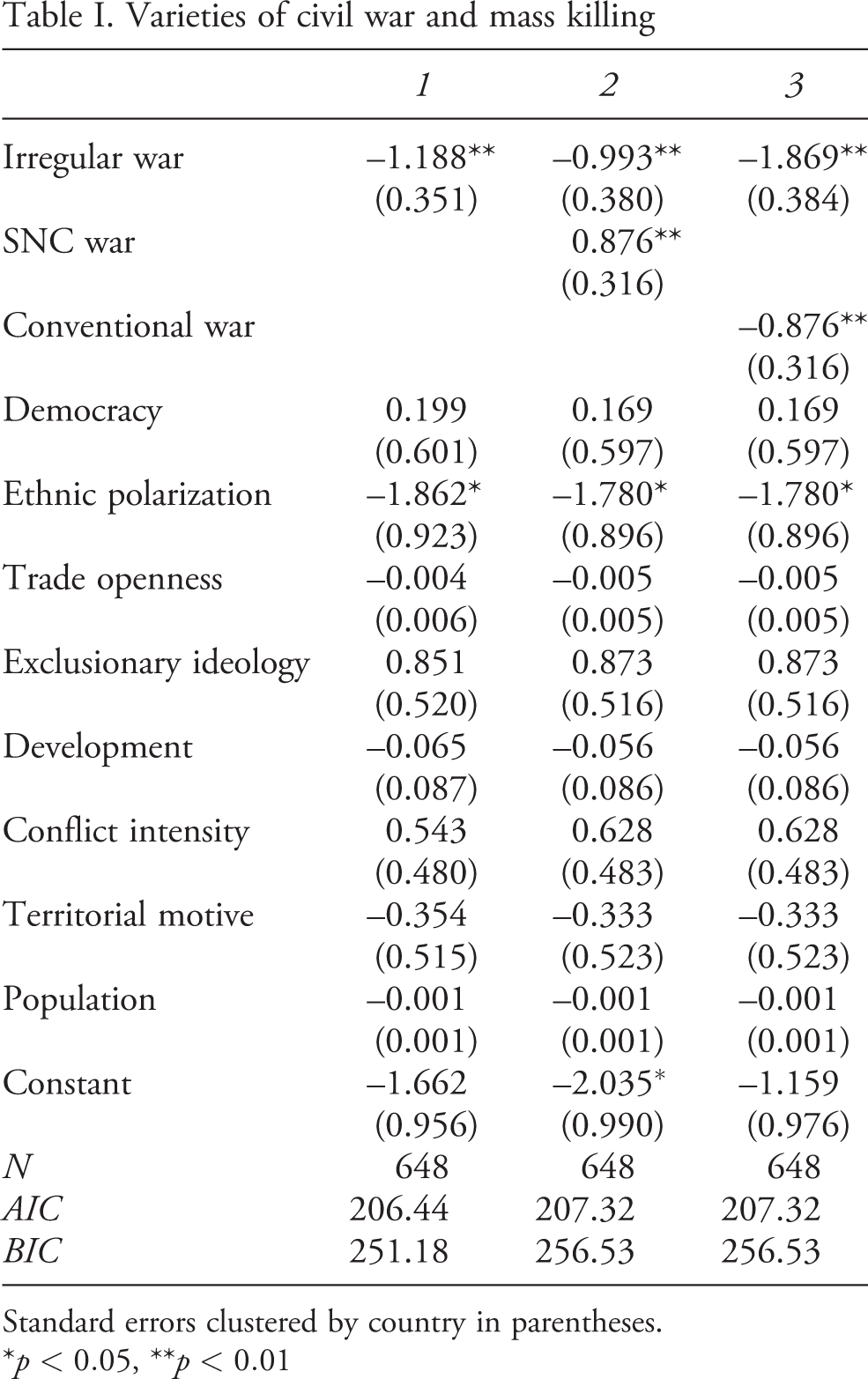
Varieties of civil war and mass killing
Standard errors clustered by country in parentheses.
*p < 0.05, **p < 0.01
Results
Using the data described above, I estimate logit models of mass killing onset with standard errors clustered on the country. The main results are reported in Table I. Model 1 presents a regression that includes the guerrilla war variable as well as standard covariates for mass killing. Consistent with the hearts and minds logic, the coefficient on Irregular war is negative and statistically significant, meaning that mass killing is less likely to occur during guerrilla conflicts. One possible critique of this model, however, it that it compares the likelihood of mass killing during irregular wars to the likelihood of mass killing during all other civil wars (i.e., both conventional wars and SNC wars). To ensure that this choice of the reference category does not drive the First difference estimates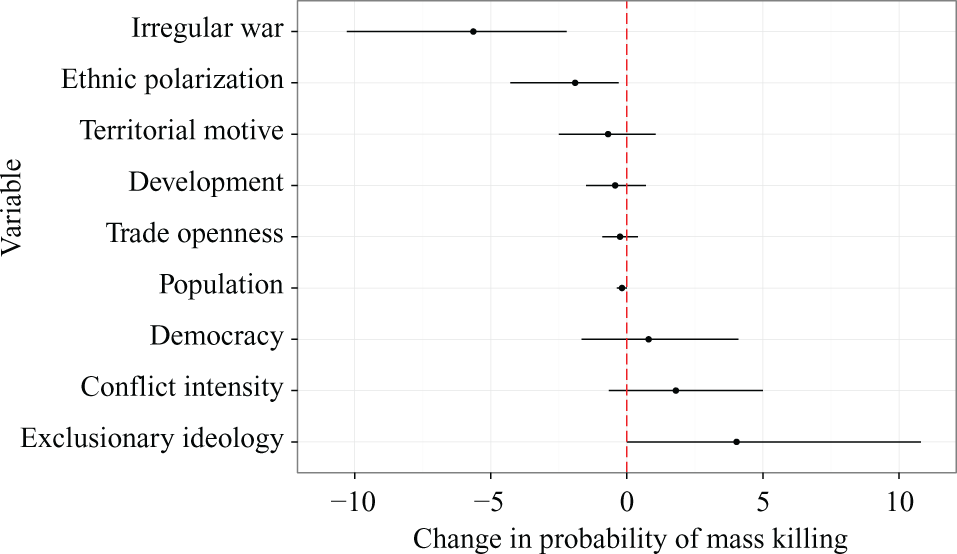
While the models reported in Table I imply that mass killing is significantly less likely during guerrilla wars, it is difficult to interpret the magnitude of the effect through regression estimates alone because the models are nonlinear. Hence, I calculate substantive effects using the estimates obtained in Model 1. These simulations show how changing the value of an independent variable influences the probability of mass killing onset while every other variable is held constant. 33 The results, shown in Figure 1, indicate that the predicted probability of a mass killing onset is about 5.6 percentage points lower during guerrilla wars. Though this number may not appear large at first glance, it is striking given that the baseline risk of mass killing onset is low. Moreover, the substantive effect of the guerrilla war variable is larger than any of the other variables included in the model. Hence, the effect of irregular warfare on mass killing is not only statistically significant but also substantively meaningful.
I also subject the results to several additional robustness checks (see Online appendix). First, I guard against rare events bias. Rare events bias can occur in datasets with many times more zeros (i.e., nonevents) than ones (i.e., events) and causes the standard logistic regression model to underestimate the probability of the rare events. Since mass killing occurs infrequently, it is possible that my analysis suffers from rare events bias. 34 Therefore, I reestimate the models in Table I with a rare events logistic regression technique that corrects for this potential bias (Tomz, King & Zeng, 2003). My results are consistent.
Second, I ensure that the inclusion of the control variables does not bias the results. Methodologists have long argued that including a battery of control variables in a regression can create several problems (e.g., violations of modeling assumptions and non-random listwise deletion). Achen (2002: 446) goes so far as to say, ‘A statistical specification with more than three explanatory variables is meaningless.’ To ensure that the long list of covariates included in the models in Table I does not bias my results, I reestimate those models without the control variables and find that the results hold.
Third, I incorporate data designed to capture the characteristics of rebel groups. Though the focus of this paper is on state-sponsored violence against civilians, rebel groups nonetheless are worth examining because they help shape a conflict’s strategic environment. Consequently, the rebels might influence the strategy the state pursues toward the civilian population. In this vein, I add three additional covariates that measure rebel characteristics and/or the conditions in which they operate: whether the rebel group possesses an external base, whether there is a civil war in a neighboring country, and the extent of mountainous terrain in the state. The first two variables, both from Salehyan (2007), address claims that regional instability in general and external bases in particular augment rebel group capabilities by providing foreign sanctuaries where rebels can regroup before resuming attacks against the state. The third variable, from Fearon & Laitin (2003), addresses the argument that mountainous terrain aids rebels by limiting the reach of the state. None of these additional variables are statistically significant, nor do they alter the main findings about varieties of civil war and mass killing.
Fourth, I analyze a slightly different sample of cases. The results reported in Table I include all civil conflicts regardless of whether there is an ongoing mass killing event. This is reasonable because the coding rules used in Ulfelder & Valentino’s (2008) mass killing dataset allow for additional mass killings to begin in a country with an ongoing mass killing event if a different group is targeted. However, one could argue that it is more appropriate to exclude countries with ongoing mass killings from the sample. When I do so, my results are consistent.
Fifth, I employ several strategies to check whether various forms of temporal heterogeneity might distort the results. Since the risk of mass killing may change over the course of a conflict, I reestimate the models in Table I with a control variable for war duration, its square, and its cube. 35 To guard against general time trends in the data, I also reestimate the models including a simple year counter, its square, and its cube. Lastly, some have suggested that the end of the Cold War represents a discontinuity affecting civil wars in general and civilian victimization in particular (e.g., Kaldor, 1999; Kalyvas & Balcells, 2010). To address this possibility, I reestimate the models in Table I with a post-Cold War dummy variable. In all three sets of models, my conclusions are unchanged.
Comparison to existing findings
The results reported here challenge the draining the sea logic espoused in Valentino, Huth & Balch-Lindsay (2004), arguably the most prominent article on the topic. What drives the difference in our findings?
One possibility is the different thresholds used for our dependent variables. In their study, Valentino, Huth & Balch-Lindsay (2004) define mass killing as the intentional killing of over 50,000 civilians during a civil war. By contrast, the data I use require 1,000 civilian deaths for an event to count as a mass killing episode (Ulfelder & Valentino, 2008). Do the different fatality thresholds account for the contradictory findings? To check, I use the Ulfelder & Valentino (2008) codebook to limit my analysis to mass killing episodes that produced at least 50,000 civilian fatalities. 36 Despite a substantial decrease in the number of mass killing onsets, 37 I still find that mass killing is less likely during guerrilla wars (though the difference is no longer statistically significant). Given this relatively minor change in my results, the operationalization of the dependent variable does not appear to provide a convincing explanation for the dramatically different results in the two articles.
Another possibility is the measurement of the independent variable (and the related issue of the unit of analysis). The Valentino, Huth and Balch-Lindsay variable for the variety of civil war is static. Their unit of analysis is the entire civil war, and they code a conflict as featuring either guerrilla or conventional warfare for the whole conflict’s duration based on the ‘primary tactics used by the opposition’ (2004: 389). By contrast, the PRIO 100 dataset used in this paper provides a dynamic measure of civil war variety. The unit of analysis is the conflict year, which means the technology of rebellion variable can change over the course of a civil war. 38 Could this explain our conflicting findings? To check, I examined how often the technology of rebellion variable changes during multiyear conflicts. 39 I found that the nature of warfare does in fact change fairly often: out of the 90 conflicts that lasted for more than one year, 17 experienced a change in the technology of rebellion. 40 Moreover, 10 of these 17 conflicts witnessed a mass killing onset, suggesting that the time-varying coding of the independent variable could meaningfully influence the results. Digging even deeper, 7 of those 10 mass killing onsets occurred during a phase of conventional warfare, which may explain why I find a higher rate of mass killing during conventional warfare than do Valentino, Huth & Balch-Lindsay (2004).
Therefore, Valentino, Huth and Balch-Lindsay’s static coding of civil war variety provides a relatively compelling account for why their results differ from mine. To be clear, this does not necessarily mean that they are ‘wrong.’ In fact, the differences between our findings may be less drastic than they appear at first. Since the nature of fighting often changes over the course of a single war, Valentino, Huth and Balch-Lindsay could still be correct that guerrilla wars often end up taking a heavy toll on the civilian population. For instance, a mass killing event that begins during conventional fighting may very well continue long after the conflict shifts to irregular fighting (as happened in the Russia–Chechnya conflict mentioned earlier). However, my results clearly show that mass killing campaigns do not typically start during irregular wars, which calls into question the causal logic of the draining the sea argument. 41
Lastly, it is worth mentioning that these results raise an interesting new question: why does the nature of fighting change during some wars while it remains constant during others? Though this question is beyond the scope of this paper, providing an answer could be a fruitful avenue for future work.
Conclusion
Why do some civil wars feature the mass killing of civilians while others do not? This article provided an answer by following a varieties of civil war approach that disaggregates civil wars according to the nature of fighting. I started by describing the conventional wisdom, a draining the sea logic that expects guerrilla wars to exhibit relatively high levels of civilian victimization. I then outlined two challenges to this draining the sea argument – one drawing on the logic of hearts and minds and the other on the nature of conventional warfare – that suggest the opposite empirical prediction. After deriving competing hypotheses on the relationship between civil war type and mass killing, I presented an empirical test by pairing recently released data on the technology of rebellion in civil wars with improved data on mass killing. The results call into question the draining the sea argument: states appear less likely to initiate mass killings during guerrilla wars.
These findings are open to multiple interpretations. On the one hand, an optimistic interpretation is possible. Guerrilla wars may be less bloody than typically believed. While there certainly are several high-profile cases of state-led mass killing during irregular conflicts, these cases may be closer to the exception than to the rule. Of course, caveats are required. First, this study exclusively examines the intentional killing of civilians. It therefore does not permit conclusions on the level of unintended collateral damage during guerrilla wars, which may be high given the extensive intermingling of combatants and civilians. Second, the limited time period for this study does not include the numerous (and often notoriously bloody) small wars that imperial powers fought on their peripheries during the 19th and early 20th centuries. Despite these caveats, the findings reported here can support an optimistic conclusion on the behavior of counterinsurgents.
On the other hand, a pessimistic interpretation is also reasonable. The findings merely show that mass killing onset is less likely during guerrilla wars relative to other types of civil conflict. Put differently, other forms of civil war appear to be more devastating for civilians than previously thought. This raises notable implications for the study of civil conflict because scholars have written a great deal about guerrilla warfare but comparatively little about other forms of civil war. Indeed, much of the literature on the logic of violence focuses on factors that are very important during guerrilla conflicts (i.e., the identification problem) but are less relevant outside the context of irregular warfare. In general, conventional civil wars have received less attention both theoretically and empirically. 42 Looking ahead, more academic work on the incentives to wield violence against civilians outside the context of guerrilla warfare offers a potentially fruitful research agenda.
Footnotes

References
Supplementary Material
Please find the following supplemental material available below.
For Open Access articles published under a Creative Commons License, all supplemental material carries the same license as the article it is associated with.
For non-Open Access articles published, all supplemental material carries a non-exclusive license, and permission requests for re-use of supplemental material or any part of supplemental material shall be sent directly to the copyright owner as specified in the copyright notice associated with the article.
