




Abstract
What accounts for the puzzling persistence of sexual assault of both women and men within the ranks of the US military? Despite increasing efforts to end this intraforce violence, sexual assault of women persists at levels comparable to those in the civilian population and significantly higher than that of other crimes (data challenges prevent comparing rates for men). Drawing on recent analysis of rape as a practice rather than a strategy of war, we suggest the answer lies in the socialization not only of recruits but also of officers. We draw on an original typology of socialization processes and analysis of four well-documented cases to suggest the following account of why sexual assault persists. First, informal socialization processes (including sexualized hazing) trivialize sexual harassment and assault, establish assault as an appropriate form of punishment (including of those transgressing military gender norms), and license retaliation against victims who report. Second, officers sometimes sexually harass and assault subordinates, thereby endorsing similar acts by servicemembers under their command. Third, formal socialization processes of enlisted men and women, despite recent reforms, continue to reproduce a masculinity that undermines policies that seek to prevent sexual assault, in part because it fails to override these unauthorized and illegal socialization processes. Finally, the socialization of officers, combined with problematic incentive structures, undercuts efforts to end the de facto tolerance of sexual abuse by many officers. In our emphasis on horizontal as well as top-down socialization processes, and on those that subvert official policies as well as those that seek to inculcate them, we also contribute to scholarly understanding of socialization within organizations more generally.
Keywords
After Liz Luras joined the US Army, her date to the Marine Corps Ball, a fellow soldier, raped her. Although she did not report it, a third soldier did. After Luras returned to her unit, her peers harassed her and raped her twice more – in retaliation for speaking out, she believes (Braunschweiger, 2016). The Army eventually forced her out on unfavorable terms that limited her access to health care and left a black mark on her record, while her rapists were never charged and remained in the Army.
Servicemen are also victims of sexual assault. In 2009, a group of servicemembers gang-raped a recently enlisted soldier. When he reported the assault, his unit commanders told him, ‘It must have been your fault. You must have provoked them’ (Ellison, 2011).
These are not rare events. A recent survey estimated that almost 5% of active-duty servicewomen and almost 1% of servicemen experienced a sexual assault during the year beginning 1 September 2013; 2.1% of servicewomen and 0.3% of servicemen suffered rape (Morral, Gore & Schell, 2014–16, Vol. 2: 11–12). In almost all cases, the perpetrators were military colleagues, often but not always male. Sexual harassment is still more common: 21.6% of women and 6.6% of men reported having experienced harassment during that year (Morral, Gore & Schell, 2014–16, Vol 2: 34).
Sexual assault within the US military remains frequent despite two decades of ‘zero-tolerance’ policies (three in the case of the Navy) and more than a decade of institutional reforms implemented as scandal after scandal broke – including the widespread sexual harassment of female servicemembers at the Tailhook convention in 1991, the indictment of 12 Army drill sergeants for sex crimes in 1997, the exposure of widespread sexual assault at the Air Force Academy in 2003, and the accusation that 12 Air Force training instructors had assaulted their subordinates in 2012. The revelation in 2017 that Marines had posted hundreds of nude photographs of female colleagues online renewed calls for more effective policies.
Sexual assault within the ranks is legally subject to punishment under the military code of justice, draws unwelcome congressional scrutiny, and is a source of ongoing negative publicity. Its persistence within a hierarchical, professional, and highly institutionalized state military thus poses a puzzle.
Historically, crime rates by members of the US military (crimes per capita of the military population) during peacetime were significantly lower than rates by civilians for all crimes, except for sexual crimes against women, for which the rate was closer to civilian rates (during World War II, it was much higher; Morris, 1996). Rates of sexual assault of civilian and military women remain roughly similar (Black & Merrick, 2013: 13); data challenges prevent comparing rates for men (see the Online appendix). The fact that the military significantly suppresses crime in every category of violent crime except rape is puzzling. Other patterns are also puzzling. The fraction of rape that is carried out by multiple perpetrators is much higher than among civilians. Both peers and unit leaders – not just the perpetrator – often aggressively retaliate against victims who report sexual assault. Conviction rates (the fraction of alleged perpetrators tried that are convicted) remain significantly lower than for other crimes adjudicated by military courts, despite the fact that very few allegations (presumably the best evidenced) are brought to trial.
Together these patterns suggest that sexual assault is still broadly tolerated. Although individual officers may not tolerate assault by soldiers under their command – and thus its rate varies significantly across units – sufficiently many do such that sexual assault persists.
In this theory-building article, we offer a new perspective on this puzzling persistence. We suggest that sexual assault within the US military should be understood as a practice: a pattern of violence that is not authorized or ordered but tolerated by officers, and one that is often driven by social dynamics among soldiers, not just by individuals acting on private preferences. We propose an original typology of socialization processes and analyze four cases of sexual assault to suggest the following account of why sexual assault persists. Informal socialization processes (including sexualized hazing) trivialize sexual harassment and assault, establish assault as an appropriate form of punishment (including of those transgressing military gender norms, be they ‘too’ feminine in a traditionally male institution, insufficiently ‘masculine’, and/or LGBT), and license retaliation against those who report sexual abuse. Moreover, officers sometimes sexually harass and assault subordinates, thereby endorsing similar acts by servicemembers under their command. Formal socialization processes of enlisted men and women, despite recent reforms, continue to reproduce a masculinity that undermines policies that seek to prevent sexual assault, in part because it fails to override these unauthorized and illegal socialization processes. 1 Finally, the socialization of officers in military academies – particularly the abuse of new students by upper class members – combined with problematic incentive structures undercuts efforts to end the de facto tolerance by many officers of sexual crimes.
Beyond advancing scholarly understanding of sexual assault within state militaries, this article also contributes to the literature on unordered violence of all types, particularly wartime sexual violence when it is frequent but not a ‘strategy of war’. Our central contribution to this special issue is our typology of socialization processes within armed organizations that distinguishes between top-down and horizontal processes of socialization, thereby amplifying the mechanisms discussed in the introductory article (Checkel, 2017), and between those that promote official policies and those that subvert them. By formal socialization we mean top-down processes that inculcate the organization’s policies; by informal socialization we mean processes between peers that undermine those policies. Our emphasis on the neglected theme of the socialization of officers is a further contribution.
Our analysis draws on surveys of members of the US military and judicial, military and policy documents analyzing sexual assault and harassment, on the one hand, and on theories of political violence, sexual assault, and gender, on the other. We draw on the former to analyze available data and distill from the latter explanations for its persistence. We first document relevant patterns of military sexual assault and harassment, assess extant explanations, and summarize insights from the recent literature on principal–agent models of political violence and on wartime rape. We then advance the typology of socialization processes on which we base our analysis. We illustrate our hypotheses with the analysis of four cases, drawing on documents from district- and appellate-level court records. We conclude with an assessment of the implications for research and policy.
Patterns of sexual assault and harassment within the US military
The US military defines sexual assault as ‘intentional sexual contact characterized by use of force, threats, intimidation, or abuse of authority or when the victim does not or cannot consent’ (Department of Defense, 2017: 3). We here identify the principal patterns of sexual assault and harassment (particularly those significantly different from civilian patterns) for which an adequate explanation of its persistence would account. Throughout, we refer to sexual assault when both perpetrator and victim are servicemembers as ‘military sexual assault’ (MSA). In the Online appendix, we provide a detailed summary of these patterns (with citations) and discuss the data sources on which we draw. Our source (unless another is explicitly cited) is the RAND Military Workplace Study (RMWS, carried out in 2013–14; Morral, Gore & Schell, 2014–16), the best-documented survey to date, which we supplement with estimates from a more recent survey, the 2016 Workplace and Gender Relations Survey of Active Duty Members (2016 WGRA; Department of Defense, 2017), if the RMWS did not include those data or if the two sources differ significantly.
The RMWS estimates that 1.54% of active-duty servicemembers experienced one or more instances of sexual assault of some kind in the relevant year (between September 2013 and September 2014). 2 The difference across genders is sharp: 0.95% of males reported a sexual assault, as did 4.87% of females. Nonetheless, there are more male than female victims due to the much larger proportion of males in the military. (The 2016 WGRA reports significantly lower estimates for non-penetrative sexual assault in 2016; the estimates for rape do not significantly differ.) Approximately 0.59% of active servicemembers (0.33% of men and 2.10% of women) suffered rape. The rate of sexual assault for servicewomen is comparable to that for civilian women (see Online appendix).
The vast majority of assaults were carried out by fellow servicemembers: 81% of male victims reported that the perpetrator in the victim’s single or most serious sexual assault was someone in the military, as did 89% of women. More than half of those assaulted reported that the perpetrator of their single or most serious past-year assault was a more senior servicemember. Rates of victimization vary by service branch: women in the Navy, Marines, and Army are 1.7 times more likely to be assaulted than women in the Air Force, and men 4 times more likely. (In the 2016 WGRA, the Air Force remains a low outlier; the Navy emerges as a high one for men and the Marines for women.)
The RMWS did not report prevalence of sexual assault against LGBT servicemembers. According to the 2016 WGRA, it is significantly higher, particularly for those that identify as men, for whom it is 11.7 times than for non-LGBT men (for sexual harassment, it is 4.6 times higher; calculated from Department of Defense, 2017: 357–358).
Sexual assault of female soldiers by their colleagues is a longstanding pattern. In a survey of female veterans who served between the Vietnam War and the Persian Gulf War, 19% reported having been raped during their military service and another 11% reported attempted rape (Sadler et al., 2003). Of those raped, 70% were raped by a non-commissioned officer and 18% by a commissioned officer (Sadler et al., 2003: 267). 3 In a larger, nationally representative survey of female veterans who had visited a Veterans Administration facility during the year beginning 1 July 1994, 23% reported having been sexually assaulted while in the military (Skinner et al., 2000).
A much higher proportion of male perpetrators of rape in the military use physical force against female victims than do male civilian perpetrators. In the military, 55% of female victims reported that the perpetrator used physical force, in contrast to civilian victims, who report its use much less often (between 0% and 8% of rape events; see Online appendix).
Sexual assault by multiple perpetrators is significantly more common in military than in civilian life. Of service members who experienced at least one sexual assault, 42% indicated that there were multiple perpetrators in the most serious assault, significantly higher than civilian rates, which range from 10% to 33% in the few industrialized societies that report these data (da Silva, Woodhams & Harkins, 2014). Perhaps because many male victims suffer sexual assault in the context of hazing, they were in 2014 significantly more likely than female victims (nearly half compared to one-third) to suffer multiple perpetrator assault in the most serious assault. (In 2016, approximately one-third of both men and women reported multiple perpetrators – see Online appendix.)
Of those who endured a sexual assault, 76% of men and 56% of women experienced multiple sexual assaults during that year. The risk of additional sexual assault within a year is higher than the lifetime risk for child sex abuse survivors, for whom the mean prevalence of revictimization is just under 50% (Walker et al., 2017).
Sexual assault is associated with sexual harassment. Women who were sexually harassed in the military workplace were 14 times more likely to report they were also sexually assaulted that year than those who were not sexually harassed; men who were harassed were almost 50 times more likely to indicate being sexually assaulted. Harassment itself is common: 21.6% of women experienced sexual harassment during the relevant year, as did 6.6% of the men. Many victims, particularly men, reported that the harassment continued for months; for nearly one-third, more than a year. Men are more likely to suffer harassment by groups of victimizers than are women. The character differs as well: men receive persistent or severe suggestions that they do not look or act like a heterosexual man should, while women endure repeated, unwanted requests to engage in a sexual relationship, and repeated comments about their appearance (both also suffer repeated sexual jokes).
Retaliation against servicemembers who report sexual assault is frequent and often severe. About two-thirds of those who reported sexual assault in 2015 experienced at least one form of retaliation (Namrow et al., 2016: vi–vii). Of women who reported a sexual assault, one-third reported professional retaliation (e.g. a negative performance review), over half social retaliation (ostracized, harassed), one-third adverse administrative actions (transfer), and about one-tenth being punished by the chain of command. Retaliation rates have been roughly constant for more than a decade, suggesting that relevant reforms have been ineffective.
Finally, the conviction rate (the fraction of those tried who were convicted) for sexual assault in military courts is significantly lower than for other serious crimes. The conviction rate in the General Court-Martial (equivalent to a felony court), for example, is about 90%, while that for MSA crimes – presumably the best evidenced – is less than 50%. The vast majority of alleged perpetrators are never brought to trial (see Online appendix for details).
Thus, the available data point to some particular patterns for which an adequate explanation for MSA and its persistence should account.
Existing explanations
To account for patterns of political violence in general and illegal/unauthorized violence in particular, scholars often draw on the principal–agent framework (Butler, Gluch & Mitchell, 2007; Gates, 2002; Hoover Green, 2016; Mitchell, 2004; Weinstein, 2007; Wood, 2009, 2015, 2017). The approach builds on two asymmetries between the principal(s) and the agent(s): (1) in their preferences over some action that the agent may take, (2) about which the principal has limited information. Although various principal–agent problems are relevant here – including between Congress and military leaders, between citizens and the military, and between officers and the soldiers they command – we focus on the last. 4 We consider a single commander (the principal) of a group of combatants (the agents). The combatants in general differ from the commander in their preferences over the type, targeting, and level of violence to undertake. The commander does not observe the violence that is wielded by the combatants, yet he seeks to control it, at least to the minimal degree that it not target him – the ‘commander’s dilemma’ (Hoover Green, 2016). (We use ‘commander’ in the generic sense of an officer who commands subordinate soldiers, not in the US military sense of a particular high-level rank. We use the male pronoun as most such officers are men.)
Armed groups develop institutions to address these challenges, to varying degrees. The commander may seek to recruit combatants amenable to his preferences, to socialize recruits to comply with or perhaps to internalize his preferences, to discipline them for not following orders, and to know who did not do so (institutions of internal intelligence) (Wood, 2017). We consider the explanations advanced – often implicitly – in the literature to explain the persistence of MSA in light of this framework. For simplicity of exposition we initially assume that the commander prefers that the combatants not engage in sexual assault.
Continuity with civilian culture
The preferences of combatants might not align with those of the commander if they simply reflect a civilian culture that licenses sexual abuse. Some policy analysts understand abuse within the ranks as an unsurprising extension of the broader culture of the United States (Anonymous, 2013; Kuersten, 2014; Vanden Brook & Zoroya, 2013; Zenko & Wolf, 2013). In a similar vein, some scholars argue that military masculinity and broader US values are mutually constitutive (Belkin, 2012; Serlin, 2004). But this line of reasoning cannot account for some of the patterns discussed above: that prevalence rates of other crimes in the military historically were significantly lower than those in civilian settings (why should continuity be true only of sex crimes?); that conviction rates of military perpetrators are much lower for sex crimes than other crimes; that more sexual assaults are carried out by multiple perpetrators in the military; that military victims often suffer repeated assaults and severe retaliation if they report it; and the varying prevalence of MSA across branches.
Recruitment patterns
Armed organizations may seek to mitigate principal–agent issues by seeking to recruit those likely to already share the commander’s preferences. However, the prevalence among male recruits of prior perpetration of sexual assault (not just risk factors for perpetration) in the military appears to be about double that in civilian society (Turchik & Wilson, 2010: 270; Stander et al., 2008). In addition, many female recruits share risk factors for rape such as being young, single or divorced, poor, of low social status, and with a history of sexual abuse prior to joining the military; indeed, the prevalence of such history is higher than in the comparable civilian population (Turchik & Wilson, 2010: 270). Recruitment patterns likely contribute to the prevalence of MSA but do not account for particular patterns, particularly the high fraction of assaults that occur with multiple perpetrators or the lower conviction rate for sex crimes.
Organizational culture
Firms often promote a particular organizational culture to mitigate principal–agent problems. Similarly, through its sexual harassment and sexual assault training programs, the Department of Defense attempts to promote a culture of respect for women within its ranks. But many scholars argue that the military’s organizational culture nonetheless promotes or at least does not effectively prevent rape and sexual assault through its emphasis on the production of violence, obedience, performance, resilience, team loyalty, and abuse of alcohol (Castro et al., 2015; Turchik & Wilson, 2010). More specifically, a dominant aspect of military culture is its strongly ‘militarized’ or ‘hyper’ masculinity – an exaggerated form of masculinity characterized by beliefs in dichotomous, polarized, and stereotypical gender roles; the valorization of control, power, competition, and pain tolerance; the celebration of heterosexual virility; and the denigration of traits associated with femininity (Enloe, 2000; Eriksson Baaz & Stern, 2009; Goldstein, 2001; Kurpius & Lucart, 2000; Morris, 1996; Turchik & Wilson, 2010). An extensive literature has established links between hypermasculinity and propensities for sexual aggression, misogynistic beliefs, and male perpetration of sexual assault (Begany & Milburn, 2002).
Historically, the military’s socialization processes were violent, sexualized, and overtly misogynistic. Basic training – perhaps the quintessential formal socialization practice – is required of all new recruits and is understood as a rite of passage transforming civilians into soldiers and boys into men while building group cohesion (Arkin & Dobrofsky, 1978; Goldstein, 2001). Unit cohesion stems from members’ social bonds. The forging of such bonds initially takes place through both the formal processes of drilling and degradation of recruits by the drill sergeant followed by ‘rebirth’ as group members through initiation rituals, and also informal processes including other rituals and hazing (King, 2006, 2007; Siebold, 2007). Together, these socialization processes forge a group with strong mutual loyalty and intense pressure to conform. Training and hazing historically relied on abusive, highly gendered stereotypes, conflating training for combat with the sexual conquest of women in ‘motivational’ discourse, as when US drill sergeants denigrate recruits as ‘ladies’ and ‘fags’, and in traditional marching chants such as ‘This is my rifle; this is my gun [hand on crotch], This is for fighting; this is for fun’ (Burke, 2004). The ‘Crossing the Line’ ceremony, a longstanding rite of passage marking the first time a member of the US Navy crosses the equatorial line on a military ship, historically included rituals in which penetration of body orifices (including the anus) was a central feature (Belkin, 2012: 90–91). This ritual forced members to experience and later to perform sexual assault. Such practices created spaces where official rules were ignored, eroding the understanding of sexual assault as a crime and normalizing non-consensual sexual contact (Belkin, 2012; Callahan, 2009; de Volo & Hall, 2015).
Due to public outrage after the episodic revelation of such rituals, the Department of Defense has attempted to eliminate them for over a century; for example, banning hazing at the US Naval Academy in 1874 and in all academies in 1901, and more recently, developing institutions to facilitate the reporting of sexual assault by victims. Perhaps nothing is more illustrative of the inadequacy of these reforms than cases in which officers in charge of relevant programs have themselves perpetrated sexual assault (Halloran, 2013; Shankner, 2013). In 2013, the director of the sexual assault prevention program for the Air Force was charged for sexually assaulting a woman; he was later acquitted on insufficient evidence, despite multiple victims naming him as a perpetrator (Shapira, 2013). In 2014, the Army’s top sex-crimes prosecutor was reprimanded for sexually assaulting a fellow female prosecutor (Carroll, 2014).
Disciplinary and monitoring institutions
As recruitment and socialization are rarely sufficient to eliminate all violence by combatants that goes against the commander’s preferences, armed organizations build disciplinary institutions to monitor and punish combatant behavior. Policy advocates often argue that if impunity for sexual assault were to end, so too would the crime, and suggest that the locus of impunity lies in the supervising officer’s discretion to investigate and prosecute. Indeed, supervisors are allowed to take the character and service of the alleged perpetrator into account and to assess the extent of the harm, both of which tend to make discipline unlikely (Turchik & Wilson, 2010: 272). This prerogative is highly problematic for several reasons (not least because of perpetration by officers). Sexual assault by those under the officer’s command is a black mark on his own record, thereby undermining his incentive to investigate alleged assaults (Role of the Commander Subcommittee to the Response Systems to Adult Sexual Assault Crimes Panel, 2014: 99). And conversely, commanders who publicly support prosecution have been accused of biasing prosecution efforts by exerting unlawful command influence (Hillman, 2014: 3). Tolerance of retaliation against victims who report assault, by deterring others from doing so, likely contributes to the persistence of MSA (Judicial Proceedings Panel, 2016). More fundamentally, the tendency among officers to maintain traditional notions of gender roles may prevent them from recognizing sexual assault as such, thereby perpetuating impunity and reinforcing tolerance (Carpenter, 2016). Such institutional disincentives to investigate and prosecute clearly contribute to the persistence of MSA but they do not explain sexual assault by officers.
The above explanations offer some insight into the persistence of MSA but also raise further questions. What processes support the ongoing pattern of anomalously frequent sex crimes, exaggerated masculinity, and frequent retaliation, in a hierarchical and powerful institution that claims to prohibit yet rarely prosecutes such crimes?
Rape as a practice
To account for the persistence of sexual assault within the US military, we draw on scholarly advances in analyzing wartime sexual violence against civilians. Recent research has documented sharp variation across armed organizations (be they state militaries or non-state armed actors) in the frequency, form, and targeting of such violence (Cohen, 2013; Cohen & Nordås, 2014; Wood, 2006, 2009; Wood & Bleckner, 2017). In particular, some armed organizations engage in frequent rape of civilians; many do not. Despite the frequent rhetoric among advocacy and policy circles that rape, when frequent on the part of an armed organization, is a ‘strategy’ of war, scholars increasingly question that claim, one often inferred from observing frequent rape rather than evidence that it is in fact organizational strategy or policy (Agirre Aranburu, 2010; Eriksson Baaz & Stern, 2013; Wood, 2010).
Rape of civilians can be frequent without having been purposefully adopted as a strategy, that is, without having been ordered, authorized or institutionalized. In these cases, the pattern is better captured by the notion of a rape as a practice (Wood, 2012, 2015, 2017). Such rape is (1) tolerated by commanders and (2) driven by small unit social dynamics such as a desire to conform or to avoid punishment or ostracization, not only by private preferences for rape on the part of individuals. Participation may reflect the pressure to conform so intense in military life, not the seeking of sexual gratification or domination.
No one argues that sexual assault within the US military is a policy, much less a strategy, which suggests that the notion of practice may help account for its persistence. Both conditions appear to be present. Typology of socialization processes within armed organizations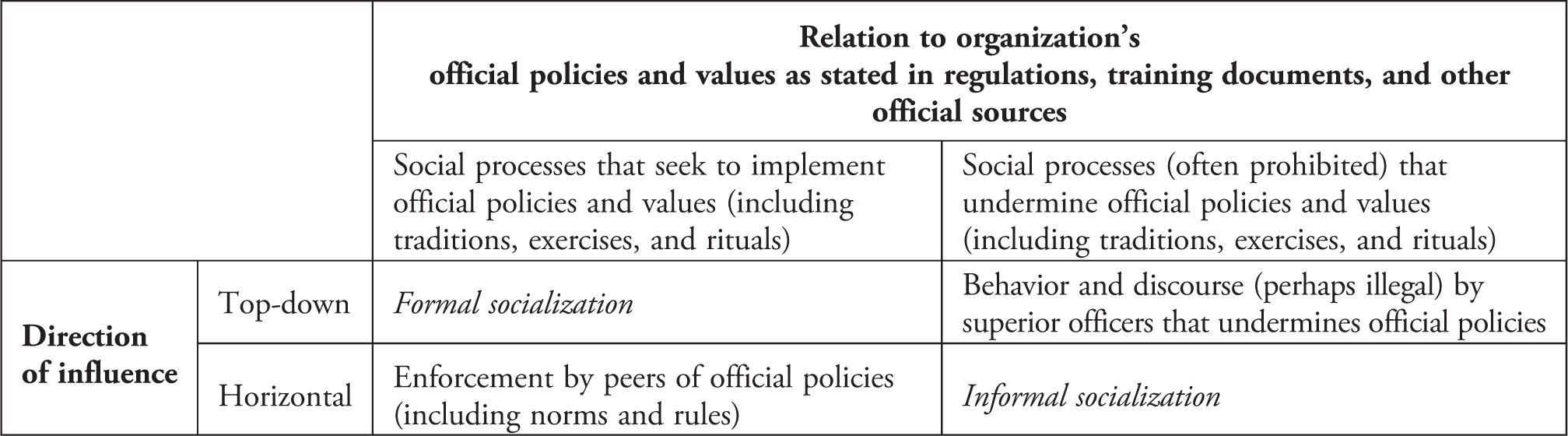
This literature emphasizes the role of diverse socialization processes in the emergence of rape as a practice in some wartime settings (Boesten, 2010; Cohen, 2013, 2016, 2017; Enloe, 2000) and in its effective prevention in others (Hoover Green, 2016). Sexual assault may itself be a socialization process (socializing both victims and perpetrators), as in the case of gang rape. Moreover, it suggests that the socialization of commanders, not just recruits, is key to the emergence of rape as a practice (Wood, 2017). Importantly, the literature distinguishes between socialization stemming from top-down imposition of the organization’s norms through its institutions, and socialization stemming from horizontal social dynamics. These considerations are relevant despite the fact that MSA often occurs far from combat zones: both top-down and horizontal socialization occur stateside as well as during deployment.
Accounting for the persistence of MSA
In this section, we develop our three-fold argument to account for the persistence of sexual assault as a practice within the ranks of the US military. We first define key terms and then present a typology of socialization processes as well as four well-documented cases.
By formal socialization, we mean the traditions, exercises, rituals, and other social processes that seek to implement from ‘above’ the organization’s policies as stated in its regulations, training documents, and other official sources. By informal socialization, we mean the rituals, traditions, exercises, and other processes between peers that undermine those policies (indeed, such informal processes are often formally prohibited). The first draws on top-down mechanisms of socialization (Checkel, 2017); the latter on horizontal, peer-to-peer mechanisms.
We summarize these classes of socialization processes in a 2 x 2 typology, in which the vertical dimension distinguishes between top-down and horizontal influences, and the horizontal dimension between those processes that reinforce official policies of the organization, and those that do not (Figure 1). Formal socialization processes are captured in the upper left-hand cell, and informal processes in the lower right-hand cell. Other combinations may also occur. Top-down socialization through unauthorized and sometimes illegal behavior and discourse by superiors that undermines official policies (the upper right cell) occurs in all four of our cases; horizontal socialization into formal organizational norms and rules (lower left) is possible but not one we found in our cases.
In what follows we draw on four cases of MSA as well as the typology to develop our argument for the persistence of MSA. While we do not claim that the cases are representative, they are very well documented and illustrate distinct types of MSA and harassment, the tolerance by officers, the severity of retaliation, and social norms within units. We draw on official docket filings from three civil suits: Klay v. Panetta, Cioca v. Rumsfeld (from which we draw the Cioca, Jeloudov, and Havrilla narratives), and Doe v. Hagenbeck. 5 (The Online appendix discusses these sources, and includes longer narratives of each case as well as citations, suppressed here for clarity.)
Rebekah Havrilla joined the US Army in January 2004. During basic training, the officer in charge repeatedly used misogynistic and homophobic language (‘bitch’, ‘cunt’, ‘fag’, ‘pussy’) to criticize recruits. The instructor of the required training for sexual harassment and assault prevention permitted participants to enact the prohibited behaviors as he described them, which escalated until one soldier stripped naked and stood on a table in full view of his colleagues (which itself constitutes sexual harassment under Department of Defense regulations). While deployed to Afghanistan in 2006, her supervisor severely and publicly harassed and assaulted her, and another colleague forcibly raped her, after which she filed a restricted report (names would not be included, it would not go to the commanding officer, nor would an investigation be triggered). In 2009, she sought the assistance of a military chaplain after seeing her rapist on her base; he told her ‘it must have been God’s will for her to be raped’ and that she should attend church more frequently.
Soon after joining the Coast Guard in 2004, Kori Cioca’s immediate superior began sexually harassing, fondling, and belittling her. After she reported it, he escalated the abuse, even masturbating over her in her bedroom. Cioca endured months of harassment and abuse, including his striking her across the face when she refused to touch his penis. Eye witnesses and sympathetic officers reported the abuse to the officer in charge, who replied ‘let her burn’ because ‘she ruins careers’. In December 2005, her superior raped Cioca. She reported the rape, but he claimed the interaction was consensual. Despite her offering to take a lie detector test, she was ordered to sign a statement that she had had an ‘inappropriate relationship’ with him; he was convicted only of hitting her. The officer in charge transferred Cioca to a new location where she did not have access to adequate medical care for her injuries. After she reported further harassment, she was discharged, during which she was assigned to an (otherwise) all-male barrack, intensifying her PTSD.
When Greg Jeloudov arrived at basic training in 2009, he was immediately targeted for being ethnically different (Russian) and deviating from traditional masculine roles (working as an actor). His peers severely harassed him, telling him ‘We’ll send you back to Russia split in half, you commie faggot’ and ‘you champagne socialist faggot from New York gonna get what you deserve’. Within two weeks of his arrival on base, members of his unit gang-raped him, telling him that they were ‘showing him who was in charge’. He reported the rape to his drill sergeant, who ridiculed him, and to the officer in charge, who said it must have been his fault. The officer forced Jeloudov to sign a document falsely stating that he was a ‘practicing homosexual’, which was then used to discharge him.
‘Jane Doe’ was a star student at the US Military Academy (West Point), the US Army’s elite undergraduate college dedicated to training officers. In 2010, a classmate raped her. She sought medical treatment and filed a restricted report, as she feared the social and professional retaliation that would follow if she sought a formal investigation. Academy officials had failed to implement earlier directives to reduce sexual assault: court documents describe in great detail how they not only tolerated but reproduced a misogynistic culture that subjected cadets to constant harassment, highly prevalent sexual assault, emotional distress, and the pressure to conform to male norms. Prohibited marching chants with verses such as ‘I wish that all the ladies / were holes in the road / and I was a dump truck / I’d fill ‘em with my load’ and ‘I wish that all the ladies / ’were statues of Venus / and I was a sculptor / I’d break ’em with my penis’, were not only common, but tolerated by the academy leadership, which knew of these chants and did not stop them. Academy officials openly joked with male cadets about sexual exploits and male faculty routinely encouraged them to seize any opportunity to have sex. Doe suffered intolerable anxiety and isolation following her rape, and left the school three months later.
We draw on these cases and the typology to suggest how our theory accounts for the persistence of MSA.
Socialization of military recruits
Beginning in 2004, the US Congress and Department of Defense implemented major institutional reforms to address sexual harassment and assault, including the founding of the Sexual Assault Prevention and Response Office in 2005. As a result, formal socialization (the upper left cell of the typology) during basic training now includes sexual harassment and assault prevention programs. Upon arrival, for example, recruits to the Army are taught about the ‘Seven Core Army Values’ and that sexual assault prevention is aligned with those core values (US Army, 2016). Yet those programs appear to have had little effect (Childress, 2013; Gedney et al., forthcoming; Whitlock, 2015). Havrilla’s case shows that instructors and peers may mock the training, and Jeloudov’s that peers may harass and assault a male (falsely) perceived as gay despite it. Basic training still emphasizes the inculcation of military values and group cohesion through the drill sergeant’s authoritarian, hypermasculine figure. Thus, one mechanism enabling MSA’s persistence may be that formal socialization processes, despite the prevention programs, nevertheless produce a masculinity – enacted by some servicewomen as well as men – that reinforces sexually abusive cultures in some units.
Prevention programs may fail to address sexual harassment and assault through a second mechanism: those formal socialization processes may simply be too weak to override informal socialization processes that in some units facilitate sexual abuse. Such processes – horizontal, bottom-across socialization into norms and practices not authorized by the organization’s institutions and perhaps explicitly prohibited (the bottom right cell) – include hazing and abusive, sexualized language targeting women and others perceived as weak. For example, among men who report gender discrimination, its most common form was ‘persistent or severe accusations of not acting according to men’s gender role’ (Morral, Gore & Schell, 2014–16, Vol. 2: 42). Harassment may be particularly severe against those perceived as outsiders, as in the case of Jeloudov, perceived as being both Russian and gay. Participation of peers in retaliation against victims who report sexual abuse, as in Cioca’s case, socializes unit members to value loyalty over respect for official policy.
Moreover, sexual harassment and assault can themselves be a form of informal socialization in abusive units: members who participate or observe learn a culture of sexual aggression, entitlement, and domination based on an informal hierarchy of social status. In Jeloudov’s case, ongoing severe harassment and punitive gang rape of the outsider – and the tolerant response of commanding officers – very likely reinforced the insider identity of those who participated.
Informal socialization in the form of such sexual assault occasionally targets colleagues who have broken military rules. (In such cases, assault enforces organization norms, but because the abuse itself is unauthorized, they are an instance of the lower right (not left) cell of the typology.) In one case, three male military policemen (MPs) punished two male Marines who failed to produce requested identification by driving them to a remote area and raping them multiple times, and threatening to kill them if they reported the crime (Belkin, 2012: 83–84). In another case, Marine guards (all male) and a Navy medic repeatedly raped a Marine who had gone AWOL, forced him to perform oral sex on new detainees and told him to ‘get used to not being in control’ (Belkin, 2012: 88).
Prohibited top-down socialization processes – the upper right cell of the typology – may persist and thereby reinforce the hypermasculine organizational culture described above, a third mechanism that may explain the failure of reformed formal socialization processes. For instance, drill sergeants continued for many years, including after the gender integration of the Army, to use banned sexist and homophobic rhetoric to motivate soldiers, calling them ‘pussies’ or ‘faggots’, telling them that they ‘run like women’ (Snyder, 2003: 191–193). Some drill sergeants themselves sexually assaulted recruits in recent years (Lamothe, 2014; Risen, 2013). Moreover, when supervisors engage in severe and public sexual harassment, as in Cioca’s and Havrilla’s cases, they implicitly endorse the (prohibited) behavior. When unit commanders or supervisors dismiss or minimize allegations of harassment and assault, as in Cioca’s and Jeloudov’s cases, they demonstrate a policy of de facto tolerance of those actions, against official policy. And when they tolerate or instigate retaliation as in those cases, they endorse further abuse, again against policy.
Thus in some units, informal socialization processes (including hazing) trivialize sexual harassment and assault; establish assault as an appropriate form of punishment, including of those whose gender or sexual identities are seen as transgressing norms; and license retaliation against victims who report. In other units, officers engage in illegal behaviors including harassment and assault of subordinates, thereby endorsing similar acts by unit members. Formal socialization processes targeting enlisted men and women, despite recent reforms, continue to reproduce a masculinity that undermines policies that seek to prevent MSA, in part because it fails to override these informal socialization processes.
The socialization of commissioned officers
Officers not only socialize their soldiers but are themselves the target of socialization. All commissioned officers (COs) go through one of three institutions: a military service academy, Reserve Officers’ Training Corps (ROTC), or Officer Candidate School (OCS). With the exception of the few who are commissioned after serving as an enlisted soldier or sailor, commissioned officers are thus generally trained and socialized separately from recruits. We focus here on the highly selective service academies (the US Military Academy, the US Naval Academy, and the US Air Force Academy) because, as four-year military colleges, they fully immerse their students in US military culture. Furthermore, due to congressional scrutiny after a series of scandals at the academies, sexual harassment and assault at the academies are relatively well documented.
After more than two decades of reform efforts, rates of rape in the three military service academies are very similar to those of the military in general: 2.3% of women and 0.3% of men reported at least one instance of ‘completed unwanted sex’ during 2014; the majority (61% of female victims and 66% of males) were attacked by a fellow student in the same class year (Cook et al., 2015: vi–x).
Some aspects of socialization at the academy are similar to socialization of recruits. First, although reforms have prohibited some formal socialization processes, some persist largely unaffected as informal processes. For instance, although the Air Force Academy has prohibited openly misogynistic marching chants, the ban has had only nominal effect, as documented in Doe vs. Hagenbeck. If any of the cadets in today’s co-ed squadrons refuse to participate, they are likely to be harassed by their peers. David Boxwell, a former professor at both the US Air Force Academy and the US Naval Academy, explains that in formally prohibiting certain processes, bonding rituals such as group masturbation become ‘more surreptitious, smaller-scale, cabbalistic, in a word, “underground.”’ 6 As in the case of basic training of ordinary recruits, the military identity inculcated through these socialization processes is at its core a form of masculinity emphasizing dominance, aggression, and the dehumanization of the enemy, which several scholars connect to organizational cultures within the US military that facilitate sexual assault (Callahan, 2009; Castro et al., 2015; de Volo & Hall, 2015). Second, the documents in Doe vs. Hagenbeck describe in great detail how officials at the US Military Academy tolerated a culture that subjected female cadets to constant harassment, prevalent sexual assault, emotional distress, and the pressure to conform to patriarchal norms. Indeed, some officials explicitly endorsed that culture, against policy. Third, the public nature of much sexual harassment socializes new cadets who participate or simply observe into that culture. Thus, similar to the case of ordinary recruits, reformed formal socialization processes have failed to curtail informal socialization processes that reinforce cultures conducive of sexual abuse.
However, socialization at academies differs from socialization of recruits. Most importantly, future commissioned officers not only undergo formal socialization by superior officers, including more senior students, but also endure extensive informal socialization at their hands. The fourth-class system, in which upper-class cadets dominate younger cadets, is a longstanding feature of US military academies. The system has long included extensive hazing, despite its banning by the US Congress more than a century ago. Sexual hazing by senior cadets at the US Army’s Military Academy, for example, continues (Groah, 2005: 1–24). Similarly, although hazing is prohibited at the US Naval Academy, its ‘4/C Development System’ gives upperclassmen the right and responsibility to ‘correct infractions’ and to oversee ‘every aspect of the training, performance, and growth of Midshipmen 4/C’ (Commandant of Midshipmen, 2014, Enclosure 3: 37–40), a formal authority that helps explain ongoing physical and psychological abuse of ‘plebes’ (Groah, 2005). De Volo & Hall (2015: 866, 870) describe the Air Force Academy as ‘based upon a strict hierarchy in which new or “fourth-class” cadets are powerless and obedient to more senior cadets’. Although sexual abuse is prohibited, they suggest it is nonetheless common (as an informal practice) during Basic Cadet Training (de Volo & Hall, 2015: especially 878–879).
The fourth-class system and its abusive traditions remain central to socialization at the military academies and may contribute to the organizational culture and authority structures that facilitate the persistence of sexual harassment and assault despite their formal prohibition. Socialization, both formal and informal, appears to produce an officer culture that values hypermasculine men but denigrates most women (because they are ‘too masculine’ or merely feminine), men seen to be ‘unmanly’ or weak, and gender and sexual minorities. The result, when combined with problematic institutions such as commander prerogative for investigating and prosecuting sexual assault allegations, is a body of officers that by and large tolerates sexual harassment and assault. To be sure, not all officers embrace such norms, beliefs, and practices, but sufficiently many do that abuse and tolerance of it continues.
Conclusion
We argue that socialization, both formal and informal, of recruits and also of officers is central to understanding why sexual assault and harassment persist within the US military. Despite ongoing reforms to formal socialization processes to emphasize the harm and threat that MSA poses to the organization, the formal socialization of recruits into the US military continues to reproduce a masculinity whose values, norms, and beliefs not only fail to override local norms in those units whose cultures support abuse, but that also in other ways undermines policies that seek to prevent sexual assault. Certain informal socialization processes in some units trivialize the sexual harassment and assault of colleagues; establish sexual abuse as an appropriate punishment, including of those whose gender or sexual identities are seen as transgressing military gender norms; and license retaliation. Moreover, officers sometimes sexually harass and assault subordinates, thereby endorsing similar acts by servicemembers under their command. The socialization of commissioned officers, particularly the abuse of younger students in the US military academies by members of advanced classes, combined with incentive structures that penalize those who report sexual assault up the chain of command and that preserve commander prerogative to investigate sexual assault, continues to undermine efforts to end the de facto tolerance by many officers of sexual abuse.
Our argument promises to account for other puzzles as well. For example, in some units sexual harassment and assault of a particular victim or victims reinforce their outsider status and, in cases in which the abuse is public, reinforce the insider status of those who participate or merely observe, leading to repeated victimization and also retaliation if the abuse is reported.
Our typology enriches the literature on political violence in identifying distinct types of socialization processes that mitigate or intensify the tensions between principals and agents. Our proposed theory may also contribute to the analysis of other forms of unordered and unauthorized violence. In particular, it strengthens the literature on wartime sexual violence in identifying socialization processes that support frequent rape as a practice rather than a strategy of war.
For scholars of socialization, the typology defines fruitful avenues for further research by bringing together the largely separate literatures on socialization in hierarchical institutions, such as multilateral organizations, schools, and militaries, and in ‘flatter’ associations such as gangs. The interplay we discuss between formal and informal processes of socialization could be particularly productive for the analysis of violence in schools and prisons. In particular, that formal socialization processes may, when prohibited, become informal processes that reinforce problematic behaviors may be a general phenomenon. The reproduction of hypermasculine norms and beliefs through informal socialization suggests that reforms to formal socialization processes fail through the active resistance of those targeted (Checkel, 2017; Manekin, 2017).
We hope that this analysis contributes to policies that more effectively address sexual assault within the ranks of the US military. It highlights the need for deeper analysis of the impact of informal socialization processes, including how their effects differ by gender, and in particular, how the official prohibition of formal socialization processes may merely lead to their transformation into informal processes. In particular, our theory suggests that differences in the socialization of soldiers and officers across units and across branches of the US military (and perhaps also across other state militaries) may account for differences in rates of sexual assault. The promotion of exaggerated forms of masculinity merits more scrutiny in Department of Defense reports. Future surveys should document the prevalence of sexual assault and harassment among those who leave the military during basic training, during the first six months of service, and the population of about 200,000 or so servicemembers who annually separate from the service (all likely to suffer higher than average rates of MSA). That victims so often suffer repeated sexual assaults – and retaliation – also merits more investigation.
Finally, our argument suggests that analysts study in more detail the processes of officer socialization, informal as well as formal, throughout the military career and also in the formation of non-commissioned officers such as drill sergeants. In particular, socialization processes that lead to the discounting of sexual assault allegations merit significantly more scrutiny. What understandings of gender, harm, and performance underlie the effective tolerance of MSA despite decades of somber denunciations from the leadership about the ‘crisis’?
Footnotes
Acknowledgements
The authors thank Peter Aronow, Julia Bleckner, Jeffrey Checkel, Dara Cohen, Maria Eriksson Baaz, Elizabeth Hillman, Andrew Morral, Stephen Moncrief, Roger Petersen, Livia Schubiger, Kai Thaler, and two anonymous referees for comments on earlier drafts, and Julia Bleckner, Ellie Dupler, Maria Gargiulo, and Nicole Villar Hernandez for research assistance. The authors thank the Whitney and Betty MacMillan Center for International and Area Studies of Yale University for research support.
Supplemental material

Notes
References
Supplementary Material
Please find the following supplemental material available below.
For Open Access articles published under a Creative Commons License, all supplemental material carries the same license as the article it is associated with.
For non-Open Access articles published, all supplemental material carries a non-exclusive license, and permission requests for re-use of supplemental material or any part of supplemental material shall be sent directly to the copyright owner as specified in the copyright notice associated with the article.
