



Abstract
The International Criminal Court’s interventions have prompted debate about the wisdom of criminally prosecuting combatants while attempting to build peace in conflict-ridden societies. Previous research fails to distinguish between different types of trials. Using a large-N dataset of three types of criminal trials undertaken during internal conflict – domestic security trials of rebels, domestic human rights trials of state agents, and international war crimes trials of both – this article tests a theory of the compellent effect of criminal prosecution on conflict termination. We find that, even when accounting for endogeneity, rebel trials are associated with a higher probability of conflict termination, while trials of state agents are weakly associated with conflict persistence. We argue that the former compel the opposition to discontinue fighting, while the latter signal to rebels a lack of government resolve. We also find that the effect of international trials, which at times appear weakly associated with conflict termination, is endogenous to international intervention more generally.
Introduction
In Colombia, where the International Criminal Court (ICC) has conducted a years-long preliminary examination, negotiations between the government and the rebel Revolutionary Armed Forces of Colombia (FARC) hinge on how to address human rights violations committed by all sides during 50 years of war. Activists demand that perpetrators be held criminally accountable, while former combatants hope to avoid trials. Faced with this dilemma, policymakers have pondered how the prospect of criminal justice affects peace settlements. 1 Do criminal prosecutions of armed combatants during violent intrastate conflict help bring about the end of fighting? This question was once relegated to the fringes of transitional justice discussions, which focused on the consequences of prosecutions after political transitions. However, the issue of justice in the midst of armed conflict has come to the forefront with the ICC’s repeated interventions into active conflict zones in countries such as Uganda, Democratic Republic of the Congo (DRC), Sudan, and Libya.
Academics and policymakers debate the alleged pacifying effect of criminal prosecution. Rationalists expect soldiers to respond to criminal indictments or arrest orders by digging in their heels and fighting even harder, in order to avoid the risk of a lengthy prison stint (Vinjamuri & Snyder, 2015). By contrast, norms theorists argue that prosecutions sideline various conflict actors – like the Lord’s Resistance Army (LRA) in Uganda – and thus damage their fighting capacity (Akhavan, 2005). However, neither possibility, that prosecutions lengthen or shorten conflict duration, has been tested with cross-national data equipped to explore patterns across space and time.
Any exploration of the pacifying effects of criminal justice must account for variation in trial processes. However, to date, few studies have distinguished different types of criminal justice activity. While the ICC focuses squarely on a specific set of ‘atrocity crimes’ written into the Rome Statute (Scheffer, 2012), these do not cover the full spectrum of crimes for which combatants may be prosecuted in the context of intrastate conflict. This fact has caused some conceptual confusion in the literature. In their analyses, some authors focus specifically on prosecutions for human rights and atrocity crimes (Kim & Sikkink, 2010), while others broaden their definition to also include trials of combatants for plotting coups, committing treason, sabotaging the military, or threatening national security (Binningsbø et al., 2012; Olsen, Payne & Reiter, 2010). Each of these kinds of domestic trials – those that focus on human rights violations, and those that focus on security crimes – can reasonably claim to serve ‘justice’. Yet it also is reasonable to suspect that these trials have different effects in the context of intrastate conflict.
In this article, we empirically explore the effects of different types of trial activity on conflict termination. Unlike previous research, we distinguish three types of prosecutions of conflict actors – domestic security trials of rebels, domestic human rights trials aimed at state agents, and international war crimes trials targeting both – and theorize how each type of trial may or may not compel actors to end the conflict. We test the derived hypotheses on a cross-national dataset of criminal trials. We find that, even when accounting for endogeneity, trials of rebels are associated with a higher probability of conflict termination, while trials of state agents are weakly associated with conflict persistence. We argue that the former compels the opposition to discontinue fighting, while the latter signals to rebels a lack of government resolve. We also find that the effect of international trials, which at times appear weakly associated with conflict termination, is endogenous to international intervention more generally. We conclude by reflecting upon the theoretical and political implications of our findings.
Judicial interventions and the duration of intrastate conflict
Theorists who put stock in the power of human rights norms believe trials curtail atrocities. For example, Cherif Bassiouni (1996: 18) writes that prosecutions promote peace because ‘they serve as deterrence, and thus prevent future victimization’. Further, the prosecutors of international courts assert that ‘only a sustained commitment to accountability will deter these atrocities’. 2 Scholars isolate several important mechanisms through which trials might break cycles of violence: punishment, deterrence, and the symbolic expression of the rule of law (Akhavan, 2001; Drumbl, 2007; Elster, 2004; Kim & Sikkink, 2010). With regard to the first, perpetrators’ willingness and ability to instigate further violence may be hampered by their incarceration and/or loss of support resulting from courtroom revelations. Retributive justice also may deter future abuses if would-be abusers know they might be punished (Akhavan, 2009; Jo & Simmons, 2016; Kim & Sikkink, 2010). Finally, trial proceedings may promote the rule of law by reviving a dormant judiciary, challenging the normative acceptability of violence, and communicating to victims that the government is committed to defending human rights (Nettelfield, 2010; Orentlicher, 2010; Osiel, 1997; Smulovitz, 2002).
Others, who we refer to as rationalists, express greater pessimism. Rationalists view trial optimism as resulting from wishful thinking, legal romanticism, or misplaced causality that is better attributed to structural conditions. More importantly, rationalists worry that trials might keep soldiers on the battlefield, derail ongoing peace negotiations, and deepen grievances between opponents. If faced with the choice between seeking peace only to be arrested for human rights violations, or continuing to fight, armed combatants will likely choose the latter option because it is less costly (Sands, 2011; Shadid, 2011). Thus, groups expecting to be targeted for prosecution may be unwilling to bargain, leading to a breakdown in negotiations (Aron, 1981; Branch, 2007; Huntington, 1991). Moreover, trials may further exacerbate tensions between perpetrators and their opponents (Hadden, 2004; Long & Brecke, 2003; Snyder & Vinjamuri, 2003/04). By blaming one side or the other for their wartime actions, trials risk creating martyrs and generating new grievances that could sustain or exacerbate conflict (Mamdani, 2015; Weinstein & Stover, 2004).
Rationalists are often hostile to international courts in particular. The ad-hoc tribunals, and now the ICC, are seen as not only neo-imperial, but as external interlopers that potentially disturb fragile bargaining (Branch, 2007; Kissinger, 2001; Turner, 2008). Others see them as tools of ethnic incitement for political entrepreneurs (Subotić, 2009). Furthermore, these interventions can interfere with the work of domestic judicial processes, which may more effectively address context-specific sources of conflict (Clark, 2011). A common refrain of criticism is that, at best, international indictments may do little to change the political calculations of indictees. If leaders have determined that atrocities will increase the chances of success in the conflict and order their commission, ICC action seems unlikely to fundamentally change their calculus (Cronin-Furman, 2013). The threat of ICC indictment appears likely to curb violence only in situations where subordinates had previously been given free rein to engage in excesses. In those instances, ICC interest in the conflict may lead military and political leaders to assert control and insulate themselves from potential indictments.
Despite the policy community’s predominant concern with judicial intervention in ongoing conflict, scholars, particularly those who conduct broadly cross-national research, have paid remarkably little attention to the question. Instead, scholars have focused primarily on the effects of trials in post-conflict (Lie, Binningsbø & Gates, 2007; Meernik, Nichols & King, 2010) and/or post-authoritarian environments (Olsen, Payne & Reiter, 2010; Reiter, Olsen & Payne 2012; Sikkink, 2011). This likely reflects the transitional justice field’s understandable focus on periods of ‘transition’, where a society is moving from violence to institutionalized political behavior. Nonetheless, the preoccupation with transitions means in bello trial interventions need greater scrutiny.
Lack of rigorous investigation, though, is not the most important problem. Theory is. Expectations about trials during conflict situations diverge because observers tend to lump different processes together. As we have shown, justice proponents tend to argue that trials can deter further violence, while detractors argue that they cannot deter. But if the debate is over whether trial interventions shorten or lengthen ongoing civil wars, the argument should not be framed in terms of deterrence. If rebels are already engaged in armed combat against the government, ending this engagement requires acts of compellence, not deterrence. Whereas deterrence is about stopping actors from doing things they have not yet done, compellence is about stopping them from doing things they are already doing (Schelling, 1966: 72–73). Applying a deterrence logic during conflict makes sense if one is considering whether trials stop armed combatants from committing certain acts during battle (Jo & Simmons, 2016), influence autocrats’ decisions to step down (Nalepa & Powell, 2015), or alter the behavior of actors in neighboring countries (Escriba-Folch & Wright, 2015). It also is logical to focus on deterrence after the conflict has terminated, when the question becomes how to prevent actors from starting a new fight. However, when war is already being waged, the relevant question is how criminal prosecutions might compel armed combatants to stop fighting. Next, we distinguish three types of criminal prosecutions that occur during conflict before considering how each type may or may not compel conflict actors to stop fighting.
Prosecutions in the midst of conflict
In intrastate conflict settings, judicial interventions can take many forms. Authoritarian leaders stage show trials for coup plotters. Military courts charge soldiers for deserting, breaking ranks, or mutiny. Governments send suspected enemies of the state to trial, even when they are actually journalists, academics, or unionists. And sometimes, independent courts indict soldiers and rebels for terrible acts committed in the course of conflict. In war, then, criminal prosecutions can serve to punish enemies, to discipline, to repress, and/or to seek justice. Even when presented with a near-complete record of events, it is difficult to determine which purpose motivates actors who initiate judicial proceedings. One can imagine government leaders arresting opposition members for supposed human rights violations when, in fact, their intention is to eliminate a threat. For example, in October 1992, the Peruvian state prosecuted Abimael Guzmán and other leaders of the Sendero Luminoso rebel group in a secret military trial. Some officials claimed it was for war crimes, yet others reported the charges were treason and terrorism. It is difficult to know for sure because the proceedings were not public. 3
We distinguish three types of trial from data collected by the Transitional Justice Research Collaborative (TJRC). 4 These include domestic trials of armed opposition figures (Security Trials), domestic trials of state agents accused of human rights violations in relation to conflict (Domestic Human Rights Trials), and international criminal prosecutions of conflict actors (International Trials). The reason we choose these categories is that they allow us to explore claims without making unnecessary assumptions about motivations. With respect to security trials, for example, we cannot distinguish among trials of armed rebels for human rights violations, treason, crimes against the state, or plotting coups. Prosecutors sometimes claim to care about human rights, when, in reality, they just care about punishing rebels. Moreover, regardless of whether or not the government’s intention is to exploit international human rights norms for its own purposes (Grodsky, 2010; Loyle & Davenport, 2016; Subotić, 2009), judicial action is likely to be interpreted that way by opposition forces. For this reason, we group all trials of rebels together. We term them security trials because they result in the long-term imprisonment or death of armed challengers. As such, their aim is to strengthen the security of the state.
The second type is the domestic human rights (DHR) trial. Because we cannot assume that domestic human rights trials against rebels are different from security trials, this category focuses only on human rights prosecutions of state agents. We define DHR trials as domestic prosecutions of state actors for crimes against international human rights norms, including genocide, crimes against humanity, torture, unlawful killing, political imprisonment, disappearance, and sexual violence. For this article, we specifically analyze trials for crimes that take place when state actors are performing custodial duties in conflict zones, or when they are engaged in combat or counterinsurgency. Because they target military personnel, police officers, security forces, and paramilitaries associated with the government, these trials are functionally different from those we label security trials. To return to Peru, in 1994, two generals and six officers were tried for the extrajudicial killing of nine students and a professor at La Cantuta University for alleged involvement with the Shining Path. 5 Though those convicted in this trial later received amnesty, this fits the definition of a DHR trial.
Third, we examine international trials, which are distinct in that they are not initiated domestically, but by outside judicial institutions, including ad hoc international tribunals like the International Criminal Tribunal for the Former Yugoslavia (ICTY); hybrid international-domestic tribunals like the Special Court for Sierra Leone; and the ICC. We specifically count all prosecutions of government or rebel forces for human rights violations committed in conflict situations. We distinguish this category and lump the targets together because, even though states exert some influence over international courts, conflict actors are unable to control them to the same degree they might domestic proceedings. In international courts, the nearest equivalent to national security trials would be prosecuting individuals for the crime of aggression. We do not address these cases for two reasons. First, they are extremely rare. Although the ICC may eventually have jurisdiction over the crime, international courts have not dealt with it since Nuremberg. Second, as the Nuremberg International Military Tribunal and the aborted attempt to prosecute Kaiser Wilhelm after World War I illustrate, these types of trials typically occur after conflict ends (Bass, 2000).
A global dataset, the TJRC has information on over 3,000 trials for crimes involving human rights or security crimes since 1970. Of those, 841 were related to crimes committed in the midst of an armed conflict: 6 92 are security trials, 658 match our criteria for DHR trials, and 91 are international trials (a breakdown of trials by country can be found in Table AIII of the Online appendix). The use of these trials has changed over time. As Figure 1 illustrates, the number of DHR trials increased in the 1990s and again in the 2000s, now surpassing the total number of ongoing conflicts. Figure 2 depicts the percentage of each type of trial as a total of all mid-conflict trials by year. While security trials were the dominant type of trial through the 1970s, they were eclipsed by DHR trials in the mid-1980s. We explore the impact of these trends on conflict duration in the next section.
Trials and conflict duration
Ending conflicts requires either that the government achieves victory, or that both sides decide to bargain rather than continuing to fight.
7
In the first instance, compellence is achieved through power. If rebel forces are decisively defeated, individual rebels will be compelled to surrender and stop fighting, at least in the Count of ongoing conflicts and mid-conflict criminal prosecutions Stacked area chart of prosecutions in conflict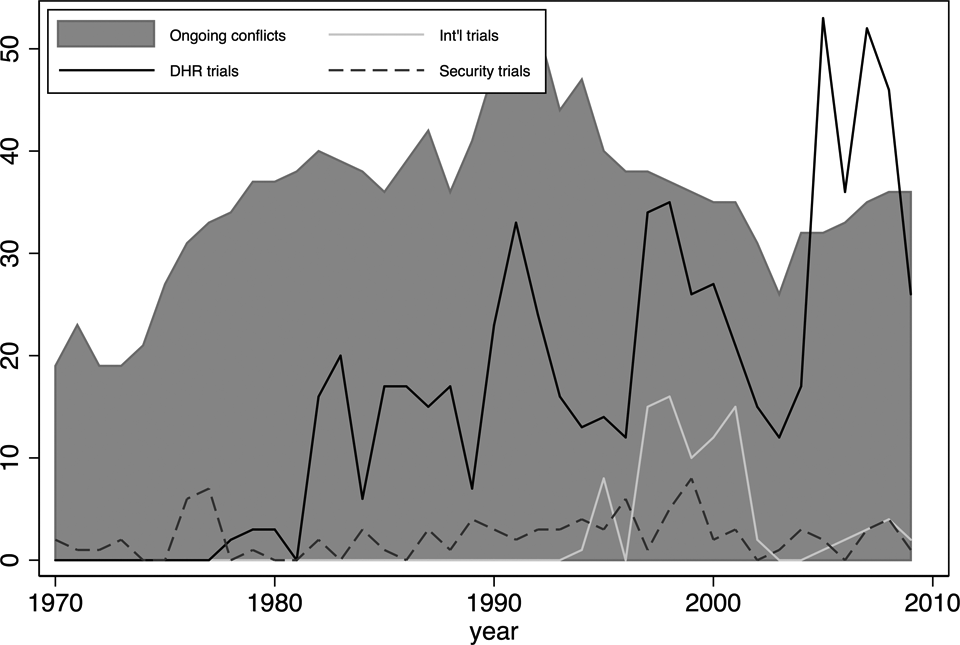

How are criminal prosecutions related to conflict-bargaining processes? Security trials, we argue, represent an extension of the conflict to the courtroom. Typically, these trials do not look like prosecutions in states with developed, independent judiciaries; they often do not follow due process, try dozens of individuals at once, and involve irregularities. For example, in 1977, the Nicaraguan government held a trial for Sandinista leader Tomas Borge Martinez, along with 109 other guerillas. The rebels were held in secret, beaten and tortured, and sentenced by a court on questionable charges (Riding, 1977). Because they often apply exceptional rules and suspend normal judicial processes, security trials like this one should be considered an extension of a military strategy to end the war.
Just as war is politics by other means, security trials are war by judicial means. In particular, we consider security trials to be a milder, more internationally legitimate form of leadership decapitation. Rather than killing them, governments can arrest their adversaries, hold trials, and enjoy the benefits of legal legitimation. A growing body of research suggests that this strategy is often successful. Cross-national studies of terrorist and insurgent groups find that eliminating a group’s leadership significantly increases the probability of ending the violence (Johnston, 2012; Price, 2012; Tiernay, 2015). Jordan (2009) suggests that leadership decapitation prompts groups to seek peace by wiping out the leadership qualities that made the group successful and eliminating a valuable node in the social network that underlies the organization. The apprehension and prosecution of opposition figures should, therefore, be doubly effective in terms of compellence. By removing members of the rebel opposition, state forces ensure that they cease organizing further violence. Also, by showing that the state is capable of capturing and trying its most significant challengers, the regime sends a message to the rebel rank and file, who may still be engaged in combat or planning future attacks, that further resistance is likely to result in significant losses. Among other things, observers credit the trials of Guzmán and other leaders with fatally weakening Sendero Luminoso (Burgoyne, 2010). As such, security trials may compel holdout rebel forces to choose outright surrender or to begin bargaining from a position of weakness.
By contrast, related research hints that security trials may lengthen conflict, at least for a time. This could happen for two reasons. The disruption of rebel organizations may lead to a splintering of the opposition, resulting in an escalation and intensification of violence as factions seek to outbid each other for supporters (Conrad & Greene, 2015). An additional reason is that, after witnessing fellow fighters taken to trial, rebels may seek to avoid the same fate by fighting harder. In Nicaragua, the Sandinistas intensified their campaign after Borge’s imprisonment. During the campaign, they seized the National Palace where the legislature sat and exchanged hostages for cash and more than 60 prisoners, including Borge. Ultimately, support for the Somoza dictatorship splintered and eventually led to its downfall (Anderson, 1988: 183). Though we expect security trials to compel rebels to end the war, the competing logic is also plausible. Thus, we undertake a two-tailed test of the following propositions: Hypothesis 1a: Security trials will be associated with an increased probability of conflict termination. Hypothesis 1b: Security trials will be associated with a decreased probability of conflict termination.
While security trials are an extension of government strategy to win the war, domestic human rights trials involve state judiciaries attempting to rein in the excesses of government forces. As such, these trials may be understood as a reflection of ‘positive judicial independence’ (Hilbink, 2012). Despite the wishes of military leaders trying to keep order by any means necessary, lawyers and judges often seek to prevent armed forces from going beyond circumscribed limits to the use of force, inside and outside of war zones. By applying law to state actors in conflict, DHR trials may serve to restrain military forces.
In a recent example, the Juan Santos regime in Colombia initiated prosecutions against a number of government soldiers for creating ‘false positives’ – a term used to describe low-income workers who were lured into the countryside, murdered by the military, dressed as guerillas, and used to artificially increase the body count in the war against FARC and National Liberation Army (ELN) guerillas. This objectionable behavior was evidently sanctioned by some military commanders, who later resigned. As news of this scandal hit, it became very important for President Santos – who may himself have known about false positives during his tenure as Defense Minister in 2008 – to step aside as the judiciary proceeded with investigations in military abuses (Kaul, 2012).
Theorists have not considered how government or rebel combatants would respond to domestic human rights prosecutions of state agents. On the government side, military forces may be compelled by extensive judicial pressure to seek a resolution. Conflict research suggests that government forces with long-term experience fighting against rebels become hardened and unwilling to negotiate. If some of these forces are put on trial for complicity in human rights violations, their replacements might prove more willing to support an end to fighting (Prorok, 2016). State agents also may seek to exert greater control over the trials. In Colombia, for example, when they were unable to resist the ‘false positives’ trials, the military successfully pressured the government to allow the cases to be heard in military courts (Isacson, 2013).
It is less clear how rebels might respond to DHR trials. On the one hand, prosecuting state agents could be taken as a signal of overall government strength. Addressing the grievances of victims and activists, undoubtedly a weaker challenge to the regime compared to an armed opposition, may transmit the government’s confidence in eventual victory. The ‘false positives’ trials in Colombia were closely followed by the start of secret government talks between the government and the FARC in Havana in early 2012 (Isacson, 2013). Furthermore, conducting DHR trials might provide the government the moral high ground, which can swing support away from rebel forces thirsty for legitimacy (Jo, 2015). On the other hand, additional work also argues that democratic restraint, rooted in the rule of law, may attract longer campaigns of violence from rebels and terrorists (Bueno de Mesquita & Dickson, 2007; Pape, 2005).
8
Prosecuting government agents might be interpreted by rebels as a sign of government weakness. Rebels could view DHR trials as desperate attempts to curry favor with the international community or as evidence of growing division within government ranks. Based upon these competing logics, we conduct a two-tailed test of the following propositions: Hypothesis 2a: Domestic human rights trials will be associated with an increased probability of conflict termination. Hypothesis 2b: Domestic human rights trials will be associated with a decreased probability of conflict termination.
Scholars have long been interested in the effect of third-party intervention on the duration of intrastate conflict. Intervention obviously can take a number of forms, from diplomacy to economic aid to sanctions and military intervention. For many types of intervention, empirical findings about their effect on conflict duration are mixed and inconsistent (Hoeffler, 2014). International human rights trials are a type of intervention, one that is often initiated for reasons that are at least partially unrelated to conflict dynamics. International judicial intervention is triggered when powerful states’ interests are sufficiently damaged by the conflict, the violence is an egregious violation of international human rights norms, and domestic courts are unwilling or unable to enforce international law (Schabas, 2008). These trials are thus a manifestation of international indignation, which, like other types of intervention, could be tone deaf to local context (Vinjamuri & Snyder, 2015).
How might international trials be related to compellence? One must first consider that international trials have seldom targeted conflicts that are easily resolved. The wars that the international community responds to – like those in the Balkans, the Great Lakes region of Africa, Sudan, or Colombia – are intractable. In such conflicts, an equilibrium between fighting forces is often reached, and positions become inflexible. The task for international actors, then, is to attempt to disturb that equilibrium and compel actors to stop fighting. This may be an advantage of international trials. Unlike security and DHR trials, which are largely endogenous to internal political and conflict dynamics, international trials are produced by third-party actors. Therefore, they may serve as a kind of shock to a stable or unchanging conflict situation.
While several scholars argue that international trials prolong war by eliminating bargaining options, an application of our compellence theory leads to the expectations that, if anything, they are most likely to enhance the probability of conflict termination. The logic is simple. Were the balance of power such that one side could overwhelm the other militarily, victory would happen with or without international trials. In stalemated conflicts, without a disruption or sudden shift in the balance of power, there is little reason to suspect that rebel or government forces will be compelled to move from fighting to bargaining.
One disruption that might have such a compellent effect is the increased risk of investigation or indictment by an international court. Leaders of each fighting side might grow concerned about international monitoring of the conflict, especially monitoring that is attentive to humanitarian and human rights law. Their concern could then translate into decreased violence (see e.g. Jo & Simmons, 2016). Greig & Meernik (2014), for example, find that ICC arrest warrants increase the chances that conflict parties will seek third-party mediation. Even though foot soldiers will likely assume they are at little risk of being targeted by international courts, they might still shy away from engaging in activity that is distinguished for its brutality, lest they attract attention (Jo & Simmons, 2016). All these factors could usher in a period of bargaining that may ultimately result in a cessation of conflict. Leaders will maintain the hope that they can later bargain away whatever legal punishments they face. This logic is backed by anecdotal evidence from Uganda. Following the release of his arrest warrant in 2005, Joseph Kony met with Jan Egeland on the border between Uganda and the DRC. Kony ‘apparently told Egeland that he wanted the ICC warrants lifted as a condition for entering the formal talks’ (Bosco, 2014: 129).
Still, we must leave room for the opposite logic as well – that international courts will not compel opponents to seek peace. International trials can also be manipulated by governments intent on targeting rebel opponents. Government leaders in the DRC, Central African Republic, and Ivory Coast all reportedly invited ICC involvement in order to send their opponents to The Hague (Broache, 2015). This cynical misuse of international tribunals gives state agents confidence in continued impunity and undermines any credibility the court might have had with opposition forces. Rather than negotiating an end to conflict, rebel groups might, in fact, follow the path that Kony ultimately took when the Juba settlement broke down: dig in and fight (Rodman & Booth, 2013). Given these conflicting expectations – that international criminal investigations disrupt stalemates and also that they are used to target opposition groups – we test the following propositions: Hypothesis 3a: International trials will be associated with a greater probability of conflict termination. Hypothesis 3b: International trials will be associated with a reduced probability of conflict termination.
Research design
The dependent variable for our analysis is conflict termination, which is marked by at least a year-long cessation of fighting. We are interested in whether criminal prosecutions hasten or prolong the time until conflict termination. To test our hypotheses, we run a series of probit models using a dataset we constructed using a combination of UCDP/PRIO’s Armed Conflict and Conflict Termination Datasets, which we organize into 150 conflict panels between 1970 and 2009 (Kreutz, 2010; Petterson & Wallensteen, 2015). 9 The dataset contains information on 288 fighting episodes and 252 conflict terminations in 89 countries.
UCDP/PRIO data can be organized into government–rebel dyad panels or into conflict panels. Data organized by conflict groups together multiple dyads if more than one rebel group is simultaneously fighting against the government over the same issue. We adopt the overall conflict rather than the dyad as our unit of analysis for three reasons. First, data on prosecutions are most reliable at the conflict unit of analysis. When coding prosecutions, it is far easier to identify the conflict in which a trial defendant is fighting than to identify the specific rebel group to which the defendant belongs. The reason is that source material often describes the armed conflict while failing to include information on trial defendants’ specific group membership. Second, we assume that trials can alter one conflict without affecting another simultaneously ongoing in the country; for example, trials for groups fighting in the Ituri region of the DRC might seem remote to those groups fighting in the Kasai region. It makes sense to treat these conflicts separately because they exhibit different characteristics. Third, while it is not as ideal as a dyad-level analysis, a conflict-level analysis is a more conservative evaluation of the argument, because it tests the effects of trials on conflict processes that can involve many parties. Dyad-level studies might overestimate the impact of trials on overall civil war duration by counting as a success an individual group’s demobilization while other groups continue to fight. Testing for the effects of prosecutions on the entire conflict allows us to account for this possibility.
Our key independent variables – Security trials, domestic human rights (DHR) trials, and International trials – are available from the TJRC in binary format, indicating the presence or absence of a new trial. 10 To test our hypotheses, we run a series of models that also control for conflict-specific factors that existing research indicates influence the probability of conflict termination. One group of controls includes characteristics of the conflict. Conflicts being fought over territorial control (Territorial), rather than over the nature of the government, are less likely to end quickly (Fearon, 2004). The Cumulative intensity of the conflict also should prolong its length. The more lives taken, the more difficult it will be for each side to accommodate the other. We operationalize cumulative intensity as a binary that equals 1 if the war has reached a total of 1,000 battle-deaths. We also control for the Conflict duration, the number of years that the conflict has been fought since the first year. The longer a conflict goes on, the more likely it is to end at some point. Each of these three variables is derived from the UCDP/PRIO Armed Conflict Dataset (Gleditsch et al., 2002; Petterson & Wallensteen, 2015). We control for additional conflict factors that we code based on Cunningham et al.’s (2009) Non-State Actor Dataset. One variable we include is the number of dyads fighting (Fighting dyads) in the conflict in each year; a five-level (–2 to 2) categorical variable measuring the Balance of power between the strongest fighting dyad in relation to the government; a measure of whether the conflict is ethnicized (Ethnic war); and an indicator of whether it can be categorized as an extended Coup. Conflicts that erupt after coups should be short-lived, but ethnicized conflicts should last much longer.
A second group of factors accounts for outside actors, which might both help explain the presence of trials and predict the end of conflict. We include binary measures for the presence of UN Peacekeeping forces, 11 and also for third-party mediation attempts (DeRouen, Bercovitch & Pospieszna, 2011). Because the presence of outside parties assists fighting sides in bargaining, we expect a positive association with conflict termination. It is also possible that the mere attention of the ICC’s Office of the Prosecutor (OTP) urges conflict actors to begin moving toward accommodation with the other side, to avoid eventual prosecution. For this reason, we include a variable (ICC intervention), which is coded 1 in all country-years in which the ICC-OTP is performing a preliminary examination or a full investigation. Including this variable will also allow us to separate the effects of ICC monitoring from actual trial proceedings initiated by it. 12
Probit models
**p < 0.01, *p < 0.05, † p < 0.10.
Results
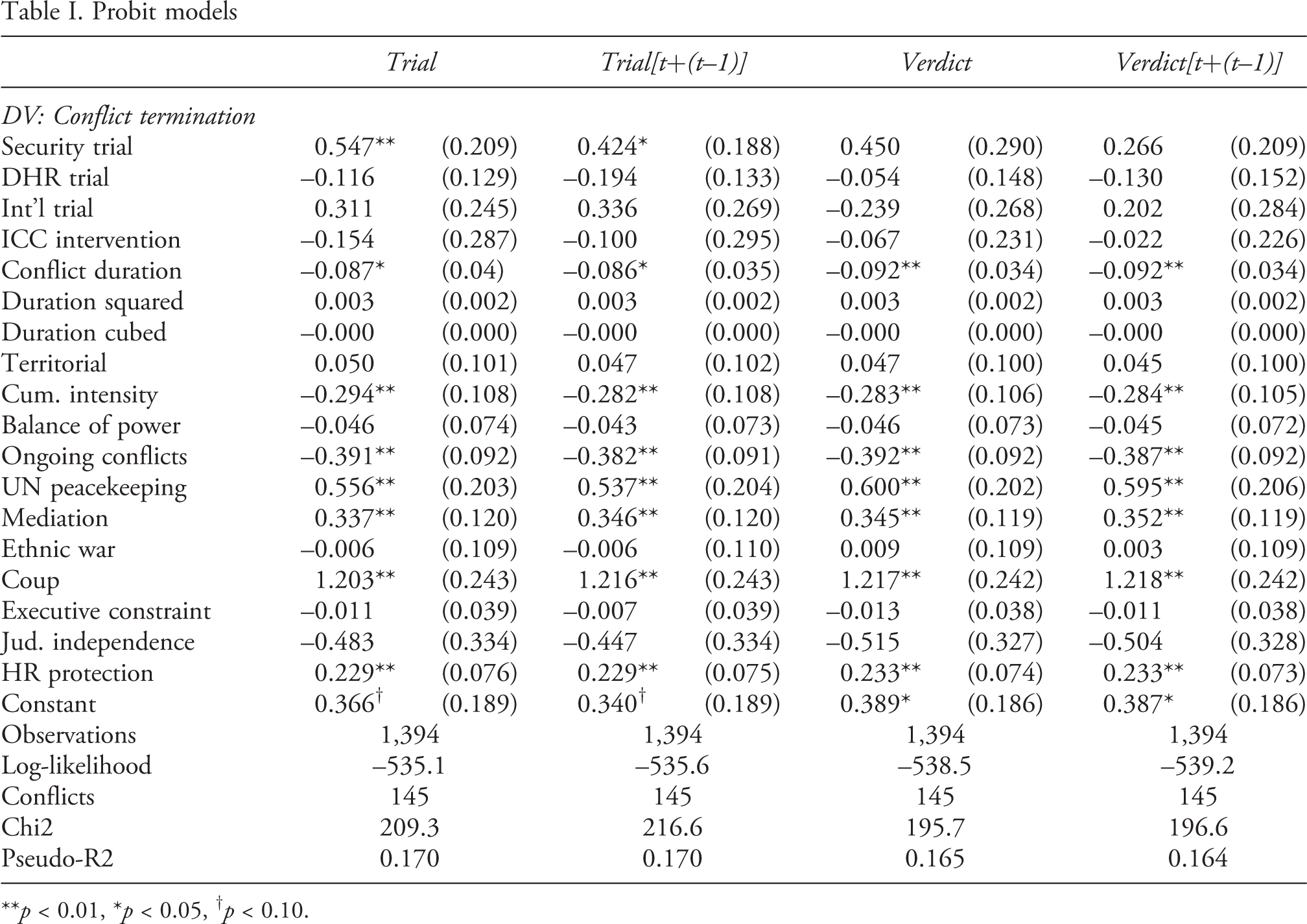
Table I presents the results from four probit models
13
that predict conflict termination while controlling for the amount of time a particular installment of conflict has lasted (Conflict duration).
14
Robust standard errors are clustered by conflict. Column 1 of Table I shows the results of a probit model using binary indicators of whether a prosecution was initiated in time t. Column 2 shows the results using an alternative operationalization of the trial variables that accounts for the possibility that trials have a lagged effect on termination. These variables are coded 1 if a trial took place either in time t or in time t−1, allowing us to analyze whether the conflict ended any time within two years of a prosecution. Columns 3 and 4 employ the same model specification, but with trial verdicts as the independent variable of interest. This allows us to test whether the outcome of a trial is more important than its initiation. Because trials Probit coefficients
The models fit relatively well. Based on the chi2 term reported in Table I, the null that all the coefficients are equal to zero can be rejected, and Hosmer–Lemeshow tests indicate the model fits the data. Many control variables also exhibit statistical significance. Conflicts that achieve a high level of intensity are less likely to end, as are those with more fighting dyads. The presence of UN peacekeeping forces and third-party mediation increases the probability of termination. Greater domestic protection of physical integrity rights also increases the probability of conflict termination. These are all expected findings, which hints that the model performed well, and that there are few reasons to be concerned about case selection or specification.
Figure 3 depicts the coefficients from each model along with confidence intervals. In support of Hypothesis 1a, the coefficient for Security trials in the first two models is positive and statistically significant at the 0.05 level, indicating that these kinds of trials are associated with an increased probability of conflict termination. Hypothesis 2b is not supported. While the coefficient for DHR trials is in the predicted negative direction in each model, the results do not allow us to reject the null hypothesis that DHR trials have no effect. Finally, in line with Hypothesis 3a, international trials are positively associated with an increased probability of termination, though the coefficient is not statistically significant. If anything, this finding is evidence that international trials are not associated with lengthier conflicts, as some scholars worry. Trial verdicts are less correlated with conflict termination than the initiation of prosecutions, as none of the variables of interest achieve statistical significance in Models 3 and 4.
Figure 4 demonstrates the substantive effects of the trial variables based on Models 1 and 2. Depicted is the change in probability of termination when each variable changes from 0 to 1. Security trials are associated with a 13–16% increase in the probability of conflict termination. This is roughly equivalent to the change in probability that comes with the presence of a UN peacekeeping operation (14%). International trials are associated with a roughly 9–10% increase in the probability of termination, while domestic trials account for a 2–3% reduction in that probability. However, because the confidence intervals cross the zero line for DHR and First differences, baseline: no prosecutions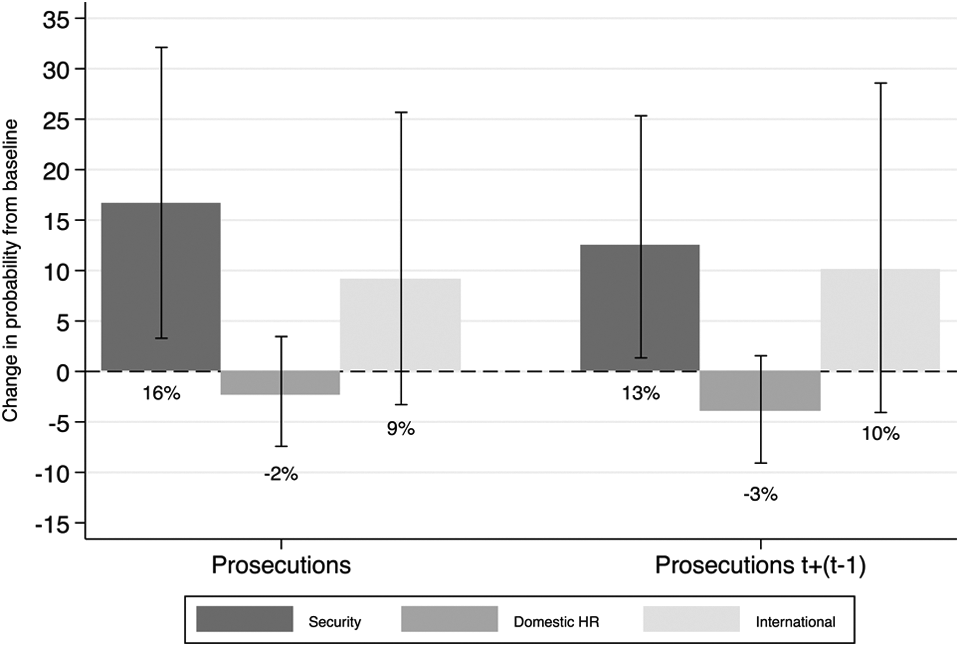
Testing the mechanism
The findings presented above have two possible shortcomings. The first is that the processes examined might exhibit simultaneity: the same factors could increase both the likelihood of criminal prosecutions and the probability of conflict termination (or non-termination). For example, in conflicts where the government has gained supreme military advantage, we might expect one or more security trials and an end to fighting. If this is the case, and the trial parameters in our models are correlated with the error terms, the models’ coefficients will be biased. The second shortcoming is that the theoretical mechanisms are not tested directly. We theorize that security trials result from executive strategy to end civil conflict, that DHR trials are produced by active and independent judiciaries and checks on the executive, and that international trials are part of a broader interventionist response to intractable conflict inspired by the global community. However, the models presented above are unable to test these relationships. These shortcomings can be addressed by specifying three additional seemingly unrelated bivariate probit (SUBP) models. These employ simultaneous equations to account for recursive processes (Gartner, 2011; Greene, 2003). For an explanation of the model design, see the Online appendix.
The results of the SUBP models, presented in Table II, provide some valuable insights into the processes being analyzed. To begin, when controlling for endogeneity, the magnitude and the significance of the trial coefficients change. Security trials still prove to be correlated with conflict termination, though the significance of the coefficient drops to the 0.10 level. The most significant predictor of security trials is judicial independence: the more independent the judiciary, the less likely a government will try rebels in court. This makes sense given the abuses to due process common in security trials. When accounting for this endogenous explanation, the effect of security trials on conflict termination remains substantively significant.
DHR trials are positively correlated with greater judicial independence and executive constraints, and negatively correlated with human rights protections, at a 0.05 level of significance. Strong democracies are more likely to attempt to hold government forces accountable for human rights violations, though, where human rights are better respected, there is less need for such trials. These factors, which enhance transparency and accountability, could be related to the move to prosecute state agents because they are conduits of normative pressure on regimes. Still, because DHR trials are negatively related to the end of conflict, rebels may, in fact, become emboldened by the regime’s willingness to abide by legal norms. This is at least suggestive evidence that, whatever grievance-addressing effects may accrue to DHR trials during conflict, they do not outweigh rebels’ cold calculations of government resolve that take place amidst fighting.
Finally, International trials (p = 0.654) is neither statistically nor substantively significant. This may be attributable to the fact that these kinds of trials overlap with other modes of international involvement. For example, one of the strongest predictors of international trials is the presence of UN peacekeeping forces in the country. In general, it may be difficult to observe the independent effects of international trials on civil war countries.
Conclusion
Seemingly unrelated bivariate probits of trials and conflict termination

**p < .01, *p < 0.05, † p < 0.10.
First, trials targeting rebels for crimes against the state are more likely to occur in countries where the judiciary is beholden to other branches of government. Opposition groups may view them as illegitimate, but security trials appear to compel rebels to end conflict by sapping their will or capacity to fight by removing key leaders. States are more likely to use these trials when the judiciary lacks independence, so they could generate new grievances based on the violation of rights. An important question remains as to whether conflicts in which security trials are used are more likely to reignite.
Second, DHR trials of state agents conducted in the midst of conflict are on balance less likely to compel rebels to stop fighting. It is difficult to explain this finding in full, but we know that this type of prosecution is more likely when the judiciary is independent – that is, the executive is being effectively monitored and checked (Dancy & Michel, 2016). Thus, DHR trials may signal democratic restraint or the regime’s unwillingness to engage in total warfare. In the midst of conflict, opposition groups could interpret a state holding its own officials accountable as a sign of weakness, or they may pay little attention to these processes. If such trials compel state actors to seek peace, it may embolden rebels. Greater exploration of both sides’ behavior is needed. It also remains to be seen whether a commitment to the rule of law symbolized by such trials reduces the likelihood of conflict re-emerging if and when termination does occur.
Third, against doomsayers who worry international trials may exacerbate conflict, we find that international judicial involvement is not causally related to the probability of termination. Trials by international courts are correlated with a slightly lower risk of conflict persistence, but, as the SUBP models indicate, this is likely because they are an offshoot of more general international diplomatic and peacekeeping interventions.
Whatever the case, it does not seem that repeated worries about rebels digging in their heels in response to international trials are entirely justified based upon the empirical record, and the consideration of counterfactuals.
Finally, this article is careful to focus on compellence, a mechanism specific to ongoing conflict. However, after rebels and state forces have already agreed to bargain instead of fight, the mechanism of interest shifts from compellence to deterrence. In other words, the question shifts from ‘How do we stop the fighting?’ to ‘How do we prevent bargaining actors from returning to the fight?’ As has already been suggested, it is quite possible that, in this second stage, the effects of these three types of trials will change. For instance, while DHR trials of state agents do not compel rebels to lay down their arms, by addressing grievances, this kind of trial may prevent would-be rebels from (re)starting violent campaigns in the future. This possibility and others lead logically to a second phase of research: the deterrent effect of criminal prosecutions following the termination of conflict.
Footnotes
Replication data

Acknowledgements
The authors would like to thank Will Moore for his work on an early version of the manuscript, as well as the editor anonymous reviewers for their constructive comments.
Funding
This material is based upon work supported by the National Science Foundation (Grant Nos. SES-0961226 and SES-1228519) and the Arts and Humanities Research Council (Grant Nos. AH/1500030/1 and AH/K502856/1).
Notes
References
Supplementary Material
Please find the following supplemental material available below.
For Open Access articles published under a Creative Commons License, all supplemental material carries the same license as the article it is associated with.
For non-Open Access articles published, all supplemental material carries a non-exclusive license, and permission requests for re-use of supplemental material or any part of supplemental material shall be sent directly to the copyright owner as specified in the copyright notice associated with the article.
