




Abstract
How do natural disasters affect rebel group recruitment? Some influential research to date suggests that natural disasters – by lowering the opportunity cost of joining an armed movement – are likely to facilitate rebel group recruitment. In contrast, this study argues that natural disasters can negatively affect rebel organization and their recruitment efforts. It posits that natural disasters may weaken rebel groups in two main interrelated ways: (1) by leading to acute scarcity for rebel combatants and supporters, weakening the rebel group’s organizational structure and supply lines, and (2) by increasing government and international presence in areas where the insurgents operate. Empirically, this article explores these suggested mechanisms in two cases of natural disasters in the Philippines (typhoons Bopha in 2012 and Haiyan in 2013), which affected regions partially controlled by the communist rebel group, the New People’s Army (NPA). Based on data from extensive fieldwork, there is no evidence suggesting a boom in rebel recruitment in the wake of the typhoons. Rather, the NPA was temporarily weakened following the tropical storms, significantly impacting the civil war dynamics in the Philippines.
Introduction
How do natural disasters affect rebel group recruitment? Many studies suggest that natural disasters’ impact on macroeconomic performance, agricultural output, and livelihood will make people more likely to join rebel groups and increase the risk of conflict escalation (cf. Brancati, 2007; Nel & Righarts, 2008; Maystadt, Ecker & Mabiso, 2013; Miguel, Satyanath & Sergenti, 2004; Bohlken & Sergenti, 2010; Nillesen & Verwimp, 2010; Wischnath & Buhaug, 2014b; Eastin, 2016). Indeed, the impact of a disaster and the associated economic shock could increase recruitment due to lower financial barriers and fewer legitimate opportunities for generating income (Eastin, 2016). It has, for example, been argued that disasters ‘give rise to orphans who are prime targets for rebel recruitment’ (Brancati, 2007: 721) and potentially lead to ‘part-time recruitment of otherwise employed agricultural labour’ (Raleigh & Kniveton, 2012: 54). Increased recruitment may, in turn, increase conflict severity (Wischnath & Buhaug, 2014a).
However, rebel recruitment, the often-cited causal mechanism linking disaster and conflict risk, has only been assumed, but not directly explored in previous research. Quantitative studies have looked at the association between disaster and conflict incidence and intensity at the aggregate level but have not explored the presumed linkage to rebel recruitment efforts more directly. Meanwhile, a handful of recent studies have suggested that natural disasters may also have a potentially pacifying effect, creating opportunities for peace processes to take hold (Kelman, 2011; Slettebak, 2012; Kreutz, 2012; Salehyan & Hendrix, 2014). Tying in with this literature, this study provides micro-level evidence to suggest that natural disasters may negatively affect a rebel group’s organization and its recruitment efforts in two interrelated ways. First, devastating disasters induce scarcity for rebel combatants and supporters, weakening the rebel group’s logistics and supply lines, and its capacity to recruit disaster victims. Second, significant state government assistance in collaboration with the international humanitarian actors in rebel areas is likely to lead to a loss of territorial control for the rebel group, making its recruitment activities more complicated and risky. Together, these factors represent temporary setbacks for the rebel groups that can significantly alter the dynamics of civil wars by increasing, for example, the government territorial control.
These theoretical propositions are explored through two case studies of typhoons in the Philippines – Bopha in 2012 and Haiyan in 2013 – which affected two regions partially controlled by the New People’s Army (NPA). Based on 49 semi-structured interviews and six focus group discussions with rebel group leaders and combatants, military officials, local community leaders, and NGOs during four months of field research in the Philippines in 2013, 2014, and 2015, the article traces how rebel group organization and recruitment were weakened following natural disasters. The vast majority of the people interviewed, being rebel combatants, the military, and local communities, agreed that natural disasters limited rebel groups’ recruitment activities in the post-disaster response and recovery period (a time-frame estimated as nine months). The reinforcing dynamics of acute scarcity of food and resources, weakened communication and supply lines, and increased national and international presence led the NPA members to focus on reorganization and recovery, rather than recruitment. Increased territorial control by the government following the two typhoons led to the capture of two of the most important leaders of the NPA in 2014.
This study offers novel micro-level evidence of the impact of natural disasters on conflict dynamics in the Philippines. Given the ongoing exposure of the Philippines to both natural disasters and armed conflict, the country represent a ‘hot-spot’ where a strong link between disaster and conflict should be expected, according to the theoretical prediction in existing literature (de Sherbinin, 2014). In addition to being a ‘typical case’ (Gerring, 2004), the Philippines is also chosen because most existing studies on the disaster–conflict link have not looked beyond sub-Saharan Africa (Wischnath & Buhaug, 2014b). Through a single case, this study focuses on exploring and capturing micro-level dynamics in order to theoretically inform future research, rather than test established theories (George & Bennett, 2005; Gerring, 2004). Yet, in doing so, the study provides new insights on the agency of rebel groups in the wake of natural disasters and explores the impacts of changing environmental conditions on conflict dynamics. It addresses an important gap in previous research where ‘actors and agency tend to be vaguely portrayed’ (Theisen, Gleditsch & Buhaug, 2013: 662).
The micro-level evidence on insurgent and government post-disaster behavior may help inform an unsettled academic debate on the impact of disaster on conflict, by pointing to factors that may condition this relationship. The study suggests that state physical presence to deliver aid and its capacity to channel international assistance may be crucial to prevent the rebel group from taking advantage of the situation. The effect of a natural disaster and the level of scarcity may also depend on the rebels’ physical exposure. It is therefore the combination of the typhoon’s impact and a certain type of penetration in the rebel group control area by the government and international humanitarian actors that weakened the rebel group recruitment activities in the post-disaster period. This article therefore highlights the regional variation in how states manage disaster, particularly between different countries in Asia and Africa. When the state is weak, unable or unwilling to provide relief, and reluctant to work with international actors, this leaves more space for the rebel group to fill the void and recruit disaster victims. As a result, how natural disasters affect conflict dynamics is mediated by a wide range of context-specific factors.
The study is organized as follows. First, previous research on natural disasters, conflict, and recruitment is reviewed. The next section develops the theoretical argument regarding the effects of natural disasters on rebel groups’ organization and recruitment. After discussing case selection and methods, the two case studies from the Philippines are presented. The last section discusses the findings and their applicability to other cases.
Previous research: Natural disaster, conflict, and recruitment
Natural disasters are events ‘involving a natural hazard (e.g. flood, cyclone, landslide, volcanic eruption, earthquake) which have consequences in terms of damage, livelihoods/economic disruption, and/or casualties that are too great for the affected area and people to deal with properly on their own’ (Wisner, Gaillard & Kelman, 2012: 30). There is some evidence in previous research that climatic factors – operationalized as variability in rainfall and temperature, or as natural disasters – influence the risk of armed conflict or other forms of organized violence (cf. Brancati, 2007; Burke et al., 2009; Fjelde & von Uexkull, 2012; Nel & Righarts, 2008; Wischnath & Buhaug, 2014a; von Uexkull, 2014; Couttenier & Soubeyran, 2014; Hsiang, Burke & Miguel, 2013). Yet, the robustness of some of these finding have been challenged (cf. Buhaug, 2010; Slettebak, 2012). Based on the large-N evidence at hand, it is hard to understand the underlying causal processes at play between natural disaster and increased conflict (Salehyan, 2014). 1 Prior research examining the disaster–conflict hypothesis has put forward four theoretical approaches to account for the correlation between disasters and increased (or decreased) risk of armed conflict.
The first approach argues that a natural disaster, mainly drought, may escalate competition over dwindling livelihoods, such as water, pasture, and cropland (cf. Homer-Dixon, 1999; Kahl, 2006). These scarcities could lead to communal violence in societies with little coping capacity (Fjelde & von Uexkull, 2012). In a similar vein, disaster may also increase migration, which will in turn increase competition over already dwindling resources and fuel communal conflict between the host population and the newcomers (Reuveny, 2007).
A second approach argues that natural disasters, especially drought and heat waves, can make individuals more likely to exhibit violent behavior toward others (Hsiang, Burke & Miguel, 2013). This could potentially fuel civil wars on a larger scale as a result of individual-level aggression during temperature increases (Hsiang, Burke & Miguel, 2013). This literature is mostly driven by behavioral and psychological studies, and it considers civil war as an aggregate outcome of individual behaviors where formal and informal institutions do not play an active role in curbing or fueling hostilities (Wischnath & Buhaug, 2014b).
The third and most researched approach describes how natural disasters affect state stability and armed conflict via their impact on macro-economic performance, agricultural output, and livelihood security. The loss of income from the disaster may affect conflict dynamics through three complementary processes: lowered opportunity costs of rebelling, increased opportunities for recruitment, and heightened grievances (Wischnath & Buhaug, 2014a). Assuming that participating in armed conflict is a risky alternative source of income (Grossman, 1991), it seems probable that individuals who experience an economic shock due to a disaster might be more willing to join a rebel group. Faced with few economic alternatives from agriculture, individuals are more likely to value the expected short-term benefits and pay-offs of joining a rebel group. They are therefore more easily recruited by rebel groups (Eastin, 2016; Wischnath & Buhaug, 2014a; Collier & Hoeffler, 2001). The impact of the disaster on economic stability may affect the government’s ability to deal with insurgent activities (Le Billon & Waizenegger, 2007; Nel & Righarts, 2008). This may incentivize terrorist action by reducing the costs associated with attacking specific targets (Berrebi & Ostwald, 2011). Finally, the economic impact of natural disaster on people’s livelihood may increase the grievance of the population. Grievances may be further increased by absent or unfair aid assistance by the state following disaster and motivate a larger pool of individuals to join and/or support an active rebel group to redress their grievances (Eastin, 2016; Wischnath & Buhaug, 2014a; Raleigh, 2010; Benjaminsen, 2008). Increased recruitment and troop size will in turn increase armed conflict intensity (Wischnath & Buhaug, 2014a).
Finally, some scholars also claim that scarcities following disaster may have pacifying effects by bringing ripe moments for negotiations (Kreutz, 2012; Kelman, 2011) and by affecting the resources and tactical environment where the rebel group operates (Eaton, 2008; Beardsley & McQuinn, 2009; Saleyan & Hendrix, 2014). For example, with regard to communal conflict some studies show that wetter years, associated with more abundant vegetation in eastern Africa, are on average more violent than drier years (Meier, Bond & Bond, 2007; Witsenburg & Adano, 2009; Theisen, 2012). Similarly, Saleyan & Hendrix (2014) argue that natural disasters can affect the tactical environment, and reduce the resource base for mobilization of armed violence. Indeed, most individuals will be more concerned with basic survival than with joining a rebel group (Saleyan & Hendrix, 2014: 241).
While a majority of studies claim that more widespread grievances, coupled with lower opportunity costs of rebelling and increased opportunities for recruitment, may escalate ongoing armed conflict, a small number of studies indicate that disaster may complicate rebel group actions. One explanation for this academic conundrum is that a disaster’s effect on rebel group behavior and conflict dynamics may differ, depending on a range of other conditions. A comparative study of the effect of the 2004 tsunami in Indonesia and Sri Lanka, for example, suggests that the same natural disaster had different impacts on conflict dynamics and rebel group behaviors (Enia, 2008; Beardsley & McQuinn, 2009). This general variation warrants further research (Eastin, 2016). One useful step forward is carefully executed case studies, which, through a focus on the agency of rebel groups and governments in the post-disaster period, can identify the causal mechanisms that link disasters to particular outcomes, such as recruitment. The next section develops a theoretical argument for how disasters may weaken rebel groups.
Disasters and weakened rebel groups
Many studies have assumed that natural disasters facilitate rebel recruitment by fueling grievances and lowering the opportunity costs for joining the insurgency (cf. Eastin, 2016; Wischnath & Buhaug, 2014a). This study argues that disaster may actually have the opposite effect, weakening the rebel group’s organization and its ability to enlist new fighters. Recruitment is defined as the strategic activities that rebel groups undertake to mobilize participants to join their efforts to fight the state (Weinstein, 2007). While recruitment is composed of several facets, this study only focuses on two main recruitment activities: outreach activities (going to places where there are potential candidates for joining the rebel group) and screening (probing and induction of potential combatants) (cf. Hegghammer, 2013). The article argues that natural disasters weaken rebel groups in two main ways. First, disasters increase scarcity for rebel combatants and supporters, weakening the rebel group’s organizational structure and supply lines. Second, significant government presence supported by international assistance may lead to a loss of territorial control for the rebel group, complicating its recruitment activities. Together, these factors are likely to decrease the ability of the rebel group to recruit new combatants during the post-disaster period. These two mechanisms are outlined in turn.
Scarcity and weakened organization
Devastating disasters not only destroy the natural environment where rebel groups are hiding but decimate the civilian support base as well. Many natural disasters, especially tropical storms, destroy the vegetation and the camps of the rebel groups, thereby limiting their capacity to hide from and launch hit and run attacks against the government. The actual impact of the disaster may, however, depend on the type of disaster and its localization: earthquakes, for example, may be more damaging for government controlled infrastructure, especially if the capital is hit. This study argues that, if rebels and government forces are equally affected by a natural disaster, the impacts will be more pronounced on the rebels than on the government because rebel groups do not have the same access to infrastructures and military equipment to start with, and because they cannot as easily tap into national and international resource networks, such as contingency funds, insurances, and international loans. In general, most of the civil wars today are characterized by asymmetry between the state and a weaker rebel group. Even weak governments are usually better armed and organized than rebel groups (Valentino, Huth & Balch-Lindsay, 2004; Saleyan & Hendrix, 2014). Rebel groups’ bases and camps are usually built in remote and sometimes thickly forested mountain areas (Fearon & Laitin, 2003), reducing their exposure to government attacks, but making them more exposed to extreme weather events. The rebel group’s infrastructures are also less robust than those of the government.
Generally, civilians provide (voluntarily or involuntarily) food, shelter, supplies, and sometimes intelligence to the rebel group (Kalyvas, 2006; Valentino, Huth & Balch-Lindsay, 2004). However, in times of disaster these civilians do not have anything more to give, which directly affects the rebel group’s supply and support line. Food and other supplies become scarce, camps and hideouts might be destroyed, and morale within the group is likely to be adversely affected. Natural disasters can displace millions of people from one region to another. It is estimated, for example, that more than four million Filipinos emigrated to other regions in the country following typhoon Haiyan in 2013 (UNOCHA, 2013). This means for the rebel group a decreased support from the communities. Due to disaster-induced destruction and scarcity, rebel groups’ combatants may also migrate to less affected regions, where they can more easily hide and rely on communities for food and shelter.
Although this may sound trivial, the importance of food provision for both rebel groups and state armies is crucial for military victory; as Napoleon famously put it in his war against Russia, ‘c’est la soupe qui fait le soldat’ or ‘an army marches on its stomach’. Other military strategists such as Sun Tzu recommended ‘forays in fertile territory in order to supply your army with food’ (Saleyan & Hendrix, 2014). Indeed, undernourished people do not make good combatants and previous research indicates that rebel leaders are more interested in recruiting trustworthy and skilled combatants (Hegghammer, 2013). Given that rebel groups tend to be more dependent on the local population for food, shelter, and equipment than state armies, they might be relatively more weakened.
Under this context of scarcity, combatants may be more concerned with survival, recovery, and reorganization than recruiting (Saleyan & Hendrix, 2014). Indeed, organized rebel groups require funding, logistics, and planning, but periods of scarcity in the aftermath of a natural disaster are likely to cut communication and supply lines, together weakening the rebel groups. As a result, it is unlikely that the rebel groups will have the material and human resources to increase their recruitment activities after natural disasters. Recruitment is labor intensive and risky, and it requires both material resources and long-term insertion in the community (Hegghammer, 2013). Finally, natural disasters can weaken the ability of the rebel group to police its combatants. In normal times, policing combatants to avoid defection is a costly task, which requires resources from the rebel group (McLauchlin, 2014). Some groups will provide financial incentives or freedom to loot, while others will invest in political education and strong hierarchical controls (Weinstein, 2007). Rebel commanders might be unable to control desertion due to the shock from the disaster and the sudden shift of priorities from fighting to recovering. The financial incentives may become limited and the organization weakened, thereby reducing the cost of deserting from the rebel group. In addition, economic shocks, which often follow as a consequence of natural disaster, tend to cause a blow to morale and can lead to increased levels of attrition within the rebel group (Eck, 2014).
Government and international response
While there is a tendency in this literature on disaster and conflict to underestimate the importance of institutions and quality of governance (Buhaug, 2015), the government response to the natural disaster has important effects on rebel groups’ capacity to use the disaster for recruitment purposes. Recent research suggests that the provision of key infrastructures by the state seems to moderate drought-related communal conflict in sub-Saharan Africa (Detges, 2016). The extent to which people are likely to suffer from disaster is conditioned by their ability to adapt and access relief and other essential services provided by the government and international aid actors. Previous studies have also demonstrated that recruitment in refugee camps is dependent on the presence of international actors, because it is this that defines what access armed groups may have to disaster displaced camps. Protection from access by belligerents is therefore crucial to avoid recruitment (Achvarina & Reich, 2006).
In theory, natural disaster assistance can provide an opportunity for the state to establish its presence and build its legitimacy, potentially ‘buying off’ rebel supporters. Indeed, there is some evidence that aid assistance can bolster the government’s provision of basic security and public goods, which is a key determinant of popular support and a strategy to beat the insurgency (cf. Shefner, 1999; Berman et al., 2011; Beath, Christia & Enikolopov, 2013). Yet this is contingent on the government’s capacity and willingness to provide aid to disaster-affected communities following natural disasters. Sometimes governments may have regional bias toward a certain population or believe that the disaster may not be sufficiently serious to send assistance. Military calculations may be important in allowing international aid, as the government may fear it would strengthen opposition parties or highlight human rights abuses, as was the case during cyclone Nargis in Myanmar in 2008. In their military calculations, some countries may also consider it more efficient to let the population starve in rebel group territory than to ‘buy their heart and minds’ by providing relief (Keen, 1994).
However, when the government has the capacity and willingness to respond to the disaster and when it can channel the international response, it is in a good position to prevent rebel groups from recruiting disaster victims. While there are some exceptions, the government is more often supported by the international community during disaster relief operations than rebel groups, which are usually not recognized as legitimate actors or seen as counterparts for disaster relief. The government may benefit from multilateral or bilateral aid and debt relief, which may, at least temporarily, increase its budget and ability to provide assistance and conduct military operations (Kuhn, 2009). Therefore, the period following a devastating natural disaster is likely to be characterized by an increased presence of national and international humanitarian actors in the region, reducing an insurgent group’s territorial control and limiting its capacity to easily recruit (Bennett, 2010). Territorial control is essential for rebel recruitment as it increases the amount of information about the population and therefore helps to recruit trustworthy and committed combatants (Hegghammer, 2013). Kalyvas (2006: 125) argues that territorial control creates a sort of ‘mechanical ascription’, and ‘informational monopolies’ that increase the probability that civilians will collaborate and join the armed group that has control. The loss of territory due to efficient national and international response to the disaster can therefore negatively affect rebel recruitment. ‘If extended territorial control creates monopoly on information and normalizes rebel recruitment, the loss of such control should arguably have potential to undermine these mechanisms for recruitment’ (Jonsson, 2014: 53). In addition, alternative livelihood such as cash for work programs organized by humanitarian actors could provide new alternative opportunities for rebel combatants to sustain their families. This may reinforce the desire of some combatants to leave the rebel group. The next section specifies the methodology used to explore these causal mechanisms.
Methodology
Previous research on natural disasters and armed conflict has been mainly quantitative. Much remains to be done to more clearly understand the causal mechanisms at work and ‘high-quality case studies are still much in need for future theory development’ of the links between natural disasters and conflict (Theisen, Gleditsch & Buhaug, 2013: 621). By exploring a single case, this study focuses on identifying micro-level dynamics, which are useful to theoretically inform existing literature, in need of a ‘more nuanced theoretical approach’ (Buhaug, 2015: 271). An in-depth case study is particularly well suited to explore patterns of recruitment in the wake of natural disasters, because it allows the researcher to obtain data that are not easily available for quantitative studies and to carefully trace the causal process by which a disaster influences the rebel group’s organization and recruitment.
The Philippines provides an ideal case in this regard as the country is affected by both natural disasters and conflict. It represents a ‘typical case’ (Gerring & Seawright, 2007) and a ‘hot-spot’ for disaster–conflict links (de Sherbinin, 2014). The theoretical expectation is that this is a country prone to increased recruitment and conflict following disasters, since armed insurgencies have tried to mobilize disaster victims. This study uses process-tracing to explore the behavior and tactics of the NPA in the Philippines following two major typhoons in the Philippines: Bopha and Haiyan. The propositions developed in previous sections are explored through these two cases of disaster to evaluate whether the suggested causal mechanisms are at play. The advantage of being able to explore two cases of natural disasters in 2012 and 2013, which took place in NPA affected regions, is that it allows this study to observe whether rebel groups have behaved similarly during these two disasters.
The case studies build on unique interview material collected during four months of field research in the Philippines in 2013, 2014, and 2015. The author conducted 49 semi-structured interviews and six focus group discussions with rebel groups, military personnel, government officials, NGOs officials, community leaders, international organization staff, and disaster victims (see Online appendix 1). Most of these interviews took place in English, but a local translator was used for some interviews with rebel leaders and indigenous leaders. The respondents were approached through the author’s network and ‘snowball sampling’, meaning that one contact usually leads to another set of contacts (Biernacki & Waldorf, 1981). While this method can limit generalizability and may bias the sample because access to respondents is contingent on existing networks, personal referrals often provide the only access to respondents, especially in civil war settings (Cammett, 2006). Having said that, the author has captured a broad sample of respondents with different backgrounds and views in order to build a comprehensive picture of the situation. To ‘triangulate’ and ensure the reliability of the data collected, secondary documents, such as local newspaper articles, are also used in the article. Interviews took place in Metro Manila, Davao, Cebu, Bogo, Cateel, Bislig, Tacloban, and smaller villages around these cities (see Figures 1 and 2). Several long stays in the field between 2013 and 2015 allowed the researcher to build trust with the informants. This was essential for gaining access to sensitive information, which was unlikely to be gathered in one shot interaction (Parkinson, 2013).
Typhoon Bopha, locally known as Pablo, affected over six million people, displaced around one million people and resulted in 1,901 fatalities (EM-DAT, 2013; UNOCHA, 2012). Typhoon Bopha heavily affected Eastern Mindanao, one of the main strongholds of the NPA in the Philippines. It was the strongest typhoon ever to affect the region of Mindanao. Typhoon Haiyan, locally known Yolanda, was the strongest typhoon ever recorded in the Philippines, with powerful winds up to 300 km/h and a storm surge (NOAA, 2013). It affected over 14 million people and displaced approximately 4.1 million (UNOCHA, 2013). The definite number of fatalities is still unknown, but may reach 8,000 people (EM-DAT, 2013). Among the regions affected by typhoon Haiyan, some, like Samar and Leyte, are influenced by the NPA. The NPA is the only rebel group in the Philippines that has been affected twice by exceptionally strong natural disasters.
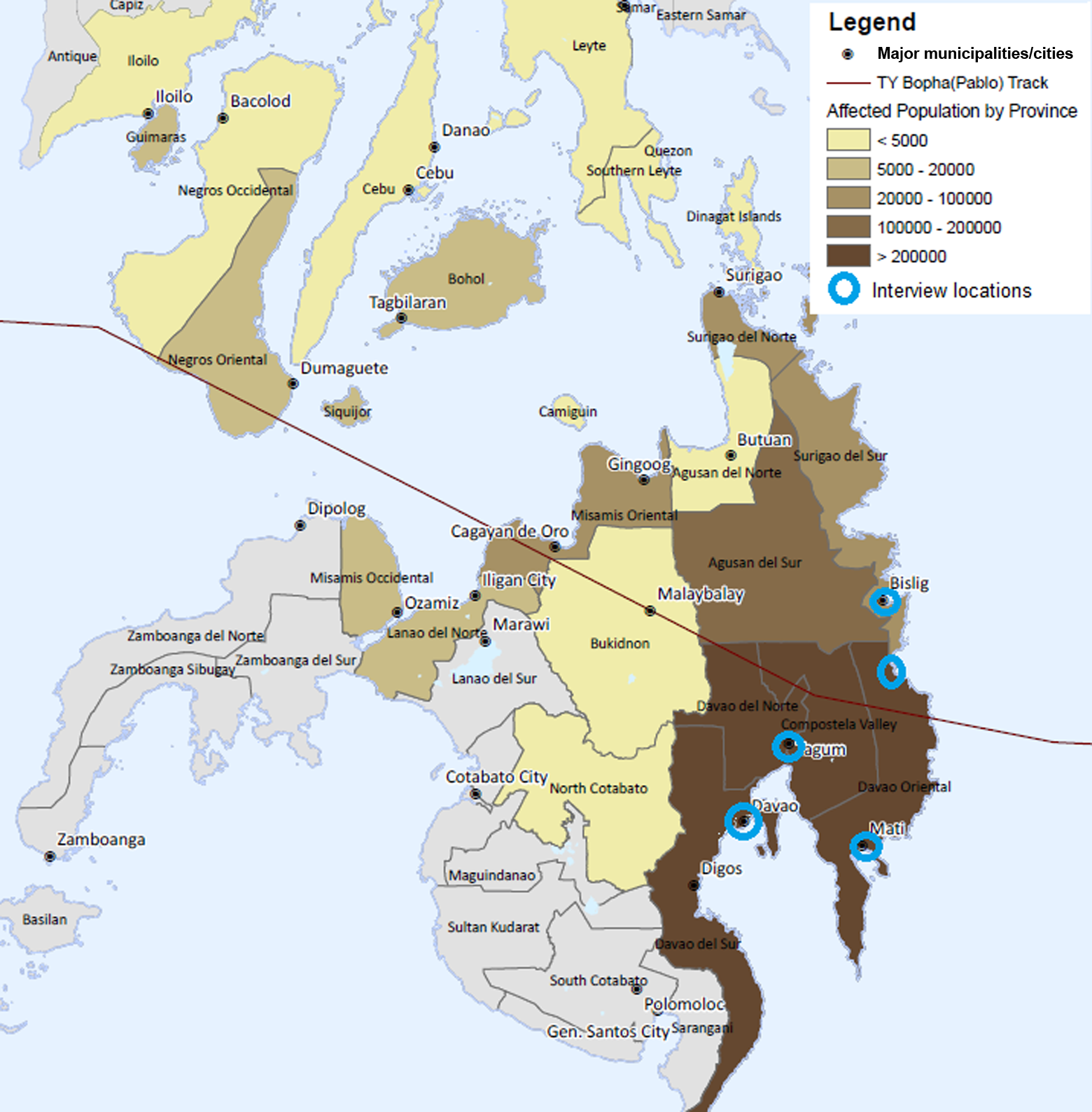
Map of typhoon Bopha (Pablo) December 2012
While the Philippines is often affected by natural disasters, these two tropical storms were the most damaging disasters recorded in the last 20 years (EM-DAT, 2013). They therefore had a tremendous impact on the communities living in these two regions and on the organization of the rebel group. The maps in Figures 1 and 2 show the level of damage inflicted by the two typhoons and the field research locations where most of the interviews and focus group discussions took place.
The New People’s Army during typhoon Bopha in 2012 and typhoon Haiyan in 2013
This section explores how two natural disasters have affected the organizational structure and ability to recruit of the Philippines communist insurgency – composed of the Communist Party of the Philippines (CPP), the New People’s Army (NPA), and the National Democratic Front (NDF). The armed wing of the rebellion, the NPA, has been fighting the Philippines government since the 1970s, and it counts today around 4,500 combatants present in most regions of the country. While the NPA is involved in mining and logging, it still relies on the local population for its armed struggle and does not usually target civilians indiscriminately (Walch, 2014).
Following typhoons Bopha and Haiyan, the communist insurgency took the opportunity to denounce the inefficiency of the government’s response to the natural disasters. The rebel group publicly called the population to ‘unleash a surge of protest’ against the government and hold it ‘accountable for its criminal negligence’ (extracts can be found on Philippine Revolution website, 2014). Interviews with rebel leaders echo statements similar to those that were publicly shared on their
Map of typhoon Haiyan (Yolanda) November 2013
However, these calls did not lead to any strong mobilization around the NPA, with the exception of small demonstrations in Davao and Tacloban (Manlupig, 2013; Carcamo, 2014). The ‘people surge’ against the government following typhoon Haiyan did not take place as the rebels would have expected (local government official 4, September 2014). The Asia Foundation (2014) issued a survey showing that victims of typhoon Haiyan were more satisfied with President Aquino and the government in general than were other Filipinos. These findings contrast with some of the narratives by the media and opposition groups about the government’s failure to adequately respond to the disaster. While 20% of the disaster victims reported having gone hungry in the past three months compared to 15% of other Filipinos, they did indicate more support for the government and other humanitarian actors than non-disaster victims in the country (Rood, 2014). Similarly, interview data suggest a disconnect between the NPA leadership’s call for mobilization and in-the-field recruitment following disasters. The next section goes into the details of the daily life of NPA combatants and highlights the many challenges the group faced following typhoons Bopha and Haiyan.
Scarcity and weakened organization
It was like a nuclear war. The forest cover was gone and some trees fell on our comrades and destroyed our camps. We were all very scared. (rebel leader 5, April 2013)
Interviews with local communities and rebel combatants seem to support the view that times of disaster make life even harder within the rebel group. ‘Many of the communities that we rely on to get foods and sometimes shelters, do not have anything to eat after the natural disasters’ (rebel leader 6, November 2013). Accounts of food scarcity and disorganization inside the NPA ranks were also found in the Philippine press: ‘Everybody was affected by the storm, and the communist insurgents now have a disorganized structure’, Bonafos told reporters in Camp Aguinaldo. ‘Like everyone in the storm-hit regions, the communist insurgents likely lost contact with one another’, he said. ‘They are looking after themselves as well, finding food and water after the typhoon’s strong winds and storm surges wiped out everything in their path’, the official said. (Philippine Daily Inquirer, 2013)
The level of scarcity endured by both combatants and their families following natural disasters led combatants to focus on recovering activities instead of recruitment and fighting (rebel leader 9, August 2014). Both rebel leaders and military officials agreed that there was a general drop in the level of armed violence because of their respective recovery efforts. In addition, it is estimated that one-third of the overall affected population was displaced by the disasters as many families immigrated to Cebu and Manila after typhoon Haiyan and to Davao after typhoon Bopha in order to recover (local government official 3, January 2015). In this context of scarcity and humanitarian response, various peacebuilding NGOs seized the opportunity appeal for peace (International Alert, 2013).
In addition to the journalists’ claims that the NPA was weakened following both typhoons, rebel combatants themselves agreed that the period following the disaster was not the most appropriate for recruitment (rebel leader 1, September 2013). While the NPA’s recruitment patterns have changed over the years, it still spends time and energy in outreach and screening activities. The NPA outreach stage aims to spot potential individuals who may be persuaded by the NPA ideology. This stage of recruitment examines the political views and activities of a potential recruit and assesses ideological compatibility with the armed movement. Then the rebels identify potential leaders in the community who have the ability to convince other people to join the group. During the screening stage, cadres inside the rebel group ‘investigate’ the potential recruit’s background, checking activities of family members, and their relations with government officials and military personnel (former rebel 1, November 2013, January 2015). This screening process aims to examine whether the potential recruit is a threat or liability to the armed movement (rebel leader 7, August 2014). In their outreach and screening activities, NPA recruiters tend to focus on indigenous leaders who might have the potential to persuade others to join the rebel group (indigenous leader 2, May 2013). Recruitment usually takes a couple of months that include political education, community work, and military exercises (rebel leader 7, August 2014).
Given that the patterns of recruitment in the NPA require time and resources, the period after natural disasters, which is characterized by scarcity and disorganization, is unlikely to lead to an increase in the number of recruitment activities (rebel leader 9, August 2014). Instead, energy is spent on reorganization and on providing relief and assistance to their rebel combatants and supporting communities (rebel leader 7, August 2014). While the party will use the disaster to ‘mobilize’ the population against the government, NPA troops in disaster affected regions do not have the capacity and the resources to recruit after the disaster (rebel leader 8, November 2013). During focus group discussions with disaster displaced communities (August, 2014), no one said they had been approached by the NPA or by its related organizations. Instead, there was more evidence of rebel combatants trying to get relief from NGOs and DSWD (focus groups 1 and 5, 2013–14).
A clear sign that the rebel group was weakened is the relatively low level of armed encounters involving the NPA after typhoons Bopha and Haiyan (military 3, August 2014). Many believe that the unilateral ceasefires declared by the NPA after both typhoons were a way for the rebel group to be able to reorganize and recover, while being at the same time a good PR strategy in showing their commitment for disaster relief (government official 3, August 2014). The military argues that the unilateral ceasefires by the NPA following natural disasters are a sign of their growing weakness. Indeed, unilateral ceasefires are only declared when the region affected is critical for the group. When there is a disaster in Manila, for example, there is no ceasefire because there are few supporters and no NPA camps in the region (military 2, August 2014). It is most often a tactic which enables the NPA to recover, and this is why the army rarely agrees to declare a ceasefire as well, even though the focus will be on disaster relief and not combat (military 2, August 2014). Aware of the weakening of the group, the government negotiating panel tried to use the opportunity to restart the negotiation with the NPA (interview government official 4, September 2014). In sum, interviews and focus group discussions suggest that both typhoons weakened the group temporarily, leading it to focus on reorganization and recovery activities instead of recruiting and fighting.
Government and international presence
The government indicated its ability and apparent willingness to provide local communities with relief and essential services following typhoons Bopha and Haiyan. The government efficiently worked with the international humanitarian actors to provide adequate relief (international NGO 2, January 2015). According to various evaluation reports and interviews with UNOCHA staff, the national and international responses to both typhoons were considered successful compared to responses to other natural disasters (IASC, 2014). Good and longstanding relationships between the UN and the Philippines’ government made humanitarian coordination smooth and efficient. According to the head of UNOCHA in the Philippines (April 2013 and January 2015), the government provided an enabling environment for humanitarian actors with efficient civil–military coordination, and national and local institutions for disaster management were used by international actors as entry points for their relief efforts.
The good relationship between the government, the military, and the international actors made the humanitarian assistance more effective in reaching remote areas affected by the typhoons. This limited the grievances created by the natural disasters among the population and therefore people’s willingness to join existing rebel groups (local NGO official 3, August 2014). While in the early 1980s the NPA could attract intellectuals and recruit from urban centers, most recruitment today takes place in villages (barangays) already controlled or partially controlled by the NPA in remote regions (rebel leader 4, November 2013). These populations provide the NPA with food, shelter, and sometimes information on the military operations conducted in their area. Outreach activities take place in those remote communities where there is almost no government presence and strong rebel control (rebel leader 8, April 2013). While long-term control of communities is therefore a requirement for the NPA to recruit combatants, the humanitarian response reached the vast majority of the NPA controlled regions, limiting the group capacity to recruit (government official 4, November 2013).
Rebel recruitment in disaster-displaced camps was made difficult because international organizations and NGOs involved in camp management have monitored and raised awareness about human trafficking and recruitment to armed groups (focus group 4, August 2014). In every displaced persons camp, posters are displayed regarding recruitment and human trafficking. Camp dwellers are also invited to express their grievances on paper or during meetings in order to avoid any conflict in the camp (focus group 5, August 2014). Most of the disaster-displaced camps have community elected leaders that are responsible to assess needs, mediate conflict, and look after the welfare of the camp dwellers, which includes special attention to human trafficking and recruitment into armed groups (local government official 5, August 2014). The camps, by being rather small, were easier to monitor compared to large refugee camps in Africa (International NGO 3, February 2015). It was therefore virtually impossible for rebel recruiters to get access to these camps without being noticed (focus group 5, August 2015).
This increase of national and international presence to provide relief together with rebel group migration to regions less affected by the disaster provided an opportunity for the government to establish or re-establish its presence in these regions (professor 2, August 2014). This sudden increase of national and international presence hindered the rebel group’s clandestine efforts to recruit new combatants. Because typhoons destroyed the vegetation where rebels were hiding, the NPA was forced to move to neighboring regions to reorganize and recover (military 2, August 2014). The destruction of typhoon Bopha led the NPA troops in Davao Oriental to go to neighboring regions, such as Agusan del Sur and Bukidnon, which were less affected by the destruction of the typhoon (rebel leader 6, November 2013; military 4, August 2014).
The military was well aware of their advantage in disaster relief compared to the NPA. A military officer stated (August 2014): ‘During and after natural disasters, we have to maximize our presence, let the people know that we are here, responding to the people’s needs because large scale disaster response is the only operation we have that the insurgents do not have’. The Philippines’ military, due to its logistics support, is one of the main relief providers after natural disasters. They take part in the cluster meetings with the UN agencies and NGOs, and they provide security briefs to all humanitarian actors (international organization 1, January 2015). The armed forces therefore use disaster relief as a strategy to buy civilian loyalty in regions that used to be under rebel control. ‘Disaster relief shows that the government cares about its citizens and that is why the army has been increasingly involved in disaster relief. Military means are not enough, we need to provide development as well’ (military 4, August 2014). Typhoons Haiyan and Bopha have helped to clear some regions controlled by the NPA and the disaster response has been an efficient way to hold areas recently freed from rebel control and to build government legitimacy (government official 2, January 2015; military 4, August 2014). A ‘clear-hold-and-build’ strategy has been specifically used by the army in their disaster relief efforts. This strategy has been denounced by the NPA. According to one of the leaders of the NPA, ‘the Aquino regime, the Armed Forces of the Philippines (AFP) and their American ally has used the Yolanda [Haiyan] tragedy as a camouflage to carry out relentless offensive operations in Samar region and elsewhere’. Similar statements were found in the press: The communist leader has enjoined AFP [Armed Forces of the Philippines] units who are participating in the relief and rehabilitation to be unarmed, not combat-ready and to desist from conducting intelligence activities. While the NPA will temporarily stop launching tactical offensives against its legitimate military targets, it will remain active in defending itself from the enemy’s overt and covert operations. (Davao Today, 2012)
According to interviews with army intelligence officers, increased state control following typhoon Haiyan has permitted a better monitoring of the NPA leader, eventually leading to the capture of Benito and Wilma Tiamzon, the top leaders of the NPA (military 6, January 2015). This was also highlighted in the media: ‘A senior government source told Rappler the Tiamzons have been the subject of intense surveillance since the onslaught of Super Typhoon Yolanda (international codename Haiyan), when they were monitored in Leyte. “They have been in and out of Leyte since December, at the height of relief operations for Yolanda,” the source, speaking on condition of anonymity, said’ (Rappler, 2014).
According to interviews with a wide range of informants and media reports, typhoons Bopha and Haiyan negatively affected NPA organization and recruitment activities. Increased scarcity and weakened rebel organization, together with a surge of national and international actors in some rebel areas, greatly reduced the rebel group’s access to the affected communities and its ability to recruit aggrieved disaster victims.
Discussion and conclusion
While the rebels tried to use natural disasters as a way to legitimize their armed struggle against the government, the post-disaster period did not provide a suitable setting for the NPA to recruit due to increased scarcity, weakened organization, and increased national and international presence. The study could not explore whether recruitment decreased dramatically, as there are no quantitative data on this, but the vast majority of interviewees and secondary sources agreed that natural disasters create more challenges than opportunities for the rebel group in the post-disaster period. In sum, this article did not find evidence of increased recruitment leading to increased conflict in the wake of natural disasters in the Philippines. Instead, it seems that these two natural disasters have had some pacifying effects, at least in the post-disaster recovery period, the time-frame for this study.
The interview material suggests that it is unlikely that natural disasters will lead to a total weakening of the rebel group. Natural disasters are localized and rarely affect the entire country. Thus, disasters weaken the rebel group for a time and in a specific region, limiting its recruitment activities, but it is unlikely that the insurgency will end. This fits nicely with Kreutz’s (2012) study, which found that natural disasters increase the chances of reaching a ceasefire – often used by insurgents to reorganize and recover – but have no effect on long-term peace agreements. The interviews also provide additional support to Salehyan & Hendrix’s (2014) argument on the pacifying effect of scarcities, and Slettebak’s (2012) assumptions that natural disasters limit rather than expand the window of opportunity for insurgents. While natural disasters represent temporary setbacks for the rebel groups, they are not insignificant events for civil war dynamics. They do impact the balance of power between rebel groups and the state. For example, the government has been able to increase its control in rebel zones following typhoon Haiyan, which eventually led to the capture of top leaders of the NPA.
Much of the NPA setback following the two typhoons is not simply a result of these disasters, but a product of the rebel group’s exposure to tropical storms and a penetration in the NPA controlled area by the government and the international humanitarian actors. The nature of the state response and its interaction with international humanitarian actors shape the extent to which rebels are able to take advantage of the disaster situation. This is a significant variable which highlights issues of regional variation between states in Africa and Asia. When the state is weak, unable or unwilling to provide relief, and reluctant to work with international actors, more space is left for the rebel group to fill in the void and recruit disaster victims. For example, weak and biased state institutions in Mali are making recruitment into rebel groups easier following droughts (Benjaminsen, 2008). The ways in which conflict dynamics are affected by natural disasters are mediated by a wide range of context-specific factors that vary across countries and regions.
This study makes three significant contributions to existing research. First, this article explores recruitment as a micro-level causal mechanism between climate shock and conflict dynamics. It provides unique data on recruitment following disasters in the Philippines that were gathered on the ground and throw light on the causal mechanisms in question. The article specifies the actors – the rebels, the civilians, the state, and the international humanitarian actors – and closely examines their behaviors, opportunity, and motive, which represent important gaps in previous research (cf. Buhaug, 2015). Second, this article provides the first qualitative study that explores recruitment dynamics in the wake of natural disasters in South East Asia, a region that is affected by conflict and natural disaster but that is considerably neglected in this regard as compared to sub-Saharan Africa (Wishchnath & Buhaug, 2014). It therefore highlights important regional variation. Third, the results of the study also have implications for the ongoing scholarly discussions on the causes of civil wars by indicating how opportunity structures condition rebel behavior following disasters. While the rebels tried to use the grievances of the population to mobilize the population, opportunities to actually recruit were limited by the presence of government and international humanitarian actors.
Empirically, some natural disasters that occurred in conflict-affected countries did weaken rebel groups and complicated recruitment in similar ways as in the Philippines. For example, the impact of the 2004 tsunami weakened the GAM’s support base, willingness to fight, and tactical advantage, forcing them to negotiate with the government (Le Billon & Waizenegger, 2007; Beardsley & McQuinn, 2009). In Sri Lanka, there is some evidence that international aid and debt relief following the 2004 tsunami helped to increase the military budget of the government and to later defeat a weakened LTTE (Kuhn, 2009). While the causal mechanisms of this study may not apply in the context of the Sahel and eastern Africa, where states tend to be very weak, the scarcity argument seems to explain the weakening of Al-Shabaab during the famine in Somalia in 2011–12 (Chothia, 2011). Indeed, many farmers and herders, who were a major source of support for Al-Shabaab, left the regions in search of food aid, depleting not only the support base of al-Shabaab but also its recruitment pool (Roble, 2011). ‘The Al-Shabaab extremists used to take the people’s hard-earned income to pay for their arms and ammunition as well as salaries for their fighters. These depredations became too much to bear when combined with a devastating drought’ (Roble, 2011: 4).
In a context where natural disasters are increasingly seen by policymakers as potentially increasing armed conflict, future research should explore what factors make communities more resilient to disaster and conflict. This article demonstrates that natural disasters do not always lead to increased recruitment and conflict. It indicates the importance of context, such as the strength of state institutions, military decisions, international response, and the magnitude of disaster impact to understand under what conditions disaster may lead to increased conflict. There are potentially many other contextual factors that can decrease or increase conflict after natural disasters and future research, both qualitative and quantitative, should explore them more closely.
Footnotes

Acknowledgements
I am grateful to Hanne Fjelde and colleagues at Uppsala University for excellent comments on earlier drafts of this article. I also wish to thank the Gutierrez family and Doc Gail for their valuable support during fieldwork, and all the interviewees who gave their time to talk to me in the Philippines.
Funding
This research was financially supported by the Swedish Research Council (Grants 2016-06389 and 2016-00243).
Notes
References
Supplementary Material
Please find the following supplemental material available below.
For Open Access articles published under a Creative Commons License, all supplemental material carries the same license as the article it is associated with.
For non-Open Access articles published, all supplemental material carries a non-exclusive license, and permission requests for re-use of supplemental material or any part of supplemental material shall be sent directly to the copyright owner as specified in the copyright notice associated with the article.
