




Abstract
What accounts for geographic variation in organized criminal violence? In Honduras, a country with one of the highest homicide rates in the world, the intensity of violence rivals many civil wars. Yet violent crime varies across cities and neighborhoods. Armed groups seeking to control territory use violence for different purposes, including competing against rivals, coercing residents and state officials, and exploiting the public for profit. Variations in community organization, defined as the density of interpersonal ties and the prevalence of shared expectations for collective action, affect the utility of violence for each of these purposes. Community organization can raise the cost of controlling territory, reduce the benefits of coercive violence, and generate pressure to protect residents from exploitation. These dynamics are examined through a comparison of nine neighborhoods in three of Honduras’s most violent cities, drawing from disaggregated homicide data and ethnographic research. The comparison shows that neighborhoods with denser community organization experienced lower levels of violence. Narrative evidence points to specific ways in which community organization mediates effects of competition among criminal groups and their interaction with state officials. Community characteristics thus affect the way non-state armed actors exercise authority in areas of limited state presence.
Introduction
The scale of organized criminal violence in the Western hemisphere rivals that of many civil wars. The countries of Central America’s Northern Triangle – Honduras, El Salvador, and Guatemala – rank in the top five of global homicide lists, with annual rates that reached 91.4, 69.9, and 38.6 homicides per 100,000 inhabitants, respectively, in 2011 (UNODC, 2013). 1 Fatalities associated with organized crime totaled 76,000 between 2010 and 2014 (IISS, 2015). As in civil wars, however, these aggregate numbers hide considerable variation over time and space. In Honduras, the homicide rate increased rapidly between 2005 and 2011 (see Figure 1). Yet 65% of homicides occurred in only 5% of municipalities (UNAH/IUDPAS, 2014). In La Ceiba, the Honduran city with the third highest homicide rate, three-fourths of violent deaths occurred in one-third of the city’s neighborhoods. The most violent neighborhoods shift from year to year (see Figure 2), contributing to uncertainty and fear for urban residents, and complicating efforts to prevent crime.
What accounts for geographic variation in violence by criminal organizations? While prior research has
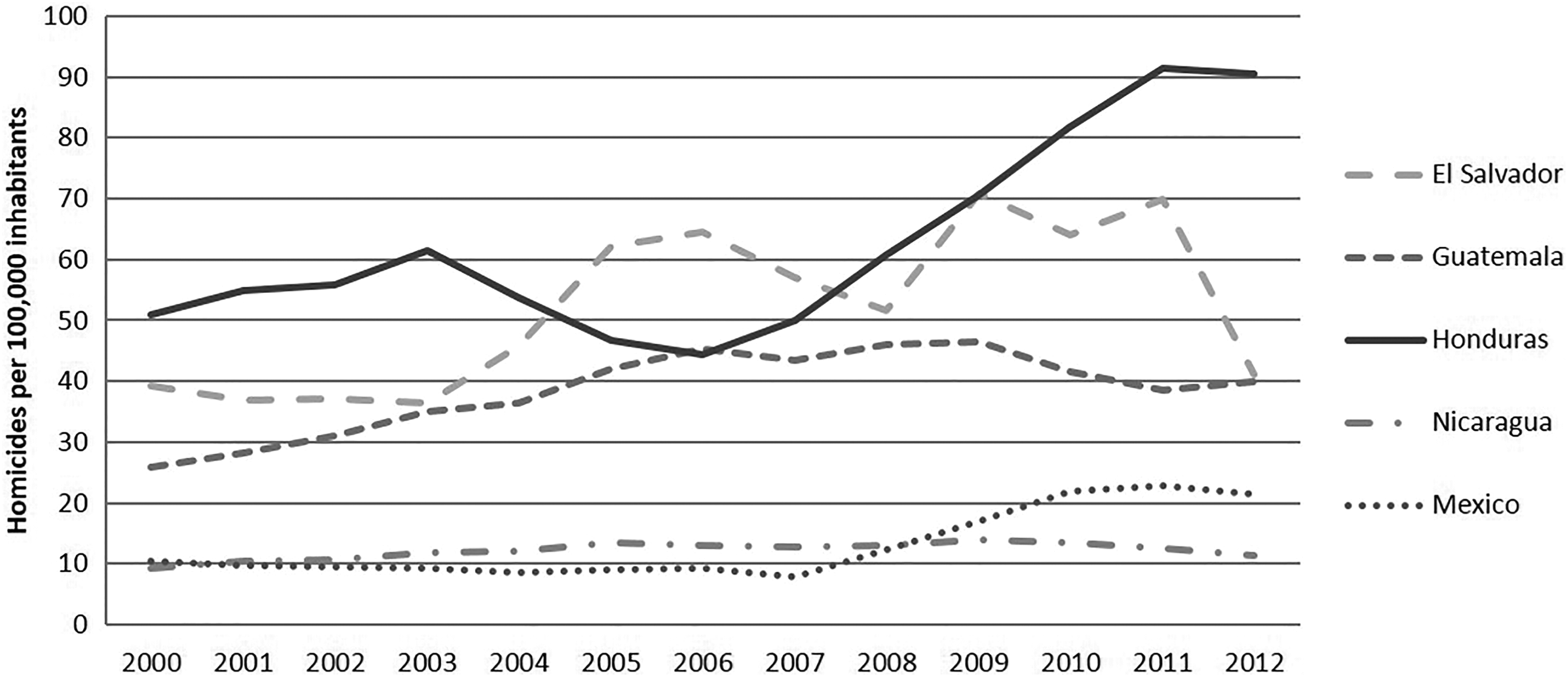
Homicide rates in Central America and Mexico

Number of homicides per neighborhood per year in the ten most violent neighborhoods in La Ceiba, Honduras, 2009–12
emphasized these groups’ limited use of violence (Gambetta, 1996; Andreas & Wallman, 2009), recent studies have drawn from literature on civil war to explain its increased scale and variation (Kalyvas, 2015). These studies emphasize the use of violence for strategic purposes, as criminal organizations compete for territory and market access, or interact with the state (Cruz & Duran-Martinez, 2016; Shirk & Wallman, 2015; Osorio, 2015; Duran-Martinez, 2015; Lessing, 2015; Bailey & Taylor, 2009). Considerable variation across neighborhoods remains unexplained, however. In focusing on relations among criminal organizations and the state, these explanations have devoted less attention to their interactions with the public. To control territory and maintain access to illicit markets, criminal organizations must interact with the public, and they sometimes exercise quasi-political authority (Arias, 2006; Reno, 2009; Moncada, 2013; Lebas, 2013). Yet the violence associated with this authority varies widely. By examining interactions between criminal groups and the public, we seek to explain this variation, while shedding light on the forms of order exercised by criminal groups.
This article explores how neighborhood social characteristics affect the use of violence for territorial control. We argue that variations in community organization, defined as the density of interpersonal ties and the prevalence of shared expectations for collective action, affect the strategic utility of violence. For criminal groups that aim to control territory, violence serves three distinct functions: competition – to protect territory from rivals; coercion – to secure the cooperation of residents or state officials; and exploitation – to extract revenue from the public. The density of community organization affects the relative cost and benefit of violence for each of these functions. Community organization raises the cost of controlling territory and deters competitive violence; for groups that control neighborhoods it lowers the cost of gathering information and reduces the benefit of coercive violence; and it increases pressure on criminal groups to provide protection and limit exploitative violence. Community characteristics thus mediate the effects of intergroup competition and criminal–state relations, and contribute to variations in violence across neighborhoods.
We examine these dynamics through a comparison of nine neighborhoods in three of the most violent cities in northern Honduras. Beneath the highest homicide rate in the world, this region exhibits significant micro-level variation. Drawing upon homicide data disaggregated by neighborhood and qualitative narratives collected through ethnographic research, we compare levels of violence and community organization across neighborhoods. We find that the neighborhoods with denser community organization experience less criminal violence. Residents’ narratives yield details regarding specific forms of community organization, and the mechanisms through which they affect violence. Organized communities prevent competitive violence by discouraging criminal groups from controlling their neighborhoods; they reduce coercive violence through the enforcement of informal norms; and they prevent exploitative violence through pressure on criminal groups to provide protection. Community organization also limits space for criminal groups to operate by improving residents’ relations with the state. Although we cannot infer from this small sample that community organization generally leads to lower violence, the narratives point to specific ways in which community characteristics affect the behavior of armed groups. They also suggest that these interactions are embedded within broader relations between the state, criminal organizations, and society. This study thus points to the need for further research on how relations between armed groups, communities, and state officials affect violence.
The remainder of this article proceeds as follows. The next section draws from literature on organized crime and civil wars to distinguish among functions of violence in the context of struggles over territory. While prior studies have examined competition among armed groups and collusion with state officials, they have not explained neighborhood-level variation in violence. The third section lays out theoretical expectations for how community organization affects organized criminal violence and mediates the effects of competition and collusion. The fourth section examines these dynamics in northern Honduras. It describes the overall effects of competition and collusion among criminal organizations and state officials, and examines how variations in community organization interact with these pressures. The conclusion lays out implications for studying violence by non-state armed actors in the context of limited state presence.
Logics of organized criminal violence
The relationship between violence and organized crime is far from straightforward. Sociologists and criminologists have examined how economic, social, and environmental factors affect the risk of individuals’ involvement in crime (Bursik, 1988; Sampson & Groves, 1989; Moser & McIlwaine, 2006), but have devoted less attention to organized crime (Tita & Ridgeway, 2007). Research on organized criminal groups has emphasized their preference for limited and selective violence, since stability and cooperation with the state can facilitate economic gain (Andreas & Wallman, 2009). Even mafias and youth gangs, sometimes considered among the most violent criminals, use violence selectively to maintain protection rackets, facilitate economic activity, and protect communities (Gambetta, 1996; Hill, 2003; Varese, 2001; Venkatesh, 1997). The presence of such groups has been correlated with lower levels of violence where crime is otherwise prevalent (Sobel & Osoba, 2009).
The surges of violence in Central America and Mexico challenge these conceptions. The scale of this violence, its organization, and its direct challenge to states’ monopoly on violence, suggest that it ‘occupies a gray zone between “ordinary crime” and political violence’ (Kalyvas, 2015). Scholars have shown that criminal and rebel groups sometimes cooperate in the context of civil war (Andreas, 2004). The large-scale violence in countries like Mexico, Honduras, and Venezuela, and in cities like Lagos, Karachi, and Nairobi, suggests that criminal groups may behave like rebels even in the absence of war. Rebel groups use violence strategically to motivate recruitment and impose discipline (Weinstein, 2006; Staniland, 2012), to signal resolve in the context of negotiations (Hultman, 2007), to influence the behavior of the population (Kalyvas, 2006; Wood, 2010), or to manage local disputes (Autesserre, 2010). To the extent that criminal groups pursue similar objectives, they may also use violence strategically.
One similarity among many criminal and rebel groups is their drive to control territory. In the Brazilian favelas, drug trafficking organizations control neighborhoods to secure access to markets (Arias, 2006). In Central America, youth gangs fight over neighborhoods to establish their turf (Cruz, 2007). In Nigerian cities, ‘area boys’ engage in protection rackets, extortion, and petty crime (Meagher, 2007). In Mumbai, goondas involved in smuggling exercise control over local property markets (Weinstein, 2008). Not all criminal groups seek to control territory – some lack sufficient organization, while others pursue activities that do not require territorial control. Criminal groups that aim for territorial control may also differ from rebels in their use of violence, given their focus on economic gain rather than political change.
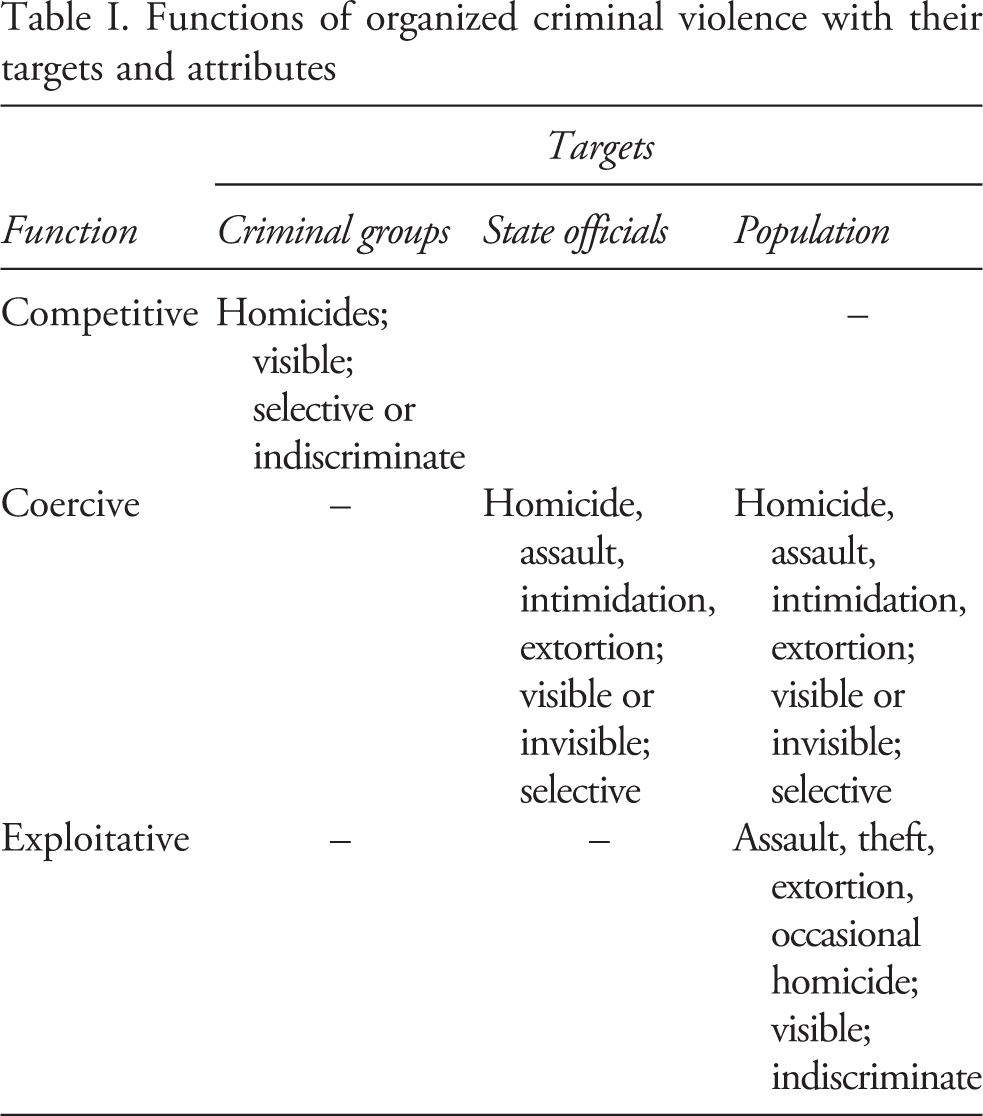
The logic of territorial control nonetheless points to three common functions of violence for rebel and criminal groups. As in civil wars, criminal groups use competitive violence against other armed groups to protect their turf (Kalyvas, 2006; Wood, 2010; Duran-Martinez, 2015). Competitive violence tends to be especially severe, often resulting in numerous homicides as groups seek to eliminate or deter rivals. Second, territorial competition fuels coercive violence, directed at the residents of a territory or state officials to influence their behavior (Kalyvas, 2006; Wood, 2010; Hultman, 2007). Criminals use violence to persuade the public and state officials within their territory to cooperate with them, and to deter support for rivals or law enforcement. Forms of coercive violence vary from visible killings, to more selective and less visible assaults aimed at intimidating. Third, armed groups sometimes engage in exploitative violence in territories they control to extract resources from the population. This generally involves less severe forms of violence, such as assault, theft or extortion. The extent of exploitative violence depends partly on whether the armed group chooses to protect the residents of a given territory rather than exploiting them (Arjona, 2014; Mampilly, 2011). Although the forms of violence associated with these functions vary, they each tend to involve distinct targets and attributes, as summarized in Table I.
Most explanations for variation in criminal violence emphasize one of these functions while neglecting others. Research on geographic concentrations of violence in Mexico and Colombia has emphasized competitive violence, pointing to battles among criminal organizations
Functions of organized criminal violence with their targets and attributes
over control of drug smuggling routes (Osorio, 2015). The effects of this competition on coercive and exploitative violence are less clear, however. In civil wars, competition between armed groups has been linked to spikes in coercive violence as rebels seek to deter the population from collaborating with the enemy (Kalyvas, 2006; Wood, 2010). Rebel groups that face less competition use less violent means of influence, and are more likely to protect residents than exploit them (Mampilly, 2011). For criminal groups, competition may similarly fuel increased coercive and exploitative violence, but it may also have the opposite effect. Groups facing competition may limit their use of coercive and exploitative violence to cultivate public support. In his study of the Brazilian favelas, Arias (2006: 47) argues that drug trafficking organizations’ need to ‘limit attacks from competitors’ leads to investment in protection as they seek to ‘maintain links to the population that lives in the areas in which they operate’. In turn, the absence of competition may encourage criminal groups to exploit residents to maximize profit.
Other studies have focused on the coercive violence that emerges from interactions between criminal organizations and the state. Criminal groups frequently use violence to influence state officials (Lessing, 2015), and more collaborative relations have generally been associated with lower levels of violence (Shirk & Wallman, 2015). Criminal–state collaboration may also reduce coercive violence against the public. Where politicians rely on criminal groups to mobilize votes or maintain order, criminal organizations can use state backing to enhance their authority without resorting to violence. Criminal groups with state support tend to employ ‘measured forms of violence to foster and regulate local economic markets to maximize the amount of wealth available for taxation’ (Moncada, 2013: 229). Criminal groups that collaborate with the state also limit their use of violence to avoid jeopardizing these relations (Duran-Martinez, 2015).
Yet criminal–state collaboration may increase exploitative and competitive violence. Where state presence is limited, criminal groups can exploit their positions as brokers between the state and the public. Backed by politicians, criminal organizations can exploit the public with impunity. In her study of urban vigilante groups in Lagos and Nairobi, LeBas (2013) finds that groups that formed to protect their communities shifted toward criminal protection rackets, larceny, and other exploitative violence as they accepted patronage from state governors. In Medellin, Colombia, criminal groups co-opted government programs to exploit the public (Abello-Colak & Guarneros-Meza, 2014). Duran-Martinez (2015) argues that these effects vary with the cohesion of the state – where authorities cannot act coherently, criminal groups have less to gain from providing protection and more to gain from exploitation. Collaboration with the state may also fuel competitive violence, if criminal groups compete for access to state protection. A spike in violence in Port-au-Prince, Haiti in the early 2000s has been linked to competition among neighborhood armed groups for the political patronage that they could access if they controlled sufficient territory (Kolbe, 2013). Yet collaboration may also limit competitive violence. Rising violence in Mexico has been traced to a breakdown of relations between a dominant cartel and the state that had previously limited violence, as government repression created new openings for rival groups to compete for turf (Shirk & Wallman, 2015).
Neither competition among criminal groups nor relations with the state explains variation in violence across neighborhoods. Competition among criminal groups fuels competitive violence, but groups facing competition may or may not use coercive and exploitative violence in territories they control. Collusion with the state may reduce coercive violence, but it may also increase exploitative and competitive violence in individual neighborhoods. These explanations do not account for why criminal groups choose to protect residents in some neighborhoods but not in others. To examine this variation, we turn to a third set of interactions, between criminal organizations and the public.
The effects of community organization
Dense community ties have long been associated with low crime rates. Across countries, high social capital – particularly social trust – has been correlated with low incidence of crime (Lederman, Loayza & Menendez, 2002). At the neighborhood level, scholars have found that social ties enable communities to prevent crime through informal social control (Sampson & Groves, 1989; Kubrin & Weitzer, 2003). Dense ties lead to extensive face-to-face interactions, facilitate the flow of information, and improve residents’ ability to monitor crime. Interpersonal trust, combined with shared expectations that residents will take action to support each other, facilitate community-wide efforts to confront criminal groups or prevent youth from joining them. As Robert Sampson (2012: 153) notes, ‘dense networks are not sufficient for the exercise of control […] expectations of action are crucial’. Although most of this research focuses on North America and Europe, scholars have pointed to weak social ties to explain rising crime in rapidly urbanizing cities around the world (Beall, Goodfellow & Rodgers, 2013). Yet crime also varies across neighborhoods in these contexts. Especially in cities where state presence is limited, dense ties and shared expectations for collective action – which we refer to as ‘community organization’ – might similarly enable residents to prevent crime without relying on the state.
H1: Neighborhoods with dense community ties and shared expectations for collective action experience less violent crime.
Community organization may not necessarily mitigate all forms of criminal violence, however. The scale of violence and organization of criminal groups in Central America might overwhelm community efforts. Criminal organizations could exploit dense community ties to strengthen their authority (Glaeser, Sacerdote & Scheinkman, 1996; Arias, 2006). The effects of community organization may depend on other features of the local context.
Disaggregating the functions of violence points to specific ways in which community organization might mediate the pressures that fuel criminal violence. With respect to competitive violence, organized communities can mitigate the effects of criminal competition by increasing the cost of controlling their neighborhoods. Through collective measures to enforce shared norms or demand protection, residents make it more difficult for criminal groups to establish a foothold, raise the cost of maintaining control, and discourage criminal groups from fighting over their neighborhoods. According to Arias (2006), in Brazilian favelas strong civil society networks keep drug traffickers at bay even in proximity to lucrative markets or smuggling routes. An observable implication of this logic is that in competitive environments, neighborhoods with dense community organization should experience a lower incidence of severe forms of violence like homicides. Criminal groups are also less likely to be present in these neighborhoods.
H2: In areas where no group dominates, neighborhoods with dense community ties and shared expectations for action experience low levels of competitive violence, as observed by few homicides and limited presence of organized criminal groups.
Community organization may also result in less coercive violence. As Kalyvas (2006) explains in the context of civil wars, the use of violence to exert control can be costly, in spurring defection by residents or violent responses from the state. As rebel groups achieve firmer control, they use less costly methods of securing compliance like cultivating local networks to gather information and providing protection in exchange for support. Dense community networks can facilitate these tasks, enabling information gathering, service provision, and enforcement of rules with minimal violence. Whether or not criminal groups collude with the state, the opportunity to co-opt dense community networks should thus decrease coercive violence. This logic implies that more organized communities should experience less coercive violence and more collaboration with criminal groups that dominate their neighborhoods.
H3: Where one criminal group dominates, neighborhoods with dense community ties and shared expectations for action experience low levels of coercive violence, as observed by few homicides and assaults, and collaboration between organized criminals and residents.
Community organization may also reduce exploitative violence. Through their capacity for collective action, organized communities can exert pressure on armed groups to provide protection and limit exploitation (Arjona, 2014). Organized communities depend less on armed groups to provide services since they can organize collectively on their own. They are therefore less likely to be exploited by criminal groups – even those that collaborate with the state. Community organization can thus mediate the effects of criminal–state collusion within individual neighborhoods. Especially where one group dominates, more organized communities should receive more protection, and experience less exploitative violence like assaults and robberies, than less organized communities.
H4: Where one group dominates, neighborhoods with dense community ties and shared expectations for action experience low levels of exploitative violence, as observed by low rates of assault and petty crime, and protection by the dominant group.
Community organization may thus reduce the incidence of violence and mediate the effects of intergroup competition and criminal–state relations. Dense ties and shared expectations for collective action raise the cost of controlling neighborhoods and deter criminal groups from competing over them. Criminal groups face pressure to limit coercive violence and exploitative violence. To be sure, this logic applies mainly to groups that aim to control territory. Further, we do not have space here to examine the origins of community organization. Communities may deepen interpersonal ties and capacity for collective action in response to prior violence, the presence of criminal actors, or state actions (Bateson, 2012; Abello-Colak & Guarneros-Meza, 2014; Samper, 2012). Community organization may also depend on longer-term social and economic dynamics that precede the rise of organized criminal violence. Nonetheless, to the extent that community organization affects the behavior of organized criminals in the short term, we argue that it contributes to variations in violence. In the next section, we explore these dynamics in the cities of northern Honduras.
Criminal violence in northern Honduras
Honduras is one of the most dangerous countries in the world, especially among those not experiencing civil war. The homicide rate doubled between 2006 and 2011, reaching 91.4 homicides per 100,000 inhabitants in 2011, the highest in the world. Yet this statistic obscures variation across regions, cities, and neighborhoods. As shown in Figure 3, homicide rates varied widely across departments, from less than 20 to nearly 130 homicides per 100,000 inhabitants (UNAH-IUDPAS, 2014). The most violent municipalities lie in and around the two largest urban centers, Tegucigalpa and San Pedro Sula, and along the country’s northern coast. Within cities, homicide rates vary dramatically across neighborhoods.

Homicide rate by department in Honduras, 2012
To examine these variations, we compare nine neighborhoods in three of the most violent cities on Honduras’s northern coast, La Ceiba, El Progreso, and Choloma. These cities’ location along primary drug transit routes, and their high homicide rates – 140.7, 132.3, and 68.7 per 100,000 inhabitants in 2013, respectively (UNAH/IUPDAS, 2014) – point to the active presence of criminal organizations. Three neighborhoods were selected in each city with varying levels of violence and community organization. They are referred to as Neighborhoods A through I to protect the confidentiality of participants in the study. Neighborhoods (known in Honduras as barrios and colonias) are geographically defined areas that are recognized by municipal governments as the basic unit for the delivery of services. To control for factors commonly associated with criminal violence, all have similar demographic and socio-economic characteristics, as shown in Table II. Each neighborhood has a population size in the middle two quartiles for its municipality (between 200 and 1,500 households) and an average income at the bottom two quartiles, as measured by annual energy consumption per neighborhood. The selected neighborhoods all have access to basic services, such as a primary school, electricity, and/or water, and are formally recognized by the municipality. Despite these similarities, homicides ranged from zero to an average of five per year between 2009 and 2012.
To measure the level of violence, we start with neighborhood-level homicide data compiled by the National Autonomous University of Honduras Violence Observatory. 2 The Violence Observatory triangulates data from police, medical, and media sources to correct for inaccuracy or manipulation. 3 Still, homicide rates measure only the most severe and visible form of violence, and do not distinguish among perpetrators or functions. Homicides may serve as a good proxy for competitive violence, but coercive and exploitative violence typically involve other crimes. Unfortunately, crime statistics in Honduras are not reliably disaggregated by motive or perpetrator, and reliable neighborhood-level data on other crimes were not available. To supplement homicide data, we draw on qualitative reports from residents regarding the incidence of other violent crimes and the presence of organized criminal groups. During focus group discussions and interviews, residents were asked about the prevalence of crime in their neighborhoods, where it occurs, who is responsible, and how safe they feel at different times of day and night.
To assess community organization and explore its effects, we draw from focus group discussions and
Characteristics of selected neighborhoods
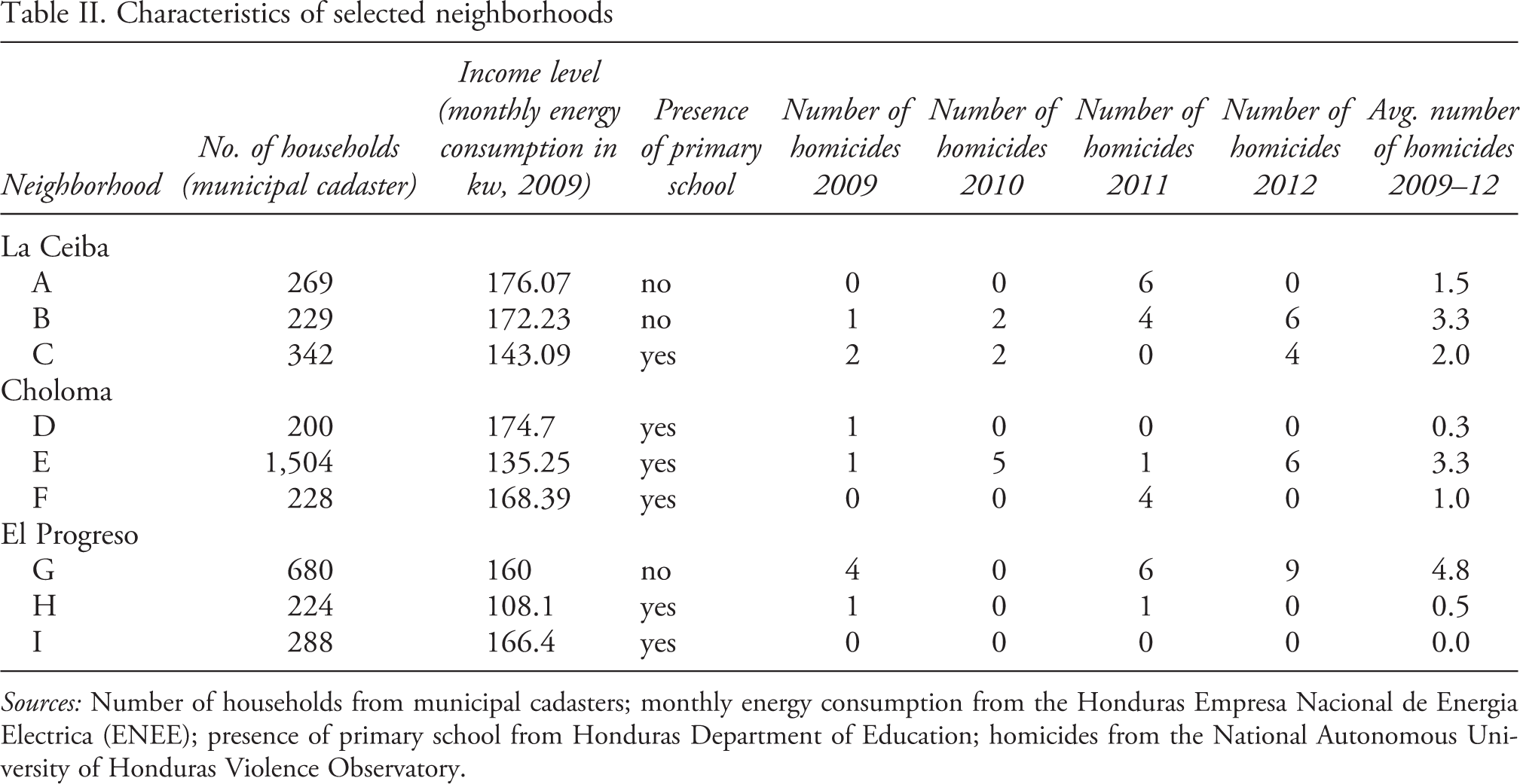
Sources: Number of households from municipal cadasters; monthly energy consumption from the Honduras Empresa Nacional de Energia Electrica (ENEE); presence of primary school from Honduras Department of Education; homicides from the National Autonomous University of Honduras Violence Observatory.
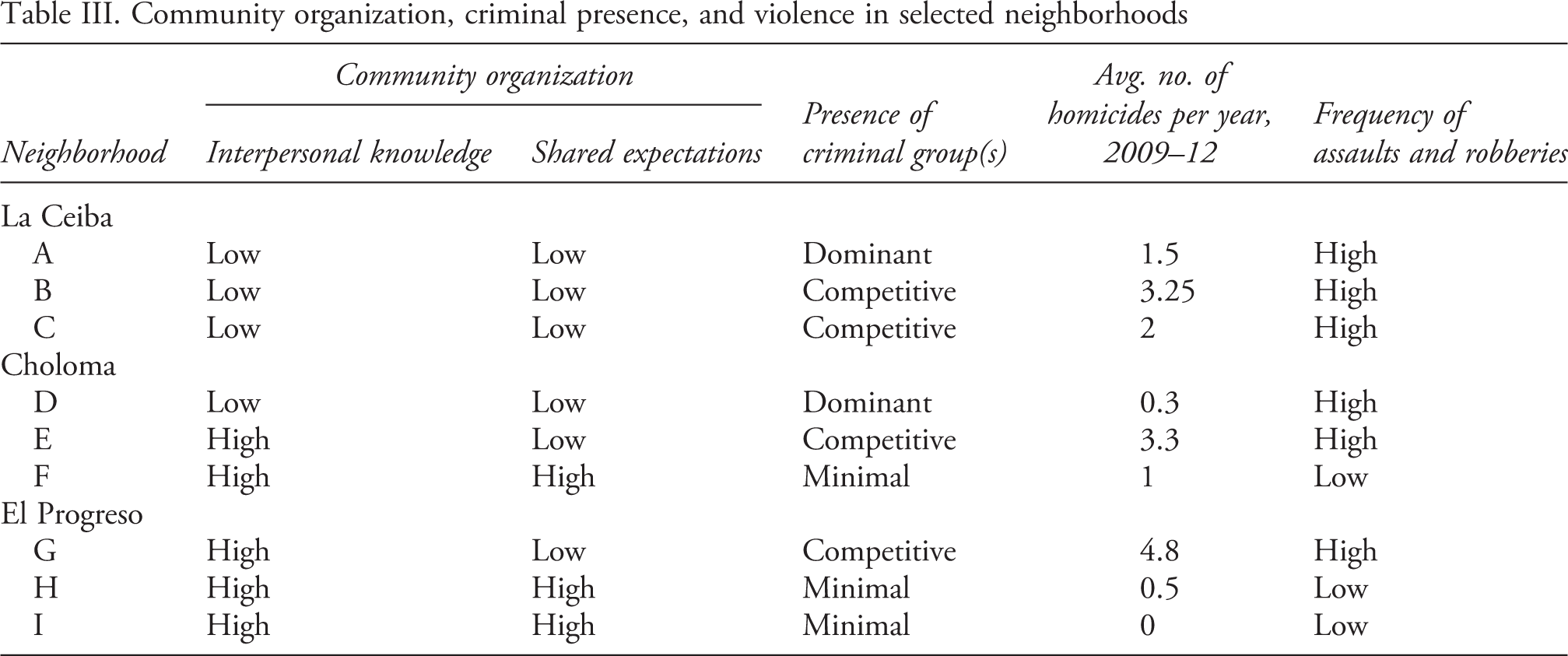
interviews conducted in the nine selected neighborhoods of Choloma, La Ceiba, and El Progreso between May and September of 2013. The research team, which consisted of the authors and three Honduran researchers, employed three separate techniques. First, 27 focus groups were conducted, including separate groups of men, women, and youth in each of the nine neighborhoods. Members of the research team led the participants of each group through a ‘social mapping’ exercise, during which they identified the leaders and groups in their neighborhoods, the links among them, and their roles in fueling or preventing violence. Second, the research team conducted 28 structured ‘case-tracking’ interviews with individuals in the nine neighborhoods who had been victims of a violent crime, focusing on the steps they took following the incident, and how their communities, local leaders, and state institutions responded. Third, the research team conducted 32 semi-structured interviews with residents and community leaders in each neighborhood, and with municipal officials in all three cities. These techniques generated rich portraits of each neighborhood that detailed the nature of community organization, the extent of violence, and the behavior of criminal organizations. Summary findings are presented in Table III.
We note two main limitations of these data. First, although residents are remarkably well informed about their neighborhoods, their narratives may convey biases and inaccuracies, especially with respect to the prevalence of crime and behavior of criminal groups. The information was triangulated among multiple residents, government officials, and law enforcement personnel, and all of the findings presented here were corroborated by multiple sources. We nonetheless treat specific facts with caution, while drawing on residents’ perceptions to shed light on the nature of community ties and their interaction with criminal groups.
Second, the small number of neighborhoods limits the possibility of inferring causality, even if we observe lower crime rates in organized communities. Violence may affect community organization rather than the other way around. Competition, criminal–state collusion, or other factors may drive both community organization and crime. Given the small sample size, we cannot eliminate these possibilities. Yet narrative data drawn from a small number of neighborhoods present other advantages. In-depth accounts reveal specific forms of community organization in these neighborhoods, the causal mechanisms through which they affect the behavior of criminal groups, and their interactions with other features of the environment.
Competition, collusion, and rising crime
At the national level, rising homicide rates in Honduras can be linked to heightened competition among organized criminal groups and collusion with a fragmented state. The sharp rise in homicides between 2006 and 2011 coincided with a shift in drug trafficking routes into northern Honduras (UNODC, 2012). As pressure from law enforcement in Mexico and the Caribbean
Community organization, criminal presence, and violence in selected neighborhoods
pushed traffickers into Central America, the 2008 financial crisis and 2009 military coup expanded space for criminal organizations in Honduras (Bosworth, 2010). As many as 87% of all cocaine smuggling flights departing South America first landed along the northern coast of Honduras during this period (ONDCP, 2012; US Department of State, 2013). As shown in Figure 3, the districts with the highest homicide rates lie along the main transit routes on Honduras’s northern coast.
New market opportunities heightened competition among criminal groups. A visible change in many neighborhoods was the decline of the maras – the youth gangs that had previously dominated urban space – as new groups emerged to contest their control. The maras had established themselves in Honduras during the 1990s, fueled by deportations from the USA and the spread of gang culture throughout the region (Cruz, 2007). In the early 2000s, government repression forced them to flee the capital, but they spread to secondary cities around the country. In the mid and late-2000s, however, the maras faced pressure from new groups seeking to encroach on their territory. On the one hand, local vigilante groups expanded as a result of government programs like the Comites de Seguridad (Security Committees) and Mesas de Seguridad Ciudadana (Citizen Security Roundtables) that organized civilians to fight the maras. Although official support for these initiatives was short-lived, remnants of these groups persisted in many neighborhoods, and some sought to profit from expanding criminal markets. On the other hand, new groups emerged to compete for control of valuable neighborhoods along drug trafficking routes, especially in proximity to roads, harbors, and other transit points. Drug trafficking through Honduras was mostly organized by cartels based in Mexico and Guatemala, but they contracted with local groups to manage the transit (UNODC, 2012: 23). Although some maras seized these opportunities, other groups linked to business elites or neighborhood gangs attempted to push out or co-opt the maras in order to control lucrative neighborhoods. Referring to these groups as cartels due to their involvement in the drug trade, a resident of Choloma explained: Here, we can see that there is a strong presence of a cartel. I don’t know what it’s called, but they operate through the youth that grew up within this neighborhood. All of the pandillas (gangs) are part of this group. The cartels have succeeded in converting the pandilleros (gang members) into their drug distribution arm.
4
A new form of organized crime has arisen from there, in which they control, maintaining a certain level of order, but then there is another group that becomes more powerful […] where there are no confrontations or massacres between pandillas (gangs), because one removed the other from its territory and only one group Average number of homicides per year in competitive vs. dominated neighborhoods, 2009–12 is present that imposed itself, there is a perception among citizens that they live in peace.
5
There was a struggle over territory on this street. I think it was the 18th street, and in the next street it was the MS, so they were fighting over there. They would confront each other, and we only heard the bullets hitting the roofs [….] what we saw is that people were dying, but I don’t know if the people that died were the bad ones […] today they say that those who commit assaults have been eliminated.
6
What accounts for our community being safe is that there is a group of men called the X men. It is a group that takes care of the community. If they hear that there is a criminal, first they call him out, and then they might kill him.
7

Competition and dominance do not fully account for variation in violence among neighborhoods, however. The left side of Figure 4 shows that homicides vary considerably in neighborhoods where no group dominates. Moreover, while Neighborhoods A and D experienced few homicides, residents reported other crimes, as we elaborate below.
The overall level of violence in northern Honduras can also be linked to collusion between criminal groups and a fragmented state. To fight rising crime, the government has established multiple, parallel security units with overlapping jurisdiction. The resulting fragmentation has created opportunities for criminal groups to co-opt local police officials. Most residents reported limited contact with the state, especially law enforcement. When asked about the police, they consistently noted their lack of responsiveness. As one resident stated, ‘when there are problems once in a while, even the police from the nearby station don’t come’.
8
Residents across neighborhoods also described examples of collusion between police and criminals, which they or their neighbors had personally witnessed. This collusion appears to contribute to exploitative violence, since residents are forced to endure crime and intimidation with nowhere to seek protection. A resident of La Ceiba explained: We can’t [go to the police] because of the circle of corruption that exists. If you call the police to tell them that I am assaulting someone, the police would make sure and tell me who is calling them so that I can go after you.
9
Community organization and violence prevention
The research revealed striking variation in community organization across neighborhoods. Residents of most neighborhoods in the study reported little interpersonal knowledge, low trust in their neighbors, and few opportunities for communal interaction. Sparse community organization can be traced to broader social trends. Over the last two decades, the growth of export processing zones in northern Honduras has fueled rapid internal migration and urban expansion, resulting in weak social ties in many urban neighborhoods. Although numerous associations operate in nearly every neighborhood – including multiple churches, youth clubs, and sports teams – most people interact only with the people in their own church or club and rarely with others. Even the patronato, a community leadership board elected in every neighborhood, has little convening power. The sparseness of social ties inhibits collective action. Residents of many neighborhoods echoed the complaints of one La Ceiba resident that ‘there has not been development or maintenance of the neighborhood’, because of ‘poor participation of the inhabitants’ and the ‘absence of organization’.
10
Residents associate low expectations for collective action with limited interpersonal trust, since ‘when someone asks them to contribute they feel imposed upon, they say they are being taken advantage of’.
11
An official in Choloma explained: We see that families come and those who are born from these families have none of the tradition and customs that emerged in this city, there is an uprooting with respect to the municipality, there is no commitment to resolve problems in the neighborhood.
12
I know all of the neighbors, people know each other, maybe not by name but by face and we know the people are not thieves, but if we see someone we don’t know on the corner we immediately know what to do about it.
14
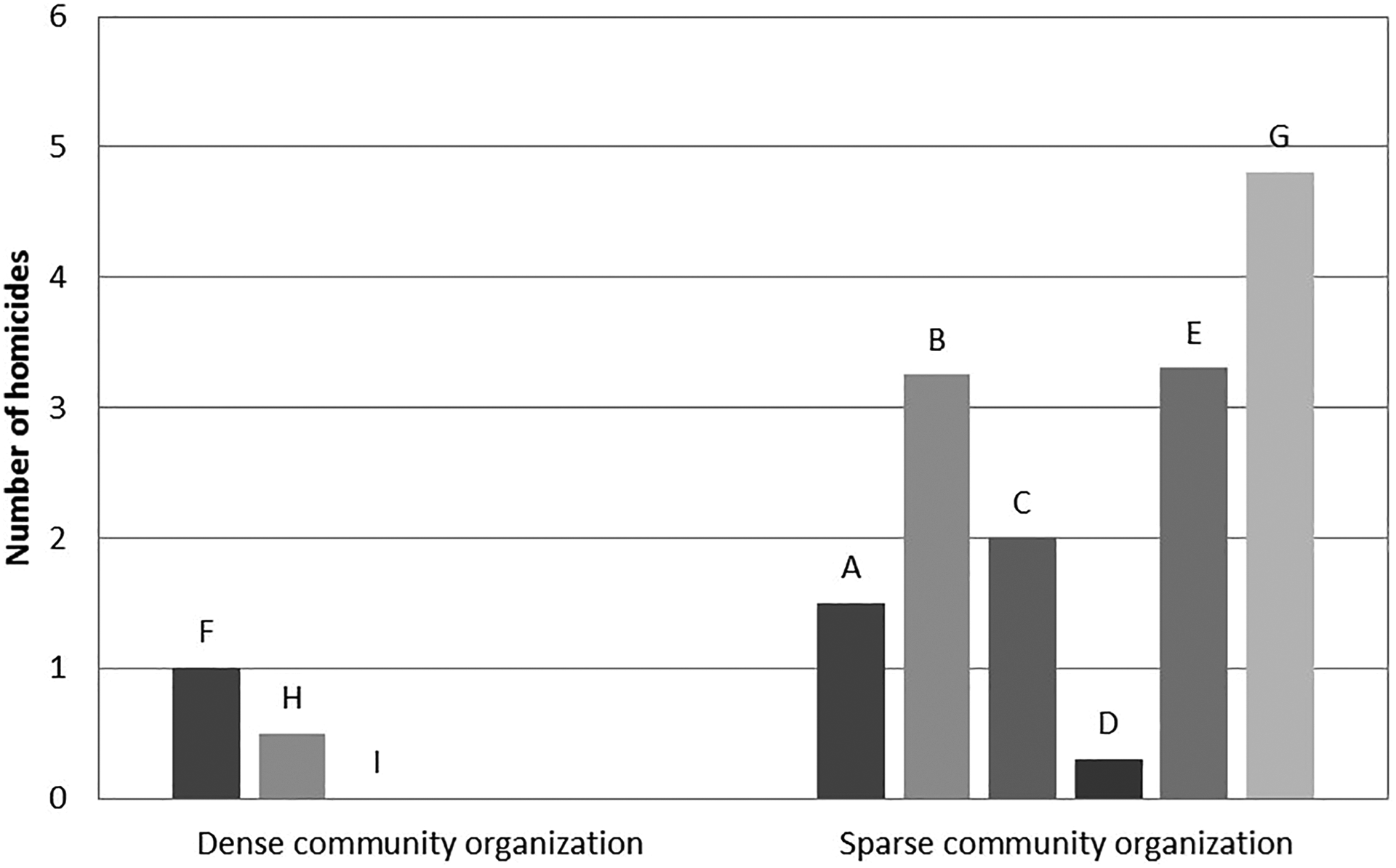
Average number of homicides per year in neighborhoods with dense and sparse community organization, 2009–12
organizations need something, they collaborate with the patronato; we make the request together, and collaborate until the problems have been solved.’
15
Another resident proudly described these shared expectations as integral to neighborhood identity: Our neighborhood has this advantage over any other community: if someone organized a project, people say let’s do it. Here the people are warm, humble people, who are ready to collaborate [….] even if they can’t pay, they work or send their children so that the project gets done. In other communities, people are apathetic.
16

Average number of homicides per neighborhood per year by community organization and armed group competition/dominance, 2009–12
In the other neighborhoods, residents reported more frequent assault and extortion, and less community support. Where they monitored crime, their efforts were mostly limited to individual blocks. A resident of Neighborhood E reported that ‘on my street no one has assaulted me because we get along well and we all keep watch’, but ‘they commit assaults everywhere else’. 19 Since residents rarely organize community-wide events or resolve problems collectively, they resort to individual protection measures. Following a school burglary in Neighborhood G, ‘the teachers closed the school and there were no classes since the parents were frightened’. 20 One man who had witnessed a crime in his neighborhood echoed a common sentiment in stating that he had no choice but to ‘buy a weapon to defend myself on my own since they told me they would kill me’. 21
The historical narratives offered by residents of neighborhoods F, H, and I suggest that community organization contributed to lower violence, rather than the other way around. In Neighborhoods I and H, residents traced their organization to the neighborhood’s founding, in 1981 and 1991, respectively, and to the efforts of individual leaders. In Neighborhood I, residents emphasized their common origins in a rural area where ‘people are accustomed to work, and their values influence them’. 22 In Neighborhood F, residents described an earlier period of violent competition among maras, and attributed recent tranquility to the joint efforts of community leaders and neighborhood associations. We cannot eliminate the possibility that violence – or the lack thereof – contributed to community organization rather than the other way around. Yet residents’ narratives point to processes that preceded large-scale violence, such as settlement patterns and leadership, to account for community organization. Once community organization gains strength, it plays specific roles in limiting violence.
Mediating criminal competition and collusion with the state
According to residents of Neighborhoods F, H, and I, the primary mechanism through which they maintain their safety is by keeping criminal groups out of their neighborhoods. Consistent with Hypothesis 2, they reported that no criminal organization operated in their neighborhood. The homicide data is consistent with these reports. Among neighborhoods without a dominant criminal group – displayed on the left side of Figure 6 – those with denser community organization experienced fewer homicides. Residents of these neighborhoods also reported lower incidence of other crimes. They attributed their safety to specific collective efforts: by cleaning up community spaces and vacant lots, they eliminated areas for criminal groups to congregate; by organizing sports leagues and enforcing community norms, they prevented neighborhood youth from joining criminal groups. In Neighborhoods F and I, residents prohibited the sale of alcohol in their neighborhoods and closed down bars and ‘billiard halls’ to discourage the presence of criminal groups. In doing so, they succeeded in mitigating the effects of criminal competition around them. Moreover, they organized these initiatives without government involvement, as a resident of Neighborhood I explained: Here, there are no bars or billiard halls. It has been years since they haven’t permitted them, they left quickly after the decision was taken. When there are billiard halls selling alcoholic beverages in a community, people from other areas come and the crime begins to organize. But here, I know that I can meet 10 guys from our community, and I won’t be afraid. This is because the leaders did not permit bars and billiard halls.
23
The narratives suggest that community organization may also mitigate coercive and exploitative violence, although the evidence is more tentative. In the context of fragmented state institutions and widespread collusion with criminal organizations, residents are generally at the mercy of criminal organizations. In neighborhoods dominated by a single armed group, residents reported sparse organization and high levels of both coercive and exploitative violence, consistent with Hypotheses 3 and 4. Residents of Neighborhoods A and D reported limited interpersonal knowledge, low levels of trust, and few community-wide activities. As shown on the right side of Figure 6, these neighborhoods experienced few homicides, likely due to the absence of turf battles. Yet homicide data does not adequately capture violence for other functions. Residents reported considerable coercive violence. In response to a question regarding how the dominant group keeps the community safe, one resident of Neighborhood D simply replied ‘death’, while another woman elaborated that ‘if there is a criminal, first they call them out, then they might kill them’. 24 Residents of Neighborhood D described order based largely on fear: ‘there are no gangs here, but if you go out late you can’t walk around on the street because they will kill you’. 25 They also stated that they avoided this group as much as possible and never sought them out for help. Residents of Neighborhood A described even more coercive violence, including forced payments and frequent intimidation. As one woman noted: ‘you can’t speak to anybody, because they might kill you [….] those who live here know that there is one law: see, hear and be silent’. 26
These two neighborhoods also reported considerable exploitative violence. Residents of Neighborhood A described frequent assaults, to the point that ‘we can’t go out because something always happens’. 27 Another resident stated: ‘they assault, and if you don’t let them assault they kill. They are well armed, better armed than soldiers, visibly, walking in the street [….] we live at the mercy of what they say, and we can’t go out at night’. 28 In Neighborhood D, residents described a more mixed picture. One resident reported feeling ‘calmer but not totally secure’, while others stated that ‘from ten pm I don’t feel secure in the street’ and that ‘there are dangerous parts of the neighborhood where there are groups who assault you’. 29 Residents reported relying on self-help measures like ‘not walking with brand-name cellphones’, or ‘after 9 pm staying in the house and not going out’. 30 While the armed groups in Neighborhoods A and D may have eliminated rivals, they did not appear to respond to residents’ safety needs.
None of the neighborhoods in the study had the combination of a dominant armed group and community organization that could further substantiate Hypotheses 3 and 4. Accounts from Neighborhood G nonetheless lend some tentative support. Residents reported some elements of community organization, including dense interpersonal ties at the sub-neighborhood level, but low expectations for collective action. One resident described being ‘organized by sector’ to ‘stay informed on what is happening in the different sectors of the neighborhood’.
31
Others, however, complained of limited community-wide activity, since although ‘the community used to be united […] now people do not want to contribute’.
32
Although they did not succeed in deterring criminal groups, residents reported that a group that had previously dominated the neighborhood had refrained from exploitative violence. We cannot confidently attribute this behavior to community organization, but residents’ accounts are suggestive: When they were in this neighborhood they didn’t assault; their rules were that none of them would assault the community, and no one could come from elsewhere to disturb the community […] they had fights with youth from other neighborhoods, but they never entered to bother people in this community, so the patronato (community leaders) established relationships with many of them.
33
The youth worked together with the patronatos and succeeded in building a sports field. They produced a document about how the youth from the three communities would manage it for their teams. And recently they requested support from the mayor to illuminate the field, and now they have lighting. Now they play until 11 pm, and those are communities that are now very safe.
35
These narratives thus point to another pathway through which organized communities prevent crime, through their interactions with the state. Given our focus on communities’ relations with criminal groups, we cannot fully explore these interactions here. State officials may affect the density of community organization and level of violence, just as organized communities may spur state action. Nonetheless, the narratives suggest that as they achieve denser organization, communities’ interaction with the state may influence the behavior of criminal organizations.
Conclusion
In the midst of large-scale violence, local order matters. Where the state exercises limited direct authority – during civil war or in marginalized urban neighborhoods – people seek other means of protection. We have argued that communities with dense interpersonal ties and shared expectations for collective action can improve their own safety in the midst of widespread violence. In the cities of northern Honduras people rely on various actors for protection, from police, local government, and community leaders, to vigilantes, gangs, and other criminal organizations. In some neighborhoods, criminal groups have partially improved residents’ sense of safety by ending turf wars and imposing order. In neighborhoods with dense community organization, residents have found other ways to prevent violence, through collective action to enforce shared norms and deter criminal groups from competing over their territory. Residents’ accounts suggest, more tentatively, that criminal groups that control neighborhoods may vary their use of violence in response to community mobilization. Although the evidence presented here cannot conclusively eliminate other possible explanations for the lower levels of violence in organized communities, it reveals specific ways in which communities appear to influence the behavior of criminal groups and contribute to their own safety.
By shedding light on how communities affect the behavior of criminal groups, this research informs the growing body of research on non-state armed groups. If communities in northern Honduras have influenced violence by criminal groups, other armed groups – including rebels or insurgents – may respond in similar ways. These findings thus point to the need for more attention to the characteristics of communities and their effects on violence in different contexts.
Yet these effects are embedded in broader relations among state officials, armed groups, and the public. Further research might clarify how community organization evolves in response to actions by state officials and criminal groups. Scholars have explored ways in which criminal groups embed themselves in relations between citizens and the state (Cruz & Duran-Martinez, 2016; Abello-Colak & Guarneros-Meza, 2014; Samper, 2012; Arias, 2006). Our research highlights ways in which community mobilization can open or close space for criminal groups to establish their authority in a territory, and influence the form of order that emerges. While we have not examined the behavior of state officials, the narratives imply that their responses to community efforts may be crucial. Further research might elucidate how armed groups respond to variations in state–society relations, and how these variations depend, in turn, on the behavior of state officials, criminal groups, and communities. Examining community perspectives can contribute toward understanding violence in urban spaces, and ultimately toward identifying ways to prevent it.
Footnotes
Replication data

Acknowledgments
The authors wish to thank José Miguel Cruz, Clionadh Raleigh, Reyko Huang, Nicholas Miller, and three anonymous reviewers for helpful feedback; Ana Mejía, Jaime Irías, and Misael Castro for assistance in conducting the fieldwork; personnel at the World Bank and IDECOAS-FHIS in Honduras for facilitating the research; and the municipal officials, community leaders, and residents of El Progreso, Choloma, and La Ceiba for their time, energy, and insights.
Funding
The research was funded by the World Bank with support from the Royal Dutch Netherlands Partnership Program.
Notes
References
Supplementary Material
Please find the following supplemental material available below.
For Open Access articles published under a Creative Commons License, all supplemental material carries the same license as the article it is associated with.
For non-Open Access articles published, all supplemental material carries a non-exclusive license, and permission requests for re-use of supplemental material or any part of supplemental material shall be sent directly to the copyright owner as specified in the copyright notice associated with the article.
