




Abstract
Authoritarian regimes are not known for adopting independent courts, yet the frequency of states empowering their judiciaries has steadily increased. In 1961 only 9% of autocracies had a partially or fully independent court, but by 1987 more than one-third of authoritarian states had reformed their judiciaries. Initiating judicial reform is risky for a regime that seeks to maintain its authority over its populace, including risks to their preferred policy positions and judgments that run contrary to the preferences of the regime. Given these risks, why do authoritarian leaders often relinquish authority to independent courts? This article argues regime leaders will choose to empower at least nominally independent courts in order to resolve information problems that lead to bargaining failures and civil war. This project uses propensity score matching to account for the complex relationship between institutional arrangement and civil war, and finds that states that adopt an independent court reduce their risk of civil war between 54% and 75% when compared to states that are equally likely to have adopted an independent court, but did not. These results suggest that leaders seeking to reduce uncertainty when bargaining with potential oppositions groups have strong incentives to implement independent judiciaries, and improve our understanding of how and why authoritarian leaders choose to delegate authority to independent judicial institutions.
Introduction
Authoritarian regimes are not typically associated with adopting an independent court system. However, the proportion of authoritarian states that have implemented a judicial system with at least nominal independence has substantially increased over time. In 1961 only 9% of authoritarian states had a partially independent judicial system, but by 1987 over one-third of authoritarian regimes had instituted a nominally independent judiciary. Not only are more states adopting independent courts, but courts are becoming more independent as well. Over this same time period independence has increased: the average across all countries increased from a low of .34 in 1968 to a high of .53 in 2008. 1
Initiating judicial reforms can be a risky move for autocrats. By relinquishing authority to courts, even courts with limited jurisdiction or independence, leaders may become subject to the rulings of the court. The court may overturn preferred policies of the regime, and the court may gain popularity and legitimacy in the eyes of the public, making it difficult for the regime to curtail judicial authority at a later date. Similarly, courts are often used as an avenue for civil or political rights groups to argue claims and advocate for policy change, where the regime tactics may be declared illegal or unconstitutional. Given the substantial risks involved with an independent court, why do authoritarian leaders adopt independent judiciaries or implement reforms expanding the power of the courts?
This article argues authoritarian leaders will choose to empower independent or partially independent judiciaries in order to solve two major bargaining problems, commitment problems and information asymmetries, that can result in domestic unrest and civil war. If leaders face potential threats from opposition groups holding grievances with the state they will be more likely to choose institutional arrangements that can address these grievances, either through co-option or concessions, which can provide information that reduces their uncertainty about how resolved or committed groups are to the cause, or through institutional arrangements that will lend credibility or accountability to the commitments or concessions they make, decreasing groups’ incentives to defect from an agreement. Independent court systems can mitigate these problems by providing avenues to redress grievances with the state to groups that may be excluded from other areas of political participation. Courts decrease the monitoring and information-gathering costs necessary to resolve information problems at low cost to the regime. Finally, by empowering independent courts, regimes provide an unbiased outlet where the regime and the opposition can hold each other accountable to the commitments or agreements that they make. By subjecting themselves to rule of law and an independent court, they can be assured there is an avenue for redress if any commitment is breached.
The implications of this theoretical argument, that independent courts should reduce the likelihood of civil war, are tested empirically with matching techniques to account for confounders affecting both the likelihood of conflict and the likelihood of adopting independent courts. The article proceeds as follows: first a review of the literature on judicial institutions in authoritarian regimes, followed by a theoretical explanation of how judicial institutions solve information problems for the regime. The next section presents the empirical models and methodological approach, and the article concludes with a discussion of the results and avenues for further study.
This article finds empirical support for the argument highlighted above. By applying propensity score matching, rather than traditional regression analysis, this study finds that in authoritarian states that have at least a partially independent judiciary, the likelihood of civil war decreases by anywhere from 54% to more than 75%. The contribution of this analysis is twofold: first, it adds to the substantive literature that helps us better understand why authoritarian regimes adopt independent courts, and second, methodologically, by using propensity score matching this study accounts for selection bias that plagues standard regression analysis and allows for drawing inferences about the relationship between institutions and conflict in authoritarian regimes.
Courts in authoritarian regimes
The benefits of independent judiciaries in liberal democracies are long documented. They have been credited with protecting minority rights (Dahl, 1957), providing regime legitimacy (Hirschl, 2004), protecting preferred government policies (Landes & Posner, 1975; Rogers, 2001), ensuring a place for political parties once they are out of power (Finkel, 2005, 2008; Ginsburg, 2003), and ensuring executive agencies do not veer from legislative intent (McCubbins & Schwartz, 1984). Yet, there is considerably less written on the benefits they provide in authoritarian states and when authoritarian states will opt to use them. This growing body of literature has focused on two common explanations: to create and ensure protection of property rights in order to regulate commerce and attract investment, and to provide insurance for the regime in the event of a removal from power.
Prior to a discussion on the explanations of judicial independence in authoritarian regimes, a brief discussion of independence is warranted. Judicial independence is often broken into two types – de jure and de facto independence – but in its simplest form a judge is independent when she is the author of her own opinions, and her opinions are respected and implemented (Feld & Voigt, 2003). Breaking this down further, de jure independence refers to the formal mechanisms that protect and promote the ability to freely decide cases. This includes constitutional rules on how judges are selected, retained, promoted, and reviewed; whether judges’ salaries are insulated from political or arbitrary changes; and whether the judicial branch has the power of judicial review. When judges are free to decide on cases based on their interpretation of the law, the facts in the case, their own interpretation of statutes or provisions, ideology, or other decisionmaking standards or rules without interference from other political branches, and without fear of punishment or retribution, the judge and the judiciary can be said to have de facto independence.
Judicial independence is often conceptualized as a binary state: either states possess a full independent court, or judges are at the mercy of undue influence by the executive or other political actors. However, this is not a useful way of thinking about the state of judicial decisionmaking in a given system. Judges may be more or less independent. A system may have partial judicial independence in which judges are free to rule on cases without any fear of retribution in one (or many) issue areas, but are punished, their salaries restricted, or otherwise influenced in issue areas that reflect core interests of the regime. Similarly, judges may be appointed and retained through a judicial council, but may only serve a limited term, or the executive may be able to remove them. Similarly, judges might be pressured directly or indirectly to decide a case in a particular direction, but not punished for failing to do so. There are many ways to think about judicial independence, but for the purposes of this article, I conceive of judicial independence as the extent to which a judge can issue an opinion in a given case based on her own assessment of the issues, and whether the decision is implemented by the parties involved.
Returning now to explanations of judicial independence in authoritarian regimes, and why leaders empower judges to decide cases freely. In the case of protecting property rights and attracting investment, Weingast (1996) notes that any state strong enough to ensure property rights is strong enough to intrude on them. Therefore, governments must be able to credibly commit to the protection of property rights, and one way to do this has been the establishment of courts. ‘By establishing a neutral institution to monitor and punish violations of property rights, the state can make credible its promise to keep its hands off’ (Root & May, 2008: 8). By creating an independent body to mediate disputes between property or business owners, or between owners and the state itself, the regime signals to potential investors that it is willing to play by the rules and be subject to the laws of the state. By regularizing the rules of the game, participants can know what to expect and in the event that a dispute arises they are convinced that other players will be bound by the same laws.
This would lead us to believe that all, or at least many, authoritarian regimes would be interested in adopting or reforming the judiciary, and yet we still see significant variation in the extent of judicial independence globally. Among autocracies, judicial independence ranges significantly: Botswana had judicial independence scores of .922 in 2006 and 2007, while Turkmenistan had scores of .018 in the same years. Additionally, states that attract foreign investment or have strong economic output do not necessarily have independent judiciaries as well. According to the CIA World Fact Book, China is ranked fifth among all nations in stock of foreign direct investment (FDI), 2 but has an average judicial independence score across all years in the sample of .213. Singapore is ranked 11th in FDI and has an average judicial independence score of .405, with a minimum score of .335 and a maximum score of .613. Saudi Arabia is ranked 24, with an average judicial independence of .128, whereas Malaysia is ranked 35th, with an average judicial independence of .488. What these examples suggest is that investment and protection of property rights might be an important theoretical contribution for understanding why regimes might want to strengthen or create courts, but the empirical relationship is less clear. Additionally, Epperly (2017) demonstrates in his study on political competition and judicial independence there is no statistically significant relationship between FDI and judicial independence in non-democracies.
A second argument explaining why authoritarian leaders empower independent judiciaries applies the political competition and insurance arguments found in the democratic literature to authoritarian regimes. When non-democratic leaders face real electoral challenges from the opposition they will be more likely to create independent courts in order to minimize the risks and costs of being out of power (Epperly, 2017). When leaders face electoral competition, and risk being removed from office, they are less likely to face punishment when the judiciary is independent (Epperly, 2013, 2017). While the insurance argument has explanatory power for authoritarian leaders that face uncertainty about their continued hold on power, it is limited to those cases in which leaders believe they face uncertainty, a condition that is not satisfied in many authoritarian states.
The insurance theory, or political competition, explanation only holds in electorally competitive authoritarian regimes. Only when the outcome of an election is uncertain will an autocrat have incentives to create an independent judiciary. Authoritarian leaders go to great lengths to reduce the uncertainty surrounding the position in office. They rig elections, engage in voter fraud, and ban opposition parties to minimize the uncertainty of their tenure in office. To that end, few authoritarian leaders leave through true political competition. A far greater proportion of leaders leave office in a constitutional manner – the majority through coup, followed by popular uprising (Svolik, 2012). Therefore, previous explanations of independent courts are slightly unsatisfying. An alternative explanation is that courts solve certain bargaining problems that, when left unresolved, can lead to the onset or escalation of domestic unrest and civil war.
Civil war
Greed and grievance are almost universally considered to be explanations for why opposition groups rebel against a regime (Collier & Hoeffler, 1998, 2004; Fearon & Laitin, 2003). There is a clear ‘consensus that poverty, large populations, a low level of economic development, a prior history of civil war, and political instability’ increase the likelihood of civil war (Walter, 2009: 244). Yet, as Arena & Hardt (2014) point out, governments can readily observe if their people are poor or are excluded from the political process, and whether they can effectively mount an insurgency. However, the regime may not as easily assess just how dissatisfied their population is, where major sources of discontent will emerge from, or how resolved groups are to challenging the status quo. Even if the regime is willing to offer concessions to these groups there still exists deep distrust between the sides; opposition groups will likely have reason to believe the regime will back out of the concession deal once an opposition group agrees not to mobilize or lay down arms, and the regime has reason to distrust an opposition group that could take advantage of concessions and mobilize (or re-mobilize) in spite of their agreement.
Information and commitment problems are common explanations for why two sides cannot reach an agreement to avoid war, as well as explaining why civil war settlements are harder to maintain (Powell, 2006; Walter, 2002; Elbadawi & Sambanis, 2002; Blattman & Miguel, 2010; Walter, 2009). As Walter (2009) notes, commitment problems are especially acute in internal disputes due to the power imbalance between regimes and rebels or opposition groups, and regimes can often renege on agreements with little recourse available to the betrayed group. Similarly, information problems are particularly thorny issues in internal disputes because opposition groups have significant incentives to withhold from the regime information about their capacity for mobilization, but also about their level of resolve, or commitment to challenging the regime and the status quo. Institutions that regularize information gathering mitigate the likelihood that information and commitment problems will lead to the occurrence or resurgence of a new or ongoing conflict.
A third strand of explanation for civil wars focuses specifically on ethnic group, or ethno-nationalist rebellions. When ethnic groups are excluded from the political process, or have recently lost substantial political power, conflict with the regime becomes more likely (Cederman, Wimmer & Min, 2010). The probability of conflict with the government increases as the size of the ethnic group excluded from power increases relative to the size of the ethnic group in power (Cederman, Buhaug & Rød, 2009), and this conflict probability increases substantially when the excluded ethnic group has a transnational presence relative to the ethnic group in power (Cederman, Wimmer & Min, 2010). When groups are systematically excluded from the political process they have few or no outlets to address their grievances and often turn to rebellion as the means to make their demands heard.
Other political institutions, mainly popularly elected legislatures, have repeatedly been shown to reduce the likelihood of civil war (Maves & Braithwaite, 2013; Fjelde, 2010) and extend the tenure of the regime (Gandhi, 2008; Lust-Okar, 2005; Gandhi & Przeworski, 2006; Blaydes, 2011). By providing space in which regime opponents can ‘address contentious issues in a diplomatic forum, but also enact policy changes as a result of these discussions, these institutions serve as a domestic solution to popular discontent’ (Maves & Braithwaite, 2013: 9–10). However, Goldstone et al. (2010) suggest limited optimism about the effect of liberal institutions in hybrid regimes and caution that these may lead to increased instability.
If these other political institutions are not available to certain political groups, courts serve an important role. However, this is only possible when the court is at least nominally independent; if members of a group perceive that the court is simply another arm of the executive they will be unlikely to have confidence that they will receive a fair hearing and they will have little incentive to pursue their demands in the judiciary. If ethnic groups are barred from voting, from running in elections, from holding seats in a legislature, or even from forming, they have very few outlets through which to express their grievances. If the ethnic divisions are politically salient, and the group in power is systematically excluding, or even targeting, their ethnic rivals, the out-group has little recourse for its demands. However, if the court is independent and if judges have discretion over the cases they hear and the jurisdiction of their court, they can provide an outlet for excluded groups. If particular ethnic groups cannot participate in the normal course of politics through political parties or the legislature, then at times of new or ongoing conflict, groups may choose to try their luck in the court system if the court is perceived to be independent or even partially independent of the regime
A theory of court empowerment
Empowering independent judiciaries can be a risky move for authoritarian leaders. However, the potential benefits are substantial, including decreasing the risk of domestic unrest and escalation to civil war. By its very nature a judiciary is an information-gathering system. Litigants must provide documentation and evidence to support their claims. In cases involving a government policy, litigants are required to provide specific details about the way in which regime policies have harmed them, their families or their communities, depending on the nature of the claim. They are required to provide information on the time, the date, and the extent of the harm they have suffered. This information is valuable to the regime as it provides geographic data on who its policies are most specifically affecting and where groups or individuals willing to challenge the regime reside, as well as specific information on the individuals willing to stand up to the regime.
Courts also generate information on resolve. The legal process is costly by nature, in time and in resources. By initiating a law suit against the state litigants must absorb direct legal costs such as filing fees, attorney fees and processing fees, and they may have to pay for documents, copies, or certification of documents. Indirect costs may be even greater. Litigants must take time off work or away from their families to meet with attorneys, give statements, assist in their case, and attend hearings or trials. Indirect costs also include the risks of the attention, and ire, of the regime. Additionally, law suits are lengthy processes often taking years to be resolved. It is likely that only groups strongly committed to their case, or strongly resolved to change policy, will assume these substantial costs.
This information allows the leader to determine those groups that pose the greatest risk of mobilized challenge to his tenure. This is valuable information for the regime; without knowing how resolved opposition groups are to challenge the status quo, or how committed they are to changing policy, the regime may miscalculate the type or level of concessions necessary to satisfy their demands. The regime then risks making offers that are too small or do not meet the demands of the opposition, who may then choose mobilization, an unsatisfying outcome for the regime.
The regime also risks offering concessions that are too large. Again, without knowing how resolved a potential opposition group is, the regime risks offering large concessions when the group would have been satisfied with some lower-level concessions. While this potential outcome does not risk mobilization or escalation of a conflict, the regime does risk giving up policy concessions it would rather not, to groups that do not need large concessions in order to be pacified. Once granted concessions, opposition groups are less likely to pose a serious threat to the regime, as their demands have been satisfied. This ongoing interaction between opposing groups and the regime through the court system provides information to the regime that can mitigate the onset of a new conflict, or lessen the likelihood of escalation of an ongoing conflict.
An example from Egypt may clarify this theory. In the mid to late 1970s Anwar Sadat embarked on a process to liberalize Egypt’s judiciary. In the early days of the newly empowered Supreme Constitutional Court (SCC) the Wafd party challenged a 1978 law. The ‘Law for the Protection of the Homefront and Social Peace’ stated that ‘whoever caused the corruption of political life before the July revolution [1952 revolution], either through participation in the leadership or the administration of political parties in power before the revolution […] shall be deprived of the right to join political parties, and of the exercise of rights and activities of a political nature’ (Moustafa, 2007: 103). The Wafd party, a pre-revolutionary party, had been excluded from political life in Egypt. While officially excluded from public life, political leaders were active in underground political groups and sought a more vibrant political party system in Egypt. The Wafd party challenged the law, and named the president, the prime minister, and the minister of the interior, among other regime insiders, in the case. Unsurprisingly, this was vehemently opposed by the regime.
The Supreme Constitutional Court disagreed with the regime’s assertion that the SCC could not review the law and issued an opinion ruling the law unconstitutional, allowing hundreds of politicians and public figures to return to the political system (Moustafa, 2007). Similar rulings by the SCC followed throughout the 1980s, legalizing many formerly banned parties and political leaders. Even more surprising was that the regime complied with the SCC rulings and allowed the banned parties and leaders to participate, at least nominally, in political life. These concessions, allowing participation of former pre-revolutionary political leaders, were not in the interest of the regime, and yet the regime complied with the SCC decisions.
It is impossible to know the counterfactual in this case; had the SCC not been independent, had the court not taken up political rights cases, or had the regime not complied with rulings, what would these political activists have done? Would they have led mobilization against the regime? Again, that is not something we can definitively determine. However, what we do know is that the nature of the court process required activists working underground in the Egyptian political system to publicly identify themselves to both the court and the regime as opponents of the law who were demanding a place in political life. It is plausible this information was valuable to the regime, as it is likely the regime knew these activists existed and were dissatisfied, but through the court process the regime was able to determine just how dissatisfied these activists were, exactly who they were, and what they wanted from the regime.
In this case, members of the regime resisted changing the law that banned pre-revolutionary political leaders from political life. They were not interested in allowing these opposition leaders a space in the political arena, as evidenced by their lengthy legal fight. However, through this process we can extrapolate that information was revealed to the regime about the strength of the opposition’s resolve, and the regime acquiesced to the court decision granting concessions to the banned parties by allowing them to participate in the political process. Had the SCC not been relatively independent and able to rule against the regime in these cases, this information would otherwise not have been revealed to the regime, and there may have been a risk of mobilization by the activists outside of the political system. These arguments produce the following testable hypothesis, which will be evaluated in the following section:
Hypothesis 1: States that adopt partially or fully independent judiciaries are less likely to experience civil wars than states without an independent judiciary.
Empirics
The relationship between judicial institutions and civil war is complex, mainly because the decision to adopt an independent court is not made in a vacuum. Institutional arrangements are a result of a state’s colonial history, economic development, institutional memory, history of previous conflict, decisions of past and current leaders, influence from outside states, and many other factors. These factors also have a significant impact on the likelihood that the state will experience domestic conflict. Therefore, any methodological approach must account for, and untangle, the relationships between these factors. A significant problem of course is selection bias; those states that are most likely to adopt independent courts may also be less likely to experience civil war independent of the effect of judicial independence. Therefore, any empirical strategy must account for the issues of selection bias and confounding variables. This section first discusses propensity score matching used to address these concerns; this is followed by a description of the data used in this study.
To truly understand the effect of judicial independence on civil conflict and to understand if there are indeed causal effects of adopting an independent court, counterfactual analysis is required. What we truly want to know is if a state experiences civil conflict with/in the absence of an independent court. Estimating this effect would be relatively uncomplicated if it could be conducted in an unconstrained research environment. All it would require would be an experiment where states with the same regime type, institutional arrangement, economic development, history of conflict, and severity of the previous conflict were randomly assigned to treatment, having an independent court, or to control, no independent court, and observations of whether they experience civil conflict. Unfortunately, executing an experiment like this is practically impossible. The use of observational data further complicates our understanding because the assignment of treatment is rarely, if ever, random or independent.
If conducting a randomized experiment to determine the causal effect of judicial independence on conflict is not an option, can this effect be determined? Fortunately, the potential outcomes framework advanced by Neyman (1935) and Rubin (1973, 1974) as well as Rosenbaum (2010) provide a roadmap for conducting causal inference using observational data. The idea behind this framework is that for every unit, in this case every country-year, there is an outcome variable with two potential outcomes, whether there was, or was not, conflict in that specific country-year. However, each outcome is observed only after treatment (or no treatment) has been assigned, and thus we only observe one potential outcome.
Another problem, in addition to only observing one potential outcome after treatment or control, is that the framework presented above assumes that treatment and control are independently or randomly assigned. However, in this case we know that the adoption of independent courts is not random, and that the variables that affect the outcome also may affect the likelihood of receiving treatment. Overcoming this problem is, fortunately, not nearly as prohibitive as conducting an experiment. By estimating a propensity score, or the conditional probability of assignment to treatment given the observed covariates, we can estimate the effect of treatment on the outcome for observations with similar or matched propensity scores (Rosenbam, 2010).
Once the propensity scores have been estimated, nearest-neighbor matching is used to create a sample of treated observations (states with independent courts), and those that do not receive treatment, in this case those states that do not have an independent court (Guo & Fraser, 2015). The nearest-neighbor method matches treated observations with control observations if the absolute difference between the two propensity scores is the smallest of all possible pairs of propensity scores (Guo & Fraser, 2015). In matching without replacement, once the untreated observation is paired with a treated observation it is removed from the pool of possible matches for other treated observations. In matching with replacement, the untreated matched observation is returned to the pool of potential matches. Matching is done using Stata’s psmatch2 program with and without replacement. The models presented in the tables and graphs in this article present the results of the matching without replacement, and matching with replacement yielded similar results. By isolating the sample of treated observations and their nearest-neighbor matches, we can estimate the effect of treatment on the outcome among those observations that were equally likely to have received treatment. In this way we can isolate the effect of having an independent court, once we have accounted for all observable confounders, and estimate what changes in the likelihood of civil war can be attributed solely to an independent court.
Data
The outcome variable, Civil war, is developed from the UCDP/PRIO Armed Conflict Dataset (Gleditsch et al., 2002). Armed conflict is defined as ‘a contested incompatibility that concerns government and/or territory where the use of armed force between two parties, of which at least one is the government of a state, results in at least 25 battle-related deaths’ (Gleditsch et al., 2002). Only conflicts defined as those that occur between the government of a state and an internal opposition group, with or without intervention from other states, are included. 3 The Armed Conflict Dataset also includes information on conflicts that result in at least 1,000 battle-related deaths, serving as a higher threshold of what constitutes a civil war. In the first set of models presented, the lower threshold of 25 battle-related deaths for civil war is used, and in the second set of models the higher threshold of 1,000 battle-related deaths is used.
The Civil war measure is coded as 1 for each year in which there is an active armed conflict that meets either the 25 or 1,000 battle-related death threshold. The coding is agnostic to whether this is an ongoing conflict, a new conflict, or recurring conflict. As such, if a new conflict began in State A in 1972 that reached 25 battle-related deaths, it would be coded as 1. If State B had a conflict that started in 1971 and lasted through 1973, then for the year 1972 it would also be coded as 1, just as 1971 and 1973 would be coded as 1. 4
The key independent variable, or treatment variable, Judicial independence, is a de facto concept of latent judicial independence (LJI) developed by Linzer and Staton. This measure attempts to capture the latent nature of de facto independence, or the extent to which judges are able to issue opinions that reflect their own judgment, rather than influence from external sources (Linzer & Staton, 2015). Empirically, these latent concepts are difficult to measure directly. As such, Linzer & Staton (2015) develop a Bayesian IRT model to generate judicial independence scores from 1960–2012 from eight commonly used measures of de facto judicial independence. These measures evaluate two major components of the conceptualization of judicial independence: judicial autonomy – decisionmaking free from influence; and judicial power – that the decisions are implemented. The LJI improves upon the component measures as each separate measure is plagued by varying degrees of missing data (a low of 14% missing for the Polity IV Executive constraints measure, to a high of 94% missing in the Global competitiveness report), which the LJI measure resolves (Linzer & Staton, 2015).
The LJI measure is a continuous estimate of judicial independence ranging from 0 to 1. However, in order to aid the matching process a dichotomous measure of independence is generated. When the LJI estimate is greater than or equal to 0.40 the state is coded as 1 or independent, and is coded as 0 or non-independent when LJI is less than or equal to 0.39. Because the LJI scores are estimated from eight component measures it is impossible to say exactly what independence in these states looks like. It might mean that judges in these states have significant autonomy and are free from significant influence from external actors but may have their opinions occasionally (or frequently) ignored. It may be that judicial opinions are regularly implemented and respected, but the opinion writer is occasionally encouraged to decide in one particular direction. Theoretically, in order for independent courts to affect the likelihood of civil war, civilians must be willing to participate in the court system, and at the very least anticipate they will likely receive a fair hearing, even if the court is not perfectly independent. Therefore, a measure where partial independence is accounted for is necessary. Additionally, the average judicial independence score for all autocracies across all years in the sample is 0.24, indicating that the cut-point of 0.40 is an above average estimate of independence for autocracies.
To ensure that the results of the model estimation are not driven by a few states with high judicial independence scores, an alternative specification of judicial independence is also used. States that have a judicial independence score of 0.40 or greater, but less than 0.90 are coded as 1, where states with LJI scores of less than 0.40 are coded as 0, not independent. States that have an LJI score of 0.90 or greater are excluded from the analysis. 5
There are a number of confounding variables that need to be accounted for in order to understand the relationship between judicial independence and civil war. First, a state’s colonial history may affect the institutional arrangement of a state, as well as its likelihood of civil war. British is a dichotomous measure from the ICOW Colonial History Data Set (Hensel, 2014) that is coded 1 if the state was a colony of Great Britain and 0 otherwise. Similarly, French is a dichotomous measure indicating whether the state was a French colony.
Second, even though this study is concerned only with authoritarian regimes, the types of authoritarian regime and other institutions are likely to affect both the propensity for empowering the judiciary and the likelihood of civil war. To capture the different types of authoritarian regimes, dichotomous measures for Civilian, Military, and Monarchy are created from the Democracy and Dictatorship Revisited Dataset (Cheibub, Gandhi & Vreeland, 2010). Separate from the effect of the type of authoritarian regime, the institutional arrangement within the regime is likely to affect both judicial independence and civil war. A measure of Regime change is needed as well. If the state experienced a change of regime in the last three years, either a change in the type of dictatorship or a move from democracy to dictatorship, it is coded as 1; it is coded 0 if no regime change took place. This is also generated from the Democracy and Dictatorship Revisited dataset.
As Maves & Braithwaite (2013) and Fjelde (2010) show, elected legislatures substantially affect the likelihood of civil war, and Epperly (2013, 2017) finds that political competition is a significant factor in judicial independence. Therefore, I use a measure of Political constraints from Henisz’s Political Constraints data, which is an index of the feasibility of policy change. This measure accounts for the extent of party alignment across the executive and the legislature, fractionalization in the legislature, and the veto points across the legislature and the executive. This measure is a better approximation of party competition across the legislature or executive as it does not simply count the number of parties, or whether there are elections for these branches, but accounts for the ability of these different parties to effectively make policy change. A higher political constraints score indicates more constraints on policy and less feasibility of change (Teorell et al., 2016).
Ethnic group exclusions and political grievances are a major impetus for civil conflict, and significant divisions in society are often at the root of these grievances. These divisions may also affect the decision of the regime to empower judiciaries if these divisions are politically salient and groups are excluded from political power. Therefore, a measure of Ethnic fractionalization is included in the models. The fractionalization measure ranges from 0 to 1 and higher levels of fractionalization indicate that if two people were chosen at random they are more likely to be from different groups (Alesina et al., 2003).
Following the literature on greed and grievance as causes of civil war, measures of economic development are needed. States with lower economic development or slow or no economic growth may be more likely to experience civil war, but may also lack strong judicial institutions. There are two ways in which economic development is measured in these models; the first is a Lagged GDP per capita measure from the Gleditsch and Ward Expanded GDP dataset (Gleditsch, 2002), and the second is a measure of GDP growth since the previous year, from the World Development Indicators, to capture any large changes in the economic state of the country.
Propensity score estimation results
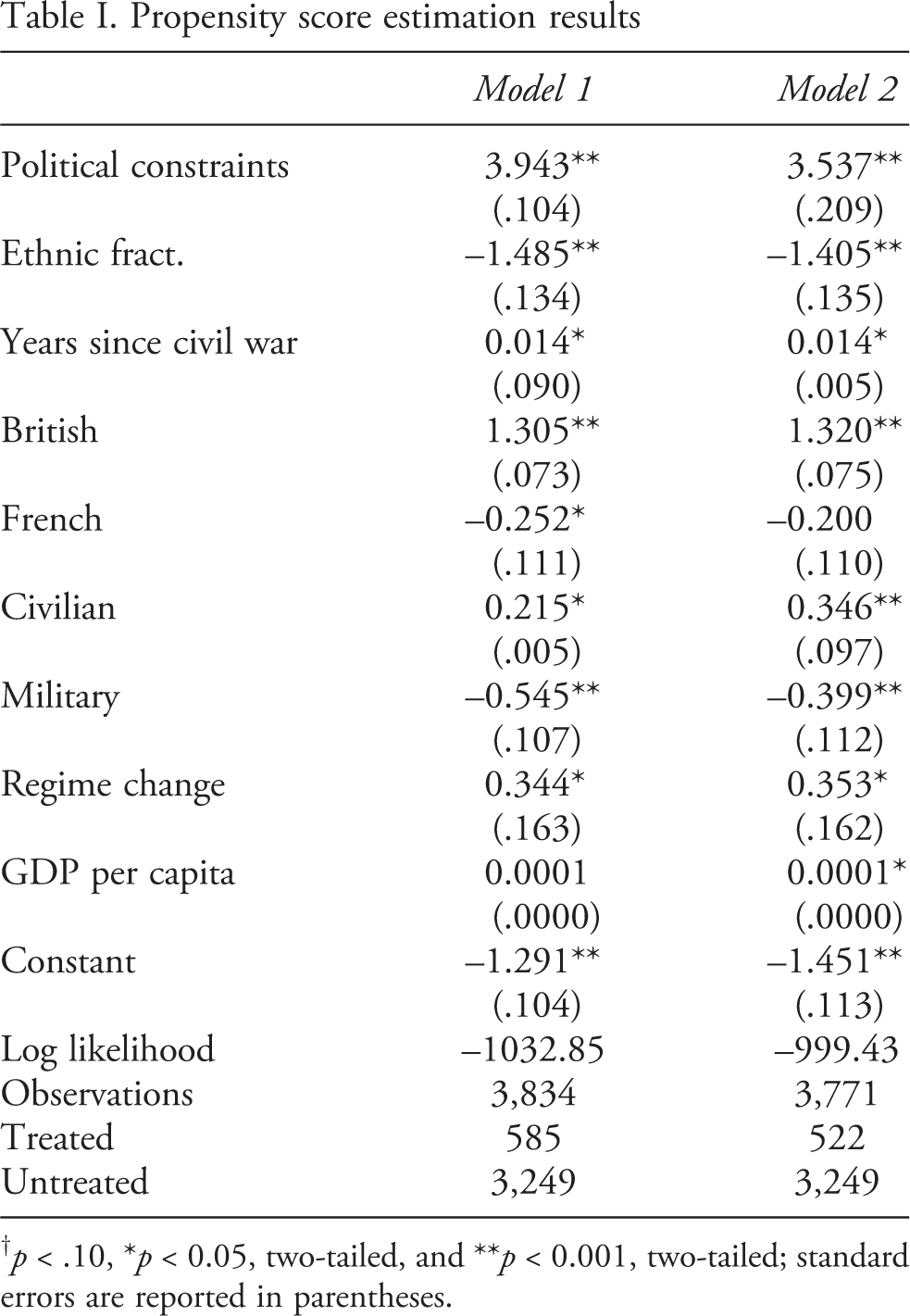
† p < .10, *p < 0.05, two-tailed, and **p < 0.001, two-tailed; standard errors are reported in parentheses.
Results
The results of the propensity score estimation can be found in Table I. Model 1 includes the estimates using the 0.40 judicial independence cut-point and Model 2 uses the 0.40–0.90 cut-point, excluding the high values of judicial independence.
Once propensity scores are estimated, treated observations are matched with untreated observations, and the average effect of the treatment is calculated. The likelihood of civil war is plotted in Figure 1 using the 0.40 measure of Judicial Independence. Figure 1 presents the likelihood of civil war among both treated and control observations, which are plotted with 95% confidence intervals. The left panel presents the results using the 25 battle-related deaths measure of civil war, while the right panel displays results using the 1,000 battle-related deaths measure. In the first panel the predicted probability of civil war among treated observations is 0.068 and 0.150 for control observations. Therefore, having an independent court reduces the likelihood of civil war by roughly 54%, among states that are equally likely to experience civil war. The results are greater when considering the higher threshold for civil war. The predicted probability of civil war as measured by 1,000 battle-related deaths is 0.027 among states without an independent court, and 0.008 among states with an independent court – a decrease of roughly 69%.
To show these results are not driven by states with high values of judicial independence, the propensity scores are estimated and observations matched, after excluding observations with judicial independence scores greater than 0.90. Figure 2 presents the predicted probability of civil war among both treated and control observations, which are plotted with 95% confidence intervals, but excluding observations with high judicial independence scores. The left panel again presents the results using the 25 battle-related deaths measure of civil war, while the right panel displays results using the 1,000 battle-related deaths measure. The likelihood of a civil war resulting in at least 25 battle-related deaths is 0.155 among the control observations, and 0.046 for the treated observations. In this specification, an independent court decreases the likelihood of civil war by roughly 70%. The results are similar for civil wars resulting in at least 1,000 battle-related deaths; the predicted probability of war among treated observations is 0.008 and 0.031 among control observations. Again, the decrease in the likelihood of civil war is 75%. Therefore, we can conclude the results are not being driven by significantly high values of judicial independence.
Discussion
When considering why authoritarian regimes adopt independent or partially independent courts, explanations typically center around arguments for promoting economic development or on insurance provisions in the event the regime loses power. Yet, much of the discussion fails to account for the ways in which independent court systems can solve bargaining problems, or resolve grievances that may result in civil war. As the models presented above suggest, an independent court can have a substantial effect on the likelihood that a regime experiences not just deadly, violent civil wars, but also lower intensity armed conflicts, both of which may destabilize the regime or hasten the regime’s removal from power. The results discussed above show that an independent court can reduce the likelihood of civil war by 54% to 75%.
By using propensity score matching rather than standard regression techniques, the effect of an empowered judiciary begins to become clear. Since many of the factors that affect a state’s propensity for judicial
Predicted probability of civil war (0.40 measure of judicial independence) Predicted probability of civil war (0.40–0.90 measure of judicial independence)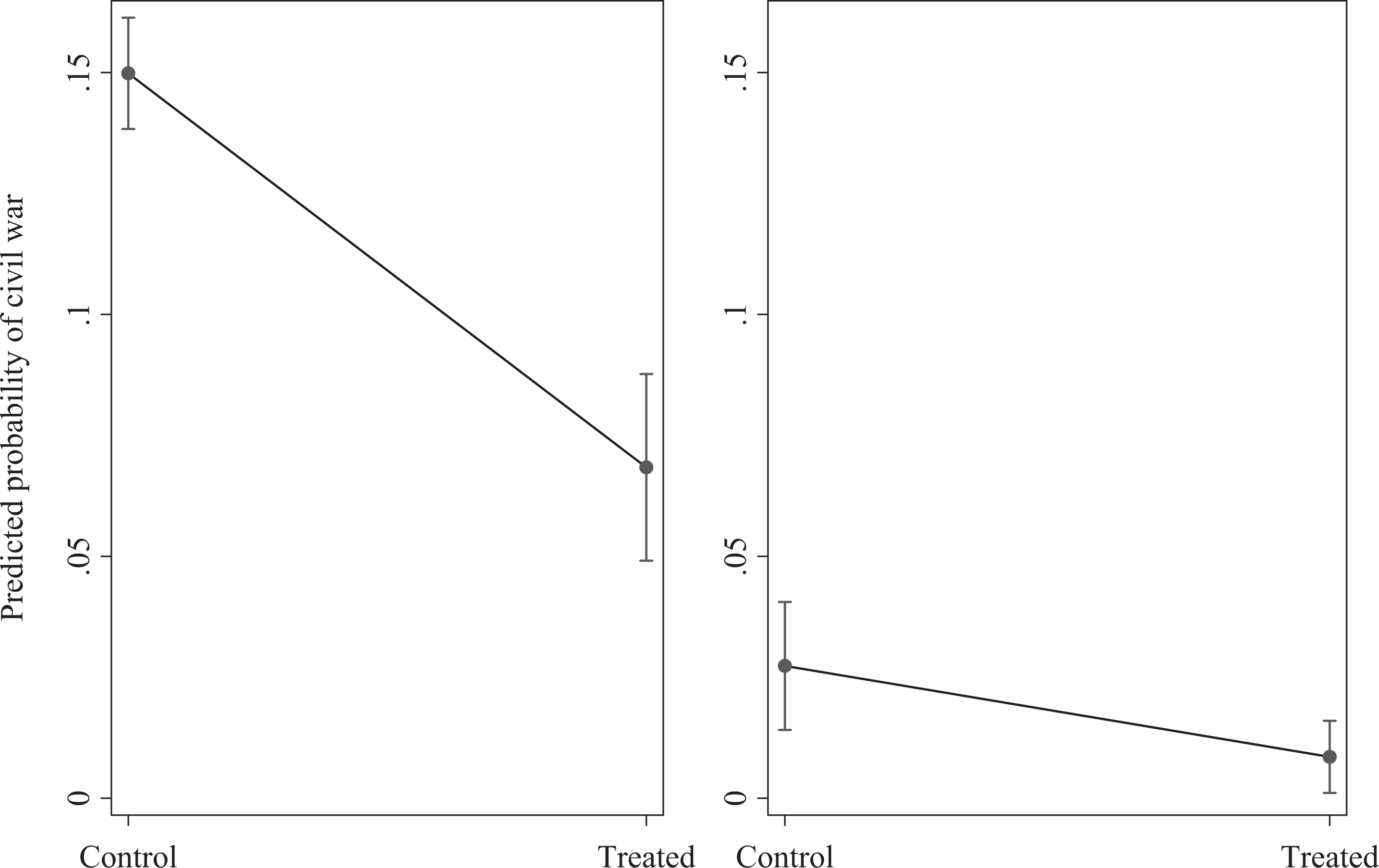

While matching vastly improves our ability to disentangle the complex relationship between institutional arrangements and the likelihood of conflict, it is not a magic bullet. The success of the matching procedure relies on the assumption that the propensity score is estimated based on all of the observable confounding variables, and that no observable confounders are excluded. Additionally, in order to draw strong causal inferences about the relationship between a treatment variable and the outcome of interest we must assume that unobservable confounders will not bias the results. This is a difficult (if not impossible) assumption to satisfy. This does not mean that matching procedures do not add value to our understanding of complex phenomena – on the contrary, they do improve our ability to account for true confounders in our estimates. However, it is important to note that these results may be sensitive to unobservable variables not accounted for in the models.
Additionally, the models presented above are conducted using propensity score, nearest-neighbor matching, without replacement. In any matching procedure, untreated observations that are not matched with a treated observation are removed from the pool of observations from which we draw our inferences. This is done to ensure that we are truly comparing like cases and drawing inferences only about similarly situated observations. However it does mean that we are losing valuable observations. In the case of this study it means I am discarding authoritarian states without independent courts that may, or may not, have experienced civil war. As is always the case when observations are excluded, it is impossible to tell what these observations might have taught us about the phenomenon of interest.
Conclusion
Independent judiciaries are not commonly associated with authoritarian governance. The idea that a judge can rule on a case involving the regime fairly and impartially, without influence from the government, is often out of place in a political system known for absolute or near absolute control of institutions. However, this old assumption is frequently being evaluated as more and more research demonstrates that in fact authoritarian regimes are empowering judicial institutions and complying with the rulings that they produce. Explanations for this phenomenon have frequently centered on economic development arguments and insurance theories, both of which leave many scholars wanting more.
This project seeks to add another possible explanation into the mix: specifically, that leaders empower independent judiciaries in order to resolve bargaining problems that, left unattended, may lead to domestic unrest, or even civil war. The empirical results support this theoretical argument as well; among states that are equally likely to have adopted an independent court, those states that do empower their judiciaries decrease their risk of civil war by between 54% and 75%.
These results pose interesting implications for furthering both the study of judicial institutions in authoritarian regimes, and methodological approaches for answering these questions. First, the results presented here suggest that previous explanations for the creation of independent courts might leave out an important impetus: that when leaders face potential threats from opposition groups, creating an independent court can have positive effects on the likelihood of civil unrest. Additionally, because the relationship between institutional choice and domestic conflict is a complex one, with many factors affecting both the likelihood of adopting judicial institutions and the likelihood of civil conflict, this project develops a methodological strategy that accounts for the complexity of that relationship. By using propensity score matching rather than traditional regression analysis, confounders are properly treated as factors that affect both the likelihood of independence and the likelihood of conflict. While this method is not without error, it does improve the ability to untangle these complex relationships
Finally, the implications of this research are important not just for the scholarly understanding of authoritarian judicial institutions, but also for policy concerns with respect to authoritarian regimes. By analyzing the effects of institutional choices, and identifying those institutions that bring substantial benefits to leaders and their people, we may better understand how and where civil war is likely to break out, and how institutional choice may impact future generations.
Footnotes
Replication data

Acknowledgements
The author wishes to thank Emily Hencken Ritter, Jacob Kathman, Philip Arena, Christopher Cooper, Todd Collins, and anonymous reviewers for their thoughtful comments on previous drafts of this article. Any errors that remain are the fault of the author alone.
Notes
References
Supplementary Material
Please find the following supplemental material available below.
For Open Access articles published under a Creative Commons License, all supplemental material carries the same license as the article it is associated with.
For non-Open Access articles published, all supplemental material carries a non-exclusive license, and permission requests for re-use of supplemental material or any part of supplemental material shall be sent directly to the copyright owner as specified in the copyright notice associated with the article.
