




Abstract
While recent research focuses on why conflict parties attack peacekeepers, little attention has been given to other types of resistance against peacekeeping missions, such as intimidation and obstruction. It is argued in this article that one reason why peacekeepers are obstructed and intimidated is that armed actors that target civilians want to maintain the operational space to carry out attacks against civilians and want to prevent peacekeepers from monitoring human rights violations. A spatially and temporally disaggregated analysis on resistance against peacekeepers in Darfur between January 2008 and April 2009 indeed suggests that the intimidation and obstruction of peacekeepers is more likely to take place in areas with higher levels of violence against civilians. The findings hold when taking into account the non-random occurrence of violence against civilians through matching the data. Finally, anecdotal evidence from other sites of armed conflict than Darfur suggests that resistance against peacekeepers in these cases is also likely to be related to the targeting of civilians. This suggest that in order to be effective in protecting civilians, peace missions should not only be robust as highlighted in previous research, but peace missions should also develop an effective strategy to deal with armed groups that try to prevent peacekeepers from fulfilling their mandate.
Introduction
Recent research has begun to address what explains violent attacks on peacekeepers (Fjelde, Hultman & Lindberg Bromley, 2016; Salverda, 2013). However, little attention has been given to other types of resistance against peace missions, such as the intimidation and obstruction of peacekeepers. In this article, I argue that intimidation and obstruction are used strategically by armed actors that want to prevent peacekeepers from fulfilling their mandate. While the mandate of peacekeeping missions can include many different focal points, a prominent aspect of most contemporary peacekeeping missions is the protection of civilians (Hultman, 2013). However, armed actors try to undermine a peacekeeping mission’s ability to protect civilians through the obstruction and intimidation of peacekeepers. Intimidation can instil fear into peacekeepers, making them reluctant to move to areas where civilians are targeted. An explicit threat to use violence is thus a fundamental characteristic of intimidation. Refusing peacekeepers access to areas where civilians are targeted naturally also prevents peacekeepers from protecting civilians; and, crucially, it prevents peacekeepers from gathering information on human rights abuses. This article investigates how violence against civilians influences the intimidation and obstruction of peacekeepers.
Consider the following examples of sabotage efforts of peacekeeping activities in the Darfur province in Sudan. On 30 October 2014, Sudanese government troops carried out attacks against the civilian population of the town of Tabit in North Darfur. Several civilians were killed and women and girls were raped on a massive scale. Human rights officers of the United Nations–African Union Hybrid Operation in Darfur (UNAMID) tried to access the area, but were repeatedly denied access by the government (Human Rights Watch, 2015). The obstruction of UNAMID peacekeepers by the Sudanese authorities prevented a credible investigation from being carried out. The government of Sudan also repeatedly prevented a credible investigation by UNAMID following the use of chemical weapons against civilians by government forces in the Jebel Marra area during the first half of 2016 (Amnesty International, 2016).
Peacekeepers have also been obstructed and intimidated in Darfur in order to prevent them from protecting civilians. For instance, on 26 January 2011, around 200 Sudanese government soldiers in 40 vehicles arrived at a UNAMID base near Shangil Tobay. The soldiers subsequently surrounded the peacekeeping base, after which the government army commander threatened to burn down the UNAMID team site if the peacekeepers continued to interfere and try to prevent the government soldiers from searching the camp of internally displaced people adjacent to the UNAMID base (Reuters, 2011). Several years earlier, in 2006, Human Rights Watch observed that the African Mission in Sudan (AMIS) was ‘severely hampered’ in its civilian protection because of the continuing obstruction of the Sudanese government (Human Rights Watch, 2006). A telling example of this obstruction is how the government of Sudan made it impossible for AMIS to prevent the destruction of the village Khor Abeche by Arab militias in Darfur on 17 January 2005. Flint and de Waal recall: The African Union had been attempting to deploy troops in Khor Abeche and Nitega village ever since an incident in which the Missirya [a Darfurian Arab tribe] accused [Minni] Minnawi [one of the Darfurian rebel leaders] fighters of stealing 150 cows and refusing to hand over the bodies of two men killed in an earlier attack. The AU and the UN accused the government of ‘deliberate procrastination’ in authorizing the African Union Mission in Sudan (AMIS) deployment despite the fact that the Nazir Tijan [an Arab militia leader] ‘had in their very presence repeatedly threatened the destruction of Khor Abeche’. While the government stalled, the militia struck, sending 350 men into Khor Abeche on horseback and camel, ‘killing, burning, and destroying everything in their paths and leaving in their wake total destruction with only the mosque and the school spared’. (Flint & de Waal, 2008: 155–156)
It should, however, be acknowledged up front that the reasons to sabotage the work of peacekeepers are not exclusively restricted to the civilian protection work of peacekeepers. Resistance may also be aimed at undermining other functions of peacekeepers than the protection of civilians. For instance, several case studies have illustrated how armed actors resist the efforts of peacekeepers to demobilize and disarm combatants (for example, see Spear, 1999).
A major reason why the sabotaging of the work of peacekeepers has not yet been studied systematically is simply a lack of data. Utilizing a unique dataset provided by the African Union High-Level Panel on Darfur, a systematic analysis of resistance against the United Nations–African Union Mission in Darfur (UNAMID) is conducted in this article. Beyond the availability of data, Darfur is a suitable case for several other reasons. First of all, UNAMID was the largest UN peacekeeping mission during the time period studied in this article (Duursma, 2017b). Secondly, Darfur is a good case to study the links between the targeting of civilians and resistance against peacekeepers because the level of violence against civilians in Darfur exhibits quite some variation in space and time in the period under study.
This article proceeds as follows. First, I put forward a theoretical argument for why armed actors that target civilians try to undermine peacekeeping missions. Next, I present the research methodology to examine resistance against peacekeepers in Darfur. The subsequent section details the empirical evidence of the magnitude and nature of the resistance against UNAMID based on the JMAC dataset. The penultimate section briefly considers whether the findings would also hold in other sites of armed conflict, reflecting on the generalizability of the findings. The final section concludes that armed actors obstruct and intimidate peacekeepers to undermine the civilian protection efforts of peacekeepers.
Theory
Building on arguments for why armed actors target civilians, this theory section discusses two motivations for obstructing peacekeepers: (1) the prevention of monitoring of human rights violations against civilians; and (2) maintaining the operational space to carry out attacks against civilians. These motivations explain why we should observe a positive correlation between targeting of civilians and targeting of peacekeepers.
A wealth of previous research shows that peace missions are effective in preventing conflict parties from fighting (Duursma & Read, 2017; Fortna, 2008; Hultman, Kathman & Shannon, 2014; Ruggeri, Dorussen & Gizelis, 2017). Several studies also show that the deployment of peacekeepers makes violence against civilians less likely (Fjelde, Hultman & Nilsson, n.d.; Hultman, Kathman & Shannon, 2013).
However, relatively few studies have addressed the factors that determine whether conflict parties cooperate with peacekeepers or not. Based on event data on UN peacekeeping missions in post-Cold War Africa, Dorussen & Gizelis (2013) find that conflict parties are generally inclined to cooperate with peacekeeping policies aimed at strengthening state capacities, whereas human rights policies are more likely to be contested. They also find that, compared to rebel parties, governments are more likely to cooperate with peacekeeping actions (Dorussen & Gizelis, 2013). In another study which draws on the same data, Ruggeri, Gizelis & Dorussen (2013) find that larger peacekeeping missions increase the level of cooperation, but this effect is conditional on the government side being the stronger conflict party. These studies, however, mainly focus on whether the conflict parties cooperate with or resist the UN, rather than the methods the conflict parties employ to resist peacekeeping efforts.
Some recent research that explicitly focuses on resistance against peacekeepers has begun to emerge, but these studies typically focus on violent resistance. Salverda finds that relatively stronger rebel parties are more likely to use violence against peacekeepers, suggesting that rebels may use violence strategically, namely as a means to make the peacekeeping mission leave the country, clearing the way for a rebel victory and regime change (Salverda, 2013). In addition, Fjelde, Hultman & Lindberg Bromley (2016) find that rebels are likely to target peacekeepers when the balance of power turns against them in their struggle against governments, as this can derail a peace process that could lead to an unfavourable settlement due to the loss of power. In short, previous research has mainly focused on violence against peacekeepers as a method of resistance, while ignoring the obstruction and intimidation of peacekeepers.
Before explaining why conflict parties do not want any peacekeepers around when they target civilians, it is important to reflect on why armed actors target civilians in the first place. Various explanations for why conflict parties target civilians in civil wars have been put forward, but most explanations put violence against civilians in the context of the efforts of the conflict parties to win the civil war. By and large, two major strategic considerations of armed actors to target civilians are identified in the literature. First, several studies find that armed actors target civilians to deter civilians from collaborating with the enemy. Kalyvas shows that belligerents in civil war selectively target civilians in disputed territories in order to deter the population from defecting to the enemy (Kalyvas, 2006). Similarly, Toft & Zhukov (2015) show that violence against civilians is used to make supporting an insurgency movement costly for the population.
A second major strategic consideration of armed actors to target civilians is to combat an adversary that cannot easily be defeated. It follows from this ‘war by other means’ perspective that armed actors target civilians to weaken the support base of their opponent. Valentino, Huth & Balch-Lindsay (2004) find that the mass killing of civilians is significantly more likely during guerrilla wars than during other kinds of wars. They explain this finding by pointing out that guerrilla forces are difficult to defeat directly, which often prompts governments facing major guerrilla insurgencies to target the guerrillas’ civilian base of support. Similarly, Downes (2011) finds that being desperate to win makes conflict parties decide to target civilians that are supporting the enemy. From this perspective, targeting civilians can be a form of punishment to coerce the enemy into defeat or it can be used as a way to deny the enemy the benefit of civilian support. In short, the current literature on violence against civilians suggests that the targeting of civilians is a crucial ‘tool’ in winning the war.
It is therefore not surprising that armed actors wish to mitigate those factors that constrain them in their ability to target civilians. The deployment of a peacekeeping operation is such a constraining factor for armed actors. Indeed, conflict parties have two reasons for not wanting any peacekeepers around when they target civilians. First, armed actors that target civilians do not want ‘protectors’ of civilians around. Peacekeepers that are mandated to protect civilians are likely to engage armed groups that target civilians. Consequently, the presence of peacekeepers dissuades conflict parties from using violence against civilians. Indeed, several recent studies have found that the presence of peacekeepers makes conflict parties less likely to target civilians. Hultman, Kathman & Shannon (2013) find that the greater the number of deployed uniformed personnel in a country, the less likely violence against civilians becomes. Kathman & Wood (2016) find that high numbers of peacekeeping troops reduce violence against civilians in ‘peace’ spells following armed conflict. The presence of peacekeepers is thus an obstacle for conflict parties wanting to target civilians.
A second reason why armed actors try to undermine peacekeeping activities is that peacekeepers often collect information and report these back to the leadership of the mission, which, in turn, can send this information to the UN Headquarters in New York or the United Nations Human Rights Council (UNHRC) in Geneva (Duursma, 2017a). In essence, armed actors that are targeting civilians do not want ‘snoopers’ around that can collect information on human rights abuses and the targeting of civilians. Since uniformed and civilian personnel employed in peacekeeping operations have privileged access to many of the world’s conflict zones, peace missions have become crucial actors with regard to the collection of information on security-related incidents in countries that experience civil war (Duursma, 2017a; Duursma, 2018). Since reports that show that the conflict parties target civilians would be diplomatically very costly for conflict parties that are already in the international spotlights (Ausderan, 2014), conflict parties will try to prevent peacekeepers from collecting information on the targeting of civilians through intimidation and obstruction of peacekeepers.
Accordingly, the presence of a peacekeeping mission essentially interferes with the logic of violence against civilians in civil wars. Previous research on civilian victimization has uncovered that civilians are often targeted by armed actors as part of a strategy to win the war (Kalyvas, 2006; Wood, 2014). Yet, the presence of peacekeeping forces constrains armed actors in terms of their ability to target civilians because peacekeepers act as protectors and snoopers. While peacekeepers acting as protectors reduce the opportunities of armed actors to target civilians, peacekeepers acting as snoopers essentially decrease the incentives for armed actors to target civilians by making it costlier. I argue that armed actors try to mitigate the protector and snooper activities of peacekeepers through obstructing and intimidating them. The intimidation of peacekeepers in areas where civilians are targeted can instil fear, making peacekeepers reluctant to patrol in these areas where civilians are targeted. Refusing peacekeepers access to areas where civilians are targeted also prevents peacekeepers from protecting civilians and gathering information on human rights abuses.
I acknowledge that attacking peacekeepers can in principle also prevent peacekeepers from snooping and protecting, but obstruction and intimidation are a less costly strategy to accomplish the same goal. Attacking peacekeeping personnel constitutes a war crime under international customary law, and the Statute of the International Criminal Court (ICC) also defines it as such. Obstruction and intimidation of peacekeepers are not defined as war crimes. Furthermore, armed actors obstructing peacekeepers can say they do this to ‘protect’ peacekeepers, but the attacking of peacekeepers cannot be justified this way. Similarly, intimidation can be very subtle; for instance, armed actors might warn peacekeepers to not show up in a certain area as they might be confused with the enemy.
A major exception to my argument – that reputational costs and operational obstacles are always a concern to armed actors targeting civilians – is that armed actors sometimes target civilians to gain international attention or receive some form of external benefits, such as recognition by international actors in peace treaty negotiations. 1 I address this exception and some other scope conditions towards the end of this article.
In short, I put forward three hypotheses to test whether armed actors indeed try to undermine the civilian protection efforts of peacekeepers through obstruction and intimidation.
Hypothesis 1: A higher level of violence against civilians in a given area makes the obstruction and/or intimidation of peacekeepers more likely in this area.
Evidence in favour of Hypothesis 1 would support the central argument, but it could also support some alternative explanations. Perhaps armed actors use intimidation and obstruction more in one type of area than in other areas – and this type of area could also be more disposed towards violence against civilians. The empirical analysis will take possible confounding variables into account to control for this possibility, as well as using a matching design to account for the non-randomness of violence against civilians and the deployment of peacekeepers. Yet, I also put forward two additional hypotheses to more directly assess whether armed actors use obstruction and intimidation as a strategy to frustrate efforts of peacekeepers to protect civilians.
Hypothesis 2: The targeting of civilians in a given area decreases the time until a peacekeeping patrol is obstructed and/or intimidated in this area.
Hypothesis 3: The obstruction and/or intimidation of peacekeepers in a given area decreases the time until civilians are targeted in this area.
A limitation of solely testing Hypothesis 1 would be that it would be impossible to infer the temporal order of events, which means that conclusions cannot be drawn about whether obstruction and intimidation are used prior to attacks on civilians or following attacks on civilians. Supporting Hypothesis 2 would provide evidence for the ‘snoopers’ argument which holds that armed actors that have targeted civilians will try to prevent peacekeepers from collecting evidence on human rights abuses. Supporting Hypothesis 3 provides evidence in favour of both the ‘snoopers’ and the ‘protectors’ argument. The reason why supporting Hypothesis 3 not only would provide support for the ‘protectors’ argument is that armed actors could anticipate monitoring by peacekeepers and therefore might engage in preventive obstruction and/or intimidation. 2
Methodology
In order to examine the hypotheses above, I conduct a quantitative case analysis of resistance against UNAMID in Darfur. The JMAC data employed to study resistance against UNAMID have been provided by the African Union High-Level Panel on Darfur. The incident data have been compiled by JMAC between 3 January 2008 and 6 April 2009, in real time, to support the day-to-day operations of UNAMID. The JMAC data are uniquely detailed (Duursma, 2017a). Of the 2,861 descriptions of security incidents included in the JMAC data, 41 incidents were coded as involving the intimidation of peacekeepers, 47 involving the obstruction of peacekeepers, and 451 involving the targeting of civilians.
The JMAC data is well suited to examine the links between resistance against peacekeepers and the targeting of civilians. JMAC units within peacekeeping missions are generally tasked to collect information that can both help to ‘protect the mandate and protect the force’ (Duursma, 2017a). Since the obstruction and intimidation of peacekeepers relates to the protection of the force and the targeting of civilians relates to the protection of the mandate, the JMAC unit within UNAMID has systematically collected information on these types of events.
The JMAC data are used to code the variables on resistance against peacekeepers and the targeting of civilians in two newly constructed datasets. The unit of analysis is the locality-month in both datasets. A shapefile from the Office for the Coordination of Humanitarian Affairs (OCHA), which divides Darfur into 63 localities, is used to construct the dataset. The locality is an appropriate unit of analysis since the borders of the 63 localities matter in terms of the zones of control of the various armed actors operating in Darfur. Armed actors in Darfur generally compete over control of territory within the confines of the administrative borders of these localities (Duursma & Read, 2017; Flint & de Waal, 2008). Previous research has shown that violence against civilians is related to zones of control (Kalyvas, 2006), so I expect that armed actors obstruct and intimidate peacekeepers within the borders of localities in which they compete over the loyalty of the population. Using the locality as unit of analysis makes it possible to control for disputed localities in which both rebels and government forces control towns. This is important because peacekeepers might be predisposed to operate in disputed localities, while disputed localities might also be susceptible to higher levels of violence against civilians.
While I deem the locality the most appropriate unit of analysis for this study, I also run a model using grid cell data instead of locality data as a robustness check. The PRIO-GRID dataset, version 2.0, is used, which includes 213 cells that cover Darfur (Tollefsen, Strand & Buhaug, 2012). To test whether a higher level of violence against civilians in a given area makes the obstruction and/or intimidation of peacekeepers more likely in this area (Hypothesis 1), I use a dataset in which monthly observations of the localities are used as the unit of analysis. This enables an analysis of the temporal dynamics of resistance against peacekeepers, as well as violence against civilians. Since the dataset covers the period between January 2008 and March 2009, the dataset has 945 observations (15 months × 63 localities). The grid cell dataset has 3,195 observations (15 months × 213 cells).
To model the obstruction and intimidation of peacekeepers using this dataset, I employ a variable that codes the number of incidents in which peacekeepers were obstructed and/or intimidated by armed actors in a given locality in a given month. To compare obstruction and intimidation of peacekeepers as a strategy of resistance to the use of violence against peacekeepers, I use an additional dependent variable that codes the number of violent attacks on UNAMID that have taken place in a given locality in a given month. The dependent variables are thus count data. I use a negative binomial regression model because the distribution of the standard errors of violence against civilians is not normally distributed. As an extra robustness test, I also employ a logit model to study the obstruction and intimidation of UNAMID peacekeepers. For this logit model, I use a binary dependent variable that is coded as 1 if obstruction and/or intimidation against peacekeepers have occurred in a given locality in a given month.
To model whether the targeting of civilians in a given area decreases the time until a peacekeeping patrol is obstructed and/or intimidated in this area and vice versa (Hypotheses 2 and 3), a dataset is used that takes a given locality-day between 1 January and 8 April as the unit of analysis. This dataset has 29,232 observations (464 days × 63 localities). 3 To test Hypothesis 2, the duration between a given locality-day and the obstruction and intimidation of peacekeepers is assessed as the dependent variable. For Hypothesis 3, this is the duration between a given locality-day and the targeting of civilians. In order to model the duration between the events of interest in number of days, I employ hazard analyses. Cox duration models are used because this procedure is semi-parametric and thus less dependent on any parametric assumption.
An example of an attack on UNAMID is an ambush by the Sudanese army of a UNAMID resupply convoy heading to El Tina from Um Buru on 7 January 2008, during which a civilian driver was injured (Observation 4 in the JMAC dataset). An example of obstruction of peacekeepers is an incident that occurred on 2 July 2008, when a UNAMID patrol on its way to the Bulbul area was denied access by a Sudanese military commander who claimed that the situation in the Bulbul area was calm and that there was no need for a patrol (observation 830 in the JMAC dataset). An example of intimidation is an incident that occurred on 25 September 2008, when two men approached a UNAMID police adviser who was on a patrol at the market area of Shaeria town and threatened him that Janjaweed would kill him for protecting the Zaghawa internally displaced persons (Observation 1303 in the JMAC dataset).
Obstruction entails the refusal of passage to peacekeepers, while intimidation refers to an effort to influence the behaviour of peacekeepers through instilling fear or through threatening with negative consequences should peacekeepers act a certain way. Intimidation and obstruction are thus not two mutually exclusive categories. If an armed group refuses a peacekeeping patrol passage it may simultaneously threaten the peacekeepers with armed violence if they show up in the area again in the future. Since intimidation and obstruction often overlap, and since I argue that both intimidation and obstruction are used to prevent peacekeepers from fulfilling their mandate, I have grouped obstruction and intimidation together in an Obstruction and/or intimidation variable.
Furthermore, I acknowledge that attacks against peacekeepers may be used as a way to intimidate or obstruct peacekeepers. Nevertheless, I have made the obstruction and/or intimidation and violent resistance categories mutually exclusive. As soon as an armed group uses armed violence, Violent resistance is coded as 1 and Obstruction and/or intimidation as 0, regardless of the possible intentions of the attackers.
The main independent variable of interest is Violence against civilians, which codes the number of incidents in which an armed group attacks civilians in a given locality or cell in a given month. In addition to attacks on the ground, I consider the bombing of villages and other type of airstrikes against civilians as violence against civilians. I also consider non-lethal use of violence against civilians. The JMAC dataset also includes incidents in which civilians were targeted but did not die. For example, the JMAC dataset reports that a group of unknown armed men opened fire on a private vehicle which travelled from El Ferdous to Al Sunta on 12 January 2008, injuring one of the two passengers (Observation 11 in the JMAC dataset).
I control for several possible confounding variables that might influence both resistance against peacekeepers and violence against civilians. First, I control for the presence of a Peacekeeping base in the locality. Peacekeepers are likely to be deployed where civilians are most at risk (Hultman, Kathman & Shannon, 2013) and the presence of peacekeepers is of course a necessary condition for resistance against peacekeepers. I draw on data from Fjelde, Hultman & Nilsson (n.d.) to code whether a peacekeeping base is present in a locality or grid cell. Previous research has also shown that peacekeepers are most likely to be deployed in areas where armed fighting takes place (Powers, Reeder & Townsen, 2015; Ruggeri, Dorussen & Gizelis, 2018; Townsen & Reeder, 2014), as well as that violence against civilians is correlated with clashes between the conflict parties (Hultman, 2007; Wood, 2014). Peacekeepers are thus naturally more exposed to violence in places where civilians are targeted, which is why we might observe a positive correlation between targeting of civilians and targeting of peacekeepers. It is therefore absolutely crucial to control for Armed clashes in a given locality. In addition, the leadership of peacekeeping missions might also anticipate armed fighting and send peacekeepers to areas that are disputed. Hence, I control for Disputed locality in which both rebels and government forces control towns. To code this variable I draw on data from Seymour (2014), supplemented with Small Arms Survey reports.
Two structural factors related to the locality that may increase or decrease the likelihood of resistance against peacekeepers are controlled for, namely a binary variable that indicates the presence of Mountains (Jebel Moon, Jabel Marra, Jebel Umkardos, Jebel Adola, and the Midoub mountains) in the locality and a binary variable that indicates the presence of a Major town with more than 75,000 inhabitants (Nyala, Al Fasher, Ad Daein, and Al Geneina) in the locality. For the dataset that employs the grid cell as unit of analysis, I use the percentage per grid of the land that is covered by mountains using data from the United Nations Environmental Programme (UNEP) Mountain Watch Report (Blyth et al., 2002) and the percentage per grid of the land that is covered by an urban area taken from the European Space Agency 2009 GlobCover report (Bontemps, Defourny & Van Bogaert, 2009). It should be noted that the two structural factors related to the locality do not vary over time.
Finally, I use robust standard errors, clustered on the locality or cell to account for the clustering of resistance against peacekeepers. In order to control for temporal dependence, I include a variable that measures the number of months since the last time peacekeepers were obstructed and/or intimidated in a given locality or cell (Time since last attack on peacekeepers; Time since last intimidation and/or obstruction of peacekeepers).
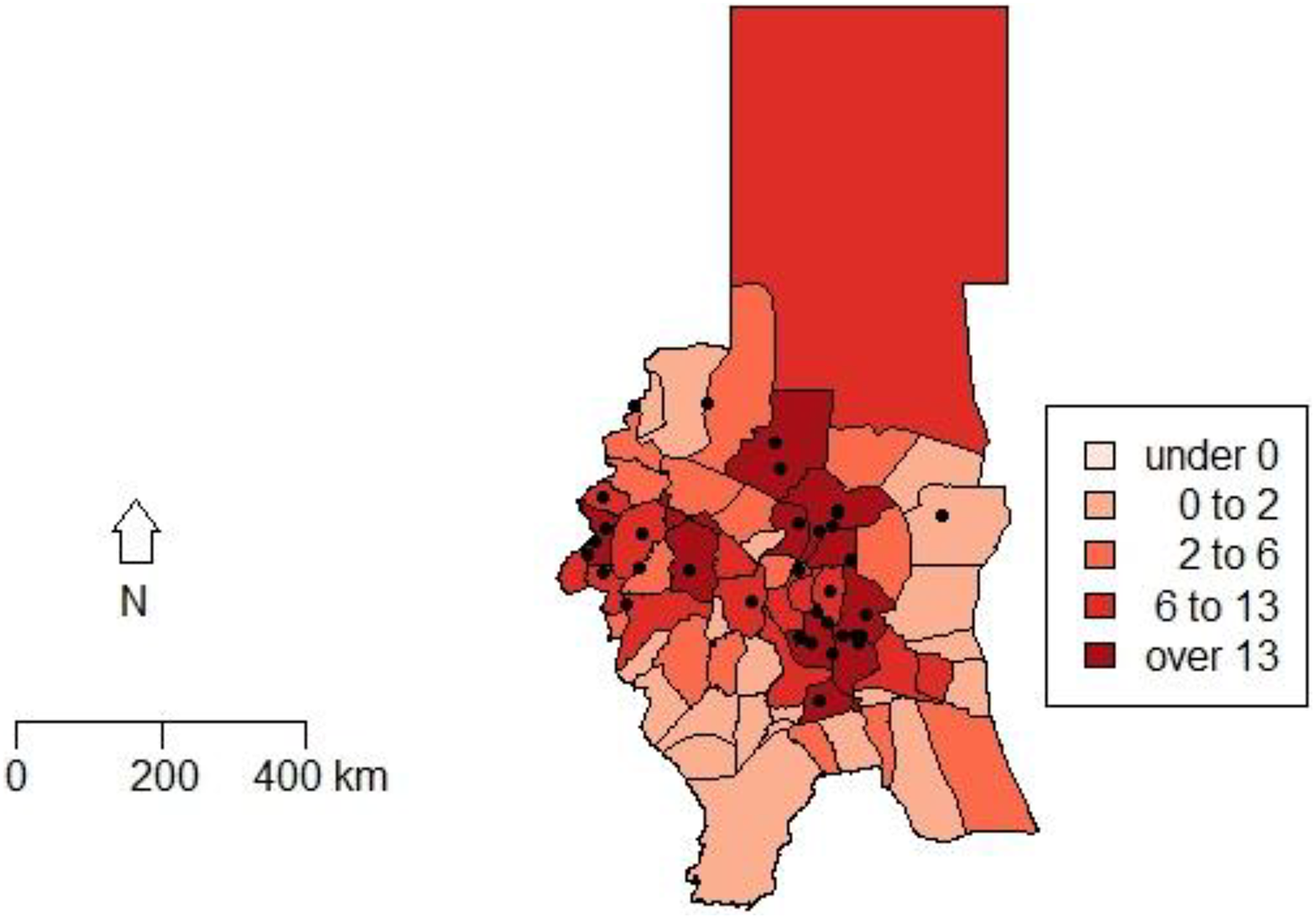
The spatial correlation between the targeting of civilians and the obstruction and intimidation of UNAMID in Darfur, January 2008–March 2009
Findings
Figure 1 shows that the targeting of civilians is spatially correlated with the obstruction and intimidation of UNAMID peacekeepers. The map is a basic choropleth map that indicates the relative frequency of the targeting of civilians in Darfur’s localities. The localities with darker shades of red have experienced higher levels of violence against civilians. The black circles plotted on the map are instances of obstruction and/or intimidation of UNAMID peacekeepers, from which it follows that obstruction and intimidation of UNAMID predominantly occurs in those areas which have experienced high levels of violence against civilians.
While Figure 1 is indicative of a correlation between the targeting of civilians and the obstruction and/or intimidation of UNAMID peacekeepers, it does not provide significant evidence by itself. Accordingly, Table I employs negative binominal models and logit models on attacks and obstruction and/or intimidation of UNAMID peacekeepers.
It follows from Model 1 that the targeting of civilians in a given locality in a given month does not have a statistically significant impact on attacks against UNAMID within this locality and month. This suggests that direct violence against peacekeepers by armed actors is less likely to be used as a strategy to undermine the civilian protection capacity of peacekeepers. A plausible explanation for this finding is that attacking peacekeepers can in principle also prevent peacekeepers from snooping and protecting, but obstruction and intimidation are a less costly strategy to accomplish the same goal.
Resistance against UNAMID in Darfur, January 2008–March 2009

Robust standard errors, clustered on the locality or cell, are in parentheses. *significant at 5%; **significant at 1%.
Resistance against UNAMID is treated as a count variable in Model 2. Yet, of the 53 locality-months in which the obstruction and/or intimidation of peacekeepers took place, 32 observations entailed only a single incident involving the obstruction and/or intimidation of peacekeepers. Two incidents of obstruction and/or intimidation of UNAMID in a locality-month occurred 14 times, three incidents two times, four incidents four times, five incidents did not occur, and six incidents involving the obstruction and/or intimidation of UNAMID took place only once. Model 3 shows that the targeting of civilians in a given locality in a given month still has a significant and positive effect on the nonviolent targeting of UNAMID when the dependent variable is a binary indicator of the occurrence of violence on civilians and when a logit model is used.
One limitation of the previous estimates on the correlation between the targeting of civilians and the obstruction and/or intimidation of peacekeepers on a local level is that the non-random assignment of the targeting of civilians is insufficiently taken into account. For instance, it might be the case that peacekeepers get in the cross-fire when they want to protect civilians from attacks by armed actors. However, this is not the case. There are only six locality-days on which both an attack on civilians and the obstruction and/or intimidation of peacekeepers took place. A closer look at these six cases shows that peacekeepers were not involved or caught in the cross-fire during any of these six attacks on civilians. Moreover, if this cross-fire explanation indeed were to be valid, then one would also expect a positive and significant correlation between the targeting of civilians and attacks on peacekeepers. Yet, it follows from Model 1 that this is not the case. Nevertheless, to more comprehensively address the methodological problem of the non-random assignment of the targeting of civilians, a matching design is used (see Rubin, 1979). More specifically, I use the coarsened exact matching (CEM) method introduced by Blackwell et al. to coarsen the independent variables and recode them so that similar values are grouped together. The exact matching algorithm is then used to identify the matches. Next, the coarsened values are abandoned and the actual values of the independent variables in the matched data can be used to estimate the causal effect of civilian targeting (Blackwell et al., 2009). The CEM method thus essentially follows the logic of most similar designs.
Results of matching: Treatment = Violence against civilians

Since the imbalance is not completely removed, I subsequently replicate Model 2 using the matched data. As follows from Model 4 in Table I, the analysis based on the matched data does not alter the main finding. The significant and positive correlation between the targeting of civilians and the obstruction and/or intimidation of peacekeepers remains, even when taking into account the non-random assignment of the targeting of civilians.
Model 5 assesses the link between the targeting of civilians and resistance against peacekeepers using grid cell data. Whether the territory covered by the grid cells is disputed is not included in the model since there is not sufficient information to adequately code zones of control in Darfur at grid cell level. It follows from Model 5 that the positive and significant correlation between the targeting of civilians and the nonviolent targeting of peacekeepers remains when using grid cell data.
In addition to the matching procedure, I run two more robustness checks. First, I replicate Model 2 using fixed effects, but this does not change the findings. Second, since the size of the most northern locality of Darfur, El Malha, is so much bigger than that of the other localities – much of El Malha is unpopulated due to the desert – I examine whether this locality influences the findings. Dropping the observations related to this locality did not alter the main findings.
I thus find strong support for Hypothesis 1. The intimidation and obstruction of peacekeepers is more likely to take place in areas with higher levels of violence against civilians. This finding remains robust when controlling for several possible confounding variables. The findings also hold when taking into account the non-random occurrence of violence against civilians through matching the data. Using grid cell data instead of locality-level data does not alter the findings either.
The descriptions of the security incidents included in the JMAC dataset shed light on the statistically significant and substantially strong correlation between the targeting of civilians and nonviolent resistance against UNAMID. For instance, the JMAC dataset includes eight incidents in which civilians were targeted in the Bielel locality during March 2008. In the same month, on 14 March 2008, government soldiers fired warning shots at a UNAMID patrol in Bielel, on their way to Labado from their base in Shearia, after which the peacekeepers were stopped and told that they were in a no-go area for UNAMID (observation 191 in the JMAC dataset). Similarly, the JMAC dataset includes seven observations of the targeting of civilians in El Geneina locality during March 2009, of which three relate to incidents in the Al-Riyadh internally displaced people (IDP) camp. It was precisely in this camp where a UNAMID night patrol was stopped by government soldiers on 7 March 2009 and requested to return to their base. The commander of the UNAMID patrol was told by the GoS military officer that he had been instructed by the National Security Service that he should not allow UNAMID peacekeepers into the camp (Observation 2554 in the JMAC dataset). Similarly, on 3 February 2009, a UNAMID assessment patrol was sent to Muhajeria to collect information following heavy bombings by government forces, which included civilian targets, but the Sudanese authorities refused UNAMID access to the area (Observation 2122 in the JMAC dataset).
One limitation of the models above is that it is impossible to infer the temporal order of events. It is not possible to determine whether obstruction and intimidation are used prior to attacks on civilians or following attacks on civilians. Table III employs duration models in order to examine this.
Duration models on resistance against UNAMID and the targeting of civilians in Darfur, January 2008–March 2009

Robust standard errors, clustered on the locality, are in parentheses. *significant at 5%; **significant at 1%.
As a robustness check, I examine whether the analyses in Models 1 and 2 in Table III meet the proportional-hazards assumption of the Cox model, which holds that each observation’s hazard function follows the same pattern over time. The results of this analysis are discussed in the Online appendix.
Finally, the impact of the targeting of civilians on the time until peacekeepers are obstructed and/or intimidated and vice versa is shown in a Kaplan-Meier graph in Figure 2. The Kaplan-Meier graph to the left shows the survival curve of the obstruction and/or intimidation of peacekeepers, whereas the Kaplan-Meier graph on the right shows the survival curve of the targeting of civilians. The vertical reference line in both graphs represents the 30 days mark. The survival curve on the right, which shows the impact of peacekeepers being obstructed and/or intimidated on the time until civilians are targeted, is very steep in the beginning. In fact, civilians were targeted within 30 days following the obstruction and/or obstruction of peacekeepers in 48 out of the 69 cases in Kaplan-Meier estimates on the obstruction and/or intimidation of peacekeepers and the targeting of civilians
A telling example of the efforts of armed actors to prevent peacekeepers from being present when civilians are targeted is the obstruction and intimidation of UNAMID patrols that took place in the Sheiria locality in January and February 2009. On 12 January 2009, a group of peacekeepers patrolling in Shaeria Town was stopped by unidentified armed men who surrounded them with Browning machine guns, fired warning shots, and told them not to return (Observation 2059 in the JMAC dataset). Five days later, on 17 January 2009, four villages around Shaeria town – Abu Dangal, Umm Shegeria, Haskanita, and Sungu villages – were looted and burnt by Arab militia men. Six civilians were killed and 15 wounded (Observations 1974 and 1997 in the JMAC dataset).
In only 78 (19.5%) of the 401 cases in which civilians were targeted did the obstruction and/or intimidation of peacekeepers take place within 30 days. This suggests that armed actors most frequently try to undermine the protection function of peacekeepers or anticipate monitoring by peacekeepers and therefore engage in preventive obstruction and/or intimidation.
Beyond Darfur
To get at least some sense of whether similar dynamics can be observed in other sites of armed conflicts in which peacekeepers operate, this section briefly reflects on the level and nature of resistance against peacekeepers in other UN peacekeeping operations.
Following the Lusaka Ceasefire Agreement concluded on 17 July 1999, the United Nations Mission in the Democratic Republic of the Congo (MONUC) was deployed in the DRC to monitor the peace process. MONUC initially succeeded in bringing at least some sense of security to the areas where it deployed. For example, in April 2001, a Moroccan contingent was deployed in Kisangani. The population of the town, which had been controlled by RCD-Goma and the troops of Laurent Nkunda, welcomed the UN troops as liberators. Yet, around one year later, on 14 May 2002, the rebels retook the city and immediately displayed their dominance by threatening to attack the MONUC peacekeepers should they intervene. The MONUC troops, vastly outnumbered, subsequently watched and stood idle when the rebels took full control of Kisangani and killed more than 150 civilians in the process (Guéhenno, 2015: 120).
Fast-forwarding to 2017, fighting erupted in the Kasai-Central province of the DRC between government forces and the Kamuina Nsapu milita. The government response included the heavy targeting of civilians, including women and children, resulting in numerous deaths. To prevent a credible investigation regarding these human rights abuses, the government restricted the access of MONUC’s successor, the United Nations Organization Stabilization Mission in the Democratic Republic of the Congo (MONUSCO) (Reuters, 2017a). In a statement deploring the killing of civilians in the Kasai-Central province, MONUSCO chief Maman Sidikou called upon the government to immediate halt the ‘restrictions on the freedom of movement on MONUSCO, which impede on the ability of the Mission to discharge its full mandate in the DRC’ (MONUSCO, 2017).
The United Nations Mission in South Sudan (UNMISS) was deployed in July 2011 to ensure peace consolidation in the newly independent country. However, a civil war broke out in December 2013, which shifted the focus of UNMISS to supporting the peace process and protecting civilians. UNMISS peacekeepers have been severely hampered in their civilian protection efforts as a result of obstruction and intimidation. For instance, in early 2017, government forces started an offensive in the Upper Nile state, during which civilians were heavily targeted as well, but the government refused to allow UNMISS peacekeepers access to the conflict zones (Reuters, 2017b). Similarly, government forces prevented UNMIS staff from accessing the Eastern Equatoria state town of Pajok in April 2017. In an official statement, the UNMISS leadership urged the government to immediately allow it access ‘so it can fully implement its mandate, including to protect civilians and report on human rights violations’ ( Sudan Tribune, 2017a).
The UN’s response to the obstruction and intimidation of peacekeepers in South Sudan has become much more proactive. Reflecting how frequently UNMISS peacekeepers are obstructed, the UN Secretary-General formally noted in a report on South Sudan that the restrictions on access of peacekeepers have made it difficult for UNMISS to fulfil its mandate ( Sudan Tribune, 2017b). In addition, the UNMISS leadership has instructed field commanders to hold their ground when their patrols are blocked by troops. There have been several instances of platoons sleeping at checkpoints for up to three days until they were finally allowed to go (Reuters, 2017b). The head of UNMISS, David Shearer, has also occasionally responded to some roadblocks with public pressure. For instance, he demanded access to the Torit orphanage on UN radio (Reuters, 2017b).
Beyond probing the validity of the argument in DRC and South Sudan, it is important to reflect on cases in which the main argument advanced in this article does not apply. A glance at the many places where UN peacekeeping operations are deployed suggests that at least three scope conditions can be specified. First, one would expect peacekeepers to be less likely to be obstructed and intimidated in places without ongoing armed conflict, as for example peacekeepers who were part of the United Nations Operation in Côte d’Ivoire (UNOCI). Since the targeting of civilians often takes place in the context of ongoing civil wars (Kalyvas, 2006; Valentino, Huth & Balch-Lindsay, 2004), armed actors in post-conflict settings probably have less incentives to curb the civilian protection capacity of peacekeepers. Second, and relatedly, one would expect peacekeeping missions without a robust mandate – as for example the United Nations Mission for the Referendum in Western Sahara (MINURSO) – to also experience less obstruction and intimidation. Peacekeeping missions without a robust mandate are deployed in places with less violence against civilians in the first place, but peacekeepers without a robust mandate also do not have the capacity to prevent armed actors from targeting civilians. In other words, there is less need for armed actors to obstruct and intimidate peacekeepers when the peacekeeping mission does not have a robust mandate. Third, and lastly, one would expect the obstruction and intimidation of peacekeepers to be less likely in countries where armed actors target civilians to get recognition for their importance. For instance, al-Qaida in the Maghreb and the Islamic State operating in Mali widely publicize events in which they have attacked civilians, indicating that these insurgents might be less interested in preventing peacekeepers from monitoring human rights violations. In addition, since MINUSMA is actively supporting the government of Mali, jihadist insurgent groups in Mali typically engage MINUSMA peacekeepers rather than intimidate or obstruct them.
Conclusion
This article has examined resistance against peacekeepers at the local level. At a minimum, this article shows that resistance against peacekeepers takes other forms than only direct attacks. Yet, crucially, the findings also support the claim that armed actors are more likely to obstruct or intimidate peacekeepers when they target civilians. In essence, armed actors do not want to run the risk of being attacked by peacekeepers that fulfil their mandate to protect civilians and do not want peacekeepers to collect evidence of human rights abuses following incidents in which they have targeted civilians.
Since peacekeepers are naturally more exposed to violence in places where civilians are targeted, one would expect a positive correlation between targeting of civilians and targeting of peacekeepers. This article has dealt with this issue in five ways. First, I have controlled for the number of armed clashes that take place in a given locality-month and for whether localities are disputed in the sense that both government troops and non-state armed actors in conflict with the government control territory in the locality. Second, even when using a matching design that specifically deals with the non-random assignment of the targeting of civilians and takes several contextual factors into account, including the number of armed clashes in a locality-month, the significant correlation between the targeting of civilians and the obstruction and/or intimidation of peacekeepers holds. Third, to examine whether the main finding of this article is a result of peacekeepers getting in the cross-fire when they want to protect civilians from attacks by armed actors, I have also looked at the impact of civilian targeting on violent attacks on UNAMID. If the cross-fire logic was at play, one would also expect a significant correlation between the targeting of civilians and attacks on UNAMID, but this is not the case. Fourth, and relatedly, peacekeepers were not caught in the cross-fire on the six locality-days on which both civilians were targeted and peacekeepers were obstructed and/or intimidated. Finally, I have used duration models to observe that the targeting of civilians reduces the time until the obstruction and/or intimidation of peacekeepers and vice versa.
A fundamental characteristic of contemporary peace missions is the weight that is attached to the protection of civilians (Hultman, 2013). Yet, little is known about how to best deal with efforts by the peacekept to undermine peacekeeping efforts. Future research should therefore aim to explain how best to deal with intimidation and obstruction aimed at preventing peacekeepers from protecting civilians. The summary reports included in the JMAC dataset suggest that UNAMID peacekeepers have often tried to avoid confrontation when faced with obstruction and intimidation. For instance, on 21 November 2008, UNAMID personnel patrolling farmlands in the vicinity of Nyala were told by an Arab militia to leave the area and not to patrol it again. The UNAMID peacekeepers subsequently left to avoid confrontation (Observation 1644 in the JMAC dataset). Yet, whether avoiding confrontation is the most effective course of action remains to be examined. If avoiding confrontation is at the expense of peacekeepers’ effectiveness in protecting civilians, then the leadership of peace missions should devise a plan that aims to achieve an optimal outcome for this difficult trade-off.
In conclusion, I have argued that conflict parties try to prevent peacekeepers from fulfilling their mandate where they are most needed: in those areas where civilians are in need of protection from armed groups. Evidence based on UNAMID’s peacekeeping effort in Darfur seems to suggest that this is indeed the case. This suggests that in order to be effective in protecting civilians, not only should peace missions be robust as highlighted in previous research (Hultman, Kathman & Shannon, 2013), but peace missions should also develop an effective strategy to deal with armed groups that try to prevent peacekeepers from fulfilling their mandate.
Footnotes
Replication data

Acknowledgements
I am grateful for very useful feedback from Alex de Waal, Govinda Clayton, Andrea Ruggeri, Walt Kilroy, Roger Mac Ginty, Roisin Read and Luke Abbs. Any errors are my own. I would also like to thank Hanne Fjelde, Lisa Hultman, and Desirée Nilsson for kindly sharing their data on the locations of UNAMID peacekeeping bases.
Funding
The article is made possible through ESRC grant ES/L007479/1 ‘Making Peacekeeping Data Work for the International Community’.