



Abstract
Violent conflict among rebels is a common feature of civil wars and insurgencies. Yet, not all rebel groups are equally prone to such infighting. While previous research has focused on the systemic causes of violent conflict within rebel movements, this article explores the factors that affect the risk of conflict between pairs of rebel groups. We generate hypotheses concerning how differences in power, ideology, and state sponsors between rebel groups impact their propensity to clash and test them using data from the Syrian civil war. The data, drawn from hundreds of infighting claims made by rebel groups on social media, are used to construct a network of conflictual ties among 30 rebel groups. The relationship between the observed network structure and the independent variables is evaluated using network analysis metrics and methods including assortativity, community structure, simulation, and latent space modeling. We find strong evidence that ideologically distant groups have a higher propensity for infighting than ideologically proximate ones. We also find support for power asymmetry, meaning that pairs of groups of disparate size are at greater risk of infighting than pairs of equal strength. No support was found for the proposition that sharing state sponsors mitigates rebels’ propensity for infighting. Our results provide an important corrective to prevailing theory, which discounts the role of ideology in militant factional dynamics within fragmented conflicts.
A revolutionary’s worst enemy is often another revolutionary.
Introduction
Infighting among rebels is a common feature of civil wars and insurgencies. Rebel movements are usually divided into brigades that fight under several factional banners with varying degrees of coordination. 1 This fragmentation generates a competitive landscape in which violent infighting occurs frequently. The history of civil conflicts is replete with dramatic instances of rebel-on-rebel fratricide (Bakke, Cunningham & Seymour, 2012). 2 The ongoing Syrian civil war offers a stark reminder of how rebels can turn on each other while simultaneously waging war against a formidable regime.
The puzzle of rebel infighting can be addressed at either the systemic or dyadic level. The burgeoning literature on interrebel wars almost exclusively focuses on systemic risks that generate conflictual rebel relationships. These include the problem of credible commitments born out of anarchy (Christia, 2012), the depth of movement fragmentation (Cunningham, Bakke & Seymour, 2012), regime weakness or impending rebel victory (Lichbach, 1995), the presence of lootable resources (Fjelde & Nilsson, 2012), and the quest for patronage within violent patrimonial political systems (Seymour, 2014). In this article, we take a dyadic approach to understanding which groups are most prone to infighting when rebel movements descend into factional conflicts. Investigation at the dyadic level helps us go beyond the systemic assumption of unit homogeneity and thus can offer finer predictions about who is likely to enter into fratricidal wars.
We make three contributions – theoretical, methodological, and empirical. Theoretically, we investigate the effects of power, ideology, and state sponsorship on the propensity for infighting in rebel dyads. We conceptualize power in conflict dyads as either symmetric or asymmetric (i.e. groups of similar or dissimilar strength, respectively). Whereas power parity may generate conflict between an established rebel faction and a rising competitor, power asymmetry may invite rebel aggression by strong factions against their weaker rivals. We test both propositions. We conceive of ideology in conflict dyads as either proximate or distant (i.e. groups with overlapping ideological positions or opposing ideological preferences, respectively). We hypothesize that higher rates of conflict are more likely between ideologically distant groups than between those that are ideologically proximate. Lastly, we explore the potential effects of state sponsorship on interrebel conflicts by looking for the presence or absence of overlapping state sponsors in rebel dyads. We posit that rebels that share state sponsors are incentivized by their external patrons to forge unity and will thus experience less infighting than those with distinct state sponsors.
Methodologically, we introduce a network-analytic approach to explain the determinants of salient conflict dyads in rebel movements. Conflict dyads can be embedded within a network of movement infighting, which enables the detection of patterns of infighting relationships. We use assortativity, community structure detection, and network simulation, as well as an additive and mixed effects (AME) latent factor model to evaluate the effects of power, ideology, and state sponsorship on generating conflict within dyads. We also run a number of robustness tests including validation of our findings using exponential random graph models (ERGM), another approach to statistical inference on networks (Desmarais & Cranmer, 2017).
Empirically, we rely on relational and quantitative analysis of the ongoing Syrian civil war, a conflict that is at the center of regional and international insecurity, multiple humanitarian crises, and military interventions by major powers. We constructed a unique database of three years of rebel infighting for the period of January 2013 to December 2015. The data come from primary insurgent documents such as rebel operational communiques, social media postings, and jihadist web forums. We also drew upon rebel groups’ political programs and manifestos to capture their ideological leanings. Lastly, we collected data on power measures, operational location, and state sponsors of the most prominent groups involved in interrebel conflicts. This rich dataset allows us to test our hypotheses with a number of robustness checks to bolster the validity of our conclusions.
We find compelling evidence that ideology is a major driver of infighting in rebel movements. An ideological difference among rebel dyads consistently increases their propensity for infighting, a result that is robust across analyses and time. Specifically, sectarian jihadists were the most prone to engage in interrebel wars and they did so mainly with non-sectarian Islamists and with secular nationalists and Kurdish separatists. Comparatively, groups that were nationalists or Kurdish separatists did not fight among each other as often as groups of different ideological types. We also observe strong, although less consistent, evidence for power asymmetry infighting dyads; Syrian rebel infighting is usually between groups of disparate strengths. Lastly, we found no relationship in any model between state sponsorship and infighting. Despite the rivalry among the rebel sponsoring states, we could not find clear evidence that this rivalry shaped militant infighting patterns in the Syrian conflict.
Power in conflict dyads
In an anarchic context with no central authority to enforce binding promises within rebel movements, information and credible commitments problems force rebel groups to be self-regarding and consider their survival above all else (Christia, 2012). Relative power considerations can determine who falls victim to aggression, who merely survives, and who ultimately thrives and captures the lion’s share of post-conflict spoils (Krause, 2017). Relative power considerations can lead to two predictions about which rebel dyads are more likely to fight. When rebels confront each other, their power distribution can be either asymmetric (one group is substantially more powerful than the other) or symmetric (both groups are roughly equal in capabilities). 3 Both scenarios are capable of generating interrebel conflicts.
Powerful groups can exploit the asymmetry in forces by eliminating minor players that infringe on their territory and resources (Fjelde & Nilsson, 2012). They may also attack weaker groups that hold the potential to grow in power and thus challenge their leadership in the future (Pischedda, 2018). Strong rebel groups can also target weaker factions that may act as spoilers in conflict-ending negotiations. Although less intuitive, it is possible for weaker actors to undertake the risk of challenging powerful rebel groups because the payoff is quite high if they are successful (Krause, 2017). This ‘gamble for resurrection’ is especially likely if the minor challenger is going after a powerful group that controls a resource-rich territory, which can rapidly accelerate the ascendency of the weaker party (Fjelde & Nilsson, 2012). Thus, our first power hypothesis:
Hypothesis 1a: Asymmetric power – Infighting will be more likely between groups of disparate power.
In contrast, symmetric power distribution can produce infighting among rebels as an emerging and dissatisfied militant organization approaches parity with an established rebel group. Two equally powerful rebel groups could threaten one another’s security and leadership aspirations, so power parity is a cause for concern for established rebel organizations (Krause, 2017). Two mechanisms help explain how power parity can unleash interrebel violence. The disruption to the existing rebel power hierarchy leads to greater conflict as the hegemonic rebel group, feeling threatened by a rapidly rising rebel faction, seeks to prevent the latter’s continued ascendancy. Or, the newly ascendant rebel power itself could initiate conflict by challenging the status quo under the hegemonic rebel faction because it seeks greater representation within the rebel institutional hierarchy (McLauchlin & Pearlman, 2012). Thus, our second power hypothesis:
Hypothesis 1b: Symmetric power – Infighting will be more likely between groups of comparable power.
Ideology in conflict dyads
Rebel groups are fragmented along their ideological preferences, not just their power capabilities. Ideology reflects a group’s political demands, normative commitments, and future objectives. It also helps bind rebels to their commanders by fostering identification with group goals and it can motivate commitment and sacrifice (Lichbach, 1995: 92–93). That is why insurgent organizations from diverse traditions – Marxists, Maoists, ethnonationalists, and fundamentalists – dedicate time and resources to socialize their recruits ideologically (Oppenheim et al., 2015; Hoover Green, 2016). We would expect that under scope conditions of ideological diversity, competition and conflict will shape interrebel relationships (Seymour, Bakke & Cunningham, 2016).
Following Gutiérrez Sanín & Wood (2014: 215), we define ideology in rebel movements as: a systematic set of ideas that includes the identification of a referent group (a class, ethnic, or other social group), an enunciation of the grievances or challenges that the group confronts, the identification of objectives on behalf of that group (political change – or defense against its threat), and a […] program of action.
We hypothesize that divergence along these three ideological components can aggravate infighting in rebel dyads. Conversely, group dyads with similar ideological positions along these three dimensions will exhibit low rates of infighting. Thus, our ideological hypothesis:
Hypothesis 2: Ideological distance – The greater the ideological distance between two rebel groups, the higher the likelihood of infighting.
Three causal mechanisms help explain how ideological differences can produce infighting. First, groups with fundamentally divergent conceptions of the ideal polity are likely to view their cohabitation in the rebel field as mutually threatening. Not only do their competing ideological visions violate their core normative commitments for which they are making the ultimate sacrifice, their divergent conflict objectives make credible commitments difficult to uphold. Absent trust, competing camps see their coexistence as a zero-sum game with little possibility for power-sharing in the future.
In contrast, groups with shared conceptions of the ideal polity corroborate each other’s core political preferences and thus can readily signal to their ideological kin their intentions to share power in the post-conflict political order. Moreover, the ascendancy of ideologically similar groups is less threatening to one’s core constituency and sponsors, reducing the pressure to compete over leadership. Conversely, a conflict between ideologically similar groups can expose the conflicting parties to condemnation from their supporters because their infighting undermines the unity of their ideological faction.
A second ideological mechanism involves the relationship between conflict framing and targeting. Groups with opposing conflict narratives are likely to adopt divergent targeting portfolios (Gutiérrez Sanín & Wood, 2014). For instance, an overtly sectarian conflict frame may justify expansive attacks against the civilians of a rival sect more readily than a frame that rejects sectarian divisions and, instead, paints all of the nation and its diverse sects as equally vested in forging a new polity. The debate over the legitimate targets of violence is often a key source of dissension within rebel movements, inviting open conflict.
A third ideological mechanism relates to competing visions of territorial sovereignty. As a conflict becomes protracted, the territorial integrity of the state may become a subject for negotiation. Rebels that harbor broader or narrower territorial ambitions may clash with rivals that seek to maintain the extant state boundary. Removing spoilers from the rebel movement can thus drive interrebel conflicts. 5
State sponsorship in conflict dyads
State sponsorship can generate both rebel unity and rebel rivalries. Civil wars invariably invite external actors to intervene on behalf of the combatants, seeking to project influence and prevent rival states from adversely shaping the conditions for conflict termination. 6 The sponsorship of proxy actors is a cost-effective way for states to compete with their state rivals (Salehyan, 2010). External patrons thus provide arms, money, supplies, or sanctuaries to rebel groups in the expectation that these rebels will exhibit sufficient discipline and cohesion to fulfill their patron’s strategic aims. Sponsors can threaten to withhold financing and war materiel from those who are jeopardizing a cohesive rebel coalition (Lichbach, 1995: 179). Bapat & Bond (2012) view such external leverage as an important interrebel institution that can help overcome the credible commitments problem, increase cooperation, police against side negotiations, and mediate conflicts between rebel groups.
However, state sponsors can also undermine rebel unity by incentivizing some rebels to challenge their rivals (Tamm, 2016). This is particularly the case when multiple state sponsors with opposing political agendas seek to foster their own proxy clients through patronage. The presence of multiple sponsors increases the degrees of freedom rebel groups can exercise to support themselves and reduces the degrees of freedom any individual external patron can exert to foster cohesive rebel coalitions (Salehyan, Siroky & Wood, 2014). Thus, whereas overlapping state sponsorship in rebel dyads should mitigate conflict, this moderating effect is diminished in dyads with non-overlapping state sponsors.
Hypothesis 3: Overlapping state sponsorship – Rebel groups that derive support from the same state sponsors will experience less infighting than those who have distinct state benefactors.
Network analytic methodology
Social network analysis in political science is designed to account for interdependence within a system of political actors (Ward, Stovel & Sacks, 2011; Hafner-Burton, Kahler & Montgomery, 2009; Maoz, 2010). Dyadic models that assume independence of observations mischaracterize relational data because infighting is dependent upon relationships with a range of groups within the system (Dorussen, Gartzke & Westerwinter, 2016). For example, network analysis can account for how variation among groups in their degree of infighting (their total number of clashes with other groups) constrains the overall pattern of infighting. The relative numbers of high and low degree groups shape the extent to which high degree groups must primarily fight each other or can fight with many lower degree groups instead. The fragmented nature of asymmetric conflicts makes network analysis a promising quantitative approach for evaluating militant behaviors in multiparty wars (Zech & Gabbay, 2016).
A social network consists of nodes and the ties between pairs of nodes. The nodes can be individuals, organizations, or countries and the ties signify relationships such as communication, cooperation, or conflict. In our empirical analysis, we employ a network in which ties represent the number of infighting episodes between group dyads. Four different methods of investigating and testing the relationship between the conflictual network and the independent variables are applied: (1) comparing the ‘assortativity’ – a measure of the variable’s tendency toward producing homophily or heterophily (connection of like or unlike nodes, respectively) – of the observed network with the assortativity distribution obtained from a null model simulation; (2) correlating the variable with important patterns in the network as found via eigenvector-based representations of community structure; (3) a simulation of tie formation that explicitly includes the variable to estimate the characteristic zone within which conflict is enhanced (homophily) or suppressed (heterophily); and (4) an additive and multiplicative effects (AME) latent factor model, relying on the Markov Chain Monte Carlo algorithm. The first three are used to analyze power and ideology separately and the fourth allows us to compare power, ideology, and state sponsorship simultaneously.
Assortativity is the standard measure used to assess whether tie formation is driven by similarity with respect to a scalar variable (as we operationalize power and ideology). The assortativityα is the correlation of the variable values at each end of a tie taken over all ties (see Appendix). An assortativity α value of +1 corresponds to a network with maximal homophily whereas –1 signifies maximal heterophily. For statistical testing purposes, the assortativity cannot be treated as one would treat a standard correlation because ties are not taken to be independent. Accordingly, we compare the observed assortativity with the distribution obtained from a null model simulation in which the independent variable of interest is not included: if the observed value is greater (less) than the simulation mean then the tie formation process exhibits homophily (heterophily).
Network structure can be visualized in a way that relates to the assortativity of the variable of interest. The modularity matrix is a transformation of the tie data (see appendix) that is often used for community detection purposes (Newman, 2006). Its eigenvector decomposition can be used to identify patterns of tie formation that are shaped by the variable. If tie formation displays homophily with respect to the variable, then the variable should correlate to some extent with one of the highly ranked (most positive eigenvalues) eigenvectors. However, if tie formation displays heterophily, the variable should instead correlate with one of the lowest-ranked (most negative eigenvalues) eigenvectors (Newman, 2006).
In the null simulation, nodes form ties (fight with each other) probabilistically. Each iteration consists of the placement of a tie between nodes where the iterations proceed up to the total number of ties in the observed network. The simulation seeks to reproduce the observed node degrees and so assumes that the propensity of a group to fight with other groups is known but not the distribution of its infighting ties. As a result, each node can only receive a maximum number of ties equal to its observed degree (it is not always possible to reproduce the degrees exactly, but the differences are typically small). At any given iteration, the degree deficit by which a node’s current degree falls short of that maximum affects its tie formation probability – the larger the degree deficit, the more likely it will form a tie. The degree deficit decreases until it reaches zero, at which point a node can no longer form ties. For the null model simulation, the probability of dyad tie formation is proportional to the product of their degree deficits only.
To account for homophily in a node variable, the null simulation is modified so that the probability of tie formation also depends on the distance between the node variables. The variable-dependent probability is taken to fall off as a Gaussian function of the distance where a characteristic length scale l defines the preferred zone within which interactions are likely. The heterophily simulation is similar except that now interactions are more likely outside the zone defined by the characteristic length scale, which we refer to as the suppression length lS . The purpose of these simulations is to see if a simple model of interactions including the variable of interest can minimize the error with the observed network at a well-defined value of the length scale. If so, additional evidence is thus provided for the operation of homophily or heterophily as well as an estimate of the length scale itself. For instance, if a heterophily simulation of ideology yielded a suppression length of lS = 2 then that would imply that a group is more likely to fight with groups that are outside a distance equal to half the range of the full five-point ideological scale we deploy below. The appendix shows the simulations’ mathematical formulation.
We augment these methods with two types of network regression analysis. We use the AMEN package in R to estimate an additive and multiplicative random effects model of militant infighting in Syria (Hoff, 2015). This model allows for the inclusion of both nodal and dyadic covariates. Latent space methods have been applied to international conflict data (Minhas, Hoff & Ward, 2016). We also use an ERGM method as a robustness check in the Online supplemental material.
The Syrian civil war
The Syrian civil war began as a peaceful Arab Spring movement but quickly formed into an armed insurgency against the regime of Bashar al-Assad (Lister, 2015). The conflict further evolved into a sectarian civil war and regional proxy conflict between the Gulf states and Iran (International Crisis Group, 2013). Non-state actors, including foreign fighters and transnational organizations like Al-Qaeda and Hezbollah, followed suit. Major powers – Russia and the United States – also intervened to shape conflict outcomes (Phillips, 2016).
Infighting data and variables
We collected data on 508 distinct infighting episodes between rebel groups in Syria from 1 January 2013 to 31 December 2015, yielding 697 Infighting dyadic ties (some episodes involved multiple groups and fronts, each of which was coded as a distinct infighting dyad). Our unit of analysis is the rebel group, which we define as a collection of armed fighters, ranging from several hundred to several thousand men and women, that have a commander and a distinct organizational identity as represented by a logo, and that uses violence in the course of a civil war or an insurgency to achieve publicly stated political aims against an incumbent regime and its allies. When rebel groups fight as part of formal coalitions or joint operation rooms, we disaggregate those broader units into their member groups and distribute infighting ties (dyads) to all the subgroups or to the specific ones involved in the infighting.
Rebel Infighting, our dependent variable, is defined as actual violent interactions between rebel groups. Violent interactions include armed clashes; firing artillery at rival positions; assassinating or executing rivals; arresting rebels or holding them captive; militarily advancing on a rival’s territory or checkpoint with the intent of capturing it; and blowing up buildings, headquarters, or checkpoints that belong to one’s rivals with car bombs or suicide attackers. Infighting does not include political disputes, defections, expulsions from the group, splintering, or counter-alliances. There were many infighting episodes that went on for days and weeks. Some turned into infighting campaigns that spanned several months. To accommodate such spans of continuous clashes, ties are defined at the month level with a tie between groups assigned for a given month if at least one violent interaction took place (for complete coding rules, see Online supplemental material). In the AME models described below, we use a square root transformation of infighting counts to approximate a normal distribution, with additional model specifications displayed in the Online supplemental material.
Assortativity, community structure, and simulation results

Variables are displayed under the corresponding time periods (N = number of groups, m = number of ties). For assortativity: α is the assortativity of the observed network where the negative sign in parentheses indicates that α is less than αnull corresponding to heterophily (positive sign connotes homophily); αnull and σnull are respectively the mean and standard deviation of the assortativity in the null simulation taken over 10,000 runs; the p-value p is the (two-tailed) fraction of runs exceeding |α – αnull|. For eigenvector correlation: EV is which one of the two most dominant eigenvectors has maximum correlation r with the variable (for heterophily, 1MN: most negative, 2MN: 2nd most negative; for homophily, 2MP: 2nd most positive); p is the p-value of r. For variable simulation: lS is the mean suppression length (heterophily) and l is the mean interaction length (homophily) at which the minimum error occurs and CI is the 95% confidence interval (blank entries signify the absence of a clear minimum); 1,000 runs at each point (ranging from 0.1 to 6 in 0.1 increments for ideology variables; from 500 to 25,000 in increments of 500 for power) were used to generate 1,000 resamples of size 50 with replacement and then the l or lS which minimized the squared error between the observed and simulated networks for each resample was found. *p < .05, **p < .01, ***p < .001.
For Group Ideology, we hand-coded major ideological statements of the 30 groups that were involved in infighting episodes. We evaluated groups for three ideological areas of relevance to the Syrian conflict. Sectarianism serves as our Conflict frame variable: groups with high sectarianism scores cast the conflict as Sunnis vs. Shiites (Alawites), whereas groups with low sectarianism scores have little or no anti-Shiite rhetoric. Salafism, which measures the extent to which groups ascribe to that highly puritanical strain of Sunni Islam, provides our Ideal polity variable. The use of Salafism better resolves differences within various stripes of Islamists than a simple secularism vs. Islamism scale. Revisionism is used for the Territorial aspiration component of ideology: groups with low scores seek to preserve Syria’s territorial integrity, whereas a high score signifies a desire to abrogate it, in particular as do Caliphate-minded sectarian jihadists or Kurdish separatists.
A five-point scale was used for each component, and nationalists/Kurdish Separatists tend to fall on the low end (1) and sectarian jihadists on the high end (5) (see Table IV in the Online supplemental material for the ideological scores of the 30 groups). In addition, we also constructed an Average ideology variable from the average of Conflict frame, Ideal polity, and Territorial aspiration to serve as an aggregate variable for visualization purposes and to provide an additional test of overall homophily.
Secular nationalists are represented by the Free Syrian Army (FSA), an umbrella organization that has many affiliated brigades. The FSA frames the Syrian rebellion as a national and democratic revolution that encompasses Syria’s diverse ethnic and religious communities. It avoids overt sectarianism and rejects the goal of establishing an Islamic state ruled by strict religious laws (International Crisis Group, 2012).
On the other end of the ideological spectrum are groups like Al-Nusrah Front (ANF) and the Islamic State (ISIL). Formed in January 2012, ANF is an outwardly sectarian and jihadist faction that frames the conflict not as a revolution but rather as a religious war against a secular regime ruled by heretical Alawites. It calls for the establishment of an Islamic state governed by strict religious law. In 2013, ISIL broke up the ranks of the ANF to form an even more extreme sectarian jihadist faction. Its goal has been to carve out an Islamic state exclusively for Sunni Muslims that stretches from western Iraq to northeastern Syria.
Residing between the two poles of secular nationalist and sectarian jihadist are many Islamist factions ranging from Muslim Brotherhood affiliates such as the Al-Tawhid Brigade (ATB) to Salafists such as Ahrar al-Sham Islamic Movement (ASIM). We categorize these groups as Salafist nationalists because they want to establish an Islamic state within the extant boundaries of Syria’s national territory and do not frame the conflict in overtly sectarian terms.
Kurdish communities formed their own combatant organizations, notably the People’s Protection Units (Yekîneyên Parastina Gel, YPG), to safeguard their territories from both regime forces and hostile rebels (International Crisis Group, 2014). The secular YPG views Kurdish co-ethnics as its primary constituency, for which it seeks autonomy within, or separation from, the Syrian state.
Figure 1 displays the number of infighting incidents by ideological dyads across time. Infighting increased dramatically across the network in 2014 and 2015. Groups with an ideological difference have more infighting ties in every year and overall than groups with shared ideologies. Jihadist groups also fight among themselves more frequently than do dyads composed of secular nationalists or Kurdish separatists.
Rebel infighting appeared in every Syrian governorate, but the vast majority of the infighting took place in the rebel-held areas of Aleppo (38%) and the Damascus countryside (19%), followed by Idlib and Dayr al-Zawr Infighting incidents by ideological dyads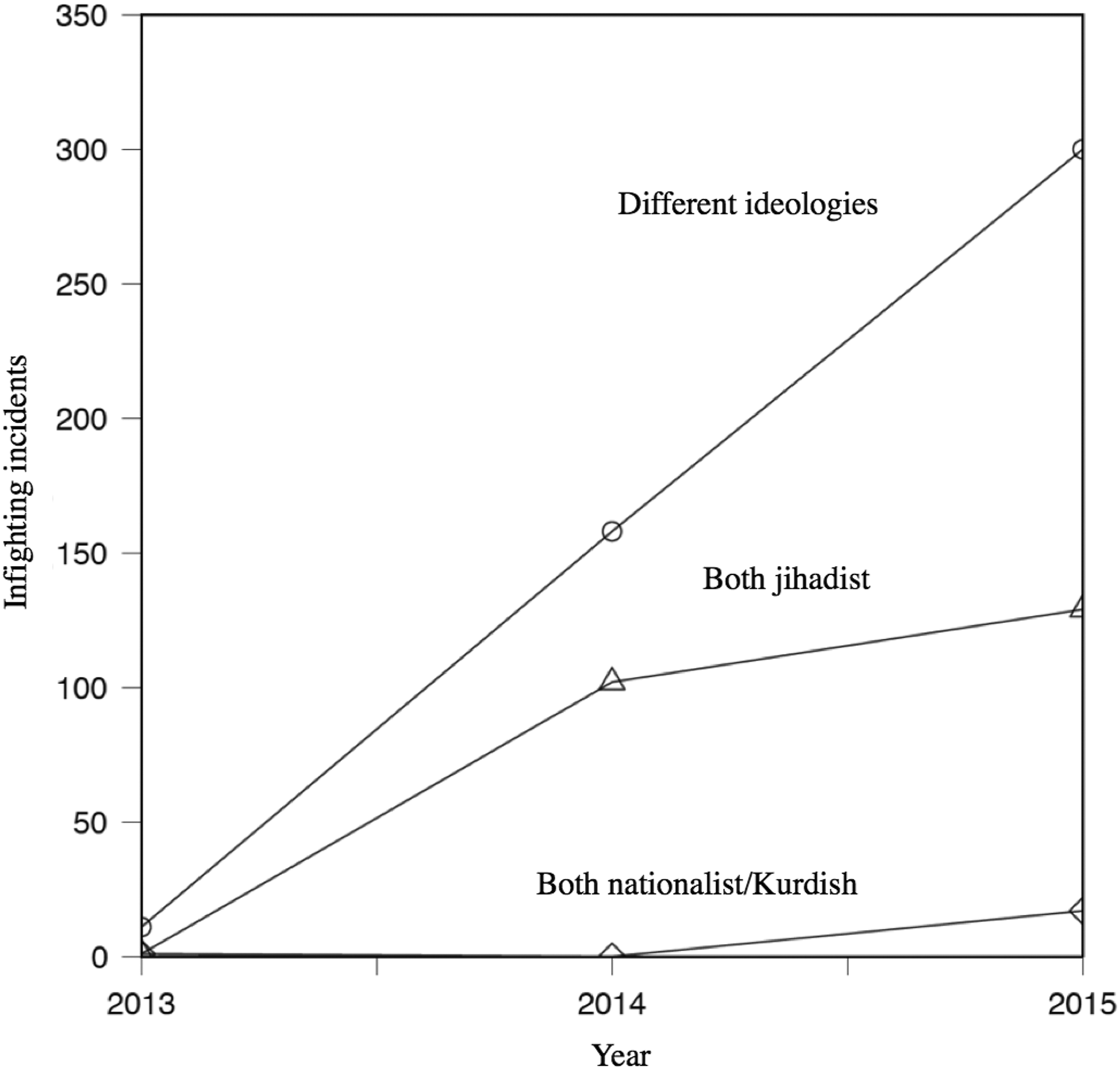
ISIL fought the most with rival factions; it was involved in 41% of all infighting episodes, followed by ANF (15%), ASIM (8%), and Jaish al-Islam (JAI) and the Kurdish YPG (7% each). FSA-affiliated factions were involved in about 6% of the infighting episodes. Our dyadic analysis is undirected, meaning we do not distinguish between who began the hostilities and who was merely defending.
State sponsorship at the node-level (rebel group) is simply coded as 1 if the group had a state sponsor at any point during the period 2013–15. State sponsorship at the dyad level is coded as 1 if the two members of the dyad had any overlapping state sponsors. The major state sponsors of rebels have been Turkey, Saudi Arabia, Qatar, Jordan, and the United States (Phillips, 2016). Some groups have multiple sponsors. There are many organizations with no or unknown state sponsors. These include ISIL and ANF, but also many of the smaller groups.
We included two additional control variables for use in our network regression analysis. Operational location
The network of Syrian militant infighting ties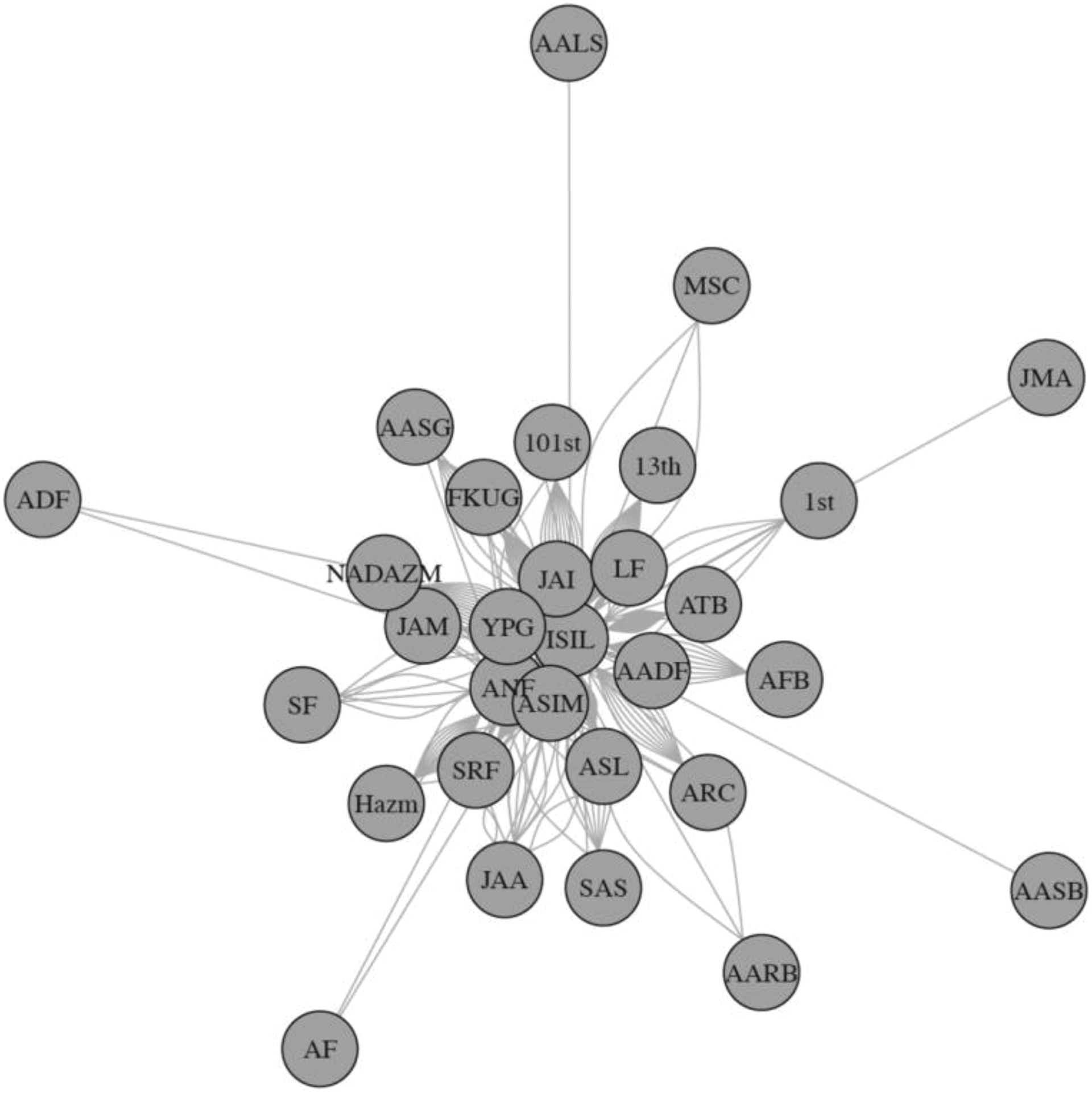
Network description
Figure 2 displays a visual representation of the network of infighting ties. Each line or tie denotes a single infighting episode. Observe that ISIL, along with ANF, ASIM, JAI, and YPG, form the center of the network, which means that they are the most frequent participants in interrebel conflicts (Table II in the Online supplemental material displays the descriptive statistics of that network and our variables).
Results
Assortativity and network simulation
A network whose elements correspond to the number of clashes between groups forms the basis of our analysis. Table I shows the observed assortativity values of the infighting network with respect to the ideology and power variables for the complete data time period (2013–15). We discuss the ideology results first. Considering 2013–15, the observed assortativity for every ideology variable is more negative than its assortativity in the null simulation, indicating heterophily. All three ideology components and their averages are found to have highly significant deviations from the null assortativity. They also have significant correlations with one or the other of the two eigenvectors with the most negative eigenvalues. This alignment with salient structural features in the network suggests that ideological heterophily plays an important role in shaping patterns of conflict. The 2014 and 2015 assortativity results show a similar pattern to 2013–15 with all the ideology variables again significant. For 2014, all of the components best correlate with the second most negative eigenvector. However, for 2015, Territorial aspiration best correlates with the most negative eigenvector, a change which suggests that, as concerns over the disintegration of Syria grew, the salience of Territorial aspiration intensified. Overall, we conclude that the high significance of the ideology assortativity for the full data and both individual years provides strong support for Hypothesis 2, that the likelihood of infighting increases with the ideological distance between groups.
As all ideology variables display heterophily, the suppression lengths, within which infighting is less likely, are reported for the ideology simulations with variable-based interactions. For the 2013–15 data period, well-defined suppression lengths for the heterophily simulation are found for Territorial aspiration, Conflict frame, and Average ideology. That lS = 1.7 for Average ideology indicates that the probability of infighting becomes substantially larger when the ideological distance between the groups in a dyad exceeds about half the full ideology scale. Note that Ideal polity does not have a well-defined suppression length consistent with its relatively small magnitude assortativity. The 2015 time period is similar to the full dataset, but the suppression lengths are shorter indicating a narrowing of the ideological zone for which infighting is substantially less probable. For 2014, however, only Territorial aspiration and Average ideology exhibit well-defined suppression lengths although at relatively large values over 3. The difference between 2014 and 2015 parallels the decrease in assortativity to more negative values in the latter period.
AME regression results

The power range is in units of a thousand. DV is the square root of the count of infighting incidents. *p < .05, **p < .01, ***p < .001.

The infighting network structure for the 2013–15 period
Turning to Power, the difference between the observed Power assortativity and the null mean value for 2013–15 is negative, indicating heterophily, and also highly significant, thereby supporting the asymmetrical power Hypothesis 1a that strength disparity tends to increase infighting. Although Power does not correlate well with either of the two most negative eigenvectors, the variable-based simulation does yield a well-defined suppression length of 2,600. Heterophily with respect to power is also indicated by the significant negative assortativity deviation in 2015. The 2014 period, however, shows no significant effect of power and it is greater than the null assortativity indicating a tendency toward homophily rather than heterophily. Consequently, we conclude that there is strong evidence for the asymmetrical power dynamic although it is less consistent across analysis types and time than ideology.
Network regression results
Table II displays the results of network regression analysis. Hypotheses 1a and 1b are evaluated through examining a difference in Power. A positive and statistically significant relationship with Infighting would provide evidence in favor of Hypothesis 1a, power asymmetry: as the difference in size between two groups grows, they become more likely to fight. Conversely, a negative and statistically significant relationship would demonstrate support for Hypothesis 1b, power symmetry.
We see evidence for Hypothesis 1a in Table II: difference in size between groups generally increases the likelihood of Infighting. We note that while this finding has the largest substantive impact, it does not achieve statistical significance in all models run: in binary outcome variables and a raw count, it does not achieve statistical significance at all (see Online supplemental material).
Hypothesis 2 is evaluated using the Ideological distance variable, defined as the difference between Average ideology values of the groups in a dyad. Table II shows that Ideological distance displays a positive and statistically significant relationship regardless of which other variables at the dyad or node level are included, thereby indicating a greater tendency for infighting among ideologically dissimilar groups. This variable is by far the most consistent in terms of achieving statistical significance (regardless of model used, see Online supplemental material) and has a relatively large substantive impact (as compared with, say, location or sponsorship), lending strong support to Hypothesis 2. It even holds in terms of direction and significance of beta values in Model 5, which controls for ISIL at the node level. ISIL, the most frequent participator in infighting, has a strong effect on the network: this is manifest by the most negative eigenvector as shown in Figure 3, and by a large effect size and statistically significant result in Model 5. Thus, even when controlling for ISIL, ideology still has a statistically significant effect on the likelihood of infighting.
Hypothesis 3 is evaluated using shared State sponsorship. A negative and statistically significant relationship between State sponsorship and Infighting would provide evidence in favor of Hypothesis 3 – that Shared sponsorship makes infighting less likely. We find no evidence of a relationship between Shared sponsorship at the dyad level and Infighting (even when controlling for having or lacking a sponsor at the node level). The absence of a relationship could reflect the limited control that state sponsors have over their clients or a deliberate strategy to hedge by betting on multiple groups without concern over their collective cohesiveness. Rubin (2002: 198) noted this pattern in the case of Pakistan’s support for the Afghan mujahidin during their anti-Soviet jihad; and Staniland (2014: 163) in the case of India’s support of Tamil factions in Sri Lanka during the 1980s.
ERGM results in the Online supplemental material confirm our findings concerning group size and ideology (though as with the AME analysis, power is less consistent across model specifications). Together, these three methods provide robust support for the ideological distance hypothesis, and support for power asymmetry shaping Syria’s interrebel conflicts. We also find evidence that shared location makes infighting more likely.
Discussion and conclusions
We addressed the puzzle of interrebel wars at the dyadic level and tested it using data from the Syrian civil war. The results of our analyses using assortativity, community structure detection, network simulation, and AME regression indicate that two mechanisms – Ideological distance and Power asymmetry – predict which rebel dyads are at most risk for infighting. Ideologically opposed groups have a higher propensity for infighting than ideologically proximate ones, and groups of disparate strength are more likely to fight with each other than groups of comparable power. These findings suggest that power and ideology need not be viewed as competing explanations of rebel infighting. Instead, they complement one another. For example, power may explain why rebels engage in fratricide, including the quest for security and hegemony in a competitive landscape, and our analysis demonstrates that they are more likely to engage in war with groups of dissimilar size. Ideology, though, appears to tell us with whom groups are likely to fight in order to achieve their power aims. The greater the ideological distance between groups, the more likely they are to fight one another.
Our ideology findings may raise an endogeneity challenge. It could be asserted that infighting driven by power considerations compels groups to accentuate their ideological divides to justify or motivate the conflict. In this scenario, conflictual relationships drive the ideological distance exhibited in infighting networks, not the other way around. This objection assumes that militant groups arise as ideological blank slates, contrary to the fact that the founders of such groups often have strong ideological orientations from the outset. One of the key insights from Staniland’s (2014: 33) social institutional theory of rebellion is that insurgents ‘draw upon prewar political life in order to quickly form organizations that can handle the strains of violence’. Many of the individuals who would go on to form Syria’s major Islamist rebel groups were actually in jail at the start of the revolution due to their prior Islamist activism and then subsequently released (Lister, 2015: 53–55).
Additionally, ideological manifestos and political programs, an important element of our coding, are typically issued by groups shortly after their formation. Their ideological statements, therefore, are biased toward a time before these groups have entered into interrebel wars. In other words, a variable biased toward the earlier period in the data cannot significantly correspond to patterns of conflict over two distinct years, 2014 and 2015, as well as the entire time period and yet be causally dependent on the infighting ties which are skewed toward a later period in the data (see Table I). Table I also illustrates that ideology corresponded to the second most negative eigenvector, indicating that ideological differences are a greater force than power asymmetries in shaping the overall pattern of the network. Furthermore, ideology cannot be epiphenomenal to power since they are simultaneously significant in Models 4 and 5 of the AME regression analysis – that is, when we control for power, ideology is still statistically significant and remains significant in all models. Nor can ideology simply be a function of overlapping state sponsorship since no significant relationship was found between the latter and the infighting network. Finally, ISIL is not driving the relationship as this finding exists even when controlling for this group in Model 5.
Another possible challenge to our results stems from our use of militant claims of infighting. It can be argued that militants preferentially reveal clashes with ideologically distant groups and conceal the ones with their ideological kin, and thus our data underrepresents infighting among ideological brothers. Of course, such self-censorship may occur, but to raise this objection beyond conjecture, one must estimate its frequency, a difficult task given the lack of ground truth. The use of militant claims enables construction of a dataset that is large enough to employ network analysis for a single conflict, an enterprise that can be pursued much less robustly using standard conflict datasets like UCDP. Although comparison with the UCDP data is difficult, when searching for missing infighting dyads (here, meaning pairs that fight at least once) among our ten most prominent groups (by degree), the UCDP data provide no evidence of a missing dyad. If the concealment of infighting between ideologically proximate groups was frequent, then one would expect that at least one such pair would be found in UCDP that is absent from our data. That there is none leaves little evidentiary basis to support the self-censorship objection. Furthermore, our data reflect many fighting episodes between ISIL and ANF, two ideologically similar movements. This suggests that the presumption that rebels mask their infighting when it is politically inconvenient is contradicted repeatedly in at least one prominent conflict dyad.
Lastly, one might object that our analysis leaves out the state, an important factor in shaping interrebel conflicts. The state’s accommodative arrangements can give some rebel groups a greater degree of freedom to attack their rivals because they are less concerned about fighting the state. For example, the Syrian regime has been accused of deliberately neglecting ISIL in its targeting policy so that a tacit alliance between the state and ISIL allowed the latter to concentrate its fighting resources on wiping out its rivals. Although accounting for selective targeting of rebel groups by the state would add to the substantive analysis of infighting, doing so is empirically difficult as the Syrian regime typically made claims of attacking ‘terrorists’ rather than specific groups.
We assess the impact of omitting the state through consideration of ISIL’s effect on the network. Given that ISIL is responsible for 41% of all the infighting ties, the potential collusion between the Assad regime and ISIL would be the most consequential confounding factor arising from the omission of the state. However, Figure 3 shows that the second most negative eigenvector best correlates with Average ideology in the full data period and not the most negative eigenvector, corresponding to ISIL arrayed against all the other groups – a result suggesting that ISIL is not the dominant driver of our ideological distance finding. Furthermore, removing ISIL from the network yields the best correlation with the most negative eigenvector (p = .02), and the assortativity test still strongly supports ideological heterophily (p < .0001). That ideological heterophily persists in the pattern of infighting after removing ISIL provides strong evidence that infighting cannot be attributed to selective targeting by the state or its collusion with particular groups.
Our empirical findings in the Syrian case add weight to a burgeoning body of scholarship that makes the case that ‘ideological considerations play a prominent role in guiding insurgent decisionmaking’ (Hirose, Imai & Lyall, 2017: 48). This literature has empirically demonstrated how ideological variables can explain important conflict processes in civil wars, such as anti-civilian atrocities (Straus, 2015) and mobilization effectiveness (Ugarriza & Craig, 2012; Costalli & Ruggeri, 2015). Our article shows that ideology also matters to rebel infighting and gives added credence to those who call for bringing armed politics back into the study of civil conflicts (Staniland, 2015; Balcells, 2017). Allowing for both power and ideology to impact insurgent factional dynamics should improve our understanding and anticipation of conflict trajectories in fragmented civil wars.
Footnotes
Replication data

Acknowledgments
We thank Naazneen Barma, Cassy Dorff, Peter Krause, and Zane Kelly.
Funding
This research was funded by the Office of Naval Research under grants N00014-15-1-2549 and N00014-16-1-2919.
Notes
Appendix
We describe the formalism used to calculate the assortativity, relate it to the eigenvector spectrum of the modularity matrix, and formalize the network simulation. We consider a symmetric network with N nodes represented by the adjacency matrix with components Aij
, equal to the number of ties between nodes i and j (Aij = Aji
). The degree of node i is the sum of its ties,
which is the difference between the observed tie strength and what would be expected from a null process in which ties are formed in proportion to the product of node degrees without regard to any interactions driven by node variables. Assortativity is the standard measure used to assess homophily of network tie formation with respect to a scalar variable (as we operationalize power and ideology).
The assortativity α that the network displays with respect to a node variable x can be related to the modularity matrix via
which is equivalent to the correlation of x over ties (Newman, 2006).
The spectrum of the modularity matrix is defined via
To formulate the null and variable-based simulations, we denote the maximum possible degree of node i by Di
(its degree in the empirical network) and its degree at iteration step n by ki
(n). The deficit between the maximum and current degrees is then
Kn
is a normalization constant so that