



Abstract
Both theorists and practitioners continue to show interest in transatlantic burden-sharing. Resource allocation choices – both to and within defense budgets – are grand strategic choices, and membership in alliances and security communities affects how states make those choices. International security and political economy scholarship offers plausible explanations for transatlantic imbalances in military expenditures. However, NATO allies and EU member-states have pledged to one another not just to spend more on defense, but to allocate more defense resources to equipment modernization. Current scholarship does not fully explain the sources of such within-budget choices, which would help anticipate the likelihood of such pledges succeeding. Building on work by security scholars, defense and political economists, and scholars of interorganizational relations, I argue that stringent fiscal rules dampen the kind of defense spending NATO and EU strategists seek. Governments respond to increasingly stringent fiscal rules by reducing overall defense expenditures, while at the same time shifting existing defense resources to personnel, and away from equipment and operational expenditures. I find evidence in support of this argument by using education levels in the states in question as instruments for fiscal rules. This phenomenon represents a significant risk for important transatlantic strategic initiatives, namely NATO’s Wales pledge on defense investment.
Keywords
Resource allocation is a strategic choice (Norrlof & Wohlforth, forthcoming; Posen & Ross, 1997), power over which is foundational to social ordering among states (Galtung, 1969). Members of the transatlantic security community (Risse, 2016) influence one another’s defense spending through both NATO and the EU, the main institutions of a transatlantic security complex (Lake, 2009). Both organizations have publicly enjoined members (NATO, 2014; European Council, 2016) to improve burden-sharing 1 by increasing overall defense spending, and by devoting additional resources to capabilities and operational contributions.
How likely is this initiative to succeed? I address this question by asking a more specific one: how does the transmission of supranational fiscal rules 2 into national policy affect burden-sharing? I find that such rules are associated with burden-shifting, or seeking to ‘limit contributions’ without ‘wrecking the alliance from which all benefit’ (Thies, 2015: 8).
Scholars (Schelling, 1955; Hoag, 1957; Olson & Zeckhauser, 1966) have long focused on the collective action problem such enjoinders seek to address. Recent concerns that burden-sharing disputes may cause the USA to ‘moderate its commitment’ (Mattis, 2017) to allies has led scholars (Nye, 2017) to wonder about the enduring viability of consensual liberal hegemony (Ikenberry, 2011).
Yet, no research to date has operationalized burden-sharing as NATO and the EU have defined it. 3 Nor has research on interorganizational politics (Koops, 2017) and the management of ‘multiple institutional commitments’ (Alter & Meunier, 2006: 4) addressed the effects of European integration on burden-sharing behavior, even as national (Hollande, 2015) and EU (Juncker, 2015) leaders have noted that EU fiscal rules may incentivize states to shift defense burdens.
I address these gaps by testing a novel theory: as states transmit EU fiscal rules into domestic practice, they increasingly engage in burden-shifting. The transparency of transatlantic institutions mitigates overt free-riding, or fully relying on allies to underwrite one’s own security (Sandler, 1993). Members burden-shift instead.
I operationalize burden-shifting as limiting top-line defense spending, while also curbing spending on the capabilities and operational contributions that members of the transatlantic community prioritize. This approach captures ‘real’ (Hallams & Schreer, 2012) burden-sharing more precisely than previous quantitative work, while avoiding the generalizability challenges plaguing qualitative research (Bennett, Lepgold & Unger, 1994; Haesebrouck, 2016). I test my theory using multivariate models with panel data including new dependent and independent variables and making use of a two-stage least squares (2SLS) identification strategy, using education levels as an exogenous instrument for the European Commission’s Fiscal Rules Index (FRI – the official EU measurement of stringency of national fiscal rules).
This research complements previous defense economics and conflict research on burden-sharing to help bridge the quantitative–qualitative gap. While defense economists (Harris, 1986; Coulomb & Fontanel, 2005; Arvanitidis, Kollias & Messis, 2017; Christie, forthcoming) have considered relationships between fiscal constraints and defense spending, none has addressed fiscal rules as such. Defense economics and conflict researchers have not yet used FRI. This absence is significant, as FRI is the key metric EU members use to evaluate fiscal governance.
Additionally, the dataset is the first to include disaggregated defense spending data 4 for the entire transatlantic defense community – all NATO allies and EU member states. 5 Disaggregation addresses concerns about ‘form of contributions’ (Oma, 2012: 12), which quantitative analyses (Bove & Cavatorta, 2012; Becker, 2017) have only begun to address. I combine previously unexplored multilevel fiscal variables, standard defense economics variables, security, and domestic variables in a single model, uncovering a contradictory relationship between EU fiscal rules and transatlantic burden-sharing.
Substantively, for each standard deviation increase in FRI, states reduce defense spending by 0.467% of GDP. This suggests that a one-standard deviation decrease in the mean FRI would be associated with mean defense spending in NATO’s European members increasing from 1.46% of GDP to 1.92% of GDP: just below the guideline allies agreed at Wales. Even more striking, for each one-point increase in FRI, states decreased the equipment share of their budget by six percentage points and the O&M share of their budget by 4.7 percentage points. A reversal of this equipment decrease would mean an extra $13 billion across NATO, which would enable, for example, the purchase of any combination of additional 60 Global Hawk unmanned aerial vehicles or C17 aircraft across the Alliance, enough to meet requirements in combat airlift and intelligence, surveillance, and reconnaissance (NATO, 2018). A reversal of the O&M decrease would likewise amount to approximately $13 billion, enough to fund about 2.6 years of operations against the Islamic State. 6
This analysis has five additional implications for broader debates in conflict research. First, modeling structural, EU, and national-level variables together sheds light on dilemmas of collective action and deterrence (Weede, 1985) operating at each of those levels. Second, such a multilevel model of detailed burden-sharing choices contributes to the debate on the role of non-security variables in material security choices (Kimball, 2010; Zielinski, Fordham & Schilde, 2017). Third, disaggregating defense budgets contributes to discussions on the choice of appropriate burden-sharing indicators (Hartley & Sandler, 1999). Fourth, including defense industrial variables in a multilevel model sheds light on the role of industrial policy in alliance politics (Hartley, 2006). Finally, my findings suggest that institutional design is likely to affect states’ ability to influence one another’s behavior (Wallace, 2008) in unexplored domains.
Operationalizing burden-shifting by disaggregating defense spending data enables more precise analysis and bridges gaps between the defense economics and security literatures on burden-sharing. Using panel data in a 2SLS model including sensitivity analyses (Clarke, 2009) to estimate the effect of FRI addresses omitted variable bias and reverse causality (Angrist & Pischke, 2015: 106) without increasing risks from the proliferation of control variables in ordinary least-squares (OLS) models (Schrodt, 2014).
Theory: Rival organizational claims and burden-shifting
I propose a framework for burden-shifting choices that emphasizes the interplay between potentially rivalrous multilateral commitments. Most existing literature ignores this interplay, and those scholars who do address the resource implications of interorganizational politics (Biermann, 2008) do not address burden-sharing.
NATO and EU leaders recognized the need for strategic cooperation in their 2016 Warsaw Joint Declaration. The Council of the EU’s recent establishment of Permanent Structured (defense) Cooperation (PESCO) aims at ‘ambitious, and more binding common commitments’ including ‘regularly increasing defence budgets […] to reach agreed objectives’ (EEAS, 2017). Nonetheless, the transatlantic community continues to fall short of aspirations for ‘adequate resources and fair burden-sharing’ (Stoltenberg, 2016: 7). Why?
Interorganizational dynamics matter. Non-compliance with fiscal rules leads to sanctioning through the EU’s Excessive Deficit Procedure (EDP) – NATO has no analogous mechanism. This difference, along with the fact that EU fiscal rules, grounded in the Maastricht Treaty, are more formal than NATO guidelines, means that they constrain defense spending as states transmit them into national legislation. FRI, my key independent variable, measures this transmission.
The simplest response to supranational fiscal constraints is curbing defense spending to spare other spending more likely to provide electoral benefits (Whitten & Williams, 2011). Fiscal rules constrain deficit spending for domestic political purposes – states therefore seek other ways to pursue those purposes (Fordham, 2002). More stringent fiscal rules lead states to shift the burden of collective defense: Hypothesis 1: The higher a state’s FRI in year y–1, the smaller share of its GDP and overall budget it will devote to defense expenditures in year y.
I argue that causality flows from fiscal rules to defense spending. National fiscal rules in EU members are generally transmitted from collective decisions taken at the Mean bivariate correlation – supranational rules, and FRI
Figures 1 and 2 visualize how fiscal rules proceed from the EU to the national level – national fiscal rules, captured by FRI, follow supranational rules (IMF, 2015) 7 temporally, and not vice-versa. Figure 1 plots the (positive) mean relationship between the supranational rules to which a country was subject from 1990 to 2016 and that country’s FRI.
Figure 2 shows how these two variables have evolved over time among the entire sample and among individual states with differing structural situations. FRI increases generally follow additional supranational rules. Poland’s FRI appears to have increased in conjunction with Time series – supranational rules and FRI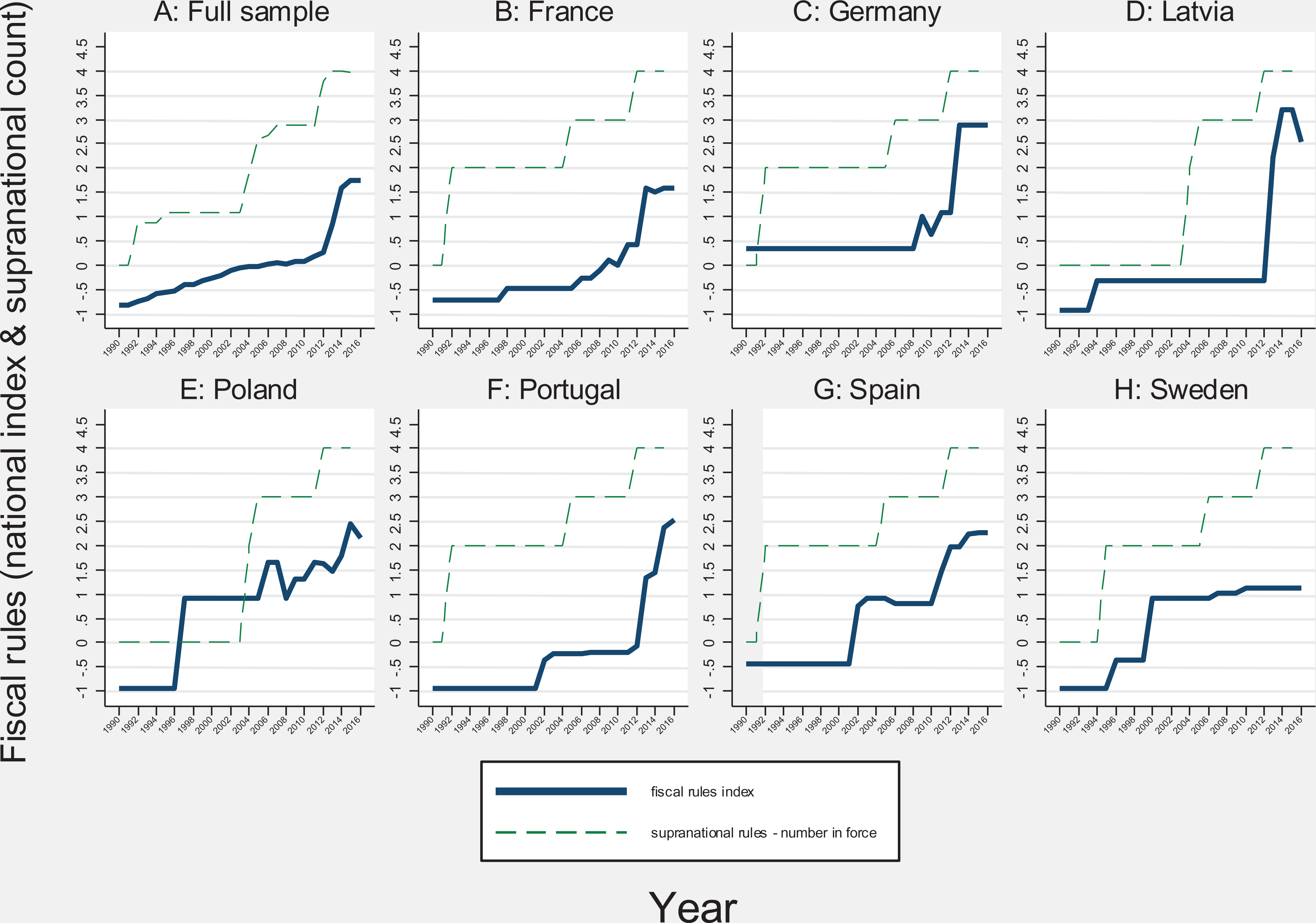
As the Maastricht criteria dampened European defense spending, NATO attempted to encourage allies to increase defense spending throughout the 1990s, first informally at the level of the Defence Planning Committee, 8 and then among defense ministers in 2006 (Appathurai, 2006). Nonetheless, Figure 3 demonstrates that as European defense spending declined following the Maastricht treaty, burden-sharing grew even more unequal through the 1990s and 2000s. By the time of the Wales pledge 9 in 2014, the USA still accounted for over 65% of all transatlantic defense spending.
Further complicating matters, a ‘strain toward agreement’ (Schilling, 1962: 23) pushes allies to burden-shift rather than free-ride. Facing fiscal pressure from the EU, but not wanting to endanger the benefits they derive from NATO, allies can shift US share of total transatlantic defense spending, by category Arms industry, by country
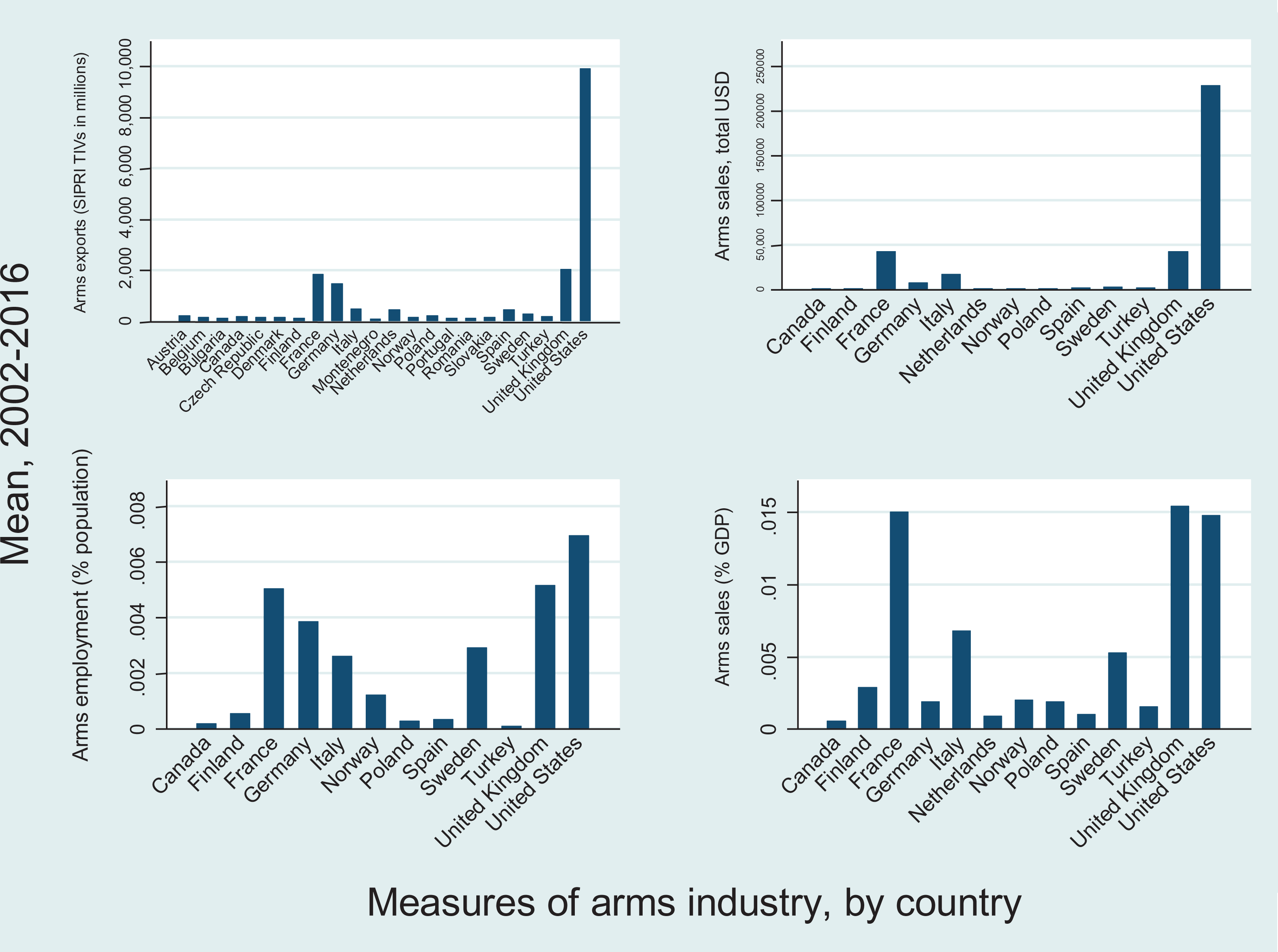
Shifting defense funds into personnel allows states to create or retain jobs without immediate fiscal consequences in the form of higher defense spending, and to shift burdens to allies in less visible ways. Fiscal rules ‘may discourage public investment’ (Astrayan, Castellón & Stratmann, 2018: 4). Because of its less direct effect on domestic economies, defense investment, and particularly equipment and O&M spending, is even more vulnerable to such effects than other forms of investment. Constrained governments may see this as an opportunity for ‘creative accounting’ (Von Hagen & Wolff, 2006). For example, countries without significant national defense industries may shift resources from equipment into personnel for such purposes. Figure 4 illustrates – using two absolute measures (SIPRI, 2016, 2018) and two relative measures (SIPRI, 2016) – that ‘the European defense industry is not evenly spread across the EU’ (Roth, 2017). Table I illustrates strong positive correlations between each of the four measures of national defense industries and defense spending – ‘increased spending may not flow equally to all member states’ (Roth, 2017).
The Wales pledge sought to mitigate these dual tendencies: heads of state and government publicly agreed to goals of 2% of GDP on defense and 20% of defense budgets on equipment. They made their NATO commitments more formal (though still lacking sanctions), and extended them to equipment, making it more difficult for allies to conceal burden-shifting within defense budgets. NATO’s emphasis on ‘national plans’ (Stoltenberg, 2017) transmitting the pledge further formalizes burden-sharing commitments.
Pairwise correlations, arms industry and defense spending
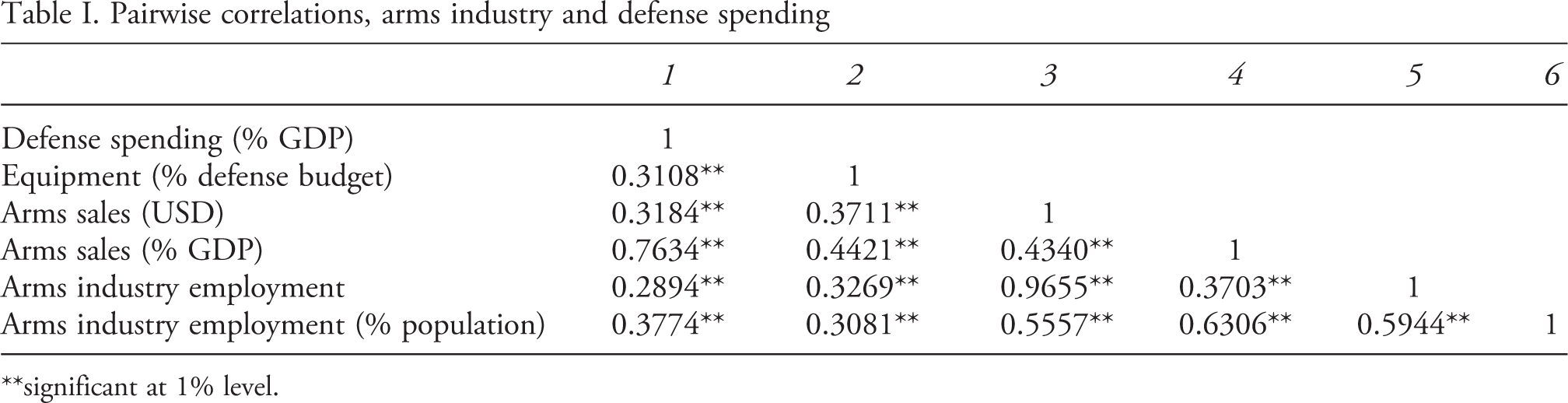
**significant at 1% level.
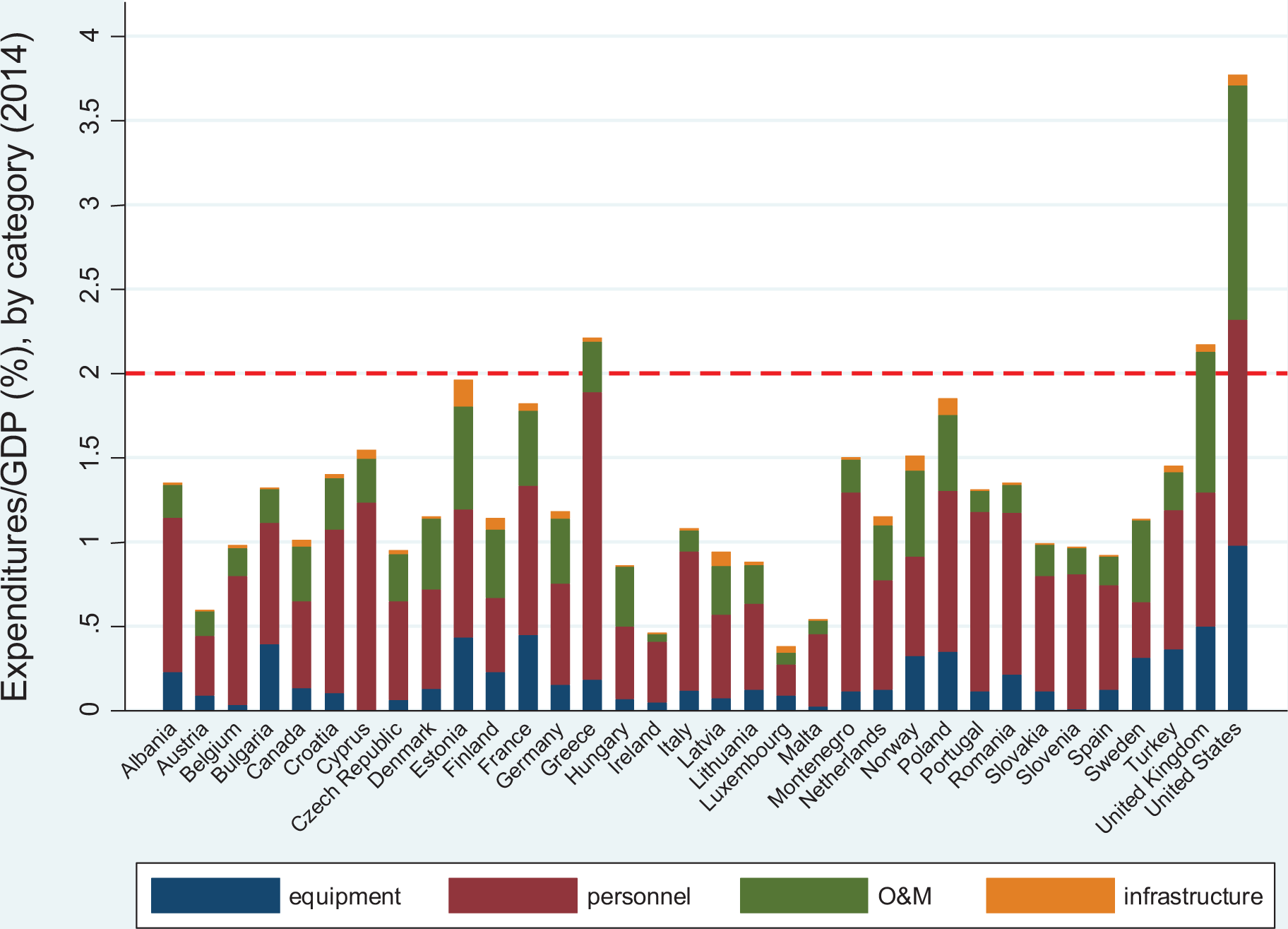
Military expenditures/GDP by type of expense
Figure 5 demonstrates the significant variation in the composition of 2014 defense budgets across the transatlantic community. For example, Bulgaria devoted less than 2% of its defense budget to equipment, while Poland allocated over 30%. Countries also vary significantly across the other three categories of defense expenditures, ranging from 36.4% to 80.7% in personnel expenditures, from 6.2% to 39.5% for O&M, and from less than 0.1% to 10.1% for infrastructure. My theory addresses this variation more directly than the current literature does. Because countries seek ‘the highest level of security possible at the lowest possible cost’ (Sloan, 2016: 5), while peer pressure leads to burden-shifting rather than free riding, increasingly stringent fiscal rules result in defense resources moving out of capabilities and contributions, which do not benefit constituents directly, and into personnel, which may (Becker, 2017).
Hypothesis 2: The higher a state’s FRI in year y–1, the greater share of its defense and overall budgets it will devote to personnel expenditures in year y.
Hypothesis 3: The higher a state’s FRI in year y–1, the smaller share of its defense and overall budgets it will devote to equipment and O&M expenditure in year y.
Empirical testing
To test these hypotheses in a 2SLS model, I argue that my instrument, education levels in year y–2, cause increased FRI in year y–1, leading states to burden-shift in year y by reducing overall defense expenditures, and favoring personnel over equipment and O&M spending. I begin, however, with a theoretical model of transatlantic burden-sharing for OLS testing:
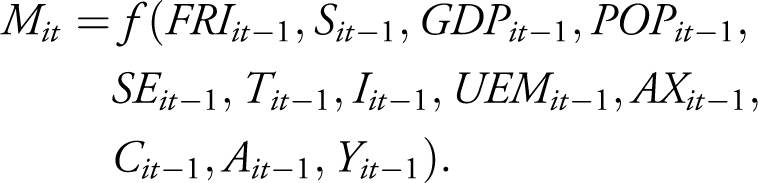
M is the share of military spending in a country’s GDP (NATO, 2017; SIPRI, 2017). This has been the variable of interest since the earliest quantitative burden-sharing studies (Olson & Zeckhauser, 1966), and remains an important indicator. I further disaggregate M into its constituent categories in accordance with NATO (2017) and EU (EDA, 2014) procedures.
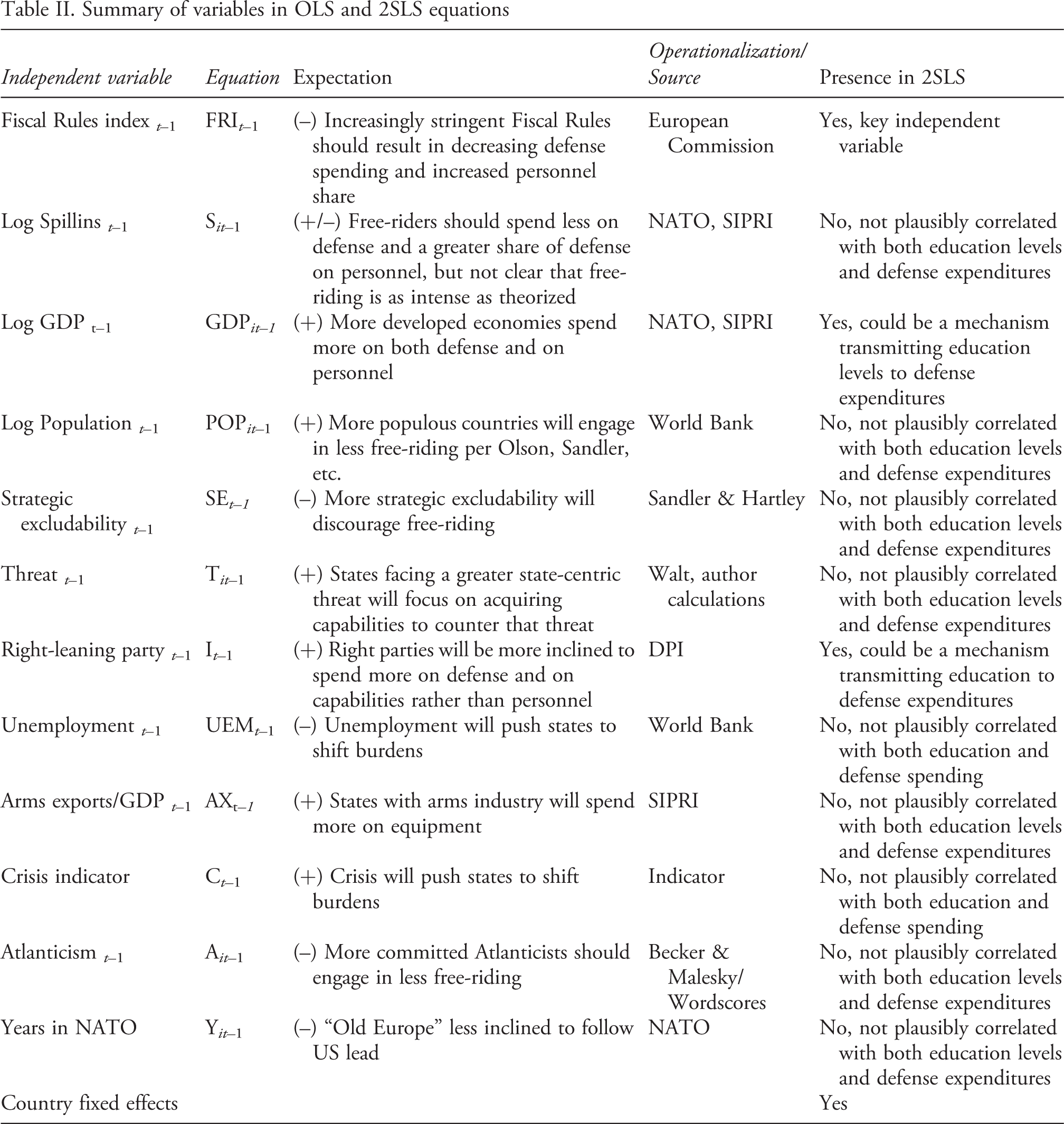
FRI, the key independent variable, is ‘a comprehensive time-varying index for each Member State constructed by summing up all fiscal rule strength indices in force in the respective Member State weighted by the coverage of general government finances of the rule’ (European Commission, 2017). This variable is the primary measure of stringency of fiscal rules used by both policymakers and scholars (Ayuso-i-Casals et al., 2009). EU fiscal rules aim to ensure sound public finances, ‘set[ting] numerical targets for budgetary aggregates’. They ‘pose a permanent constraint on fiscal policy, expressed in terms of a summary indicator of fiscal outcomes, such as the government budget balance, debt, expenditure, or revenue developments’. While the ‘primary objective of fiscal rules is to enhance budgetary FRI heat map (FRI: Fiscal Rules Index)
S is ‘Spillins’, the total defense expenditures of all allies minus those of ally i. Sandler (1993) uses spillins to operationalize Olson and Zeckhauser’s exploitation hypothesis, under which such spending has negative spillover effects, especially when benefits are non-excludable.
GDP and population (POP) (World Bank, 2017) of country i are the key independent variables in the public choice literature. I use the natural log of these variables because cross-country variation is extreme.
SE is the excludability 11 of allied strategies. Sandler & Forbes (1980: 427) theorized that strategy changes in the late 1960s meant that ‘rivalry in consumption, multiple outputs, benefit exclusion, and private benefits increasingly characterize[ed] modern alliances’. As allied strategy moved from deterrence to protection, the benefits of membership became increasingly excludable, and burden-sharing therefore improved.
T is the state-centric threat level (Walt, 1985) faced by country i. I calculate this as Russia’s spatially adjusted defense spending 12 interacted with Russian intent, manually coded as 1.5 from 1953 to 1989, 1 from 1990 to 2008, 1.25 from the invasion of Georgia in 2008 through 2014, and 1.5 following the annexation of Crimea in 2014. 13
I is the ideology of the government in power (Beck et al., 2001) in country i, coded as 1 for right-leaning and 0 for left-leaning. This is an additional control for domestic politics and may capture some behavior that is particular to party politics not captured by the domestic transmission of supranational fiscal rules.
UEM is country i’s unemployment rate, a likely domestic driver of burden-shifting (Becker, 2017), especially in states without significant domestic arms industries through which to channel potential domestic benefits of equipment expenditures. Arms exports as a share of GDP (AX) accordingly incorporates such industries into the model.
C is an indicator capturing the fiscal and economic crisis that has affected the transatlantic community since 2008. I use this variable in my theoretical model to ensure results are not an artifact of differing variation in the FRI before and after the crisis, or the independent effects the crisis may have on defense spending.
A is the extent to which country i exhibits an Atlanticist strategic culture. Becker & Malesky (2017: 165) define Atlanticism as a ‘preference […] for a transatlantic approach to European security, in which the United States’ role is central’, finding that Atlanticism predicted increased O&M spending during NATO’s ‘out of area’ period. I replicate their WordScores (Lowe, 2008) methodology to score all states in the study based on the national strategy document in effect in the year concerned, adding documents from non-NATO EU members and recently published NATO member documents.
Y is the number of years country i has been in NATO. This variable captures the theoretical importance of NATO membership (not all members of the transatlantic community are members), the institutionalization of that membership over time (Wallander, 2000), and the likely effects of time on the rest of the covariates.
Each model includes country fixed effects, capturing national particularities not already captured by the domestic-level variables in the model. In the 2SLS models, I cluster robust standard errors by country in order to address somewhat limited years relative to the number of observations.
Summary of variables in OLS and 2SLS equations
Correlates of disaggregated military expenditures and fiscal rules
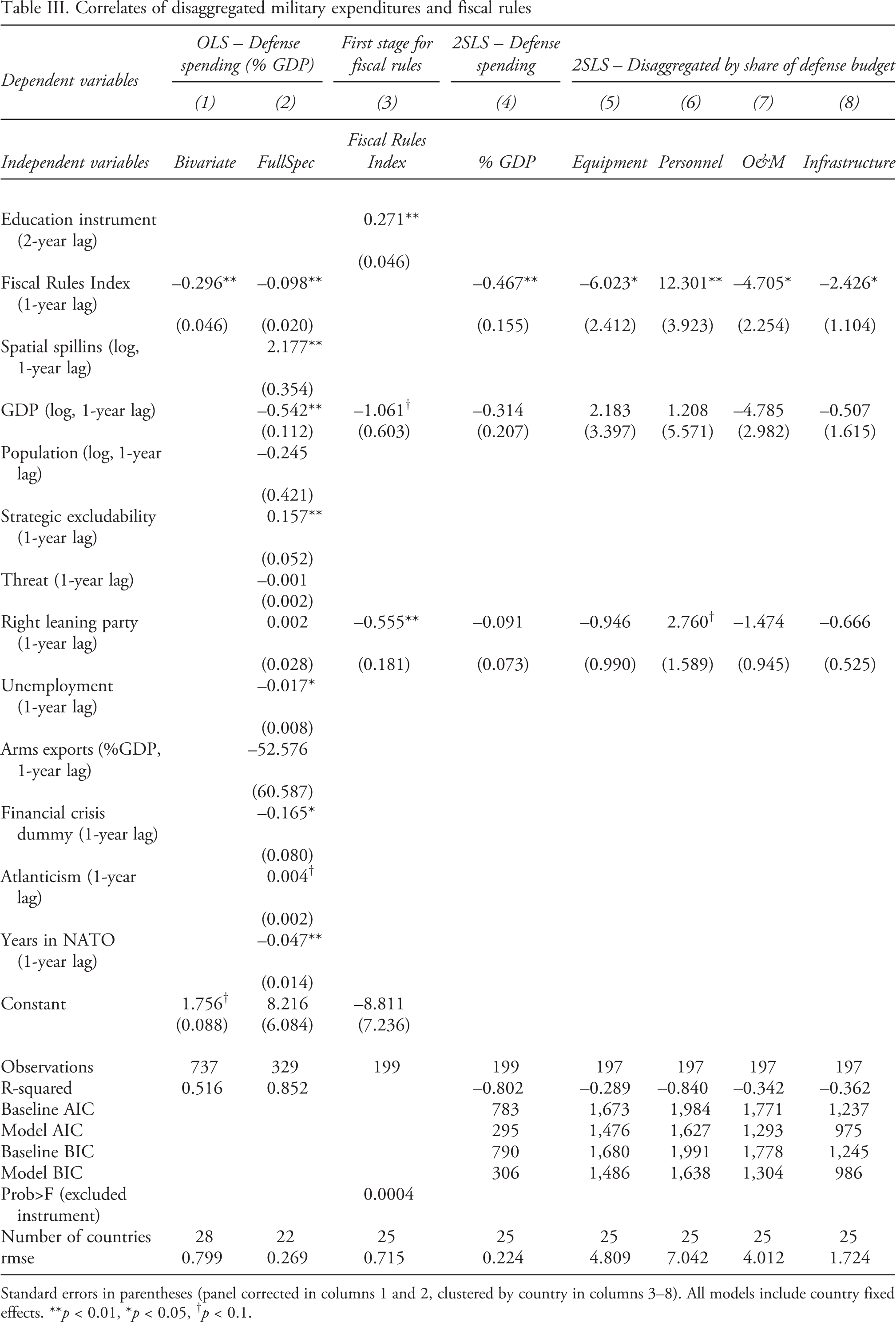
Standard errors in parentheses (panel corrected in columns 1 and 2, clustered by country in columns 3–8). All models include country fixed effects. **p < 0.01, *p < 0.05, †p < 0.1.
These results, however, do not definitively rule out the danger of omitted variable bias (Clarke, 2009), nor do they address some other threats to the analysis. A particular risk is selection bias – FRI ‘might actually be a mere reflection of a deep preference for fiscal discipline’ (Debrun et al., 2008: 319). I address these issues by using education level, an exogenous instrument for fiscal rules identified by Badinger & Reuter (2016), to conduct a 2SLS analysis of the effects of FRI.
The instrument is the UNDP’s (2016) education index: mean expected years of schooling indexed to range from 0 to 1. As a mean for an entire population, it is unlikely to be sensitive to fiscal or economic pressures affecting FRI or defense budgets from year to year. Consider the role of the over-50 population in Germany, most of whom received their education at least 30 years ago, and a large minority of whom were educated in the German Democratic Republic. The weight of Czech and Slovak individuals having received their education in Czechoslovakia, or Estonian, Latvian, and Lithuanian individuals having received their education in the USSR is similar. I am thus confident that my education instrument is not also a driver of short-term economic or fiscal fluctuations.
The instrument meets three critical 2SLS requirements. First, it is a key causal determinant of fiscal rules (Badinger & Reuter, 2016). Second, it meets the independence assumption by being ‘unrelated to omitted variables we might like to control for’ (Angrist & Pischke, 2015: 106) – namely those identified above. Third, it satisfies the exclusion restriction because fiscal policy is the only likely channel through which education levels are likely to affect defense spending. There is no reason to believe that national strategic and fiscal planners consider education levels directly when considering what resources to invest in defense, or, in particular, in deciding how to allocate those resources across the four categories of defense spending once they are in the defense budget.
There are reasons to question the exclusion restriction, however. It seems plausible that even mean long-term education levels in a country may correlate with economic and political outcomes in that country, although it is not clear how and in which direction causality might flow. To address such concerns, I include GDP and domestic political ideology in the 2SLS models, as well as country fixed effects. Additionally, Supplementary Table C in the Online appendix replicates my main analysis using Conley, Hansen & Rossi’s (2012) ‘plausibly exogenous’ sensitivity analysis to investigate the extent to which the results of my 2SLS analysis hold with mild violations of the exclusion restriction. Supplementary Table D replicates the analysis using supranational rules themselves as an instrument for FRI – supranational rules are extremely unlikely to affect national fiscal behavior through any channel except their transmission into national rules, measured by FRI. The findings are robust to such analysis.
Columns 3–8 of Table III therefore present the results of a 2SLS analysis in which I argue that

describes the relationship between FRI and disaggregated defense expenditures. Next,

where FRI is the Fiscal Rules Index in a particular country, EDUC is the UNDP education index, and X is a vector of covariates affecting all variables. I use EDUC directly as an instrument for FRI in Equation (2). This is a valid identification strategy if EDUCit–2 is uncorrelated with εit. EDUC does not appear in Equation (1) because while it is correlated with the causal variable of interest (fiscal rules), it is not correlated with unobservable determinants of the dependent variable of interest (defense spending). The main equation is (1).
I treat FRIit as endogenous, and model it as

where EDUCit is the education instrument. The first stage results for this relationship, depicted in column 3, align with Badinger & Reuter’s (2016) analysis that there is a causal relationship between education levels and fiscal rules. The p-value of 0.0004 for the F-statistic in column 3 also indicates that the instrument is quite strong. Baum, Schaffer & Stillman’s (2007) standard routine also affirms the validity of the education instrument. The F-test of the excluded instrument, which tests for weak identification of endogenous regressors by testing the null hypothesis that including the instruments in the model does not result in a better statistical fit (Angrist & Pischke, 2009), provides a value of 12.59, with a probability of 0.0004 that the null hypothesis is true. Coupled with the Cragg-Donald F statistic, which at 57.37 is well above the Stock and Yogo threshold of 16.38, this strongly suggests that my instrument is not weak. The p-value of 0.0003 resulting from an underidentification test using the Kleibergen-Paap rk LM statistic allows me to reject the null hypothesis that the model is underidentified.
Columns 4–8 depict the substantive results. The estimated effect of FRI on military spending as a share of GDP is 0.467, significant at the 1% level. This indicates that for each one-point increase in the FRI, we can expect the average state to decrease defense spending as a share of GDP by 0.467 points – in other words, to move significantly away from the 2% guideline. For a country like Germany, this equates to a 35% decline in its defense budget relative to GDP, which is about what happened to European defense budgets from 1990 to 2015. Columns 5–8 depict the even more significant effects within defense budgets: for each additional FRI point, a state increases personnel’s share of its defense budget by 12 percentage points (significant at the 1% level), reduces equipment’s share by six points, and reduces O&M’s share by 4.7 points. This translates into fewer states meeting NATO’s 20% guideline for equipment share of defense budgets, and means that allies are less likely to volunteer for important operational activities, or train their forces to high standards, which demand O&M spending. Although allies are not likely to acknowledge this behavior, some have offered warnings (Ministero della Difesa, 2015; Hollande, 2015).
The scale of the FRI is relatively compressed – theoretically ranging from –5 to 5 – but changes have been significant. The mean FRI among the states studied increased by about one point from 1990 to 2010, and then by another full point from 2011 to 2015. In 2013, for example, Ireland, Luxembourg, France, and Germany all experienced increases of over two points in their FRI, Cyprus and Portugal between one and two points, and Estonia and Latvia between .3 and .5 points.
Because the R-squared in an instrumental variable regression is of limited use, I report the Akaike’s information criterion (AIC) and the Bayesian information criterion (BIC). For the models of interest, the difference between the model and the baseline AIC/BIC is consistently large and negative, which suggests that the use of the 2SLS model improves fit. Coupled with the relatively high R-squared for both OLS models, this indicates that the 2SLS results are consistent with the OLS results, while offering a better fit, addressing the possibility of reverse causality, and addressing additional omitted variable bias without risking collinearity.
That the coefficient in column 4 is larger than in columns 1 and 2 is likely due to the 2SLS capturing systematic variation while dropping the stochastic element of variation (Wooldridge, 2015: 479–480). While my primary purpose in using the instruments is to address endogeneity, they also serve this purpose – reducing bias and strengthening coefficients. Supplementary Table E, in the Online appendix, replicates the analysis in Table III using the share of overall government spending rather than of GDP and defense budgets. The results are substantively similar.
These results suggest that increasingly stringent EU fiscal rules compete with desires to increase defense spending, to increase the share of equipment within defense budgets, and to orient capabilities toward shared priorities. In short, they appear to be in conflict with transatlantic defense aspirations.
Conclusions
Political economy (Nincic & Cusack, 1979) and international security (Auerswald & Saideman, 2014) research offers compelling explanations for the distribution of security and defense burdens across alliances, and economists (Dahan & Strawczynski, 2013) shed much light on the relationship between defense spending and economic output and welfare. However, most of the variables that the current literature finds to be predictive of defense spending are not useful from a policy perspective – allies cannot change, for example, the nature and proximity of threats in order to discourage burden-shifting.
Moreover, even though the two most significant organizations shaping European security have explicitly targeted equipment spending and operational contributions, little scholarship has analyzed the drivers of disaggregated spending, or relationships between fiscal norms established by each organization. As European security concerns compete with fiscal and economic ones for policymakers’ attention, addressing this gap has critical policy implications.
In particular, as European states manage the future of the European Union during a fragile economic recovery alongside rising nationalism and populism (Mudde & Rovira Kaltwasser, 2017), while at the same time attempting to cope with an increasingly challenging security environment, understanding the effects of fiscal constraints on defense spending is more important than ever. I contribute to this understanding by using education level as a source of exogenous variation in fiscal rules, and then examining the effect of those rules on the allocation of resources both to and within defense budgets.
I find that governments respond to tightening fiscal rules by shifting resources away from defense, and by shifting remaining defense resources into personnel spending, which they may see as an economic stabilizer in an otherwise constrained environment. This behavior is detrimental to military capability and readiness, undermining NATO and EU defense aims.
This relationship between EU fiscal rules and burden-shifting has strategic implications. First, it suggests that there is real competition for scarce fiscal resources between the demands of EU’s fiscal pact and transatlantic defense priorities. My analysis suggests that if each NATO ally’s FRI had risen by one standard deviation in 2017, Estonia and Poland would fall below the pledge’s 2% guideline, and the UK would be within .02 points of doing so. Moreover, Italy and Slovakia would fall below the 20% guideline, and Poland and the UK would be within one point of it. Increasing FRI thus poses a risk to compliance with agreements among allies, which could damage transatlantic unity.
Second, it affirms the importance of European economic recovery to both improved burden-sharing and to broader questions of resourcing the transatlantic strategic approach to a deteriorating security environment. Critically, this transatlantic community includes not just NATO allies but, at a minimum, the non-NATO allies who are members of the EU – their security is inextricably tied with that of NATO allies, they are affected by the same structural variables as their neighbors, and they respond similarly to those variables. Future research should include these states.
My analysis has five additional implications for broader debates in conflict, security, and defense economics. First, a multilevel model of defense spending choices in the transatlantic community sheds light on dilemmas of collective action and deterrence (Weede, 1985). In a ‘fog of peace’ (Goldman, 2010: 5), allies push one another to invest in capabilities to deter or defeat unforeseen threats in an uncertain future. The United States’ ‘patron’s dilemma’ (Yarhi-Milo, Lanoszka & Cooper, 2016) is compounded by the need to deter adversaries and reassure allies without incentivizing burden-shifting. While this dilemma affects both multilateral (Beckley, 2015; Gerzhoy, 2015) and bilateral (Cha, 2010) relationships, the US tendency to seek primacy (Porter, 2018) renders it more acute. My findings suggest that the design of fiscal rules may mitigate this dilemma – future research could test this proposition.
Second, a multilevel model of disaggregated burden-sharing choices contributes to the understanding of non-security variables in material security choices (Kimball, 2010; Zielinski, Fordham & Schilde, 2017). The ‘guns vs. butter’ debate is far more complex than the simple trade-off the phrase implies, with national fiscal (DiGiuseppe, 2015), trade (Smyth & Paresh, 2009), macroeconomic (Goldsmith, 2003), and political (Chapman, 2007; Eichenberg & Stoll, 2017) dimensions playing important roles in decisionmaking. In a security community seeking ‘positive peace’ (Gleditsch, Nordkvelle & Strand, 2014: 145), but in which members’ threat perceptions differ, domestic variables play an important role. Yet, the strategic question of how the EU’s economic mandate interacts with NATO’s security mandate has remained unexplored – previous work on NATO–EU relations focuses on the extent to which defense and security contributions from the two organizations (Lundestad, 1986; Sloan, 2016) are operationally complementary or conflictual (Croft et al., 2000; Hofmann, 2009). Analyzing EU-level fiscal and economic variables alongside national and structural-level variables thus contributes to addressing persistent transatlantic collective action puzzles (Lepgold, 1998) – particularly relevant as key allies challenge the EU in multiple ways, including calls for improved burden-sharing.
Third, disaggregating defense budgets contributes to discussions on the choice of appropriate indicators (Hartley & Sandler, 1999). Studies on operational burden-sharing have often focused on peacekeeping (Shimizu & Sandler, 2002; Bove & Elia, 2011; Gaibulloev, George & Sandler, 2015; Sandler, 2017). Research on broader operational burden-sharing has generally been qualitative and based on a single operation (Haesebrouck, 2016). Work on strategic origins of burden-sharing (Batchelor, Dunne & Lamb, 2002) is often confined to single countries. The use of indicators consistent with burden-sharing metrics used by both the EU and NATO bridges gaps between scholarship and policy (Jentleson & Ratner, 2011), and discerns behavior consistent with agreed priorities like NATO’s Wales pledge on defense investment from opportunistic signaling behavior (Horowitz, Poast & Stam, 2014).
Fourth, by including defense industrial variables in a multilevel model, I shed light on the role of defense industrial policy in alliance politics (Hartley, 2006). Doing so helps to assess the extent to which allies without domestic defense industries share defense burdens or ‘pay for protection’ (Ringsmose, 2009: 73). Future research could evaluate the relationship between domestic defense industry and burden-sharing behavior.
Finally, my findings shed light on the effects of institutional design on states’ influence on one another (Wallace, 2008). While scholars have analyzed both the role of regional economic organizations in security (Haftel & Hofmann, 2017) and the complex relationship between NATO and the EU (Hofmann, 2009), this is the first to analyze the relationship between EU fiscal rules and burden-sharing, two of the top items on the transatlantic agenda. The finding that the former influences the latter fills this gap, and suggests collective action toward mitigating conflict between the two.
My analysis suggests important questions for future research. First, is the Wales pledge working? Is there a ‘Trump effect’ on transatlantic burden-sharing? While fiscal constraints have a negative effect on allies’ performance on the Wales pledge criteria, the fact that only one year of ‘post-Wales’ FRI data is available makes meaningful statistical analysis of any possible effects of the pledge itself unlikely. Doing so in coming years will help understand the interplay of economic and strategic concerns in transatlantic security, and the relationship between the EU and NATO in this area of intersection.
Second, individual countries vary in their responses not only to fiscal variables, but also to the additional control variables in the literature. In-depth, mixed-method country studies including fiscal, strategic, and economic variables could shed light on how particular countries respond to these variables, and uncover critical causal mechanisms.
Third, my findings, coupled with research on the effect of design (Ayuso-i-Casals et al., 2009) and enforcement (DeLong et al., 2012) on the outcomes of fiscal rules, suggest that collective action can mitigate unintended effects of fiscal rules on burden-sharing. Research into effects of rule design and enforcement on burden-sharing could offer useful policy prescriptions, such as ways in which to make EU fiscal discussions less ‘security-blind’ (Mattelaer, 2016: 6).
Finally, the finding that non-NATO EU members behave quite similarly to NATO allies suggests that rather than incentivizing free-riding, NATO may have an important organizational role to play in redressing it. Rising defense budgets following the Wales pledge suggest that it may be having some of its desired effects – as additional years of data become available scholars can test this proposition empirically. Observing and analyzing the trajectory of the Wales pledge, and the ability of the transatlantic community to reconcile the competing demands of collective defense and fiscal rectitude, may shed important light on what policy tools are likely to work best in this area.
Footnotes
Replication data

Acknowledgements
I owe a debt of gratitude to Lee Savage, Eddy Malesky, Charlotte Cavaillé, Stan Sloan, Stephanie Hofmann, Anand Menon, Ron Smith, Malcolm Chalmers, Mike Walker, Fran Murphy, Susan Carter, Jack Hillmeyer, Luis Simon, Alexander Mattelaer, and Daniel Fiott for input on this manuscript and for contributions to my general education. This research is the author’s alone and does not represent any official position of NATO or the United States Government.
Notes
References
Supplementary Material
Please find the following supplemental material available below.
For Open Access articles published under a Creative Commons License, all supplemental material carries the same license as the article it is associated with.
For non-Open Access articles published, all supplemental material carries a non-exclusive license, and permission requests for re-use of supplemental material or any part of supplemental material shall be sent directly to the copyright owner as specified in the copyright notice associated with the article.
