




Abstract
Although just under half of all coup d’état attempts involve fatalities, there has been surprisingly little attention to the conditions under which coups turn violent. Existing research emphasizes the incentives coup plotters have to avoid bloodshed but does not explain the conditions under which violence nonetheless occurs. This article develops a theoretical framework that predicts that the extent of violence that occurs during coup attempts will vary systematically with central features of incumbent regimes and coup plotters. It then tests these predictions using new data on the fatalities associated with 377 coup attempts between 1950 and 2017. Coups against military regimes are found to be less violent than those against civilian dictatorships. This is because military rulers are better able to estimate the likelihood of the coup succeeding and more sensitive to the costs associated with using violence to suppress a coup. Since their post-coup fates tend to be better than those of other authoritarian leaders, they also have fewer incentives to hang on to power at any cost. The analysis also demonstrates that coups led by senior officers involve less bloodshed than those by junior officers and enlisted men. However, coups against rulers that counterbalance their militaries are no more violent than those against rulers that do not. The results shed new light on the dynamics of coup attempts.
Introduction
The threat of violence underlies all coup d’état attempts. It is what distinguishes coups from voluntary resignations and other peaceful transfers of power (Luttwak, 1979; Marshall & Marshall, 2016). Yet the extent of violence that occurs during coup attempts varies widely. Many coups are carried out without bloodshed. This is true even of coup attempts in countries with deep ethnic divisions, like those in Nigeria in 1993 and Fiji in 2006, neither of which resulted in a single fatality. Violence can also be strikingly limited during coup attempts in countries experiencing other forms of political unrest. The 1977 coup attempt in Pakistan and the 1992 coup in Peru were bloodless even though both countries were embroiled in civil wars at the time. Other coup attempts, however, result in a significant number of deaths. In Haiti, 35 people died in the 1989 coup attempt, as coup plotters exchanged ‘intense rifle and artillery fire’ with loyal troops in a battle for control over the capital (Preston, 1989: A3; see also Treaster, 1989). The failed July 2016 coup in Turkey resulted in an estimated 265 deaths (Arango & Yeginsu, 2016). Coups in the Dominican Republic in 1965 and Guinea Bissau in 1998 killed thousands (Bosch, 2007; Dixon & Sarkees, 2016). What explains why some coup attempts are more violent than others?
There has been surprisingly little scholarly attention to this question. A related literature on civil war severity has begun to develop (e.g. Lacina, 2006; Heger & Salehyan, 2007; Balcells & Kalyvas, 2014). However, quantitative research on coups has thus far focused on the incidence and outcome of coup attempts (e.g. Londregan & Poole, 1990; Powell, 2012; Svolik, 2013; Piplani & Talmadge, 2015; Böhmelt & Pilster, 2015; Bell & Sudduth, 2017; De Bruin, 2018), as well as their impact on democratization (Marinov & Goemans, 2014; Thyne & Powell, 2016), without looking at their severity. Other scholars have examined how coup attempts and efforts to prevent them affect the onset, duration, or recurrence of civil war (Braithwaite & Sudduth, 2016; Thyne, 2017; Roessler, 2011; Powell, 2014), but do not examine violence during the coup attempt itself.
Meanwhile, studies that focus on the dynamics of coup attempts emphasize the incentives coup plotters have to avoid intramilitary violence, but, with few exceptions, do not generate predictions about when it will nonetheless occur (e.g. Finer, 1962; Luttwak, 1979; Nordlinger, 1977; Stepan, 1971; Farcau, 1994; Geddes, 1999). Finer (1962: 154), for instance, argues that the ‘whole point’ of a coup ‘is to carry out the displacement or the supplantment [of the current regime] with the minimum of bloodshed’. Examining military intervention in Brazil, Stepan (1971: 90) concludes that a ‘recurrent theme in Brazilian military coups is the need to avoid bloodshed’. Similarly, in his interviews with military officers in Ghana, Singh (2014: 6) found that no matter what their opinions were on the merits of individual coup attempts, officers ‘were emphatic about avoiding what they describe as “unnecessary violence”’. Coup plotters are thought to avoid violence because it has the potential to undermine support for the coup or the unity and cohesion of the armed forces (Needler, 1975). As Geddes (1999: 126) argues, during a coup attempt, ‘the worst possible outcome for the military as an institution is civil war in which one part of the armed forces fights another’. In these accounts, violence is portrayed largely as an unfortunate accident or miscalculation on the part of coup plotters. Singh (2014) is the only scholar to directly address the subject of violence during coup attempts. He identifies the military rank of coup leaders as an explanatory variable but does not test the argument systematically.
The contribution of this article is to develop a theoretical framework to explain variation in the extent of violence that occurs during coup attempts and to test its predictions empirically with a new dataset of coup violence. In what follows, I first define coup violence. In the next section, I build on existing theories about the dynamics of coups to develop a framework that can explain the extent of violence that occurs during them. I argue that while military officers (and incumbent rulers) do have incentives to minimize violence, as Luttwak (1979), Finer (1962), Geddes (1999), and others have emphasized, they weigh the costs of using it against those of being on the losing side of the coup attempt. Whether violence occurs also depends crucially on how accurately the relevant actors can estimate the likelihood of the coup succeeding. I then argue that perceptions about the likelihood the coup will succeed, the costs of defeat, and the costs associated with using violence are likely to vary systematically with central features of coup plotters and incumbent regimes. These include whether the regime in power at the outset of the coup is military or civilian, whether the regime counterbalances the military with other security forces, and whether coup plotters come from the highest ranks within the military.
After developing these arguments in more detail, the article tests them using new data on the violence associated with 377 coup attempts, 1950–2017. The dataset includes both successful and failed coup attempts. In compiling it, I drew upon a number of existing datasets that capture the violence associated with particular types of coup attempts, reconciling conflicting information and expanding coverage with additional research. The analysis demonstrates that coups against military regimes and those led by senior-most military officers involve less violence than other types of coups. In contrast, there is no evidence that counterbalancing results in more violent coup attempts. These results hold when controlling for other factors likely to influence the extent of coup violence. I also carry out a battery of robustness checks that suggest these findings are not simply the result of selection effects, patterns in missing data, particular coding decisions, or combinations of control variables. The article concludes with a discussion of the implications of the findings and directions for future research.
Defining coup violence
Coup attempts are defined as illegal and overt efforts by the military or other elites within the state apparatus to remove the executive from power (Powell & Thyne, 2011: 252). While violence need not be present in a coup attempt, the threat of it must be. The perpetrators of most coup attempts are those within the state apparatus best positioned to threaten violence: members of the state’s military and security services. Non-military elites can also instigate coup attempts but must depend on the military if the threat of violence is to be carried out.
Coup violence, in turn, is defined as violent death or homicide resulting from contestation between coup plotters and regime loyalists while a coup attempt is underway. This definition excludes deaths in demonstrations that occur before or after the coup attempt but includes those that occur during it. Executions and purges that occur after the coup attempt has concluded are also excluded. I consider a coup attempt to be underway when control of coup targets is actively contested. I limit the focus to violence during the coup attempt because, as I outline below, the factors that shape the behavior of coup plotters and regime loyalists while a coup is underway are likely to be distinct from those that shape the decision to target regime opponents outside of the context of a coup. In particular, the central dynamics of coup attempts, in contrast to other forms of political violence, occur almost exclusively within the armed forces (Singh, 2014; Luttwak, 1979). Limiting the focus to violence during coup attempts captures the type of violence most directly connected to them, providing a reasonable measure of the scale of the violence that can be compared across cases. The perpetrators and victims of violence during coup attempts are primarily members of the military and security forces, although civilians may also be killed.
Explaining violence during coup attempts
To build a framework for understanding violence during coup attempts, I draw upon the large literature on the dynamics of coups and interests of military officers (e.g. Finer, 1962; Farcau, 1994; Luttwak, 1979; Geddes, 1999; Singh, 2014; Casper & Tyson, 2014; Little, 2017). This work suggests that coup attempts can best be understood as coordination games in which the central actors, officers in the military and security services, would prefer to act in concert above all else. In particular, ‘the most important concern for many officers deciding whether to join a coup conspiracy is their assessment of how many others will join’ (Geddes, 1999: 126).
Coup plotters begin their efforts to seize power by recruiting potential supporters within the state apparatus. Where they are able to consult extensively in advance, the coup can be accomplished without the visible movement of troops, or any use of force. Stepan (1971), for instance, describes the protracted efforts to coordinate in advance of the 1964 coup in Brazil. In most cases, however, extensive consultation and coordination ahead of time is too risky (Nordlinger, 1977). As Luttwak (1979: 153) describes, ‘the danger of denunciation will also increase as more and more people become aware that a coup is being planned’. As a result, in most coup attempts, conspirators are kept to a minimum. When the coup begins, the majority of military officers are not yet committed to one side or another. In the initial hours of their attack, coup plotters aim to quickly capture centers of symbolic power, such as the presidential palace and parliament, along with television and radio stations that allow them to broadcast their actions (Luttwak, 1979; Bleck & Michelitch, 2017; Geddes, 1999; Singh, 2014).
How much violence the coup attempt entails depends on how the incumbent ruler and other members of the military and security forces choose to respond. Each potential outcome to the coup entails a combination of costs and benefits for each of these actors; the question is then how they perceive these costs and benefits. I argue that there are three preferences and perceptions that are crucial.
First, each actor estimates some likelihood that the coup will succeed. This calculation is by no means straightforward. The large literature on bargaining, information, and conflict (e.g. Fearon, 1995; Powell, 2002) suggests that because war is costly, if parties in dispute could agree about its likely outcome, they would be able to reach an agreement that would avoid it. Where they cannot, fighting helps reveal information about the capabilities and resolve of combatants. In the context of a coup attempt, information problems are likely to be even more acute. The need to plan in secret makes it difficult for coup plotters to estimate the depth of their support within the military and security forces at the outset of a coup, and to credibly convey their strength to other actors while the coup is underway. Coup plotters have incentives to exaggerate their support in order to convince potential opponents to remain on the sidelines (Singh, 2014: 30–31). Side switching is also common during coup attempts. For instance, during the 1981 coup in Thailand, Bunbongkarn (1987: 19) describes how a number of senior officers ‘had joined the coup before defecting to the government side’. The difficulty in estimating in advance the likelihood a coup will succeed helps explain why coup violence is frequently portrayed as a miscalculation on the part of coup plotters.
Second, actors consider the costs to defeat. Ousted leaders lose office, and frequently see additional punishment in the form of exile, imprisonment, or death (Goemans, Gleditsch & Chiozza, 2009). Within the military and security forces, those on the losing side of the coup may be dismissed, executed, or otherwise punished. Even officers with strong preferences in support or against the coup may feel responsible for protecting the troops under their command. Singh (2014: 6), for instance, describes how the military officers he interviewed ‘felt it was wrong to use their troops, possibly endangering their lives, to support the side they preferred if it was likely to lose’. In addition to the costs to individual participants, in the wake of a failed coup, the military as a whole may face a loss of prestige, cohesion, discipline, resources, and political standing (Kebschull, 1994).
Finally, there are costs to violence during a coup, no matter what its outcome is. Material costs may include the loss of life and damage to property and infrastructure. Where the violence that occurs pits members of the military against one another, it can also undermine the cohesion and morale of the armed forces (Finer, 1962; Nordlinger, 1977). As a result, there is widespread consensus among scholars of civil-military relations that the ideal coup, from the perspective of coup plotters, involves no fatalities at all (Luttwak, 1979; Stepan, 1971). Leaders also bear some of the cost of intramilitary violence; after all, a military weakened by fraternal violence is likely to be less effective at deterring foreign aggression or repressing domestic opposition. Finally, violence may also carry some political cost. This is why coup plotters aim to capture their targets quickly, putting themselves in a defensive position – and putting the onus on regime loyalists to either accept the new status quo or take responsibility for the violence that resistance entails. During the 1961 coup in South Korea, for example, Nordlinger (1977: 106) describes how ‘once the capital had been taken, the unpalatable responsibility for dividing the army and the country lay with the loyalists’; when they refused, the coup succeeded.
This discussion provides a framework for making predictions about the extent of violence likely to result from different types of coups. In particular, it suggests that where incumbent rulers and military officers are better able to estimate the likelihood of the coup succeeding, they should be able to coordinate around an outcome without the use of violence. In contrast, where information about capabilities and resolve is more opaque, the risk of violence increases. It also suggests that actors are likely to balance the costs of defeat against those of using violence to attempt to alter its course. Where their post-coup fate appears dire, leaders should be more willing to use force to combat the coup; where they have a more reasonable prospect of peaceful retirement, they may be more willing to relinquish office without a protracted fight. Finally, where actors perceive the cost of using violence to be particularly high, the incentives to avoid it are stronger. In what follows, I explore how perceptions about the likelihood of success, cost of defeat, and cost of violence are likely to vary systematically with central features of incumbent regimes and coup plotters.
Military versus civilian dictatorships
The first feature of incumbent regimes that is likely to affect perceptions about these parameters is whether the regime in power at the outset of the coup comprises military or civilian rulers. As Geddes, Wright & Frantz (2014b: 153) describe, military rule ‘implies not only that a man in uniform occupies the top leadership post but also that other officers have some political influence’. Coup attempts against military regimes should result in fewer casualties than those against civilian dictatorships. This is for three reasons. First, rulers in military regimes are likely to have access to better information that can be used to assess the likelihood that the coup will succeed. The information asymmetries present in any principal–agent relationship are particularly acute in the context of civil-military relations (Feaver, 2003). As specialists in the management of violence, military officers have advantages over civilians in tactics and logistics; as a result, their estimates of whether coup plotters will ultimately prevail may be more accurate than that of civilian rulers.
Second, the leaders of military regimes are likely to perceive the costs of the coup succeeding to be lower. Although much research on dictatorship assumes rulers value hanging on to power above all else, this is not necessarily true of military regimes. The tenures of military regimes are shorter than those of other types of dictatorship and military rulers are more likely to negotiate an exit from power (Geddes, Wright & Frantz, 2014b). This may be, in part, because the post-tenure options of military rulers appear better. In contrast to civilian dictators, military rulers have a ready-made, high status profession to return to. Examining the post-tenure fate of leaders removed from office irregularly, Geddes, Wright & Frantz (2014a: 321) find that leaders of military regimes and monarchies are less likely than personalist dictatorships to face punishment in the form of exile, prison, or death, but more likely than party regimes to do so. However, when the manner of exit from office is limited to coups, leaders of military regimes fare better than their counterparts in all other types of authoritarian regimes. 1 Leaders of military regimes ousted in a coup are killed at half the rate of monarchs and rulers of single-party regimes, and at one-third the rate of personalist regimes. Better post-coup fates mean that military rulers have fewer incentives than other civilian dictators to use violence to suppress a coup attempt.
Finally, military regimes may be more sensitive than civilian ones to the material and political costs of using violence during a coup. After all, much of the violence is borne directly by members of the military and security services. In practice, faced with the choice of using violence to suppress a coup and returning to the barracks, military regimes have frequently chosen the latter. As Welch (1970: 55) describes, military regimes typically end when their leaders become convinced that ‘military unity and effectiveness would be further impaired by remaining in power’. The premium military rulers place on unity is also reflected in the fact that upon coming to power, military regimes tend to abolish divisions within the security sector (De Bruin, 2018). In their efforts to compel the leaders of military regimes to step down, coup plotters thus tend to emphasize the violence that will follow if they do not. For instance, Singh (2014: 101) describes how, during the 1978 coup in Ghana, coup plotters appealed to the head of the military regime to resign, ‘asserting that intransigence on his part might cause bloodshed’. This discussion suggests the following hypothesis: Hypothesis 1: Coups against military regimes will be less violent than coups against civilian dictatorships.
The use of counterweights
The second feature of incumbent regimes that is likely to affect perceptions during a coup is whether the regime has counterbalanced the regular military with presidential guards, militarized police, or militia (Horowitz, 1985; Quinlivan, 1999; Belkin, 2005; De Bruin, 2018). The presence of such forces is likely to be associated with more violent coup attempts. First, the more actors that are present during a coup attempt, the greater the probability that one will overestimate the likelihood the coup will fail, and move to resist it. As Finer (1962: 156) notes, where multiple forces are present, it is more likely that the ‘masterly computation’ of how different forces will react can go awry. It may also be easier for coup plotters from within the regular military, which make up the majority of coup attempts, to predict the responses of fellow military officers than to predict those of officers in other security forces. In the 1966 coup in Ghana, for instance, military coup plotters believed before the coup began that they had the backing of both the police and the presidential guard; once the coup was underway, however, the presidential guard defended the regime (Afrifa, 1967; Baynham, 1988).
The perceived cost of defeat is also likely to vary systematically with counterbalancing. The creation of counterweights to the military may suggest that a ruler perceives the cost to being ousted in a coup to be particularly high and intends to fight it. Soldiers in counterbalancing forces may also perceive the costs to coups from within the military succeeding to be higher than soldiers in the regular military do. Rulers brought to power in a coup frequently reorganize and consolidate the security sector, eliminating independent security forces or subordinating them to the military chain of command, in order to restore the military’s monopoly on the use of force. For example, after the 1975 coup in Bangladesh, Sheik Mujibar Rahman’s counterweight was disbanded (JRB Ordinance, 1975). In Nigeria, the military intervened to disband President Ibrahim Babangida’s new National Guard force (Radio Ghana, 1993). This may give officers in other security forces incentives to ‘fight to the death’, increasing the likelihood of a substantial number of fatalities.
Finally, violence is likely to be seen as less detrimental in an already divided and politicized security sector. Where the coup pits military coup plotters against presidential guards or other independent security forces charged with defending the regime, all parties may perceive that the costs to using violence are lower and take less care to avoid it. Firing on members of an independent presidential guard, or the president’s personal militia, for instance, may neither threaten to undermine military cohesion nor require officers to overcome normative prohibitions on violence against fellow military officers with whom they have worked, trained, and lived. During the 1989 coup in Panama, for instance, members of Manuel Noriega’s riot police units and paramilitary militia led a ‘bloody counterattack’ on coup plotters (Pitt, 1989: 1). This suggests the following hypothesis: Hypothesis 2: Coups staged to unseat rulers with presidential guards or other security forces to counterbalance the military will be more violent than those against rulers without them.
The rank of coup plotters
The rank of coup plotters within the military hierarchy is also likely to affect the extent of violence associated with the coup. Senior officers have better access to information about the inclinations of fellow officers prior to the start of a coup. This enables them to feel out potential allies discretely and to coordinate with co-conspirators in advance of the coup. They also have a greater capacity to shape other soldiers’ expectations about the outcome of a coup and thereby deter resistance. In particular, generals have the power to convene key commanders in face-to-face meetings that establish common knowledge while the coup is underway, as well as easy access to avenues for dissemination of information, such as internal armed forces radio stations (Singh, 2014: 28–31, 35–38). Higher-ranked officers also have more experience planning and executing complex military operations; as a result, it is more likely that they will be able to develop a workable plan of attack and capture their targets competently. The 2006 coup in Fiji, for instance, led by the chief of army staff, was a ‘slow, methodical, and seemingly irresistible takeover of state power’, in which potential avenues of resistance were cut off (Fraenkel, 2009: 44). In contrast, coup plotters lower down in the military hierarchy may be more likely to make tactical blunders that increase uncertainty about the outcome of the coup, and thereby increase the likelihood of violent resistance.
Officers may perceive the costs of a successful coup from the lower ranks to be higher than the costs of a senior officer coup. Maintaining the authority of officers over enlisted men – and the authority of senior officers over junior ones – is a central institutional interest of the military (Needler, 1975). Senior officers may view coups from lower ranks as a fundamental challenge to their own positions and to the interests of the military as a whole and be more willing to use violence to suppress them. Finally, coups from the lower ranks may also be an indicator of more internally divided militaries in which the costs of violence appear to be lower (Fossum, 1968; Thompson, 1976). This discussion suggests that coup violence will be decreasing in the rank of the coup leadership. In particular: Hypothesis 3: Coups led by generals and other high-ranking officers will be less violent than those led by mid-ranking officers, such as colonels and majors, which will, in turn, be less violent than those led by junior officers, non-commissioned officers, and enlisted men.
Data on violence during coup attempts
I test these arguments with new data on the incidence and extent of violence that occurred during 377 coup attempts, 1950–2017. I use two measures of coup violence. The first is a dichotomous indicator for a Violent coup, which is equal to 1 where at least one fatality was associated with the coup. The second, Coup severity, is an ordinal scale estimate from 1 to 4, where 1 corresponds to bloodless coups, 2 indicates fatalities ranging from 1 to 25, 3 indicates 26–999 fatalities, and 4 indicates 1,000 or more. 2 The measures capture deaths that occur during the active phase of a coup, in which control over the capital is contested, and which could be credibly linked to efforts to oust the executive.
The universe of cases was drawn from Powell & Thyne’s (2011) list of attempted and successful coups d’état. I focus on the first coup attempt that occurs in each country in each year; there are 410 in total between 1950 and 2017. 3 For each coup attempt, I first compiled estimates of the violence associated with each attempt included in four existing datasets: the Center for Systemic Peace’s (CSP) 2014 Coup d’état Dataset (Marshall & Marshall, 2016); Geddes, Wright & Frantz’s (GWF; 2014a) dataset of Autocratic Regimes, v1.2; UCDP/PRIO Armed Conflict Dataset version 17.2 (Gleditsch et al., 2002); and Correlates of War (COW) Intra-State War Data Set v. 4.1 (Small & Singer, 1982). I then conducted additional research to adjudicate between conflicting estimates and expand coverage to additional coup attempts. The sources included historical news sources such as the New York Times and Washington Post; academic accounts of civil-military relations in each country; historical dictionaries; Library of Congress Country Studies; reports from nongovernmental organizations; and conflict narratives from the Dynamic Analysis of Dispute Management (DADM) Project at the University of Central Arkansas (Mullenbach, 2018). The Online appendix includes a codebook that describes the scope of the dataset, source material, and coding procedures in more detail; it also identifies potential sources of bias in the data and the strategies used to mitigate them.
The resulting dataset includes information on the incidence and extent of violence associated with 377 coup attempts. Of these coup attempts, 45.4% (171/377) turned violent, while 54.6% (206/377) did not. Successful coups were more likely to remain bloodless than failed ones: 64.6% of successful coups (124/192) involved no fatalities, while only 44.3% of failed coups (82/185) did the same. Of coup attempts that resulted in fatalities, 96 out of 171, or 56.1%, resulted in 1–25 fatalities, 38.0% (65/171) resulted in 26–999 fatalities, and 5.8% (10/171) resulted in more than 1,000 deaths.
Independent variables
Military regime is a dichotomous indicator equal to 1 in years in which control over policy, leadership selection, and the security apparatus is in the hands of the military, and 0 otherwise; it comes from Geddes, Wright & Frantz (2014a). It is available for 361 coup attempts in the dataset. The variable Counterbalancing (log) is a logged count of the number of security forces a regime employs that are both independent from military command and deployed near centers of political power that are the targets of coup attempts. 4 The data on counterbalancing come from De Bruin’s (2019) State Security Forces (SSF) dataset, which includes information on features of security forces in 110 randomly selected states. It is available for 224 coup attempts in the dataset. To leverage as much of the violence data as possible, I show specifications below with and without indicators for counterbalancing included. 5
I coded the rank of coup plotters from the CSP data, which identifies the leaders of each coup attempt, in conjunction with the other supplemental sources listed in the Online appendix. I follow Singh (2014: 35) in dividing the military into three strata that reflect ‘a fundamental functional division of the armed forces’. The variable Coup leader: general is a dichotomous indicator equal to 1 where the coup leadership involves one or more military officers with the rank of general or above, and 0 otherwise. Coup leader: major, colonel indicates coups led by majors and colonels, who are in control of the fighting units of the military. Coups staged by captains, lieutenants, officer cadets, non-commissioned officers, and enlisted men are indicated by Coup leader: below. I use the highest-ranked coup plotter publicly associated with the coup.
6
Finally, I include an indicator, Coup leader: nonmilitary, to capture coups in which no Regime type and coup violence Rank of coup plotter and coup violence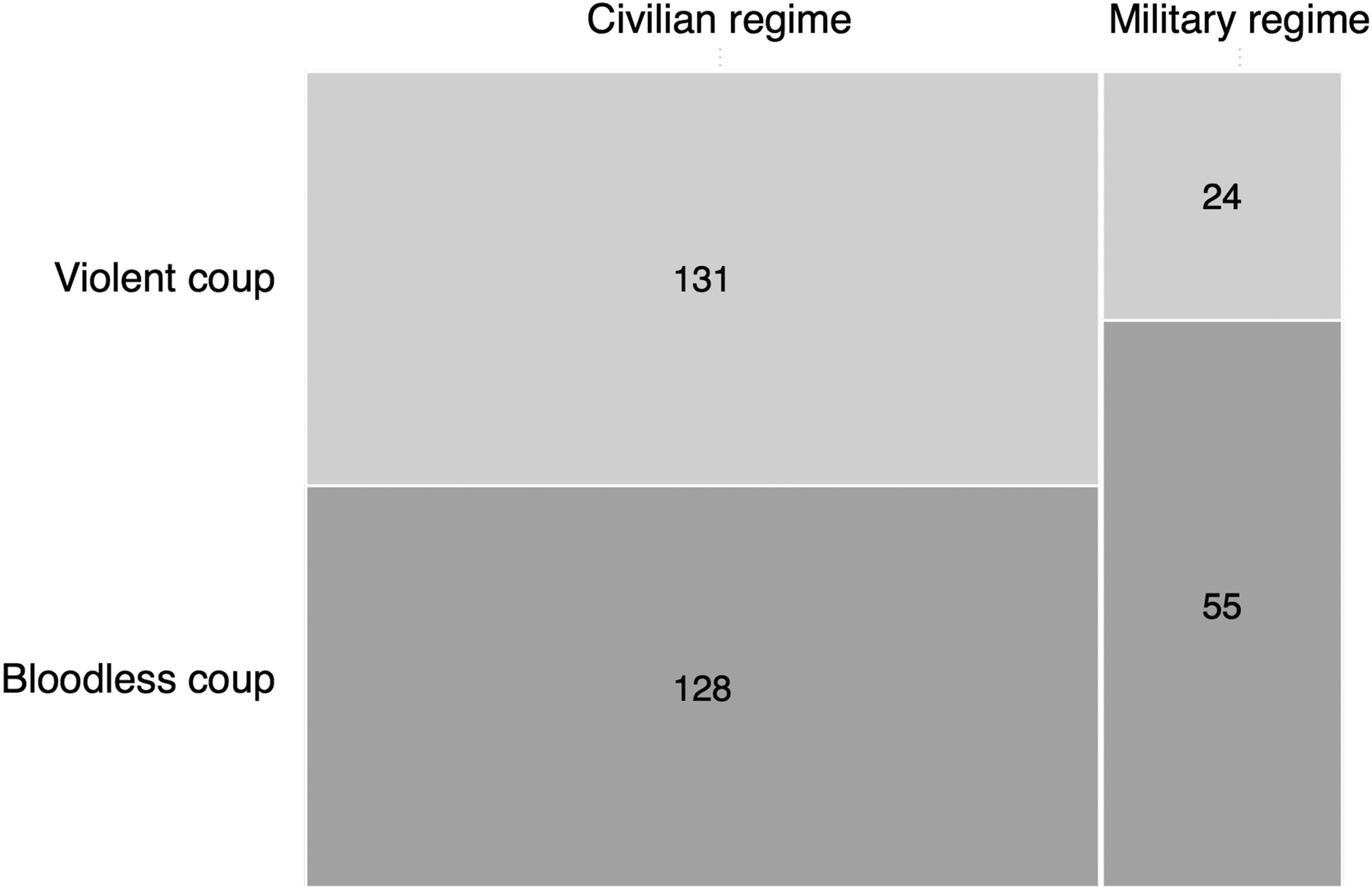
Figures 1
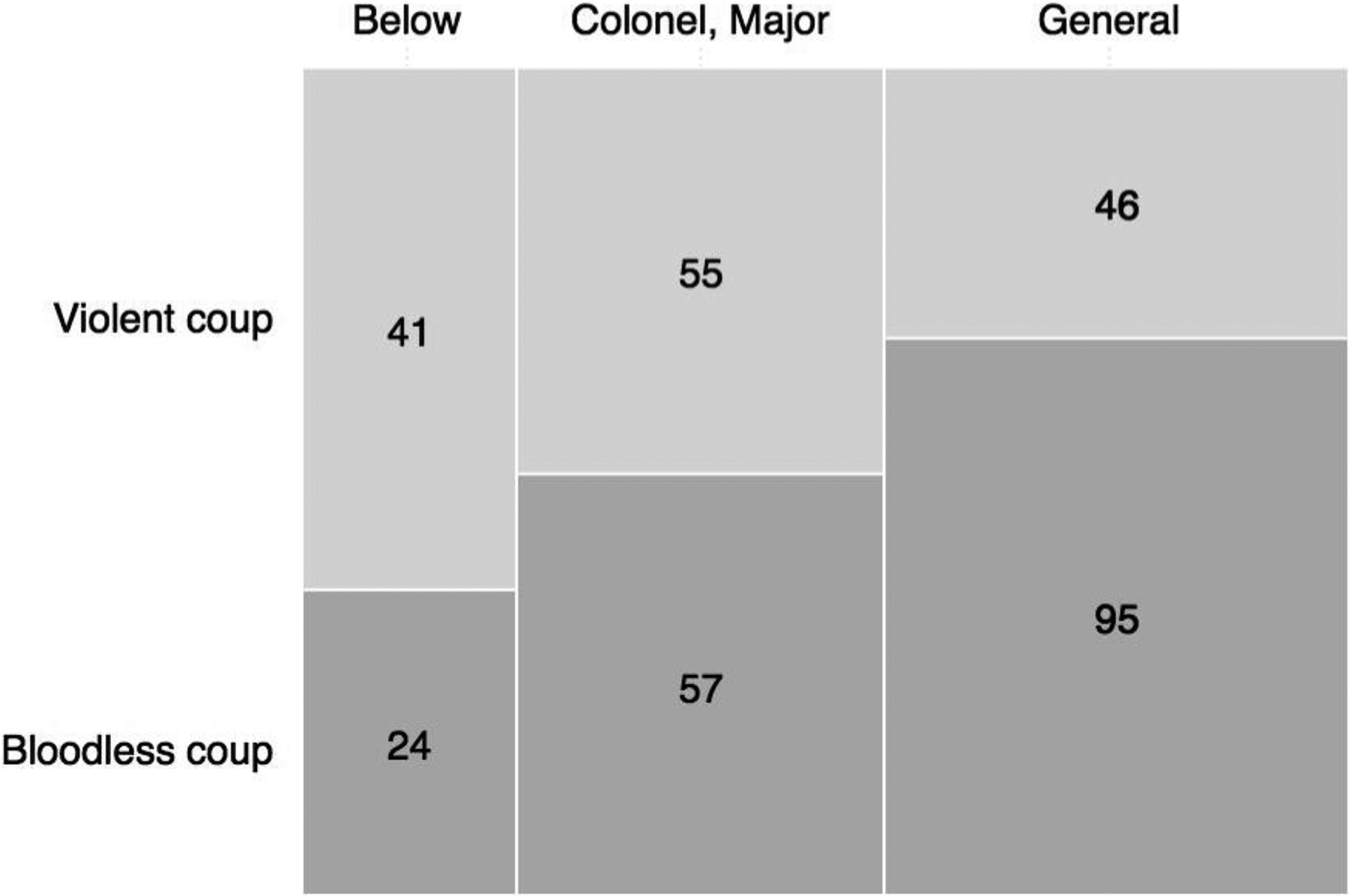
–3 compare the percentage of coups that turn violent by regime type, coup leadership, and counterbalancing. Coups against military regimes are much less likely to involve violence than coups against civilian regimes: 30.3% (24/79) of coups against military regimes turn violent, compared to 50.6% (131/259) of those against civilian regimes. A chi-squared test indicates that this difference is statistically significant (Chi2 = 9.948; p = 0.002). The level of violence that occurs during a coup also varies with coup leadership. Coups led by officers ranked general or above turned violent only 32.6% (46/141) of the time. In contrast, 49.1% (55/112) of coups by mid-ranking officers – majors and colonels – were violent. Where junior officers, non-commissioned officers, or enlisted men rebelled, violence was most likely; it occurred in 63.1% of attempts (41/65). These differences are also statistically significant (Chi2 = 18.082; p = 0.000). The relationship between counterbalancing and violence is also generally as Counterbalancing and coup violence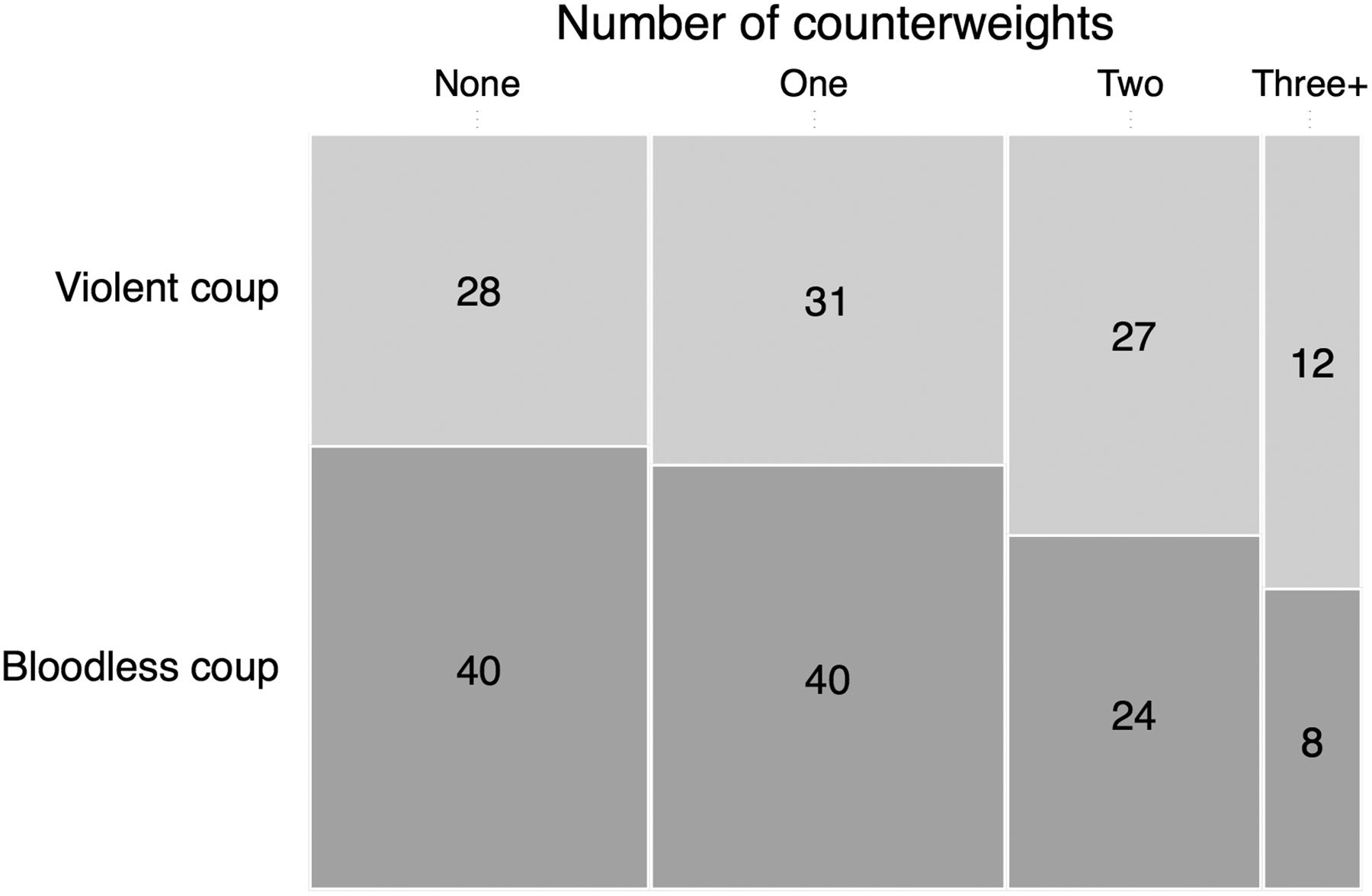
Control variables
I next estimate the determinants of coup violence in a multivariate setting. I control for several military- and country-level factors that may affect the extent of violence that occurs during a coup. Better-trained and better-equipped militaries may have the capacity to inflict more damage at lower cost in the event of a coup. I thus control for Military spending/soldier (Singer, Bremer & Stuckey, 1972). It may be more difficult for officers in larger militaries than for those in smaller ones to accurately assess the likelihood of success and to coordinate prior to the coup attempt (Finer, 1962). I thus control for the logged number of Military personnel (Singer, Bremer & Stuckey, 1972). Logged GDP per capita and population are also included as controls (Gleditsch, 2002). As the size and wealth of a state increases, the prize of dictatorship becomes smaller and the potential costs of a protracted battle for control over the state becomes more expensive. Coups in democratic states, in which the level of dissatisfaction with the current regimes is more likely to be known, should be less violent. Democratic leaders may be also less inclined to use violence to repress a coup attempt, either because their post-tenure fate is better than those of authoritarian leaders (Debs & Goemans, 2010), or because they are more sensitive to the political costs of violence. I code the variable Democracy as equal to 1 where a country’s Polity IV polity2 score is 6 or higher in a given year (Marshall & Jaggers, 2002).
I also include a control for ongoing civil war. An ongoing civil war might indicate that grievances against the regime are widespread and facilitate coordination (Piplani & Talmadge, 2015). If this were the case, we would expect coups during civil war to be less violent. On the other hand, it may be that civil wars generate new grievances that expand the pool of potential coup plotters to include those with less capacity to carry them out successfully (Bell & Sudduth, 2017). If this were the case, we would expect greater uncertainty about the outcome of the coup – and, as a result, for coups during civil war to be more, rather than less, violent. It may also be that the cost of violence appears lower to all actors in the context of already ongoing and widespread political violence. I use Bell and Sudduth’s indicator for civil war to test these possibilities. 7
Finally, some historical and temporal factors may affect the extent of violence that occurs during a coup. France has remained heavily involved in domestic political developments in its former colonies in Africa; by one recent count, it intervened to defend incumbent regimes against coups and rebellions some 19 times between 1962 and 2008 (Hansen, 2008). The intervention of an additional actor is likely to increase uncertainty over the outcome of the coup and increase the use of violence. I thus include a dummy variable capturing whether a state is a former French African colony (Teorell et al., 2011). Finally, I include a Cold War dummy, which is equal to 1 between 1947 and 1991. In the post-Cold War period, coup plotters increasingly face international opposition and pressure to democratize, which may discourage the use of violence (Marinov & Goemans, 2014). All independent and control variables, with the exception of those capturing coup leadership and ongoing civil war, are measured in the year prior to the coup attempt.
Findings
Determinants of coup violence
* p < 0.05, ** p < 0.01. Robust standard errors in parentheses, clustered by country.
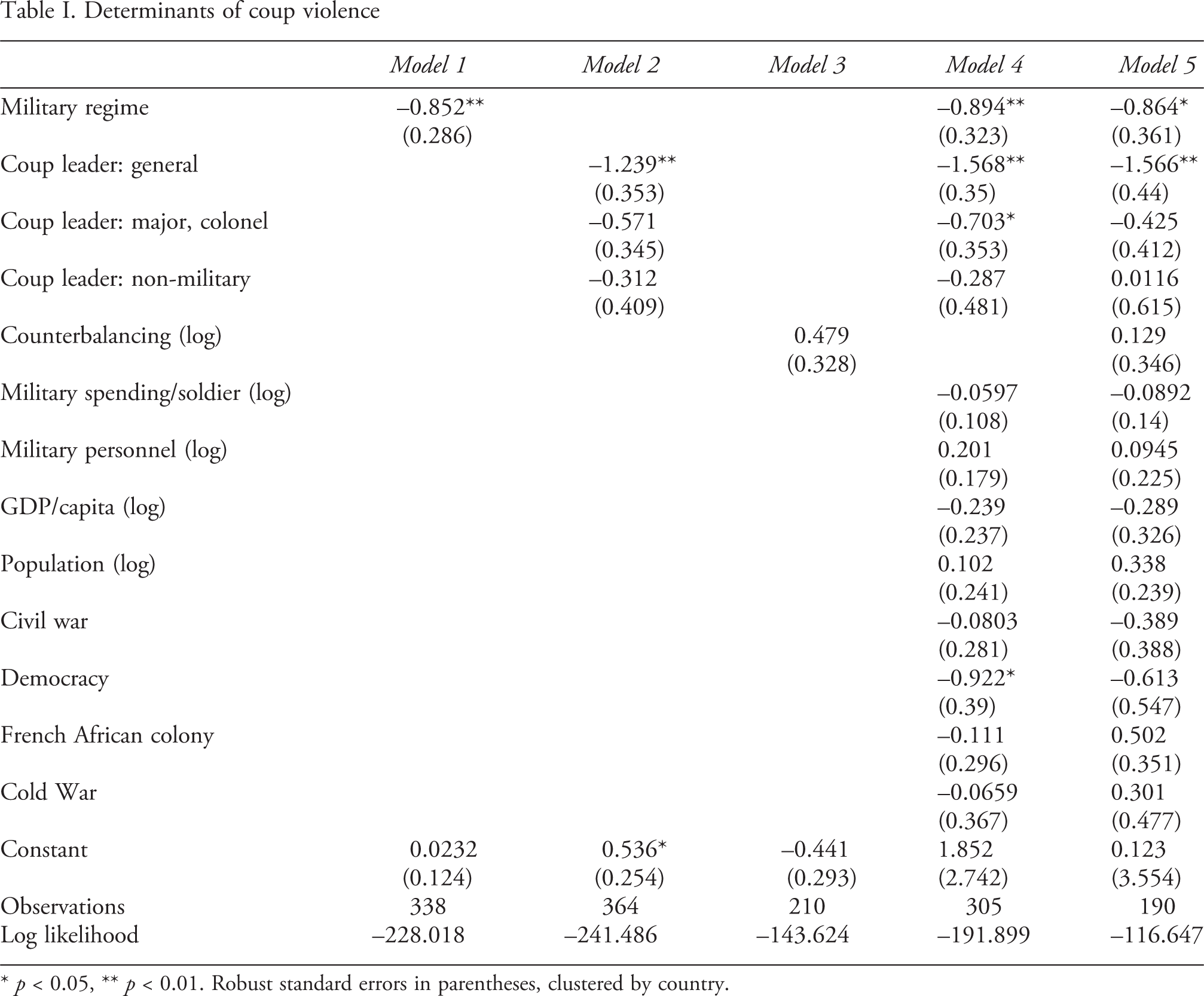
Tables I and II show that coup attempts against military regimes are less violent than those against civilian dictatorships. This is true even when controlling for coup leadership, military spending and size, GDP/capita, and other features of states that might be expected to influence the extent of coup violence. The relationship between regime type and coup violence is also substantively large. Figure 4 shows how the predicted probability of a violent coup changes with changes in selected independent and control variables while holding all others at their medians (from Table I, Model 4). The probability of violence is 19 percentage points lower under a military dictatorship than under a civilian one.
Determinants of coup severity
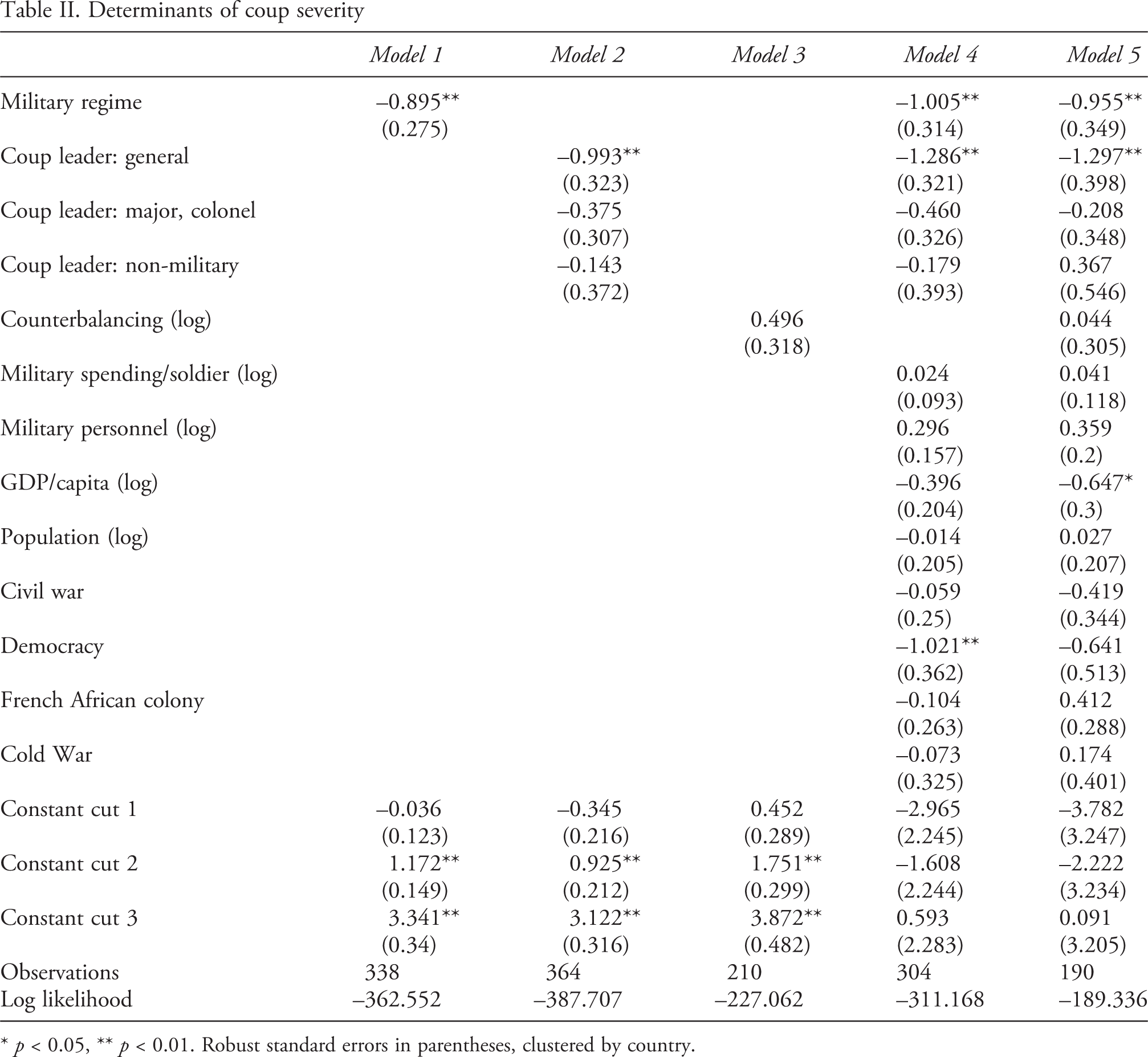
* p < 0.05, ** p < 0.01. Robust standard errors in parentheses, clustered by country.
In contrast to the findings on regime type and coup leadership, violence does not vary systematically with the use of counterweights.
9
This finding is surprising given that counterbalancing is associated with less successful coup outcomes, and case evidence suggests that where counterbalancing works, it does so because counterweights use force to defend the regime (De Bruin, 2018; Powell, 2012). There are several plausible explanations for the null findings. Existing indicators of counterbalancing are available for about half the coup attempts in the analysis. As a result, it could be that the sample size is simply too small to detect an effect.
10
Marginal effects of selected variables on the probability of a violent coup, from Table I, Model 4 (the marginal effect of a change from 0 to 1 is shown)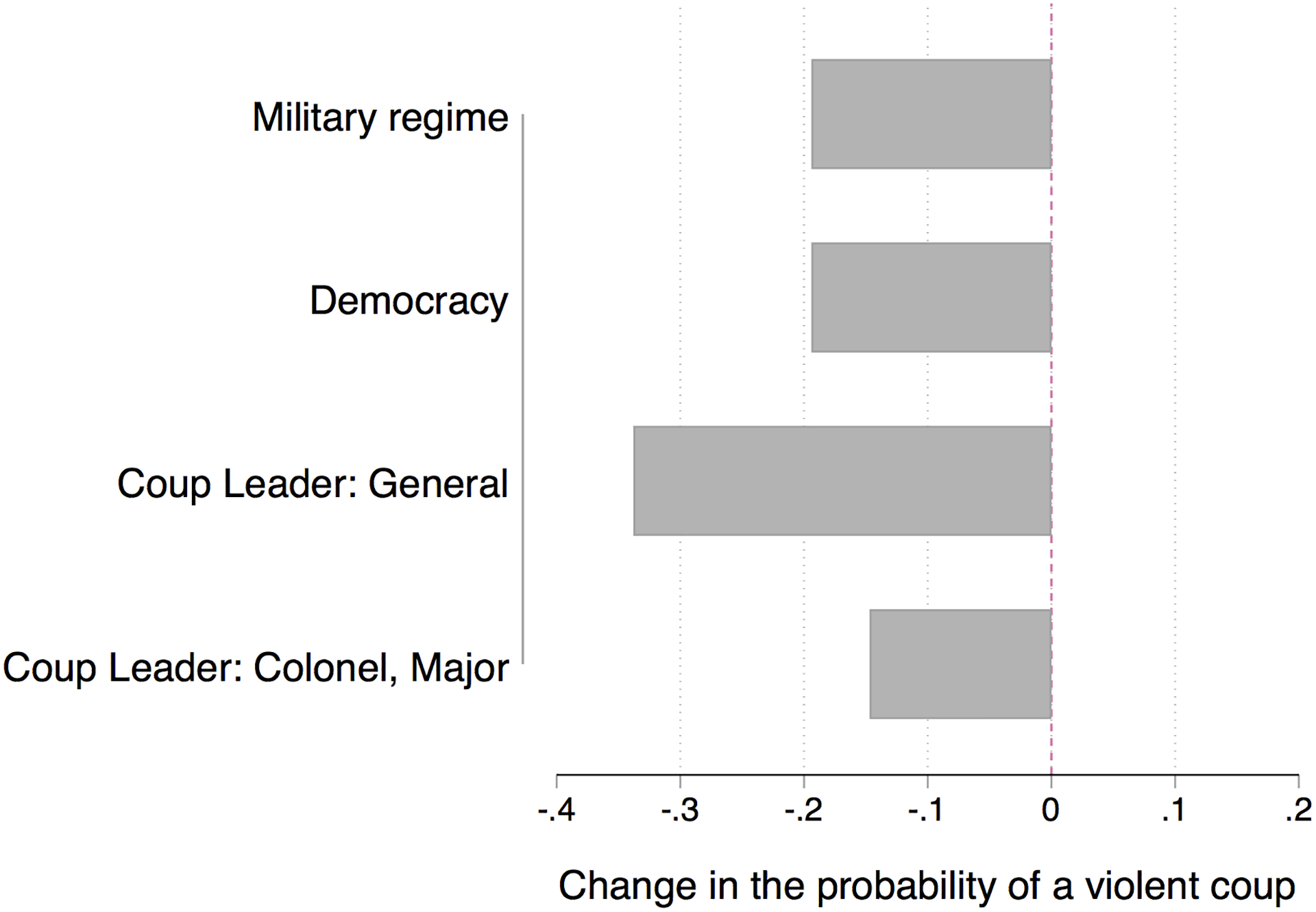
Results on other control variables are sensitive to the specification used. Democratic regimes are associated with less violence during coup attempts in specifications without the control for counterbalancing, whether the dependent variable is the dichotomous indicator for Coup violence or the ordinal variable Coup severity. Figure 4 illustrates the substantive effective of democracy on the likelihood of a violent coup (from Table I, Model 4); in this specification, the substantive effect is as large as that of military regimes. In Table II, which models Coup severity, the coefficient estimates on two other variables reach conventional levels of statistical significance. Military size is correlated with coup severity: larger militaries stage more violent coups. As anticipated, coups in wealthier states involve less violence than those in poorer states. In contrast, the results do not suggest a relationship between ongoing civil war and the amount of violence that occurs during a coup. 11 Other military- and state-level indicators, including those capturing military spending per soldier, population size, and former French colonies do not reach statistical significance; the coefficient on the Cold War dummy is positive, as expected, but also insignificant.
Alternative explanations and robustness checks
I have argued that coups against military regimes are likely to be less violent than those against civilian regimes because military regimes are better able to assess the likelihood the coup will succeed, perceive the costs of defeat to be lower, and are more sensitive to the costs of using violence. However, it could instead be the case that selection effects drive the association. The expertise military rulers possess in the use of force may deter prospective coup plotters from staging an attempt except where they have some other, unobserved reason to believe that military rulers will choose not to resist. If this were the case, however, we would expect to find fewer coup attempts staged against military regimes than civilian ones, when the reverse is true – coup attempts are more common in military regimes (Powell, 2012). Furthermore, the negative association between regime type and coup violence remains when I model selection effects explicitly using a two-stage model of coup attempts and violence (see Table B4 in the Online appendix). Another possibility is that the effect of military regimes is limited to coups staged by high-ranking officers. However, when coups led by the senior-most officers, those with the rank of general and above, are excluded from the sample, the effect on military regimes remains (Table B5).
I have also argued that coups staged by high-ranking coup plotters are likely to be less violent than those staged by lower-ranking ones because generals, admirals, and other top officers have access to better information with which to assess the likelihood the coup will succeed and resources with which to shape the expectations of others. The cost to using force may also appear much lower where coups come from within the lower ranks of the military. However, another possibility is that this finding is an artifact of the available data on coup attempts. I noted above that I was unable to compile estimates of the fatalities associated with 33 coup attempts. It is plausible that bloodless coups by low-ranking officers are less likely to receive sufficient attention from journalists, scholars, and nongovernmental organizations reporting on coup attempts to code estimates of coup violence. If this was the case, it could artificially induce a negative correlation between the rank of coup plotters and coup violence. 12 To check for this possibility, I examine the percentage of coup attempts for which data on violence were missing by rank; 7.1% of coups staged by junior officers and enlisted men are missing estimates for coup violence, compared to 7.7% of coup attempts staged by others. In other words, violence data is not more likely to be missing in coups staged by lower-ranked coup leaders. Missingness is also uncorrelated with other independent and control variables in the model (Tables B6–B7 in the Online appendix).
Another related possibility is that bloodless coups by junior officers receive so little coverage that they do not appear in Powell & Thyne’s (2011) dataset of coup attempts in the first place. This could also introduce an artificial correlation between rank and coup violence, but one that would be more difficult to detect. While this possibility cannot entirely be ruled out, I check whether the results on rank hold when using an alternative dataset of coup attempts compiled by the CSP, which includes a number of coup attempts that Powell and Thyne could not verify. The results on coup rank hold when these data are used in place of Powell and Thyne’s. Additional robustness checks described in the Online appendix test whether the results might be the artifact of particular coding decisions or the choice of control variables, and whether they are robust to additional controls for state repression. 13 None overturned the central findings on military regimes or senior officer coups.
Conclusions
This article demonstrates that the extent of violence that occurs during coup attempts varies systematically with features of incumbent regimes and coup plotters. Coups against military regimes are less violent than those against civilian dictatorships. I argue that this is because the leaders of military regimes have access to higher quality information about the likely outcome of coup attempts; they are also more likely than other civilian dictators to perceive that the costs of violence may outweigh the costs of defeat. Senior officer coups also involve less bloodshed than those led by junior officers and enlisted men. This is in part because their success is less detrimental to the institutional interests of the military and because coups from the lower ranks may indicate pre-existing divisions within the military that make subsequent violence less costly. Finally, senior officers are likely to have access to better information about the likelihood the coup will succeed, and more resources with which to shape the expectations of others. In comparison, coups in civilian dictatorships and those staged by junior officers and enlisted men were more likely to turn violent. While there are no simple policy solutions that follow from these results, they can help policymakers identify, and potentially respond more quickly to, the coup attempts that are most likely to turn violent.
These findings also suggest several avenues for future research. First, while this article focuses on features of incumbent regimes and coup plotters, it also provides a more general framework to explain coup violence, which emphasizes actors’ perceptions about the likelihood the coup will succeed, costs of defeat, and costs of violence. Future research might examine how external actors, such as international organizations and other states, and/or civilian elites might also influence these parameters. Second, in establishing patterns in the extent of violence that occurs during coup attempts, I have ignored potentially interesting variation in the targets and perpetrators of the violence. In particular, some coup attempts may turn violent because coup plotters plan to employ force from the outset. This was the case in the 1971 coup in Morocco, for instance, in which the commander of a cadet training school and the head of the royal household led 1,400 cadets in a bloody attack on the summer palace (Hess, 1971). In other cases, violence may occur because the regime refuses to step down and loyal forces come to its aid. The 1982 coup in Kenya fits this pattern. Coup plotters were able to seize control of the radio station, airport, and telecommunications stations without firing a shot; it was the General Services Unit, a paramilitary force built up as a counterweight to the military, that resisted, engaging coup forces in pitched battles around the capital (Decalo, 1998). While disaggregating the violence that occurs by perpetrator and target may not be feasible in a large-N dataset, future work might do so in a smaller number of coup attempts. Third, this article examined the violence that occurs during coup attempts in isolation from other forms of political violence, including state repression, rioting, and protest violence that might occur before or after the coup attempt. Future work might constructively combine the new data gathered here with other datasets on these different forms of political violence to develop a fuller picture of the violence surrounding coups.
Footnotes

Acknowledgements
For comments on earlier drafts, I am grateful to Yelena Biberman-Ocakli, Risa Brooks, Jessica Maves Braithwaite, Christian Davenport, Kerstin Fisk, Hanne Fjelde, John Ishiyama, Jaclyn Johnson, Peter Krause, Bethany Lacina, Yonatan Lupu, Jacqueline McAllister, Theodore McLauchlin, Will Moore, Lindsay Reid, Sam Rosenfeld, Peter Vining, Jessica Weeks, and Michael Weintraub. Thanks also to Maggie Joyce, Monique St Jarre, Isaac Kirschner, and Casey Kopp for excellent research assistance.
Funding
This research was supported by a Peace Research Grant from the International Peace Research Association Foundation.
Notes
References
Supplementary Material
Please find the following supplemental material available below.
For Open Access articles published under a Creative Commons License, all supplemental material carries the same license as the article it is associated with.
For non-Open Access articles published, all supplemental material carries a non-exclusive license, and permission requests for re-use of supplemental material or any part of supplemental material shall be sent directly to the copyright owner as specified in the copyright notice associated with the article.
