



Abstract
We consider whether prior political activism increases the likelihood of engaging in higher-risk forms of violent collective action. We test our hypothesis in the context of the 2014 Euromaidan and subsequent separatist violence in Eastern Ukraine. In the aftermath of the Euromaidan protests, the Ukrainian government began a widespread campaign to mobilize young men for military service against separatist movements in the Donbas region amid escalating tensions with Russia. In July 2014, we survey young men who were volunteering to join the Ukrainian military’s counterinsurgency efforts and compare them to other young men who live in the same community but had not volunteered. Using a case control study design, we interviewed 100 young men who reported to a local Ukrainian army recruitment station in Kharkiv, a city in Eastern Ukraine which was an important center for military recruitment efforts. We compared them to 100 other young men who lived in the same communities, received recruitment notices, but had chosen not to report. Military recruits were sampled by cluster-sampling at the recruitment station, with random selection of recruits by cluster. Civilian males were sampled by random route in the vicinity of the recruitment station. When comparing survey responses between recruits and civilians, we find strong linkages between prior Euromaidan participation and military mobilization. Our results are robust to controls for parochial ethnocentrism and mere support for Euromaidan goals. Maidan participation and military mobilization are also correlated with a strong sense of self-efficacy, optimism, risk tolerance, patriotic nationalism, and feelings of in-group solidarity with protesters and the military. These correlates illustrate plausible mechanisms for how individuals could transition to increasingly higher-cost, higher-risk forms of collective action.
Keywords
Introduction
What compels ordinary civilians to mobilize for violence? Drawing on the social movement literature (McAdam, 1986; McAdam, Tarrow & Tilly, 2001; Tarrow, 2011), we ask whether prior political activism can serve as a springboard for more high-risk, high-cost forms of collective action? We conduct our research in the context of Euromaidan protests and subsequent separatist unrest in Eastern Ukraine. We examine whether Maidan-related activism naturally spills over into counterinsurgency recruitment. We test our hypothesis about political activism and military mobilization using a case control study design where we compare recruits to young men in the same community who did not enlist. We conduct surveys of young men who report to a government army recruitment station for deployment to the front against ethnic Russian separatists in the Donbas region. We find that recruits display elevated Euromaidan political activism compared to their non-combatant counterparts. Our research advances the literature by evaluating how prior political activism finds expression in people’s willingness to engage in combat. Our results also underscore how governments may exploit prior activism to mobilize civilians for violent causes.
Literature
Our research speaks to a wide body of scholarship to include the literature on political activism and social movements, the insurgency and counterinsurgency literature on mobilization for violence, and a broad literature on military recruitment in times of war and crisis. Most importantly, we draw from the social movement literature on how political activism can lead individuals into higher-risk forms of collective action (McAdam, 1986; McAdam, Tarrow & Tilly, 2001, 2003; Tarrow, 2011; Tilly & Tarrow, 2015). McAdam (1986), in particular, makes an important distinction between ‘low-cost’ and ‘high-cost’ activism. Based on participation in the 1964 Freedom Summer project, he found that individuals with higher levels of civic engagement, dense network affiliations, and a history of prior activism were more likely to transition to higher-risk forms of collective action: in this case, to volunteer to travel in support of the US civil rights movement in the American South. In the context of Ukraine, we ask whether prior political activism during the Euromaidan might incentivize individuals to mobilize for higher-risk counterinsurgency actions in Donbas. As such, Maidan participation represents our lower-cost, lower-risk form of political activism, while joining the Ukrainian military is our subsequent higher-cost, higher-risk form of collective action. 1
Because our high-risk/cost collective action involves participation in violence, our case study also speaks to the literatures on military mobilization broadly and insurgency/counterinsurgency more specifically. In the broader literature on military recruitment and enlistment, there is considerable variation in government strategies and capacities for mobilizing civilians. 2 In both volunteer and conscript-based militaries, the military recruitment literature often points to structural inequalities, labor market opportunity costs, and selective incentives to explain who enters into military service, and into combat roles specifically (Warner, Simon & Payne, 2003; Asch et al., 2010). The literature also shows that emotions and symbolic psychological beliefs (patriotism, nationalism, honor, pride, group bonding) may be as important as instrumental and selective material benefits to draw people into the military and retain them (Burk, 1984; Wong et al., 2003; Lievens, 2007; Griffith, 2008). However, the role of prior political activism is remarkably absent from much of the general literature on who joins the military in times of war and peace. Our study helps fill this gap.
Finally, in the more specialized literature on insurgency/counterinsurgency in civil war, a number of scholars have examined motivations for joining rebel groups (Fearon & Laitin, 2003; Wood, 2003; Kalyvas, 2006; Humphreys & Weinstein, 2008; Arjona & Kalyas, 2011), and more attention is now being paid to government efforts to recruit civilians into military combat to counter such insurgencies (Jentzsch, Kalyvas & Schubiger, 2015; Staniland, 2015; Forney, 2015; Carey, Colaresi & Mitchell, 2015). In the counterinsurgency literature, research tends to focus on the strategies for battling insurgencies (Fielding & Shortland, 2010; Toft & Zhukov, 2012) and how different strategies might affect insurgent support (Lyall, 2009; Lyall, Blair & Imai, 2013). Research generally suggests that recruitment for counterinsurgency is challenging, especially when attachments to national governments are weak (Giustozzi, 2007), regional, sectarian, or ethnic parochial divisions are strong (Sambanis, Schulhofer-Wohl & Shavo, 2012), or when counterinsurgency efforts are led by external state actors (Shafer, 2014). Counterinsurgency efforts are also more challenging when insurgents themselves receive support from external state backers (Salehyan, Gleditsch & Cunningham, 2011; Maoz & San-Akca, 2012). However, less is known about how governments might recruit from civilian populations to fight insurgencies and what induces civilians to join counterinsurgency efforts, including the role of political activism in counterinsurgency recruitment. Instead, most studies of activist motivations have been highly insurgency-focused.
One possibility is that the logic of recruitment is similar. Prospective insurgents and counterinsurgents are both motivated by a combination of rational choice-type selective incentives and/or psychologically driven motives (Petersen, 2002; Weinstein, 2006). In the insurgency literature, Weinstein (2006) stresses the importance of activist-based motivations for fighting, but such motives are underexplored in the counterinsurgency literature. To help fill this gap, we examine whether political activism might induce individuals to volunteer for military service in the context of a counterinsurgency effort in Eastern Ukraine. We argue that political activism could help explain who volunteers for service as well as who complies with conscription efforts. If civilians mobilize for insurgency on behalf of activist-driven causes, could activism drive individuals to join counterinsurgency movements as well?
Theory and hypothesis
During wartime, governments could face considerable military recruitment challenges. Ordinary citizens may be less inclined to join the military during conflict, and preferences for fighting may also depend on the type and degree of threats posed. In general, we assume collective action problems in recruitment efforts. Individual incentives to free ride may increase under the threat of war, especially when facing formidable adversaries (though see Kalyvas & Kocher, 2007). States may also have varying capacities to offer selective incentives or enforce coercive efforts (ex. conscription) to overcome those free rider problems. When governments are constrained in both carrot and stick capacities for recruitment and where personal costs of fighting may be severe, we consider the role that prior political activism might play in mobilizing civilians for violence. We test the following hypothesis:
Political activism: Prior political activism increases the likelihood of mobilizing for military combat.
How could prior activism lead people to join the military? We follow the logit of McAdam (1986) by conceptualizing activism and military mobilization on a continuum of increasingly higher risk forms of collective action. We consider the relationship between activism and military mobilization in general, and insurgency and counterinsurgency mobilization more specifically, as a possible extension and escalation of prior forms of contentious politics. In the context of military recruitment for counterinsurgency, we explore whether counterinsurgency mobilization can be viewed as an escalation of prior contentious politics that draws activists into military ranks. 3
What types of contentious politics might lead activists to engage in higher risk collective action? One possibility is that the source of contention is based on parochial, sectarian, or ethno-national social cleavages. Peterson (2002) in particular has pointed to the role of collective fears, hatreds, and resentments in driving civil conflict, especially along ethnic and sectarian lines. People agitate, mobilize, and counter-mobilize in response to specific acts of in-group/out-group political exclusion, social or economic inequality, religious or other identity-driven forms of persecution (Cederman, Gleditsch & Buhaug, 2013). When contentious politics involves strong ethnic, sectarian, or regional cleavages, parochial individuals with elevated in-group ties and out-group aversions may select into both activist and combatant roles, either as insurgents or as defenders of the regime (Sambanis, Schulhofer-Wohl & Shavo, 2012). This would lead us to predict that activists have a heightened sense of ethnocentrism compared to non-activists, which leads them to mobilize on behalf of ethno-national causes.
Another possibility we consider is that contentious politics is more politically partisan than parochial. In the context of an insurgency/counterinsurgency conflict, such partisan issues might involve matters of subnational territorial autonomy, control of the state, or a range of issues related to political power and inclusion that draw prior activists into insurgent and counterinsurgent ranks (Gurr, 1970). This would lead us to predict that activists have stronger partisan preferences compared to non-activists on issues of political contention, which leads them to increasingly higher-risk collective action to advance their partisan political goals.
Finally, we explore psychological processes or mechanisms by which prior activism might lead to military mobilization. The social movement literature underscores the propensity for close-knit, densely affiliated activists with strong convictions to transition from low-risk to increasingly high-risk/high-cost forms of collective action to achieve their goals (McAdam, 1986; Tilly & Tarrow, 2015). We consider a process where political activism enhances an individual’s sense of agency, empowerment, and self-efficacy, leading activists to discount risk and become more favorable to other forms of violent collective action, including military mobilization. 4 In terms of pathways, one possibility is that prior activism reinforces patriotic nationalism, where activists join the military based on symbolic and psychological beliefs about honor and patriotic duty to defend the nation from an internal or external threat (Burk, 1984; Wong et al., 2003; Lievens, 2007). This might be especially true when the fault-lines of activist contention coincide with international boundaries, where the main political adversary is both foreign and domestic, or otherwise perceived as an existential threat to the state, as in the case of many insurgency conflicts. We also consider whether linkages between military and activist networks help facilitate the mobilization of empowered activists into military ranks. 5
To summarize, we examine the relationship between prior political activism and military mobilization. We evaluate whether activist motives can be characterized as parochial and/or politically partisan. We then explore how activism could encourage a sense of self-efficacy, patriotic nationalism, and group solidarity between activist and military networks that propels activists into more violent forms of collective action. 6 We now discuss our rationale for case selection in more detail below.
Rationale for case selection
While many militaries around the world engage in recruitment efforts, the emerging crisis in Ukraine provided a window of opportunity to test our hypothesis during a major campaign to mobilize civilians for military combat. We chose to conduct our study in Ukraine for several reasons. 7
Beyond basic access and opportunity rationales, Ukraine allows us to examine the transition from low-cost to higher-cost forms of collective action (McAdam, 1986). In the context of Ukraine, how might Euromaidan political activism against the Yanukovych regime spill over into counterinsurgency mobilization against Donbas separatists? To explain the linkages between Maidan activism and Donbas mobilization, we consider a parochial ethnic cleavage-based and a political cleavage-based explanation.
According to the parochial model, Maidan protests and Donbas counterinsurgency were both born out of contentious ethnic cleavages. Ukraine contains a sizable minority of ethnic Russians who, based on the 2001 census, comprise 17% of the population, but are more concentrated around the Black Sea regions of Crimea (59%) and Odessa (29%), and the eastern regions of Donbas (39%) and Kharkiv (26%) bordering Russia. The parochial model suggests that the Maidan protests, Russia’s subsequent annexation of Crimea, and the rise of Russian separatists in Donbas pitted ethnic Ukrainians against ethnic Russians. The parochial model views Maidan political activism as an expression of parochial ethnocentrism and ultra-nationalism within the ethnic Ukrainian community. 8 The willingness of Maidan activists to mobilize for counterinsurgency in Donbas is a function of their parochial ethnic-nationalism and aversion to ethnic Russians.
There are reasons, however, to be skeptical of the parochial explanation. While concerns about ethnic tensions in Ukraine were raised by many following the collapse of the Soviet Union (Posen, 1993; Bremmer, 1994; Tishkov, 1997; Suny, 1998; Laitin, 1998), there is an ongoing debate over the salience and importance of ethnic cleavages in Ukrainian politics and society and whether such divisions are a product of language (Fournier, 2002; Kulyk, 2011), regionalism (Birch, 2000; O’Loughlin, 2001), or a combination thereof (Barrington, 2002; Barrington & Faranda, 2009). So far, violence in Ukraine has not been linked to increased ethnic tensions in the general population (Coupé & Obrizan, 2015). Recent research also suggests that insurgent unrest in Eastern Ukraine may be more a function of 2008 global economic shocks and disruption of export ties to Russia than enduring ethnic rivalries (de Haas, Djourelova & Nikolova, 2016; Zhukov, 2015).
In contrast to the parochial model, we explore an alternative explanation based on ongoing domestic and international political cleavages over Ukraine’s relationship between Europe and Russia. We situate the Euromaidan protests and Donbas violence into a broader historical period of evolving contentious politics along this issue cleavage (Tilly & Tarrow, 2015). In particular, Kuzio (2015a) details how the political violence of the Euromaidan and Donbas conflicts evolved from lower-level contentious politics going back to the 1980s that deepened following the 2004 Orange Revolution and escalated thereafter between supporters and opponents of Viktor Yanukovych (Wilson, 2005; Kuzio, 2010). Before the Maidan protests began, the Donbas region provided a critical electoral base for Yanukovych and his Party of Regions, where ties to Russia were strong (Osipian & Osipian, 2006). At that time, Frye (2015) shows that economic orientation toward Europe versus Russia, rather than ethnicity or language cleavages, had become the primary point of contention between Yanukovych supporters and opponents. Indeed, the Maidan protests originated in response to President Yanukovych’s decision to oppose an Association Agreement with the European Union in favor of the Customs Union with Russia, a move which was widely favored in the Donbas region (Diuk, 2014). Yanukovych’s ouster in February 2014 was followed almost immediately by antigovernment demonstrations and separatist calls in Donbas. 9 Hence, Donbas violence could be viewed as an escalation of prior ‘Europe versus Russia’ domestic political contention drawing Maidan supporters and opponents into military ranks.
Russia also played a critical role in intensifying domestic political divisions in Ukraine. Russia openly supported Yanukovych during and after the Maidan crisis and crackdown, ultimately offering him sanctuary. With a pro-Western government in power in Kiev, Russia retaliated by annexing Crimea and supporting separatist movements in Donbas (Bachman & Lyubashenko, 2014; Mitrokhin, 2015; Kuzio, 2015b; Katchanovski, 2016; Laruelle, 2016). 10 Some argue that Russia may have provoked the separatist conflict in Donbas out of fear that Maidan activism would bolster pro-Western groups in Moscow (Horvath, 2015). Others argue that Russian actions in Crimea and Donbas were in response to fears of Ukraine’s likely EU and NATO expansion (Mearsheimer, 2014; Tsygankov, 2015). In either scenario, Russia plays an important role in the political origins of both the Maidan protests and Donbas conflict. Russia’s involvement in both crises could also be an important catalyst for patriotic nationalism driving activists into combat.
In summary, to explain how Maidan activism leads to Donbas mobilization, we place the Donbas insurgency in a continuum of escalating contentious politics between pro-Europe Maidan activists and pro-Russia supporters in the Donbas. We argue that the initial success of Maidan protests had a self-empowering effect on activists, who demonstrated a willingness to engage in high-risk/high-cost mobilization to further their goals. Ukrainian political elites were also aggressively mobilizing for counterinsurgency in the immediate aftermath of the surge of Maidan activism and had incentives to harness the energy of the Maidan protesters by framing military recruitment as a furthering of Maidan-related causes: Ukraine’s struggle for independence and a future in Europe over domination by Russia. 11
Generalizing beyond Ukraine, we ask whether prior political activism offers insights into military mobilization during conflict. We examine wartime recruitment efforts in a weak, semi-democratic regime with limited military and economic capability facing threats from both an internal regional, ethnic insurgency and a more powerful external state actor. We consider Ukraine a compelling case to study the role of prior political activism in mobilization, because the government lacks the capacity to offer carrots or sticks to incentivize recruitment via financial inducements or forced conscription and must rely heavily on volunteerism. Under such constraints, we ask what role prior activism might play as an inducement in the mobilization process. Our results also speak to the challenges of military recruitment in states with limited institutional capacities.
Research design
Conducting research on military combatants is challenging for a number of reasons. Due to government restrictions, gaining access to military personnel is often extremely difficult. There are also further restrictions and prohibitions on what military personnel may reveal due to the sensitive nature of their deployments. There is also the problem of socialization and social desirability bias. It is difficult to know whether active duty military are speaking freely or whether they are simply reporting what they know to be acceptable responses for fear of reprimand from superiors. In summary, most militaries operate in a highly controlled and restrictive environment that poses challenges for social science research. The crisis in Ukraine offered a unique opportunity to conduct this study in a less constrained environment where we hoped individuals would be more inclined to speak freely and openly.
We interviewed prospective recruits at a military recruitment station as they prepared to enlist for active combat duty – battlefield deployment in a counterinsurgency operation in Eastern Ukraine. For comparison, we also interviewed civilians in the proximity of the recruitment station, who have chosen not to join the mobilization effort. Using a case control design, we restrict our sample to young men of age 18–27, consistent with those who were being targeted by the Ukrainian government for recruitment.
By examining individual attitudes at the onset of military service, our approach minimizes risks to both enumerator and subject because we do not attempt to approach soldiers in hostile, combat environments. We also seek to limit the influence of socialization effects from the experience of group bonding during basic training, integration into military life, and the harsh conditions of field combat. This is important because we suspect that survey responses could be sensitive to time, place, and context. Asking former combatants to recall motivations and preferences years after a conflict has ended could lead to under-reporting, especially if wartime rivals have long since reconciled. During conflict, combatant preferences may also be affected by events experienced on the battlefield. There is also selection bias on survivors in retrospective studies.
To identify motives for political activism and military mobilization, we employ a wide range of survey instruments. We begin with a battery of questions to evaluate their emotional state. We then collect basic demographic information. We ask recruits directly ‘Why are you joining the Ukrainian army?’ 12 We also use indirect questions to probe for activist driven preferences and motives for joining the military and explore pathways through which activism may manifest into support for violent collective action (self-efficacy, group solidarity). We also control for plausible confounders of activist-based explanations for military mobilization to include selective incentives, opportunity costs, ethnocentrism, and mere Maidan support. While we are unable to fully identify causal effects or mechanisms due to the observational nature of our data, our exploratory findings can inform future research.
Sampling and data collection
Descriptive statistics
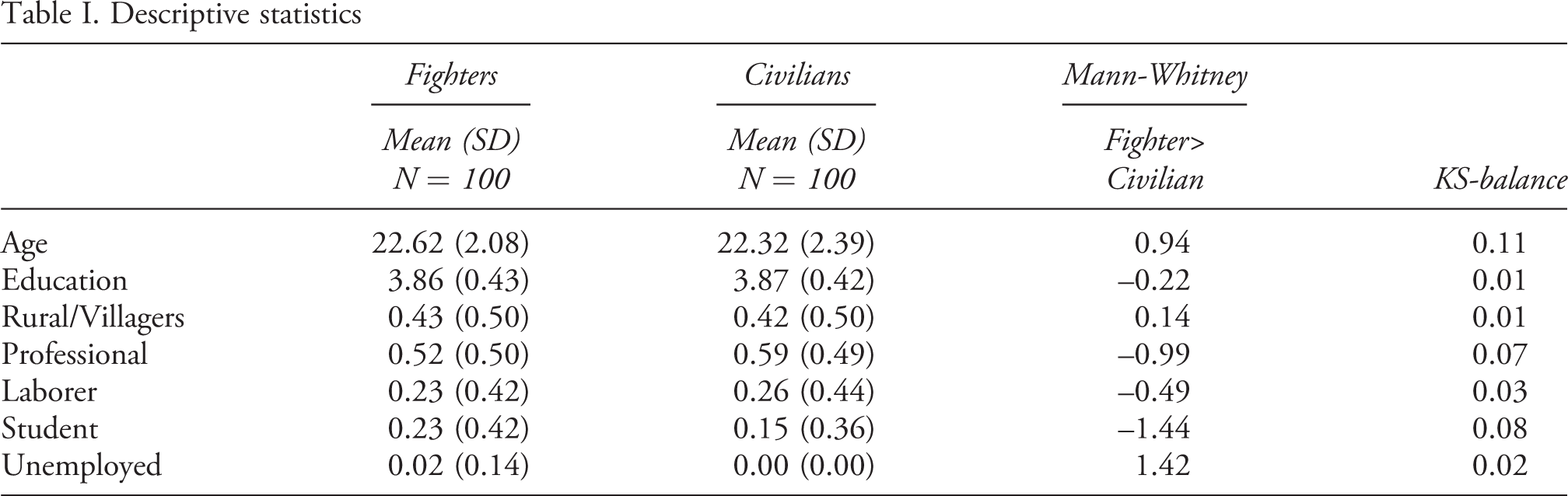
One possibility, however, is that our inferences are highly sensitive to local context. Individuals in Kharkiv may differ in important ways from other regions of Ukraine. Unfortunately, limited resources and access to recruitment centers prevented us from expanding our sample size. Population inferences are difficult in research on military recruitment and political activism due to selection bias and small-N samples of activists and recruits relative to the general population. Rather, our research is exploratory. We ask whether we can find evidence of activist-based motives for military recruitment in a small-sample case-control comparison.
Empirical strategy
To assess prior political activism, we pose questions to recruits to understand the range of reasons and rationales they may have for joining the Ukrainian army. We then turn to logit regression models of the form F(Υi) = β0 + β1Mi + β2Xi + ∊i , where our key dependent variable of interest (Υi ) is the logistic transformation of a binary variable for whether individual (i) enlists = 1 or does not = 0. Our key explanatory variable (Mi ) is a binary variable for whether the respondent took part in Maidan protests while (Xi ) is a vector of extended controls. Among controls, we test our activism hypothesis against other selective incentives for mobilization by controlling for age, education, villagers, and employment background as proxies for underlying financial incentives and opportunity costs for joining in the military.
Because all our variables are observational in nature, not randomly assigned, causal inference is hampered by endogeneity and selection bias. However, we can increase confidence in our results using extended controls to deal with selection on observables. Ideally, the Ukrainian draft would serve as a meaningful treatment for coercive pressures to enlist, but we do not have any way to independently assess who received draft notices and who did not, and civilians have incentives not to be forthcoming about whether they received such notices. 17 Hence, we cannot directly test the impact of the conscription regime. However, if recruits are primarily forced conscripts as opposed to willful volunteers, then this should predict the null hypothesis that political activism among new recruits does not differ from the civilian population. They are only serving out of a compulsory obligation, not due to prior political activism or in pursuit of activist-driven goals. 18
Analysis
We begin by examining stated rationales for joining the counterinsurgency effort. We asked recruits to indicate from a range of options why they decided to join the Ukrainian military, then to identify the most important reason for joining among options provided. We also gave them the opportunity to include other reasons not listed (see the Online appendix Tables I–II for response details). Among the 100 recruits we sampled, none stated that they felt compelled to join as a result of the draft. They all claimed to be volunteers. Also, none directly referenced the Maidan protests as a reason for joining the military, nor were they primed to think about their views or involvement in the Maidan by prior survey items. 19 To probe for Maidan-related motives for joining, we turn to self-reported behavioral and attitudinal measures of political activism.
Our primary measure of prior political activism is participation in Maidan protests. 20 We assess the extent to which Maidan participation differs between recruits and other men within their age cohort and community, who have not opted for military service. The dependent variable is coded 0 for civilians and 1 for army recruits. Maidan participation is coded 1 if the subject indicated that they participated in Maidan protests and 0 if not. Ideally, we would have more detailed measures of Maidan participation beyond this simple instrument to include duration/type(s) of participation, but our sample size limits more in-depth analysis.
In Figure 1, we report the predictive margins of Maidan participation on military mobilization based on a Maidan participation and military mobilization (predictive margins) Maidan participation and military mobilization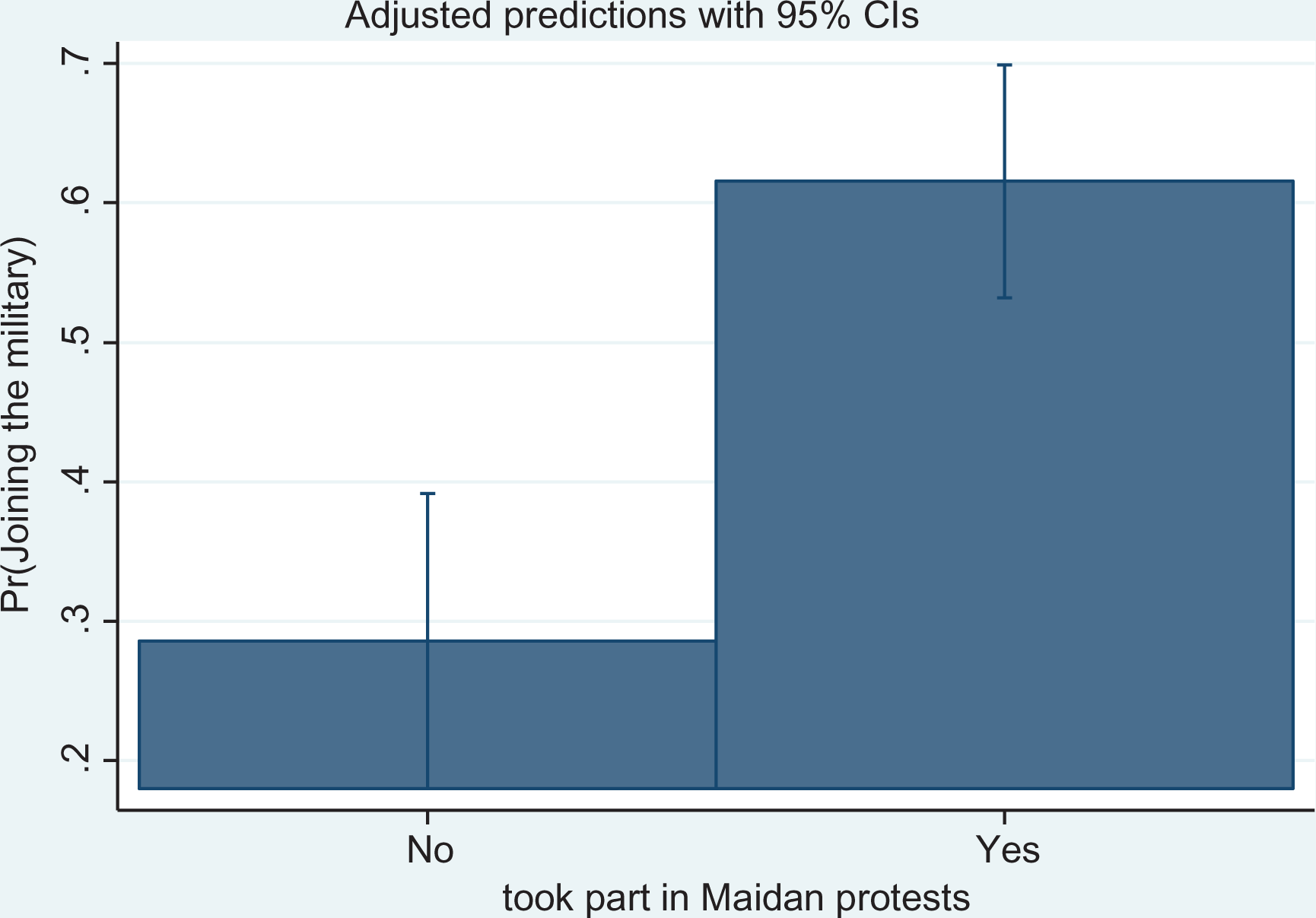
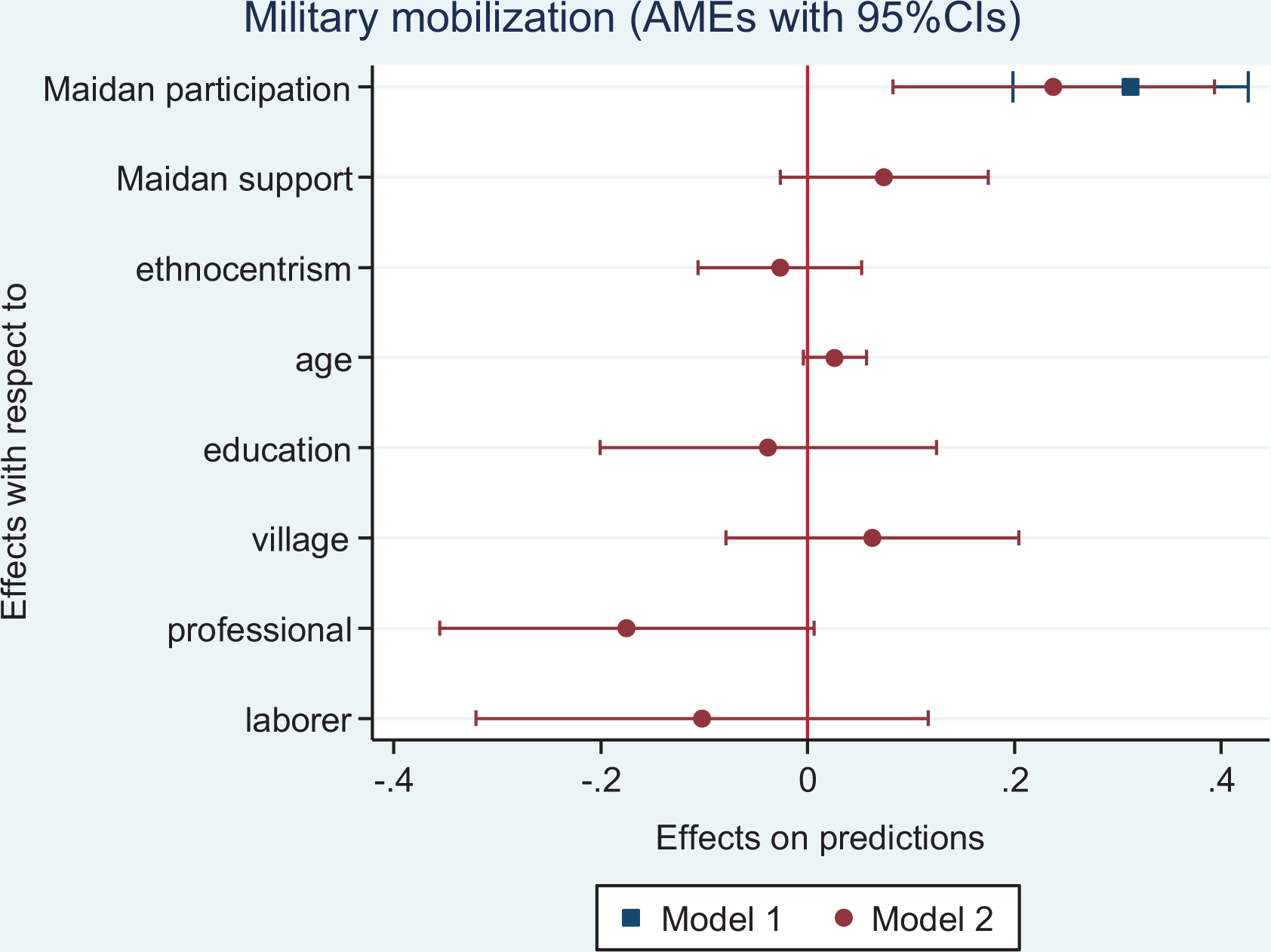
Next, we consider whether the effect of Maidan participation is robust to the inclusion of a number of extended controls and potential confounders. In Figure 2, we report the average marginal effects (AMEs) of Maidan participation and extended controls on the probability of joining the military. 22 AMEs greater than zero indicate a positive effect on joining the military. Model 1 indicates the AME of Maidan participation from the simple binary logit regression model. In Model 2 we include a number of extended controls, which we describe in detail below.
First, we consider whether military mobilization is a function of Maidan-related political contention. We measure Maidan support based on seven items from our survey: support for the Maidan protests, blame attribution to Yanukovych and Vladimir Putin for Maidan-related violence, and political preferences consistent with the broad goals of the Maidan protests (EU approval, support for the EU and NATO membership, opposition to joining the Russian-led Customs Union). 23 We also estimate the AME of each item in the survey on the probability of joining the military when regressed in separate logit models with extended demographic controls (Online appendix Figure 1). At the onset of military service, recruits express support for Maidan political goals that distinguish them from civilians. Recruits are more likely to support Maidan protests than civilians. They are also more likely than civilians to blame Viktor Yanukovych and his Party of Regions for Maidan violence. However, blame is not limited to the Yanukovych regime. Compared to civilians, recruits are also much more likely to blame Russian President Vladimir Putin for Maidan violence. They are also more supportive of Ukrainian membership in the European Union and NATO and opposed to joining Russia’s Customs Union than civilians, which is consistent with the goals of the Maidan protests (Diuk, 2014; Onuch, 2014). Factor analysis indicates that these items line up strongly on a single dimension which we combine into an index of Maidan Support. 24 Results from Figure 2 Model 2, however, indicate that actual participation in Maidan protests, rather than general Maidan support, is the stronger predictor of military mobilization when regressed in the same model, though the two items are highly intercorrelated (r = 0.60).
Next, we consider whether military mobilization is a function of ethnocentric divides. To measure ethnocentrism, we develop an index based on responses to eight survey items (see Online appendix Figure 2 for AMEs for each item). First, we measure in-group ties based on language and ethnicity using a simple social distance scale (e.g. How close do you feel to: Ukrainian speakers, Russian speakers? 1 = not close at all, to 4 = very close). Though all our subjects identify as Ukrainians and Ukrainian speakers, recruits do not feel closer to other Ukrainian speakers than do civilians. We then include a series of questions aimed at whether people are hostile to or hold negative stereotypes about Russians in Ukraine (Agree/Disagree: they are enemies of Ukraine, they are disloyal, they support Russia’s annexation of territory, they oppose EU membership, they support Putin). However, recruits are no different from civilians in responses to these items. They are also even less likely than civilians to see Russians in Ukraine as enemies. Finally, at the start of the survey, all subjects completed a ‘third-party’ dictator game, where they are asked to distribute a sum of money (100 Hryvnia or approx. $5) between an anonymous ethnic Ukrainian and an ethnic Russian from Ukraine. The dictator game is commonly used to identify behavioral bias in the treatment of various in-groups vs. out-groups including ethnicity (Fershtman & Gneezy, 2001). Although 40.1% of subjects gave more money to an ethnic Ukrainian than an ethnic Russian, differences in in-group bias between recruits and civilians were not significant (Online appendix Figure 2). Factor analysis indicates that responses to all these items lined up on a single dimension, which we treat as a latent variable for ethnocentrism. 25 In Figure 2 Model 2, we find no evidence that ethnocentrism predicts military mobilization. Recruits are no more ethnocentric than civilians in either their attitudes or behavior on any of the dimensions of our index. The correlation between Maidan participation and ethnocentrism is also weak (r = 0.05).
Hence, we find stronger support for military mobilization being driven by political contention over Ukraine’s relationship between Europe and Russia than ethnocentric divides.
Finally, we include a number of demographic controls for age, education, whether the subject is from Kharkiv city or a nearby village, and whether the subject was employed in a professional or service sector position before enlisting, a student, or a skilled/unskilled manual laborer, which serves as a proxy for underlying financial incentives and opportunity costs to joining. We find that individuals from more professional employment backgrounds are less likely to join the military than those from more working class backgrounds and students (who are the comparison group). We believe this likely captures some of the effects of financial incentives and opportunity costs on military mobilization. However, we observe that Maidan participation continues to be a strong predictor of military mobilization when controlling for demographics and other possible confounding explanations based on mere Maidan support and ethnocentrism, though omitted variable bias remains a possibility. 26
In summary, military recruits reflect attitudes and behaviors that are consistent with activist-driven motives for fighting. Our findings support the social movement literature on the transition to high-cost/high-risk activism (McAdam, 1986). Political opposition to the Yanukovych regime, borne out through Maidan political activism, are strong predictors of who is joining the counterinsurgency in Donbas. Hence, prior political activism offers important insights into mobilization for counterinsurgency. The army is drawing into its ranks former Maidan protesters who, while not vengeful against Ukraine’s ethnic Russian population in general, have strong preferences for European integration and are aggrieved at those who want to increase Russia’s influence over Ukraine, especially Viktor Yanukovych and Vladimir Putin, to whom they ascribe blame for the violence. This helps explain why some of those who took part in Maidan protests subsequently mobilized for the counterinsurgency effort against separatists in a heartland of pro-Russia support.
From the Maidan to the military: Exploring pathways
What might compel former Maidan activists to engage in high risk military mobilization in Donbas? Establishing causal mechanisms or processes from observational data is challenging due to endogeneity among explanatory variables, proposed mediators, and outcome variables (Nagelkerke et al., 1995). Here, we merely explore plausible pathways between prior political activism and military mobilization based on self-efficacy, support for violent collective action in the form of patriotic nationalism, and linkages between activist-military networks. We argue that activism could instill a sense of optimism, agency, and empowerment, elevating risk tolerance and support for violent collective action. A strong sense of self-empowerment coupled with patriotic nationalism could help explain why prior activists mobilize to defend their country. Close linkages between activist groups and military networks should also help facilitate the transition from one form of collective action to another.
To measure self-efficacy, we construct an index based on emotional affect, risk tolerance, and optimism about the future (see Online appendix Figure 3). We measure positive and negative emotional affect at the beginning of the survey using a variation of the PANAS-X scale (Watson & Clark, 1999). Overall, recruits appear to be very enthusiastic at the onset of their military deployments. The scale reveals that recruits display stronger positive affect (happiness, attentiveness, pride) and less negative affect (fear, sadness, anger) than civilians. To measure risk tolerance, we employ two survey items and a variation of a standard risk game from behavioral economics. 27 As predicted, we find that recruits are more risk tolerant in both their attitudes and their behavior than civilians. Finally, we employ three items to assess optimism bias. In each item, we find that recruits are significantly more optimistic and (over-)confident than civilians. Factor analysis indicates that emotional items, risk tolerance, and optimism align on a single dimension which we combine into a latent variable of self-efficacy. 28
Next, we examine the link between Maidan activism and support for violent collective action in the form of patriotic nationalism. We build an index of support for violent collective action based on responses to ten items in our survey that measure support for violence in Donbas, support for external military intervention, and opposition to peace negotiations. In Online appendix Figure 4, we provide evidence that those who support violent collective action are more likely to enlist. Based on survey responses, army recruits are more likely than civilians to blame Russia for the Donbas conflict, to see Russia as an enemy of Ukraine, favor using force against Russia, and favor using force to retake lost territory. They are also more likely to support the expansion of the conflict to include Western military intervention and are less willing than civilians to negotiate with Russia in the interests of Possible pathways between Maidan participation and military mobilization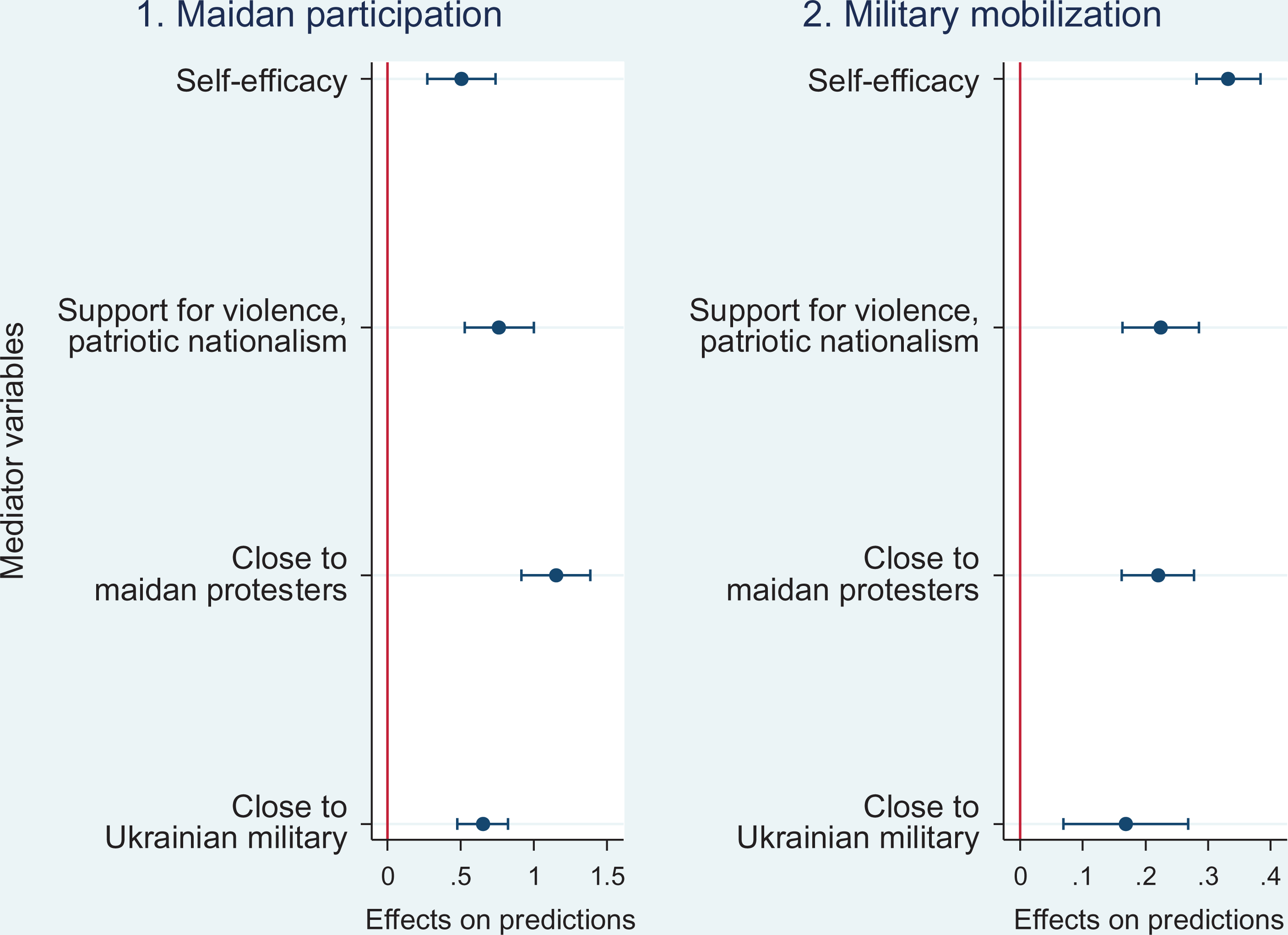
Finally, we use simple social distance scales to assess how close individuals feel to other Maidan protesters and members of the Ukrainian military to address interlinkages between Maidan and military networks. Figure 3.1 reports the expected values from OLS regression analysis where we regress Maidan participation on several proposed mediator variables (self-efficacy, support for violent collective action/patriotic nationalism, and group solidarity with other Maidan participants and the Ukrainian military). We find that Maidan participation is positively correlated with all four mediator variables. Figure 3.2 then reports the average marginal effect of each potential mediator variable on the probability of joining the military based on logistic regression. Again, each mediator is highly correlated with military mobilization. Overall, our analysis suggests that those who felt empowered by participating in Maidan protests are more supportive of violent collective action and now find themselves mobilizing for counterinsurgency. While we cannot establish clear causal relationships or mechanisms, our results suggest plausible pathways for mobilization into increasingly higher risk collective action. 31
Conclusion
When governments face insurgent threats, we find that prior political activism can play an important role in mobilizing citizens for counterinsurgency warfare. Ukrainian civilians who engaged in Maidan political activism are more likely to enlist in military service in Donbas. To the extent that the literature tends to stress selective incentives and underlying structural conditions to predict who selects into combat, our observations about prior political activism and military mobilization are noteworthy. 32
In general, we do not find that recruits in our sample represent a clear underclass of Ukrainian society. In terms of economic background and education, they look similar to their civilian male counterparts. What does distinguish them are their experiences of prior activism. New recruits were more active supporters of the Maidan revolution that ousted President Yanukovych and his Party of Regions from power. Consistent with the social movement literature on the transition to from low- to high-cost/high-risk collective action (McAdam, 1986; McAdam, Tarrow & Tilly, 2001), we find that military mobilization in Donbas can be seen as an escalation of prior arenas of contentious politics. We also explore pathways between Maidan activism and military mobilization and find that both Maidan participants and military recruits feel more self-empowered, have higher risk tolerance, are more supportive of violent collective action, and have a strong sense of solidarity with both other Maidan activists and the Ukrainian military than comparable civilian males.
In contrast, we do not find strong evidence that parochial ethnic biases are driving individuals to mobilize against ethnic Russians. Recruits in the study were no more or less biased than civilians, but we acknowledge that our results could be contingent on high levels of intergroup contact and tolerance in the ethnically mixed region of Kharkov. 33 Parochial motivations might be more salient in less cosmopolitan regions of Ukraine. However, our results are encouraging that political orientation toward Europe vs. Russia, not ethnicity, language, or religion, are the primary cleavages in the current conflict, in which case, ethnic Ukrainians and Russians may reconcile if peace talks succeed. 34
However, we also find that military servicemen are more skeptical and less committed to negotiating for peace than civilians. It is well known at the macro level that many civil conflicts, once started, are difficult to resolve, negotiated settlements to conflict are generally challenging to maintain, and risks of recurrent violence are often high (Walter, 2004; Fortna, 2004a). At the micro level, we argue that activist-based goals could explain why some conflicts are so intractable. A conflict that pits one group of activists against another could potentially reduce trust and restrict the bargaining space that individuals are willing to accept in negotiating for peace. While conflict outcomes are ultimately determined by policymakers, their willingness to negotiate for peace may be encouraged or constrained by the preferences of substate actors (Trumbore, 1998). This could have important implications for conflict duration and outcome if soldiers are not committed to a peace process. Such preferences could help explain why ceasefire violations are so common (Fortna, 2004b). Activists on the battlefield may undermine diplomatic efforts at the negotiating table. In Ukraine, we see evidence now that the current ceasefires under the Minsk Agreement have been consistently violated.
In conclusion, we find that, as with insurgencies, prior political activism can play an important role in predicting who fights, especially in regard to counterinsurgency efforts. Our study at the onset of military mobilization is timely because activist motivations may be difficult to estimate from retrospective studies of violence, where people view their behavior through the lens of conflict experiences and outcomes and due to selection bias on survivors. As such, we offer an insightful window into the preferences of citizen-soldiers as they mobilize for war.
Supplemental Material
Supplemental Material, JPR856043_appendix - Mobilizing civilians into high-risk forms of violent collective action
Supplemental Material, JPR856043_appendix for Mobilizing civilians into high-risk forms of violent collective action by Vera Mironova and Sam Whitt in Journal of Peace Research
Footnotes
Replication data

Acknowledgments
We would like to thank Regina Faranda, Michelle Romo, and participants at the EIRES workshop on survey research in Ukraine (George Washington University, 21 January 2015) for their feedback on this project. We also thank the anonymous reviewers for their valuable comments.
Notes
References
Supplementary Material
Please find the following supplemental material available below.
For Open Access articles published under a Creative Commons License, all supplemental material carries the same license as the article it is associated with.
For non-Open Access articles published, all supplemental material carries a non-exclusive license, and permission requests for re-use of supplemental material or any part of supplemental material shall be sent directly to the copyright owner as specified in the copyright notice associated with the article.
