



Abstract
How do leaders signal their intentions during a crisis? Scholars point to audience costs, potential political punishment for bluffing during bargaining, to explain how accountable leaders communicate. However, the empirical support for audience costs is mixed. I argue that this apparent disconnect between theory and evidence is due to different ways that audiences can threaten to use their sanctioning power during a crisis. When determining whether to punish a leader for a failed coercive threat, their domestic supporters should balance concerns over consistency and policy outcomes. As such, accountable leaders’ ability to credibly communicate is not automatic, rather it depends on their supporters’ policy preferences. I apply this insight using casualty sensitivity as a conditioning policy preference. I expect, and find, that audiences only help a leader commit to fight when fighting is low-cost, and actually prevent commitment when fighting is high-cost. Using compellent threat data, I find that audiences have countervailing effects on credibility due to their preferences for leaders who are both consistent and avoid costly conflict. This conditional effect could explain prior mixed support for audience costs in observational data, as prior studies pool together instances where I find audiences have strong, but opposing, effects.
Keywords
One day after announcing an agreement to destroy Syria’s chemical weapons, President Obama defended his diplomatic solution in an interview. A year prior, Obama threatened the Syrian government with ‘enormous consequences if we start seeing movement on the chemical weapons front, or the use of chemical weapons’ in the Syrian civil war (Snyder & Borghard, 2012). In August 2013, the Syrian government crossed Obama’s ‘red line’, killing 1,400 civilians near Damascus with chemical weapons (Warrick, 2013). Obama requested a skeptical Congress authorize military intervention, which his Secretary of Defense later claimed was ‘an almost certain way to scotch any action’ (Panetta & Newton, 2014: 450). With congressional approval doubtful, the United States struck a deal with Russia to eliminate Syria’s chemical weapons. Pressed over backing down from his threat, Obama responded that he was ‘less concerned about style points (and) […] more concerned about getting the policy right’ (This Week, 2013). Obama bet the public cared more about avoiding conflict than his flip flop. 1
Obama’s belief that outcomes trump consistency in the eyes of voters breaks with research on audience costs, which assumes that people dislike inconsistent leaders. However, the response of Obama’s own Secretary of Defense to his decision illustrates the core logic. Secretary Panetta argued that ‘[w]hen the president as commander in chief draws a red line, it is critical that he act if the line is crossed. The power of the United States rests on its word, and clear signals are important both to deter adventurism and to reassure allies that we can be counted on’ (Panetta & Newton, 2014: 450). If domestic audiences agree, and sanction inconsistent leaders, these leaders should be hesitant to violate prior commitments for fear of political punishment. They can leverage this risk of punishment to signal their willingness to uphold commitments, allowing them to better cooperate with partners and coerce adversaries (Fearon, 1994).
Obama’s belief in the importance of policy conforms with recent arguments of audience costs critics, who claim citizens care more about policy than consistency (Snyder & Borghard, 2011). Audiences might prefer successful military action, taking a dim view of leaders who fail to achieve their war aims (Croco, 2011; Weeks, 2012; Croco & Weeks, 2016; McManus, 2017). Alternatively, they might be averse to casualties, regardless of whether conflict is successful (Weeks, 2012; Sirin & Koch, 2015). Finally, audiences could only care about a few salient issues, forgiving or ignoring poor performance on minor policies (Clare, 2007; Gibler & Hutchison, 2013). These arguments suggest public commitments from accountable leaders are no more believable than those from unaccountable strongmen. These leaders will not hesitate to reverse course to placate domestic critics, as Obama did over Syria.
I argue that both Obama and Panetta are correct: domestic groups care about both a leader’s policy and consistency, but do not always care more about one than the other, as both audience costs proponents and critics often assume. I argue that audiences care about consistency more than some policies but less than others. Using this more flexible argument, audiences can push leaders to take unyielding stands when they emphasize consistency and to pursue flexibility when they encourage good policy. This, in turn, can either help or hinder a leader when they seek to commit to certain policy positions. Prior conclusions that audiences always or never facilitate commitment are derived from specific assumptions regarding what these groups care about, which I show can lead to incomplete empirical tests and inferences. Using this framework, I argue that specific citizen preferences for consistency and for limiting high-cost conflict produce conflicting signals in coercive bargaining. This case is particularly interesting because these competing preferences work against each other. Additionally, while recent work has gone far beyond military crises, audience costs were originally proposed as a way to communicate in such a dispute. When conflict is expected to have heavy costs, leaders who face domestic groups are deterred from fighting and more likely to be resisted by adversaries. These leaders can better coerce targets when the expected costs are low, and their supporters care more about consistency than avoiding costs.
My results show that audiences can make coercive demands more or less successful. When the military costs of coercion are low, accountable leaders can better coerce opponents than unaccountable leaders can, consistent with the expectations of audience costs proponents. Contrary to these expectations, unaccountable leaders begin to outperform accountable ones as military costs rise. When the costs of fighting are severe, threats from leaders who answer to domestic groups are far less successful than those from leaders who do not. This relationship is consistent across multiple measures of militarized threats, the presence of domestic audiences, and the costs of combat.
I make several contributions to the study of coercive bargaining. First, I show that assumptions about audience preferences conceal the complicated role of these groups. The effect of domestic groups on the ability of leaders to create commitment depends on whether they care more about consistency or policy. Their priorities are not fixed. Second, my empirical results suggest that previous findings of null effects of democracy on credibility could be due to failing to disentangle the conflicting effects of audiences. Finally, policy preferences play a role independent of audience costs. Recent work limits these preferences to mitigating the credibility-enhancing effect of audience costs (see Clare, 2007; Gibler & Hutchison, 2013; Chaudoin, 2014). In contrast, I show that constrained leaders can be less believable than unconstrained ones, which could not be the case if policy preferences were limited to attenuating audience costs.
Signaling commitment
How do leaders communicate their intentions to foreign allies and adversaries? If peaceful discussions break down due to mutual distrust, creating convincing messages could prevent conflict (Fearon, 1995). Audience costs are frequently invoked as a way in which leaders can reveal their future behavior (Fearon, 1994). Leaders can publicly declare their planned policy choices. If they flip flop, they risk political sanctioning from domestic actors who dislike inconsistency. If foreign partners understand the risk of a public stand, these declarations credibly communicate leaders’ future choices, enabling long-term cooperation.
Despite their popularity, the empirical support for audience costs is mixed, particularly in observational Insignificant differences in broken promises to use force between democracies and autocracies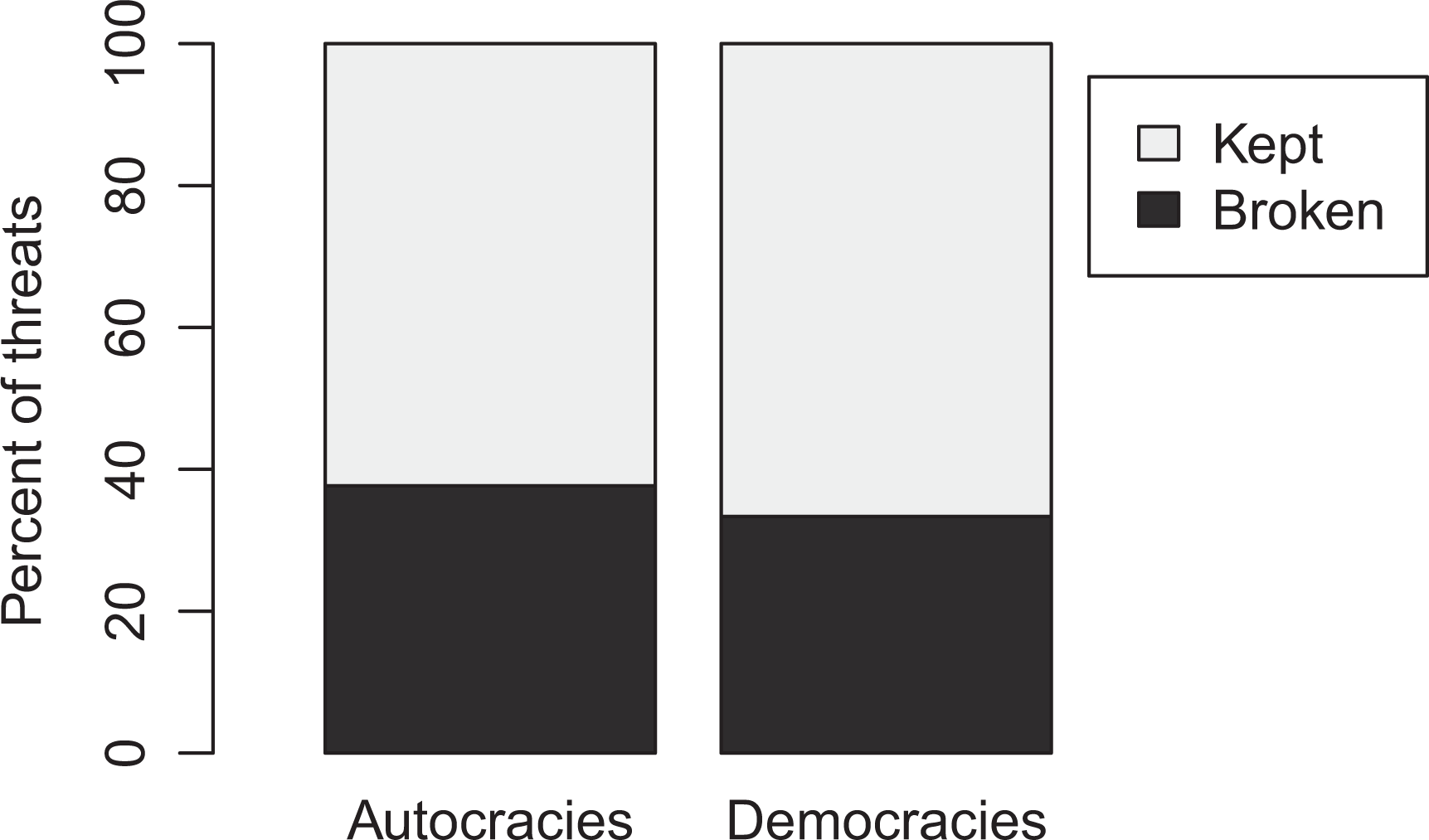
One possibility is that people do not care about empty threats, or at least not enough to force a leader’s hand. Audience costs work only under ‘the demanding assumption that leaders are able to generate sufficiently high levels of expected audience costs; so high, in fact, that peace becomes worse than war’ (Slantchev, 2011: 40). Perhaps, in practice, this requirement is never met. Snyder & Borghard (2011: 455) reach this conclusion, claiming that ‘domestic audiences understandably care more about policy substance than about consistency’. Foreign crises produce multiple policy outcomes observers could use to evaluate a leader instead of consistency. Poor performance, such as failing to win or secure their stated goals, might be grounds to remove a leader (Bueno de Mesquita & Siverson, 1995; Croco, 2011; Weeks, 2012). Alternatively, other domestic actors could be more exposed to the costs of war, and therefore sanction a leader who incites costly conflict (Gartner & Segura, 1998; Valentino, Huth & Croco, 2010; Weeks, 2012).
Instead, I argue that audience concerns over policy and consistency are complementary explanations of accountable leaders’ crisis behavior. Fearon (1994: 582, 591) recognized that leaders faced a trade-off between delivering good policy and being consistent, but did not consider that audiences affect both sides of that trade-off. Subsequently, scholars recognized the potential for both audience concerns to affect a ruler, but did not consider the possibility that these preferences create conflicting signals during crisis bargaining. Some find that audience costs are unchanged by considering audience preferences over war outcomes; audiences disapprove of inconsistency and leaders can use this to coerce adversaries (Schultz, 1999; Trager & Vavreck, 2011), or audience preferences complement audience costs by enhancing credibility (Kertzer & Brutger, 2016). Others claim audiences care more about crisis outcomes than consistency, suggesting constrained leaders are not more credible (McManus, 2017; Snyder & Borghard, 2011). 4 Finally, some suggest policy preferences limit audience costs, arguing that either audience costs break down when audiences have strong policy preferences (Chaudoin, 2014) or only work when they do (Clare, 2007). I build on these competing conclusions in two ways. First, I consider the possibility that audiences care about both policy and consistency, but sometimes care more about one than the other, contrary to prior work that assumes a consistent preference hierarchy. Second, I examine how these preferences influence the credibility of leaders when making compellent threats.
Mixed signals
Political regimes vary in whether rulers depend on the consent of supporters to hold on to power. Early work distinguished democracies, which feature regular, contested elections for leadership, from non-democracies, which lack these institutions. More recently, scholars recognized that leaders of some non-democracies are accountable to supporters, such as party or junta members (Weeks, 2008). The insight that only accountable leaders can generate audience costs led to Fearon’s extensively tested intuition that democracies should be better able to generate audience costs.
However, the existence of audience constraints has broader implications than work on audience costs recognized. Leaders who are accountable to other citizens can be held accountable for a number of policy decisions. The institutional arrangements or power-sharing agreements that enable some supporters to sanction a leader either exist or do not. If they do, then leaders face sanctioning not just for inconsistency, but for any policy mishap. I call these leaders constrained, since they can be in democracies or non-democracies. In contrast, unconstrained leaders do not depend on others to hold office because they have consolidated power. These rulers do not have to worry about political sanctioning for policy failures.
This complicates the effect of accountability on a leader’s behavior. I assume incumbents take their supporters’ preferences into account because they want to hold on to power. These leaders should anticipate possible political sanctioning for poor policy. As a result, theoretical predictions about their behavior depend on assumptions about the importance of consistency and policy to domestic groups. If, as audience costs proponents assume, supporters care primarily about consistency, leaders should strive to be consistent at the expense of any other consideration. Instead, I assume that audiences care about both policy and consistency and use their punishment power to sanction leaders both for inconsistency and policy failure. However, some policies are more important to these groups than consistency, while others are less important. In the former case, rulers face more punishment for bad policy than inconsistency. This is the situation Obama believed he faced in Syria. In this situation leaders abandon consistency in pursuit of the correct policy, as Obama did. In the latter case, leaders should strive for consistency, as they will be punished less for delivering poor policy than for inconsistency.
However, this framework cannot make specific predictions about how constrained leaders behave without knowing the specific preferences of their supporters. I focus on the preferences of domestic groups in crisis bargaining. How audiences incentivize crisis behavior has important implications for when war breaks out. In addition, I follow prior work in focusing on two audience preferences. First, drawing on existing audience costs research, I expect domestic groups to punish incumbents who make empty promises. Bluffing reveals a leader is incompetent or damages the state’s reputation. The public or insiders will respond by backing challengers they hope are more competent (Fearon, 1994; Smith, 1998). Second, I focus on supporters’ casualty sensitivity, should war break out. While all states experience costs when they fight, only certain institutional arrangements allow audiences to inflict additional political punishment on their leaders for these. Both democratic publics and authoritarian elites are more exposed to war costs than their leaders (Reiter & Stam, 2002; Weeks, 2012). As costs rise, citizens’ support for continuing to fight falls (Gartner & Segura, 1998), so they ratchet up political punishment to ensure the leader suffers similarly for fighting, despite being insulated from direct costs. 5 In addition, accountable rulers attempt to limit costs when they do fight, suggesting they are aware of the risk of inflicting these costs on their supporters (Valentino, Huth & Croco, 2010; Sirin & Koch, 2015).
While forward-looking incumbents should attempt to avoid political punishment, their options are limited in a crisis. They can attempt to defuse the crisis, preventing war but tarnishing the state’s reputation. Or, they can take a militant approach that leads to war but saves face. Both choices trigger sanctions, either for inconsistency or fighting. 6 The incumbent’s best chance to stay in power is to choose the approach that minimizes political punishment. As a result, the effect an audience has on a leader’s crisis choices depends on how severely a leader expects to be punished for fighting and backing down.
By extension, the potential punishment severity determines whether a leader’s threats are credible. Audience costs have two effects in a crisis. First, they make a ruler more willing to fight after making a threat. The greater audience costs, the more likely a ruler will be forced to follow through to avoid those costs. Second, assuming the target understands the risk of backing down, leaders can leverage this risk to communicate their willingness to fight. 7 If a public threat risks committing a leader to war, leaders that want to avoid war should be deterred from taking such a stand. A public demand informs the target the incumbent is willing to fight. In contrast, an unconstrained leader does not risk war by making threats, rendering the threat uninformative.
Sanctions over fighting undermine both effects of audience costs. The greater punishment audiences impose for fighting, the more likely a leader would rather settle after making a threat. However, if they can back down from a threat, making one is less informative. If the political punishment incumbents face for fighting is so severe that it is unlikely they can fight, and the target realizes this, the threat is non-credible (Schultz, 1999, 2001; Filson & Werner, 2004). 8 The threat of political punishment for fighting is effective in preventing war at the cost of undermining a ruler during a crisis. The audience would benefit if they could promise not to punish fighting. This would let the ruler wring greater concessions from the target by tying their hands. Despite this gain, domestic groups cannot commit to not punish fighting if the threat fails. If war breaks out, their goal is to limit casualties, which they can only do by sanctioning the ruler. Any guarantee to curb punishment for fighting to help the leader in a crisis is non-credible, which both the leader and target realize.
Given the offsetting effects of audience costs and cost sensitivity, how audiences affect a leader’s credibility depends on what they care more about. Punishing the ruler more for backing down enables credible signaling overall by facilitating commitment. Punishing fighting more hinders incumbents’ attempts to signal resolve. Identifying which choice carries greater political risk is difficult. First, if leaders try to stay in power, observational measures of leader removal are biased (Tomz, 2007). Second, as I argued, sanctioning a ruler is a broad tool domestic groups use to shape policy. Audiences can remove rulers for many policy blunders, making it difficult to identify when they were motivated by concerns over consistency and costly conflict. To overcome these issues, I use observational features of the crisis to identify when the public or elites should be most motivated to punish a leader for fighting, regardless of whether a leader chooses to do so. When they inflict extreme punishment for fighting, it is more likely to exceed the punishment they would inflict on a leader who backs down.
Specifically, I focus on the anticipated material costs of fighting. These costs include the loss of lives and resources as well as the general destruction from fighting. Focusing on material costs resolves the difficulties in determining the reasons for, and extent of, political punishment. First, domestic groups only bear the costs of war when the leader fights. Costs only motivate them to remove a leader who makes good on a threat and should not change their opinion of a leader’s consistency. Regardless of these costs, a ruler who uses force after threatening to is consistent, while one who fails to damages the state’s international standing or looks incompetent.
Second, the punishment citizens inflict on the incumbent should increase with the material costs of fighting. Citizens bear most of these costs, so they lower a leader’s utility for fighting through political sanctions in an attempt to create preference alignment. Russett (1990: 46) argues that democratic leaders ‘lose popularity in proportion to the war’s cost in blood and money’, logic which can be extended to include constrained autocrats. When potential war costs are high, the punishment for following through will be greatest, limiting a ruler’s ability to fight. Further, adversaries can imperfectly anticipate the audience’s behavior, so potential costs undermine a leader’s credibility.
Given this, I expect increases in the costs of war to increase punishment for following through relative to backing down. 9 When the material costs of fighting are low, audiences impose little punishment for fighting.
As a result, they make it more difficult for a leader to back down, enabling credible threats:
Hypothesis 1: Domestic audiences make threats less likely to fail when war is low-cost.
In contrast, when war is costly, the public or insiders severely punish fighting. Given this, a constrained leader likely faces greater punishment for fighting than for backing down. As a result, compared to an unconstrained leader, a constrained leader should be more likely to back down from a threat. Opponents should anticipate this and resist high-cost threats from constrained leaders:
Hypothesis 2: Domestic audiences make threats more likely to fail when war is costly.
I also expect only constrained rulers to be affected by increases in the costs of fighting. As these costs increase, the punishment an accountable leader will incur for standing firm on a threat rises, while the punishment for backing down remains constant. Increasing costs make them more likely to back down from a threat, reducing their credibility:
Hypothesis 3: Increased costs make threats from constrained leaders more likely to fail.
Unconstrained leaders are largely immune from the increased costs of fighting. While domestic actors still bear these greater costs, they lack the ability to sanction the ruler. If unconstrained leaders are no less willing to follow through on a high-cost threat, their credibility is unaffected:
Hypothesis 4: Increased costs do not affect the likelihood that threats from unconstrained leaders fail.
Hypotheses 1 through 4 propose an interactive effect between leader accountability and the costs of fighting on the credibility of the leader’s threats. These hypotheses imply a fifth expectation that war costs increase the odds of threat failure more for constrained than unconstrained leaders and, equivalently, that domestic audiences increase the odds of threat failure more as costs increase:
Hypothesis 5: The marginal effect of costs of conflict on the probability of threat failure is positively related to the presence of a domestic audience. Similarly, the effect of domestic constraints on threat failure is positively related to the costs of conflict.
10
These hypotheses allow me to evaluate my theory and the existing audience costs and policy preferences theories. If supporters care mainly about consistency, they boost a leader’s credibility regardless of the costs of fighting. In this case, Hypothesis 1 alone would receive support. In contrast, if they focus more on war costs, these should primarily determine a constrained leader’s credibility. These rulers would always be less credible than their unconstrained peers, but particularly disadvantaged when costs are high. This implies support for Hypotheses 2 through 5. Low costs alone would not be sufficient to make threats from constrained leaders more credible. Compared to accountable leaders, unaccountable ones facing similarly low costs do not have to worry about political punishment over these costs, making them more willing to follow through. Support for all hypotheses is most consistent with my theoretical argument, which predicts a conditional effect of audiences on credibility.
A potential concern is that rulers limit the impact their supporters have by picking their fights. This selection process does not confound my expectations for either military or audience costs. First, audience costs communicate information exactly because leaders choose when to make threats. Because audiences may force them to fight if resisted, leaders only make threats when the stakes are sufficiently important to risk war. Selection is necessary for threats to contain information. Second, leaders might avoid making threats that risk costly conflict. 11 It might seem that, contrary to my argument, costs increase the credibility of constrained incumbents. Due to their cost sensitivity, these rulers might only threaten costly war when resolved. Realizing this, the target should believe accountable leaders’ threats when war would be costly. The problem with this intuition is that the prior assumptions are incompatible. If targets acquiesce to leaders who face high costs, these leaders should threaten regardless of their true resolve, because there is little risk of war. Constrained leaders are selective because their threats are resisted when costs are high. Since democratic selectivity is an implication of my argument, it does not pose a threat to my expectations. 12,13
I illustrate my theory using a case at odds with audience costs arguments: the Gulf War. After Iraq’s initial invasion of Kuwait, George HW Bush declared that ‘[t]his will not stand, this aggression against Kuwait’ ( New York Times, 1991). Bush deployed troops to Saudi Arabia and lobbied Congress and the United Nations to support military intervention. These public commitments should have created audience costs that communicated Bush’s willingness to fight (Schultz, 2001; Trager & Vavreck, 2011). The failure of Bush’s threat seems inconsistent with audience costs. 14 However, considering US casualty sensitivity makes it clear that Bush’s threat could have generated audience costs and still failed. Saddam Hussein believed the United States was ‘a society which cannot accept 10,000 dead in one battle’ (Burns, 1990). As such, he could have viewed Bush’s threat as non-credible, despite its public nature, if he believed the US public was too sensitive to costs to let Bush fight.
The Gulf War also suggests constrained leaders cannot always enhance credibility by reducing costs. Valentino, Huth & Croco (2010) argue that democracies limit costs by joining coalitions, using tactics that lower fatalities and fighting far from home. Consistent with this argument, the United States formed a coalition, emphasized air strikes, and kept the fighting within Iraq and Kuwait. However, both the United States and, presumably, Iraq anticipated costly conflict. The US worst case estimate was 20,000 fatalities (Broder, 1991). 15 Hussein did not believe Bush would risk harsh public backlash over these deaths by carrying out his threat.
To illustrate how preference assumptions can drive the results of tests for audience costs, I reanalyze the data from Figure 1, which showed democracies were no more likely to follow through on a threat than autocracies. I make two changes. First, instead of a democracy variable, I use a measure of institutional constraints for all regimes. Second, I distinguish between high- and low-cost threats. Figure 2 reveals differences that Figure 1 concealed. Constrained rulers are more likely than unconstrained ones to break a promise when war is high-cost, but less likely to when war is low-cost. This is consistent with the theory and shows that empirical findings of trivial effects of audiences could result from pooling cases where audiences help and hurt credibility.
Data
I use the Militarized Compellent Threat (MCT) data to measure threat effectiveness (Sechser, 2011). This dataset records all compellent demands backed by the threat Differences in broken promises to use force by regime type and costs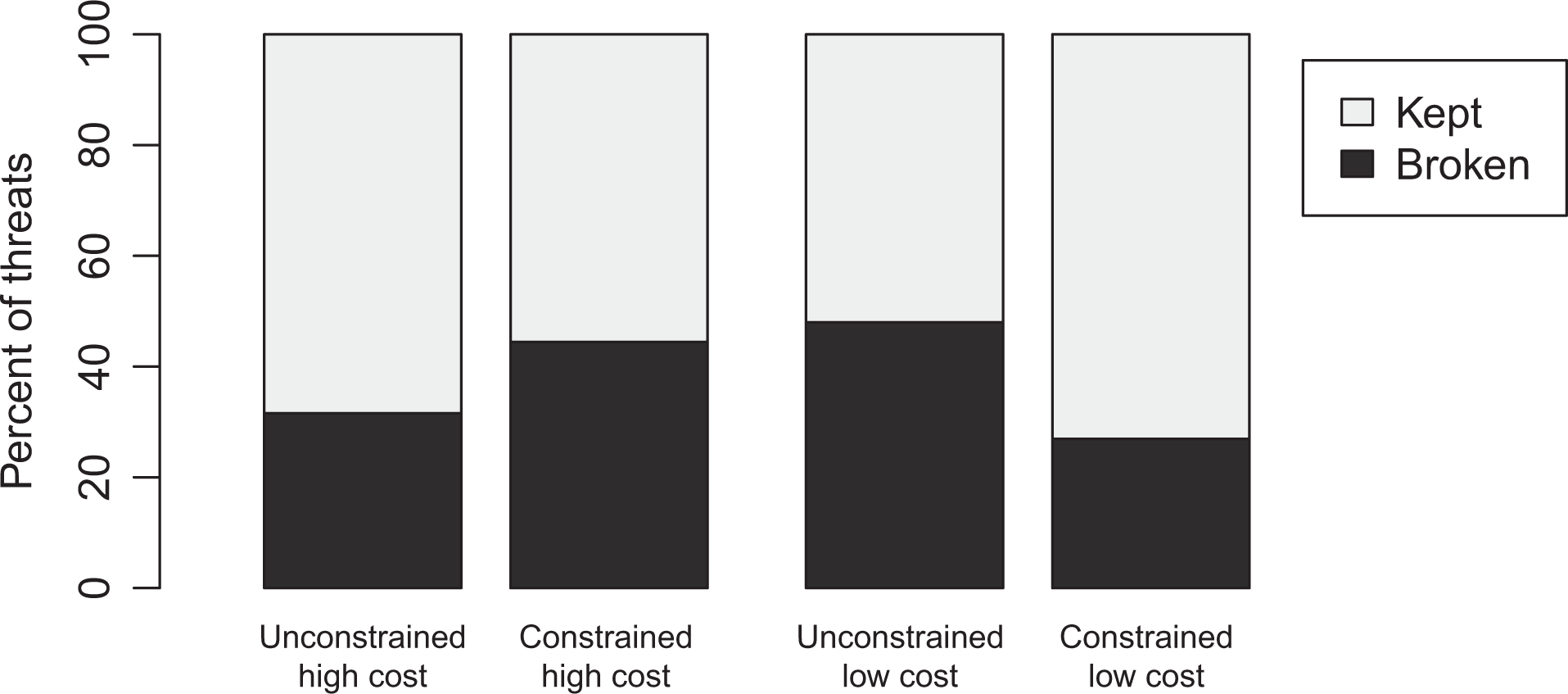
The MCT dataset contains 242 observations of 210 threats. A quarter are multilateral threats: multiple states threatening the same target in the same incident. 17 Existing analysis of the MCT data addresses the non-independence of these observations by clustering the model standard errors on the MCT incident. This approach is insufficient. Within the MCT incident there is no variation in the threat outcome; multilateral threats succeed or fail as a group. These observations are rightly viewed not as groups of partially dependent units, but repeated observations of the same unit: the threat incident. 18 Including these observations in the subsequent analysis would deflate the model standard errors by inflating the sample size. In addition, bandwagoning could obscure the effect of relevant variables. A weak state joining a strong state in making a successful threat is recorded as an instance of successful compellence by a weak state. This could obfuscate the effect of military power on threat success. For these groups I only include the state coded as the primary challenger in the MCT and include a control variable, Joint threat, that identifies multilateral threats.
I operationalize leader accountability using two measures of domestic institutions. First, I use Uzonyi, Souva & Golder’s (2012) audience cost capacity (ACC) measure. ACC is an ordinal measure from 0 to 3 based on openness of leader recruitment and restrictions on political participation. Higher values indicate easier challenger mobilization. Uzonyi, Souva & Golder (2012) use ACC to measure whether leaders can generate audience costs, noting that these variables measure the ability of a challenger to remove an incumbent. But, challengers could use these same institutions to punish a leader for costly conflict. As a result, I use ACC as a measure of the level of domestic constraints in a state. I create a set of four binary variables for each level of ACC. 19 Other measures of domestic constraints, such as Weeks’s (2008, 2012) regime type variables, are only coded for the post-World War II era, and would be missing for roughly half the MCT observations.
My second measure is Boix, Miller & Rosato’s (2012) democracy measure, Democracy (A). 20 This measure defines democracies as regimes with executives elected through fair elections, which matches the theoretical mechanism of leader accountability (Boix, Miller & Rosato, 2012: 8). This minimalist definition is preferable to maximalist definitions which incorporate multiple concepts that are unrelated to constraints. In addition, the data cover the temporal range of the MCT data, unlike other minimalist measures. Despite these advantages, focusing on a democracy/non-democracy distinction risks overlooking within-group variation in constraints, particularly among non-democracies (Weeks, 2012). As a result, the primary models use ACC.
To measure the costs of war, I use the threatening state’s share of dyadic military capabilities measured by economic indicators from the National Material Capabilities (NMC) data (Singer, Bremer & Stuckey, 1972). Stronger states should incur fewer costs when using force, making capability ratios a good measure of costs. While military capabilities are usually measured with six indicators from the NMC, I show in the Online appendix that the economic measure of capabilities has a more robust correlation with battle-deaths from the Correlates of War data, and that the results are unchanged using the full CINC measure (Sarkees & Wayman, 2010). 21
I control for several confounding variables. First, I include the indicator variable Demonstration from the MCT data, which indicates that the threatening state used a military demonstration. While sunk costs threats are less efficient than audience costs, they can convey resolve and lead to acquiescence (Fearon, 1997). Regimes that cannot generate audience costs might use other signals, creating the potential for omitted variable bias. Second, I include a measure of the target’s regime type. Third, I control for geography with a variable, Contiguity, which following Schultz (2001) takes a value of 1 if states are contiguous by land or separated by fewer than 150 miles of water. Fourth, I include indicator variables for both states’ possession of nuclear weapons (Nuclear weapons (A) and (B)) (Gartzke & Kroenig, 2009). I include the Joint threat indicator which identifies threats from multiple states. I also create counts of prior failures in the directed dyad (Prior failures) and the number of prior times the target of the threat has conceded to any challenger (Prior coercions). 22 Reputation theories emphasize the value of looking tough, suggesting states that were coerced in the past might be more likely to resist threats (Sechser, 2011).
Results
Effect of regime type and capability on threat failure
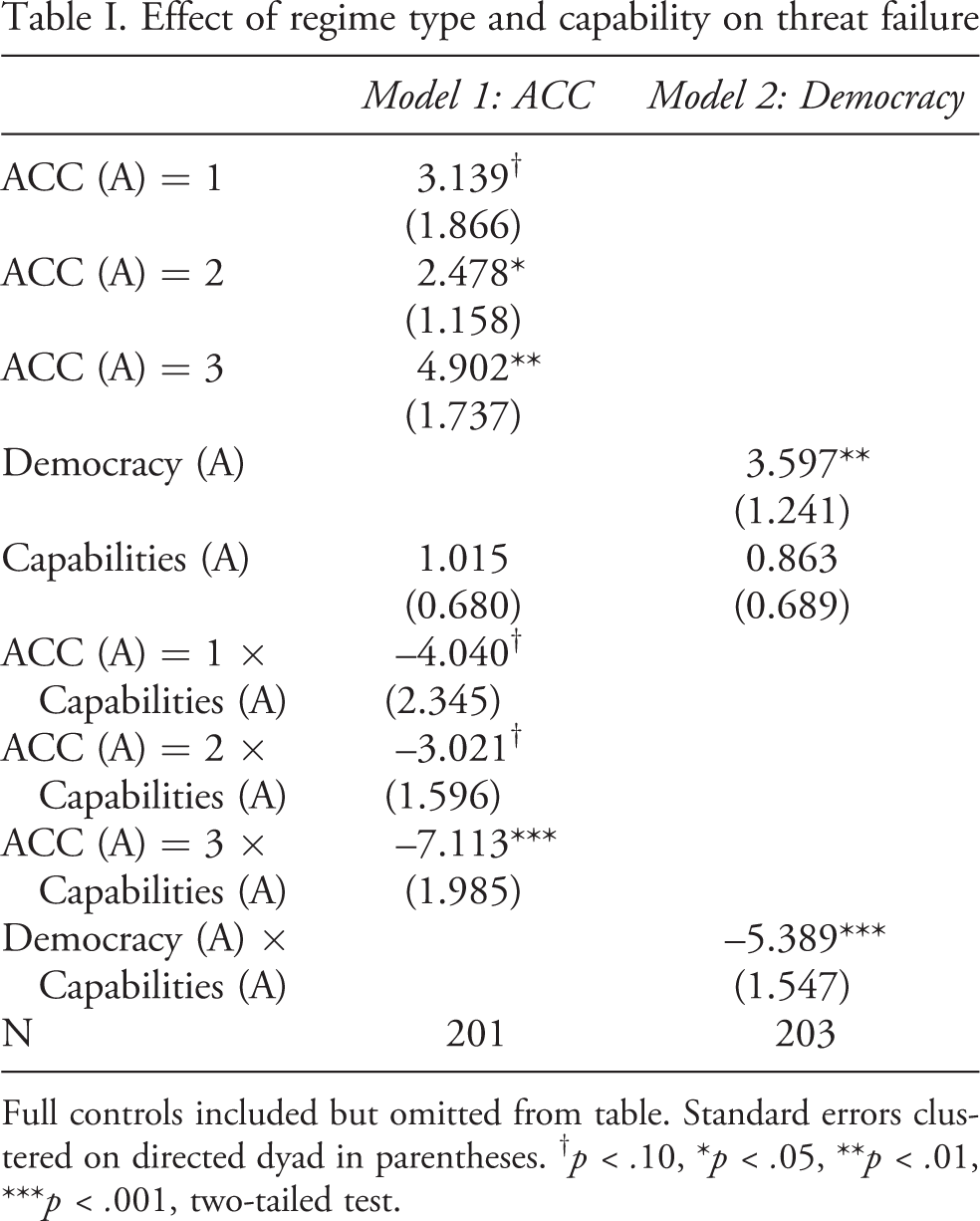
Full controls included but omitted from table. Standard errors clustered on directed dyad in parentheses. † p < .10, ∗p < .05, ∗∗p < .01, ∗∗∗p < .001, two-tailed test.
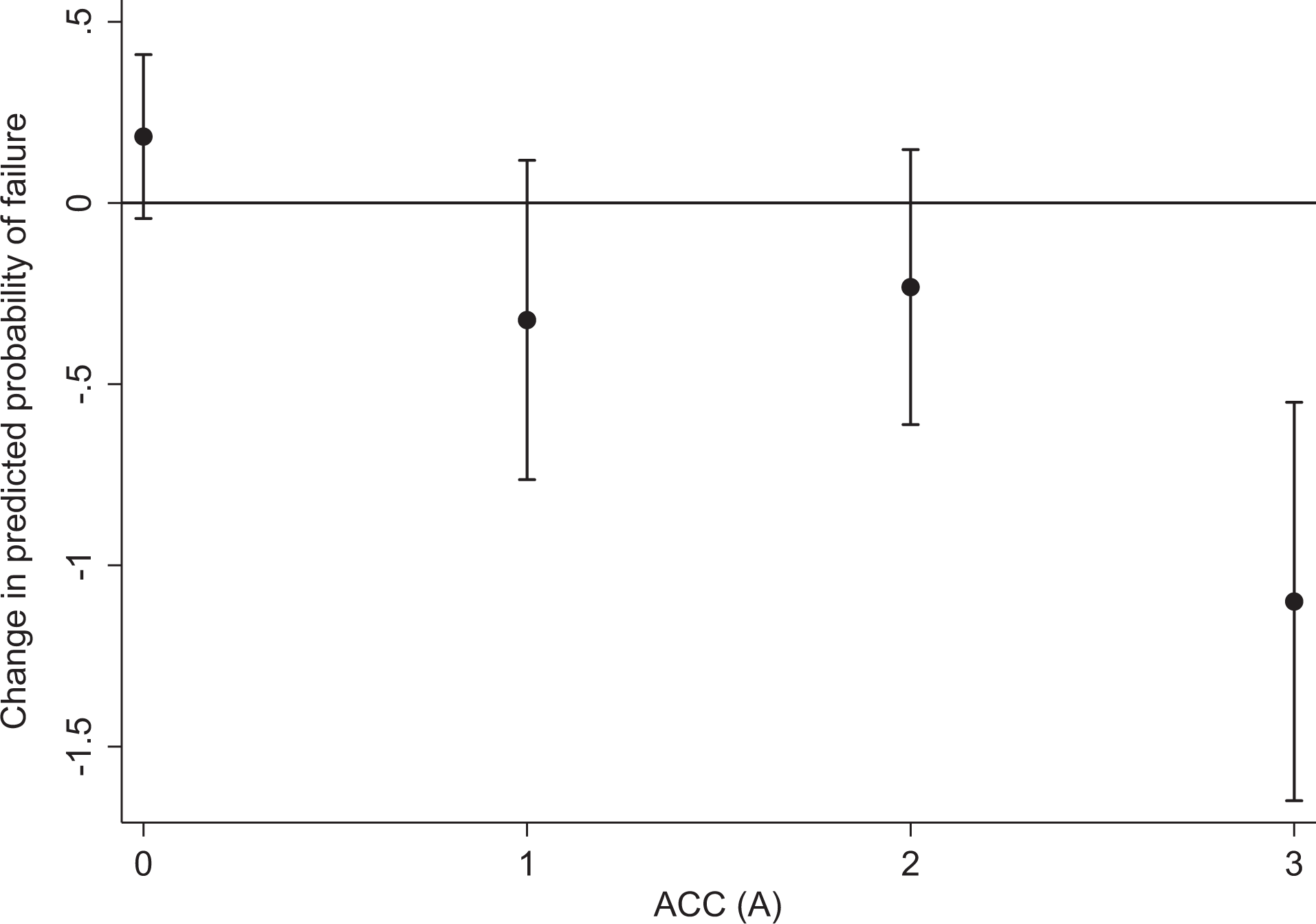
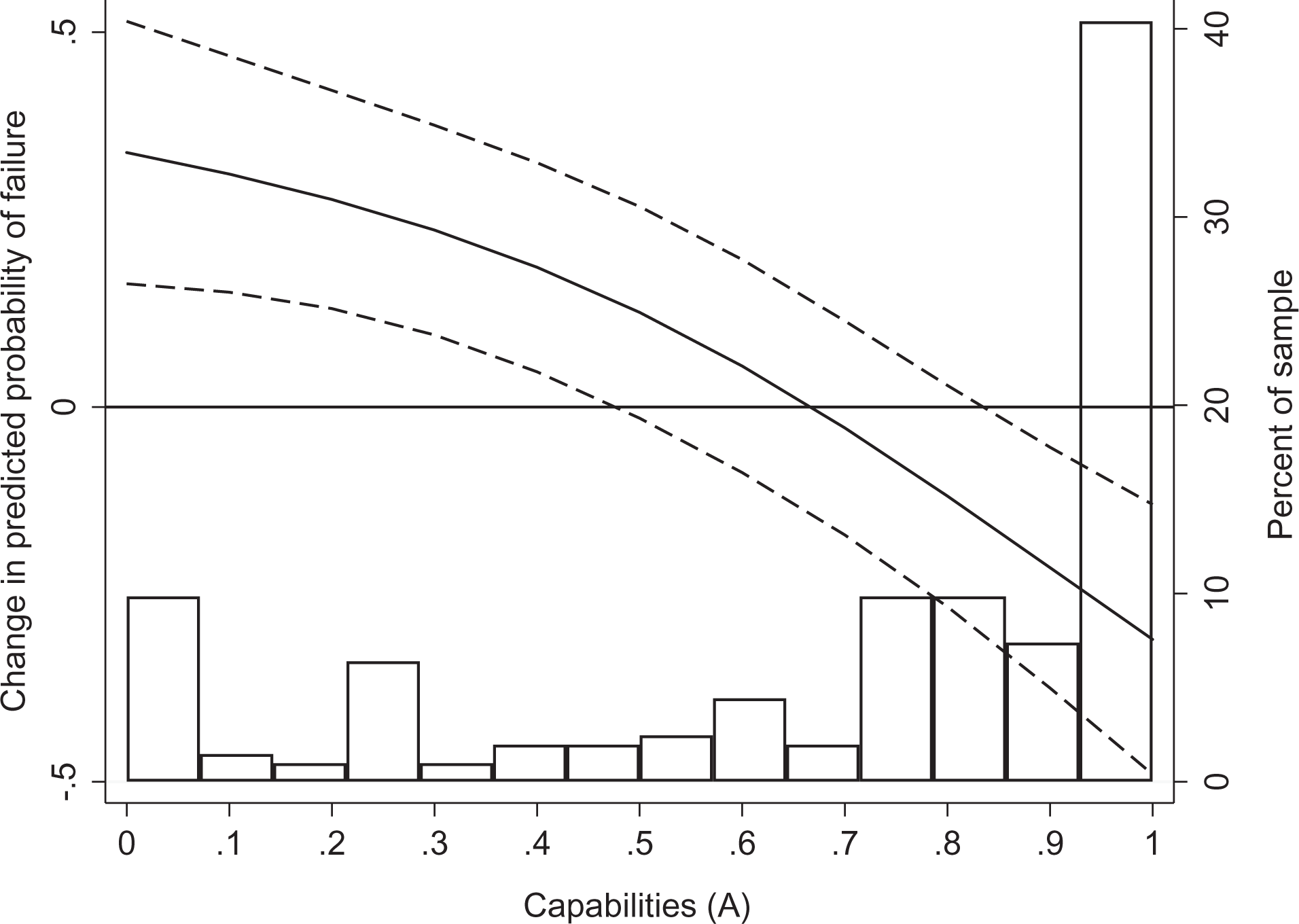
Figure 4 presents the marginal effect of military capabilities on threat failure for different levels of regime constraints. The marginal effect of Capabilities (A) is statistically insignificant for regimes that score a zero on ACC, meaning there are no domestic constraints Effect of ACC (A) across Capabilities (A)
Effect of Capabilities (A) over ACC (A)
Effect of Democracy (A) across Capabilities (A)
Effect of Capabilities (A) over Democracy (A)
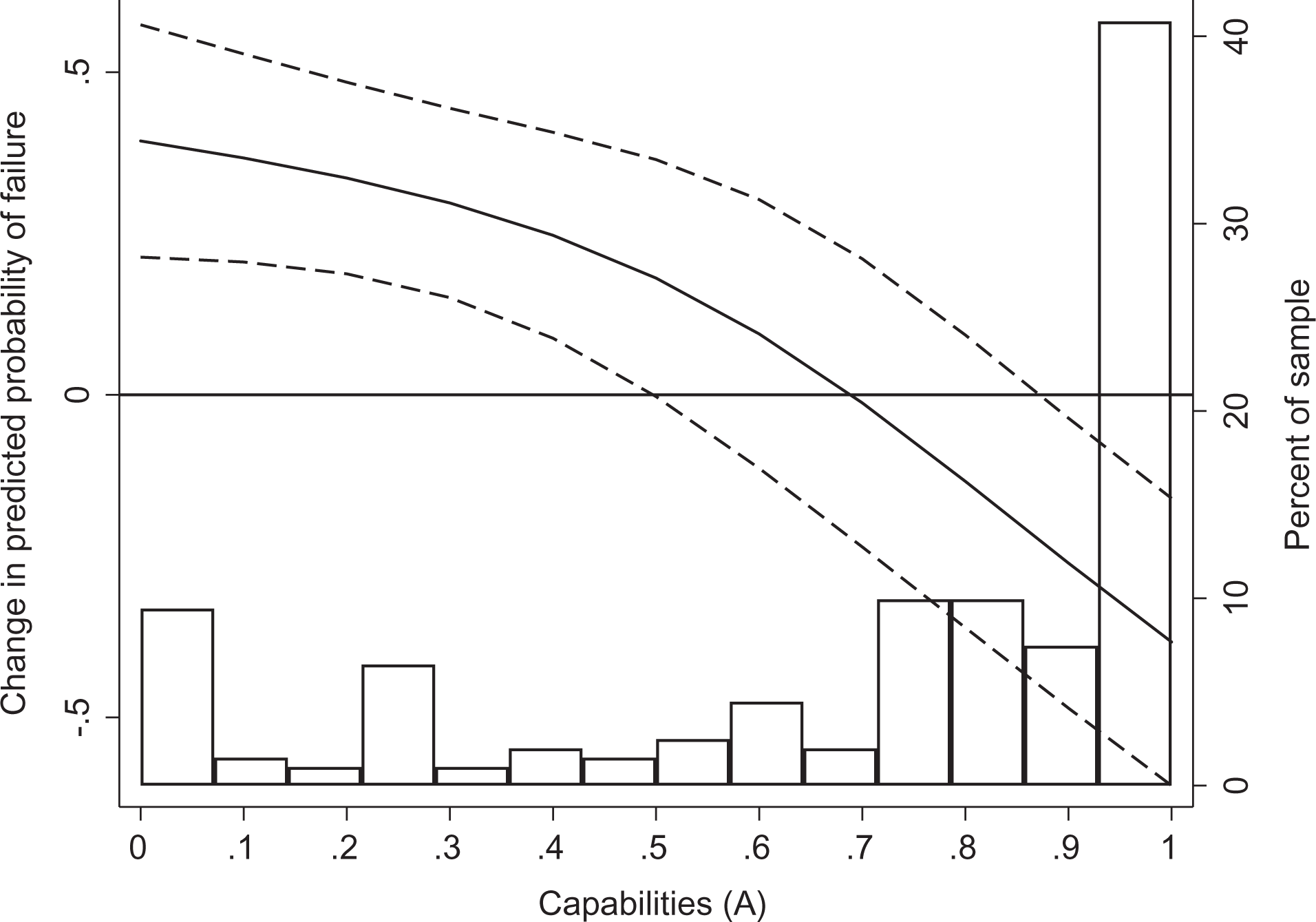
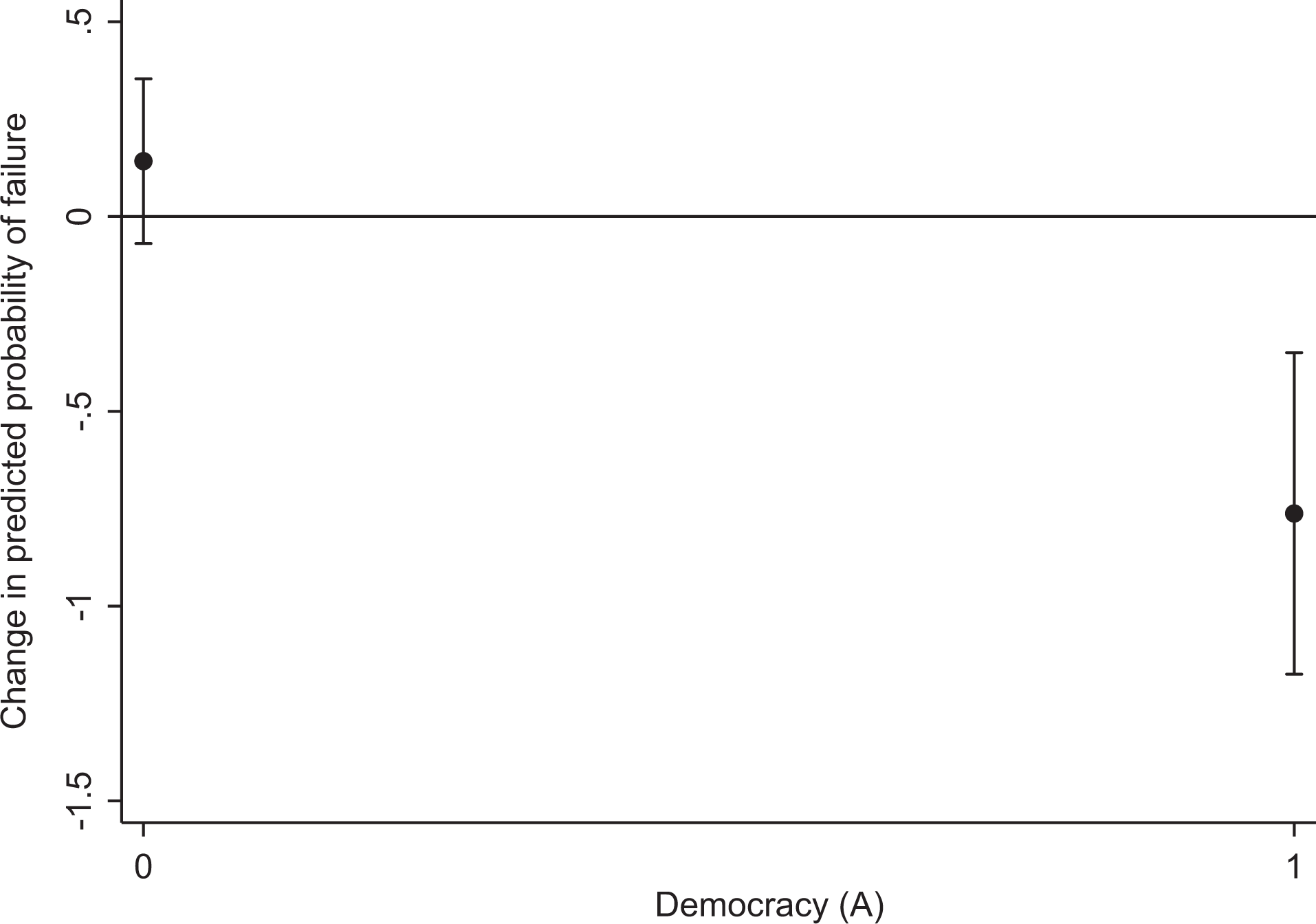
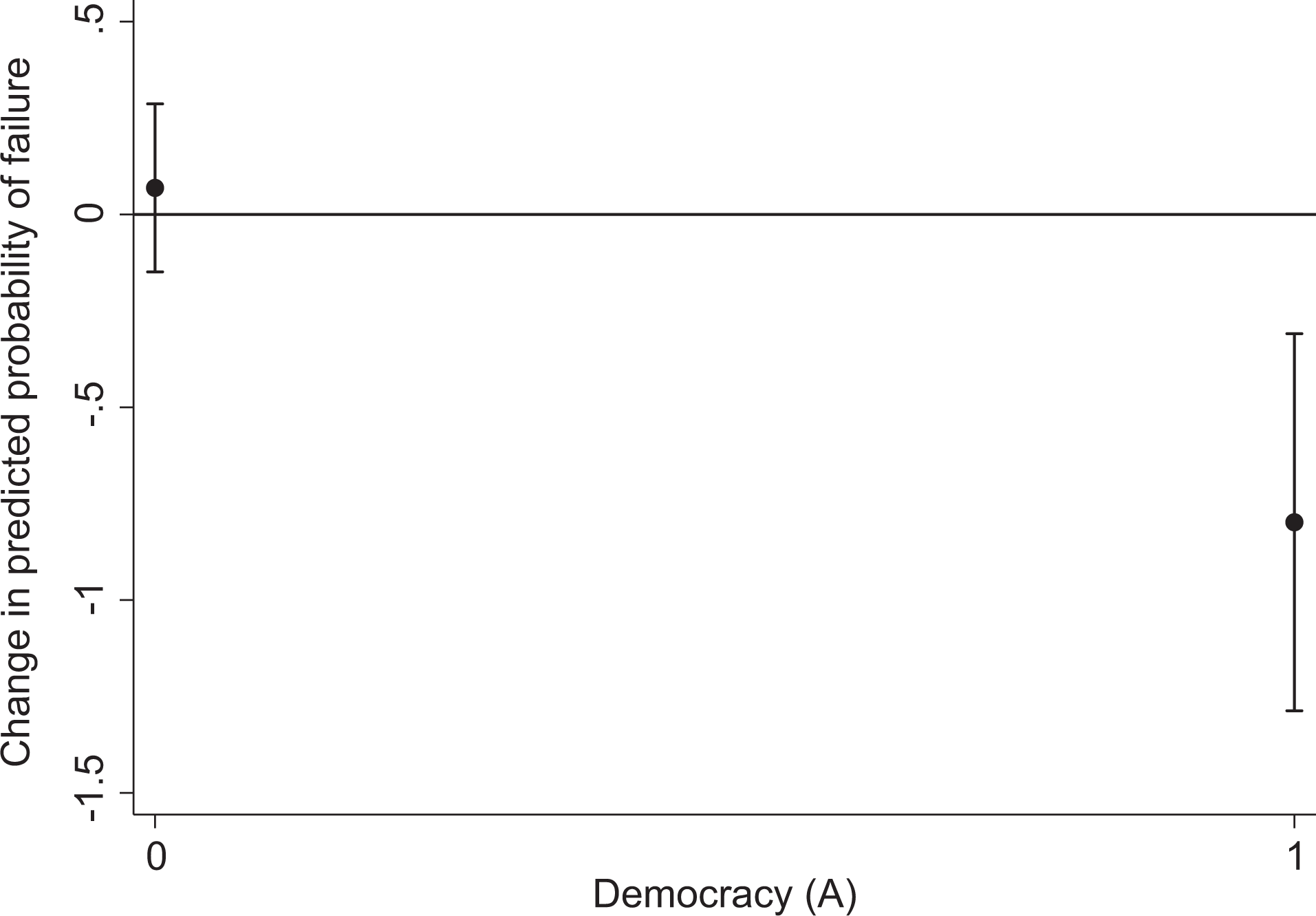
Figures 5 and 6 show similar effects with Democracy (A). When the threatening state controls 10% of the dyad’s capability, threats from democracies are 31 percentage points more likely to fail (p < .01). However, when the threatening state controls 90% of the dyad’s capabilities, democracy decreases the probability of threat failure by 21 percentage points (p < .01). This is again consistent with Hypotheses 1 and 2. Figure 6 shows the marginal effect of Capabilities (A) is statistically insignificant (p = .14) for non-democracies and substantively smaller than the effect for democracies. In contrast, an increase in Capabilities (A) decreases the probability of threat failure for a democracy by 76 percentage points (p < .01). These effects are consistent with Hypotheses 4 and 3. Finally, the second difference, calculated as before, is –52 percentage points (p < .01), consistent with Hypothesis 5.
To illustrate the substantive effect of the results, I present simulations of two cases within the data based on the ACC model estimated with Clarify (King, Tomz & Wittenberg, 2000). The first is Japan’s successful demand that the British close the Burma Road in 1940 (MCT-077). In 1940, the Japanese controlled 28% of the dyad’s military capabilities, and scored a zero on ACC (A), indicating a lack of domestic constraints. The Japanese threat had a 24% chance of failure. Had Japanese leaders faced domestic constraints, the probability of threat failure rises to 79% (p < .05). 27 In contrast, consider the Soviet Union threatening Finland in 1939 over control of Finnish territory (MCT-085). The Soviet Union similarly lacked domestic constraints but controlled an estimated 98% of the dyad’s capabilities, yet it was unable to coerce Finland. For the Soviet Union as it existed, the simulation estimates a 75% chance of threat failure. For a hypothetical Soviet Union with domestic constraints, the probability of failure falls to 32% (p < .01). As predicted, constraints are beneficial when making low-cost threats and detrimental when making high-cost threats.
Picking a fight
Theoretical work on audience costs argues that observable factors cannot affect perceived resolve once a crisis begins. Fearon (1994: 586) claims that ‘states will “select themselves” into crises on the basis of observable measures of relative capabilities and interests and will do so in a way that neutralizes any subsequent impact of these measures’. In the theory, I argued that cost sensitivity should still affect credibility. In addition, this proposed selection process is inconsistent with my results. If crises follow this process, there should be no interactive effect: constrained regimes would be unconditionally more likely to succeed because only audience costs affect credibility. My results cannot be caused by selection bias caused by the process Fearon proposes, which introduces econometric selection bias against finding an interactive effect. Instead, the empirical results suggest the role of cost sensitivity extends beyond selection to the credibility of threats, as I argue.
This does not mean selection dynamics are unimportant, only that the selection process proposed by Fearon cannot either drive the primary results or explain them. A comparison to the econometric literature on selection bias makes this clear. The canonical example of selection bias is the effect of selecting into the labor market on the relationship between education and wages (Heckman, 1974, 1979; Sartori, 2003). The selection effect of joining the labor force can produce downward bias in estimates of the relationship between education and wages. Individuals with less education that select into working might do so because they have high latent ability. If ability positively correlates with wages, the estimated effect of education is biased downward because the sample consists of able individuals with less education.
Strategic selection implies a negative correlation between the costs of fighting and selection into the sample, which here is making a threat. Nevertheless, some high-cost types make a threat. These types must be the kind with relatively high resolve, which takes the place of high latent ability from the previous example. If resolve is negatively correlated with threat failure, then the estimated effect of cost sensitivity is biased against finding a negative relationship between costs and credibility due to high-cost, high-resolve types in the sample. These types should be successful despite high costs due to their high resolve, in the same way that low-education, high-ability workers have higher wages than their low education would predict. That I find a negative effect of cost sensitivity suggests that selection cannot explain the role of costs.
Despite this, I test for the possibility of a different selection effect driving the results using a selection model (Heckman, 1974). Scholars have criticized these models due to their use on inappropriate data, potential misspecification via poor identifying assumptions, and the difficulty of interpreting the model results (see Vance & Ritter, 2014; Brandt & Schneider, 2007; Sartori, 2003). However, selection models are theoretically justified when observed outcomes are biased through the correlation between selection into the sample, unmeasured factors, and the outcome of interest. 28 This is both exactly the type of process Fearon proposes and what potential democratic selection into costly but important conflicts implies.
I convert the MCT data into directed dyad-year data by creating observations for all directed dyad-years in which a threat was not made. 29 I use a binary dependent variable, Threat, which takes a value of 1 if a threat is recorded in the MCT data and zero otherwise. The outcome stage dependent variable remains Failure, which is coded as missing when a threat is not made. I identify the models using cubic polynomials of the number of years since the directed dyad’s last threat, to control for temporal dependence (Carter & Signorino, 2010; Reed, 2000), as well as a count of the prior number of threats. 30
The results are presented in Table II. The most important finding is that the estimate of the error correlation (ρ) is insignificant, meaning the null hypothesis of no selection bias cannot be rejected. However, I show in Figures 7 –10 that the marginal effects and first differences in the probability of threat failure, conditional on a threat being made, are substantively equivalent to the main results, suggesting that selection problems do not drive these results.
Conclusion
Heckman probit tests for selection on unobservables
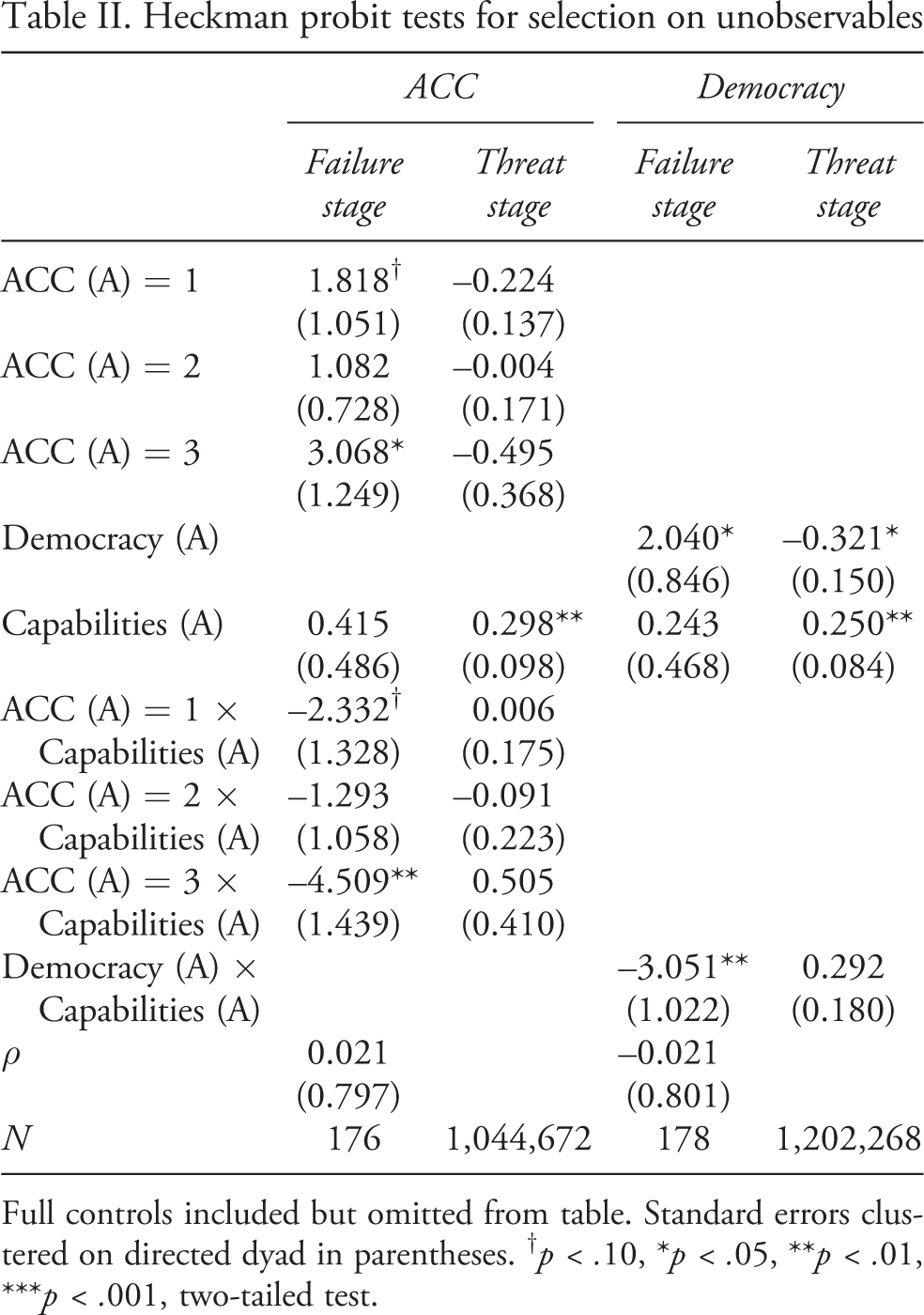
Full controls included but omitted from table. Standard errors clustered on directed dyad in parentheses. † p < .10, ∗p < .05, ∗∗p < .01, ∗∗∗p < .001, two-tailed test.
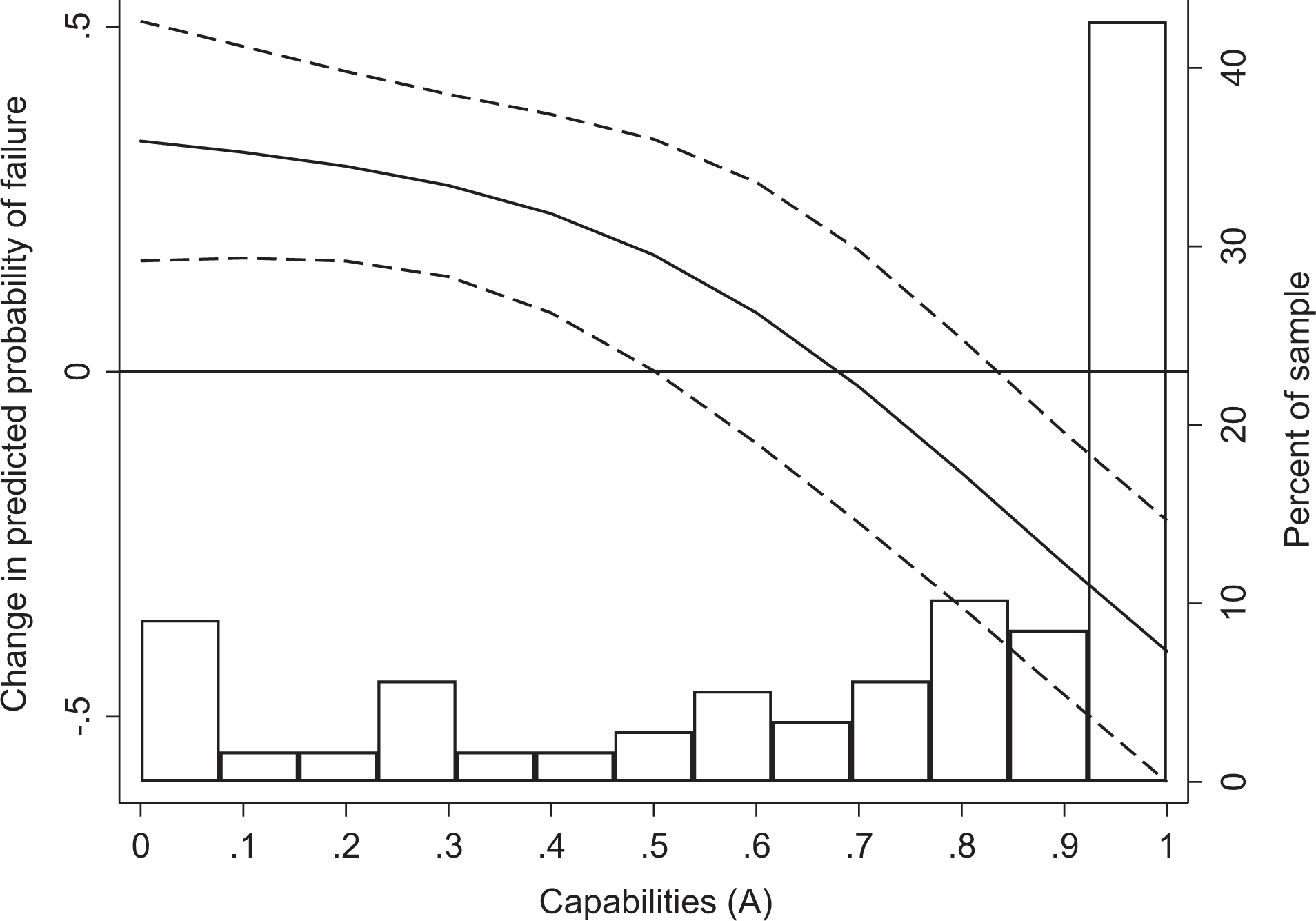
Selection model estimates of effect of ACC (A) across Capabilities (A)
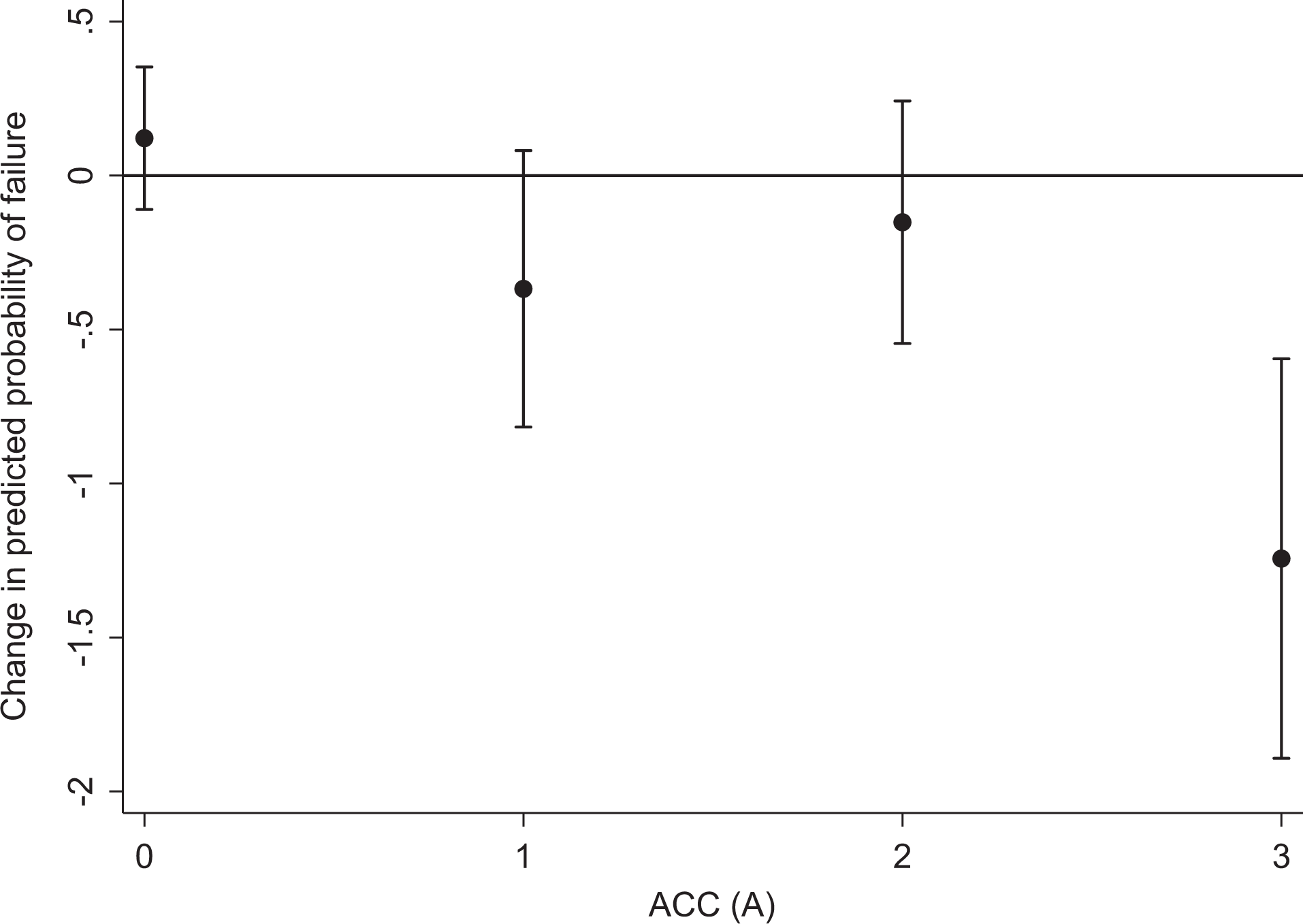
Selection model estimates of marginal effect of Capabilities (A) over ACC (A)
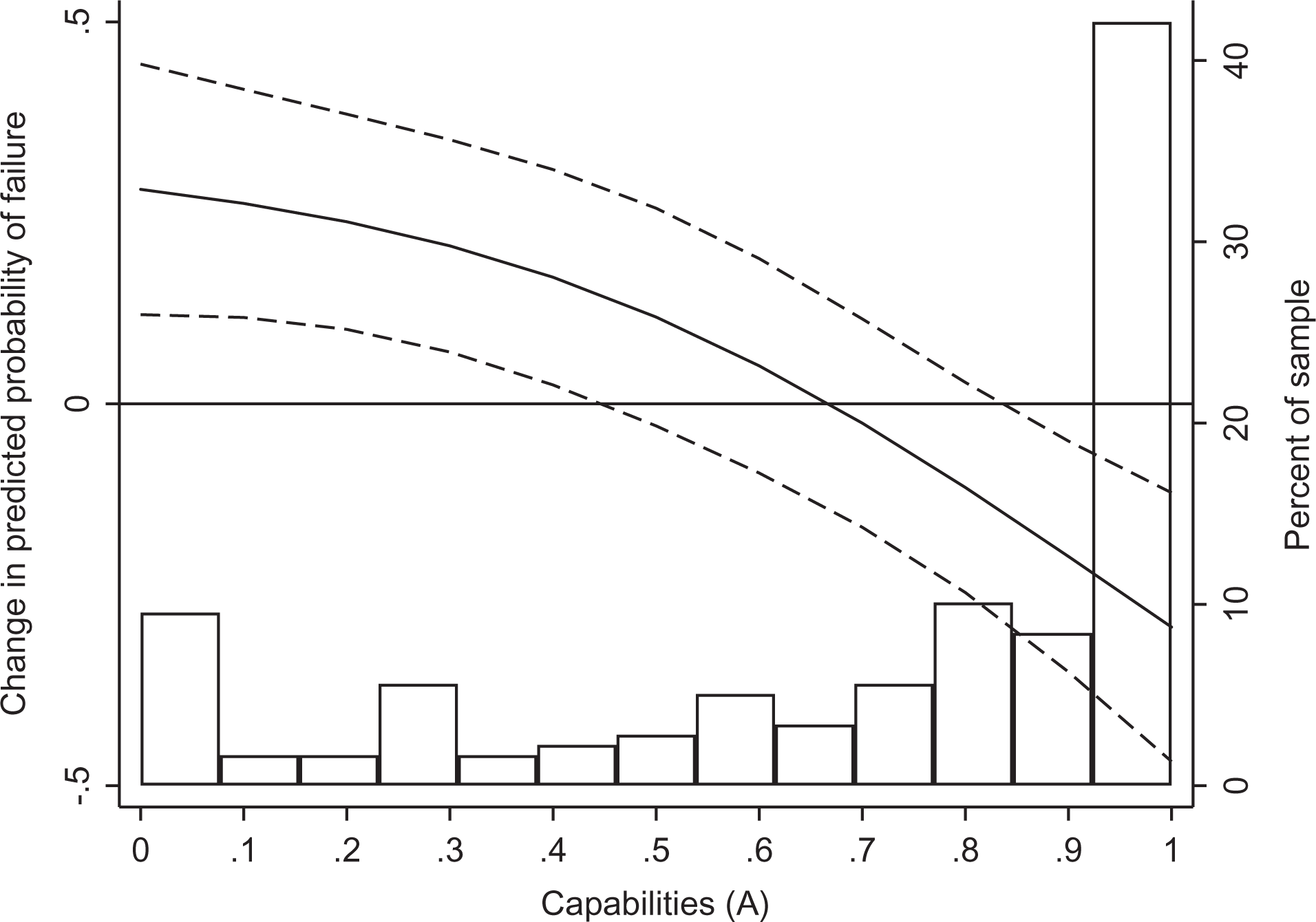
Selection model estimates of effect of Democracy (A) across Capabilities (A)
There are two general takeaways from this result. First, domestic audiences are neither as helpful nor as unhelpful as audience costs advocates and critics often contend. Whether these groups help leaders communicate is conditional on whether they care more about policy specifics or consistency. Second, given this, the assumptions scholars make about what these audiences want determine our theoretical expectations regarding their effect on policy. Assumptions by both audience costs proponents and critics that audiences are primarily focused on one aspect of policy have led to limited Selection model estimates of effect of Capabilities (A) over Democracy (A)
Footnotes
Replication data

Acknowledgments
I am particularly grateful to Mark Souva and Rob Carroll for their helpful comments on far too many versions of this article. In addition, thanks are due to Bill Berry, Sean Ehrlich, and Jee Seon Jeon, as well as the reviewers, editor, and participants at MPSA’s 2016 Annual Conference and SPSA’s 2016 Annual Meeting, for thoughtful feedback at various stages. All errors remain mine.
Notes
References
Supplementary Material
Please find the following supplemental material available below.
For Open Access articles published under a Creative Commons License, all supplemental material carries the same license as the article it is associated with.
For non-Open Access articles published, all supplemental material carries a non-exclusive license, and permission requests for re-use of supplemental material or any part of supplemental material shall be sent directly to the copyright owner as specified in the copyright notice associated with the article.
