



Abstract
This article summarizes the Correlates of War Intergovernmental Organizations (IGO) Version 3.0 datasets. The new datasets include information about the population of IGOs in the international system and state participation in those formal international institutions from 1816 to 2014. Consistent with Versions 2.0 and 2.3, Version 3.0 of the IGO data comes in three forms: country-year, IGO-year, and joint dyadic membership. This article briefly describes the data collection process and identifies important changes to the dataset before moving to analyze fundamental patterns in the data. Most notable among the changes from earlier versions of the data is the inclusion of annual membership data for the 1815–1964 time period. In addition, we present information about the overall trends in the institutionalization of cooperation at both the global and regional levels, with the latter focusing on the interesting membership dynamics in Asia and Africa. We then track and discuss patterns in state memberships and examine how these changes manifest in the dyadic data. The article concludes with a discussion of how the COW IGO 3.0 data compare to other prominent datasets on state participation in international institutions and highlights some new areas of research that will benefit from the release of the updated IGO membership dataset.
Introduction
Intergovernmental organizations (IGOs) have become central actors in the study of international relations. Recent years have seen consistent growth in the volume of research focusing on international organizations, with equal amounts of attention focused on IGOs as independent and dependent variables. Important research agendas such as the liberal peace (Pevehouse & Russett, 2006), network analyses of institutional ties and effects (Dorussen & Ward, 2008; Hafner-Burton & Montgomery, 2006), regime complexes and the expansion of global governance (Orsini, Morin & Young, 2013; Johnson, 2014), and the rational design of institutions (Koremenos, Lipson & Snidal, 2001; Copelovitch & Putnam, 2014) highlight the sustained empirical and theoretical work produced in recent years.
Essential to understanding what role IGOs play in global politics is an accounting of them and their state members. This article reviews and analyzes the latest Correlates of War Intergovernmental Organizations data (Version 3.0). The new dataset allows scholars to further investigate many questions related to IGOs. It expands the temporal domain of previous IGO datasets (updating the data to 2014), provides a more systematic accounting of state membership in IGOs prior to 1965, and improves on previous sampling of the IGO population. We describe the new dataset, highlight important changes from earlier versions, discuss trends in the new data, compare the data to other IGO datasets, and offer potential avenues for future research on IGOs.
Origins, evolution, and usage
The original Correlates of War (COW) Intergovernmental Organizations data were collected by Wallace & Singer (1970) and represented the first systematic effort to catalog formal, state-created institutions and their state memberships. Consistent with the goals of the COW Project, the data allowed researchers to look for system-level relationships between the number of IGOs in the international system and the rate of interstate conflict. A second goal of the project was to use the information about state memberships in IGOs as a way to examine patterns of connections between states (Wallace & Singer, 1970: 243). Using definitional criteria set forth (reviewed below), Wallace and Singer identified 208 IGOs in the years between 1815 and 1964. The data were organized into five-year periods, with state memberships coded to reflect whether each state was a member of a given IGO at any point during each five-year period.
Version 2.0 of the COW IGO data (Pevehouse, Nordstrom & Warnke, 2004) built on the original data collection in multiple ways. Given that the original data collection stopped in 1964, Version 2.0 brought the IGO data into line with other COW datasets by adding data from the 1965–2001 period. The update provided new data for years in which there was significant expansion in the number of IGOs (see Figure 1). Numerous IGOs were created during this time period and a plethora of new states entered the international system, adding to the potential set of actors that could populate these institutions. New IGOs were identified and coded, as were changes to the state membership lists. Likewise, IGOs that ceased to function during this time period IGOs and states in the world system, 1816–2014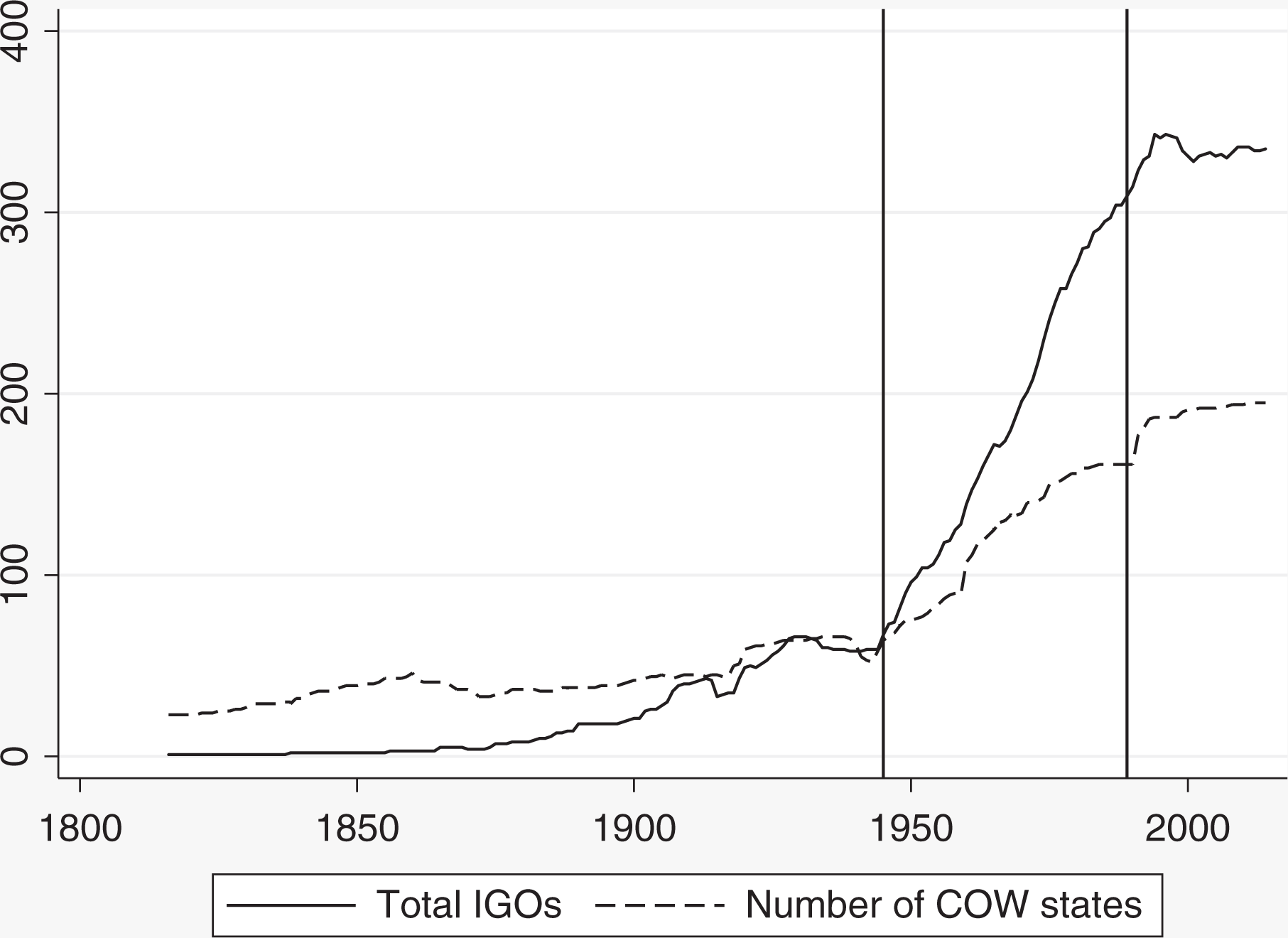
These updated datasets on IGOs and their members have been widely used in numerous studies in the field of international relations and cognate disciplines. International relations scholars use the data in a variety of contexts such as: regional integration (Chacha, 2014; Goertz & Powers, 2014; Haftel, 2013; Haftel & Hofmann, 2017; Mansfield, Milner & Pevehouse, 2008), peace promotion and conflict management (Greig, 2015; Greig & Diehl, 2006; Pevehouse & Russett, 2006; Shannon, 2009; Shannon, Morey & Boehmke, 2010), state networks and diffusion (Beckfield, 2008; Cao, 2012; Greenhill, 2010; Greenhill & Lupu, 2017; Kinne, 2013; Maoz, 2010; Zhukov & Stewart, 2013), democratization (Hafner-Burton, Mansfield & Pevehouse, 2015; Mansfield & Pevehouse, 2006, 2008; Poast & Urpelainen, 2015), and membership selection (Boehmer & Nordstrom, 2008; Donno, Metzger & Russett, 2015).
Definitions, sources, and changes in the data
Version 3.0 of the data retains the original definition of an IGO as set out by Wallace and Singer. To qualify as an IGO, an international institution must have the following characteristics: (1) be a formal entity, (2) have states as members, and (3) possess a permanent secretariat or other indication of institutionalization such as headquarters and/or permanent staff. These three criteria are meant to exclude other types of international institutions, such as treaties and informal organizations (Vabulas & Snidal, 2013).
Version 3.0 continues the practice of previous updates in requiring that an organization have a minimum of three state members, thus excluding bilateral organizations. Also, we continue to exclude IGOs that are not created by states, which are commonly referred to as ‘emanations’ (Shanks, Jacobson & Kaplan, 1996). 2
State membership coding rules for Version 3.0 also remain the same: we distinguish between members, associate members, and observer states. As with all versions of the data, the state must be included in the COW state membership data to be included in the IGO membership data. This necessitates a decision about a particular IGO, the European Union, which is sometimes treated as a state member by other IGOs. We do not exclude IGOs that include the EU as a member-state, whether or not the EU as an institution has a formal vote in the organization. In most cases, we were able to determine if the EU’s membership was exclusive of its member-states. That is, does the EU vote replace votes of EU individual members? If so, when the EU joins, each EU member-state is coded as having left the organization. For example, the International Coffee Organization (ICO), as a part of its 2007 agreement (which entered into force in 2011), disallowed individual EU states as members, instead treating the EU as a single member. In many cases, however, the EU-as-member serves as an observer, with individual states retaining memberships. 3
One significant change in Version 3.0 regarding individual state memberships involves the pre-1965 data. Version 2.0 retained the five-year periodization in the Birth and death rates of IGOs, 1816–2014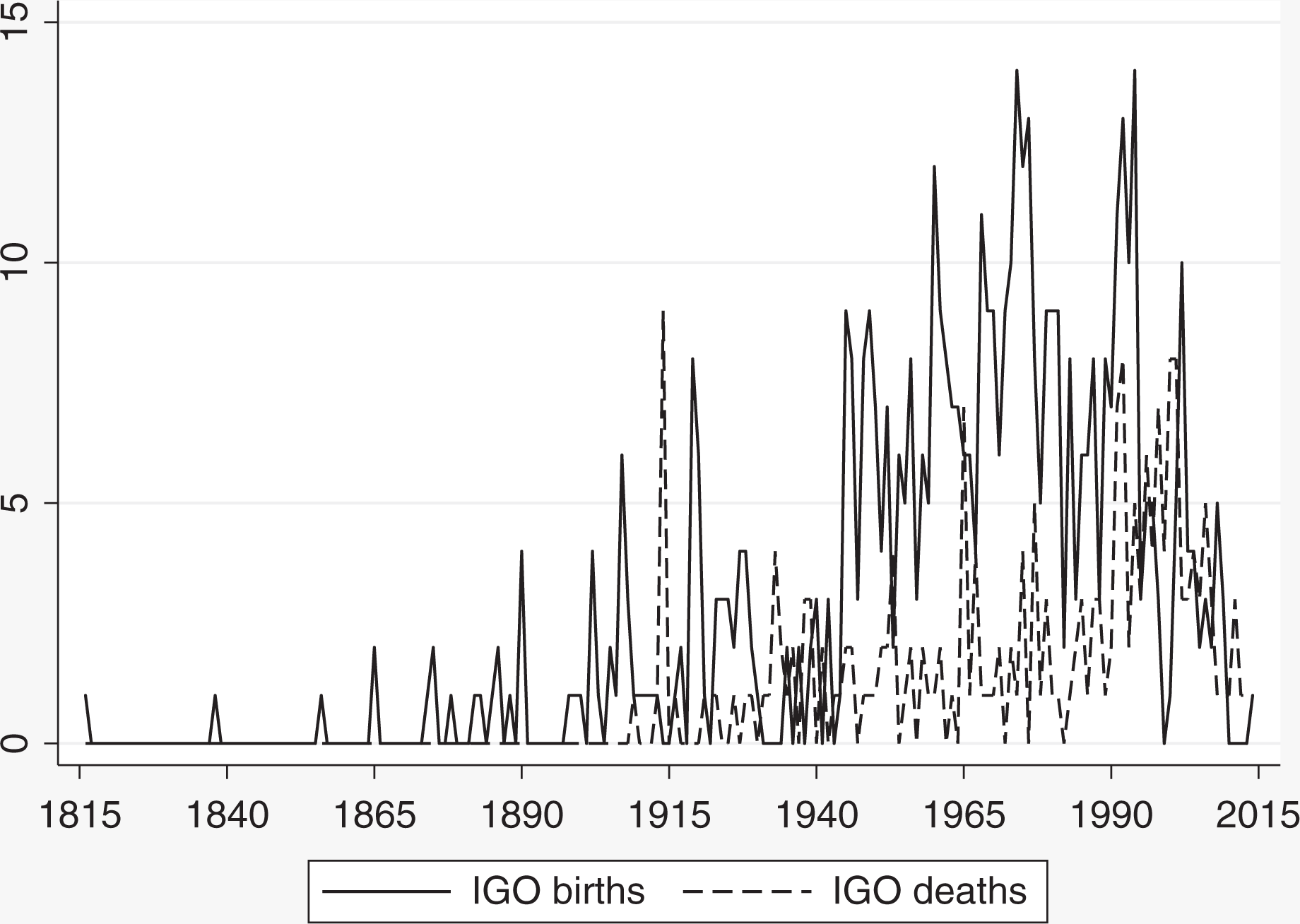
The COW IGO Version 3 data
Given these coding rules, Version 3 of the COW IGO data contains 534 IGOs. Figure 1 shows the total number of IGOs in the international system between 1816 and 2014. Although the total number of IGOs in the dataset is 534, the maximum number of IGOs in any given year never reaches 400, due to the number of IGOs that die off or are consolidated in some way (see Figure 2).
As with previous versions of the IGO data, Version 3 shows the tremendous growth of IGOs in the middle portion of the 20th century, especially after World War II. And while it is not the purpose of this article to provide a causal model to explain these trends, it is worth noting that there are several possible explanations for this expansion discussed in the literature. The move to international institutions to support the post-World War II order (Martin & Simmons, 1998); the use of international institutions to buttress Western-oriented rule-making (Ikenberry, 2009); the growing demand by states for institutions to facilitate the solution of cooperation problems (Keohane, 1984); the rise of international norms, often embodied in IGOs (Barnett & Finnemore, 2004); and the rise in the number of nation-states have all been suggested as possible causes of this expansion (Pevehouse, Nordstrom & Warnke, 2004).
Figure 1 also replicates two patterns established in earlier versions of the data. First, the growth of IGOs is related to the number of COW-recognized nation-states during this same period. These two series move together very closely – indeed, they are correlated at r = 0.95 (p < .00). 5 Figure 1 also highlights, using vertical lines in 1945 and 1989, that the period of fastest growth in IGOs occurred during the Cold War. This reflects both the growth in states and the competition dynamics whereby Western-oriented institutions would spur the creation of parallel Soviet-led institutions (e.g. NATO and the Warsaw Pact; GATT and COMECON). Prior to 1945, there was growth in the number of IGOs, but much of this was limited to the 20th-century period. After 1989, growth in IGOs has slowed dramatically – a trend we return to later.
Despite these seeming secular trends, Figure 2 indicates there is considerable annual variation in the rates of IGO creation and death. Two important patterns are evident. First, the rise of IGOs during the Cold War masks a significant number of IGO failures during this period. Between 1945 and 1989, an average of 1.6 IGOs die annually, while 7.2 are created per year. Thus, there is some turnover in the global population during this period of overall growth. Second, the stagnation in the rate of growth for IGOs in the past few years is a result of lower IGO creation rates as well as an increased number of IGO deaths. In the entire post-Cold War period, the annual creation rate decreases substantially, dropping to 4.4 per year, while the death rate more than doubles to 3.4 per annum.
Regional trends
Using the definition of geographic regions used by the Correlates of War project (see Russett, 1968; Correlates of War, 2017), we can classify IGOs as operating largely within a particular region compared to universal organizations (e.g. the UN, the IMF) or cross-regional institutions (e.g. NATO). As previous analyses have demonstrated, there are significant differences across geographic regions IGO counts across regions, 1816–2014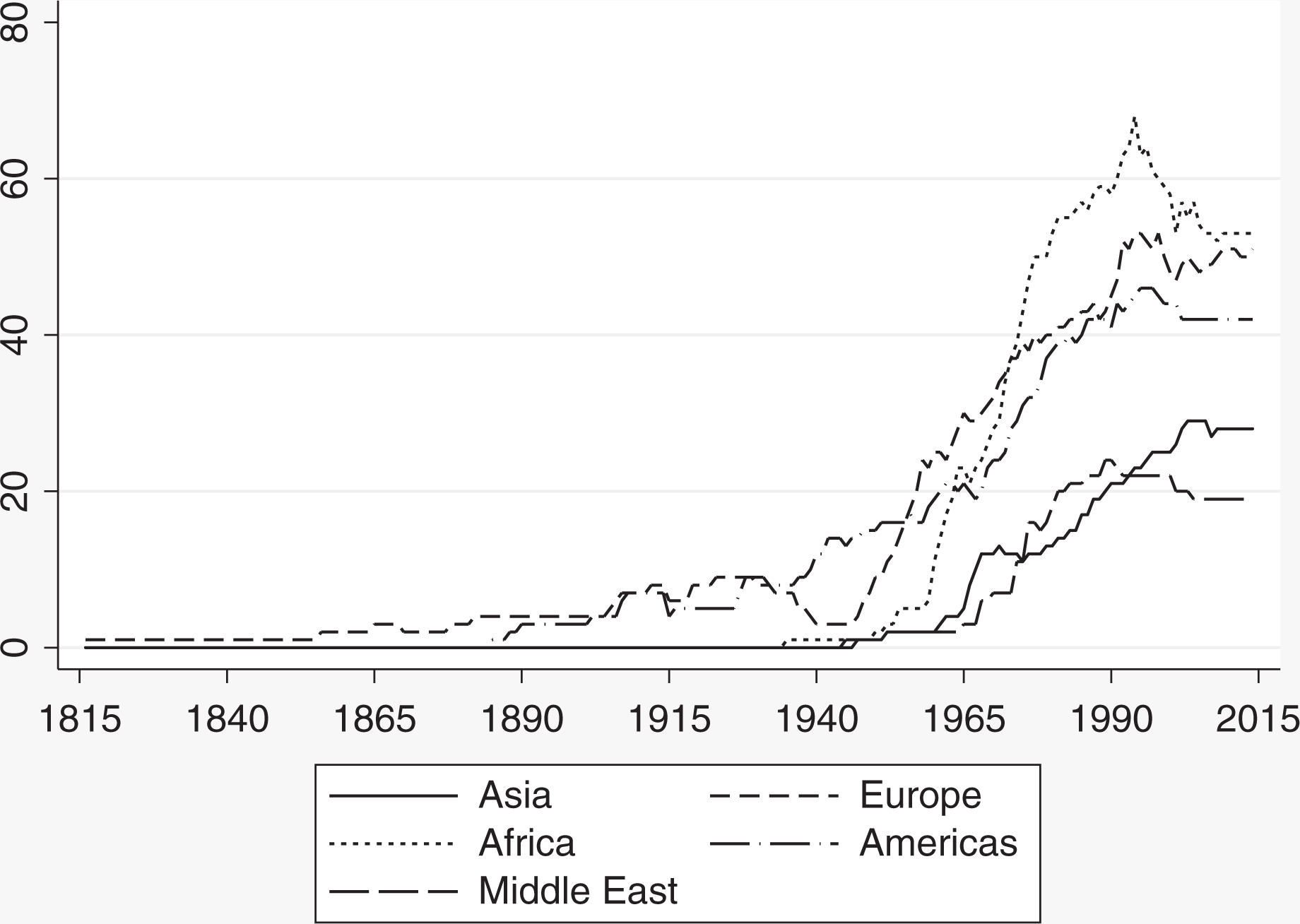
Figure 3 compares the number of IGOs across five geographic regions. Some trends parallel those in Version 2.0 of the data. Three regions stand out as more heavily populated with IGOs: Europe, the Americas, and Africa. In 1974, the number of African IGOs surpasses the number of European IGOs. For the remainder of the time, Africa contains the most IGOs. Africa contains a growing number of states in this period, so it is perhaps not surprising that it outstrips Europe in its IGO population. Moreover, with its large number of sovereign states, Africa has struggled to generate pan-African cooperation, a fact that is reflected in the institutional architecture of the continent. Rather than a smaller number of institutions that capture cooperation across all of Africa, the larger number of institutions reflects the fact that states have created subregional institutions that seemingly mirror each other in terms of function. Yet, two other regions that experience decolonization and growing numbers of independent states, Asia and the Middle East, show much slower IGO growth rates over the same period. This overall regional pattern of differentiation is consistent with previous findings (Pevehouse, Nordstrom & Warnke, 2004) and the literature on regionalism more generally (Fawcett & Hurrell, 1995; Acharya & Johnston, 2007).
Along with these similarities, there are notable differences in regional trends in the newer data. First, with the exception of Asia, each region has fewer IGOs than it did at the end of the Cold War. The overall decline in IGOs shown in Figure 1 is not caused by a decline in any one particular region. Second, Africa, while still highest in the number of formal IGOs, has experienced a larger decline than most regions. An examination of the data shows that there are a number of smaller organizations that are declared defunct during this period, such as the African Timber Organization and the Association of African Trade Promotion Organizations. Indeed, the 1990s is a period of significant turnover for African IGOs: a large number of trade and monetary unions are declared dead, but immediately replaced with new trade organizations. For example, the Preferential Trade Agreement of Eastern and Southern Africa is replaced by the Common Market for Eastern and Southern Africa at the end of 1994.
Third, Asia provides an exception to the decline in regional institutions. This is surprising given that in the previous version of the data, Asia’s institutionalization was nearly equivalent (low) to the Middle East. Clearly, Asian states have decided that formal IGOs are helpful in achieving their goals. Why has the number of IGOs continued to rise in Asia but not in other regions? China’s role will likely be key in answering this question. Many scholars have already noted China’s increasing role in IGOs (Shambaugh, 2005), its turn towards multilateralism in some areas (Wu & Landsdowne, 2008; Liao, 2015), and the potential of IGOs to alter Chinese behavior (Johnston, 2001).
State memberships in IGOs
These data also tell us about variation in state participation in these organizations (see Mansfield & Pevehouse, 2006; Rey & Barkdull, 2005). We choose the five most populous states within two geographic regions to illustrate some descriptive trends in the data. Specifically, we focus on Asia and Africa where the new data highlight interesting state-level variation in membership patterns.
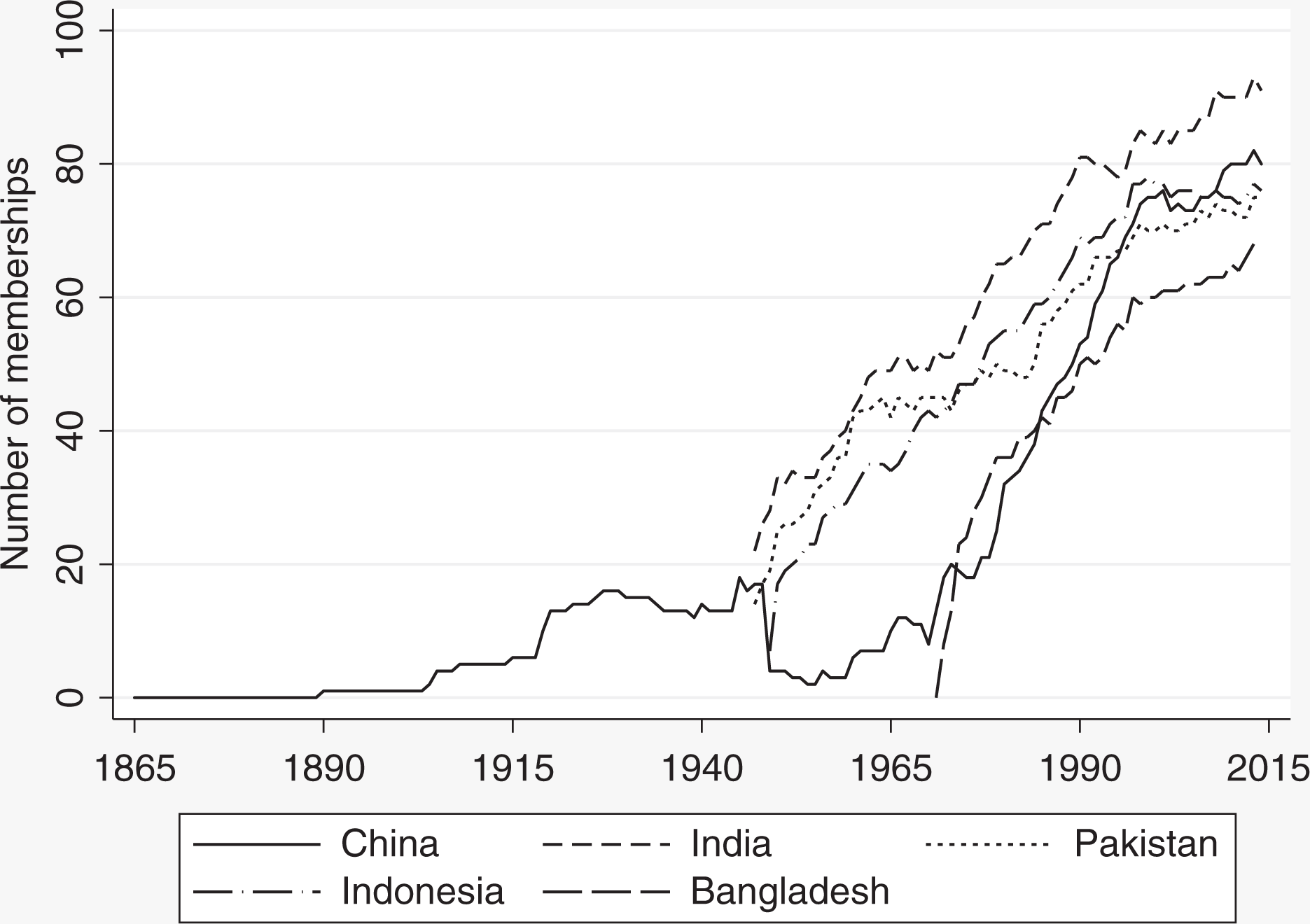
Figure 4 shows a complex set of series for five Asian countries: Bangladesh, China, India, Pakistan, and Indonesia. Recall that Asia is the only geographic region to experience increased institutionalization since the end of the Cold War. Historically in Asia, as with other regions, membership rates stagnate around World War II. China’s memberships decline rapidly in 1949, after the end of the Chinese civil war and the recognition of Taiwan as ‘China’ by most international organizations. This dataset continues to code ‘mainland’ China (the post-civil war PRC) under the same code; thus, the decline in membership reflects the shift in control of mainland China from the ROC to the newly founded – but largely unrecognized – PRC. By the 1970s, the PRC has been catching up quickly – renewing its seat in many international organizations such as the UN.
IGO membership: five states in Asia, 1865–2014
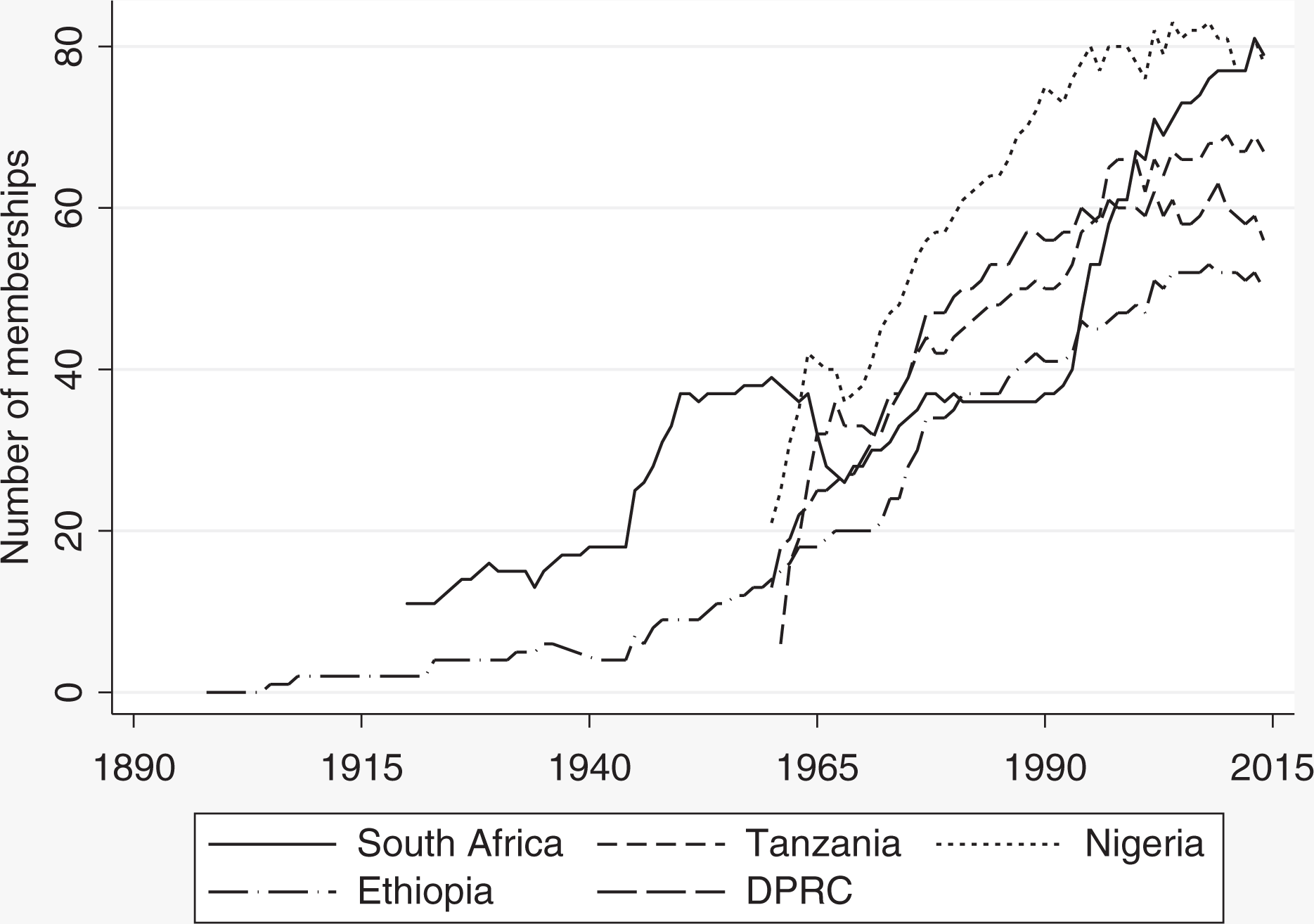
IGO membership: five states in Africa, 1890–2014
Indonesia and India follow parallel tracks in their IGO portfolios. Interestingly, they start at a different number of memberships upon independence, and this number remains nearly constant for 65 years: India is a member of 16 more IGOs than Indonesia in 1950; it is a member of 15 more in 2014. One interesting question is whether both China and India will maintain their growth rates of IGO memberships, especially as China begins to experiment with starting its own regional organizations such as the Asian Infrastructure Bank.
Both Bangladesh’s and Pakistan’s portfolios grow quickly after independence as well. Pakistan shows more variance than Indonesia or India, while Bangladesh’s portfolio grows, yet never catches the wealthier, more populous states in the region.
Figure 5 shows membership patterns for five African states: South Africa, the Democratic Republic of the Congo (DRC), Ethiopia, Tanzania, and Nigeria. While Africa has the highest number of IGOs in existence, state membership in those organizations varies widely. Several interesting patterns emerge among these states. South Africa experiences the same postwar boost in IGO memberships as many other independent former Commonwealth countries, but as decolonization proceeds and South Africa becomes increasingly isolated internationally, it is expelled from several organizations, then rejoins some organizations in the mid-1970s. Its portfolio stagnates completely in the late 1970s and throughout the 1980s. Post-apartheid, it experiences a rapid rise in IGO memberships as the new government quickly joins many IGOs which have previously shunned South Africa.
Tanzania’s and the DRC’s IGO profiles follow quite similar patterns to Nigeria’s, although Nigeria’s count is larger throughout the period. All three experience a rapid rise in IGO memberships after independence, with a slow-down only towards the last few years of the data. The DRC’s growth in IGO memberships has slowed recently, no doubt due to its lack of political stability. Finally, although Ethiopia has the longest history of independence in Africa among this group, its involvement in international organizations lags behind the others through the years of observation. Only newly independent states and South Africa during the apartheid period maintain fewer memberships.
The trends discussed in this section are meant to give the reader a flavor for the new data, yet also suggest some possible avenues for future research on the determinants of state membership in IGOs, a few of which we return to in the final section.
The COW IGO data in comparative perspective
The birth and death rates of IGOs, as shown in Figure 2, vary over time and point to the importance of understanding more fully the decisions to join and leave IGOs. Yet, a recent overview of the quantitative study of international organizations notes the number of datasets focused on IGOs and state memberships is quite small (Gartzke & Schneider, 2013). Indeed, although datasets about the capabilities of IGOs (e.g. Hooghe et al., 2017) and datasets produced by IGOs are growing, the fact is that the universe of datasets that focus on identifying IGOs and their members is small. 6 And while Gartzke and Schneider discuss the COW IGO data at some length, it is not the only dataset of its kind. How does the COW IGO dataset compare to other collections?
The strength of the COW IGO dataset is its broad coverage, both across time and across space. This is not surprising when one considers the nature of the COW project’s early goals – to evaluate system-level arguments concerning the nature of organizations and conflict. By collecting membership data in the process of identifying all IGOs, Wallace and Singer were able to make claims about membership patterns and how those two items – number of IGOs and number of state participants in IGOs – fluctuated over time in relation to one another and to international conflict.
As is noted in Table I, the emphasis on comprehensiveness is reflected in the information for the new COW IGO dataset. It contains yearly observations that capture which IGOs exist (years correspond to year of IGO birth and death) and which states are members of a given IGO for nearly all of the 200 years (1816–2014) of the modern state system. The current dataset has information for over 500 institutions and state-level membership data for all states who are considered members of the COW State System Membership data (Correlates of War Project, 2017).
Datasets on institutions and membership patterns
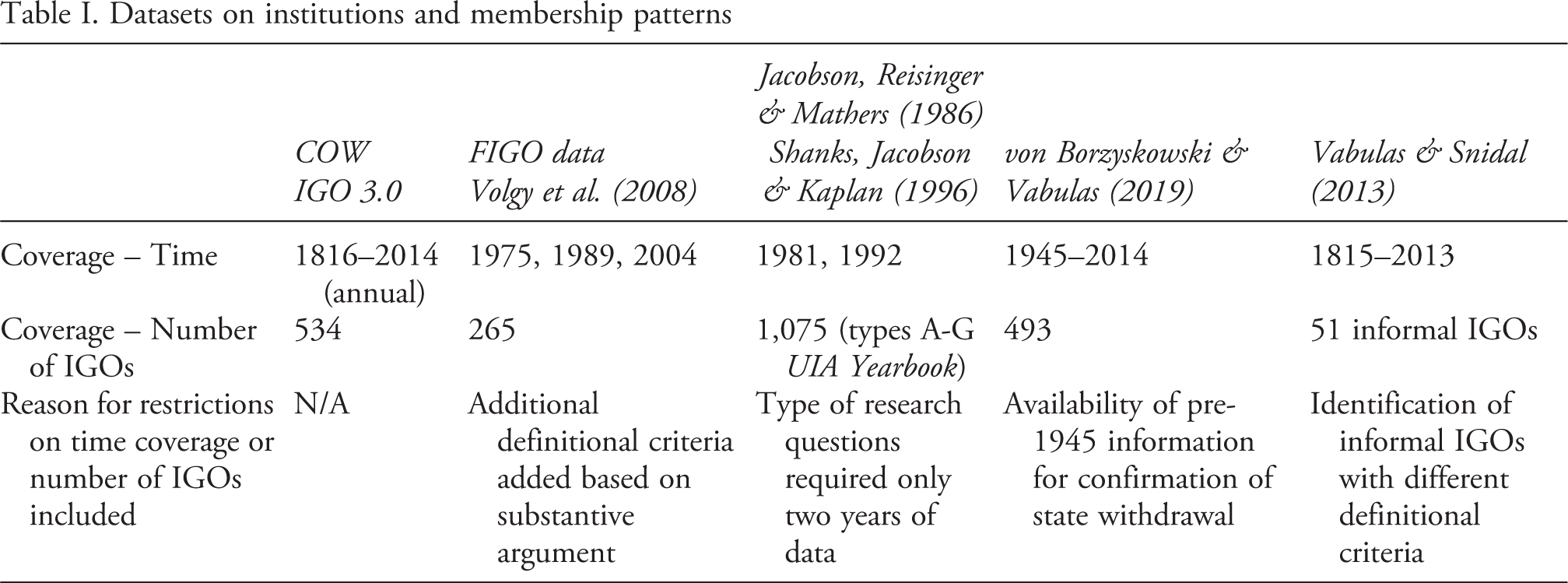
Volgy et al., on the other hand, are motivated by a substantive question related to which IGOs matter in terms of structuring international rules. The Formal International Governmental Organization (FIGO) data collection includes fewer IGOs than the COW data, which is a direct reflection of the authors’ belief that the definitional criteria used by COW is too expansive. An alternative position, they argue, is that some restrictions in the coverage of IGOs should be made to account for different institutions’ abilities to influence interstate relations. For Volgy and co-authors, the issue is that some IGOs included in the COW data are not ‘significantly organized and autonomous enough’ (Volgy et al., 2008: 849) to warrant inclusion in their study of how states are institutionalizing a post-Cold War order. As such, the set of criteria used to identify relevant IGOs includes additional information about staffing and budgets. Again, the trade-off is that the data collected under this new operational definition cover only three years, albeit three years that are appropriate for the stated purpose of comparing post-Cold War order to earlier periods of institutionalized order.
Two of the more recent data collection efforts in the area of international institutions reflect significant new research agendas in the study of international institutions. Work by von Borzyskowski & Vabulas (2019) asks why states leave organizations and therefore collects data necessary to answer those questions. Von Borzyskowski & Vabulas (2019) go beyond examining state membership changes in the COW data, conducting significant additional research using internet news sources and IGO webpages and produce data about member-state exits for over 400 IGOs. Vabulas & Snidal (2013) focus on informal organizations (IIGOs). After operationalizing IIGOs, Vabulas and Snidal identify 51 informal IGOs and catalog state memberships of their sample, allowing for analysis of membership dynamics in this new category of international institutions.
Future research avenues
These new data on state memberships in IGOs allow scholars to address a variety of questions that were difficult to research with previous versions of the data. As noted earlier, the work on the determinants of IGO membership (including accession, withdrawal, or expulsion) is relatively sparse, compared to membership in other international institutions such as alliances (Mattes, 2012) or preferential trade agreements (Mansfield & Milner, 2015). Taking that literature as a point of comparison, it is notable that some existing works on membership and the effects of alliances model historical periods differently, for example, due to systemic effects such as polarity (Leeds, 2003). Just as debates over the democratic and capitalist peace have evolved to examine structural breaks in the relationships between variables (e.g. did the democratic peace exist prior to World War II; see Farber & Gowa, 1995; McDonald, 2015), these new data could be used to test similar arguments regarding IGOs and any number of outcomes.
Indeed, numerous studies have debated the influence of IGOs on conflict behavior (Pevehouse & Russett, 2006; Boehmer, Garztke & Nordstrom, 2004; Anderson, Mitchell & Schilling, 2016; Greenhill & Lupu, 2017). Those studies have been limited to the post-World War II era or have used prewar data by imputing membership within the five-year panels of the original IGO data. These new data will allow better inferences about the role of IGO membership in shaping conflict behavior over the past 200 years. 7
Turning the IGO-conflict literature around in terms of cause and effect, what is the role of conflict in shaping IGO creation and memberships? Although the field has extensively pursued this question with conflict as the outcome, it is possible that conflicts curtail state membership in IGOs. This could be due to resource constraints that accompany conflicts, to expulsions that arise from wars, or regime changes that may result from conflicts. It is also worth noting that, anecdotally, many IGOs are created in the immediate aftermath of war (e.g. League of Nations, United Nations, Bretton Woods institutions), in an attempt to guard against future conflict or to institutionalize peaceful bargains that end conflicts. The question of whether conflict is a precursor or consequence of IGO membership is important to understand the complex relationship between institutions and conflict.
Of course, state memberships in emerging 19th- and 20th-century institutions itself is a fascinating area of research. Given that many systemic variables (e.g. polarity) and system-wide measures (e.g. the number of democracies) vary extensively prior to 1965, these new data open questions of what correlates with IGO membership to more empirical scrutiny.
The annualized historical data also allow a broader temporal analysis of some of the existing correlations found in more recent times. For example, numerous scholars have noted the association between regime type and IGO membership (e.g. Poast & Urpelainen, 2018), yet these conclusions have been drawn on the basis of only a post-World War II sample, at a time when the number of democracies was growing. Would the same set of findings regarding regime type hold up when examining the interwar period? Or the era of the Concert of Europe, when more functional organizations dominated the institutional landscape?
So far, most of our suggestions have focused on the refinement and expansion of existing research programs. Based on the descriptive data in this article, other important questions arise. For example, what explains variations in post-independence membership portfolios? Once states are recognized as independent states in the international system, their IGO membership portfolio grows quickly. Yet, all newly independent states have a different starting point in terms of numbers of memberships. This starting point appears to create some path dependence: states who start low stay low, while those who begin high stay high. The question of how newly independent states become enmeshed in IOs was a research area during the period of decolonization (Akzin, 1955), but has received only limited attention since (for example, on the GATT/WTO, see Copelovitch & Ohls, 2012). Perhaps issues of state development, as outlined by Gibler (2017), play some role in explaining state involvement in organizations upon independence, just as he argues it is relevant for understanding conflict patterns.
Relatedly, research on the topic of regionalism and regional organizations could benefit from these new data. The 1960s and 1970s saw a vibrant debate over functionalist explanations of regional organizations (Haas, 1970; Nye, 1970). Scholars debated the rise and fall of different regional institutions through a functionalist/neofunctionalist lens, usually with the aid of comparative case studies. Yet, with this more systematic data collection, one could examine if membership patterns (and characteristics of members) help to explain patterns of the success and failure of regional organizations both historically and currently.
Treating patterns of institutionalization of the global system is more easily done with this new dataset. At the systemic level, an important empirical puzzle in the field of international organizations is the question of why IGOs appear to be in decline. Far more work, both theoretical and empirical, is needed to shed light on this question. The last two iterations of our data suggest that the growth of IGOs (as defined by the data) is declining. It is even possible that, in some regions, the population of IGOs is shrinking. Recently, Abbott, Green & Keohane (2016) have argued that theories of organizational ecology could explain this shift. They contend that institutional innovations such as public–private partnerships have begun to crowd out IGOs as an organizational form. Figure 1 closely parallels their own prediction about the life-cycle of IGOs in the international system. Yet, their argument contains only suggestive examples which cannot rule out competing possibilities. If the proliferation of new actors during decolonization led to the overproduction of IGOs, we now see the number returning to a normal equilibrium point. Thus, we see IGOs failing at a higher rate (Gray, 2018). Both of these arguments (and others) are broadly consistent with trends in the IGO population over the last 100 years. Scholars would do well to further explore these population dynamics in a systematic manner.
In a similar vein, a core question for scholars of international institutions has been the selection of the form or design of cooperation. For example, do states form IGOs, informal organizations, public–private partnerships, or alternative forms of institutions? Other scholars have begun to release datasets of other institutional forms that track patterns of the creation of these alternative arrangements. Scholarship in these emerging areas has focused mostly on overall patterns rather than individual actor choice concerning membership or institutional form. For example, recent data on public–private arrangements suggest that in some issue areas, growth signals a changing structure of global governance (Andonova, 2017). One could imagine more fine-grained testing of the predictions of regime complex theories (e.g. Raustiala & Victor, 2004), theories regarding the changing modes of global governance (e.g. Barnett, Pevehouse & Raustiala, 2018), or engagement of the rational design of institutions framework (see Koremenos, Lipson & Snidal, 2001) across different classes of organizations.
These are just a few potential questions that emerge with a descriptive review of the data. Other readers will surely note other patterns, issues, and anomalies. We hope the data will be useful for understanding the nature of IGOs in world politics over the past two centuries.
Conclusion
This article has reviewed the new version of the Correlates of War IGO dataset. The dataset utilizes the same coding criteria as the previous version of the data, updating the data until 2014. In addition, Version 3 adds yearly data on state memberships from 1816 to 1964. These new data allow for a more complete picture of the development of states’ IGO portfolios in the 19th and early 20th centuries.
As with any data-generating exercise, there are some stones left unturned. While the data provide membership information, other important variables at the institutional level remain unexplored. Budget size, number of personnel, and voting rules, for example, are three factors related to IGOs that scholars could use both as variables to explain outcomes and as outcomes themselves.
Some efforts along these lines are underway. Work by Hooghe et al. (2017) codes data on institutional characteristics (especially around the concept of authority) for 76 IGOs between 1950 and 2010. Their Measurement of International Authority (MIA) dataset is grounded in their theory of delegation of international authority – and a smaller sample serves their purposes. Yet, all measurement involves trade-offs: procedure data (e.g. voting), budget size, and staff data are difficult to come by in many organizations and those missing data would not be missing at random (across space or time). For example, many of the organizations in our IGO sample are not in the Hooghe et al. dataset. While future iterations of the COW IGO data could begin that data-gathering process, it would need to be made clear that, unlike the current effort at comprehensiveness, such data would be limited.
Similarly, Koremenos’s (2016) Continent of International Law (COIL) project has coded a large number of design characteristics for a wide range of international institutions, but mostly centered on treaties rather than international organizations. Lundgren (2016) codes institutional variation of IOs with regard to conflict management and peace-brokering capabilities. His sample covers the 1945–2010 period. Finally, Hafner-Burton, Mansfield & Pevehouse (2015) code over 50 IOs (plus additional treaties) for their human rights provisions.
As interest in institutional design continues to grow and as IR scholars recognize the presence of heterogeneous treatment effects of international institutions, having more data about the characteristics of IGOs besides membership will be important. And while the institutional variation data of Hooghe et al., Koremenos, Lundgren, and others provide an excellent start to having more data on institutional provisions, there is still much work to be done. One can imagine numerous ways to differentiate IOs across time and space.
One important similarity, however, among these newer datasets on institutional design is that all are closely guided by theory and the underlying questions the scholars were attempting to answer. Given the myriad ways one could differentiate organizations, future projects to deepen IO datasets should be guided by theory to inform coding criteria and guide inferences. Divorced from well-developed theory, such projects risk creating data that are noisy and of limited use to the scholarly community.
Still, the future is bright for the quantitative study of international institutions and their effects on state behavior. For many years the theoretical work on international institutions was far outpacing the empirical work. Our brief survey shows that scholars have stepped up to improve the depth and quality of existing datasets. Just as important, though, is a significant effort dedicated to the task of operationalizing and measuring key theoretical concepts and collecting the data needed to tackle some of the important questions in this area of international relations. Finding ways to integrate existing accounts of IGOs such as the COW IGO data with the emerging datasets on institutional characteristics certainly presents one important way to move the literature forward.
Footnotes
Replication data
The codebook and do-files for the empirical analysis in this article can be found at http://www.prio.org/jpr/datasets. Original data are available from  .
.
Acknowledgments
The authors would like to thank Micah Dillard, Alex Holland, Sadie Grunewald, Nishant Sabnis, Seujong Shim, Rachel Sobotka, Yoona Song, Marissa Wyant, and Abigail Young for their research assistance. Thanks to Felicity Vabulas, Inken von Borzyskowski, and Jessica Weeks for comments on the manuscript.
Notes
References
Supplementary Material
Please find the following supplemental material available below.
For Open Access articles published under a Creative Commons License, all supplemental material carries the same license as the article it is associated with.
For non-Open Access articles published, all supplemental material carries a non-exclusive license, and permission requests for re-use of supplemental material or any part of supplemental material shall be sent directly to the copyright owner as specified in the copyright notice associated with the article.
