




Abstract
Literatures on the influences of missile defense (MD) on the existing nuclear deterrence are divided into negative and positive perspectives. However, both sides seem to make contradictory arguments. Skeptics argue that it is not feasible that MD influences deterrence stability but that it causes security dilemma and arms race, while proponents suggest that MD does not have to be perfect to reinforce deterrence stability but that it does not cause security dilemma and arms race. To fix this logical inconsistency, we identify an additional variable which is crucial in understanding the security dilemma mechanism in addition to Jervis’s (1978) two variables. By adding another variable, a minimum MD effectiveness level required for deterrence success suggested by Quackenbush (2006), to Jervis’s framework, we develop three hypotheses, two of which are novel on MD and its potential influences on deterrence stability and arms race. We then introduce a probabilistic model of the MD effectiveness by modifying Wilkening’s (2000) and conduct simulation analysis to see if MD is more likely to incur security dilemma and arms race. Our simulation results show that MD influence is likely to be different depending on a potential challenger’s national capability. Against a great power challenger, MD is least likely to meet the minimum MD effectiveness level required for deterrence success, so that the challenger is more likely to respond flexibly to the defender’s buildup of MD. Against a newly nuclear-armed state, however, a defender’s MD is more likely to satisfy the minimum MD effectiveness level, so that the defender is highly likely to respond flexibly to the potential challenger’s reinforcement effort of its nuclear force. In either case, our simulation results indicate that arms races concerning MD among them are not likely to occur.
Introduction
Does missile defense (MD) do more harm than good for strategic deterrence stability? Since the advent of nuclear weapons, which brought about a metamorphosis of international security, the debates on MD have continued for more than half a century. The literature on MD is divided into negative and positive perspectives about its influences on existing nuclear deterrence.
Skeptics’ arguments on MD boil down to its technological limitations on the one hand, and its influences on security dilemma and arms race on the other. They argue that MD technologies are not sufficient to produce perfect and ideal MD (Lebovic, 2002; Lewis & Postol, 2010; Glaser & Fetter, 2016). Therefore, MD cannot change the existing mutual assured destruction (MAD) situation between great power rivals (Rathjens & Ruina, 1986; Glaser & Fetter, 2016). At the same time, however, they suggest that MD undermines the existing nuclear deterrence stability (Brams & Kilgour, 1988; Lebovic, 2002; Zhang, 2011) and that MD instigates security dilemma and, in turn, arms race (Rathjens & Ruina, 1986; Lewis & Postol, 2010). Proponents also make two types of arguments. They argue that although MD is not perfect technologically, it can contribute sufficiently to reinforcing deterrence stability (Ding, 1999; Quackenbush, 2006). In addition, they suggest that ‘even a limited missile shield could be a powerful complement to the offensive capability’ (Lieber & Press, 2006: 28). Furthermore, proponents point out that MD does not cause security dilemma and arms race (Ding, 1999; Quackenbush & Drury, 2011). Instead, they argue that the main reason that adversaries strongly oppose MD has something to do with political and historical backgrounds (Ding, 1999).
Skeptics and proponents seem to make a similar type of logically inconsistent argument about MD feasibility and security dilemma. Skeptics argue that MD is necessarily infeasible because of its technological limitations. If this argument is correct, then MD cannot nullify a potential attacker’s nuclear strike capability. So, a potential attacker does not need to reinforce its nuclear force in response to a defender’s MD. However, skeptics also emphasize that MD inevitably causes security dilemma. If that argument is also correct, then it logically indicates that MD has a substantive influence in neutralizing a potential attacker’s nuclear force. Here, we witness logical inconsistency which we call the ‘threat–no threat paradox’ concerning MD. This type of logical inconsistency is observed in proponents’ arguments as well. They argue that MD not only improves a defender’s deterrence stability but even contributes to its offensive capability. If this argument is correct, then a defender’s MD can be a substantive threat to its adversary. So, its adversary is likely to reinforce its nuclear force in response to MD. However, proponents also argue that MD does not incur security dilemma. Thus, proponents’ arguments are not free from the threat–no threat paradox, either.
The threat–no threat paradox implies that there is a missing link between MD feasibility and security dilemma in the debates on MD. By shedding light on the missing link, we may be able to bridge a gap between skeptics and proponents in the debates and contribute to better understanding of the influence of MD on strategic deterrence stability. Here, we begin our research by examining the mechanism by which MD can cause a security dilemma, based on the work of Jervis (1978). Jervis suggests his security dilemma framework based on two variables, that is, offense–defense indistinguishability and offense–defense advantage. We identify an additional variable which is critical in understanding the possibility of a security dilemma by reflecting Powell’s (2003) and Lieber & Press’s (2017) arguments and Quackenbush’s (2006) suggestion. Powell (2003) and Lieber & Press (2017) suggest that MD influences can be different depending on a potential attacker’s national capability and Quackenbush’s (2006) finding suggests that there is a minimum MD effectiveness level required for deterrence success. In our research, we suggest that an additional variable which is critical in comprehending the security dilemma mechanism is whether or not a MD satisfies a minimum MD effectiveness level. This additional variable is a decisive clue to the threat–no threat paradox observed in the existing literature on MD.
In our research we conduct a simulation analysis on an arms race between a defender with MD and a challenger with offensive nuclear capability, and we demonstrate that the additional variable is indeed crucial in comprehensively understanding the relationship between MD and security dilemma and, in turn, arms race.
Hypotheses
Describing security dilemma, Jervis (1978) raises two critical questions. First, whether defensive weapons and postures are distinguishable from offensive ones. Second, whether the offense is advantageous to the defense. Jervis argues that if the offense is not easily distinguishable from the defense and the offense has the advantage over the defense, then a serious security dilemma is highly likely to occur and this security dilemma will result in a nuclear arms race. As suggested by him, a weapon can be used defensively or offensively, depending on the situation. In case of MD, although MD is developed to intercept the incoming ballistic missiles including intercontinental ballistic missiles (ICBMs) and submarine-launched ballistic missiles (SLBMs), it is indeed not easy to claim that MD is used only for a defensive purpose. The ‘damage-limitation capability’, that is, ‘a combination of a first strike and missile defenses’, can be considered an offensive capability (Glaser & Fetter, 2016: 52–60). Lieber & Press (2006) also suggest that a limited MD system can be a threatening complement to offensive capability. It is thus very difficult to say that MD is only for a defensive purpose.
To answer Jervis’s second question, we need to test a hypothesis with our simulation analysis. In this research, first of all, we would like to see if a great power’s offensive nuclear capability is advantageous to its great power rival’s MD. If that is found to be the case, based on Jervis’s implication, MD in general would trigger a security dilemma and provoke a nuclear arms race. According to Jervis (1978: 187), ‘the offense has the advantage’ means that ‘it is easier to destroy the other’s army’, and ‘the defense has the advantage’ means that ‘it is easier to protect and to hold’. In our research, we assume that offensive capability is directly connected to the number of re-entry vehicles (RVs) that can deliver nuclear warheads, while MD capability physically relies on the number of interceptors with a certain ‘single-shot probability of kill’ (SSPK).
1
So, following Jervis’s definition, in our research the offense has the advantage when a disproportionately large number of anti-ballistic missiles is needed to intercept a relatively small number of incoming RVs. Conversely, the defense has the advantage when MD with a certain number of interceptors that is not so burdensome for a defender is capable of intercepting all simultaneously incoming RVs that a challenger possesses. We compare the quantities of RVs and interceptors to see if a disproportionately large number of interceptors is needed to intercept a relatively small number of RVs or which side is relatively more likely to be burdened. Developing and deploying RVs seems to be much more advantageous than building MD since the number of interceptors needed to nullify all potentially incoming RVs seems to be much larger than that of RVs. Here, we would like to see if this intuitive argument is supported by our simulation analysis. The first hypothesis we test is as follows.
H1: A great power developing and deploying offensive nuclear capability is likely to be greatly advantageous to its great power rival developing and deploying MD.
Hypothesis 1 is related to a general arms competition between two great powers, one of which develops and deploys offensive capability, while the other focuses on building MD capability. However, Powell (2003: 88) suggests that it is easier for a great power’s MD to respond to the nuclear strike capability of a newly nuclear-armed rogue state than that of its great power rival. He argues that MD may provide a great power with ‘somewhat more freedom of action and make a rogue state more likely to back down in a crisis’. 2 That is, if a great power possesses MD that can neutralize a newly nuclear-armed state’s offensive nuclear capability to a certain probability, the great power is more likely to become resolute and the newly nuclear-armed state is more likely to back down.
According to Powell (2003: 108–109), however, a crisis breaks out when the balance of resolve between a great power defender and a newly nuclear-armed challenger is not so obvious. When uncertainty concerning the balance of resolve remains high or deteriorated, a defender would find it tough to be resolute enough to compel its adversary to back down. Deteriorated uncertainty would increase the risk of the nuclear crisis running out of control. Therefore, he argues that only when MD is extremely effective can the deterrence reinforcement effect of MD be expected. He explains that a great power can be more resolute by building almost perfect MD. This is because if a newly nuclear-armed state launches a nuclear first strike, MD can reduce the defender’s cost of nuclear conflict. By decreasing the cost in case situations get out of control, MD ‘increases the effective resolve’ of the defender against the challenger. Thus, he argues that ‘MD increases the maximum risk of attack’ that the defender would be ‘willing to run in order to prevail’. For this reason, MD would make the great power defender more resolute against the newly nuclear-armed challenger and more willing to endure a higher risk. Consequently, the challenger would be forced to concede since it is less likely to tolerate the risk of escalation.
Quackenbush (2006: 536), however, refutes this by arguing that MD can help to reinforce a defender’s deterrence even though it is not perfect. He suggests a game-theoretic model of ‘challenger’s deterrence threshold’ vs. ‘defender’s credibility’ concerning deterrence success. According to him, when a defender’s credibility exceeds a challenger’s deterrence threshold, the challenger can be successfully deterred. He shows that an increase in MD effectiveness helps to increase the defender’s credibility, and thus MD can play a substantive role in making the defender’s credibility exceed the challenger’s deterrence threshold, which is an essential requirement of deterrence success.
Quackenbush’s finding indicates that there is a minimum level of MD effectiveness required for deterrence success. That is, as long as MD effectiveness satisfies the minimum level, no matter how effective MD is, a defender’s MD is likely to make a challenger back down so that deterrence will succeed. His minimum level of MD effectiveness suggests that Jervis’s (1978) aforementioned two conditions of security dilemma are insufficient to explain the outbreak of security dilemma and arms race caused by MD. Based on Quackenbush’s finding, we suggest that a third condition must also be satisfied for MD to cause or not to cause security dilemma and in turn arms race. That is, a minimum MD effectiveness level required to make a defender’s credibility exceed a challenger’s deterrence threshold should be a third condition. So, if MD satisfies Jervis’s two conditions and a defender’s MD effectiveness meets the minimum requirement level, a challenger will be successfully deterred. In that situation, the challenger is more likely to take actions to reinforce its offensive nuclear capability. However, the defender is not likely to engage in reinforcing its MD in response to the challenger’s offensive capability buildup as long as MD effectiveness satisfies the minimum MD effectiveness level. Therefore, until the defender expects that the challenger’s offensive capability becomes strong enough to threaten deterrence stability, the defender is less likely to be involved in rebuilding its MD capability right away. Thus, an arms race caused by a security dilemma between the defender and the challenger is less likely to occur.
On the other hand, if MD satisfies Jervis’s two conditions but a defender’s MD effectiveness is lower than the minimum requirement level for deterrence success, then a defender’s MD is not likely to let a challenger back down. So, deterrence may fail. In that case the defender is likely to decide to reinforce its MD capability to satisfy the minimum MD effectiveness level. However, the challenger that gains the upper hand is less likely to decide to rebuild its offensive capability right away in response to the defender’s MD reinforcement effort. The challenger, which knows that building MD is disadvantageous to building offensive weapons, is more likely to wait for its offensive arms buildup until the defender’s MD capability begins to catch up with the minimum MD effectiveness level. Therefore, even if the defender starts to rebuild its MD capability, the challenger is more likely to respond flexibly and thus an arms race between the defender and the challenger is less likely to occur.
When a challenger is a great power with a considerable number of RVs for offensive nuclear strikes, a defender with MD is less likely to satisfy the minimum MD effectiveness level for deterrence success. As Hypothesis 1 notes, among great powers, possessing offensive nuclear weapons is greatly advantageous to building MD. Only when a challenger is a newly nuclear-armed state is a defender with MD likely to meet the minimum MD effectiveness level. Indeed, not all nuclear-armed states’ national capabilities are equal. States with nuclear weapons include not only great powers like the United States (USA) and Russia but also non-great powers like North Korea and Israel. 3 Thus the influence of MD on deterrence stability may be different depending on the offensive nuclear capabilities of nuclear-armed states. A great power is likely to have more offensive nuclear capability than a newly nuclear-armed state. So, when a defender’s MD capability is at a fixed level, its MD effectiveness is less likely to satisfy the minimum level when it aims at a great power adversary, while its MD effectiveness is more likely to satisfy the minimum MD effectiveness level when it aims at a non-great power rival.
In our research we use Quackenbush’s definition of the minimum MD effectiveness level required for deterrence success. We also assume that a challenger’s effort to reinforce its offensive nuclear capability will result in improvement of its strike capability to penetrate a defender’s MD in two ways – a decrease in interceptor’s SSPK and an increase in the number of RVs. Hypothesis 2, which we would like to test here, then, has a lot to do with a potential security dilemma between a great power and a non-great power, while Hypothesis 3 is related more to a potential security dilemma between great power rivals. The second and third hypotheses are as follows.
H2: As long as MD effectiveness satisfies the minimum MD effectiveness level required for deterrence success, a defender is not likely to rebuild its MD capability right away in response to a challenger’s reinforcement of its offensive nuclear capability. Therefore, an arms race concerning MD between the defender and the challenger is less likely to occur.
H3: As long as MD effectiveness is lower than the minimum MD effectiveness level required for deterrence success, a challenger is less likely to rebuild its offensive capability right away in response to a defender’s reinforcement of MD. Therefore, an arms race concerning MD between the defender and the challenger is less likely to occur.
Probabilistic model
Several scholars have developed mathematical models to evaluate the effectiveness of MD (Ordway & Rosenstock, 1963; Layno, 1971; Kent et al., 2008; Lebovic, 2002; Wilkening, 2000), but they have focused heavily on military technological feasibilities and have not addressed much on the political implications of MD.
Our research examines the general mechanism of MD. It is notable that the current MD systems are based on the salvo mechanism: to wit, MD in general is based on a kinetic mechanism of multiple interceptors per target. It improves the probability of nullifying targets by increasing the number of interceptors per target. More advanced homing systems enable multiple interceptors of MD to simultaneously trace and engage with targets. Currently, both national missile defense (NMD) and theater missile defense (TMD) operate under this salvo mechanism. Interceptors utilizing this mechanism include the Ground-Based Interceptor (GBI), the Patriot Advanced Capability-3 (PAC-3), the Standard Missile 6, and the Terminal High Altitude Area Defense (THAAD) interceptor (BAE Systems, 2012; Lockheed Martin, 2014, n.d.; Starr, 2019; Raytheon, n.d.). Thus, as long as MD is based on a kinetic mechanism, the effectiveness of MD would hinge upon the salvo mechanism. In our research, therefore, we focus on MD in general.
Lebovic (2002) and Wilkening (2000) design probabilistic models based on MD developed and deployed in the 21st century. Lebovic’s model examines the situation in which a single interceptor deals with one incoming ballistic missile at a time, and shows that the effectiveness of MD decreases drastically as the number of incoming ballistic missiles increases even slightly. Wilkening’s probabilistic model for calculating the effectiveness of MD deals with the situations in which multiple incoming RVs with nuclear warheads are to be intercepted by multiple anti-ballistic missiles. His model reflects all of the fundamental characteristics of the current MD and generalizes its mechanism. Nonetheless, the model focuses on military technological and operational aspects of MD and thus has limits in examining its political implications. His model has technical limitations as well. For example, it assumes that a detection process of MD can successfully discriminate warheads from decoys. However, in reality perfect discrimination between nuclear warheads and decoys is not likely. In this research we simplify Wilkening’s model by relaxing this assumption. 4
Number of RVs and interceptors given P(MD) ≥ 0.5 and p = 0.9 or 0.8


In Equation (1), p is the interceptor’s single-shot probability of kill (SSPK), n is the number of interceptors needed to destroy per incoming target, and m is the number of simultaneously incoming RVs. Here, the number of RVs includes not only nuclear warheads but also decoys.
Simulation results
By introducing a modified version of Wilkening’s probabilistic model, our simulation results provide interesting political implications about MD including its influences on arms race caused by security dilemma. Table I shows the number of incoming RVs and the number of anti-ballistic missiles to intercept them given P(MD) ≥ 0.5 and p = 0.9 or p = 0.8. To create Table I, we fix P(MD) ≥ 0.5 and vary the value of p 0.8 and 0.9 from Equation (1). Here, in the first column, p = 0.9 means that the interceptor’s SSPK is 0.9. In the second column, n = 2 and prob(I) = 0.99 means that if two interceptors are used to destroy each incoming RV, then the probability that the single RV is successfully intercepted is 0.99. However, the more simultaneously incoming RVs there are, the lower the probability of successfully intercepting all of them. Thus, in the third column RVmax = 68 and Actual P(MD) = 0.5048 mean that the maximum number of incoming RVs that MD, based on two Ten simulation linesa given the values of P(MD) and p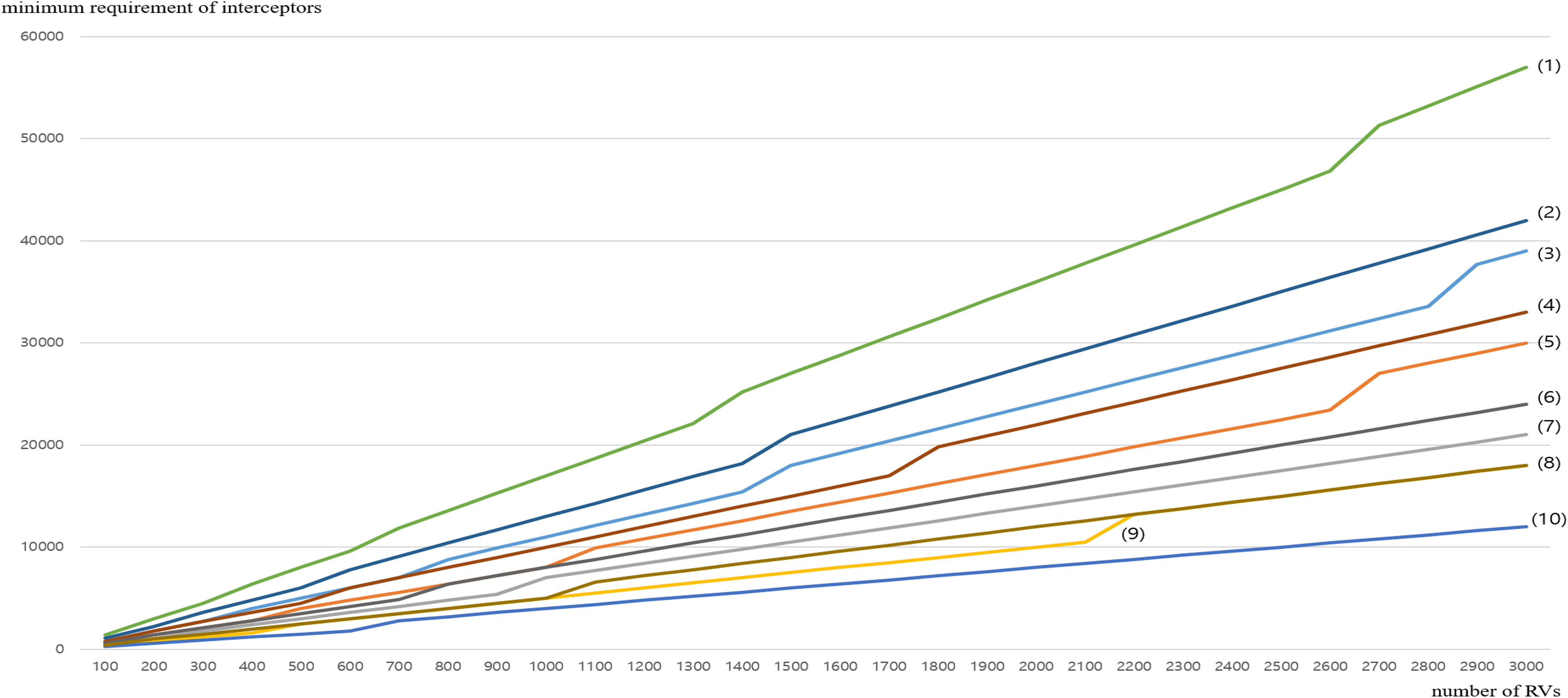
In the fourth column, Imin = 136 means that such MD should be able to field at least 136 anti-ballistic missiles to successfully intercept 68 incoming RVs satisfying the requirement of P(MD) ≥ 0.5. In case 69 or more RVs are incoming, MD with two interceptors per single RV is less likely to meet the requirement of P(MD) ≥ 0.5. In those cases MD should provide at least three anti-ballistic missiles per RV to successfully intercept all incoming RVs with P(MD) ≥ 0.5. In case 69 RVs are incoming simultaneously, a successful MD satisfying P(MD) ≥ 0.5 needs to fire 207 interceptors. In comparison to MD with two interceptors per single RV, that with three interceptors per RV is capable of intercepting up to 692 incoming RVs with at least 2,076 interceptors. This exponential increase in the number of anti-ballistic missiles required to intercept more incoming RVs implies that in general offensive weapons have a relative advantage over MD in arms race.
Figure 1 shows ten combinations of simulation results by varying p values from 0.5 to 0.6, 0.7, 0.8, and 0.9, and required minimum P(MD) values 0.5 and 0.99. Here, the x-axis refers to the number of incoming RVs and the y-axis refers to the minimum number of interceptors required to meet either P(MD) ≥ 0.5 or P(MD) ≥ 0.99 when p varies from 0.5 to 0.6, 0.7, 0.8, and 0.9. When examining ten graph lines, there are specific sections where the slope of each line rapidly increases when the value of x-axis increases. This is because when the number of incoming RVs keeps increasing, from a certain point MD with n interceptors per RV would find it impossible to meet the requirement of the minimum P(MD) value. Thus, it is necessary to increase the minimum number of interceptors per RV from n to n+1. The sections in the simulation lines in which the slopes increase suddenly indicate that the number of interceptors per RV changes from n to n+1.
The simulation results in Figure 1 imply that when competition between MD and offensive weapons intensifies, a defender’s defense burden is likely to be more severe than an offensive side since the number of interceptors per RV, which is directly associated with the defender’s burden, increases from n to n+1. The average values of the slopes of ten simulation lines also support this implication. The average value of the slope of line (1), the steepest among ten simulation lines, is 17.4, Number of interceptors needed to satisfy the minimum MD effectiveness level when the number of RVs changes from 10 to 5,000 in simulation line (1) with p = 0.5 and P(MD) ≥ 0.99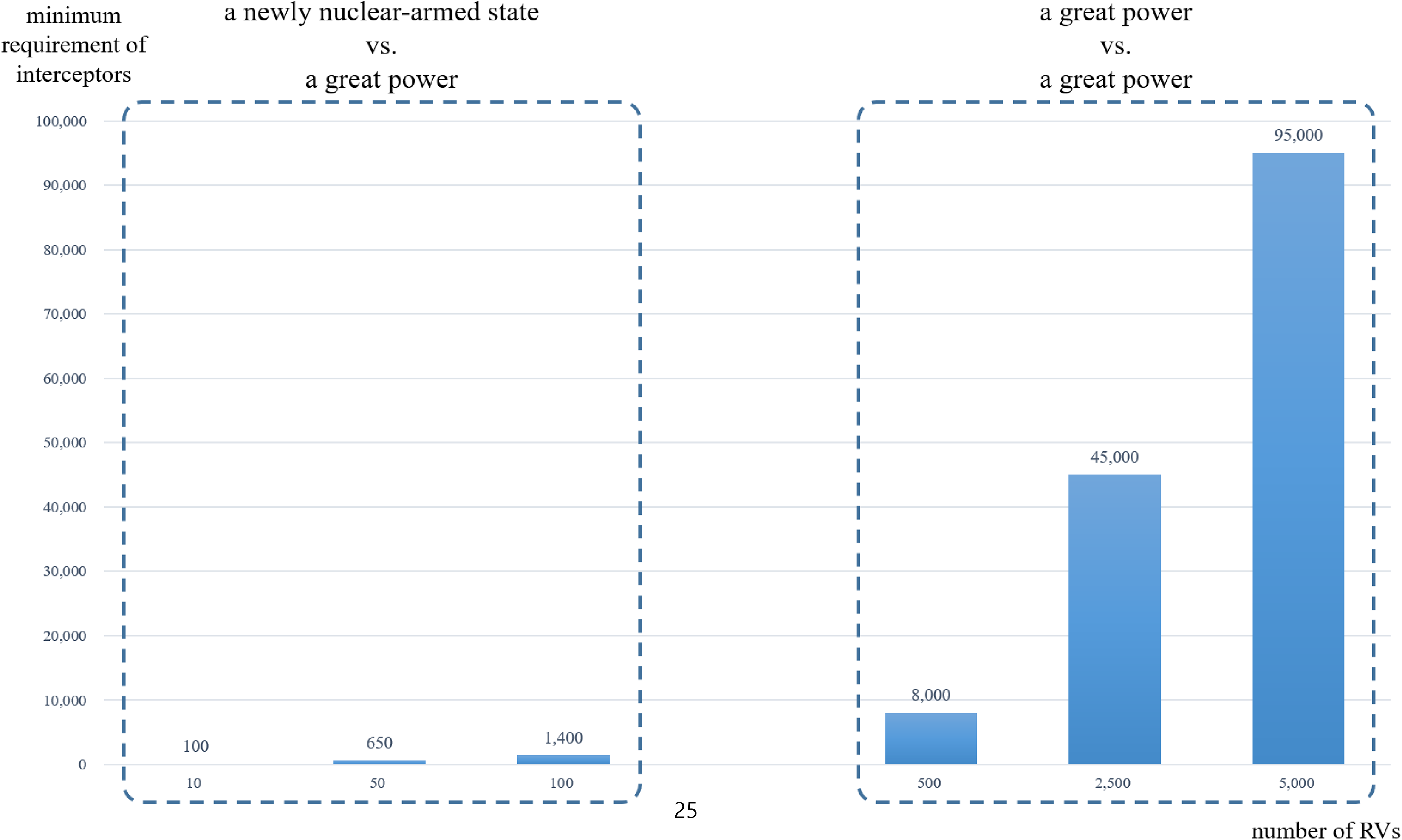
But, it holds only for the case among great power rivals. Between a great power and a fledgling nuclear-armed state it may not be the case. Since national capabilities between a great power and a newly nuclear-armed state are not equal, a newly nuclear-armed state with limited national capability, especially economic capacity, is likely to feel more burdened in augmenting its nuclear strike capability in response to a great power’s MD. Figure 2, which shows the number of interceptors needed to satisfy the minimum MD effectiveness level when the number of RVs changes from 10 to 5,000 in simulation line (1), demonstrates this argument more clearly. This figure indicates that when a challenger has the offensive capability of projecting 10 or 50 RVs simultaneously, a defender needs to have 100 or 650 interceptors respectively to meet the minimum MD effectiveness level. So, a great power which possesses MD with about 650 interceptors is likely to threaten the deterrence stability of a newly nuclear-armed state with only 50 RVs or less. However, when a challenger possesses the capability of launching 500 RVs at once, a defender needs to bear the severe burden of building 8,000 interceptors to satisfy the minimum MD effectiveness level for deterrence success. If the challenger increases the number of its RVs up to 2,500, the defender seems to be least likely to bear the burden of increasing the number of its interceptors up to 45,000, an astronomical number. Thus, Figure 2 shows that the degree of MD’s disadvantage is considerably different depending on its adversary’s offensive nuclear capability. That is, a great power possessing offensive nuclear capability is likely to be greatly advantageous to a great power building MD, whereas a newly nuclear-armed state building offensive nuclear capability is not likely to be advantageous to a great power possessing MD. This finding supports Hypothesis 1.
Let’s go back to Figure 1 for a moment. This figure demonstrates another interesting finding that even though values of p and P(MD) are different, there are specific situations in which the minimum requirements of interceptors are equal in a certain range of the number of incoming RVs. For instance, lines (8) and (9) in Figure 1 show that there are several overlapping parts of the slopes between lines (8) and (9). Figure 3, which is an enlarged version of a part of Figure 1, shows them more clearly. Line (8) refers to MD with p = 0.9 and P(MD) ≥ 0.99, and line (9) refers to MD with p = 0.8 and P(MD) ≥ 0.5. Here, parts of the slopes of the two lines overlap when 500 ≤ the value of x-axis ≤ 1,000 and Simulation lines (8) and (9) from Figure 1
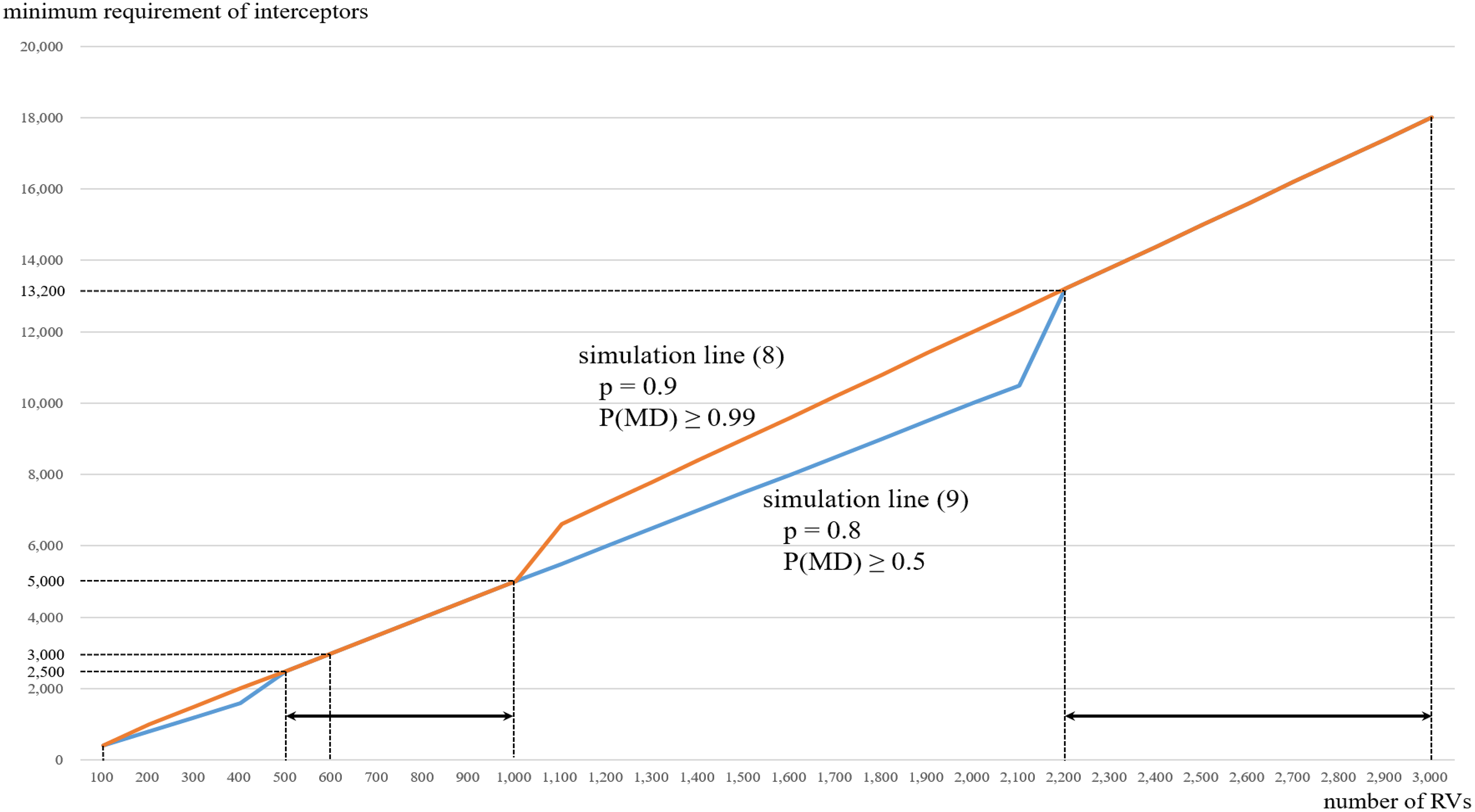
Figure 4 shows two simulation lines (11) and (12). Line (11) refers to MD with p = 0.6 and P(MD) ≥ 0.9 and line (12) refers to p = 0.6 and P(MD) ≥ 0.6. In line (12), let’s suppose a defender has 4,000 interceptors with p = 0.6. In this case, as long as a challenger possesses the offensive capability of simultaneously launching 500 RVs or less, the defender’s MD is likely to satisfy the minimum MD effectiveness level required for deterrence success: P(MD) ≥ 0.6. That is, if a great power builds MD with about 4,000 interceptors with p = 0.6, then a newly nuclear-armed state possessing less than 100 RVs, for example, is not likely to be capable of threatening deterrence stability. Even if the challenger tries to reinforce its offensive capability from 100 RVs to 200 or to 300 RVs, its offensive capability is still unlikely to destabilize the existing deterrence situation. Therefore, until the challenger builds more than 500 RVs, the defender is likely to respond flexibly to the challenger’s reinforcement effort. This interpretation supports Hypothesis 2.
Now, in line (12) let’s suppose a challenger possesses the offensive capability to project 2,000 RVs simultaneously and a defender possesses the MD with 4,000 interceptors with p = 0.6. In this case the defender’s MD is not likely to satisfy the minimum MD effectiveness level. For the defender with 4,000 interceptors with p = 0.6 to meet the minimum MD effectiveness level, it needs to build at least 16,000 more interceptors. This finding suggests that until the defender builds its MD capability up to total 20,000 interceptors with p = 0.6, the challenger is less likely to engage in reinforcing its offensive capability. Instead, the challenger is more likely to respond flexibly to the defender’s reinforcement effort. Simulation lines (11) and (12)
Nine nuclear powers’ ballistic missile capabilities
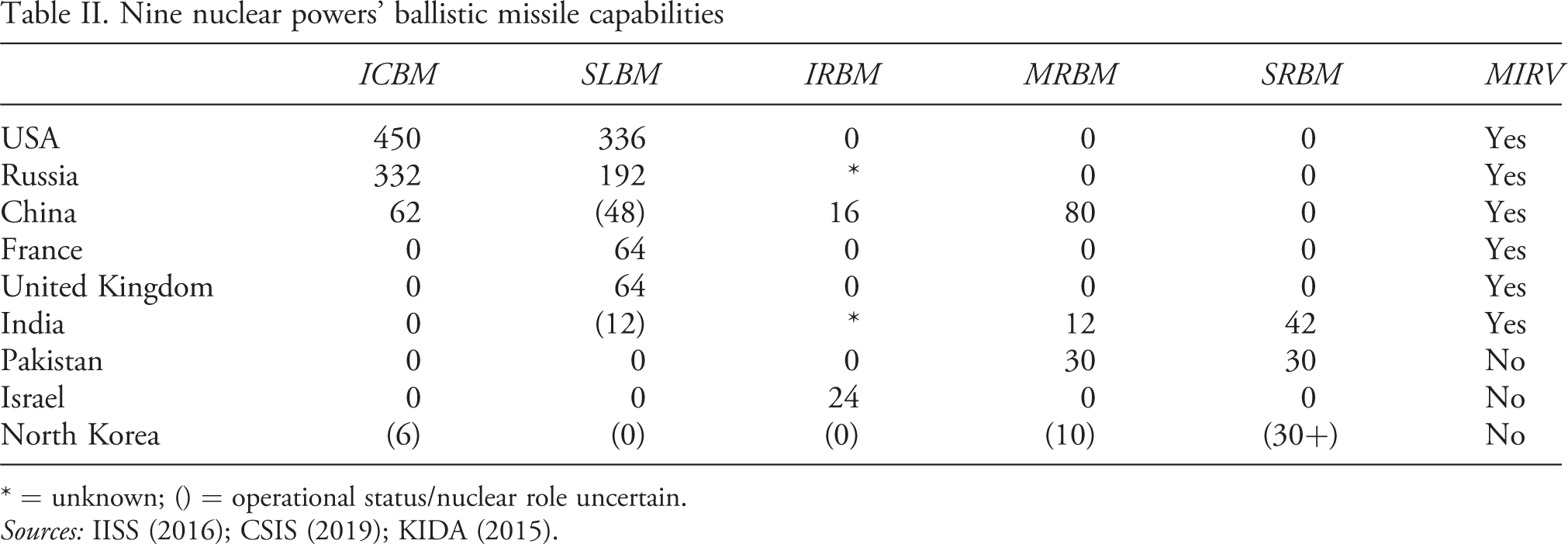
* = unknown; () = operational status/nuclear role uncertain.
Sources: IISS (2016); CSIS (2019); KIDA (2015).
Table III shows two different situations – one in which deterrence stability is highly likely to be maintained and the other in which it is least likely to be maintained. The first situation occurs when a hypothetical great power’s MD effectiveness is lower than the minimum MD effectiveness level required for deterrence success. In that situation a defender’s MD is less likely to let a potential challenger back down, and thus deterrence may fail. The other situation occurs when a great power’s MD effectiveness satisfies the minimum effectiveness level so that a defender’s credibility is more likely to be reinforced by MD. In that case a challenger is likely to be successfully deterred. In Table III, we fix p = 0.6 and P(MD) ≥ 0.6 and conduct a simulation to see how many interceptors are needed to satisfy the minimum MD effectiveness level. 10 Here, we utilize the nine nuclear powers’ ballistic missile capabilities shown in Table II and also assume that a nuclear state with MIRV capability can project ten RVs per ballistic missile.
The result indicates that a great power’s MD with 100 interceptors may not be able to undermine the deterrence stability of Pakistan, Israel, or North Korea. But, when its MD is reinforced to possess 500 interceptors with p = 0.6, its MD satisfies the minimum MD effectiveness level so that it is likely to undermine each deterrence stability of these three countries. Therefore, as long as a great power’s MD effectiveness with a certain number of interceptors capable of p = 0.6 satisfies the minimum effectiveness level, which is P(MD) ≥ 0.6 in this simulation, a great power with that type of MD is more likely to avert unnecessary effort to reinforce its MD when any of these three nuclear states tries to reinforce its offensive capability. This finding thus supports Hypothesis 2.
Number of interceptors needed to satisfy P(MD) ≥ 0.6 when p = 0.6

b ‘not satisfied’ means that the minimum MD effectiveness level for deterrence success is not satisfied.
On the other hand, the result also indicates that even when a hypothetical great power’s MD is reinforced to have 10,000 interceptors, the deterrence stability of the USA, Russia, or China is not likely to be affected since its MD effectiveness with 10,000 interceptors capable of p = 0.6 is still lower than the minimum MD effectiveness level. This means that neither the USA, nor Russia, nor China needs to respond immediately to the hypothetical great power’s severe reinforcement of its MD from 100 to 10,000 interceptors. So, an arms race concerning MD among these great powers is less likely to occur. Thus, this finding supports Hypothesis 3.
From the military aspect, the higher the P(MD) value, the more impenetrable MD is. So, the usefulness of MD will depend very much on the technological factors. On the other hand, from the political decisionmaking perspective, a defender could enjoy flexibility in developing and deploying MD with limited effectiveness since P(MD) and p values with moderate levels could still impose severe risk and burden on a potential attacker. Unlike Lewis & Postol (2010: 30) suggest, this finding indicates that MD does not have to be ‘unambiguously reliable and robust’ to claim its effectiveness.
Conclusion
In our research we have identified a third variable that is crucial in understanding the security dilemma mechanism in addition to Jervis’s (1978) two variables. Our simulation results have shown that an increase in MD’s interceptor capability is likely to lead to an increase in the credibility of a defender with MD and thus is likely to have an impact on the probability of deterrence success. Our simulation results have also shown that the MD influence is likely to be different depending on a potential challenger’s national capability. Against a great power challenger, MD is least likely to meet the minimum MD effectiveness level required for deterrence success, so that the challenger is more likely to respond flexibly to a defender’s buildup of MD. Against a newly nuclear-armed state, however, a defender’s MD is more likely to satisfy the minimum MD effectiveness level, so that the defender is highly likely to respond flexibly to the potential challenger’s reinforcement effort of its nuclear force. In either case, our simulation results indicate that arms races concerning MD among them are not likely to occur.
The findings of our simulation analysis suggest that a defender which invests in developing and deploying MD has room to maneuver in deciding on the MD it needs to build. A defender can build MD which does not threaten its great power rivals and thus avoid unnecessary arms races with them, but at the same time can destabilize any fledgling nuclear-armed state’s deterrence capability. Its political decision about how many interceptors to deploy, for example, thus could send mixed signals to its great power rivals and newly nuclear-armed states. To its great power rivals, MD with a certain number of interceptors is less likely to intimidate their credible second strike capabilities. But, to newly nuclear-armed states, the identical MD is likely to make them believe that it would weaken their nuclear deterrence stability.
Furthermore, our simulation results demonstrate the importance of obtaining MIRV capability. Before emergence of MD, survivability of second strike capability from an enemy’s first strike was regarded as the most important factor for stable nuclear deterrence. That is, when a target state successfully hides only a handful of its nuclear warheads and delivery systems as retaliatory capability, the MAD situation could be established. However, with existence of effective MD, survivability of second strike capability is not sufficient to secure stable deterrence. Thus, fledgling nuclear-armed states would try to possess MIRV capability to increase their chances of successfully penetrating their potential enemy’s MD.
Footnotes
Acknowledgements
We would like to thank anonymous reviewers, the editor, Kim Sunghyun, and Kim Doyoung for their helpful comments and suggestions.
Funding
This research was partly supported by the Brain Korea 21 Plus Project of the Department of Political Science, Yonsei University, funded by the National Research Foundation of Korea.

Notes
Appendix: Modification of Wilkening’s (2000) model
Wilkening’s probabilistic model is as follows:
P(0) refers to the probability that the number of the attacking type j targets which will penetrate the missile defense, is zero. Kj denotes the probability that a type j target is detected and destroyed. Here, j means the number of the type j targets including warheads and decoys, i.e. RVs.
Wilkening designs Kj as follows:
in which Pj(track), which is the detection part, is expressed as follows:
Here, Pdet&track indicates the probability of detecting and tracking an incoming target with sufficient precision. Pclassify refers to the probability that a warhead or a decoy is classified as a warhead, and Prel indicates a part of the missile defense reliability that affects all shots taken by the missile defense.
Pj(kill|track), which is the interception part, is expressed as follows:
Here, kj refers to the single-shot probability of kill (SSPK) associated with each shot at the target j. n is the total number of shots taken at each target of the type j. Thus, Wilkening’s model is as follows:
Here, we assume that Pj(track) = 1. First, in our research we consider the attacker’s perspective. If an attacker (Attacker) shows a defender (Defender) that it is impossible for Defender to destroy all incoming RVs, although Defender successfully detects and tracks down all RVs and reflects them to MD command and control system, then Attacker would expect the credible nuclear deterrence. So, we assume that Pdet&track = 1 and Prel = 1.
Second, even if the probability that a warhead is mistakenly classified as a decoy is low, missile defense is likely to fail unless the interceptors successfully catch all incoming RVs. Thus, we assume that it is difficult to distinguish warheads from decoys, that is, Pclassify = 1. From the defender’s perspective, if Defender shows Attacker that even though Defender cannot perfectly distinguish warheads from decoys, if Defender focuses not only on the targets classified as warheads but on all detected targets and has enough interceptors to destroy them, then Defender is likely to convince its adversary of MD’s powerful effectiveness.
That means that the number of targets that Defender needs to shoot down is all RVs including both warheads and decoys. We set that value as m in our probabilistic model. That is, m is equal to the number of all incoming RVs. Here, the SSPK is noted as p.
Therefore, in our model we rename P(0), which means the probability that not even one of the incoming RVs penetrates the missile defense, as P(MD). Thus, our modified probabilistic model is as follows: