



Abstract
Why would dictators purge members of their ruling coalition? Some argue that doing so can minimize the risk to dictators’ political survival, while others contend that dictators who mount purges are motivated by the desire to share resources with fewer allies. In this study, we analyze an original dataset, compiled from biographical data on the subordinates of the founding emperors of seven ancient Chinese imperial dynasties. Analyzing the data with competing risks models, we find that military experience is a strong predictor of political purges. Emperors were less likely to execute officers who had fought in more battles, but more likely to execute commanders, especially those who had established military credentials prior to the founding of an empire. In addition, the incidence of political purges heightened toward the end of an emperor’s life, which implies that the founding emperors were concerned about the security threats against their designated successors. Potential challengers came not only from the military, but also from the aristocracy. Indeed, we find that the blood relatives of the emperors were more likely to experience a mild form of purges: deprivation of titles. These findings suggest that dictators are more likely to use purges to reduce existential threats.
Introduction
In The Dictator’s Handbook, Bueno de Mesquita & Smith (2011) state that the first rule of becoming a dictator is to reduce the size of the ruling coalition. Of all the possible ways to trim the ruling coalition, political purges are arguably the most intriguing and most widely used measure in history. 1 Yet, the reason why dictators purge certain coalition members, but not others, remains less well understood. In this article, we critically examine the determinants of political purges. Our central argument is that political purges are more likely motivated by a desire to reduce perceived threats against dictators’ political survival, rather than by greed for more resources.
There is a growing body of literature on political purges in authoritarian regimes. For instance, Easton & Siverson (2018) find that severe purges are associated with longer post-coup tenures of dictators. Braithwaite & Sudduth (2016) show that purging high-ranking military officials is conducive to the prevention of civil conflict. Albertus & Menaldo (2012) contend that purging in the form of asset expropriation allows dictators to signal their commitment to core supporters. On the timing of purges, Sudduth (2017) shows that dictators who came to office by way of coups are more likely to conduct military purges early in their tenure.
These extant works are based on cross-national empirical analyses. To examine why dictators purge certain coalition members, however, we need more fine-grained data at the individual level. In this study, we analyze the logic of political purges by taking advantage of an original dataset that contains the biographical information of military officials under seven founding emperors in ancient China. Our data are afforded by the unique historiography of ancient Chinese literati historians, who had a scholarly tradition of writing biography for political figures. Most notably, the collection of the classical Standard Histories contains hundreds of such biographies that cover almost every single important political figure under each emperor in each dynasty. This rich collection provides us an important source for tracking the military officials’ experience, rank, and mode of death, which in turn allows us to conduct a systematic investigation into the targets and timing of political cleansing.
Our scope of analysis encompasses the military subordinates of the founding emperors of seven dynasties led by ethnic Han Chinese. We choose these military officials as our unit of analysis because they posed great threats against the founding emperors. Unlike that of succeeding emperors, the political ascendancy of founding emperors depended heavily on a team of highly competent military officers to help them destroy the previous regime, wipe out competing forces, and erect a new empire from scratch. It is this military savvy that made these officers a looming threat against the emperors’ own survival. In addition, a founding emperor might not necessarily be a ‘natural’ leader of his team from the outset. 2 His leadership position might have been acquired from brutal power struggles with his peers, who might not see him as a sacrosanct ruler or a leader by default. 3 Confronted by these competent and not necessarily loyal subordinates, founding emperors faced a more precarious political situation than succeeding emperors. How these founding emperors responded to the threats posed by their allies should provide important insight into the logic of dictatorial survival, particularly in the absence of modern power-sharing institutions such as political parties.
We find that military experience is a strong predictor of political purges. High-ranking military officials, especially those who had earned their military credentials during empire-building battles, were more likely to fall victim to purges. Military officials who had familial ties with the founding emperors were unlikely execution targets, although founding emperors’ blood relatives faced relatively higher chances of demotion. In addition, political purges were more likely to occur within the first few years after empire-founding and toward the end of the founding emperor’s life. These findings suggest that purges are driven mostly by existential threats, rather than by distribution concerns. They also imply that political threats come not only from the military, but also from those who are able to compete with the incumbent over political legitimacy, namely, blood relatives.
Political purges: Theories and practices
We define a purge as an authoritarian leader’s act of depriving a certain member of the ruling elite of his or her political power. When purges happen, affected members of the ruling coalition often need not only to relinquish their political power, but also to endure mishaps such as the deprivation of titles, public denunciation, exile, imprisonment, torture, or even execution. Dictators can implement purges without political institutions. In fact, they may even need to bypass institutional constraints and due process, in order to carry out purges effectively. One illustrative example is Mao Zedong, who had a predilection for launching mass mobilization campaigns – most notably, the Cultural Revolution – to attack his rivals within the party, even at the cost of undermining the party-state.
While political purges may lead to the downfall of members of the ruling coalition, the damage endured by the purged members is not always irrevocable. For instance, Hugo Chavez, the leader of a failed coup in Venezuela, eventually captured the presidential office of the country. Deng Xiaoping, who had been purged three times under Mao Zedong, became the supreme leader of the country after Mao’s death.
What motivates dictators to purge their subordinates? There are two distinct perspectives on this question. One view, advanced by Bueno de Mesquita et al. (2003), emphasizes the importance of the distribution of economic benefits among coalition members. Dictators have a strong incentive to keep the ruling coalition as small as possible. With a small coalition, a dictator can spend less on buying the political support of the coalition members, which implies that s/he can then keep more private goods for him/herself. In addition, holding constant a dictator’s expenditure on coalition members, a smaller coalition size should increase the loyalty of individual coalition members, whose support is vital to dictators’ political survival against external and revolutionary threats (Acemoglu, Ticchi & Vindigni, 2010). From the perspective of an individual coalition member, s/he would ‘favor a reduction in its size as long as she or he continues to be a member’ (Bueno de Mesquita et al., 2003: 335). According to this argument (the distribution-driven thesis), political purges occur because dictators attempt to reduce the size of the ruling coalition in order to maximize each remaining member’s share of the spoils.
Another view (the security-driven thesis) is concerned with dictators’ existential risk, which arises from inherent conflicts between dictators and coalition members (Svolik, 2009; Magaloni, 2008; Gandhi & Przeworski, 2007). Many authoritarian leaders came to power because they were able to forge an effective coalition of support for overthrowing the previous regime via coup d’état or revolution. The fact that this coalition is able to destroy a regime demonstrates the looming existential threat that it poses against the newly installed dictator (Acemoglu, Ticchi & Vindigni, 2010). The threat is exacerbated by challengers’ incentive to feign loyalty (Wintrobe, 2000). 4 To reduce this existential risk, dictators often devise various measures for preventing coups (Quinlivan, 1999). Purging is one type of coup-proofing strategy. By eliminating suspect members of the coalition, dictators can reduce imminent political risk while demonstrating their invincibility to would-be challengers who may have otherwise contemplated staging a coup (Braithwaite & Sudduth, 2016).
These two views yield different predictions about the target and timing of political purges. First, consider the target of purges. If distribution concerns weigh more heavily than security concerns, we would then observe that less powerful members of the ruling elite are more likely to be purged. The basic premise is that removing coalition members involves risks. De Bruin (2018) shows that even an attempt to counterbalance potential rivals may heighten the risk of coups. Presumably, it is even more risky to remove powerful coalition members than less powerful ones. If the prime motive of dictators is to reduce the size of the ruling coalition, they should go after the easy targets.
On the contrary, if perceived security risk outweighs distribution concerns, 5 we would then observe that powerful members are likely targets of persecution, because powerful members, by definition, pose a greater existential threat against the incumbent leader. Of course, attacking powerful coalition members involves substantial risks, but the potential benefit likely outweighs the cost. In fact, those who pose no credible threat against an autocrat are not worth the effort of persecution.
A key question is ‘What makes a powerful coalition member?’ The most straightforward answer is military prowess. As Svolik (2009) argues, the only way for the ruling coalition to deter a dictator’s opportunism is a credible threat of coups d’état. Singh (2014) also points out that coups orchestrated by high-ranking officers stand a higher chance of success than those organized by low-ranking soldiers. Many dictators are well aware of the danger of keeping powerful rivals within the ruling coalition (Geddes, 2009). For instance, Saddam Hussein purged many reputed generals, for fear of the latter’s popularity (Belkin & Schofer, 2003). If a dictator aims to eliminate powerful coalition members, s/he should first remove high-ranking and experienced military officers within the ruling coalition. This leads to the following hypotheses:
Hypothesis 1a: Experienced military officers are more likely to be purged. (Security-driven thesis)
Hypothesis 1b: Experienced military officers are less likely to be purged. (Distribution-driven thesis)
Hypothesis 2a: High-ranking military officers are more likely to be purged. (Security-driven thesis)
Hypothesis 2b: High-ranking military officers are less likely to be purged. (Distribution-driven thesis)
In addition to the military, another group of coalition members that are of paramount political significance is dictators’ family members. As Quinlivan (1999) points out, appointing reliable individuals to coup-prone positions is a widely used coup-proofing strategy. In assessing interpersonal reliability, people often make use of primordial characteristics such as kinship and ethnicity (Fukuyama, 1995). This explains why many African dictators use ‘ethnic stacking’ to marginalize coalition members who belong to other ethnic groups (Roessler, 2011). If dictators can rely on coethnics, they must also exploit the loyalty of their family members. It is fairly common to see dictators fill strategic positions with their relatives. For instance, Ferdinand Marcos, the former dictator of the Philippines, appointed his wife to be the governor of Metro Manila. Saddam Hussein even married his daughters to military officials to ‘cement dynastic alliances’ (Quinlivan, 1999).
Perhaps ironically, history is replete with coup attempts by dictators’ family members. For example, when the health of Hafez al-Asad, the former dictator of Syria, deteriorated in 1983, his brother, Rifaat, attempted to replace him as president, although the plot failed and Rifaat was exiled to Geneva (Seale, 1988). Compared with military officers, dictators’ family members may pose an even larger existential risk against the dictators or their heirs apparent, because in many regimes the ‘selectorate’ of political leaders is culturally confined to a small group of people who share the royal lineage (Bueno de Mesquita et al., 2003). This restrictive membership effectively limits intervention in leadership succession by anyone outside of the aristocracy. Under such circumstances, the greatest political threat against the incumbent comes from the people with the right lineage, rather than those with political might per se. We therefore have the following hypotheses:
Hypothesis 3a: Dictators’ relatives are more likely to be purged. (Security-driven thesis)
Hypothesis 3b: Dictators’ relatives are less likely to be purged. (Distribution-driven thesis)
The security-driven and distribution-driven theories also yield different predictions about the timing of purges. In particular, according to the distribution-driven theory, dictators need to entertain the possibility of excluding certain coalition members from spoil distribution, but only after they have secured control of the spoils. In studying ethnic power-sharing in Africa, Roessler (2016) points out that the asymmetry of threat capabilities between rulers and rival ethnic groups increases the former’s incentive to pursue ethnic exclusion, as the expected cost of retaliation by the excluded groups is low. Extending this observation, we expect that before establishing a firm grip on state resources, dictators are likely to orient their focus on the acquisition of resources and/or power, rather than on spoil distribution. In other words, when a dictator begins to contemplate excluding some members from his or her largesse, this indicates his or her success in power consolidation. For this reason, according to the distribution-driven theory, we expect to see purges occur after power consolidation by dictators.
By contrast, security-driven purges occur when dictators attempt to consolidate their power vis-à-vis the coalition members. As Svolik (2009) points out, the inherent conflict between dictators and coalition members gives rise to two distinct types of dictatorships: contested and established. Contested dictatorships are characterized by frequent coups, as dictators and coalition members constantly engage in power struggle. Established dictatorships refer to situations where the ruling coalition is too weak to pose any credible coup threat against the dictator. The ruler of a contested dictatorship is tempted to gain more power at the expense of the ruling coalition, until s/he succeeds in transforming the regime into an established dictatorship. Such power grabs manifest themselves in political purges. In other words, according to the security-driven theory, we expect to see purges occur before dictators’ power consolidation. We therefore have the following hypotheses:
Hypothesis 4a: Purges are more likely to occur before dictators consolidate their power. (Security-driven thesis)
Hypothesis 4b: Purges are more likely to occur after dictators consolidate their power. (Distribution-driven thesis)
Background of dynasties in Ancient China
After the first emperor of Qin had defeated other warring states and established the first unified Chinese empire in 211 BCE, China was ruled by dozens of dynasties in the following millennia. Many of them were led by emperors with ethnic Han blood lineage who governed vast territories that were commonly known as the Middle Kingdom. Major dynasties include Qin, Han, Jin, Sui, Tang, Song, and Ming. 6 The rulers of these dynasties were all confronted with the same conundrum that haunts dictators today: how to ward off threats against their political survival? As discussed in the previous section, the most important source of political threat against a dictator comes from his subordinates.
The threat posed by subordinates was most acutely felt by the founding emperor of a dynasty. As Jackman (1993) points out, it takes time for a political system to gain legitimacy, because establishing rules and regulations is a time-consuming process. Founding emperors had neither ancestral heritage nor well-accepted social norms for legitimizing their rule. They came to power not because of their hereditary titles or policy achievements, but because of their success in toppling previous empires or in conquering other warlords. The very downfall of the previous empire signaled that absolute monarchy was neither inviolable nor permanent.
In addition, as Zakharov (2016) points out, loyalty can be endogenously determined by competence; incompetent officials tend to be more loyal due to their lack of an outside option. Founding emperors’ military success hinged upon a team of highly competent military commanders. Through the years, these commanders had accumulated plenty of practical combat experience and possibly a good professional reputation among their friends and foes. These personal assets reduced their barriers to exit from the existing ruling coalition. An illustrative example is Han Wang Xin, an acclaimed commander, of the Western Han dynasty. He ended up defecting to a foreign enemy, the Xiongnu (Loewe, 2009: 85).
How did emperors deal with these potential challengers? Chinese emperors sometimes relied on administrative methods to deal with potential coup threats. For instance, the power to deploy troops was usually held exclusively by emperors, who delegated military authority to high-ranking officers only in times of war. In reality, Chinese emperors often lacked complete control over military officers, because of frequent border conflicts with neighboring kingdoms, especially the pastoral nomads from the north (Bai & Kung, 2011), which allowed military officers to have a chance to develop their own support base.
Occasionally, there was intermarriage between the family of high-ranking military officers and the royal family. Zhao Kuangyin, the founding emperor of the Song dynasty, was a case in point. With overwhelming support from the military, Zhao captured the throne by staging a coup d’état in 960 CE. After taking power, his anxiety about being overthrown by his own military supporters grew. Zhao subsequently established marriage ties with major military generals in exchange for their retirement (Lorge, 2013). In other words, these generals surrendered their military power for a reduction in the risk of being brutally purged by the emperor. Seen in this light, intermarriage is not power-sharing, because these military officers were not sharing the emperor’s autocratic/coercive power.
Another important tool for containing internal military risks is purging. The history of ancient China is replete with anecdotal examples of political purges. Liu Bang, the founding emperor of the Han dynasty, also known as Emperor Gaozu of the Western Han, was a case in point. He had Peng Yue, one of his highest-ranking generals, ground to death, with his body made into mincemeat that was further distributed among his fellow comrades. 7 The cruelty of Liu was in part due to a sense of political insecurity. For fear of mutiny, he placed many high-ranking officers in regions where he could closely monitor them. For instance, Liu moved Commander Han Xin’s fiefdom from the prosperous Qi area to a part of the Chu area that was close to Liu’s hometown and power base. Despite the relocation, Commander Han Xin was eventually executed. Another illustrative example is the founder of the Ming Dynasty, Zhu Yuanzhang, who was notoriously unkind to his subordinates. Because he suspected that Commander Lan Yu, who had helped him defeat the Mongols and establish the empire, was plotting against him, he massacred 15,000 individuals allegedly affiliated with Commander Lan.
Political purges in ancient China were carried out by means not confined to execution. Deprivation of titles and demotion to a less important position were also frequently used. For example, Zhang Ao, who was married to the daughter of Emperor Gaozu, was demoted to Marquis of Xuanping as a result of his officers’ failed assassination attempt on the emperor. 8 It is important to distinguish between demotion and retirement. Senescent officers likely stepped down from powerful positions. But in all likelihood, retired officers still retained access to privileges and titles of honor. When demotion occurs, however, the affected officials are excluded from the ruling coalition, hence losing many perks and privileges.
Empirics
To test these hypotheses, we compiled an original dataset that contains information on the subordinates of the founding emperors of seven ancient Chinese dynasties. Figure 1 displays the duration in years of these seven dynasties. As may be seen from the figure, even the shortest-lived dynasty lasted for more than 30 years. We choose these seven dynasties for two reasons. First, they were all led by imperial families with ethnic Han Longevity of the seven Chinese Dynasties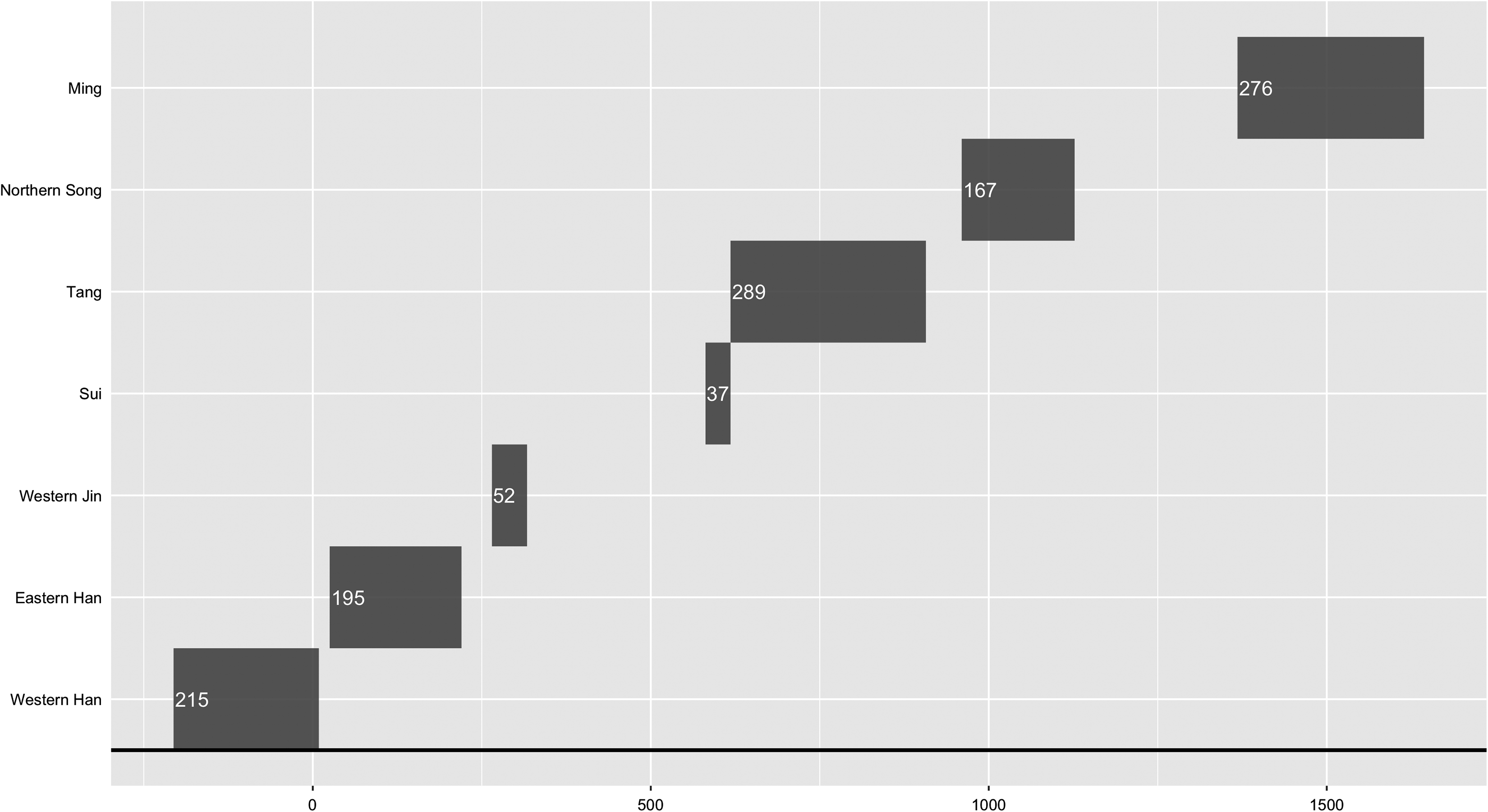
The second reason is that all of these empires were considered to be ruling a unified China. Historically, China experienced several periods of political disunity, each of which lasted for decades, if not centuries. During those periods, multiple regional political regimes co-existed. To ensure comparability of the empires in our sample, we exclude these regional powers and consider only unified empires. 10
Our data come from two main sources: (1) classical texts in Chinese and (2) A Chronicle of Wars in China (Yuan, 2008), a special volume that documents all major wars fought in China since the first empire. A notable feature of classical Chinese historiography is that biographies (liezhuan) constitute the main body of the Standard Histories (zhengshi), which are considered a reliable source and used in related studies such as Cioffi-Revilla & Lai (1995). These biographies provide rich information on important political figures of each dynasty. In addition to biographies, we also consult other historical texts such as chronicles (ji) and tables (biao). These classical texts of Chinese history allow us to uncover important information about the subordinates, including whether they were blood relatives of the emperor, how they died, and their aristocratic titles. At times, we also make use of published tombstone epitaphs to track the death year of some subordinates. For the list of our classical historical references, see Online appendix A. Admittedly, the textual description of the warfare in the biographies, particularly as related to some long-ago dynasties, is inevitably brief. The list of military subordinates that we compiled from the biographies inevitably misses some officials. For this reason, we further make reference to A Chronicle of Wars in China (Yuan, 2008). For many of these wars, the Chronicle provides information on the names of the chief commander and military officials involved.
With these two sources, we have been able to identify 980 key military officers. The mode of death of 647 of these officers can also be identified (see Online appendix G for the list of these officers). These officers either fought in recorded wars or received titles for their military achievement. 11 All were followers of seven founding emperors: Emperor Gaozu of Western Han, Emperor Guangwu of Eastern Han, Emperor Wu of Western Jin, Emperor Wen of Sui, Emperor Gaozu of Tang, Emperor Taizu of Northern Song, and Emperor Taizu of Ming.
Two caveats are in order. Despite the considerable effort we put into identifying the military officers, our list is unlikely to be exhaustive. After all, the Chinese historians who wrote the classical texts probably had scholarly interests in more than warfare. Their works were not intended to provide a comprehensive coverage of the details of every battle, including full lists of the military personnel involved. However, the missing data are unlikely to be randomly distributed; for example, low-ranking military officers were likely excluded. Our sample, albeit truncated, should still allow us to test our hypotheses, as we are primarily interested in the relationship between emperors and their subordinates who were able to threaten the emperors’ survival – namely, military officers of relatively important political standing.
Another potential source of bias comes from the recorded histories. Historians or the producer of the Chronicle (that is, the Chinese People’s Liberation Army Publishing House) may have subjectively interpreted historical events such as the nature of a military conflict. We cannot rule out the existence of such personal or institutional biases. However, such biases may be less of a concern in the current study for two reasons. First, we are collecting factual information about subordinates, including their names, honorary titles, and royal affiliation. The risk of subjective reporting is relatively low. Second, we are dealing with ancient Chinese dynasties, which are not sensitive issues in contemporary Chinese politics. Censorship (King, Pan & Roberts, 2013) or manipulation of the data by cadres for career promotion (Wallace, 2016) is unlikely. Similarly, the classical texts in history were written decades, if not centuries, after the demise of the dynasty in question. 12 It is unlikely that the authors or publishers could benefit from systematic manipulation of the factual data of previous dynasties.
Descriptive statistics
Figure 2 displays the distribution of these officers’ battle experience. As may be seen, most officers fought five or fewer battles. Yet, the distribution has a long tail, suggesting that there is no shortage of officers with a long fighting history. Because the military officers in this study were followers of founding emperors, one might think that they accumulated their battle experience Fighting experience of the subordinates of founding emperors
We identify five modes of death: natural death, death in battle, execution by an emperor (Execution), death after demotion (Demotion), and others. Natural death and execution by an emperor are self-explanatory. A subordinate is classified under ‘death in battle’ if he died in a battle fought on behalf of the founding emperor. ‘Death after demotion’, a less severe type of purge, refers to demoted subordinates who received no exoneration Frequency of wars by empires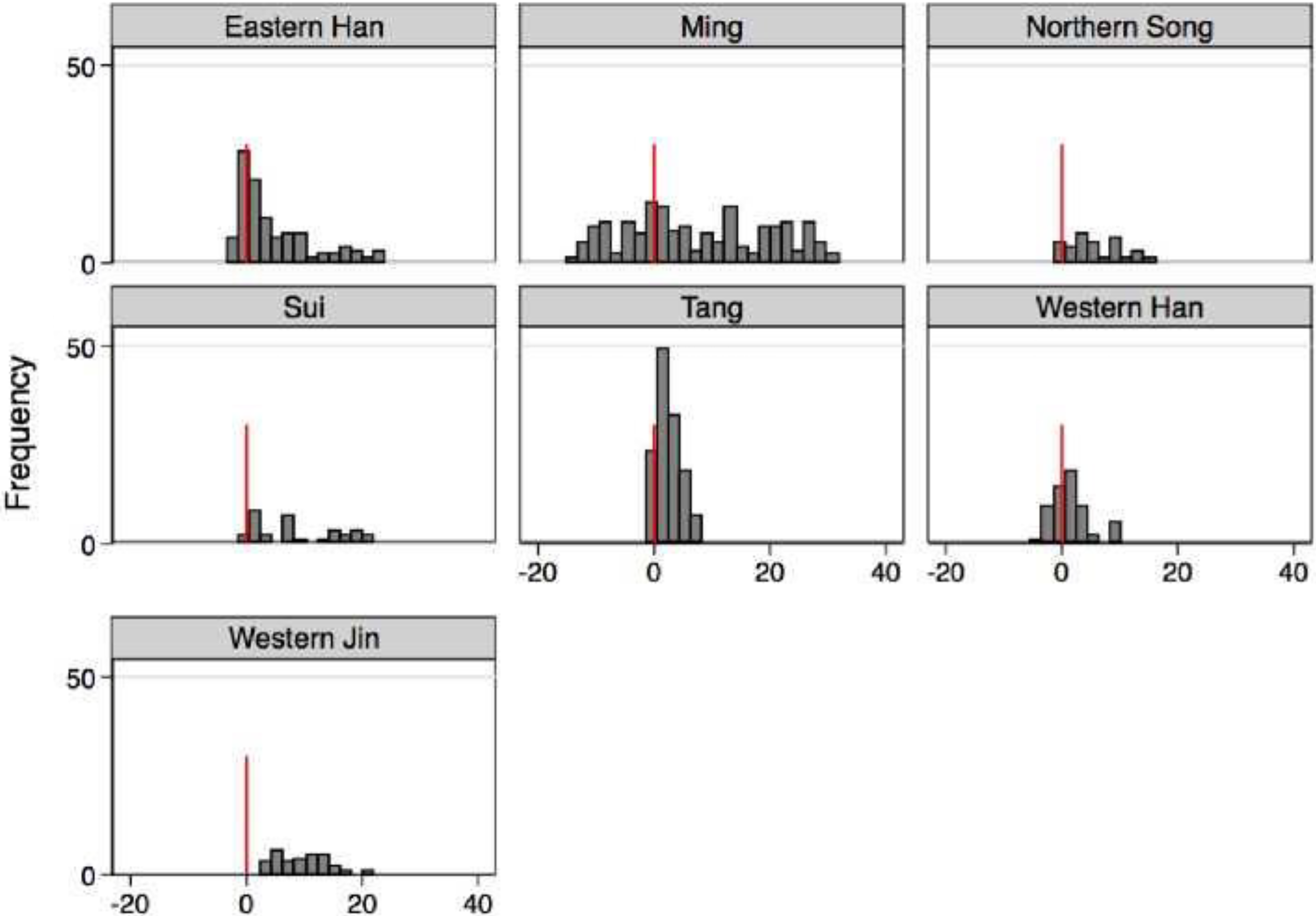
Operationalization
We operationalize ‘experienced military officers’ by counting the number of battles a dictator’s subordinate engaged in (Battle experience). This variable should be positively correlated with a subordinate’s potential threat against the emperor, as he could develop leadership skills and reputation through battles. Similarly, we operationalize ‘high-ranking military officers’ by counting the number of times that a subordinate served as a military commander (Commandership experience).
14
The basic premise is that only the most outstanding officer was Modes of death of the subordinates of founding emperors.
We have constructed a dummy variable, Royal family, that assigns a value of 1 to military officers who have familial ties with the emperor and 0 otherwise. It was not uncommon to see subordinates defect from one warring state to another. We use the subordinates’ biographical information to construct a dummy variable, Former enemy, that assigns the value of 1 to defector subordinates and 0 otherwise.
To test hypotheses related to the timing of purges, we need to have an indicator of power consolidation on the part of the founding emperors. While power consolidation is not observable, we can measure it indirectly. A ruler typically would declare the founding of an empire after stabilizing his rule, which usually manifests itself in significant territorial conquest. We therefore use the founding year of an empire to operationalize the concept of power consolidation. We consider an empire’s political power consolidated in and after the founding year. The variable Time after founding measures the number of years between a subordinate’s death year and the founding year of the empire.
In addition to the founding year of an empire, another crucial time point where power consolidation matters to the founding emperor is his death year; whether he can pass the throne to his designated successor depends on the extent to which the latter’s power is consolidated. An emperor, when still in power, may have an incentive to purge potential challengers against his heir apparent (Bueno de Mesquita & Smith, 2011). In addition, Bueno de Mesquita & Smith (2017) predict that effective purges are more likely carried out by healthy dictators. While no one is able to foretell his or her exact date of dying, a senescent emperor probably had a sense that his days were numbered. We construct a dummy variable, 5 years before emperor’s death, to test if a senescent emperor would become more likely to purge.
Empirical specification
Each subordinate in our dataset experiences one of the five death outcomes, which are mutually exclusive. The outcomes are terminal, such that once an outcome occurs the subordinate leaves the sample permanently. There is no right-censored observation, although some data are missing, as we were not able to trace the death outcomes of all the subordinates.
The data structure is the typical survival data. 15 In our case, the event of interest is how a subordinate dies. Because the subordinates are exposed to multiple survival risks, we analyze the data using competing risk models. There are two common approaches to modeling competing risks: the cause-specific hazard model and the subdistribution hazard model (Austin, Lee & Fine, 2016). Although both approaches are intended to capture the effect of covariates on subjects’ survival risks, there is a subtle difference in the quantities that these models measure. The cause-specific hazard model is particularly suitable for estimating the impact of the covariates on the event of interest, while the subdistribution hazard model is useful when evaluating the effect of the covariates on the cumulative incidence of the event of interest. We provide a more detailed and formal discussion of these models and their differences in Online appendix B. For the current study, which focuses on factors associated with political purges, the cause-specific hazard model is more relevant, although we also analyze the data using the subdistribution hazard model.
To reduce omitted variable bias, we control for a number of factors that may have effects on subordinates’ death. Some officers outlived the founding emperor. Their risk of being purged might change after the death of the founding emperor. On the one hand, it is possible that the risk would increase, because the succeeding emperor, whose reputation was arguably less prominent than his father’s, might find these veteran officers too threatening. On the other hand, it is also possible that the risk would decrease, as these officers might become too senescent to pose any substantial threat to the succeeding emperor. To control for the potential change in the risk of political purges resulting from the founding emperor’s demise, we include a variable, Time after first emperor, that measures the difference between the death year of a subordinate and that of the founding emperor. Finally, to ensure that the effect of the variables related to military experience is driven by military achievement rather than seniority, we control for subordinates’ Seniority, which is measured by the number of years between the founding of the empire and the year in which they fought their first recorded battle. The larger the variable, the longer a subordinate had followed the emperor prior to the establishment of the empire.
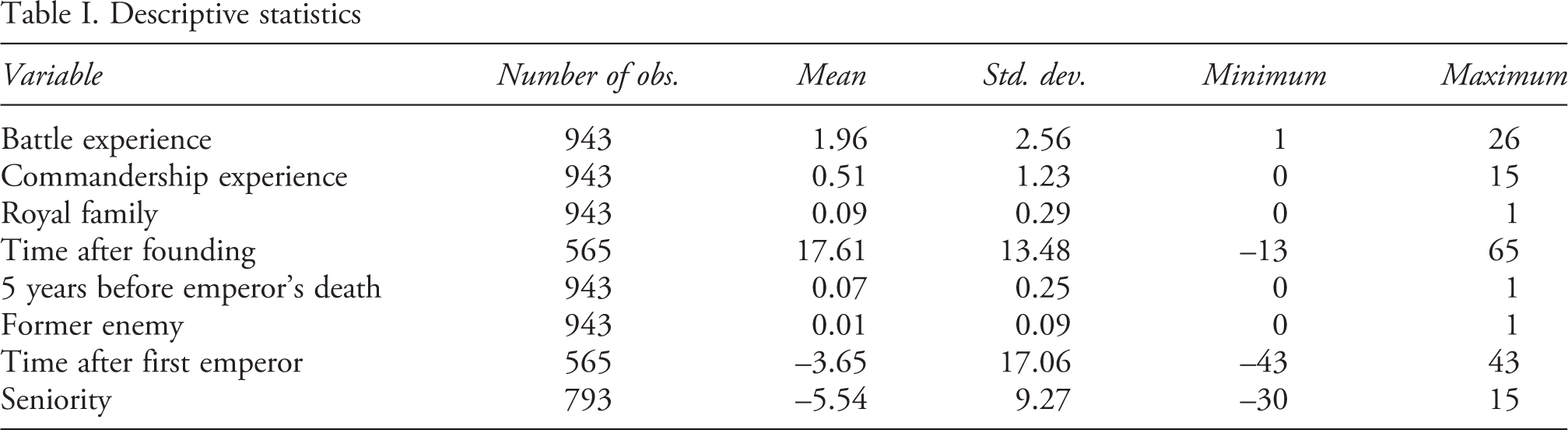
Unfortunately, some basic demographic variables are left uncontrolled for. In particular, we do not control for gender because only one officer in our dataset was female (i.e. Princess Ping Yang of the Tang dynasty). Nor can we control for age because the classical texts provide no information on the birth year of the military officers. Descriptive statistics of all the independent variables are presented in Table I.
Descriptive statistics
Correlates of purge: Competing risk analysis
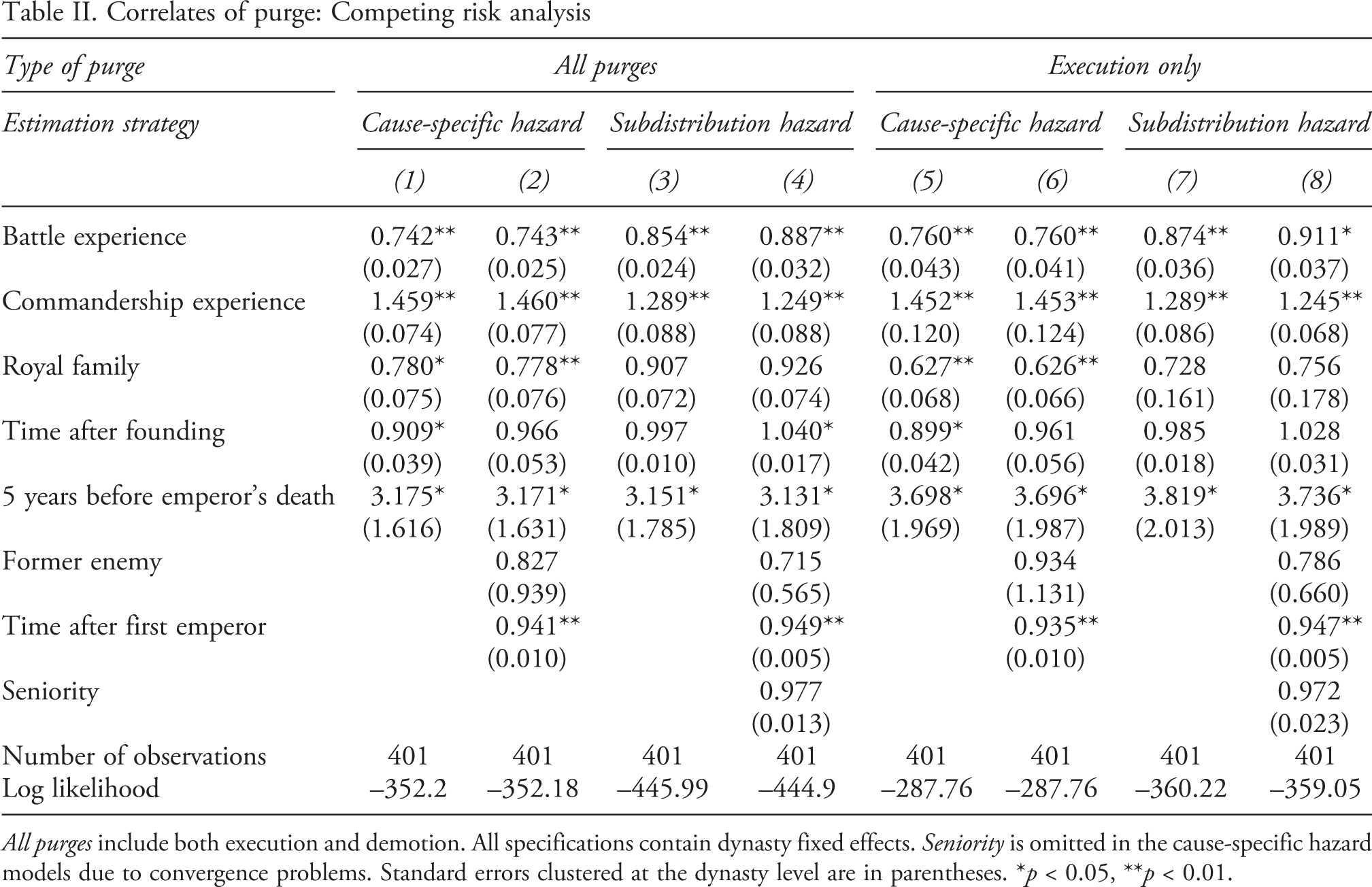
All purges include both execution and demotion. All specifications contain dynasty fixed effects. Seniority is omitted in the cause-specific hazard models due to convergence problems. Standard errors clustered at the dynasty level are in parentheses. *p < 0.05, **p < 0.01.
Results
Main results
Table II shows the results of our empirical analysis. The coefficients displayed are hazard ratios. When hazard ratios are greater (smaller) than 1, this implies that a unit increase in the underlying variable is associated with higher (lower) risks of the event of interest, holding all other variables constant. We divide our data into two subsamples. In the first subsample, we combine Execution and Demotion into a single category, All purges, while in the second subsample we examine Execution only. For each subsample, we run two specifications under each of the two estimation strategies (cause-specific hazard model and subdistribution hazard model). The first contains only the variables of interest. The second specification includes control variables Former enemy, Seniority, and Time after first emperor.
As may be seen from the table, the military experience of subordinates has significant effects on their probability of being purged. Our variables of interest related to military credentials, namely Battle experience and Commandership experience, are both statistically significant across all specifications. Interestingly, the coefficients on these variables show opposite effects; while Battle experience is associated with a lower risk of purges, Commandership experience is associated with a higher risk. The results provide mixed support for the distribution-driven and security-driven theses. On the one hand, founding emperors tend not to purge experienced military officers, which is consistent with the expectation of the distribution-driven thesis (Hypothesis 1b). On the other hand, however, experienced commanders were particularly vulnerable to political purges, which supports the prediction of the security-driven thesis (Hypothesis 2a). Both mechanisms seem to be at work; founding emperors rewarded military officers who had contributed to the empires, insofar as they posed no substantial military threat against the emperors. Note that the results hold, even if we focus only on executions, as shown in Specifications (5) to (8).
It is instructive to compare the substantive significance of the effects of the variables of interest. A convenient way to visualize the impact of variables on subordinates’ chance of being executed is to use the cumulative incidence function (see Online appendix B for a formal definition). To compute the cumulative incidence function, we rely on the estimates of Specification (8), which is related to execution based on a subdistribution hazard model. 16 In the upper panel of Figure 5, we plot the estimated cumulative incidence of execution (Specification (8)) in the presence of competing events such as natural death and death in battles, based on two chosen values of Battle experience: 1 and 3. 17 Twenty years after the first battle, a subordinate who participated in three battles had a probability of about 0.03 of being executed, while the probability for one who had only a single battle experience is somewhat higher (approximately, 0.036).
As a comparison, in the lower panel of Figure 5, we also plot the estimated cumulative incidence of execution (Specification (8)) based on two values of Commandership experience: 0 and 2. The effect of military commandership is pronounced. In particular, 20 years after a subordinate engaged in the first recorded battle, his probability of being executed by an emperor was about 0.04 if he had served as a military commander twice. By contrast, the chance of being executed for an officer who had never served as a military commander is around 0.025 only. In addition, the risk of being purged for Estimated cumulative incidence of execution by emperor: Battle and commandership experiences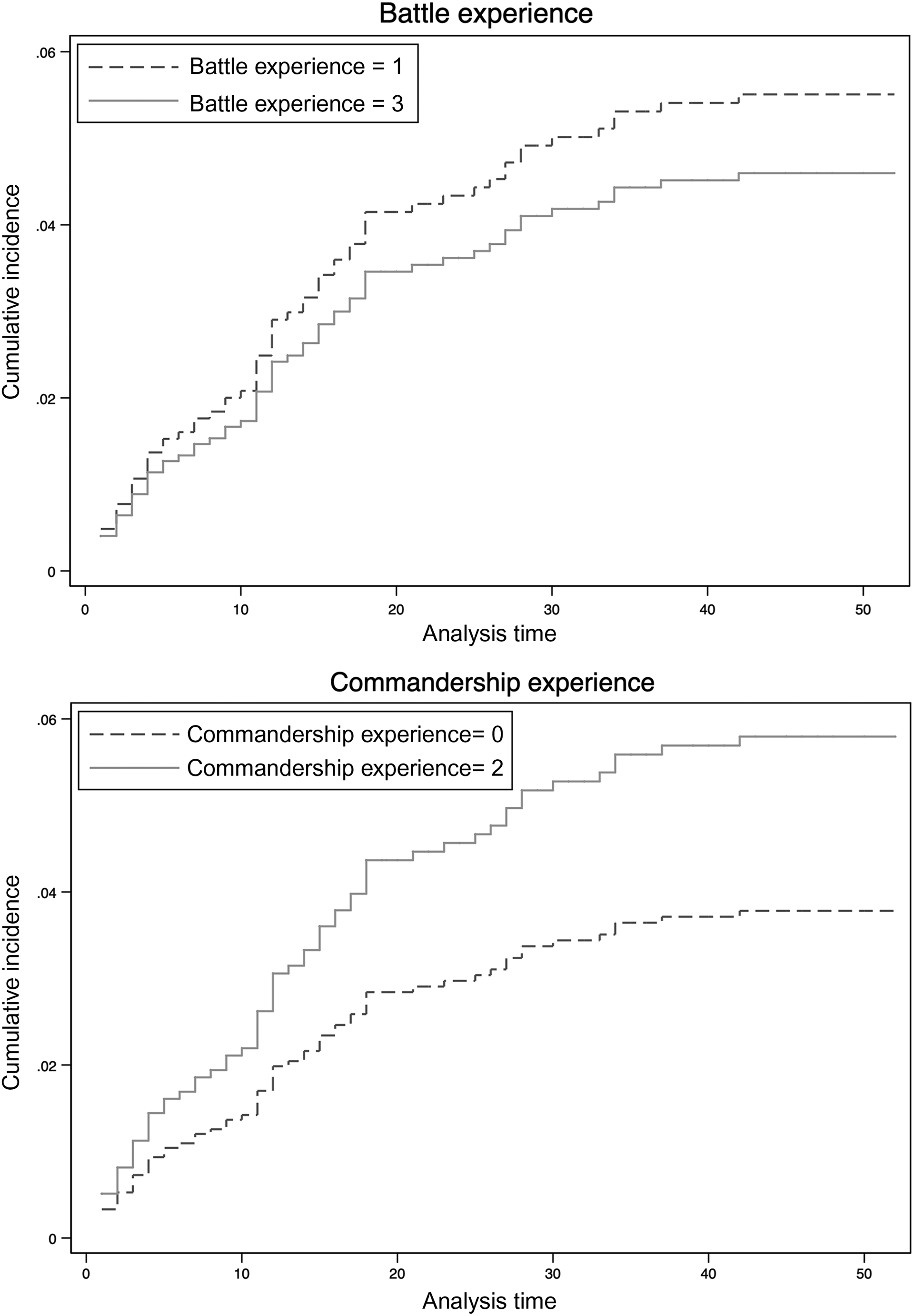
Another variable of interest is Royal family. As may be seen from Table II, the coefficient on this variable is smaller than 1 and statistically different from 0 in all specifications using cause-specific hazard models, implying that being a member of the royal family did make one less likely to become a target of purges. When estimated with subdistribution hazard models, the coefficient on this variable is no longer significant. For this reason, we find partial support for Hypothesis 3b, which is related to the distribution-driven thesis.
As for the variables of interest pertaining to the timing of purges, their effects are mixed. In particular, the variable Time after founding is smaller than 1 in some specifications, but higher than 1 in others. We find no compelling evidence that founding emperors were more likely to purge subordinates before their power consolidation. Interestingly, purges seem to be more relevant to the power consolidation of their successors. The variable 5 years before emperor’s death is associated with higher purge risks and is statistically significant in all specifications, implying that political purges were more likely to occur prior to the death of the founding emperors. The results provide empirical support for the security-driven thesis (Hypothesis 4a); emperors purged subordinates who might threaten the political survival of their designated successors.
Note, however, that the risk of execution becomes significantly smaller after the death of the founding emperors (Time after first emperor). A plausible reason is that the succeeding emperors might have deemed military officers who outlived the founding emperors too senescent to pose any substantial threat. We find no significant effect of Seniority and of Former enemy on purges or execution.
Robustness checks
Table II provides the results of the basic tests of the hypotheses. Many purge dynamics are not fully considered. In this section, we devise additional tests to check the robustness of the previous results, while unraveling the subtle mechanisms of purges masked in the previous broad-brush analysis.
Heterogeneous battle/commandership experiences
Some battles are strategically more important than others. In particular, battles leading toward the establishment of an empire are arguably more crucial than those fought afterward. Empire-building battles also provide military officers the opportunities to develop leadership skills and personal credentials that rival the emperor’s. By the same token, commandership experience during empire-building is associated with a greater perceived threat against the emperor than commandership experience afterward. If the security-driven thesis is correct, we would expect to see a large impact of pre-empire-building battle and/or commandership experience on purges.
Heterogeneous empire-building experiences
Dictators come to power through different means, which in turn structures the political risk they subsequently confront. Most notably, Sudduth & Bell (2018) find that dictators who were able to wipe out the previous regime through revolutions and major coups were less likely to be ousted than rulers who came to power through regular succession. They argue that this is because regime-making signals the strength of the dictators, hence reducing subsequent coup risk. Although all founding emperors in our dataset qualified as regime-changing leaders, the ways they entered office were somewhat different. In particular, three empires (the Western Jin, Sui, and Northern Song) were established by coups d’état. The political risk they faced may therefore be different from the risk confronting revolutionary emperors.
Heterogeneous royal membership
In the previous analysis, we examined royal family as a single category. As mentioned, however, members of the royal family possess two distinct familial ties: blood and acquired ties. Blood ties are natural-born, but subordinates with no blood relation to the emperor can acquire royal ties through intermarriage. As discussed, some founding emperors, such as Zhao Kuangyin of the Northern Song, used intermarriage to neutralize the threats of their military officers. In Chinese dynastic history, only relatives by blood can become legitimate heirs to the throne. In other words, blood relatives should pose a greater political threat to emperors than relatives by marriage. Amalgamating blood relatives and intermarriage into a single category may lead to an underestimated effect of blood relationship on the probability of being purged.
Alternative power consolidation measure
We operationalize power consolidation using an empire’s founding year. One may argue that the founding of an empire may indicate success in quelling external threats, but not necessarily internal ones. Studies show that the first few years of a regime tend to be more politically tumultuous due to a higher incidence of coups (Little, 2017) and of military purges (Sudduth, 2017). For this reason, to test if purges are driven by security concerns, one should focus on the first few years after the founding of an empire, the period when a dictator would consolidate his or her power vis-à-vis other coalition members.
Robustness checks
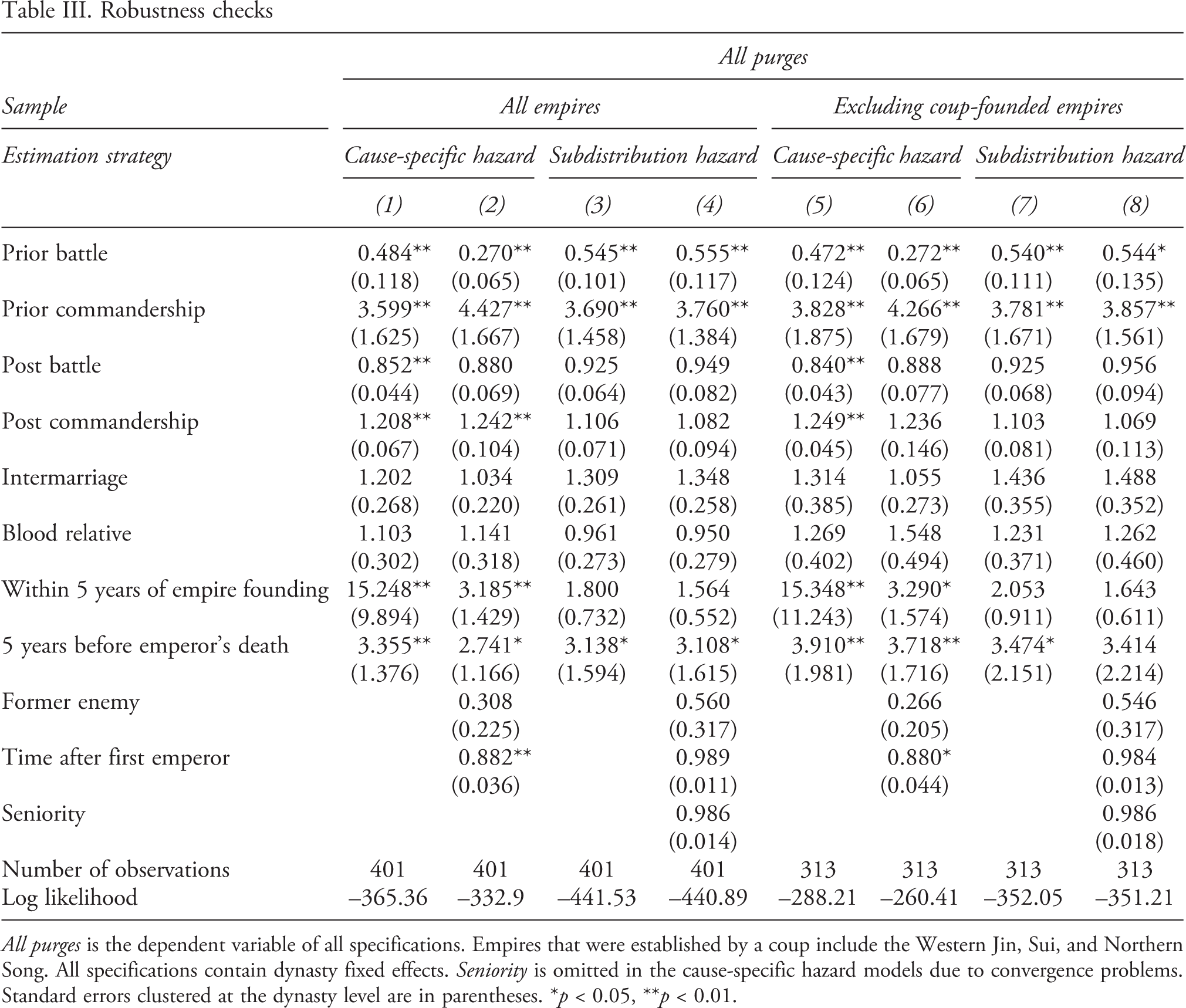
All purges is the dependent variable of all specifications. Empires that were established by a coup include the Western Jin, Sui, and Northern Song. All specifications contain dynasty fixed effects. Seniority is omitted in the cause-specific hazard models due to convergence problems. Standard errors clustered at the dynasty level are in parentheses. *p < 0.05, **p < 0.01.
Table III displays the results of the robustness checks using All purges as the outcome variable. First, consider the variables of interest Prior battle and Prior commandership, both of which are statistically significant in all specifications. As in the main results, these variables have opposing effects on purges. The coefficients on Prior battle are smaller than 1, suggesting that subordinates who engaged in more empire-building battles were less likely to be purged. The obverse is true for subordinates who had commandership experience before the founding of an empire.
Note that the coefficients on Prior commandership are much larger than those on the aggregate measure, Commandership experience. Converting the coefficient of Specification (4) into a probability, we find that a subordinate who had been a commander in two empire-building battles had a 40% chance of being executed 20 years after the first battle. By contrast, for those who had never been a commander, the chance was less than 5%. The effect of Prior commandership is clearly substantively significant.
Consistent with empire-building military experience, the variables Post battle and Post commandership also have opposing effects on purges. In particular, subordinates who fought more post-founding battles were less likely to be purged. Commandership experience after the founding of an empire is still associated with higher probabilities of purges. Compared with Prior battle and Prior commandership, however, the effect sizes of Post battle and Post commandership are much smaller. In fact, the coefficients on the variable Post battle are mostly insignificant, and those on the variable Post commandership are statistically different from zero only in cause-specific hazard models. The results are consistent with our conjecture that there is heterogeneity in the effects of military experience on the probability of purges. Those who developed substantial military credentials through empire-building seemed to pose more credible threats against the founding emperors, thereby more likely becoming the target of a purge. The results here provide support for the security-driven thesis.
As in the main results, we are unable to find a statistically meaningful effect of being a royal family member on the probability of purges, even if we replace the variable Royal family with more fine-grained categories. Neither Intermarriage nor Blood relative is statistically different from 0, suggesting that those who were able to develop familial ties with the founding emperors were no more likely to be purged.
As for the timing variables, the variable 5 years before emperor’s death continues to show a significant correlation with purges in all but the last two specifications. The results are consistent with those in the main analysis; founding emperors seemed to begin another round of purges toward the end of their life, probably in an attempt to remove potential threats against their designated successors. Finally, the coefficient on the variable Within 5 years of empire founding is positive and significant in all cause-specific hazard specifications. This result is consistent with the security-driven thesis; founding emperors were more likely to purge subordinates in the early stage of their empires as a way to consolidate their power.
In addition to the above analysis, we also conduct other tests to check the robustness of the results. We single out demotion as a distinct category of purge, using it as an outcome variable. We find that founding emperors’ blood relatives actually faced higher chances of demotion (see Online appendix C), suggesting that royal family members, especially those who were able to challenge founding emperors’ political legitimacy, were not completely immune from purges, although the punishment they endured tended to be lighter.
Emperors sometimes justified their purges in the name of pre-emptive strikes against a potential plot. We rerun the specifications in the main results by excluding alleged ‘coup plotters’, and find largely the same results (see Online appendix D for a list of alleged coup plotters and appendix E for the empirical results). Finally, to ensure that our main results are not driven by outliers who were exceptionally experienced battle fighters or commanders, we rerun the specifications in Table II by winsorizing the variables of interest, Battle experience and Commandership experience. As may be seen in Online appendix F, the results are largely the same as in Table II.
Conclusion
How to resolve the mutual threats between dictators and the members of their coalition of support is considered a ‘fundamental problem of politics in authoritarian regimes’ (Svolik, 2009). At the heart of this conflict is dictators’ ability and desire to maim coalition members. One way to do it is to purge them, a tactic that has been practiced by dictators since ancient times. Despite its long history, much about political purging remains poorly understood. In particular, there is no scholarly consensus on the likely targets of purge. One view (the distribution-driven thesis) holds that a dictator has a strong incentive to reduce the membership of the ruling coalition, in order to maximize his or her own gains as well as those of the remaining coalition members. Another view (the security-driven thesis) emphasizes the perceived security concerns behind political purges: dictators want to minimize their survival risk, which usually comes from within the ruling coalition.
These two views are associated with different empirical implications; we test these implications using an original dataset that contains information on the subordinates of the founding emperors of seven ancient Chinese dynasties. We find mixed results with regard to the target of purges. On the one hand, founding emperors were more likely to purge less experienced military officers, suggesting that they went after ‘easy targets’, which is consistent with the prediction of the distribution-driven thesis. On the other hand, they were also more likely to purge military commanders who had made significant contributions to empire-building, implying that subordinates who posed greater existential threats against founding emperors were likely purge targets.
As for the timing of purges, our data analysis shows evidence more in favor of the security-driven thesis. Commandership experience during the empire-building period was associated with a greater risk of purges than commandership experience after the founding of an empire, implying that empire-building commanders were deemed more politically threatening by founding emperors. Senescent emperors were more likely to purge subordinates. This may reflect their anxiety over the stability of their succession plan. In addition, many political purges began even before the founding of an empire, which suggests that autocratic power consolidation is endogenously determined by political purges. In other words, dictators mount purges and purges mount dictators.
Footnotes
Replication data

Acknowledgments
We thank Ting Chen, Enze Han, Jean Hong, Junyan Jiang, James Kung, Tao Li, Daqi Liao, Frank Liu, Kai Quek, Vivian Zhan, and Jiangnan Zhu for their helpful feedback. We also thank the participants of the 2019 Empirical Political Science Working Group in Hong Kong (EPSinHK) for their generous comments. We are grateful to Doris Chen for research assistance.