




Abstract
Scholars observe that armed non-state actors (NSAs) often provide social services to reinforce their popular support and legitimacy as guarantors of local order. On the other hand, NSAs usually face funding constraints that make the independent provision of distributive goods difficult. This article argues that armed NSAs employ an alternative, more cost-effective tactic to deliver services. It argues that militant groups can leverage their armed capacity to capture control of and monopolize access to state-sponsored services. As an example, it documents the capture of public electricity infrastructure that took place in post-invasion Baghdad under the Sadrist Movement, an armed group formed shortly after the ouster of the Ba’athist state. Using local-level information about the location of Sadrist offices and remote sensing data, it estimates that Sadrist-affiliated neighborhoods in Baghdad saw an average increase in access to electricity between 2003 and 2006 that was significantly greater than in other areas of the city. The article concludes by addressing threats to inference, showing that these differences are not alternatively explained by demographic differences or changes therein due to ongoing conflict. It also discusses how this NSA strategy might contribute to an equilibrium of low state legitimacy and weak capacity in fragile contexts like that of post-2003 Iraq.
Keywords
Introduction
A rapidly expanding literature investigates how and why non-state actors (NSAs) provide a range of social services (Gough et al., 2004; Helmke & Levitsky, 2004; Cammett & MacLean, 2014). NSAs involved in the provision of social welfare range from nongovernmental organizations and faith-based associations to political movements and armed groups. The role of NSAs is particularly pronounced when states neglect, for a variety of reasons, to assume a proactive role in service provision. Economic crises and political conflicts often simultaneously lower the state’s capacity to distribute goods and raise the profile of actors operating outside of – sometimes in opposition to – the government itself. As a result, NSAs often substitute for an absent or crippled public sector, and may even co-produce goods in collaboration with state efforts (Gough et al., 2004; Boege, Brown & Clements, 2009). Previous scholarly work demonstrates the role NSAs play in the independent provision of security (Meagher, 2012), healthcare (Cammett, 2014), and other infrastructural goods (Lee, Walter-Drop & Wiesel, 2014; Post, 2014).
This article builds from existing theories of non-state welfare provision and highlights a different strategy employed by NSAs. It argues that NSAs also distribute social welfare by capturing and monopolizing access to previously extant public services. It argues that, when an NSA maintains the capacity to enforce order, the informal acquisition of control over services formally provided by the state is a cheaper alternative to investing in independent service provision. Through the capture of state resources, NSAs can monopolize local control of the services in question for the purpose of engendering popular support and legitimizing their role as purveyors of social order. This relationship between NSAs and the state should arise in places where the following scope conditions are met: lack of state monopoly over violence, coupled with some baseline of welfare investments by the state prior to attenuation of its administrative capacity.
To provide empirical evidence for this argument, the article investigates neighborhood-level changes in access to electricity between 2003 and 2006 in Baghdad. Prior to 2003, successive regimes controlling the Iraqi state invested in electricity infrastructure, usually concentrating their efforts on the capital. After the 2003 US military invasion, both Iraqi and international sponsors moved quickly to repair damage done to the grid, again focusing most heavily on the country’s densely populated political center. Yet during this period, the Iraqi state also saw a steep decline in its capacity to enforce order, ceding control to a variety of armed NSAs. Numerous secondary accounts indicate that one such organization, the Sadrist Movement, used its armed capacity to capture control of public electricity in Baghdad, allowing them to administer its provision and divert this scarce resource to their supporters (Zorpette, 2006; Cockburn, 2008; Wright, 2018).
Using annual nighttime lights imagery and information on the location of Sadrist Movement offices in Baghdad, the article shows that Sadrist-affiliated neighborhoods saw an increase in electricity access that exceeded other areas by about 6.4 percentage points on average. These findings hold when local-level population and population density changes are controlled for, which helps to address the confounding roles likely played by residential sorting, forced displacement, and violence during this time period. The article then discusses selection into treatment (i.e. why Sadrist offices were created in some neighborhoods, but not others) and shows that the effect of neighborhood-level Sadrist affiliation on electricity does not predate the 2003 invasion. It also addresses the relationship between Sadrist affiliation and neighborhood-level sectarian composition. It employs several empirical tests to reassure against the argument that Shi’a-dominant neighborhoods enjoyed favoritism from the central state after 2003.
These findings contribute to social science literature documenting the variety of strategies employed by NSAs to reinforce political support and legitimate their status as guarantors of social order. While some NSAs may co-produce services with the state to bolster state legitimacy, this article highlights how different, more predatory forms of service co-production contribute to an equilibrium of state weakness. The capture of previously extant infrastructure to provide services to constituents allows NSAs to secure locally dominant status at the expense of the state while avoiding costly and time-consuming investment in independent welfare systems.
Service provision strategies by non-state actors
A large literature demonstrates that NSAs play a critical role in various aspects of governance despite definitionally not holding state power. NSAs have outsize power in contexts where governments demonstrate a lack of capacity to provide the goods commonly associated with contemporary sovereign statehood such as security, infrastructure, and other basic welfare services (Gough et al., 2004; Acemoglu, 2005; Cammett & MacLean, 2014). There exist countless examples of NSA intervention into the provision of water (Post, 2014), electricity (MacLean et al., 2016), garbage collection (Patel, 2007), healthcare (Cammett, 2014), financial aid (Baylouny, 2010), and policing (Fearon & Laitin, 1996; Davis, 2009). Scholars have noted that the relationship between the state and NSAs can be characterized by competition, co-production, or acceptance of mutually distinct scopes of action (Helmke & Levitsky, 2004). Underlying these theoretical configurations is an assumption that NSAs invest independently in the provision of services, which subsequently places them in a neutral, antagonistic, or partnered relationship with the state.
These relationships between the state and outside actors often prominently feature in contexts where NSAs have the capacity to use violence. A large scholarship shows how militias and paramilitary organizations enforce order under conditions in which the central state and its military have dissolved (Arjona, 2014; Jentzsch, Kalyvas & Schubiger, 2015). Apart from security provision as a type of public good, some scholars note that militias are structurally better poised than alternative types of NSAs to provide other distributive goods because they often construct effective ‘statelets’ where they monopolize force in conflict contexts (Picard, 2000). This type of monopoly control is essential in order for NSAs to demand costly action from their beneficiaries: without it, recipients can simply look elsewhere for competitor options. Conversely, militias and other armed non-state groups that establish themselves as key purveyors of security and other services are logically better poised to gain support and extract costly action from said constituents.
Many examples exist of armed NSAs that concomitantly wielded force and provided a broader array of distributive goods to their supporters, or to those living in areas heavily occupied by perceived supporters. During the Lebanese civil war (1975–90), a variety of militias established independent modes of taxation and social welfare provision within the largely co-sectarian geographic enclaves they controlled (Picard, 2000). Analogous examples of militia provision of not only security, but also a variety of other services have been detailed in Latin America (Arjona, 2014), sub-Saharan Africa (Mampilly, 2011), and Western Europe (Kalyvas, 2000).
Why do militias provide costly social services under conditions of state failure? That militias can provide such goods does not necessarily mean they should. Given the financial constraints most militias face in financing directly combat-related activities, it is not immediately apparent why they should also invest in providing welfare services. Scholars do show that provision of club goods increases loyalty to armed groups by legitimating their status as guarantors of local order (Berman & Laitin, 2008; Guichaoua, 2010). Others show that militia intervention into social welfare provision paves the way for such groups to gain electoral popularity and attain power within the state (Eaton, 2006; Lyons, 2016). Provision of social services also acts as a proof of concept by demonstrating to local audiences that a militia is capable of running the postwar state (Stewart, 2018). 1
Scholarly perspectives on service provision by armed NSAs also consider how the reinforcement of their popularity and legitimacy affect that of the state. A large literature demonstrates that NSAs and states may co-produce social services in a way that simultaneously reinforces the legitimacy 2 of both (Ostrom, 1996; Tsai, 2007; Mustasilta, 2018). In cases where the state has a low perceived baseline of capacity for service provision, NSA service provision often further undermines state legitimacy. Perceptions of how and by whom a service is being provided mediate people’s understanding of which political actors deserve respect or obedience (Corbridge et al., 2005; Mcloughlin, 2015). Indeed, this is one reason scholars have noted that nascent states expand their social service delivery systems in the first place: to establish loyalty and quash alternative power sources (Van de Walle & Scott, 2011). In contexts where the state is not perceived as an efficient guarantor of order, provision of basic governance goods by NSAs further reinforces a sense that the state does not represent such a guarantor, and is thus not a legitimate source of authority (Leander, 2005; Sacks, 2011). Brinkerhoff & Johnson (2009) demonstrate that this characterizes the post-2003 Iraq context, in particular, with NSA service provision reinforcing, rather than ameliorating perceptions of state weakness. To that end, observers note how the Sadrist Movement’s social service provision across lower-income Shi’a majority areas of Baghdad and elsewhere in Iraq has played a key role in perpetuating its legitimacy while that of the state continues to falter (Kathem, 2018).
In sum, prior scholarship highlights the incentives for militias to provide welfare services as a way of legitimating their authority at the expense of the state’s in low-capacity contexts. The range of strategies militias use to provide these club goods, however, remains under-examined. Independent procurement of the inputs necessary for certain welfare services, such as electricity, water, and sewage, is both expensive and time-consuming. The properties of these goods – the complex infrastructural systems and up-front investment they require – make them simultaneously very visible and in-demand, but also more difficult to provide (Krasner & Risse, 2014). More immediately visible and demanded services are thus likely to bring higher rewards to militias that provide them in terms of legitimation, similar to how services with such properties bring higher returns for states that provide them (Corbridge et al., 2005; Krasner & Risse, 2014). Yet constraints on time and financing are more severe for many militias than for states with existing modes of revenue generation and the international legitimacy necessary to acquire donors. Certainly, militias rely on both autonomous revenue generation and donor funding, but both sources are painstaking to acquire as well, particularly in their nascency (Fearon & Laitin, 2003).
On one hand, therefore, militias seeking to provide social services under financial constraints might choose to provide cheaper goods. Provision of services that require less investment into infrastructure represents an efficient strategy insofar as it limits sunk costs – thus ensuring minimal losses if the group were to eventually lose territorial control in the area where it invested. On the other hand, however, provision of cheaper services lowers the cost of competition from adversaries, that is, other militia groups aiming to gain support from the same population, other unarmed non-state actors, or the state. Once multiple actors enter the governance marketplace, the price of gaining support should increase, thus defeating the purpose of providing cheaper services in the first place.
Cost-constrained militia organizations, therefore, face a dilemma in their ultimate aim to monopolize control over the provision of social order. Cheap service provision invites competitors, but expensive start-up investments into infrastructure are risky and may prove futile if territorial losses are incurred. This article describes and tests the implications of a third path that resolves this dilemma. I argue that armed groups distribute social services through the capture of state-funded public infrastructure and subsequent exclusion of competitors from control over these resources. I argue that such groups leverage control over extant state resources for the same reasons described in prior literature, namely, to attract new supporters and retain existing ones. This article, however, explicates a cheaper and heretofore unexamined mechanism by which armed groups accomplish these goals.
This strategy, of course, involves considerable risks, placing militia organizations at contentious odds with state authorities where they might once have been co-producers of security (Staniland, 2015). In cases where the state maintains a high enough capacity to enforce order, where the militia in question is sufficiently weak relative to state authorities, or where public infrastructure has been degraded to a high degree, the dynamics described in this article are not likely to emerge. Where the converse is true, however, the capture and monopolistic protection of state-sponsored social services – even their barest remnants – constitutes an economical alternative to independent investment into services by militia groups. The section that follows describes how one organization, the Iraq-based Sadrist Movement, began to employ this tactic in the aftermath of the 2003 US invasion and subsequent collapse of state-sponsored order.
Historical background
The Sadrist Movement was formally created in 2003, but its roots trace back to Shi’a political opposition that accompanied the Ba’athist regime throughout its tenure (1963–2003). The Sadrist Movement’s leader since 2003, Muqtada al-Sadr, leveraged networks cultivated over four decades following the US overthrow of the Ba’ath party to formalize an armed organization. While ideologically positioned against the US-sponsored regime, the Sadrists also deftly relied upon their armed capacity to gain control of public infrastructure in the neighborhoods they controlled. Accounts from first-hand observers clearly link the provision of electricity in Sadrist-affiliated neighborhoods to the movement’s strategy of capturing and monopolizing state resources.
Origins of the Iraqi Sadrist Movement
The Iraqi Ba’ath party came to power following a coup in 1963. Shortly thereafter, a small number of organized movements emerged as critics of the Ba’athist government. Chief among these was the Da’wa party (Hizb al-Da’wa al-Islamiyya), an Islamist movement created in 1968 3 and developed over the next decade under the spiritual leadership of Muhammad Baqir al-Sadr, a Shi’a cleric and philosopher (Batatu, 1981; Jabar, 2003). The state responded to the party’s efforts by persecuting Shi’a clerics who became involved with political opposition. By the late 1970s, the Da’wa party had relocated its headquarters to Iran, and Al-Sadr himself was executed in 1980 by the order of then-President Saddam Hussein (Isakhan & Mulherin, 2018).
Active opposition by Shi’a political movements against the Iraqi state largely dissipated during the Iran–Iraq War, which lasted from 1980 to 1988 (Khoury, 2013). Yet 1991 brought a new wave of protest led by Kurdish and Shi’a forces across the northern and southern districts of the country, which later became known as the Sha’aban Intifada. The rebellion largely consisted of lightly armed bands that attacked government buildings and managed to temporarily liberate a number of major cities in Shi’a- and Kurdish-majority areas. Military members who remained loyal to the Hussein regime, however, crushed the rebellion (Khoury, 2010). Following the uprising, Hussein began to enact an increasingly harsh and diverse set of policies targeted at individuals and collective groups perceived as disloyal (Tripp, 2007; Blaydes, 2018).
In the aftermath of the failed 1991 uprising, a loose network of Shi’a political activism was established by Muhammad Sadeq al-Sadr, cousin of the assassinated former Da’wa party leader. Sadeq al-Sadr’s activism, based in the lower-income Shi’a neighborhood of Baghdad then known as Revolution City (now Sadr City), was distinct from that of the Da’wa party. Throughout the 1990s until al-Sadr’s assassination in 1999, his movement comprised a blend of regime opposition, rejection of religious quietism, populist ideology, and locally rooted clientelist networks (Harling & Nasser, 2007; Robin-D’Cruz & Mansour, 2020). Harling & Nasser (2007) refer to al-Sadr’s political activism during this time as distinct from the organizational apparatus typically associated with parties (like Da’wa), but instead as a flexible political trend rooted in Islamic activism intersecting with class-based concerns of the urban poor. Al-Sadr’s primary formal activities during this period centered around forming more direct ties between the Shi’a population and clerical leadership, culminating in the reinstallation of Friday prayers, a practice previously disavowed by Iraq’s Shi’a religious establishment (International Crisis Group, 2006).
Following al-Sadr’s 1999 assassination, his informal movement lay dormant until the 2003 US invasion of Iraq and overthrow of the Hussein regime, which granted an unprecedented level of freedom to Shi’a political expression. Al-Sadr’s son, Muqtada, began mobilizing supporters of his father in Baghdad’s Sadr City and elsewhere shortly following the invasion while concomitantly organizing an armed wing for the movement, the Mahdi Army (Jaysh al-Mahdi, or JAM). Following the 2003 invasion, what became known as the Sadrist Movement moved toward more formal modes of organizing, which included openly establishing offices and forming local committees to address looting and other security violations (Cockburn, 2008; Wright, 2018). Over the next several years, the movement expanded its activities in Baghdad’s Shi’a-majority urban neighborhoods and beyond the capital, into many of the country’s central and southern districts. The movement distributed cash and other material assistance, building off pre-existing networks of support established in the 1990s as mechanisms of revenue collection and welfare distribution (Cammett, 2014).
By 2003, the Sadrist Movement had emerged as an armed NSA seeking to delegitimize the US-sponsored Iraqi government and legitimize its own authority among pre-existing bases of support. Like a variety of similar militant organizations, it based much of this popular legitimacy on its ability to provide concrete services to its constituents, albeit under considerable financial constraints given its nascency and working-class base of support. An International Crisis Group (2006: 18) report states that al-Sadr ‘promote[d] a system under which his followers take direct possession of whatever resources they can acquire – a far more fluid leadership style in which he directs less than he referees and adjudicates. Part of the explanation, of course, is that the Sadrists’ revenue sources are quite limited’. The following section describes how the Sadrist Movement directed this strategy specifically toward gaining control of Iraq’s structurally vulnerable electrical grid to provide a highly sought-after, scarce service to the neighborhoods where it based its operations.
Electricity provision in Iraq after 2003
Following the 1963 Ba’athist coup, the state embarked on an ambitious developmental agenda. This included expansion of electricity infrastructure, previously developed during the late Ottoman era and under the British mandate, beginning in urban areas like Baghdad, along with Basra, Erbil, and Mosul (Jackson, 2016). Subsequent expansion continued during the pre-Ba’ath monarchy period (Batatu, 1978). The decade that followed the Ba’athist ascent to power saw significant improvements in the national standard of living and the growth of a new middle class (Khoury, 2013). Some of this progress was halted by the Iran–Iraq War, which crippled the Iraqi economy and was followed by over a decade of further debilitating international sanctions. Sanctions had a particularly impactful effect on the electricity sector, leading to a slow repair of damage incurred during the war and intermittent power outages due to low generation capacity (Gordon, 2010).
In the first two months of the 2003 US invasion of Iraq, however, production of electricity plummeted to approximately one-fourth of pre-invasion levels, and over 50 transmission towers were damaged. The violent sabotage that became common in the postwar era resulted in further deterioration. As such, the USA named recovery of the electrical grid as the first priority of the reconstruction period (Bowen, 2009). After the 2004 election of the Coalition Provisional Authority, the Iraqi Ministry of Electricity began working with the US government to repair the power grid (Alahmad, 2013; Berman, Shapiro & Felter, 2011). Yet by 2006, the amount of power being generated – though above prewar standards – still fell far short of the nation’s needs. This discrepancy between supply and demand stemmed from a combination of poor planning and corruption on the part of various state ministries, coupled with insufficient government revenues (Zorpette, 2006; Alahmad, 2013).
The structure of electricity provision in Iraq made the grid particularly vulnerable to control by different armed actors. Systematic record of the Iraqi electricity grid is scarce – US occupying forces discovered upon entry that no map of the electricity grid even existed (Alahmad, 2013). Power plants exist throughout the country, concentrated around Baghdad, as well as the north and far south of nation, where the majority of natural resources are located (Zorpette, 2006). The current generated by these large plants is then sent through transformers that increase the voltage, which allows power to travel across longer distances. High-voltage transmission lines then direct power across the country until it reaches electrical substations, where voltage is lowered so that power can be distributed to individual neighborhoods and homes along smaller lines.
For states where larger power plants generate enough electricity to meet the demand, these neighborhood-level substations need only ensure that voltage is reduced so that power can be successfully supplied at the local level. In many developed countries, substations are fully controlled by a remote, centralized monitoring system, which improves efficiency and lowers operating costs. In Iraq, however, where electricity supply consistently fails to meet demand, the dispatch operators of local substations exercise enormous control over who gets access to electrical power, and when. ‘A typical substation might have dozens of feeders, each of which might supply power to a large neighborhood’, Zorpette (2006: para. 101) stated. ‘There isn’t nearly enough power to keep all the feeders on at once, and it is the dispatch operator’s job to turn feeders on and off […] By simply doing their jobs they make countless people suspicious and angry, every day’.
Several observers based in Iraq immediately after the invasion assert that local political actors exerted key influence over substation dispatch operators. After 2003, the electrical grid was divided into neighborhood-level territorial fiefdoms with high capacity to override official directives from the Ministry of Electricity, given that switches were physically controlled in local dispatch centers rather than the Ministry headquarters (Zorpette, 2006; Glanz & Farrell, 2007). Substation operators who attempt to follow the commands they receive from the national dispatch center faced frequent threats from local militias (Agnew et al., 2008; Stone, 2008). In this vein, an American lieutenant observed that armed militia members ‘could threaten or bribe substation operators to withhold electricity from one area and provide uninterrupted electricity to other areas’ (Spinner, 2004: para. 24). Wright (2018: 144) observed that the Sadrists took control of several Baghdad substations in precisely this way in order to redirect electricity to areas of core support. Cockburn (2008) corroborates this claim with an anecdote in which a Sadrist militia member went to the house of an official responsible for ordering electricity cuts and threatened him, resulting in several unprecedented days of uninterrupted access. One Sadrist Movement member subsequently declared: ‘We, the young men, organized ourselves and volunteered, without anybody leading us, to guard public property […] We guarded power stations, transformers, and electricity cables, so if there was any electricity at all in Baghdad after the fall of Saddam, it was because of al-Sadr’s followers’ (Cockburn, 2008: 117). Relatedly, others state that when the Iraqi government began providing free fuel to small generators that emerged in response to frequent outages, the Sadrists went to supporter households and ensured they had access to generator power (Fantappie, 2011).
Qualitative accounts from the immediate aftermath of the US invasion suggest that the Sadrist movement began to control how public electricity was provided at the neighborhood level. These efforts did not require the Sadrists to make costly investments into electricity infrastructure or natural resource extraction. These observations ground the empirical analysis laid out in the following section, which tests whether Sadrist-affiliated neighborhoods systematically received better access to electricity in the years following the collapse of the Ba’athist state.
Data and research design
Dependent variable
The main outcome of interest for this article is electricity provision, and more specifically changes in electricity provision between 2003 and 2006. To measure this outcome, the article uses data collected from the Defense Meteorological Satellite Program-Operational Linescan System (DMSP-OLS), which provides yearly composite images of worldwide ‘nighttime lights’ beginning in 1992. These images are geocoded and edited for clouds and gas flares – an important correction for many developing countries, including Iraq, in which oil and gas production sites experience frequent bright flares. The DMSP-OLS annual data provide an accurate assessment of spatial variation in the overall quantity and quality of electricity at a highly localized level, as various studies have demonstrated (Agnew et al., 2008; Golden & Min, 2013; Min & Gaba, 2014; De Juan & Bank, 2015). Lights are measured on a scale from 0 to 63, the former representing a complete lack of light output, and the latter the maximum level of detectable coverage. These data also likely capture light output from the private generators that emerged throughout Iraq after 2003 to compensate for the inadequate public electricity grid. Accounts of the generator industry in Baghdad at this time state that initial investments were usually made by private entrepreneurs (Zorpette, 2006; Wright, 2018). In some areas of Baghdad, the Sadrists would subsequently assume control of the pre-existing private generator industry. Therefore, if private generator outputs are partially responsible for the systematic changes I expect to observe across different areas of Baghdad, this is still consistent with the core argument of the article: that the Sadrists efficiently provided electricity by capturing control of extant infrastructure.
To compare light output across Baghdad neighborhoods, I measure the average annual light output for 84 neighborhoods, the boundaries of which are delineated based on a map created by Charles Izady in collaboration with the Gulf/2000 project at the Columbia University School of International and Public Affairs, later adapted slightly by Cammett (2014). These neighborhoods are nested within Baghdad’s nine administrative districts.
Explanatory variable and control items
This article tests the claim that neighborhoods where the Sadrist Movement maintained a greater organizational presence and popular support gained higher levels of access to electricity in the years immediately following the collapse of the Ba’athist state. To proxy for Sadrist presence and popularity, I rely on data collected by Cammett (2014) in collaboration with the International Crisis Group between 2003 and 2009. The dataset contains the location and description of each Sadrist Movement office or Primary Health Center founded during that time period. The data were collected by a researcher based in Baghdad and cross-checked with the now-defunct Sadrist Movement website, which provided a comprehensive record of all events that were sponsored by their offices.
For the purposes of the empirical analysis in this article, I restrict the scope only to offices founded between 2003 and 2004 in Baghdad, eliminating offices created well into the post-treatment period. Figure 1 displays and names the eight neighborhoods in which Sadrist offices were built during this time. I then coded a binary variable for each neighborhood indicating whether it contained a Sadrist office founded during the 2003–04 period.
Population size is one of the most concerning confounders for studies that use nighttime lights as a proxy for electricity provision. Changes in population or population density are problematic for measuring change in output over time if we suspect that these changes are correlated with the explanatory variable of interest. To account for this, I use data collected by the Oak Ridge National Laboratory’s LandScan Global Population Database, which provides information on ambient population (averaged over 24 hours) at an approximately 1 km resolution. These data represent the finest resolution global population distribution data currently available. 4
Another important confounding variable for this empirical analysis is neighborhood-level ethno-sectarian composition. Given the linkages between the Sadrist Movement and the Shi’a community of Iraq, it is unsurprising that Sadrist offices were largely constructed in Shi’a majority neighborhoods. Differences between Sadrist affiliated and unaffiliated neighborhoods, therefore, could merely be a product of some other dynamic associated with the Shi’a of Baghdad during this time. To control for ethno-sectarian composition and employ a placebo test (discussed in the following section), I again use spatial data from the Gulf/2000 project adapted by Cammett (2014). Each of the 84 neighborhoods in Baghdad is coded as Shi’a dominant (76–100%), majority (51–75%), mixed (26–50%), minority (1–25%), or non-Shi’a. Since Baghdad is a city populated overwhelmingly by Shi’a and Sunni residents, this functions as a proxy for the relative balance of residents between the two sects. 5
Difference-in-differences design
To evaluate changes in the distribution of electricity across Baghdad neighborhoods, I employ a difference-in-differences model. This measurement strategy allows me to causally assess the effect of Sadrist affiliation on neighborhood-level electricity access by comparing changes within affiliated and unaffiliated neighborhoods between 2003 and 2006. Table I details differences between Sadrist and non-Sadrist neighborhoods between 2003 and 2006, highlighting the disproportionately Map of Sadrist office locations by neighborhood in Baghdad, 2003–06
A difference-in-differences approach helps mitigate concerns that different neighborhoods systematically vary along unobserved time-invariant characteristics also associated with the outcome variable of interest, electricity provision. This is because a difference in differences strategy relies upon the assumption of parallel trends, not parallel starting points. In an experimental setting, therefore, random assignment to treatment eliminates the need to control for time-invariant pre-treatment factors that vary systematically between ‘treated’ (i.e. Sadrist) and ‘control’ groups, such as population density. A balance table comparing pre- and post-period population density between Sadrist and non-Sadrist neighborhoods can be found in the Online appendix. As is standard for difference-in-difference analyses, I use a pooled linear regression model with time and unit fixed-effects, restricting the analysis to within-neighborhood change over time. Standard errors are robust and clustered at the neighborhood level to account for interdependence between unit observations.
Change in nighttime lights by Sadrist affiliation
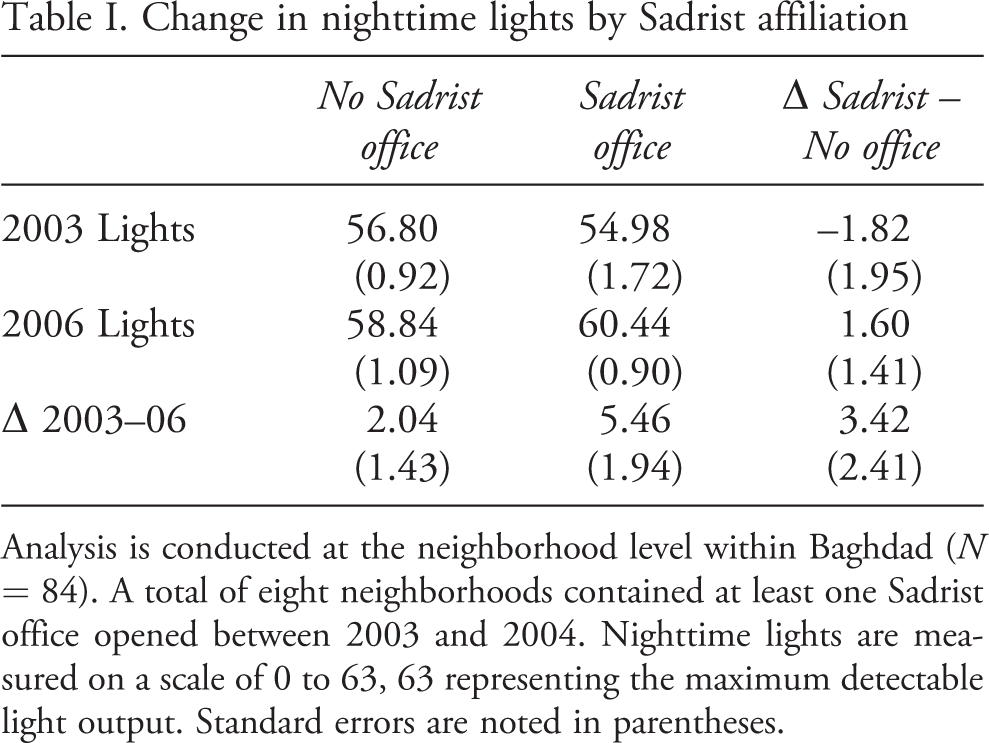
Analysis is conducted at the neighborhood level within Baghdad (N = 84). A total of eight neighborhoods contained at least one Sadrist office opened between 2003 and 2004. Nighttime lights are measured on a scale of 0 to 63, 63 representing the maximum detectable light output. Standard errors are noted in parentheses.
Results
This section begins by discussing the article’s major finding related to changes in electricity access experienced by Sadrist-affiliated neighborhoods in Baghdad between 2003 and 2006. It shows that Sadrist neighborhoods gained disproportionate access to electricity during this time period, and that these findings are robust to any neighborhood-level population changes that occurred during the period in question. The article then addresses three key alternative theories. First, I discuss how controlling for population changes ameliorates the possibility that the Sadrist Movement’s use of violence during this period caused the observed changes, rather than direct control of electricity provision. Second, I discuss selection into treatment (i.e. Sadrist affiliation) and use a pre-period difference-in-differences analysis to show that the main results do not hold prior to 2003. Third, I assess differences across neighborhoods with various ethno-sectarian compositions to reassure against the possibility that these findings are an artifact of the state favoring of Shi’a neighborhoods after 2003.
Key findings
Figure 2 compares changes in nighttime light output between Sadrist and unaffiliated neighborhoods between 2003 and 2006. In an average measure of light output for 2003, unaffiliated neighborhoods outpaced Sadrist neighborhoods by an average approximately 1.8 units, with light output across the 84 neighborhoods ranging from 25.1 to 61.5 (63 representing the maximum detectable output). By 2006, however, the light output of Sadrist neighborhoods outpaced that of unaffiliated neighborhoods by an average of 1.6 units. Over the course of the time period in question, light output Difference in mean nighttime lights in Baghdad by Sadrist affiliation, 2003–06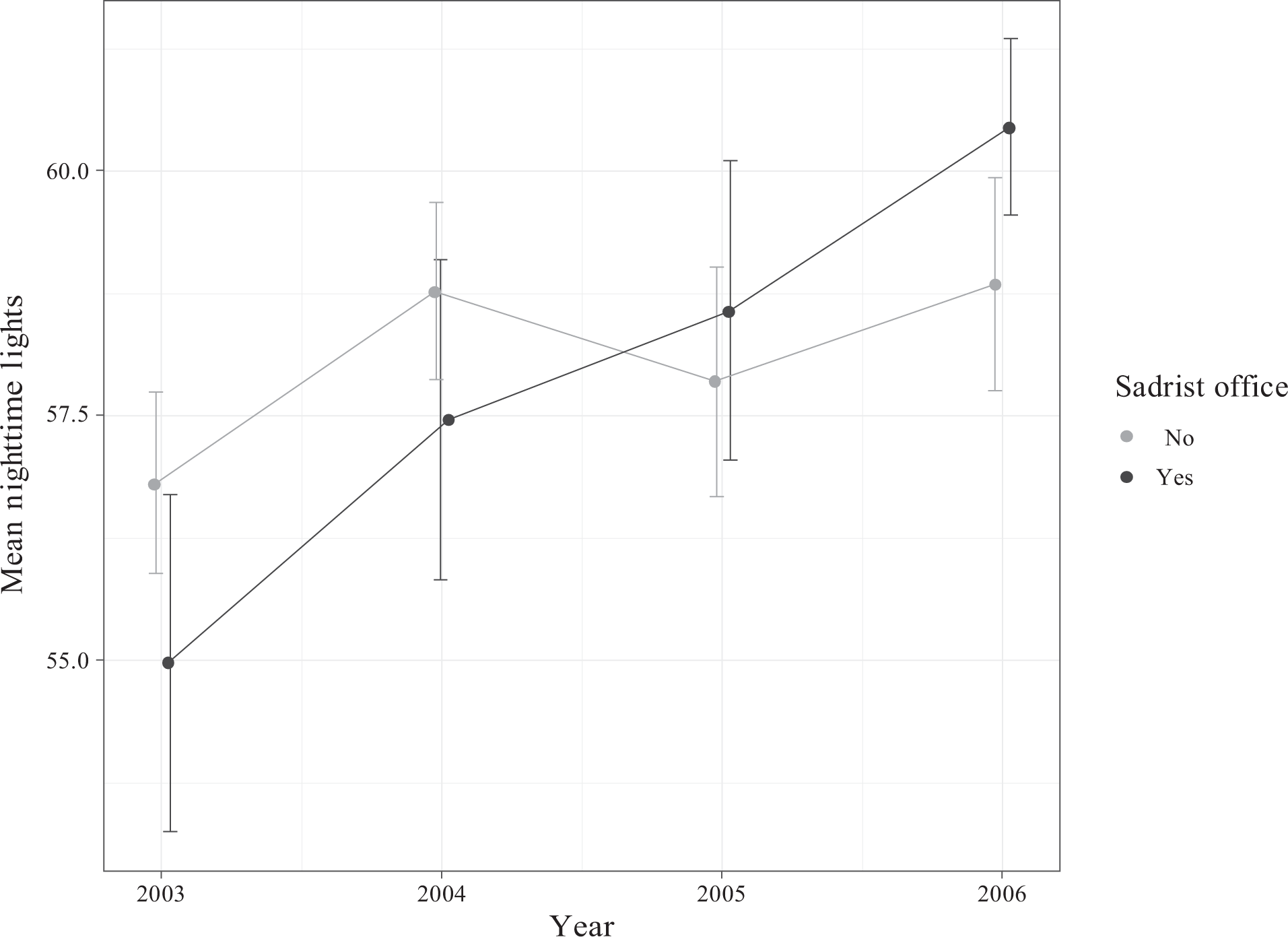
Table II reports the full regression results from the difference-in-difference model, which restricts the analysis to within-neighborhood changes between 2003 and 2006 and, in different specifications, controls for changes in population and population density. 6 In the baseline model without population controls, Sadrist areas saw an estimated change in nighttime light output between 2003 to 2006 that was on average 3.421 units greater than the estimated change in unaffiliated neighborhoods. Whereas unaffiliated neighborhoods saw a 3.6% average increase in light output, Sadrist neighborhoods saw an approximately 9.9% average increase during the same period – a 6.3 percentage point difference between neighborhoods.
Effect of Sadrist affiliation on change in mean nighttime lights, 2003–06
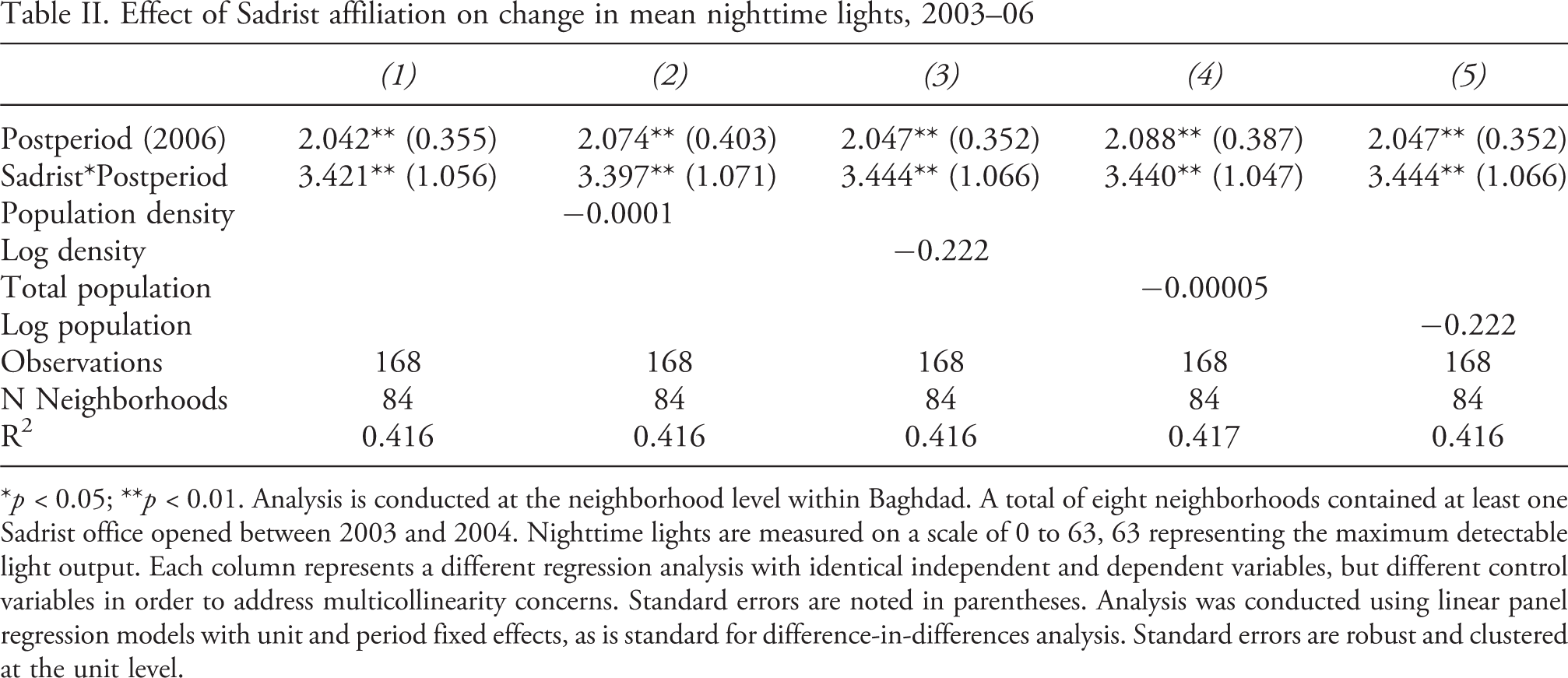
∗p < 0.05; ∗∗p < 0.01. Analysis is conducted at the neighborhood level within Baghdad. A total of eight neighborhoods contained at least one Sadrist office opened between 2003 and 2004. Nighttime lights are measured on a scale of 0 to 63, 63 representing the maximum detectable light output. Each column represents a different regression analysis with identical independent and dependent variables, but different control variables in order to address multicollinearity concerns. Standard errors are noted in parentheses. Analysis was conducted using linear panel regression models with unit and period fixed effects, as is standard for difference-in-differences analysis. Standard errors are robust and clustered at the unit level.
Controlling separately for changes in population and population density, logged and unlogged, changes neither the statistical significance (p = 0.01 across all models) nor magnitude of the baseline findings. Model specifications 2–5 in Table II demonstrate that the divergence between Sadrist and unaffiliated neighborhoods observed during the period in question is not explained by measurable population movement, displacement, or other demographic changes in birth and death rates. The following section discusses these issues and other threats to causal inference in greater detail.
Addressing threats to inference
This section addresses three key threats to inference for this empirical analysis: (1) political violence inflicted by the Sadrist Movement, (2) selection by neighborhoods into Sadrist affiliation, and (3) state-sponsored favoritism of Shi’a neighborhoods. These issues are considered in turn.
The validity threats posed by the Sadrist Movement’s armed activities in post-2003 Iraq deserve careful consideration. The Sadrist Movement and its corresponding militia wing, the Mahdi Army, deployed considerable use of violence against opposition militias and other armed groups, both Sunni and Shi’a, during the period in question. Though Berman, Shapiro & Felter (2011) collect and use data on civilian casualties for this time period, the data are restricted to violence deployed against coalition forces, and do not account for intermilitia activities. To this author’s knowledge, such data collected at the neighborhood level in Baghdad do not exist.
The empirical analysis takes two steps to mitigate the paucity of local-level data on violence in Baghdad. First, the analysis ends in 2006, prior to the 2007 upsurge in sectarian violence and militia-sponsored ethnic cleansing that engulfed the capital and other parts of the country. Difference-in-difference analyses frequently face a trade-off between measuring longer-term trends and mitigating time-variant threats to inference that arise, and I aim to strike a balance between these goals by restricting the analysis to the 2003–06 interval. For that time period, one need only be concerned if one suspects that Sadrist areas experienced systematically lower levels of violence than non-Sadrist areas, subsequently affecting light output. By controlling for population and population density changes during this time period (see Table II), I account for potentially disproportionate patterns of displacement and death, and the core results remain unaffected.
A second threat to inference involves how the Sadrist Movement selected into the locations it chose for its offices, spread across eight neighborhoods in Baghdad. Baseline differences in income or public service quality are differenced out in the difference-in-differences design, but changes therein are not. If we suspect that some longer-term trends due to unobserved characteristics of these neighborhoods drove the changes observed between 2003 and 2006, then we might be concerned that the Sadrist Movement’s activities did not actually drive said changes. Therefore, I use an analogous difference-in-differences design to measure changes in electricity provision that occurred between 2000 and 2002, when the Sadrist Movement was forced entirely underground and its activities halted (see the Online appendix). The difference between Sadrist and non-Sadrist neighborhoods for this period is statistically insignificant.
This empirical test does not rule out an additional alternative hypothesis: that variation in some neighborhood-level variable both specific to the post-2003 period in Iraq and correlated with Sadrist affiliation resulted in greater changes in access to electricity provision, as measured by light output. A pressing concern is that all eight Sadrist-affiliated neighborhoods are Shi’a-majority, and that the Shi’a on average gained far greater political power at the national and local levels following the 2003 overthrow of the Sunni-dominant Ba’athist regime (see the Online appendix for a map of ethno-sectarian composition by neighborhood). Shi’a favoritism might be linked to greater changes in electricity access through either (1) disproportionate access to state-allocated reconstruction funding, which targeted the electricity sector, or (2) political elite-sponsored diversion of electricity flows into Shi’a-dominated neighborhoods.
To address these concerns, I first include a summary table showing changes in nighttime light output across neighborhoods of various ethno-sectarian composition (see the Online appendix). Shi’a-dominant (N = 28) and homogenously Shi’a (N = 25) neighborhoods did indeed experience greater changes in light output between 2003 and 2006, relative to other neighborhoods. We need only be concerned, however, if within-neighborhood changes in light output are systematically correlated with having a majority Shi’a population. Therefore, I use a difference-in-difference design in which the treatment variable is defined as a neighborhood’s having a 76–100%, 51–75%, or 51–100% Shi’a population (see the Online appendix).
Across all three models, the effect of Shi’a-majority status is of a small magnitude and statistically insignificant at the p = 0.05 level. Differences across ethno-sectarian communities, therefore, are more plausibly attributed to Sadrist affiliation, even though Shi’a majority status and Sadrist Movement office locations are clearly intertwined.
Discussion and conclusion
In keeping with scholarly work on the provision of social services by armed NSAs, this article highlights a distinct strategy employed by such organizations. It argues that in Iraq, following the US invasion and collapse of the Ba’athist state, the newly empowered Sadrist Movement wielded armed force to capture control of the state-run electricity sector. They did so by targeting local-level infrastructure and attendant bureaucratic overseers. By assuming control over the remnants of public infrastructure, the Sadrist Movement was able to monopolize a scarce resource and divert it to areas in which it maintained its largest bases of support and operational headquarters. Examination of neighborhood-level variation in nighttime lights output between 2003 and 2006 reveals systematic divergences between Sadrist and unaffiliated neighborhoods that were not present prior to the Sadrist Movement’s creation, and cannot be explained by other demographic factors, such as population density or ethno-sectarian composition.
The strategies employed by the Sadrist Movement that this article focuses on are understudied, but certainly not unprecedented. During the Lebanese civil war, various militias raided the storage facilities of the national army for weapons and assumed control over the country’s formerly state-run commercial ports (Picard, 2000). Today, many of these militias-turned-parties maintain large numbers of parliamentary seats and key ministerial positions. During civil conflict in Colombia, similarly, paramilitary groups infiltrated public health cooperatives in order to effectively claim credit for the delivery of state-funded medical care (Gutierrez & Schonwalder, 2010). At the height of its power as a territory-controlling militia during the Syrian civil war, the so-called Islamic State leveraged control over the country’s formerly state-administered oil fields to acquire a weekly estimated revenue of 28 million USD at the height of their authority (Do et al., 2017). In each of these cases, armed NSAs relied on their ability to wield force in a context of weakened state authority to capture state-controlled resources and monopolize control over them. Such control may influence the populations in need of these services, potentially inducing them to engage in a variety of electoral and non-electoral forms of political action benefiting the NSAs in question.
In addition to highlighting a new pathway by which armed NSAs provide services, this article speaks more broadly to how militias like the Sadrist Movement reinforce their authority at the expense of the low-capacity state contexts out of which they often emerge. While it is true that social welfare across the globe is often a product of combined intervention by state and non-state actors, the effect of service provision by armed groups in fragile or post-conflict contexts seems to have demonstrably negative effects on popular perceptions of state legitimacy. Conversely, it often legitimates the ability of such organizations to wield force alongside, often even against, the state itself. In other words, the capture of extant infrastructure and its effective rebranding by NSAs in Iraq and elsewhere constitutes a form of predatory co-production that contributes to a cycle of state weakness and delegitimation.
Future scholarly work in this vein could address some of the questions that emerge from these observations, but which lie beyond the scope of this article. Did the service provision strategies by the Sadrist Movement compel beneficiaries of its actions to perceive the legitimacy of the organization and, relatedly, that of the Iraqi state, differently? Did the Movement compel beneficiaries to participate in militia service or other forms of costly action? How do those living in militia-controlled regions or neighborhoods attribute credit or blame for the welfare services they have or lack access to? Such questions feed into a broader and ongoing research agenda linking micro-level dynamics of armed conflict to welfare outcomes and state capacity.
Footnotes
Replication data

Acknowledgements
The author would like to acknowledge Marsin Alshamary, Lisa Blaydes, Ruth Carlitz, Kevan Harris, Kristen Kao, David Laitin, Salma Mousa, Jonathan Rodden, and Daniel Tavana for providing comments and suggestions on prior drafts. Helpful feedback was given by two anonymous reviewers. The author also thanks Melani Cammett for providing some of the data used in the analysis.