




Abstract
There is a long-running disagreement about how regime type affects a country’s ability to project resolve. Specifically, there is an open question about whether being a democracy helps or hurts a country’s reputation for resolve. I consider this question by directly estimating a state’s reputation for resolve using a unified theoretical and statistical approach. To be precise, I derive an empirical model from a dynamic game of continuous-time bargaining where each side fights in order to build a reputation for resolve. I then fit this model using data on the duration and termination of civil conflicts between 1946 and 2009. I find that while governments tend to have stronger reputations for resolve than the rebels they face, democracies are seen as much less likely to be resolved both prior to and during conflict than their autocratic counterparts. Likewise, democracies are more likely to end a conflict by making a policy change in favor of the rebels than autocracies. Despite these differences, both democracies and autocracies experience a discrete increase in their reputations for resolve once conflict begins, with democracies receiving a much larger boost. As such, these findings contrast with a large literature on democratic credibility theory, while simultaneously providing evidence consistent with some of the logic behind democratic credibility theory.
A long debate in the conflict literature asks whether democracies are disadvantaged relative to autocracies in various aspects of internal or civil conflict (e.g. Horne, 1977; Getmansky, 2012). Part of this debate focuses on whether democratic norms and institutions strengthen or weaken perceptions that a state is resolved or committed to fighting. While the concept of a reputation for resolve has been mostly considered within the interstate conflict setting, concerns related to resolve are often found in theories that consider democratic disadvantage in civil conflict. This raises the question: Do democracies have stronger or weaker reputations for resolve than autocracies in civil conflict?
One common understanding suggests that the competitive aspects of democracy (e.g. election cycles) and/or a commitment to democratic norms prevent democracies from fully committing to fighting in civil conflict, hurting their ability to build a reputation for resolve (e.g. Horne, 1977; Merom, 2003; Valentino, Huth & Balch-Lindsay, 2004). This line of thought suggests that democracies are unable to credibly commit to standing firm against rebels as both sides know that the state does not have the domestic support for long conflicts. In contrast, a competing approach suggests that democracies might have an advantage over other regime types because giving into an enemy’s demands could lead to domestic political punishments for backing down. The prospect of punishment enhances a state’s reputation for resolve by pushing it to stand firm in conflicts (Fearon, 1994; Weeks, 2008). Historically, these types of punishment concerns have only been considered by interstate conflict scholars, but recent work has found that domestic punishment threats hang over leaders during intrastate conflicts, too (Prorok, 2016). The extension of domestic punishment concerns to the civil conflict setting raises questions about how the prospect of punishment affects a democratic state’s reputation for resolve.
However, despite the theoretical importance of reputation for resolve to conflict dynamics, there are major practical difficulties in empirically analyzing its role in conflict. Direct empirical efforts to consider these questions are made difficult by the fact that an actor’s reputation for resolve is inherently unobservable. In this article, I contribute to the study of civil conflict by directly considering reputation concerns within a unified theoretical and statistical framework. I do this by creating an empirical war-of-attrition estimator that is based on a theoretical model of fighting and reputation-building, and I fit this model to civil conflict duration and outcome data. This approach enables the first large-N analysis that directly estimates reputation for resolve and relates it to conflict using observational (i.e. non-survey or experimental) data. Specifically, it allows me to consider how reputations vary across different states and evolve over the conflict process. This undertaking builds on a strong tradition in political science of fitting formal models to observational data to back out theoretically interesting, but inherently unobservable, parameters. Past undertakings have focused on fundamental concepts such as legislative ideal points and audience costs in interstate disputes. This type of structural analysis allows scholars to estimate and analyze concepts of deep theoretical interest. I build on this tradition with a focus on reputation for resolve.
I find that higher levels of democracy are associated with lower initial reputations for resolve, a gap which persists throughout the conflict process. In other words, both at the start of and during a conflict, democracies are, on average, seen as less likely to be resolved than autocracies. This democratic disadvantage matches and builds on a set of theories, intuitions, and results spanning decades (e.g. Horne, 1977; Kertzer, Renshon & Yarhi-Milo, 2021), by providing new evidence against what is commonly referred to as ‘democratic credibility theory’, or the idea that democracies tend to have a higher reputation for resolve than autocracies (Kertzer, Renshon & Yarhi-Milo, 2021). Additionally, this evidence comes from a much wider range of countries and a much longer time span than past efforts to consider reputation for resolve directly, which typically consider reputation for resolve within the context of either very specific conflicts or with lab/survey experiments.
However, there is some nuance to this finding on democratic disadvantage. Specifically, I find that both regime types experience a notable boost in their reputations for resolve once hostilities begin. One explanation for this reputational boost is that it reflects the basic logic of democratic credibility theory, but that this logic is neither exclusive to democracies (i.e. regimes of both types face punishment for backing down), nor is it sufficient to overcome the reputation advantage that autocrats begin with in the intrastate conflict setting. To put this another way, once a state finds itself in an internal conflict, the knowledge that backing down is punished leads others to infer that the government is more likely to be resolved, and as such, the government receives a discrete increase in its reputation regardless of regime type. Thus, while democracies, on average, receive a notable reputation boost at the beginning of a conflict (the standard democratic credibility result), they are still seen as less likely to be resolved than autocracies throughout the conflict process. 1 Together, these two results provide new insight into how we think about reputation for resolve in civil conflict by uniting two major theoretical frameworks. Additionally, this explanation is consistent with and extends results by Crisman-Cox & Gibilisco (2018) and Weeks (2008) into the intrastate setting, while also confirming and building on results by Prorok (2016) who argues that leaders of all regime types can be punished for poor performance in intrastate conflict.
Reputation, bargaining, and conflict
For decades there has been an understanding among scholars and policymakers that generating a reputation as intransigent or resolved can improve a leader’s bargaining position. Regarding intrastate conflict specifically, Fearon (2013) and Walter (2006, 2009) argue that reputation concerns lengthen internal conflicts. In particular, Fearon (2013) uses a model similar to the one presented below, where the repetition of large demands that are unlikely to be acceptable is presented as a key feature of civil conflict. Specifically, he notes that ‘states or rebel groups typically pose relatively extreme war aims that they do not expect the other side to concede’, and that long periods of time can ‘pass without either side making a serious offer’ (2013: 3). This type of strategic posturing suggests that actors on both sides of a conflict see an advantage to having a strong reputation and are willing to fight to build one.
Of course, there are many ways to define the concepts of resolve and reputation for resolve. I conceptualize reputation for resolve following Dafoe, Renshon & Huth (2014: 372), who define it as ‘reputation for not backing down’. The idea that resolve is all about not backing down fits with, albeit simplifies, Kertzer’s (2016: 3) understanding of resolve as ‘not what an actor wants, but rather, the extent to which she maintains this intention despite contrary indications or temptations to back down’ (emphasis in original). Specifically, resolve is different from an actor’s ability or their costs of fighting, but rather it is the ‘actor’s […] steadfastness, dogged persistence, or “stick-to-itiveness”’ (Kertzer, 2017). 2 In other words, resolve is about standing firm and not backing down, while reputation is a belief about whether or not an actor is resolved.
However, this setup is not the only way scholars have thought about these concepts. A common alternative approach is to think about resolve as a weight on the costs of conflict, which makes conflict less costly for resolved actors (e.g. Fey & Ramsay, 2011: 157). In these works, the costs of conflict ‘bake in’ resolve and an actor’s reputation for resolve is captured in the beliefs that others have about their weighted costs of conflict. The drawback of conceptualizing resolve in this way is that resolve becomes inseparable from the cost of fighting, making an already tricky concept even more difficult to pin down. However, the way resolve is defined in this article captures a special case of this alternative conceptualization where a resolved actor down-weights the costs of conflict to a sufficiently small amount.
Using the simpler understanding of resolve produces two main advantages when building an empirical model to estimate reputation for resolve. First, this approach makes the estimation problem tractable as it produces a model with a unique equilibrium, making likelihood-based estimation more straightforward. Second, introducing resolve as a type of actor who is unwilling to back down allows for a theoretical (and thus empirical) model that puts the emphasis on resolve as separate from the costs of conflict. This removes an identification problem that is inherit in thinking about it as a weight on the costs of conflict.
Regime type and reputation
As mentioned, resolve is treated here as a trait: any given actor is either resolved or not. As such, a reputation for resolve refers to beliefs about whether an actor is resolved. While concerns about reputation are pervasive in theories of civil conflict, it is unclear how regime type affects a government’s reputation for resolve in civil conflict. Two main theoretical frameworks dominate how regime type influences a state’s reputation for resolve. Specifically, there are conflicting views on whether the characteristics of democracy make it easier or harder for democracies to appear resolved going into and during conflict. While most work that explicitly considers reputation and regime type comes from the interstate setting, the intrastate conflict literature has often discussed democratic disadvantage in ways that suggest reputational concerns and imply that democracies will struggle to generate an appearance of resolve either prior to or during conflict.
The first framework focuses on the aspects of democracy that make declarations of resolve less credible than their autocratic counterparts. Here, a combination of norms and competitive elections precludes a democratic state from reputation-building. Regarding the former, democracies in civil disputes are unable or unwilling to employ the types of brutality or restrictions on civil liberties that are seen as necessary in these conflicts (Merom, 2003). Regarding the latter, democratic regimes are unable to commit to long periods of conflict, as the costs of conflict lead to war-wariness among the public. As the public turns against the conflict, the leadership either has to follow or be replaced. As a result, democratic leaders facing the prospect of civil conflict find themselves in a bind: they cannot deploy the level of violence that can end a civil dispute quickly, nor can they hope to succeed in a long war of attrition before voters turn on them (Valentino, Huth & Balch-Lindsay, 2004). Promises to pay large costs and fight lengthy conflicts lack credibility, a disadvantage that is known to all the actors involved in the conflict. Under this framework two implications emerge: democracies will have a lower reputation for resolve than autocracies both at the onset and throughout the conflict – although as Getmansky (2012) points out, empirical support for this understanding of a democratic disadvantage has been decidedly mixed with several studies finding minimal or no differences in civil conflict duration or outcomes among regime types (e.g. DeRouen & Sobek, 2004; Fearon, 2004; Lyall, 2010).
The second framework is founded in democratic credibility arguments, in that it focuses on how threats of domestic punishment affect a state’s reputation. This line of reasoning is largely built on interstate conflict theory, but it has seen recent inroads into the intrastate setting. Here, domestic actors worry about their state’s reputation and punish leaders who back down during a dispute (Fearon, 1994). This punishment mechanism suggests that democracies are more likely to be resolved than other regime types as they seek to avoid incurring these penalties. The threat of domestic punishment has been used to explain why democracies initiate and/or escalate interstate crises/conflict, economic disputes, and a range of other costly actions. While democratic credibility is most associated with these interstate settings, several of its core ideas have begun to emerge in the intrastate setting. Specifically, Prorok (2016) finds that domestic audiences also punish their leaders for intrastate conflict performance and the threat of punishment affects intrastate conflict outcomes. Overall, theories of domestic punishment lead to the idea that democracies will have an inherent advantage over autocracies as it is often easier for audiences to exert these punishments within a democracy. The primary implication of this framework is that democracies will have a stronger reputation for resolve during conflict.
Note that these two frameworks are not inherently incompatible. It is entirely possible that autocrats might have a stronger reputation for resolve at the initial point of incompatibility, but that the democratic credibility logic applies once the democracy is committed to fighting. In this case, autocracies might have an initial reputation advantage, but are then surpassed by democracies. This possibility, however, is not typically considered by democratic credibility theorists who tend to focus on the idea that domestic punishments/constraints lead to a democratic advantage over autocracies. While some work has found evidence that democratic and autocratic governments both face punishments for backing down in either interstate or intrastate disputes (Crisman-Cox & Gibilisco, 2018; Prorok, 2016; Weeks, 2008), little has been done to show how these trends evolve over the course of the conflict process and whether any disparities in reputation for resolve are pervasive, eliminated, or reversed once conflict begins.
A model of bargaining and reputation
To consider the role of reputation for resolve in a more thorough manner, I need an empirical framework that directly incorporates it as an estimable parameter. Given that reputation is an unobservable characteristic, this undertaking requires building a theoretical model that includes reputation for resolve and then fitting that model to civil conflict data. I do this by adapting a model of continuous-time bargaining with reputation-building from Abreu & Gul (2000). As they do not consider armed conflict directly, I simplify and adapt the model to focus on civil conflict. 3 Within the model, conflict is represented as a continuous-time war of attrition that is the limit case of a discrete-time bargaining game where each side is allowed to make frequent offers.
Note that this is not meant to be a new or encompassing theory of civil conflict. The purpose of the theoretical model is to set up an empirical model that contains reputation for resolve and allows for estimating the differences between regime types. As such, the framework has several notable omissions and simplifications compared to other common conflict models. Of course, no theoretical model ever exactly captures the true data generating process, but a reasonable structural model enables the researcher to estimate and analyze important quantities of interest. I focus on just the aspects of the model that are used in estimation and defer more detailed discussions to Online appendix E.
Continuous-time bargaining
Consider a government, G, and a rebel group, R, bargaining over a good with a value normalized to size 1. Each player can be one of two types: resolved or unresolved. The resolved type of actor
The timing of the game is as follows. The game starts at
This war of attrition, however, has a very special and substantive interpretation. Notably, Abreu & Gul (2000) demonstrate that this war of attrition is equivalent to a continuous-time bargaining game where at each instant
As mentioned, a strategy for a resolved actor is an algorithmic choice. In contrast, an unresolved i plays according to a mixed strategy. These strategies are characterized by a cumulative distribution function (CDF) over possible exit times, where
Each player has beliefs about its opponent’s resolve. Specifically, let zi
be player j’s initial belief that i is actually resolved.
6
In the language of Dafoe, Renshon & Huth (2014), zi
is i’s initial reputation for resolve: the beliefs that others have that i will neither negotiate nor back down in the conflict at start of the interaction. These beliefs are updated over the course of the conflict by applying Bayes’s rule. Define
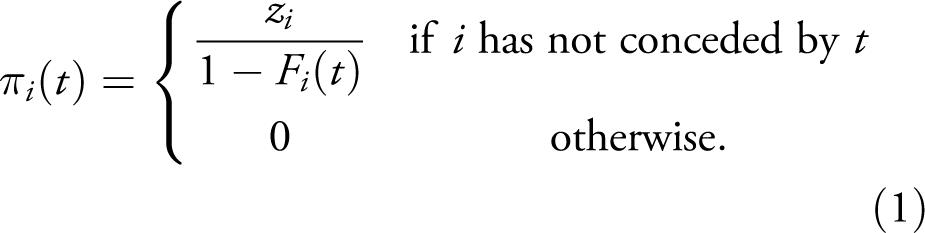
Note that this expression follows from the fact that
As this is a dynamic game of incomplete information, I look for a sequential equilibrium (hereafter equilibrium) that is represented by a profile
A final note on the profile
Because these strategies are based on CDFs over exit times, they are parameterized in terms of hazard rates. Specifically, let

Unresolved player i exits faster when its opponent is more patient (rj
increases) or pays lower costs to fighting (
Two features of
Result 1: (Abreu & Gul, 2000) There is a unique sequential equilibrium to the continuous-time bargaining game. In equilibrium, if
and the probability that j ≠ i exits at time t or sooner is given by the CDF
The proof of Result 1 can be found in Abreu & Gul (2000: 92–93).
8
Recall that Fi
reflects that probability that i quits at t or sooner and is unresolved, which is also the total probability that i exits at time t or sooner regardless of type.
9
Based on Result 1, a strategy for an unresolved i is
Overall, this model captures three common conceptions of conflict. First, the idea of civil conflict as the repetition of large, unlikely-to-be-accepted demands is also found in Fearon (2013). Second, the role of civil conflict as a reputation-builder matches Walter (2009) and Powell (2017). Third, the theoretical model presented here closely resembles the model in Fearon (1994), who considers interstate crisis escalation using a similar continuous-time war of attrition where private information over resolve explains bargaining failure/delay.
Note that democracy does not directly appear in the theoretical model. This omission is intentional. By not directly including regime type in the underlying model, I avoid ‘baking in’ any results at this stage in the analysis. Instead, I include a democracy measure into the specification of zi when fitting the theoretical model to conflict data. Additionally, because this is not an original model I forgo any comparative statistics or other equilibrium analysis.
As with all approaches there are some limitations of the theoretical framework that should be discussed before fitting it to data. First, while it is helpful that
Estimation strategy
With the strategies listed in Result 1 I construct the strategic duration model. The goal is to estimate each side’s initial reputation for resolve, z, along with the hazard rates

Below, I use include the same predictors for both actors and so hereafter I write
Likewise, I parameterize the hazard rates using a standard functional form, such that for player i

This reduced-form specification allows us to see if particular variables affect an individual player’s decision to exit the conflict. Without additional assumptions, however, it does not tell us the path this effect takes beyond which player’s behavior is affected. To be precise, I cannot say that any specific variable effects the rebel’s hazard rate,
In order to fit the model, I need to identify three key features of each observation. First, I need to know which side is the possible first quitter (player 1), as this determines whether the government or the rebels use the strategy given by F
1 (the other side uses F
2). The identity of the possible first quitter is determined endogenously during the model fitting using the inequality in Result 1, the data, and the current guess at the parameter values. Second, I need to know which side (if any) backed down in the conflict. This determination is discussed in the data section below. Actors who do not back down have censored conflict durations.
11
Third, I need to know if an actor backs down at
Data
The data primarily come from the Uppsala Conflict Data Program (UCDP) dyadic datasets, which record conflict onset, termination, and outcomes at the country-rebel group level between 1946 and 2009. The termination data are used to determine the conflict’s outcome, which is necessary for evaluating the log-likelihood. These outcomes are recorded for each conflict episode (period of extended fighting) within a government–rebel dyad (Kreutz, 2010). Ideal data would record how and why each side leaves a contest. However, the UCDP termination data provide the best dyadic data on civil conflict outcomes to date, and as such, I focus on how the outcomes recorded by UCDP map into changes in the status quo policy. Each observation is a conflict episode. When an episode ends without concessions to the rebels, this means that the rebels have conceded for the moment, revealed that they are unresolved, and ended the particular interaction.
The UCDP dataset codes the civil conflict outcomes on a seven-point scale. Outcomes 1–3 involve a government adopting changes to the status quo that ends the current conflict episode. As such, I code these outcomes as the government exiting the conflict and revealing that they are unresolved. Specifically, outcome 1 is an official peace agreement and while this may involve some compromise on both sides, it is clear that crafting an official agreement with an internal opponent is indicative of an unresolved government acknowledging that it cannot make the rebels submit. Outcome 2 is a pure ceasefire (i.e. no conditions or concessions), while outcome 3 is a ceasefire that involves some policy change. Any ceasefire reflects a major shift on the part of the government to recognize its opponent as worthy of negotiation. However, listing all ceasefires as government concessions is less clearcut than full-scale peace agreements. As a result, I recode pure ceasefires as rebel concessions in a robustness check reported in the Online appendix to ensure that the results are not sensitive to how ceasefires for recorded.
Outcomes 5 and 7 do not involve policy changes that alter the status quo. Outcome 5 reports the rebel group backing down from the conflict (i.e. the conflict episode ends without either a policy change or a military defeat), while outcome 7 reports the rebel group disbanded or merged with another group. These two outcomes are cases where the rebel group backs down and exits the conflict. 12 Outcome 6 is listed as ‘other’ in the codebook; I hand code these cases. Finally, outcome 4 signifies that one side achieved a military victory, and I code the observation as censored before either side reveals its type.
The dependent variable is the duration, in months, of each conflict episode. Time in the model starts at
This coding provides perhaps the easiest approach to a thorny conceptual issue since data on nonviolent bargaining between governments and substate groups is historically sparse. However, it is certainly not the only way to think about these cases. I return to this point in Online appendix D.4, where I consider alternative ways to think about these 0 duration cases. Specifically, I use CONIAS data to fit a model where the
Determinants of initial reputation for resolve

Bootstrapped 95% confidence intervals in parentheses.
In an alternative specification, I also consider how the most recent conflict outcome affects current reputations for resolve. After all, concerns about how past outcomes affect reputation in the present are frequently discussed in reputation theories of conflict. Specifically, Chatagnier (2015) and Crescenzi (2007) note that fighting is frequently used by governments to build a reputation for the next bargaining situation. These studies suggest that a recent concession by the government should have a negative effect on the government’s reputation for resolve heading into a current conflict. To account for how past outcomes affect current reputation, I include a dummy variable for whether the government offered a concession in the most recently ended conflict it was involved in prior to the current observation.
Results
Recall that
I can now address the question: Does democracy help or hurt a country’s reputation for resolve? While this question has received substantial attention from conflict scholars, the structural model provides some of the first large-N results that can directly consider this question. In Models 2 and 3, the results suggest that democracies are viewed as less likely to be resolved at the start of civil conflict. This finding of a democratic disadvantage in civil conflicts contrasts with Getmansky (2012) and others who finds no real differences across regimes in terms of civil conflict performance. Nevertheless, it provides new evidence for a long-held belief that leader turnover and ‘volatile voters’ prevent a democratic state from credibly committing to engaging in the kind of long-term fighting necessary to demonstrate resolve (Horne, 1977; Kertzer, Renshon & Yarhi-Milo, 2021; Merom, 2003). This view is in line with Valentino, Huth & Balch-Lindsay (2004) who argue that democracies are reluctant to employ the kinds of repression that may be needed to win civil conflicts. These past works provide reasons why we should expect a democratic disadvantage to emerge. The results in Table I provide the newest and perhaps most direct support for this understanding of a democratic disadvantage.
At first glance, it looks as though this result may conflict with how we think about reputation in the interstate setting. After all, there is a common conjecture among interstate conflict scholars that democratic countries should have better reputations for resolve than autocrats because they run a higher risk of being punished for backing down in conflicts than autocrats. This connection between punishment and resolve has a long history, with various authors arguing that when governments are faced with the prospect of being punished for backing down the likelihood that the government is resolved increases (Fearon, 1994: 581).
To better assess what role, if any, the possibility of punishment plays in the civil conflict context, I look at how reputation for resolve evolves for an average democracy (polity score 6, other covariates fixed to a mean/median value) and an average autocracy (polity score –6), Reputations for resolve across regimes
However, this trend is not unique to democracies. Autocratic regimes also receive a reputation boost once they begin fighting. This boost might suggest that both types of regimes face possible punishments for backing down in a fight, which is consistent with results from Prorok (2016) and extends findings from Crisman-Cox & Gibilisco (2018) and Weeks (2008) into the civil conflict setting. The prospect of autocratic punishment is very intuitive in the civil conflict context. Backing down against an internal threat can seriously undermine an autocratic leader’s domestic position and result in their removal or death, leading to a situation where leaders fight to survive. Taken together, these differences in pre-conflict and within-conflict reputation reconcile these different frameworks for thinking about the relationships between regime type and reputation for resolve.
So far, however, I have only considered the role that democracy plays on the government’s reputation without looking at the rebels. Recall that in Table I, both the governments and rebels have a distinct reputational disadvantage within democracies. Figure 1 shows that when I fix the regime type for both rebels and governments, there is a gap between democracies and autocracies. What we still need to know is if the competing effect that regime type has on rebel groups leads to democracies having better or worse conflict outcomes than their autocratic counterparts. Answering this question requires looking at the likelihood of the government backing down as a function of regime type. Despite the reputation gap shown in Figure 1, it could be the case that rebels within democracies are even more likely to be unresolved, which might mean that the reputational gap across governments is practically less important. However, as shown in Figure 2, democracies are, on average, more likely to back down than their autocratic counterparts, even allowing for the fact that the rebel groups faced by democracies are also less likely to be resolved on average.

Concessions to rebels and regime type
Overall, the results presented in this section tell a nuanced story about democracies, reputation for resolve, and civil conflict. On the one hand, democracies carry a reputational disadvantage over authoritarian regimes at the start of and throughout conflict. As mentioned above, this gap matches past work that focuses on expectations about a democratic government’s willingness to negotiate and unwillingness to engage in internal conflicts that violate democratic norms and even fits the expectations of the United States Armed Forces (as referenced in Lyall, 2010). On the other hand, once in conflict democracies receive a relatively large reputation boost. This result is consistent with work on democratic credibility theory and how democracies engage in interstate conflict (e.g. Kertzer, Renshon & Yarhi-Milo, 2021). This democratic boost in reputation once a civil conflict is underway matches the advantages that democracies are often thought to enjoy once they commit to fighting. Interestingly, democracies are not alone in receiving this boost heading into conflict. Autocratic regimes also receive a reputation jump for deciding to fight, suggesting that autocrats may also face the prospect of punishment once they enter a conflict (as in Prorok, 2016).
This analysis presents us with three results on regime type and civil conflict: autocrats have a stronger reputation for resolve throughout conflict; democracies and autocracies both receive an immediate reputation boost for entering conflict; despite having a larger reputation boost, democracies are still more likely to back down than autocrats. What explains these three trends? One reasonable explanation has to do with the post-conflict outcomes for leaders (as in Debs & Goemans, 2010). Specifically, autocratic leaders potentially have a lot more to lose than democrats when backing down. For example, the Assad regime has a very compelling reason to project resolve in the current Syrian conflict: giving into rebel demands could easily lead to exile, imprisonment, or execution. More severe punishment prospects improve the autocrats’ initial bargaining position and can explain both the democratic reputation deficit and why democracies are more likely to cut a deal with internal challengers.
I expand upon this main specification in a number of ways to address concerns to inference in Online appendix D. One set of concerns focuses on possible omitted variables in the specification of reputation parameters z. I also look more closely at the underlying mechanism driving the democratic disadvantage by separately considering different aspects of democracy. In this analysis, I find that the competitive aspects of democracy (rather than the constraining components) have the most pronounced effect, supporting the main analysis. Other robustness checks ensure that main results are not driven by coding or measurement choices.
Conclusion
In this article, I directly consider the relationship between regime type and reputation for resolve in civil conflict. I do this by introducing a theoretically and statistically unified approach to studying civil conflict. Specifically, I created a new strategic duration estimator based on a formal model of bargaining and reputation, which enables the direct estimation of each side’s initial reputation for resolve. In doing this, I find that autocracies have stronger reputations for resolve than democracies throughout the conflict process. At first glance this result appears to contrast with a lot of interstate conflict work that finds that democratic states have an enhanced ability to project or signal resolve. However, this democratic credibility logic still emerges when democracies decide to fight. In these situations, democracies receive a major increase in their reputation for resolve.
Interestingly, it is not just democracies that receive a reputational boost for entering into conflict. I also find evidence that autocrats are perceived as more resolved once they decide to fight. This enhanced reputation is consistent with several recent results that suggest that autocrats also face the prospect of punishment for backing down in conflict. In the case of internal conflict, autocratic punishments make perfect sense, as in many of these situations autocrats may find themselves facing extreme punishments (such as exile or death) for failing to vanquish a domestic challenge.
The empirical model presented here represents several jumping-off points for future work. One avenue of future work should focus on expanding the empirical model to include periods of peace and strategic selection into conflict. This extension would better account for the dynamic and cross-conflict effects of reputation for resolve. Additionally, it would be very useful for scholars to look at other estimators based on alternative models of reputation for resolve. These alternatives could capture different aspects of reputation that may be missing from the Abreu & Gul (2000) framework and may lead to different estimates. These frameworks could then be tested against each other and help us move toward a better understanding of the determinants of reputations and their affects on conflict duration and outcomes. Other work can also apply this statistical model to interstate conflict or other situations where reputation for resolve is a quantity of interest such as government shutdowns in US politics. In these cases, we may be interested in how beliefs differ across targets and initiators, or if certain leaders are better or worse at appearance of resolve.
Beyond these extensions and applications of the underlying model there are also potential uses for the point estimates of reputation for resolve. Specifically, it seems like these factors may be useful for analyses of civil conflict onset and for models of conflict and/or post-conflict peace duration. In the case of the former, some measure based on these reputation for resolve parameters might serve as a useful explanatory variable for why some intrastate disputes do not escalate to violence. In the case of the latter, each side’s reputation for resolve at the start of the dispute likely serves as a, previously unobserved, factor that determines the length and stability of post-conflict peace. For instance, states who had an above average reputation for resolve at the start of original conflict may be seen as even more likely to be resolved during the post-conflict period, which in turn may help maintain the peace.
Footnotes
Replication data

Acknowledgments
Thank you to Scott Abramson, Rob Carroll, Kevin Clarke, Mark Fey, Mike Gibilisco, Kristian Skrede Gleditsch, Hein Goemans, Bethany Lacina, Hans Leonard, Rabia Malik, Jacob Montgomery, Andrea Morris, and Carlise Rainey, as well as the audiences from the London School of Economics, Texas A&M University, the University of Rochester, and Washington University in St Louis for their helpful remarks. All errors are my own.
Notes
References
Supplementary Material
Please find the following supplemental material available below.
For Open Access articles published under a Creative Commons License, all supplemental material carries the same license as the article it is associated with.
For non-Open Access articles published, all supplemental material carries a non-exclusive license, and permission requests for re-use of supplemental material or any part of supplemental material shall be sent directly to the copyright owner as specified in the copyright notice associated with the article.
