



Abstract
Scholars increasingly call for documentation and analysis of specific forms of conflict-related sexual violence. Moreover, accountability for crimes is stronger when specific patterns of victimization are documented. This article introduces the Repertoires of Sexual Violence in Armed Conflict (RSVAC) data package, which assembles reports from 1989 to 2015 of forms of sexual violence by government/states forces, insurgent/rebel organizations, and pro-government militias for each conflict and year. RSVAC compiles the reported prevalence of eight forms of sexual violence – rape, sexual slavery and forced marriage, forced prostitution, sexual mutilation, forced pregnancy, forced sterilization and abortion, non-penetrative sexual torture, and sexual abuse (as well as that of multiple-perpetrator reports of each form). It includes extensive qualitative notes on reported incidents, as well as ‘conflict manuscripts’ that include the relevant portions of source documents. Disaggregating ‘sexual violence’ into its distinct forms enables analysis of the reported presence of forms of sexual violence across time, conflicts, and organizations. We illustrate its usefulness by highlighting hitherto neglected global patterns it suggests, and also discuss limitations, potential biases and underreporting that users need to take into account. We outline several research questions that the data can help answer and suggest how the data package could inform policy efforts to address sexual violence and its consequences.
Rape occurred on a massive scale during Sierra Leone’s conflict. The insurgent organization Revolutionary United Front (RUF), the Armed Forces Revolutionary Council (AFRC) (military forces who became a rebel group) and another insurgent group the West Side Boys (Cohen, 2016) all engaged in high levels of rape. The RUF and the AFRC also engaged in sexual slavery and sexual abuse on a massive scale as well as sexual torture 1 (RSVAC dataset). In contrast, the West Side Boys were reported to engage only in rape. 2 Such differences are hidden if scholars analyze them as ‘sexual violence’ without disambiguating into different forms and combinations of forms.
Causes of sexual violence are likely to vary with the specific form: rape during combat operations, for example, is likely driven by different mechanisms than forced marriage or abortion. Social science theory seeking to explain variation in wartime sexual violence should therefore analyze its specific forms. Such variation is also important because accountability is deepened when specific patterns of victimization are recognized by truth commissions and prosecuted in national or international courts, and because interventions during conflict as well as post-conflict victim support are likely to be more effective if tailored to those patterns.
This article introduces the Repertoires of Sexual Violence in Armed Conflict (RSVAC) data package, consisting of a dataset (including extensive qualitative notes), conflict manuscripts (compiling the relevant sections of the source documents), and a codebook. The dataset summarizes the reported repertoire – the reported forms of sexual violence at different prevalence levels – perpetrated by government/state forces, insurgent/rebel organizations (Harbom, Melander & Wallensteen, 2008), and pro-government militias (PGMs) 3 (Carey, Mitchell & Lowe, 2013) in interstate and intrastate armed conflicts each year from 1989 to 2015. Building on the Sexual Violence in Armed Conflict (SVAC) dataset (Cohen & Nordås, 2014), which reports aggregated prevalence of ‘sexual violence’, RSVAC disaggregates the reported prevalence of eight forms of sexual violence: rape, sexual slavery and forced marriage, forced prostitution, forced sterilization and abortion, forced pregnancy, sexual mutilation, non-penetrative sexual torture, and sexual abuse – for each actor and year, along with qualitative notes concerning victims, targeting, location, and other contextual details.
Qualitative comparison of repertoires and targeting, or identification of relevant cases for in-depth analysis will often be the most appropriate uses of the data package. Observational challenges in sexual violence research can be particularly pronounced in a disaggregated approach. Scholars should consider possible limitations and underreporting in the data before any statistical applications, and explicitly discuss and qualify empirical results with those caveats. In discussing the dataset, we consistently refer to reported prevalence, not the true levels of abuse.
The RSVAC data package confirms a recent theme of the literature: Sexual violence is not a good proxy for rape. Moreover, it provides systematically collected, cross-case evidence of tentative patterns (tentative because they are based on reported incidences only), some hitherto little recognized, that stand in contrast to conventional policy assumptions. Collective targeting based on social identity seems more often based on presumed political affiliation rather than ethnic identity for some forms of sexual violence. Organizations that reportedly engage in wide repertoires often do so at high prevalence. An organization’s sexual violence repertoire appears to be quite stable over time. A higher proportion of states are reported to engage in non-penetrative sexual torture than rebel organizations; a higher proportion of rebel organizations are reported to engage in sexual slavery or forced marriage.
The data package can help scholars identify other hitherto neglected patterns in the reported violence repertoire by particular actors in specific conflicts, analyze the context and consequences of reported prevalence of particular forms of the wider concept of ‘sexual violence’, identify cases for in-depth study, and provide scholars with a basis for grounded advice to policymakers and advocates.
Why disaggregate ‘sexual violence’?
Many large-N studies have been undertaken of conflict-related sexual violence (CRSV, defined in the next section), particularly since the release of the SVAC dataset. Yet scholars have called for more disaggregated data to further advance this research (Koos, 2017). RSVAC facilitates this agenda.
By pattern of sexual violence, we mean the combination of repertoire (the form – rape, sexual slavery and forced marriage, forced prostitution, forced sterilization, forced pregnancy, sexual mutilation, etc.), targeting (for each form, against what social groups), and frequency (for each form, the count or fraction of each social group targeted), in which an armed organization – or a unit thereof – regularly engages (Gutiérrez Sanín & Wood, 2017). The RSVAC approach facilitates asking precise questions about targeting and frequency for each repertoire element: Against what social groups? With what frequency? What types of co-variation occur between different forms of sexual violence and the organization’s wider repertoire of violence? Do organizations engage in either very few or many forms of sexual violence? Rather than assuming that armed organizations either exhibit consistent restraint or engage in indiscriminate use of all forms of sexual violence with high prevalence, RSVAC allows scholars to conduct a more nuanced analysis of different repertoires (see later in the article).
Documenting and analyzing patterns of sexual violence is an important basis for making sound policy recommendations. Unless human rights organizations and scholars document all forms of sexual violence, some harms will go unrecognized and some perpetrators will not be called to account. Moreover, efforts to mitigate sexual violence during conflict can be more effective if interventions are based on the best available, detailed reports of the forms of sexual violence each organization appears to engage in and against whom.
Disaggregating ‘sexual violence’ is also important for social science theory. The mechanisms underlying different forms of sexual violence generally differ. Rape during combat operations, for example, is driven by a different logic than forced abortion. Sexual mutilation is driven by a different logic than forced marriage. For example, forced marriage was a political project for the Lord’s Resistance Army rebel group in Uganda – a part of building a ‘new Acholi’ nation through reproduction (Baines, 2014). Sexual mutilation would not be a possible substitute in this case. Analyzing the repertoire of sexual violence also contributes to understanding how an armed organization’s ideology and institutions shapes its pattern of violence (e.g. Hoover Green, 2016, 2017; Gutiérrez Sanín & Wood, 2014; Straus, 2012, 2015), including sexual violence (Cohen, 2013, 2016; Revkin and Wood 2021; Wood, 2009, 2014, 2018). While scholars have analyzed surveys to document and analyze CRSV in particular conflicts (see Traunmüller, Kijewski & Freitag, 2019; Koos, 2018), RSVAC facilitates the development and testing of theory about CRSV repertoires across time, conflicts, and organizations.
The RSVAC data package
The RSVAC data package (dataset, codebook, conflict manuscripts) adopts the scope and units of observation of the SVAC dataset (Cohen & Nordås, 2014) updated to 2015. Hence, we include the same armed conflicts, actors, and years (including up to five interim and post-conflict years). 4
For each conflict-actor-year, the dataset presents an ordinal measure of the reported prevalence level for each of eight forms of sexual violence: rape, sexual slavery and forced marriage, forced prostitution, forced abortion and sterilization, forced pregnancy, sexual mutilation, non-penetrative sexual torture, and sexual abuse. We also include notes on context, targeting, and the reported occurrence of multiple perpetrator sexual violence for each form.
Definitions
We consider as conflict-related sexual violence (CRSV) violations perpetrated by the named armed actors involved in each conflict, and exclude violations by civilians or unnamed assailants. 5 Sexual violence in general is sexual acts that are ‘committed by force, or by threat of force or coercion […] or […] against a person incapable of giving genuine consent’ (International Criminal Court, 2011: 8). Following the SVAC dataset, we build on International Criminal Court (ICC) documents as the most authoritative source defining forms of sexual violence such as rape, sexual slavery, forced prostitution, etc. (ICC, 2011). We also include non-penetrative sexual torture, sexual mutilation, and sexual abuse on the grounds that they are needed social science categories that fall under the broader ICC definition although they are not explicitly defined as sexual violence crimes by the ICC. The definition of sexual mutilation is taken from SVAC (Cohen & Nordås, 2014).
We coded an act as a particular form of sexual violence if the act is named as such in the source material or described with sufficient detail to enable categorization. Accordingly, general reports of ‘sexual violence’, ‘sexual attacks’, or other broad descriptors are not coded. For this and other reasons (discussed later) our measures sometimes underestimate prevalence.
Drawing boundaries between different forms of sexual violence is challenging. We therefore code some very related forms together in the dataset, mainly to avoid conceptual overlap between categories. For example, forced marriage (defined as the case where the perpetrator used force, or threat of force or coercion, to cause a person or persons to enter a forced conjugal association), is combined with sexual slavery in part because what a combatant may consider a ‘marriage’ may be experienced as sexual slavery by the victim. Similarly, we code forced abortion and forced sterilization together. 6 Importantly, the qualitative notes preserve transparency about the specific coding decisions, which allow the interested scholar to disaggregate them.
Definitions of forms of sexual violence
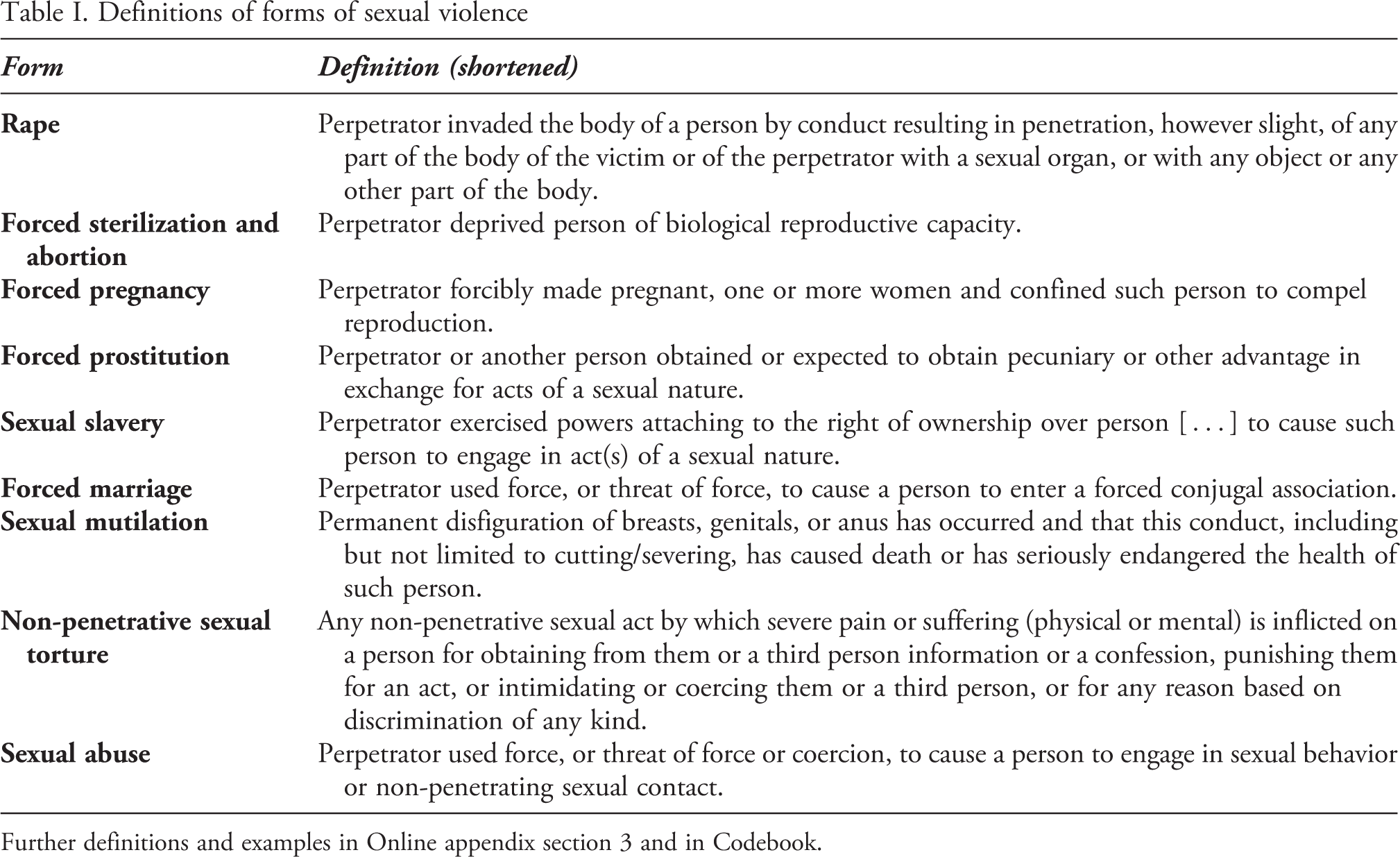
Further definitions and examples in Online appendix section 3 and in Codebook.
Table I outlines the definitions of sexual violence forms included in RSVAC.
Sources and coding procedures
The RSVAC data package was created using the SVAC dataset and conflict manuscripts, which contain excerpts on sexual violence from the annual US State Department ‘Country Report on Human Rights Practices’ (USSD) and the annual reports and special topical reports published by Amnesty International (AI) and Human Rights Watch (HRW). A human coder read the SVAC conflict manuscripts, and recorded relevant excerpts into new RSVAC conflict manuscripts, checking the original source if necessary (see the RSVAC Coding Manual).
For particular judgments on how to define an act of sexual violence, the coder recorded their rationale as a note in the RSVAC conflict manuscript. Reports of rape, sexual slavery, and sexual abuse are often declaratory (the form is explicitly named in the source), whereas reports of sexual mutilation and non-penetrative sexual torture are often descriptive, meaning the source reporting describes an act of violence, and the coder classifies the perpetrator’s act in accordance with the RSVAC definitions. 7
We employ the ordinal prevalence scale and coding conventions used in the SVAC dataset (Cohen & Nordås, 2014) and by Cohen (2013). The ordinal categories indicate whether there were no reports (0) or reports of (1) isolated, (2) numerous, or (3) massive numbers of occurrences of that form of sexual violence on the part of each actor and each year based on each source separately (USSD, HRW, and AI). This results in 24 prevalence variables (three sources, eight forms).
Additionally, eight prevalence variables (one for each form) and a qualitative note field record reported violence by multiple perpetrators. These variables are coded on an ordinal scale: no reports (0), isolated reports (1), or significant reports (2). The code 2 indicates that multiple perpetrator incidents were reported in one or more of the three sources to have occurred relatively commonly, frequently, or regularly. The scale differs from the form-prevalence variables because the sources rarely provide detailed accounts of its frequency. A qualitative note field at each conflict-actor-year summarizes the reporting.
RSVAC qualitative notes
An important aspect of the RSVAC data package is the extensive qualitative notes that report additional information in the source material (context and details) for over 80% of observations (conflict-actor-years with non-zero prevalence values) of rape, sexual slavery, non-penetrative sexual torture, sexual mutilation, and sexual abuse. Five fields of qualitative notes for each form give information on: (1) victim characteristics, (2) targeting, (3) attack timing, (4) attack location, and (5) witnesses (see Online appendix section 3.1).
Notes on victim characteristics indicate whether the perpetrator attacked victim(s) who were male, detainees, refugees, and/or children. Such notes indicate, for instance, that children were reported as victims of rape in 62% of conflicts (53 of 86) in which rape was reported, and children were reported as victims of forced prostitution in 50% of conflicts (2 of 4) in which that form was reported. Because we found that male victims were much more often reported to be targets of non-penetrative sexual torture, the notes on victim characteristics for this form indicate whether the reported sex of the victim(s) was male, female, or not reported. (We note that the sources do not allow us to estimate the share of victims by gender.) The data show that male victims were reported in 78% of non-penetrative sexual torture observations of rebels or states during conflict years; female victims were reported in 16% of such observations.
A qualitative note records targeting that appears to have been based on some aspect of the victim’s identity (collective targeting) including the victim’s ethnicity, nationality, religion, age, combat actor affiliation, or another trait. Our sources very rarely include information indicating selective targeting based on behavior, so we did not code that.
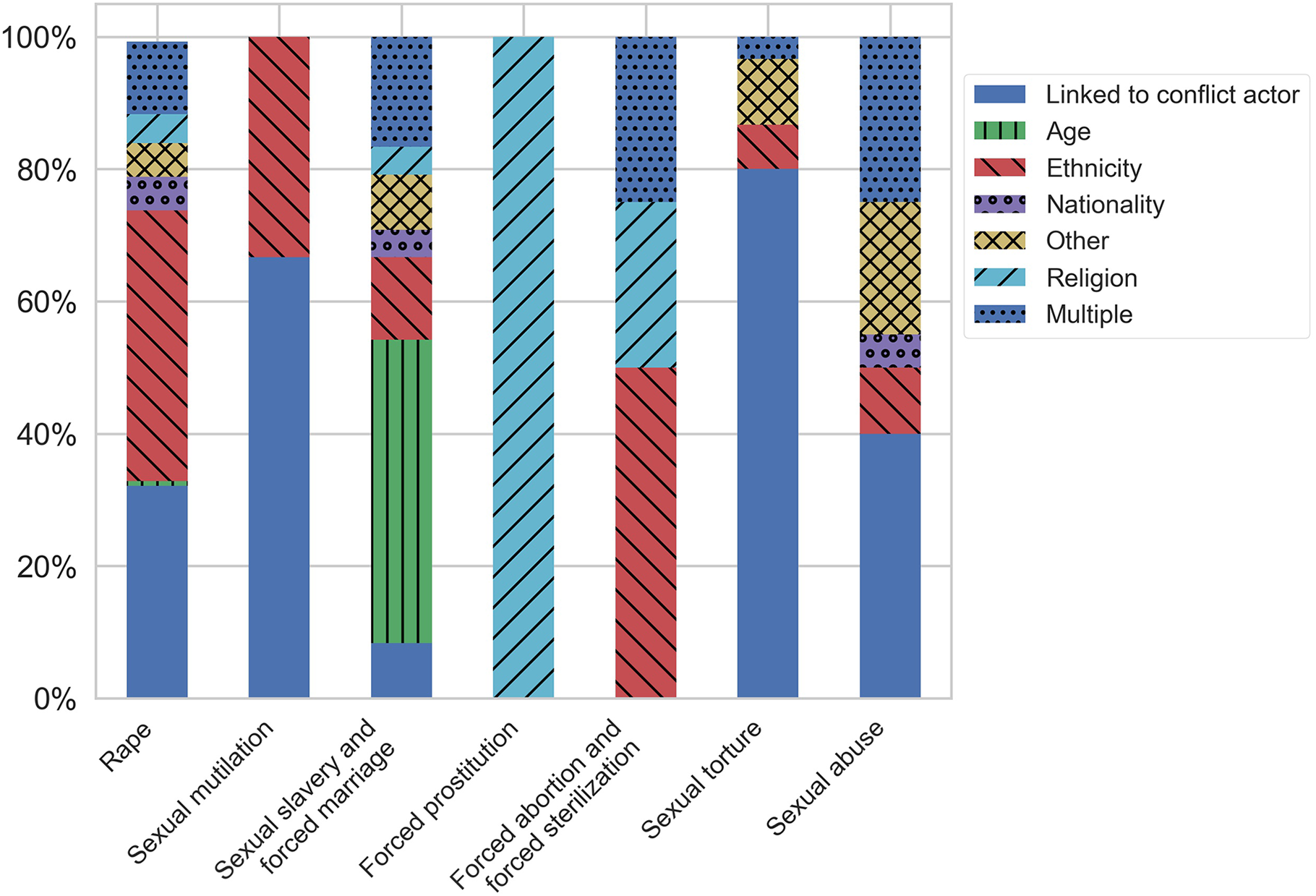
In our judgment, because the qualitative notes tentatively identify targeting and contextual elements, they are likely to be as important for identifying variation in CRSV as the reported prevalence entries. Figure 3, in the following section, presents initial analysis comparing targeted characteristics across forms of sexual violence.
RSVAC conflict manuscripts
The conflict manuscripts contain direct quotations from the three sources (USSD, HRW, AI) for every year in the dataset. The documents have searchable headers that are organized by actor, year, and source, and include passages on sexual violence that were coded as well as those that were not. Observations with non-zero prevalence values are accompanied by a table documenting the term or phrase underlying the coding decision. Several conflict manuscripts are hundreds of pages long. 8
Limitations and potential biases
Sexual violence is difficult to document and systematically code for a range of reasons (cf. Cohen & Nordås, 2014; Cohen & Hoover Green, 2012; Leiby, 2009). Like other global datasets on sexual violence (see Cohen, 2013; Cohen & Nordås, 2014), we measure the reported prevalence of violence – not the totality of what actually took place. Hence, we cannot conclude a repertoire element did not occur just because it was not reported. Underreporting – often due to shame or social stigma on the part of victims, their families or communities – could cause significant bias. Our sources may have incomplete information about an event or be entirely unaware of some incidents of sexual violence, which is particularly problematic if the underreporting is not random. 9 Using multiple, frequently consulted sources for human rights scholars (USSD, HRW, AI) helps to somewhat mitigate these issues.
The coding rules deliberately exclude unspecific and aggregated information. This is both a strength (as it maintains coding rigor), but also a limitation in that not all possibly relevant information is used. Specifically, for information to be codable, the source must identify the actor, the year, and the conflict, as well as some description of the sexual violence form. Sometimes, the source material aggregates information on armed actors with overlapping political aims (e.g. in the case of Colombia, violence was sometimes attributed to ‘guerillas’ without specifying which of Colombia’s five guerrilla organizations was the perpetrator, which prevented coding). Other times, the source aggregates distinct conflicts in geographic proximity, as in India, the source material described several distinct conflicts in the northeast as ‘areas where armed opposition was active’, which was similarly not codable given the conflict-actor-year unit of analysis. The choice of ordinal measures of prevalence makes the coding less sensitive to the problem of having uncodable information; and including uncodable information would often not have altered the prevalence coding for the relevant observational units.
Scholars should carefully consider the uncertainty and incomplete nature of the reported prevalence data in the RSVAC dataset before undertaking any statistical analysis, or perhaps consider modeling the uncertainty specifically, for example through latent variable modeling (Krüger & Nordås, 2020). Even descriptive inference such as that we engage in later should reiterate the caveat that it is based on reported prevalence, as we strive to do throughout this article. Qualitative comparison of repertoires and targeting will often be the most appropriate use of the data package. Scholars analyzing sexual violence repertoires during particular conflicts should complement RSVAC data with specialized reports from reputable organizations beyond our three sources, and consider case-specific reporting bias and the presence of anomalous reports (see Online appendix section 5).
Repertoires of sexual violence in conflict: Some tentative patterns
In this section, we identify some patterns in the RSVAC data that merit further research. In the tables and figures that follow, we exclude observations of Side A2nd (states that are government allies) and Side B2nd (states that are rebel allies) (UCDP categorization 10 ) as well as PGMs, and our analyses include conflict-years only.
We first note that the reported prevalence of rape should not be inferred from that of sexual violence. Of observations of sexual violence at level 2 or 3 in the SVAC dataset where rape and at least one other form of sexual violence are reported, the RSVAC rape prevalence scores differ from the SVAC sexual violence prevalence scores in 42% of observations.
Percent of states and rebel groups reported to have perpetrated various sexual violence forms at any prevalence level

See Online appendix 1 for additional summary statistics and maps.
Figure 1 shows reported conflict-actor repertoires for states (Figure 1a) and rebels (Figure 1b) involved in at least one form at prevalence level 2 or 3 during at least one conflict-year. The most common sexual violence repertoire for both states and rebels was rape alone (16 out of 44 conflict-actor repertoires and 13 out of 42 conflict-actor repertoires, respectively). For states, this is followed by the combination rape, non-penetrative sexual torture, and sexual abuse (seven instances); then rape and non-penetrative sexual torture (four instances), whereas for rebels this is followed by rape and sexual slavery and forced marriage (eight instances); then rape and sexual abuse (four instances). While the only single-element repertoire reported is rape, the dataset includes a number of distinct three- and four-element repertoires for both states and rebels, one rebel repertoire that includes all forms (reported for the Fuerzas Armadas Revolucionarias de Colombia), and one rebel repertoire that does not include rape at all (consisting of sexual abuse and sexual mutilation reported for Sendero Luminoso). There are more reported repertoires appearing only once for rebels (10 instances) than there are for states (four instances) indicating that rebel groups’ individual reported repertoires differ more from one another than states’ repertoires do. 11
Figure 2 shows co-variation in the forms of sexual violence used by conflict-actors, states (Figure 2a), and rebel groups (Figure 2b), at the conflict-actor-year level. The node size represents the count of conflict actors that a. Conflict-actor level sexual violence repertoires for states for prevalence level 2 or 3. b. Conflict-actor level sexual violence repertoires for rebels for prevalence level 2 or 3
In Figure 2a, we see that 28 states were reported to engage in non-penetrative sexual torture and rape in at least one conflict-year, and 10 states in rape and sexual slavery and forced marriage in at least one conflict-year. Figure 2b suggests that rebel groups were reported to engage in a wider variety of repertoire element combinations. 12
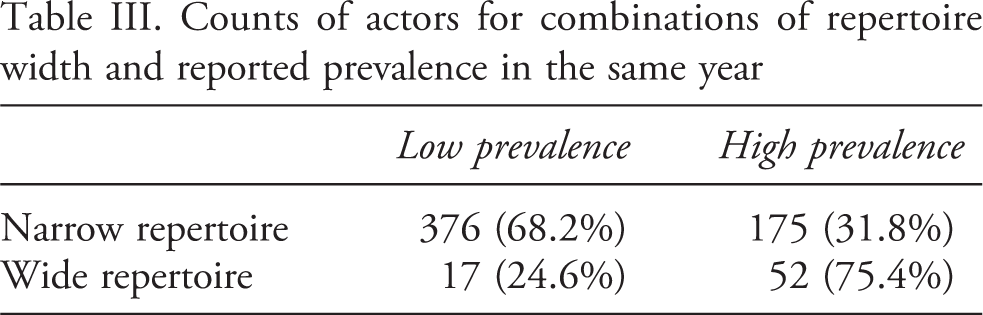
For actors reported to have engaged in at least one form of sexual violence, Table III explores how repertoire ‘width’ – the number of reported forms of sexual violence by an actor in a single year – combined with the reported prevalence level of sexual violence that year. Narrow (reported) repertoires (one or two forms) are more common than wide ones (three or more forms). Wide repertoires are more often reported with high prevalence (the actor engaged in at least one form at prevalence level 2 or 3; 75% of wide repertoire observations), and narrow repertoires with low prevalence (68% of narrow repertoire observations). Yet, many (off-diagonal) exceptions to these patterns exist that could be explored further. (See Online appendix section 1.3.2 for results using a different definition of ‘high prevalence’.)
The reported repertoires are generally quite stable. For about 66% of conflict-actor-years, there was no change in the number of reported forms of sexual violence from one conflict-year to the next. More specifically, the reported prevalence of sexual slavery and forced marriage and non-penetrative sexual torture changed infrequently from year to year, with no reported change in 89% and 83% of conflict-actor-years, respectively. The reported prevalence of rape by armed organizations changed more frequently but was stable in 66% of observations (see Online appendix section 1.3.3 for details).
Targeting based on the victim’s identity was reported in 25% of observations (conflict-actor-years with non-zero prevalence values) of rape and sexual mutilation, roughly 20% of observations of sexual abuse and forced abortion, 34% of observations of sexual sexual slavery and forced marriage, 28% of observations of non-penetrative sexual torture, and one observation of forced prostitution. Figure 3 concerns observations that included reports of collective targeting, showing for each form the distribution of targeted characteristics. The stacked sections of the bars indicate the share of observations for each of six characteristics (ethnicity, nationality, religion, a. Co-variation in forms of sexual violence by states. b. Co-variation in forms of sexual violence by rebels Collective targeting by targeted characteristic Counts of actors for combinations of repertoire width and reported prevalence in the same year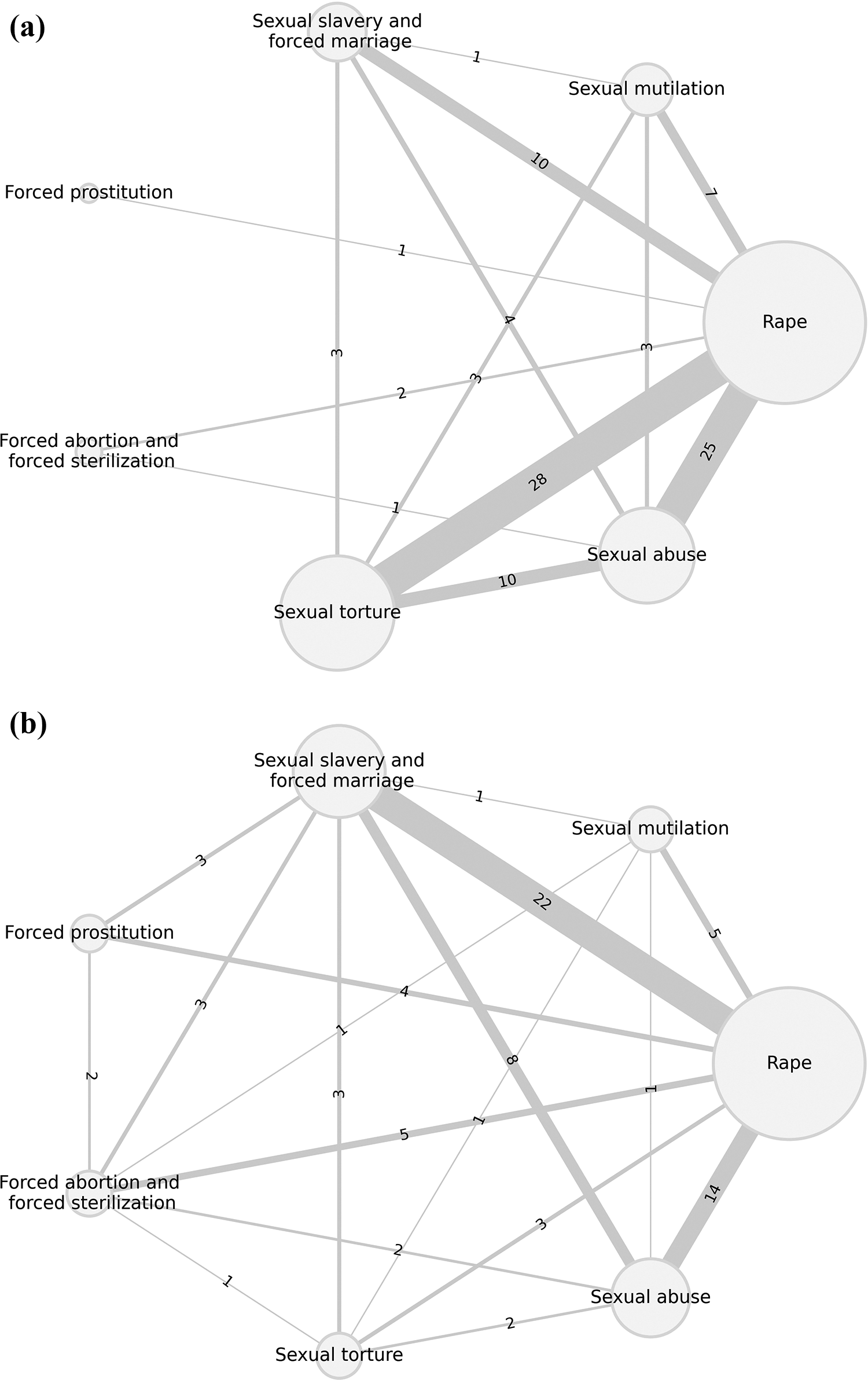
Conclusion
Documenting the forms of sexual violence in which armed organizations are reported to engage is important to mitigate violence and its consequences, and also to construct and assess theoretical explanations for violence during war. The RSVAC data package shows that the reported prevalence of different forms of sexual violence varies sharply across armed organizations. Reported variation is more complex than a simple dichotomy between those organizations that use a wide repertoire and those not reported to engage in any. Moreover, targeting may vary with repertoire element.
Throughout, we have emphasized that the RSVAC data package compiles reported sexual violence repertoires, and that the dataset’s qualitative fields and the associated conflict manuscripts are important to properly interpret the dataset. As we often encountered reports of sexual violence that we could not code (because they were not specific enough), we urge those colleagues – policy advocates and practitioners as well as scholars – who work hard and often courageously to document CRSV to report its occurrence in as much detail as possible, including its form, the perpetrating organizations (including the unit if possible), targeted social groups, and apparent prevalence.
We hope that analysis of the RSVAC data package can facilitate more appropriate and specific policy advocacy and implementation, including more precise early-warning tools and more effective mitigation. For example, the distribution of aid to mitigate the harm of sexual violence should be informed by its particular form and targeting: those who suffered sexual slavery may need particular kinds of aid different from those needed by those who suffered forced sterilization. Moreover, focusing on only a few repertoire elements risks failing to mitigate or prevent sexual violence against social groups, including male and non-gender binary victims, whose suffering is less recognized.
Transitional justice policies will also be strengthened if informed by this disaggregated approach. Prosecutors, investigators, and truth commissions will be better able to hold perpetrators and their commanders accountable if they seek from the beginning to document each organization’s repertoire of sexual violence and its targeting. Such detailed knowledge could prevent the inadvertent granting of impunity for some form of sexual violence.
The dataset and the patterns we tentatively identified in this article also suggest avenues for further research. What accounts for those states and rebels that have narrow (or nonexistent) sexual violence repertoires vs. those that have wide repertoires? Under what conditions do sexual violence repertoires widen or narrow? Under what conditions do particular combinations of forms of sexual violence occur together? Are there combinations that do not occur together? To what extent (and how) do the repertoires of states differ from their PGMs? Finally, our data also includes reported sexual violence repertoires after conflict’s end. How do the post-conflict repertoires of state forces differ from those they exerted during war?
The RSVAC data package can hopefully help scholars to address these types of questions, and also guide policy efforts to mitigate the occurrence of different forms of sexual violence and their consequences, particularly the ongoing suffering on the part of survivors, their families and communities, and the families and communities of those who did not survive.
Footnotes
Acknowledgements
The authors thank Mayesha Alam, Julia Bleckner, Sophia Dawkins, Alex De Waal, Amelia Hoover Green, Dipin Kaur, Hilary Matfess, and Robert Nagel for comments on an earlier version, and Dara Kay Cohen for comments on an early version of the dataset and coding manual.
Replication data
The dataset, codebook, and scripts for the empirical analysis in this article can be found at http://www.prio.org/jpr/datasets and  . All analyses were conducted using R and Python.
Funding
The authors disclosed receipt of the following financial support for the research, authorship, and/or publication of this article: This research was partially funded by the Norwegian Research Council, project no. 262425.