




Abstract
This article identifies a mechanism through which multiparty mediation – mediation with multiple active third parties – has positive effects on civil war resolution. Balanced mediation efforts – those providing third parties biased toward both sides of the dispute – have unique advantages in generating peaceful outcomes. In particular, balanced efforts alleviate the commitment concerns faced by both the rebel group and the government, improving the prospects for peace. In this article, I develop a measure, Mediation balance, which aggregates the mediators’ biases when multiple third parties are present. I also consider, both theoretically and empirically, how the number of mediators interacts with mediation balance to shape outcomes. I test my theory on civil war mediation attempts between 1989 and 2005, finding that balanced mediation efforts improve the probability of reaching an agreement. Furthermore, the strength of this effect is influenced by the number of mediators involved. Mediation balance also influences the probability the agreement halts the violence, albeit in unexpected ways.
Introduction
As a popular conflict management tool, mediation receives substantial attention from scholars and policymakers. Much of this prior work conceives of mediation’s effects in terms of how the mediator relates to the disputants. Mediation, however, frequently involves more than one mediator. Of the civil war mediation efforts between 1989 and 2005, almost half involved multiple mediators. 1 Understanding mediation, therefore, requires understanding the connections and interactions among the mediators as well as between the mediators and the disputants. I explore these connections by considering how mediator biases can balance each other to improve (or hinder) mediation outcomes. By considering the number of mediators as well as their characteristics, I find that some combinations meaningfully improve the chances of mediation success while others hinder conflict resolution efforts. Importantly, this project goes beyond whether an agreement is reached to consider whether these agreements halt violence, at least in the short term.
To the extent that the presence of multiple mediators is considered in the resolution literature (see e.g. Beardsley, 2011), the conclusions are pessimistic: multiparty mediation 2 decreases the chances of success. This pessimism might seem intuitive as multiparty mediation faces unique challenges, including forum-shopping, mixed messages, and buck passing (Crocker, Hampson & Aall, 1999). Crowded mediation efforts in Burundi, for example, illustrate the challenges created when mediators fail to coordinate, sending different signals to the disputants and undermining the peace process (Hara, 1999).
Despite these challenges, multiparty mediation does sometimes succeed. In Angola, the Troika (the United States, Russia, and Portugal) worked with the United Nations (UN) to broker the Lusaka Protocol. Hare (1999: 658) cites UN Special Representative Beye as telling Troika representatives, ‘[i]t is not certain that the mediators will be able to bring peace to the Angolans, but it is perfectly clear that they will never achieve it without our help’. I argue the mediation team’s composition has implications for whether an agreement is reached and the expectation the agreement will last. 3 In this article, I focus on mediator bias, exploring how bias aggregates in multiparty settings.
I assert that a balanced mediation effort, one with a mediator biased toward each side of the conflict, provides the multiparty effort unique advantages unavailable in a single-party context. When both the rebels and the government have an ally, the mediation effort benefits from all the advantages of bias, while also mitigating the concerns of and revealing information to both sides of the conflict. I find balanced efforts increase the probability an agreement is signed, but this effect only holds for small multiparty efforts. The mediation’s balance also influences the probability the agreement halts the violence, albeit in unexpected ways.
Mediation’s role and impact
Past work on mediation has explored a variety of questions regarding who offers to mediate, when belligerents accept these offers, and how mediation influences settlement or conflict recurrence. Mediators with historical linkages to the disputants are more likely to offer their services (Greig & Regan, 2008), and mediation is most likely where a third party can more readily reshape the dynamics between the disputants from conflict to cooperation (Terris & Maoz, 2005). Combatants are also more willing to accept mediation when resolution requires unpopular concessions, using mediation as political cover (Beardsley, 2010).
Importantly, mediation does not occur randomly (Gartner & Bercovitch, 2006; Beber, 2012). Rather, mediation is used in the most difficult cases, those the disputants cannot resolve bilaterally. Once present in these difficult cases, mediators provide leverage and tools that encourage resolution. Gartner and Bercovitch refer to this as mediation’s competing ‘selection’ and ‘process’ effects. Mediators encourage resolution by helping disputants navigate two key obstacles to peace: credible commitment and private information (Fearon, 1995). Commitment problems occur when one or both sides have incentives to renege on promises made during negotiations after the agreement is signed. Disputants often feel particularly vulnerable post-agreement as compliance leaves them weaker, making them an easier target if the other side does renege (Walter, 2002). Information asymmetries, on the other hand, complicate finding a mutually acceptable agreement. Disputants have private information regarding their strength and resolve as well as incentives to misrepresent this information to secure a better deal (Walter, 2006). This private information obscures the range of agreements that would be acceptable to all sides.
Effects of biased mediation
Savun (2008) defines bias as having preferences that align more closely with one party than the other; Savun distinguishes between absolute bias (bias toward one side independent of the relationship with the other side) and relative bias (bias that considers the mediator’s relationship with both disputants), arguing relative bias is more salient to mediation outcomes. Carnevale & Arad (1996) assert that bias can be an important source of influence and that bias provides an incentive for the actor to intervene. While mediators with strong interests in the conflict are motivated to aid resolution, this sometimes comes with mediator preferences that do not align with the disputants’ interests (Maoz & Terris, 2006: 411). Motive to intervene alone, therefore, is not sufficient to improve mediation outcomes.
Kydd (2003) argues biased mediators alleviate information problems by credibly revealing information when they counsel caution to their preferred side. Touval (1975) asserts bias influences how the combatants interpret information shared by the mediator, also concluding that this communication can be informative. That bias is necessary for mediators to reveal information, however, is not universally accepted. Rauchhaus (2006) argues impartial mediators can, in some circumstances, reveal information, and Beber (2012) concludes biased mediators should actually be less effective than their impartial counterparts in revealing information.
Others consider the role of bias in overcoming commitment problems. Svensson (2007) concludes mediators biased toward the government have a positive effect on the probability disputants sign an agreement while mediators biased toward the rebels have no effect on reaching agreement. Svensson argues this is because mediators biased toward the government can assuage government fears of future exploitation once the rebels have gained political authority. Interestingly, while Svensson (2007) finds mediators biased toward the government are more likely to produce a settlement, Svensson (2009) finds mediators biased toward the rebels are more likely to secure power-sharing arrangements or third-party guarantees. These provisions are then associated with reduced risk of conflict recurrence (Mattes & Savun, 2009; Fortna, 2004).
These positive effects of mediation, however, come at a price. As Rothchild (2008: 107) states, ‘[l]everage is derived from the parties’ need for a solution they cannot achieve on their own. To the extent they depend on a mediator to facilitate an agreement, they strengthen his or her ability to reward cooperative moves and raise costs on inaction’. By manipulating the negotiation environment, mediators induce cooperation. The durability of mediated agreements is often limited, however, as the long-term incentives and preferences of the belligerents remain unchanged (Beardsley, 2008). Once the mediators stop exerting pressure, the disputants are likely to return to conflict.
These studies, while advancing scholarly understanding of mediation significantly, assume that only one mediator is present in a given conflict, multiparty efforts operate as a cohesive unit, or the influence of each mediator is independent of the other mediators. Thus, they do not consider how mediator biases interact when multiple mediators are present. Notable exceptions include Crocker, Hampson & Aall (1999) who discuss the challenges, and potential benefits, of multiparty mediation from a practitioner’s viewpoint. Citing these challenges, Beardsley (2011) finds that multiple, uncoordinated mediators exacerbate the time-inconsistency problem of mediation. Beardsley's analysis, however, does not consider the composition of these multiparty efforts.
As multiparty mediation is common post-Cold War, exploring the additional complexities and benefits of multiple mediators provides deeper insight into the effect of mediation (specifically of mediator bias) on conflict resolution. I argue that balanced multiparty efforts are better positioned to alleviate concerns on both sides of the conflict during the negotiation and implementation of an agreement, increasing the chances of mediation success.
Mediator bias and mediation balance
A balanced mediation effort is one in which each side of the dispute has a mediator looking out for their interests – at least one mediator favors the rebels and at least one favors the government. Thus, balanced mediation is unique to multiparty efforts as achieving balance requires at least two mediators. Impartial efforts are those in which no mediator is biased toward either side. Unbalanced efforts have at least one mediator biased toward one side and none biased toward the other side. A mediator is considered biased if they have cultural or strategic connections to a disputant. 4 In particular, I assess each mediator’s relative bias, acknowledging relationships with both sides of the dispute in determining if a mediator is biased.
To explain the role of balanced mediation, I consider mediation’s positive process effects and how multiple third parties influence these effects. 5 Specifically, I focus on the ability of mediators to mitigate commitment concerns and reveal information. 6
Balance and credible commitment
Throughout the peace process, disputants face moments of vulnerability. Regardless of the other side’s sincerity in seeking a settlement, neither side can credibly commit not to take advantage of these moments of weakness. These commitment problems are difficult to resolve bilaterally. Moreover, impartial mediators are often unable to mitigate these concerns. Wanting to protect the peace process, impartial mediators have incentives to ignore minor violations if revealing these violations would jeopardize the negotiations, preventing impartial mediators from alleviating concerns as effectively as biased mediators.
Biased mediators have incentives to protect the side toward which they are biased, providing assurances throughout the peace process. Importantly, past work has found the direction of mediator bias has differential effects. Mediators favoring the government improve the chances of reaching an agreement (Svensson, 2007), while mediators favoring the rebels are more likely to secure third-party guarantees in agreements (Svensson, 2009). Government-biased mediators alleviate government concerns about losing power to the rebel groups by committing to protect their interests and monitor rebel activity. By decreasing the government’s perceived vulnerability in negotiating, government-biased mediators increase the government’s willingness to negotiate.
Mediators biased toward the government, however, do little to alleviate rebel concerns and instead might exacerbate rebel feelings of vulnerability. Rebel groups are concerned that once they sign an agreement (often requiring demobilization or disarmament), the government will take advantage of their new weakness. This concern discourages rebels from signing and implementing agreements. Rebel vulnerability during disarmament and demobilization is why mediators favoring the rebel group push for third-party guarantees (Svensson, 2009). As both sides of the conflict anticipate moments of vulnerability during the resolution process, mediator bias in their favor provides assurance that their interests and concerns are being taken seriously at the negotiating table. Thus, bias toward both the government and the rebels should improve the chances of reaching an agreement.
Importantly, mediator bias can also drive disputants away from the table, derailing or stalling negotiations. In January 2007, the Lord’s Resistance Army (LRA) and Government of Uganda had been negotiating in Juba when the LRA declared they were withdrawing from the talks, citing that the mediator (South Sudan) had become ‘increasingly biased’ (Atkinson, 2009: 11). It took substantial multilateral efforts, the inclusion of observer delegations from Kenya, Tanzania, Mozambique, and South Africa, and the UN Special Envoy taking the formal role of co-mediator to bring the combatants back to the table (Atkinson, 2009).
While a biased mediator can alleviate one side’s concerns, it risks leaving the other side feeling more insecure. Impartial mediators would not exacerbate the security concerns of either side but struggle to extend credible promises of protection or monitoring to either side. By including mediators biased in both directions, balanced mediation alleviates both government and rebel fears of commitment.
Balance and information asymmetry
A secondary mechanism through which balanced mediation improves the prospects for peace is revealing information. For a mediator to reveal information, they must have information at least one disputant does not and be able to credibly communicate this information. Some argue disputants will be skeptical of information from an impartial mediator as they have incentives to misrepresent if they believe doing so will encourage the disputants to accept a deal (Kydd, 2003). Others argue impartial mediators can reveal information, critiquing the assumption that these mediators are only concerned with avoiding (or ending) war (Rauchhaus, 2006). If unbiased mediators prefer a moderate, compromised solution instead of peace at all costs, then they should be able to reveal some information.
Biased mediators can also only credibly reveal information in some circumstances, namely when counseling caution to their preferred side (Kydd, 2003). In this way, a biased mediator can decrease their side’s uncertainty about the true range of mutually acceptable agreements. Biased mediators, however, cannot credibly communicate with the other side. Rather, the opposition is likely to perceive the mediator as unfairly tilting the agreement. Zartman (1995: 21) asserts, ‘mediators need not be impartial, but they must deliver the side to which they are perceived as close; they must not be perceived as selling a proposed agreement that is biased in their friends’ favor’. This is incredibly difficult (if not nearly impossible) for a single biased mediator to do.
Beber (2012) points to this difficulty and concludes that impartial mediators should be better at revealing information than biased mediators. Since biased mediators can only credibly communicate with their preferred side, if it is the other side that needs to hear the information, the biased mediator is unlikely to be believed. This is an astute point that highlights the limitation of a single biased mediator but fails to consider the possibility of two mediators biased in opposite directions. By balancing the biases, the mediators can share information with both sides. A balanced mediation effort should improve information revelation as each side has a mediator to recommend caution when appropriate. Moreover, through their relationships with the combatants, the oppositely biased mediators can credibly claim the proposals they put forward or compromises they suggest are truly in the best interests of their respective sides, giving balanced efforts a unique advantage.
Defining mediation success
In sum, balanced mediation efforts can alleviate both rebel and government commitment concerns while also improving the ability to reveal information to both sides. Balanced mediation, therefore, should be more successful than other mediation efforts. What does it mean for mediation to be successful? An important initial step in the resolution process is reaching an agreement. Even if an agreement is signed, however, the risk of conflict recurrence remains high in civil wars (Walter, 2004). Therefore, a second conceptualization of success captures whether the mediated agreement halted the violence post-agreement.
Some mediation efforts fail at producing either of these outcomes (e.g. negotiations between Sudan and the SPLM/A in the early 1990s (Butler, 2019)). Others produce agreements, but these agreements do not last (e.g. the ceasefire between the Sri Lankan government and the LTTE in early 1994 (Samuel, 1998)). Finally some mediation efforts result in long-lasting peace (e.g. the Rome Peace Accords signed in Mozambique in 1992 (Ajello, 1999; Bartoli, 2005)). Acknowledging different metrics for successful mediation, therefore, provides a more holistic evaluation of mediation’s effect on conflict resolution.
Negotiations in Angola highlight the role of balanced mediation in producing an agreement. 7 After independence, two groups that had previously fought together against Portugal fought each other for control over the newly independent country. The government received extensive support from the Soviet Union while the National Union for Total Independence of Angola (UNITA) received support from South Africa and the United States (Rothchild & Hartzell, 1995). Despite concerns from both the government and UNITA that the Namibian peace accord would mean a reduction in support from their allies, neither the United States nor the Soviet Union was ready to leave (Papp, 1993: 186). In fact, the United States sent letters and made public announcements of support for UNITA to signal their continued investment (Cohen, 2000: 88). Similarly, the Soviet Union promised to continue funding the government while also encouraging negotiations (MacFarlane, 1992).
In the early stages of negotiations, Cohen (2000) credits the United States and Soviet Union with getting the disputants to the table in the first place. Mediation efforts began under the leadership of Mobutu Sese Seko, president of Zaire, with little progress. Portugal then asserted itself as the primary mediator with the Soviet Union and United States as observers. For four months, Portuguese mediation also made little progress (Williams, 1993: 204). Once the United States and Soviet Union became more active, however, negotiations progressed quickly (Schneidman, 1993: 219). Debates over when the ceasefire would start delayed signing the agreement, but on 31 May 1991 an accord was signed in Bicesse, Portugal (Williams, 1993: 207). Representatives from the Troika were to monitor the accord’s implementation (Aksu, 2003). Thus in Angola, balanced mediation produced an extensive agreement where previous efforts had failed, leading to Hypothesis 1.
Hypothesis 1: Balanced mediation efforts will, on average, be more likely to reach a peace agreement than unbalanced or impartial mediation efforts.
Many peace agreements, however, are unsuccessful in ending the violence for even a short time (Gartner & Bercovitch, 2006). Also frequently, third parties present during the negotiations leave after witnessing the signing of the agreement, producing the time-inconsistency problem of mediation (Beardsley, 2008). I argue that biased mediators are more invested in the outcome of the conflict and the security of their ally. This self-interest to leave political advisers and monitors, even after the agreement is signed, should mitigate the vulnerabilities associated with initial implementation and encourage the disputants to put their trust in the mediator instead of their opponent. Further, while biased mediators have an interest in monitoring the conflict post-agreement, I expect these interests to be even stronger for balanced efforts as the mediators face the reality that leaving would tip the scales substantially toward the opposite side. By leaving, the mediation would shift from balanced to biased against their side. Therefore, I expect balanced efforts to mitigate the time-inconsistency problem of mediation. This additional incentive to stay is illustrated in the ceasefire monitoring plan for the Bicesse Accords which included observers from both the United States and Soviet Union.
Balanced mediation protects both sides with credible assurances, providing the disputants a safety net during the initial steps of implementation. I expect balanced mediation, therefore, to improve the chances a signed agreement halts the violence.
Hypothesis 2: Agreements negotiated by balanced mediation will, on average, be more likely to halt violence in civil conflicts than those negotiated by unbalanced or impartial mediation.
In sum, when it comes to bias, the ideal mix is one of balance. Impartial efforts do not suffer from perceptions of bias but are also less able to overcome the challenges of resolution. Unbalanced mediation is likely to result in distrust from the unrepresented side. Balanced mediation can draw on the benefits of mediator bias while also avoiding the limitations of unilateral bias.
Balance and number of mediators
Importantly, in evaluating the effect of balanced mediation, the number of mediators must also be considered for both theoretical and empirical reasons. Balanced mediation is fundamentally multiparty; for both sides to have an ally, there must be two mediators present. Additional mediators introduce additional complications by increasing the number of interests and voices at the table. These competing interests can result in longer, slower negotiations with more roadblocks to settlement. For example, mixed messages from the mediators over priorities or proposed compromises can create confusion, distrust, and incentives to leave the table. As a result, practitioners are often pessimistic regarding the effectiveness of multiple mediators (Crocker, Hampson & Aall, 1999). It is, therefore, important to disentangle the (dis)advantages of multiple mediators from the (dis)advantages of balanced (but inherently multiparty) mediation. Balanced mediation provides a way for multiple mediators to strengthen the mediation effort, making the additional complexities associated with multiple mediators worthwhile. Not acknowledging the inherently multiparty nature of balanced mediation, however, risks conflating the positive effects of balance with the negative effect of multiple mediators.
In addition to this theoretical distinction, the observed number of mediators varies substantially when comparing balanced mediation to other efforts. The mean number of mediators in a balanced effort is 3.8 while the mean numbers in unbalanced and impartial efforts are 1.8 and 1.6, respectively (median values are 4, 2, and 1, respectively). To isolate the effect of balance from number of mediators, I interact type of mediation with number of mediators.
Empirical testing
To evaluate these hypotheses, I used a sample from the Civil War Mediation (CWM) dataset (DeRouen, Bercovitch & Pospieszna, 2011) which includes 307 mediation efforts between 1989 and 2005. These efforts seek resolution in 49 conflicts across 42 countries. Each mediation effort captures a joint or concurrent meeting between the disputants and mediator(s). These efforts can last days or months. If an effort terminates and then the disputants return to the table (with the same or new mediators), this is considered a new meditation effort.
Measuring mediation success
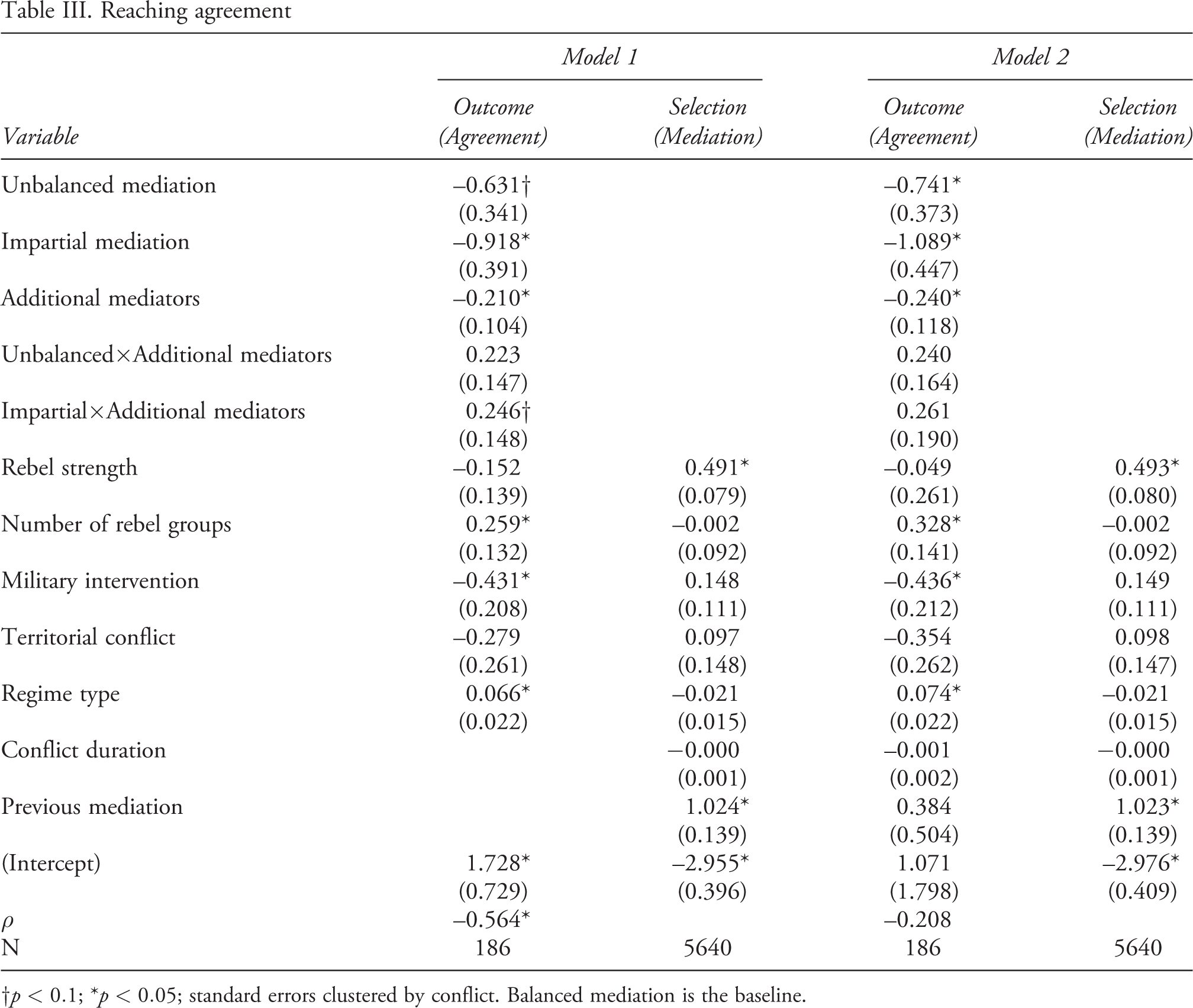
To evaluate Hypothesis 1, I measure mediation success as whether the negotiations produced an agreement. As mediation is not randomly assigned to conflicts (Beber, 2012), I estimate a probit model with sample selection (Van de Ven & Van Praag, 1981), with the conflict-month as the unit of analysis. 8 In the selection equation, the dependent variable is whether mediation occurred in that conflict-month. In the data analyzed, 186 conflict-months experience mediation. The outcome equation evaluates if a mediation effort produced a peace agreement. 9 Table III reports the results of these analyses.
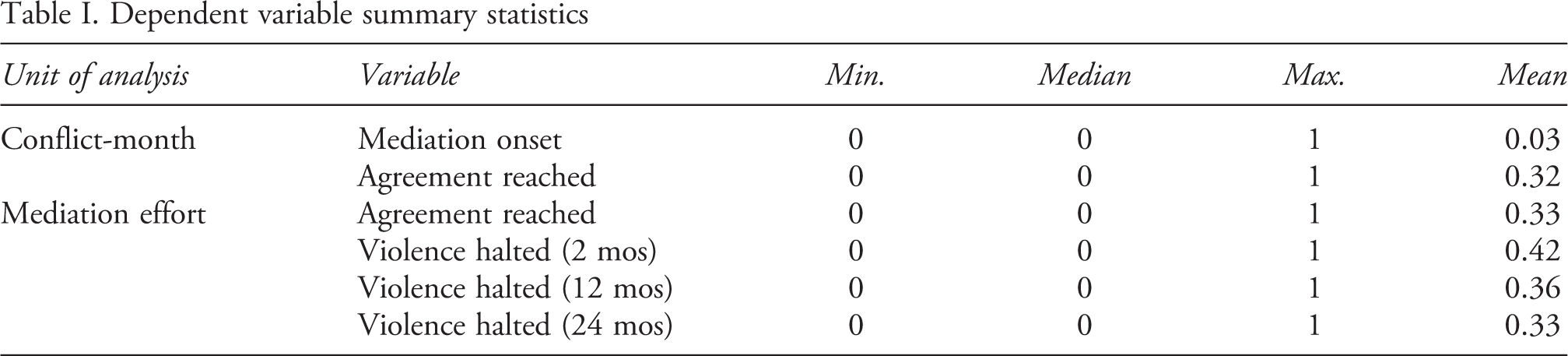
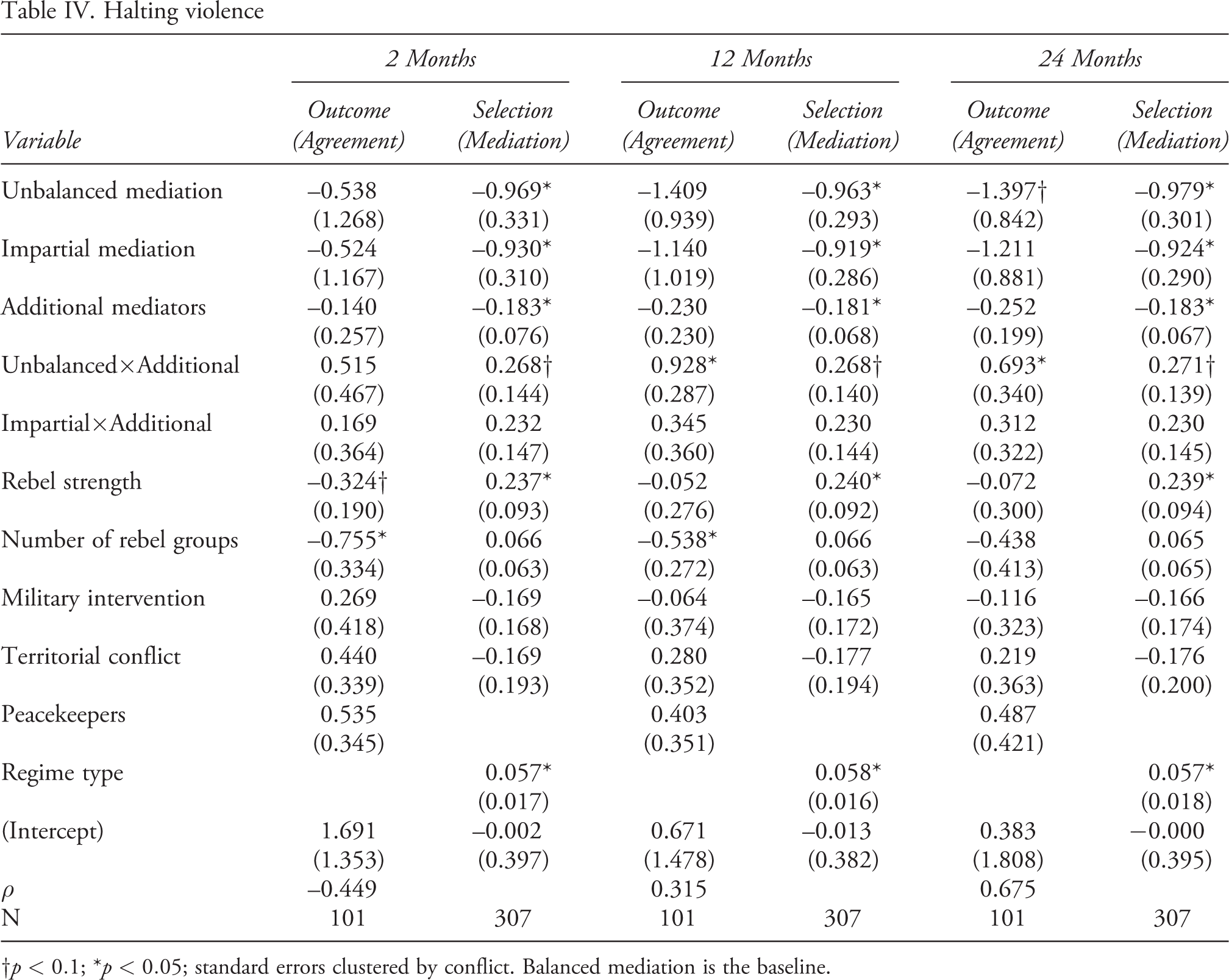
To evaluate Hypothesis 2, I operationalize success as halting the violence post-agreement (see Table IV). The unit of analysis is the mediation effort. Once again, I estimate probit models with sample selection. 10 The selection equation’s dependent variable is whether the mediation effort resulted in an agreement. The dependent variable for the outcome equation is whether the agreement resulted in a 2, 12, or 24-month halting of the conflict. I determined whether these thresholds were reached using the UCDP Conflict Termination Dataset (Kreutz, 2010). Summary statistics for the dependent variables can be found in Table I.
Measuring mediation balance
To determine the mediation effort’s balance, the connections between each mediator 11 and both disputants were determined along two dimensions: military/political and cultural. 12 Each mediator’s connection is either positive (biased toward), negative (biased against), or zero (impartial).
Military/political bias
Dependent variable summary statistics
Next, I consider the political bias of international organizations (IOs). Lundgren & Svensson (2014) make a compelling argument that assuming IOs are unbiased is empirically inaccurate and often not the IO’s intention. 14 Treating IOs as unbiased, therefore, limits our understanding of their role in conflict resolution. Drawing on revealed preference theory (Samuelson, 1948) and signaling (Fearon, 1997), ‘IOs were defined as biased if at least one IO member provided support to either of the sides, resulting in either pro-government (biasgov) or pro-rebel (biasreb) bias’ (Lundgren & Svensson, 2014: 326). An IO would be coded as biased toward both the government and rebel group if it has at least one member that supports the government and at least one member that supports the rebels. 15
Cultural bias
The second dimension is cultural bias. While some have dismissed this dimension, given the cultural and identity-based sources of tension in many civil conflicts (see e.g. Denny & Walter, 2014), this dimension plays an important role in shaping the relationship between combatants and mediator(s). A mediator is considered culturally biased toward a disputant if it shares politically relevant religious or ethnic ties with that disputant as determined by the Ethnic Power Relations (EPR) Dataset (Wimmer, Cederman & Min, 2009), Ethnic Armed Conflict Dataset (Cederman, Min & Wimmer, 2010), and Minorities at Risk Organizational Behavior (MAROB) Dataset (Wilkenfeld, Asal & Pate, 2011). EPR identifies all politically relevant ethnic groups (including ethno-religious groups) in each country. The Ethnic Armed Conflict Dataset identifies the relevant ethnic groups in each conflict, which was further supported by MAROB when possible. 16
Relative bias
Each mediator’s biases are captured by four dichotomous variables: military/political bias toward government (
Distribution of Mediation balance
Mediation balance
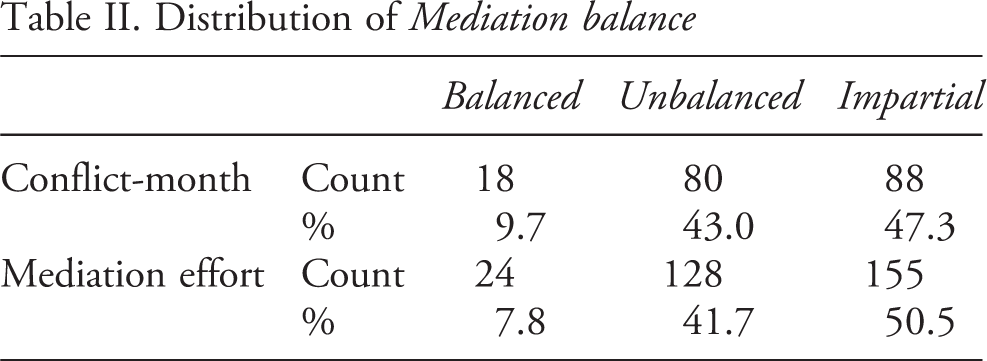
After identifying each mediator’s relative bias, these biases were aggregated to capture the mediation’s overall balance, producing the key variable of interest: the three-category nominal variable Mediation balance. Mediation efforts are impartial if all mediators have a relative bias score of 0. An effort is balanced if both sides have a mediator biased in their favor (i.e. for at least one mediator R is negative and for at least one mediator R is positive). An effort is unbalanced if only one side has mediators biased in its favor. Table II reports the distribution of Mediation balance for both samples: conflict-month and mediation effort.
Additional mediators
As argued previously, the number of mediators must be included for both theoretical and empirical reasons. Additional mediators captures the number of mediators minus 1 as all efforts must have at least one mediator. Subtracting 1 eases the interpretation of the interaction terms by making the baseline single-party mediation. In the analyses reported in Table III, the mean number of additional mediators is 0.90 with a standard deviation of 1.31 (median 0; most efforts have one mediator). In Table IV, the mean number of additional mediators is 0.85 with a standard deviation of 1.22 (median 0). Distribution plots of all key independent and dependent variables can be found in Online appendix Figures A1–A6.
Model selection and controls
To test my hypotheses, I estimated probit models with sample selection. These models, especially with small samples, require at least one variable to satisfy the exclusion restriction; it must be included in the selection equation but not the outcome equation. 18 In civil war research, it can be very difficult to find variables that satisfy this restriction (Vance & Ritter, 2014). The factors that influence mediation onset are likely to influence mediation outcomes as disputants consider the expected outcome of mediation before agreeing to talk. Fortunately, when sample sizes are large, the estimates from a probit model with sample selection are consistent and identified (Sartori, 2003).
Because of the above discussion, in Table III, I estimate models with and without excluded variables as the sample size is large. As the sample size in Table IV is smaller, I only report selection models with carefully chosen exclusion variables. The excluded variables and other controls are explained below.
Mediation onset
To test Hypothesis 1, I model the selection into mediation and then whether an agreement was reached. In the selection into mediation equation, I include variables from the mediation onset literature. These variables include relative rebel strength (Clayton, 2013; Clayton & Gleditsch, 2014), number of rebel groups (Clayton, 2013; Clayton & Gleditsch, 2014), military intervention in the conflict (Sawyer, Cunningham & Reed, 2017), the country’s polity score (Ruhe, 2015; Keels, 2019), whether the conflict was over territory (Clayton, 2013; Clayton & Gleditsch, 2014), conflict duration (Greig & Regan, 2008; Keels & Greig, 2019), and previous efforts at mediation (Clayton, 2013; Clayton & Gleditsch, 2014; Ruhe, 2015). Relative rebel strength comes from the Non-State Actors Dataset (Cunningham, Gleditsch & Salehyan, 2013); number of rebel groups and previous efforts at mediation are from CWM (DeRouen, Bercovitch & Pospieszna, 2011). Military intervention draws on the UCDP External Support Dataset (Croicu et al., 2011), and polity comes from Marshall & Gurr (2020). Issue incompatibility and conflict duration come from the UCDP Armed Conflict Dataset (Pettersson, Högbladh & Öberg, 2019).
Reaching agreement
Reaching agreement
†
Exclusion restriction
Table III reports two models. In the first, Previous mediation and Conflict duration are included in the selection equation but not the outcome equation. In the second model, no variables were excluded as identification is less of a concern when the sample size is large. Online appendix Table A3 includes two additional specifications that exclude Previous mediation and Conflict duration individually. Moreover, Table A2 includes models without selection. The conclusions drawn are consistent across model specifications.
Previous mediation and Conflict duration were chosen because they could theoretically influence selection into mediation but not whether mediation secured a peace agreement. Previous mediation indicates that at least some members of the international community are invested in helping the disputants reach a resolution. Recent mediation makes new offers of mediation (by both the same and new mediators) more likely (Greig & Regan, 2008). Interested third parties, however, are not enough to secure agreement, as evident by how frequently mediation efforts fail. While a subsequent mediation effort could increase the chances of success by building upon advances made during the previous effort, this assumes the new effort is able to capitalize on those advances. Changes in mediation team composition, conflict dynamics, or new international priorities could all prevent the mediation effort from building upon the past. Thus, while past mediation signals international investment in getting the disputants to the table, it does not necessarily improve the chances of mediation success.
Halting violence
†
Longer conflicts should encourage the disputants to accept mediation. ‘Expectations for victory decline as the duration of conflict grows’ (Greig & Regan, 2008: 767). Reaching a settlement, however, requires that beliefs about the opposition’s strength and resolve have converged. While longer conflicts might reveal the opposition’s strength, the opponents’ resolve or willingness to continue fighting might not be as readily apparent. Thus, the duration of conflict might encourage disputants to engage in mediation but not be sufficient to secure a settlement as the combatants continue to test their opponent’s true demands and resolve.
Moreover, in previous studies of mediation onset and outcome, Previous mediation and Conflict duration have only been included in the selection equation or only significantly influenced selection but not outcome (Clayton, 2013; Keels & Greig, 2019; Keels, 2019). These studies indicate, at least empirically, that conflict duration and prior mediation influence selection into mediation but not the likelihood that mediation produces an agreement.
Halting the violence
To test Hypothesis 2, I first model reaching an agreement and then whether the violence halted for 2, 12, or 24 months post-agreement (see Table IV). In these models, the selection equation evaluates if mediation ended in an agreement. Thus, I use the same control variables discussed above.
In the equations with halting the violence post-agreement as the outcome, I include factors associated with conflict recurrence: military intervention in the conflict (Karlén, 2017), whether the conflict is over territory (Karlén, 2017), relative strength and number of rebels (Rudloff & Findley, 2016), and the presence of peacekeepers (Mattes & Savun, 2010; Fortna, 2003). If peacekeepers (UN or non-UN) were stationed in the country came from Bara & Hultman (2020).

Marginal effect on Agreement reached given mediation
Exclusion restriction
In Table IV, Polity is included in the selection equations but not the outcome equations. Once again, finding a variable that theoretically satisfies the exclusion restriction is challenging as many of the factors that shape reaching an agreement will also shape its implementation. Polity was chosen because recent studies of conflict recurrence generally and conflict recurrence after a negotiated settlement specifically have failed to find a significant relationship (Hartzell & Hoddie, 2003; Mattes & Savun, 2010; Keels & Mason, 2019; Steinert et al., 2019; Quinn et al., 2007; Walter, 2004). Hartzell & Hoddie (2003) hypothesize that a history of democratic institutions should make compromise and negotiation easier for combatants. Their empirical analysis, however, does not find an association between regime type and durability of peace. This indicates that perhaps democratic institutions make compromise and negotiation more attractive (encouraging an agreement to be reached) but cannot overcome the incompatibilities that led to conflict in the first place (ending the violence). Once an agreement is reached, to end the fighting the combatants must expect the other side to abide by the agreement, disarm, and demobilize. The conflict itself indicates the opposition has been willing to use violence to secure its interests in the past, regardless of regime type. Thus, regime type might influence the disputants’ willingness to compromise but not overcome the commitment problems that prevent implementation. 19
Results
Online appendix Table A1 reports summary statistics for all control variables. Table III and Figures 1 and 2 present the results of the model with Agreement reached as the outcome of interest, testing Hypothesis 1. Table IV and Figures 3 and 4 present the results with Halting violence as the outcome of interest, testing Hypothesis 2. To highlight the relationships of greatest interest (balanced mediation vs. other mediation types), balanced mediation is always the baseline category. 20
Looking at Table III, the coefficients on impartial and unbalanced single-party mediation are both negative, although this relationship is not statistically significant at the conventional 0.05 threshold for unbalanced efforts in Model 1. 21 Looking at the marginal effects of unbalanced and impartial efforts across number of mediators (Figure 1), this difference between impartial and balanced efforts holds when the number of mediators is small. When there are two mediators (the minimum necessary for a balanced mediation effort), impartial efforts are less likely to produce an agreement than their balanced counterparts. With three or more mediators, all three mediation types are not statistically different from one another. Thus, the positive effect of balanced mediation only holds when the number of mediators is kept to a minimum.

Predicted probability of Agreement reached given mediation
Marginal effect on Halting violence given agreement
The difference between balanced and impartial efforts, when the number of mediators is two, is not only statistically significant but also substantively interesting (Figure 2). 22 The probability of agreement falls from 59% for balanced efforts to 28% for impartial efforts. Balanced two-party mediation also outperforms single-party impartial mediation. Quickly, however, the value of balance falls when additional mediators are present. Interestingly, the expected performance of impartial and unbalanced efforts is fairly flat across number of mediators, as indicated by the predicted probabilities in Figure 2.
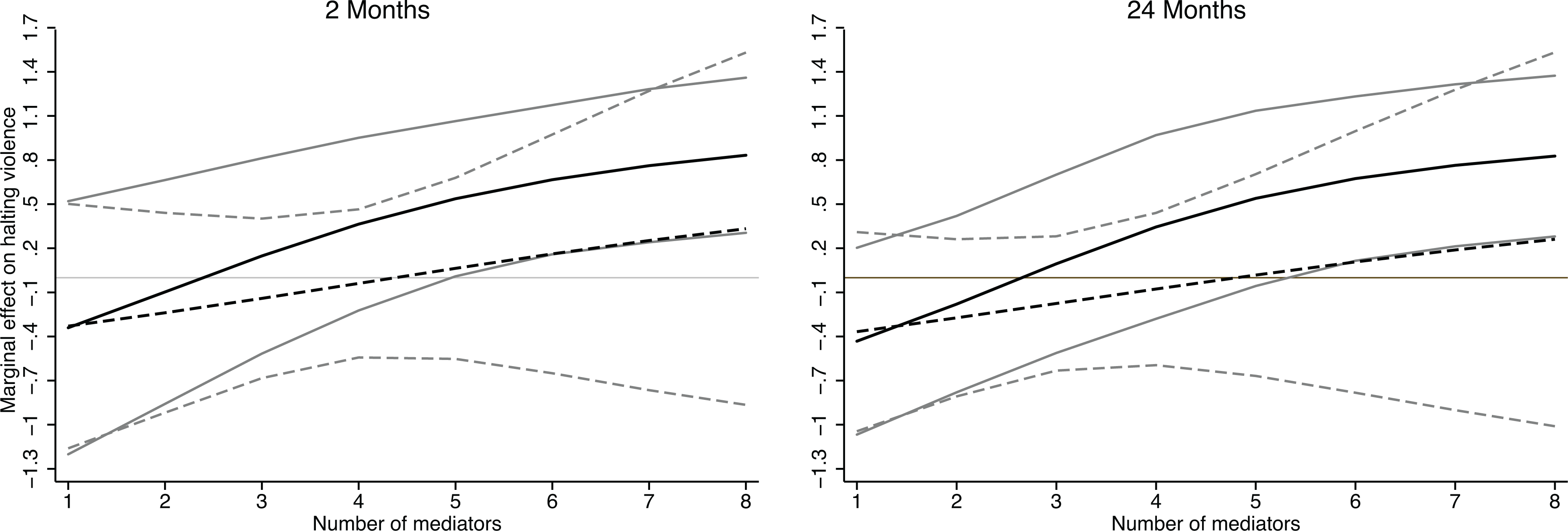
In Table IV, balance does not at first seem to influence the probability of halting violence post-agreement. Figure 3, however, reveals an interesting result from the interaction.
23
The types of mediation are not statistically different from each other when number of mediators is low. As the number of mediators rises, unbalanced efforts outperform balanced efforts. This surprising finding runs counter to Hypothesis 2 and is discussed further below. In Table IV, the selection equation consistently indicates unbalanced and impartial efforts are less likely to produce an agreement Predicted probability of Halting violence given agreement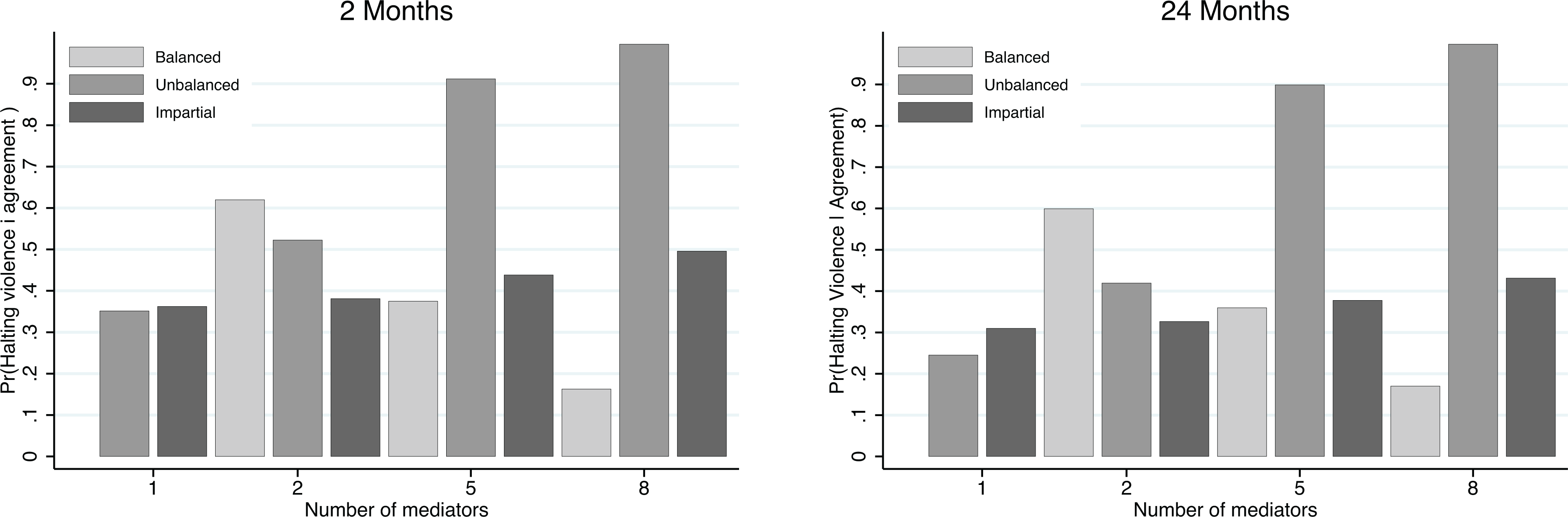
Discussion and conclusion
Collectively, the results above tell a complex story about the role of bias, balance, and multiparty mediation in conflict resolution. After signing an agreement, the disputants face a new set of obstacles to peace. In particular, demobilization creates new vulnerabilities that lead to heightened tensions and eroded trust. Even when the disputants sign the agreement in good faith, moments of tension and insecurity plague implementation. Thus, even when mediators find an agreement the disputants genuinely prefer to continued conflict, they often cannot ensure the combatants will continue to prefer that agreement a year later.
The Bicesse Accords highlight these long-term challenges. Even though the accords were initially a success, UNITA struggled to transition into a political party (Venâncio & Chan, 1996: 83). Despite the elections being ‘generally free and fair’, Savimbi claimed fraud and threatened to abandon the peace process if UNITA lost (Cohen, 2000: 116–117). The United States urged Savimbi to accept the results, but Savimbi relaunched the conflict (Venâncio & Chan, 1996: 100). The United States withdrew its support in response, but with new access to diamond mines, UNITA funded its campaigns without US aid (Hare, 1999: 661). Thus, while balanced mediation produced an agreement, it did not secure a lasting peace. The mediators stayed post-agreement, as expected, but their continued presence was insufficient. The needs at the negotiating table were not the same as those beyond the table.
Perhaps more interesting is the effectiveness of unbalanced mediation when multiple mediators are present. The Juba talks provide some inspiration for potential dynamics at play. When the LRA threatened to leave the talks, the UN took on a stronger role, and four neighboring states sent official delegations to offset the LRA’s concerns about South Sudan. Importantly, while Sudan had provided support to the LRA early in the conflict, this support was terminated by 2002 (Croicu et al., 2011). Thus, there was no way to balance South Sudan. Perhaps the inclusion of multiple additional actors without direct ties to either side offset the perceived bias of South Sudan, keeping the LRA at the table. Ultimately the Juba talks failed to end the war in Uganda, but the idea of offsetting one mediator’s biases with multiple unbiased actors merits consideration in future work.
Notably, balanced mediation is uncommon. Only 11 balanced efforts produced agreements in the data analyzed here. Considering other ways in which biases could be offset would broaden the available options for the international community in circumstances where balancing is not possible. In addition to contributing to the academic literature, identifying when and how multiple mediators improve the chances for successful resolution has important policy implications. States, IOs, and other international mediators cannot provide support to all conflicts simultaneously, forcing potential mediators to select where to invest their time and resources. A more refined understanding of how an additional mediator helps (or hurts) resolution would assist in allocating resources where they are most needed.
Footnotes
Replication data

Acknowledgments
I extend my gratitude to Navin Bapat, Kyle Beardsley, Skyler Cranmer, Mark Crescenzi, Douglas Dion, Stephen Gent, Yooneui Kim, Bomi Lee, Sara Mitchell, and Ki Eun Ryu for their feedback and assistance in the development of this project. Also, I thank the anonymous reviewers and editors of JPR for their thoughtful feedback.