



Abstract
McGloin (2009) recently demonstrated that an imbalance in delinquency between a subject and his or her best friend predicted within-individual changes in offending behavior. Still, the precise mechanism(s) whereby subjects moved toward delinquency balance remained unclear. It is possible that this process has little to do with the transmission of deviant values, but instead is a reflection of unstructured and unsupervised time spent with peers. The results suggest that an imbalance in time use between peers predicts an imbalance in deviance between peers, but not within-individual change in delinquency. The discussion considers the implication of these findings for theory and research on peer processes.
Both theory and research on peer-based risks for delinquency have long focused on exposure to deviant peers (Pratt et al. 2010). It has become increasingly clear, however, that scholars must not only consider what sort of friends an adolescent spends time with but also how he or she spends time with them. Largely due to Osgood, Wilson, and O’Malley’s (1996) argument that informal socializing with peers provides natural situational inducements for deviance, social routines with friends have been incorporated into the discussion of how peers can shape behavior during adolescence. Indeed, Haynie and Osgood (2005) recently found that unstructured and unsupervised time with peers contributed to adolescents’ delinquency independent of and at a comparable level to peer group deviance. Thus, for scholars interested in illuminating the processes of peer influence, accounting for socializing routines and consequent opportunities, as well as deviance levels, is vital.
McGloin (2009) recently contributed to the deviant peer discussion by calling attention to “delinquency imbalance” between friends, theorizing that people will change their behavior to be more congruent with their best friends’ actions (i.e., the deviance gap between a subject and friend defines the level of criminogenic risk). In support of this premise, her analysis of the AddHealth data revealed that a deviance gap between a subject and his or her in-school best friend predicted within-individual change in delinquency, even when controlling for objective exposure to peer deviance. 1 Despite the salience of opportunities with regard to peer influence, however, McGloin did not consider the potential impact of socializing routines on the balance process. This is unfortunate because accounting for opportunity structures could provide greater theoretical clarity on how delinquency balance operates. Indeed, informal socializing with peers may play two important roles in this process.
First, an imbalance in delinquency levels between in-school friends might reflect different socializing routines outside of school. As Rees and Pogarsky (forthcoming: 32) recently noted, the “dynamics between best friends are not fully understood without reference to the social setting in which both are embedded.” Although adolescents spend time together during school hours, they could have very different after-school routines, when they are focused on sports, hobbies, employment, and hanging out. Outside of the school walls, youth will vary in terms of their level of parental supervision, the amount of free time they have, and how often they spend time with peers without agenda. One friend may typically spend ample unstructured and unsupervised time with peers, leading to higher levels of delinquency, and one may spend more time in structured and supervised settings, leading to less delinquency. Thus, the deviance “gap” between a subject and his or her best friend—the independent variable in balance theory—could at least partly reflect differential exposure to situational inducements and opportunities for delinquency. In this way, the impact of informal socializing with peers may extend past the immediate situation; if an imbalance in time use between friends is exogenous to a delinquency imbalance, socializing routines could therefore indirectly affect within-individual changes in delinquency, as well.
Second, McGloin (2009) acknowledged that the precise mechanism(s) whereby subjects moved toward delinquency balance remained unclear. Although it would be tempting to simply infer that balance emerges from reciprocal normative influence, it is also possible that this process is not due to the transmission of deviant values. Instead, an imbalance in time use between friends may have a direct impact on the within-individual change in delinquency. Because friendship is at least partly defined by involvement, one might expect best friends to become enmeshed in each others’ social activities over time. Disparate time use could begin to converge, consequently promoting shifts in delinquency levels to a “middle-ground” between the two original reference points. As an example, hanging out at the serious delinquent’s home may involve unsupervised time with fellow adolescents, whereas there may be relatively more guardianship or structure at the less serious delinquent’s house. The worse delinquent therefore finds his opportunities for informal socializing somewhat limited, whereas his best friend’s opportunities broaden. Thus, the tendency for subjects to change their behavior toward delinquency “balance” could reflect a merging of social routines and, consequently, a convergence of situational opportunities for offending. 2
This underlying mechanism is theoretically plausible, but it might be limited in reality by social constraints. Parents play a role in controlling adolescents’ time use (see Osgood, Anderson, and Shaffer 2005) and teenagers often have many obligations that structure their daily routines. This can include sports, clubs, and employment, not to mention that most adolescents are also in school for approximately 35 hours/week. Youth may not have the autonomy or ability to change their social routines in a way that allows for a blending and balancing of informal socializing with peers. This stands in contrast to normative influence, which does not have to overcome the same constraints. Best friends who attend the same school are likely to see each other nearly every day of the week, for several hours per day, providing ample time to influence each other’s attitudes and behaviors. Indeed, previous work has highlighted the particularly strong socialization that can occur in structured institutional settings (e.g., McCord 1992). Thus, the role of time use in facilitating changes in delinquency toward balance, certainly as an alternative to normative influence, is open for debate and warrants empirical attention.
This research note uses the AddHealth data to investigate whether an imbalance in time use (i.e., informal socializing) between a subject and his best friend (1) predicts a delinquency imbalance, as well as (2) within-individual change in delinquency. Doing so provides necessary insight into the potential mechanism(s) underlying the delinquency balance process, bringing together what now seem to be the primary peer-based risks for delinquency: socialization and situational inducements provided by peers in informal settings.
Data and Measures
Like McGloin’s (2009) initial analysis, this research relies on the subjects from the saturation sample of the AddHealth data set. 3 The precise sample is somewhat different, however; it focuses on the adolescents who identified a same-sex best friend and whose best friend provided information on self-reported delinquency as well as unstructured and unsupervised time with peers. 4 As with the previous study of delinquency imbalance, the dependent variable is a difference score derived from measures at waves 1 and 2. Both the wave 1 and 2 in-home surveys, administered approximately 1 year apart, assessed how often the respondent engaged in 13 deviant activities over the previous 12 months. Answers were summed at each wave and then the difference was taken between the waves. Positive values on this outcome indicate an increase in delinquency from wave 1 to wave 2 and negative values indicate a decrease in delinquency (mean = −.97, SD = 3.67). The delinquency imbalance measure is also replicated here. Because the subjects’ same-sex best friends self-reported on the same 13 delinquency items, it is possible to determine the difference between the subject’s and best friend’s delinquency at wave 1 (i.e., best friend’s sum for the 13 deviance items—subject’s sum for the 13 deviance items). Positive values on this measure therefore indicate that the friend was more delinquent, whereas negative values indicate the friend was less delinquent than the subject (mean = .44, SD = 5.64).
Turning to the measure of the imbalance in the time spent socializing informally with peers, subjects were asked at wave 1 how often they “just hung out” with friends during the past week, with responses ranging from 0 (not at all) to 3 (5 or more times). As other scholars have also argued (Anderson and Hughes 2009; Haynie and Osgood 2005), this measure captures time spent with peers in unstructured settings, especially since it is preceded by questions about more structured and specific activities (e.g., time spent playing sports or working on hobbies). Because Osgood, Wilson, and O’Malley (1996:640) argued that “situations conducive to deviance are most prevalent during leisure activities away from senior family members,” this item is supplemented with a question (also at wave 1) asking how often the subjects’ mothers were present when they returned home from school, with responses ranging from 1 (always) to 5 (never). This provides some insight into the amount of unsupervised time in an adolescent’s general routine at the time when he or she is arguably most likely to “hang out” with peers. These two items are summed so that scores can range from 1 to 8, with higher scores indicating more time allotted to such routines. 5 As with the delinquency items, subjects and best friends provided answers to these questions, which therefore means one can determine the difference between the amount of time subjects and their respective best friends spend informally socializing with peers. This difference score serves as the measure of imbalance in socializing routines. Positive values indicate that the best friend’s routines consisted of more time with peers in unstructured and unsupervised settings, whereas negative values indicate the friend spent less time socializing with friends in this way compared to the subject (mean = .21, SD = 2.48).
This analysis also replicates the control variables employed by McGloin (2009). First, the models include an item-measuring change in the exposure to “objective” peer deviance from wave 1 to wave 2 (i.e., the difference between the best friend’s deviance score at wave 1 and wave 2; higher scores indicate an increase in the level of deviant peer exposure) to ensure that the deviance imbalance measure is not serving as a proxy for objective exposure (mean = −1.05, SD = 4.69). Second, the models account for change in several social bonds—parental attachment (mean = −.04, SD = .61), school attachment (mean = −.13, SD = .76), and friend attachment (mean = .11, SD = .81)—from wave 1 to wave 2, which theoretically should be related to changes in delinquency. Finally, the analysis also accounts for gender (53 percent female), race (71 percent White), and age (mean = 15.4, SD = 1.49), largely because these attributes could be related to friendship patterns and processes (Cairns et al. 1995; Giordano 2003; Pettersson 2003; Yanovitsky 2005). 6
Because respondents are clustered within schools, which were not randomly selected, the analysis relies on fixed-effect models because they make no assumptions about the distribution of unobserved heterogeneity (Allison 2005; Bushway, Brame, and Paternoster 1999). In addition, residual dependencies could exist because a respondent can emerge as both a subject and a best friend/friends. In order to reduce the possibility committing a type I error due to reduced standard errors, the regression models, which were run in STATA, also report robust standard errors (Cameron and Trivedi 2005).
Results
The first regression model in Table 1 replicates the core finding from McGloin’s (2009) recent work—here it provides a point of comparison for the model that includes the time use measure. Model 2 demonstrates that the imbalance time use measure emerges as a statistically significant predictor of delinquency imbalance with a best friend, which is consistent with predictions. A subject who spends more unstructured and unsupervised time with peers than his or her best friend does also tends to be more delinquent than his or her friend. Conversely, a subject who spends less unstructured and unsupervised time with peers than does his or her best friend is likely to be the less delinquent of the pair.
Fixed Effect Regression Models with Robust Standard Errors Predicting Within-Individual Change in Delinquency from Time 1 to Time 2 and Delinquency Imbalance with Best Friend
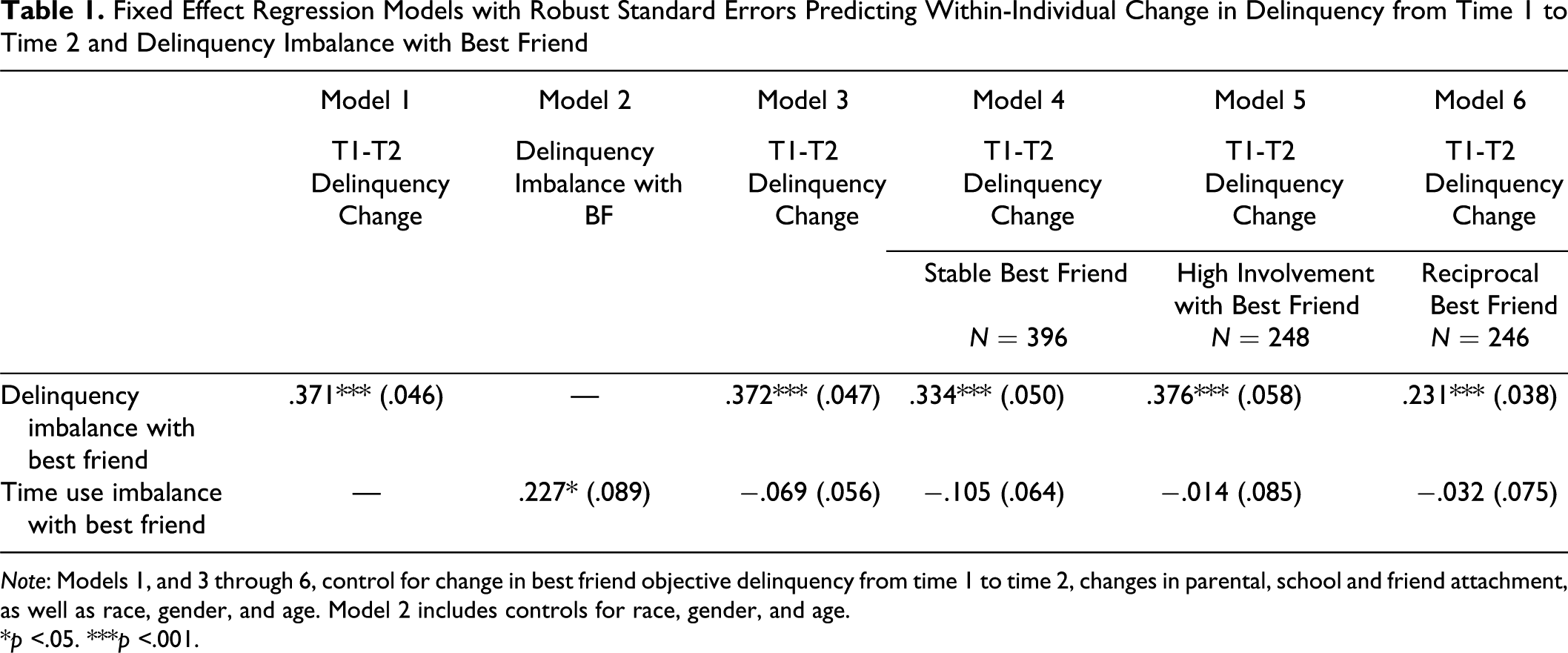
Note: Models 1, and 3 through 6, control for change in best friend objective delinquency from time 1 to time 2, changes in parental, school and friend attachment, as well as race, gender, and age. Model 2 includes controls for race, gender, and age.
*p <.05. ***p <.001.
Model 3 then determines whether an imbalance in informal socializing also predicts within-individual change in delinquency, while concurrently diminishing the impact of the delinquency imbalance measure. Both the magnitude and statistical significance of the relative deviance coefficient appear unaffected by the inclusion of the time use measure (compared to model 1), and the difference in time use measure does not achieve statistical significance. This suggests that, although an imbalance in social routines may be implicated in why best friends have differential delinquency levels, it does not explain the tendency for subjects to change their own delinquency in a manner consistent with an attempt to achieve delinquency balance.
Still, it is possible that the current sample misses an existing relationship between imbalance in time use and delinquency change, urging some supplemental analyses. Perhaps the presumption that friends come to share leisure routines is erroneous for all in-school best friends. First, friendships are often transient in adolescence—indeed, in the current sample about 45 percent of the subjects identified different people as a best friend at waves 1 and 2—and sharing routines might be more likely to occur for “stable” friendships. As model 4 demonstrates, however, results for only the subjects with stable best friends are nearly identical to model 3. Second, though best friends are typically the closest friend/friends within individuals, the extent to which the subjects are involved with these best friends may vary across individuals. During wave 1, subjects answered three questions that had simple binary answers: did you go to the best friend’s house over the past week; did you meet the best friend after school to hang out or do something over the past week; and, did you spend time with the best friend over the previous weekend. Model 5 replicates the regression only for those subjects who answered “yes” to all three questions. As with the previous model, however, narrowing down the analysis to this subsample does not alter the findings. Finally, model 6 focuses on the assumption that friends sharing routines and leisure time might be more reasonable for reciprocal best friends (i.e., the subject and best friend nominated each other as best friends). As with the other two supplemental analyses, this model also shows that the imbalance in time use measure cannot be implicated as explaining within-individual change in delinquency.
As mentioned earlier, an imbalance in time use may not prompt within-individual change in delinquency because adolescents are not readily able to shift socializing routines in a way that converges with a best friend. A closer look at the data on this point revealed that approximately 70 percent of the sample reported doing housework three or more times during the previous week and nearly 50 percent played sports three or more times during the previous week. Furthermore, the average respondent spent more than 20 hours during the previous week watching television and videos or playing video games. This is all in addition to the time spent in school, thereby providing some support to the premise that blending social routines could face substantial impediments.
Discussion
McGloin (2009) recently argued that important insight into the change and stability of offending could be gained by focusing on the gap between subjects’ and friends’ levels of deviance, led by the notion that humans prefer social equilibrium and will therefore seek congruence. It is of course tempting to focus on the “deviant” aspect of this relationship, but theory and research have suggested that peers can facilitate offending regardless of their individual-level proclivities for antisocial behavior. For instance, Osgood et al. (1996) argued that the natural processes inherent to unstructured leisure activities, particularly among adolescents left unsupervised by parental figures, are amenable to engaging in delinquency. Given that best friends exist within a larger peer group and that social routines with peers are so salient during adolescence, it is reasonable to ask to what extent the balance process could be due to socializing patterns rather than deviant normative influence.
The current analysis found that a divergence between a subject and best friend in the amount of unstructured and unsupervised time spent with peers predicted the deviance “gap.” This suggests that a delinquency imbalance with the in-school best friend may (at least in part) be due to differential exposure levels to situational inducements and opportunities for antisocial behavior outside of school. Of course longitudinal data will be needed to confirm causal pathways, but this finding is important for at least three reasons. First, researchers typically view opportunities for delinquency as stemming from deviant sources, but perhaps the opposite could also be true. Differential opportunities and social routines can impact friends’ delinquency levels, which in turn influence behavior. Although Osgood et al. (1996) highlighted the immediate situational motivation for deviance provided by informal socializing, this does not mean that its impact is ephemeral and limited to that situation. How youth spend time outside of school can affect levels of delinquency—experiences which are then imported into school and shape normative influence. In this way, situational context can immediately promote delinquency as well as indirectly facilitate changes in behavior (whether pro- or antisocial) through the balance process. Second, this finding illuminates the connection between how one spends time with peers and peer delinquency. Recent work has focused intently on establishing the independent effects of informal socializing with peers and having deviant peers on delinquency (Haynie and Osgood 2005), but this does not mean that they are unrelated, as evidenced here. Third, this result reminds scholars that in-school best friendships—the basis for many studies of deviant peer influence—are embedded within a larger network of friendships and social routines that occur outside of school. Ignoring that fact could limit theoretical and empirical clarity of peer influence mechanisms.
This inquiry did not find support for the notion that an imbalance in time use also predicted within-individual change in delinquency. Therefore, it cannot be implicated as the mechanism driving delinquency balance. As noted, this may be due to adolescents having limited capacities to shift their social routines to converge with a best friend’s. Data presented here lend some support to the notion that other social obligations may impede such convergence, reminding us that peer processes operate in social context, which can facilitate or impede the risk process (Wikstrom 2006). For instance, normative influence comparatively has ample chance to operate as best friends spend time together nearly every day in school; school offers a constrained environment in which students can frequently and consistently share values, as well as serve as powerful sources of reinforcement for each other. Thus, normative influence in school likely has fewer barriers than does changing social routines outside of school.
Attention now turns to identifying the mechanism connecting delinquency imbalance with a best friend and individual-level change in delinquency. The obvious suspect is reciprocal normative influence. To truly determine whether normative influence is the underlying process at work, however, one needs explicit and direct measures of this process, which are surprisingly rare in the socialization literature (McGloin and Stickle 2011). This is especially important for delinquency balance since one can identify at least one more possible explanation. Initial discussions of imbalance focused on the anxiety and unease that supposedly emerged from incongruence, which created a drive for change (Heider 1958). In his general strain theory, Agnew (1992) asserted that people are strongly motivated to narrow the gap between aspirations and achievements. During adolescence, friendships are the primary formative relationships whereby a person begins to define his or her identity separate from parents and family (Warr 2002). The primary role of friends with regard to social status and identity can be a powerful motivator to conform to the behavior of one’s intimate friends. If current behavior (i.e., “achievement”) does not match up with that of a valued friend (i.e., the “aspiration”), this strain can produce profound anxiety and subsequently urge changes in behavior (i.e., to become more like their friend). 7 In this way, deviance imbalance might be seen as a form of strain, which consequently promotes changes in delinquency. Future work should therefore make an attempt to specify measures that explicitly capture strain and normative influence. Doing so would provide additional insight into the balance process, complementing the information garnered here about the role of socializing routines with peers.
Footnotes
Notes
The author(s) declared no potential conflicts of interests with respect to the authorship and/or publication of this article.
This research uses data from Add Health, a program project directed by Kathleen Mullan Harris and designed by J. Richard Udry, Peter S. Bearman, and Kathleen Mullan Harris at the University of North Carolina at Chapel Hill, and funded by grant P01-HD31921 from the Eunice Kennedy Shriver National Institute of Child Health and Human Development, with cooperative funding from 23 other federal agencies and foundations. Special acknowledgment is due Ronald R. Rindfuss and Barbara Entwisle for assistance in the original design. Information on how to obtain the Add Health data files is available on the Add Health website (http://www.cpc.unc.edu/addhealth). No direct support was received from grant P01-HD31921 for this analysis.