



Abstract
Objectives: Recent tests of labeling theory reveal a criminogenic effect of official labels. Drawing from Braithwaite and Sherman, the current study examines how the effects of a criminal label on recidivism vary by the degree of warmth and attachment found in the family environment. Method: Using ordinary least squares regression and product-term analysis, the authors tested their hypothesis using data from the Children at Risk program, which contains a sample of high-risk youths. Findings: Family attachment, examined across several waves of data, significantly diminishes the harmful effects of a criminal label. Conclusions: Results suggest that warm, supportive parents can reduce the likelihood that their children will reoffend. Their findings also imply that the labeling perspective may need further specification regarding the conditions under which a labeling effect is most likely to occur. Implications for juvenile justice policy are also discussed.
In explaining the causes of crime, criminology’s historic focus has been on the characteristics of individuals and their social environments. With the rise of labeling theory (Becker 1963; Tannenbaum 1938), however, theorists shifted their views on the etiology of deviance from the criminal to the system that criminalized him. Labeling theory’s central hypothesis is that rather than reducing crime, a criminal label increases subsequent crime by stigmatizing offenders and isolating them from conventional identities and social institutions. Empirical research often has supported this argument, especially in recent rigorous tests (e.g., Bernburg and Krohn 2003; Bernburg, Krohn, and Rivera 2006, Chiricos et al. 2007; Johnson, Simons, and Conger 2004; Sweeten 2006). This strong evidence prompted Lilly, Cullen, and Ball (2007:131) to conclude that “the labeling process…is a powerful criminogenic force that stabilizes participation into legal roles and turns those marginally involved in crime into chronic or career offenders.”
There are, however, key questions that remain unanswered regarding the influence of official labels. In particular, prior research only minimally considers whether the effects of labels are conditioned by other factors, and when this has been considered, the focus has been limited to structural or demographic moderators like socioeconomic status (SES), gender, and race (Bernburg and Krohn 2003; Chiricos et al. 2007; Sampson and Laub 1997; Sherman and Smith 1992). What is lacking in the literature is an examination of key social process variables that condition the effects of labeling on criminality. These social process variables involve patterns of social interaction and socialization that may alter how a criminal label is experienced and perceived, and thus, the extent to which it produces later delinquency.
This study considers this possibility for one aspect of social process that is especially relevant to juveniles: The quality of parental socialization. This aspect of the child’s social environment is related to a wide range of developmental outcomes, including norm internalization, self-control, social competence, and academic success (Sampson and Laub 1993; Simons, Simons, and Wallace 2004; Steinberg et al. 1991). However, the question of whether or not quality parenting moderates the effects of official labeling on subsequent delinquency has yet to be examined. There is reason to suspect that quality parenting would play such a role. Indeed, theoretical arguments along these exact lines are found in Braithwaite (1989) reintegrative shaming theory, which hypothesized that the effects of formal and informal punishments depend on whether these punishments are delivered in a reintegrative manner that reinforces the individual’s membership in the community of law-abiding citizens. Braithwaite (1989:56) explicitly identifies the family environment as a context in which reintegration can be achieved. Sherman’s (1993) defiance theory makes a similar argument, suggesting that increased offending in the wake of an arrest occurs largely when offenders feel stigmatized. Such stigmatization should be less likely for children whose relationships with parents are marked by strong feelings of warmth, attachment, and approval.
This study tests the hypothesis that labeling will have less harmful effects on offending for children whose family environments are characterized by attached, warm, and supportive social interactions. This is done with data from the Children at Risk (CAR) project, a longitudinal assessment of at-risk youth living in distressed neighborhoods. As we discuss below, these data are in key respects well suited to examining this issue. First, however, we describe in greater detail the prior theory and research on labeling theory, including the possibility that the labeling–delinquency relationship depends on key characteristics of adolescents and their social environments.
Prior Theory and Research on Labeling Theory
Labeling theory claims that the criminal justice system encourages crime and deviance by imposing negative labels upon individuals (Becker 1963; Lemert 1951). A system that should deter crime therefore might instead increase it. Tannenbaum (1938) first drew attention to this issue in describing the “dramatization of evil” that accompanies official labels. He saw the labeling process as one of “tagging, defining, identifying, segregating, describing, emphasizing, making conscious and self-conscious; [it is a process of] stimulating, suggesting, emphasizing, and evoking the very traits that are being complained of” (Tannenbaum 1938:19-20).
This critique of official sanctioning would be elaborated upon in subsequent decades (Becker 1963; Bernburg 2009; Lemert 1951; Paternoster and Iovanni 1989). A resulting hypothesis that is central to the labeling perspective is that exposure to official labeling should increase rather than decrease later deviance, and this pattern should hold when accounting for differences in initial crime or delinquency. Moreover, this effect should operate through a variety of intervening mechanisms. First, labeling should increase later deviance by encouraging a deviant identity; through processes of symbolic interaction, the stigma of labeling produces a deviant self-concept that ultimately becomes the individual’s master status, therefore encouraging further deviance (Becker 1963; Lemert 1951). Also, through patterns of social exclusion, labeling should attenuate conventional social ties. This occurs when conventional others devalue the labeled individual and deny them full access to educational, civic, and occupational opportunities (Becker 1963; Bernburg 2009). Finally, labeling should encourage movement into deviant subcultures (Bernburg et al. 2006). Such groups provide social support, as well as “collective rationalizations, attitudes, and opportunities that encourage and facilitate deviant behavior” (Bernburg 2009:192).
The studies testing labeling theory vary in terms of their methods and foci. Many have examined the theory’s basic proposition regarding the direct effects of criminal justice labeling on deviance. Historically, the findings from this research are mixed, with some studies supporting the theory and others supporting its antithesis, deterrence theory (Barrick 2007; Thistlethwaite, Wooldredge, and Gibbs 1998; Ventura and Davis 2005). However, researchers have pointed to key methodological limitations with these efforts (see Bernburg and Krohn 2003). The focus on short follow-up periods (which contradicts labeling theory’s attention to long-term shifts) is one such limitation. Also, many studies made comparisons between individuals receiving labels of differing severity (e.g., probation instead of jail) rather than between those receiving and not receiving an official label (Bernburg and Krohn 2003; Barrick 2007). The neglect of intervening mechanisms and contingencies is yet another limitation (Paternoster and Iovanni 1989).
Barrick (2007) discusses these shortcomings in her review of prior tests and concludes that the most rigorous tests of labeling theory tend to be the most supportive. Overall, her meta-analysis of 66 tests of labeling theory indicated that “the labeling hypothesis receives more support than its logical opposite, deterrence” and that there is modest support for the notion that official sanctions increase subsequent deviance (Barrick 2007:8). Support is especially strong in a handful of recent rigorous tests (e.g., Bernburg and Krohn 2003; Chiricos et al. 2007; Fagan, Kupchick, and Liberman 2003; Johnson et al. 2004; Spohn and Holleran 2002). These studies differ in their exact methods and measures, but they all suggest a positive effect of labeling on crime and deviance.
Many recent studies also have examined the mediating variables that explain the effects of labeling. These studies reveal that labeling increases delinquency in part by affecting achievement in education and employment (Bernburg and Krohn 2003; Davies and Tanner 2003; Sampson and Laub 2003; Sweeten 2006). Bernburg and Krohn (2003), for example, found that official juvenile justice intervention decreased the odds of high school graduation by more than 70 percent. Other studies reveal a mediating role of association with deviant subcultures—those who are labeled experience an increase in deviant peer association, which in turn increases offending (Bernburg et al. 2006; Johnson et al. 2004).
Potential Moderators of the Effect of Labeling
Recent tests of labeling theory have neglected the important possibility that the effects of labels vary across different offender characteristics or circumstances. As Agnew (2005:114) has argued, key causes of crime often may have effects that are conditional in nature: “it is usually the case that a cause has a larger effect on crime when other causes are present.” Therefore, a “consideration of interaction effects” is desirable, as it can “better explain why the leading causes result in crime some of the time” (2005:212).
To be clear, interactive effects have not been entirely ignored in labeling theory tests (see Bernburg and Krohn 2003; Chiricos et al. 2007). However, most prior examinations of this issue have examined demographic or social status moderators, such as offenders' race or SES. This research often has indicated that labeling effects are greatest for African Americans and those from low SES families (e.g., Adams, Johnson, and Evans 1998; Bernburg and Krohn 2003; Sampson and Laub 1997). This research suggests that the effects of labels are greatest for those who have fewer personal and social resources. In Bernburg’s (2009:202) words, the disadvantaged are already stigmatized to some degree, and their “powerlessness can undermine the ability to resist the effects of labeling.” It bears emphasizing, however, that some research has reached the opposite conclusion and found that labels are more consequential for Whites and those of higher SES, presumably because their higher status produces a more significant and stigmatizing “fall from grace” (see Chiricos et al. 2007; Klein 1986). Methodological differences do not appear to explain these divergent patterns. Studies that focus, for example, on police contacts among juveniles (see Bernburg and Krohn 2003; Klein 1986) have sometimes diverged from one another but been in agreement with studies that focused on official convictions among adults (see Chiricos et al. 2007; Klein 1986). Other studies have considered the moderating influence of the offender’s sex and have reached mixed conclusions, with some finding greater effects of labels among males (Ray and Downs 1986) and others finding greater effects among females (Chiricos et al. 2007).
A key element tying this work together is the focus on the moderating role of structural or demographic variables. Variables that more directly reflect the nature of social relationships and interactions—including those in the family, peer, and school contexts—have not been considered. These social process variables often independently predict offending, which suggests that they may also condition the effects of labeling. Most notably, social interactions with significant others could amplify—or alternatively, diminish—the stigma, shame, and social exclusion associated with labeling. Some social relationships could further stigmatize the labeled individual, whereas others could ameliorate the harm associated with labeling. Variables such as race and SES are indirect indicators of exposure to such social relationships and interactions, but ideally, research in this area would consider these social processes more directly.
In considering that social relationships might moderate the effects of labels, the family environment stands out as an important context, particularly for juvenile offenders. The quality of the family environment and parental socialization are consistently related to juvenile delinquency, both in early correlational studies (Glueck and Glueck 1950; Hirschi 1969) and in recent rigorous tests that control for confounding factors, including the child’s temperament and prior behavior (Sampson and Laub 1993). This research points to how the family environment directly affects delinquency, but for some formally labeled individuals, the family environment also could affect delinquency by amplifying or diminishing the effects of labeling. Specifically, a warm and approving relationship with parents can redirect the juvenile to a more prosocial existence that involves less delinquency. On the other hand, for some juveniles, a lack of family attachment could reinforce the harmful by-products of labeling, including the formation of a deviant identity, reduced commitment to conventional goals, and involvement in delinquent groups.
Two important criminological theories make arguments that are consistent with these views. Braithwaite’s (1989) reintegrative shaming theory and Sherman’s (1993) defiance theory emphasize that the effects of sanctions on later behavior depend on the circumstances and manner in which these sanctions are experienced. Braithwaite (1989) argued that sanctions will be less harmful—perhaps even beneficial—when delivered in nonstigmatizing ways that allow for offender reintegration. This can be accomplished when sanctions occur in a context marked by love, trust, respect, and approval. Under such circumstances, the offender’s membership in the community of law-abiding citizens is reinforced, therefore discouraging a deviant identity and affiliation with deviant subcultures. Importantly, Braithwaite (1989) emphasized that the family is a natural social institution for accomplishing reintegration because a framework of reconciliation and support in the wake of transgressions is common in many families. Indeed, Braithwaite (1989:56) noted that “the best place to see reintegrative shaming at work is in loving families.”
Sherman’s (1993) defiance theory makes similar arguments in emphasizing that increased offending after an arrest occurs when offenders perceive their sanctions as unfair, have weak bonds to the community, and cannot acknowledge their shame. Under such circumstances, sanctions “lead to an emotion of angry pride” (p. 461) that promotes a defiant “increase in the prevalence, incidence, or seriousness of future offending” (1993:459). Warm, supportive parents should be able to discourage a defiant reaction of this kind. Because of their strong and approving relationship with the child, such parents can better frame the sanction as a condemnation of the act rather than of the person who committed it; moreover, they might better convey that the sanction is reasonable in light of the act that was committed. Under such circumstances, children can better express their shame, ultimately making the sanction “irrelevant or possibly even deterrent to future rates of offending” (Sherman 1993:461).
Few tests of reintegrative shaming theory (e.g., Hay 2001; Makkai and Braithwaite 1994) and defiance theory (Bouffard and Piquero 2010) have been conducted, but these tests often reveal support. For example, Makkai and Braithwaite (1994) examined whether reintegrative shaming techniques increased nursing homes' compliance with regulatory standards, while Bouffard and Piquero (2010) examined the basic tenets of defiance theory in examining long-term trajectories of offending. Both studies lend credence to the notion that social stigma and disintegrative shaming encourage reoffending. It bears emphasizing, however, that these studies have not addressed the hypothesis of the present study regarding the ways in which the family environment condition the effects of labels. Thus, efforts to identify the potentially conditional nature of the labeling–crime relationship remain incomplete. This prompted Bernburg (2009) to conclude in his authoritative review that researchers “need to specify the conditions that enhance or moderate labeling effects” (p. 193) and that, to date, there has been a “failure to specify such contingencies empirically” (p. 194).
The Current Study
This study examines whether the quality of the family environment moderates the association between labeling and delinquency for a sample of high-risk early adolescents. Drawing from Braithwaite’s (1989) and Sherman (1993), we hypothesize that experiencing an arrest will have a diminished effect on subsequent delinquency for juveniles with a family environment that is marked by strong ties of attachment. Although many aspects of the family environment are relevant to this hypothesis, we focus on attachment because of the direct way in which it is implicated by Braithwaite (1989) and Sherman (1993). Both theories emphasize the need to avoid the stigmatization of the child, and this should be most possible when family members support one another, are involved in one another’s lives, and have a strong sense of cohesion. Such ties should advance the basic goal of reintegration by allowing the child to acknowledge shame in a constructive manner and maintain a prosocial identity and affiliations. Such a pattern would reflect the ability of diligent parents to help their child manage an experience that poses a risk for heightened offending.
Data
This hypothesis is tested with data from the CAR study, a three-wave panel study of high-risk early adolescents living in distressed urban neighborhoods. These data were originally collected for the purpose of evaluating a comprehensive case management intervention designed to reduce serious offending. Roughly half of the adolescents were randomly assigned a case manager who coordinated such things as family counseling and educational assistance. These services modestly reduced some forms of later delinquency (Harrell, Cavanagh, and Sridharan 1999). Our goal is not to evaluate the success of this program (though we will control for its effects), but instead to capitalize on the strong features of this study that make these data useful for testing labeling theory. Most notably, the CAR sample is comprised of high-risk adolescents with a reasonably high prevalence of official labeling (roughly 20 percent at wave 2 of the study). This contrasts favorably with general population samples marked by an especially low prevalence of arrest. It also compares favorably to samples drawn from officially labeled populations in which all offenders have received justice intervention of some kind. As Bernburg and Krohn (2003; also see Paternoster and Iovanni 1989) note, such samples preclude a comparison between the two groups most pertinent to tests of labeling theory: Those who have experienced official labeling and those who have not. It should be noted, however, that the CAR data may still provide a conservative test of labeling theory, given that labeled and unlabeled subjects both were identified as high risk of delinquency (thus, perhaps minimizing the differences between the two). Finally, the three-wave panel design of the CAR study enables a longitudinal analysis that includes temporal separation between measures of prior delinquency, the experience of official labeling, and involvement in subsequent delinquency.
The CAR data were collected in five U.S. cities (Austin, TX; Bridgeport, CT; Memphis, TN; Savannah, GA; Seattle, WA) that implemented the CAR program. Eligible youths were those who (1) were 11–13 years old at the initiation of the study in 1993, (2) resided in one of the economically distressed, high-crime neighborhoods targeted by the study, and (3) had been deemed at high risk of delinquency based on risk criteria assessed by school, court, and social service officials. This screening procedure produced a pool of nearly 700 youths, and 98 percent of selected subjects agreed to participate in the study at wave 1. Data were collected with comprehensive face-to-face interviews with the adolescents, who were an average age of 12 years old at the first wave. Subjects were then reinterviewed at two later points: Wave 2 data were collected 2 years later (when subjects were about 14 years old), and wave 3 data were collected 1 year after that (when subjects were about 15 years old). The response rates were relatively high, with 77 percent of subjects participating at the end of the program and 76 percent doing so at the follow-up (see Harrell, Cavanagh, and Sridharan 2000). Moreover, attrition did not appear to be selective—comparisons of retained cases and those lost to attrition produced no significant differences for any variable considered, including age, sex, Black, and Hispanic. After list-wise deletion, our final sample contains 562 subjects.
In using the CAR data, we used wave 2 data to measure exposure to labeling during the prior two years, while wave 3 data were used to measure involvement in delinquency during the ensuing 12 months. Measures of parental warmth, on the other hand, are drawn from all three waves. Because patterns of parental socialization are not perfectly stable during childhood and adolescence (in part because of the changing circumstances of children and parents), we consider whether the moderating role of this variable varies over time (Stewart et al. 2002). Finally, to account for key sources of spuriousness, wave 1 data are used to control for background characteristics of the adolescents (including prior delinquency) that could lead to experiences with labeling and involvement in later delinquency.
Measures
Official labeling
Similar to a number of prior studies, labeling is measured in terms of experiences with arrest (Bernburg and Krohn 2003), which can reasonably be expected to trigger the pattern of “tagging,” “defining,” and “identifying” the child as a deviant that is central to most conceptions of labeling (see Tannenbaum 1938:19-20). In short, an arrest is a key instance in which the “dramatization of evil” may first begin. Indeed, although such things as conviction, detention, or incarceration also can serve as good measures of official labeling, it is possible that “the labeling process has run its course” to some degree at those later points in the justice process (Paternoster and Iovanni 1989:385).
Also, experiences with official labeling can be measured either with self-reports or with data from official records, and recent supportive tests of labeling theory include both approaches. For example, Stewart et al. (2002) and Johnson, Simons, and Conger (2004) used self-reported measures of official labeling, whereas studies from Chiricos et al. (2007) and Spohn and Holleran (2002) drew from official records. Bernburg and Krohn (2003) used one self-reported measure and one official measure, with both measures yielding the same substantive results. One potential limitation of the self-report approach is that it allows subjects to self-define the meaning of arrest. Some juveniles may report an arrest when, in fact, they were questioned by police or had minor social interaction with an officer. Other juveniles may be reluctant to admit that an arrest had occurred. Previous studies have found, however, that self-reports of official delinquency are significantly correlated with arrest measures drawn from official records. Hindelang, Hirschi, and Weis (1981), for example, found that correlations between self-reported and official arrests ranged from .70 to .83. Hardt and Petersen-Hardt (1977) reached a similar conclusion. These patterns indicate that juveniles' self-reports of arrests are fairly accurate; of course, in some instances, they are the only measures available.
In line with the observations noted above, we measure arrests with a self-report question in which subjects indicated in the wave 2 interview whether they had been arrested during the prior 2 years. This dichotomous indicator was coded as 1 for those who reported an arrest and 0 for those who did not. Reflecting the high-risk nature of the CAR sample, 21 percent of subjects reported an arrest. (Table 1 provides descriptive statistics and intercorrelations for all study variables). Consistent with prior tests of validity for self-reported measures of arrest, this measure has fairly strong construct validity. Reports of getting arrested were significantly correlated with delinquency during the wave 1 period that preceded the arrest (r = .23) and the wave 3 period following the arrest (r = .31). Additionally, self-reported arrests were highly correlated with reports of other justice system outcomes, including appearing in court (r = .48) and experiencing justice system detention (r = .72), thus suggesting that subjects were reporting real incidents of arrests, rather than less serious social interactions with police.
Descriptive Statistics and Intercorrelations for all Study Variables (N = 562).
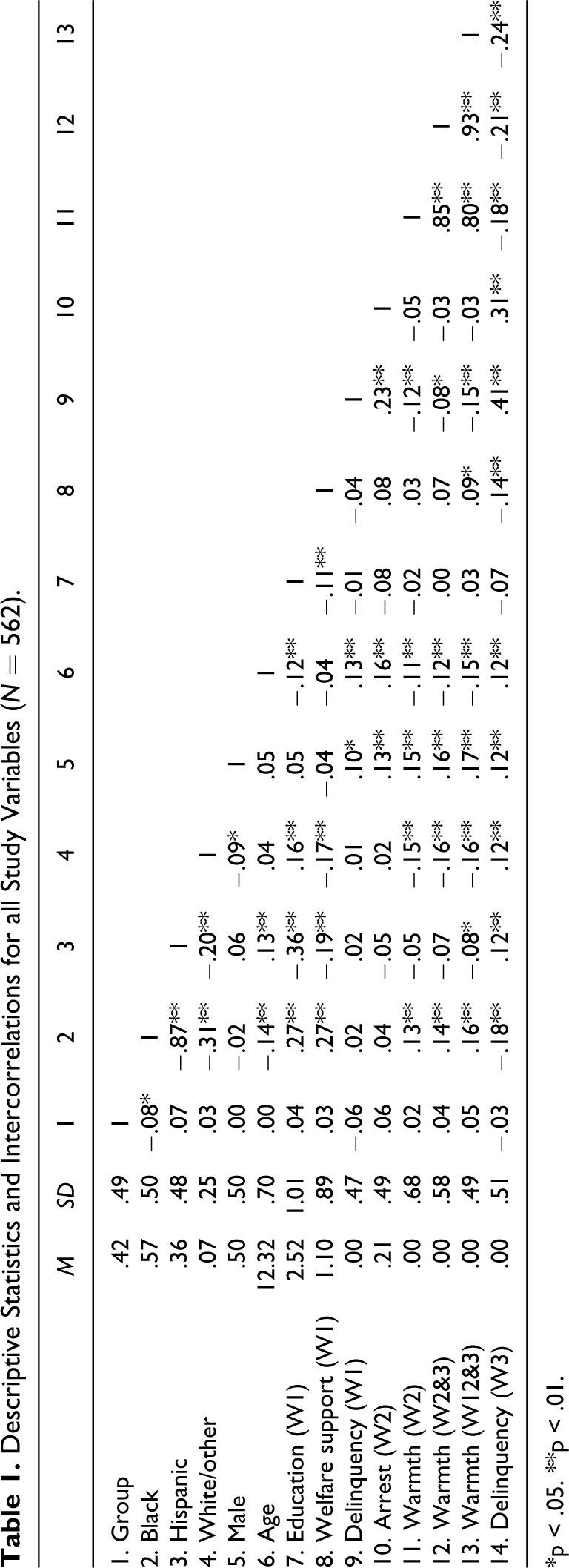
*p < .05. **p < .01.
Family attachment
The CAR data included six survey items that indicate the degree of warmth and attachment found in subjects' families. The child subjects answered these items by indicating their agreement (0 = no, 1 = yes) with six statements about their family. High scorers indicated that members of their family help and support each other, back each other up, get along well, have feelings of togetherness, possess a sense of “group spirit,” and devote plenty of attention to everyone else in the family. These 6 items appeared in all three waves of data, therefore allowing us to create attachment measures pertaining to three different time periods.
The first scale includes all 18 items (six from each of the three waves) that span the study period. This measure has an α of .81, and a factor analysis pointed conclusively to a one-factor solution in which the first factor accounted for 75 percent of the variation with these items and had an eigenvalue of 3.81 (the only eigenvalue exceeding 1.00). The advantage of this measure is that it captures a relatively long-term pattern of attachment, including the period preceding the report of labeling, the period contemporaneous with labeling, and the period subsequent to labeling. It is possible, however, that more short-term patterns of attachment are especially consequential in the wake of an arrest. We therefore separately analyzed a wave 2 measure (6 items, α =.77) that captures the level of attachment around the time of the labeling and a combined wave 2 and wave 3 measure (12 items, α = .82) that also includes the year following the report of labeling. The scales were created by standardizing each item (to ensure that all items were weighted equally) prior to averaging, with all items coded such that high values indicate high attachment. The resulting measures were correlated with delinquency in the expected manner. For example, the 18-item measure of attachment across all waves was significantly and negatively correlated with wave 3 delinquency (r = −.24)
Delinquency (at wave 3)
The dependent variable, a wave 3 general delinquency index, is comprised of 24 standard self-reported delinquency items. This scale covers a range of offending types, including violent delinquency (e.g., taken part in a group fight, attacked someone), property delinquency (stolen something valued at $50 or more, damaged someone else’s property), and substance use (use of marijuana, crack cocaine, psychedelics, and inhalants). For the violent and property delinquency items, the reference period was the prior year and response categories ranged from 1 (no involvement) to 4 (5 times or more). For the substance use items, the reference period was the prior 30 days (to account for the difficulty of providing annual estimates for highly frequent acts), and response categories ranged from “never” to “40 times or more.” The items were standardized and then averaged, producing a 24-item scale with a Cronbach’s α of .87.
Control variables
A number of controls are included to address the possibility that any observed associations between arrest and delinquency could reflect the influence of key background characteristics of the adolescents. Specifically, all analyses include controls for subjects' age (coded in years), sex (with males coded as the high category), and race (with dummy variables created for African Americans, Hispanics, and Whites/others). Also, although the sample was drawn exclusively from disadvantaged neighborhoods, there is moderate variation between subjects with respect to family SES. We therefore include controls for parental education (with responses ranging from grade school or less [coded 1] to graduated from college [coded 5]) and the family’s receipt of food stamps and Aid to Families with Dependent Children. Values for this welfare support variable ranged from 0 (if they received neither form of support) to 2 (if they received both forms of support). Next, in light of the services that roughly half of the sample received as part of the CAR program’s experimental design, a dummy control (1 = experimental group) was included for group membership. And finally, a control was included for subjects' wave 1 level of general delinquency to account for the expected influence of prior delinquency on both the likelihood of getting arrested and involvement in subsequent delinquency. This 24-item wave 1 measure (α = .84) contains the same items used for the wave 3 delinquency measure used for the dependent variable, and this scale also was constructed by standardizing and then averaging the items.
Results
The first step in the analysis was to estimate the baseline relationships between our key theoretical variables—labeling and family attachment—and wave 3 delinquency. This was done by estimating two Ordinary Least Squares (OLS) regression equations. The first contains only these variables, while the second equation adds all of the controls. Table 2 shows the results for these equations, with the first model revealing significant effects of both arrest (b = .309) and the attachment measure that draws from all three waves (b = −.237). In the second equation that includes the controls, the coefficients for arrest and family attachment are modestly reduced, but both maintain their significant relationship with delinquency. With respect to the influence of labeling in particular, its relationship with delinquency is substantively important. This can be seen by comparing the unstandardized coefficient for this dichotomous variable to the unstandardized coefficient for sex, another dichotomous variable typically found to affect delinquency. The unstandardized coefficients for these variables reveal changes in delinquency that come from a one-unit change in the predictor (i.e., from not labeled to labeled or from female to male). As equation 2 in Table 2 reveals, the unstandardized coefficient for arrest (b = .292) is roughly 3 times greater than the effect of being male (b = .094), which also is statistically significant. This pattern is consistent with other recent studies that reveal a positive multivariate association between exposure to official labels and involvement in delinquency.
OLS Regressions of Wave 3 Delinquency on Arrest, Attachment, and Controls.

Note. For each variable, the standardized coefficient is shown in the top row and the unstandardized coefficient and standard error are shown in the bottom row. *p < .05. **p < .01.
Our principal interest is in whether this arrest–delinquency relationship was moderated by the degree of family attachment. To consider that issue, we used OLS product-term analysis (Aiken and West 1991; Jaccard, Turrisi, and Wan 1990) with an interaction term that is the product of the independent variable (arrest) and our hypothesized moderator (family attachment). When this product term is entered into an equation that includes its constituent parts, its coefficient reveals the extent to which the relationship between arrest and wave 3 delinquency is conditional on family attachment. In light of the possibility that this interaction may depend on the exact period in which a given pattern of attachment was experienced, we examined three interactions—one for each of our attachment measures that pertain to different time periods—in separate equations that included all controls.
The results for these equations are shown in Table 3. Each equation reveals a significant main effect of arrest (with bs staying in a tight range from .225 to .231). Each equation also reveals, however, a significant interaction between arrest and the degree of attachment. Importantly, each interaction coefficient is negative, indicating that the relationship between arrest and wave 3 delinquency is reduced when the level of family attachment is high. Model one reveals this pattern for the attachment measure drawn from all three waves. In this equation, a significant positive coefficient for arrest (b = .225) is counterbalanced by a significant negative coefficient for the interaction term (b = −.094). This pattern reveals that when family attachment is 1 SD above its mean, the standardized arrest–delinquency relationship is cut by roughly 40 percent to .131 (.225 to .094). On the other hand, for cases in which family attachment is 1 SD below the mean, the standardized arrest–delinquency relationship is amplified to .319 (.225 + .094).
Ordinary Least Squares (OLS) Regressions of Wave 3 Delinquency on Arrest × Attachment Product Term.

Note. For each variable, the standardized coefficient is shown in the top row and the unstandardized coefficient and standard error are shown in the bottom row.
A similar pattern of results is revealed in models 2 and 3, which examined the alternative measures of attachment. Indeed, the highest magnitude interaction was for the parenting measure that combined wave 2 and 3 data (model 2). For that measure, a standardized interaction coefficient of −.137 is paired with a standardized main effect of arrest of .226, revealing that 60 percent of the positive effect of arrest on delinquency is eliminated when the level of family attachment is high. This is consistent with the idea that the moderating role of attachment was most important during the period contemporaneous with and immediately following the experience of the arrest. A key point to emphasize, however, is that regardless of which measure of attachment is used, the results are substantively similar: Family attachment and official labeling interact to predict reoffending, such that exposure to high attachment reduced the labeling effect for these at-risk youth.
As a test of robustness, we estimated these three models separately for males, females, Blacks, and Hispanics, given that the sex or race of the child could influence the stigma associated with an arrest, and therefore the moderating influence of family attachment. These models yielded results that were similar to the full-sample results presented above. For every subgroup, the interaction coefficient had a negative sign, and the interactions coefficients were significant in many instances despite the lower N in these split sample models. Using the formula recommended by Paternoster and his colleagues (1998) for comparing regression coefficients for different groups, we found no instances in which the difference in coefficients between groups (males vs. females, Blacks vs. Hispanics) was significant (with z values ranging in absolute value from .073 to 1.362). We also tested for age × arrest interactions and found that none were significant. These results therefore indicate that the significant moderating role played by family attachment for the full sample was not driven by patterns that were exclusive to select demographic subgroups.
Conclusion
The position that official labeling increases subsequent crime and delinquency has received support in prior research. We considered that this relationship might be conditional in nature. Specifically, drawing from Braithwaite’s (1989) reintegrative shaming theory and Sherman’s (1993) defiance theory, we argued that high family attachment should attenuate the effects of arrest on delinquency for at-risk adolescents. The analysis reached two key conclusions. Each is elaborated upon below, along with a discussion of the implications of these findings for theory, policy, and future research.
The first conclusion was that official labeling increased subsequent delinquency, and this relationship persisted when accounting for confounding factors like prior delinquency, age, race, sex, and SES. This supports the findings in recent, rigorous tests (Bernburg et al. 2006; Bernburg and Krohn 2003; Chiricos et al. 2007; Spohn and Holleran 2002), thereby providing further evidence that official intervention (in this case, arrest) can be criminogenic.
Our second conclusion was that the relationship between arrest and delinquency was not uniform in nature, but rather varied according to the degree of attachment and warmth in subjects' families. The highest magnitude interaction involved family attachment that was experienced contemporaneous with and directly subsequent to the experience of labeling. This indicates that a strong family environment at and around the time of criminal justice labeling can buffer the criminogenic effects of that label. The overarching point to emphasize is that, in the case of criminally labeled juveniles, parents who are supportive, warm, and involved can reduce the likelihood that children will reoffend.
The results of this study imply that the labeling perspective may need further specification regarding the conditions under which a labeling effect is most likely to occur. Classic versions of labeling theory devote little attention to the idea of conditional causation. Our findings suggest that this may be an important theoretical oversight—the social environment in the family was relevant to whether an arrest increased offending. This is consistent with arguments from Braithwaite (1989) and Sherman (1993), both of whom emphasized the conditional nature of the relationship between sanctions and offending. Although these theories have attracted attention and occasional empirical tests, they have not been significantly incorporated into labeling theory. Our suggestion is that they address an important void in labeling theory and that greater integration of these ideas may be warranted.
These findings also have implications for policy. First, they suggest the need to avoid official labeling of at-risk youth whenever doing so is reasonable. The tagging and ostracizing of adolescents can create unnecessary stigma, which in turn encourages defiance and discourages the reintegration of labeled youth (Braithwaite 1989; Lemert 1951; Sherman 1993). While sanctioning often is necessary, diversion and deinstitutionalization for youth who commit minor offenses should be emphasized. Second, our results suggest that when youth are labeled by the criminal justice system, policy makers should provide family skills training to the parents of labeled youth. Parent training has been found to reduce delinquency (Piquero et al. 2009), and interventions of this kind can suppress the harmful effects of an experience with official labeling. Doing so may enable better reintegration of youths into their families and help them acknowledge their shame in a prosocial manner. And broadly speaking, parent training may preserve or enhance the bonds of attachment that are relevant to the child’s future success, thus reducing the harmful fallout from a juvenile arrest.
These implications for theory, future research, and policy should be seen in the context of study limitations. First, official labels obviously are conferred through nonrandom processes. We addressed this by conducting longitudinal analyses with temporal lags between variables and by including a comprehensive control for prior delinquency. Nevertheless, without random assignment of labels, concerns about causal order and spuriousness cannot be eliminated. Limitations of our data also bear emphasizing. First, these data were originally collected not for the purpose of testing labeling theory, but instead, to examine the effects of the CAR intervention (Harrell et al. 1999). Subjects who were randomly selected to receive this intervention were themselves exposed to some degree of labeling. This is a possibility that we cannot dismiss, although we controlled for group membership to account for differences between treatment and control subjects. Additionally, the CAR data are nearly 20 years old, and the nature of family life is subject to change over time. With respect to measurement, similar to other recent studies, our measure of official labeling relied on self-reports rather than official records. Prior studies indicate that self-reports of arrest are fairly accurate and our measure had high construct validity, but replication of our findings with labeling measures from official records would be instructive. The timeframe of our study also is important. The CAR data allowed us to assess the effects of labels on delinquency for a 1-year period, but labeling theory emphasizes processes that may be more long-term in nature. Considering that possibility in future research could determine whether the moderating role played by family attachment is sustained over time. Finally, we considered the hypothesis that social relationships moderate the influence of official labeling with a focus only on the family environment. Experiences and interactions outside of the family—including those with peers, teachers, or ministers—might also moderate the effects of labeling.
One other theoretical limitation bears emphasizing. We focused on whether family attachment moderates the effects of an arrest on delinquency, but an alternative possibility is that an arrest could lead to subsequent delinquency by reducing family attachments. Thus, attachment could mediate—rather than moderate—the arrest–delinquency association. In connection to this, Sampson and Laub (1997) argued that exposure to legal sanctions undermines social bonds, and this pattern was supported by Stewart and his colleagues (2002). We therefore see this as an important theoretical possibility that should be considered in future research. Notwithstanding these limitations and priorities for new research, our results suggest that labeling research should move beyond an examination of direct effects to uncover the conditions under which labeling is most likely—or least likely—to result in reoffending. This study represents an initial attempt to do so by examining a key social process variable in the lives of adolescents: the degree of attachment that is found in their family environment. The conclusions of this study point to the importance of a positive family environment in attenuating the effects of criminal justice labels on recidivism. We hope that the findings presented here encourage additional work on the social processes that might moderate the effects of labeling.
Footnotes
Declaration of Conflicting Interests
The author(s) declared no potential conflicts of interest with respect to the research, authorship, and/or publication of this article.
Funding
The author(s) received no financial support for the research, authorship, and/or publication of this article.