



Abstract
This study examines whether developmental role attainment in three areas (high school graduation, employment, and marriage) mediates the relationship between childhood abuse and neglect and adult arrest. Children with documented cases of physical and sexual abuse and neglect (before age 11) and a comparison group of nonabused or neglected children were matched on age, sex, race, and approximate socioeconomic status (N = 1,169) and followed-up and interviewed at approximate age 29. Arrest records were collected from law enforcement agencies. Childhood abuse and neglect predicted decreased likelihood of graduating from high school, current employment, and current marriage and greater likelihood of juvenile and adult arrest. Each of these developmental roles partially mediated the relationship between childhood abuse and neglect and adult arrest. The importance of these three developmental milestones and implications of the results for intervening with abused and neglected youth are discussed.
Keywords
Child abuse and neglect have been associated with increased risk for problems in three critical areas of development; education, employment, and marriage. Given the importance of attaining these normative roles (Arnett 2000, 2007; Erikson 1964), it is likely that derailments in these key areas play important roles in a person’s life and influence pathways to subsequent adult outcomes. However, surprisingly little is known about the extent to which these types of developmental milestones play a role as pathways to adult outcomes for maltreated children. The purpose of this article is to examine whether developmental role attainment in three specific areas (high school graduation, employment, and marriage) mediates the relationship between childhood abuse and neglect and one important adult outcome (criminal behavior).
In proposing their life-course perspective, Sampson, Laub, and colleagues (Laub, Nagin, and Sampson 1998; Sampson and Laub 1993, 2005) have called attention to the importance of developmental roles for positive life outcomes, drawing on the work of Elder (1986) to focus on “turning points” in a person’s life. Sampson and Laub’s Life-Course theory (1993, 1997) suggests that failure to attain critical developmental milestones (what we label developmental roles or milestones) is problematic and increases a person’s risk of negative outcomes in adulthood. Conversely, successful navigation of these critical milestones leads to better outcomes. Sampson and Laub (1993, 1997) argued that marriage and work act as “turning points” in the life course. More recently, this theory has been extended to include high school graduation (Natsuaki, Ge, and Wenk 2008). The assumption is that the derailment in even one of these important developmental roles would increase the likelihood of poor outcomes in adulthood. Interestingly, despite the numerous studies that have reported links between childhood maltreatment and crime (English, Widom, and Brandford 2001; Maxfield and Widom 1996; Smith and Thornberry 1995; Stouthamer-Loeber et al. 2001; Widom 1989b; Zingraff et al. 1993), with one exception (Stewart, Livington, and Dennison 2008), research has not yet examined the role of turning points in the lives of maltreated children. Thus, it remains unclear whether the concept of turning points applies to maltreated children who are vulnerable to multiple negative consequences, including crime and delinquency.
Child Abuse and Neglect and Developmental Roles
High school graduation
Several studies have reported that maltreated children are at risk for lower levels of educational achievement and intellectual performance and at higher risk for grade retention and repetition and academic difficulties in reading, math, and attention skills (Boden, Horwood, and Fergusson 2007; Eckenrode, Laird, and John 1993; Jonson-Reid et al. 2004; Lansford et al. 2002; Leiter and Johnsen 1997; Perez and Widom 1994). For example, Eckenrode and colleagues (1993) found that maltreated elementary and middle school students scored 10 percentile points lower on a standardized math test, had lower grades overall, and were more likely to fail a grade in school than nonmaltreated peers. Abused and neglected children have also been found to have lower levels of high school graduation compared to nonmaltreated peers (Boden, Horwood, and Fergusson 2007; Harris 1983; Perez and Widom 1994), especially maltreated girls (Andrews and Brown 1988; Boden, Horwood, and Fergusson 2007). Among those who graduated from high school and attended college, abused and neglected youth were less likely to complete college (Boden, Horwood, and Fergusson 2007; Duncan 2000). In addition, maltreated children are at increased risk for receiving special education services for both academic and emotional difficulties (Jonson-Reid et al. 2004). In sum, increasing evidence indicates that maltreated children are at increased risk for problems with academic achievement, although the reasons for these academic difficulties are not known. Some academic difficulties may be associated with brain injury or other deficits resulting from physical abuse or neglect; others may be due to malnutrition associated with neglect, or from a lack of concern about education in their families. However, the accumulated evidence strongly suggests that maltreated children are likely to experience academic problems and, in turn, it is possible that these problems may serve as one pathway to subsequent negative life outcomes.
Employment
Child abuse and neglect have also been linked to unemployment and employment disability. For example, Sansone et al. (2005) found that adults who experienced childhood neglect were 18 times more likely to claim employment disability, especially psychiatric disability, compared to adults without a history of child maltreatment. Another study found that, regardless of disability status, adults who experienced maltreatment in childhood were more likely to be unemployed (Romito, Crisma, and Saurel-Cubizolles 2003). A recent article (Currie and Widom 2010) reported that adults with documented histories of childhood abuse and/or neglect had lower levels of employment, earnings, and fewer assets as adults, compared to matched control children. These authors also noted that maltreatment appeared to affect men and women differently, with larger effects for women than men. Despite the sparse research on this topic, the existing evidence points to increased risk for employment problems associated with child maltreatment. Again, it is not known whether these employment outcomes result from lower academic achievement, greater psychological problems, or other factors.
Marriage
Another consequence of child maltreatment extends to a person’s interest in or ability to enter into marriage and the likelihood of maintaining a marital relationship. In several studies, both men and women with histories of childhood abuse and neglect reported greater instability in their romantic relationships (Colman and Widom 2004; Fleming et al. 1999; Whisman 2006). Using data from the National Comorbidity Survey (an epidemiologic investigation designed to study the prevalence and correlates of psychiatric disorders), Whisman (2006) found that individuals who reported physical abuse, rape, or serious physical attack in childhood were about twice as likely to experience a marital disruption (e.g., divorce, separation), compared to those who did not report a history of childhood trauma. Among adults with documented histories of child abuse and neglect, maltreatment was associated with higher rates of divorce (Colman and Widom 2004). High rates of marital disruption have also been reported for specific types of abuse. For example, Romito et al. (2003) found that women in their sample who were physically abused in childhood were more likely to be never married. A study of women in Australia found that those who reported a history of childhood sexual abuse were significantly more likely to be divorced, separated, or married more than once than those who did not report such a history (Fleming, O’Day, and Kraemer 1999). Using intraindividual analyses, Sampson, Laub, and Wimer (2006) demonstrated that for males, desistance from crime is more likely during periods of marriage than during unmarried periods (e.g., divorce, separation). These intraindividual findings provide strong support for the potential positive effects of marriage. Nonetheless, research has yet to demonstrate that marriage serves as a turning point for adults who have experienced abuse and neglect in childhood.
There is evidence that childhood maltreatment is associated with increased risk for problems in three critical aspects of adult development (education, employment, and marriage) that may, in turn, serve as pathways to subsequent negative outcomes. However, because abused and neglected children are at increased risk to be arrested as juveniles (Loeber et al. 2001; Maxfield and Widom 1996; Smith and Thornberry 1995; Widom 1989b; Zingraff et al. 1993), it may be that delinquency represents an earlier step in the process of being arrested as an adult and influences the likelihood of a person achieving or failing in these three developmental areas, particularly high school graduation and employment. Therefore, in attempting to understand the role of these developmental milestones in the lives of abused and neglected children, it is important to take into account whether the person has a history of juvenile delinquency and whether a prior history of juvenile arrest is a more critical influence on the derailment process than the developmental milestones that we focus on here. It is also possible that failure to accomplish these important roles moderates the relationship between child maltreatment and adult crime, such that it is the combination of child abuse and neglect and failure to achieve these developmental roles that leads to subsequent negative outcomes.
Given persistent differences in gender role expectations, it is also possible that the pathways from child maltreatment to adult arrest differ for males and females. Of the existing studies that have considered sex differences in consequences of child abuse and neglect, some have reported sex differences (Dodge, Bates, and Pettit 1990; Friedrich, Urquiza, and Beilke 1986; Harrison, Hoffmann, and Edwall 1989a, 1989b; Ireland and Widom 1994; Livingston 1987; Toray et al. 1991; Widom, Ireland, and Glynn 1995; Widom and White 1997), whereas others have not (Dembo et al. 1989, 1990). However, despite the growing number of women in the workforce, employment expectations continue to differ for men and women (Koski 2007) and the role played by employment in the lives of abused and neglected men and women may differ. Women might be more likely to be unemployed by choice or expectation and, therefore, unemployment may serve as a less salient developmental milestone for women than for men. On the other hand, the failure to be married might be more salient for women than men and might be associated with poorer adult outcomes for women.
In addition, there are sex and race differences in the potential mediators and outcome (adult arrest) examined here. Males are more likely than females and Blacks are more likely than Whites to be arrested (Miller 1996; Tracy et al. 2009; US Department of Justice 2010). Blacks are less likely to graduate from high school compared to Whites, especially during the time period examined in the present study (see Leach and Williams 2007). Blacks are also less likely to gain and maintain steady employment (Fairlie and Sundstrom 1999) and to marry (Franklin, Smith, and McMiller 1995). There is debate about whether higher unemployment rates among Blacks are due to lower educational attainment, institutional racism, or a combination of these factors. Leach and Williams (2007) suggest that both historic and current social inequalities may lead to a developmental and life-course gap between Blacks and Whites across generations.
Historically, African American children are more likely to be raised in single parent households than White children (Annie E. Casey Foundation—Kids Count Data Center, 2009; Federal Interagency Forum on Child and Family Statistics, 2011; McAdoo 1997) and, therefore, less likely to be exposed to successful marital relationships and perhaps less likely to consider marriage or less able to maintain a marital relationship. To further complicate matters, each of these developmental roles is in some way interdependent on the other.
In sum, existing research indicates that childhood abuse and neglect are associated with increased risk for problems in three critical areas of development (education, employment, and marriage) and later outcomes of adult criminal behavior. However, there is sparse research on the extent to which failure to achieve these three important developmental milestones serves as a “turning point” or mediator in the lives of maltreated children, moving them toward subsequent negative outcomes. Additionally, it is not known whether these three milestones exert different influences for maltreated children and children without such histories. That is, it is possible that these developmental roles might moderate the association between child abuse and neglect and adult arrest.
The Present Study
Based on a prospective cohort design, the present study is the first to examine whether three developmental milestones mediate and/ or moderate the relationship between childhood abuse and neglect and adult crime. Specifically, we ask six basic questions: (1) Are individuals with a history of child abuse and neglect less likely to graduate from high school, to be employed, and to be married in early adulthood (approximate age 29) and more likely to be arrested as an adult, compared to matched controls? (2) Does successful achievement of developmental roles (high school graduation, employment, and marriage) decrease a person’s risk for crime in adulthood? (3) Do developmental roles (high school graduation, employment, and marriage) mediate the relationship between child abuse/neglect and adult arrest? (4) Do these relationships vary by a person’s sex or race/ethnicity? (5) Does achievement of developmental roles moderate the relationship between child abuse and neglect and risk for adult crime? (6) Does successful accomplishment of these developmental milestones continue to mediate the relationship between child maltreatment and adult arrest, after taking into account a prior juvenile arrest?
In this article, we use guidelines set forth by Kenny, Kashy, and Bolger (1998) to determine whether certain factors act as mediators in associations between variables. According to these guidelines, there are four conditions necessary to show mediation: (1) Child abuse and neglect (the independent variable) should significantly predict adult crime (the dependent variable); (2) child abuse and neglect should significantly predict the mediator(s); (3) the mediator must significantly predict adult crime, while controlling for childhood abuse/neglect; and (4) the effect of child abuse and neglect on adult crime must be reduced when the mediator is included in the model.
Methods
Sample and Design
The data used here are from a research project based on a cohort design study (Leventhal 1982; Schulsinger, Mednick, and Knop 1981) in which abused and neglected children were matched with nonabused and nonneglected children and followed prospectively into adulthood. The prospective nature of this study allows some issues of causality to be examined and helps to disentangle the effects of childhood victimization from other potentially confounding effects. Because of the matching procedure, the subjects are assumed to differ in the risk factor (i.e., having experienced childhood sexual or physical abuse and/or neglect). Since it is not possible to randomly assign subjects to groups, the assumption of equivalency for the groups is an approximation. In the first phase of this research, a large group of children who were abused and/or neglected approximately 20 years earlier were followed through an examination of official criminal records and compared with a matched group of children (Widom 1989b). The abused and/or neglected group was composed of victims of substantiated childhood physical and sexual abuse and/or neglect whose cases were processed during the years 1967 through 1971 in the county juvenile or adult criminal court (situated in a metropolitan area in the Midwest). The rationale for identifying the abused and neglected group was that their cases were serious enough to come to the attention of the authorities. Only court substantiated cases of child abuse and neglect were included. Abuse and neglect cases were restricted to those in which the children were 11 years of age or less at the time of the abuse or neglect incident. Excluded from the sample were court cases that represented: (1) Adoption of the child as an infant; (2) “involuntary” neglect only usually resulting from the temporary institutionalization of the legal guardian; (3) placement only; or (4) failure to pay child support. A comparison group of children who did not have documented cases of abuse and/or neglect was established, with matching on the basis of sex, age, race, and approximate family socioeconomic status during the time period of 1967 through 1971. Matching for social class was important because it is theoretically plausible that any relationship between child abuse or neglect and later outcomes is confounded or explained by social class differences (MacMillan et al. 2001; Widom 1989b). It is difficult to match exactly for social class because higher income families could live in lower social class neighborhoods and vice versa. The matching procedure used here is based on a broad definition of social class that includes neighborhoods in which children were reared and schools they attended (Watt 1972).
Children who were under school age at the time of the abuse and/or neglect were matched with children of the same sex, race, date of birth (± 1 week), and hospital of birth through the use of county birth record information. For children of school age, records of more than 100 elementary schools for the same time period were used to find matches with children of the same sex, race, date of birth (± 6 months), class in elementary school during the years 1967 through 1971, and home address of the abused or neglected child. Overall, there were matches for 74 percent of the abused and neglected children.
Official records were checked and any proposed comparison group child who had an official record of abuse or neglect in their childhood (n = 11) was eliminated and a replacement child was substituted. The number of individuals in the control group who were actually abused, but not reported, is unknown. The control group may also differ from the abused and neglected individuals on other variables associated with abuse or neglect.
The initial phase of the study compared the abused and/or neglected children to the matched comparison group (N = 1,575) on juvenile and adult criminal arrest records (Maxfield and Widom 1996; Widom 1989b). The second phase of the research involved the tracing, locating, and interviewing of the abused and/or neglected (on average 22.3 years after their childhood victimization) and comparison group subjects. Two-hour follow-up interviews were conducted between 1989 and 1995. The interview consisted of a series of structured and semistructured questions and rating scales, measures of intelligence quotient and reading ability, and a psychiatric assessment. Interviewers were blind to the purpose of the study, to the inclusion of an abused and/or neglected group, and to the participants’ group membership. Similarly, the subjects were blind to the purpose of the study. Subjects were told that they had been selected to participate as part of a large group of individuals who grew up in the late 1960s and early 1970s. Subjects who participated signed a consent form acknowledging that they were participating voluntarily.
Of the original group of 1,575, 1,307 subjects (83 percent) were located and 1,196 (76 percent) interviewed between 1989 and 1995. Of the people not interviewed, 43 were deceased (before interview), 8 were incapable of being interviewed, 268 were not found, and 60 refused to participate (a refusal rate of 3.8 percent). The findings reported here are based on 1,196 subjects (676 abused and/or neglected and 520 comparison subjects). The maltreated group consisted of physical abuse (n = 106), sexual abuse (n = 96), and neglect (n = 541). Because children may have experienced more than one type of abuse or neglect, the numbers add up to more than the total number of abused and neglected children in the sample. There were no significant differences between the follow-up sample (N = 1,196) and the original sample (N = 1,575) in terms of demographic characteristics (male, White, non-Hispanic, poverty in childhood census tract, or current age) or group status (abuse/neglect vs. comparison group).
The present study includes only participants who self-identified as either Black (or Afro-Hispanics) or White (or White of Hispanic origin) resulting in a sample of 1,169. Excluded were 27 participants who self-identified as Asian, Native American, or Other. Approximately half the group was women (48.7 percent) and 64.4 percent were White. At the time of interview, the average age of the participants was 29.24 years (SD = 3.84, range = 19.0–40.7 years). There were no differences between the abused and neglected group and comparison subjects in terms of sex, race/ethnicity, or age.
The average grade of school completed for the entire sample was 11.49 (SD = 2.10). Occupational status of the sample was coded according to the Hollingshead Occupational Coding Index (Hollingshead 1975) and levels ranged from 1 (laborer) to 9 (professional). More than half (54.9 percent) of the sample were in menial/semiskilled occupations, 33 percent held skilled, clerical, or semiprofessional jobs and 13.1 percent held professional/managerial jobs. Overall, the group is skewed toward the lower end of the socioeconomic spectrum.
Variables and Measures
Child abuse and neglect
Identification of childhood physical and sexual abuse and neglect was based on court substantiated cases from a Midwest county area during the years 1967 through 1971. Physical abuse cases included injuries such as bruises, welts, burns, abrasions, lacerations, wounds, cuts, bone and skull fractures, and other evidence of physical injury inflicted by a parent or caregiver. Sexual abuse cases varied from those with relatively nonspecific charges of “assault and battery with intent to gratify sexual desires” to more specific charges of “fondling or touching in an obscene manner,” rape, sodomy, incest, and so on. Neglect cases reflected a judgment that the parent’s (or caregiver’s) deficiencies in childcare were beyond those found acceptable by community and professional standards at the time. These cases represented extreme failure to provide adequate food, clothing, shelter, and medical attention to children. Abuse/neglect is a dichotomous variable based on official records of any of the three types of maltreatment (0 = control, 1 = abuse/neglect).
Developmental role attainment
Three dichotomous variables (0 = no, 1 = yes) were created to represent high school graduation, employment, and marriage status. For high school graduation, participants were asked about their highest level of school completed at the time of the interview. The information was then dichotomized to indicate whether or not each participant had completed high school. For current employment, a dichotomous variable was developed based on two items. First, participants were asked to indicate the number of months of employment during the past 12 months. If the number of months indicated was greater than 0 then they were asked, “Are you employed now?” Participants who responded as “employed now” were coded as currently employed (1). Others were coded “0” as not currently employed. To assess whether the person was currently married, we asked a single item about the participant’s marital status. Participants who reported “married” were coded married (1), whereas participants who endorsed being widowed, separated, divorced, or never married were coded not currently married (0).
Juvenile and adult arrests
Arrest information is based on official criminal histories obtained from two searches of law enforcement (local, state, and Federal Bureau of Investigation) records at two time points (Maxfield and Widom 1996; Widom 1989b). Adult arrests were defined as those occurring at age 18 or older and did not include arrests for traffic offenses. Juvenile arrests are based on arrests that occurred before age 18. Any adult arrest is a dichotomous variable (1 = yes; 0 = none).
Statistical Analysis
Statistical analyses involved several steps. Logistic regressions were conducted to determine whether child abuse and neglect predicted the outcome (any adult arrest) and to determine the effect of child abuse and neglect on three potential mediators (high school graduation, current employment, and current marriage). We then conducted mediation analyses for each of the hypothesized mediators (high school graduation, employment, and marriage), separately. If the odds ratio (OR) for the independent variable (child abuse and neglect) predicting the dependent variable (adult arrest) is attenuated to nonsignificance by the introduction of the hypothesized mediator, then this would be interpreted as fully mediating the association between child abuse and neglect and adult arrest. If the OR for the child abuse and neglect remains statistically significant, but is substantially attenuated (a .20 or greater reduction), then the potential mediator variable would be considered a partial mediator. All analyses control for age, sex, and race, except for the analyses that focus on race (analyses control for age and sex) or sex (analyses control for age and race). ORs and 95 percent confidence intervals (CIs), along with significance levels, are reported. SPSS version 17 was used. Numbers in analyses vary slightly due to missing information. Separate analyses were conducted for men and women and Whites and Blacks.
Results
Child Abuse and Neglect and Adult Crime
Table 1 shows that abused and neglected children were significantly more likely than controls to have an arrest as a juvenile and as an adult. Table 1 also shows that individuals with histories of childhood abuse and neglect were significantly less likely to graduate from high school, be currently employed and currently married, compared to the controls.
Child Abuse and Neglect Predicts Arrest and Potential Mediators.

Note. N = number in group; CI = confidence interval.
***p < .001.
Developmental Role Attainment and Adult Arrests
The next set of analyses shows that successful achievement of each of the developmental roles was associated with a significant decrease in risk for adult arrest, controlling for age, sex, and race (see Table 2). More than 55 percent of those who failed to graduate from high school were arrested in adulthood, compared to less than 34 percent of high school graduates (OR = .36, 95 percent CI = .28–.46, p < .0001). Similarly, individuals who were currently employed were significantly less likely to have an arrest as an adult, compared to those not currently employed (OR = .37, 95 percent CI = .28–.49, p < .0001). The same pattern was evident for those currently married versus those not currently married (OR = .40, 95 percent CI = .30–.52, p < .0001). In addition, t-tests were conducted to examine mean differences in the number of arrests for each group. Individuals who graduated from high school had significantly fewer adult arrests than those who did not graduate, M (SD) = 1.38 (3.54) versus 3.33 (5.81), t = 7.13, p < .001. Similar results for number of arrests were found for those who were currently employed compared to those who were not, M (SD) = 1.46 (3.38) versus 3.56 (6.24), t = 7.44, p < .001, and for those who were currently married compared to those who were not, M (SD) = .97 (2.60) versus 3.05 (5.56), t = 7.59***.
Child Abuse and Neglect and Developmental Role Attainment as Predictors of Adult Arrest.
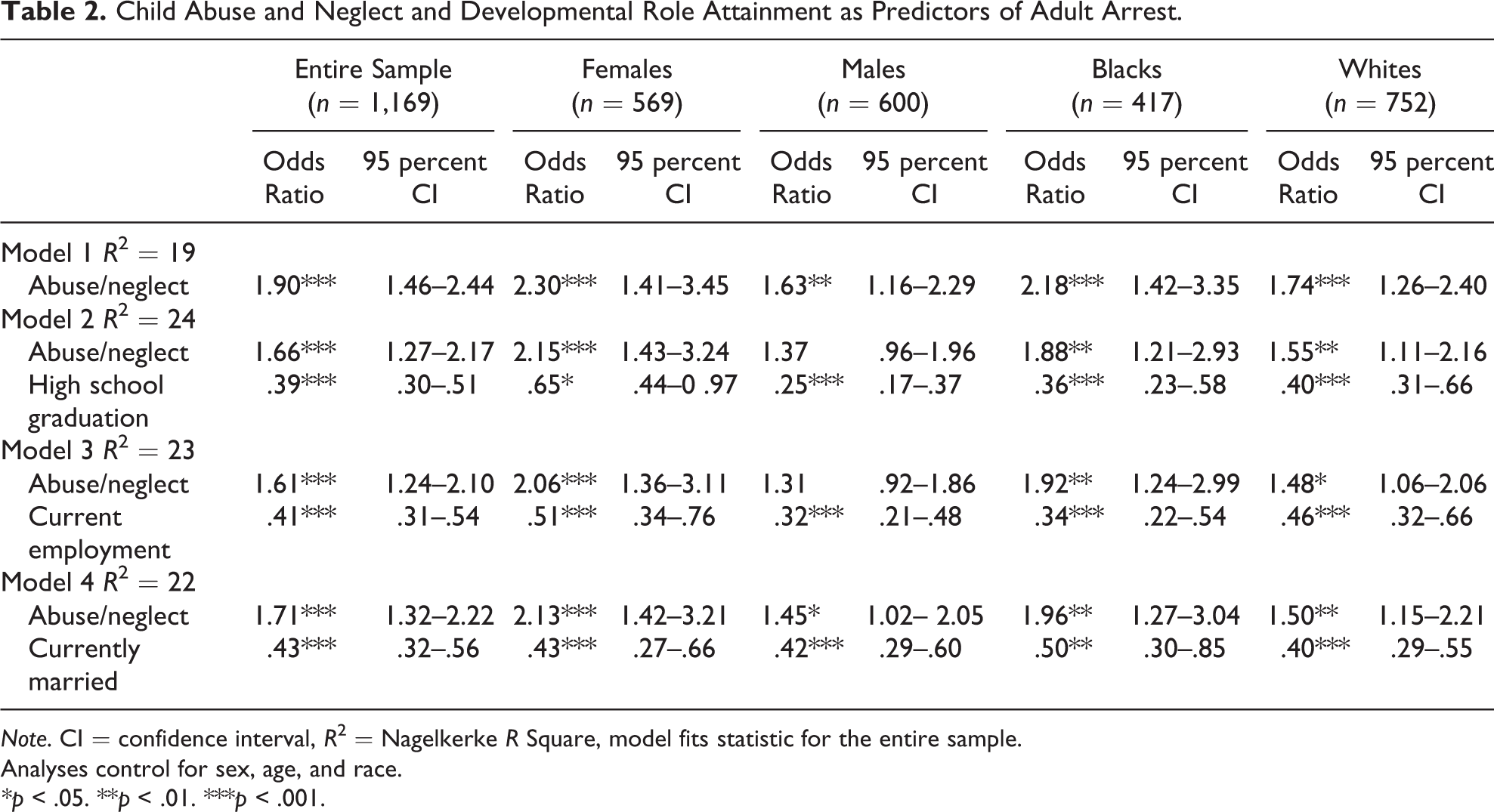
Note. CI = confidence interval, R 2 = Nagelkerke R Square, model fits statistic for the entire sample.
Analyses control for sex, age, and race.
*p < .05. **p < .01. ***p < .001.
For tests of mediation, it is necessary for the temporal relationship between the critical variables to be correct. In this case, our potential mediators should precede the dependent variable (adult arrest). For high school graduation, we believe it is reasonable to assume that high school graduation occurred before the adult arrest. In terms of marriage, we do not have complete information about the marriage or its quality. However, we calculated the age at which the participant was married (determined by subtracting the number of years married from the age at interview) and compared that to the age of adult arrest among people who were married and arrested. Using this procedure, we found that only 16.2 percent of the participants had an arrest after marriage. Looking at people who were employed and had an adult arrest, we calculated the percent who had an adult arrest that occurred before or after the interview when information about current employment status was obtained. We found that the majority had an arrest prior to the interview (93.7 percent) and only 7.3 percent had an arrest after the interview. Thus, in nearly all cases, the temporal order for mediation was met.
Do Developmental Roles (High School Graduation, Employment, and Marriage) Mediate the Relationship between Child Abuse/Neglect and Adult Arrest?
Results thus far confirm the necessary criteria for testing mediation. Both the predictor (child abuse and neglect) and the potential mediators (developmental roles) were significantly related to the outcome variable (adult arrest). Similarly, the predictor variable (child abuse and neglect) was significantly related to each of the potential mediators. The next step in the mediation analyses is to determine whether the hypothesized mediators (developmental roles attained) predict adult arrest, controlling for child abuse and neglect. Table 2 (models 2–4) shows the results of logistic regression analyses with the introduction of each of the three potential mediators, after controlling for age, sex, and race. First, looking at the column representing the entire sample, child abuse and neglect remained a significant predictor of adult arrest, despite the introduction of any of the three developmental milestones (high school graduation, current employment, or currently married) into the model. However, compared to the effect of child abuse/neglect in the simple model without the hypothesized mediators, the introduction of each developmental role reduced the magnitude of the association between child maltreatment and adult arrest. Of the three developmental roles, current employment showed the largest mediation effect, reducing the risk associated with maltreatment from OR = 1.90 to 1.61, although the effect of child abuse and neglect remained significant. Being married showed a weaker effect, reducing the risk associated with maltreatment from OR=1.90 to 1.71.
Table 2 also shows that the introduction of each of the developmental roles into the model reduces the association between child abuse/neglect and adult arrest for females, Blacks, and Whites. However, in the case of high school graduation for females and current marriage for males and females, the reduction failed to meet our a priori criteria for partial mediation. Overall, for males, the pattern of results differs. Similar to the other subgroups, for males, marriage partially mediated the relationship between child maltreatment and adult arrest. However, for males in our sample, high school graduation and current employment reduced the effect of child maltreatment so that in those models, the effect of child abuse/neglect became nonsignificant: for education (OR = 1.37, p < .10) and employment (OR = 1.31, p < .10). Nonetheless, it should be noted that the OR for child abuse/neglect in the marriage model (OR = 1.45, p < .05), while significant, was only slightly larger. Of the three developmental roles, current employment was associated with the largest effect for males, females, and Whites. For Blacks, high school graduation had the largest effect on adult arrest, whereas marriage showed the weakest effect. However, it should be noted that Blacks in the sample were less likely to be married than Whites (22.3 percent vs. 50.7 percent).
Nonetheless, when all three developmental roles were examined simultaneously for the overall sample, each one of them continued to significantly reduce the likelihood of adult arrest, despite the introduction of the other roles. With simultaneous entry of all three developmental roles, child abuse and neglect remained a significant predictor of adult arrest (OR = 1.32, 95 percent CI = 1.00–1.75, p < .05), but there was evidence of partial mediation. We also examined the cumulative effect of attaining more than one developmental role and found that for the entire sample, attaining one developmental role resulted in a marginally significant decrease in risk for adult arrest (OR = .68, 95 percent CI = .45–1.03, p < .07), attaining any two of the three developmental roles significantly lowered a person’s risk of adult arrest (OR = .29, 95 percent CI = .20–.44, p < .001), and attaining all three roles resulted in an 89 percent decrease in risk of adult arrest (OR = .11, 95 percent CI = .07–.18, p < .001).
Developmental Roles and Adult Arrest, Controlling for Juvenile Arrests
Table 3 shows the extent to which these findings may be attributable to an earlier effect of child abuse/neglect on juvenile arrest that, in turn, would increase risk for having an arrest as an adult. Table 3 shows that the effect of child abuse and neglect on adult arrest remains significant in the model for the entire sample and for females, Blacks, and Whites. However, the OR is reduced with the introduction of juvenile arrest, suggesting that all three factors (child abuse and neglect, juvenile arrest, and developmental role) increase the likelihood of having an adult arrest. For males, graduating from high school and being currently employed substantially reduced the effect of child abuse and neglect on adult arrest to nonsignificance (see earlier Table 2). However, Table 3 shows that introduction of juvenile arrest into these models further reduced the effect of child abuse and neglect as a predictor of adult arrest. That is, for males, accounting for both developmental role attainment and having a juvenile arrest reduces the significant effect of child abuse and neglect as a predictor of adult arrest to nonsignificant.
Child Abuse and Neglect, Developmental Role Attainment, and Adult Arrest, Controlling for Juvenile Arrest.

Note. CI = confidence interval. R 2 = Nagelkerke R Square, model fits statistic for the entire sample.
Analyses control for sex, age, and race.
*p < .05 **p < .01. ***p < .001.
Developmental Roles as a Moderator of the Relationship between Child Maltreatment and Adult Arrest
There were no significant interactions between child abuse and neglect and any of the developmental milestones predicting adult arrest (see Table 4). Thus, our findings indicate that developmental role attainment does not moderate the relationship between child abuse and neglect and adult arrest.
Does Child Abuse and Neglect Moderate the Relationship between Developmental Milestones and Adult Arrest?

Note. CIs = confidence intervals.
*p < .05. **p < .01. ***p < .001.
Discussion
We replicated earlier findings showing that child abuse and neglect increases a person’s risk for being arrested as a juvenile and as an adult. Our new findings indicate that child abuse and neglect has a negative impact on a person’s likelihood of successfully achieving three important normative roles (high school graduation, employment, and marriage) and that the failure to attain these developmental milestones was associated with a significant increase in risk for adult arrest. Furthermore, these findings suggest that these milestones partially mediated the relationship between child abuse and neglect and adult arrest. For abused and neglected youth who graduate from high school, gain employment, and marry, the likelihood of adult arrest was significantly reduced compared to abused and neglected youth who do not attain these developmental roles. However, we did not find evidence that developmental milestones moderated the relationship between child abuse and neglect and adult arrest, indicating that developmental role attainment was protective for both the maltreated and the control groups.
Why might high school graduation serve to turn an abused or neglected child’s trajectory toward a more positive outcome? First, high school graduation typically serves as an important gateway or developmental marker, affecting a person’s ability to attain other important adult roles. Second, the failure to complete high school may launch an abused and/or neglected youth toward negative adult outcomes. Alternatively, based on the effect of juvenile arrest on later arrest and its relationship to child abuse/neglect, it is also plausible that this is a continuation of a pattern that began much earlier. Third, some researchers suggest that the missed opportunities for positive outcomes and socialization experiences, for example, when a person fails to graduate from high school, may not only limit later options (e.g., employment, marriage) but may also exacerbate the levels of stress experienced by the person, making it more likely that he or she will have fewer subsequent successes and more negative outcomes (Caspi and Moffitt 1995; Roisman, Aquilar, and Egeland 2004). These possibilities are all empirically testable hypotheses and warrant further examination. Nonetheless, abused and neglected children should be encouraged and helped to remain in school with their peers. Teachers and other school administrators should receive training in how to recognize signs of abuse and neglect and in how to intervene and provide support early, so that children do not fall behind academically, socially, and emotionally. This early recognition and intervention within school systems might be particularly salient for Blacks. For Blacks, high school graduation was the developmental role associated with the largest reduction in risk of adult arrests, whereas current employment was associated with greater risk reduction for Whites. Even if high school graduation is not likely, the structure of the school environment and the time spent in school may reduce the likelihood of getting into trouble.
Current employment also partially mediated the relationship between child maltreatment and adult arrest, similar to the role of high school graduation. Employment may act to buffer abused and neglected children in a number of ways. Both the financial benefits associated with employment and the number of hours spent working (vs. being idle) may serve as deterrents from criminal behavior. For example, in an earlier study, Uggen (2000) found that employment served as a turning point for adult offenders (primarily males) age 27 and older, but not for adolescents and young adults in their early twenties. The present results suggest that employment served to reduce the risk of adult arrests for the individuals in our study as well, particularly among abused and neglected males. We found that current employment fully mediated the relationship between maltreatment and adult arrest for males, but not for females, suggesting that employment might play a more important role for males given the greater expectation for male versus female employment (Koski 2007). Alternatively, our findings suggest that the impact of maltreatment on risk of arrest is greater for females than males, and perhaps achievement of these three important milestones is not enough to protect them. Our results indicated that marriage served as a partial mediator of the relationship between child abuse and neglect and adult arrest for males, Blacks, and Whites and to some extent for females. Thus, these new findings provide support for the concept of “turning points” and for the role of marriage as a deterrent for crime. These new findings also extend the literature on the role of marriage to maltreated children. However, this is a complicated issue because there is an increasing body of literature that shows that child abuse and neglect increases a person’s risk for a variety of negative outcomes (interpersonal and mental health) that may themselves serve as predispositions against marriage, as barriers to finding suitable partners, and to maintaining a marital relationship.
Although the protective effect of marriage was seen for males and females regardless of race, the magnitude of the effect may differ by race. Consistent with the extant literature, we found that Blacks were less likely to marry and therefore, they may be less likely to reap the protective benefits of marriage. Ironically, the lower rates of marriage among Blacks might be linked to lower protection from arrests, and in turn, the higher rates of arrests and subsequent incarceration among Blacks, particularly Black men might lead to fewer eligible partners for marriage (Huebner 2007; Lewis 2010) and ultimately a lower rate of marriage. The implications of these findings regarding the role of marriage for individuals with histories of child abuse and neglect are not obvious or simple, but at a minimum, our findings suggest that efforts should be made to assist abused and neglected children to achieve successful relationships.
The current findings suggest that the failure to attain age appropriate developmental roles is important to understanding the pathways from which abused and neglected children are at increased risk for at least the one negative adult outcome examined here. Our research also shows that achieving all three developmental roles (high school graduation, employment, and marriage) dramatically reduced risk for being arrested as an adult. Further examination of the derailment process for maltreated children in relation to these developmental roles is needed. For example, is the failure to achieve these important developmental roles due to a person’s own limitations that may have developed as a result of the abuse or neglect experience or is the derailment in part influenced by family background, neighborhood characteristics, or the sociopolitical context in which maltreatment occurs? Ultimately, our goal should be to better understand how maltreated children become derailed and then how best to intervene in their lives to prevent the negative trajectory from maltreatment to poor outcomes.
For the entire sample, child maltreatment remains a significant predictor of adult arrest, even after controlling for juvenile arrest. However, throughout these analyses, the importance of having a juvenile arrest is evident. Having a juvenile arrest predicts having an adult arrest in every model tested (Table 3), and may be a more critical influence on the derailment process than each developmental milestone. Nonetheless, the evidence of a positive effect of the developmental milestones is also evident and in some cases eliminates the significant effect of child abuse and neglect. This continuity of arrest history needs further investigation to determine whether it is characteristics of the individual, the stigma of juvenile arrest, being detained as a juvenile, or other responses by the system that make it difficult to overcome one’s earlier history.
Finally, despite the strengths of these new findings, some limitations warrant comment. First, developmental role attainment was reported during an interview when participants were age 29 on average. Each participant reported whether he or she had graduated from high school, was currently employed, and/or currently married. Although we know whether the person was employed or married at the time of the interview, we do not know the age at which these milestones first occurred. However, post hoc analyses indicated that the vast majority of the adult arrests occurred before the developmental milestone (or potential turning point) was achieved. That is, only 16.2 percent were arrested after the age of current marriage and less than 10 percent were arrested after being employed.
Second, for marriage, we only considered a person’s status at the time of the interview. Participants might have been previously married and since divorced, separated, or widowed. This is especially true of the abused and neglected group, given their increased risk for marital disruption (Colman and Widom 2004). For males, Sampson et al. (2006) found that being married for any period of time helps to reduce the likelihood of engaging in adult criminal behavior. It is also possible that cohabitation without marriage, more frequent now than in the past, may serve a role similar to marriage. In addition, research on the effect of marriage on crime rates has found that the quality of marital relationships has a more significant effect on desistance than marital status alone. The protective effect of the relationship is linked with specific aspects of relationships, including quality and cohesiveness of the relationship, satisfaction with the relationship bond formed between partners (Sampson and Laub 1993) and relationship stability (Capaldi, Kim, and Owen 2008). Research has also found that romantic involvement with antisocial partners promotes continuity of antisocial and criminal behavior (Capaldi et al. 2008; Herrera, Wiersma, and Cleveland 2008). Abused and neglected children may have a more difficult time forming cohesive and satisfying relationships with significant others which may affect the buffering effect of marriage (Colman and Widom 2004). These issues are beyond the scope of the present investigation but worthy of future research with maltreated individuals. Third, our findings are based on cases of childhood abuse and neglect drawn from official court records and most likely represent the most extreme cases processed in the system. This means that these findings are not generalizable to unreported or unsubstantiated cases of child abuse and neglect (Widom 1989a). We do not know the extent of unreported abuse or neglect in the control group (i.e., false negatives). Fourth, officially reported cases of child abuse and neglect are generally skewed toward the lower end of the socioeconomic spectrum. Thus, we do not know the extent to which these findings can be generalized to child abuse and neglect cases that occur in middle or upper class children and their families. Indeed, the consequences of abuse and neglect in the context of middle or upper class families may manifest in ways quite different than for the children in the present study. Finally, these findings represent the experiences of a group of children who were abused and neglected during the 1960s and early 1970s in the Midwest part of the United States. It is possible that children abused and neglected at a later point in time or at present may manifest different consequences as a result of different responses to their victimization (mandatory child abuse reporting laws) or to different forms of intervention.
Our study reveals the strength of the effects of child maltreatment on adult outcomes. For the overall sample, child abuse and neglect remained a significant predictor of adult arrest, even after controlling for demographic characteristics, having a juvenile arrest, high school graduation, employment status, and current marriage. However, these new results show that the attainment of developmental roles partially offsets the negative consequences of childhood maltreatment.
Footnotes
Declaration of Conflicting Interests
The authors declared no potential conflicts of interest with respect to the research, authorship, and/or publication of this article.
Funding
This research was supported in part by grants from NICHD (HD40774), NIMH (MH49467 and MH58386), NIJ (86-IJ-CX-0033, 89-IJ-CX-0007, and 93-IJ-CX-0031), NIDA (DA17842 and DA10060), NIAAA (AA09238 and AA11108), and the Doris Duke Charitable Foundation. Points of view are those of the authors and do not necessarily represent the position of the United States Department of Justice.